The Lone Ranger and the Trouble With Reboots

The-Lone-Ranger-International-Character-Movie-PosterSo. We know I take a long time to get to movies. I will go to a movie theater maybe three, four times a year; I like to engage on my own terms. Some movies I know will lose very little impact by waiting a while and watching when I want, not by making an appointment with it. There are some movies, admittedly, that I will strive to see in their natural setting (no matter how degraded that setting has become), but let’s face it: there is much more fare I know can wait. I knew The Lone Ranger was going to be such a movie before the first negative press was ever unleashed.

Yeah, I’m old. I remember watching the Clayton Moore TV series when I was a kid, somehow never realizing he was wearing tights, not jeans. There was a Lone Ranger cartoon in the good old bad old days of violent Saturday morning cartoons that was cheap but thoroughly bizarre, inflected with its prime time contemporary, The Wild Wild West (there was a later, Filmation cartoon that was typically sanitized and useless). In the pulp movie revival fueled by Star Wars and Raiders of the Lost Ark, there came Legend of the Lone Ranger, which I have never seen.

0Our old pulp heroes have a built-in problem, being creatures of the pop culture of their time, and that is the not terribly-enlightened handling of sidekicks of any color but white. Mandrake the Magician would probably make a decent movie character, being so visually oriented, but the muscle-bound, leopard-skin wearing, be-fezzed Lothar would have to be re-booted several times before he could even begin to be acceptable. More on sidekickery later.

Despite this, Disney still went ahead with The Lone Ranger. Casting a white actor, Johnny Depp, as the traditional “faithful Indian companion, Tonto” is really the least of its problems. America has a particularly shameful history in its dealings with the native population, and most modern Westerns have at least a small portion of their running time devoted to this. The Lone Ranger has at least two instances of genocidal imagery, and in a better-structured movie, either of them might have mattered. But here, it simply becomes part of the white noise that slowly engulfs the story (and no matter what anyone else says, Depp is doing a superb Jay Silverheels imitation).

2013-07-01-http_-www.huffingtonpost.com-marshall-fine-movie-review-ithe-lone-ra_b_3529917.html-lonerangerThrough some judicious editing and – I know this is heretical, but what the hell – another run of the script through the writing mill, unhampered by focus groups, this might have been a much tighter movie at only two hours, and possibly a kickass, exciting one at 90-100 minutes. This is a problem I have with Gore Verbinski movies in general, and the major reason I never got past the first Pirates of the Caribbean movie. I don’t mind a meandering path in a movie, as long as it builds to its set pieces and provides what I came to an action movie to see: action, preferably of the cathartic kind. But chances are, if you took Verbinski or Depp out of the mix, this movie would not have gotten made.

Now, the Lone Ranger story is such an antique, we did need the origin story retold (I suppose), especially since we’re taking a few liberties with it to give our new version of the character his Hero’s Journey. This time, John Reid is a hastily-deputized Texas Ranger, who follows his brother in a posse tracking escaped outlaw Butch Cavendish, who is now a cannibal (just in case he wasn’t villainous enough before). Surviving the ambush, John is chosen by a “spirit horse” to be the “Spirit Walker”, the man who cannot be killed, at least according to Tonto. Then again, we will also later be told that Tonto was driven insane by causing the death of his tribe by leading two white men to the silver mine that will be the McGuffin for our plot.
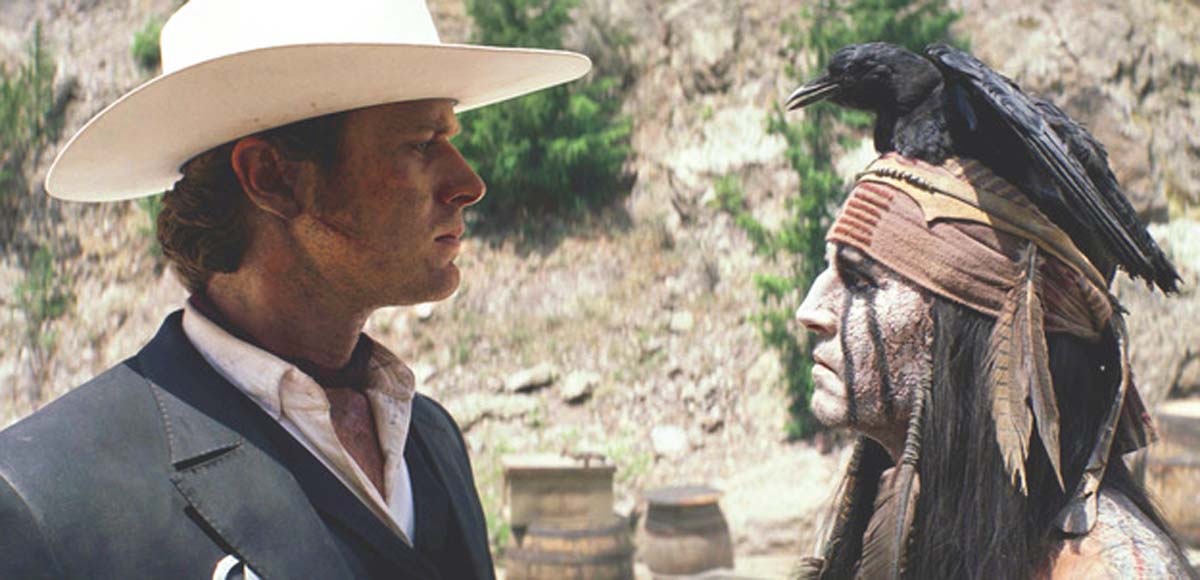
THE LONE RANGERI counted three separate instances where the movie’s plot had obviously entered its end game, but the script then undercut that and decided to keep going for an hour or so. The bizarre egregiousness of some of the story problems has no better example than Helena Bonham Carter’s character, Red Harrington (some junior executive took a three-martini lunch and the rest of the day off after coming up with that name), a whorehouse madam with an ivory prosthetic leg that conceals a shotgun. To justify her prominence in the advertising materials, the plot will then twist itself into a few more topologically improbable shapes to accommodate her part in the complex end sequence.

DF-16553-R-jpg_183232Armie Hammer does everything he is asked to as John Reid. Sadly, what he is told to do is often some pretty stupid stuff. There are times when the template seems to be lifted from The Green Hornet movie, where Britt Reid (yes, notice the last name, Warren Ellis fans) is the comic doofus and Kato (again, your mandatory sidekick of color) is the competent one. And more than once The Lone Ranger reminded me of another ill-starred Western reboot, Wild Wild West, especially about the time we go to Red Harrington’s whorehouse, so reminiscent of Fat Can Candy’s that I kept expecting to see Kevin Kline in drag.

There are borrowings from other movies, tributes that I can accept: the use of Monument Valley (though I don’t remember it being in Texas), and a complicated love triangle with two brothers and one’s wife straight out of The Searchers. Three locomotives are wrecked in this movie, one named The Jupiter, in deference to Buster Keaton’s train-centric The General (and Depp’s love for the comedian is indulged in several of the action set pieces). I’m okay with that.

John-Carter-1-680Disney had a similar failure with John Carter, the difference being that John Carter was a much more solidly-constructed  movie and deserved better (it also hedged its bets, as its indigenous noble savages were aliens). The Lone Ranger, though, is a morass of story ideas that are often in the wrong order, and the viewer simply waits, tapping its foot and checking its watch, to get to the action sequences, which are gorgeously shot, exciting, and expensive.

I do get why some people don’t like the movie, and it has a lot to do with what I’ve outlined above. What I don’t get is the hate directed toward it. I’m pretty sure there’s a “worst movie ever made” review or three thousand out there, and my response is always going to be, “You don’t watch near enough movies.” Yes, despite all my bitching, I did enjoy The Lone Ranger. Not enough to watch it again, but I had a fairly pleasant time.

I’ve said it before, I will say it again: my relationship with a movie is very simple. I ask that it entertain me, and I will allow myself to be entertained. It’s not that hard, but a lot of movies manage to fail that simple deed.

And I really feel that sometimes, what is missing from many people’s approach is that, simply, they will not allow themselves to be entertained. Like a character in an Ingmar Bergman movie desperately seeking their one version of God when evidence of God is all around them, a lot of movie-goers demand that rush, that tingle they got the first time the star destroyer rushed overhead and kept rushing, or Indy ran from the boulder. And when that rush does not come, the movie is obviously worse than the heat death of the universe. People. You’re not always going to get that. And if that’s all you’re looking for, you’re going to miss what is offered to you. Permit yourself to have some fun, for God’s sake. And I absolutely, honest-to-God do not understand the concept of “hate-watching”. What the hell. There is a doctoral thesis waiting to be written on that life-wasting nonsense.

the_lone_ranger_trailer_fullHaving said that, I am now going to undercut myself, because that’s another takeaway from Wild Wild West: undercutting and demeaning your source. At the end of WWW, as was traditional in the TV series, when they had some time to fill or a plot point cheat that needed explanation, Artie would ask West, “Mind if I ask you a question?” They did this in the movie, but Will Smith’s answer was a dismissory, “Actually, I would mind.” In The Lone Ranger, Reid finally, finally, rears up on that gorgeous white horse and belts out, “Hiyo Silver! Away!” to which Tonto says, “Never do that again!” It’s supposed to be a laugh line, but we’ve been waiting for that a long time. We have, in fact, been waiting the entire movie to hear that trademark line. And that is probably the reason why “Fuck you, movie!” is the last thing anyone remembers about The Lone Ranger.

Buy The Lone Ranger at Amazon

The Summertime Blues

It had been a week since I watched a movie. That’s a long time for me, and it’s a sign of a serious funk. So sorry, folks who come here for acerbic remarks or amateur musings on classic films, all I have to talk about this week is me, so you might not find this interesting at all. I don’t blame you. See you next week.

Then like a lot of things I put up here, that was an untruth. Yesterday – Father’s Day – I actually found myself doing something I NEVER do, which is turn on the TV and flip through the channels. We long ago determined cable was an unfunded mandate, and said goodbye to it with few regrets (mainly Turner Classic Movies and Mythbusters). Lo and behold, a couple of those newfangled digital channels coughed up stuff I would actually watch, even with commercial interruptions – one being David Lynch’s The Elephant Man, which is still superb (and unavailable on domestic blu-ray, grumble gripe bitch complain), and the Danish kaiju flick, Reptilicus, which has somehow gotten even worse. (All you Godzilla 2014 haters go watch this, then get back to me on how bad the modern flick is)

I’ve been put on a mild anti-depressant to help with my sleep problems, which it has, to a degree. I’m not sure if my current tendency toward rumination and self-examination is due to being a bit more rested or a bit less depressed. Anxiety levels are about the same, because little pills do nothing about stressors.

A major cause for pondering was Father’s Day. I’m lucky, my parents are still alive, so I can call the old codger and we can kill some cell phone minutes not talking to each other. But I’m no spring chicken myself, and notes from my mother telling me they’ve paid for their funerals and recently went to see their headstones have my head in a really weird place. Really weird.

As you know, I’m a father myself. That wasn’t something I had really planned for, but my wife, Lisa, having been an excellent, involved teacher and therefore second mother to a lot of children, wanted nothing more than a child of her own, so that had to become one of my priorities, and if I can claim nothing else in my life, I at least did that right. It was a long trip, full of tears and loss, but we finally produced a son, and now we get to worry how he’s going to get to college.

But. That wasn’t what I was pondering. I took stock of the people I hang with, and the number of fathers there is shockingly low. What is shocking about that, though, is the fact that I now regard fatherhood as the default, rather than the extraordinary circumstance. There is nothing profound or life-changing in that realization, as the very fact of fatherhood itself is profound and life-changing enough.

Of course my son has hit his teens, and they’re not as terrible as I had anticipated (and that’s the sort of  statement that will surely come back to haunt me); I guess I’m fairly lucky. He usually only comes out of his pit of a room to ask if dinner is ready yet, then returns to his Xbox. I’d be the same way, except I’m usually the one cooking dinner. I do have my own pit of a room, after all.

I guess I may be in the throes of a slow-motion mid-life crisis, one that crops up every few years like a persistent case of acne. As we all know (because I bitch about it constantly), I work three and often four part-time jobs. Weekends are a foreign concept to me, but then, I was trained as an actor, and for them there is no such thing, anyway.

I’ve been involved with one of those murder mystery dinner theaters for years. I’m going to be saying those lines during my funeral. The money is pretty good, I shouldn’t complain. But there is physical labor involved: loading and unloading the van because it’s a gypsy outfit and we can’t leave any of our stuff up longer than a couple of days. The characters are all human cartoons, and sometimes that gets pretty physical, to the detriment of my bad knee, my asthma and general decrepitude. A lot of the audience have no idea whatsoever what is involved in live theater (and this is loosely categorized as live theater, I guess), have no idea how to behave, and Jesus H. Christ, I hate trying to perform for drunks.

So here we have one of the classic symptoms of what led up to those famous Post Office shootings – remember them? Before they spread out into the community at large? Bad working conditions were coupled with a dependency on the job they hated – the salary, the benefits. I’m not going to go on a murderous rampage, but good God, I’m so tired of it. But the “day job” barely takes care of the utilities – the weekend shows pay for groceries and gas.

Somebody out there is thinking that I should be thankful for what I’ve got. I am. But that doesn’t mean I shouldn’t be reaching for more, for something better.

So tonight I’m going to do something I haven’t done in years. I’m going to an audition at my old theater.

Things have improved since I left for the better financial rewards of dinner theater.  The pay is much better – in fact, it would be almost commensurate with what I’m earning, although the work is spread over several days instead of just two. But there is the bonus of A) portraying an actual human being for a change, and B) doing it for an audience that actually wants to be there, where I’m not perceived as standing in the way of the salad service, or actively attempting to corrupt the frail sensibilities of churchfolk.

This is going to introduce more conflict into my life, if I’m cast. Finding people to replace me at one of the nighttime jobs. A shuffling of cast at the dinner theater. My son won’t be able to work the dinner theater, either, which he does for spending money.

But that might be the sort of thing to shake me out my current doldrums. And then I can complain about not having any time to watch movies, a return to business as usual.

The 39 Steps (1935)

39-3It usually surprises people that I’m not a big Hitchcock fan. Oh, it’s not like I hate his movies. I love Psycho, enjoy Rope (flawed experiment though it may be) and the episodes of Alfred Hitchcock Presents that he himself directed. But I didn’t care for VertigoThe Birds just sort of leaves me cold, and… well, you get the picture.

I’m spending a lot of Act Three of my life watching movies and often re-appraising how I relate to them. Given that a lot of my opposition to Hitchcock’s work was due to Contrarianism on my part (ask me how long I went refusing to buy any Beatles albums), it’s only fair that I give him another shot every now and then, so why not that most Hitchcockian of Hitchcock movies, The 39 Steps?

knife in the backRichard Hannay (Robert Donat) has his evening at the Music Hall interrupted by a scuffle between drunken ruffians and police, which is itself interrupted by two gunshots. He helps a woman (Lucie Mannheim) out through the crush of panicked people, and she surprises him by asking to go home with him. Being a smooth operator, Hanny complies, and finds she is far more intriguing than he suspected: she fired those two shots to get away from two men who are pursuing her. She is, in fact,  a spy trying to intercept some secret aircraft plans that have been stolen and are destined to smuggled out of England to some unnamed foreign power. She asks for a map of Scotland, and promises to tell Hannay just what the heck “the 39 steps” she mentioned is all about in the morning, if he is still interested.

Well, except the next morning, she has a knife in her back and collapses on the sleeping Hannay, a map of Scotland with a village’s name circled in red clutched in her hand.

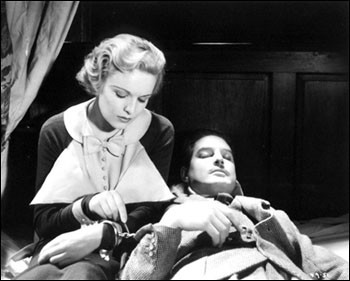
donat_and_carroll_handcuffed_39_stepsHannay, presuming the police will not believe him, sneaks out past the two spies watching the front of his building and heads for Scotland, ensuring that the police will think he murdered the lady in his apartment. Thus begins a series of chases and hairsbreadth escapes, as Hannay tries to find out what “The 39 Steps” is, where the plans are, and what he can do to stop the plot without going to jail for murder. Eventually he winds up handcuffed to the lovely Pamela (Madeleine Carroll), who has turned him in twice, but the enemy agents assume she knows too much, and once she eventually finds out Hannay is telling the truth, falls in love with him. Which still leaves the problem of the police, the plans, the spies, and just what the heck the 39 Step are anyway.

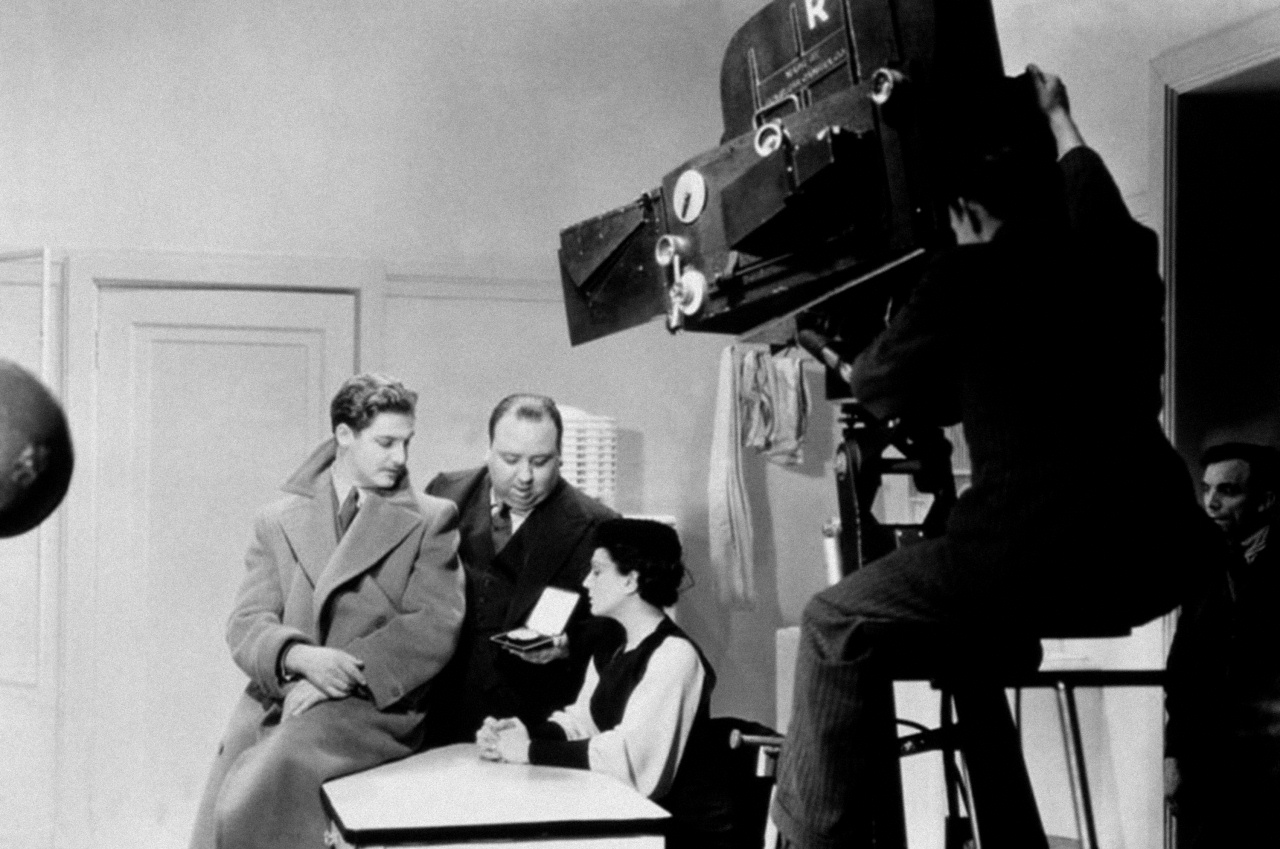
Hitchcock was on a bit of a roll at this point in his early career; the year before had seen The Man Who Knew Too Much, featuring an exciting young actor from Germany named Peter Lorre, and the next few years would produce Sabotage, Secret Agent, and The Lady Vanishes, before Hitchcock dashed off Jamaica Inn to fulfill his contractual obligations and then split to America and the bigger toybox offered by David O. Selznick.

39-StepsHere, you can see a lot of the elements that Hitchcock would repeat throughout his career: the man wrongfully accused and pursued by both the authorities and the bad guys (I think it’s this trope that causes me to avoid Hitchcock movies, it speaks to a persecution complex on my part), the shadowy McGuffin that drives the plot (and which pales in importance compared to the plot it sets in motion), the spunky blonde heroine who suffers all sorts of abuse. And it is all managed with such panache, perfect pacing and underlying jet black humor that it’s no surprise it was a huge hit. Donat and Carroll are absolutely perfect, but you can say this about any role in this movie. It is just so damn well-made.

For some reason, I had thought that Hitchcock remade The 39 Steps later in his career; though there are two remakes, Hitchcock didn’t direct either one.  I can be forgiven for thinking this, as Hitchcock did remake several of his earlier pictures, and if you get right down to it, he did remake The 39 Steps – he just called it North by Northwest. Which, yeah, is another movie I need to give a second chance. I do recall enjoying it a half a century ago.

BuyThe 39 Steps on Amazon

The Questionable Joys of 1963

Something that’s kind of odd, but not even that surprising: Usually WordPress intercepts 30-40 spambot comments on this blog in any given day. In the days since I published my piece on the death of my beloved pug-dog Mavis, that has dropped to three or less a day. Even the bots realize there’s little return in inserting your online casino ads under a sad story. I didn’t know they paid that much attention.

But now I’m imagining a bunch of sad spambots sitting around morosely, playing mumbledy-peg or solitaire to fill in their idle hours. I guess I really should give them something to try to post under.

NattvardsgästernaAfter the hell of that week, when I finally elected to watch a movie, I was of two minds: escapist fare, or something that had been on my Watchlist forever, and was one of Roger Ebert’s Great Movies: Ingmar Bergman’s Winter Light,  which is the exact opposite of “light escapist fare”. Also, by “forever” I mean “since I watched The Seventh Seal last year and decided to fall in love with Gunnar Björnstrand, who played the squire, Jöns.

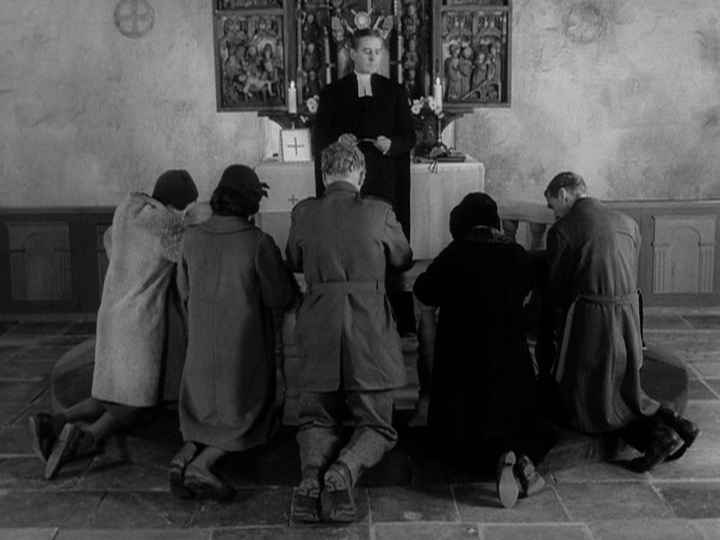
Björnstrand here plays Tomas Ericsson, the pastor of a Lutheran church in a small fishing town. As the movie opens, Ericsson is presiding over a service for a congregation of eight, including a deacon, the hunchbacked sexton, and Ericsson’s former mistress, who is an atheist. Only five of the eight take communion.

BergmWintlight1This is going to be a rough day for Ericsson. He is coming down with a cold – his fever is increasing, and he still has to fill in for communion at another church later that afternoon. His mistress is pressuring him to get married, and two of the people at the sparse service, the Perssons, a fisherman (Max von Sydow) and his pregnant wife (Gunnel Lindblom) visit him afterwards. Persson has been consumed of late with fear after reading about the Red Chinese developing nuclear capabilities. The sensationalist article he read stated that the Chinese are raised from infancy to know nothing but hate, and he is crushed by knowledge of sure, ultimate doom.

The former mistress, Marta (Ingrid Thulin) flits in and out of the morning, fussing over Ericsson’s health. While waiting for Persson to return for a private conversation, Ericsson reads a letter Marta wrote him, and here we have but one of many reasons Bergman was considered a master: the letter is not delivered to us as a voiceover, but a single close-up, nearly six minutes long, of Thulin speaking the contents of the letter directly to the camera. Like Ericsson, we are trapped in the room with it, and Thulin’s delivery (and needless to say, Bergman’s writing) is so good our minds never wander, as Marta details what went wrong with their relationship, their mutual complicity in its dissolution, and why they should get married and take care of each other. Drained, Ericsson falls into a fitful sleep at his desk until Persson arrives.

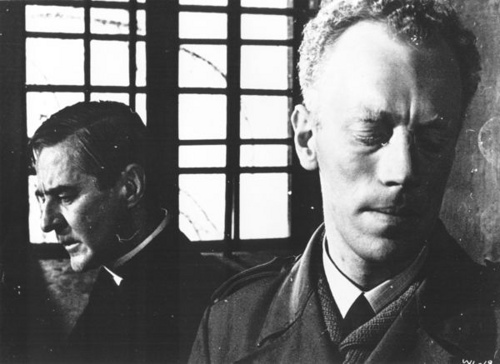
3150738673_bb1767d8fcEricsson gets right down to matters. “How long have you thought about killing yourself?” But as the conferences goes on, the pastor finds his own spiritual gas tank long exhausted, and he can find no comfort to offer the fisherman, only his own misgivings about the very existence of God, a disjoint that began when he was unable to reconcile things he saw during the Spanish Civil War with his concept of the Almighty. Persson, discomforted by this outburst from a clergyman, excuses himself and leaves.

Marta is still waiting for him in the sanctuary. “Now I’m free,” he tells her, but Marta’s relief that he finally agrees with her views on God is cut short by another member of that wan congregation arriving to tell Ericsson that Persson has blown his brains out down by the river.

winter-lightThe day is far from finished with Ericsson. He will sit with Persson’s body until the morgue arrives to claim it. He will deliver the sad news to Persson’s pregnant widow and three children. He will, once and for all, tell Marta how he feels about their relationship, the bookend to her earlier letter, but delivered face-to-face; and he will preside over that evening communion, a service for the only person in the church- Marta the atheist, praying for the ability to understand and somehow get through to Ericsson.

So yeah, Winter Light can be used as Exhibit A in the cultural cliché that “Swedish movies are depressing”.

The film’s title in its native Swedish, Nattvardgästerna, translates to “The Communicants”, a clever title of double meanings; not only are our main characters involved in one of the loneliest sacraments ever performed, but each has their own problems with communication, a very common thread in Bergman films, alongside another: a protagonist so obsessed with finding proof of his own personal version of God, he is blind to every other possibility of God’s nature and existence.

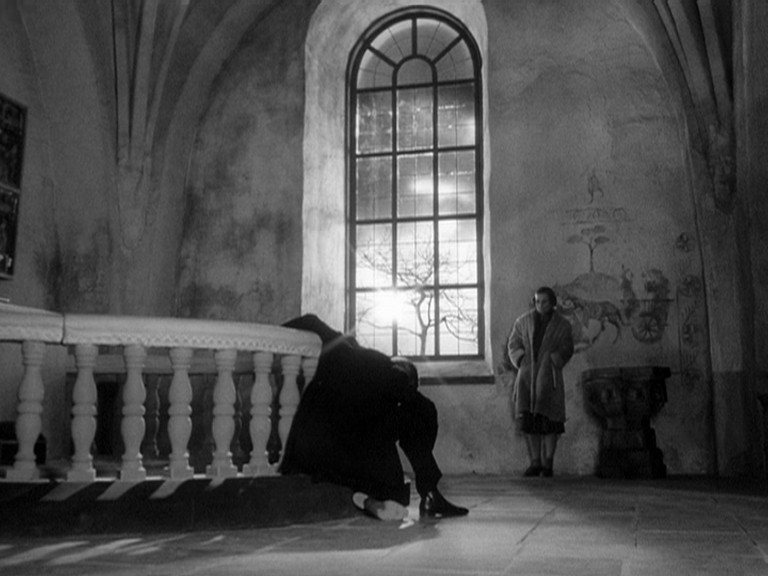
3150738027_0757f99d03The English title, Winter Light, is also brilliantly multi-faceted. The lush detail of Bergman’s earlier movies is here stripped away, and Sven Nykvist, behind the camera of what I think is only his third Bergman film, emphasizes the isolation and bleakness of life under the gray winter skies. There is one literally radiant moment, after Persson takes his leave of the distraught pastor, and in the window behind Ericsson, the sun very briefly breaks through the clouds as the clergyman has a moment of clarity about his relationship to a God that may not even be there. This leads to the “I’m free” moment, but the clouds close again, the news of Persson’s suicide is delivered, and uncertainty again takes hold.

If there is any shred of optimism to be found in Winter Light, it is in the person of the sexton, Algot, played by Allan Edwall. As Ericsson ponders whether or not to hold the Communion service in a nearly-deserted church, Algot asks him about his reading of the Gospels, and how he feels the emphasis on Jesus’ physical suffering is misguided, as he himself has suffered physical pain all his life and is no saint. Algot feels that Christ’s keener suffering must have been the fear that his teachings were misunderstood, that he was truly forsaken. “He believed everything he’d ever preached was a lie. The moments before he died, Christ was seized by doubt. Surely that must have been his greatest hardship? God’s silence.”

image.aspThese are words that must touch Ericsson, and touch him deeply. He makes the decision to hold the service, because no matter what, there must be Communion. There must be duty.

So I say watch the movie, but be prepared for what it is: a stark portrait that may serve as a mirror when you least expect it.

Buy Winter Light at Amazon

So after such an effervescent, frothy confection, you’d think I’d go for a comedy or a movie where things go boom, but no, I still had a commitment to quality in May (oh, I had such plans for the month!), so my next stop was Akira Kurosawa’s  High and Low.

220px-HIGH_AND_LOW_JP_I’ve seen all of Kurosawa’s samurai flicks – hell, The Seven Samurai was the movie that drew me into my love for film, at 13 or 14 years of age. But those are such a small part of the man’s output, I’m doing him a great disservice. Perhaps I started at the top with Ikiru, but I still have a long trail to walk. There are worse problems.

Kingo Gondo (Toshiro Mifune) is a successful executive who, on the verge of a risky corporate takeover, is plunged into a dilemma: a kidnapper, attempting to abduct his son, has instead gotten his chauffeur’s child. The kidnapper doesn’t care, he still demands thirty million yen for the boy’s release. The dilemma is that Gondo is mortgaged to the hilt for the takeover, and if he uses that money for the ransom, instead of the controlling stock of the shoe company where he works, he will be ruined financially.

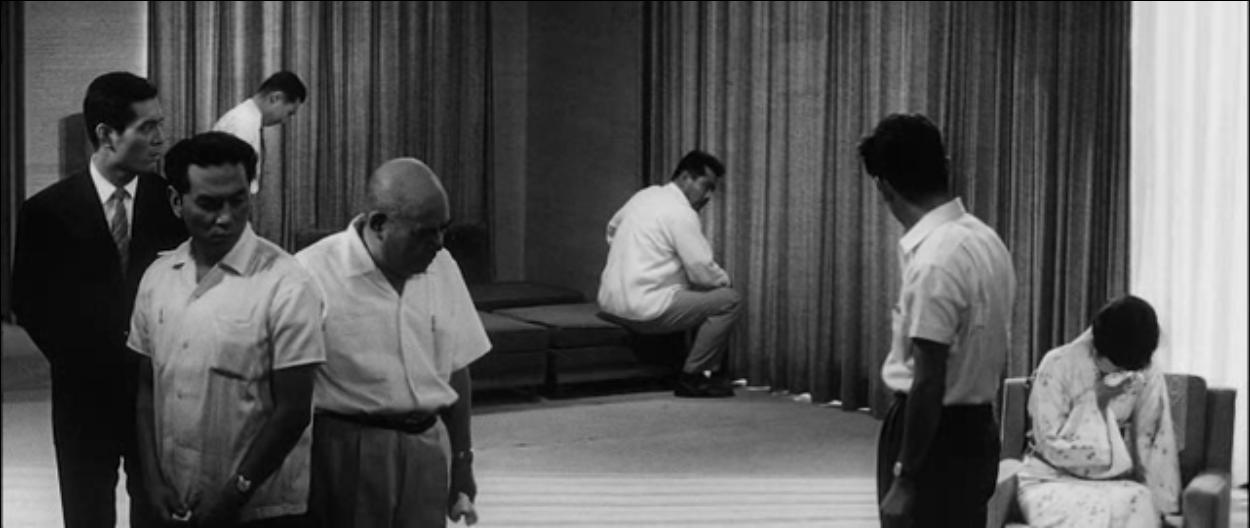
That is the moral quandry that drives the first act of High and Low, and the phrase “first act” has never been more appropriate. Shot almost entirely in Gondo’s spacious living room, with a hilltop vista of Yokohama, Kurosawa rather famously rehearsed and blocked this segment like a stage play, and shot it in long takes. It’s fascinating to watch how this allows Kurosawa to manipulate the negative space around the embattled businessman as he steadfastly refuses to be destroyed for a child that is not even his own. His bubble of isolation expands and contracts, it is violated by his wife and the poor, bereft chauffeur. Eventually, he decides to do the right thing and pay the ransom, and the bubble collapses.

highandlowThe second act lets us out into the world, as Gondo performs a complicated drop of two briefcases stuffed with money, and the police do what they can to identify the people involved. Settle in for the third act, which is a very good police procedural – the cops trying to recover the money before Gondo defaults on his loans, and falls from the grace of his hilltop house.

High and Low is based one of the 87th Precinct novels by Ed McBain, aka the prolific Evan Hunter, King’s Ransom. I enjoy those novels, and the source material shows through in the characterization of the cops. Tatsuya Nakadai makes for a cracking Steve Carella analog as the leader of the task force trying to help Gondo. The police are thoroughly professional and prepared; they arrive dressed as delivery men in case Gondo’s house is being watched, and it is. In fact, when the kidnapper calls to ask why Gondo’s curtains are closed, the cop immediately dive to the floor and behind furniture so the curtains can be opened.

high-and-lowSo yeah, I like watching Dragnet re-runs, I like the 87th Precinct novels, and the closest I get to binge watching are the Investigate Discovery murder investigation shows on Netflix. Some folks find this part of High and Low boring; I find it compelling.

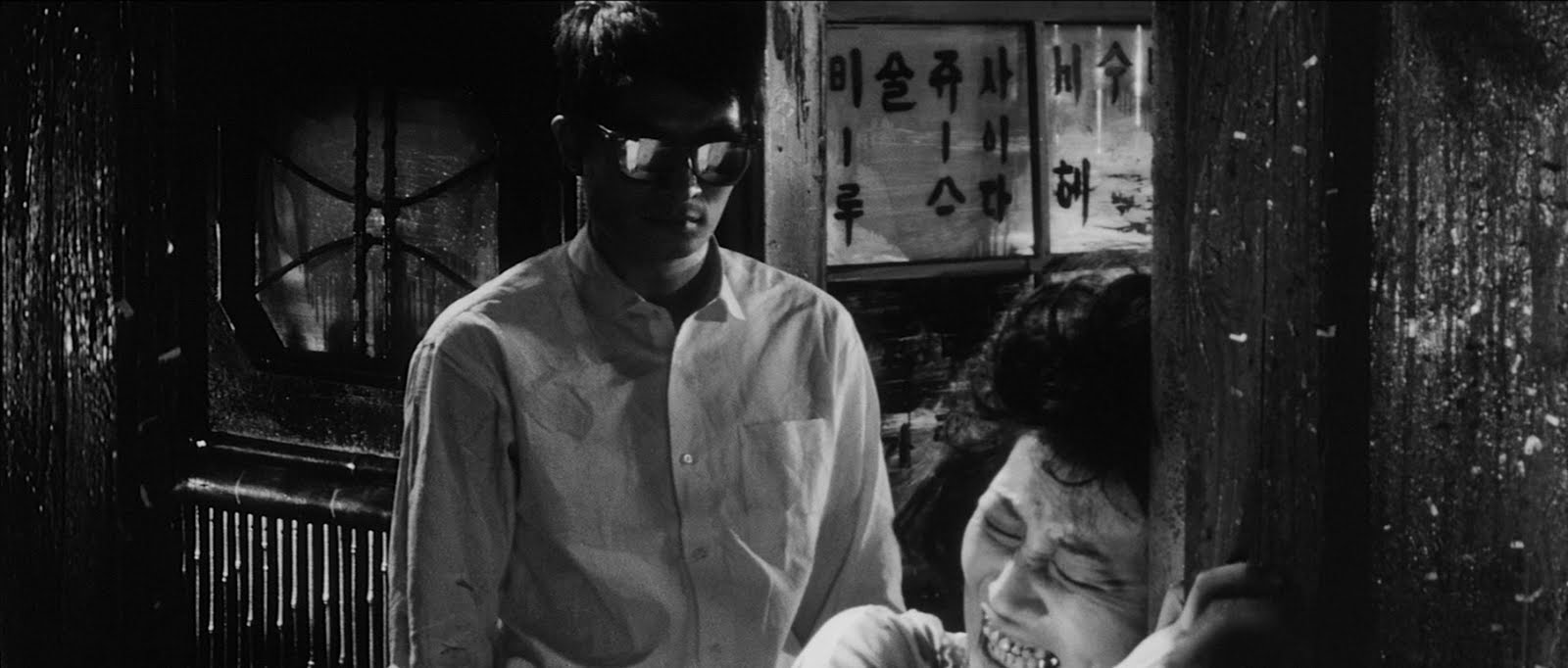
High and Low definitely lives up to its title, starting at Gondo’s spacious house and descending slowly into the slums of Yokohama and finally a hellish venue the cops only call “Drug Alley”. It also charts the similar fall of Gondo, who loses his house and worldly possessions, yes, but also begins to rise again. The kidnapper, a medical student living in a slum, whose window has a direct line-of-sight to the Gondo house, seems to have no motivation outside humiliating Gondo – which ultimately fails, because the court of public opinion has found great sympathy for the executive, leaving the young nihilist with nothing but a scream of rage and fear as he is taken away to be executed.

jszptgI can sure pick the uplifting movies, can’t I?

Buy High and Low at Amazon


Mavis.

mavieI’m not sure exactly when it was that I decided I wanted a Pug. I had always been a big fan of the squashed-face breeds, ever since a childhood encounter with a terrifying-looking but incredibly friendly and good-natured English Bulldog. I decided I always wanted to keep something around that was uglier than me. Wait, I think it was actually during my first viewing of Dune, when I started noticing little details to distract me from my Frank Herbert-fan dismay. During a battle scene, noticing people not only carrying weapons but Pugs, because in a life-or-death fight, you must always save the Imperial Ugly Dogs.

But purebreeds are expensive, and I was warned away from them because of the health problems inherent due to excessive in-breeding over the centuries. I gave up on the idea. Then in 2002, my wife, Lisa, was in a conference with one of her students’ mother, and the lady had to take a phone call. She listened to the other end of the line a moment, and said, “No.” Then a bit later, “No. My kids already have enough animals. I don’t want a Pug.” And Lisa said, “Wait a minute.”

Lisa and MavisSo the Pug’s current parents brought her over to check out the house and us. They were moving to a place that did not allow animals, and they were hoping to get her into a nice house with a backyard where she could play, or else they would have to surrender her to a shelter. We’re nice people, and my son, Max, at that time age 4, thought she was greatest thing ever. So the transfer was made, hands were shaken, and we were given food, treats and toys. I am told her mother managed to hold it together and didn’t start crying until they got a block away.

At the time, she was called Clover, because she was born on St. Patrick’s Day. Lisa thought that was a horrible name, and re-christened her Mavis, which was later lengthened to Mavis Louise, because that is how my wife rolls (It was later shortened to “May-May”, because that is also how she rolls).

There was a period of adjustment, to be sure. Mavis kept running away, the first few weeks, looking for what she knew were her real parents, and I would have to chase her down, sometimes a block or two away. But as time passed, she realized this was where the food was, and where the love was, and we started the second phase of our relationship. This was aided immeasurably by Mavis meeting our then-neighbor’s dog, a little white furry foo-foo piece of fluff, and the two became pals immediately. They even dug a hole under the fence so they could visit each other. Fortunately the neighbor thought that was grand.

Halloween Mermaid; She liked it better when she found out how much attention it got her

Halloween Mermaid; She liked it better when she found out how much attention it got her

Pugs are very sweet-natured and incredibly energetic. They are known as being a lot of dog in a small package. Our house is two stories, and the first floor is arranged in a circle around the staircase, living room into kitchen into dining room into living room, and whenever anyone new came in – or heck, even anyone familiar – Mavis would get so excited she would run around the circle, sometimes twice, before she exploded with joy, or something.

I walked her every morning before work, and she would constantly strain at the end of the leash, practically choking herself with her collar, because we weren’t getting there fast enough. I bought a harness to fasten around her sturdy chest, and one of those extendable leashes. I used to laugh at how adept she got at stepping into that harness.

Mavis was the very essence of a lap dog. Whenever I settled down to watch a movie, she would leap into my lap, get settled, and soon be snoring contentedly. Pug snores also belie their relatively small size. Every living thing in the house at that time snored, so she fit right in. I didn’t mention to my wife that her snores sounded just like Mavis’, because I’m not an idiot. Max took Mavis into his bedroom every night. He didn’t seem to mind the snoring. Swear to God, kids can sleep through anything.

sleepy palsMy niece gave me one of those magnets you can put on the back of your car, that said “My Pug Is Smarter Than Your Honor Student”. I put it on my car to humor her, but that was far from the truth. Mavis was the sweetest, most loving creature on the face of the Earth, but she was dumber than a box of rocks. That huge head held a brain that was, I am certain, perfectly smooth. I didn’t care. I’m a fairly intelligent guy, and smarts just lead to unhappiness and woe. My Pug-dog was relentlessly happy, and we lived to see that Pug grin.

santa pugYears passed. We got older, and so did she. She wasn’t able to jump up into my lap anymore, so I gladly lifted her up. More and more often, she wanted to end her walk early, and sometimes I had to carry her home. Eventually she grew to prefer just going out into the backyard, doing her business, and barking at the local squirrels.

lap dogsMy sister-in-law lives in the woods of West Texas on the Dry Frio River, with a bunch of strays she has adopted. One week my wife brought home Brownie, a mutt who was the smallest of the pack, and was getting bullied and starved by the others. Brownie was a traumatized little dog, and didn’t trust Mavis; but Mavis only wanted to make friends and play. Eventually she won Brownie over. The dark side to that was that Max took over Brownie as his dog, and started taking her into his bedroom at night instead of Mavis, who could no longer jump into, or safely jump down from, his bed.

profileI felt for my poor little Pug but Lisa didn’t want her in the bedroom, and since I eject the cats from said bedroom every night (I have a thing about things walking on me at night, ie., I tend to scream and hurl them across the room), I couldn’t really complain. We set a bed in the upstairs hallway for her, and by God she would laboriously climb up that stairway every night to be close to us in her sleep.

The trip down the stairs was getting more and treacherous, too. I would try to be downstairs when she attempted it, because the final three steps always resulted in a blind scramble, and stumble, and crashing into the wall. Her eyesight had begun to fail, too; too often I felt the heartbreak of watching her run into a wall or door. She didn’t always make it to the pee pad we laid out for her upstairs, or perhaps she couldn’t find it, or perhaps she didn’t care that much any more. Lisa lobbied to keep her in the kitchen, with its more easily cleaned tile floor, and I was forced to admit she was right.

pug wrasslinWe set up baby gates at the two doors. Mavis adjusted to this quickly enough. One of the gates was next to the back door, so it was easy to let her and Brownie out to do their business and romp and do whatever it is dogs like to do. Mostly sun themselves until it gets too hot, which doesn’t take too long in Houston.  She usually found her way back and scratched at the door to be let in.

Then, one day, while I held the screen door open for Brownie and Mavis to go out, it happened: Mavis slipped, and lay on the concrete slab outside the door, convulsing. I scooped her up off the rough concrete and moved her over to the grass. She peed all over me in transit, but I hardly noticed. I laid her on the grass and stroked her head, thinking, God if this is it, please make it as painless as possible. After a few minutes she sat up, then stood up and waddled across the yard to smell the flowers.

old pugA couple of days later, Max was home because they were testing at his school, and it wasn’t his day to test. Mavis had another seizure, and Brownie started howling, and Max reasonably enough freaked out and called his mother, who called me. I was already leaving work. I got home and Max was sitting with her; she was in her bed, and seemed alright, but over the last few weeks her breathing had become more labored. As someone with no appreciable nose myself, I can tell you that breathing is a chore anyway, but this was something new, and more difficult. She had been spending more and more time in her bed, only lying down to sleep. The rest of the time she sat up, because breathing was easier.

I relieved Max and sat with her for an hour until she went to sleep. I went upstairs to get a little sleep, because I had a meeting to cover that night. That seemed to be it for the seizures – that we witnessed, anyway – but I cleaned up a couple of pools of urine that were streaked with blood. One night Lisa slept over at a friend’s house because she had just moved and her dogs were still in the kennel, so she needed company. I had a bit of surprise the next morning when I got up, and there, sleeping in the bedroom across from the master, was a certain grizzled old pug-dog.

I gently picked her up and carried her downstairs. One of the baby gates had fallen over – on top of her bed – and she had climbed up the long, impossibly long staircase, just like old times, to be near us. She started struggling to be put down, because she didn’t like to be held too long anymore – I think it made breathing even more difficult.

The next week work was ridiculous – I had my morning hours, then running support at City meetings in the evening. The Wednesday night City Council meeting was a real corker, moved to a larger venue so angry citizens could complain about – well, let’s just say it was Classic Not In My Back Yard and leave it at that. My call time was 5pm. The meeting adjourned at 3:06am the next morning, and equipment still needed to be broken down and transported back to home base. It was almost 5am before I got home.

Needless to say, I slept in. When I got up and went to work, Mavis was in the kitchen, not in her bed, but lying on the floor under the dishwasher. That wasn’t too uncommon; it was right under an air-conditioning vent, and Pugs are notoriously hot little dogs. I petted her and went to work for a truncated day.

When I came back, she was still, there, and I realized what this actually was.

I quickly changed out of my work clothes and ran back to her, sitting down on the floor next to her. I grabbed a handful of paper towels on my way, because the tears were already coming, and I knew there were going to be a lot more.  I didn’t try to move her, I didn’t want to make things worse. I just sat there, crying and stroking her, telling her how much I loved her, how beautiful she was, how she was Daddy’s Pretty Girl, and it was okay if she had to leave, she didn’t have to stay if it was too hard. Eventually, Lisa and Max came home from school, and found us there. Max tenderly touched her back, Lisa stroked her head and said, “May-May?” and she moved her head once, and stopped breathing.

She was just hanging on to say goodbye to everybody.

my chair nowI’m not sure how long I sat there, my hand on her cooling back, still stroking it as if she could feel it in the Beyond. Finally, I got up. Lisa borrowed a shovel from our neighbor and the three of us started digging a hole in the back yard.

It’s good to have physical labor to do at a time like this. I was able to think about something else as we cut through roots and dug out discarded brick and rebar from the previous owner’s failed attempt at a herb garden. Finally it was deep enough, and Lisa wrapped Mavis in a tea towel – “Blue, to match her eyes” – and brought her out, because I couldn’t. Seeing those poor, gray lifeless legs as she carried her across the yard really brought home the finality of all this. She laid Mavis in the grave. I tossed a handful of dirt into it, and my family followed suit. We took turns filling in the grave, then we held hands while Lisa said a few words, because, again… I couldn’t.

While Max cleaned off the shovel to return it to the neighbor, I went upstairs, closed my office door, and gave myself up to the wracking sobs I couldn’t before. When I finally came downstairs, Lisa was cleaning the kitchen. It looked so empty without a little sausage-shaped dog with a curly tail, sitting in her bed, or maybe sidling over while I was cooking to see if I could spare some chicken, or hamburger. I usually could. I put the baby gates in the garage. They weren’t needed anymore.

sunbathThey say that dogs were put on the Earth to teach us that unconditional love exists, and to show us what it looks like. Mavis was part of my life, a part of my family for 12 years. Max can’t really remember a time without her.  I miss her. I miss her reedy little bark, I miss her smile, I miss her stench when she went too long without a bath, I miss her snoring, I miss her sneezing, I miss that bizarre sound, between a bark and a howl, that she made when I came home too late at night. I miss her sitting at the top of the stairs, looking down into the living room, trying to look like the Hound of the Baskervilles but failing because she was a lovable little pug dog with a goofy face. I miss going into the kitchen and having her immediately start hoovering and snurfling around while I misquoted a line from the show that Lisa and I met during, saying “Pug dog, you are hideously in the way.”

I miss my May-May. I miss her so much.

It will get better. I know it will. Well, at least, it will get easier. This isn’t the first time I’ve lost a beloved animal, and probably not the last. But I should only live so long to know this love and sorrow again, and – what would be better – to love as much as a certain little squashed-face dog, who stole my heart and took a little piece, just the tiniest little piece, but such a painful piece – of my heart with her. That would be an accomplishment.
Rest well, Pugnacious. I’ll see you in heaven.

 Daddys Pretty GirlMavis Louise Williams
aka Daddy’s Pretty Girl

2000-2014

“I’m dainty. Daddy said so.”


Talk Among Yourselves

Last week was rough. This week is going to be rougher.

My third job (of four, because as we all know I am a taker) is audio support of the televised city meetings on the local Municipal channel – what I refer to as doing my part for the transparency of government. Two such meetings blew up last week, and the debris is landing this week. For the School Board, a literal turf war over whether or not to spend the remaining money from a bond on synthetic turf for the stadium. City Council is getting involved (this is one of the very few Municipal School Districts in the nation).

City Council is also going to receive part two of public acrimony from a Planning and Zoning meeting last week; citizens are outraged that a light industrial building is going up near their neighborhood. I’d often heard of the phenomenon of NIMBY (Not In My Back Yard), but this was my first opportunity to witness it. Two and a half hours of talking in circles, threats (I love people threatening to “vote out” a board manned by appointees), and shouting down people trying to defend themselves. It was the opposite of fun.

So the Mayor declared that the City Council meeting that would have the final say on this would be moved to a larger venue, meaning that our crew would have to set up cameras and all the other necessary equipment, and another day of my week vanished.

Spanish_Godzilla_2014_PosterI had another post prepared, which went into much more detail about my woebegone life, but you know what? Nobody wants to hear that crap. I didn’t get to watch any movies last week, and I won’t be able to watch any this week (miracles may happen. Who knows?). But I did get to watch Godzilla today, so I’m in a good mood. I’m dumping the longer, downer version of this post and moving on.

I hope you have a better week than me, unmarred by political infighting and mobs with torches and pitchforks. If you’re at all interested in giant monster movies or disaster movies, go see Godzilla – I really feel it is the best Godzilla movie since the very first one.

See you on the other side, amigos.

Quality Continues

I suppose, if you take a look at my works (ye mighty, and tremble), you might think that all I watch are bad movies. After all, I wrote for many years a site called The Bad Movie Report (hello, Web 1.0, if not.05). That part of my branding grew so ingrained that when I tried to write about something I thought was good, the e-mails would come in “How dare you even talk about [redacted] it’s not a bad movie!” Small wonder I eventually walked away. I’m claustrophobic; I don’t like being boxed in.

Just like everyone else, I enjoy a good movie. I just disagree at times about what constitutes a “good movie”.

This means there are holes in my education. Some -perhaps more than I would care to admit – are due to my pushing back against popular opinion. I don’t trust the masses. They can be kind of stupid. A lot more is due to availability. I can’t just turn on Netflix and watch Godard’s Breathless or Murnau’s The Last Laugh – I have to actively seek it out, find it, and probably pay for it, before I can even think of watching it.

So several years back, I started educating myself. I’m not getting any younger, and there are movies I heard about all my life, and have just never gotten around to seeing. I tried keeping lists of Movies I Will By God Be Watching This Year, and those didn’t really pan out. They’re still stuck on top of this page, if you want to see my failure. It’s just best for me to set aside a month and say, this month. The good stuff. I find Roger Ebert’s essays on The Great Movies a rock-solid starting place. Let us continue:

The Gospel According to St. Matthew (1964)

stmattI had been looking forward to this for some time, ever since experiencing Pier Paolo Pasolini’s Trilogy of Life movies (The Decameron, The Canterbury Tales, Arabian Nights). Having then experienced Pasolini’s controversial Salo, It seemed proper to finally indulge that desire. As Sean Frost pointed out, it’s not every director that has the guts to handle De Sade and the New Testament.

Here’s the thing: I had been led to believe that this was a fairly politicized version of Jesus, and given Pasolini’s personal views, I really expected such. But there really isn’t that much of it in evidence here: there is a special emphasis on Jesus’ speeches to the masses between the triumphant procession of Palm Sunday and Passover, where he is really socking it to the Pharisees and generally sealing his eventual fate, and therefore, the redemption of Mankind. It seems a pretty traditional movie version of the accepted text.

But here’s the other thing: I’m not entirely sure I trust the print I saw.

1964 Il Vangelo Set shotThe version that was available to me was on Amazon’s video service, and as a Prime member I had access to the movie for free. There are two things about that version that marred my experience: the first was a transparent watermark in the corner for Film Chest, which I was eventually almost able to ignore. The other thing, far more damaging, was that it was dubbed in English.

Yes, I have been completely spoiled by the Criterion Collection.

My suspicious nature concludes that anything could have been substituted in the dubbing process. I also sort of doubt my own little paranoid conspiracy theory, but the dub job does the movie absolutely no favors. Flavorless, flat and rushed, it’s like listening to the English dub of Speed Racer, but without the charm.

03_top10jesusfilmsThere’s still a lot to like in the movie, however. Pasolini was able to do amazing things with a period piece on a limited budget, bits of Italy and Morocco standing in for the Holy Lands, embracing a low-level, unflashy aesthetic that adds significantly to the realism. He also has an eye for the most remarkable faces for the camera to dwell upon, sometimes grotesque, sometimes beautiful, always real and honest.

I really did want my political Jesus, though. I wanted a movie version of Baigent, Lee and Lincoln’s The Messianic Legacy. Frustrated Gnostic that I am, I still feel Judas is getting a raw deal. But possibly Pasolini, lapsed Catholic though he was, still could not bring himself to totally smash some icons.

Buy Gospel According to St. Matthew at Amazon

The Honeymoon Killers (1969)

Honeymoon KillersYou know what? It is suddenly a week since I wrote that last part. When I said I couldn’t possibly do a formal Movie Challenge, a movie a night for a month, I was being way more prophetic that I thought possible.

The next flick I watched was The Honeymoon Killers, which is not on Ebert’s list, but it is in the Criterion Collection. It was my turn to pick a movie for the Daily Grindhouse podcast, and after two incredibly mediocre movies, we were ready for something better. It was a calculated risk on my part, because I’d never seen Honeymoon Killers, but I did know my first exposure to it was via one of Danny Peary’s Cult Movie books, so that seemed a fair indicator.

We were supposed to record last Wednesday, but Joe Cosby’s work had shifted into Hell Mode, so it was just going to be me and Jon Abrams. Then Jon’s workplace turned on him, and the podcast world doesn’t need an audio version of this blog. So it got delayed.

Les tueurs de la lune de mielThat is the shorthand version of last week. Crisis and exhaustion were the watchwords of the day, and when I managed to wind up in my easy chair, I didn’t have the energy for anything more involved than one of the many true crime shows on Netflix.

Speaking of true crime: The Honeymoon Killers is based on a true story – yeah, I know, we’ve heard that before – of a murder case from the late 40s to early 50s. TV show producer Warren Steibel and opera composer Leonard Kastle both hated the movie Bonnie & Clyde, feeling it was “too glamorous”, with even bloody violence given artistic merit. Steibel, wanting to branch out into movie production, managed to get $150,000 together – still peanuts, in 1969 – and convinced Kastle, the only writer he knew, to do the screenplay.

Kastle puts together a pretty good chronicle of the relationship between suave con man Ray Fernandez and overweight nurse Martha Beck, although all he had to go on was trial records and newspaper clippings. Kastle loved filmmakers like Goddard, Truffaut and Pasolini, and constructed the story like one of their neo-realist movies. The effect is a sort of documentary verisimilitude, a low-level reality, aided by the black-and-white photography (which also glosses over the fact that they could not afford to do a true period piece).

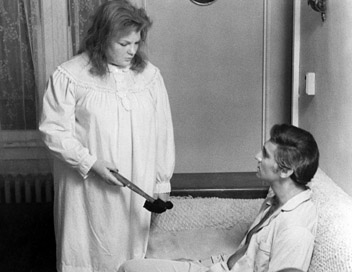
Sem7peli2The center of the story is the unlikely romance between Ray and Martha, and how Martha’s jealousy interferes with Ray’s studied predatory gigolo procedures, and eventually leads to murder. That build-up leads to pretty horrific murder scenes that would be considered fairly tame these days, but have an added punch thanks to the relatively staid events leading up to them. Tony Lo Bianco and Shirley Stoler are perfectly cast, and carry the movie effortlessly.

Kastle, who eventually took over direction after two others didn’t work out (and one was a young Martin Scorsese), may be taking his cues from European directors (and does a great job – his visual storytelling is efficient but elegant), but he also seems to derive some inspiration from the 1967 In Cold Blood, another piece of true-crime cinema with a black-and-white, documentary approach. Though in Kastle’s case, it was more a matter of financial necessity, which he then proceeded to exploit, and exploit very well. There are simply some things you can do with black-and-white that is impossible with color film.

Well, I had meant to save my babbling for the podcast, but I guess this is rehearsal, eh?

Buy The Honeymoon Killers at Amazon

My Darling Clementine (1946)

mcWqxj75qltyh85d4O7EJ6FYzsfOne thing I learned about The Honeymoon Killers was just how much Kastle shortened and in a lot of cases, actually whitewashed the story: Martha Beck’s backstory was particularly heartbreaking, and the two were accused of over twenty murders, not just the four we witnessed. Well, Hollywood, and all that. The necessities of fiction, of telling a good story.

Then how to address John Ford’s My Darling Clementine, the tale of the legendary Shootout at the OK Corral, where damned near nothing is true?

First of all, none of that is John Ford’s fault. The script is largely based on Stuart Lake’s posthumous biography of Wyatt Earp, Frontier Marshal, which in true Shootist style, is a collection of bunkum. The 1939 movie of the same name gets it just as wrong, if not wronger. To be sure, there is still a deal of controversy among historians about what exactly went down at the OK Corral, but we can be pretty sure that whatever it actually was, it wasn’t very photogenic.

54.57-foxIn this particular alternate universe, Wyatt Earp (Henry Fonda) and his brothers are driving a herd of cattle west, and not doing a particularly good job of it. While the three oldest, Wyatt, Morgan (Ward Bond) and Virgil (Tom Holt) head into Tombstone to get a shave and a beer, the Clanton gang, led by Walter Brennan, rustle the cattle and kill the youngest Earp, James (a baby-faced Don Garner). The Earps take jobs as lawmen in Tombstone, at least until they can track down their brother’s murderers. Doc Holliday (Victor Mature) runs a saloon in town, and he and Wyatt strike up an uneasy friendship, strained all the more when Doc’s old girlfriend Clementine (Cathy Downs) finally tracks Doc down, and Wyatt takes a liking to her.

Holliday, rather famously, is dying from consumption, and tries to send Clementine packing, egged on by his current girlfriend, a fiery saloon girl with the unlikely name of Chihuahua (Linda Darnell). Chihuahua’s fecklessness will eventually provide Wyatt with the piece of evidence he needs that the Clantons were responsible for James’ death, but that also gets her a bullet in the back from Billy Clanton (John Ireland). After that, it’s only a matter of time until everybody winds up at the OK Corral slinging lead.

My Darling Clementine (1946)This is Fonda and Ford’s first movie together after their tours of duty in World War II, and there is a tinge of melancholy and loss over the proceedings not evident in their pre-War work. Ford still works the atmosphere and period textures like few other directors ever managed, and some of the lighting effects in the nighttime scenes are spectacular – easily the best being the scene in which Holliday must operate on the wounded Chihuahua in the empty saloon, the improvised operating table illuminated by every oil lamp in the joint, surrounded by the deep black forms of people standing by, unable to help.

That’s also a bit indicative of the post-War Ford spinning his wheels a bit, though; the scene is directly lifted from his earlier Stagecoach, right down to the drunken doctor calling upon nearly forgotten skills for emergency surgery, assisted by his patient’s hated rival. An earlier scene with Fonda delivering a monologue over James’ grave is also reminiscent of a similar scene in Young Mr. Lincoln.
martinsYou really sort of expect Tombstone to have been mysteriously relocated to Monument Valley – this is a John Ford Western, after all. The liberties taken with history only get more fanciful from there. Virgil was the Marshal in Tombstone, with Morgan, James and Wyatt occasionally pitching in to help. James, Virgil and, yes, Wyatt, were all married when they moved to boomtown Tombstone – dreadful sorry, Clementine. Holliday’s friendship with Wyatt went back several years before Tombstone, and unlike here and Frontier Marshal, he survived the Shootout. There were two Clantons present, and four other suspected rustlers, and only Billy Clanton and two brothers, the McLaurys, died.

Hell, these days we’re told the Shootout actually happened down the street from the OK Corral.

The lead-up to the Shootout is a great deal more complex than Clementine would have us believe, but the messy details of reality would only get in the way of a good story. It’s intriguing to consider that the version we’ve had on TV and in theaters for the past 65 years was trimmed of nearly 30 minutes by producer Darryl F. Zanuck, according to his own sensibilities and some preview audiences that necessitated retakes months after the movie wrapped. A nearly complete version of Ford’s version was actually discovered at UCLA in ’94. It’s not necessarily better, either, just… different.

Anyway, I think I now really need to watch something in color.

Buy My Darling Clementine at Amazon

After the Gold Rush

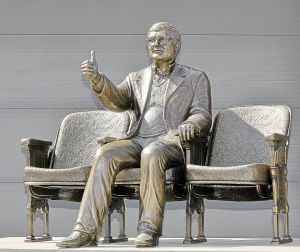
Nobody can say "They don't build statues to critics" anymore.

Nobody can say “They don’t build statues to critics” anymore.

It was a little over a year ago that we lost Roger Ebert. Not only did the man popularize film criticism in a way the common jerk on the street could understand – no fancy French words or obscure buzz phrases for him, his critiques were always couched in plain, understandable English – toward the end of his life he became an outspoken voice for tolerance and social justice, in a time of his life when cancer had stolen his actual voice.

Shortly after his death, someone at the Letterboxd site suggested a movie challenge, watching one of the movies from Ebert’s essays on “The Great Movies” each night in May, along with Ebert’s sole screenplay credit, Beyond the Valley of the Dolls. I thought this was a swell idea. Letterboxd, if you’re a member, will tell you what percentage of a given list you’ve seen, and I blush to admit I had only seen a quarter of the movies on Ebert’s list. I’m now up to a little more over a third.

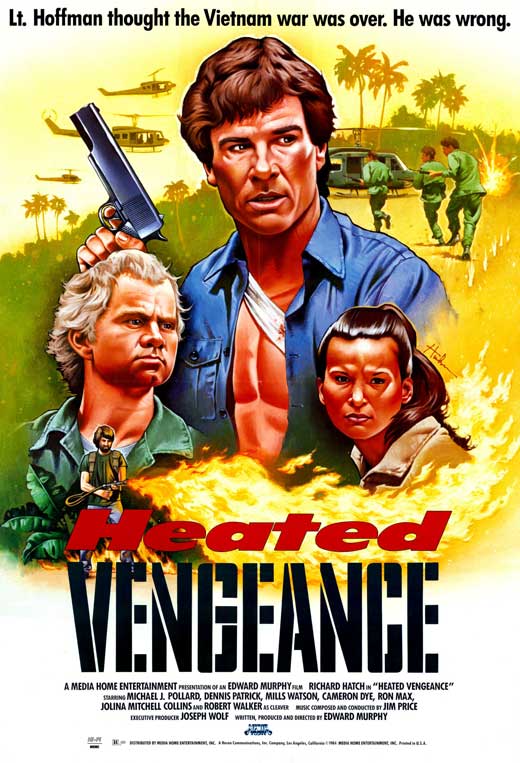
This challenge hasn’t passed into tradition; no one seems to be doing it this month. That’s okay. My schedule is what could politely be called berserk, and there’s no way I’m getting in a movie a night in May. But after the horrific one-two punch of Heated Vengeance followed by Boardinghouse, closely followed by Alien Zone/House of the Dead, I am more than ready for a transfusion of quality. A heavy transfusion.

The Battle of Algiers (1966)

BATTLE OF ALGIERS ARG_thumb[4]Whoa, almost too heavy.

This is Gillo Pontecorvo’s movie about the Muslim liberation movement in French Algeria, made a mere three years after Algeria was given its independence. Though based on the memoirs of one of its leaders, Yacef Saadi (who plays himself in the movie – he’s the one who kinda looks like Robert Forster), Battle feels surprisingly even-handed. Oh, the film’s sympathies are definitely with the Algerians, but it also makes it plain there are bloody hands on both sides of the equation.

Shot in a style one almost immediately feels is documentary, handheld cameras shooting in grainy black-and-white, constantly flirting with going out of focus, the movie, with quick efficiency. tells us visually that the Algerians live under Apartheid circumstances – the colonial French population lives in a clean, modern section of the city, while the natives – in the famous Casbah, where stereotyped lovers tried to take their ladies for decades – are in a crowded slum. The first bomb is laid in the Casbah by rogue French authorities in reprisal for a series of police assassinations, and things proceed to get far worse from there.

womenThe most powerful segment involves three women abandoning their concealing Muslim robes, donning makeup and cutting their hair so they can pass for French women, gliding with ease through the military checkpoints, and deliver the bombs in their purses. Each woman, upon reaching their target, spends a few minutes, not only to allay suspicions, but to look at the people – men, women, children – they know they are about to murder. The film is always frank about the human toll on both sides.

Three bombs in one day brings in a platoon of paratroopers, led by the charismatic Colonel Mathieu (Jean Martin), himself a former French Resistance fighter, and well-versed in the ways of insurgency; and without irony, he proceeds to use that knowledge to slowly take apart the Liberation Front.

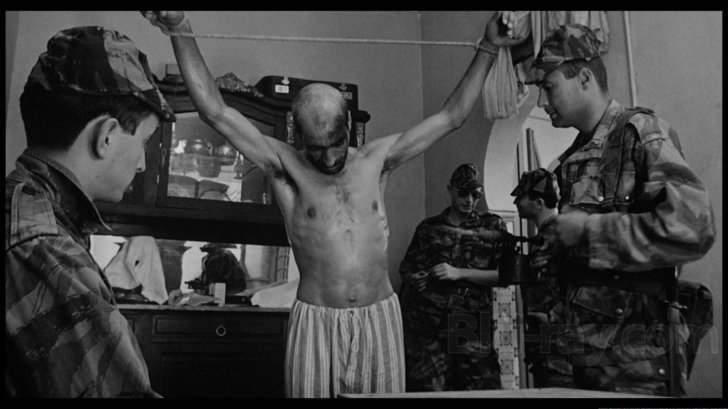
tortureIt’s telling that Mathieu never uses the word “torture” to describe what happens to the insurgents they arrest, it’s always simply “interrogation”. It’s even more telling that the torture scenes were cut out for US release. It’s most telling of all that in 2003, the New York Times reported that the Pentagon held a screening for officers and civilian support dealing with the situation in Iraq as “How to win a battle against terrorism and lose the war of ideas”.

At one point, the head of the Liberation Front states that all their efforts are toward provoking a popular uprising in the city; without that, the idea of independence is doomed. Mathieu succeeds in crushing the Front, but that popular uprising nonetheless happens in a couple of years, and we are told three years after that, came Independence at last.

And three years after that came The Battle of Algiers. There is a reason the Pentagon showed it, and probably still does. It remains completely and horrifically relevant and current, nearly half a century later.

Buy The Battle of Algiers on Amazon

Ivan the Terrible, Part II (1958)

600full-ivan-the-terrible,-part-2-posterSeems I felt a bit political here, hm?

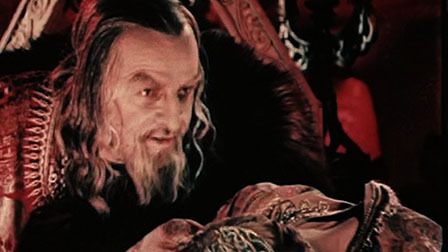
I had watched the 1944 Part I for the letter I in my alphabetical March Movie Madness. Much as Joseph Stalin loved the first one, he hated this one, forever killing the third movie in the proposed trilogy, and insuring this part would not be released until 1958. Apparently, he felt Sergei Eisenstein had not sufficiently mythologized Tsar Ivan, or more to the point, he saw too much of himself on the screen.

The last movie ended with Ivan’s brilliant political ploy of leaving Moscow, causing the populace to journey to him and beg for his return. He begins planning ways to get rid of the embedded ruling class, the Boyars, culminating in giving his “loyal dog”, the head of his feudal secret police, free rein to take care of traitors, resulting in the beheading of three Boyars, then Ivan’s doffing of his fur hat and emotionally crying, “Too few!” (No, no need for Stalin to be upset)

Ivan’s old friend, now the Bishop of Moscow (and not coincidentally, relation to the three dead Boyars), vows to “crush Ivan with the full weight of the Church!” Fat chance, as his theatrical shenanigans only gets him arrested. Take that, Church, enemy of Russian Unity!

ivan2This all culminates in an assassination plot ramrodded by Ivan’s literally poisonous aunt, who wants her dull-witted son Vladimir on the throne. The plot with the aunt has been simmering since Part I, so it was nice that Eisenstein at least managed to wrap up that storyline before Stalin pulled the plug. Really, the story was just starting to percolate. Stupid Stalin. Guess I need to read a book to see how things turned out.

Just like Part I, the acting is still rooted in declamatory silent German Expressionism (I joked that maybe what Stalin hated was the constant close-ups) but this is all part of the layered, painterly technique that Eisenstein brings to the screen. It is a rare frame indeed that could not simply be cut from the film, framed, and IVAN_rosenbaum_still_1_video_stillhung on the wall of a museum. Two sequences are in BiColor, a process using only red and blue to produce – well, a fairly disorienting aspect, fitting in its first use at a wild party, not so much for the final shot where Ivan proclaims death to all enemies of Russian Unity. Then, of course, there’s the magnificent score by Sergei Prokofiev.

Very hard to go wrong with personnel like that. Watch it today and stick it to Socialism.

(Sorry, Stalin apparently purged any trailers from YouTube)

Buy Ivan The Terrible Part II on Amazon

Wild Strawberries (1957)

2855041_detAfter the heaviness of Battle of Algiers and Ivan the Terrible, I needed to switch gears, and here I made a mistake. The mistake was certainly not in watching an Ingmar Bergman movie; Bergman is one of the constant delights of my late-in-life attempt to educate myself in film, so delightful I find myself rationing  him out, like precious water in a drifting life raft. No, my mistake was in thinking Wild Strawberries was listed in Ebert’s Great Movies. Several other Bergman flicks are, but it was still a bad assumption on my part. But having now watched it, I can only theorize that’s because Ebert was taken from us before he could write about it. That’s my story, and I’m sticking to it.

Wild Strawberries‘ story, though, concerns Isak Borg (Swedish film legend Victor Sjöström), who at 78 years of age, is being given an Emeritus degree for his 50 years of outstanding service in Medicine. Borg himself admits that he has found it easier over the years to avoid the entanglement of relationships, and is distant even from his only son, himself a successful doctor. He lives with a Great Dane and a housekeeper, Agda (Julien Kindahl) who has put up with him for 40 years.

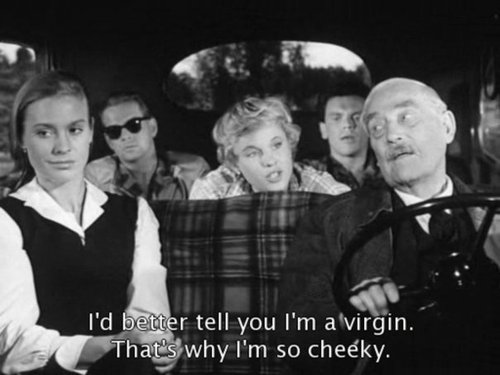
Wild-Strawberries-wallpaperThe day before the ceremony, Borg elects to drive there instead of flying, much to the consternation of Agda. He will be accompanied by his daughter-in-law, Marianne (Ingrid Thulin), who has been a houseguest for several weeks. Marianne and Borg tolerate each other, really; we find that Marianne thinks him a cruel and selfish man, hiding behind “old world manners and charm”. Along the way, they will pick up three student hitch-hikers, more or less led by Sara (Bibi Andersson), a pipe-smoking young firebrand and her two satellites, Anders and Viktor, one planning to be a minister, one an intellectual atheist, and both in love with her. Borg and Marianne both enjoy the company of the teenagers and their brash, youthful interplay.

Eventually, after a brief visit to Borg’s mother – who at 96 years of age, makes Isak seem downright warm – Marianne confesses to Borg the reason she had been staying with him, and not her husband Evald (Gunnar Björstrand). She is pregnant, and Evald is adamantly against becoming a father, feeling the world is a terrible place and there is no use bringing another wretch into it to suffer. Moreover, Evald is more than ready to die himself, just to get it over with.

cheekyvirginDuring the journey, Borg has been plagued by dreams and visions of his childhood more real than his present life, and is shocked that his son’s outlook on life is so very bleak; he himself, thanks to the dreams, memories, and company of the three hitch-hikers, has just come to realize that he has been more dead than alive, and in a series of final scenes after his ceremony – with the hitch-hikers, with the now-reconciled Evald and Marianne, even in apologizing to Agda for his behavior that morning (in a beautiful, truthful moment, she looks at him and says, “Do you feel alright?”), Borg begins, in small but significant ways, to once again live his life.

It is one of the most radiant, emotionally satisfying film conclusions I have seen in a long time. The fact that Bergeman produced both this and The Seventh Seal in the same year takes my breath away. Highest possible recommendation.

Buy Wild Strawberries on Amazon

The General (1926)

8691I find the real problem with watching a Bergman film is that I immediately want to watch another one. But, like I said, rationing. (I’ll also mention I don’t do “binge-watching”, either) So, late Saturday night after a particularly grueling show, I judged it time for Buster Keaton.

The General is one of Keaton’s best-known movies, and there are several reasons for this: it’s a genuine masterpiece, copyrights lapsed so there were horrible public domain tapes of it everywhere, and last, but oh certainly not least, it is that close to being a serious action movie.

Keaton plays Johnnie Gray, an engineer in 1861, who loves only two things: his locomotive, The General, and sweet Annabelle Lee (Marion Mack). The Civil War breaks out, and Johnnie eagerly tries to enlist, but his skill as an engineer is too valuable to risk him on the battlefield, and he is turned down. Annabelle thinks this is due to cowardice, and walks out on him. (So many of these comedies depend on people simply not talking to each other…)

the-generalA year later, a group of Union spies steal the General (and kidnap Annabelle, as much by accident as anything else) and proceed to drive it to Northern lines, sabotaging rail and telegraph along the way. Keaton is in hot pursuit in another locomotive, and finds himself stranded in enemy territory. He finds out about a planned Union attack, and must rescue his sweetheart, retrieve the General and make it back home to warn the Confederates about the impending invasion.

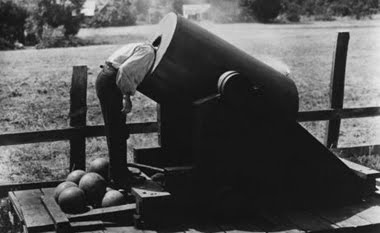
The General can be split into five acts, with the second and fourth being the extremely complicated and exciting chase scenes, first with Keaton as the pursuer, then as the pursued. These are so full of creative uses of the now-almost-arcane rail system technology and their idiosyncrasies, they are quite educational. Keaton was an incredible athlete, and The General has some his most impressive and probably dangerous stunts, on a moving train – it’s small wonder that Jackie Chan singles him out as an inspiration.

tumblr_lsj0uvZpIQ1qbhnrvo1_500The General also has an impressive budget for the time, with a version of Marietta, Georgia being built in Oregon (where there were still small-gauge tracks that could accommodate the antique engines being used), and 500 Oregon Guardsmen playing both armies in the conflict, filmed marching one way, then changing uniforms and marching in the other direction. One of the best setpieces has the oblivious Keaton chopping wood in the coal car, while behind him whizzes past first a retreating Confederate army, then an advancing Union.

Then comes the impressive fifth act, when the two armies meet at a gorge and the pursuing Union train collapses the bridge Keaton has sabotaged – the most expensive stunt in silent film history, and done without telling any of the onlookers or extras – their surprise and shock is quite unfeigned. (The engine also stayed at the bottom of the gorge until World War II, when it was salvaged for scrap)

Well, those durned Union troops are driven off, especially when confronted with Keaton’s comic mayhem, and Keaton finally gets his army post, a Lieutenant’s rank, and the girl. Though why she made her love dependent on his willingness to get killed or maimed is puzzling, as is his love for her. Ah, well, we’ll just close the file on a very satisfying movie, and not trouble ourselves with niggling little details like rooting for the underdog Confederates (nary a slave nor plantation in sight to complicate things), or that the circumstances here inevitably lead into Birth of A Nation and the Ku Klux Klan. No, we’re simply going to enjoy a good movie, and not let politics ruin that.

Buy The General on Amazon


The Gold Rush (1925)

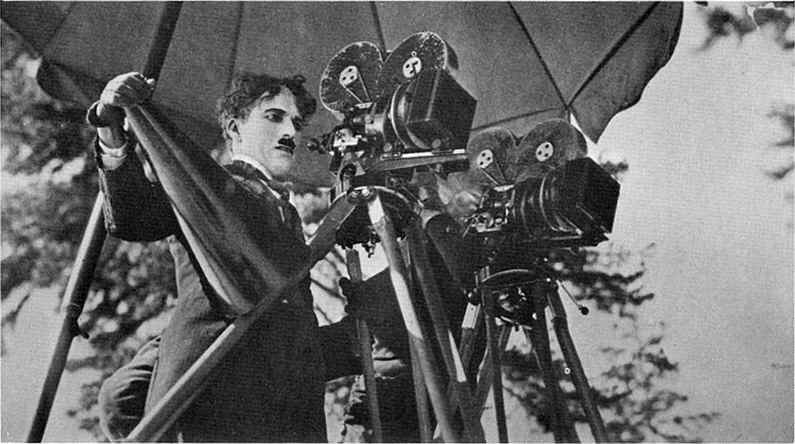
goldrushIt is a hard, and odd thing to admit – but up until this point, I had never seen a complete Chaplin movie.

Bizarre, isn’t it? I’ve seen plenty of clips over the course of my life, but never even a complete two-reeler, much less his feature-length work. It just never happened.

So here I am, watching what is arguably his most popular feature (a lot of people, Chaplin included, would argue for the more sentimental City Lights, but I ain’t there yet), if not his most profitable, a reputation bolstered by a re-release in the 40s, re-edited and with a new narrative track. That was also supposedly Chaplin’s favored version,  but rebel that I am, I watched the original, silent version. Come to think of it, I’ve never watched any of Lucas’ bowdlerized versions of the Star Wars movies, either.

chaplin-gold-rush-1925-grangerThe first thing that is going to hit you upside the head is the fact that Chaplin was a serious filmmaker. I mean, that goes without saying, right? But the casual viewer enters the movie without realizing just how serious. After a intercard setting up the historical context of the Alaskan Gold Rush of 1898 – “historical” is a bit much, since we’re talking less than 30 years before – we have a shot of hundreds of people making their way up to a narrow mountain pass. Supposedly populated by boxcars of hobos shipped in from Sacramento, this is the sort of practical shot that you can imagine a young Werner Herzog seeing in a darkened theater and thinking, “Ja, this is what I want to do with my life!”

After this, we’re getting into more typical comedy territory, as Chaplin’s iconic Tramp character – in this iteration, “The Lone Prospector” – waddles along mountain precipices, unknowingly followed by a huge black bear, and eventually stranded in a cabin during a horrific blizzard with fellow prospector Big Jim McKay (Mack Swain) and the villainous Black Larsen (Tom Murray). Chaplin, intrigued by horror stories of the Donner Party, plays their isolation and hunger pangs for maximum comedy, resulting in two classic bits – one, mined for years thereafter by Looney Tunes, where Big Jim hallucinates that Chaplin is an enormous chicken, and the other, where the Tramp boils and eats his shoe. That such an act of desperation is successfully played for laughs is indicative of the heights of Chaplin’s talent.

thegoldrush-2Eventually, the Tramp hits the boom town and sells his useless prospecting tools. This is where he is going to meet his -and Chaplin’s – eventual lady love, Georgia (Georgia Hale), whose every appearance is presaged by a card with lovely typography announcing “GEORGIA!” Never mind that the lady is a prostitute in the local saloon. Such things were not spelled out, even in pre-code Hollywood, and like John Wayne’s naive Ringo Kid in Stagecoach, the guileless Tramp only sees a beautiful woman, where others see a commodity.

Chaplin – like all the great clowns – believed in comedy leavened with a generous portion of pathos, and the Tramp’s smitten love for Georgia provides all the pathos he needs. The Gold Rush has one of Chaplin’s signature bits, what has come to be known as “The Dance of the Rolls”, when the Tramp, unable to speak how rapturously happy he is to be in the adoring presence of his lady love on New Year’s Eve, instead demonstrates his joy with a spontaneous dance number using two rolls on forks as legs. How serious is Chaplin about his clowning? Look carefully – You’ll see him counting time.

The pathos comes when he realizes this is all a dream – Georgia and her fellow working girls have forgotten the date they casually set with the funny little man and are partying hard at the saloon. And even then, as th Tramp looks in the bar window in an attempt to see his feckless love, there is a sequence where the bar patrons sing “Auld Lang Syne” and the camera picks up close-ups from the crowd, faces we have never seen before, and will never see again, united in that song, and with such a mixture of melancholy, regret and hope that it is incredibly affecting.

goldrush cameraIncidentally, the Tramp doesn’t see Georgia because she, her friends, and her brute of a boyfriend have gone to his cabin “To have some fun with the funny little man”. Georgia feels no small pang of sorrow when she discovers the remnants of the party the Tramp worked so hard to put together, but that doesn’t stop her from carrying on with the brute, culminating in a scene where said brute passes a note confessing her rather bewildering love for the douchebag to the Tramp, resulting in a scene that would have been painful beyond bearing had Big Jim not arrived and carried off the Tramp to help find the “mountain of gold” he found and lost during the blizzard.

In point of fact, Chaplin excised the whole passing of the love note sub-plot from the re-issued version, and that is probably a wise thing. Georgia had already rebuked Brutus the scene before, and her confession of love to him really complicates the eventual romantic denouement we know is inevitable.

The_gold_rush_15No, Chaplin has whisked us away for one more classic comedy setup: he and Big Jim wind up once more at Black Larsen’s cabin, the one landmark Big Jim can count on to find his missing claim. A violent windstorm actually moves the cabin during the night, depositing it on a precipice and causing it to see-saw as its occupants wake and move around. It’s probably the first time a set was built on gimbals to tilt so wildly, and the sequence has some pioneering miniature work involving the cabin and even a tiny, articulated Chaplin. Again, it’s a set-up that is going to be utilized over and over again in the coming years.

As luck would have it, the cabin’s precarious position is just outside Big Jim’s strike, so at the end of the movie we have the delight of seeing the Tramp in rich man clothes (though old habits die hard, and he still scrambles to pick up a discarded cigar butt). While he and the equally opulent Big Jim are interviewed and photographed on the deck of a cruise ship, we find out that GEORGIA! is also a passenger, setting up their final meet and romantic clench, which in the context of the ’25 version, feels rote and unearned. The older, wiser Chaplin set it up better in the later re-issue. Still, there are few better things than to follow a sympathetic character in a rags-to-riches story and see him get the girl, unless it would be to also see the brute boyfriend get eaten by a bear.

goldrush3I watch The Gold Rush not entirely tabula rasa; there was a series on PBS in the 80s called The Unknown Chaplin, which I avidly devoured. In it was shown a treasure trove of Chaplin’s outtakes, which served as a marvelous examination of how the man worked. He used the studio as a sketchpad, basically, working scenes over and over with variations to see which  played best, which produced the best laughs. It’s estimated that his first feature, The Kid, had a shot-to-print ratio of somewhere around 55:1. It’s a small wonder then, that The Gold Rush was one of the most expensive silent features ever made – but then again, as one of the most profitable, it proved a risk well worth taking. After this would come The Circus, and then the coming of sound, with which Chaplin would have something of a problematic relationship.

 Buy The Gold Rush on Amazon

Before The Gold Rush

I’m going on yelp and giving this new flu a bad review.

The last couple of weeks have been a delirious fever dream, as I pretty much lived on Dayquil and sugar-free cough drops. I punked out of work when I could, but most of the time I couldn’t. The most amazing bit, to me, was when my church asked for my voice at two Easter services and if I felt too bad I didn’t have to do it but could I please also do a rehearsal on Saturday morning, too? After the rehearsal, one musician reportedly said, “Darth Vader just opened our service.” Yeah, I sounded profoundly sepulchral. No problem hitting those low notes. I radiated gravitas. And phlegm.

caught fluSo after Easter weekend – when I did the Show, and the services, and made homemade chicken soup because I was the mobile one in Plague Central – I took Monday off, and then a surprising thing happened. Exhaustion took its toll and I actually slept through Monday night, awakening only occasionally to cough up a piece of lung. I felt good enough to go into work, pound that week’s story into shape and submit it before the deadline, go home, nap, go do audio support for that evening’s Economic Development Corporation meeting (honestly, I have watched un-subtitled Mandarin movies that were more comprehensible to me), slept again, and felt almost human Wednesday. Which is good, because I had a traveling show at a refinery in Deer Park (and it’s always good before a show to receive that little lecture about what to do if there were some sort of catastrophic accident while we were there), then run home, change clothes, and do a remote broadcast that evening.

I felt good enough that I won’t even mention that the remote was for a Candidate Debate between folks running for School Board and City Council positions. No, what I’m actually not going to mention is that one of the Council candidates was sick, so we had a Candidate Debate with one participant. That was good TV.

death1Oh, yeah, I watched some movies while I was sick, too.

First up was Death Promise, an odd little homegrown kung fu revenge flick from 1977. This was nowhere near as bad as I was told, and I found it pretty entertaining. Okay, admittedly the boom mike should have gotten a credit. Indications are we’re going to devote a Daily Grindhouse Podcast to it, so I’ll leave my blithering to that, and leave you with this truly remarkable fight scene, including a bad guy whose ki-ya sounds like an asthmatic cat who’s smoked too many cigars:

And oh yeah, ignore them. Buy this fine movie at Amazon.com.

Speaking of the podcast, one of the best things it turned me onto was the delightfully insane, inept-in-all-the-right-ways movie Raw Force, aka Kung Fu Cannibals. This was the first of two movies directed by Edward D. Murphy. We were all curious about his second, and last directorial effort, Heated Vengeance, but I was apparently the only one who cared enough to do something about it.

In other words, I took a bullet for the team.

heated-vengeance-movie-poster-1985-1020693907In the three years between Raw Force and Heated Vengeance, Murphy learned a few things, and got a better budget together. This is obvious from the very first scene, which depicts a Viet Cong attack on an American firebase in Laos. Richard Hatch is there as our heroic commanding officer, Joe Hoffman, who gets wounded and choppered away from his native translator lady love Michelle (Jolina Mitchell-Collins). Hoffman gets sent back to the States and his wife, and years later he returns to Thailand, newly divorced and looking for Michelle, now a doctor, and what could be his son. Too bad he runs into Larry Bingo (Ron Max), a guy in his command who was getting sent up the river for raping a native girl, but escaped during that expensive Cong attack we keep flashing back to. Bingo kidnaps Hoffman, takes him to his drug production base (set up in Hoffman’s abandoned army camp), intending to wreak some heated vengeance. Hoffman escapes, and goddammit, we’re watching The Most Dangerous Game again.

There is surprisingly little action in this action movie; there’s a lot of talk, though. Murphy still likes his villains kind of colorful, and Bingo leaves no scenery unchewed. Among his henchmen are Michael J. Pollard, being very Michael J. Pollard-y, and Robert Walker Jr., an unfortunate actor who Hollywood just never figured out what to so with. Things don’t start getting really weird until about the last twenty minutes or so when the wounded Hoffman is taken in by some Laotian natives, and Michelle and his son track him down with the help of a friendly traveling toilet salesman (a pretty welcome Dennis Patrick). By this time, Bingo is down to a flamethrower and Michael J. Pollard, and there is an explosive finale which Murphy could not have possible been able to afford, but he goes ahead and tries to do it anyway, which was the Edward D. Murphy I had been looking for all along.

heatedvengeance5big

“Wha? Heated? Vengeance? That’s a thing?”

It is a very good vehicle for Richard Hatch, though: he does the everyman with his back against the wall bit pretty well. But honestly, I spent a lot of time in this flick checking how many minutes it had left, and that is never a good thing.

So how do I recover from the disappointment of not finding another Raw Force? I watch Boardinghouse, because I’m an idiot.

I was pretty much unaware that Boardinghouse  even existed before noted sociopath Joe Cosby forced me to watch Things for Daily Grindhouse Podcast Mark I, and evidence showed that Things was inspired by Boardinghouse, at the time the most successful made-for-video Canadian movie evar. The video was apparently even transferred to 35mm for a theatrical release.

Huh.

boarding-house-movie-poster-1982-1020230391After an opening where we find out the titular house has a history of violent deaths (one involves an incredibly effective garbage disposal), most of which can seemingly be traced to a telekinetic sibling who’s committed to a mental hospital for life. The house eventually devolves to Jim Royce, who opens it as an all-female boardinghouse, with him as live-in landlord, figuring that this will be the ticket to a “bachelor’s paradise”. This means that he will soon be banging each and every one of his tenants, when he’s not meditating on his desk in his underpants, honing his telekinetic skills.

That’s right, there are two telekinetics in this movie, soon to be three when Jim teaches Debbie (Lyndsay Freeman) his methods. Good thing, too, because the original TK escapes from the hospital after forcing a woman to hang herself and a man’s intestines to jump outside his body.

vlcsnap-2012-07-07-23h03m57s59The women in the Boardinghouse are about as well written as your typical frat house movie, which is to say they are not written at all, and they appear to have little inclination or ability to be anything more than casually catty and evil to each other. There is an Asian girl who mysteriously vanishes after her sex scene – and it’s not like when another girl vanishes and it’s part of the plot, no, she just ceases to be. There is also a black girl, but we only see her when she’s going to work (and she’s the only one who appears to do so, so I guess that should be counted as a positive character trait). Well. she does show up at the big party scene at the end just in time to get killed, but – groundbreaker! – the black character isn’t the first one to get killed! Admittedly, it’s because she hasn’t been around for most of the movie, but still…

Maybe these two ladies have expanded roles in the Director’s Cut, which is  apparently a full hour longer, but I don’t care. I JUST DON’T CARE.

I will give it this: Boardinghouse tries to outdo Rock N’ Roll Nightmare in the bizarre, terminally-silly-ending-that-is-supposed-to-be-terrifying department, and it certainly gives Jon Mikl Thor a run for his money. This amazingly dark trailer should give you an idea of the visual splendor of the movie:

Folks, video equipment doesn’t do well in low light environments, unless you know what you’re doing, and even then... And oh, yes, “Horror Vision”. When you hear a sound and see a black glove, you’re supposed to close your eyes. It’s like Chamber of Horrors‘ Horror Horn and Fear Flasher, except the makers of Boardinghouse get tired of the gimmick about 45 minutes in and forget about it. Maybe it shows up in the last few minutes, but you know… care. Did not.

Folks, I watch a lot of crap like this. No dilettante I, I have seen shit that would turn you white. After a while, it gets to you, it really does. This is why I take off May and watch movies on my Wall of Shame, movies I should have watched years ago, almost all taken from Roger Ebert’s Great Movies List. At a low ebb, I kicked this off early and knocked one of those bricks off the wall: I watched Charlie Chaplin’s The Gold Rush.

I hear many of you screeching about the whiplash injuries incurred by that sudden turnaround in quality. Fine. We’ll leave that for next time.