Well, I had a pretty good run of Wednesday updates going there. Looking back over previous posts (and sometimes I could even be bothered to correct errors) I find this is the Status Quo. Every September, my life shifts gears, and I get much busier. I get back into the new-story-every-week mode at the Day Job, hopefully pick up another writing contract, and City Meetings that need audio support in the last month of their fiscal year (when they’ve run out of money) hire the cheapest guy. Which would be me.
My weekend gig is also reviving an old show, so rehearsals also cut into the time.
So my spare time is getting sparser than the hair atop my head (hint: there is damned little up there), so I’m afraid this is going to be the normal for a while. I don’t much care for that, but the alternative is a tad troublesome, ie., having no money.
That’s the big blockade to a cherished dream: just watching a movie a day. Lots of people do this. Lots of people watch more than one movie a day. I could do it if I gave up sleep. But I’m already a pretty grumpy bastard, no need to ratchet that up. I’d also need to stop writing about the damned things, at which some of you would likely breathe a sigh of relief.
(hm. That would free up an hour or three every week…)
Anyway, I’m likely to be pretty scarce this month. If it’s any consolation, I’ve been working on something for October with some other movie bloggers, and you’re going to get absolutely sick of me next month.
The end of August moving into September is always a stone drag, man. Trying to get to sleep last night, I read over some old columns, and this became distressingly clear. Mainly, it is the cusp of fiscal years and budgets for the City meetings for which I run audio support – this means more meetings, jammed closer together, and more complicated remote broadcasts. At least that means more money.
Then there is the writing contract that went into hiatus for focus groups (give me a moment to grind my teeth, please), and though my part of the project didn’t pass muster, it was returned to my hands with an order to carry on, as it was deemed useful, and this time without too much interference. That also meant more money.
What none of that generates, though, is more time. I’m finishing up two stories I’ve worked on for the last month, and then I switch to the story-a-week format that will rule my life through Christmas. So I had a lot on my plate.
Therefore, it was only logical, that I take a day off and go over to Rick’s to watch movies.
Rick, as we know from the Crapfest articles, is not shy about proclaiming his love for such questionable fare as Evilspeak and Skatetown USA. Well, you might say I have equally gory skeletons in my closet, but I also enjoy things that the mundane world point out as good movies.. So does Rick. Rick was also smart enough to wait until plasma screen TVs became the Betamax of the HDTV world, and scarfed up a decent one at a reasonable price, had it professionally installed, then researched how to calibrate it himself to outstanding result. I love my Samsung LCD, but daaaaaamn Rick’s plasma is pretty. We torture-tested it with Samsara, Journey to the West: Conquering the Demons (Rick and I don’t see eye-to-eye on all movies, but we are in agreement about Stephen Chow), and The Holy Mountain.
That was a good, low-impact day. I needed another, so I went over with a bag of movies and a bag of Muddy Buddies, which Chex should really be marketing under the name “Satan’s Crack Cocaine”.
Just two days before I had finally – finally! – gotten a copy of William Friedkin’s Sorcerer, which I had not seen since its theatrical release back in – God help me – 1977. Rick had never heard of it, and the movie really had vanished for a number of years. It was a commercial failure for many reasons. Friedkin’s previous movie was, of course, The Exorcist, so people went to a movie titled Sorcerer expecting to see, at the very least, a sorcerer of some sort (spoiler: it’s the name of a truck). There was also the problem of another little movie that had premiered a few weeks before, something called Star Wars.
At some point the plan was to call the movie The Wages of Fear, which is the title of the Georges Arnaud novel that is the basis of this and the equally essential Henri-Georges Clouzot movie. Friedkin gets grumbly if you accuse Sorcerer of being a remake, though, which probably led to the name change.
So Roy Scheider – cast after every star in Hollywood turned it down, or were turned down by the studio – is a low-level criminal lying low in a pit of a village in some unnamed South American country, along with several other men from various countries on the run from various crimes. An oil well fire in a remote part of the country calls for the transport of six boxes of dynamite, all sweating nitroglycerine, over mountainous terrain and roads that hardly even deserve the name. The boxes are split between two trucks, with two drivers each, with the hopes that at least one truck will survive the trip. Our four expatriates are desperate enough to accept the assignment for the high pay.
Now once we get past the question of why the oil company doesn’t fly in some much more stable explosive to blow the well, we get to the actual trip through the mountains, 218 miles of potentially deadly potholes and at least one rickety bridge that doesn’t look like it will support one man, let alone a massive truck (the bridge, incidentally, cost over a million bucks, and had to be moved at least once when the river it was built over dried up). This journey doesn’t start until the halfway point of the movie, but it delivers enough tension and suspense for three movies. I wore out the Tangerine Dream soundtrack album in college. The Friedkin-supervised blu-ray is gorgeous, and I’m glad to see the movie back in the public eye.
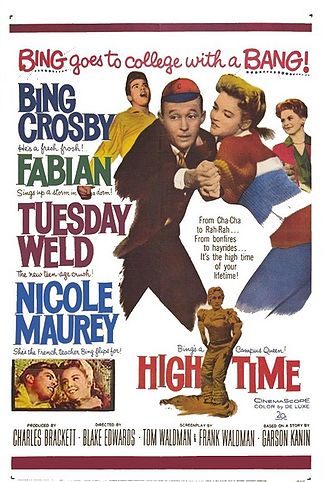
Now, in our attempt to give ourselves brain cramps, we went immediately to the 1960 Bing Crosby comedy, High Time. Well, we thought it was a hilarious contrast, anyway.
As downbeat and grim as Sorcerer was, this Blake Edwards comedy is the polar opposite. Bing is Harvey Howard, widower and owner of a highly successful chain of restaurants. Over the protests of his adult children, Harvey decides to do what he didn’t have time for while establishing his hamburger empire: go to college. Demanding no special treatment, he becomes a freshman at age 51, and there you have the thrust of our story.
I first saw this movie on TV sometime in the late 60s, then again – on TV – when I was in college myself. The major thing I take away from High Time is this movie totally lied to me about college.
Bing’s dorm roommates include Fabian, future Twin Peaks hotelier Richard Beymer, and an Indian student played by Patrick Adiarte, to prove how liberal everyone is (we do not see a single black student on campus until the closing graduation scene, and it is, indeed, a single student). Bing has many adventures of a zany college sort (Bing in drag for a fraternity hazing stunt is particularly scarring) and falls in love with the widowed French professor (Nicole Maurey). His kids attempt to sabotage the romance by getting her fired, which we figure was the root cause of the accusations of child beatings leveled by one of Crosby’s actual kids (and disputed by Crosby’s other kids, but we’re not going to let that get in the way of our snark).
Gavin MacLeod is on hand as the Odious Comic Relief Professor Thayer, an inept science teacher who I’m pretty sure manages to kill himself in Bing’s freshman year and it’s just his hapless ghost haunting the campus for the rest of the movie. On hand to take our minds off MacLeod are an incredibly young Tuesday Weld (17 years old!) and Yvonne Craig (still only 23). We may have overused the sad trombone sound effect, but it was enjoyable, if slight in that typical 1960 family entertainment way.
YouTube doesn’t have a trailer, but here, have a coffin-boxed five minutes:
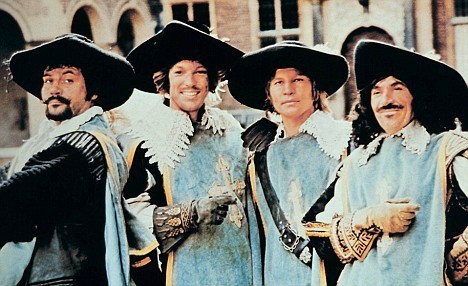
For the last movie of the evening, we split the difference, because I discovered that I had brought another movie Rick had never heard if, and I could not let that stand: Richard Lester’s 1973 version of The Three Musketeers. This and its sequel (The Four Musketeers, duh) are two of my very favorite movies, and I find they were very formative for me: the movies are a very faithful adaptation of Dumas’ novel, but we are never far away from a sly wink, a pratfall, or any other form of piss-taking. It is respectful and entertaining, and a hell of a swashbuckler, to boot, with fights choreographed by the legendary William Hobbs. I am disgruntled that I had to turn to Amazon UK for an all-region blu-ray.
Stunning cast: Michael York as D’Artagnan, Oliver Reed as Athos, Richard Chamberlain as Aramis, and Frank Findlay (truly the Rosetta Stone of British cinema) as Porthos. Suitable villainy with Christopher Lee as Rochefort, Charlton Heston as Cardinal Richelieu, and Faye Dunaway – yet another touchstone of 70s cinema – as Milady DeWinter, the prototype for every ice-cold, manipulative, brilliant femme fatale in film noir. Raquel Welch as D’Artagnan’s love Constance (okay, making Constance a comedic klutz was a bit much… still funny, though). Able support by Spike Milligan, Roy Kinnear, Simon Ward… hell, Sybil Danning’s in there, too.
(Rather more infamously, these two movies led to the “Salkind Clause” in contracts, which stated that you couldn’t film one big movie, split it into two, and then pay your cast and crew for only one. Not that this stopped them from trying it again with Superman and Superman II…)
What I’m saying is there is no reason these movies should be so obscure, and they are the reason I spat upon the Disney “Young Swords” version, ptui ptui. (The Paul W.S. Anderson was horrible, too, but horrible in a way I can enjoy)
I gladly left the blu-ray set with Rick so he could finish the story with The Four Musketeers. I went home and was asleep within the hour, and actually awoke refreshed and ready to face the turmoil of the week.
Such is the magic of cinema, Oliver Reed, Muddy Buddies, and totally disrespecting Bing Crosby.
Last week was depressing. We lost Robin Williams, then Lauren Bacall, bang bang. I went to bed one night in 2014 and when I watched the news the next day, I had apparently awakened in 1964, without the attendant youth and energy I possessed in ’64. Then again, I think ’64 was the year one of my numerous bouts of pneumonia nearly succeeded in killing me, so perhaps this uneven version of time travel was for the best.
This week? Just as depressing.
If I stand for nothing else, I certainly stand for escapism in my entertainment. So let’s see…
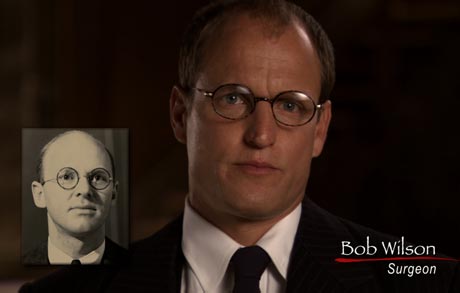
I completely fail at escapism in my first choice from Netflix, Nanking (2007), which is about the Japanese occupation of that city in 1937, and its attendant horrors. The narrative drive of the film is provided by diary and journal entries, largely from a group of Western missionaries and businessmen who took it upon themselves to establish a “safety zone” for refugees; many of these people were rightly honored as heroes by the Chinese, and they paid the price for that heroism, often in unfortunate and yes, depressing ways. The entries are spoken by actors like John Getz, Mariel Hemingway, Chris Mulkey, Jurgen Prochnow, Woody Harrelson, Stephen Dorff, Rosalind Chao. This is bolstered by interviews with survivors, many of whom break down in tears about things they witnessed while still children.
This is a tremendously sobering movie. It makes all too obvious the evil of which men are capable, but also the tremendous good of which they are equally capable. This is not a movie for light viewing, but it is very, very good: history made all too real and gut-wrenchingly horrible.
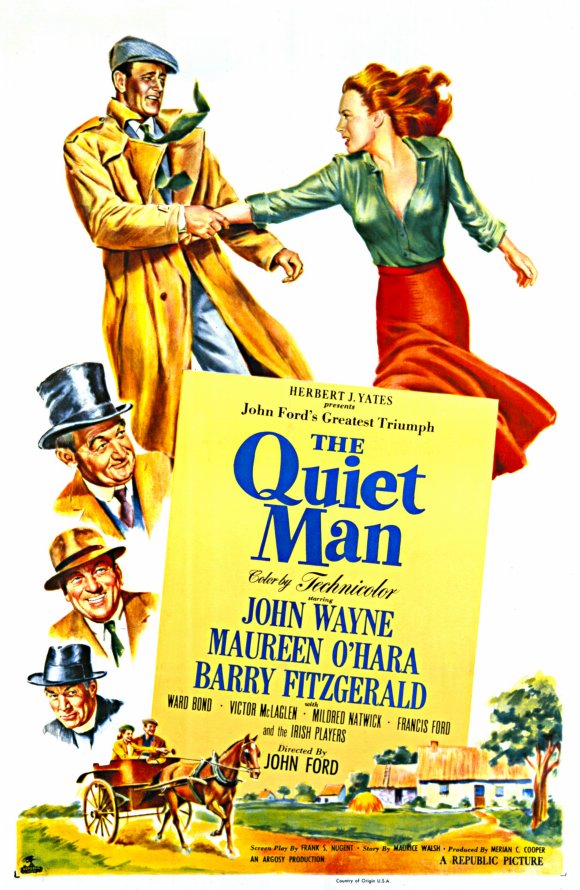
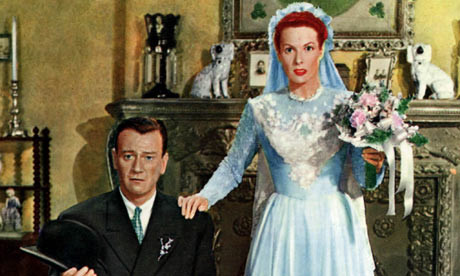
I was on slightly more sure footing with a blu-ray I had picked up at my local used disc store, which is Olive Films’ 60th Anniversary Edition of John Ford’s The QuietMan. It’s hard to typify The Quiet Man as anything but escapism – hell, I’m sure there are many people in Ireland who would love to visit the version of Ireland presented here.
In case you’ve not had the pleasure: John Wayne is Sean Thornton, a retired prize fighter who returns to his birthplace, the Irish village of Innisfree. There “The Yank” runs into Mary Kate Danaher (Maureen O’Hara), and immediately falls in love with her, as who wouldn’t? There is a fiery, tempestuous courtship (although “the proprieties will be observed” as declared by village marriage broker Barry Fitzgerald), and they are wed. The main conflict is with Mary Kate’s brother, the bellicose Will Danaher, who refuses to pay Thornton her dowry. The Yank doesn’t care about the money, but it is a tradition ingrained in his Irish bride, and it nearly destroys their newly minted marriage. Thornton is reckoned a coward because he won’t fight Danaher – but only the local Protestant vicar knows Sean’s secret – he killed a man in the ring, and swore to never again strike another person. Everything turns out alright when Thornton and Danaher finally throw down, much to the delight of the entire village (and the movie audience).
This was Ford’s dream project, which also meant that no studio in Hollywood would touch it for years. I always thought it was kind of odd that this was a Republic picture, but an included supplement hosted by Leonard Maltin cleared that up: Republic was trying to break out of its reputation as a maker of serial potboilers and B movies, and signed Ford to a three picture deal. Still, they wouldn’t let him do Quiet Man until he delivered a profitable picture first, on a lower budget than he was used to: Rio Grande, supposedly to offset the losses The Quiet Man would produce. After convincing Republic of a number of things, not the least of which was using Technicolor, shooting on location, and upping the budget to $1.5 million (and he delivered it a few thousand under budget), he finally made his dream movie – and a dream it is, as gentle and humanistic a story can be that ends in a fifteen minute fistfight. An unusual movie for Wayne, not known for making romantic comedies – nor for playing straight man to a bunch of fine character actors.
I felt a bit disappointed in the transfer on the Olive Films blu-ray, until I watched the Maltin extra, which was obviously sourced from video, and it had the chroma turned up absurdly high. The Technicolor on the Olive transfer is much more realistic, and is fine, really – it’s just that previous versions had led me to expect to be hit between the eyes with vibrant green in every shot.
For maximum escapism, I returned to Netflix and something I had intended to watch ever since I heard it had been added: Space Pirate Captain Harlock, or, as Netflix calls it (confounding my searches for a while) Harlock: Space Pirate. Because, well, come on; who doesn’t like pirates? In space?
Though I really like the character Harlock, I have to admit my exposure to him is pretty limited. I first encountered him in Galaxy Express 999, which was showing at the local art house theater. In those days, finding anime was tough, let me tell you. I managed a couple of dubbed episodes of the TV show, and one movie, Arcadia of My Youth, which was, in those days, called My Youth in Arcadia.
This is a motion-capture CGI movie, and more than a bit of a reboot. A prologue tells us that as Earth began to die, mankind reached out tot he stars, and with its usual aplomb, failed miserably. There was a general exodus back to Earth, but so many people would have finished the job, as it were, so something called the Homecoming War happened, with the result that the Gaia Communion operates Earth as a closed, gated community, with no interlopers allowed.
Of course, Captain Harlock and his crew are tooling the Arcadia around the galaxy screwing with The Man, but they’re also up to something, and a spy manages to worm his way into the crew to find out what. Harlock is setting up “dimensional detonators” at specific nodes, with which he hopes to disrupt the fabric of time, basically resetting the universe.
I had a brief discussion on Facebook about live-action adaptions of the anime of our youth, and how the modern versions of Devilman, Gatchaman and even Cutey Honey got bogged down in tidal pools of mega-angst. (This was pretty nicely parodied in Karate Robo Zaborgar – “You can’t punch me! I have diabetes!”). There is mega-angst in this Harlock, too, but it doesn’t seem needlessly tacked on (and to be fair, most of my memories of Arcadia of My Youth is of people crying). Harlock is apparently immortal, well over a hundred years old, and tired. He has a deep dark secret deeper and darker than anyone would suspect, and so does our spy.
I was originally drawn to anime for its ability to present the amazing imagery in service to stories that were, to me at least, coming from unique viewpoints. The space imagery in this CGI movie is pretty marvelous, for the most part. The story gets really ponderous in the last 20 minutes or so, but it was still pretty solid entertainment, and took me somewhere else for two hours.
It actually happens, every now and then, that I get a Saturday off. This is a mixed blessing; no work on Saturday means no pay, but it also means that it is possible to throw together a Crapfest WITH NO HOLDS BARRED! IT’S A SATURDAY! ALL BETS ARE OFF! WHAT YOU GOT TO DO ON A SUNDAY, ANYWAY?
(Well, I had to get up at 8am to read at Hippie Church, but why should I get more sleep on a Sunday than I do any other day?)
We had a fairly full roster, with only The Other David absent, as in a mirror image of my plight, he had a show that evening. Host Dave had rearranged the furniture in the Crapfest Room, and we lolled about in spacious luxury as Hell unspooled before our very eyes.
Dave started off with a movie that, like the devil, has many names: the one plastered on the screen as a subtitle was Sex and the Vampire. If you are looking for it on the IMDb, it is better known as Santo and Dracula’s Treasure or Santo en el tesoro de Drácula. In my peculiar little world, El Santo requires no introduction; I find in this world, however, such is not the case. So there was some discussion about lucha libre and pro wrestling, and everybody missed the plot set-up, which is Standard Operating Procedure for a Crapfest. (In lieu of such discussion, I will simply direct you to the Wikipedia page for El Santo)
El Santo, besides being a famous wrestler, crimefighter, and monster-killer, is also an accomplished scientist, it turns out, and has invented a time machine. But it is INCREDIBLY DANGEROUS and has not been tested yet, so the scientists he invited to ooh and ahh at it instead go “Poo-poo!” and march out. The machine will only send a person back to a past incarnation, and for some reason it is safest to send a woman with voluptuous curves into the past, so Santo’s plucky girlfriend Luisa (Noelia Noel) puts on a high-collared silver suit and walks into a very short Time Tunnel.
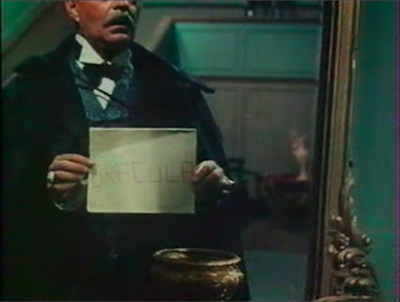
Wouldn’t you know it, she appears in a household that is being bedeviled by a foreign gent who calls himself Alucard (Aldo Monti), and yes, our local brainiac Professor Van Roth (Fernando Mendoza) has to write that name down and hold it up to a mirror. This version of Dracula, it should be pointed out, has a propensity for taking off women’s clothing, and has a harem of brides who take “clothing optional” very seriously. This convinced Paul that Dracula was the true hero of the movie.
Now, about the time we start wondering “Didn’t this movie used to have El Santo in it?” We see El Santo watching the unfolding Dracula movie on a Time TV; and he’s getting increasingly worried when Luisa’s previous incarnation is vampirized and about to be staked by Van Roth right after he put paid to Dracula. Santo brings her back in the nick of time.
Dracula, Prince of Nudies
Now how, you may wonder, did I know about Santo’s time machine, and the shadowy black figure who is watching Santo watch Time TV? Well, much to my consternation, el tesoro de Dracula is in large part an uncredited remake of Attack of the Aztec Mummy, which I had watched a couple a months ago in preparation for an October roundtable (plug plug). Santo decides that finding Dracula’s resting place, and getting his medallion, which will lead to the titular treasure, will prove to all those scoffers that his time machine works.
There follows a shot-for-shot recreation of the tomb scene in Aztec Mummy, right down to the odious comic relief spotting the villainous Man In Black and mistaking him for a ghost. The only deviation is a fight between Santo and the MiB thugs, after which they find Dracula’s coffin, the stake still in his remarkably preserved body, and they take the medallion. But! Dracula’s ring has the key to decoding the medallion’s map, and the MiB steals the ring, then has his burly henchman Atlas wrestle Santo for it (I was wondering how they were going to work a wrestling ring in, and they promote the match for two weeks). Santo, of course, wins, and the MiB hands over the ring, which you have to admit is kind of classy.
But he then has his thugs take the stake out of Dracula, figuring that the Count will track down his jewelry, and we’re back to Aztec Mummy territory again. Paul said, “Yay! Dracula’s back! Maybe we’ll have boobs again!” (speaking of titular treasure, har de har) Paul is remarkably psychic, as we did indeed, and then Drac goes ahead and revives all his clothing-challenged brides again, to boot. Santo still wins, which in Paul’s book, means that evil (and clothing) won the day.
It was time to start preparing the evening meal, and the folks doing the planning had outdone themselves: Erik had personally hand-wrapped and skewered a small army of shrimp in bacon, and Rick had an assortment of artisan sausages and pork tenderloin. Science and physics were employed to grill this meaty menagerie without making the Crapfest Room any hotter. All these efforts were highly successful, and damn Rick, but you work magic on a grill. In medieval times, you would have been burned at the stake as a sorcerer. I had a meat hangover the next day, and couldn’t look at anything but salad.
But it also fell to me to throw in some filler. We had already been through all my trailer compilations, but I had brought something else, something that could also be turned off at anytime with no loss of story: Miss Nymphet’s Zap-In, which had been offered by Vinegar Syndrome as a free download.
There is nudity in the first scene. There is nudity in every scene following. ‘Why are you being so nice to them?” Dave asked me, dismayed. “Because I know what is to come,” I replied. Zap-In is a blatantly obvious rip-off of Laugh-In. right down to go-go dancers (topless in this case) doing their thing while supposedly humorous text is displayed over their gyrating forms. Every now and then we see the cast walking in a circle as if they were playing musical chairs, until someone off camera throws the signal, they all freeze in different positions and say “ZAP!” One lady keeps falling over, which is the funniest thing in the entire movie.
False advertising, and overpriced, to boot.
You see, this is an H.G. Lewis movie, produced and directed under two of his numerous pseudonyms. And you haven’t lived until you see H.G. Lewis doing comedy. Wait, I should have said you have never experienced a slow, lingering death until you have seen H.G. Lewis doing comedy. So, in a 75 minute movie, at minute 40, I hear a haunted voice from the back of the room moaning, “I never thought I would be tired of seeing tits.” They made it to minute 50 before they begged to shut it off like George C. Scott in Hardcore. I felt like Victor Von Doom after one of his plots against the Cursed Richards had achieved fruition.
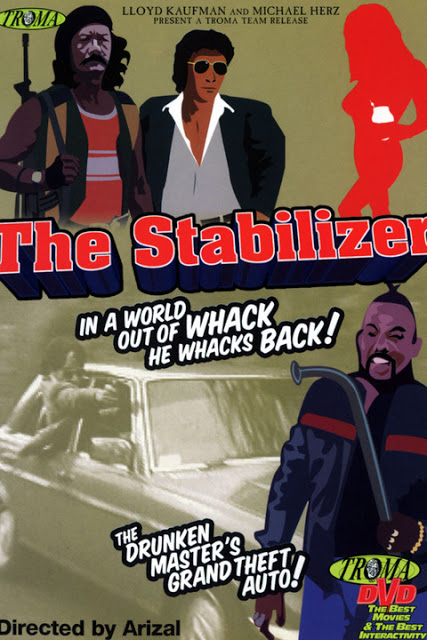
All right now, seriously, folks. It was time for a movie I had been trying to force into a Crapfest for months, if not years. The Stabilizer.
It’s the Drunken Master’s Grand Theft Auto! It says so right on the box!
The Stabilizer is an Indonesian action movie from 1986 starring Peter O’Brian, a teacher who was vacationing in Indonesia when filmmakers noticed he looked sorta kinda like Frank Stallone and offered him lots of money to extend his vacation and make a couple of movies. He wound up making five more over the next six years, ending up with Angel of Fury, with Cynthia Rothrock.
O’Brian is Peter Goldson, a CIA guy called The Stabilizer because the CIA likes to nickname guys the opposite of what they do, I guess. He comes to Jakarta to help his old friend Captain Johnny (Harry Capri) find Professor Provost (Kaharudin Sayah) who has invented a “narcotics detector”, and who has been abducted by Goldson’s old enemy, the musically-named Greg Rainmaker, whose supervillain gimmick is big boots with golf cleats.
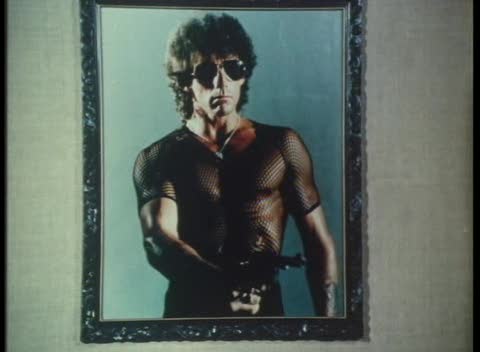
Both The Stabilizer’s girlfriend and his archenemy have this photo of him. And that’s all you really need to know about this movie.
What follows is pretty much non-stop action with sweet 80’s fashion, all leopard print spandex and triangular pockets with zippers. The only way to respond to this movie is the line from Pee-Wee’s Big Adventure: “Great movie, Pee-Wee! Action-packed!” Seriously: it is quite possible to see the seed of movies like The Raid in this, with a desire to create Raiders of the Lost Ark-style action setpieces without the real talent – or coherent story – to back it up. Whatever else it may be, The Stabilizer is not boring, and is totally committed to insane action. It presents a country where doors are never used when there is a motor vehicle to drive through a wall, and bad guys have maps on their person labeled “Location Map”, causing the heroes to say, “This could lead somewhere.”
ZAP!
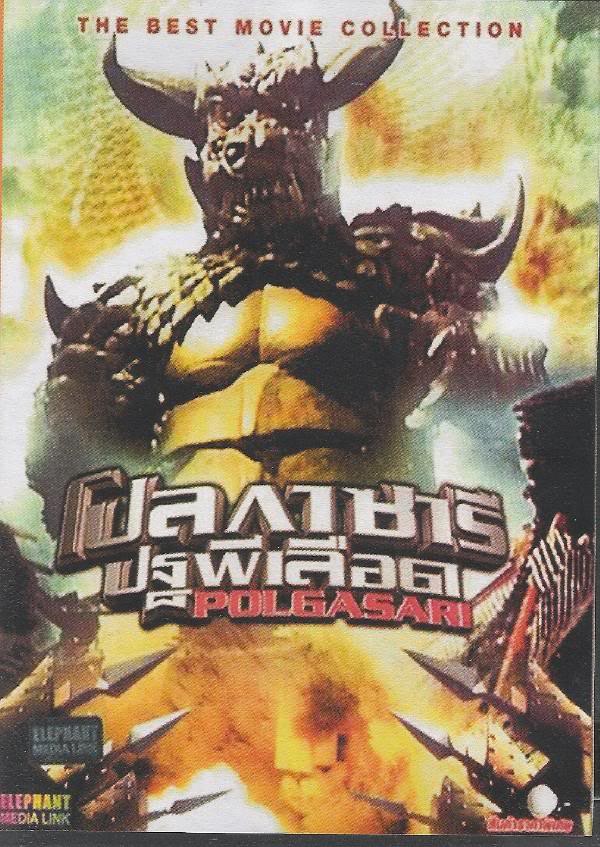
When trying to come down from the mind-searing momentum of The Stabilizer (“Situation… stabilized!!!“) Dave determined that the very best way to go was with Pulgasari. Again, a short class was required.
In 1978, Kim Jong-il, then only the son of the ruling despot of North Korea, decided he wanted to make some movies and had one of his favorite directors, the South Korean Shin Sang-ok kidnapped (Shin’s actress ex-wife, Choi Eun-hee, was abducted first, possibly to lure Shin to Hong Kong) to direct his films.
Shin directed seven films for Kim Jong-il, until he and Choi managed to flee to an American Embassy while attending a film festival in Vienna – in 1986, eight years after their abduction. This story is probably better than any Shin was forced to make under orders; I may never know, because Pulgasari seems to be the only one generally available.
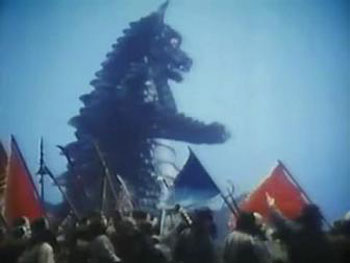
Based (of course) on a North Korean fairy tale, Pulgasari starts with the usual despotic King (but it’s okay, because he’s an imperialist despot, not a beloved despot like Kim Il-sung) crushing the peasantry and confiscating all their cookware and farming implements to make weapons. A heroic blacksmith refuses and is tortured and imprisoned. He makes a little figure out of rice and mud before he dies; his daughter pricks her finger while sewing, and a drop of blood falls on the figure, bringing it to life as the metal-eating monster Pulgasari.
The more metal it eats, the bigger it gets, and it is soon helping the rebel army take on the evil forces of the King, despite all the kaiju size deathtraps the army prepares for it. (Kim Jong-Il was also a big Godzilla fan, so it’s really kind of interesting that his kaiju flick owes more to the Daimajin movies than the Big G). Eventually the King gets smished and the people triumph, except that Pulgasari is still hungry and starts eating all the cookware and farming implements (because Pulgy represents unchecked capitalism, you see) until the blacksmith’s daughter sacrifices herself to save the villagers.
Pulgasari has a professional sheen but stolid pace; Jong-il hired technicians from Toho, including Kenpachiro Satsuma, the stunt performer who was operating the Godzilla suit in that period, to play Pulgasari. As I said, very professional, good-looking… and more than a little tedious. As Dave said after the movie was over, “I feel like I was kidnapped by North Korea.”
Something extremely insane was necessary to raise us from the Pulgasari doldrums. There was a small vocal minority that was fomenting for The Apple, to mark the passing of Menahem Golan, but it was noted that none of these people had actually seen that movie, and they were in large part the same people Rick had conned into demonstrating for The Garbage Pail Kids Movie, so they were roundly ignored. After tossing The Apple under the bus, we, for some outlandish reason (I personally blame lots and lots of vodka), went for another movie Rick had been pushing for ages: Skatetown USA.
We must note that Skatetown has never had a legitimate video release, likely because its soundtrack has a lot of really recognizable songs from 1980, marking it as being from the same era as FM and Americathon, when movies were marketing tools for what were hoped to be hot-selling soundtrack albums. Rick’s copy was apparently one of a number of nefarious versions floating around struck from a 16mm print.
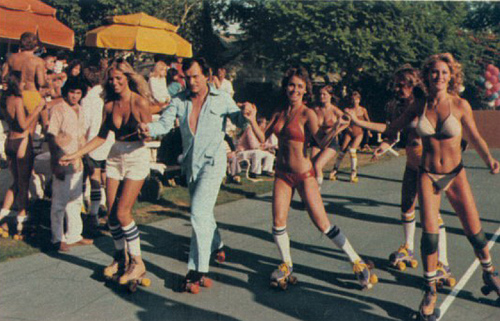
This is one of those movies that you can tell was based firmly on the Official Drug of Disco, Cocaine – and that is the only possible excuse for its existence. Roller Disco had come and gone in the time it took to make this movie, much less get it released. But let’s see what sense can be made out of what came from this cauldron of coke and something else beginning with a K sound.
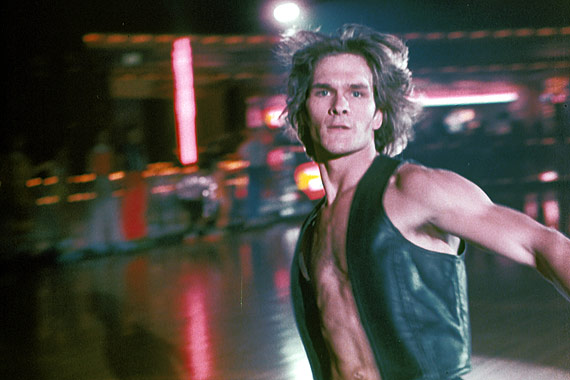
Here is everything wrong with the late 70s, in one picture.
There is this roller disco presided over by a Wizard in a white afro. It’s actually owned by Bill Barty and run by his son, Flip Wilson. Okay, I’ll wait a few minutes while you work the cramps out of your brain. Okay? Halfway through the movie, we’ll discover that Mrs. Barty is Flip Wilson as Geraldine, so that explains THAT.
NOW. There is some sort of contest held every year at the roller disco (in this wizard-run fantasy realm, roller disco has been going great guns for two years), for the best roller disco dance number, and the prize is a thousand dollars and a moped. Scott Baio is training his friend Stan (Greg Bradford) to win the contest, making them the Rocky and Mickey of this movie (Bradford actually has less range and versatility than Stallone). BUT. The fix is on, and the leader of the local gang of disco hooligans, Ace (Patrick Swayze, in his film debut) is sure to win for the second year running.
I really do not miss the days of roving bands of roller disco hooligans.
ALSO. Some illegal drugs have been spilled in a grinder so every body is getting hooked on the Most Delicious Pizza Ever (made by professional fake Avery Schrieber Vic Dunlop), including Ruth Buzzi, who is there as part of a church group to shut down this Den of Iniquity. I’m also told Joe E. Ross is in there, too, going “Ooh, ooh!” but I missed him. Also Dorothy Stratten in a halter top and hot pants. Her I saw (mainly because Rick would scream “Dorothy Stratten!” every time she appeared).
THEN. The competition happens, with Ace’s treacherous band of hooligans sabotaging all the other solo acts, led by Ace’s right hand man, Ron Pallilo as Dark Horshack. One of the contestants is a guy who, for some reason only apparent to the cocainated, is dressed like a Mexican bandito, right down to floppy mustache. He became known to us as “I Love Cocaine Man”, especially after Dark Horshack douses him with itching powder just before his number. Knowing the rest of this movie, it was probably itching cocaine.
DARK. HORSHACK.
Swayze’s entry, partnered with his belt, is actually pretty good (Swayze was a competitive skater, after all). Stan’s entry is even better (we’re told), and goes un-sabotaged when Dark Horshack is ambushed by an over-acting Bill Kirchenbauer. Admittedly, at one point, Stan does ride a skateboard while still wearing roller skates, which is sort of the Platonic ideal for skating. The fix is still on, though, and Ace wins – and it’s time for SUDDEN DEATH OVERDISCO!!!
Marcia! Nooooo!
This is a couples event, so Swayze and his main squeeze – and of course, his belt – smoke up the dance floor while Dark Horshack takes Stan’s partner out parking with a drug pizza. Stan’s partner, incidentally, is Maureen McCormick, better known as Marcia Marcia Marcia Brady on The Brady Bunch, and here, sadly enough, lapsing back into cocaine addiction, given the work environment. She is so out of it, we can’t even call her Dark Marcia, it’s more like Trash Marcia, and I just came through this movie feeling badly for her. Especially since she’s now hooked up with Dark Horshack, thanks to the drug pizza.
Ace’s squeeze defects over to Stan (replacing Marcia Marcia Marcia) and Stan wins, leading to a roller race down a pier resulting in Stan’s saving Ace’s life when a bit of sabotage goes wrong. Everybody now likes and respects everybody else, and we all go back to the roller disco for happy dancing and lots of cocaaaaaaaaaaaaaine.
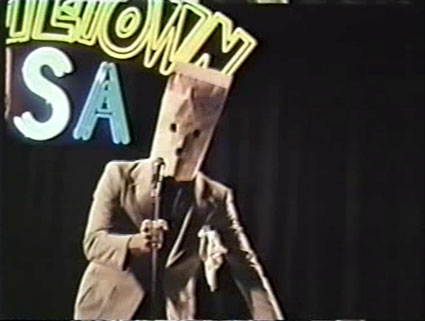
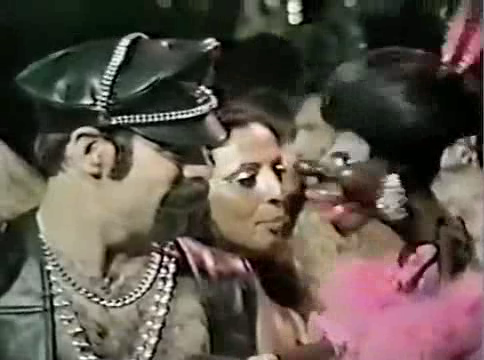
A Photo of everything ELSE wrong with the late 70s.
Scott Baio says he kept turning this movie down until they offered him a ridiculous amount of money, and he still wound up regretting it, saying “It was just a guy making a film who didn’t know how to make a film,” by which he means William A. Levey, whom we all know from (ack) Blackenstein. Case closed.
And, for all that, Skatetown USA was still accorded to be the highlight of the evening.
“The Greatest Story Ever Rolled” hahahahahaSHOOT ME
Surprisingly, this poster doesn’t lie THAT much…
The rest of the wusses headed out, leaving only Rick, myself and Dave, who then proceeded to tempt me with a movie with which I was unfamiliar. A Philippine flick featuring Vic Diaz and Sid Haig, Wonder Women. “Sold!”
Ross Hagen is Mike Harber, who is hired/blackmailed by Lloyds of London to find a missing jai alai star player, only to find that he has been kidnapped by Dr. Tsu (Nancy Kwan) for spare parts in her organ-legging operation. She offers youthful, strong body parts (and in some cases, total brain transplants) to rich old men to finance her other… stuff, I guess, including her army of mini-skirted murderesses. Harber isn’t shy about mowing them down with his sawed-off shotgun, either, when they shoot at him, which is often.
Vic Diaz, the patron saint of Philippine exploitation movies, plays Lapu Lapu, the driver of a fantastically pimped-out taxi who serves as Harber’s guide. Sid Haig, on the other hand, has a pretty uncommon role, as Dr. Tsu’s lawyer and organ broker, given to suits and shirts with enormous ruffles. Dr. Tsu has some failed experiments in cages (which I immediately dubbed “Mew-tants”), and if you think they’re going to eventually get loose and start roaming the compound, get yourself a cookie from the Crapfest jar (You can’t miss it, it looks like Vic Diaz). There is also a really good chase scene using those tricked out taxis through crowded streets – very Bondian.
Because Dave demanded (and supplied) it: a picture of Dr. Tsu’s operatory, including surgical scrubs by Glad®, all the better to continue showing off their kicky miniskirts and go-go boots:
Past that, though, there isn’t that much to remember. It seems an unnecessary remake of The Million Eyes of Su Muru, but what the hell, badass babes in miniskirts provides a good cooling down period. Oh yeah, Dr. Tsu has invented something called “Brain Sex” so you can also throw in ripping off Barbarella to the list. And the assassination at the cockfight from Man With the Golden Gun. And… oh, never mind, this piece is already too long.
So we woke up Rick (“I tried. I really tried.” “But what? It wasn’t bad enough?”) and went on our weary ways. It was a good Crapfest. You can tell a really good Crapfest by the way it eats holes in your memory, rendering you unable to be totally certain that you really saw what you think you saw. So we leave you with the two things that make the world go ’round:
ZAP!
and
(Dave worked hard on that. Feel free to praise him, or pity him.)
This will be quick (I hope), because I’m tired, tense and not a little angry. None of these are good by themselves, and in concert, they feed on each other relentlessly. I also have quite a bit to do.
These Three Horsemen of Negativity are headed up by their leader, also known as Freelance Work. Or to be precise, the freelancer’s plight – completing one’s work in a timely manner, whereas the payment for same is, shall we say, lackadaisical.
I’m either stressed out or getting scanned. Getting scanned would be preferable.
“Our Accounts Payable person takes July off.” Thankfully, that sentence was not followed with, “Is that a problem?” because I would have had to answer that. The bigger paycheck which is causing bigger stress… well, I can take the tack that every day I don’t find it in my mailbox, it is made more probable that it will be there the next day, right? It is one of the vagaries of the postal system that if I send a card to my mother (or vice versa) who lives 100 miles away, it gets there the next day, which is pretty remarkable, when you get right down to it. But if I am mailed a paycheck from downtown Houston, which is 15 miles away, it takes a week or more to get to me. That is a completely different form of remarkable.
I try to impress upon myself that the bills that were due are paid. We aren’t starving. We have a roof over our head. I have enough money to pick up my blood pressure medication tomorrow. It could be worse. It’s been worse.
Still. Tired. Tense. Angry.
I’m entering into one of those lop-sided hell weeks full of city meetings. Have a writing deadline, No shows this weekend, a financial hit that makes that missing paycheck from downtown even more important. That does, however, mean the freedom to have a Crapfest this weekend, which will soothe some hurts. Likely won’t get to write about it until next Wednesday, though.
Last Saturday, I hit critical mass. There was just too much hateful stupidity being thrust at me from all directions, and it was time to walk away from social media. @rstevens, the creator of Diesel Sweeties, one of the most consistently smart webcomics out there, put it best on Tuesday:
Go to that URL. Buy his stuff.
And let me tell you: going to Netflix and watching old episodes of Forensic Files is not going to help you get rid of that gloomy “What the fuck is wrong with people?” feeling. Quite the opposite. Protip, and all that.
And sweet Jesus, it’s an election year.It’s only going to get far, far worse. I’m either going to be a saint or a sot by the end of the year, and I know which one sounds more worthwhile.
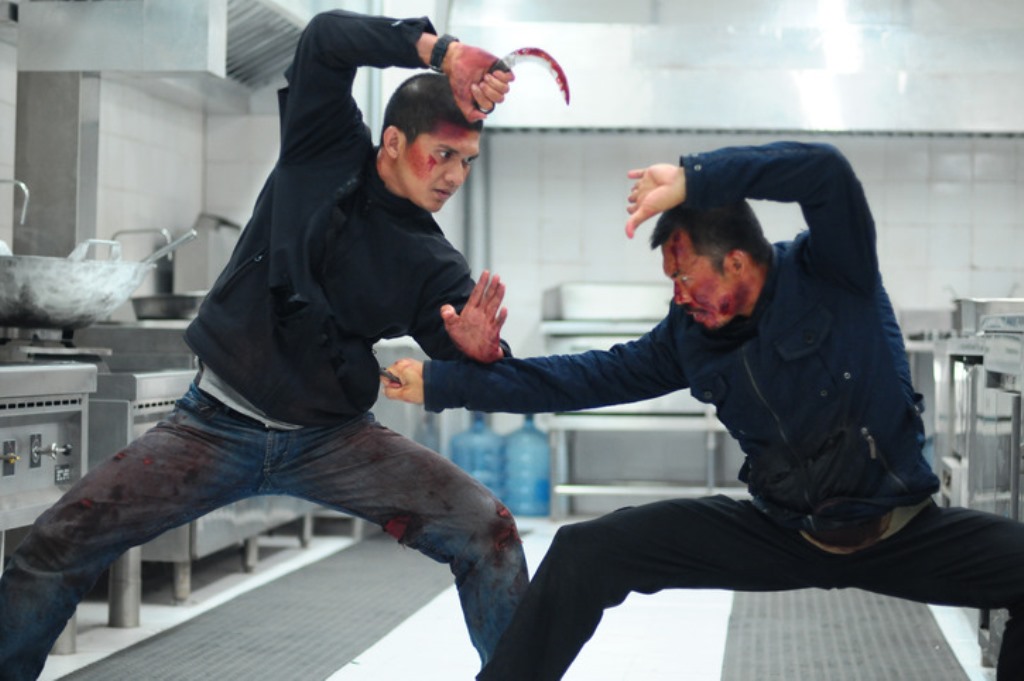
Oh, yeah, you probably want to hear about movies. I saw Guardians of the Galaxy. It was good. I only gave it four stars out of five, but it was fun, and left plenty of room for the sequel that was announced like the day before it freaking opened. The only real flaw, past an overly familiar storyline, was, once more, fight scenes where I could only assume what was going on. On the extras for The Raid 2, Gareth Huw Evans, who is one of the best action directors now living, refers to that as “hearing a good fight scene, not seeing it”.
Past that, it has fun. It has a hero who is “not 100% a dick” – and in fact, has a tremendous amount of heart. What I wasn’t expecting was the movie itself to have so much heart. Almost all our title characters are dealing with grief in one form or another, and they find out they don’t have to deal with it alone. That’s a good message. I will endorse it.
The fact that stuff goes boom a lot is a definite bonus.
So see you next week folks. I’ll try to be a lot snarkier, if not happier.
Yes, my writing contract is finally renewed/resurrected/whatever. No, my entry did not win the focus group sweepstakes. I’ll still be writing it, as the scope of the project has expanded. I’m being literally literal about that: My entry, which was once a diverting little Twilight Zone-type yarn, has suddenly become an end-of-the-universe tale. Trying to wrap my head around that has been… entertaining. The conflict which the story’s previous version was based upon now seems rather trivial. Except the characters are the same, and it’s not trivial to them.
I’d be in more of a tizzy if I hadn’t just spent a half-hour at the local washateria (turns out 25 year-old washing machines can suddenly decide to just not work. Who knew?) and that half hour was spent with MP3s blaring through earbuds and yours truly scrawling out four pages worth of handwritten story notes. This might turn out to be not so bad.
Many times I find I can come across the solution to a problem by not thinking about it. So I didn’t think about it by watching a couple of movies that were pretty much diametrically opposed in their audiences, except where those two audiences intersected, ie., me.
The first was The Raid 2. I have rhapsodized about its predecessor and its predecessor’s predecessor, so this was inevitable. I was down with the flu the one friggin’ week this was playing at cinemas, thanks a lot Sony. Finally, it came out on blu-ray – of course, the month I was beyond broke. Thank God for Next Projection and a promotional giveaway, which I won, and was finally – finally! – able to watch it.
The words holy and shit get used a lot when you’re watching The Raid 2. Also ow and oof and gaaaaaaah. If you consider The Raid and The Raid 2 as one long story – which it is – and if you get a bit delusional and consider that one long story to be a toothpaste tube, with plot being the toothpaste, then all the plot toothpaste got squeezed over to the Raid 2 end. If you want to find any nits to pick, it would be that the plot is very familiar.
The Raid‘s Rama (Iko Uwais) finds out that surviving the first movie has put himself and his family in real danger. There is a very large portion of the police force that is corrupt, and he finds himself on a very small task force that is bent toward taking the bad cops down. To this end, Rama is sent to prison to get close to one of the mob boss’ son (Arifin Putra). After two years in prison, Rama is released and joins that gang, just in time for an upstart mobster (Alex Abbad) to start a gang war.
That’s a setup we’ve seen many times, from numerous Hong Kong dramas to the TV series Wiseguy. There are certainly enough top-drawer fight scenes to keep holdover fans from the first Raid interested (hell, Rama basically beats up a wing of his new prison home barely 14 minutes into the film), but the final hour of this two-and-a-half hour movie shifts into action movie overdrive, becoming as tense and relentless as the first movie, and culminating in a seven minute-long hand-to-hand fight scene that had yours truly (hardened veteran of more martial arts movies than you’ve had hot meals) curled up into a ball in his easy chair, with a pained grimace on my face.
After three movies which I have loved, there is no doubt in my mind that Gareth Huw Evans is one of the premier action movie directors of our time. He is aided in no small part by Iko Uwais and Yayan Ruhian (who was killed as Mad Dog in the first movie, and returns as another off-kilter assassin in this one), who have formed the core of his repertory company as actors and fight choreographers. It’s surprising how these two, basically martial artists, have developed into such good actors (a quality evident in the team’s first movie together, Merantau). Iwais in particular has magnetic star quality.
I anxiously await the next one. I’ll still have these three movies to keep me warm (and grimacing ow!) until it arrives.
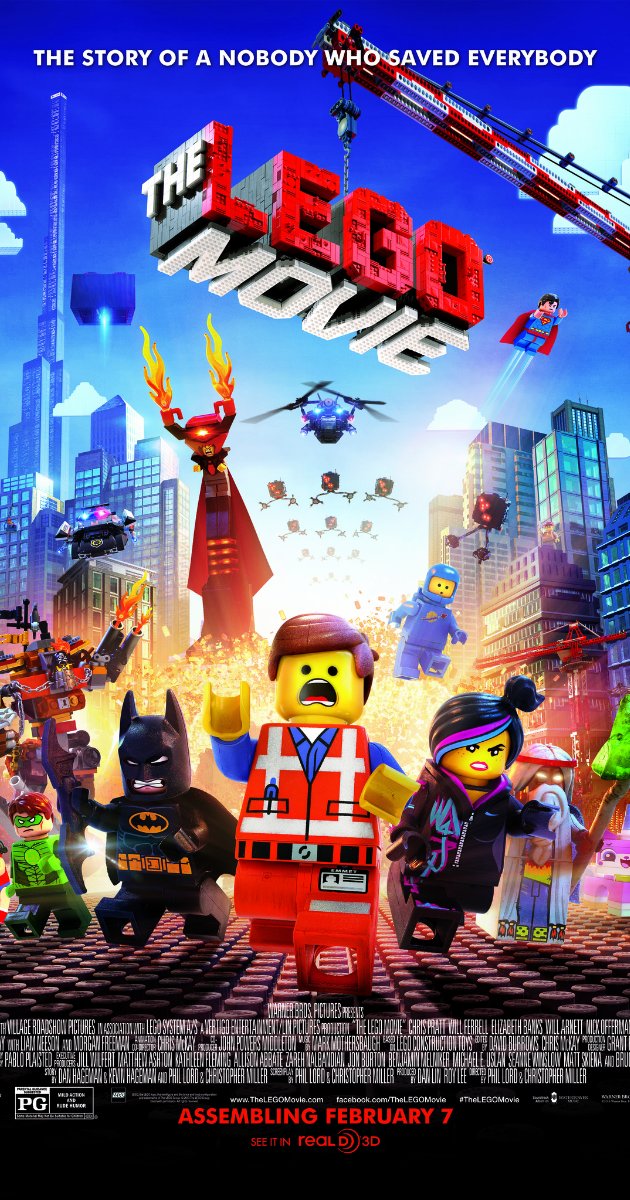
Now, to grind the gears as we do a bootlegger turn of the imagination: The Lego Movie.
This was something of a surprise hit earlier this year when released in February, traditionally No Man’s Land for movie openings. Once again we have a terribly familiar plot: a prophecy, a doomsday weapon, the Chosen One, the Hero’s Journey. But The Lego Movie has a lot of silly, satirical fun with that increasingly misused plot. The creativity on display is bracing, with little details proving the care the animators put into this. The dazzling, shared Lego universe provides for a lot of surprising cameos, and it’s all such infectious fun I really resented it when the Real World intruded on the story. But that was unavoidable, I suppose, and it does give rise to the best ending twist I’ve seen in a long time.
One of the best reasons to watch it is to consider that the movie’s villain is named Lord Business, which meant that every right wing pundit in the universe was decrying it as an anti-capitalist movie. Right. A movie based on a highly successful toy line and a marketing tool for that highly successful toy line is anti-capitalist. Pull the other one, idiots.
I’m not saying anymore about the movie itself; this is a joy of discovery type movie. If you’ve seen it, you know what I mean. If you haven’t, you should do so at your earliest opportunity.
Thanks to my piecemeal work, there usually arrives each month a Hell Week, when everything happens at once, and I have absolutely no free time. This past week has been that week for July. Tonight will be my first and only evening off, and the question is will I catch up on work in other areas or just relax, by which I mean possibly watch a movie.
July hasn’t been a great month. July is never a great month. It’s the first month you realize you’re really working for the electric company. We’ve already heard me gripe and moan about the Independence Day festivities, and this year’s was a corker, with a storm cell blowing up an hour before the parade start, causing all video equipment to quickly be bundled inside; there was still a parade (although one float had been destroyed by the storm) and I was one of the lucky few to be manning a hastily set-up camera.
But hell, I got a free T-shirt.
After a week of private shows and city meetings, today’s entry on the extra side of the ledger is a writer’s meeting, which is good, because it means my contract goes off hiatus and I can stop calculating gallons of gas versus eating lunch, but it also has a dark side because, yep, even less free time. But I can stop fretting over the bills for a brief while.
Periods like this always create an urge that itches away in a unscratchable portion of your brain, a feeling that something has to change, but the feeling comes with no real idea how to accomplish that change. I’m not going to walk away from my Day Job, only found almost by accident after a year of unemployment. It may only be part-time, but it’s work I enjoy in a field that is not terribly friendly to a person my age. Given all my other responsibilities, including the about-to-be-reactivated writing contract, seeking another part-time job was not feasible. That left Publisher’s Clearing House sweepstakes and precious few other options.
Notice what’s missing?
Another area of desired change is my methodology for watching movies, and, again, no real idea how to effect that change in current circumstances. Last year, I did a couple ofmovie-watching challenges (and one this year), and I find it takes a terrible toll on me: I seem to want to take a day or so after watching a movie to consider it, to glean what I have taken away from the experience. That’s the part I have no idea how to change, but if I do not… well, there is no way in the world I am going to get to watch every movie I wantanyway. Treating each movie like a pebble that has to be thrown in a rock polisher for several days to be fully appreciated is just cutting that available time down even more.
So yeah, the only solution I see is to become suddenly, undeservedly wealthy and spend the rest of my days doing nothing but watching those movies. And then having the rest of those days cut short by congestive heart failure because I’m doing nothing but sitting in my easy chair watching movies.
So that’s a less than ideal solution. (Though I’d be lying if I said it didn’t appeal to me on a certain level)
There is also the killjoy section of my brain (which is quite highly developed, it seems) that points out this is rationalization on my part, to make up for not having time to watch all the movies I like. (“Hey, remember when you watched The Red Shoes and The Searchers the same day? You weren’t whining then.”) I’ve had evenings free when I did not watch a movie, but killed time on Facebook or watching murder investigation shows on Netflix. Those nights rankle when I am too busy to watch a movie; they feel like squandered time and wasted opportunities, but downtime is so necessary.
So, in the final analysis, one does what one always does, I suppose. Muddle through, hope for the best, and remember that surely there was some freaking reason you bought that four-hour cut of Heaven’s Gate.
Jodorowsky’s Dune started making waves on the festival circuit last year, and the more I heard about it, the more I wanted to see it. Here’s the short version, if you’re scratching your head: the celebrated surrealist filmmaker Alejandro Jodorowsky (El Topo, The Holy Mountain) tried, in the 70s, to make a movie version of Dune. This documentary tells that story.
That brief synopsis, though, gives you no real idea of what is waiting for you in this film. I placed my new blu-ray in the player, ready to find out – and found I had the first defective disc I’d encountered since switching to blu-ray several years ago. An exchange was managed easily enough, but it was then late Saturday night before I got the chance to revisit it – and it turned out to be exactly what I needed, at exactly that time and place. And that is so Jodorowsky.
I had been aware of the plans to make Dune – I think they were dutifully reported in Heavy Metal magazine, because, after all, Moebius was the first of Jodorowsky’s “spiritual warriors”, and because it was Jodorowsky. In the 70s, I had only the vaguest idea of who this Jodorowsky chap was; I had read about El Topo, but in the cities where I lived, Midnight Movies were composed mainly of all-night Beatles marathons and the occasional screening of Dawn of the Dead or 200 Motels. By the time I moved to a major metropolis, screenings of his work had become rare. For many years my only experience was Santa Sangre, which was marvelous, but not prime Jodo.
So watching Jodorowsky’s Dune was like revisiting those breathless dispatches from thirty some-odd years ago, when this insane artist was trying to make an insane movie and was gathering other insane artists into that purpose.
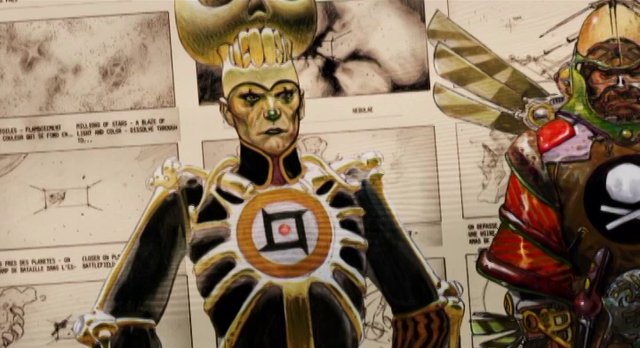
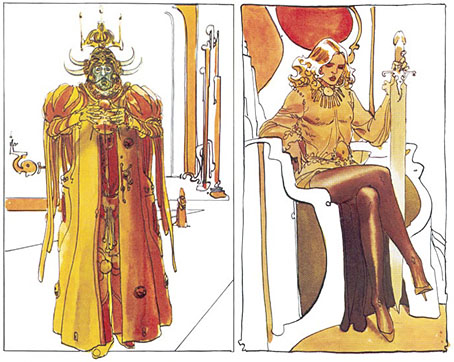
I mentioned “spiritual warrior” earlier, and that is precisely how Jodorowsky viewed his collaborators. His movie wasn’t just going to change movies, it was going to change viewers’ very consciousness. Jean Giraud, aka the amazing French comic artist Moebius, was his camera from the very beginning, dashing out storyboards and costume designs at breathtaking speeds. Douglas Trumbull, fresh off 2001 and Silent Running, was turned down for not being ideally spiritual, and a chance viewing of Dark Star netted the next warrior: Dan O’Bannon.
And so it goes. In a series of interviews, these warriors tell about their being brought into the project; Chris Foss, for spaceship design, a Swiss artist you may have heard of, named H.R. Giger, for the design of the fascistic and depraved Harkonnen clan. But the bulk of Jodorowsky’s Dune is told by Jodorowsky himself, and his tales of the recruiting efforts are marvelous, the stuff of legend. Casting David Carradine as Duke Leto, meeting Mick Jagger at a party and asking him to play Feyd Ruatha on the spot, and getting an immediate “Yes.” Onto the trials of getting agreement from his two dream castings, Orson Welles for Baron Harkonnen and Salvador Dali as the insane Emperor of the Galaxy.
Jodorowsky also planned to have different musical groups compose the music for each House and the systems they controlled: Pink Floyd for House Atreides, Magma for Harkonnen. No mention is made for who would be the group representing Arrakis, the title planet, but one can safely assume it wasn’t Toto.
As we all know, in this Universe, the movie didn’t happen. No studio was willing to put money into a massively expensive movie made by a madman they knew nothing about. (The budget was something like $15 million dollars – quite a chunk of change in those days, but then, Jodorowsky wanted to do things in 1975 that Industrial Light & Magic would not even attempt to do in a live action movie today. Some of the most impressive sequences in Jodorowsky’s Dune use limited animation to bring some of Moebius’ storyboard and Chris Foss’ designs to life)
Also humorous (in a bitter, twisted sort of way) was the concern that the movie would be too long, and it was requested that the script be cut down to an hour and a half. How long was the last Transformers again?
A movie of Dune was eventually made, as we all know, and it also one most people despise. I need to give that one another shot eventually (but not anytime soon). Jodorowsky’s version would have digressed further from Frank Herbert’s novel, but both have virtually the same denouement, the greening of Dune, instead of the open-ended nature of the novel, leading to many sequels. Movies must end, after all.
Jodorowsky’s Dune then goes on to point out how the Greatest Movie Never Made contributed its DNA to many, many movies in the coming years; the most obvious, the disappointed Dan O’Bannon gathering up some of his fellow spiritual warriors for Alien, but other examples resonating right up until the present day. Pretty awesome, really. When it is put forth that if Dune had been made, and if it had hit it big instead of Star Wars… what would be the state of cinema today?
I said this was what I had needed, at this particular time. I was exhausted after two shows, in pain, the torment of two audiences watching a comedy physically resisting the urge to laugh out loud, all exacerbated by a triple low in the ol’ biorhythms. I was a sullen mess, but watching Jodorowsky exult over the details of a dream project that came this close to reality, the fond reminiscences of the artists he recruited, and his enthusiasm for what he tried to achieve – again, almost four decades after the fact – is exhilarating and beautiful.
It’s impossible to watch Jodorowsky’s Dune without falling at least a little in love with Alejandro Jodorowsky, and falling in love is something we all need to do a little more.
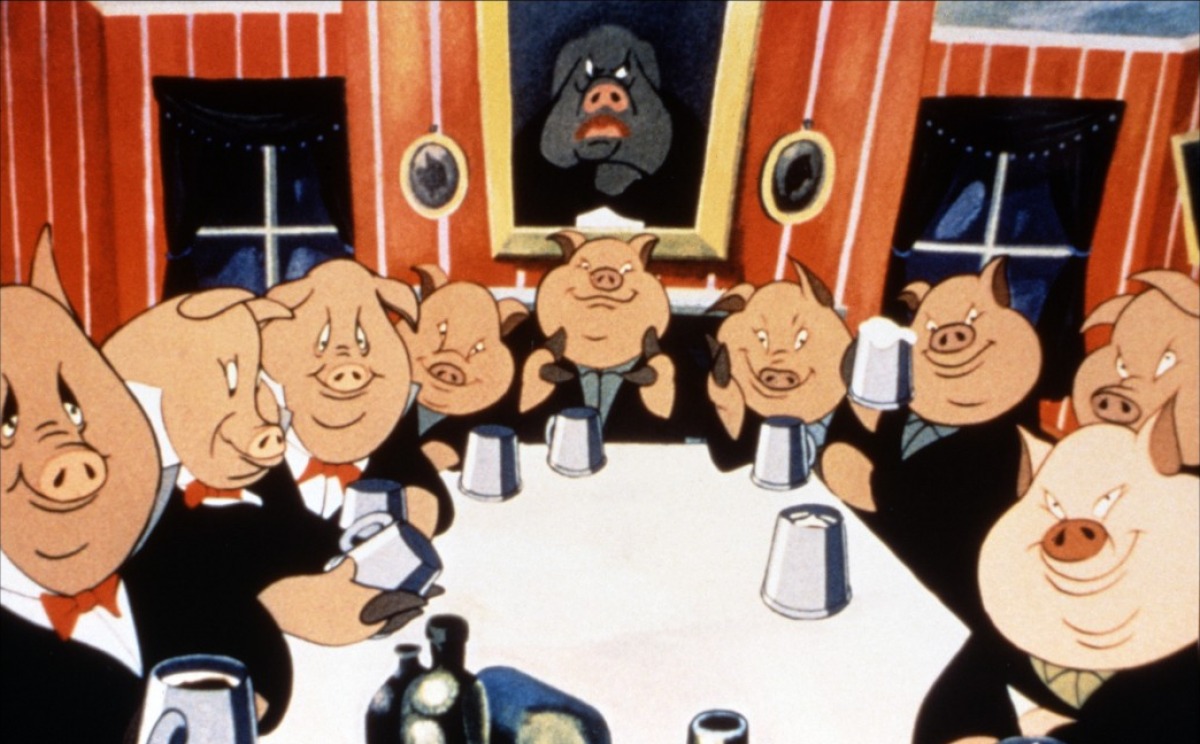
There’s a pretty fair chance that if you went to high school, you wound up reading George Orwell; in my case it was 1984, but another standard was Animal Farm, a fable that retold the Russian Revolution and creation of the Stalinist dictatorship using the livestock at an English farm as stand-ins. I couldn’t with any reliability tell you if this is still the case, but it certainly was when I was in high school (it will also tell you when I went to college, that I am going to mistakenly type the title as Animal House several times before this is finished). Since its publication in 1945, Animal Farm has never gone out of print; would that this 1954 animated version had been so widely available.
Basically, Manor Farm was once a going concern, but as the story begins, its owner, Mr. Jones, has “fallen on evil times, and worse, into bad company”, spending his evenings at the local pub and abusing the animals when he comes home drunk. An ancient and revered hog, Old Major, rouses the animals to revolution on his deathbed, and confronted by a barnyard united against him, Jones flees. He returns with friends, who are similarly chased off, though at a cost – the farm dog is killed, leaving behind her orphaned pups.
The animals make a go of turning the farm around, led by the clever pigs. They have a system of laws, food is plentiful (though the first winter is rough), in general, a worker’s paradise. Unfortunately, the cunning pig Napoleon has been plotting some time, and having raised the orphaned dogs as his personal shock troops, has the idealistic pig Snowball killed… and thus begins the slow corruption of the re-christened Animal Farm.
It’s interesting to note the differences between the book and the movie; the movie is pretty well-considered, compressing some events and omitting others in an effort to engage audiences. There’s a fair amount of humor in the first half, that a lot of people point to as “Disney-fication”, and likely the work of Animation Director John Reed, an import who had worked on several Disney productions, including Fantasia and Three Caballeros. The sight gags are nowhere to be found in Orwell,of course, but provide a light backdrop for the grimness that will come.
And grimness there is. The movie does not shy away from death, though we are spared the worst of it. The assassination of Trotsky is played out as Napoleon literally setting the dogs on Snowball as the prelude to usurping the leadership of Animal Farm. We hear it, though; ditto the execution of the animals involved in an abortive uprising against Napoleon. You may have been suckered into thinking this was Disney at the beginning of the revolution, but this is the aftermath, baby, and it ain’t for children.
Halas and Batchelor Cartoon Films is not a well-known outfit in America; they were largely known for industrial animation, and especially for propaganda shorts made during World War II, a background which positioned them ideally for making a movie out of Animal Farm. The idyllic landscapes have a watercolor beauty which would not be out-of-place in a rival Disney production, to be sure, but it’s the darker, grayer palette of the farm scenes, expecially in the second half, that memorably reinforces the message of the source material. John Halas was a Hungarian emigré who had been trained in design by the Bauhaus school (the Batchelor part of the equation was Joy Batchelor, who began as an assistant but eventually became his wife). That adds a certain Central European flavor to the animation, which also helps to render it distinct.
I should also mention, while we’re talking about propaganda, that the worst-kept secret in the world is that initial funding for the project came from the CIA. Take that, Commies! That possibly led to the other great departure from Orwell’s novel, the ending, where the animals finally have enough, and march on Napoleon and his fellow suit-wearing pigs in a second revolution. Perhaps it was hoped that copies of the movies smuggled across the Iron Curtain would foment similar unrest; more likely it was the desire to give the movie a more upbeat ending than the source novel, where the animals realize they really have it no better than before, and possibly worse.
Then, as we learned in Battle of Algiers, revolution is a long time coming. The Berlin Wall fell in 1989, forty some-odd years after this movie. To say that the new ending to Animal Farm is in any way responsible is absurd, but it has to be admitted that whoever insisted on it was aware of the cycle of history, if not the realities of human nature.
Another facet of the production definitely worth noting is the voice talent of Maurice Denham, a radio actor who supplies all the voices in the movie, save that of the narrator, Gordon Heath, who was a BBC newsreader. Denham has a wide range of well-considered voices at work here, often making you suspect that someone is fibbing about the solo talent. The score by Matyas Sieber, another Hungarian and longtime collaborator with Halas and Batchelor, has a unique flavor, often using instruments not usually found in movie scores, such as the off-kilter accordion used for the drunken Farmer Jones.
TNT produced a live-action version of Animal Farm in 1999, doubtless made possible by the success of 1995’s Babe, and using the same technology. It was even more widely criticized for variances from the source, and though a much higher-caliber roster of voices lent their talents to the effort, it is still Denham’s version of the animals that lives on.
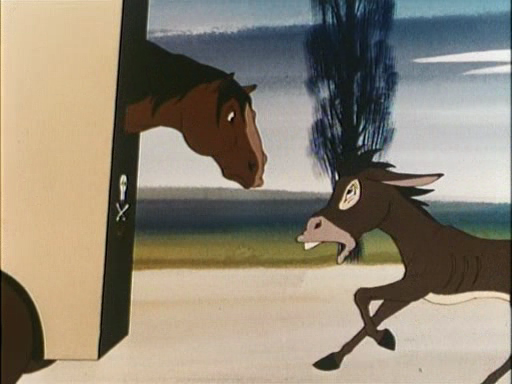
Though I haven’t seen this version, I am certain I would still prefer the animated one; many of the aspects of Animal Farm are heartbreaking, like the eventual fate of Boxer the draft horse. Hero of the Revolution and hardest working animal on the farm, he is injured in the second great battle with the humans, and eventually unable to work. While the other animals are rebuilding a windmill the embittered Farmer Jones had dynamited, the villainous Napoleon sells Boxer to a glue factory in exchange for a crate of whiskey.
Seeing that transpire, even with animatronic models of real animals, would outright kill me. It was bad enough watching it happen with drawings. And that, good people, is the power of a well-made movie, animated or not.
If there is one thing that I have taken away from this outing – and that is besides the fact that I now want to see more of the Halas and Batchelor output, like their 1966 version of Ruddigore – is that their studio made the 1966 Lone Ranger cartoon, which was strikingly different visually from any other cartoon broadcast on Saturday mornings, much darker, and stylized. It has since vanished into undeserved obscurity, and dammit, I want to see them again.
If you’ve been with me for any length of time, you are familiar with the phenomenon of the Crapfest. A group of us gathers every two or three months to gasp in wonder at the vast world of the Cinema of Diminished Expectations. Or, ofttimes, to simply gasp.
We had a full complement this time, saving only The Other David, who was healing his voice for an upcoming musical, and felt that shouting in dismay would be counter-productive to that. Fair enough. Break a leg, friend. This left us at myself, Rick, Paul, Alan, Mark, Erik, and your host, Dave.
While planning for this shindig, Host Dave informed us, in the tone usually reserved for doctors telling you to lose weight, that the agenda for this Crapfest had been decided long ago. (Maybe I should have said “In the tone usually reserved for the Lawgiver telling us The Prophecy”, but I’m going to need all my prophecy jokes for later) To that end, he laid out this pre-conceived roster.
I’m going to have to take some blame for the first feature. You see, once upon a time, we tried to limit the scope of a Crapfest to a single luminary in the realm of Crap Cinema. That luminary was Graydon Clark, and that was a mistake of Biblical proportions. Too much of a bad thing, as it were. But at the very beginning, there was a choice to be made, between Angel’s Brigade or Without Warning. The deciding vote came down to Paul, who reasonably enough, deduced that since Rick “Let’s watch Evilspeak again” Mantler had voted for Without Warning, it was only logical to vote for Angel’s Brigade instead. This was wronger than any deduction Dr. Watson had ever made, but I really can’t fault his logic.
So there was this time I bitched that I was still owed a viewing of Without Warning. So that was our opening salvo.
I think I’m not exactly engaging in spoilers when I tell you Without Warning is about an alien coming to Earth and hunting humans with little flying creatures he throws like frisbees, and yes, this was seven years before Predator. The major difference between the two is a) millions of dollars and b) Predator manages to fill its running time pretty well. The Alien spends the first part of the movie knocking off celebrity guests, or at least affordable C-listers of the era, starting with Cameron Mitchell and moving on to Larry Storch, playing the master of a cub scout troop. Storch was only on set half a day, and it seems to play out in real time.
Our protagonists are four teens who ignore the warnings of Professional Harbinger Jack Palance to not go to the lake, there’s trouble there. Half the teens become frisbee kibble fairly quickly, and since one of them is a young David Caruso, the Alien got a standing ovation. The other two (Tarah Nutter and Christopher S. Nelson) try to get help after discovering their pals and several other corpses in a remote shack. They find a believer in Martin Landau, playing a mandatorily shell-shocked veteran called “Sarge”, and, of course, Palance. The bar where they try to get help is notable for featuring Sue Ann Langdon, Neville Brand, and Ralph Meeker (in his last role, no less), none of whom stick around for the big alien fight, such as it is. They leave that to future Oscar winners Landau and Palance.
There is an interminable period at the end of the second act and before the third, sort of an eternal entre acte, where our two teens, on the lam from the increasingly psychotic Landau, break into somebody’s vacation home and set up shop. Nutter keeps waking up screaming and saying things like, “What if this is Sarge’s house?” which allowed us to kill the next ten minutes of filler with panicked questions like “What if snakes can carry knives?” “What if Zamfir really is master of the pan pipes?” and “What if Iron Man had Spider-Man’s powers?”
If there was one takeaway from this, it is that I wanted to make sure I didn’t buy the upcoming blu-ray from Scream Factory out of misguided nostalgia. MISSION ACCOMPLISHED!
The Alien, incidentally, is played by the 7′ 2″ Kevin Peter Hall, because of course he is. And Hall would also play the title character in Predator. Also, Mr. Hall is not finished with us yet, because we are moving on to Prophecy, for which I must also take some blame. You see, back a year ago or more, I reviewed the French movie Prey, noting that it was basically Prophecy with mutated wild boars instead of a bear. I also mentioned I had never seen Prophecy, because I’d read David O. Seltzer’s novel, and immediately thought, “well, I can miss this one.”
To which Dave was all like whaaaaaaat and you are watching this.
Dammit.
Well, we already know about the mutant bear. Robert Foxworth is a two-fisted doctor concerned with social justice issues (as we find out in an opening scene set in a ghetto with the cleanest, freshest spray-painted graffiti you have ever seen), who is sent to a northern paper mill to investigate charges of pollution. The charges turn out to be true, as the whole region is lousy with mercury, which Foxworth assures us has “mutagenic” qualities. This is going to produce some tension in his wife, Talia Shire, who is pregnant, she just hasn’t bothered to tell Foxworth yet.
Extra risibility is supplied by Richard Dysart as the front man for the paper mill, essaying a cagey mix of Pepperidge Farm spokesman and Edward G. Robinson. And Armand Assante as an Indian.
The most famous scene in the movie was quoted in the TV trailer, when the bear attacks a family campsite and a kid tries to hop away in his sleeping bag, only to be dashed against a rock in a flurry of downy feathers. This also convinced 1979 Me that avoiding this movie was a good idea. There is no way anybody thought that was going to be anything but laughable, right? Especially when you consider the movie is directed by John freaking Frankenheimer.
Frankenheimer would say in later years that the movie would have been better if he hadn’t been at the height of his alcoholism during its shooting. The truly lamentable thing is there are moments in this movie that are superb. Foxworth examining the camp site where the exploding sleeping bag took place, and finding enormous claw marks on a tree, and then realizing that the claw marks go fifteen feet up the tree.
The best sequence for me, though is a bit later. Shire finds some mutant bear cubs in a fishing net nearby. One is still alive, but barely (no pun intended). It’s in recovering this cub that Foxworth spends too long, and his helicopter ride is socked in by a storm. They make it to an Indian hunting village where Foxworth labors to keep the cub alive until Dysart and the Sheriff can come and see proof of the pollution. Trouble is, Mama Bear also shows up and wants the cub back.
This is the second great monster movie sequence, when our name actors (plus one or two more) take refuge in a tunnel under one of the tents to hide from the beast and all they can do is listen to the screams of the men still above ground as the monster kills them. Then, silence. Silence for way too long. But who’s going to look out and check?
So that day on the set, Frankenheimer only had half a bottle of Scotch, or something.
We’re building up to a big showdown with Mama Bear (even the most city-slickerish among us was yelling “Leave the bear cub! PUT IT THE HELL DOWN!” but movie characters never listen), which is… okay, I guess, but has nowhere near the tension it wants to have. It’s kind of like the end of the novel Jaws where the shark suddenly succumbs to all the damage done, but we’re led to believe it’s Foxworth stabbing it with an arrow over and over again. Also, the last shot shows us there’s another mutant bear wandering around, so fuck you, movie.
Oh, yeah, I forgot to mention that was Kevin Peter Hall in the mutant bear suit. See? Connections are everywhere.
The worst part was when I got hungry and mentioned to Rick it was time to start dinner and I was going to help Rick in the kitchen because it was like my idea, but Dave was like, no, motherfucker, you get in there and you watch this movie.
DAMMIT.
I don’t mind crap monster movies – hell, in a way, those are my life. But crap monster movies with a painfully earnest social relevance angle – those hurt me.
Speaking of hurt, I had been saving hurt up for a long time. The Garbage Pail Kids Movie, Batman and Robin, Highlander II The Goddamn Quickening. I let that all out with something that had been dredged up by the Drive-In Mob: Bob Hope’s 1976 TV special Joys.
Supposedly, someone has lured a bunch of comedians to Bob Hope’s place to murder them all. You see, it’s Joys because Jaws was really big, and… the murderer is… kinda… like a shark? But not? This is about the level of writing here; you have several roomfuls of comedians – just look at that list on the IMDb page – and none of them are allowed to do their schtick, outside of Arte Johnson obviously improvising a few and Don Rickles calling people a hockeypuck. Because that many comedians in one place? That would be hilarious. Too bad what they’re given is the most insipid jokes 1976 could dig up. Most disheartening is Groucho Marx, frail and nearing death, not even bothering to pretend he isn’t reading cue cards and still making me laugh. Though Kevin Peter Hall is not there, Larry Storch is, and we also have to deal with disco era Don Knotts and Don Adams.
And commercials from Texaco, which assured us it was working to keep our trust.
Oh, the hatred that was cast my way! Hatred which I fully deserved, but I felt much better for having given vent to my spleen. And then Dave retaliated magnificently with Playboy’s Roller Disco Pajama Party, which actually aired on ABC in 1979, even though it sounds like an SCTV sketch. I could only look across the room, give him the thumbs up, and say, “Respect.”
Yes, this is a documentary about frolicking in the Playboy Mansion. Richard Dawson is there to make you cringe, and there were lots of astoundingly beautiful women which just about every man in the room had seen naked (I profess admiration of a sort for the guys who could name each and every one of them, even when they weren’t being introduced). Roller skating, and dancing to Village People songs we had never heard.
Rick’s haunted voice came from the back of the room several times, stating, “This isn’t going to get any better, you know. You may think it is, but it ISN’T.” But I was enjoying myself. Pretty women are pretty women, and there were quite a few here.
FILTH!
It had its educational points, too: we’d had no idea that there was a disco version of Pink Floyd’s “Have A Cigar”. Nor did we know that Waylon Flowers had a black version of his Madam puppet. (My reference source for all things gay, long-time theatre friend Rodney Walsworth, informs me the puppet was named Jiffy, and he saw Flowers perform with her at a club). The clip below has a glimpse of Jiffy, but sadly does not seem to have the bit where Flowers attempts to work his sassy black puppet magic on Jim Brown, who is visibly counting to ten several times just to keep from jamming this puppet up this little peckerwood’s ass.
No, here is this hunk of the show – the whole damn thing’s on YouTube, folks, it’s easy enough to find – that has the high point for us. About 13 seconds in, after a Mork and Mindy promo, is the 30 second throw to the local newscast coming on after Roller Disco Pajama Party, and it’s obvious the station has been getting a lot of calls about the show…
We really wanted that guy to come back.
A scene from True Detective, Season 2
You don’t have to watch the whole thing, or maybe you do, because you’ll catch a brief glimpse of Marjoe Gortner at the party (he got applause. I love my homies.), the aforementioned Jiffy, Richard Dawson referring to index cards as he interviews some Playmates, and likely the most skin you’ll see in the whole enterprise. Just enough to make our gathering feel all cheated and hollow inside.
Not me, though. I went home feeling purged, cleansed of all the negativity that had been weighing on me. Such is the power of inflicting crap on your fellow man. This feeling did not survive the light of day, but I slept like a baby that night, and I look forward to the next one, where I can start playing the nice guy again.





































 drfreex.com