Let’s start with a small confession: I had to stop smoking the Devil’s Lettuce years ago, because I’m asthmatic. I found gummies were less deleterious to my lungs. My recent hospital stay would have doubtless been even worse, had I kept using my old skull-shaped bong. So now it’s a cheery little gumdrop in the evening to help dispel stress and make easing into sleep easier.
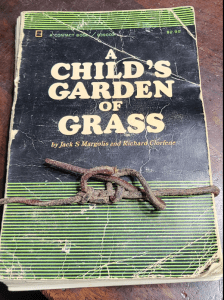 Those of you familiar with the Wacky Weed will also know of its propensity to inspire Deep Thoughts, thoughts that will commonly not survive the return of sobriety. The best example of this was in the seminal classic stoner book, A Child’s Garden of Grass. The fellow in the anecdote had a thought so profound, he had to write it down. The next morning he checked his notebook and he had written, “There’s a funny smell in this room.”
I, too, have a notebook. I, too, have written the occasional Bit of Profundity on it. I realized I needed the damn notebook because age has done its inevitable drying up of my brain, and as a director I once worked with told me, “Writing it makes it go to a different part of your brain.”
Last night I had such a Deep Thought that I filled an entire page of that notebook. This is a treacherous thing in itself, as my handwriting is abysmal. I was told this was due to a lack of hard work on my part, not because of any such frippery as neurodivergence or any other such undiscovered lore. No, I’m not bitter at that, or that I was flatly told to stop wasting time cartooning and concentrate instead on math, you’re smart, you’re just not applying yourself.
God, what a different career path I could have had.
Anyway.
We need to hook this essay up to a tow truck to drag it out of the mud of my childhood and into the 70s and 80s for my point.
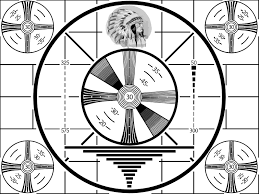
“EEEEEEEEeeeeeeeeee-“
I’m too bloody lazy to find when TV stations stopped signing off at midnight with the National Anthem and a test pattern. After that, though, they suddenly had hours of airtime to fill up with something, and that something was whatever they had in the movie packages the stations had bought.
Movies were downright ubiquitous those days. Movies played during Prime Time, in the morning hours, in the afternoon. But especially from midnight to 6am. The Sunday paper with its local TV guide gave me a roadmap for what was ahead that week (and nearly caused a heart attack when I saw Forever Evil was playing the next Saturday on Up All Night).
In most American households in those days (and probably still now, but I can’t be sure because shit got weird yo) the TV was turned on first thing and stayed on until the house’s resident night owl turned it off. It wasn’t necessary to watch, it was necessary to have the sound. As one smart guy put it, we were listening to the medium, not the message.
And part of that medium was the movies.
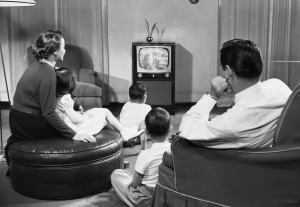 I guess a lot of my night owl movie watching was doing just that – listening while reading, looking up when something interesting happened. But a lot of it was staying up until 2am to watch a rare showing of Lemora or Corman’s budget-starved peplum Atlas. But there were also times that I would read Tim Lucas examining some obscure Italian spy comedy and thinking oh my god, I’ve seen this! thanks to those late-night viewings.
That particular TV landscape is only a memory now, alas. TV stations found it more lucrative to show unending infomercials instead of relying on local businesses taking advantage of the reduced fees for night owl advertising. That’s only part of the reason, I’m sure. Tune into that morning Dialing for Dollars show and discovering you’ve already seen the movie? Change that channel!
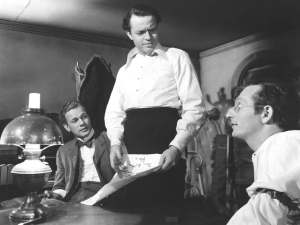
“Ewww! Get that crap off my TV!”
And a lot of those old movies were black-and-white, which somehow morphed from a matter of budgetary and technological necessity to an Ew! Black and white! P-too! Evil! Which is something I will never understand. Especially since those people also refuse to watch anything modern done in black-and-white as an artistic choice.
My major overarching argument here is that constant firehose of movies, even if only half-watched, had educational value. You could get swept into another time period, another culture, just for a few minutes or longer. We could develop a worldview that didn’t end at our nose or our phone screen. It could nudge us into intellectual curiosity, to finding out more – which sadly seems to also be out of favor, culturally.
So what brought me to this episode of Old Men Complaining About the Modern World?
Probably obvious.
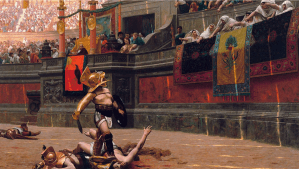
“Tariff him!”
Tonight there is scheduled to be a UFC MMA event on the lawn of the fucking White House, and smarter men than me – Rick Wilson, to name just one – have pointed out that this is a scene from any of those Fall of Rome movies you would have seen in rotation. The Emperor of a failing nation idly watching while sweaty muscle men beat each other up for their amusement, even as the people starve, and the nation crumbles. As a real-life metaphor, it is hard to beat.
I think Rick may be just a little older than myself – he came up through those movie-infused years (though I’m also pretty certain Rick has read a book or two). We have the historic receipts administered through art.
And I’m just not sure that most people now have that knowledge, having lived through a time that movies were relegated to paid streaming channels, not free through your local TV. I find that immeasurably sad and the lack of historical comprehension not a little frightening.
If you were ever doubting that I was an aging hippie, take this as your proof: I have just demonstrated that I can blame Capitalism for anything.