A Break for Crap

Trying to prove that we didn’t actually need to sully a holiday with this month’s Crapfest was perhaps ill-considered. The Sunday before Memorial Day weekend, but not the holiday weekend itself? Well, perhaps it was best to not to mess with anyone’s plans for a three-day weekend. I did not necessarily feel that way Monday morning, though, when I appeared to be suffering from a lack of sleep and some sort of snack hangover.

But I really need my bimonthly Crapfest. Need it badly. Especially this month, consumed by the end of the school year and the Roger Ebert Great Movies Challenge. Like finding that incredibly rare rude Disneyworld employee, Crapfest was a welcome oasis amongst all that oppressive quality.

When I arrived, host Dave was running Varan the Unbelievable off his hard drive, because he’s a tech-head who does things like that. (I may work in video, but that doesn’t mean I like to run cable through walls. Dave does, and my hat is off to him for doing it well) As more people arrived, the conversation grew lively, and Dave’s media player dutifully moved on to the next digital file, the original Earth vs The Spider. How lively was the conversation? It was twenty minutes before we realized the soundtrack was in Spanish. Aieee! Aranya grosso no bueno!

starcrash_poster_01This was taken as a clue that we should start the festivities, and for some reason it usually falls to me to choose the first movie. Maybe it is because I generally try to be a nice guy and come up with something at least entertaining (Things was an exception). Maybe because Dave feels that, therefore, his choice in the second slot will seem even more horrible by comparison. Or it will give him a chance to determine how badly he needs to hurt me in return.

But I had discovered a couple of fests ago, that one of our newbs, Erik, was fairly knowledgeable in the ways of le cinema bad, yet had never seen Starcrash. Neither had the other FNG, Mark. This is what we refer to in the trade as a moral imperative, and so we old-timers settled in for a re-watch.

I feel I have to explain Starcrash, even though, if you are reading this blog, chances are it’s unnecessary. Starcrash is an Italian attempt to capitalize on the success of Star Wars, at a time when Star Wars had not yet opened in Europe. So all Luigi Cozzi had to go on was photos, possibly some imported trailers. It’s pretty obvious that lacking the thing he was imitating, he had to fall back on Euro science fiction movies like Barbarella, Antonio Margheriti’s Gamma I flicks, and, for some reason, Jason and the Argonauts. The cast is Caroline Munro, Marjoe Gortner, Joe Spinell, David Hasselhoff and Christopher Plummer. And a police robot who talks like a Southern sheriff. If you have not yet seen it, all this should have convinced you to rush right out and find it now.

Erik was gobsmacked. “This is horrible,” he said, amazed. I think he may be a bit unaware of the depths we regularlysubject ourselves to at Crapfest – one day he will realize what a sweet, sweet gift we gave to him that day.

ultraman120607um5It was time to cook up dinner, and I filled the time with a couple of episodes of Ultraman (this would be the 1966 series). I showed the episode with the pearl-eating monster because A) Science Patrol token girl Akiko is really upset that the monster is eating all those lovely pearls; B) Science Patrol gets rid of the monster by literally shoving a rocket up its ass and blasting it into space; C) meaning Ultraman is unneeded, but he shows up anyway. We needed a second episode, and chose “The Rambunctious One from Space” at random, hoping it would be some manner of space biker, not realizing that such weirdness wouldn’t be showing up until the sentai shows started rolling out in the late 70s. No, it’s just another giant monster, or what they refer to in Japan as “Tuesday”.

Dave had been inferring for some time that I wasn’t drunk enough to watch his selection yet. Not that this was ominous, or anything.

Well, yes, yes it was. Because he had decided to show Nukie.

nukie-movie-poster-1988-1020693623Nukie is an E.T. rip-off made 6 or 7 years after the fact and (deservedly) more obscure than Mac and Me. Apparently of South African origin (with lots of German names, to boot), it didn’t even hit VHS in the US until 1993. I remained blissfully unaware of it until  Stomp Tokyo’s 2000 review, and I spent the intervening years not exactly avoiding it, but not seeking it out either. I’m sure that in my inevitable war crimes trial, the day I spent helping the visiting Chris Holland paw through boxes of VHS tapes at my then-favorite used movie store for copies of Nukie that he could inflict on innocent people will be entered in evidence.

So. There is a sort of cartoon comet zooming all over Earth while we hear the voices of two aliens, Nukie and Neeko, argue about how they shouldn’t be doing this. Something goes wrong and Nukie crash lands in Africa, while Neeko touches down in America, where he is promptly captured by the Space Foundation and routinely tortured by scientists. Nukie befriends a couple of outcast native children, and in general tries to find out where this “America” person who is holding Neeko can be found – by asking animals.

Nukie and Neeko have a psychic link, which means that whenever Nukie is finally about to get to sleep, Neeko will get poked and start screaming “NUUUUUUKIEEEEEEEEEEEEEEEEEEE!!!” in his head, and that also we in the audience will likewise scream “NUUUUUUKIEEEEEEEEEEEEEEEEEEE!!!” when bored, which was often. Before they can take off to space again, they have to be together, you see. Never mind that we see Nukie turn into a cartoon comet and loop around the Moon once.
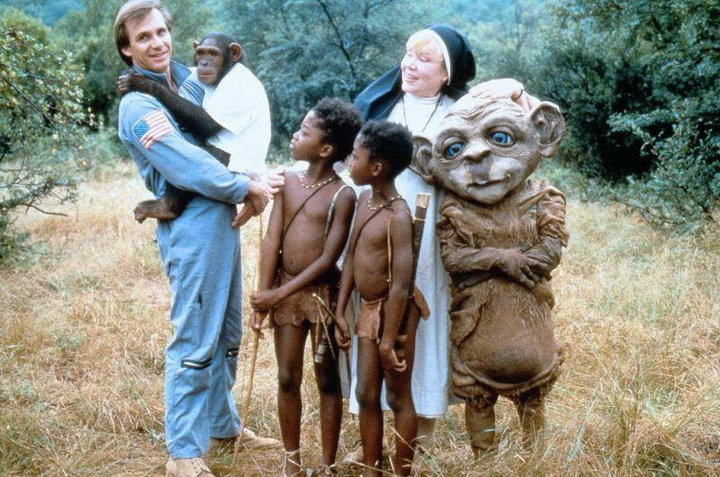
936full-nukie-photoThen, in the village where all sorts of skullduggery is afoot, none of it particularly coherent, a chimpanzee wearing a shirt starts talking. This is enough to make us stop screaming “NUUUUUUKIEEEEEEEEEEEEEEEEEEE!!!” and discuss whether the humans onscreen could hear the chimp or not; in the following scene, Nukie is talking to other primates (the aliens can speak any language once they hear enough of it), but the whole subject of talking monkeys was introduced before this sequence… Then Neeko helps the Space Foundation computer achieve sentience. Well, it actually already sentient, since it can hypnotize aliens and humans – somehow – and laugh like a mad scientist. Neeko just helps it become a better person.

Your star power in Nukie is limited to Glynis Johns as a nun in the Village of Problems (looks like things went to hell for the Banks family after Mary Poppins left, if Mrs. Banks joined a nunnery and is working in Africa), and Steve Railsback as the least effective field agent for a Space Foundation ever – although it has to be admitted that he flies Neeko to Nukie in his helicopter – apparently overnight, from America to Africa! – so the two can get the hell off this mudball and we can put this whole dismal exercise behind us.

The best part of the whole ordeal was Rick fervently making his case that if Dave had chosen Nukie, he had no moral high ground to claim in his steadfast resistance to Rick’s dream entry, The Garbage Pail Kids Movie. I think he may have had a point, there.

No, wait – the best part was where Dave, as we entered the subjective fifth hour of Nukie, began to moan in his chair, “What have I done?” like Col. Nicholson in Bridge on the River Crap.

candy-stripe-nursesHigh ground or no, Dave put on The Yesterday Machine to “give people a chance to go to the bathroom”. Fifteen minutes later, no one had gone to the bathroom and the damned thing was still playing. Unwilling to sit through a 35-minute explanation of how time travel works again, I held a straw poll of the contents of my Crapfest Bag of Tricks and the clear winner was a return to the original fare of the first Crapfests, a New World drive-in programmer by the name of Candy Stripe Nurses.

There are three stories at play in Candy Stripe Nurses as our nubile young not-really nurses try to change the world via nude scenes. More than ever, you can sense Roger Corman with one of those accountant visors and a stop watch nudging the director and murmuring, “I can’t help but notice there hasn’t been any nudity for 7 minutes.” Not fooling – in one of those instances, where there was no way to stop the plot for naked flesh, it was provided by streakers at a basketball game. Not as ideally salacious as you’d want, a bit heavy on the socially-conscious story elements… but at least it wasn’t Nukie. And as is the case with these movies, when you’re not waiting for the next nude scene, you’re waiting to see where Dick Miller will crop up.

Let’s take a moment to thank Joe Dante for cutting together this completely NSFW trailer:

(By the way, whichever of you guys tried to correct me on the director of Candy Stripe Nurses – you were right, it was Allan Holeb. I just got hung up on seeing Barbara Peeters’ name as Second Unit Director. I was wrong.)

Exorcist_II_Heretic_02There was some sort of problem with Erik’s portable hard drive, so while Dave took it to the back room to diagnose, he ominously said to me, “Figure out what’s next.” I didn’t do the straw poll again. I simply opened the vintage Warner Brothers snapper case and inserted Exorcist II: The Heretic. Enough of this weak-ass stuff. People had been demanding The Heretic for some time.

Mark was a bit apprehensive, unsure if this was truly riff material. Pshaw, said I, and ho boy, was I right. I’m pretty sure there was some exposition going on, but it was drowned out by multiple, simultaneous bad Richard Burton impersonations, which continued for the next two hours. Drunk jokes were the standard fare, but I was astounded and delighted by the variation and lack of repetition. I am especially fond of the section where we switched to using booze as a motivator. “Okay, Mr. Burton, for this scene we’ve put a bottle of scotch on top of this mountain, and… OH GOD ROLL THE CAMERAS! ROLL THEM NOW!!!”

In case you’ve never had the pleasure: Burton is Father Lamont, another exorcist who is having a crisis of faith, yet is sent by the Church to investigate the death of Father Merrin in the first movie. He meets up with the now teenaged Regan, and things sort of fall apart from there. The original audience started laughing the movie out of the theaters with the first sequence involving The Synchronizer, a device that “syncs people up” using biofeedback, a strobe light, and a deep pulsing note.  It allows people to share a hypnotic trance and experience each other’s dreams, or something. That sequence is actually pretty effective, if you can get past the dubious science.

Anyway, the best part, past the Richard Burton jokes, is the Ennio Morricone score, which I still have on the original vinyl. Enjoy Ennio rocking out on the trailer:

Actually, the best part was realizing that I was watching the original ending on this disc; Warner tried several different endings to deflect audience derision when the movie opened, and when I saw it, it was the ending where Burton died battling the demon Pazuzu. Offscreen, of course, no need to actually bring him back to shoot new footage. It was shoddy work, and though the original ending is rather ridiculous, it is obviously part of the same movie I just spent two hours scratching my head through.

By then it was midnight, and we had jobs to get to in the morning. We woke Alan up and sent him home. (“Why couldn’t I have nodded off during Nukie? Why?!?”) We also swore undying vengeance against Dave. Which will make the next Crapfest all the more… interesting.

Here’s my Letterboxd profile just prior to this Crapfest:

Freeman Williams ’s profile • Letterboxd


And here it is after, Can you spot the difference?:

Freeman Williams ’s profile • Letterboxd (1)


Never mind, it’s back to this, now:
Freeman Williams ’s profile • Letterboxd (2)

A Month of Roger Ebert’s Great Movies, part three

As a tribute to the late Roger Ebert, some members of the Letterboxd community are spending May visiting films in his Great Movies series. Since this dovetails with my personal project of filling shameful voids in my film education, I decided to commit myself, once more, to a regimented schedule for which I don’t really have time, but hey, you know. Movies.

Double Indemnity (1944)

double-indemnity-1All the various pieces of film-noir intersect in a perfect specimen of the genre, creating Venetian blind lighting motifs that would be appropriated over and over again into the next century.

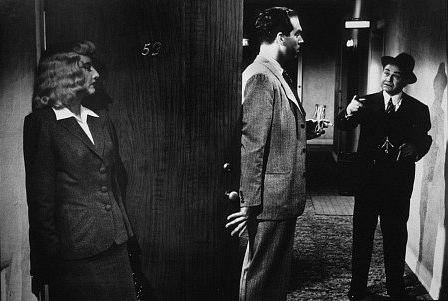
Fred MacMurray was convinced by director Billy Wilder to take leave of his usual light comedy roles to play Walter Neff, a highly successful insurance salesman who runs afoul of Phyllis Dietrichsen (Barbara Stanwyck in a horribly cheap blonde wig), an unhappy housewife who desperately wants to be rid of her loveless oil executive husband. Once these two finish playing bedroom games, Neff manages to get Dietrichsen insured for double indemnity in case of accidental death, then carefully rigs the murder, using his knowledge of insurance scams to commit the perfect crime.

Unfortunately, Neff’s best friend is insurance investigator Barton Keyes (Edward G. Robinson), a Sherlock of Statistics who at first figures the death is just bad luck for the insurance company, then homes in on the one tiny inconsistency in Neff’s plot. Keyes has a blind spot toward his old friend, Neff, and believes someone else is her accomplice – but the salesman watches in dread as that blind spot shrinks and his relationship with Phyllis starts to sour and curdle, and they begin to turn on each other.

double-indemnity-1944-movie-screenshot-495pxDouble Indemnity quite simply does everything right, from a beginning that grabs the viewer (and gives a perfect reason for Neff to spend the rest of the movie narrating his own downfall) straight through a twisted story that never strays from the logical – at least insofar as anything concerning human emotions can be – to a wholly satisfying end. MacMurray probably surprised the hell out of everybody. Stanwyck already had a reputation as a solid, versatile actress, and this movie established her as the Dark Lady of film-noir for many years, proving that the right actress can even overcome a director’s horrible choice of wigs. But the real standout for me is Edward G. Robinson, taking a step down from his usual starring roles to play Keyes, in his own way the hard-boiled detective of the story. Robinson has several dynamite speeches that he delivers perfectly, rapid-fire. Screenwriter Raymond Chandler made sure to be on the set when Robinson did those.

It amazes me that Hollywood made two James M. Cain novels with similar themes – unbridled lust and adultery lead to murder – under the  restrictive Hayes Code.

The Birth of a Nation (1915)

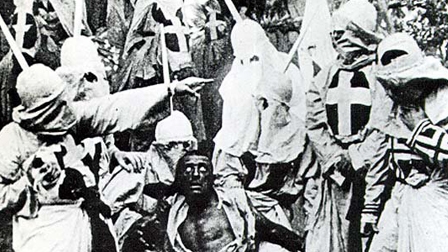
birth_of_a_nation_CHoly shit, people. Just holy shit.

I’ve been warned enough times about Birth of a Nation. But it still winds up in reference books, still on Ebert’s list, because it is a remarkable technical and artistic achievement a mere 20 years after the exhibition of the first motion picture. It undeniably kicked off serious American cinema. It possesses a stature worthy of reckoning, but also an unfortunate message.

Right up front you get a warning with the title card “The Birth of a Nation (Adapted from Thomas Dixon’s novel The Clansman)”. The first hour and a half tells the tale of two families, the Stonemans and the Camerons, whose sons are great friends (and whose eldest boys quite fancy the daughters on the opposite sides). The Stoneman family hail from the North, the Camerons own a cotton plantation in the South. Then the Civil War hits, and of course the boys wind up facing each other on the battlefield. The youngest die, the two elders survive. Lincoln pardons Cameron from an unjust execution when Miss Stoneman (Lillian Gish) and mother Cameron beg for his life. Gish refers to him as “The Great Heart”.

Lincoln’s assassination is fully and well-staged in a recreation of Ford’s Theater (but out in the open air, for lighting purposes). The Camerons read of his death and sadly look up from the newspaper, stating, “Our best friend has died. What will happen to us now?” If you’re slightly dubious of that being the actual reaction of defeated Southerners, just wait.

the-birth-of-a-nation-1915As I’ve said, that first 90 minutes is a good enough retelling of the period before and during the Civil War, but I wasn’t smitten with it when it was called Gone With the Wind, either. Then the second half of movie starts with a card that reads “This is an historical presentation of the Civil War and Reconstruction Period, and is not meant to reflect on any race or people of today.” In other words, We are about to get racist, but we are not racist.

Stoneman takes over after Lincoln is assassinated, and while he does not hang the Southern leaders, as he had previously advocated, he does go full-bore into making sure the freed slaves of the South become fully equal to the white citizens. This takes the form of whites being turned from the polls and blacks being bribed to elect rascals and carpetbaggers to the local government. My God, you can just hear current political talking points being freshly minted. Stoneman’s choice to head up the Reconstruction is a villainous (of course) mulatto named Simon Lynch, who secretly aims to establish his own Black Empire, and not incidentally marry Lillian Gish against her will.

THE BIRTH OF A NATION, Miriam Cooper, Lillian Gish, 1915Luckily, at the two-hour mark, the elder Cameron son has established the Knights of the Ku Klux Klan, and it is these brave sheet-beclad horsemen who rout the Black Apocalypse that Lynch has created (to Wagner’s “The Ride of the Valkyries”, no less), save Lillian Gish from Lynch’s vile mixed-race clutches, and, at the end, keep the Negros in their homes during the next election.

That last hour is a total mindfuck to rival The Holy Mountain or Holy Motors, let me tell you. Ideally, you try to cast yourself in the same mindset of a person watching the movie contemporaneously, and you just can’t. You can’t erase the image of blacks on the legislature floor leering at white women in the balcony when intermarriage is legalized. You can’t forget Gus the Rogue Negro (obviously a white man in blackface, as are any actors who come into contact with white actresses), stalking the teenaged Cameron girl, who leaps from a cliff rather than endure his touch. And it is really hard to forget sweet little Lillian Gish telling her Klan boyfriend, “Kill one for me!”

Birth of a Nation is culturally important, but it’s nightmarish. It may be even more culturally important, for just that reason.

The Bridge on the River Kwai (1957)

el_puente_sobre_el_rio_kwai_1957_7My decompression from The Birth of a Nation involved some more twisted ethics, but ethics that were slightly easier to relate to.

Based on a true story, it involves a platoon of captured British soldiers sent to a WWII Japanese labor camp in Siam, where they are supposed to, you guessed it, build a railroad bridge over the Kwai river. Our main conflict comes from the insistence of the camp’s commandant, Major Saito (Sessue Hayakawa) that the British officers also work alongside the enlisted men, which Colonel Nicholson (Alec Guinness) rightly points out is a violation of the Geneva Convention. This insolence gets Nicholson thrown in The Oven, and his officers in The Punishment Hut until they give in to Saito’s demands. The soldiers, meanwhile, keep sabotaging the construction while the officers bake in the sun. I should mention that the American prisoner who actually starts the movie, Shears (William Holden) manages to escape through the jungle, though nearly dying three times in the attempt.

Nicholson is made of incredibly stern stuff, and Saito finally finds an excuse to accede to his wishes under the auspices of a Japanese holiday. Once Nicholson sees what a wreck the bridge is, and what a rabble his men have become during his imprisonment, he decides that the best thing to do, to return discipline to his ranks and to show the Japanese what a British soldier can do, by God, is to build the bridge, and build it well. Saito, desperate to finish the bridge by his deadline, agrees, even conscripting his own men to construction work under the British officers, several of whom had built similar bridge in India.Nicholson becomes ever more obsessed (though in a genteel way) with the bridge’s completion, unaware that Shears has been basically blackmailed to make an unwilling journey back to the camp to blow up the bridge.

bridgeontheriverkwaiBridge gets fascinatingly complex in its character’s motivations; Saito sinking slowly into depression as his enemy does what he could not, to the point of planning seppuku after the bridge’s christening; Nicholson’s slow metamorphosis to slave driver, finally, ironically, putting his officers on the work force, and eventually even injured and sick men from the dispensary; and Sears, more or less forced – genteely, you gotta love the Brits – into the commando force and finding himself voluntarily risking his life once in the field.

William Holden always had an appealing vulnerability under his gruff handsomeness, and honestly should have been the only actor considered to play Shears (that didn’t stop them from offering it to Bogart, Grant, and Olivier). Like Fred MacMurray, Alec Guinness was, to this point, mainly known as a comedy star. The role of Nicholson had been offered to Charles Laughton (!), Ronald Coleman, Ralph Richardson, James Mason… the musical chairs even extended to directors. Nicholas Ray, Howard Hawks… only eventually David Lean. The two screenwriters were Michael Wilson and Carl Foremen, both Blacklisted. It is amazing that this movie exists at all, much less turned out to be the masterpiece it is.

Research finds the story a bit more interesting, though less cinematic. The real Major Saito was apparently a much more enlightened gentleman, negotiating with his charges for their work duties. In fact, the real-life version of Colonel Nicholson testified on his behalf at a war crimes tribunal! Two bridges were made, both were bombed by Allied forces, but the sturdier one was repaired, and much like Nicholson’s dream, is still being used today.

The Thief of Bagdad (1940)

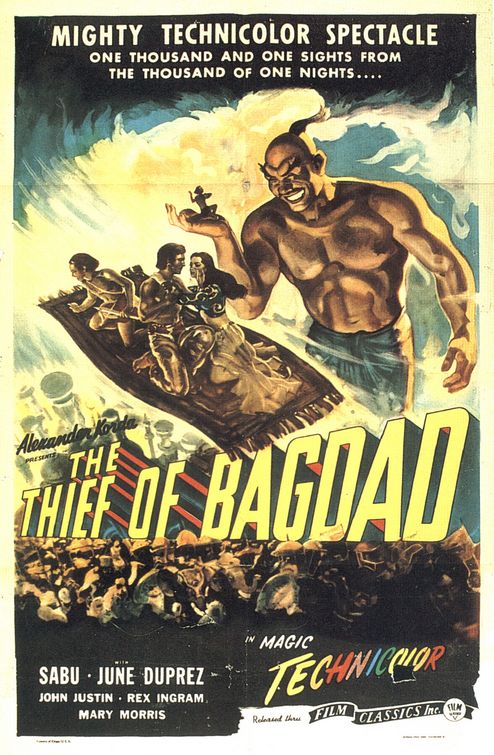
11160955_oriEventually, I had to run up against another movie I just couldn’t love, though lots of people do.

Thief of Bagdad is an Alexander Korda production, impossible to trace to one director, as Korda kept switching them in and out like drill bits. It’s an Arabian Nights fairy tale concerning a kindly ruler, Ahmed (John Justin), who befriends the title character, Abu (Sabu) when he is deposed by the evil vizier, the sorcerer Jafar (Conrad Veidt). Both men are in love with the princess (June Duprez) of a neighboring city, and when magically blinding Ahmed and turning Abu into a dog doesn’t work, Jafar shipwrecks them with a summoned storm. At which point things get weird.

Abu finds a genie (Rex Ingram) who flies him to the top of the world to steal a jewel called The All-Seeing Eye, which works like a magic TV, allowing him to locate Ahmed. The treacherous genie then sends Ahmed to Bagdad and execution, and strands  Abu on top of a mountain, As luck would have it, Abu’s destruction of the Eye of the World in a rage unlocks the gate to the Land of Legends, where the Thief gets the tools he need to rescue his friend.

2510033843_e3031446e3I don’t expect fantasy movies to necessarily be tightly constructed, but Thief’s plot feels sadly thrown together – I really missed my three act structure. The movie’s harried production – it had to move from its British studio during the Blitz into America – along with the directoral musical chairs works against it. But if I was somewhat bemused by the movie’s fevered insistence to cram nearly all the fantastical elements into the final third, it was fun to watch it while pretending to be a young Ray Harryhausen and see the inspiration for the green men and the six-armed goddess in Golden Voyage of Sinbad.

And Rex Ingram is a fine genie. Conrad Veidt excelled at playing villains with a soul, and Jafar, who would be able to hypnotize the Princess into loving him, but knows this would be a hollow victory, qualifies. The relatively new Technicolor process gets a real workout, and we see the first instance of the blue-screen technology that would enable traveling mattes for years to come, and the matte lines that would plague visual effects artists for the next fifty years.

There were more Arabian Nights-style movies over the years, but none matched the scope and fancy of Thief of Bagdad until that young Harryhausen fellow in the theater started making his own movies. For that, if nothing else, Thief of Bagdad gets props.

A Month of Roger Ebert’s Great Movies, part two

As a tribute to the late Roger Ebert, some members of the Letterboxd community are spending May visiting films in his Great Movies series. Since this dovetails with my personal project of filling shameful voids in my film education, I decided to commit myself, once more, to a regimented schedule for which I don’t really have time, but hey, you know. Movies.

Rio Bravo (1959)

Poster - Rio Bravo_01Earlier this year, in the course of another challenge, I said that The Searchers is likely the Ultimate Western. That’s the sort of generalization that gives you pause, once you’ve made it, over and over again, as you think of other movies that might fit that position just as well. Its scope is not as broad, but that’s also a strength for Rio Bravo, the Other Ultimate Western.

This was director Howard Hawks’ first movie after a four-year hiatus following the critical and box office failure of Land of the Pharaohs. He had some things to prove to a lot of people, not least of all himself, and the result is a movie that is so darned good he took some its best parts and re-used them again seven years later in El Dorado.

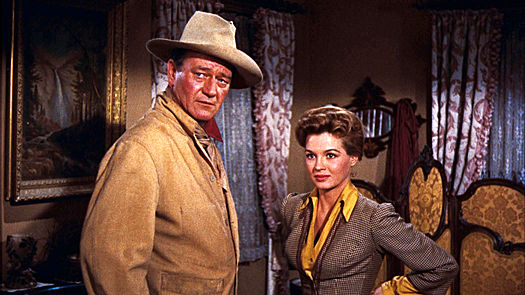
Sheriff John T. Chance (John Wayne) locks up Joe Burdette (an astonishingly young – and thin – Claude Akins), the younger brother of the local ruthless cattle baron, for murder. This prompts big brother to seal up the town and start importing gunslingers to free Joe before the federal Marshall arrives in six days. Chance recruits his former deputy, Dude (Dean Martin) an alcoholic struggling to regain his sobriety and self-respect, and eventually Colorado (Ricky Nelson), a preternaturally calm and competent young gun. He’s already got cantankerous cripple Stumpy (Walter Brennan, sans teeth) overseeing the jail with a shotgun and an unending stream of invective.

rio_bravoInto this siege situation Hawks also drops Feathers (Angie Dickinson), a peripatetic gambler who chooses to settle in Rio Bravo when she takes a shine to the Sheriff. Dickinson here is lucky to get the role of a typical Hawks woman, preferring the company of men to her own sex, easily the equal of any of them. Wayne the actor seems honestly uncomfortable with the idea of a love affair with a woman who is almost literally half his age, and that somehow makes The Duke adorable. But this movie also marks an important turning point in his career – Wayne is obviously no longer a young man, and here begins the line of movies dealing with that fact, through the 60s and eventually into True Grit and Rooster Cogburn.

Martin and Nelson seem like stunt casting, and that may be true in Nelson’s case, at the height of his popularity in the TV series The Adventures of Ozzie and Harriet, but Martin definitely worked hard for the role. It benefited his acting chops considerably when Hawks wouldn’t let him get away with his usual nightclub drunk schtick – Martin sinks his teeth into the uglier, pathetic parts of drying out, and when he finally gets his mojo back, it is a triumphant, memorable moment.

It’s easy to fantasize that you can pick and choose between the casts of this and El Dorado and swap out Robert Mitchum for Dean Martin, James Caan for Ricky Nelson… but truthfully, both movies are just fine the way they are.

The Big Sleep (1946)

el_sueno_eterno_1946_2It’s really ideal when you can follow a Hawks movie with a Hawks movie.

Humphrey by-God Bogart plays Philip Marlowe, prototypical private eye. He’s hired by the aging and slowly dying General Sternwood (Charles Waldron in his final role) to clear up the matter of some gambling debts and possible blackmail against one or both of his wild daughters (the elder of whom is Lauren Bacall). Of course, since this is from a Raymond Chandler novel, nothing is as simple as it first seems.

Rather famously, The Big Sleep was held over from its original release date to A) clear out Warner Brothers’ inventory of war movies when World War II ended earlier than Warner had scheduled; and B) to punch up Lauren Bacall’s character, reshooting several scenes and adding others a year after the original shooting had wrapped.  1944’s To Have and Have Not was a tremendous hit thanks in large part to the Hawksian chemistry between Bacall and Bogart (and obvious sexual heat, needless to say).

But you don’t monkey with the structure of a complex plot like Chandler’s without paying a price, and The Big Sleep‘s gets pretty muddled to accommodate the new dynamics. I was thankful I’d gone out of my way to see the more linear 1978 version with Robert Mitchum a couple of years back, it helped anchor me through the turmoil.

Still, it’s a good ride. Past the banter betwixt its two stars, you could spot this as a Hawks movie by the incidental characters: Marlowe keeps running into charming, attractive women doing their jobs – in one case, a normally male job like a cabbie – doing them well, and with enough smarts and sass to impress Marlowe. probably past their time in the story (were it not for Bacall, if you catch my drift). Lucky goddamn Marlowe.

Beat the Devil (1953)

large_tmtx7hDqcZGYyQ8H76I7ZKOumgmI didn’t have another Hawks movie on tap, so instead I went for more Bogart.

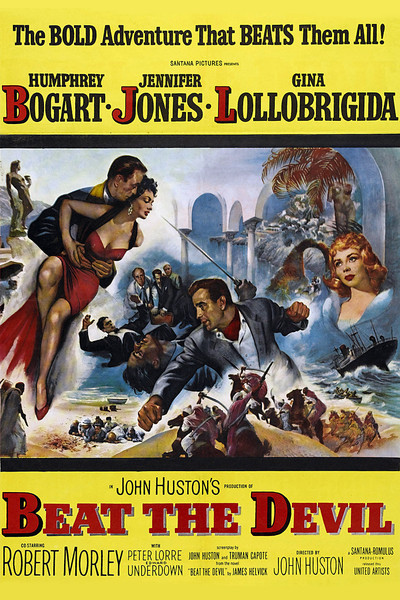
Beat the Devil is an odd bird, and most people don’t seem to know what to make of it. You have a collection of four rogues headed by Robert Morley and Peter Lorre, and they’ve thrown in with Bogart to purchase some land in Africa that they suspect is rich in Uranium. This setup is complicated by the fact that they are marooned in Italy while their steamer is repaired or the captain sobers up – “More than a day, less than a fortnight.” Also complicating matters is a British couple, the Chelms: the stuffy husband and the brilliant but talkative wife (Jennifer Jones), who has an overactive imagination that leads the rogues down all sorts of false assumptive trails.

That isn’t complicated enough? Bogart and Jones fall in love, and oh, didn’t I mention Bogart is married to Gina Lollobrigida? Gina is an ardent Anglophile who falls for Mr. Chelm.

It gets even more complicated than that, but this is another movie that depends on the joy of discovery, so let me just leave it at that. This is a stellar spoof of adventure movies with foreign no-goodniks in pursuit of atomic gold, and honestly, the only thing missing is Sydney Greenstreet, who had retired in 1949, suffering from diabetes and Bright’s Disease (which had plagued him through most of his movie career). Robert Morley rises suitably to the occasion, however.

Matters weren’t helped by the movie posters proclaiming “The Bold Adventure That Beats them All!” “Adventure At Its Boldest! Bogart At His Best!” Nobody went into Beat The Devil expecting an hour and a half of banter so dry you could make a martini with it (Truman Capote is a credited writer). Everybody plays it deadly serious, making it even more hilarious. Bogart is smart enough to just lean back and let chaos reign around him. And did I mention the director was John Huston? Yeah, this nestles between Moulin Rouge and Moby Dick.

Beat the Devil is definitely an odd creature. Enjoyable, as long as you know what sort of movie you’re going to get. Have a nice three-minute clip from early on…

Stagecoach (1939)

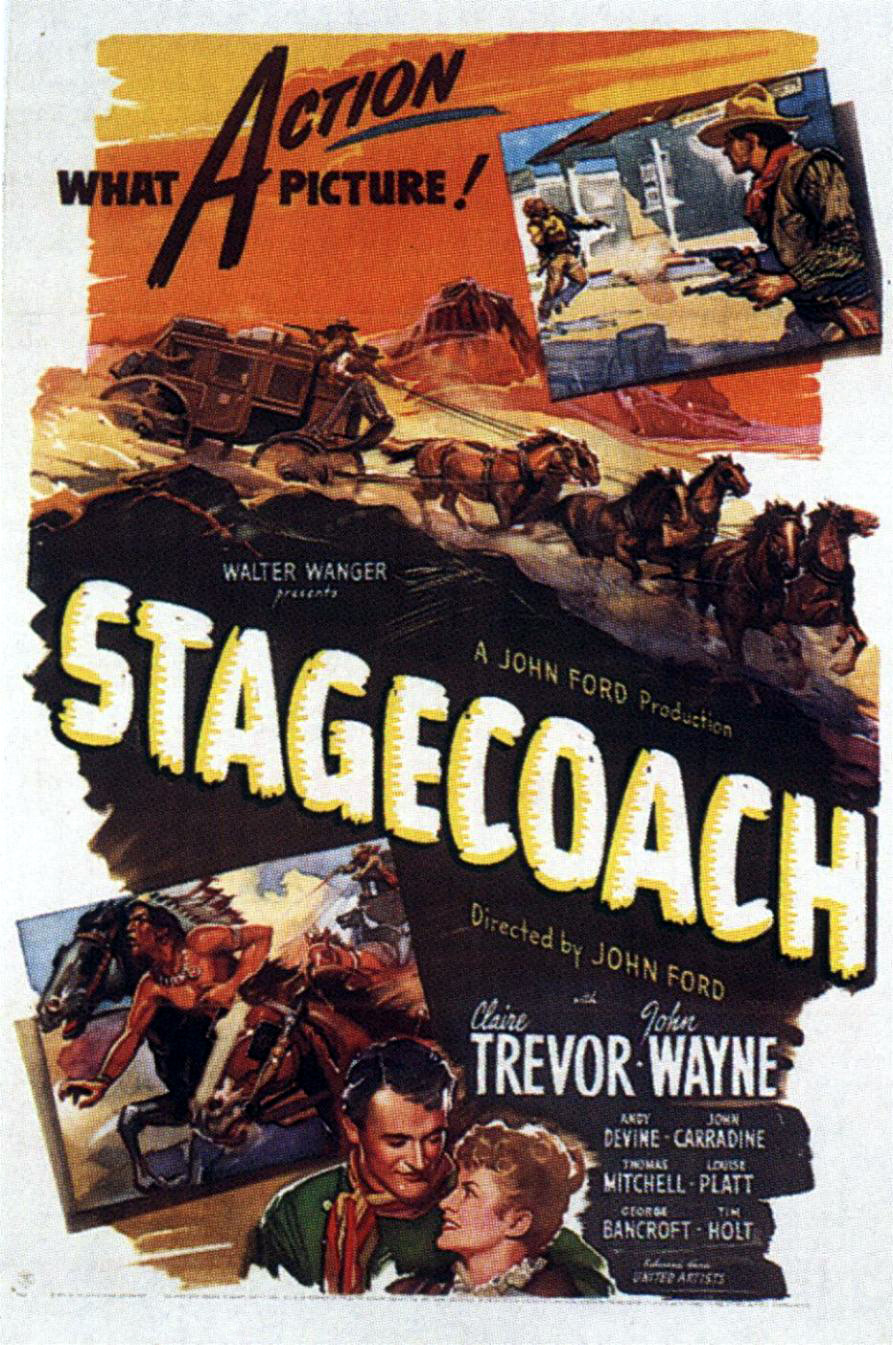
Poster - Stagecoach (1939)_03Out of Hawks and Bogey, I might as well bookend this with more John Wayne, right?

Stagecoach marks a number of notable firsts. It’s John Ford’s first movie shot in Monument Valley, and the first of a long line of collaborations with John Wayne. Wayne had, by this time, made a slew of B-Westerns. That worked against him in the casting process, but when Gary Cooper wanted too much money, Ford finally got Wayne.

Stagecoach takes a basic dramatic premise and plays it for all its worth: Throw a bunch of disparate characters in an enclosed space, put that space in danger, and let events play out. The title coach is making a regularly scheduled run, complicated by the presence of Geronimo on the warpath. The cast includes an alcoholic doctor (Thomas Mitchell) being  exiled from the town, and ditto a “fallen woman”, Dallas (Claire Trevor), whose crimes are never elaborated upon, since it’s still 1939. There is also a woman trying desperately to meet up with her Cavalry officer husband, a roguish gambler who takes her under protective wing (John Carradine, superb as ever), a banker running away with a mining company’s payroll (it’s also still the Great Depression, so boo hiss at the Banker), and a whiskey salesman whose sample case is going to be decimated by the doctor. And then they pick up the Ringo Kid (Wayne) on the way. He’s escaped prison to avenge the murder of his family by the Plummer Brothers, and unfortunately for him, the Sheriff is riding shotgun on the coach.

That’s quite a cast, and I didn’t even mention Andy Devine as the stagecoach driver. At this far remove, it is interesting to note that of this solid, often powerhouse group, Claire Trevor was at the time the box office draw.

stagemovieThe group dynamics shift throughout the journey, especially when the promised cavalry escorts keep getting called away to chase Geronimo. The scalawag Banker and the Officer’s Wife (and therefore The Gambler) want to keep pushing on, despite the danger – though the group is forced to shelter in place when the sickly wife is found to be pregnant and the doctor has to go into hyper-sober-up to get her through a difficult delivery, aided by the prostitute. During all this, the guileless and somewhat naive Ringo Kid falls for Dallas, thinking her just another lady; when they eventually arrive at their destination he’ll find out different, and it won’t matter.

That brief paragraph doesn’t begin to even outline the complexities of character and plot breezed through by Stagecoach in a mere 96 minutes. Viewing an extra on the Criterion DVD, a video essay by Ted Gallagher about Ford’s visual style, you find out how Ford threw exposition and character development simply by where he chose to point the camera in any given scene, and you realize that you are dealing with a director working several degrees above most of us. Tremendously humbling.

There are many, many reasons to watch Stagecoach, but I’m going to instead leave you with another first: the hat John Wayne wears as the Ringo Kid, he would wear in many another Western; its final appearance is as the beat-to-shit hat Chance wears in Rio Bravo, after the which the Duke finally retired it and kept it under glass in his house.

I love it when we can circle back like that.

A Month of Roger Ebert’s Great Movies, part one

As a tribute to the late Roger Ebert, some members of the Letterboxd community are spending May visiting films in his Great Movies series. Since this dovetails with my personal project of filling shameful voids in my film education, I decided to commit myself, once more, to a regimented schedule for which I don’t really have time, but hey, you know. Movies.

With the certain knowledge that I have to work the occasional evening, I started early, trying to get a buffer going.

Faust (1926)

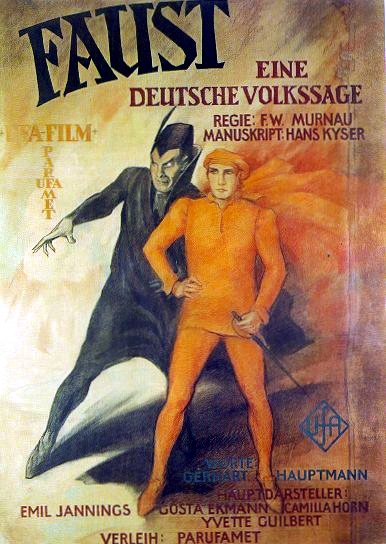
Faust-PosterLike any good horror nerd, I was familiar with F.W. Murnau’s Nosferatu – A Symphony of Horror, but remained sadly ignorant of his other works. After the phenomenal success of The Last Laugh, Murnau was given carte blanche for his next project, and the result was Faust, at the time the most expensive movie ever produced in Germany… until Metropolis, which we’ll get to later.

Based on various tales in German folklore, but most especially on Goethe’s play, Faust employs a setup well-known to readers of the Book of Job: Satan makes a bet with an archangel that he can corrupt Faust, a decent and devout man of learning. The Devil, of course, is a big cheater and sets loose the Black Death in Faust’s village. When he cannot cure the disease, Faust in desperation tries a ritual in one of his ancient books, summoning the Devil in the form of Mephisto.

3242077879-1Mephisto is an excellent marketer, offering Faust first a free trial day of unlimited power, then finagling to have the day end when the aged Faust, newly imbued with youth, is about to bed The Most Beautiful Woman in the World. Needless to say, Hell has a new customer. Eventually Faust returns to his home town, and falls in love with the shy maiden Gretchen. Of course, Mephisto put his powers to use, and being a demon, manages to frame Faust for murder and totally destroy Gretchen’s life. The demon has forgotten about the power of love, however, which prevails no matter how much misfortune he piles upon it.

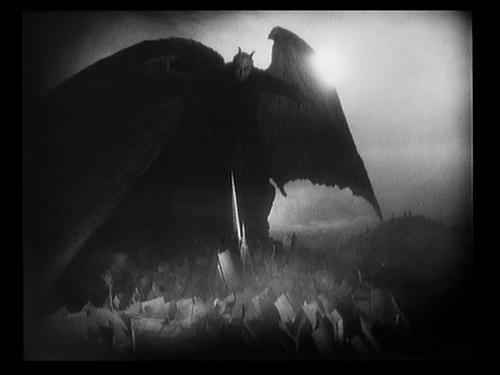
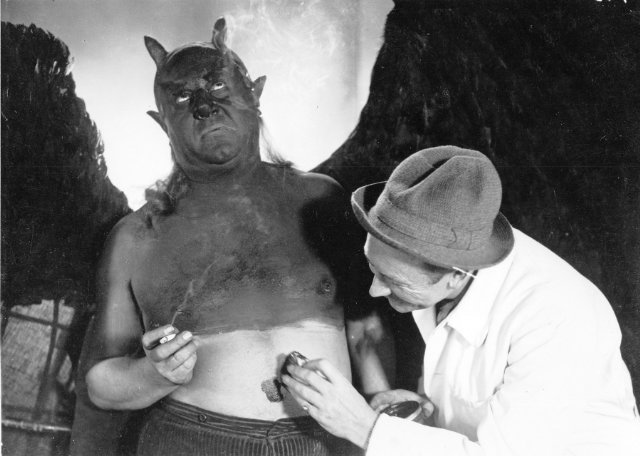
The imagery in the first act of Faust is stunning, puppets representing War, Pestilence and Famine on demon horses riding in the sky, Satan nestling  Faust’s village in enormous bat wings.  Moreover, the acting is surprisingly subtle for a silent movie. I had initially thought young and old Faust were played by two different actors, but no, that is Gösta Ekman in both roles. Emil Jannings already had a stellar career in movies when he starred in The Last Laugh, and as Satan and Mephisto, he is not only terrific, he is also obviously having the time of his life. Though Murnau wanted Lillian Gish for the role of Gretchen, he eventually cast a stand-in named Camilla Horn, launching a career that would last into the 90s.

Jannings & Murnau

Jannings & Murnau

This is, in short, a marvelous movie, leaving Nosferatu in the dust. We’ll leave this for a moment, but we’ll find it a bit of a touchstone.

Here, have the first four minutes:

Man With A Movie Camera (1929)

man_with_movie_camera_poster_3Nothing less than the great-grandfather of Koyaanisqatsi. Soviet director Dziga Vertov and his brother attempt to break down the linearity of boring old story-centered cinema with this document of  “a day in the life of a city”. Shot over three years in (actually) three cities – Moscow, Odessa and Kiev – the movie uses a dizzying variety of techniques, dutch angles, double exposures, time-lapse, even some stop-motion animation, and some very innovative editing to sweep the viewer away and shake him up, with no stories or context to distract from the images. All in 63 minutes.

I watched the Kino International version on Netflix Instant, which employs a soundtrack composed by Michael Nyman in 2002. The original score was apparently as experimental as the movie itself, featuring voices, orchestra instruments, and an electric buzzer or two, rather reminding me of some John Cage pieces. Nyman’s score is dynamic and forceful, feeling a little Glassian at moments, cementing Man With A Movie Camera‘s relationship to the Godfrey Reggio’s later Qatsi movies.

Here, I found an excerpt with the Nyman score:

Triumph of the Will (1935)

triumph-of-the-will-movie-poster-1934-1020198741Back to the Germans. This is the fairly infamous documentary of the 1934 Congress of the Nazi Party held in Nuremburg. It is rightfully held up as one of the first and one of the best propaganda films ever made. It is also one of the best documentaries.

Given total support by the Party, director Leni Riefenstahl controlled a crew of almost 200 people, 40 of which were cameramen. Trenches were dug, tracks were laid, special cranes were constructed, all so Leni could get the shots she needed. Some speeches were re-shot later, but overall, it is a testament to her abilities that there are huge, amazing crowd scenes – the congress was attended by 700,000 people – and yet, in only one instance, could I see one of those many cameras.

Triumph is only six minutes shy of two hours, and it can, fact, eventually get boring – damn, but fascists love their parades – but the final rally is amazing. The best part, for me, is seeing the uncut footage of Hitler’s closing speech. We’ve seen this footage excerpted so many times in various programs, that it’s quite refreshing to see it intact, and to witness those little moments when Hitler steps back from the podium to let the crowd roar, and you see Hitler – not the icon, not the image, but the man – you see Hitler, eyes toward his speech, silently contemplating, listening to the crowd, and thinking to himself, “Yes, that was quite good, wasn’t it?”

Reifenstahl’s techniques are still being used almost a century later; this movie is certainly worth a look, for many reasons. Like Man With A Movie Camera, its major value, outside their many innovations, is as a time capsule, a slice of a particular time and place, preserved for all time.

Reifenstahl also actively lobbied for the role of Gretchen in Faust. Who knows what might have happened had she gotten it?

Here’s that final speech, with some overblown music added:

Metropolis (1927)

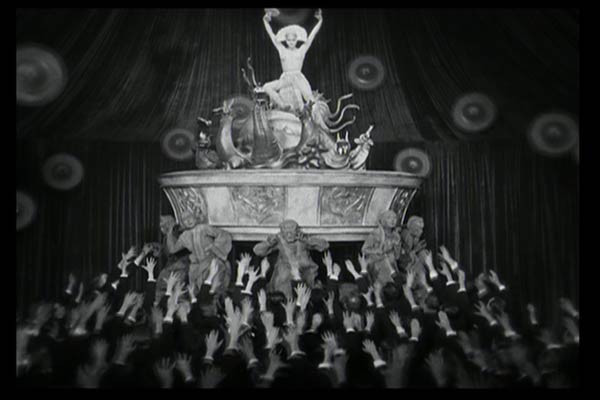
metropolis-poster…and back to the silents. You’re allowed a bit of cheating in the Ebert Challenge (no more than 10 re-watches), but I’m not even sure this qualifies – it has been years since I’ve seen Metropolis, but this was certainly the first time I’d seen  the restored version.

In a sentence I am really growing weary of typing, Fritz Lang’s Metropolis was a dismal flop on first release, and it’s running time was scissored down over and over again. Restoration had variable success until the beginning of the 21st century, when a chance mention led to the discovery of a 16mm print of the original in Argentina. It had apparently been bought by a South American company for distribution at its first viewing, and somewhere in the 20th century it had been transferred to 16mm when the nitrate 35mm print became too unstable. But it had 25 minutes of the missing 30 in somewhat salvageable condition.

Kino’s edition looks astoundingly good; the insertion of the recovered footage perforce must stick out like an over-exposed, streaky sore thumb, but even that is helpful in gauging what exactly has been returned, allowing the viewer to piece together the reasoning behind the edits. An entire subplot involving “The Thin Man”, a spy sent after young Federson by his father, as the young man becomes increasingly infatuated with the under-city of the Workers, and their Messiah, Maria.

metropolis05Still missing is the scene in mad scientist Rotwang’s house, where the elder Federson struggles with his old rival and frees Maria from his clutches; this is now explained in an intertitle card. I seem to recall in my first viewing only seeing Maria running from the house, with no explanation of how she escaped.

My major realization in seeing this, so hard upon the heels of Faust, is how much more I appreciated Murnau over Lang, and I had long treasured Lang. But Murnau’s work is full of subtlety and human moments. Lang is far more interested in melodrama and grand, sweeping motions. As my friend Mark Konecny pointed out, for better or worse, Lang was the future of cinema, and kept making movies until 1960. Most of them were pretty darned good. Murnau worked more slowly, and only made three sound movies before his untimely death in a traffic accident in 1931.

So once again I get to end one of these with a “what if-?” or an “if only-” and hustle myself back to my viewing chair. It’s high time I watched some American fare.

Human Lanterns (1982)

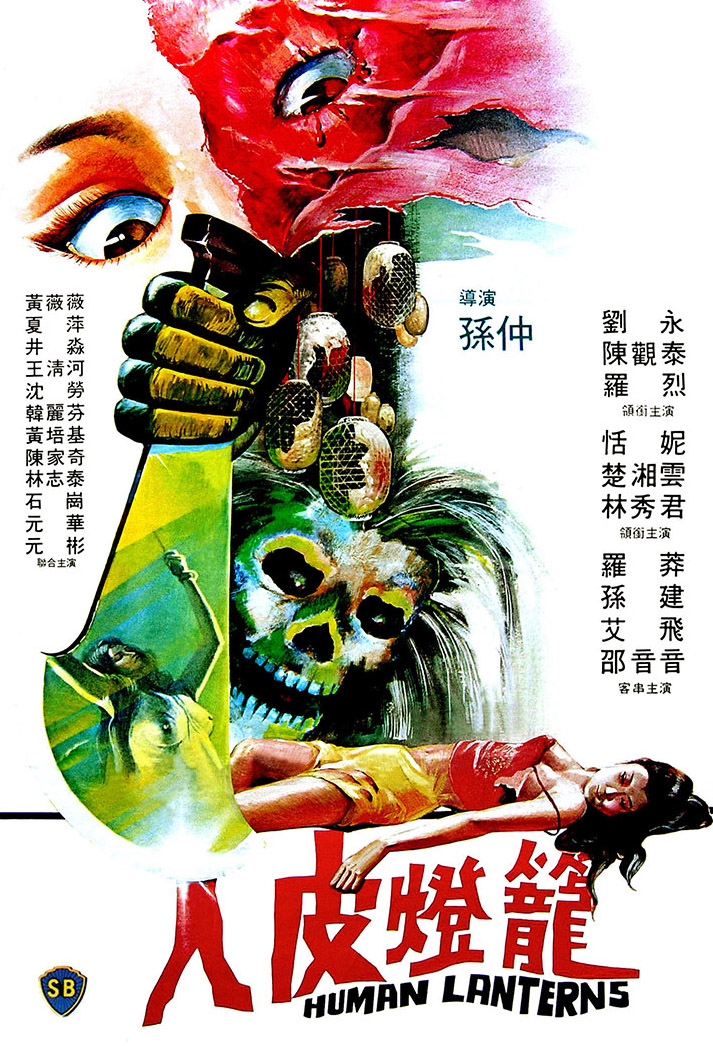
HumanLanterns_GoldenSwallow_SC36Before I descend into the madness of another Movie Challenge Month, I should probably talk about one of the movies I did manage to watch during my burnout from the last one: Human Lanterns, a piece to 80s horror nastiness from the Shaw Brothers. It is on The List, after all.

When the craze for Asian movies started up again in the 90s, I was right there with it, searching out movies in an age when the Net was just starting out and a person in my position had to make do with books, magazines, and mail order. I still have a ton of VHS tapes in boxes in my garage, most of very iffy quality and downright scurrilous sources. But one of the movies spoken of as a sort of HK video nasty was Human Skin Lanterns, later amended to Human Lanterns. And here it is, in my hands, in a pristine DVD.

A company named Celestial Pictures started putting out remastered, gorgeous DVDs of the Shaw Brothers back catalogue in the early 00s, and again, there I was. The American Dollar was very strong against the HK dollar, and I was importing close to 20 discs a month for under $200. There were movies I thought I would never see in my lifetime, movies familiar only in their cropped, dubbed versions on Saturday afternoon TV, and movies I took a chance on and was rewarded handsomely.

Human-LanternsAs all good things must, the contract I was working on at the time ended, and I was back to my duller, more financially strapped state. But then domestic American editions of the Celestial discs began appearing, and look, there it is in my hands: Human Lanterns. With the Image Entertainment logo.

So here’s your plot: There are two kung fu bigshots in town, Tan (Chen Kuan Tai) and Lung (Tony Liu). There is the usual rivalry between the two, but the difference here is that both men are real douchebags, and their antics are the sort of things that make their friends look away uncomfortably. Their latest achievement is wrecking a party at Tan’s over a prostitute both men frequent.

The upshot of the evening is that both men swear they are going to win that year’s Lantern Competition, and Lung journeys to the town’s market to find out who has really been making lanterns for Lung in past years – the merchant he actually pays for them doesn’t have the skill. To his surprise, Lung discovers this masterful lantern maker is none other than Fang (Lo Lieh), a man Lung beat in a duel seven years before, leaving him with a facial scar and a brooding hatred.

Lung beseeches Fang to let bygones be bygones, to make him a truly beautiful and unique lantern that will beat Tan’s entry. In return, Lung promises riches and a way out of the hovel in which Fang lives and works. Fang agrees, as this is the spark that will power a vengeance seven years in the building.

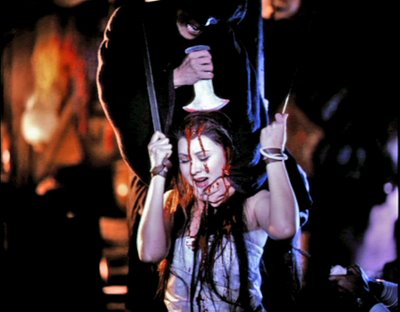
human-lanterns-2_webFang begins by kidnapping the aforementioned prostitute and skinning her alive. There are gorier instances of this in genre cinema, but this particular version is low-tech and pretty nasty. Tan and Lung cast suspicions on each other for the woman’s disappearance, and the local policeman (Sun Chien) is pretty ineffective, as in all horror movies.

Fang continues his plan apace, eventually kidnapping Tan’s younger sister, and finally Lung’s wife, who we discover was the cause of that duel seven years before.  Things build to a massive kung fu fight and a fiery finish, which only one of the characters will survive.

There are, as I said, gorier movies of this sort, but Human Lanterns manages to be unpleasant in its own, personal ways. Thankfully, we only see two of the women being skinned, but Fang, in the full throes of his villainy, has to rape the woman who caused his defeat and disfigurement. We never see Tan’s younger sister go through this, only Fang’s gleeful playing of cat-and-mouse with her in his hellish underground workshop. We entertain a bit of hope that she might still crop up, unharmed toward the end… but no. This is a horror movie, a slasher film in period garb. Don’t let the accouterments of an action movie fool you.

There is a special kind of chill when Lung finally finds that underground charnel house and sees the completed lanterns, and is held transfixed for a moment by their beauty, not realizing that the one he is admiring features the “beautiful red mole” on his wife’s back that he so treasured.

lantern25The cast is quite good. Chen Kuan Tai, a superb martial artist and star of many a Shaw Brothers blockbuster, seems pretty wasted in his role; Tony Liu is given much more screen time and fills it well enough, but neither of these men are given any way to truly gain audience empathy; the only people we feel for are the victims. Poor Sun Chien never got a break – we always see him playing second fiddle to other members of the Venom Gang, and here he has to play the Asian version of Barney Fife.

Lo Lieh was a very versatile performer; he could certainly handle hero roles – witness King Boxer/Five Fingers of Death – but where he really excelled was playing villains, and Human Lanterns gives him more than adequate atrocities to sink his teeth into. While doing his wetwork, Fang wears some sort of hairy ape suit with a skull face ,and watching this figure, swinging through the trees, loose-jointed and cackling, is pretty chilling.

lantern17Human Lanterns has its share of fight scenes, but none are dynamic enough to cement the movie as a kung fu flick – and the horror segments are memorable enough, but often seem imported from another movie. It’s an odd creature to be sure, worth a watch from horror fans, but probably not action-packed enough for martial arts mavens.

Out of the Gauntlet…

…and into another trap.

March was an interesting month. As both of you reading this blog know, I thought it would be fun to participate in the Letterboxd.com March Movie Madness Challenge, which resulted in a bunch of short reviews under the “ABCs of March” heading. That involved going through the alphabet by watching a movie every night. I have a sort of sick jealousy towards people who could actually do that – I indulged in a tremendous amount of gaming the system, watching several movies a day during my enforced week off (Spring Break at the college). Coming off that glut of movie watching and following up by a rather ravaging Crapfest also had an unforeseen consequence: I was completely burned out on movies.

The Author's Brain: Artistic Representation

The Author’s Brain: Artistic Representation

I done one… one! review since. While recharging my batteries, I’ve gone back to Habit Number One, reading. Burned my way quickly through Lindsay Faye’s marvelous Dust and Shadow and Gods of Gotham. Finally finished Warren Ellis’ thoroughly demented Crooked Little Vein, which was the detective novel Hunter S. Thompson probably wishes in the afterlife he had written. And (also) finally got round to Richard Kadrey’s fourth Sandman Slim novel, Devil Said Bang, and those damned things just keep getting better.

I’d been flirting with the idea of getting back on the cinematic horse when I was hit with one of those two weeks of extreme business that seems to be your lot when you’re working a couple of part-time jobs and engaging in several freelance projects. One of those projects finishes up this Sunday, and I’ve hit a period of relative calm. Well, I think to myself, it might be time to watch a movie or two.

Then I discover that Danny Baldwin and Oscar Velasquez, the same people who came up with the March Movie Madness challenge, have come up with another one for May, and oooooh, is it irresistible. To honor the memory of Roger Ebert, participants watch Beyond the Valley of the Dolls, then one movie a night from Ebert’s Great Movies series. I mean, good Lord, look at that list. Go ahead, I’ll wait.

I’ve watched about a third of those movies, so finding 30 I had not was relatively easy. Some of them are even on The List. In the final version of my proposed watchlist for May, I already owned 19; 4 were on Netflix; 6 I could get from my local library (my local library system is pretty damned sweet, if I haven’t mentioned that lately). The last two I picked up for cheap from my own Amazon Wish List.

So I guess I’m doing this.

challenge-accepted-stoplightThere are all sorts of problems I foresee. I don’t have Spring Break to fall back on. At least six evenings are already scheduled for work. Two days for my wedding anniversary get-away. One evening for the Capital Fundraising Kick-Off for my old theater. Monday and Tuesday evenings my wife must have the HDTV to watch Dancing With The Stars, so I can’t watch Blu-rays those evenings. There should be a Crapfest in there, somewhere, too. This is a field of logistical landmines, to be sure.

I am also likely the only person in the world who would complain about watching quality movies.

So there will be more system gaming, I am sure. I will likely start the process tonight, trying to build in a buffer. My portable DVD Player will go with me to San Antonio. I’ll have to save the shorter movies for nights with work and so on. And somewhere in there, find time to write about this ordeal of excellence.

I guess this why they call it a challenge.

Radio Silence

I’m sure you weren’t concerned about my current silence – Jesus, there is certainly more than enough very real stuff to worry about this week – but here I am, anyway.

I’m having another of those incredibly busy two week periods. Three, count ’em three shows this week. Three, count ’em three writing projects, all of which presume they are the most important things on Earth. Special remote broadcast next week as the School Board candidates duke it out. So exciting.

toobusyStill dealing with a bit of burnout after the March Movie Madness and Crapfest. I’ve watched one movie since Hercules, Samson & Ulysses, some episodic TV, and spot-checked my Blu-ray of Django Unchained (having already seen it in the theater). After a 2012 fairly bereft of paying work, I’m not going to complain too loudly about suddenly being busy.

Hopefully back in the latter part of next week. If not, as I said, you’ve got plenty to occupy your time until I do manage to return.

Keep your head down. Courage.

Hercules, Samson, and Ulysses (1963)

hercules_samson_and_ulysses_poster_01This movie and I go back a ways. When it first played theaters – and yeah, 1963 sounds right, yeah, fifty years ago – I begged my mother to take me to see it. Those three names were something to conjure with, alright, and I was pretty certain that there would be carnage aplenty. You see, I was pretty certain the title meant there were three musclemen involved. My mother watched a lot of peplum on the afternoon movies (yes, local TV stations showed movies in the afternoon – and mornings! – instead of talk shows full of people shouting at each other. In some respects, it was a Golden Age), so I knew about Hercules and Maciste and some other guys, so three of them had to mean three times the action.

And I have to admit I remember absolutely nothing about the movie – well, I do remember one thing, it turns out – which made it a cinch that when Warner Archive put it out on disc, it was only a matter of time before I had a copy in my hands. Especially when Chad Plambeck started enthusing about it (Chad was also kind enough to inform me that this movie didn’t hit American shores until 1965, which means I saw it only 48 years ago. That put a spring back in my step, let me tell you).

Well, there is one other thing I sort of remembered, or at least the memory came rushing back as the movie started, like a fly ball popped into the stands at an unsuspecting observer: Ulysses is not, in fact, a muscleman with a misappropriated name. We are actually dealing with Odysseus (Ulysses being the Roman version of that name), while still a teenaged Prince of Ithaca, here hanging out with Hercules (Kirk Morris, in this version). Hercules throws a discus, and Ulysses shoots it with an arrow. We are assured that the targets in this primitive skeet shooting won’t be found for days, but big deal, the kid’s royalty. He can afford it.

A group of men come to Ulysses’ father, King Laertes, to complain about a sea monster killing fishermen. This, of course, is catnip to Hercules, who will head up an expedition to kill the dastardly beastie. Ulysses will tag along with a basket full of carrier pigeons, because that is what youthful sidekicks do.

Director Pietro Francisci – to whom we will return later – is annoyingly cagey with the sea monster. Seen only at night, and in tantilizingly brief clips, it seems to be a manatee or an otter with a piped-in roar. In any case, it cuts through the water well, but Hercules harpoons it at the beginning of a terrific storm. In return, the unseen monster pokes a huge hole in the boat’s hull. So Hercules, Ulysses and four other survivors wind up castaway in a strange land.

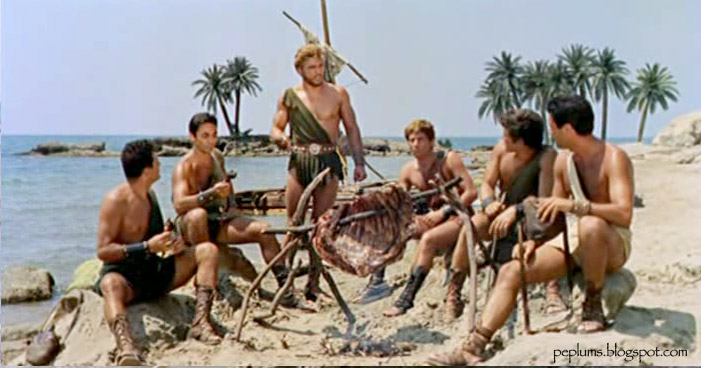
p_beach6After Herc punches a bull to death (“I wonder what sort of creature that was,” muses one guy over the ensuing barbecue, leading to the amusing thought that there are either no cows in Ithaca, or the man is an idiot) they wander inland (leaving the fire under the side of beef burning), to find that they are in the land of Judea, where fortunately everyone speaks Greek. Or English, anyway.

In this first village we find Samson (Richard Lloyd – actually Iloosh Koshabi), who is currently in hiding, because the King of the Philistines is looking for him, probably over that whole jawbone-of-an-ass thing. Samson suspects these barely-dressed men are spies. Hercules, on the other hand, is simply looking to hire a boat to get home, and is told his best bet for this is, you guessed it, the King of the Philistines. So Herc plucks some gems from his belt and uses them as collateral for the loan of some horses. On the way to Gaza, the party encounters a lion, so Hercules must wrassle it and strangle it – or so we’re told, the editing in this scene is suspiciously choppy. Their guide, seeing this, assumes that Hercules is actually Samson, and runs on ahead to tell the King.

Herc-vs-SamsonMeanwhile, a platoon of Philistine soldiers is searching the village for Samson, and finds the carcass of a strangled lion in a pile of furs. This is extremely weird and hilarious, until somebody later mentions this is at the house of the village tanner, which makes a little more sense, but jeez, it is definitely time for Samson, a confirmed serial lion strangler, to admit that he may have a problem. This puts the Philistine leader in a foul mood and he orders the entire village burned and everybody killed (except those he can sell as slaves). Okay, this is the sole image I remembered from my youthful viewing: people being nailed to the sides of their houses while the buildings burned. That left a scar.

The unfortunate prisoners are dragged along until, as is traditional, one passes out, and the leader orders her killed. It is at this point I finally got a good look at a Philistine soldier, and discovered that all their helmets were modified Nazi helmets. That may be putting too fine a point on your symbolism, but then, I am not Pietro Francisci.

As luck would have it, the woman passed out exactly where Samson had set up an ambush, and he proceeds to slaughter the entire regiment with a couple dozen javelins he brought along just for the occasion. Once Samson finds out what happened at the village, he is more convinced than ever that Hercules is a spy.

hercules_samson_ulysses_liana_orfeiMeantime, we get to meet Delilah (Liana Orfei), upgraded to the Queen of the Philistines, who is convinced that the King just needs to chill out about this whole Samson business. We will eventually find out that this is because she wants Samson for herself. Delilah has a muscleman fetish and apparently has collected all the muscleman bubblegum cards, because she instantly recognizes Hercules.

The King holds Ulysses and the other four men hostage while commanding Hercules to hunt down Samson and bring him back as a prisoner. Delilah goes along for the ride, and when her attempted seduction of Herc proves fruitless, she resorts to her prowess at scheming to lure Samson out.

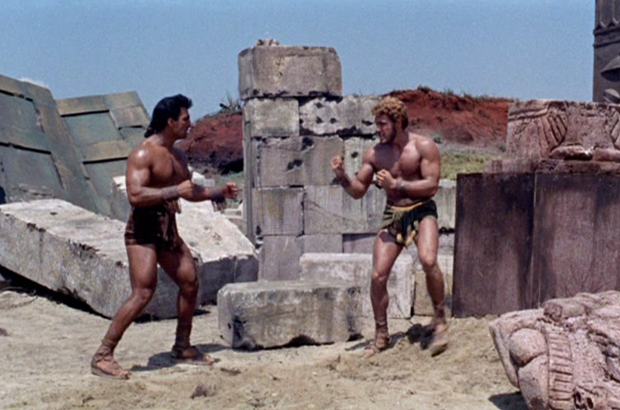
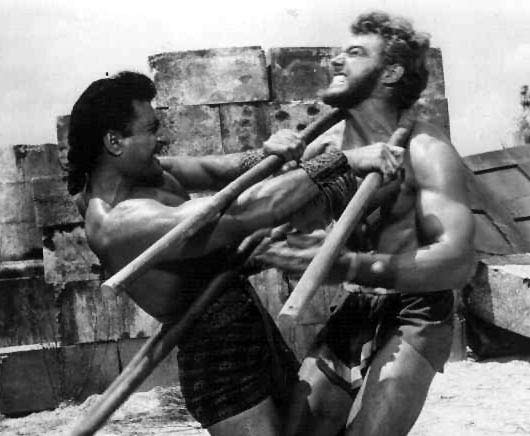
It has to be admitted: Francisci puts his money into stuff the audience wants to see, because the initial fight between Hercules and Samson is a corker, in 1963 peplum terms. In a field of Babylonian ruins, they throw each other into walls and columns of huge styrofoam blocks, throw the blocks at each other, bend iron bars around each other – it’s no Neo versus Agent Smith, but it is pretty cool. I’m pretty sure six year-old me enjoyed it immensely. But once the crew has exhausted all their styrofoam and foam rubber tricks, Hercules says, “Hey, you know? We should team up.” and Samson says “I was thinking the same thing,” and then playtime’s over.

kirkmorris17Delilah keeps trying to escape and warn the King, but the two muscle men use convenient half-mile long lassos to bring her back. Eventually she will convince Samson to let her try to fool the King into giving Herc’s friends a boat and making it look like Samson is a prisoner, but she’s Delilah and shows up at the rendezvous with the Philistine Army, dressed like Barbarella on Military Ball Night. Ulysses gets to prove he’s clever by finding exactly the right buttress for Herc and Samson to bring the Temple of Dagon down (somewhat ahead of schedule) in a welter of styrofoam and foam rubber. I suspect the peplum industry had been manufacturing and storing these thing up for years, and Francisci called up the full supply.

Not all the Philistines get crushed, though, and things look bleak until King Laertes shows up with the boat builder Argos, whose newest creation is the 007 Astin Martin of the 12th century B.C., festooned with javelin throwers and arrow machines (those carrier pigeons kept Laertes apprised of where Ulysses was shipwrecked, and the wimminfolk got tired of waiting). So with a festive “Beware of Delilah!” Hercules and Ulysses take leave of Samson, though we’re pretty confident he’s going to ignore that advice.

lo3Hercules, Samson and Ulysses is generally regarded as the last gasp of the Peplum movies, and its only appropriate that it should be directed by Pietro Francisci, who started the whole fad with the 1958 Hercules, which put a pulp dimension into the Biblical-era spectacles that were so popular at the box office. By ’63, the genre is pretty much sleepwalking through the plot; I’m pretty sure six year-old me could have written this one, right down to the unmotivated teaming up of the musclemen. “An’ then they fight for a while, and tear stuff up, an’ then they decide they should be friends.” Roger Corman made Atlas in ’61, and rarely was there a more canny judge of what was hot and vice versa.

But as I said, Francisci puts the most effort into the mandatory setpieces, the big battle of oiled musclemen and the final confrontation with the Philistines, and you have to admit that at the end, you’re satisfied. You don’t come to a movie titled Hercules, Samson and Ulysses to have the secrets of the universe unfolded before you, you’re here to have fun. Bring the popcorn, sit back, and relax.

Crapfest: Making A Good Friday Bad

There seems to be an ebb and flow in the Universe around these things: I’d had another stressful and exhausting two weeks, the midpoint of which was the Fort Bend International Festival, a nice 11 hour day with only two minor fifteen minute breaks. I should feel lucky – I was totally expecting 12 hours. This was followed by a holiday on the following Friday, Good Friday, but that only meant everything had to be done a day early. I really didn’t feel rested until a week after the Festival, and a day after Crapfest.

Two could not make it – David and Erik – and we added a newb, Mark, who, like me, works at a college but has a much more elevated position than I (realistically, the janitors have a much more elevated position than I). Paul and Alan arrived after their commitments; I had beaten Rick to Dave’s house by mere minutes, giving us sufficient time to curse each other and the screen, because I had burned another compilation of horrible things from the Everything Is Terrible website. Here is one of the least offensive, in case you were ever wondering what happened to Madness after that “Our House” money ran out:

I’m still trying to figure out how to rip that and make it my ringtone. Apparently some memories of this song gave Rick problems in church Sunday morning.

The-Bodyguard-558x836Dave wanted me to go first, but although I had a stack of discs in front of me, I pointed out that we had been promising Paul we would show Sonny Chiba’s The Bodyguard for months. “What? Is it Be Nice To Paul Day?” “Sure, why not?” So we finally watched The Bodyguard, which is, unfortunately, no Streetfighter, but hey – it is Sonny Chiba.

It is quite literally Sonny Chiba, as Sonny Chiba plays a guy named Sonny Chiba who is a world-famous karate instructor. After a gangster is machine-gunned on the steps of St. Patrick’s, Sonny is hired to be the bodyguard for the dead gangster’s (wouldn’t you know it?) Japanese girlfriend. Yes, it’s Sonny Chiba vs the Mafia, and there are lots of broken bones sticking out of arms before the evening is out. The girlfriend is trying to do one last drug deal in the gangster’s honor, or something, and Sonny comes along for the ride as he goes between slapping the crap out of her and falling for her. Mark’s utterance of , “Boy, I hope this ends like Get Carter” is sort of prescient, but only sort of. And Paul sits there with a big grin on his face for most of it.

Our hopes were, however dashed in that Kevin Costner never showed up so Sonny could punch his lights out. Also: I had no idea that Sonny Chiba is in the Book of Ezekiel, but there it is, right at the beginning. This movie was educational, too.

Well, that clip kind of let you hanging, didn’t it? Here, the trailer picks up where that left off, and gives you a glimpse of the Enno Morricone-wannabe soundtrack, which was pretty hot:

After this, I discovered that it was also “Be Nice To Alan Day”, which is where things began to go horribly wrong. Alan had been doing actual research, tracing filmographies of  people like Pamela Jean Bryant (Miss April 1977, says resident Playboytologist Paul), mainly known in these parts from H.O.T.S. and Lunch Wagon. And what does his research uncover but this… thing from 1993 called GetEven, re-titled to Road to Revenge, possibly because the original title was too suggestive of what anybody watching it should consider. (Actually, it seems to be the opposite – GETEVEN seems to be the current title)

Here is your set-up: first, realize there is a lawyer named John De Hart (the emphasis is apparently on the “De”). He is also apparently a very successful lawyer. So naturally he decides to become a movie star.  He writes, produces, stars and co-directs in an action movie titled Get Even. He also has a musical number. I am not lying about this:

Yes, that is Pamela Bryant at the bar, proving what a good actress she was by looking like she’s enjoying herself. She also should have won awards for the two sex scenes she had with De Hart. Yes, he gave himself two sex scenes with a Playmate. And before you ask, yes, he sings the two songs under the sex scenes. Really awful flashbacks to The Room surfaced under these conditions.

1302247If you were really sharp, you saw Wings Hauser dancing during the clip. Here’s our plot, such as it is: Rick Bode (De Hart) and the unlikely-named Huck Finney (Hauser) were LAPD cops under William Smith (who packs the even more unlikely name of Normad). Normad frames them for drug charges – and about the worst thing to come from that is they lose their jobs – which somehow then makes him a judge. The passage of time in this is oddly (some might say ineptly) fluid, so I guess he got elected to that position somewhere in there. Now, not only is he William Smith, crooked cop and drug-dealing judge, no, that is insufficient for our needs, he is also a baby-killing Satanist. Bryant witnessed a baby sacrifice years before (or maybe it was minutes before), but Smith doesn’t decide to kill her until De Hart marries her. Which of course leads us to our Road to Revenge, perhaps the shortest Road to Revenge ever. Less than a block, or so.

De Hart’s baggy face rarely ever changes expression, though he is really good at looking directly into the camera. Wings Hauser is obviously improvising his dialogue, and it does serve to pad out the running time to feature-length. There is one speaking role – a nun – who is so mind-blowingly awful, she is in the movie twice, just to make De Hart look good. And yes, our hero is guilty of several counts of murder by the time the movie is over, but that’s okay, right?

You, too, can go to geteventhemovie.com and purchase your own copy for a whopping 10 bucks. I do not personally recommend such a thing – but then, when have you ever listened to me?

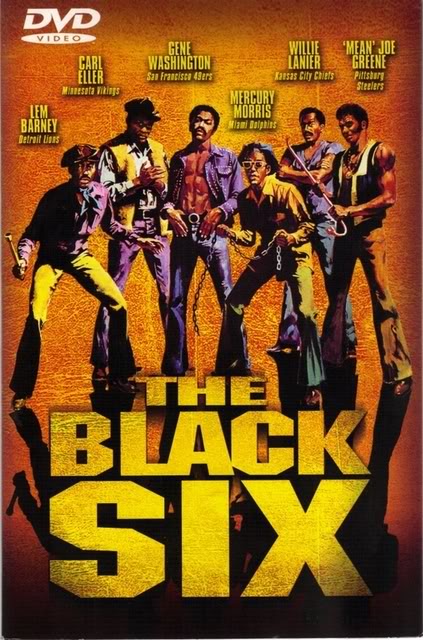
TheBlackSixPaul takes his position as Designated Wuss very seriously, and left, before we put on Mark’s offering: The Black Six, the tale of a motorcycle gang made of six NFL football players. And if you know me and sports, you know I had no real idea what was going on, cast-wise, even though the opening credits were good enough to tell us what team each guy played on. Anyway, the Black Six are traveling the country after serving in Nam, generally being cool except when they are hastled by the man (ie., rednecks stupid enough to mouth off to six black men over six feet tall and in good shape). Until one of them finds out his kid brother was beaten to death by a white motorcycle gang.

That would be Gene Washington, chosen to be the main actor from our other pro players, who get distracted by such frippery as women on the street until they’re needed for backup.

The actual mechanism of Washington receiving this news by General Delivery at a post office during their wanderings led to a spirited discussion of exactly how much money Washington’s mother spent on postage, to send copies of this letter to every post office in America, just to make sure he got it.

Anyway, the Black Six arrive in town, get called “The New Uncle Toms” by Washington’s Angela Davis-lookalike sister, find out the cops cain’t do nothin’, and wind up in a big nighttime showdown with the murderous motorcycle gang, unaware that the spiteful honkies made a deal with an even larger motorcycle gang run by “Thor” (Ben Davidson, who I was helpfully informed was another football player). This is actually a pretty good final scene, as the six gather all the bikes in a circle and fend off onslaught after onslaught, finally ending in a huge explosion and conflagration, leading us to believe the Six are dead, except the titles assure us that everytime a brother is hassled, the Six will be there.

I’m not sure if the Black Six actually “waste 150 motorcycle dudes” – it gets a little hectic there – but it’s a pretty good finish. Up to that point, it’s obvious the Six aren’t martial artists at all, but they’re game, by golly. Matt Cimber directed a bunch of low-rent action flicks and blaxploitation movies, and his experience shows; it certainly had the most comprehensible plot of the evening.

Mark took his leave, his damage done, leaving myself, Dave, Rick and Alan. And while Alan took a nice nap, Dave started up Mission Stardust.

affiche-4-3-2-1-operation-lune-mission-stardust-1967-1I had meant to see Mission Stardust for years. It’s the Perry Rhodan movie, and when I was a teenager, I read a bunch of Perry Rhodan when Forry Ackerman started importing them here to the states.

Perry Rhodan is a weekly pulp series started in Germany back in 1961. It is pure space opera pulp – two-fisted astronauts, alien races, hairs-breadth escapes – it was glorious to young teen-aged me. Ackerman’s English versions were successful enough to keep the series running in bi-weekly paperback form until the new head of Ace Books decided it was “too juvenile” and cut it off around issue #120. Ackerman did keep it running in a subscription-only model for another twenty issues, but that was pretty much it for America. In Germany it kept going until 2011, when reportedly it got rebooted for a new audience.

So in 1967 Mission Stardust was made (aka 4…3…2…1…Death!) and the fact that no other Perry Rhodan movies were made should clue you in how successful it was amongst Rhodan fans.

2500tibiPerry Rhodan (Lang Jeffries) is in charge of Earth’s first Moon landing, where the crew of the rocketship Stardust finds a disabled alien ship with two living occupants from the planet Arkon: the elder scientist Arkin (Pinkas Braun), and the ship’s captain, Thora (Essy Persson). Arkin is looking for younger civilizations to freshen up the Arkon’s genetic pool, which means Perry will be sucking face with Thora by movie’s end (Spoiler: it took like 18 books for that to happen) even though she doesn’t like these primitive screwheads. In the meantime, Arkin is suffering from a mysterious disease that turns out to be leukemia.

The thrust of the movie then becomes getting a doctor who has developed a new treatment for leukemia from Mombassa to the Moon without revealing that there are aliens camping out on said Moon. This is accomplished by landing a smaller spacecraft in the desert and hassling all soldiers that come their way.

Rhodan and his sidekick, Mike Bull (really) (Luis Davila) sneak into Mombassa with a handful of diamonds (of course, worthless to the Arkons. Their money is mercury), unaware that a Blofeld-level bad guy has a mole on their ship and is planning to hijack the spacecraft. In other words, in order to escape our run of bad action movies, we blundered right into the arms of a bad action movie.

But it was at least a bad action movie with spaceships and robots. That was different. Sort of.

Here’s Your Scorecard:

Best Fight Scenes: The Bodyguard (which should tell you something about the quality of the others)

Easiest Plot to Follow: The Black Six

Best Score: The Black Six

Best Playmate: Road to Revenge

Best Space Vehicle That Looked Like A Dildo: Mission Stardust

Best Song: Jesus Is My Friend

Lesson Learned: We will never be nice to Paul and Alan ever a-fucking-gain

I was fearsomely buzzed on caffeine and willing to do another movie. But Alan went home halfway through Mission Stardust and Dave and Rick wanted to have lives, or something. So I went home, logged the movies and sent rambling e-mails for the rest of the evening. And at some point, realized I had horribly disfigured my Letterboxd.com profile page with this rogues gallery:

63245d73-f41d-4b82-bc8c-0125d62e218aMeaning Jesus God I gotta watch more movies. Stat.

The ABCs of March, Part Six

Finally finishing out Letterboxd.com’s March Movie Madness challenge. It got to be a little wearing there, toward the end.

The Villain (1979)

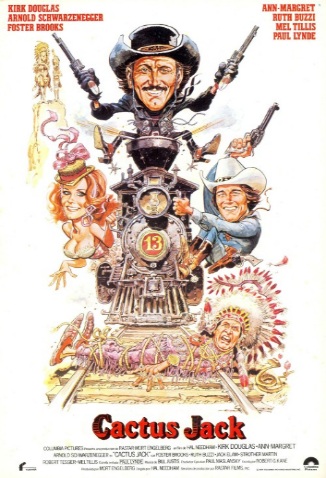
villainDear sweet mercy, is there anything worse than an unfunny comedy? This is stuntman extraordinaire Hal Needham’s third movie, after Smoky and the Bandit and Hooper. It is a Western parody, and if you are expecting Blazing Saddles, you are probably in the same shoes as everyone who paid to see this in theaters, sucked in by an ad campaign and a trailer with far better pacing and editing than the movie itself. Cactus Jack Slade, a down-on-his-luck professional bad guy (Kirk Douglas, of all people) is hired by crooked banker Avery Simpson (Jack Elam) to waylay the somewhat less-than-virginal Charming Jones (Ann-Margaret) on the way back to her pa’s silver mine and steal the money she’s transporting so Simpson can foreclose on the mine. Trouble is, she is being protected by a clueless lunkhead literally named Handsome Stranger (Arnold freaking Schwarzenegger). The other problem is that Cactus Jack is an idiot. cactus jackNo, the real problem is that the decision was made to make this a live action Roadrunner movie, with Kirk Douglas in the Wile E. Coyote role. They even do the painting-a-tunnel-on-the-side-of-the-mountain bit, for God’s sake. The problem is, neither Hal Needham nor his editor are Chuck Jones, and all the bits fall flat, flat flat. Kirk Douglas has good comic timing, and is game as hell, but the Marx Brothers, Monty Python and full frontal nudity could not have saved this movie. I haven’t even gotten into Paul Lynde and Robert Tessier as Indians. Nor will I.

White Vengeance (2011)

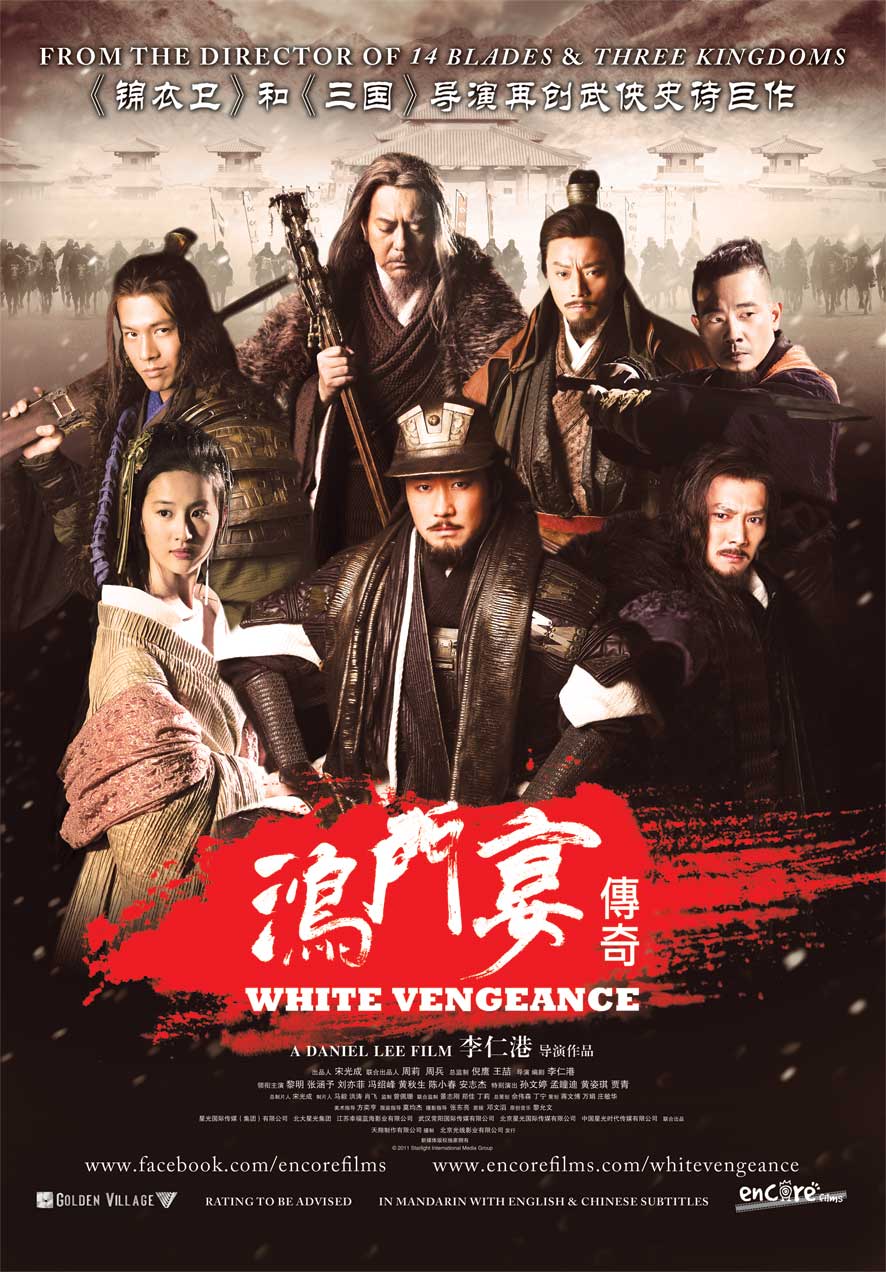
white-vengeance-poster-previewThis is the second Chinese historical epic I’ve seen in the last couple of years that had the original title The Feast, that has been changed to something more commercial for Western audiences. the first, an Asian “Hamlet”, was re-titled Legend of the Black Scorpion, which is a bit odd for a movie bereft of scorpions of any color. The re-titling of this one makes more sense, at least. White Vengeance tells the tale of Liu Bang (Leon Lai) and Xiang Yu (Feng Shaofeng), two warlords seeking to overthrow the crumbling Qin dynasty and become Emperor themselves; seeking to drive a wedge between the two men, King Huai proclaims that whoever takes over a certain town will become its Lord, a stepping stone to the Imperial Throne. It works, and Liu Bang manages the feat without shedding a single drop of blood; thus begins an internecine war between the two men, fought with armies, yes, but mostly through the machinations of each man’s counselor. Anthony-Wong-in-White-Vengeance-2011-Movie-ImageThe battle of wits seems to come to a head at the Feast of Hong Gate, where Xiang Yu’s elderly, blind mentor Fan Zeng (Anthony Wong) and Liu Bang’s right hand man Zhang Liang (Zhang Hanyu) play five games of chess simultaneously. Well, not chess, but Go, a Chinese version that has subtleties of its own. Though it seems to end with Xiang triumphant, the chess moves continue for months, even beyond Fan’s eventual death. That’s the White Vengeance of the title: the white pieces on the Go board, vying for advantage even when there are no hands to move them. White Vengeance does have massive armies charging at each other, and those scenes are well done; but I do admit I love movies that value strategizing and the movement behind the lines. There’s also a love story almost buried within the cut and thrust of the main storyline, and it seems superfluous – though it does add a bit of sweet and forlorn spice to the otherwise Machiavellian mix.

X-Men: First Class (2011)

X-Men: First ClassWhy did it take me so long to see this movie? Well, I guess I knew that some day I would need a movie starting with X that I hadn’t seen before. This is the oddest Franchise reboot in a while; most reboots update the characters, not backdate them. This one places the X-Men at the Cuban Missile Crisis, which wasn’t the fault of the Soviets, but that nasty old Kevin Bacon, here playing Sebastian Shaw, a character that didn’t actually crop up until the late 70s. First Class  gets pretty cavalier about which characters it wants to play with, and schizophrenically taking pains to explain why Mystique is so young-looking in the 21st century X-Men movies, while blithely ignoring any other number of continuity problems. X-Men-First-Class-MAgnetoIn all, this is a pretty necessary move if you want to maintain the backstory of Magneto as a survivor of the Nazi Holocaust. The graying of their mainstay characters is the problem Marvel and DC have been having for years with characters like Nick Fury – most notably not with the Howling Commandos in the Captain America movie. Sgt. Rock was still kicking around the civilian world in the 70s – that’s realistic enough – but DC would like us to forget that Bruce Wayne ran into Rock back during WWII, behind enemy lines. And I guess since they recently slash-and-burned their entire heritage, they can now legitimately say that never happened. Bitter, me? Nah. I have the trade paperbacks. Anyway, fun movie. Not going to be in my top ten, but a good superhero movie.

yellowbrickroad (2010)

yellowbrickroad-movie-posterI wonder if I would have ever settled down to watch this were it not for March Movie Madness? Possibly not. I found it on Netflix while looking for a movie beginning with Y, and here we are. The setup is this: in 1940, the entire population of Friar, New Hampshire, headed down a mountain trail. Some were found frozen to death. Some had been savagely slaughtered. But most were simply never seen again. One of the few survivors could only keep asking, “Can’t you hear it?” A husband and wife team, hoping to write a book on the subject, have spent years trying to get the official documents so they can retrace the town’s journey. Finally succeeding, they embark with a psychiatrist, a wilderness expert, a husband-and-wife cartography team, an intern, and a girl from present-day Friar, who has to show them where the path begins: a stone marker with the words “yellowbrickroad”. Well, before you can say Blair Witch Project (though this isn’t a found footage movie, I should add), our party is subjected to whirling compasses, a GPS that says they’re in every country in the world except where they are, and music constantly playing in the distance. When even shooting the stars with a sextant proves useless, all they can do is follow the music, while their sanity slowly unravels, and it’s not too long before the first murder happens. yellowbrickroad1The padding’s at a minimum (though still unfortunately there), and you have to admit we know these people before they meet their various ends. The slow burn material makes me think of Ty West. But that doesn’t necessarily mean that we like or identify with them, which may be the movie’s greatest weakness. The other weakness is the ending. A lot of people hate the ending, but I’m not necessarily one of them. It turns out this is a problem I have with a lot of modern horror fiction; there’s a superb amount of dread built up, and there isn’t a satisfactory conclusion, so you go obscure, you go strange, and leave it at that. Though the ending of yellowbrickroad is disappointing as to the reveal of the end of the trail, the imagery it ends with is horrific enough that I was satisfied. Your mileage may vary.

Zodiac (2007)

Zodiac (2007)Been meaning to watch this forever. I was stymied when the used DVD I bought was a full-screen edition (“What is this? Medieval times?“), which I finally replaced, and I needed the Z flick anyway, and I had already watched Z. Zodiac is about the Zodiac Killer, a serial murderer whose identity and exact body count is still a cause for conjecture (though the movie, and the book it’s based on, settles on a fairly good suspect). The actual murders take up a rather small portion of the runtime; most of it is given over to the investigation by police inspectors (Mark Ruffalo and Anthony Edwards) and newspapermen (Robert Downey Jr. and Jake Gyllenhaal). Oh, and I nearly forgot Brian Cox as Melvin Belli. Hope you like procedurals, because there’s a lot of it in the 157 minutes. kinopoisk.ruThat’s a damned fine cast, though, and David Fincher and his crew do a spectacular job of re-creating 60s through late 70s San Francisco. The character count does start getting unwieldy as more and more police departments are brought into the investigation, but that really does help the viewer understand the complicated nature of police work, and how frustrated the detectives working the case become, not to mention a public on the verge of hysteria. No wonder Dirty Harry became a hit using the thinly-disguised Scorpio as the villain. I was wondering how they were going to fill out that running time when there is no climactic chase or cathartic capture; the movie instead zeros in on how the pursuit of Zodiac comes close to destroying the lives of these men. There was, at least a cathartic moment for me toward the end, when a rack of paperbacks at a airport revealed that yes, the book that was being written during the movie was the one I read in 1986. Also, if you’re a Donovan fan, be aware that this movie will spoil “Hurdy Gurdy Man” for you forever.

Conclusion

Well, that was fun, but as I mentioned earlier, getting to be a grind toward the end. In the week before the Challenge ended, The Hobbit and Zero Dark Thirty both hit the stores. I would have loved to watch The Hobbit again, but no, I had the end of the alphabet to contend with. Still, I stuck it out, but now I have a bit of a problem getting excited about watching a movie again – this was too much of a good thing. I need to get over this because there’s a Crapfest tomorrow, and maybe that’s just what I need – too much of a bad thing.