Sometimes you just have to pay homage to the classics, even if they may not deserve it. We’re likely going to be arguing about Birth of a Nation for quite some time, for instance, and here’s another one that I’ve been curious about for some time – Nanook of the North, the first docudrama.
Robert J. Flaherty didn’t start out as a filmmaker; he was a paid explorer, who when working for the Canadian Railroads, spent several years among the indigenous people of the Hudson Bay area, in northern Quebec. This was about 1910; in 1913 he bought a motion picture camera and started filming these people in their everyday lives. In 1916, though, he dropped a lit cigarette on this film, and being nitrate stock, it went up in a fireball (it’s estimated that there was about 30,000 feet involved). He went back with more equipment, and using what he had learned in that previous venture, narrowed the focus to one family, and their struggles to survive a typical year in the hostile climate of Northern Quebec, and the result was a worldwide sensation.
But this is one of those movies where the behind-the-scenes is arguably more intriguing than what we see on the screen, and what we see on the screen is actually pretty damned good. There are many controversies surrounding Nanook, and all of them, unfortunately, bring the final product into question.
We’ll start with the obvious: the title character, the Great Hunter Nanook (which we are told means “Bear”), is actually named (I hope I get this right) Allakariallak. We are introduced to his two wives, Nyla (“The Smiling One”) and Cunayou. They were apparently not actually Allakariallak’s wives, but – and this is only an allegation, mind – that they were actually Flaherty’s lovers. The parentage of the baby constantly riding in Nyla’s furs, like a papoose, is unknown.
The movie begins with some striking imagery, as Spring begins and Nanook paddles his kayak to the white man’s trading post to barter the furs of his winter’s kills. One of his children is riding on the top of the kayak. Nanook gets out, helps the boy to land, and then the kayak starts disgorging the rest of the family, like a clown car. This was a surprise, but so logical, I was placing it in my “Things Learned” column, until finding out about the rest of the picture’s veracity. Now I’m not so sure.
“Eh, this blows. You got any Beck?”
There’s a scene at the trading post where the proprietor shows a Gramophone to the baffled Nanook. Allakariallak, it turns out, was no bumpkin, and knew perfectly well what a gramophone was; but he also apparently knew the value of comic relief. There’s also the fact that Nanook is portrayed in his constant hunting for food armed only with his trusty harpoon and a knife carved from a walrus tusk (which truly turns out to have a thousand and one uses), when the Inuit had been using guns for years.
So Flaherty convinced his plucky villagers to emulate their ancestors in their walrus hunt, and they seem to do a pretty good, if arduous job of it. The hunt itself may not be truly documentary, it may be scripted, but as Roger Ebert pointed out, nobody showed the walrus the script.
If you’re willing to grant that Allakariallak may be using old-timey methods to trap his other prey, a snow fox and a huge seal, it becomes a fairly nice re-telling and record of those ways. Then, with the onset of winter, the family builds an igloo (the film claims “within an hour”, but I ain’t so sure about that). This is one of the most famous segments of Nanook, and it is a wonder to behold: Nanook carving the blocks of snow with his trusty walrus-tusk knife, the women and children spackling the gaps with more snow. And most amazing to my eye, Nanook carving a block of ice from the frozen bay to serve as a window, and then placing a block of snow to reflect sunlight into the igloo. That is neatly done.
Then the family settles down for the night under their skins and furs. And something is chewing at the back of my brain: I’ve seen the movie cameras of that era, and they are big. Too big to easily fit through the tiny open Nanook and his clan crawled through. And they required more light than could be brought in through that ice window.
Yep, Flaherty built a half-igloo, open to the outdoors and its bounteous light.
This is a question we have to face again and again as fans of cinema: does a good story trump the needs of historic accuracy? The answer from Hollywood is always a resounding, “Yes!” and who is to say they are wrong? Perhaps Nanook serves best not as a strict documentary, but as a record of a way of life that had vanished before the invention of the motion picture. Hence, not “documentary”, but “docudrama”. Robert Flaherty made a career out of movies like these, and they are all well-regarded: Elephant Boy (with Zoltan Korda, introducing Sabu), Louisiana Story, The Land.
The final thing to consider is that the movie opens by telling us that Nanook died two years after the film was finished; he journeyed inland to find food and starved to death. It is much more likely that Allakariallak died of tuberculosis, in his home. But whatever the cause, the news of his death triggered mourning worldwide, so successful had Nanook been, so far had it traveled. That is the power of a good story, well told, and perhaps the whole question is best answered by another movie, John Ford’s The Man Who Shot Liberty Valance: “When the legend becomes fact, print the legend.”
This has been a couple of weeks of medical problems, family and otherwise, and the attendant throttling upwards of demand on my time. Something had to give, and for once, it was my body in second place. Plans had to be scuttled to accommodate doctor visits, testing, fighting with insurance companies, and filling in for other people on my day job (while still keeping my hours under 19 1/2 a week, because God forbid they should actually have to give me any benefits). (Please note I actually do like my job, and my status is not the fault of anyone I actually work with)
Anyway.
There’s a couple of reviews I have on the spike that I was saving. So I’ll pop one of those up later in the week so we can all pretend that life is normal. I’m only able to dash this off because it’s going to take 20 minutes to transfer this weekend’s footage from the memory cards to my computer for editing.
This provoked a rueful, knowing laugh from me (which was quite welcome, as we were in the second hour of trying to have a celebratory birthday dinner for my wife). Hopefully he does not mind my appropriating it, and will not harvest my organs in the night for black rituals or fringe science, or an unholy combination of both. If you have not yet heard the Word of Warren Ellis, click on either of those links. Your brain will thank you.
Perhaps we’ll talk about what’s been going on one day. Probably not – none of it is life-threatening, and is only of interest if you’re in the thick of it, like me.
Anyway, see you later, and be excellent to one another.
One of the great boons to a movie collector on a budget is the twice-yearly Criterion Sale at Barnes & Noble. We will not speak of the July version last year, because I was broke that month. Last November, however, the combination of the 50% off sale, a coupon, and a membership bought in better days resulted in me walking out of the store with the newly-released Jacques Tati box set for thirty-five bucks.
Tati was a mystery to me; I had no idea he even existed until I moved to the Big City and was exposed to the wondrous world of repertory movie houses. We had two back in those days, and it was the River Oaks Theater – still around, to this day – that had the wonderful sheets detailing the month’s double features, that I found stuck to most friends’ refrigerators. It was on one of these that I read of M. Hulot’s Holiday and Mon Oncle, and the bare paragraph describing Tati and his work. It sounded very intriguing, but I was working in a warehouse during the day and acting at night – time for a movie was rare. But that double feature kept coming back, year after year, so it must have been good.
So, when the Sale started mere days after the box set was released, I regarded it as a Sign.
And then I started rationing them out, because he made only six features in his life.
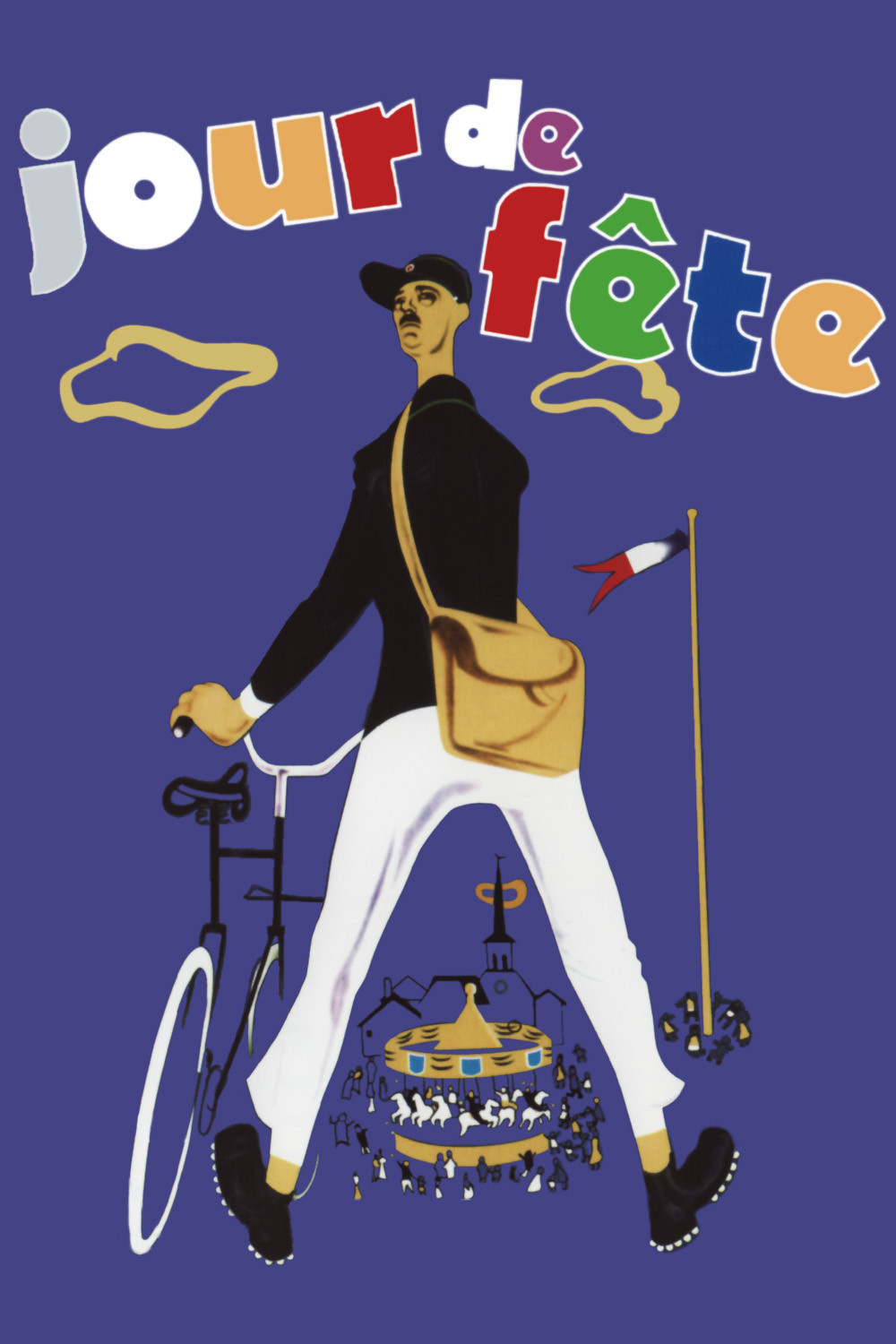
His first feature, Jour de Fête (1949), or “Day of the Celebration” (more popularly, The Big Day), was intended as a tribute to a tiny French village where Tati and several of his friends had found refuge during the Nazi occupation. The rustic village has a number of instantly identifiable types, serving as a sort of Commedia del Arte cast as the movie unfolds. A carnival comes to town, as the village celebrates… well, something. A centenary or Bastille Day, perhaps. The nature of the celebration isn’t important, it’s what it brings to town that matters.
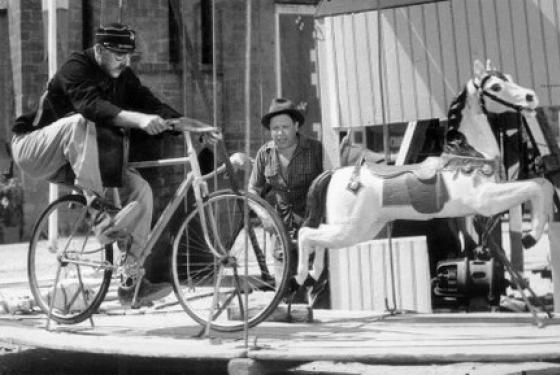
Tati is Françoise, the local mailman, the usual butt of jokes amongst the villagers, and a prime target for the two carnies running the merry-go-round, as they find him a willing participant in his own debasement. A large tent is set up, showing movies throughout the day (the soundtrack of a Western provides an ingenious backdrop for a meet cute between a carnie and a local girl, much to the disgust of the carnie’s wife), and it is in that tent that Françoise sees a film of airplane and motorcycle stunts, purporting to be the American Postal Service at work!
This leads to a tremendous burst of energy in the last part of the movie, when Françoise (egged on by the carnies, of course) attempts to perform his postal duties as quickly as possible, in often dangerous ways, such as tethering his bicycle to a moving truck so he can use its tailgate as a desk, all the while shouting “L’Americaine!” (translated as “American-Style!”) This is apparently taken almost wholesale from his earlier short film, School for Postmen, but as an ignorant Yank, I didn’t know and didn’t care. It’s a marvelous sequence that left an enormous, happy grin on my face.
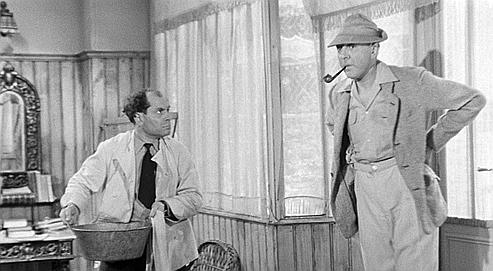
Tati didn’t shift into International Recognition gear until his second movie, Monsieur Hulot’s Holiday (1953),in which the title character (played by Tati himself, of course) wreaks havoc on a quiet seaside resort, usually with the very best of intentions. Like Jour de Fête, the story is episodic, but much more solid, as this time the viewer is certain as to the identity of the main character. Hulot, with his tall, angular frame (far too large for his rattletrap jalopy, whose noisy passage surpasses that of Jack Benny’s Maxwell), odd hat and ever-present pipe instantly inserts himself into the Classic Book of Clowns, probably inconveniencing someone while doing so and creating a catastrophe, all unawares.
I’m aware that Tati made his initial fame as a performing mime, and that most people use “clown” as a pejorative, but the true Clown works on a higher level than mere greasepaint and child-frightening costumes. Charlie Chaplin, Buster Keaton, Marcel Marceau, Claude Kipnis, Red Skelton, Jackie Gleason: all superior clowns, their best work rarely requiring anything so distracting as dialogue (in fact the version of Holiday I watched had been re-edited by Tati in 1978, eliminating virtually all dialogue); their comedy not only entertains but often comments and sometimes even teaches.
Holiday, in fact, announced the arrival of an artist in no uncertain terms. Beautiful, idyllic scenes of peaceful seashore vistas are matched perfectly with hectic scenes of a train station swarming with harried vacationers trying to find their way to supposed peace and relaxation. It’s brilliant stuff, and Tati will continue to impress, not only with the staging of his setpieces, but the artist’s eye toward composition.
The Tati statue, at the resort where Holiday was filmed.
These two movies together form a delightful entrée into the man’s work, as it becomes plain how much he had advanced in only a few years. Jour de Fête is a perfectly good movie, but Monsieur Hulot’s Holiday has been rightly praised as a masterpiece. I read several reviews that puzzled me, that criticized the episodic nature of the story, and that they did not find Tati funny. These people went in expecting Chaplin or Keaton and say so, and that way – expecting an entertainer to fall conveniently into a pre-drilled hole – will always result in disappointment. Much of the humor in Holiday is so mild as to be nearly Canadian (the apparent oxymoron “gentle slapstick” is often used) but I laughed out loud many times. Ask any of my embittered friends who are stand-up comedians: it is tough to deliberately make me laugh out loud.
Anyway, these two movies begin and end similarly: a crowd comes to town, it bustles for a while, the crowd leaves town. Françoise’ frantic mail delivery is sidelined so he can help bring in the harvest. The vacationers say their goodbyes and head home, but Hulot is ignored, more readily accepted by the bored children playing in the dirt at beach’s edge. There are a couple of people who specifically seek him out to say goodbye, having found him a delightful distraction in a pack of stolid, joyless people – but we are only too aware that Hulot was deprived of a last romantic picnic and goodbye from that attractive blonde girl who also found him entertaining, an opportunity sabotaged by his comedy rattletrap car. Such is the fate of the Clown, why we love and pity him so, and why we will always find room for him in our hearts.
One of my great regrets is that I don’t know more about classical music. I can pick out and identify the heavy hitters, but that’s most likely due to exposure via movies or Warner Brothers cartoons. Given that, I likely couldn’t, given a choice of five classical pieces, pick out which one was by Franz Liszt.
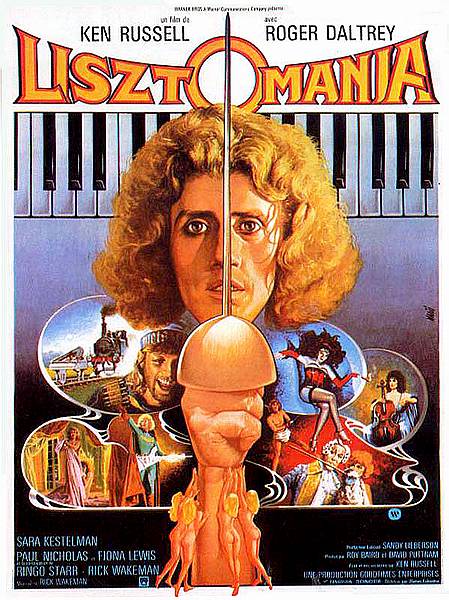
Still, here I am, watching Ken Russell’s biopic of the composer.
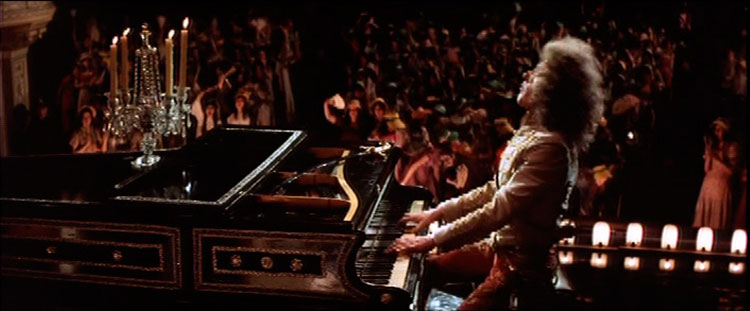
“Lisztomania” was apparently a very real thing, a term coined during Liszt’s glory days as a concert pianist; normally staid concert-goers were shocked by the screams of ecstasy and longing from Liszt’s young female admirers. (It has also been pointed out that a better translation of those contemporary writings is “Liszt Fever”, as “mania” held a much more serious meaning in the 19th century) Therefore, it seems fairly reasonable to cast Roger Daltrey, lead singer for The Who, as a very real classical music rock star.
Lisztomania is concerned with the composer’s adult life, starting with his affair with the Countess Marie d’Agoult (Fiona Lewis), then into a concert where the audience is populated by screaming young girls (causing me to flash back to the final concert scenes of A Hard Day’s Night), then onward through his years of fruitful creativity under Princess Carolyn zu Sayn-Wittgenstein (Sara Kestelman), finally ending with his exorcism of the Nazi vampire Richard Wagner, using a flame-throwing piano made of steel and glass. Then Liszt returns from the afterlife in a pipe organ spaceship powered by the women he loved in life, to defeat Wagner, resurrected as a Frankenstein Monster/Adolf Hitler with an electric guitar that doubles as a machine gun.
What I’m saying is, some liberties may have been taken with Liszt’s biography.
Now, biopics almost always play fast and loose with the truth, because movies, you know? Anybody going into a biopic directed by Ken Russell expecting a documentary is, to put it politely, going to be blown out the back of the theater by the sheer force of the extravagant visuals that flow out of the screen like a water cannon. That is, if they haven’t had a heart attack at the first sight of bare boobies 30 seconds into the film. And remember: we are talking about Ken Russell right after Tommy.
The drying up of Liszt’s creative powers during his years of non-connubial bliss with Marie is presented as a silent Charlie Chaplin movie, accompanied by Liszt’s “Love Dream” (Liebestraum), with lyrics by Daltrey. That’s a conceit that shouldn’t work, but it’s brilliant. And if you hadn’t already figured out that this movie was going to have only the slightest flirtation with reality by that opening concert with its mylar curtain backdrop, this is at least a fairly gentle – for Russell – wake-up call.
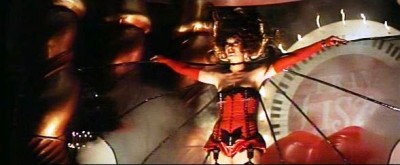
Considering we’ll be soon entering into the segment where Liszt is seduced by Princess Carolyn, who will unlock his pent-up creative juices (heh) by forcing him to abandon his libertine ways and concentrate on composing. This is presented in a sequence involving Liszt growing a ten foot erection during a production number with the Princess’ chambermaids, who then feed the preposterous priapism through a guillotine manned by the Princess in her best Rocky Horror corset. This is entirely justified artistically (I am sure).
And did I mention Ringo Starr as the Pope?
Russell is one of those directors I have come to appreciate late in life. In my early adult years, I knew him mainly for Altered States (for which my acidhead phase thanks him) and Crimes of Passion (for which… not so much). In subsequent years I’ve found Salome’s Last Dance, and thanks to the BFI and a region-free DVD player (and no thanks to Warner Brothers), The Devils. In my younger days, he was known as “Mr. Wretched Excess”, but I have really come to appreciate his audacity as well as his visual sense.
After nearly six decades on the planet (most of it spent watching movies), I’m more than grateful to find a filmmaker who not only makes me say “Oh what the fuck?” on a regular basis, but also makes sure that I have a smile on my face while doing it.
(This is an expanded version of an article I wrote for Daily Grindhouse)
Asking me to do a Top 10 list for the year is a dicey proposition. I’m rarely in a hurry to see movies, and it’s even more rare that anything excites me enough to expose myself to the pit of annoying human behavior which is the modern theatrical experience. But damned if I didn’t wind up seeing twelve movies in the year they were made available (spoiler: it was this year).
I also don’t care for ranking movies. All the movies on this list were of a pretty high quality, rendering placement squirellier than usual; overall, though, this list probably reflects that I am more colossal nerd than actual film buff. I look at other Top 10 lists and think, “Yeah, that does sound good. I should watch that some day.” Then again, the best movie I saw this year was made in 1943 – more on that later – so maybe there’s a bit of hope for me yet.
But let’s talk about 2014.
HONORABLE MENTION
MALEFICENT – Frankly, this was going to be a hard sell to me; Sleeping Beauty is my favorite Disney animated movie, and that is due in no small part to its villainess. I like my bad guys grandiose and unrepentant, and Maleficent gives my favorite one a redemptive arc. Unsure whether to regard it as representation of how the Patriarchy subverts women of genuine power and motive, even to re-writing history, or simply as a cynical money-grab. Its very existence puzzles me , but it is well worth watching for Angelina Jolie, who is frequently magnificent as the title character. Especially when she’s being evil.
CAPTAIN AMERICA: THE WINTER SOLDIER – Was highly regarded as the best Marvel yet, a seamless marriage of 80s action with the money of the current Marvel Cinematic Universe. It is certainly that, a damned near flawless action flick that actually made me like The Falcon (the Widow gets her movie first, dammit. Sorry, Mr. Mackie). But me, I like a little cosmic in my superhero stories, and Winter Soldier felt too stuck in that 80s action mode. (Don’t worry, there’s stuff coming up on this list that will allow you to call me a hypocrite) Chris Evans, though, remains the best damn Superman who never got to play Superman, a perfect portrayal of an inspiring, noble comic character.
And now for the list that is probably going to get shuffled around right up until press time:
10. GODZILLA – I like big beasts, and I cannot lie. Yes, too much time was spent on Action Man while Bryan Cranston and Ken Watanabe were wasted, but frankly, spending too much time on boring human characters is a complaint I also lodge against most of the Japanese Godzilla movies. I want my Kaiju Big Battel, dang it. This one felt heavy and apocalyptic, just like the first Gojira, and I was a very happy monster movie fan. Also, people coming out of the woodwork to talk about how much they preferred the 1998 version allowed me to clean up my friends list somewhat.
9. THOR: THE DARK WORLD – I told you I like my superhero story leavened with the cosmic, and Dark World delivered. The production design of the Thor movies impress me with their visualization of science so far advanced it looks like magic (Thank you, Misters Clarke, Kirby and Lee). Jane Foster went to Asgard and didn’t turn into a sobbing wretch like her comics counterpart, We got much more Thor/Loki love/hate action, and I absolutely loved the final battle scene flipping through dimensions. (Bizarre battle chases like that make me very happy, one of the few reasons I find Shocker tolerable).
8. THE HOBBIT: THE BATTLE OF THE FIVE ARMIES – I see an astounding amount of hate directed toward these movies; bizarre, because I find them enjoyable and very entertaining. Still, I sadly realized, as I left the theater this time, that I hadn’t enjoyed any of these as much as I had the original Lord of the Rings movies – but it was still nice to have them to look forward to every Christmas season, and there’s a part of me that will miss that. And if you hate on Billy Connolly riding a war pig, you and I are going to have words.
7. THE LEGO MOVIE – Released in the movie wasteland of February, we all went, “Right. Another toy tie-in. Super.” But this was no Transformers or GI Joe or Teenage Mutant Ninja Turtles. this was a frenetic ode to creativity and fun with an anarchic storyline encompassing (and making light of) The Chosen One, Objects of Great Power, Prophecies, DC superheroes, pirates, and spaceships (“Spaceship!”). I wasn’t a fan of the third act twist, but what are you going to do? Sing “Everything is Awesome”, probably. Like you are right now. You’re welcome. There will be a sequel – of course – but I don’t see how they can possibly keep this up.
6. SNOWPIERCER – Quite a lot of cinematic dystopias around lately, fancy that. This one is literally inescapable, as a world-circling train carries the last of humanity after an attempt to counter global warming turns the Earth into a frozen graveyard. After nearly 20 years, the Have-Nots in the rear car stage an uprising, fighting their way to the Haves in the front cars, with each car containing new hazards and new wonders. Science fiction, doing what it does best: exploring the human condition, and how we have a tendency to screw each other – and just as big a tendency to actually save each other, occasionally.
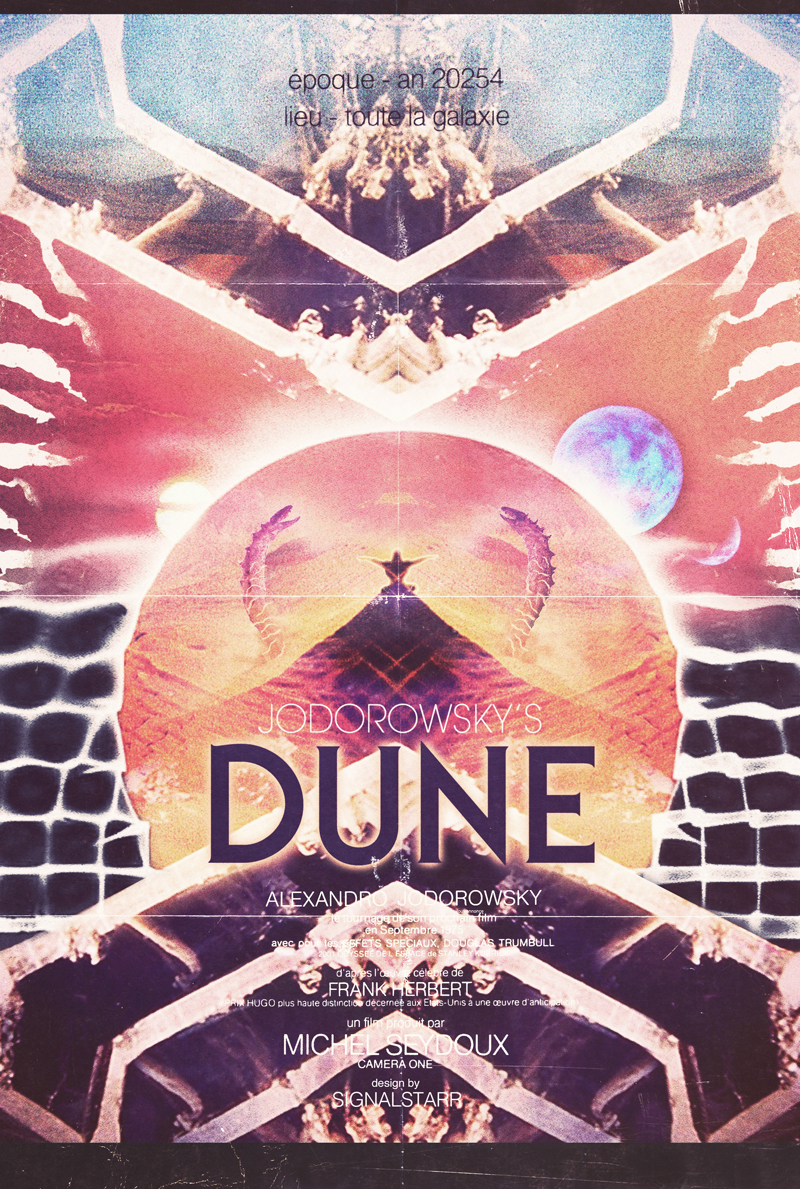
5. JODOROWSKY’S DUNE– Yes, this is a 2013 movie, but it was released on DVD in 2014, smartass, allowing those of us who don’t live near an art house to actually see it. I remember reading about Jodorowsky’s ill-fated movie adaptation of Frank Herbert’s Dune in the pages of Heavy Metal magazine when both were going concerns. Even if the movie had gotten made, I would likely have hated it, but watching Jodorowsky talk about the project, his passion undimmed by the years, and his belief he could change the world with this movie and his fellow “spiritual warriors”… well, it’s impossible to not fall a little in love with the man.
4. X-MEN: DAYS OF FUTURE PAST – The return of Bryan Singer to the franchise he launched yielded such a remarkable movie, not only linking up the personnel from the original two movies with the younger versions of First Class via a time travel story that manages to wipe out the mistakes of the franchise-killing Last Stand, but also managing to be tremendously entertaining and gripping while doing it. This was the best Marvel movie last year, that Marvel didn’t make.
3. JOURNEY TO THE WEST: CONQUERING THE DEMONS – I love Journey to the West, one of those million word Chinese novels that influenced everything that came after it (and many, many film versions), so I was uncertain about a prequel. Silly me, Stephen Chow came up with a beguiling, raucous, funny epic tale with fantastic, thrilling set pieces and genuine emotion. This was the movie I kept grabbing people and forcing them to watch this last year. And Holy Jesus, look at that poster. It’s a throwback to the masters of the 60s and 70s, it’s art, not a Photoshop job. For that alone, the movie deserves all the views.
2. THE RAID 2– And after dissing 80s action movies in the first section, what do we find here, near the top? Possibly one of the finest action movies ever made, by one of the best action directors we have seen in an age. Gareth Huw Evans, forsaking the rapid-cut, what-the-hell-just-happened style that murdered action cinema in this country, to present a more calculated, but still frantic, visceral palette. The only thing that kept this movie from the number one slot is an overly familiar storyline (a decent cop going deep undercover to infiltrate a crime family). Otherwise, acting, camerawork, the superlative fight scenes and stunt crew are all top-notch. And any final fight scene that has a grizzled old vet like me curled up in a fetal position in his chair grunting, “Ah! Oh! Gaaaah!” is some intense shit.
Which leads us to –
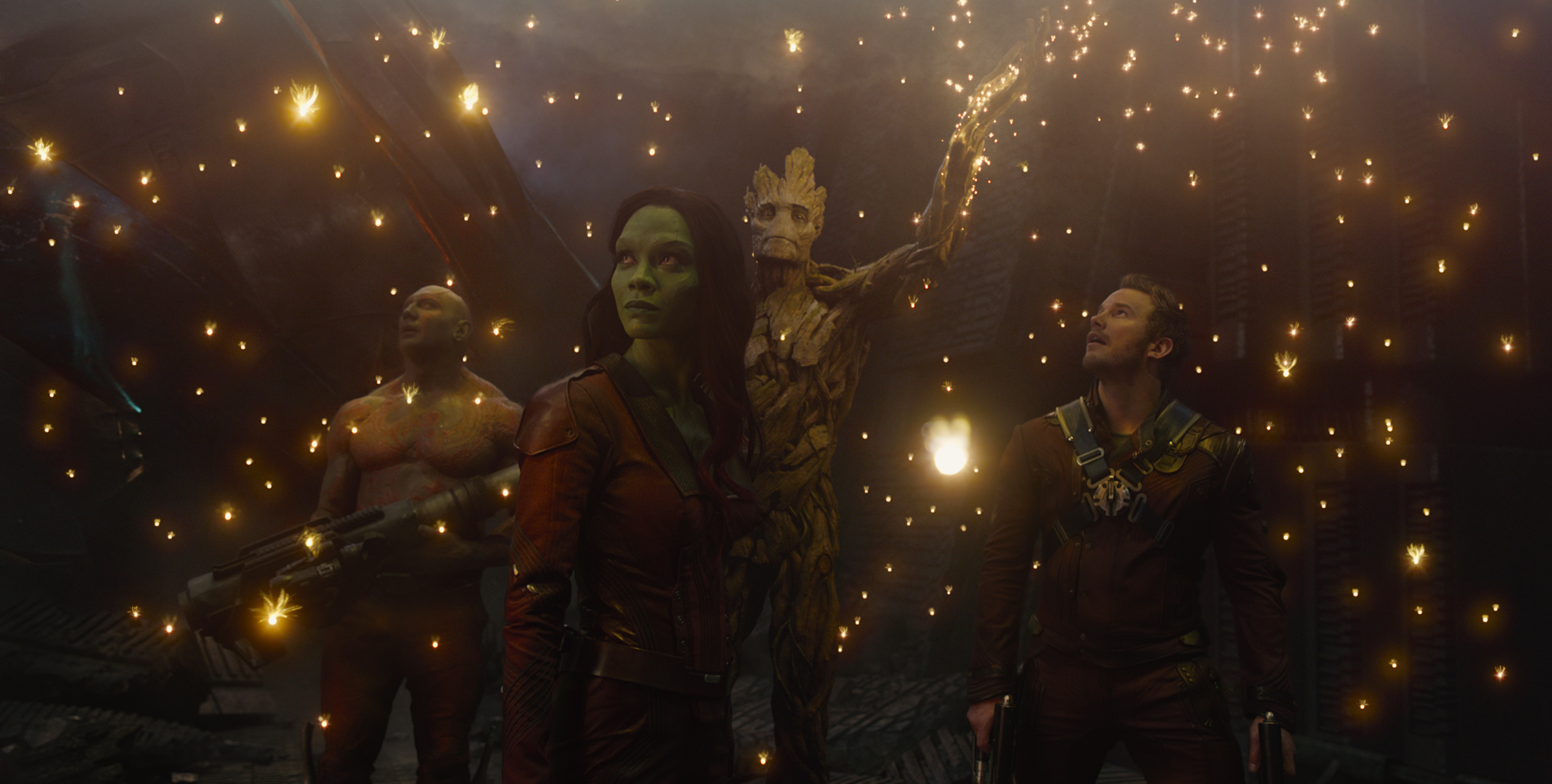
1. GUARDIANS OF THE GALAXY – Am I a huge nerd or what? Who expected a Marvel movie with no hook, no established characters hailing from an earlier movie (except for Thanos, one of the most ineffectual villains ever – so far, anyway), and in fact populated with characters it would take a Marvel geek of long years to recognize – to deliver so satisfyingly? Each of these “Guardians” are dealing with their own form of grief, and they find out in the course of the movie that they do not have to do it alone; or, in the parlance of motivational seminars, “Sometimes misfits are the right fit.” Nobody went into a movie with a tree monster from the 50s and a talking raccoon expecting to cry – but they did. There was some loose talk of Guardians being this generation’s Star Wars, and that may be true; I left the theater with the same buoyancy and sense of pure cinematic joy I felt on a certain summer day back in 1977.
Now, you may ask, what was all that about a movie from 1943? This is where things get a little strange, as I had to finally distill down what were my Top Ten Movies seen in 2014, for my Letterboxd Year in Review. Which is when I realized something: there were repeats between the two lists, of course, but their orders shuffled because of the picture in the #1 slot. This was not something that had occurred to me. So what were the Top Ten I Saw (for the first time) in 2014?
10.GUARDIANS OF THE GALAXY – That’s right, the #1 got shuffled down to the #10 spot, as I reconsidered my rankings in light of the movies in the top two slots. Ranking movies numerically is pretty stupid, anyway.
Yeah, same to you, Sky Prince or whatever your name was.
9. HIGH AND LOW – Kurosawa’s film version of an Ed McBain police procedural about a kidnapping gone wrong delivers on all fronts, especially when we get to the “Low” part of the equation. As in Ikiru, Kurosawa makes Japanese nightlife look like revelry on another world, so familiar and yet alien; and that sidetrip into Junkie Alley becomes a horrifying glimpse into Hell. All this, and Toshiro Mifune, too!
8. THE PHANTOM CARRIAGE – Silent movies are good for you. Director and star Victor Shölström delivers a melodramatic portrait of a hateful, worthless human being and somehow still gets us to root for his redemption. Charlie Chaplin and Ingmar Bergman were both big fans, and now I am, too.
7. JOURNEY TO THE WEST:CONQUERING THE DEMONS – For some reason, ranking this above Guardians on this list made good sense at the time. Maybe it was the multiple viewings. Anyway, here we are.
6. THE GOLD RUSH– Hey, another silent movie! It’s incredible to me that I managed to get this far in life without seeing one of Chaplin’s feature-length movies. I picked a good one to break that particular fast.
5. THE RAID 2 – Yes, even the mighty Raid 2 dropped a few slots, under the onslaught of quality that is to come. I still want to see Gareth Evans’ next movie noooowwwwwwww
Please don’t hurt me, Hammer Girl. I still love you.
4. HELLZAPOPPIN’ – The quality is coming, I assure you. I had wanted to see this for years, and Dave finally managed to dig up a copy of it (there’s some sort of rights issue with the original Broadway show script that kept it from getting a legit home video release). I was so smitten by it, by what Olsen and Johnson managed to pull off, even with a studio-mandated romantic storyline (and spending most of that opening ten minutes lampooning the studio that was screwing with them) – well, I’m sold. I went and sought out my very own bootleg copy. (Wheeler & Woolsey’s Diplomaniacs almost made the list, but Olsen and Johnson accomplished a lot more whileunder the Hayes Code, no less.)
3. CHILDREN OF MEN – Like I said, it takes me a while to see some movies. I’m ashamed to admit I didn’t watch Children of Men because I thought it was going to be another macho shoot-em-up, and boy howdy, I was wronger than a Nazi trying to pick out the Holy Grail. Brilliant movie. I have rarely been gladder to be wrong in my life. Ironically, I watched it the night Cuaron picked up the Oscar for Gravity, but I’m pretty sure that was just making up for not even nominating him in 2006. (The winner was Crash. Oh, yeah. Remember Crash?)
2. WILD STRAWBERRIES– Oh, the fight for first and second place was a wild and bloody one. Like I said, rankings are dumb, and both movies deserve to be #1. Here’s Victor Shölström again, this time coaxed out of retirement by Ingmar Bergman, and such a wonderful movie. Any words I’m going to babble out are not going to do it justice. Just watch it.
1. THE LIFE AND DEATH OF COLONEL BLIMP– I was expecting it to be good. I wasn’t expecting it to be superb. Again: Just. Watch it. Instead of merely showing you a clip, here’s a special guest to tell us about the restoration of the movie:
HONORABLE MENTION goes to A Hard Day’s Night, another stunning restoration on Criterion (especially with that 5.1 remix!). But I had seen it before.
And to all those other fine movies I re-watched this year: Targets, The Three Musketeers (1973), Sorcerer, The Quiet Man, Yojimbo, Sanjuro, The Holy Mountain, Samsara, The Untouchables, Vampyr, RoboCop, and Koyaanisqatsi.
The WordPress.com stats helper monkeys prepared a 2014 annual report for this blog.
Here’s an excerpt:
The concert hall at the Sydney Opera House holds 2,700 people. This blog was viewed about 23,000 times in 2014. If it were a concert at Sydney Opera House, it would take about 9 sold-out performances for that many people to see it.
Today is the last day of the Thanksgiving Holiday, the second weekend in a row I’ve had off. I have done nothing except cook. eat, sleep and play stupid puzzle games. It has been remarkably renewing. The opposite of profitable, but renewing. Which brings me to this entry.
December begins tomorrow. That is usually a busy month for me; hopefully the last two weeks are not an indicator of how busy I’ll be this year. I need to wrap up phase one of a writing project by the end of the month, and there is a personal writing project I’ve been putting off far too long.
So what I’m saying is, I’m going to stop pretending and simply announce that, likely, this space is going dark for the rest of the year. This downtime has been nice, but I need more. I haven’t watched a movie in more than a week, because – and I find this hilarious – if I watched any more, I’d have to write about them, and this entry was getting ungainly long already. That’s the epitome of putting the cart before the horse. So, before I close this tab on my browser, here’s a shorter version of that ever-growing blog post:
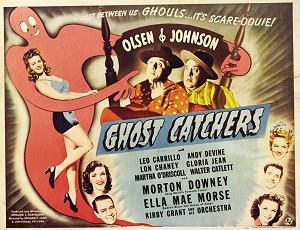
Studio execs had ground them way down by this time (it is probably telling that their last picture is titled See My Lawyer, and reportedly has very little Olsen and Johnson in it), to the point that once more we have two movies occupying the same space, but there isn’t even the uneasy truce between them that made Hellzapoppin’ great. Olsen and Johnson find themselves in an Abbott & Costello knockoff (typically, they make a meta joke about it), and the best sequence involves a jitterbug exorcism to cast out the one actual ghost in the whole thing. Mel Torme is supposedly in that, and so is Morton Downey Sr., providing far more entertainment value in five minutes than his son did in an entire career. Chic Johnson seems to be on nitrous, so constant is his giggling. I should have watched Hellzapoppin’ again.
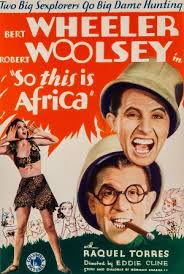
I went over to Rick’s to watch more movies; now, normally, Rick and I, during these outings, watch a better quality of film. During the last sojourn at Dave’s, however, when I showed Wheeler and Woolsey’s Diplomaniacs, Rick became a hardcore convert to the cause of W&W. We had been interested in So This Is Africa, their sole movie for Columbia (during a contract dispute with RKO), and reportedly one of their most heavily censored. Alas, my suspicions were correct, as not only does this movie suffer from the lack of Joe Mankiewicz’s lunatic scripting, but the print is pretty heavily and obviously cut, so much so that Rick and I took to marking each instant with scissor motions in the hour while hissing, “Filth!”
The best bit is an out-of-left-field riff on Eugene O’Neill’s Strange Interlude, which would have been brilliant had the Marx Brothers not done it three years before in Animal Crackers.
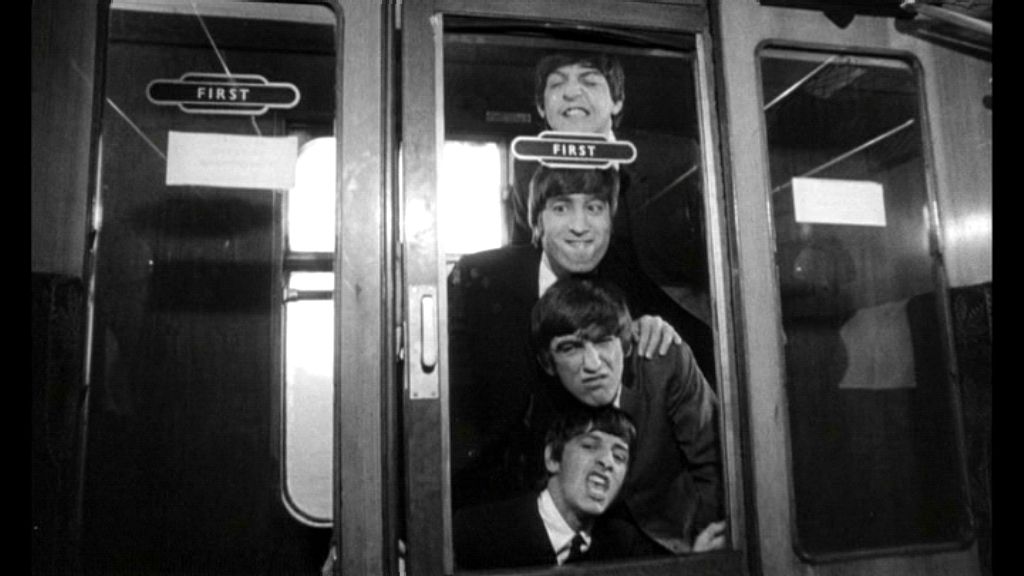
We next watched what is the best thing I’ve seen all week, which is the recent Criterion blu-ray of A Hard Day’s Night. The image is a crisp, clean black-and-white and the sound features a lovely 5.1 remix that serves the songs well. The movie stands as a milestone for any number of reasons, but mainly as a testament to letting creative types have their head, and how important is good timing. The Beatles occupied one of those rare intersections where talent and desire were in the right place at the right time, and it was amazing that Richard Lester and writer Alun Owen could break the precedent of other rock musicals to actually allow their stars to show their differing personalities, to be themselves by playing larger versions of themselves.
I hadn’t seen this movie since 1975, when a local theater ran a midnight movie marathon of this, Help!, Yellow Submarine, and Let It Be. Some of the ladies in the college crowd were game enough to scream during the appropriate parts. But what I had forgotten was how claustrophobic this picture was, that it showed how trapped the Beatles were inside their own success. There’s always a smile or a joke, sure, but their faces do not truly light up until they’re playing their music.
For some reason I truly appreciate that in the final concert segment of the movie, you are able to see that the Beatles are sweating under the stage lights. People tend to forget how much actual work is involved in performing, and it is good to see that paid tribute.
It took me two more nights to get through all the supplements. That’s a great disc, is what I’m saying.
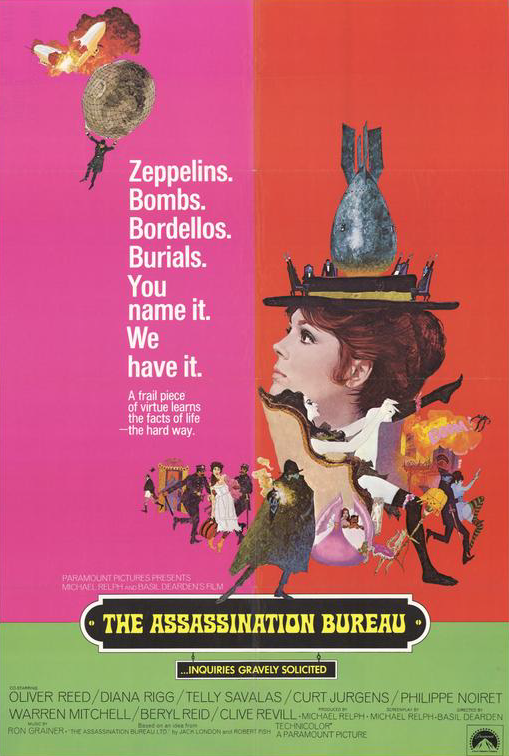
Rick is a recent convert to the cult of Oliver Reed; he arrived there by watching Terry Gilliam’s Baron Munchausen, followed by my insistence that he watch Richard Lester’s (there he is again) Three Musketeers, where Reed rather steals the show as Athos. So I brought my old disc of The Assassination Bureau(1969) (Warner Archive recently re-issued it).
This movie is what we used to call a “romp”. In pre-World War I England, a young suffragette journalist (played by Diana Rigg) discovers the existence of the title organization, run by the son of its founder, Ivan Dragamiloff (Oliver Reed). She contracts the Bureau to kill Dragamiloff himself, which the young idealist accepts – he feels the organization has grown too complacent and greedy, accepting hits for their monetary value, not the moral killing of deserving targets his father had insisted upon. Thus begins a cat-and-mouse chase throughout Europe, with Rigg unknowingly reporting to the Vice Chairman of the Bureau (Telly Savalas), who wants thatWorld War, because all his money is tied up in munitions factories.
This is light (despite the subject matter), frequently silly comedy-adventure, with a final fight scene aboard a zeppelin loaded down with a prototype blockbuster bomb bearing down on a castle housing a peace conference between all the crowned heads of Europe and Russia. I wanted Rick to see it because I think it proves that Reed could have been a credible James Bond… were it not for, you know, all the drinking and punching people.
For our follow-up, we’ll be watching The Devils, as soon as I figure how to play my Region 2 DVD on his system (really, Warner Brothers, what the hell).
I should close by mentioning that Rick, in retribution for my constant bad-mouthing of and cock-blocking a re-showing of Evilspeak at Crapfest, had re-named his wi-fi router so this was showing on my phone and iPad:
But this scheme, twisted genius that it is, has backfired upon him, as my phone now displays this comforting message:
Nyeah, nyeah.
If I don’t have a chance to see you before then, have a Merry Christmas, or whatever your inclination is this time of year. Be safe, and watch good movies. It won’t kill ya.
So I went to Dave’s. So did Rick. We watched some movies.
Hellzapoppin’ (1941)
From the Broadway Revue, not the movie. Do you care?
Now this is what you call your basic bucket list movie. It actually got mentioned in Famous Monsters, once upon a time, and I’ve wanted to see it ever since. The fact that it’s known as a milestone in anarchic filmmaking is also a definite plus. So when Dave managed to conjure up a copy, I was, as they say, there.
The movie opens with an incredible production number in Hell (the reason the movie ever cropped up in Famous Monsters), but the director charged with making the movie version of Olsen & Johnson’s successful New York stage show (in 1941, the longest-running show on Broadway!) wants to make an entirely different sort of movie altogether. Aided by a pre-Gunsel Elisha Cook, Jr. reading and re-working the script, Olsen & Johnson watch the dailies of this new movie, supplying voices for the characters, until one of them asks, “Doesn’t this movie have any sound?” “Sure, listen!” the other replies, and BAM, we are into that movie.
These bits leading up to our more normal picture are fast-paced and brilliant, and there was no way Olsen & Johnson could have kept that up – not without their stock-in-trade, interacting with a live audience. Still, you give out a heavy sigh when we slip into the usual screwball romantic comedy that forms the core of Hellzapoppin‘ the Movie. The romantic lead is staging a charity show at the mansion of his lady love, but he doesn’t want to butt in on his pal, who is at least as wealthy as the girl; he doesn’t want to look like he’s a gold digger. The boys are running tech for the show, and brought along their kid sister to help lug props: an incredibly young Martha Raye (only 25 at the time), playing a man-hungry wench who sets her sights on a fake European Count. There are mistaken identities, crosses and double-crosses, and thank God Olsen & Johnson not only tear down the fourth wall repeatedly, they dance on the rubble of the wall and then sell it for scrap.
We had some conversation about what the original stage show must have been like, because Olsen & Johnson use the medium of film for all its worth, having shouted conversations with the projectionist (Shemp Howard, no less), and doing any number of things that would be impossible on stage. One thing that could be done on stage, and is so amazing that we played it twice (and if I’m not mistaken, was excerpted in one of the That’s Entertainments): during a check of the instruments, every black servant on the estate wanders onto the stage conveniently built in the backyard, and they have an impromptu, amazing Lindy Hop number that is physically exhausting just to watch:
“Man, I wish they were in the show!” says one of the boys afterwards. You ain’t the only one, Jackson. The dancers, known as The Harlem Congaroos, are the only personnel from the Broadway show to make the leap to the movie version.
The effort to superimpose a plotline over what was apparently a vaudeville show writ large should have damaged it, but instead Olsen & Johnson grabbed the opportunity and made a movie so profoundly postmodern that every hipster should carry a copy of it in their pocket; yet, for some reason, home video currently eludes it, or vice versa. The best known of Olsen & Johnson’s movies, that’s a shame: it should stand as an example of how studio meddling can’t quite bring the creative spirit down.
Diplomaniacs (1933)
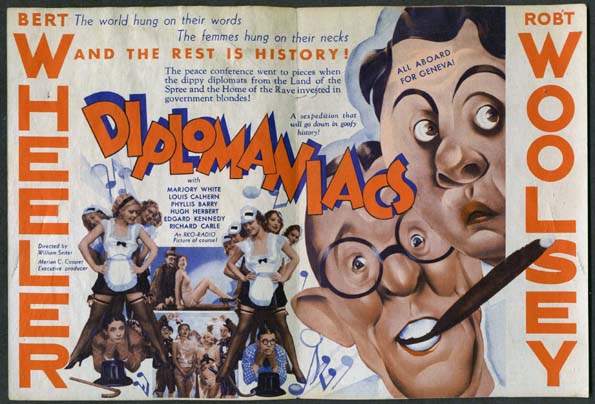
Yeah, it was me who wanted to glory in the Old Stuff that night, and that desire was sparked by this movie. The comedy team of Wheeler and Woolsey have, much like Olsen & Johnson, descended into obscurity, but thanks to Warner Archive, have had a bit of a renaissance. Diplomaniacs was an impulse buy – I needed one more disc for one of their “5 for $50” sales – but oboy, what a stroke of luck.
Wheeler and Woolsey have opened a barber shop on an Indian reservation, figuring there would be no competition – but there’s no custom, either. But hearing Woolsey making barbershop talk about international debts, the oil-rich tribe decides the barbers are their best bet for signing a peace treaty with the rest of the world. So our doofuses – the musically named Willy Nilly and Hercules Glub – are given a million dollars each and sent to Geneva.
This opening bit is little more than your typical Three Stooges opening gambit, though the Stooges didn’t have production numbers with scantily-clad pre-Code Indian maidens. But once they get on the ocean liner to Geneva, the movie really takes off, and what I mean by that is writer Joseph L. Mankiewicz’ opium shipment arrived. The remainder of the movie is so fast-paced and anarchic, so downright silly, that it is hard to imagine some manner of narcotic not being involved. Hugh Herbert (who was in Hellzapoppin’ as the detective with a bewildering array of bad disguises) is the villainous Chinaman Chow Chow, who begins every line with “It is written…” He’s the henchman of Louis Calhern, whom Dave immediately recognized as Trentino in Duck Soup. Calhern is, himself. working for a war munitions manufacturing combine run by Schmerzenpuppen, Puppenschmerzen, Schmerzenschmerzen and Puppenpuppen.
As I said, it’s a very silly movie, and I loved it. Sure, the casual racism of Chow Chow can be off-putting, but then Wheeler and Woolsey double down on the racism – hell, triple, quadruple down – with a final production number at the Peace Talks. Tex Avery cartoons had a long tradition of what Dave terms “blackface dynamite”, where characters getting a faceful of TNT were instantly transformed into minstrel show performers. Here is the precursor to that, a surprisingly effective bomb labeled “BOMB – For medicinal purposes only” (I kind of hate that the image is so soft here you can’t read that):
Oh, Holy Mother of God
Is this offensive? Well, duh. But I also think that extending the bomb’s effect to the observation gallery, and reversing Woolsey’s black glasses frames to white, points to a certain amount of piss-taking going on. It is a silly part of a very silly movie, and I look forward to seeing more of these madmen at work. Pity Mankiewicz isn’t credited as writer on any other Wheeler and Woolsey movies. Hopefully there was more opium floating around Hollywood.
I had brought the 1937 Sh! The Octopus, which would have provided us with a Hugh Herbert Film Festival, but this was deemed too Mantlerian so we watched Arabian Adventure, which I had never seen. It was a fairly obvious attempt to produce a Star Wars rip-off without being obvious about it, and its success pretty much depends on how you feel about Kevin Connor movies. Connor had previously directed fare like At the Earth’s Core,The Land That Time Forgot and Warlords of Atlantis. Genre adventures made with special effects that were dated, even for their time, also known to me as The Movies You Take A Nap During At B-Fest.
Arabian Adventure isn’t too bad, especially if you approach it as a children’s movie. It has all the standard Arabian Nights claptrap: an evil, wizardly Caliph (Christopher Lee!), a sniveling toadie (Milo O’Shea), a prince in disguise (Oliver Tobias) and a princess to rescue (Emma Samms). Also a plucky young orphan and his trained monkey, and an imprisoned good Vizier (Peter Cushing, who graces the movie far too little).
Can’t touch this!
The big scene here for the Star Wars crowd is a climactic dogfight on magical flying carpets, which manages to squeeze out a bit of excitement, but overall could have been much more impressive. Our big moments of groaning horror had to do with the appearance of Mickey Rooney as a clumsy, trollish blacksmith in charge of the giant fire-belching Kevin Connor puppets, and John Ratzenberger as the head of a group of thieves. Many were the Cliff Clavin imitations that punctuated our Arabian Adventure.
Like I said, entertaining enough, but curiously of a piece with how we began our evening: an episode of Space: 1999 that Rick credits with totally destroying his cherished memories of childhood. I’m in no rush to revisit either.
There’s always a hangover after challenges like Hubrisween, where no matter how much you may like movies, you have to avoid them for a while. Listen to some music, read a book. Clean your bathroom. Then one night you finally watch a movie again, and you discover why you liked them all along.
Let’s see if I can be brief. This is a busy week, and time is at a premium, especially since I’m watching movies again.
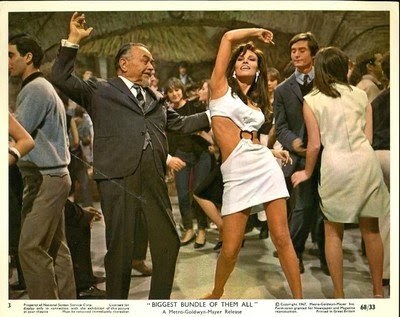
The Biggest Bundle of Them All (1968)
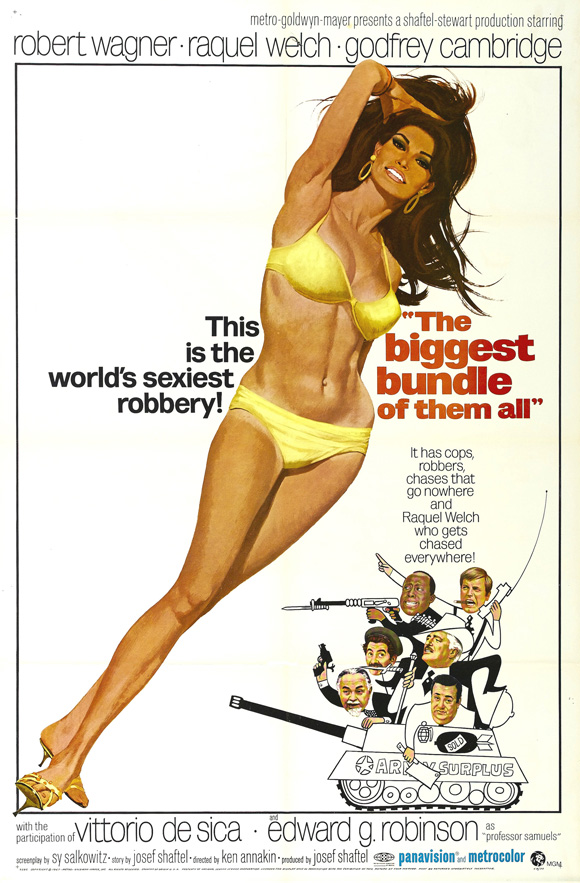
I figured to start out with some cinematic comfort food. This one I remembered playing on CBS back in the day, say ’69 or ’70, and though it didn’t introduce me to Raquel Welch (that was probably Fantastic Voyage or Fathom), she was certainly the reason I watched it. Well, it was also a caper comedy, very popular at the time, and I also loved their complex plots.
(Slight digression: when the soundtrack album cropped up in my local Woolworth’s for 99 cents in the early 70s, I grabbed it quickly. Not only did it have a reproduction of that gorgeous poster art, but the score by Riz Ortolani – unknown to me at the time – and songs by Johnny Mathis and Eric Burdon & The Animals was really good)
The movie takes place in Italy, opening at the funeral of a respected mafioso. His old compatriot, played by Vittorio De Sica, is kidnapped by a gang headed up by Robert Wagner and including Godfrey Cambridge, Davey Kaye and Francisco Mulé, representing England and Italy, respectively. (Raquel is Wagner’s girlfriend, looking forward to all the dancing she’ll be doing in exotic climes once Wagner’s schemes pay off)
This scheme doesn’t, though: they find out De Sica’s gangland star has diminished so thoroughly that no one will pay his ransom. De Sica has a plan, however: a heist of a platinum ingot shipment plotted out by his old friend, Professor Samuels (Edward G. Robinson). The catch: to buy the equipment necessary to pull it off, they have to raise $3000 within a week, and so begins a twisting tale of amateurs attempting to become master criminals.
The movie definitely has its good points. De Sica, interviewing each member of the gang, is despondent to find out they are just common joes with money problems – a musician, a chef and a mechanic. When he turns to Wagner and asks, “And what do you do for a living?” Wagner’s response is an indignant, “Nothing!” “At last! “says De Sica. “A professional!”
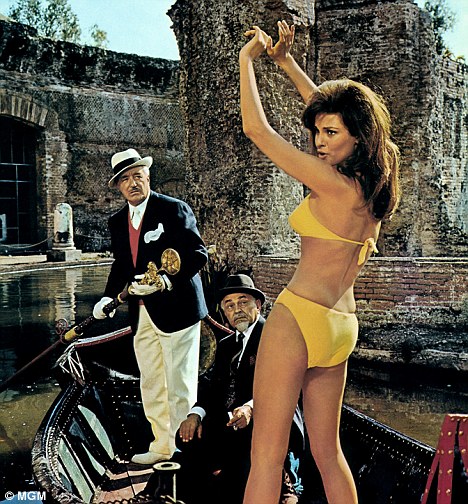
Oddly, most of the photos you find feature Raquel…
Where the movie begins to wear on me is the tortured trail of trying to steal the three grand; if you thought cringe comedy was a modern invention, this will disavail you of that notion. The final heist is pretty good, though ($3000 went a long way in late 60s Italy, it seems). The one failing here is common to most, if not all, caper comedies – crime cannot be allowed to pay, and something stupid has to happen so our heroes get away with nothing. Expected, but still…
And what of Raquel, who was so popular at the time that the Spanish title translates to Raquel and Some Knaves? Story-wise, Raquel’s purpose is to vixen out the identity of the mysterious fence in Morocco who will buy all that platinum, to the tune of five million dollars. She will also become the unexpected moral compass at the movie’s climax, when Wagner finally makes good on his long-promised double cross of De Sica.
Who am I kidding? Raquel’s purpose in this movie is to make the El Kabong sound go off in my head whenever she makes an entrance. And since we are led to believe that in her very first scene, she is dancing naked on a rooftop, that sound got deafening.
No trailer, but here’s Raquel in a bikini. KA-BONNNNG!!!
Sometimes the only way to follow up Raquel Welch in a bikini is with dachshunds in rat suits.
I think I caught the very end of Deadly Eyes on HBO back in the day, and that was the end of my involvement with it until Scream Factory put it out on blu-ray recently. Even when it was playing in theaters, it was fairly infamous for that central conceit. The plot involves some rats that have been feasting on poorly-stored grain that’s been treated with steroids, When a health inspector (Sara Botsford) condemns the grain and has it burned, the now king-sized rats have to find a new home and food source, and the city of Toronto is on the menu. The close-ups are of puppets, of course, but group scenes involving big-ass rats running around and chasing people: the aforementioned dachshunds, and an occasional terrier when they needed the rats to jump on something. (Dachshunds are not the greatest leapers of the canine world).
“No amount of tasty treats is worth this humiliation.”
Outside of the occasional rat attack, the movie is largely concerned with divorced high school teacher Sam Groom, who meets cute with Botsford and they bond and have R-rated sex. This gets him involved with the whole rat thing, and allows him to play hero when Botsford and his son from the previous marriage wind up in the subways that the rats have decided to make their new burrow (I will give the filmmakers credit for not going for the obvious “We can’t close the subways! It’s the Fourth of July!” route). The balance of the story is rather off, in that respect, taking time to build up the relationship and then put it in jeopardy while the average audience member wistfully recalls when the movie had big-ass rats running around and biting people.
Robert Clouse directs, which explains why the annoying high school students wind up at a Bruce Lee retrospective, where they all die, in a sequence that has some of the most brazen grab-the-monster-and-pull-it-to-you action I have seen since Bride of the Monster. The direction and acting are professional, at least. Though based on a James Herbert novel – well, actually, based on a screenplay that was based on the novel – everybody in the supplemental interviews are pretty upfront about having never read that novel. Writer and co-producer Charles H. Eglee, in fact points out that he based the movie on Joe Dante’s Piranha by and large, and once he makes that admission, everything clicks into place.
I’ve read James Herbert. This was probably wise. Fun, but not a milestone or anything. Still, if you only see one movie with dachshunds dressed as rats swarming over Scatman Crothers, it should be this one.
While all that Hubrisween stuff was going on, I suddenly felt the craving for a movie experience much less solitary. A need to inflict suffering on others. I felt the need for an all-horror Crapfest (well, Crapfests are sort of predicated on horror, but that’s a larger issue). By and large, the call was answered.
Except on the day, Paul and the Other David begged off, citing Ebola, because that will never not be hilarious. Alan had a matinee performance -O, cursed work ethic! – which left it down to me, Dave, Rick, Erik and Mark. We brought enough food for the original horde, so there were plenty of leftovers.
We began with a collection of Halloween cartoons curated by yours truly. I’ll make a perfunctory pass through YouTube, but I don’t hold much hope for finding any of them (and if I did, they’d be taken down within a month), so here’s a list:
Bimbo’s Initiation (1931) – a sort of proto-Betty Boop short
Scaredy Cat (1948) – Porky & Sylvester vs murder mice, and not for the last time
The Mad Doctor (1933) – Mickey Mouse. Disney was scarring young minds way before Snow White
Water Water Every Hare (1952) – Mad doctors again, this time with Bugs Bunny
Snow White (1933) – but this time with Betty Boop and Cab Calloway
Have You Got Any Castles (1938) – Musical earworm involving books, included for an appearance by Mr. Hyde, Fu Manchu, the Phantom of the Opera, and Frankenstein’s Monster. And dammit, because I love this cartoon.
The Haunted House (1929) – Mickey Mouse again, and some skeletons who just want to party.
Broomstick Bunny (1956) – Bugs Bunny, obviously, and the debut of Witch Hazel.
Okay, color me corrected (and hopefully these won’t disappear in a few weeks):
(I think I really love Have You Got Any Castles because it assumes a certain amount of cultural awareness on the part of its audience.)
This was before the switch off Daylight Savings Time, so we were still waiting for the sun to go down that the true horror could begin. It was best to go with something short, I thought, so Dwain Esper’s 1934 Maniac got the nod. Here’s the clip everyone recognizes, quoted in It Came From Hollywood:
Now here is something about Crapfest that really, I get my nose rubbed in repeatedly: subtlety is wasted, and this is the first and last time you are going to hear Maniac accused of subtlety. But so much of its charm and outrageousness is dependent on declamatory acting better suited to an 1890 stage, florid dialogue ditto, and shocking 1934 nudity excused on the flimsiest educational intertitles possible – that gets lost in the raucous atmosphere. This always happens, except for Bugs Bunny, who gets reverent silence.
It was now dark enough for the true nastiness to begin, so I trotted out Night Train to Terror. We’ve been here before, you and I, and we know that this movie is a cheapjack Dr. Terror’s House of Horrors made of cut-up versions of two previously released movies and one that was unfinished, so the usual Crapfest cry of “What’s happening?” was totally justified. But outside of the double-casting of Richard Moll giving Rick purchase for a desperate attempt to show Evilspeak again as part of a “Richard Moll Film Festival”, the best part was… well, what I did find on YouTube was an edited version that incorporates all the parts of Night Train to Terror that had Rick shrieking like a little girl:
But God is All-Merciful, except toward haters, so He resurrects the band for one more round of “Dance With Me” for the closing credits. The screams of outrage in the room were incredible.
Dave then put something up on the screen for “the break”. Speaking of lessons never learned during Crapfests, nobody ever takes a break during “the break”. The psychology of this is beyond me, except in this case: I was held spellbound by this; I had no previous idea it existed, and it is absolutely delightful. It’s Music Box With A Secret, a piece of Soviet animation heavily influenced by Yellow Submarine – itself a heavy influence on yours truly as a child – and…
…well, just hit full screen on this. You will not regret it.
Dave, you never get to look at one of my entries and sneer, “This is quality, it has no place here” again, because this is top-notch stuff.
He followed it up with Prisencolinensinainciusol, which I love. If you’ve been under a rock for the last few years (as were, apparently, many of our attendees) this was a song written by Italian performer Adriano Celentano, to demonstrate what a popular English song would sound like to a non-English speaker.
Didn’t get that? Fine. So we watched it again.
(I was nice and advanced it past the Italian introduction. I assure you Dave was not that merciful.) (Videos of this song keep being taken down and put back up. Maybe these two versions will survive more than five minutes)
Then, since no one took “the break”, Dave unspooled his entry, a movie which has as many names as Legion: Dark Eyes, Fury of the Succubus, Demon Rage, Demon Seed, but in this case, Satan’s Mistress, starring Natalie Wood’s sister, Lana Wood, and her Moonpie-sized areola.
This was a case when I was one of the people yelling “What’s going on?”, and it wasn’t because of the vodka, either. It was mainly because there is no there there. Lana is at her beach house with her husband, who does… something for a living. She moves into her own bedroom because she “needs room” and “needs time”, mainly because a dark figure keeps visiting her in the night for salacious purposes. So you’ve got your Satan, and you’ve got a lot of mistress-ing going on, and some dime store divorce drama. And Britt Ekland as a concerned friend who Satan nearly roasts in a hot tub.
Did I mention the beach house has a basement, which for some reason, contains suits of armor and a guillotine? Do beach houses even have basements? In any case, Britt’s hubby winds up afoul of the guillotine, and at his funeral John Carradine jobs in for a day as a priest who urges Britt and Lana’s husband to fight the evil in the beach house but not to “fall prey to their illusions”. Britt falls prey to their illusions and burns for it, but hubby stands strong, and apparently making your saving roll to disbelieve is all it takes to conquer Old Scratch. That’s worth remembering, write it down.
There’s not much video to be found from this flick (which sort of tells the story, right there), but leave it to Mr. Skin to post a NSFW clip of Ms. Wood in the altogether. It did pretty much sum up the production, which is probably why, like Prisencolinensinainciusol, it did not hang around long. So here’s the opening two minutes, complete with public domain scream sound effects…
So I didn’t feel at all bad about concluding the evening with a movie that had been asked for ever since its trailer showed up in a compilation: The Super Inframan. Mark complained that I was really stretching the definition of horror here, but dammit, it’s wall-to-wall monsters. What’s more Halloween than that? The fact that the monsters know kung fu just illustrates why this is known as the finest movie ever made.
“Six million light years beyond believability!” also sort of tells the tale, there.
Well. the holidays beckon. Chances that we will get in another Crapfest this year are pretty slim (even if my venerable VHS of The Magic Christmas Tree keeps trying to claw its way out of the storage box), so this may just have to carry us into the New Year. So long, fellow voyagers on the good ship Crap. It’s been fun.
Next time I’ll bring more Bugs Bunny.
Future Freex Weighs In: Turns out it wasn’t in a storage box at all. It was hiding:

 Sometimes you just have to pay homage to the classics, even if they may not deserve it. We’re likely going to be arguing about Birth of a Nation for quite some time, for instance, and here’s another one that I’ve been curious about for some time – Nanook of the North, the first docudrama.
 We’ll start with the obvious: the title character, the Great Hunter Nanook (which we are told means “Bear”), is actually named (I hope I get this right) Allakariallak. We are introduced to his two wives, Nyla (“The Smiling One”) and Cunayou. They were apparently not actually Allakariallak’s wives, but – and this is only an allegation, mind – that they were actually Flaherty’s lovers. The parentage of the baby constantly riding in Nyla’s furs, like a papoose, is unknown.
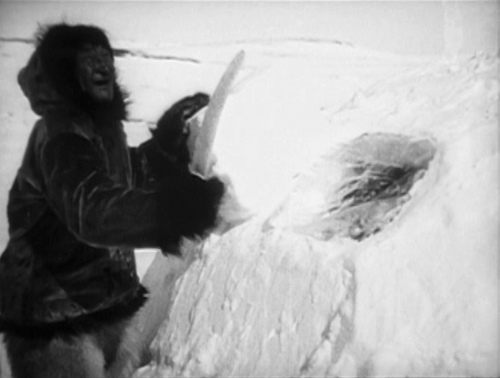 If you’re willing to grant that Allakariallak may be using old-timey methods to trap his other prey, a snow fox and a huge seal, it becomes a fairly nice re-telling and record of those ways. Then, with the onset of winter, the family builds an igloo (the film claims “within an hour”, but I ain’t so sure about that). This is one of the most famous segments of Nanook, and it is a wonder to behold: Nanook carving the blocks of snow with his trusty walrus-tusk knife, the women and children spackling the gaps with more snow. And most amazing to my eye, Nanook carving a block of ice from the frozen bay to serve as a window, and then placing a block of snow to reflect sunlight into the igloo. That is neatly done.
 This is a question we have to face again and again as fans of cinema: does a good story trump the needs of historic accuracy? The answer from Hollywood is always a resounding, “Yes!” and who is to say they are wrong? Perhaps Nanook serves best not as a strict documentary, but as a record of a way of life that had vanished before the invention of the motion picture. Hence, not “documentary”, but “docudrama”. Robert Flaherty made a career out of movies like these, and they are all well-regarded: Elephant Boy (with Zoltan Korda, introducing Sabu), Louisiana Story, The Land.
 The final thing to consider is that the movie opens by telling us that Nanook died two years after the film was finished; he journeyed inland to find food and starved to death. It is much more likely that Allakariallak died of tuberculosis, in his home. But whatever the cause, the news of his death triggered mourning worldwide, so successful had Nanook been, so far had it traveled. That is the power of a good story, well told, and perhaps the whole question is best answered by another movie, John Ford’s The Man Who Shot Liberty Valance: “When the legend becomes fact, print the legend.”






















 drfreex.com