The Memorial Crapfest

It had been six months since the last Crapfest. There are many reasons for that. The holidays, certainly. There was also the fact that I was really tired of the cat-herding involved with setting a date that everyone was available. It was just much easier to find a day to meet with Rick, or Dave, or both, and just quietly watch some movies.

Life, though, has a way of forcing our hands.

A couple of weeks ago, in my semi-annual bitching about my life post, I mentioned that I skipped out on the memorial service of an acquaintance because that evening was the only chance I had to rest, recoup and heal in a physically grueling week. The deceased was Mark, who was responsible for such Crapfest entries as Skyscraper, The Black 6, and Evil Town. It wasn’t a memorial service, but a Celebration of Life (Mark would not have appreciated a moribund memorial service, not at all) and it was apparently crowded, which is to the good.

I’m a simple man, and I memorialized Mark the best way I knew: by inflicting terrible movies upon my fellow man, as he would.

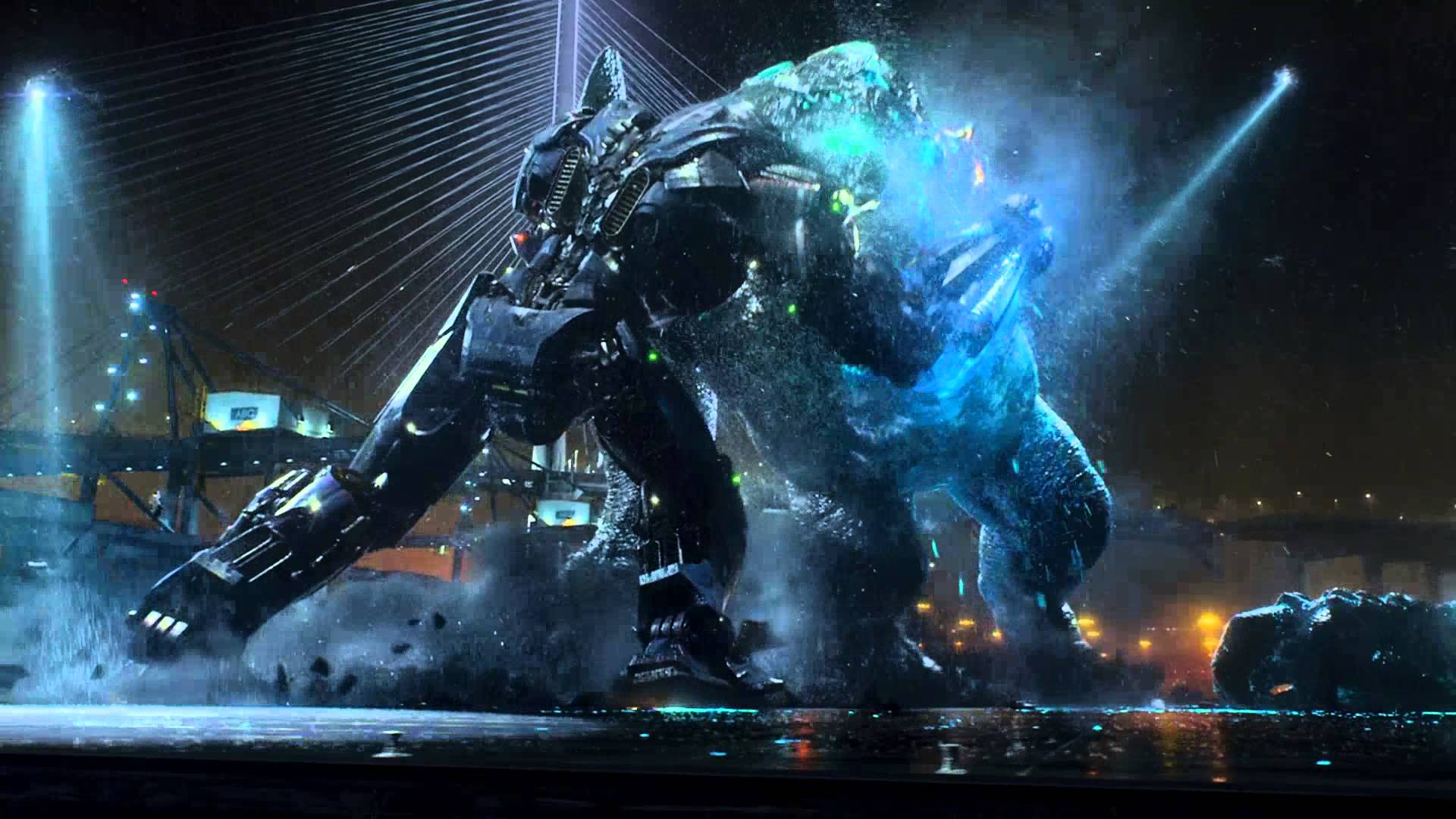
The evening began with host Dave testing out his new AV setup with the first 20 minutes of Pacific Rim. Now, Pacific Rim is not crap. It is, however, quite loud. I sat and stewed that every time I tried to start things out nicely with some vintage Rolling Stones or Tom Jones, I get castigated for daring to put some “quality” into everybody’s precious crap. No one understands that this only makes the scalpel cut deeper. Yet here is Dave, receiving no such complaints while he projects giant robots punching kaiju.
maxresdefault

NOT. CRAP.

When you’re the host, you get to do stuff like this.

But you know when nobody complains about “quality” in a Crapfest? When that quality is in the form of cartoons. I curated another set of cartoons, if only because Mark had really enjoyed the Halloween set at the last Crapfest. We start off easy with Feed the Kitty, one of Chuck Jones’ best, followed by Tex Avery’s Bad Luck Blackie, which is its polar opposite: in the first, a bulldog adores a little kitten; in the other, a bulldog continually tries to kill a little kitten.

Tom & Jerry were actually the worst about this.

Tom & Jerry were actually the worst about this.

The next section grew out of a discussion that Dave, Rick and I had after watching Diplomaniacs, about what Dave termed “blackface dynamite” (a scholarly term, to be sure) in cartoons, where an explosion turns everyone onscreen into minstrel show participants. The one instance he could recall with certainty was in Droopy’s Good Deed, which I surprisingly had in its uncensored form… but I still started off with Chew Chew Baby, a 1958 Harveytoon that played semi-regularly in the weekday morning cartoon slot, alongside the Bugs Bunny and Sylvester the Cat cartoons. It terrified me, and in short screwed me up for some time. It was a horrible thing to show a 5 year-old, and once again it is temporarily on YouTube, so look quick:

Oh, all right, here’s the censored Droopy scene in Japanese, which doesn’t make it any better:

Surprisingly, there are some (pretty awful quality) examples of the Betty Boop cartoon I’ll Be Glad When You’re Dead You Rascal You, featuring Bimbo and Koko being chased by the giant flying head of Louis Armstrong:

Again, I fully expect all of these to be purged from YouTube in the next week.

I laid out my usual four movies to be voted on. Dave was having none of this voting crap, however (the fascist), and snatched up the recently-released Sorceress DVD. I have gone into Sorceress in far too much detail elsewhere, so let me be brief, and you can visit me twenty years ago at your leisure.

Sorceress is yet another Roger Corman-produced New World Pictures attempt to cash in on the sword and sorcery fad. It was directed by Jack Hill, who has a bunch of good, influential cinema under his belt, like Coffy and Switchblade Sisters. He asked that his name be removed from the movie. It is an intriguing script, full of amazing effects that Corman was not willing to pay for, so what you’re actually watching is a cheap piece of junk. It does feature the Harris twins (Playboy Playmates) and their nudity, Frampton the Barbarian, and for some reason, a Viking and his traveling companion, a satyr. I’m usually pretty forgiving about the acting in these things, but in this one it gets pretty dire.

Viking

“And my axe! …except I don’t have one.”

The major heartbreak in all this: Jack Hill wanted Sid Haig to play Pando, the satyr, but Corman wouldn’t pay for that, either. I weep over the loss of this portrayal. And you know what else is not in Sorceress? A sorceress! None. Zip. Zero. Corman apparently took a list of possible titles to a local high school and asked them which movie they’d go see. “Why, the one that gives me a chance to see boobies,” they replied, and so it was.

After this, Alan had brought something. When Alan brings something, it is always horrific. This time, it was, at least, horrific and short. It was the premiere episode of the shortest-lived M*A*S*H* spin-off ever, W*A*L*T*E*R*. Yes, Gary Burghoff’s shot at a show featuring his Radar O’Reilly character.

There are a few points of interest: using one of the best episodes of M*A*S*H* as a springboard – the one featuring a TV crew filming a documentary of the 4077th – a “Where are they now?” special catches us up on what happened to Radar – excuse me, Walter – in the intervening years. He lost the family farm and got abandoned on his wedding day, among other things. So now he is a beat cop in St. Louis.
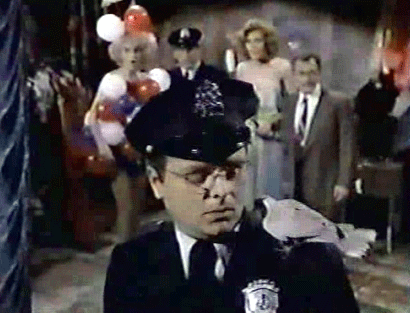
walter2Now, Walter using his Radar O’Reilly powers to solve crimes is the series I would have tuned in to every week. Instead, what we have here is some gently uplifting comedy about how being a nice guy and having an affinity for animals makes Walter a good cop. Any warm feelings toward the show engendered by having Dick Miller crop up as the manager of a burlesque house besieged by warring strippers is wasted by the fact that Walter’s eventual love interest is played by Victoria Jackson. Possibly before she went insane, but still.

You know what? Screw you. Why should I be the only one to suffer?

There needed to be some filler while dinner was grilled (We were too wrapped up in W*A*L*T*E*R* to attend to such things, it seems), and this fell to me. I had two trailer compilations, labeled “Adventure” and “Satanism” “Satan!” chose Paul, enthusiastically. He would regret that.

There are a lot of movies with “Satan” and “The Devil” in their titles, and the most amazing thing about this is that most of these movies are boring. How is this even possible? They don’t even have enough good stuff in them to make a good trailer, and this is sad.

fitnessRick had prepared a ton of hamburger patties. Dave imperiously strode through the kitchen, proclaiming, “You will have double cheeseburgers! This is the LAW!!!” In a rare gesture of restraint, I only had two double cheeseburgers. I miss those double cheeseburgers. They were good double cheeseburgers.

(Why yes, I did just have my semi-annual visit to my doctor, during which we discussed my weight gain. I told her it was all Rick’s fault. She sighed and scribbled something in the TO BE KILLED column.)
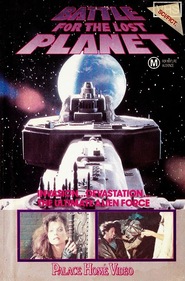
lost planetThen Dave put on his choice. It was a choice that would make us miss boring old Satan. Like many of Dave’s choices, it had more names than a petition against closing a local community center. The name it had chosen for the evening was Galaxy Destroyer, but it is apparently better known as simply Galaxy or Battle for the Lost Planet (“uncensored TV version of Kampf um den verlorenen Planeten”) or “Do you even watch these fucking things before you show them?”

SO there’s this thief named Harry Trent (Matt Mitler) who has stolen a very valuable data tape, and hijacks a space shuttle to escape the security guards chasing him. First problem: he damaged the shuttle and can’t maneuver it, so he has to take a comet’s route back to Earth, which will take five years. Luckily (if not realistically) , there is sufficient fuel and food for this. Second problem: he passed a fleet of wannabe Vogons who reduce the Earth to a scorched black ball.

So after five years of komedy, like discovering he also broke the ship’s stove so that the food is crap and drawing a naked woman on a pillow to seduce, Trent returns to an Earth that has regrown into a bunch of B-movie communes, and discovers he has become a legend, because the data tape he stole will operate a mega-weapon that will destroy the pig-faced aliens. He picks up a feisty liberated woman (Denise Coward), runs into space crabs, has to deal with Mad Dog Kelly, the Maddest Mad Man on the Q Morning Zoo… no I’m sorry, he’s Joe Genitissi in a role that should have gone to Frank Stallone, a Mad Max wannabe who thinks all women should willingly be in his harem and Trent fights him to the death AND OH MY GOD WILL YOU JUST END I REALLY MISS BORING SATAN.

semistalloneSemi-Stallone gets Trent into the Mega-weapon complex and finds out it can kill anybody or anything just as long as the particulars can be programmed into it. Even with the data tape, the surviving scientist (Bill MacGlaughlin) can’t figure out how to program it to kill the aliens. Semi-Stallone says that’s because he’s “too cordial” and he just has to program in human beings and tell the machine to kill everything else. Congratulations, asshole, you just destroyed the biosphere, animals, insects, bacteria and all.

But no, this works, and the aliens dissolve like the demons at the end of the original Evil Dead, but this is deemed so cool that they show many, many instances of it until even that becomes boring. Gaaaah.

This is the work of Brett Piper, who some of you will know from A Nymphoid Barbarian in Dinosaur Hell, and you are nodding sagely right now.  Some fair stop-motion animation, almost nudity (“MY movie had boobies,” I once again entoned from the back), komedy, and some tiresome social commentary.

Dave sneered that we had lost our “bad movie legs”. See for yourself, the three minutes where the movie almost got exciting:

And lest that make you think you might actually want to watch this, here’s the actual trailer:

The only comment on YouTube:

Screen Shot 2015-05-07 at 12.31.32 PM

And you know what else wasn’t in Galaxy Destroyer, besides entertainment value? A galaxy, being destroyed or not.

Sometime during this Paul scapered off into the night, claiming work the next morning (he was lying, he wanted to watch the Rockets game in peace. Incidentally, they lost that night.) and also Erik, claiming a hangover (the veracity of this is unknown). This left Dave, Rick, Alan and myself. “What else you got?” asked Dave. I presented two discs which I knew to be around an hour long. “What else you got?” he asked again, and I realized I was the only person in the room who had to get up for work the next day.

Short sleep rations are a fact of my life. You don’t scare me.
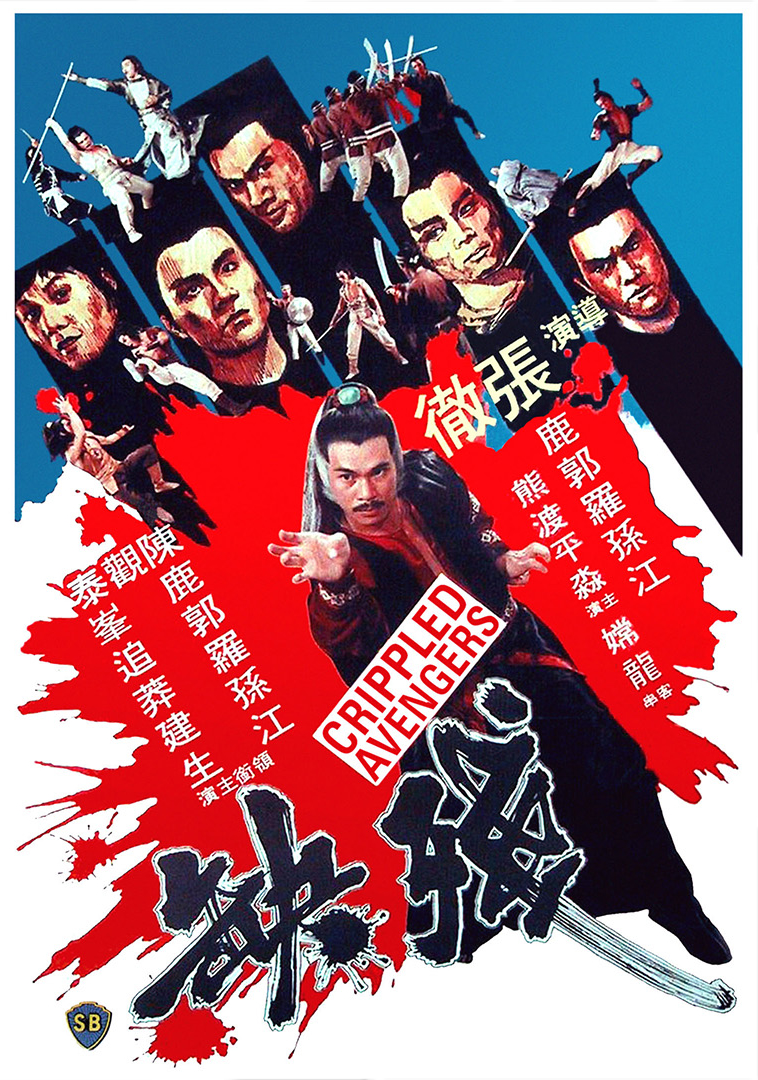
Can-que_e39fe8ffI presented two more movies. And with some sort of hell-spawned wisdom, Dave chose the movie that would be of a fit with the rest of the evening: The Return of the Five Deadly Venoms, which has nothing to do with the earlier movie, Five Deadly Venoms. It is, in fact, a re-titling of Crippled Avengers, because people are idiots.

Chan Kuan-Tai plays To, a famous kung fu hero, whose wife and child are hideously mangled by enemies (To then kills the scumbags with one tiger blow each). His son survives, though his arms have been cut off, and To raises him to be a great fighter with iron arms that have some proto-Tony Stark weaponry in them. They also become colossal jerks, ruling the local village with an iron (ha!) fist, and crippling most of the cast of Five Deadly Venoms for various minor infractions, like talking back or bumping into them on the street.

So, a newly blind man, a deaf-mute, a legless guy, and a brain-damaged hero who tried to help them (but still has excellent kung fu skills in his muscle memory), learn kung fu and come back to rid the world of To and his iron-fisted son. If you need more details, once again you can commune with my younger self.

Chang Cheh’s Venom movies (as they are known) tend to end in spectacular fight scenes that rely more on acrobatic skills than martial artistry, but the fights are so dizzying, like a gymnastic tournament gone ballistic, that it is damned near impossible not be sucked in. Another special shout out goes to Wang Lung Wei as To’s second-in-command, whose battle cry of “Let’s go!” whenever his men were losing, became the quote of the evening.

It washed away the Boring Satan and Boring-er Galaxy Destroyers and ended the night on an up-beat. Nyah nyah on Erik and Paul who have to nurse their delicate psyches through horrid memories of Galaxy Destroyer when they think of this night, and not the exhausting final fight of Crippled Avengers or the ta-tas of the Harris Twins (“My movie had boobies!”)

And rest assured that Mark is laughing at us all, and probably making a joke about an obscure Richard Burton movie.

Looks like I’m back to my cat-herding duties.


2 Films, 2 Women

100

(Bit of a warning here. There are spoilers ahead. Admittedly, one of the movies is from 1929, but the other is from 2014. All warned? Good.)

Professional duties keep interfering with stuff that doesn’t pay, like my mumbling about film. Well, that’s life. So when I found myself with a morning free, I decided it was time to actually climb back on that horse and watch one of those movies I keep telling myself I’m going to watch. I am unsure whether it was because there was bright sunshine outside my home office or because of the movie itself that I felt so ambivalent about what I was watching.

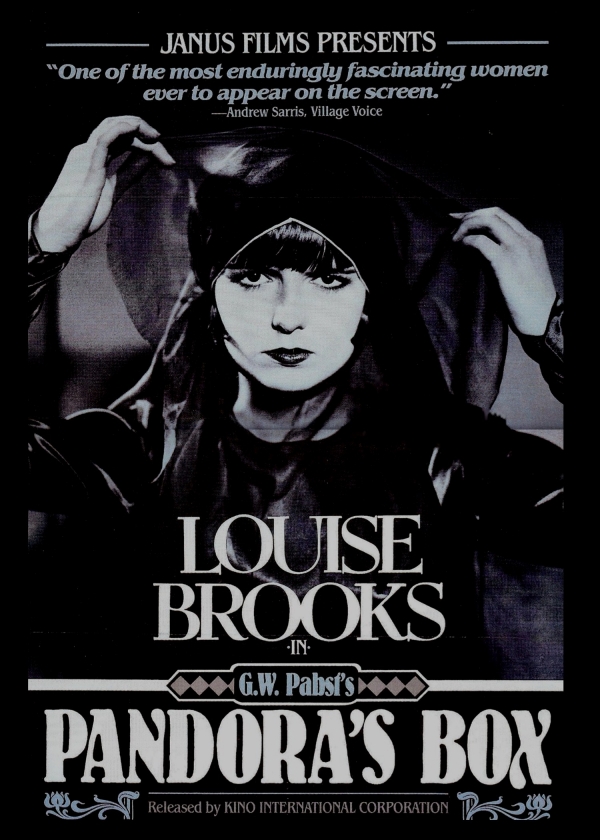
600full-pandora's-box-posterWhat I was watching was GW Pabst’s Pandora’s Box, which is called things like “classic” and “the greatest silent movie ever made”. I’ve run into this before, movies that smart people positively gush over and yet I find myself unmoved (the ones that quickly come to mind are The Third Man, The Thief of Bagdad and Vertigo). Pandora’s Box is also called “surprisingly modern”, and perhaps that is what is working against it, in my eyes.

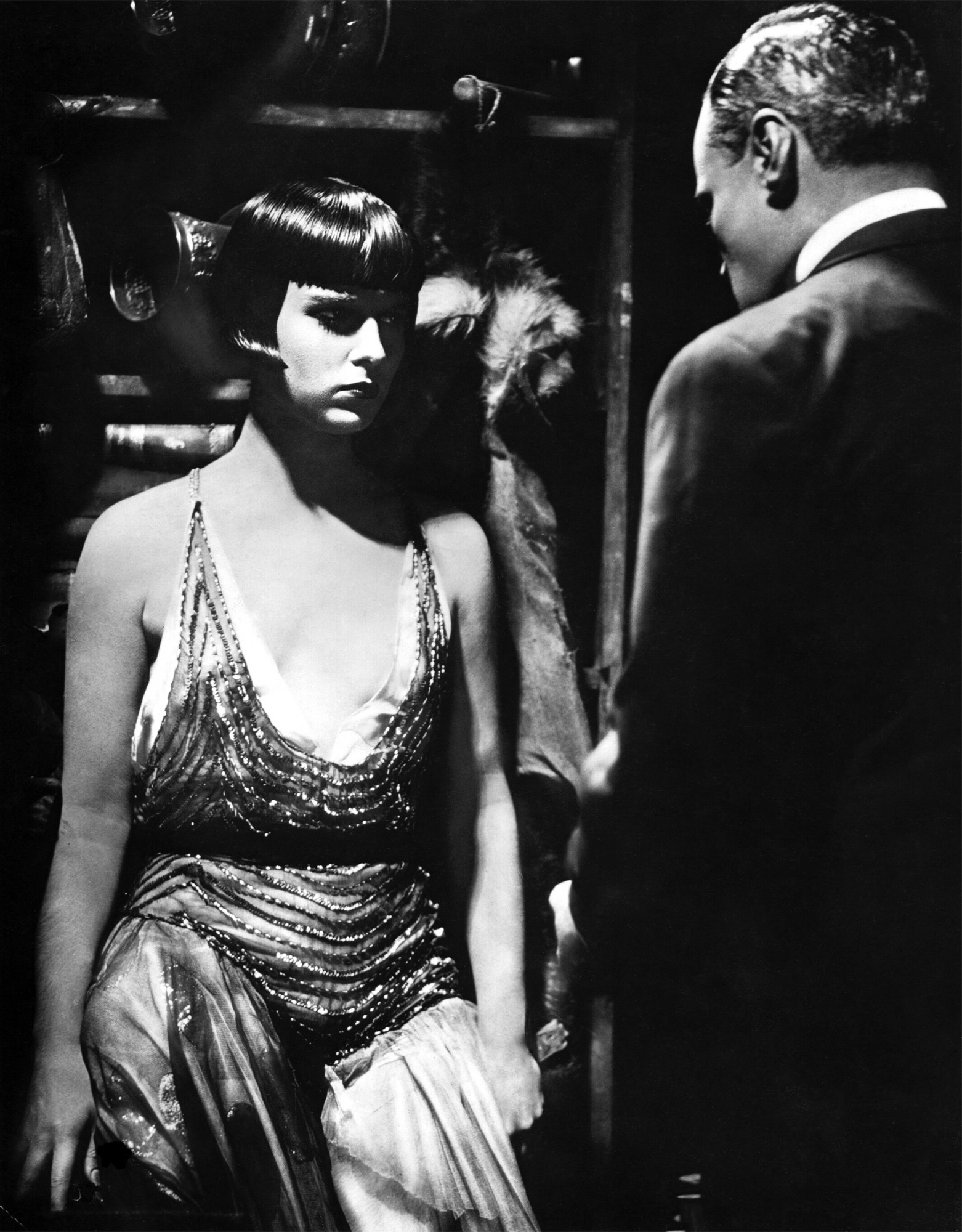
This is the story of Lulu, played famously by Louise Brooks, who is held up as sort of the platonic ideal of the flapper. Lulu is a young woman who is uninhibited, sexy and at the same time terribly naive; she lives fully in the moment, with little regard for the past or any apprehension as to where her actions may lead her. As the movie opens, she is the mistress of publishing magnate Dr. Schön (Fritz Kortner), an older man who is trying to end the relationship so he can marry the daughter of the Minister of the Interior. Getting Lulu cast as a lead singer in his son’s (Frances Lederer!) new musical revue doesn’t do the trick, either, when Schön shows up backstage with his fiancée and Lulu refuses to dance “for that woman!” It’s a ruse that allows her to once again get Schön under her sway, and as his engagement is ruined, he marries Lulu, although he assures his son “It will be the death of me.”

Pandora-s-Box-pandoras-box-1929-15443286-1562-2000Well, it does indeed, when on his wedding day, Schön, in a fit of jealous depression, hands Lulu a gun and commands her to kill herself before he does it himself. In the ensuing struggle, Schön is fatally shot. Lulu is sentenced to five years for manslaughter, but her lowlife friends manage to spring her and smuggle her out of the country. While in hiding, she runs afoul of a white slaver, and manages to get everybody in her entourage murdered or ruined, until she winds up in a drafty garret in London. Desperately turning to prostitution, her first client is Jack the Ripper. And finally, the tale is over.

Now. The movie is based on two extremely popular German plays by Frank Wedekind, Earth Spirit and Pandora’s Box. The story, starting with relationship soap operatics and transforming into melodramatic tragedy, was popular but controversial. Further controversy followed the movie version when Pabst cast American Louise Brooks as Lulu, a character considered to be thoroughly German, replacing Marlene Dietrich at the last moment (this actually freed up Dietrich to make The Blue Angel, so no harm, no foul).

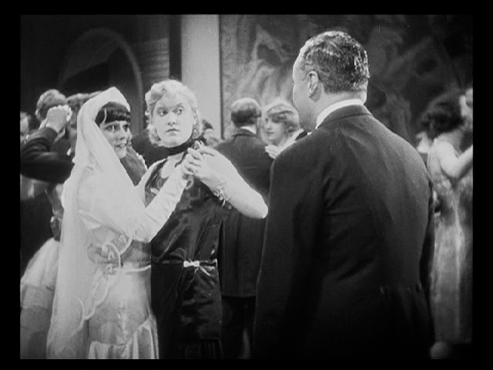
4505665140_8b6f800bbdDietrich, though, would not have been a good fit for Lulu; when one thinks of Dietrich, one thinks of worldliness, and it is essential to the story that Lulu be pretty unaware of the truths of the world she moves through. A world run by men, who attempt to own her in one way or another, often quite literally. The one malicious act Lulu performs (more out of a childish jealousy than any true malice) is the scuttling of Schön’s engagement, from which all her future woes will descend. That once she is rescued from the courtroom by her friends, she returns to Schön’s home and takes an unhurried bath reveals more about the way she feels she moves through this world than anything else. Even at her lowest ebb, she charms Jack the Ripper into throwing away his knife and possibly seeking redemption, however momentary, in her arms. It’s not her fault her old friend, probable first pimp and possible father, Schigolch (Carl Goetz) left a knife on the table.

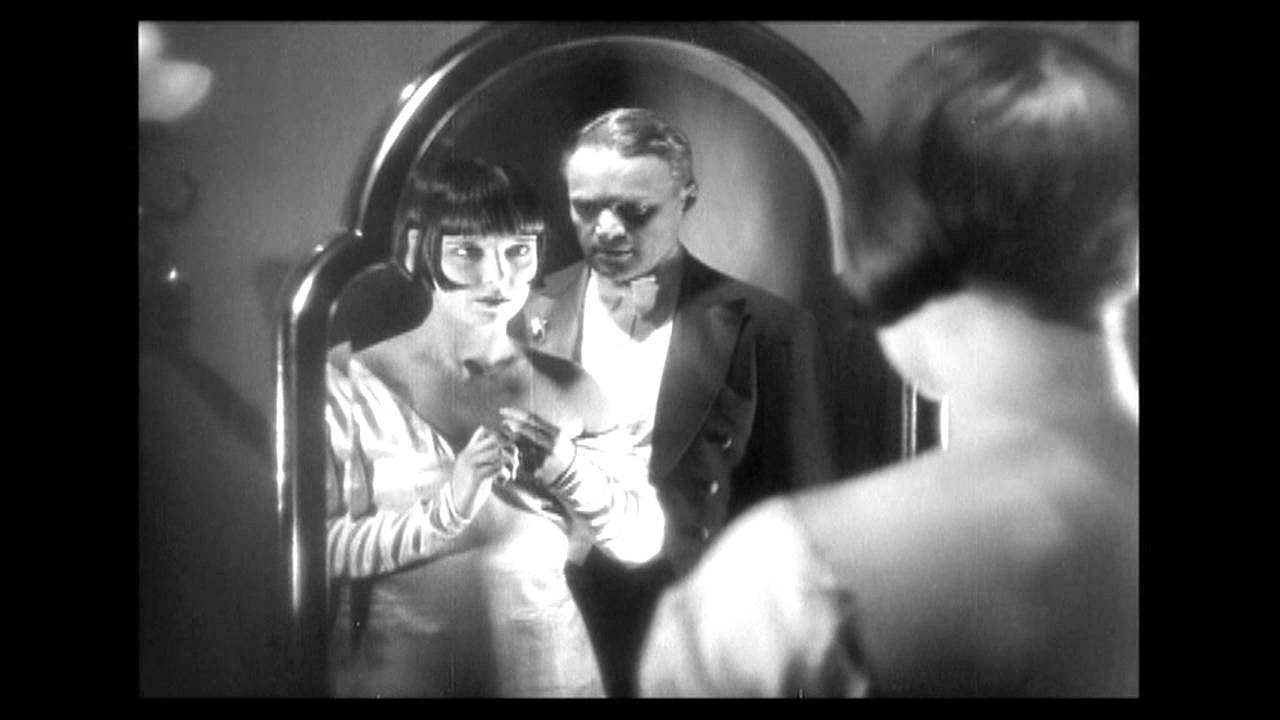
maxresdefaultThe title Pandora’s Box comes from the speech the prosecutor makes at Lulu’s trial, who claims that Lulu is the Pandora’s Box that released all sorts of evil into the life of Schön. It’s actually kind of a stupid speech, but it serves to set where Lulu exists in this world: something to be controlled. That’s the thing with all these myths and legends that have been used to rationalize the second-class citizenry of women through the centuries: whether it’s curiosity about what’s inside a box or a taste for apples – either way, presented as forms of seeking knowledge – they unleashed evil into the world, or original sin, or whatever the hell, and that’s why we’re in the mess we’re in, and it’s all their fault.

This ignores the fact that when Pandora opened the box a second time, she unleashed Hope into the world. And that Pandora, Eve, and any number of women whose stories have been lost also had to live in the world with evil, and sin, and general assholery. What the prosecutor doesn’t get is that Schon’s morbid determination that Lulu must equal death is what has unleashed the evils of the world onto Lulu. Of course not. Schön was a man, after all. He’s blameless in the eyes of the court – the world, even.

pandorasBox-criterionThe character I feel the most sympathy for is the Countess Geschwitz (Alice Roberts), a tuxedo-wearing lesbian who is just as smitten, if not moreso, with Lulu than any of the men, but is cast away towards the end to distract one of the members of Lulu’s increasingly desperate entourage, the trapeze artist Quast (Krafft-Raschig). Geschwitz is probably the best match for Lulu in the entire film, and her character’s eventual fate is particularly tragic.

It may be due to the comparative rarity of Louise Brooks movies that Pandora’s Box owes some of its lustre; Pabst warned Brooks she could end up much like Lulu if she didn’t mend her ways, and by her own admission, he was correct – her career lasted hardly another eight years.

Don’t get me wrong, though, this is a well-made movie. There is a reason it is held up as one of the crown jewels of Weimar-era cinema. The scenes backstage at the musical revue are quite entertaining, featuring comedian Sig Arno as a stage manager so harried he seems likely to explode into quivering pieces at any moment.

The “surprisingly modern” aspect just played against it, in my viewing, and that’s likely on me. Once again, having seen the movies that inspired it through the years renders any innovation fairly moot; but it is still worth seeing, if only for that fact.

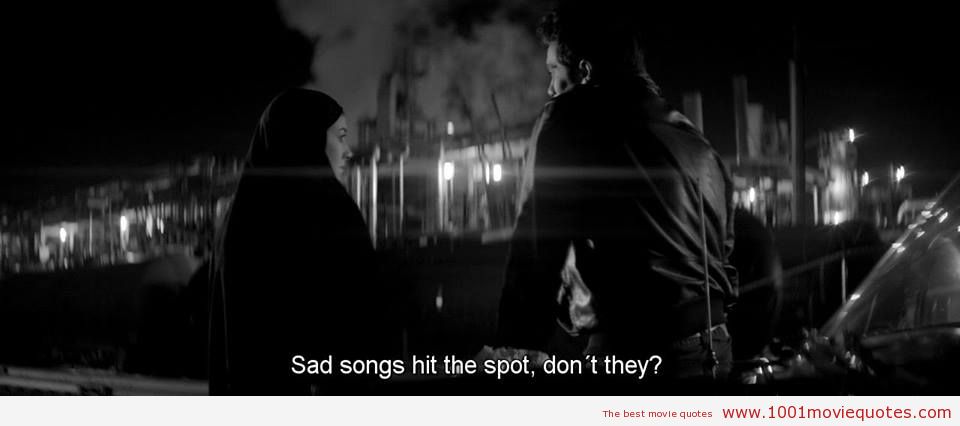
Girl posterI wanted to contrast this with the movie I watched directly afterwards, made 85 years later: A Girl Walks Home Alone At Night. Ana Lily Amirpour’s feature-length version of her earlier short of the same name was getting quite a lot of talk on the festival circuit, and recently made the jump to home video, so I can finally say I’m gratified to find the praise earned.

Seemingly set in Iran (but filmed in California), Girl is the tale of, well, The Girl (Sheila Vand), a vampire who haunts a run-down city called Bad Town. The nature of the place is revealed early on, when our other protagonist, young Arash (Arash Marandi) walks across a bridge, and in the dry ditch below, we see bodies left to rot in the sun. Lots of bodies.

agwhaan2The Girl has a peculiar moral sense in such a messed-up place. Except for an unfortunate wino, we mostly see her kill men who are mistreating women, like the abusive pimp and drug dealer Saeed (Dominic Rains). She terrorizes one poor urchin into being “a good boy… or I’ll feed your eyes to lions!” One of the most haunting images of the story is The Girl riding through the night on her purloined skateboard, her chador flowing behind her like Dracula’s cape, or bat wings.

The Girl will meet Arash in one of the more delicious meet cutes in some time, as her perambulations in the night streets is interrupted by the sight of Arash, who was somewhat unwillingly dosed with Ecstasy at a costume party. He is dressed as Count Dracula, and is staring raptly at a street light. “I’m a vampire,” he informs the vampire. “But don’t worry, I won’t hurt you.” Completely lost in his drugged state, she wheels him to her home on the skateboard.

Girl-Walks-Home-Alone-at-Night-Arash-Marandi-and-Sheila-VandThe growing relationship between The Girl and Arash is gently clumsy, perverse, and erotic in all the right ways, but never explicit; Amirpour manipulates the alternately shrinking and expanding space between the two beautifully. The Girl’s backstory, related by Amirpour in the featurettes and the enclosed graphic novel, is that she is nearly 200 years old, lonely and sad; she went to the desert to kill herself in the searing sun but keeps losing her courage; thus she finds herself in Bad Town. Vand is quite remarkable, standing out from a uniformly excellent cast; she plays well the stillness of a creature who has been so many places, and has been alive for so long, that nothing is worth hurrying or getting excited about. Her large, expressive eyes say a lot.

The parallels with Pandora’s Box are obvious, even beyond the black-and-white format, the dialogue in Farsi so we’re still reading white intertitles. Once again, we have a young man setting out on a journey with the woman who killed his father. This time though, he hesitates, actually pondering the course he is setting… and then continuing on. It’s that moment of reflection that gives the ending a slightly more upbeat feeling, a feeling of hopeful adventure instead of a descent into tragedy.

A-Girl-Walks-Home-Alone-at-Night-2014Whereas Lulu has no real agency in the world, The Girl seemingly has nothing but. If Lulu, as Frank Wedekind said, is constantly surprised by living in a world “riven by the demands of lust and greed”, The Girl long ago realized the parameters of that world and acts upon it, in her small way. Conversely, Lulu seems to expect the attention lavished upon her, but The Girl is surprised that Arash finds something worthwhile in her, something worth developing. They are mirror images in a very dark, very screwed-up world.

The Week of Doom

Warning: mindless jabbering and sullen bitching this time.

FRIDAY MORNING:

The worst of the week is, I think, over. What’s left is two days of shows that my body does not want to do. Last night was the local Candidate Debates. I usually manage to pawn off the heavier lifting and loading on younger and stronger backs, but attrition has been so heavy this year that I am the younger and stronger back (lies, all lies). So loading in, loading out (both in heavy rain) and an evening spent at a camera have resulted in not only my recent back pains intensifying, but the bad leg waking up and my good leg telling it to shut the hell up, it has a hangover.
Balwing BusinessmanSo my current life’s goal is to somehow engineer my professional life such that I can actually have weekends again. This requires long, hard looks at what I’m doing for a living. The major problem with my jobs – I work and pay taxes on four of them (because, remember, I am a moocher and a taker) – is that none of them are full-time; I have managed to juggle them for some time now, and this week was one of those instances where everything intersected and suddenly everybody needed me. I skipped out on the memorial service of an acquaintance because I desperately needed that evening to rest and heal.

And really, I’m tired of being envious and somewhat angry every time somebody posts a “Yay, it’s the weekend!” message or graphic. On one level, that is the choice I made when I decided to become an actor. On a deeper level, I am tired of acting for drunks and assholes. Would I feel better about this if I were doing – and here’s a label I hate, but like all labels, it has its uses – “legitimate” theater? Possibly. It’s nice to have an audience that, you know, actually wants to be there to listen.

Realize that this is exhaustion, pain and bitterness talking. I will be at my shows this weekend, and as usual, hit my marks and give it my all and eat ibuprofen like it was candy afterwards. Exhaustion and pain from once again humping equipment, bitterness from the economic necessity of doing same.

Let’s leave that for now and go to something that’s less rancorous, something that intrigues me: I own a Kindle, but I still pay lip service to physical books. It is a toss-up as what is going to collapse and kill me first in my home office: the stacks of movies or the stacks of books (Books are in the lead in that betting pool, adjust your wagers accordingly).

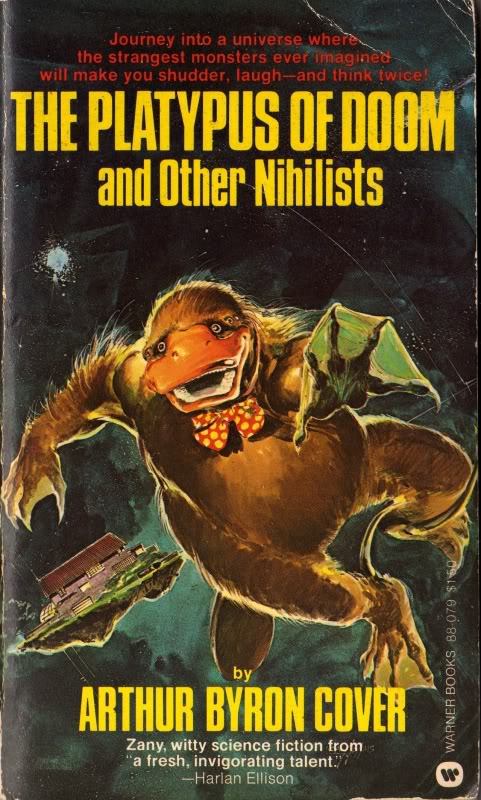
platypusA couple of months back, on my moribund Tumblr site, I reposted the cover of Arthur Byron Cover’s The Playpus of Doom, because it’s a fun title to contemplate and a good read besides, which has gone out of print. Some discussion of the book and its author followed. I discovered that there was no Kindle edition of Platypus, and the vintage paperbacks were outrageously expensive. But there was a Kindle version of his first book, Autumn Angels, which I loved, and paperbacks of its sequel, An East Wind Coming, were dirt cheap. I remember being somewhat disappointed in it, but at that price, sure, why not revisit it? So I received my yellowing package and flipped it open and oy.

Were all paperbacks like this? Cramped type crowded onto the page? I couldn’t read this.

So I guess that e-readers have spoiled me for my beloved paperbacks. Or maybe it was just this book from this publisher, but memory tells me this is not the case. It’s that my progressive bifocals and tired eyes need a less populated, cleaner page to enjoy the printed (ha!) page as I once did. I also bought two larger trade paperbacks of Ellis Peter Cadfael novels and Burroughs’ Naked Lunch, which I also need to revisit, and they are more comfortable to read.

Almost all my recent reading has been on the Kindle – saving a few dollars, and not adding to the teetering piles of bound paper that will someday crush me. I miss not being able to look up and see the titles with the easy familiarity of physical friendship, but as I get older and the type seems to get smaller, I’m glad that technology has given me a way to continue to do something that I love – even as I try to find ways to allow myself the time to do that.

SATURDAY:

There is the other side to that love of new technology, and it was brought home Friday night when I came home – once again, in heavy rain – to a dark house in a dark neighborhood, something I hadn’t experienced since the aftermath of Hurricane Ike. Used candles and flashlight that night, and I could, at least, read my Kindle Fire. As long as the battery held out.

LivingWithoutElectricityMy wife’s phone was dead, mine was halfway there – but I had charged both it and the Kindle before I left for the show. My scripts are all on the Kindle (and yes, I do read over my script before every show). Sleep was fitful that night. The next morning my wife and I went looking for a restaurant with power (luckily plentiful) and she used the car charger to get her phone back up to a minimal level.  After eighteen hours, the power came back on and I gratefully grabbed a couple of hours of very deep sleep in a cooler house before I had to rise and get ready for another show.

God, I’ll be glad when this week will be over and I’ll be able to grouse and complain about other peoples’ work and not my own. You probably will be, too.

LATER SATURDAY NIGHT:

UPDATE: It’s over. I’m too tired and sore to go to sleep. Crap.

Oh, yes, speaking of which: that Crapfest I was looking forward to? Postponed. Host Dave got a paying gig. I identify. I just finished off a bunch of those. And just as well, that probably would have been enough to finish me off.

I’m turning this off and going to bed now.

Three Movies That Don’t Belong Together

100April is shaping up to be a killer month, as in next week (known throughout the land as “@#$!ing Tax Week”) will not only damage me financially but physically, a week of non-stop labor that will (at least) end with a Crapfest, but it’s a Crapfest that largely exists because one of our number passed away recently. More on that later. If I survive.

So at least I watched some movies at Rick’s before this horrible month started. We tend to put together three movies that have some sort of connection, but this time we decided to get all eclectic and see what happened. 1308402322One of the things that this “Watch These 100 Movies” Challenge is doing is, at least, getting me off my ass as far as Charlie Chaplin goes, and it turns out Rick hadn’t really watched any of his stuff either. One I had on hand was Modern Timesso off we went.

The major memory I carry with me from my first feature-length Chaplin, The Gold Rush, is that in the opening shot I was immediately introduced to Charlie Chaplin, Serious Filmmaker. I’m not kidding about that. That proto-Herzog shot involving hundreds of people made me reconsider my opinion of Chaplin instantly. So what, then, are we to make of Modern Times, an almost entirely silent movie released in 1936, almost ten years after The Jazz Singer ushered in the era of talkies?

modern_timesIn the extended riff on Metropolis that opens Modern Times, the only time human speech is heard is through machinery: the head of the steel mill commanding his foreman to speed things up through a TV screen (science fiction in 1936!) and a sales pitch recorded on a Victrola record. Everything else? as if it were filmed fifteen, twenty years earlier: silent, with only the occasional sound effect. It’s hard arguing with the result: a master working within a format with which he is intimately familiar and comfortable.

As the story progresses and the title character (and modern times is a character in this movie) frustrates and blockades the Little Tramp at every turn, in the final sequence, even he must give himself over to synchronized sound, with – just as The Jazz Singer did – a song. Even then, losing the lyrics written on his cuffs, he has to resort to pantomime and nonsense.

Modern Times was made after Chaplin had spent a year and a half traveling the world, and talking with people as diverse as Henry Ford and Mahatma Gandhi. He returned to an America still deeply mired in the Great Depression, probably not a little politicized – and it shows. The opening section in the factory is based on Chaplin’s visit to Henry Ford’s famous assembly line, where young men were abandoning farm work for better money and, after a few years working that line, suffering nervous breakdowns. After the Little Tramp suffers a similar breakdown, he proceeds to drift from one attempted job to another, where any whiff of unionizing is visited by police wielding batons. This movie was Exhibit A when the House Un-American Activities Committee decided Chaplin was a Commie. chaplin-modern-times-1936-granger

A breath of fresh air is Chaplin’s then-lover, Paulette Goddard, as The Gamin, a young lady down on her luck, who manages to escape the juvenile authorities when the rest of her family is packed off to an orphanage. On the waterfront, the Gamin is like Tarzan (right down to wearing what appears to be one of Jane’s tossed-off dresses), and her and the Tramp’s run-ins with the Law leads to a partnership alternately heartbreaking and uplifting (and hilarious, needless to say). Once they finally seem to have found their ideal place, it’s those same forces of the Law that rousts them (all other problems solved, they still want to bust The Gamin for vagrancy), and they find themselves on the road again. That isn’t a new sensation for the Little Tramp, but he has a companion. Again, not new, but this time we have the feeling that companion is an equal, and that’s nice. And if Chaplin had to put a coda to The Little Tramp character, the silent era in general, and a last word (ha!) to an America in distress – “Buck up! Never say die! We’ll get along!” ain’t a bad one, at all.

I don’t give out five-star ratings easily. Modern Times got one instantly, and without a second thought. bloodthirsty

We had decided to place a “palette cleanser” in the second position, acting like a raspberry sorbet between courses of a meal. No sorbet this, however, what we had was a blu-ray of Andy Milligan’s Bloodthirsty Butchers. (Andy Milligan on blu. This is an age of wonders.)

Bloodthirsty Butchers is Milligan’s screen version of “Sweeney Todd, The Demon Barber of Fleet Street”, a piece of penny dreadful literature that dates back to 1846. Lots of folks have taken a crack at the story, including Tod Slaughter – there’s even a ballet, for pete’s sake. This is one of two movies Milligan actually shot in England in 1970. (The other one, The Body Beneath, gets my vote as the almost watchable of his films), instead of trying to make Staten Island look like period Europe. Tim Lucas put it best: Andy Milligan’s movies play out like filmed community theater productions. There are one or two good actors, many mediocre ones, and some oy-god-get-off-the-stage actors. And somebody’s mom (in this case, Milligan himself) sewed the costumes out of whatever was available.

The heartbreak of nailess Milligan hand.

The heartbreak of nailess Milligan hand.

The most fun was finding modern devices in the background, and how every room has the curtains drawn to avoid the 1970 neighborhoods outside; the modern hairstyles and makeup. And yelling “WHO ARE YOU??” every time a new character suddenly cropped up. (Actually, the most fun I had was fantasizing a 40-ish Stephen Sondheim, chilling out from the intense workshopping of Company and catching this crap at a 42nd St. theater. Thinking, “Hey, I bet I could get a musical out of this!”)

Watching Milligan movies is perversely fascinating, but draining. I really can only manage one a year. And I still have these other two blu-rays…

This part, at least, did have us screaming in horror.

This part, at least, did have us screaming in horror.

How was the blu, you might ask? Well, it’s quite clear, but so obviously a 16mm print that was blown up to 35mm the grain should get a screen credit. That’s not the fault of Code Red, who put out the blu – that was standard operating procedure for Milligan and William Mishkin. How else do you think he made movies for only $12,000? Milligan always had his framing too tight, so if you’re watching this on a modern 16:9 TV, reset your aspect ratio to 4:3. Andy had enough shortcomings on his own without adding to them by cropping off what little frame he had.

And I couldn’t find a trailer online. Lucky you. IF

So what were we cleansing our palettes between? Well, Rick has been having a bit of a problem with the entertainment he enjoyed as a youth. Most recently, a few months ago, we watched an episode of Space 1999 which murdered that particular sector of his childhood (the episode had an implied-nude Sarah Douglas, and endless scenes of a slow-motion bouncing ball). Then, a month or so ago, he watched an old cable favorite, Foxes ,with terrible results. So his next attempt to capture the cable glory of his childhood was approached with not a little fear. The movie was Thief, and as I put it, “This is a Criterion blu-ray. How bad can it be?”

Thief was Michael Mann’s first theatrical feature, after a very well-received TV movie, The Jericho Mile, gave him enough clout to convince James Caan to take the title role. Caan plays Frank, who is, you might guess, a thief, and an awfully good one. His two-man crew (one of which is Jim Belushi) and he plan and perform heists that specialize only in cash or diamonds locked inside seemingly invulnerable vaults. This eventually garners the attention of Leo (Robert Prosky, a TV actor also making the jump to movies), a godfather type who wants Frank to work for him exclusively.

caan weldFrank carries in his wallet a photo collage of the ideal life he wants: house, kids, wife. He convinces a waitress he’s attracted to, Jessie (Tuesday Weld) to be the wife and mother in the collage, and once she agrees, Frank also agrees to Leo deal: a couple of big jobs to sweeten his retirement pot, and then he will retire to his carefully-managed secret identity as the owner of a car lot. And that, as they say, is when the trouble starts.

Mann insisted on authenticity, not only from his actors (and the diner scene between Jessie and Frank is still taught in method acting classes), but from his story: there are several actual high-profile thieves in the cast, who were consultants, and lent the movie their tools of the trade (like that huge drill Caan uses in the opening scene). Apparently Caan learned so much under their tutelage he actually cracked a safe in his sister’s house when the mechanism fouled up. burn bar

Rick was gratified: the movie was actually better than he remembered it. For my part, I had owned the soundtrack for something like mumble mumble years, oh, all right, I bought it when it came out in 81. This was only Tangerine Dream’s second American theatrical score, but I had been buying their albums since about 77 or so. So it was nice to finally see the images that inspired some of the music.

But how did I like the movie? Thief is very good, primarily for the reason Rick put forth: its balance between character and technique, Frank’s life and his trade, is almost perfect. Mann is stretching visual muscles here that are eventually going to coalesce into Miami Vice and shape fashion and entertainment for a good portion of the 80s. And the choice of Tangerine Dream is perfect for the neon-lit vistas and brutal technology Frank employs – sometimes the score is almost indistinguishable from the  roar of the drill.

It’s also fun to see other members of the Mann Repertory Company crop up – William Peterson as a bouncer in a bar, Dennis Farina as a gunsel. Good stuff.

Now I need to finish this up, post it, and gird my loins for the next two weeks. I may get to slide in a movie or two, but I won’t get to write about them, until the latter part of the month. Enjoy what’s left of your Easter baskets, kiddies, and be excellent to each other. I should be back.

The Lady from Shanghai (1947)

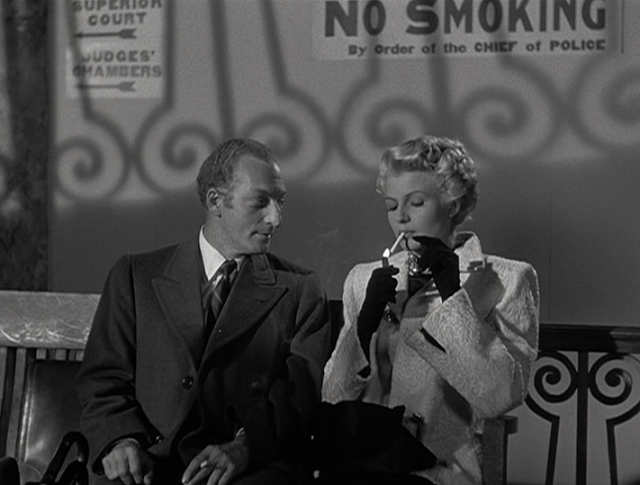
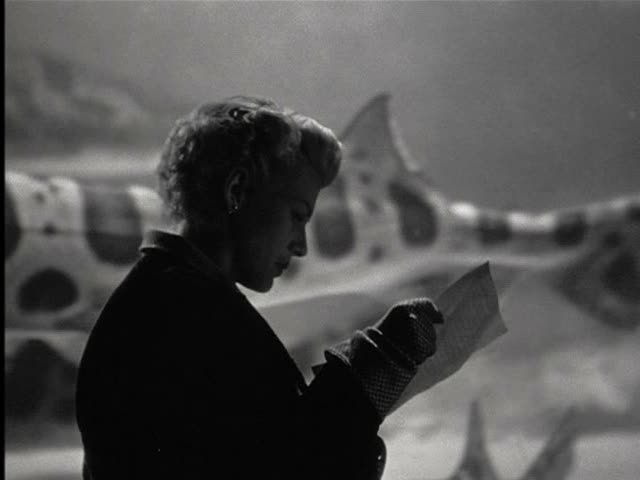
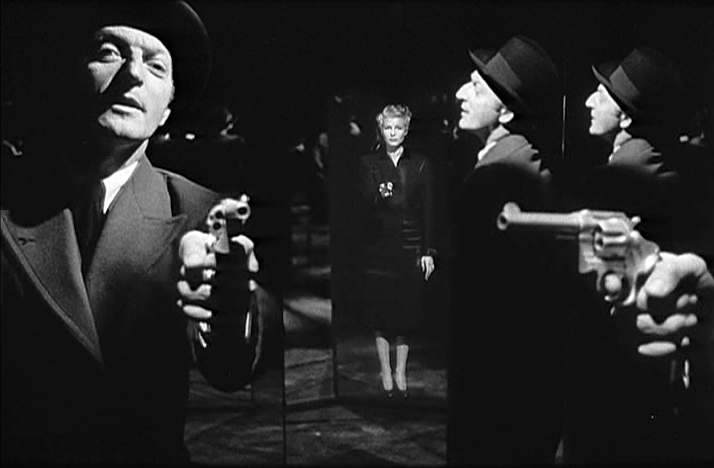
100And just when I thought I was finished with film noir for the moment, Olive Films goes and puts Lady from Shanghai out on blu-ray. I’d never really had the opportunity to see it before, although I had seen the same three minutes as everybody else: the climax in the hall of mirrors that is justly held up as a masterpiece of cinema.

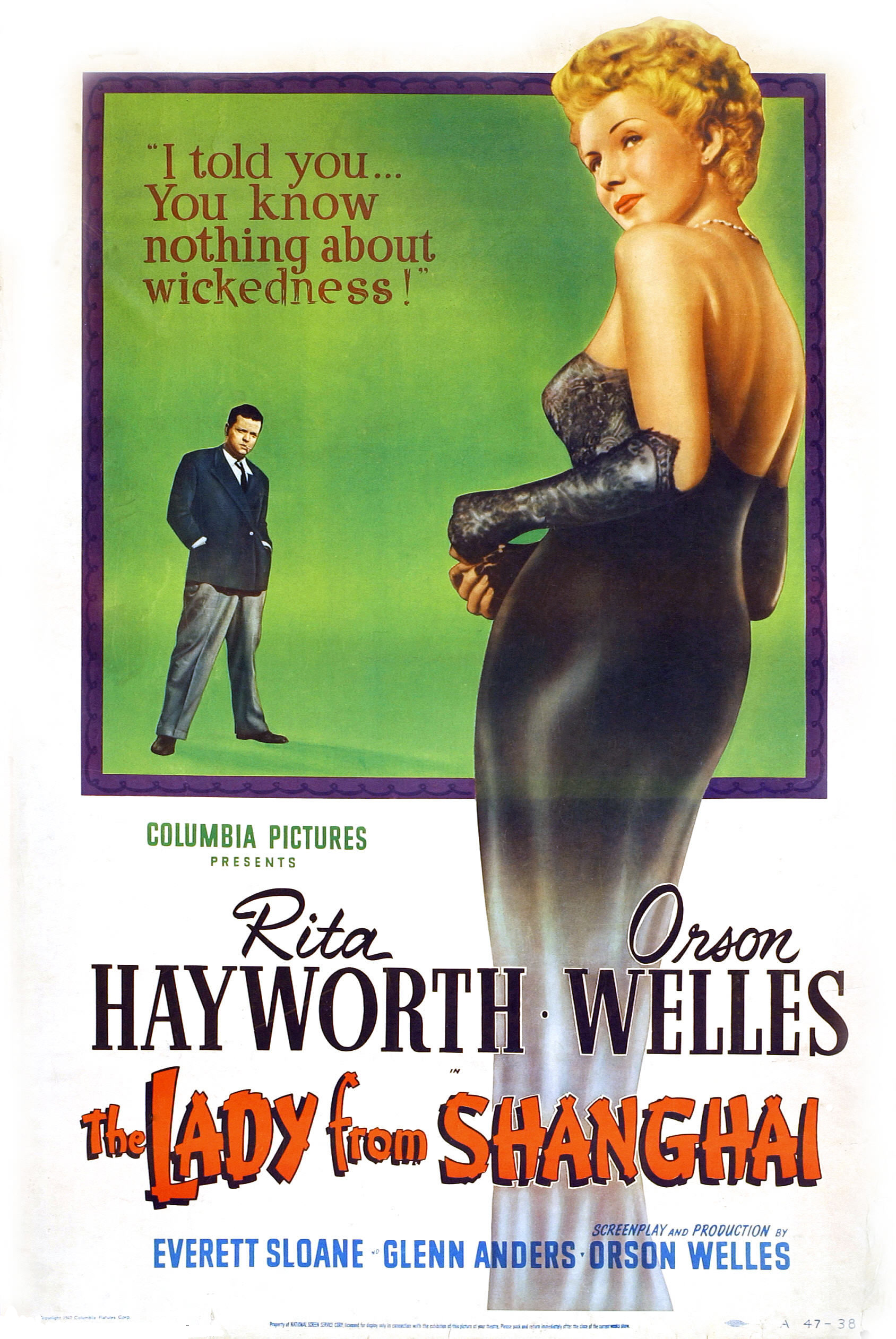
ladyfromshanghai_1948_mp_40by60But there’s a problem with finally seeing a movie when you’ve been exposed to its peak moment for years (nay, decades), which goes hand-in-hand with a very sad realization: when you are watching any of Orson Welles’ studio-backed pictures you are inevitably watching damaged goods.

Studio interference with The Magnificent Ambersons and Touch of Evil is legendary, but it wasn’t until I started digging into Shanghai that I began to be aware of that tale of woe. Welles liked to tell the story of how Lady from Shanghai came to be: The Mercury Theater was opening a musical version of Around the World in Eighty Days and when producer Mike Todd pulled out, the costumes were impounded until Welles came up with the $55,000 owed. He got on the phone to Columbia’s Harry Cohn and offered to write, produce, direct and star in a movie for Columbia, if Cohn would wire him 55 grand immediately. Welles (depending on the telling) either claimed he grabbed a paperback novel off a spinner rack near the phone booth, or a book the girl in the box office was reading: Sherwood King’s If I Die Before I Wake. In either case,Welles had never read it. Cohn bit.

Hey, I'm sold.

Hey, I’m sold.

Cohn also later stated he would never again hire someone to produce, act and star in a movie because then he couldn’t fire any of them.

It is reported that Welles’ first cut of the movie ran 155 minutes. That means that the version I saw is short by almost an hour and ten minutes. Cohn found the movie incomprehensible. The connection between those two facts is obvious.

ladyfromshanghaiWelles plays Mike O’Hara, an itinerant Irish sailor (and such an accent! Sure, and I should have watched it on St. Patrick’s Day, when the blu-ray was released, begorrah!), who falls into the sphere of Elsa Bannister (Rita Hayworth), when he rescues her from some toughs one night in Central Park. Elsa convinces her husband, rich, crippled criminal lawyer Arthur Bannister (Eliott Sloane) to hire O’Hara as bosun on his yacht for a cruise to the West Coast. Coming along for the ride is Bannister’s rather unbalanced partner, Grisby (Glenn Anders).

This being a noir movie, Elsa’s obvious attraction to O’Hara is going to blossom into a love affair. Grisby, obsessed with the certainty of nuclear war, has a harebrained scheme to fake his death at the hands of O’Hara so he can make off with the insurance money and hide out on a South Seas island while the world goes to hell. O’Hara, desperate for the money to finance a new life for himself and Elsa, agrees. This will backfire spectacularly as O’Hara is arrested for Grisby’s very real murder and finds himself on trial with Bannister as his lawyer.

lady from shanghai 06There are many, many ways is which the plot has been sabotaged to this point by the chainsaw editing. O’Hara sensibly resists Elsa for quite some time, but finally succumbs after a Cohn-mandated song. In fact, there is remarkably little chemistry between Welles and Hayworth, surprising since they were husband and wife at the time (perhaps not surprisingly, as that union didn’t last much longer. It’s possible that the movie was a last attempt to save the marriage – but that also casts a dark shadow on Welles’ insistence that Hayworth cut short her trademark long red hair and bleach it platinum blonde.). The camera has no problem making love to Hayworth in numerous close-ups, however (also mandated by Cohn).

Grisby’s plot to fake his own murder is so unconnected to reality that O’Hara’s agreeing to go along with it renders him the densest of all chumps in a genre built on chumps falling for stupid schemes. When the main problem with the plan is brought up by Bannister at the trial – how was the supposedly dead Grisby going to collect on that insurance? – the audience is muttering “I was saying that a half-hour ago.”

And that trial! Oy, such nonsense piled upon nonsense! Surprise subpoenas, the defense attorney called as a prosecution witness, who then cross-examines himself… well, Anatomy of a Murder it ain’t.

shanghai3O’Hara desperately overdoses on Bannister’s pain pills and uses the chaos to escape (after quite a fight scene in the judge’s chambers. Welles really enjoyed trashing rooms), and this where Lady from Shanghai finally starts developing its own unique character, and the extent of the damage from Cohn’s editors begins to really assert itself.

At the movie’s opening, Elsa tells O’Hara she had worked in Shanghai and Macao. Later, her maid begs O’Hara to take the job, because Elsa is a waif trapped in a nest of vipers; in fact, you can’t find worse traveling companions than Elsa, Arthur and Grisby, all constant passive-aggressive hated and sniping. There is reference to “something” that Bannister has on Elsa, that he used to blackmail her into marriage.

ladyshanghai5Now, as the movie enters its final stretch, a drug-addled O’Hara stumbles through Chinatown, finally hiding in the audience of a Peking Opera. He is effortlessly stalked by Elsa, gliding though the streets, speaking to passers-by in Mandarin. At the theater, she calls a gangster named Li, who arrives and spirits the now-unconscious O’Hara out under the nose of the Police. O’Hara has picked a perilous moment to black out, as he has just discovered, in Elsa’s purse, the gun that killed Grisby.

Yes, Elsa becomes ten times more interesting and complex in that segment, rendering everything she’s done to this point questionable, yet any explanation of how and why seems to be on the cutting room floor.

This leads to the gang’s hideout in an off-season amusement park, and the legendary Hall of Mirrors shootout as O’Hara finally discovers the depths of his chump-dom and the extent of Elsa’s poison noir dame-ness. Apparently as much as twenty minutes was trimmed from this imaginative sequence, and that is a major fucking crime against cinema in particular and art in general.

Lady-3Welles’ intention was to film the story in a fairly documentary fashion, with lots of location shooting (including yet another rich man’s transformation of his wife’s wish for a picnic into a massive, ultimately bitter, production number), and no close-ups, which must have driven Cohn, already upset over the “ruining” of his prime star with a haircut, that much closer to apoplexy. The trial scene is meant to be Brechtian parody, but no one in the intended audience had ever even heard of Bertolt Brecht. The resulting movie is the sad, scarred record of two men fighting to tell a story, each his own way, and neither particularly getting his way.

The Lady from Shanghai opened to indifferent box office and scathing reviews (except in Europe, where Welles was always more appreciated), but has come to be revered as a masterpiece, the “greatest weird picture ever made.”

And you look at it and you think, 155 minutes. Jesus. What did I miss?What did we miss?

The Killers Times Three

100
Nobody will be surprised to learn that I really love the Criterion Collection. I’ve had some people try to tell me they’re not all that, but this gets the same response as telling your great-aunt Emily June that Obama isn’t a Muslim: a few seconds of blinking uncomprehension, then renewed screeching. Yes, I am aware they put out Armageddon and The Rock. I am also aware that angel investors have to be rewarded.

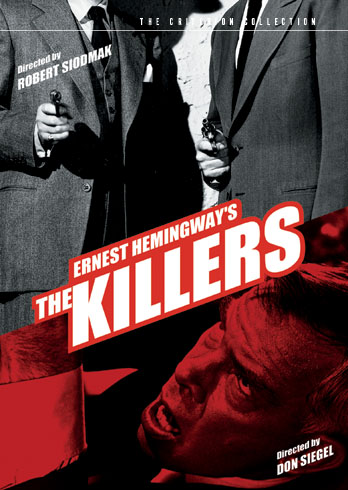
176_box_348x490_originalA few months back, when visiting my parents, I discovered that someone had offloaded a bunch of older Criterion DVDs at the local Half-Price Books. That day I could afford only one, even at half price. When we returned a few months later for Christmas, I had made sure to bring more money, and this time I managed six. And one was a really fun concept package containing three versions of Ernest Hemingway’s “The Killers”.

For those of you who did not have the privilege of being English majors, “The Killers” is considered to be a classic of American literature. Here’s a link to a PDF of the story as it originally appeared in Scribner’s Magazine in 1927. Go ahead, read it, it’s short. I’ll wait. (One of the extras on the Criterion set is Stacy Keach reading the story and doing a bang-up job. It only takes 17 minutes.)

So anyway, for the tl;dr crowd (and I pity you), it’s the story of a small town diner terrorized by the title characters, two gangster types who are in town to “kill the Swede”, who always comes in at 6:00 to eat dinner. When the Swede doesn’t show, the two killers leave – leaving the diner’s occupants alive, to their relief – and one of them – Hemingway’s guy, Nick Adams, runs to tell the Swede – and the Swede refuses to escape or call the cops, saying it would be no use.

Russkies in blackface. But what you going to do?

Russkies in blackface. But what you going to do?

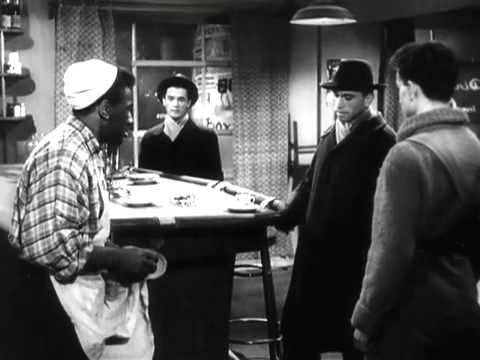
One of the three versions of the story in the Criterion set was made in 1956, and it’s the exam film of several students at the Soviet Gerasimov Institute of Cinematography, one of whom was Andrei Tarkovsky, later the director of movies like Solaris and Andrei Rublev. It is the most literal version of the three, basically translating the short story directly onto film. It’s also only 19 minutes long. It’s worth seeking out just for that; there are a couple of minor film school flubs, but it’s remarkably assured filmmaking, otherwise.

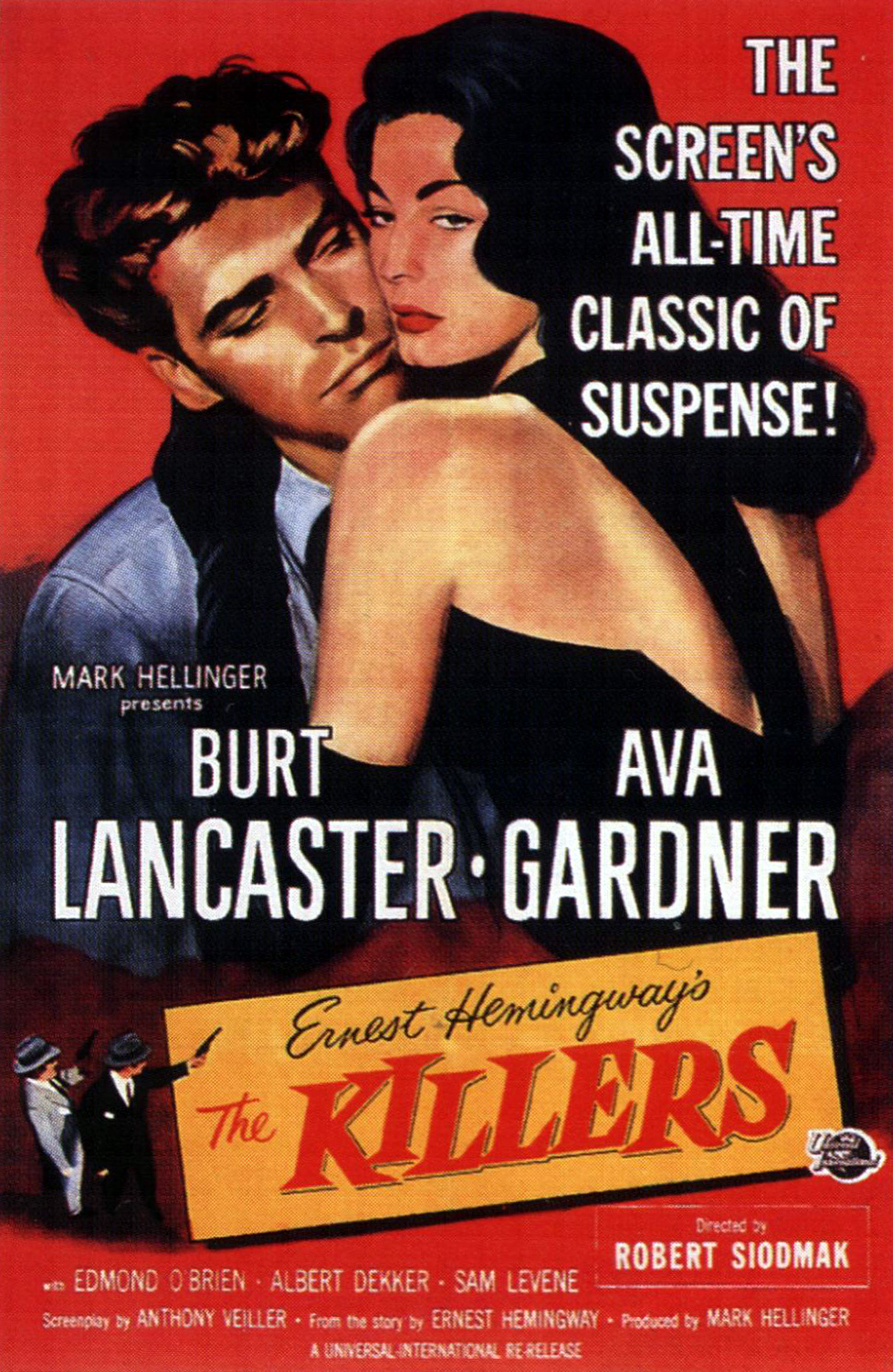
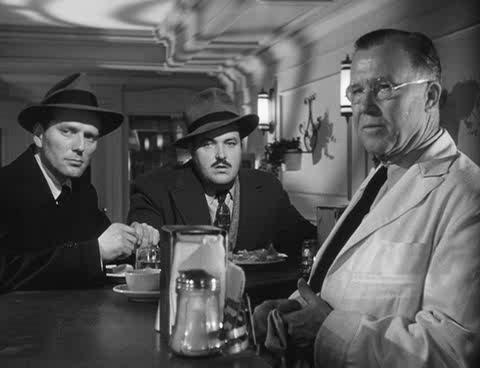
The-Killers-PosterOur first movie chronologically, however, is the 1946 version, directed by Robert Siodmak. It starts with the Hemingway story, practically verbatim, though this time when the killers leave and Nick goes to the Swede – whose name is Ole Anderson, just in case you didn’t read the story – in his boarding house room, it’s barely ahead of the killers. We find out that the Swede is also Burt Lancaster (in his film debut!). He still refuses to run, because he’s tired of running, and “I did something bad.” So the killers bust in and kill him.

Yep, we’re only 19 minutes into a 105 minute movie.

So we leave Hemingway behind and meet Joe Reardon (Edmond O’Brien, increasingly a go-to guy for film noir post-WWII), ace insurance investigator. It seems the Swede had a life insurance policy through the gas station where he worked, and Joe sets out to find why someone would want to employ overkill methods on a grease monkey.

William Conrad takes NO guff.

William Conrad takes NO guff.

The rest of the movie plays out like a noir version of Citizen Kane as Reardon slowly puts together various people’s testimonies to fill out Anderson’s life: a prize-fighter with a career-ending injury, he falls in with the wrong people, falling for in the case of Kitty Collins (Ava Gardner, who plays a poison dame like you wouldn’t believe). Anderson even takes a rap for her, serving three years in the pen. When he gets out, Collins’ once and present sugar daddy, Big Jim Colfax (Albert Dekker, six years removed from Doctor Cyclops) recruits Anderson for a big job that will net them a quarter of a million dollars.

Now Reardon is really interested, as that job – stealing the payroll of that most necessary of noir establishments, a hat factory – was covered by his company. Anderson shows up after the robbery and hijacks all the dough and escapes, not being seen again until Big Jim spots him at that gas station (and after last week’s movie, Out of the Past, I now know not to work at a gas station if I’m hiding from a crime boss). There are too many things that don’t add up for Reardon, and he knows that if he’s going to solve this case, and find that money for his insurance company. he’s going to have to find Kitty Collins. I would say, “even if it kills him,” but that’s a pretty safe bet.maxresdefault

vlcsnap-2192371The 1946 Killers is pretty good noir, full of interesting characters and guys with suspenders carrying pistols and lit cigarettes. That opening sequence (remember, back when we were still doing Hemingway?) is a little masterpiece of noir camerawork and lighting, our two killers walking in and out of pools of darkness, finally splitting up and approaching opposite ends of the well-lit diner, like an Edward Hopper painting gone wrong, dark and violent.

the-killers-1964-movie-posterCompare this to the last version in the collection, made in 1964 by Don Siegel. Producer Mark Hellinger had wanted Siegel to direct the ’46 version but the studio nixed the then-fledgling director. Siegel now steadfastly refused to do a remake, and set out to make a movie as markedly different from the ’46 version as possible, and proceeded to filing off the serial numbers.

The movie, as shot, was to be titled Johnny North. North is the Anderson character, played by John Cassavetes. The killers are Lee Marvin and Clu Gulagher. They track North to a school for the blind, where he’s teaching auto mechanics to a group of blind men. Although warned the two men are coming, North simply stands there and lets them shoot him down, and that – along with the fact that somebody paid them more than twice their usual fee to kill a shop teacher – really bothers Marvin.

assassinsSo our two killers take the place of the insurance investigator in the earlier film, and find out North was a pretty good race driver who fell in with a sports groupie, Sheila Farr (Angie Dickinson, whose career keeps intersecting my interests). She’s also the property of a shady character named Jack Browning (Ronald Reagan, in his last movie, and playing a bad guy, which he hated).

imagesNorth has a crash that breaks his leg and screws up his vision, ending his racing career. Sheila later finds him working at a drag strip, and Jack needs a good driver for a big job. There are no more hat factories, so they are going to waylay a mail truck that has the weekend’s receipts from “all those resorts on the coast.” All goes according to Reagan’s evil plans, until Johnny slugs him and takes off with the loot.

As you can guess, now the killers have to find this Sheila dame and… well, let’s just say it doesn’t have quite the happy, tidy ending of its 1946 predecessor (although there are no loose ends). And they still wound up calling it Ernest Hemingway’s The Killers, leading to a lot of critical drubbing, as this is a homeopathic version of the Hemingway story: there’s a molecule or two of the story, floating around in there, somewhere.

28The title change likely came about because, while it was being shot, it was going to be the first two-hour made for TV movie. When it was judged too violent and too amoral for TV, it was released theatrically, and the name change was likely thought more marketable. The TV origins do work against it, I feel. It feels too brightly lit, and several of the dialogue scenes drag. It has an amazing cast though; I haven’t mentioned Claude Akins as Johnny’s old mechanic, or Norman Fell as Jack’s stooge.

John Cassavetes acted in other peoples’ movies to make money to make his own. That’s not an uncommon story in Hollywood, but the thing about Cassavetes was he always gave value for the dollar. He always gave more in his roles than was necessary.

"HERE'S one for the Gipper!"

“HERE’S one for the Gipper!”

He was damned good, is what I’m saying.

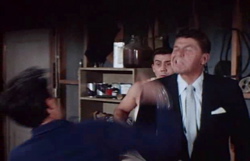
And in The Killers, he gets to slug Ronald Reagan. I’m good with that.

The Killers box set on Amazon

Le SamouraÏ (1967) & Out of the Past (1947)

100le_samouraiThe French again! Jean-Pierre Melville again! An influential film, again! Where will this all end?

Well, this is about as close to binge-watching as I get.

Once more I find myself paying for my ass-backwards journey into cinema; I’ve already seen most of the movies directly inspired by  Le Samourai, rendering it less fresh and impressive than it might have been had my movie-watching habits been more refined in the early part of my life.  Regrets like that are pretty inane, however, since my life has mostly been a journey from the rural to the increasingly urban. I was lucky to have landed in a small city with access to a PBS station when I was only 13 or 14, coinciding with a series of “Classics of World Cinema” or somesuch. That got me even more hooked on movies, but at that time – 1972 or 73 – other options were extremely limited.

I’ve always looked older than I actually am, so I managed to get into some movie screenings at the nearby college, which is where I saw King Kong for the first time (on the big screen, luckily). But again, very limited options. VCRs didn’t appear on the scene until I was in college, and then the software was still exceedingly commercial, even during the big VHS boom. It was all barbarians, boobs, blood and beasts, to paraphrase Joe Bob Briggs, and I ate it up with a spoon. I had to special order videotapes of Rashomon and Yojimbo – such fare was still rare, even after I moved to the Big City. It got better. I discovered mail order and laserdiscs, which catered to a more sophisticated clientele, shall we say.

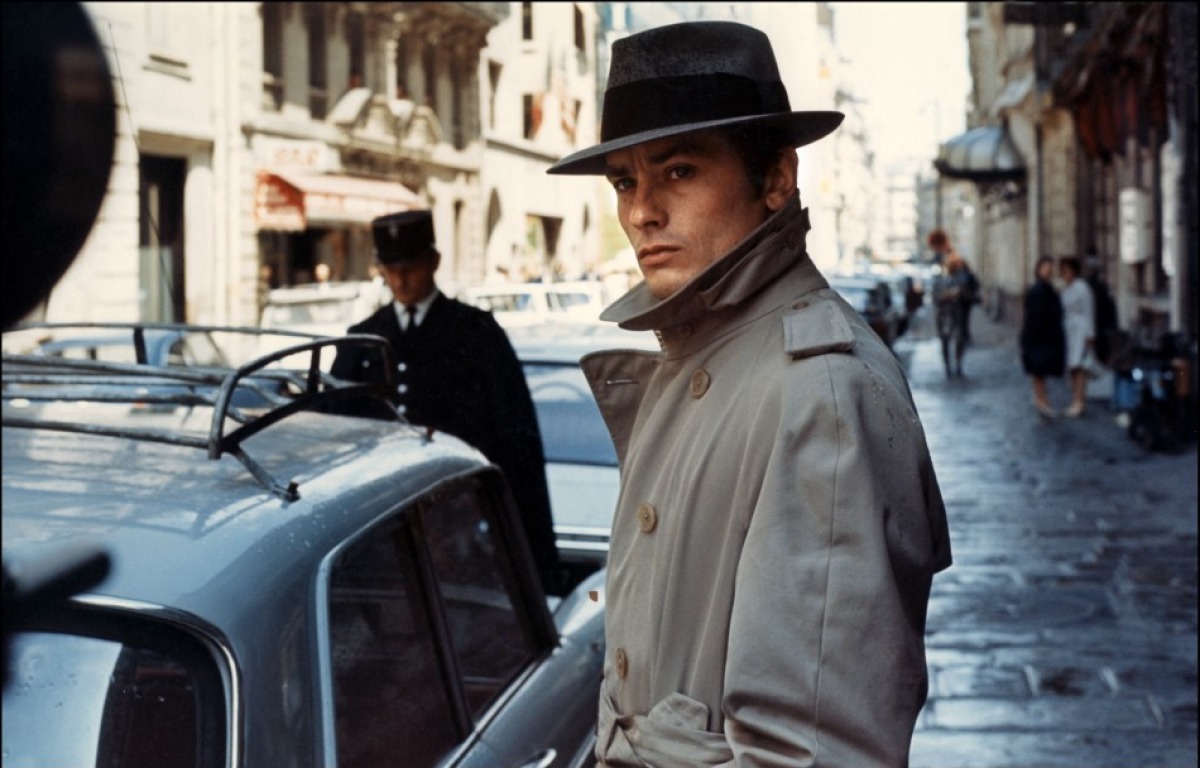
samourai-1967-01-gSo it’s no small wonder I saw The Killer before I saw Le Samourai. It is also a matter of no small wonder that in these times, I can bloody well watch Le Samourai whenever I damned well please. There is a lot to despise about these Modern Times, but there is a lot to be thankful for, too.

So now the trick is to find something significant to say about a well-respected movie that is almost as old as I.

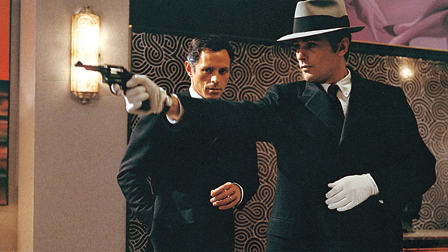
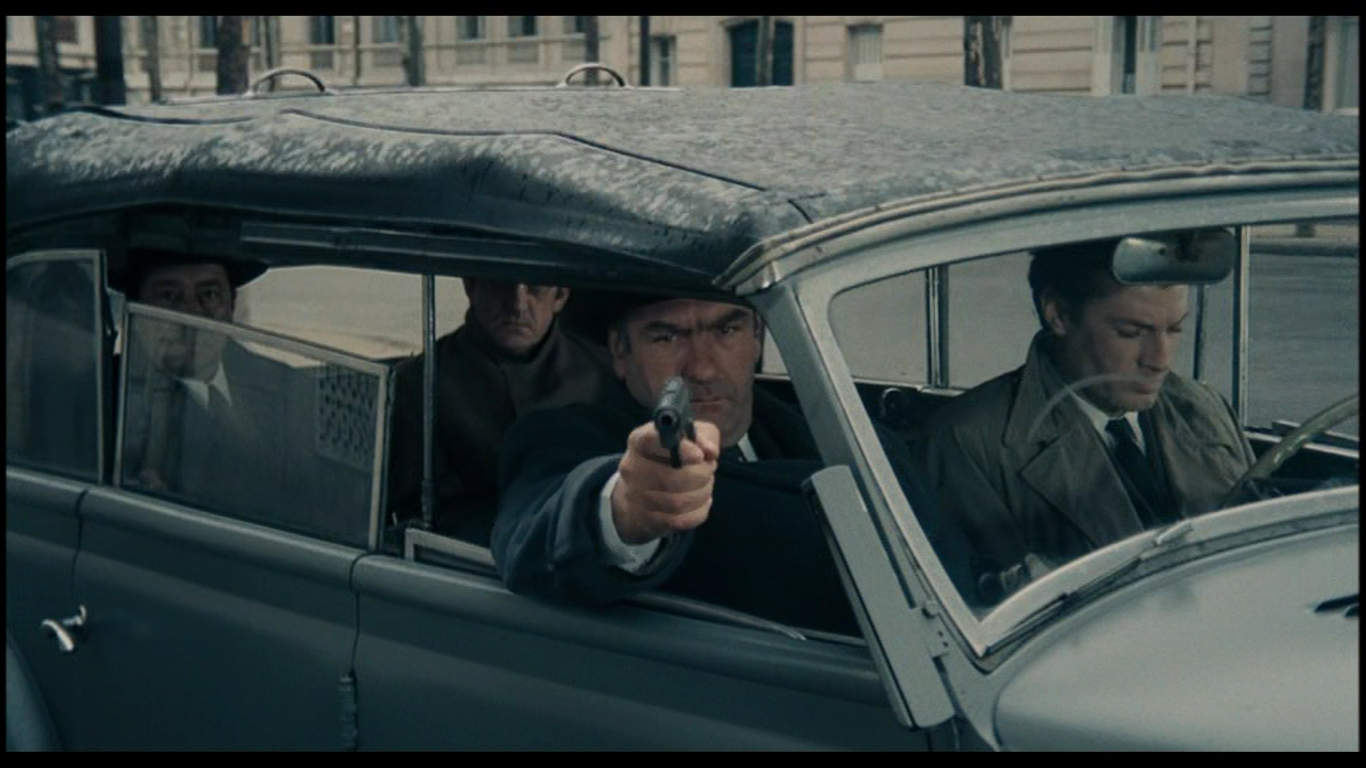
In case you’re as cinema-deficient as myself: Alain Delon is Jef Costello, a preternaturally calm hitman living a spartan existence in Paris. Jef accepts a contract on the owner of a nightclub, and successfully carries it out, after engineering a complex two-part alibi involving his former lover (Nathalie Delon), an unsuspecting customer of said lover, and a hotel room of card-playing cronies. There are several eyewitnesses who saw Jef leave the scene of the shooting, but the one who confronted him face-to-face – the club’s star attraction (Cathy Rosier) – intriguingly does not finger him in the ensuing police line-up.

le-samourai-01There are two complications: the first is Jef’s mysterious employer, who panics when Jef is picked up in a wide police dragnet, and orders Jef killed. The other is that the Commissioner in charge of the investigation (François Périer) feels Jef’s alibi is too airtight, and starts devoting more and more manpower to bring pressure to bear on the young assassin.

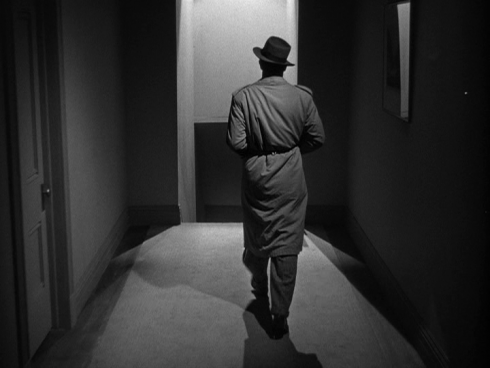
The movie’s title is not mere affectation – Jef goes about his work with a competence and inner stillness reminiscent of those earlier warriors (significantly, the title of the original novel by Joan McLeod was The Ronin, a masterless samurai). The uniform has changed: a snappy raincoat, a fedora with a carefully-corrected brim, white cotton gloves for the wet work. What Jef finds, however, is that all this is useless against the massed might of practically an entire police department, and a maddeningly inconsistent employer who sends the same man who tried to kill him to apologize and offer a new contract. Jef will try to plumb exactly what is going on, to little avail. He is an impressive warrior, but a terrible detective. Upon finding that his lover is being harassed by the police to recant his alibi, Jef makes his final decision and promises her he will sort everything out. He does this by killing the feckless employer and carrying out his last assignment with an unloaded gun, insuring the pursuing police will gun him down.

Film_306w_LeSamurai_originalLe Samouraï is perhaps the height of the French New Wave’s appropriation of and stylization of popular American film noir and gangster tropes; if one looks askance at the commissioner’s increasing use of manpower and taxpayer money to pursue a man on a mere hunch (and fortunately for him, that hunch is correct), then it is also useful to realize that this story is in no way meant to be realistic. Melville ignores current fashion, making the movie timeless. JFK had put paid to men’s habitual wearing of hats earlier in the decade, yet everyone here still wears them, just as in the American movies that inspired it.

Le Samouraï at Amazon

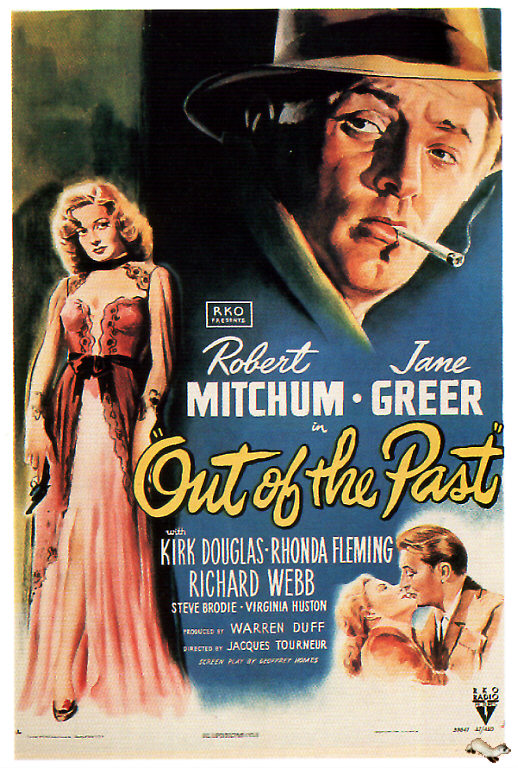
out_of_the_past_1947Even though little of it can really be called new to my jaded cinema eyes, it is useful to examine one of those inspirational movies: the Jacques Tourneur-directed 1947 classic Out of the Past.

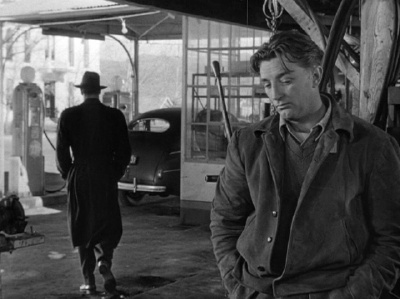
In this, another Jeff (Robert Mitchum), the owner of a gas station in a small California town, is confronted by Joe (Richard Webb), a man in a tellingly dark trenchcoat and hat, who knew Jeff back when and insists he come to a meeting with a former employer. Jeff’s calm life as a working joe and his budding romance with local girl Ann (Virginia Huston) is suddenly upended, and he confesses to Ann his past life as a detective, hired by a mobster, Whit (Kirk Douglas) to track down a woman who shot him and stole $40,000 before vanishing.

2447041_origIn an extended flashback, we find that Jeff tracked the woman, Kathie (Jane Greer) to Acapulco, where he finds out why Whit “Just wanted her back”. He falls in love with her “like a chump”, and runs away with her to California. Whit hires Jeff’s old partner to track him down, resulting in a fist fight at the lovebirds’ cabin, during which Kathie shoots his partner in cold blood and leaves him there to take the rap. Jeff buries the body, and finds a bank book that proves that Kathie’s denials of stealing the money from Whit were false.

Now that Whit has found Jeff – and, we discover, Kathie is once more under the mobster’s roof – the affable gangster wants Jeff to do one more job for him, by way of atonement. It involves stealing some paperwork that would cause Whit to serve time for tax evasion, but Jeff begins to perceive it is all a spiteful plot to frame him for murder, with his former love Kathie as an all-too-willing accomplice.

past1Tourneur was one of the top directors for filming this sort of story, and the gorgeous black-and-white photography of Nicholas Murusaca provides visual evidence of the contrast between the wide-open spaces of Jeff’s new life and the slow entrapment and claustrophobia of his return to the Big City and attempted manipulation by everyone he meets. A fine bunch of actors make good use of a script by Geoffrey Homes from his own novel Build My Gallows High, which supplies a pleasing amount of dimensionality to some pretty stock characters. It’s obvious that Kathie really does care for Jeff, but panic for her own survival causes her to make some poor, even murderous choices, making her a much more satisfying Femme Fatale than many.

Kirk Douglas Out Of the PastKirk Douglas, in only his second movie, makes Whit a charming, smiling fellow with a nicely understated violent undertow. My absolute favorite moment in the flick happens when Jeff is in his hotel room in Acapulco, packing to run away with Kathie. There is a knock at the door, and Jeff opens it, expecting his new gal – but it’s Whit and Joe the gunsel. Douglas flashes that 40,000 watt smile and says, “I hate surprises, myself. Wanna just shut the door and forget about it?”

And if there is anything to take delight in, it’s in these movies’ snappy banter, and Out of the Past has a ton of it. Le Samouraï, on the other hand, is proud of its brevity – the first ten minutes of the movie are utterly devoid of dialogue.

ootp1The other trademark of these movies is an inexorable sense of doom following the protagonist about. You keep hoping for both Jeffs to pull it off, to deliver that final Maltese Falcon coup de grace that delivers justice to the bad guys and lets him live to fight another day, at the very least, if not get the girl (who was usually trying to kill him, anyway). Le Samouraï‘s Jef we already know about, but by the end of Out of the Past, Kathie has effectively murdered every patsy, and despite Jeff’s best efforts, he realizes he is trapped, and can think of no better recourse than to call the cops while Kathie is packing for yet another escape, so that they will encounter a heavily-armed police roadblock on their way out. Both protagonists decide enough is enough, and make sure their true loves, at least, have a chance at a better life, uncomplicated by them and their bad life choices. And sometimes that is the only choice left to you.

out-of-the-past-e1403181284954My last takeaway from this Doomed-Guy-In-A-Hat-and-trenchcoat double feature concerns Alain Delon’s and Robert Mitchum’s (once he returns to his former life) uniform, the coat and the snap-brim hat: I have that raincoat, and it is never going to look as good on me as it does on those two. And though I have a fine fedora, the Legion of Douchebags have seen to it that I can never wear it again. That this saddens me more than the fate of two likeable protagonists is a personal failing, but sometimes, as the Jeffs would tell you, personal is all you got.

Out of the Past at Amazon

Belle de Jour (1967)

100belledejourThere is frequently a problem while dealing with films that are known as “Groundbreaking” and “Iconic” years after their release. This is a barrier I face once again with Belle de Jour, viewing it for the first time nearly half a century after its release: what was at first shocking and liberating is now commonplace.

Just like our last entry, Army of Shadows, Belle de Jour is based on a novel by Joseph Kessel, which was itself published in the 1920s. It seems to have changed little in the transition to screen, except for the fantasy sequences created by director Luis Buñuel. One such sequence opens the movie, with our central character, Séverine (Catherine Deneuve) enjoying a carriage ride in the country with her husband, Pierre (Jean Sorel). Pierre criticizes her for being so cold toward him, and when she tells him not to speak of that, he stops the carriage, has her tied to a tree, whipped, and ravished by his footmen.

hero_EB19990725REVIEWS08907250301ARSéverine does have an intimacy problem, possibly dating back to an incident of molestation in her girlhood. And Pierre is indeed a long-suffering saint, constantly rebuffed and spending the night alone in his half of their Rob-and-Laura-Petrie separate beds. Chance conversations with her friend Renee (Macha Meril) and her shady husband Hussen (Michel Piccoli) leads her to the establishment of Madame Anais (Geneviève Page), a somewhat upscale brothel with only two prostitutes. Séverine becomes “Belle de Jour” (a rather clever play on words, both on “day lillies” and the French expression “Belle de nuit”), who works only between the hours of two and five, coming home before her husband the surgeon.

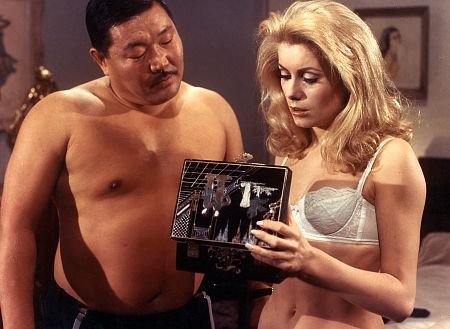
MV5BMTk1NTg3NjAwNF5BMl5BanBnXkFtZTYwOTczNTU2._V1_SX640_SY720_As Séverine waffles on whether or not she will actually commit to her new trade, Anais commands her to get into her room, and when Séverine complies meekly, says, “So. You need a firm hand.” Her first client realizes this, too, and plays to her desire for the rough stuff. So begins her sexual liberation; she even takes on an Asian client with a box whose contents mysteriously buzz, causing the other ladies in the brothel to turn him down – and in fact, in the aftermath of this encounter, we see a genuine smile on Séverine’s face for the first time in the movie. And she begins to warm to her husband, too, much to his amazement and delight.

Two serpents enter this garden of earthly delights: the first is Hussen, whom we were expecting – after all, he’s the one who gave Séverine the address – and the other is Marcel (Pierre Clémenti), a young gangster who represents a sort of bad boy avatar – leather trenchcoat and boots, sword cane, metal teeth – everything Séverine’s dark side desires. They become obsessed with each other, and Séverine quits her job at Madame Anais’ – the Madame thinks it is because of Marcel, and agrees it is a good decision, but it is truly because of Hussen’s discovery of her second life.

Belle-de-Jour-1Everything goes about as one would suspect – Marcel still manages to track Séverine to her home, demands are made, there is tragedy – but it is all so bound up in Séverine’s fantasy life, that we are not sure that the dis-assembly of her otherwise lovely bourgeois life is not another fantasy designed to punish herself, just like the opening sequence. The ending is deliberately ambiguous, and even Luis Buñuel himself has stated that he doesn’t know what the ending truly means.

Buñuel does manage to surprise me every time I approach another of his movies. He is known as one of the greatest of the surrealist filmmakers, and that is a reputation that is roundly reserved. I suppose it is pretty much bourgeois on my part that when I hear surrealism I expect Monty Python wackiness, when in reality (heh), the movement is more about giving the unconscious part of the mind equal representation with the conscious; I read a comment that the carriage bells on the soundtrack are an indicator of Séverine’s fantasies, and while the ambient sound track in the movie is quite sharp and often draws attention to itself, I’m not certain about that assertion.

I’ve also seen it held up as a feminist film, and I look at that claim sidewise as well. It can argued that it is about a woman taking charge of her sexuality, but for that interpretation to work, it has to gloss over practically every relationship in the movie. The only people that actually seem real are the pragmatic Madame Anais and her two girls (Françoise Fabian and Maria Latour), who are friendly and chatty, but have no illusions as to the absurdity and general pathos of their clientele. Humanity is messy, and these women get to see perhaps the best and worst of it.

f6a8cc81d988b2ebf9c3bebf0b8077aba8145830-700Perhaps Belle de Jour‘s reputation as a masterpiece relies on the fact that, of Buñuel’s many surrealist films, it is the most approachable; That Obscure Object of Desire demands constant interpretation, The Exterminating Angel is a puzzle, and my favorite, The Discreet Charm of the Bourgeoisie, is more like a fabulous funhouse than anything else. Belle de Jour, like its source novel, is more of a standard potboiler with some surrealist spice. In fact, I think of all the movies mentioned above, I would be most likely to recommend Belle de Jour as the entryway to the films of Luis Buñuel, for exactly those reasons.

Belle de Jour on Amazon

Army of Shadows (1969)

100
ARMY_OF_SHADOWS_1SHIt’s hard to know how to start on this, so there’s no better place than where the movie begins: the Arc de Triomphe in Paris, as a parade of Nazis file first past it, then down the Champs Elysee, right into the camera. A long, unbroken scene, devoid of reaction shots, or any context save an historical one; and this is how Army of Shadows will present its tale of the French Resistance under Nazi occupation. Unromanticized, matter-of-fact, almost documentarian.

By and large, we’re going to follow Phillipe Gerbier (Lino Ventura), an electric engineer who begins the movie on his way to a Vichy concentration camp for political prisoners. Gerbier will eventually escape when he is taken to the city for interrogation by the Gestapo, in a burst of violence surprising for the quiet intellectual we’ve spent the last fifteen minutes or so with. And so it is, layers of quiet deception always a heartbeat away from disaster or violence.

army-of-shadowsIn the first segment after Gerbier’s escape, he and two of his comrades capture a young man who had sold out his cell to the Nazis, and take him to a safe house for execution. To their dismay, they find a family has moved in next door the night before and they cannot safely shoot the traitor, and so spend several minutes dispassionately discussing various forms of murder in front of their terrified victim.

Army of Shadows did not do well on its opening in France in 1969. One of the reasons is scenes like this, wherein critics felt that the heroes of the Resistance were being cast in the same light as the gangsters in other movies by director Jean-Pierre Melville, like Le Samouraï and the forthcoming Le Cercle Rouge. (There is a political angle, too, as De Gaulle was extremely unpopular at the time of the movie’s premiere, and there is a moment when the head of the Resistance is decorated by the General-in-exile, and he receives the award with a beatific smile, as if he had just been visited by God.)

Melville himself and the author of the novel on which this is based, Joseph Kessel, were both in the Resistance, and both escaped to England to join the Free France organization there, so as depressing and bleak as the events before us are, they still carry a ring of truth.

There is heroism on display in Army of Shadows, but it’s never rewarded. A chancy attempt to rescue a comrade fails, and one daring member, who arranges to get himself captured and tortured just to find the man they are trying to rescue, dies alone and in obscurity, his legendary luck failing him when he needs it most. All our characters are doomed and they know it – and death will not always come at the hand of the Nazis, but sometimes at the hands of their comrades – and they are still determined to play their hand out until the last.

Army of Shadows 8It’s not an edifying movie, but it is a very, very good one. Thanks to a critical lambasting by Cahiers du Cinema in the 60s, it never even played in America until 2006, when it started getting its due acclaim as possibly Melville’s defining movie, if not an actual masterpiece.  Definitely recommended, though not if you’re in need of cheering up.

Army of Shadows on Amazon

Punching: The Forty Year Difference

Coming off two weeks where real life and two of my three jobs were determined to kill me (had number three pitched in, I’d be writing this from a hospital bed at least), I suddenly realized I had turned a corner and had the next 48 hours free. What to do? I should probably watch a movie. I haven’t watched a movie in two weeks. I have that stupid thing where I am going to, for sure, watch a certain 100 movies I’ve been putting off within the next year.

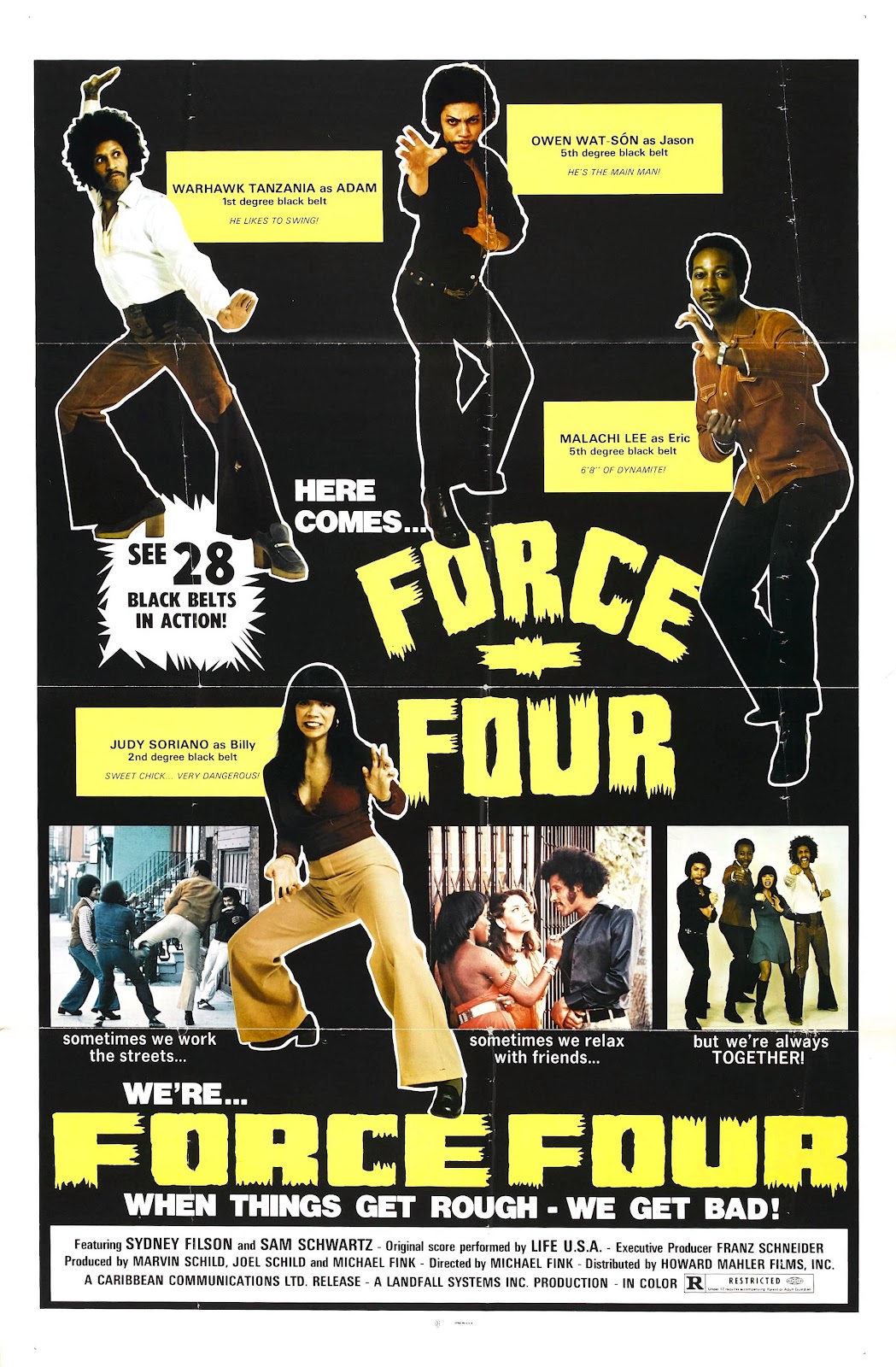
force_four_poster_012So what do I watch? Force Four. Or as the IMDb knows it, Black Force.

It is damned hard to find information about Force Four. It’s a scrappy little mongrel of a movie, and I wager the script was written on a cocktail napkin. The Black Force of the title is four martial artists (Owen Wat-son, Warhawk Tanzania, Malichi Lee, and Judie Soriano), who are all real-life black belts, They apparently have some sort of mercenary/troubleshooter thing going on, because they receive a phone call on the special phone in their panelled Black Force pad, hiring them to find and recover a African artifact that was stolen before the opening credits.

By way of introduction, each of the members of Force Four do their individual katas, which eats up some time. Then they Hit The Streets to dig up some information on the theft. This takes the form of an endless montage with the same ten shots of New York City repeated over and over played under improvised dialogue from our four stars, leavened with the occasional quick fight scene or the sight of Warhawk playing basketball in platform heels. The dialogue occasionally tries to sync up with what’s going on onscreen, and the one sudden instance of sync sound is jarring. But man, does it eat up time.

Meanwhile, in the Black Force Cave...

Meanwhile, in the Black Force Cave…

That one prostitute who rates sync sound, it turns out, works for Z (Sam Schwartz) the doughy mobster who runs things, see? Z sends out his thugs to get Force Four while they’re separated and Hitting The Streets. There are four quick fight scenes. Our plucky Black Force re-convenes at The Pad, and Owen has gotten one thug to talk (off-camera), so they go to the thug’s place and beat them up. No artifact or Z, though, so they drive upstate to Z’s house. This drive is pretty much accomplished in real-time.

DuskZ is having a house party, so the movie will also stop dead for an entire song by an outfit I dubbed Tony Borlando and Dusk, but was likely Live USA, who provided the soundtrack. And you know what? That soundtrack is pretty good. I’m gonna let Dusk/Live USA skate, even if Tony is wearing a tuxedo that left me blind for a few minutes.

Force Four beat up some more thugs on the grounds, then confront Z (who is soaking his buyer for another 100 grand, the rat). Z barely gets away, and many are the screaming extras and kung fu fights around the pool.  Owen plants a tracer on Z’s car (but drops it and then has to hide behind a tree for fifteen minutes while Z’s head thug tries very hard not to see him). This enables Force Four to follow Z the next day – and his buyer lives out even further than him – beat up everybody, and find out that the case has a false bottom with tons of uncut heroin.

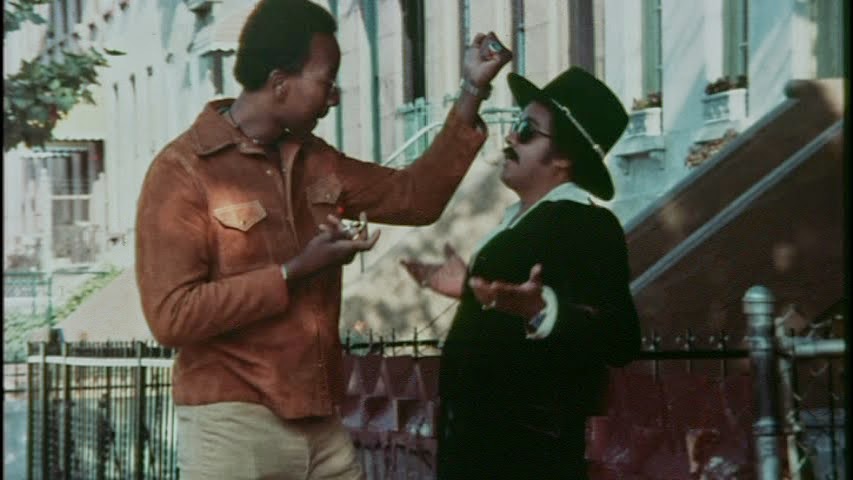
Malachi Lee gone SMACK YOU!

Malachi Lee gone SMACK YOU!

The movie is still not much over an hour long. So we have the extended dance re-mix of all the fight scenes in the movie, followed by a five minute end credit sequence, with individual shots of each and every black belt in the movie (the poster promises 28, and I believe the poster). We finally hit 82 minutes, and it’s over.

Force Four starts with some title cards stating that the martial arts contained therein are presented as realistically as possible, with no camera tricks or gimmicks. This is pretty much true, and the fights are as realistic as you can get in a world where opponents attack you one at a time and there are no guns. Each fight is over with very quickly, and our heroes don’t have a lick of trouble until the very last battle, and even then, they are never outmatched. Kind of boring. Which is a fair assessment of Force Four. Frustrating amount of padding, no real tension.

It’s also odd to consider that the breakout star from this was Warhawk Tanzania, who would make The Devil’s Express (aka Gang Wars) the next year. (Owen Wat-son had made Velvet Smooth the year before, so I guess he was the opposite of a breakout. He actually has the best acting chops of any of the Force, though Malachi Lee has a nice, quiet charisma.)

FIN02_JWick_BusShltr_SWPNow let’s compare this with the movie I saw the next day, John Wick.

In case you didn’t watch any movie trailers last year, Keanu Reeves is the title character, a very recent widow, whose wife’s parting gesture is the gift of a beagle puppy, delivered on the evening of her funeral, to ensure that John continues to have “something to love”. John also has a beautiful 1969 Mustang that catches the eye of Iosef (Alfie Allen), the lowlife son of a Russian mobster. When John refuses to sell, Iosef and his buddies stage a nighttime home invasion, beat up John, steal his car, and kill the puppy.

Puppykillers. We all hate them.

Iosef then proceeds to have a very bad couple of days as he finds out he tugged on Superman’s cape, he spat into the wind, he pulled the mask off that ol’ Lone Ranger and he just reactivated one of the most feared assassins in the history of the world. Wick met his wife, retired from The World, and the only thing that was keeping him a nice, quiet, normal nobody was the dog. And it is quite probable that not even Iosef’s daddy, kingpin Viggo Tarasov (Michael Nyqvist), and his army of hoodlums, will be able to save him.

john-wick-is-keanu-reeves-best-movie-since-the-matrixJohn Wick is, needless to say, a very violent movie; when all is said and done, Keanu has killed 76 people, but hey – dog owners understand. What keeps this from becoming Commando is the odd alternate world we find ourselves in this time: The world of the assassins, where everything – everything – is paid for in gold coins, there is a five-star safe house hotel in the Flatiron Building, and a phone call for “dinner reservations” gets you quick, discreet and complete body disposal and cleanup – one gold coin per corpse.

The movie really owes a lot to Donald Westlake’s Parker novels and Point Blank in particular, with its driven protagonist and fascinating glimpses into a hidden world with its own rules and codes. It’s also a hell of a rumination on revenge and the fact that dominos keep on falling once they’re nudged.

downloadJohn Wick was hyped to me as being the equal of The Raid 2, and for once I bought into the hype, and as usual, regretted it. I liked the movie, and unlike a lot of people, I really like Keanu, who shows some impressive acting chops in the beginning, and whatever else you may say about the man, he is not afraid to train and train hard. But living up to Raid 2 is a tough road to follow. Now, like Raid 2, we are presented with a series of fight scenes in which I can follow every motion and action. Movies that do this automatically get another star, letter grade, or whatever bogus scoring system you’re using.

I really liked it. But I wasn’t blown away.

But it’s this methodology that shows how far the action film has come in 40 years:  The black belts of Force Four did their own choreography, and Michael Fink filmed that choreography. Wick’s directors, Chad Stahelski and David Leitch, were stunt coordinators, choreographers and then second unit directors before lobbying hard for their post here: pre-viz and plotting out how fights look to the camera are second nature to them. It has become an industry, and the sooner this aesthetic takes hold of action filmmaking, that it becomes the standard again, the better. I’m thinking that it’s this clarity of motion and intent in the action scenes that had people putting it on even footing with Raid 2, it’s really that much of a breath of fresh air in an American-made film.

And then I watch the Making-of supplements and see all these scenes before the teal and orange color ramping and I start being tempted to take away that extra star. That, at least is definitely one thing The Raid 2 has over John Wick.

I watched John Wick with Rick and Dave, and Dave made the comment – likely true – “This script was only 15 pages long. I guarantee it.” I held that he was likely right, but at least it wasn’t half a page, spread out to 82 minutes. I don’t think the point was quite made because I haven’t made them watch Force Four.

Yet.

John Wick on Amazon