Crapfest: Into the Mancave

Whenever I attempt to do something even remotely handy around my house, I really feel like if I succeed, the Vatican should recognize it as a miracle. I am the least handy of primates; there is a reason I earn my living by pressing buttons.

This is the blueprint Dave was working from

This is the blueprint Dave was working from

So how amazing is it to me that Host Dave took it upon himself to create the ever-popular mancave in his garage, moving our questionable movie-watching activities out of his living room (and not incidentally, a house away from his long-suffering wife, Ann?). I’m lucky I can keep my toilet running. He air-conditions and re-purposes a damn recreation room.

There are still tweaks to be made, yes (probably until doomsday, knowing Dave), but it was fully functional for our Memorial Day weekend get-together (though our host was upset that the Disco Ball wasn’t working – yes- the disco ball.). He wasn’t content with lording that over us either, he was determined to make three pizzas from scratch, dough and all. While that process was ongoing, he had some youtube playlist of music videos going (in the mancave and the living room), and the major thing learned was Rick absolutely cannot stand Adam and the Ants, and especially not “Antmusic”. So here it is for him again:

From this you can assume I owned a lot of Adam Ant albums. Okay, two. But that was on one of them.

After seeming hours of pizza prep (I didn’t actually mind – I enjoy watching other people cook so I can steal any useful techniques for my own use), we were finally eating and settling down to watch some horrible, horrible stuff.
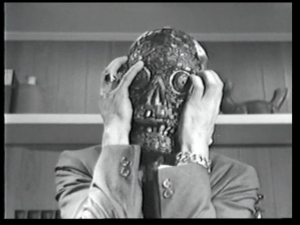
"CURSE THESE CHEAP CHINESE CARDBOARD GLASSES!"

“CURSE THESE CHEAP CHINESE CARDBOARD GLASSES!”

We started out with the 3-D sequences of The Mask, which were available in red-blue anaglyph as an extra on the recent Kino-Lorber blu-ray. I had ordered 3-D glasses from Amazon (shipped from far-away, exotic China) for pennies and distributed them. For those who missed me rhapsodizing about it before – The Mask is an ancient Aztec ritual mask that, when you put it on, produces bad acid trips, and eventually homicidal episodes. The gimmick was when the soundtrack started entoning “Put the mask on – NOW!!!!” the audience was supposed to put on their 3-D glasses and be wowed by the bad acid trip. Kino-Lorber is to be complimented for allowing our group to enjoy these bizarre segments without having to sit through the rest of the fairly static thriller.

The experience also pointed up the reason why 3-D was a flash in the pan in the 50s: red-blue (or in the 50s, red-green) anaglyph demands a lot of light when projected. Exhibitors weren’t inclined to shorten the life of their projector bulbs by cranking them up, resulting in dark images and headaches. We didn’t even have that option on Dave’s projector, but the results were still good enough to provoke good-natured screams and ducking of heads. It had to be admitted that was a first for Crapfest.

Conjoined-Poster-Small2This was followed by another first: local filmmaker Joe Grisaffi had offered one of his movies for viewing. I imagine the conversation involved Dave saying, “You do know this is called Crapfest, right?” and “You’re aware of how we treat these movies, right?” And yet, here we are, watching a movie called Conjoined.

This is the tale of the traditionally reclusive schlub Stanley (Tom Long), who has met the love of his life, Alina (Michelle Ellen Jones) on the Internet and plans to marry her. Stanley has only two other friends: Jerry (Jake Byrd), a co-worker at a slaughterhouse, and Courtney (Deidre Stephens), a cam girl whom Stanley pays just to have a conversation. On the eve of their wedding, Alina reveals a big secret: she has a sister, who will have to live with her and Stanley. As the title would suggest, the sister, Alisa (Keefer Barlow) is conjoined. Also, because this is Crapfest, the twins look nothing alike and we surmised that they were joined at the dress. (also, welcome to low-budget filmmaking)

Now the mood in the room was pretty tentative during the opening scenes. Would this be mere cringe comedy (not my favorite flavor to be sure)? I had sneaked a peek at the basic plot, but we were unsure what tone the movie was trying to set. Alisa starts fomenting for a boyfriend of her own, and when Jerry walks out on a suddenly abusive dinner, Stanley turns to the video dating service where he met Alisa, and the first date seems to be going pretty well – until the guy says something wrong, and Alisa smashes his head into the floor a couple hundred times until there’s blood and brains everywhere.

Yep. Those are twins, alright. Yessir.

Yep. Those are twins, alright. Yessir.

The mood in the mancave shifted appreciatively. This wasn’t splatstick on the level of Raimi or Jackson – not yet anyway – but it was something we could tune in to. Turns out this isn’t Alisa’s first kill, either, nor will it be the last, and as the body count rises, Stanley desperately turns to Jerry for help, with a plan to separate the two women in a plastic-sheet shrouded attic, using household appliances instead of surgical instruments. If this weren’t low-budget black comedy, both women would have bled to death, but as it is, several gallons of stage blood don’t mean much. The operation is a success, at least until Jerry, supposed to ditch Alisa’s body, makes a poor decision (bad in intent and taste) and suddenly there’s a homicidal twin more on the loose than ever.

The closest comparison I can make is to another semi-obscure regional flick, Blood Car, that I saw at another festival of questionable films. Extreme subject matter taken only semi-seriously enough to be engaging, and backed up by better acting than you’re used to seeing in such low-budget affairs. It’s not going to be for everybody, but good grief what is?!?! And never forget – This! IS! CRAPFEEEEEEEST! 

INTO THE PIT, MOVIE WITH A BUDGET!

INTO THE PIT, MOVIE WITH A BUDGET!

(Didn’t even mention how Joe came to the Fest about 20 minutes after we started the flick and was a tad uncomfortable, thinking we would have watched it by that time. He failed to reckon on pizza prep time. I think we were fairly kind. Fairly.)

19-DeathStalkerPoster

Note this scene does not occur anywhere in the vicinity of this movie.

Now, although I said I wasn’t going to do this anymore, I had presented a list of possible movies. To be plain, I’ve spent so long trying to catch up on the world of quality cinema, I kind of felt like I’d lost the thread of what constitutes a good crap cinema viewing experience. To be even more plain, I found out quickly why I had sworn I was going to stop being so democratic because that is how we wound up watching Deathstalker.

Deathstalker (Rick Hill) is a blonde pile of muscle indiscernible from other blonde pile of muscles like Ator, Blernbag, or Botox the Barbarian (he only needs a white horse and a forest of fake trees and Nazis would be stealing his footage for propaganda). He does not engage in any Death stalking throughout the movie, but he does engage in a lot of attempted rape. We were of the opinion that Deathstalker was a family name, like Baker or Cooper.

Has it been five minutes since the last attempted rape already?

Has it already been five minutes since the last attempted rape?

His quest (of course he has to have a friggin’ quest to link together all the instances of attempted rape) involves gathering a sword, a chalice and an amulet for Ultimate Magical Power. The villain Munkar (Bernard Erhard) already has the chalice and the amulet. The sword Deathstalker gets from a Muppet claiming to be a wizard (who then falls into a river and becomes an Odious Comic Relief person). Along the way he picks up the warrior Chachi (oh who bloody cares) and poor doomed Lana Clarkson as a female warrior who is on a quest to find the top of her costume.

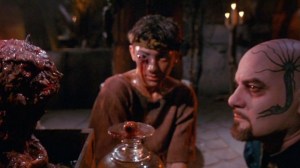
You see Munkar is having a tournament of warriors that is completely unripped-off from Enter the Dragon. Barbi Benton is also there as a captured Princess because Lana Clarkson has a sword, so somebody has to be around for rape to be attempted upon. We are assured that Munkar is evil because he keeps feeding childrens’ eyeballs to Muppets and his facial tattoo keeps switching sides (we were rooting for a subplot involving twins, but no, it was just bad continuity).

(Also I need to stop calling bad special effects Muppets because the worst Muppet in the stable has more personality than any character in this flick.)
ds-2You may have noticed a certain reliance on attempted rape in this review; that is also a fair assessment of the plot of Deathstalker. While the photography is okay, the movie itself is ugly in imagery and tone. This was the flick that convinced me it was okay to not check out every sword-and-sorcery movie that came out after Conan the Barbarian. Being the forgiving sort,  I’d bought the disc cheap years later. Maybe I was in a bad mood the day I saw it? Turns out I wasn’t.

The lady in question. Not a scene from this movie, however.

The lady in question. Not a scene from this movie, however.

Next up, we were held hostage to Dave’s newfound love for Edwige Fenech, an almost transcendentally lovely lady who made a lot of Eurotrash epics in the 1970s. She’s known mostly for sex comedies and a handful of gialli. Pretty, a good actress, and not that particularly shy, shall we say – an ideal subject for Crapfest.

Dave, though, doesn’t like to watch movies over again, and so put on one he hadn’t seen – All the Colors of the Dark. Edwige is a young lady suffering from nightmares (“Put the Mask on—-NOW!!!!), stemming from a miscarriage she had after an automobile accident. Her sister and her shrink think she needs psychotherapy, her boyfriend (no, they’re not married) is a jerk and thinks she doesn’t. So is it any wonder Edwige joins a cult of devil worshippers (in between showers, of course)?
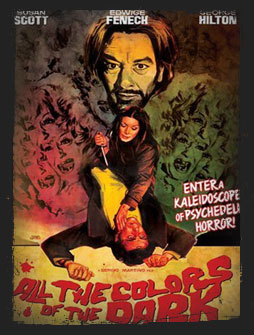
All-the-Colors-of-the-Dark-1972All the Colors of the Dark goes into some pretty decent mindfuck territory, as Edwige is forced to sacrifice the friend who recruited her into the cult (it turns out that, like Amway, the only way you can leave a devil cult is get your own replacement), there’s a guy with weird contact lens following her with a knife, her jerk boyfriend is doing unhelpful things like bringing home books about witchcraft. Edwige’s grip on reality is getting really slippery, and she stopped taking showers at the halfway mark, meaning there was a lot of boredom and loud conversations in the room.

(If there is one failing of the mancave, it’s that these conversations used to take place in the kitchen, where they were more easily ignored. Note to self: next time ask Dave which remote controls the sound)

"But I don't WANT to put The Mask on NOW!!!!"

“But I don’t WANT to put The Mask on NOW!!!!”

Anyway, like Scooby-Doo, there is eventually a logical explanation for everything, except that it’s not that logical and it’s certainly not reasonable. (I had to track down a copy later to confirm that. The conversation-unfettered-by-boobies had gotten particularly loud, and possibly resentful) It does however, give Luciano Pigozzi, the Italian Peter Lorre, a chance to drop by and pick up a paycheck.

Too talky, and I’m not just talking about the audience. Dave promises us much better results next time, with the more provocatively-titled Strip Nude for Your Killer, also known as Why the Hell Weren’t We Watching A Movie With A Title Like That?

Erik then attempted to elevate the evening with Death Bed: The Bed That Eats. 

Death_Bed-_The_Bed_That_Eats_FilmPosterFirst, realize you are looking at the saddest beast in the D&D Monster Manual: a monster bed that sits in a room and hopes that someone lies down in it. Then realize you are watching one king-hell bizarre horror movie and sit back and enjoy.

There is a Narrator (Dave Marsh) who may or may not be Aubrey Beardsley, trapped behind a portrait he drew of the monstrous bed – the Bed tried to eat him, but “my disease” prevented his complete digestion and somehow bound him to the Bed. He offers at least two origin stories for the Bed, but the one that sticks has something to do with a demon-infested tree whose wood was used to build the Bed. Most of our menu will be provided by a young runaway, her friends, and her brother who’s pursuing them (William Russ, who went on to a pretty decent career). There are a couple of instances of oddball but effective horror – when an injured victim crawls tortuously toward the one door in the Death Bed room (which takes at least as long as the interminable fist fight in They Live), only to be drawn back by a tentacle-like bedsheet just as she crosses the threshold; and when the Brother tries to cut the Bed apart with a knife, only to have his hands reduced to skeletons by the hungry mattress meanie.

deathbedhuhAccording to the IMDb, Death Bed was filmed in 1972, an answer print struck in 1977, and then… nothing. Apparently bootlegs were circulating, and when writer/director George Barry found out he had – without trying – actually worked up a fair amount of word of mouth, finally released it in 2003. I think I would have really liked it even if it hadn’t been preceded by several hours of pretty stultifying material. When I get through my current fiscal crisis, I am picking up that blu-ray… this is a flick that deserves more than one look.

We had cleared out the wusses for the night, but as this was a rare Saturday night off for me, I slipped in one last movie at midnight for the hardcore. That other standard of the Crapfest, Kung Fu Treachery – this time, with Iron Monkey.

iron-monkey-movie-poster-1993-1020471362Now, quick and fast came the cries from Twitter (when doesn’t it?) that Iron Monkey is not a crap film – that it is, in fact, a pretty good one. This is true. My response then, is two-fold: 1) This was our reward for sitting through some lame-ass shit that night, and 2) There are some lines I will not cross, and showing bad kung fu flicks is one of those lines.

Iron Monkey is sort of a Chinese Robin Hood, stealing gold from the local corrupt governor and distributing it to the downtrodden poor, using his superior kung fu. The governor is getting pretty hot about it, too, arresting people who own monkeys, look like monkeys, or seem to possess more than the standard fighting prowess. Enter Donnie Yen as Wong Kei-Ying, in town to pick up herbs for his medical practice, with his young son, Wong Fei-Hung. Astute viewers will note this boy will grow into the character played by Jet Li in the Once Upon A Time In China movies and Jackie Chan in the Drunken Master flicks (and Kwan Tak-Hing in about a hundred movies, but that’s a digression for another time). (Also Wong Fei-Hung is being played by Tsang Sze-Man, a girl, but we need to get back to the plot)

ironmonkeyKei-Ying, in defending himself from some local hoodlums, is immediately suspect, but once the Iron Monkey himself shows up to disrupt the kangaroo court, Kei-Ying is blackmailed into capturing the outlaw, with Fei-Hung held as ransom. Iron Monkey is, naturally, the sympathetic Dr. Yang (Yu Rongguang). Then the new governor finally shows up, and who should it be but the Shaolin Traitor (Yen Shi-Kwan) and his two hard-hitting disciples, and then things start to get really kinetic.

Iron Monkey sadly has a little too much of the typical Donnie Yen undercranking the camera so he looks faster than he already is, but that’s in the service of some truly splendid Yuen Woo Ping choreography (he also directed). Quentin Tarantino promoted the movie in its first American release (doing us all a big favor), which also resulted in some very good English dubbing. I circumvented this by using my import all-region DVD, which had poorly translated English subtitles. It still has my favorite line to attempt to work into everyday conversation:

monks

Now all I need is the right situation. This may, I admit, take some time.

We awoke Rick (who later complained of sleeping through the best movie of the night) and headed wearily home. We will meet again, mancave. We will meet again.



Blood Bath and Its Strange Clan

If you’ve been with me for any length of time, you know that I like to champion physical media. You may say that’s due to my not being able to afford robust broadband from any of the Great Satans currently controlling Big Cable, but the truth is it’s because we are living in an amazing age for boutique labels.

This week, I’m going to exclaim all over Arrow Films, who’ve been in operation in the UK since 1991, and recently branched out to America. There was a bit of a bobble in the distribution of their superb blu-ray of Mario Bava’s Blood and Black Lace, resulting in the dusting off of my Amazon UK account and importing it myself. That is an extra mile I did not mind walking… except that after watching that gorgeous, candy-coated transfer, I immediately wanted more with a capital M.

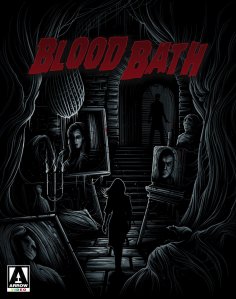
BB boxA year later, I have finally gotten my more and it is as remarkable and complete as it is improbable: A box set of four films that quite literally share the same cinematic DNA, marketed under the best-known of its many identities: Blood Bath. Tim Lucas, one of the best genre film historians and critics around today, bears the likely blame for this: in the earliest issues of his essential magazine, Video Watchdog, there was a three-part article tracing the history of these odd, stitched-together movies. Lucas points to these articles as the probable genesis of his magazine, since no other publication would have considered devoting that many pages to such obscurities. Speaking personally, I read those articles and thought, I’m not alone in obsessing over junk food movies.

I’ll try to keep this brief, as the set covers a lot of ground. Roger Corman, wheeling and dealing internationally after the box office failure of The Intruder (and not incidentally trying to get out from under the thumb of AIP), makes a stop in Yugoslavia and agrees to help fund a crime movie, filmed in English, and provide two stars for the American market. That movie, directed by Rados Novakovic, is Operation Titian. Don’t bother looking for it on the IMDb under that name, you’ll give yourself a headache. It’s there under Operacija Ticijan.

Thank you, LetterboxdOperation Titian feels a lot like the krimi movies so popular in Germany at the time, but suffers from not having a script based on a Edgar Wallace novel. The macguffin is a Renaissance painting by Titian, supposedly lost during WWII. A certain Dr. Zaroni (Patrick Magee) arrives, meeting with a shadowy someone who passes him a key to the villa in which the painting is now hidden. Zaroni kills the old man living there and steals the painting, only to discover that it is a copy. That shadowy someone is the old man’s nephew (William Campbell), who has his own plotline about his old fiancee who is marrying a reporter. Said fiancee is also the sister of the policeman who is tracking down Zaroni.

Dementia13

“Where are you headed after this, Patrick?” “Yugoslavia. You?” “What a coincidence!”

There are several more complications and twists, in true krimi fashion. The local actors, performing in English, are quite good; the photography tends toward the pedestrian, but at times produces some exceptional nighttime sequences that benefit not only from the old world architecture of Dubrovnik, but also an obvious reverence for Orson Welles’ Touch of Evil and Carol Reed’s The Third Man. Corman, for his end of the deal, provided two actors who had been working in Ireland with some young turk named Francis Coppola on a horror movie called Dementia 13. Magee does his usual excellent job of playing alternately charming and quietly menacing, often in the same line. Campbell always does best when he is allowed to be a bit hammy, and he does eventually get that chance.

The pertinent point here, though, is that, after having read Lucas’ articles and knowing what eventually became of Operation Titian, I was pretty confident that I would never actually get to see it. And now I have.

How sad is it that I can recognize an Alpha Video box by sight alone?

How sad is it that I can recognize an Alpha Video box by sight alone?

Corman had some problems with Novakovic’s finished movie, and had it reworked for the American TV market into Portrait in Terror, the second movie in the box set. Portrait rearranges the sequence of events in Titian, and excises some pretty blatant travelogue footage (think Reptilicus without that time-wasting tour of Denmark). Titian introduced its characters in a lengthy scene at an airport, and it still didn’t do a very good job of it. Portrait almost starts in media res in comparison, and the viewer clicks with the cast much more quickly.

There are some puzzling additions, however. The murder of an extorting dancer, handled obliquely in Titian is now replaced by a bizarre stabbing scene in which only the slightest of efforts was made to match the actors – the costumes are close, but that’s about it (nice work is done finding similar architecture in Venice, California, though). The stabbing is followed by the murderer laboriously carrying the body down long stretches of stairs – in broad daylight – while the camera shows blood dripping on the steps. As the killer is supposedly wearing Magee’s white linen suit – which remains spotless – this becomes egregious rather quickly. He then loads the body into a rowboat and dumps the body in the middle of a crowded bay. It is still daylight.

In Titian, that scene ends with the dancer gasping as the white-suited figure approaches; a few seconds only. In Portrait, it’s closer to five minutes. In Titian, her corpse is discovered during a sports fishing competition; we find she was impaled with a fishing spear. In Portrait, it is much the same, except the scuba diving takes much longer, and as we all know, if a movie is moving slowly, there’s nothing like a scuba diving scene to bring it to a dead stop.

What is unusual is that Portrait runs 15 minutes shorter than Titian, but it’s not an improvement. Operation Titian has a very deliberate pace, it is true, but it has a definite rhythm. That rhythm is chopped up to jarring effect in Portrait in Terror and those strange ill-considered inserts scrub the proceedings of any tension that might have been built up.

Then you get to the next evolution of Operation Titian, and things start to get really weird, as we get into the movie whose name the box set bears: Blood Bath.

SPOILER: This is all you're going to see of Magee in BLOOD BATH.

SPOILER: This is all you’re going to see of Magee in BLOOD BATH.

Roger Corman, who should have been named Patron Saint of Film Recycling some time ago, tells Jack Hill that it’s his turn to make a movie; he doesn’t so much care what kind of movie, so long as he uses 30 minutes of Operation Titian footage (this is the same MO that resulted in Peter Bogdanovich’s Targets). William Campbell balks, but is eventually brought back on to flesh out his character in Titian: this time his BloodBathArt1Antonio Sordi is a painter obsessed with his equally artistic ancestor, who was burned at the stake (along with his disturbing paintings) based on the testimony of his mistress. Sordi is also quite insane, believes he is being haunted by the ghost of that mistress, and keeps killing women at her behest, using their corpses as the models for his successful series of paintings called Dead Red Nudes, and then dipping them in a huge wax vat.

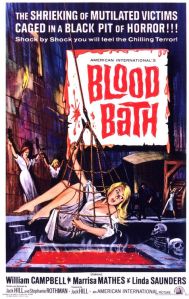
Please note that there is no blood bathing in the movie, except on the poster.

Now this is a fairly solid concept for a thriller; consult The Psychotronic Encyclopedia of Film and you’ll find half a dozen movies with a similar plot. Jack Hill does some interesting stuff, not the least of which is a surreal nightmare scene where the ghostly mistress torments Sordi. Hill also archly revives the satiric beatnik art milieu of Corman’s Bucket of Blood, with Sid Haig and Jonathan Haze drunkenly searching for the next “art thing” with skills that would make a third grader sneer.

Oh no! Beatniks!

Oh no! Beatniks!

Corman returns from shooting in Europe (Yugoslavia, again!) and once more has problems with the movie, but while Corman was wrapping his movie and Blood Bath was in limbo, Jack Hill has moved on to Spider Baby. Another Corman protege, Stephanie Rothman, gets the nod to “improve” the movie yet again. She does this by inserting a storyline that Sordi is actually a shape-shifting vampire – shape-shifting probably because Campbell rightly wanted more money to come back yet again, so hell, just turn him into another actor entirely. Rothman also manages to get another actor from Hill’s version, Karl Schanzer, as the guru of the art beatniks, Max. Schanzer is saddled by one of the worst fake moustaches in film history, but he also becomes one of the most improbable heroes in that same history.

Oh no! A vampire who looks nothing like William Campbell!

Oh no! A vampire who looks nothing like William Campbell!

Blood Bath is a surreal experience, to say the least; my main source of confusion is exactly where the hell this movie is taking place. I was quite comfortable assuming it was in California, given the Venice locations, and then Campbell starts talking about living in a clock tower active since the 11th century, so I guess we’re still in Dubrovnik? Really, the worst thing that can be said about Blood Bath is that it plays out as exactly what it is: three movies stitched together, and at least one feels like a deliberate intrusion on the others. Still, at a slim b-picture 62 minutes, it has little time to wear out its welcome.

62 minutes? That works for a double feature (it played on a double bill with Curtis Harrington’s Queen of Blood), but won’t do for TV syndication, where most movies are slotted in a two hour block. So, like the villain in a video game, Operation Titian mutates into its final form, Track of the Vampire.

Oh no! Another vampire who looks nothing like William Campbell!

Oh no! Another vampire who looks nothing like William Campbell!

The name of the game here is padding, so yet another actor becomes the black-clad vampire to chase yet another woman through California scenery to the tune of nearly ten minutes. There is, apropos of next-to-nothing, a lengthy dance scene on a beach, but most remarkable of all is the return of that extorting dancer from Titian and Portrait, and Patrick Magee – absent except for a freeze frame in Blood Bath. Campbell and Magee have been re-dubbed in these scenes to manufacture an entirely new subplot about cheating wives and avenging husbands. All this manages to bring Track up to the requisite 82 minutes, but it does the overall movie no favors whatsoever.

"If we use this fancy lens effect, no one will notice that it's padding!"

“If we use this fancy lens effect, no one will notice that it’s padding!”

Track of the Vampire is, sadly, the version I was most familiar with all these years, from several viewings on local horror movie slots – and the story never got any more comprehensible with repetition, let me tell you. That’s also where Lucas first picked up the thread, as he explains in the real jewel of the collection, a video essay titled “The Trouble with Titian – Revisited”, With all respect to Xan Cassavetes, it could have also been titled “Operation Titian: A Less-Than-Magnificent Obsession”.

If you’ve never watched a movie with a Tim Lucas commentary track, you’re in for a treat, and probably going to develop a bit of an obsession for them yourself. Track down any number of Mario Bava blu-rays (like the aforementioned Blood and Black Lace) with his work on them – Lucas literally wrote the book on Bava movies – and you will be amazed by the amount of information he can pack into less than 90 minutes. “The Trouble with Titian” represents such a magnificent visual expansion of that three-part article, along with new information he has gleaned over the years – it makes you wish every article he has written could be realized in such a form. Side-by-side comparisons of the different versions, freeze frames – a lot of time and care went into this supplement, and it shows.

blood_bath

Yay, garish blood-dripping version!

That disc also holds video interviews with Jack Hill and Sid Haig, and a gallery of around 30 pictures. A pack-in booklet has compact but fairly complete bios on Campbell, Magee and Haig, and there is a poster of the box cover art and the much more lurid theatrical poster for Blood Bath. It’s a nice bonus that labels like Arrow care enough to make reversible covers for the disc box itself, allowing me to indulge my more vulgar urges and swap that cover around for the garish, blood-dripping version.

As I said before, I never thought I would see Operation Titian in this lifetime, much less in the company of its strange, Frankensteinian descendants, and I certainly never thought I’d see them in such immaculate condition in 2K restorations! There is no reason for this box set to exist, and yet it does, and for that we should all be grateful. It traces, in great detail, the events in a very small but vibrant corner of the independent film industry, the creative arc of what were thought to be a series of disposable movies. But are any movies truly disposable?

Tim Lucas and I were not the only people struck by the strangeness of Track of the Vampire; chance cinematic encounters like this are just as likely to engender curiosity and passion as stumbling onto a viewing of an acclaimed art film. Arrow Films once again has my respect for approaching movies that have long been the subject of fuzzy public domain discs, and treating them with the same reverence and respect as their much more hoity-toity, supposedly more “respectable” contemporaries.

Buy Blood Bath on Amazon


Leaping Crap

Getting people together for anything not required by law is, as the cliché says, like herding cats. Ornery cats. Cats with agendas. Cats with agendas and thumbs. So it took a month of wrangling to get people together in order to punish them, and this all took place before that ultimate injustice, an extra Monday foisted upon us by Leap Year.

Artist's Representation

Artist’s Representation

In attendance: Rick, Paul, Alan (intermittently) Erik, Host Dave and myself. Rick had brought some pork tenderloins for dinner, and the grill was set up and flames climbed into the sky, while doubters predicted fiery disaster, burnt meat, horrible diseases and, for some reason, a sequel to Mortdecai. In an attempt to get things started, I put on Futuropolis, and it was roundly ignored in favor of fiery disaster, burnt meat, and etc.

futuropolis2Futuroplis is a short by Steve Segal (no relation) and Phil Trumbo (also no relation), started in the late 1970s and expanded to 30 minutes in 1984, when it was released on VHS by Expanded Entertainment, which is where I discovered it. I understand they expanded it once more in the 90s, but I’ve never seen that version. As far as I know, the only official release was that VHS, currently being sold on Amazon for as much as $150.  Both men went on to careers in animation and design.

vlcsnap-2016-03-09-20h12m22s192Futuropolis itself is a weird blend of traditional animation and what we used to call pixelation – stop-motion animation using real people. It features four Space Patrol members who eventually find themselves in conflict with the villainous Lord Egghead (Mike Cody) and his Mutation Ray. It all ends up in a Battle of the Minds between Egghead and ship’s Engineer Cosmo (Tom Campagnoli), which switches from locale to locale, time frame to time frame, eventually winding up as a Popeye cartoon. It’s silly and creative, and has the best starship-captain-playing-for-time-with-the-captain-of-an-alien-warship dialogue since “The Corbomite Maneuver”. The best because both captains are idiots.

As I said, roundly ignored by the attendees, usually dropping in to watch minute or two, then going back outside to insult Dave’s grill skills. I, at least, sat there and enjoyed it all over again.
Fucking kids.

After Futuropolis wrapped, Dave put on a 1983 oddity he had discovered, Battle of the Video Games. Because it involved Ms. Pac-Man, Burger Time and Frogger, naturally everybody sat down and gave it their undivided attention.

Fucking kids.

Title-Card-e1337350755935Around this time, prime time shows like Battle of the Network Stars were quite popular, so producing one of those involving the video game craze was logical, but only KTLA in Los Angeles was up to the challenge, it seems. The template’s the same: stars compete in feats of skill to earn money for their favorite charities, and plug their current shows. KTLA managed a mixed bag there: the biggest names are Lou Ferrigno and Lynn Redgrave, both probably wondering what the hell they’re doing there, Heather Locklear (shilling for both TJ Hooker and Dynasty) and Scott Baio (he says reluctantly). After that you’re dredging through the ranks of young actors in sitcoms, like Mindy Cohn and Philip McKeon. Each stultifying round of other people playing video games is broken up by interview segments with the stars.

Heather-Pacman-e1337350129288The most hilarious thing about the whole enterprise is the perceived necessity of “color commentary” by future game show host Marty Cohen trying to keep our interest up (also his breathless explanations of how each game is played, so parents and grandparents being forced to watch this won’t be totally lost). Actually, the most hilarious thing was the screams from our personal home audience trying to figure out the scoring methodology; it actually seemed that longevity was the key, the winner of each round being the one still playing on his or her quarter. And poor Lou, who really sucked at Burger Time. No, no, wait, the most hilarious thing was Rick recognizing the incidental music from an industrial film break about the manufacture of an arcade table as being from the “Pac-Man Fever” album, and his resultant shunning by the rest of us.

I will amend myself further that the truly most hilarious thing was that the final competition at a Pac-Man table chased us all out of the room. Every single one of us was in the kitchen, hiding from Battle of the Video Games, a situation which had not happened since Strange Beings.

Fucking kids.

cobraSo I was out for blood at this point, which made me feel better about my choice. Upon watching Electric Boogaloo: The Wild, Untold Story of Cannon Films, I had decided that Cobra was a prime candidate for Crapfest.

Stallone plays the Cobra (actually Marion Cobretti), a cop in the Loose Cannon Division of the LAPD (okay, he’s on something called “The Zombie Squad” but you get the picture).  There’s a serial killer called the Night Slasher terrorizing the city, but what the cops and media don’t know is the Slasher is actually a doomsday cult trying to bring about “The New Tomorrow”. When they’re not standing around in an abandoned factory banging axes together, that is.

Cobra’s the guy you call in on tough cases, like when one of the cultists takes to shooting up a supermarket with a shotgun, providing us with many product placement opportunities for Pepsi and Coors, not to mention giving Cobra a chance to say his catchphrases, “You’re a disease, and I’m the cure” and “Hey, dirtbag.” It’s an opening sequence virtually indistinguishable from many other Stallone flicks. Cobra does, however, put away his pearl-handled Colt .45 so he can throw a knife at the psycho, then pulls it again to shoot him several times. It’s not the multiple gun modes from Judge Dredd, but I guess it’s kinda unique. A little.

"Product placement? Don't know whatcha talkin' bout."

“Product placement? Don’t know whatcha talkin’ bout.”

Stallone’s then-current squeeze, Brigitte Nielsen, witnesses a Night Slasher murder and gets a good look at the face of the head cultist (Brian Thompson), and thanks to one of the cultists in the police department (Lee Garlington, and that ain’t no spoiler), they’re tracking her down. Cobra ain’t having none of that crap, resulting in a hospital murder spree, a highway chase, and a final showdown in a small California town whose population gets whittled down very damned quickly. As it must in all Cannon Films, the final showdown is in a factory, though not abandoned because there has to be a bunch of moving machinery and molten steel to kill off the bad guy.

"With this disguise, no one will ever suspect i am an evil cultist."

“With this disguise, no one will ever suspect I am an evil cultist.”

That chase scene does have one of the most remarkably insane and ridiculous bits: when Cobra gets tired of the cultists behind him taking potshots at his ’50 Mercury, he pulls a bootlegger turn and continues barrelling down the freeway in reverse, shooting the offending truck until it explodes. Then he bootlegs again and continues chasing the Head Cultist’s car (the cultist driving that car, who I assume to be an expert in such matters, says “He’s crazy!”)

Another bit which could be interpreted as groundbreaking, is the intercutting of Cobra, his partner and Nielsen holed up in a motel in the aforementioned small California town, intercut with cultists on motorcycles racing through the night, obviously moving toward a nighttime siege and gun battle. Then it’s morning and Stallone’s asking his partner “Howdya sleep?” What a violation of audience expectations! Actually, the mosquitoes were just so miserable at night, they decided to shoot the climactic battle during the day.

"Put out an APB on Mick Jagger."

“Put out an APB on Mick Jagger.”

You know, I actually do like Stallone; but this was made at the height of his power in Hollywood, and also the height of his ego, apparently. Though it didn’t make the money that Rambo or Rocky IV did, possibly due to some last-minute misgivings on the part of Cannon. Violence was cut to avoid an X rating, and then the two-hour run time was cut down to 84 minutes. There is a reason I thought the movie was a tremendously stupid cliche-o-rama when I saw it back in the day; it doesn’t have time to be anything else.

Stallone had also decided the signature quirk for Cobra would be the matchstick permanently stuck in his mouth. This does his already murky diction absolutely no favors, and in every dialogue scene between him and Nielsen, we felt very sorry for the sound recording guy on this flick. No matter how good a job he managed to do, everybody was going to assume he sucked at his chosen profession. I have to admit, though, the Stallone impressions that filled those 84 minutes was one of the best things since the Burton impression marathon during Exorcist II: The Heretic.

phynxMy blood lust being sated, it was time for Dave to make people suffer. Still, in this, I will admit come complicity: Dave had found out about something from 1970 called The Phynx and was gung ho about showing it. I looked at a few screengrabs from his copy and realized it was taken from an old videotape. “You know, I have this on DVD, and I haven’t watched it yet,” I said. So, you know: conspiracy.

After numerous unsuccessful attempts to sneak into Albania (why they didn’t come up with an imaginary country, who knows), the Super Secret Agency desperately consults its supercomputer MOTHA (Mechanical Oracle That Helps Americans), whose solution is to form a successful rock group, because “Beatles don’t need passports” (I’m pretty sure they did, but never mind). The computer then picks four lads who are kidnapped and forced to become musicians in a rigorous three-month training session. Then they become mega-successful and are invited to play a concert in Albania.

MOTHAWhy the desperation to infiltrate Albania? It seems that someone has been abducting American “World Leaders”. The movie’s definition of “world leaders” runs to aging stars like Georgie Jessel, Xavier Cugat, Maureen O’Sullivan, Colonel Sanders and Johnnie Weismuller. Yes this bizarre rip-off of The Monkees’ main reason for existing is the numerous cameos of formerly beloved personalities. Good God, just take a look at the IMDb entry and be amazed. Most of the cameos are for one line, and they’re all playing themselves, or claim to be. Richard Pryor is there to teach them about “soul”. Trini Lopez demonstrates proper fingering on a guitar. James Brown makes an appearance as “The Ambassador of the Record Industry”.

So none of these people get to show much about what made them famous. Martha Raye does have a few lines that lets her shine a bit, but most of the movie’s “story” is fairly tedious. There is a major detour into a subplot about a map into the bad guy’s stronghold that is split into three pieces, each piece tattooed on the belly of one of Martha Raye’s daughters. The three photos that allow the Phynx to track them down have no faces, leading the group to perform concerts “For Redheads Only!” and the use of X-Ray Glasses (relax, horndogs, this is a family film and the specs stop at underwear). This helps the under-developed story reach feature-length.

colonel sanders noInformation about the making of this movie is deucedly hard to find, so we have to put on our deerstalker hats (like the head of the SSA when he’s in disguise in London) and start deducing. The fact that it’s an ironic attempt to cash-in on The Monkees is obvious. The main perps, director Lee Katzin, and producers/story writers Bob Booker and George Foster all have numerous TV credits (Booker and Foster, incidentally, were responsible for one of Dave’s favorite Crapfest entries, The Paul Lynde Halloween Special). Most of the larger roles are taken by TV actors – look at Lou Antonio, who gets billing just under The Phynx themselves, as the hapless SSA Agent Corrigan. Antonio’s mug shot on the IMDb is as Lokai in the classic Trek episode, Let That be Your Last Battlefield, but he has an even more impressive filmography as an episodic TV director.

So we can blame this all on TV.

But – and here’s the thing – it’s easy to dismiss this as a clueless attempt by Hollywood oldsters trying to cash in on the lucrative Youth Culture market, but The Phynx actually has some genuinely subversive elements. The SSA meeting at the beginning has its various departments in attendance, from fake guerillas in “Castro’s Counterfeits” to riot cops in the “Education Division”. The head of the SSA, “Number One” is introduced, and he is in disguise, a box over his head with a face drawn on it – but the voice is Richard Nixon’s (the film debut of Rich Little). (Number One will later visit the Phynx in disguise, a beard being drawn on the box) The Phynx are debuted on The Ed Sullivan Show, just like The Beatles, except with Ed at gunpoint, and the reason the Phynx get their gold record is agents of the SSA (led by Corrigan), wearing gangster outfits from the 30s, attack record stores and smash all the other albums. This is a nasty satire on how the record industry was/is run – now consider that this movie is the sole screenplay credit of one Stan Cornyn, an editor and director at Warner Brothers Records. He won two Grammys for Best Liner Notes.

the-phynx-leader-guy

“I am Number One… and I am not a crook.”

So there’s something under all the bumbling, latching onto youth trends and sad nostalgia. Not enough to save The Phynx from obscurity and derision, but enough to make it my favorite movie of the night. Rick was surprised early on when he recognized one scene: this was a movie that he had seen on TV in his youth in Hong Kong. He had wondered ever since what the hell that was he had watched, unable to get an answer… until Crapfest. “God, that I had to come here to find out,” he moaned. “And took the rest of us down with you,” was the reply.

The other sweetness was the opening animated credits lulling everyone into a sense of false security, especially when the music buffs saw the credit, “Songs by Jerry Leiber and Mike Stoller”. Now, Leiber and Stoller are in the Songwriter Hall of Fame for songs like “Hound Dog”, “Jailhouse Rock” and “Stand By Me”. Then the songs came out in the movie, one by one, and the music buffs moaned in disappointment. There is one thing I have found about my compatriots in Crap – they have no appreciation for psych-tinged pop from the late 60s- early 70s. The songs are actually okay, but not at all memorable.

Fucking kids.

That's Simon Yuen on the cover. Simon Yuen does not appear anywhere in this movie.

That’s Simon Yuen on the cover. Simon Yuen does not appear anywhere in this movie.

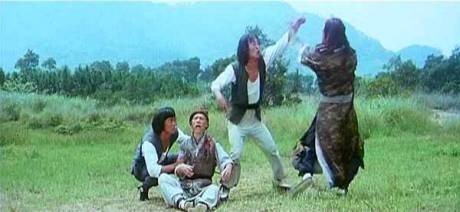
Erik had brought a copy of The World of Drunken Master, and it had been a while since we’d played a kung fu flick. This wouldn’t have been my choice, but as London Correspondent Dave Thomas put it, “It’s not the worst of the not-Drunken Master movies”.

Two scalawags have been stealing grapes from a vineyard to sell in the market, and this is a major mistake, as these are the grapes that go into making “sweet premium” wine, the favored brand of drunken masters everywhere. The two are apprehended by the Manager of the Vineyard, who forces them to work off their larcenous debt. They try to intercede when the usual villainous Tartars start grinding the faces of the poor in the marketplace, and get their butts handed to them, Eagle Claw style. The manager, seeing there is some righteousness in them, teaches them Drunken Boxing, which involves chaining bowling balls to your wrists. Eagle Claw steps up the grinding and eventually everybody fights everyone else, and most of them wind up dead.

Ah, but this is all a flashback, as the two students – now aged Drunken Boxing masters themselves – reminisce about old times. The movie’s still only 70 minutes long at this point, though, so a surprise adversary shows up, and when he doesn’t last long enough, another surprise adversary shows up – his motivation is “I’m gonna kill you!” “Wait, you’re not my enemy…” “I’m gonna kill you! LET’S FIGHT!” So they fight. Then the movie ends.

"Ow! My liver!"

“Ow! My liver!”

All the credits indicate that this is a Hong Kong production, but it’s directed by Joseph Kuo, so it feels Taiwanese. My basic problem with Taiwanese martial arts films is what should be a strength – they really are almost non-stop fighting, but there is a resulting lack in the story area. Shaw Brothers movies might be ridiculously rococo in the plotting department, but there is a story and usually a generous helping of different styles to give the fights an individual feel. We get a lot of Eagle Claw vs Drunken Style here, and as British Dave promised, some of it is pretty good. And then the story ends and the movie goes on for another twenty minutes.

But you know, it’s an okay way to breeze through 90 minutes.

Last call.

LOVE BUTCHER 1Dave started up The Love Butcher, which someone online had assured him was a terrible movie.

People online lie.

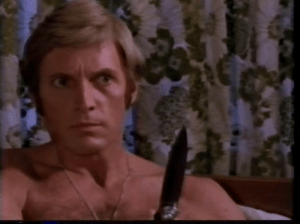
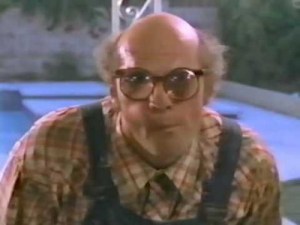
There have been a series of murders committed with “uncommon weapons”, and what the audience realizes much more quickly than the cops or even the crusading young reporter is that they’re all gardening implements, like the pitchfork that opens the movie. The audience is also cheating, as we have been watching the neighborhood gardener, the simple-minded and disabled Caleb (Erik Stern), who, in his hovel, has conversations with his brother Lester. Except Lester doesn’t really exist until Caleb takes off his glasses, puts on a wig, and straightens out his withered left arm. Then he becomes Lester, a handsome ladykiller in every sense of that word.

Lester...

Lester…

We watch Lester ply his murderous trade, and Stern employ a number of different wigs and foreign accents to get into homes, have his way with the women who don’t give him a second glance as Caleb, and kill them. If you’re rubbing your head and thinking this all sounds rather familiar, it’s essentially the plot of 1968’s No Way to Treat a Lady with Rod Steiger, except now it has more naked breasts, blood and bad 70s wallpaper.

...and Caleb

…and Caleb

Erik Stern had an okay career in TV, and he rarely embarrasses himself as Caleb/Lester. Really, the most fascinating thing about The Love Butcher is the evidence that the filmmakers (who between them have credits for movies like Sweater Girls, Schoolgirls in Chains, The Black 6 and The Forest on their resumés) were trying for a prestige product. The opening credits are done by the same house who did the titles for numerous TV movies. The script goes out of its way for character moments that would be expected in a much more serious movie. In fact, I would almost bet money that this is a TV movie that tossed in enough blood and nudity to get an R rating and theatrical release.

Not terrible, but not particularly good, either: just more evidence that most people who declare a movie “beyond bad” simply have not seen enough movies.

Fucking kids.

I’d had another surprise for the attendees, but it was close to Midnight, and high time to head home. Next time, suckers… next time.

And lest we suspect that these outings are harmless fun, and no damage is done to anybody, here is my Letterboxd “Recently Viewed” before Crapfest…

before

…and after:

After

Fucking kids.


The Human Monster (1939)

Hey, that’s how you get back to doing single movie reviews – become outlandishly busy in all other aspects of your life!

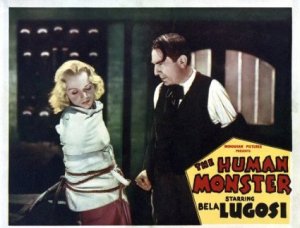
220px-The_Human_MonsterNormal movie-watching and writing time has gotten usurped by the Numerous Jobs and the utterly bizarre circumstance of having a son who is preparing to go to college (pause for look of shocked incomprehension). This has meant, oddly enough, forsaking my usual practice of delaying income tax preparation until the last possible day so I can do it all in a rush while shooting the finger at the government (“I hope they can see this because I’m doing it really hard“). This is because the paperwork is needed for financial aid. While I can’t say doing it without the ongoing reek of desperation and looming deadline was exactly pleasant, it wasn’t all that horrible. It was made much more tolerable by the gift of new music by pal Tim Lehnerer, in fact.

Taking two days to do it rather than one ugly bloc was good, too. But that was two days gone.

Anyway, after finishing them, I wanted something  as freaking far away from 2015 and taxes as was possible, and something reasonably short, as it was late in the evening, and the shorter work week after President’s Day (the Day Job is at a state college, after all) means longer hours than usual.

...or not.

…or not.

So, hello to Dark Eyes of London, which I guess is far too fanciful and poetic for us Yanks, so we call it The Human Monster.

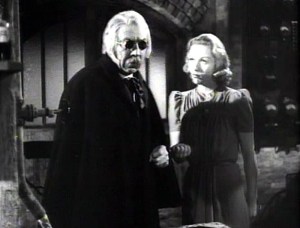
Inspector Holt (Hugh Williams) of Scotland Yard is dealing with a spate of apparently accidental drownings in the river Thames. Meantime, the philanthropic Doctor Orloff (Bela Lugosi) is lending money to Stuart, a down-on-his luck inventor, until his new invention is picked up by the government. Orloff sings the praises of philanthropy, especially his work with the Home for the Blind run by the Reverend Dearborn, who is himself blind.

It should be noted that Orloff’s philanthropy extends to paying for Stuart’s life insurance policy, as security for the loan. After Stuart promises to visit Dearborn’s Home to do some philanthropy of his own, Orloff does other odd things, like type out a message in braille to throw at the blind violinist playing outside his office.

JakeAt Dearborn’s center, one of the blind men is a brutish fellow named Jake, and if we’ve learned anything from the movies, it’s that doctors named Orloff with brutish blind henchmen cannot be trusted. Orloff is, in fact, insuring men and luring them into the Home for the Blind, where Jake drowns them in a iron tub and then throws them out a window into the Thames.

humanmonster6Holt is going to slowly grow wise to this scheme, even if he is saddled with O’Reilly, a wise-cracking cop from Chicago (Edmon Ryan), who escorted comedy-relief forger Grogan (Alexander Field) back into custody. As there is only one evil scheme afoot in England at any one time, Grogan is naturally involved in Orloff’s, forging dead men’s signatures. Balancing out O’Reilly’s involvement is Stuart’s daughter Diana (Gloria Gynt), a plucky lass who goes undercover as Dearborn’s secretary to aid Holt in his investigation.

This is based on popular novelist Edgar Wallace’s The Dark Eyes of London, and it is, at its heart, a cracking good pulp story. Wallace was one of the first crime novelists to use policemen as protagonists instead of amateur sleuths, and watching Holt piece clues together (aided by the proficient specialists of the Yard) is great fun. The comic relief is actually pretty amusing, and the crimes suitably horrific.

8x10_human_monster_keybook_JC03207_L_2In 1939, Lugosi’s star was beginning to wane, but he was still capable of powerful performances. Orloff should be ranked among his best, a character equally as cold-blooded as Murder Legendre, but also convincing in his portrayal as a concerned champion of the downtrodden. Lugosi is really chilling as he goes about his murderous business – that title is well fulfilled by the movie’s end.

I guessed the big twist of the mystery only about a minute before the reveal, but I have to admit that the story relied so much on my understanding of Lugosi and his career that I have to admire the trickery here. I don’t mind playing the sap when I’m played so well.

Man, the publicity photos really liked Gloria Gynt in that straitjacket.

Man, the publicity photos really liked Gloria Gynt in that straitjacket.

The Human Monster was a nice distraction after a weekend of pain, both physical and emotional. I went in expecting old school claptrap and was actually rewarded with a nice little thriller that is a bit repetitious, but also pretty chilling. It’s the first movie that Britain released with the “H” rating – for “Horror” – and it actually earned that. Not just in ’39, but here in the  more brutal 21st century, it still has moments with the power to make you shiver.

Buy The Human Monster on Amazon

Gangsters, Masks and Trogylodytes

I can say that I’m going to stop doing multiple movies in each post, and I will have to admit that I am lying. To accomplish this I would have to A) Write more often; or B) Watch fewer movies. Neither is likely. My berserk schedule does not allow that much flexibility, and February has turned into a month of burdensome obligations. But never mind that:

Once Upon A Time in America (1984)

once_upon_a_time_in_americaFor instance: I’m not sure how long the average post takes me to write; six to eight hours sounds about right, unless I’m talking about my favorite movie, and then it takes more like two weeks. Now consider that in the time it took to watch Once Upon a Time in America, I could have written two-thirds of this column. Of course, watching the movie is what this is all about, so that’s a specious comparison, but I am here to say that at four hours and eleven minutes, this is not a short movie.

Nor should long movies frighten us; in the right hands, they yield amazing dividends. The only slightly shorter Andrei Rublev is an incredible experience, but it also has the allure of the exotic going for it, being set in medieval Russia, whereas Once Upon a Time rests in somewhat more familiar territory, with the early 20th century providing a taste of antiquity, but only a taste. It’s the story of four Jewish kids growing up in New York and working their way into the Underworld, eventually becoming big time bootleggers during Prohibition. By that time the kids have grown up into Robert DeNiro, James Woods, William Forsythe and James Hayden. Elizabeth McGovern, Tuesday Weld, Larry Rapp and Darlanne Fluegel round out the core cast.

Once Upon a Time in America 10The movie starts with DeNiro’s character, Noodles, on the run for snitching on Woods’ character Max (and its consequent bloodbath), and finding that a million dollars he had stashed away is mysteriously missing. The movie is going to flash forward to 1968 and then back to the 1900s, throughout Noodles’ life as he attempts to put together exactly what happened, and taking the audience along with him. Somebody tracked him down in his new life and is leaving clues for him to pick up. If the biographical parts don’t interest you – and they will – the central mystery will certainly keep you hooked as the movie progresses.

There are a lot of people that are going to argue that Sergio Leone’s The Good, The Bad and The Ugly is his crowning achievement, and I would have held out for Once Upon a Time in the West, but that was before I saw Once Upon a Time in America. It’s quite possible that anyone who lobbies actively for the first two had only seen the truncated theatrical cut, slashed down to two hours and twenty minutes – almost half its running time! – a cut that Treat Williams (playing an idealistic Union boss who turns to the dark side) claimed couldn’t possibly make any sense. The version I saw had footage spliced in that was obviously from the cutting room floor, lacking the shine and gloss of finished product, and at least one lengthy scene has such an essential plot point that I was amazed it was cut. A filmgoer who had paid attention up to that point could have filled in the details later… but I’m finding more and more that filmgoers that pay attention are rare animals.

abixwBht_zps96e04c74.png~originalLeone had reportedly been offered The Godfather and turned it down, to his regret. There is a lot of the epic flashback stuff in Godfather 2 that is an obvious influence here, but Leone’s recreations of early 20th century New York are breathtaking. This is a four hour movie that only felt like three hours. It’s the longest movie on this year’s List, and I glad it’s out of the way, but I’m also very, very glad I saw it.

Buy Once Upon a Time in America on Amazon

Little Caesar (1931)

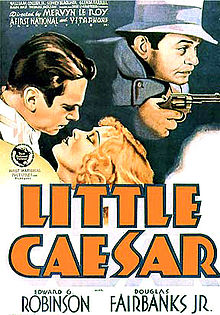
220px-LittleCaesarPYeah, it was with a little sarcasm that I followed up with Little Caesar, going so much in the opposite direction that it was absurd. The movie gives us the rise and fall of a crime kingpin in a slim 80 minutes. It may go by faster, but it also seems much slighter, certainly far less dense.

Edward G. Robinson delivers a star-making performance as Rico, who starts out the movie sticking up a gas station, but deciding to head to the Big City because he’s made for bigger stuff, see? Going along with him is his partner, Joe (Douglas Fairbanks Jr.) who sees the City as his big chance to become a dancer. Rico signs onto a mob easy enough, even though the boss (Stanley Fields) is a little concerned about Rico’s willingness to use his gun.

105659-004-3271C8DCJoe does get a job as a dancer at a night club (it was a different time, I tells ya), and slowly removes himself from Rico’s sphere. Rico does stage a hold-up at the nightclub, and winds up shooting a local Commissioner. After that, his rise to the top of the Underworld begins, and it is as meteoric as his fall, precipitated when he tries to force Joe back into his gang, and Joe’s lover convinces him to turn state’s evidence against Rico. His loyalty to Rico is, shall we say, bruised when Rico tries to kill him, but can’t bring himself to pull the trigger.

Rico will end up hiding out in a flophouse, but is roused to action by the head cop who’s been dogging him all movie long starts insulting him in the papers, leading up to a shootout and those famous words, “Mother of mercy, is this the end of Rico?”

vlcsnap-2016-01-31-01h13m17s081It all feels very 1931, if you catch my drift. Stilted and somewhat mannered, even given the subject matter. Sources are conflicted as to whether or not Rico is based on Al Capone or Salvatore “Sam” Cardinella, another violent Chicago mobster, but that doesn’t really matter. From this comes The Public Enemy, Scarface and any number of other gangster movies – but the real reason to watch is Edward G. Robinson. Robinson was a serious student of drama, and watching him act is always an unalloyed pleasure. He’s probably one of the finest character actors of the 20th century, and that he’s unrealized as such, and is instead relegated to the ranks of cartoon characters, ending every sentence with a “nyah!” is the true crime here.

Buy Little Caesar on Amazon

The Mask (1961)

CR3Ynk2VAAAzh77In the spirit of due diligence, I should reveal that I entered in a contest in December, sponsored by Classic Movie Hub and Kino-Lorber. I won the first week, and the prize was my choice of eight Kino-Lorber blu-ray titles. They were all tempting (and more than a few I have purchased in the meantime) but the only one I had never seen was The Mask, though it had haunted most of my adult life when it was the cover for RESearch magazine’s Incredibly Strange Films issue.

The Mask is notable for several reasons. First, a somewhat novel use of 3-D, especially considering that cinematic craze was over by 1955 and The Revenge of the Creature. It is also the second film by Julian Roffman, who almost single-handedly jump-started the Canadian feature film industry. It was felt that a horror movie like The Mask would be more successful commercially than his first effort, a crime film called The Bloody Brood, starring Peter Falk.

Psychiatrist Allan Barnes (Paul Stevens) has a particularly distraught patient in Michael Radin (Martin Lavut), a young archaeologist who’s been having nightmares and blackouts. Radin feels it is somehow the fault of a strange South American ritual mask he discovered recently; he claims it is exerting an unholy, murderous power over him.

The Mask 2Barnes dismisses Radin’s fears, because unlike us, he did not watch the beginning of the movie where Radin pursued and strangled a young lady. Even more distraught, Radin leaves the office, mails the mask to Barnes, and blows his brains out.

So Barnes finds himself in possession of what his deceased patient claimed had taken over and ruined his life, and like any curious person in the same room with the Necronomicon, he just has to have a look. The ominous voice in the soundtrack intoning “Put the mask on… NOW!!!” probably wasn’t helping, either.

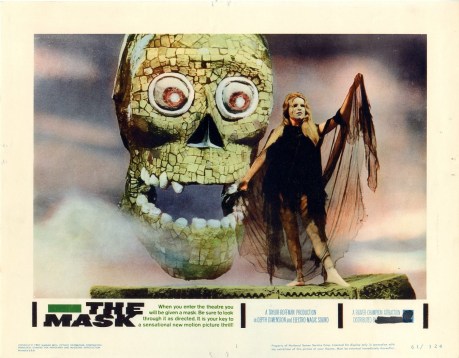
post-269895-0-10112400-1446578737This is the point at which theater-goers were supposed to put on their own mask, ie., the red/green glasses that made 3D work in those days. Barnes finds out that wearing the mask immediately results in a bad LSD trip, full of horrifying and bizarre imagery. He also feels himself compelled to wear the mask over and over, as he slowly succumbs to the same paranoia and murderous delusions as his patient.

Now the first thing one is going to ask (particularly if “one” is me) is – so how are the bad acid trip images? And the answer is pretty darn good, actually. Roffman had gone so far as to consult avant-garde artists in the design of these sequences (ironically, he abandoned their concepts as too unrealistic, especially on his budget) and employ groundbreaking electronic music. These parts are refreshingly forward-thinking. The images are strange and actually unnerving, aided immeasurably by the fact that Roffman uses his 3D very constructively, even when things aren’t flying out or reaching toward you from the screen. Objects in the foreground and the background provide nice parallax scrolling, for instance. The Kino-Lorber blu-ray, in association with the 3-D Film Archive, is sharp and flawless and produced for people with 3-D players and TVs, neither of which apply to me. The trip sequences are supplied in red/blue anaglyph as an extra, but, alas, not as a part of the 2-D presentation. The anaglyph presentation is really strong, as well – but you’ll need to provide your own glasses.

lobby-card-the-mask-1961

Sad as this is, it does force the poorer viewers among us (like me) to judge The Mask on its own merits. It has a reputation as being slow-moving, but hey, welcome to low-budget genre films in the 50s and 60s. Most people watching The Mask came to see the 3D sequences, and under those circumstances, anything not mask-related is doing to be greeted with impatience. Bereft of that gimmick, we can see The Mask as it really is: sightly clunky, repetitious and padded, but no less so than a lot of its contemporaries. And those mask sequences, appearing at roughly a half hour, 45 minutes, and then ten minutes before the end – are really something. I’m unsure of the disc authoring voodoo necessary to make such things happen, but I really wish they could have used the branching capabilities of the technology to make a 2-D/anaglyph viewing of the movie possible, just like in the theaters.

Buy The Mask on Amazon

Bone Tomahawk (2015)

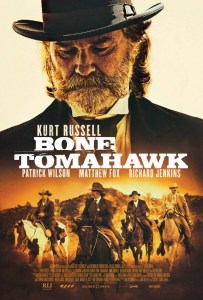
BtomahawkThis was getting quite a bit of buzz at the end of the year, and the premise is pretty unique, so I knew I was going to have to watch it, even if just for the cast. And man, what a cast; I am going to single out casting director Matthew Maisto right here for some lavish praise.

Because right at the beginning, we meet two cut-throat western bandits (literally – the very first image of the movie is a man getting his throat cut) played by Sid Haig and David Arquette. And dammit, any movie that starts out with Sid Haig is okay in my book. Not that these guys are going to last long – while vamoosing because they hear horses approaching, they blunder through what is obviously an Indian burial ground of some sort, and before you know it, Sid is festooned with arrows.

BONE TOMAHAWKBut having had our nerves jangled, let’s go over to the little frontier town of Bright Hope several days later, where cattle boss Arthur (Patrick Wilson!) is recovering from a broken leg. His wife Samantha (Lili Simmons) is the backup for the local drunken doctor (luckily for Arthur) and she is called to the jail one night to tend a drifter who got into an altercation with Sheriff Hunt (Kurt Russell!), and got shot in the leg. That drifter is David Arquette, so we’re pretty sure something bad is in the offing.

The next morning a local stable boy is dead and disemboweled, the horses he was tending are missing, and so is the drifter, the Deputy, and Samantha. The local educated Indian, the Professor (Zahn McClarnon) identifies the unique bone-tipped arrow left behind as belonging to “The Trogylodytes”, a tribe the other tribes leave strictly alone because they don’t want to die. He points the way to a series of canyons where the Trogs make their home, and a sadly small party of Hunt, Arthur, a dandified Indian fighter named Brooder (Matthew Fox!) and the “backup deputy” Chicory (Richard Jenkins!) set out to rescue their townsfolk.

bone_7This core ensemble works so incredibly well together that I yearned for more adventures with them. Matthew Fox’s appropriately-named Brooder is a fun departure for him, but the real revelation is Richard Jenkins as Bone Tomahawk‘s Walter Brennan character. Unrecognizable in the role, Jenkins very easily steals the show from the other three, and that is no small accomplishment. It wasn’t until almost halfway through the movie I realized who he was!

bonetomaPatrick Wilson’s Arthur has been given an interesting obstacle for his character to overcome: that broken leg. No devil from hell is going to stop him from rescuing his wife, but the constant re-injuring and threat of gangrene puts a particular edge to his struggle.

Oh, and the Trogylodytes, it turns out, are cannibals, so in the last half-hour it turns into an Ruggero Deodato movie. There’s a reason I can’t expect to see more movies with those four characters.

(To return to the cast once more, I should mention that among the citizens of Bright Hope can be seen – briefly – James Tolkan, Sean Young and Michael Parê. Good work, Mr. Maisto!)

bone-tomahawkThis is S. Craig Zahler’s first movie as a director (and his second as screenwriter) and it does nothing but make you hungry for the next one. The dialogue is so damned good, the characters so well-delineated, that the movie was a genuine pleasure to discover.

Also, if the Universe could continue to cough up two new westerns a year starring Kurt Russell (and maybe Sid Haig, too), I would be very appreciative.

Buy Bone Tomahawk on Amazon

Zéro de conduite (1933)

Zero_de_conduiteSo why not finish up with another story of savages? Or more appropriately, I started with the longest movie on the list, I might as well finish up with the shortest, at only 44 minutes.

Zero for Conduct is about four boys in a repressive boarding school, their lives little better than that of prisoners, who cook up an act of rebellion during the school’s annual celebration of its very existence. This is Jean Vigo’s third film – he only made four – and it was thought so scandalous and subversive that the French censor banned it until 1947. Vigo himself was quite the anarchist, and it shows in his movies to this point, a mixture of irreverence and surrealism. The new schoolteacher, Hugeut (Jean Dasté), little more than a boy himself, draws a caricature of a fellow teacher that animates itself; the dominating headmaster is a bearded midget (Delphin), and in the annual celebration, the grandstand full of dignitaries is quite obviously a bunch of literal dummies.

Zero_de_conduiteZero is tagged as influential, with many descendants like The 400 Blows quoting it. There is at least one sequence of thrilling, otherworldly beauty; possibly the first “shit” ever uttered in a French film (twice), and, sadly, the feeling that this might be a longer project trimmed down due to time and money. In any case, certainly worth a watch, definitely since I’ll soon be watching Vigo’s final film, L’Atalante.

Buy The Complete Jean Vigo on Amazon

Z: Zombie (1979)

Hubrisween 3 BlackClick ^^ for Hubrisween Central, here for our Letterboxd page

“When you do an A-Z horror movie challenge, you’re likely going to end up with zombies.”

– Tim Lehnerer, probably

zombie posterWell, this is about the most blatant personification of that statement, isn’t it? No second word, no number, no nothing. Just: ZOMBIE.

Yeah, I’ll stop you right there, because you’re about to inform poor ignorant me that this actually does have a number, it’s really called Zombie 2 because it was a sequel to Dawn of the Dead which was a big hit in Europe but it was called Zombie there and shouldn’t you know more about horror movies before you try writing about them?

Listen, troll (I would have to reply), if you were paying attention you would know that the movie is called Zombi 2 (no final e) and for some reason Zombies 2 in the international trailers and it was never a sequel to Dawn of the Dead and was, in fact, written several months before Dawn‘s European release but that was some nice low-hanging publicity fruit, wasn’t it, especially since this production company had a better lawyer than Dario Argento, and thus was paved the way for Zombie numbers 3-8 and every other crap Italian zombie film throughout eternity.

So there. Troll.

1279240863_Zombie_Flesh_Eaters_1979_1I saw Zombie in probably semi-ideal circumstances for me, which is to say I saw it on a double bill with Blood Beach at a drive-in on a warm Texas night (Zombie kept cropping up at drive-ins with different dance partners for several years). That was 35 years ago, and it was with some interest I put the Blue Underground blu-ray into the player for a return bout. (Movie Challenges like this are largely about making me watch movies I haven’t seen, but I do make an exception for anything I haven’t seen in 20 years, like The Quatermass Xperiment. Zombie definitely qualified.)

So stop me if you’ve heard this one before: an apparently abandoned sailing ship drifts into New York Harbor, causing all sorts of traffic problems until the harbor patrol boards it and finds a) rotting food, b) a chewed-up hand, c) the fattest zombie you have ever seen. (Guillermo del Toro: “You just know he ate everybody else on the boat.”) After biting out one cop’s throat, Tubby is shot several times and falls into the bay.

zombie+flesh+eaters+ss+roomThese are the circumstances that bring together Anne (Tisa Farrow), the daughter of the owner of that boat, and Peter (Ian McCulloch), a reporter. They have a meet cute while searching the boat under the nose of a police guard, during which Peter finds an undelivered letter from Anne’s father, who is dying of some terrible disease on a Caribbean island called Matool.

Flying to St. Thomas, the only boat they can find to take them to Matool – “a cursed island” – are working vacationers Brian and Susan (Al Cliver and Auretta Gay) who are spending two months sailing the islands and doing underwater photography. This will become significant when Susan goes scuba diving to get the day’s pics within sight of Matool and runs into an underwater zombie, who, in one of the movie’s signature scenes, has a fistfight with a shark, and loses that fist.

shark-vs_zombie-1(One of the many interesting factoids on the disc’s extras is the Underwater Zombie and “Shark Trainer” is Ramón Bravo, an underwater photographer of no small repute, best known for Tinterero!)

So our four “Americans” make it to Matool but bend their propeller, meaning Brian and Susan can’t dump Anne and Peter there, as was their original intent. They meet up with the island’s physician, Doctor Menard (Richard Johnson) who is not only fighting some sort of plague, but is also trying to find a scientific explanation for the zombies that have been cropping up lately. One of the few island natives that has stayed faithful to the doctor (Dakar) fills us in that a new witch doctor has been getting everybody worked up, and they all gone to the island’s interior to bang on drums and wake the dead.

zombie3Which is all the explanation you’re going to get, so just ride with it. That’s okay, we came to see a movie whose poster was some rotten corpse with worms in its eyes and the slogan WE ARE GOING TO EAT YOU, and it has to be admitted that the movie in its last half gets down to that business with gusto.

This is generally pointed to as director Lucio Fulci’s first horror movie (if you don’t count some highly-regarded gialli). His output to this point had been all over the genre map, but this one pretty much locked him into the creepshow stuff for the 80s and 90s. Now what surprised me in this re-visit so many years later is how well-made this movie is. That projector trying to cut through the humid Texas night air and subsequent VHS releases in pan-and-scan did Zombie absolutely no favors. Fulci knows where to put his camera and how to get bang for his comparatively few bucks on the screen, and the blu-ray is an absolute revelation in that regard.

The low budget also necessitates a different look to the zombies, which helps the movie achieve its own identity. A reliance on clay instead of latex actually helps these revenants look like they just clawed their way out of the ground.

zombi-2-04I bet you thought I was going to talk about the splinter-through-the-eyeball scene (damage to eyeballs seems a particular motif for Fulci). Everybody talks about the splinter-through-the-eyeball scene. It’s still grueling, even when you know it’s coming, but another factoid dropped was Zombie played in Italy with an intermission, as was the custom, and I had forgotten the splinter-through-the-eyeball happens at the halfway point. Think about that being what you took out into the lobby with you.

They probably didn’t sell much gelato during that intermission.

Another thing which helped immensely with this re-visit: being able to turn on the original Italian language track with English subtitles. Fulci’s movies have had some of the worst English dub tracks I have ever had to endure, and subconsciously that drags down the perceived quality of the movie.

zombi4When I logged my re-watch of Zombie on Letterboxd, I knew that I had entered it earlier in my relationship with the site, but it was amusing to see that when I did so, I had rated the movie four stars out of five; I stand by that rating, but I don’t remember holding it in such high regard (due to washed-out projection and VHS dubs). So it is satisfying in that way that you see an old friend for the first time in years, and you say, “You look great!” and mean it.

Buy ZOMBIE on Amazon

Y: 30 Days of Night (2007)

Hubrisween 3 BlackClick ^^ for Hubrisween Central, here for our Letterboxd page

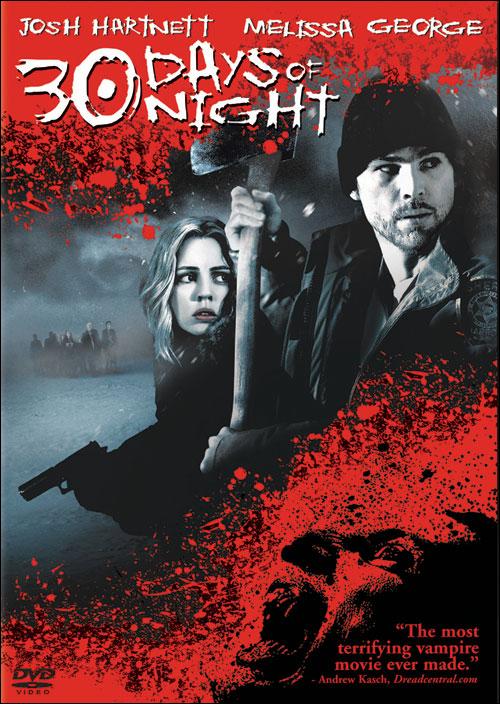
30_Days_of_Night-970861490-largeI know what you’re saying. You’re saying “That doesn’t begin with a Y.”

Shut the hell up, I explain.

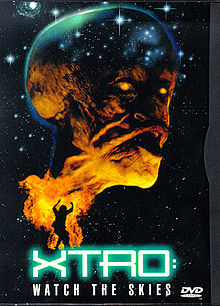
Do you know how many horror movies start with the letter Y? How many movies, period? Not a whole hell of a lot, that’s how many. I just watched Xtro 3 because the letter X has the same damned problem and I am out for blood. Do not cross me.

The subject was brought up as we were planning this expanded Hubrisween, and the guru Tim Lehnerer came up with the Blank Scrabble Tile rule. There are two possibilities, currently: If you cannot find a movie with a troublesome initial, you can use the letter to either side of it (X and Z, riiiiight); or: you can substitute a title that begins with an actual number.

I’LL TAKE THAT.

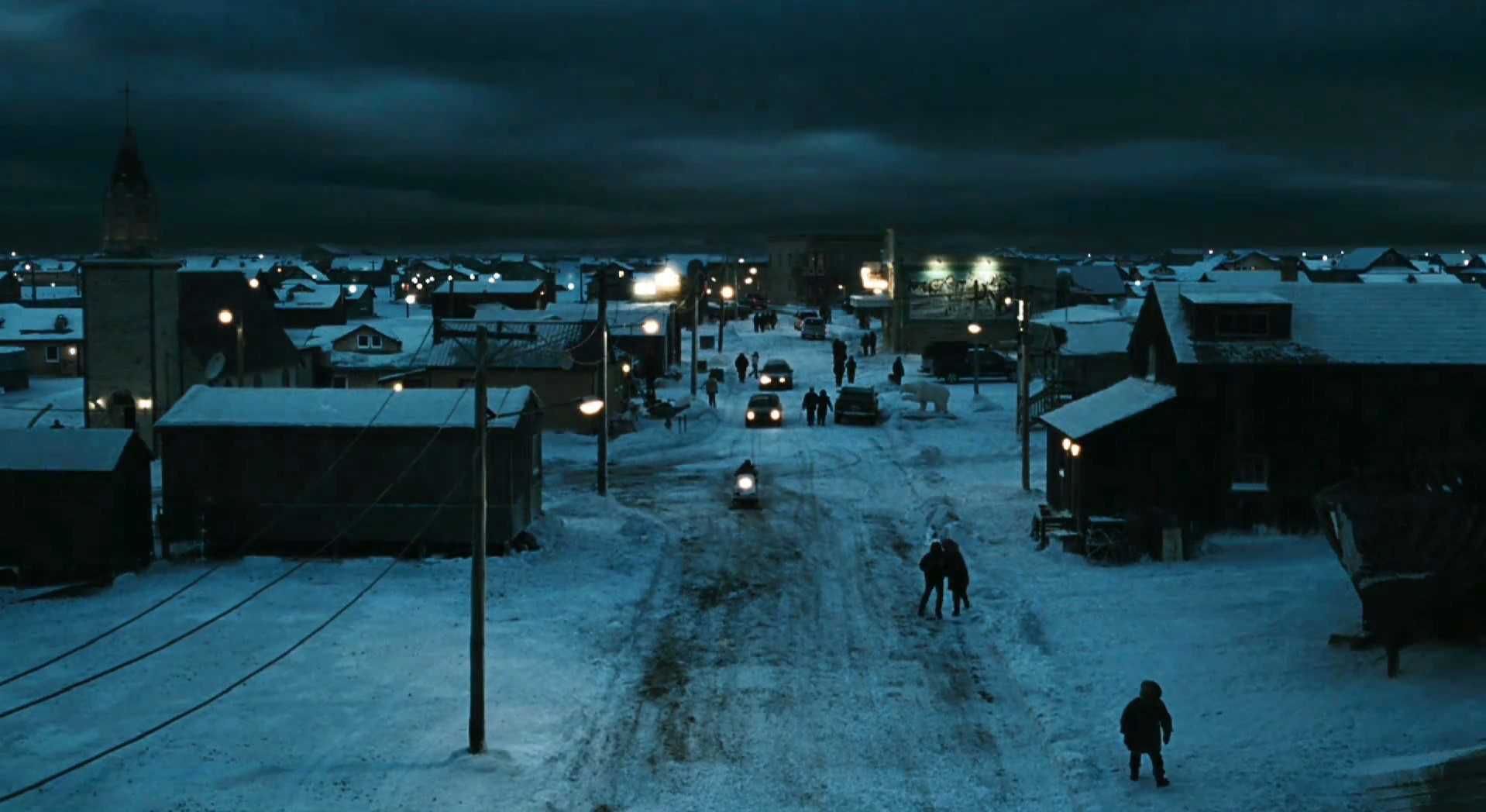
So here we are in the tiny city of Barrow, Alaska, the northernmost settlement in America. So northern they go through a night thirty days long, just like in the title. Its population dwindles by two-thirds during that month; not everybody can take that much dark.

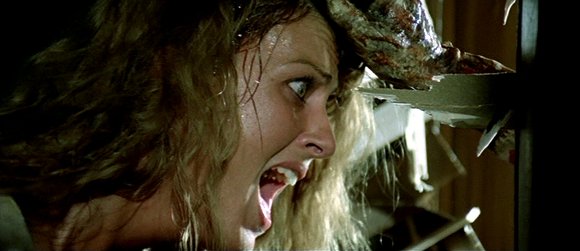
30-days-of-nightThis time around, there’s a few problems. Sheriff Eben Oleson’s (Josh Hartnett) estranged wife Stella (Melissa George) misses her plane and is stuck there, for instance. There’s trouble with the phones. There’s also a stranger in town, and it turns out he ‘s trashed the local helicopter. And killed all the sled dogs.

Oh, and there’s a pack of vampires following him.

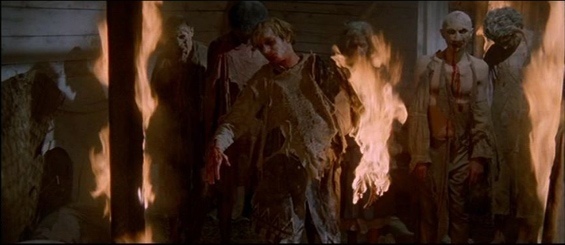
So what we have here, in a way, is yet another zombie siege film, with the added complication that the undead are intelligent, smart and vicious. Not having to worry about sleeping during daylight hours, the vampires massacre most of the remaining town openly, until we are down to a small band of survivors who keep moving from location to location as their numbers dwindle due to one misadventure or another.

30-days-of-night2So right there we have one of the major reasons I put off seeing this; if you’ve been here any length of time you know about my ten-year moratorium on zombie movies. What is not as common knowledge is there was a similar moratorium earlier, on vampire movies. Not all of you may be old enough to remember the glut of bloodsucker flicks in the 90s, but it takes quite a few of any sort of movie for me to say “Alright, jeez, enough” and there were quite. A. Few.

That being said: 30 Days of Night has a good concept, and is well-made. The vampires are cool, animalistic yet speaking their own language. There is a third act twist which is unexpected and welcome.

So why don’t I like it?

070531183ee64462a82c9c7fafcd1b0fThe aforementioned mixture of zombie and vampire movies, I suspect. The lapses in logic that seem almost inevitable in a horror movie, but are they? Really? (These are some pretty wasteful vampires. Horrific as the slaughter is, why so many at one time, when you have a month ahead of you? Then other survivors keep cropping up as the 30 days wear on, just because we need a complication or a reason for our protagonists to endanger themselves) I wasn’t in the mood for a vampire Diary of Anne Frank (the survivors leave that attic hideout before too long, anyway). I kind of like my horror movies to cash in at the hour and a half mark. This one is close to two hours.

413160-30-days-of-night-melissa-george1None of these are, in and of themselves, enough to kill a movie for me, and I suspect that had I not seen 30 Days of Night at the very end of a month of watching horror movies, I might have been a little more kindly disposed toward it – but only a little. As it is, I don’t find it terrible, I just don’t find it exceptional enough to excite me in any way. It did all right without my support, though, spawning at least one sequel, so I’ll leave it here with a sort of a shrug.  This situation reminds me of Stakeland, which is another movie that should be completely in my wheelhouse, and yet I just don’t care for it. Your mileage may vary, this movie may press all the necessary buttons for you, and that’s cool.

But oh my God am I ready to watch something non-horror related.

Buy 30 Days of Night on Amazon


X: Xtro 3: Watch the Skies (1995)

Hubrisween 3 BlackClick ^^ for Hubrisween Central, here for our Letterboxd page

220px-Xtro3DVDThis is an open call for filmmakers everywhere to make more movies starting with the letter X. The reason why should be clear: here I am watching goddamn Xtro 3.

Back during another A-Z challenge (off-season, as it were), I watched the original Xtro. I didn’t care for it, but it did have some creative ideas that set it apart from other cash-in-on-E.T. movies. Last year I watched Xtro 2, which was remarkable only for the number of movies it managed to rip off. So here we are, this year, with the inevitability of a doomed character trapped in a hidebound franchise, with Xtro 3: Watch the Skies.

The first thing you need to know is that a spaceship crashed on Earth in 1955 in a welter of poor video-generated effects. This was covered up by the government, because that is what they do. This is relayed in a tongue-and-cheek 50s newsreel that wants to be cuter than it is.

images

“Oh, yeah. These are Marines, all right.”

In the present of 1995, a man meets with a reporter in a low-rent motel, and he tells her the tale that will grind away our next 90 minutes. He is Marine demolitions expert Kirn (Sal Landi), who receives orders from his commander (Robert Culp, who hopefully made his mortgage payment off this) to head up a hand-picked crew that will go to an island 200 miles off the coast to blow up some leftover WWII ordnance so an airfield can be built there. This is fine with Kirn, as he wants to “get out of the classroom”, but he recognizes the “hand-picked crew” from his classes; they are all losers, discipline problems, and “borderline psychos”.

You might immediately suspect that all these soldiers might as well have EXPENDABLE stamped on their dogtags, and you will proven right when the guy in charge of the operations shows up, a beret-bedecked spook named Fetterman (Andrew Divoff), who tells the crew that there was also an internment camp there, so any documents they might find are classified and should be taken directly to him.

"Did the check clear? Okay, you got 30 more minutes."

“Did the check clear? Okay, you got 30 more minutes.”

You are now going Hmmmm enough that you might as well be humming a happy song culled from other movies you have seen. One detonated bomb uncovers a concrete structure. In the course of the movie, we will find out that this is where the gummint brought the spaceship, and the two aliens inside. They vivisected one alien in full view of the other, and the remaining alien got pissed off, broke out, and proceeded to slaughter everybody. The authorities had to wait until it went back into the ship and poured concrete around it to trap it. Or so the one wild man who’s been on the island for 40 years tells in a moment of lucidity.

Well, now that one stoned soldier blew a hole in the structure, the alien is loose again, and quite possibly insane, as it seems to want to constantly re-enact the vivisection of its (presumed) mate on whoever is unlucky enough to be around.

41Once the spook splits with the boat after the spaceship is uncovered, our crew has to survive the alien, then the bombing run that the spook sends to kill them, and then the kill team the spook himself leads to off any survivors. Trouble is, the spook doesn’t really know about the alien…

This all sounds like a pretty good movie, and it’s certainly better than Xtro 2. It almost succeeds in forging its own identity, but then director Harry Bromley Davenport (who directed all three of these) still has to go to the rip-off well again. The Alien can camouflage itself like the Predator. And a healthy dose of exposition is delivered by an Alien Autopsy style film reel kept by that survivor (luckily, he also kept the movie projector in good working order).

"Is the movie over yet?" "No." "Please shoot me."

“Is the movie over yet?” “No.” “Please shoot me.”

So much of Xtro 3 is poorly thought out or executed that you feel bad about it constantly shooting itself in the foot. Was the alien also trapped in the concrete, or just the ship? I can accept the characters being confused on that point, but that concrete structure is large and square – an explosion big enough to uncover it would do more than blow a hole in a corner. And accepting that our two Marines just didn’t notice a square bunker in a bunch of rock outcroppings is a bit much to handle, even if one of them is supposedly stoned to the gills.

Sequences that should be nerve-wracking are hampered by insane logic whose only purpose is to draw out the running time. And yes, this is another instance of my constantly tracking the time remaining as I watched. Even the Alien is given to the same fitful treatment; there are times it looks remarkably alive, and menacing; most of the time however, it looks and moves exactly like the puppet it is.

As I said: it is at least better than Xtro 2, but that was a bar set so low, it was resting on the ground.

Buy Xtro 3 on Amazon

V: Vampire vs Vampire (1989)

Hubrisween 3 BlackClick ^^ for Hubrisween Central, here for our Letterboxd page.

vampirevsvampire_poszterI always like to slip a Hong Kong horror movie into these proceedings, but rarely do they match up with a space in the alphabet that needs filling. But lookie here, there’s a disc I’ve owned for a number of years but never watched, and it starts with a V: Vampire vs Vampire. Don’t bother looking for it on Amazon.
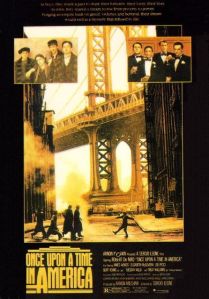
This is not as I expected, the fourth movie in the Mr. Vampire series, though it carries over a ton of characters from the first movie.  If you haven’t seen Mr. Vampire, that is something you need to remedy, and soon. Lam Ching-ying is The One-Eyebrow Priest, a Taoist master who always has to intervene when supernatural creatures start causing trouble. He has two comical apprentices, the elder of which is again the criminally under-rated Chin Siu-ho; the younger (and usually stupider) is played by a variety of actors, this time it’s Liu Fong. The first Mr. Vampire sequel added another character to the household, a Little Vampire who’s not evil like your typical hopping vampire. But like I said, this isn’t a Mr. Vampire movie.

Except it is.

It’s complicated.

imagesAfter taking care of a nasty Palm Tree Spirit, Lam is called upon by the village elders to figure out what’s wrong with their water supply. Turns out there’s too many bats in it (literally) so Lam does a complex fung shui ritual to find a better place to dig a well. All very well (ha!) and good, except a flock of bats moves the marker so the crew will dig in the wrong place.

5_183_f5e501e8fe5daf3There’s also a ruined Catholic church nearby, which a group of sisters is working to re-open. Another stock character in the Mr. Vampire company, the local Captain, wants his men to burn down the place because he thinks the bats are coming from there; Lam intercedes, and he and the Mother Superior (Maria Cordero) find the skeleton of one of the original priests who built the church, supposedly vanishing after sending word that he and his companion were battling demons. As this skeleton apparently died by shoving a cross into its own heart, Lam deduces the demons were defeated, and bravely, too. Unfortunately neither he or the Mother look up, because the ceiling is covered by bats.

The well being dug in the wrong place uncovers a decaying body, also with a cross in its heart, but this cross has a ruby embedded in it, which the Captain must have to satisfy his equally venal fiancée. This causes him to swap bodies on the pyre which Lam insists upon, so he can have time to saw the jewel off. The cross is finally removed, which as we all know, is how vampires come back to life in movies like this.

feat7This is going to set up a mighty pitched battle at the end, as Lam discovers that all his Taoist tricks do not much affect a European vampire, and things become pretty uncertain, but highly kinetic.

This was Lam Ching-ying’s first time as film director (though he had been action director for numerous movies), and he doesn’t try to do anything too extraordinary, but as usual, the action sequences are top-notch. Again, if you’ve seen any of the Mr. Vampire movies, you know what I’m talking about: Lam’s dance-like, confident approach to magic looks real and is quite convincing. The fact that, if magicdoesn’t work, he can kick you seven ways to Sunday is a good back-up plan. There are at least two plot lines that are not resolved when the movie ends, but hey – welcome to Hong Kong cinema. The Big Bad Guy is vanquished, what more do you want?

vvv01Another staple of the Mr. Vampire movies (of which this is not one) involves the old-fashioned priest coming up against modern, Western ideas and failing to understand them to some comic effect. This time out it’s the nuns of the convent trying to save the Priest’s soul when all he’s trying to do is conceal the fact they interrupted his bath and he’s not wearing any pants. In 1993 there would be a much better exploration if this sort of cultural clash with Exorcist Master, which is basically The One-Eyebrow Priest versus Dracula. At the end Lam and the Chinese Catholic priest he’s been knocking heads with the entire picture realize they have to combine the spiritual powers of East and West to defeat the King of the Vampires, and it’s pretty damned cool.

Anyway, I’ve long been a fan of Lam Ching-ying. He probably chafed at being typecast by his most famous movie, but man, was he ever good at playing that role. He elevated several movies simply by his dignified presence, even mean-spirited drivel like Skin Stripperess. He succumbed to liver cancer in 1997, and the world became a much less magical place.

YouTube has not recognized the brilliance of Lam Ching-ying yet, so we’ll just have to be satisfied with this tribute video by Lily Wang:

T: Tourist Trap (1978)

Hubrisween 3 BlackClick ^^ for Hubrisween Central, here for our Letterboxd page.

tumblr_nr1dptWZ0h1ut1d6co1_1280This is one of those movies whose fate leaves you scratching your head, and wondering about the whys and wherefores of culture. There are several things that contribute to Tourist Trap‘s longevity, chief among them a very positive review by Stephen King in Danse Macabre, and a PG rating, insuring it could be run on TV with little or no trimming.

There are two groups of young’uns on the road for mumble mumble something or other. They’re in two cars, so when the lead car has a blow-out, Woody (Keith McDermott) rolls the flat spare to the nearest gas station, leaving Eileen (Robin Sherwood) behind. The second car, driven by Jerry (Jon von Ness) and carrying Molly (Jocelyn Jones) and Becky (Tanya Roberts, very early in her career) catches up to her, she climbs aboard, and they head down the road to look for Woody.

tourist-trap-02-18Woody has found a gas station, but it is deserted. Except for a self-locking back room with cackling mannequins and objects that fling themselves willy-nilly at him. The capper is the pipe that nails him to the door. This is a superb opening sequence, and it scarred a lot of young kids during matinees.

Our surviving youngsters manage to miss that abandoned gas station and instead find themselves at the all-but-abandoned Slausen’s Lost Oasis and Wild West Museum, where their car mysteriously ceases to function. Who should show up but Slausen himself (played by Chuck Connors), who lets the ladies stay in the museum while he and Jerry try to fix the car. Oh, but don’t go out to the house in back – Davey lives there.

tourist_trap5So of course, one by one, they go out to the house in back. Where Davey undeniably is, with a small army of creepy mannequins that Davey can apparently control with some sort of Carrie White telekinesis. Davey (Slausen will explain it’s his brother) also wears a mask that makes him look like one of the mannequins. Or that’s the intent, anyway – I think it makes him look like Jay Leno. Given that the movie is almost 40 years old – and that it really doesn’t conceal the twist all that well – Davey and Slausen are the same person, and he is, to put it bluntly, insane, and our party is going to get whittled down to the Final Girl over the course of the flick.

puteshestvie-v-adWhat Tourist Trap has going for it is some novelty and some of the creepiest damn mannequins ever assembled for a movie. The scenes with them are beautifully realized and nightmarish; when the movie breaks away from them so another of the teenagers can get killed, that stuff – which, admittedly, is the stuff that most of the movie goers paid money to see – seems grafted on, like we dropped in on another movie set. The kills are fairly bloodless, including the most famous one, where Davey murders yet another traveler caught at the gas station (Dawn Jeffory) by layering plaster on her face until she suffocates (though he assures us she dies of fright) still  doesn’t breach the PG limit.

tumblr_nti1ruhrZL1rr8qsxo6_1280So there is the likely basis for Tourist Trap‘s failure at the box office. It was a PG oddity floating in a sea of R-rated dead teenager movies. The setup is strictly Texas Chainsaw Massacre without the Hitchhiker – hell, the kids are driving a Volkswagen Thing instead of a VW van. No gore, no nudity – there are chances for both, but they go unfulfilled. What remains is more dark fable than slasher movie, a tale of obsessive madness that gradually includes the audience (as well as Final Girl) in the delusion. Real people become mixed in with the mannequins, until it is impossible to tell which is which, or who is insane.

This is not what the audiences were looking for at the time.

tumblr_ne0p3bzcgO1tx499to3_1280If you’re only familiar with Chuck Connors from The Rifleman re-runs, and not some of  his other film work, like, say, The Big Country, you might be surprised to find him here (which is why it’s great casting). He finds the top and goes over it several times, but there are also times he is deliciously subtle. There is one scene toward the end when he goes from slobbering madman to sorrowful confession that actually had me thinking holy crap that was some really good acting. The cast is uniformly good, sometimes better than the material actually deserves.

judgementalbitchWriter/director David Schmoeller is better known for the Puppet Master series that arguably kept Full Moon Pictures’ doors open for years. Tourist Trap may not be able to tell if it really wants to be Chainsaw or Carrie or Psycho, but it is a pretty solid piece of Halloween creepiness. Those mannequins, man. Urrrrrrrr

Buy Tourist Trap at Amazon

(Note that I am linking to the DVD, not the blu-ray, which reportedly is missing five minutes and has a dreadful framerate)