Rumors may not have been rumors

So, without a show Saturday night, I found myself with two days off in a row, an oddity in my life as it stands now. So, of course, having convinced myself I was well enough for two grueling days of outdoor shooting and two days in the office, my body decided it was time for a complete collapse. My body can be a real jerk sometimes.

So I lost a fair portion of Saturday to fitful sleep, but awoke feeling somewhat better. Overall, the best way to describe weekend (besides urpy) is to state that as of Friday evening, I had 18 books checked out from the library. As of today, that number is 11, and I am better for it.

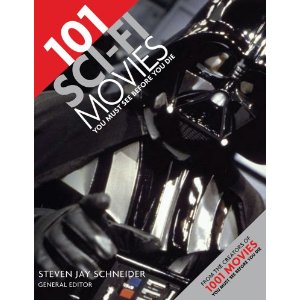
I finished 101 Sci-Fi Movies You Must See Before You Die. and (I suppose) unsurprisingly, I had seen most of them.  Like the documentary Z Channel: A Magnificent Obsession, it serves mainly as a reminder of movies I haven’t seen yet that I really should, like the original Solaris or The Amphibian Man. There are some entries that are unapologetic, too, though they make good points about the much-reviled Signs and the personally-despised Starship Troopers. Though not I, Robot. I ain’t never gonna like I, Robot.

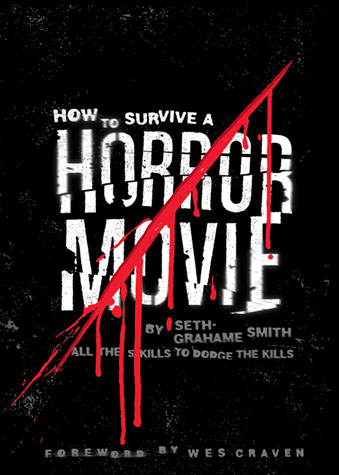
Also finished How to Survive a Horror Movie. It ran out of steam for me in the last quarter, but I feel that was largely me and certainly not the writing, which remains sharp and funny to the end. I think I had simply tired of the central joke and was ready for it to be over. That’s a danger for extended riffs.

The rest were from the world of graphic novels. Welcome to Tranquility, which is a great story set in a retirement community for super heroes and villains, written by Gail Simone, art by Neil Googe. I loved this book, and apparently it is coming back, but without Simone at the helm. Le sigh.

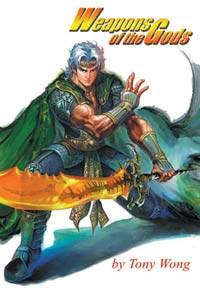
Next up was the first volume of Weapons of the Gods by Tony Wong. Chinese kung fu comics! I loved the Jademan translations during their brief American runs, and the genre is occasionally problematic. This is the culture that brought us novels like Heroes of the Marsh and The Romance of the Three Kingdoms, thousands of pages long with hundred of characters. This shows in the comics, and there are at least three major cliffhangers in play by the time the volume ends.

Next up, a volume of Larry Marder’s Tales of the Beanworld, A Gift Comes! – I had forgotten just how beguiling Beanworld was. The expansion of the world beyond the process that is Beanworld doesn’t feel forced, but rightfully makes you miss the simplicity of the early world. If that doesn’t make sense to you you should be reading Beanworld.

Then, finally, the first volume of Russ Manning’s Magnus, Robot Fighter 4000AD. Quite a title, and one of the favorites of my youth. An admitted attempt to re-invent Tarzan in a science-fiction setting, Magnus is trained from birth by an intelligent robot to be strong enough to smash robots with his bare hands. You see, in the year 4000, man has become too dependent on robots, and would be helpless in the face of rebellious metal men were it not for … wait for it… a robot fighter! Yeah, the stories are kinds simplistic, but these were definitely adventure comics for boys. And, I suppose, girls who liked men in shorts who could shatter steel with their bare hands.

Still in my possession: three works by Osamu Tesuka – the youthful mandate for more manga has some benefits for me, even if I gave DMC a try and found it not to my liking – more Batman and Jack Kirby. I heart my library.

Sick Day

I’ve managed to catch whatever stomach bug was messing up my wife’s life this last weekend – marriages are about sharing after all – and faced with the horror of two days outside shooting video while sick, I’ve elected to stay home today to… uh… get it out of my system. As it were.

Any hours this last weekend not spent fighting down nausea or doing the show while fighting down nausea were spent either playing with my new Tumblr toy or reading. While fighting down nausea.

It was my intent to sleep in this morning, but of course the sounds of Cat Rugby in hall at 6:30am scotched that. Got up, fed the horrid little creatures, and eventually went back to bed. After an hour, as usual, I had a dream that the doorbell rang. My subconscious is a jerk.

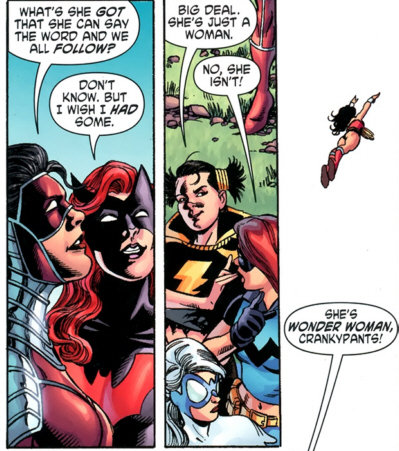
Well, on the weekend I did finally got around to Wonder Woman #600 and waaaah and boo hoo for the departure of writer Gail Simone.  She left on a note that was both suitably bombastic and sentimental. Odd that the fan resentment that met the pin-up pages in Batman 700 is seemingly non-existent for the art pages here. Probably because these are loads better, and they’re the last we’re going to see of the one-piece bathing suit costume for a while.

Yeah, the reboot starts in this issue, too. It’s not hateable. I’m willing to see what’s going to happen, but it definitely has temporary written all over it.

Enough. I’m hungry. I hope that’s a good sign. Rest of you have a good Monday.

Bah, Hembeck!

Paging through the old stuff, I found a book I had almost completely forgotten: The Fantastic Four Roast, written, laid out, and to a degree drawn by, Fred Hembeck. Every now and then, it’s a genuine shock to me that I don’t recall Fred Hembeck as a matter if course. He was very big in fandom in the late 70s, early 80s, and even among the Big Two, as seen here. He’s still around, even if Jim Shooter is no longer in charge and allowing him to destroy the Marvel Universe, willy-nilly (and that link is quite a read, in and of itself).

Hembeck’s cartoons about comics and their characters were something I looked forward to in those halcyon days, and the fact that DC and Marvel were publishing them were no small source of pride to comic fandom. So it’s always a bit of a shock when I find some Hembeck rattling around my collection and go, “Oh yeah! Him!”

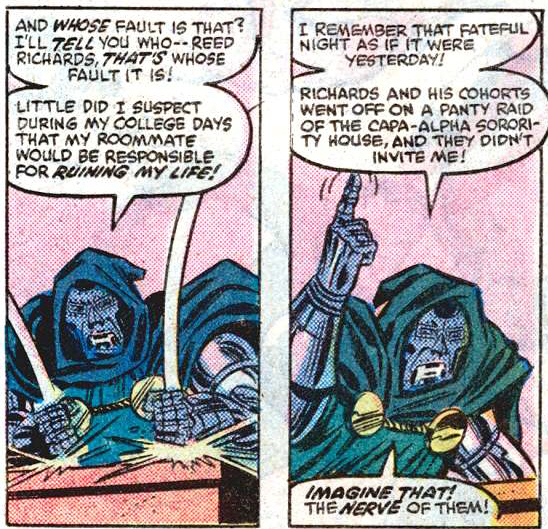
Especially since The Fantastic Four Roast happens to include one of my favorite versions of Doctor Doom.  This may seem odd coming from a guy who prefers the 1994 low-budget Fantastic Four movie over its 21st century big budget siblings simply because it got Vic right; why would I then like a joke Dr. Doom? Because Hembeck’s heart is in the right place, and… he gets it right. (I suppose the fact that I could hoot “One of us! One of us!” at Hembeck and he wouldn’t be offended or call the cops is also a factor)

The set-up is simple: upon their 20th anniversary, the FF have come to what they assumed was a tribute dinner, but is actually a celebrity roast, hosted by Hembeck. (“Dean Martin was unavailable… and too expensive.”) The jokes roll from there, but somebody is (of course) trying to kill the FF, planting deadly devices in their dinner courses (most of these are disposed of by having the Thing eat them. “Good work, Ben!”). This of course, leads to the Thing accusing Dr. Doom of being the culprit, causing Doom to take the podium:

Dr. Doom yelling after the Fantastic Four, “I hope you lose!” is one of my very favorite images.

In case you might have trouble sleeping tonight, wondering who the Shadowy Figure might be, it’s the FF’s mailman, Willy Lumpkin (played by Stan Lee in the much-reviled 2005 movie), but he’s under the control of the Brain Skull, a reference so obscure it thwarts Google. Which brings me to the conclusion of this nerdish dissertation: Fred Hembeck is the Grant Morrison of humor comics, and he should be let loose in this toy box again, as soon as humanly possible.

Batman’s Body Count Mounts

Not much time to read last night; my wife finally got a netbook and I spent some time cleaning out all the “free trial” and “buy me”
garbage, and getting updates, virus protection and the like worked out. Nonetheless got a little more read in Batman Chronicles;  that first Joker story really is one of the best of the Golden Age stories, and I really forget how striking it is when the character doesn’t smile. A 20 page deep search on Google Image shows that nobody seems to have scanned or posted that remarkable first image. Perhaps I will see what I can do.

The Joker, just as I had recalled, had an impressive body count, but I hadn’t expected Batman to try to top it in the next story. Hugo Strange breaks out of prison, liberates five very insane dudes from an asylum, then uses his weird science and growth hormones to turn them into fifteen foot-tall monsters. Batman punches Strange out a window and over a cliff (though, to be frank, even at this early point in the series, Batman might as well have stuffed him into a blast furnace and cheerfully waved, “See you later!”), strafes a truck carrying a monster with the Batplane’s machine guns, then plays King Kong with the last monster as he climbs the highest building in Gotham.

In any case, I’m a few minutes away from a meeting in which we will plan out how exactly my job will attempt to kill me this Saturday at our coverage of the city’s 4th of July parade. As we’re looking at a 50% chance of rain currently, it may not even happen. Talk about mixed emotions – the overtime would be very nice. We can but wait and see what the universe holds for us.

Meantime, here’s the 1943 Batman dealing with ne’er-do-wells:

Robin, the Boy Psycho

Yeah, I just did a few hundred words on Jose Mojica Marins in an e-mail to some friends. Sorry kids, I’m movied out. So I guess I’ll talk about some comics today.

And there is the sound of a thousand computer mice clicking elsewhere.

(A thousand? Talk about hubris.)

As both of my regular readers know, I’ve been ransacking my county library system for the comics collections I haven’t been able to afford over the years, and what should crop up from my maddeningly long list of requests than the first volume of The Batman Chronicles, which promises to be “every Batman story in exact chronological order”. That’s a damn tall order, but you go, DC. You keep crankin’ em out and I’ll keep whining to my county board to keep buying them. Unless of course either the Aladdin’s Lamp or Lottery fantasies come true, in which case these sonsabitches are all going in my new mahogany-paneled personal library.

I wake myself from that particular pleasant dream to continue: I’ve had a fascination for the Golden Age stuff since I was a kid, and all we really got by way of a taste was the annual team-up of the Justice League with the aging Justice Society of Earth-2, and those were just enough to tickle a craving into existence. There was an occasional reprint as a bonus, the odd book like All in Color for a Dime, but unless you had the money to pony up for plastic-wrapped pulp, you didn’t see much in the way of Golden Age material.

More and more reprints came to the mass market when it was determined there actually was a mass market for this stuff, and that’s great. I don’t necessarily need to own it, but I do want to experience it. And I don’t need to own it because, um, it’s not that good.

Yeah, it’s really unproductive to judge a medium in its infancy by the standards of three-quarters of a century later, but they’re the only standards I’ve got. The best descriptor for most Golden Age comics is quaint. Watching creators of the period struggle with what Scott McCloud calls “the unseen art” is fascinating, the art of telling stories in a series of sequential panels. Also courtesy of the library, I’m reading Sandman by Kirby and Simon and the improvement in storytelling dynamics made in only a couple of years is dramatic.

A  flatness in the emotional contact with the story aside, the stories in Batman Chronicles 1 are interesting for what was allowed in those days, or what was lost over the years as opposed to what was eventually gained. There are, of course, the infamous shots of Batman actually using a gun, a nod to the inspiration of the Shadow, if nothing else. Those are pretty minimal, though, and the only incident outside a splash page is Batman shooting some supernatural creatures with silver bullets – a forgivable lapse, much like the modern Batman mortally wounding the evil god Darkseid by shooting him with a quantum bullet because it was necessary.

No, I’m talking about Batman’s cavalier attitude toward his secret identity. He tells two people who Bruce Wayne has decided to help, “Let me change,” and steps into the next room to put on the Batman suit; he keeps dropping little hints to criminals while he’s pummeling them that he was the man who bought a pound of sugar earlier, at their grocery store front. In one instance, he’s in France, and the people could be expected to not know Bruce Wayne, and in the second, the bad guys are going to be more concerned about their nasal septum getting kicked back into their brains than picking up clues, but jeez, Bruce!

There’s also a lot of Disney villain deaths. You know, environmental hazards. The very first Batman villain, upon getting punched by the caped crusader, falls into an acid vat. One falls onto a sword he threw at the hero. These are the sort of things the modern day Batman would go to (obviously) heroic, and athletic, lengths to avoid. The Golden Age Bats is more of the “Ha! He deserved that!” school.

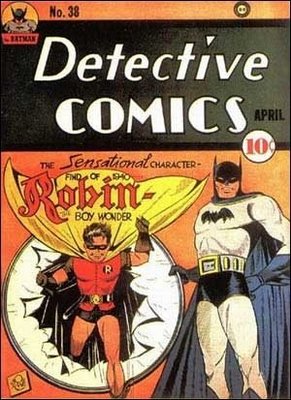
The other surprise was how relatively few stories it took for Robin to show up.

Let me be clear: I hate Robin. I hate kid sidekicks in general, but Robin gets some special ire because he’s a flashpoint. I always know I can never discuss my love of comics with a person when they say something along the lines of “Batman keeping company with an underage boy, hurr hurr.” In fact, conversation usually gets shut down altogether with my usual rejoinder, “Would you be any more comfortable if he was hanging around with an underage girl?”. Which is good, because then I don’t have to get to the “THEN SHUT THE F@#K UP!” stage.

Intriguingly, I don’t mind Robin apart from Batman. Well, apart from that stupid circus-inspired costume. Then, I suppose it depends on the writer, as I’m thinking quite warmly of the Marv Wolfman New Teen Titans or anything Grant Morrison has done.

But, theoretically we’re talking The Batman Chronicles 1, and the last story I read, which is Robin’s origin story.  I had forgotten that Boss Zucco was behind the death of the parents of Dick Grayson, which ups my respect for the movies that reference him. Batman’s training of his new aide seems to go very quickly, but then, the kids is a trained aerialist. But what is most remarkable, is how much Batman and Robin are smiling once the action gets going. Bats has been pretty grim up to this point, but these two working together are displaying a hell of a lot of enamel while they’re extracting justice.

The climax of the story takes place at the top of a skyscraper under construction. Robin jumps the gun on attacking Zucco and his thugs and there’s quite a donnybrook betwixt Robin and the bad guys, and there’s at least one – and I’m going to say more likely four – guys who plunge to their doom as a result of the fight. At least one more is thrown off by Zucco after the quisling signs a confession to sabotaging the Grayson’s trapeze, which turns out to be set up by Batman, so Robin could snap a picture of Zucco himself killing the traitor. Which is another notch in Batman’s personal kill list.

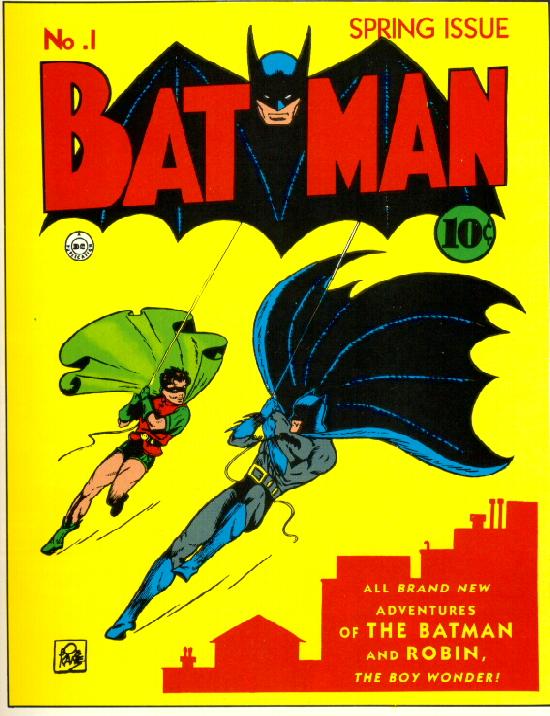
After this is Batman #1, and the first appearance of the Joker, who will in time eclipse Batman’s body count and make us forget all about it.

I’d like to say we’re better than that now, and our heroes are better than that, but I know that neither is the case. I’m going to have to settle for the writers and artists being much better, and that is cause for celebration. I am still looking forward to going through the rest of this series, to track the mellowing of the characters, and discover exactly when the Joker goes from being a homicidal maniac to the Clown Prince of Crime.

I realize it sounds like I’m hating on the Golden Age comics, but that would be like hating on Walt Whitman poetry. Not all that great, but it’s the first. Quaint, charming, and… hey, according to Amazon, not all that expensive. Hmmmmmmm…

Minor Redemption

I am pleased to report that 1602 improved greatly in the second half, and I am deeply ashamed I didn’t suss out the identity of the blonde Indian earlier. Duh

You may now rest easy for the remainder of the weekend. I have lines to learn.

Currently attempting to trace the Doom of Charlie Brown

Carrying around video equipment in Houston’s early morning humidity was predictably draining. I look on it as practice for the truly grueling experience coming down the pike: covering the City of Stafford’s 4th of July parade. Multi-camera, LIVE. I survived it last year. This year… will probably suck just as much, but the overtime will be nice.

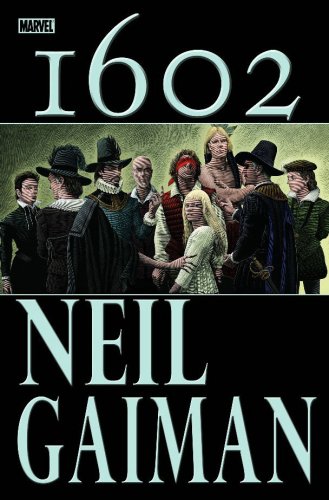
From the library: I’m currently reading a bound collection of Marvel’s 1602, which retells various Marvel comic types as if they existed in – what else – the year 1602. Kind of a fun conceit, written by Neil Gaiman and drawn by Adam Kubert. I glanced at a few copies when it was in the periodical phase, and I find my reaction to it in collected form is just as cold. I seem to like the idea as an intellectual pursuit more than an actual story, which is to say I’m finding the character concepts more compelling than the story in which they appear.

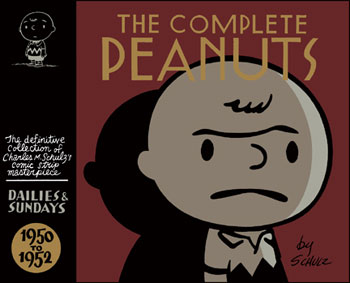
A couple of trade collections, one for Batman< Dark Detective, and one for Wonder Woman, The Hiketeia, both sadly forgettable., though the Wonder Woman book has its moments. I’m also working my way through The Complete Peanuts 1950-1952, the strip’s first two years. The biggest surprise? Charlie Brown is allowed to win. Rather often, in fact. Perhaps, if I continue to check out successive volumes, I’ll find the strip where he pisses off a gypsy and becomes the eternal fall guy.

Deapite the cover, Charlie Brown is pretty happy during most of this book. Poor sap doesn't know what's coming.

Happy Father’s Day to all you dad-types out there. I’ll see y’all next week.

Monsters in the library

I am bemused by the fact that my Sherlock Holmes post of a few days ago has randomly generated a link to a “New Jonas Brothers Myspace blog” as being “possibly related”.  Even the Great Detective would have trouble with that one.

So in my latest haul from the library, I have a tome from the John Stanley Collection,  Melvin Monster. John Stanley is probably better known for Little Lulu; Melvin Monster ran only nine issues, but it’s a bizarre, utterly charming book. Melvin  lives in Monsterland in a horrible house with his monstrous parents, Mummy and Baddy. Mummy, needless to say, actually is a mummy, and Baddy has given up on his son because he wants to go to school and be nice to people.

Melvin was around from 1965-1968, during a great monster boom in popular culture brought on by the rediscovery of the Universal horror flicks via TV, and magazines like Famous Monsters. There was literally not much else like Melvin on the marketplace, except possibly The Milton the Monster Show. a cartoon with a suspiciously similar name but lacking the whimsy of Melvin.

Aaah! Noooo! Take it away!

The book from Drawn & Quarterly is a thing of beauty, from the binding to the printing – even the pages within have a yellow cast reminiscent of yellowing newsprint.  These folks are serious about their publications; this book is the sort of handsome beast I would love to have on my bookshelf. The John Stanley Collection is apparently an ongoing project, and I looking forward to future volumes – especially if they go further into his career, and eventually reprint issue #1 of Ghost Stories, a comic which still give me the creeps decades later, and raised such a furor among parents that Stanley was never let near a horror book again, which is a damned shame.

Probably the most famous of the nightmare makers was the story that led off the book, “The Monster of Dread End”, and luckily for you, (or perhaps unluckily, depending on how well you sleep at night), The Horrors of It All has scanned it and put it up on the Web for your reading… heh… pleasure.

Dormez bien.

And I thought I’d run out of steam

I seem to be out of righteous dudgeon today. So please breathe a sigh of relief, then grit your teeth as I get boring again.

First things first: Lisa’s follow-up appointment is today. We’ll see what good and bad comes of that.

I’ve re-started my project to read the complete Cerebus series; I had reached a more-or-less natural stopping point after Volume 10/issue #200, and took the opportunity to decompress a bit. I just checked, and the Cereblog, the site that got me onto this kick, hasn’t updated in a year.  I’m not going into it on such a magnifying-glass manner as they (for one thing, I spent a lot on these phone books – several of them autographed – and don’t want to set them on fire, har de har), but I will be talking about them soon. So those of you who get all huffy when I talk about comics, sorry, but they’re at least as big a part of my life as movies.

In the meantime I read a whatchacallit, actual book, you know, one without pictures. I don’t know why I went years and years without a library card, since I live in a county with a county-wide library system that has access to thousands upon thousands of books, and that’s without even accessing Interlibrary loans. I’d wanted to read Gene Wolfe’s latest book, An Evil Guest, for some time, but hadn’t really had the opportunity until now.

Wolfe doesn’t write your typical genre-related novels, and this one was no exception. Set a hundred years in the future, it concerns an actress named Cassie Casey who finds herself an ofttimes willing pawn in an undefined power struggle between two men who appear to be sorcerers. The story, though, is largely told from the point of view of Cassie, who gets so overwhelmed by the floodtide of events that analysis is defied. The last quarter of the book takes a radical turn in tone, and Lovecraftian elements come to the fore.  If Cloverfield was a daikaiju flick told from the point of view of a member of those nameless crowds fleeing Godzilla, An Evil Guest becomes, at the end, a complicated pulp story related by Margo Lane, who never had time at the end of the adventure to be debriefed by the Shadow. I’m going to be mulling this one for a while, which is a good way to feel about a novel.

I’ve also been slowly draining the Fort Bend Library system of all their comic content, which is, gladly, going to take a while. I’m gleeful to discover they have the E.C. Segar Popeye collections, which I’ve lusted after forever and a day, and now I can at least read them, if not own them – at least as soon as they travel from their far-flung branches. I’m currently plowing through The Amazing Transformations of Jimmy Olsen, reprinting some of the batshit crazy stories from Jimmy’s book, Superman’s Pal, Jimmy Olsen, in which the ginger chump is turned into a genie, a giant turtle (“What is on his huge,twisted turtle mind?” wonders Superman), and horror of horrors, a fat person. Since, as we all know, fat people are hideous freaks.

Also in my possession for a few weeks is DC Universe – The Stories of Alan Moore, which contains some Moore stories I actually hadn’t read (I had not thought that possible). But one of the first books I checked out was also by Moore, a story I hadn’t read but only heard about: Whatever Happened to the Man of Tomorrow?

Whatever Happened -? was the coda to umpteen years of continuity, before the John Byrne-penned Man of Steel reboot (which, frankly, I never liked). It takes place in the the-near future of 1997, as a reporter interviews a retired Lois Lane on the 10th anniversary of Superman’s disappearance. Leading up to Superman’s vanishing act is an all-out war with his old foes, all of which have turned from relatively harmless bank robbers and schemers to outright murderous lunatics, leading up to a climax with a bunch of cast members dead and Superman walking into a room with gold kryptonite (which destroys his super-powers) after he’s committed the unforgivable – to him – sin of destroying the being responsible for all the mayhem before it can kill himself or Lois.

And this is one of the more sedate moments from Rise of Arsenal

Finally reading this story after all these years – a quarter-century after it appeared, apparently – something occurred to me. Moore is one of the people who changed comic book superheroes forever with Watchmen, and judging from what I’ve read of modern offerings from DC, Whatever Happened-? is more or less providing the blueprint for the currently slaughterrific state of affairs there.  Every DC comic I read these days seems to have at least one horrific murder (often more) in what seems to be a race to out-grit Marvel, and which I suspect is going to lead to another Seduction of the Innocents-type social backlash.

Well, at least we can’t blame Whatever Happened -? for the rash of DC rapes and near-rapes in the last few years. For that we have to go to The Killing Joke, also by Moore, also in the DC Universe collection.

Too bad that so few people working in comics today took something else from Moore’s work: quality writing.

Marvels (not necessarily of my youth…)

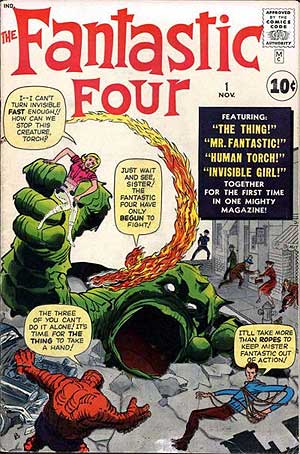
In our last loopy entry, I alluded that the Current Madness began with the Fantastic Four, and now that we have dispensed with the age-before-beauty schtick with poor, early Silver Age Superman, we can perhaps speak a bit more generally.
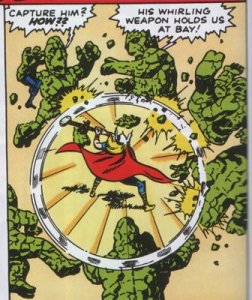
The best thing about the Marvel Essential books is that they start at the very beginning, not at an arbitrary point in the comics’ history, as do some of the Showcase books spotlighting older properties. Thus, you get to see a book founder and flop about, trying to find its own voice. The Mighty Thor is a fair example; he starts out fighting the Stone Men of Saturn, and goes on to a fairly mediocre career, up against Zarko The Tomorrow Man (twice!) and sundry menaces the thunder god seems to sort of shrug off, like those damned Reds (oooooo! Curse them!).

It’s in Thor, in fact, that we see rather starkly the impact of what has come to be known as the Marvel Method: the artist, after a story conference, goes off and draws the story, and Stan Lee would later write the captions and dialogue. When Jack Kirby is doing the art, Thor is engaging and dynamic, when he’s not… well, there’s a fallow period in the center of Volume One that, so to speak, illustrates the outcome. When Kirby returns to the title, the storytelling crackles; colorful adversaries like the Grey Gargoyle, Mr. Hyde and the Cobra fairly leap off the page, not to mention the back-up feature “Tales of Asgard”, which allowed all sorts of fanciful derring-do, at which Kirby excelled.
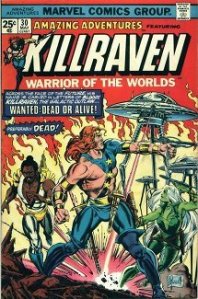
Killraven is another example . It starts out as “Amazing Adventures presents War of the Worlds”, the central conceit being the Martians put in a repeat appearance at the beginning of the 21st century, and this time they brought antihistamines and conquered the world. The Killraven we’re talking about is a guy raised in the gladiatorial pits of this un-brave new world, who escapes with a group of like-minded individuals who set to becoming freedom fighters. The series is kind of entry-level pulp adventure until writer Don F. McGregor signs in, and not too soon afterwards artist P. Craig Russell joins, and what is now called “Killraven – Warrior of the Worlds” starts to sing its own song.

I recognized Don McGregor’s name from some stories he wrote for the Warren black-and-white horror books (you know, Creepy, Eerie) which, almost without exception, I disliked. McGregor was a painfully earnest writer in a painfully earnest era, and would stop a decent horror story dead in the water for a sermon.
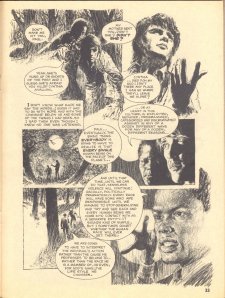
For instance, here’s Sidney Portier telling it like it is while the guy behind him turns into a werewolf in Creepy #43’s “The Men Who Called Him Monster”. Don’t those word balloons look like they’re about to pop?

McGregor’s work on Marvel titles, though, is incredible. Perhaps a bit overwritten… a better description would be densely written… but maybe his editors at the big M kept his more self-indulgent tendencies in check, with the result that his talent shines. He also did a stint on “Luke Cage, Power Man” which is more multi-layered than Mr. Cage usually got, and I seem to recall a stellar run on “The Black Panther” that I’ve got to dig back out, one of these days.

Marvel Essentials Killraven is one of these books that presents the entire run of a character, including a somewhat muddy black-and-white version of a Marvel Graphic Novel that at least wrapped up one storyline left over when the book was cancelled. Then it ends up with a well-intentioned (and undeniably pretty) but ultimately pointless attempt to revive the character in the Marvel Knights line. As such, it’s more like reading a novel than most such books, with a couple of well-sustained story arcs and some great character work. McGregor is also one of the few writers in comics who seems to appreciate and employ running gags well.

I keep dropping the Fantastic Four name, and never get around to them, do I? Maybe it’s because of the total seven volumes currently available, I’ve only read five. More likely it’s just my scattered disorganized brain. Even more likely, I’m just too lazy to organize these slow-motion essays. I find that, overall, the reason I love the Marvel Essentials books is I didn’t read that much Marvel when I was really young. I expected lofty stuff from my regular, text-based books, but for my funny books I went for the more easily-digested DC and Gold Key fare.
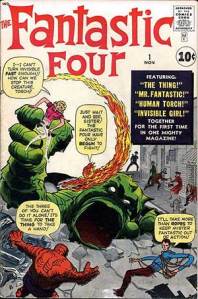
Anyway, here goes: I think the aforementioned Fantastic Four, and that other mainstay that pulled Marvel out of the poorhouse, Spider-Man, never went through the initial, ungainly phase as did Thor and Killraven. Their basic concepts and characters seem very solid from the get-go, even though it would take years for the Invisible Girl to realize her potential (to paraphrase William S. Burroughs, “She could kill anybody in the room, and that was a good feeling.”)

Going through the first five volumes of Fantastic Four is quite the trip down memory lane; this is the blueprint for what would become the Marvel Universe, introducing the Kree, the Skrulls, the Inhumans, Galactus, the Silver Surfer, the Negative Zone, and, of course, my favorite comic character of all time… Dr. Doom.

It’s also well worth noting that, with rare exceptions, it’s almost always Jack Kirby at the drafting table for these stories. With the last half of Volume Five, John Romita takes over the art chores, which is a damn fine choice; while his design sense is not as over-the-top as Kirby’s his sense of drama is just as exceptional. It’s possible, at a quick glance, to mistake Romita’s art for Kirby’s, but a closer examination reveals that Romita shines in his own, special way. Romita had a good track record at Marvel for stuff like this: he also took over Spider-Man after Steve Ditko left Marvel.

It tends to dismay my friends who are also comics fans that I’m not a Spider-Man fan. Everybody is a Spider-Man fan, it seems, but me. I’ve never seen the allure, but my pal Dave was able to put it in terms I could understand.

A) Most of the Spidey super-villains, if they met Peter Parker on the street, would not even be bothered to nudge him out of the way. He’s that much of a schlub. So, yeah, I can see the Everyman aspect. And

B) Spider-Man’s actual super power isn’t the wall-crawling or the proportional strength of a spider; it’s the fact that he can piss off anybody. Dave loves to relate in detail, with appropriate voice acting, his favorite tales of Spider-Man pissing off Mr. Hyde, for instance.

This should tell you something important about the personality of my pal, Dave.

Nonetheless: I own a cope of Marvel Essentials Spider-Man, Volume One. Why? It was at Half-Price Books. I picked it up. And I realized, “Wait a minute – this is over 500 pages of Steve Ditko art!

I may swear allegiance to writers, but those artists I love, I love unreservedly. And here is the most gorgeous comic cover evar (click to truly appreciate).