The Rats Are Coming! The Werewolves Are Here! (1972)

My greatest weakness as a writer, I have found, is that I’m just not very good at titles. I take cold comfort in the fact that I’m not the only one. How many movies are there titled Boiling PointManiacIsland of (fill in the blank)? So I get really excited – far too excited, really – when I know I absolutely must see a movie based on the title alone. Such a title – and I’ve been meaning to watch it for years – is The Rats Are Coming! The Werewolves Are Here!

There is no way I can not watch a movie titled that. It has, admittedly, taken me forty years to do so. I remember back in the dawn of the VHS boom, I saw a copy of it for rent, but I grabbed something else entirely. Maybe The Fantastic Animation Festival. Never regretted that. And now I know why.

Because, of course, the entertainment value of the movie is in inverse proportion to that incredible name.

That title is credited to producer William Mishkin, while the movie is the work of Andy Milligan. Milligan had a strange, troubled life; he entered the world of low-budget movies through his involvement in the off-off Broadway theatrical scene. His first movie was Vapors, a 30 minute gay movie set in a bathhouse. This got Mishkin’s attention, and Milligan was soon making low-budget sexploitation movies for Mishkin’s 42nd street theater connections. He knew where to find actors who’d work cheap and, thanks to his theater experience, knew how to build sets and make costumes.

So, really, I kind of sigh when I consider Milligan; His movies cannot be considered good, but it’s easy to see the aspirations at work. Given more than a few thousand bucks to work with and some support personnel, he might have been pretty good. But even his best work – something like The Body Beneath, say – still bears all the telling shortfalls of a creator wearing too many hats with too few tools at his disposal. Single mike recordings of dialogue, limited lighting, needle-drop music cues that cut off suddenly at scene changes…

But dammit, you see him trying. You see the actors trying. Milligan actually has some pretty good actors working for him… but they are betrayed by their material – almost always, written by Milligan. It is almost always stuff that would be ripe but tolerable on a stage, but on a movie screen, too often the kiss of ennui.

The Rats Are Comingconcerns itself with the Mooney family, in what we are eventually told is 1899 England. The period is a bit slippery here – Milligan’s costumes are serviceable for the period (if not entirely accurate – I’m particularly

Quick now – 1899? or 1972?

skeptical of one of Monica’s hats), but two of his younger actresses are quite obviously wearing 1972 hairstyles and make-up. Not that I mind. 1972 was a good year for me.

The Mooneys are a dreadfully dysfunctional family, something with which Milligan, sadly, had a lot of experience. The aged father of the clan is given to “attacks” whenever his temper is roused, and must be given increasingly frequent injections. The eldest daughter, Phoebe, is running family matters as best she can, aided by eldest brother, Mortimer. Next oldest daughter is Monica, psychotically jealous (or just plain psychotic), and another brother, Malcolm, is best described as “animal-like”. The youngest daughter, Diana, returns to the Mooney estate with a new husband in tow, much to the disdain of Pa. He sent Diana off to medical school so she could help him with his “experiments”. Dian’s husband, Gerald, starts noticing odd things, like dismembered chickens showing up in the halls and Monica jumping out of wardrobes with a knife.

Oh screw it, they’re werewolves, okay? The Mooneys are a bunch of freaking werewolves! It’s right there in the title, for God’s sake. Pa isn’t trying to cure the lycanthropy, though, he’s working on life extension – he, himself is 199 years old! Then everything goes to hell in the last ten minutes due to really bad timing, and the estate becomes werewolf central.

Now, this was the basis for Milligan’s original movie, which was called The Curse of the Full Moon, and ran only 72 minutes. “Not long enough!” yelled Mishkin, and to pad the movie out, they have a subplot where Monica goes into town to buy a new pet from Mr. McHarbor (that’s actually a pretty clever name), who sells her some rats that ate off his left arm and half his face one night when he had too much to drink. Why is there this subplot? Willard was making money at the time. And Mishkin came up with that delicious title.

The title still gets it wrong anyway, because the rats last maybe five minutes at the Mooney household, until Monica is bitten by a rubber rat (what part of “flesh-eating” didn’t you get?) and she returns them to McHarbor, demands her money back, and then sets him on fire. At least I think that’s what happens. The scene is badly lit, and Milligan’s handheld camera tends to go into Swirl-A-Vision during murder scenes. But The Rats Have Come And Gone! The Werewolves Will Be Here Eventually! just doesn’t have the same panache.
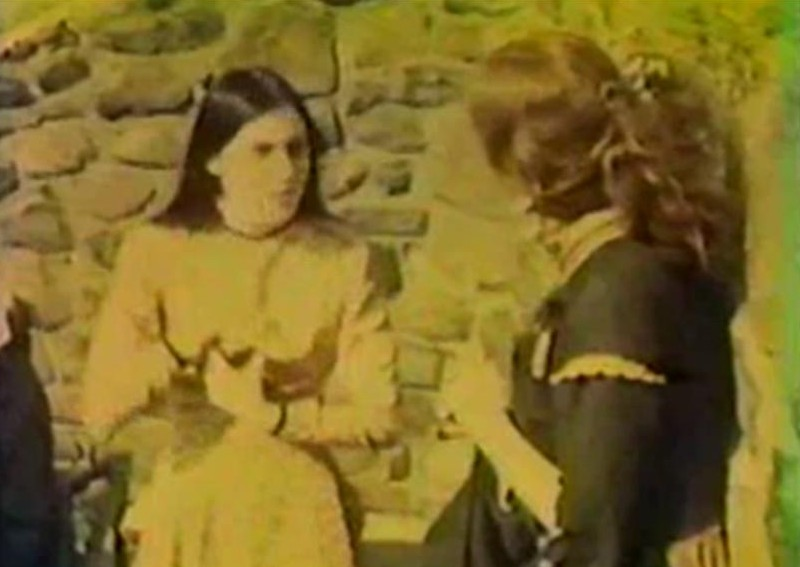
And this is what happens when you rely on “ends” for your film stock.

It turns out Monica has a friend, another girl-woman named Rebecca, who is basically a Cockney Monica. Introduced at roughly the one hour mark, the only reason Rebecca exists, besides to give the tooth-grindingly annoying Monica more screen time, is to mention that she’s seen things at the estate that ensure that Monica will hack her up bloodily.

Except. I have the Video Kart DVD of this, paired with Bloodthirsty Butchers, and the scene is scissored into incomprehension, apparently for TV. Good grief, this sort of thing drives me mad. I’ve run into this twice – while writing reviews for Shriek of the Mutilated and I Drink Your Blood – where the available tapes/discs were TV edits. Those movies – and Milligan’s horror movies – are infamous for their gore. This renders judging them on any sort of reasonable basis moot. How am I supposed to judge such an incomplete product? It’s like trying to review a G-rated version of Deep Throat. Uncut versions of the two linked movies above have surfaced on DVD, but I somehow doubt an uncut version of The Rats Are Coming is ever going to appear.

Then again, I should probably count my blessings – according to Wikipedia, the DVD currently resting on my desk does not exist.

At one point in the movie, Diana goes into town to buy a pistol. This leads to a very long scene with a comical old gunsmith who sells her a suspiciously modern-looking automatic pistol and is sweet-talked into melting down a silver crucifix for bullets. Even as you wonder why the hell this scene is taking so long (outside of padding the running time) you find yourself liking the gunsmith, he’s one of the better actors. Then you later find out the gunsmith was Andy Milligan.

Milligan the writer has a problem with circular scripts; in Rats it’s characters that keep almost saying something significant, then saying, “I’ll tell you when the time is right.” But I’ve got to say the one thread running through the movie, and whereby we finally find out what the hell is going on with the Mooneys is very well handled, if somewhat drawn out over a lot of territory; but then, I’ve never run across a truly gothic piece of fiction that I didn’t feel the same about.

At any rate, there’s a reason, I re-discover, that I measure the time between Milligan movies in years, rather than months. I find them interesting to hash out afterwards, but the actual watching… ho, boy, that can be a chore. But why take my word for it? You can download it from The Internet Archive! Not that I necessarily feel you should.

(And dear God, I love that the comments all think this is a British movie, not something shot down the street from the Staten Island Ferry! Good on you, Andy!)

And hey, here’s a trailer that gives away what is supposed to be the final Twilight Zone twist! Now you don’t have to see it!

V/H/S (2012)

As we’ve seen recently, I’m fascinated by the found footage format.  I was burbling about a horror anthology called V/H/S which was going to be nothing but found footage as interpreted by six directors (more really, there’s at least four operating under the pseudonym Radio Silence). Well, it finally became available on a number of Video On Demand venues, so I didn’t have to wait for its October theatrical debut… and I don’t like watching found footage movies in a cinema, anyway. It’s just not right.

Horror anthologies always have a framing device, and this one is fitting: a gang of hooligans who videotapes their illegal activities (like vandalism, burglaries and grabbing women to expose their breasts) get hired to pull a job that seems up their alley: breaking into a remote house and stealing a particular videocassette. Once there, they find the house’s sole occupant dead, and a lot of tapes. While the others search the house, various members of the gang check out tapes one by one…and these contain our stories.

The first story, “Amateur Night”, starts the proceedings off fairly strongly, and has one of the better devices for combating the “Why do they keep filming?” skepticism: a pair of “video glasses” with a built-in camera and microphone. Two frat boy-types pop these glasses on their nerdier friend, rent a hotel room, then start cruising the local bars. There is one woman who seems attracted to our walking camera, an odd, seemingly feral girl who only seems to know one phrase, “I like you.” Back at the hotel room, when the only other pick-up passes out, the other two men start concentrating on the Spooky Girl, with predictably (yet still somewhat surprisingly) gory results.

I should mention that Spooky Girl is effectively played by Hannah Fierman, an actress whose face I swear is 1/3 eyes. Very striking, very good performance. I’m going to say all the performances in “Amatuer Night” are pretty good, to the point of making me extremely uncomfortable. This segment seems to take a little long to get to its payoff, which is the only real criticism I can make.

You’re going to wind up in the same fix with “Second Honeymoon”, written and directed by Ti West. West has been getting some very good press with this movies House of the Devil and The Innkeepers, but I was dreadfully let down by this sequence. Very long setup, very sudden and unsatisfying payoff.

The third sequence, “Tuesday the 17th” starts yet again with a group of young people heading out into the country while some guy annoys everyone with his video camera – that’s pretty endemic to the format – but at least it’s dispensed with pretty quickly. The girl taking everyone out to her folks’ “cabin by the lake” has an agenda of her own, involving some murders at that location several years before.  The main interesting point to this story seems cribbed, however unwittingly, from the Marble Hornets web series, with a killer that screws up video signals, which at the very least leads to some interesting visuals.

No spoilers here, nope, nuh uh.

Story #4, “The Sick Thing That Happened To Emily When She Was Younger” breaks with established form magnificently by presenting the story as series of Skype calls, instead of camcorder footage. It also has some of the most effective scares and the best twist of the movie.

The last story, “10/31/98” is about yet another group of young men who are headed out to a Halloween party on the titular date. One of the guys has built a handycam into the head of his bear costume, so there you go. Nobody is really sure where this party is located, and there’s some driving around to fill time. Once they think they’ve finally found it… well, needless to say, it’s the wrong house. It is a very wrong house, and this story has some of the best frights in the whole flick.

The build on V/H/S is very good, starting out solidly, if a bit slowly, then upping the ante through the last three tales. Sadly, I think the Ti West story could have been easily excised and produced a tighter, shorter movie. The framing story does stand on its own pretty well, with a few shocks of its own. The acting is never less than professional (though the character work in “Tuesday the 17th” is pretty cliché, which I think was the point), and even very, very good in places.

So I’m going to say, yeah, very worth the rental. If you don’t like found footage, this isn’t going to change your mind. But in a pretty tepid year for horror stories, it’s nice to find one that goes for the gusto without resorting to the simple meanness of torture, or by remaking another, more successful movie from 20 years before.

Keeping that in mind: definitely worth the rental, especially if you’re a horror fan suffering through a drought of decent material.

How to Waste A Labor Day Weekend

Ah, Labor Day. You are a welcome surcease, a chance to sleep in a bit, to attend an impromptu lunch honoring a returning comrade, a chance to catch up on this blog. You are also a cancellation of The Show, which I may find tedious, but is a vital part of my patchwork economy in these troubled times. I could moan about that, or I could drown my sorrows in crap cinema, which I did. Rick was the only one of the Four Horsemen brave enough (or, alternately, in town enough – curse you, Final Weekend of Summer!) to attend. I was determined to make a dent on The List of movies I had required myself to see this year, which left us a whoooooooole bunch of leeway in our viewing, as I still had 33 movies to go, 24 on the B-Movie List, 9 on the Quality List. How’d we do? Well, the list is now down to 30, thanks to our valiant efforts. First, though, I put on a DVD-R I had gotten from Something Weird Video. To be precise, I got it for Adventures in Balloonland, but I am saving that in retribution for Strange Beings, which was inflicted on me at the last official Crapfest. No, I went for something Rick had once expressed interest in, even though he will deny it: the unaired pilot for a children’s TV show, Polly Pockets.

The King and Queen of Gloom. There goes the budget.

As the box copy points out, Polly Pockets has nothing to do with the toy line of pocket-size dolls; Polly Pockets is an effervescent brunette with a skirt composed of nothing but pockets, and theoretically anything can be pulled from them. Her accomplice is a Royal Dano-type named Dandy Andy, who is notable for failing at everything in a komedic fashion. At one point, Polly pulls something – an onion? – out of a pocket, reminding her of her trip to the Castle of Gloom, at which point the entire thing turns into a community theater production of Marat/Sade complete with songs. We were especially appreciative of the King and Queen of Gloom, whose crowns were so-very-obviously made of construction paper. The King’s was decorated with Magic Marker, but the Queen’s had some fancy glue-and-glitter detailing. Rick pointed out that the box copy also promised “A Visit to Santa”, and we figured what the hell, we’re here, and proceeded to suffer through the worst damned Christmas themed thing we had endured since The Magic Christmas Tree. Two kids write and ask Santa if they can visit him at the North Pole, and Santa – I’ve seen worse Santa beards, but not many – thinks, “Well, it’s Christmas Eve, my busiest night of the year… but what the hell,” and sends an elf to pick them up and bring them to his split-level ranch living room so they can tour some shopping center Christmas displays. Just when it starts to get really stultifying, apparently Something Weird thought, “Christ, this is boring,” and slapped in a puppet show.

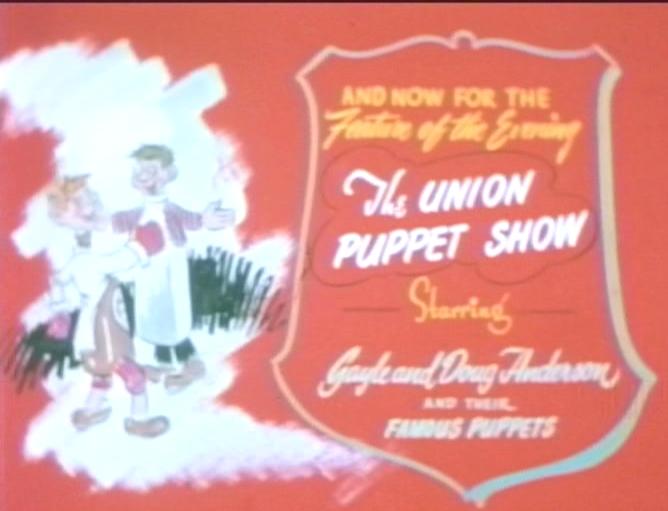
But this is not just any puppet show. No, this is Labor Day weekend, after all, so this is a Union puppet show. I am duty-bound to inform you that I Cannot Make Shit Like This Up. That title card just sort of passed us by, but then we find ourselves confronted by the happy worker puppet, telling us the sammich his wife made was so good, it practically had a beer on top. He is then bedeviled by some sort of boxer with a glass bottle for a body, who claims he is “the champion”, only to be set straight by the Worker, who informs him that the AFL-CIO is the true champion. The scene then changes to a kitchen, where another glass-bottle homunculus tells us how safe he is because he’s sterilized, which gets reallllllllly creepy when the Mom puppet shows up to be told how she needs more sterile men like himself in her life (for instance, she had been buying milk in those horrible opaque paper cartons and last evening, when she discovered it was actually empty, her husband almost left her!) . The camera keeps cutting to an audience of children who must actually be at a Howdy Doody taping or something, because they are not banging at the doors begging to be released. Then it ends, threatening us with “50 TV stations”. I don’t know what that was about, and I sure as hell ain’t going back to find out. Until I spring this on the next Crapfest, anyway, because the workers control the means of production.

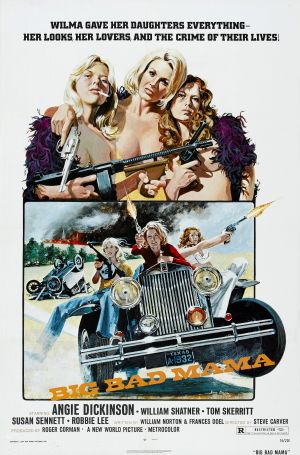
Well, enough of our civic duties, it was movie time, We started off with Big Bad Mama, something I had been trying to work into a Crapfest for ages. Pity I never did get it in, because the first bare breast shot is about two minutes into the movie, and the boys of Crapfest dearly love their gratuitous nudity.

Roger Corman had a nice little cottage industry remixing Bonnie and Clyde throughout the early 70s. This time the gang is all-female, Mama (Angie Dickinson) and her two nubile daughters (Susan Sennett and Robbie Lee), trying to make it in 1932 East Texas. If you actually live in East Texas, this will amuse you, as mountainous Southern California is not really a good match. Anyway, the girls wind up helping hapless bank robber Fred Diller (Tom Skerritt) whose heist is going terribly wrong, and thus begin their lives as felons. Mom sleeps with Diller while the girls fume over the unfairness of it all, until Mom runs into William Baxter, a smooth con man who takes Diller’s place in bed, while the two girls share the discarded Diller.

The plot structure owes a lot to Corman’s own Bloody Mama, with stress in the gang finally leading up to a kidnapping that goes wrong. Throughout, you can sense the presence of Corman, doubtless wearing a green visor and holding an open accounting ledger, nudging director Steve Carver and saying, “Excuse me, but we haven’t had a bare boob in almost four minutes.”

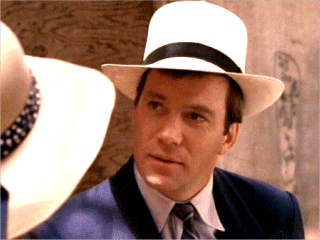
Yes, once again we find ourselves ogling Angie Dickinson’s unclad charms, and viewers of a certain age can get a bit of a pleasurable thrill by realizing that this hit the drive-ins just as Police Woman was gearing up on TV. Now a word about Shatner: I have always liked Shatner, even – perhaps especially – when he goes way over the top. There’s not a lot of it here, but I will say this: he doesn’t cheat in his nude scenes. America being what it is, the little Shatner isn’t going to hove into view, but it comes close. By God, if Angie was going to be in the altogether, so was he.

In a less salacious light: there is one scene where, in the foreground, Dickinson and Skerritt are having a yelling, screaming argument. In the background is Shatner, who, with no lines, no blocking, still manages to steal the scene. I have to respect that.

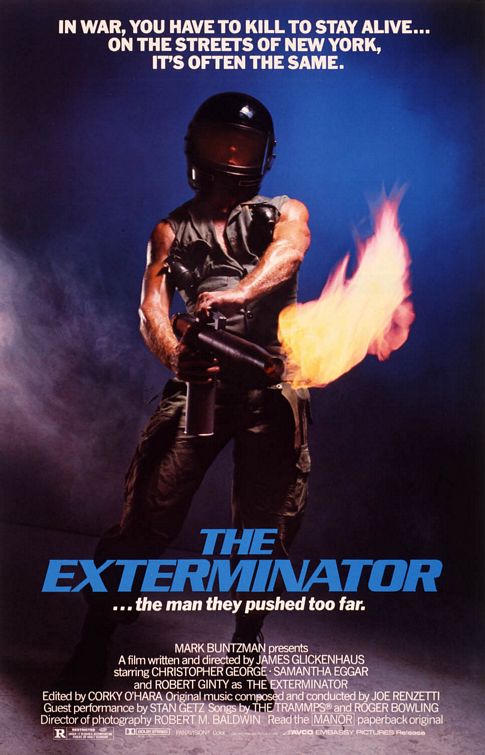
Then came the Blu-Ray (!) of The Exterminator, starring Robert “Paper Chase” Ginty, embarking on his 80s career as an action hero. Exterminator  spends a lot of money in its pre-credit sequence, showing Steve James saving Ginty’s life in Vietnam. Then we go to New York, where Steve James again saves Ginty’s ass from a gang called the Ghetto Ghouls. You might think be thinking “Hey, I hope this movie is about Steve James,” but stop thinking like that, because the Ghouls mug James the next day, breaking his neck and paralyzing him for life. Ginty starts thinking positively, tracks down the people responsible, and lets them get eaten by rats.

Hey, good movie, you might say, but no, we are only 20 minutes in. Ginty then goes about stealing money from the local head of the Beef Mafia (the cops refer to them as “meat mobsters”) to take care of James’ family. The meat mobster doesn’t tell Ginty about the trained attack dog at his house, so once Ginty dispatches the dog with an electric carving knife, he feeds the mafioso through an industrial grinding machine.

We still got tons of movie left, so Ginty just sort of starts wandering around, looking for lowlifes who need exterminating. He finds them in great plenitude in 1980 New York. There is also, needless to say, a cop on his trail: no less than Christopher George, who, like Ginty, is going to be going back and forth between USA and Italian sound stages a lot in those years. George’s story is teased out over most of the movie – very slowly teased out because we spend a lot of time on his romance with a doctor played by Samantha Eggar, which slows the plot down to a crawl.

The most interesting bit is when Ginty pulls out what we referred to as his “Vietnam Box”, a case holding a ton of weapons, including grenades, that he supposedly stole from the Army. Later, when he has a solid lead on The Exterminator, George reaches into his locker and pulls out his own Vietnam Box, with a .45 auto and a tactical shotgun.

We also get some political intrigue, which feels rather half-cooked and shoe-horned in. There’s CIA agent demanding information from George because “The Exterminator… is making the incumbent look bad.” Man! Politics! Can’t even get away from it in a crap movie!
I have to say, The Exterminator  does deliver on what it promises. If you want a gritty Death Wish type rip-off, you could do a lot worse (I know I have). And that Synapse Blu-Ray is gorgeous.

Next up: a movie my pal Dave has been pestering me to see forever: The Cell.

In The Cell, there is an experimental procedure that allows a child therapist (Jennifer Lopez) to journey into the mindscape of a catatonic boy. The procedure is suddenly, urgently pressed into use to send Lopez into the mind of a comatose serial killer (Vincent D’Onofrio), to attempt to find his latest victim before she is killed in an automated death trap.

This is Tarsem Singh’s first movie, and his penchant for manipulated images serves the trips into mental spaces quite well. Rick tells me this is a pre-nose job Lopez, and I’ll trust him on that. If there were any misgivings about Lopez as an actress, The Cell should have put them away; she does very well. D’Onofrio is, as usual, fantastic, though I think there are a few times that Singh either let him, or directed him to, go too far. Vince Vaughn is the federal agent tracking down D’Onofrio, and it was shocking to see how thin the 2000 Vaughn was.

If I have one problem with the script, it’s that when Vaughn figures out how to find the death box (after he himself has a traumatic trip into D’Onofrio’s mind), the clue that he’s sussed out is so obvious, it could only have been missed by sloppy detective work. Given the number of men working on the scene, it’s pretty unlikely.

If I have two problems with the movie, it’s that it bears some resemblance to a script I wrote back in college. My tragic mistake? I didn’t think to put a serial killer in the plot. What was I thinking?

A good enough movie. I don’t think I would have been more impressed with the visuals in 2000, though. There is just some level that it doesn’t engage me like I feel it should. I don’t delight in the process of discovery, so it fails as mystery (I’ve already bitched about that final clue). It’s not intense enough to qualify as horror, but it does come close a couple of times. It is even too busy trying to tell a touching story as Lopez struggles to save the little boy version of D’Onofrio trapped in his head to qualify as a thriller or a science fiction story. It’s an odd creature, not fish, not fowl, and I can’t find its own terms to meet it on.

But enough of that flighty stuff. We ended the evening with Women in Cages, classy fare if there ever was.

I think this may be at the start of Corman’s Filipino Women In Prison cycle; it’s directed by Gerardo de Leon, an old pro in the Philippine film market – you can thank him, at the very least,  for two of the Blood Island movies and Terror Is A Man, a surprisingly effective Island of Dr. Moreau rip-off. So Women in Cages is a well-made, efficient WIP movie, with the usual demeaning work in the sugar cane fields, showers, and catfights.

One of the very few things that sets it apart from its kin is the casting of Pam Grier as a bad guy, the Chief Matron, Alabama, a lesbian who picks her lovers from the convict pool and has a torture chamber stocked with bizarre instruments called “The Playpen”.  Alabama – who’s from Harlem, go figure – has issues, to be sure, not the least of which is the immediate assumption that the three Americans under her charge are “racist bitches”.

Alabama gets taken hostage when our heroines, such as they are, escape, and finds herself on the receiving end for a change, then in deep trouble as the savage hunters – whose job it is to bring escapees back dead or alive, usually dead – assume she is also an escapee.

There is hell of backstory here – our main prisoner is only guilty of trusting the wrong man, who is trying to have her killed in prison, and after a while you lose track of who’s double-crossing who, and then we’re back where the movie started, on a floating whorehouse where the same topless dancer has apparently been dancing for the past three months without a break. Some guy who I didn’t know was a cop for most of the movie rescues our heroine, leaving her junkie cellmate (who was the one trying to kill her) to her floating whorehouse duties in a pretty disquieting ending. Serves her right, I guess.

Women in Cages isn’t quite up to the follow-ups, Big Doll House and The Big Bird Cage, both directed by Jack Hill, which had a lot of subversive humor buried in them. Also missing is Vic Diaz. I demand Vic Diaz in all my Filipino movies, because whenever he’s around, I’m sure to be delighted with the results. Diaz retired in 2001, but he’s apparently still alive. If that is indeed so, I hope he’s well, and continues to have a long, happy life.

Vic Diaz! Praise his usefulness! (ululate)

This may be the only place on the Web where you can start out talking about the quantity and quality of boob shots in movies and wind up with a love letter to Vic Diaz. (Actually, I can think of several other places where that could be the case, but never mind that) That is the world of crap cinema in a nutshell, my friends: you often start in one place, then the journey takes you to another, surprising place. The trick is often finding a way to enjoy that journey.

Some Odd Bits of Heroism

End of Summer is always a tumultuous time.  I’m married to a teacher who runs her own private school, so there’s that madness; though I’m not on faculty, I work at a community college, so there’s that. I’ve finally gotten hallway knowledgeable about where the various classrooms are, and can direct panicking students with a fair degree of certainty. I was unprepared, however, for the woman in the parking lot waving her parking permit at me and shouting that she could not find a parking place. I may look fairly authoritative, but I see nothing about me that implies I can bend the laws of time and space or possibly lift an offending car out of what might be perceived as her God-given slot.

So in also trying to get last week’s Crapfest moving, I was rather lax on the movie-watching front, and when I did actually watch something, it was pretty undemanding.

Undemanding movies have their place.

I started out with Machete, which I have been meaning to watch for a very long time.  As you’re probably aware, Machete started out as one of the joke trailers in the Robert Rodriguez/Quentin Tarantino Grindhouse. Actually it seems like all those trailers will be getting movies in the long run, so that’s not such a surprising thing. What is surprising is that Machete would have been a better entry in Grindhouse than either Planet Terror or Death Proof, and this is coming from one of the few people who will admit that they enjoyed Death Proof.

Machete puts Danny Trejo’s character from the Spy Kids movies in an entirely different light, as an ex-federale turned indigent day-laborer in Austin. He gets sucked into a complicated plot to ensure ultra-right wing and anti-immigrant politician John McLaughin (Robert De Niro, no less) gets re-elected, ensuring an electrified fence on the US/Mexico border with holes controlled by Mexican drug lord and deadly Machete enemy Torrez (Steven Seagal, again no less).

It’s the casting that gives the movie half its fascination; besides De Niro and Seagal, there’s also Don Johnson, Jessica Alba, Michelle Rodriguez, and Lindsay Lohan as the drugged-out daughter of Jeff Fahey, and Fahey segues us into Rodriguez’s dependable repertory company: Cheech Marin, Tom Savini, and, of course, the redoubtable Danny Trejo, coming full circle from go-to badass villain to badass good guy.

Machete gleefully embraces the drive-in tropes of the movies it emulates. Like Rudy Ray Moore in his movies, the scarred Machete, because he is the title character, automatically becomes the sexiest man alive; no woman can resist him! Trejo, at 66 years of age when this was filmed, had to be pretty damned amused.

The whole subplot about immigration and illegals is actually pretty cogent and about as Ripped From Today’s Headlines as you can get; like Rodriguez, I live in Texas and this script pokes at several sore spots. There is also plentiful violence and some nudity, so like I said: perfect drive-in flick.

This was followed up by Superman vs The Elite, the latest animated movie from DC  Universe, which I had put off purchasing until I could find a used copy. It’s an unusual choice for DCU, which tends to hew to origin stories and event comics. This one is apparently based on a single issue of Action Comics: #775, “What’s So Funny about Truth, Justice and The American Way”.

The Elite is a supergroup based on The Authority, a supergroup comic originated by one of my favorite writers, Warren Ellis, and Bryan Hitch. Like Alan Moore’s Miracleman, it was a superhero comic taken to a logical extreme; The Authority operates without directives or ties to anyone but themselves. Started as a Black Ops crew, they went independent when their original organization was defunded by the United Nations, and they are the only group with the skill sets and wherewithal to handle several world-threatening events. They also have no compunctions about killing bad guys.

Mark Millar’s subsequent run on The Authority was ugly and brutish, but still within the comic’s mission of subverting the Justice League/Avengers paradigm. Millar took the book in an increasingly political direction, as The Authority started getting proactive about making the world a better place. I grew disenchanted with the series and left.

Superman vs The Elite compresses that whole thing, and honestly, not too well. The title conflict is pretty well laid out and executed, but the trigger events are cardboard cut-outs. One of the flashier villains, The Atomic Skull, has no apparent plan beyond strolling around Metropolis and reducing people to cigar ash, which he does twice. There’s a war between Bogustan and Upper Faketopia, but a terrorist attack that is The Elite’s first big test seems very vaguely connected.

The main event is fairly well done, and concludes everything, in defiance of comic continuity where The Elite, under new leadership, eventually merged with the JLA for a while. But the main thing I took away from Superman vs The Elite is how much I miss the Superman/Lois Lane marriage jettisoned, like so much else, in DC’s New 52 re-booting. That relationship just worked, with Lois providing a much-needed foil and human perspective, and turning into one of the better, stronger female characters of the early 21st century.

So: generally entertaining, but empty, and in specific: phooey.

I had gotten Superman vs The Elite at the local Movie Exchange. Not a place that I frequent, though I’ve gotten some good buys there, on occasion. I mainly troll for cheap Criterions, but usually the management is knowledgeable enough to know when they’ve got something special. Out of print movies can be priced as high as a hundred bucks or more.

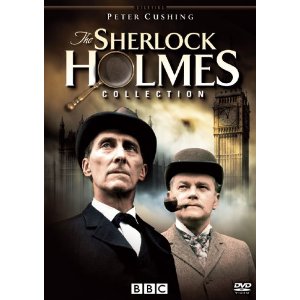
So I got a couple of discs that were savings, but not huge, but three others that I was really pleased about – the best being the three disc Sherlock Holmes Collection for $5.99. This is all five of the surviving episodes of the 60s BBC Sherlock Holmes TV series, starring Peter Cushing as Holmes. I had two of these episodes as a gift from my friend Parker, who had gotten duplicate discs from Amazon UK back in the day, and they were not interested in him returning the dupe. I have a region-free DVD player, and really enjoyed that R2 disc.

Like I said, Movie Exchange is usually pretty knowledgeable about such things, so the $5.99 price tag was a bit of a surprise. (now that I check on Amazon, that’s pretty typical for used copies) Then I noticed the store-generated label, which read “SHERLOCK HOLMES – MATT FREWER”. Ah, that explains a lot.

I decided to break into the set with its two-part adaptation of “The Hound of the Baskervilles”, a version I had not yet seen. “Hound” has to be the Holmes story most adapted into movie form. No surprise there, as it’s a hell of a great story. But it is also a story in which the supposed main character – Sherlock Holmes – is absent for two-thirds of the story. It’s Watson’s chance to shine, and sometimes he does. Not so much in this case. Nigel Stock is a Watson in the Nigel Bruce mold, though not as weighted toward comedy as was Mr. Bruce. In fact, in the 1939 Hound of the Baskervilles with Basil Rathbone as the Great Detective, Bruce’s Watson becomes a pretty dynamic character, until Holmes shows up, and then the good doctor just sort of deflates. In similar circumstances, Stock’s character remains steady, if a bit petulant .

I’ve grown so familiar with “Hound” over the years that the primary enjoyment for me in watching these adaptations, besides the quality of the Holmes and Watsons on display, is watching how the various versions take apart and rearrange the elements of the story.  The BBC version hews closer to Doyle’s original than most, though it cuts the ending short by Holmes revealing the killer twenty minutes before the actual end of the story! I guess that really cuts down on the problem of an exposition-heavy conclusion, but it’s rather disorienting all the same.

Jeremy Brett remains my favorite Holmes, but Cushing is, as you would expect, very good in the role.. There is no feeling of him simply hashing over the Hammer movie version of a few years previous, and if he is not a Homes for the ages, he is a very entertaining one. I look forward to the other four episodes in the set, even the ones I’ve seen before.

My viewing encompasses a very wide range of what we accept as “heroism” in the movies. I’m not sure of how many cartoon bad guys Machete kills, but it’s a lot; Superman, of course, refuses to kill even literal cartoon bad guys, which is the whole point of Superman vs The Elite; and then, of course, we have Holmes, who generally defers to his ex-Army roommate to handle the wetwork (and even then, Watson shoots to wound, unless you’re a Hell Hound). That’s a very wide range of heroics in pretty violent genres, and it is pretty telling that at this point in time, Superman’s noble stance seems as out-of-place as Holmes’ intellectual detachment; like it or not, we’ve been living in the age of Machete for most of my life, and likely yours, as well.

Back-to-School Crap

This one had been brewing since July. Busy Summer schedules pushed it into August, when I suggested the last Sunday, August 26th, for the day. Plenty of time! All and sundry concurred. Then, on the blessed day came the apologies, the excuses. Once more, it was down to the Four Horsemen: myself, host Dave, Alan, and Rick.

That’s okay. We know who are the hardcore, the faithful. And who are the cowardly, weak, craven, chicken-hearted, gutless, lily-livered, spineless, yellow-bellied, pusillanimous weak-kneed pigeon-hearted wusses.

Anyway.

Dave started things off with some horrific thing he had found on the Internet, Strange Beings. Let me see if I can adequately describe Strange Beings, though it really requires the literary talent of a Lovecraft. Firstly, you should know that Strange Beings  is a Power Point presentation, created before Microsoft ever invented the Great Satan of meeting software. This means that basically it sounds like somebody put a tape recorder in front of their crazy uncle, asked him Tell us about the Little People again, Unca Joe, and then took the resulting droning dissertation and used it as the soundtrack while they pointed a camcorder at books of art and scrapbook clippings. There is no motion in this thing. None. Except where the aging tape is damaged and loses the signal for a moment.

It is also two hours, three minutes, and twenty-three seconds long. That is the exact length of a VHS tape, and our narrator uses every goddamned second of it. In fact, the presentation cuts off in mid-sentence, just as he is about to deliver to us some Great Secret. “We all live in a potential para-” Para what? Paradise? Paramecium? Paratrooper? Paranormal Activity, Part Three?

The entire thing is available on YouTube. In fact, screw you, I don’t trust you, here it is right now:

Be aware: I was nice. I actually tracked down the segment where he starts talking about The Carrot People, which makes the entire endurance test almost worth it. At about the 4:55 mark.

This is apparently the work of Al Fry, about which you can find very little on the Internet, and by you, I mean me. There are other videotapes by him floating around, with titles like Triple Your Intelligence & Memory, How to Find & Keep A Soul Mate, and of course, The Hidden World History, helpfully subtitled on YouTube as “Conspiracy NWO”, which might give you an idea as to the mindset we are dealing with here. It was likely sold through ads in the back of Fate magazine and UFO Monthly. Maybe even Fortean Times. If it ever wound up at your local video store – and mine, for years, bought everything – it was on the 99 cents a night rack.

Dave’s wife, Annie, was dealing with this magnificently, but then, she was off in another room, enjoying Mr. Fry’s soothing tones. She opined that “He sounds like he’s paging through the Golden Book Encyclopedia of Magic and paraphrasing everything he sees.” Me, at about the hour mark, I was finding excuses to not be in the same room with Strange Beings. I was reduced to doing my imitation of Yaphet Kotto in Alien: “I’m asking you to pull the plug.”

Two hours, three minutes, and twenty-three seconds.

Personally, I think Dave had been saving this up ever since I mortally wounded him with Harvey Sid Fisher’s Astrology Songs. It didn’t help that I had said “Sure, why not” to Strange Beings after a glance at a brief description. Finally, with thirty minutes left, Dave took a hint from the torches and pitchforks and put on Jaws: The Revenge.

If you want to make Jaws: The Revenge look like fucking Star Wars, watch it after 90 minutes of Strange Beings.

You may recall that Dave was going to spring this on us several Crapfests ago, only to find that Netflix had unceremoniously dumped it from their streaming service. Rick appreciated this, because it gave him something to whinge about for ages. I finally took it upon myself to solve this situation, because, you know, a used DVD cost like five bucks on Amazon. So. Mea culpa.

I have spent my life making believe that there was only one Jaws movie. One Indiana Jones movie, a couple of Alien movies, and, on a good day, up to three Star Wars movies. So I really have no idea what sort of backstory I am dealing with here, except that apparently Jaws 3-D never happened. There is a subplot about what is apparently the mate of the Great White from the original Jaws tracking down the members of the Brody family no matter where they are, because it is a Psychic Revenge Shark, which someone thought was more realistic than the original idea, a voodoo zombie shark.

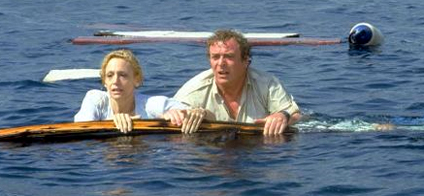
I say it is a subplot because most of the movie is taken up by the widow Brody (Lorraine Gary, probably regretting being lured out of retirement) falling under the spell of fast (and constantly) talking pilot Hoagie (Michael Caine, giving me lots of opportunities to trot out my horrible Caine impersonation). This is apparently an attempt to distract us from the fact that this movie is ripping off Orca for its main plot.

The elder Brody son is now an oceanographer studying new ways to blow up hermit crabs, so Mom gets to have a lot of hysterical scenes demanding he toss away years of expensive college to become a desert hobo or something. Did I mention the younger son got eaten by the psychic revenge shark at the opening of the movie? That was when we still thought it was a Jaws movie.

The script does stuff that would get any normal writer fired and his typewriter confiscated. Maybe that did actually happen at some point, because reportedly Mario van Peebles wrote his own lines and came up with his own semi-Jamaican accent, mon. Somebody suddenly remembers this is a shark movie and Mom goes out to sea to face it alone. Hoagie, son and Mario-mon fly out to find her, and Hoagie lands his plane nearby, apparently forgetting it is not a sea plane. Mario gets chomped on by the shark, to the cheers of all present. Then at the end it is revealed he is still alive, embittering us all for life, mon.

I haven’t even gotten to the roaring shark, the incredibly bad parenting, or the fact that the widow Brody’s hydrophobia has a whiplash-causingly rapid, complete and utter turnaround under the spell of Hoagie. If you absolutely must know more, I direct you to the Master of All That Is Bad Ken Begg, and his typically exhaustive write-up. I don’t have the strength anymore.

Why am I so exhausted? Because after Jaws: The Revenge, it was time to fix dinner, so Dave decided we should watch the remainder of Strange Beings while we did this, “Just so we can say we got through it.” This delighted Annie, and horrified me, as Fry’s vampiric tones once again muttered through the speakers. This is, admittedly, the only way I found out about the interrupted secret of the universe. But at what cost?

After not having the promised Secret of the Universe given to us (as promised), it seemed somehow logical that next we should watch Petey Wheatstraw, The Devil’s Son-In-Law.

You might recall at the last Crapfest, we marched joyfully into Rudy Ray Moore’s Avenging Disco Godfather, only to find ourselves in the grip of a message movie. We were hoping for something more classically Rudy Ray n Petey Wheatstraw, and in a lot of ways, we got it.

Watching a Rudy Ray Moore movie is a whole lot like tripping and falling through the looking-glass: you find yourself in a strange alternate dimension where Rudy Ray Moore is the sexiest man alive (the man does pack a ton of charisma, if not a lot of acting talent), and the normal standards of storytelling and filmmaking do not hold. Petey Wheatstraw is pretty ambitious for a Rudy Ray movie, and if you miss the raw fun of the Dolemite movies, you still have to give the man some props.

Firstly, you have a woman giving birth to a watermelon (watermelons are a continuing motif), then a baby who appears to be a five year-old boy. Said boy kicks the doctor’s ass and is given the name “Petey Wheatstraw”. The devil’s son-in-law part comes later.

After rigorous kung fu training (involving watermelons), Petey grows up to be Rudy Ray Moore, doing Rudy Ray Moore’s stage act.  This will put him up against the villainous vaudevillians Leroy and Skillet (played by Leroy and Skillet), who, to prevent competition with their new nightclub, have Petey and a whole bunch of other people machine-gunned at a funeral.

Going to remind you here, this is a comedy.

This leads to the Devil offering Petey a deal. If he’ll marry the Devil’s daughter and give Lucifer a grandson, Petey will be returned to Earth and given a shot at revenge. The Devil’s a pretty magnanimous kind of guy, and raises everyone at the funeral from the dead – except the kid in the coffin. So Petey wrecks Leroy and Skillet’s opening night – quite literally, using a magic cane the Devil has given him – so, hey, great movie! Glad I watched i—

Oh, wait, it’s not over yet. Petey spends the rest of the movie performing miracles with his magic cane, to the irritation of the Devil and his daughter. He is also trying to figure out a way to trick the devil and get out of his upcoming nuptials. My favorite part of his schemes is that they involve fooling the Devil just long enough to get out of town, because the Devil seemingly has very limited jurisdiction.

So you can see that Petey Wheatstraw has a good deal more scope than the Dolemite movies, if not the budget to fully realize it. The final scenes where the Devil’s minions, all leotards and dimestore capes and heavy face makeup, keep popping out from various doors, alleyways and other inconvenient places to face down Petey in simply-choreographed kung fu fights, are pretty wonderful in their low-rent let’s-make-this-movie way.

I also always like the way Moore wasn’t shy about slipping his friends’ acts into his flicks. Dammit, I want to see a Leroy and Skillet movie.

Rick was also fascinated by Leroy and Skillet – or, as they seemed to be known in their non-cinematic endeavors, Skillet and Leroy – and sent me the cover to one of their party records:

Finally, it was my turn. I had been kind of nervous, watching the clock get later, and later, that I would get squeezed out, but no, it was early enough – if just barely – for me to put in The Raid: Redemption.

I generally bring the kung fu films, you see. So when I had a chance to parlay that into a Crapfest screening – well. I did it. Don’t think anybody regretted it; we discussed it animatedly in video game terms. “Man, I hope he finds a save point soon.” “Oh, crap! Mini-bosses!”

I’ve already gone on about The Raid, but here’s that preview one more time:

Looking forward to that sequel, let me tell you.

Then we gathered up our traps, and prepared to leave. What was on TV, once we turned off the DVD player? Why, look, it’s Batman and Robin. It’s like they knew.

This led to a discussion of “Why not Batman and Robin? It’s crap!” The answer to that may be as simple as Dave’s “I don’t know if I could face that again.” But now Rick has something new to whinge on about, and balance is maintained in the universe.

Solaris (1972)

It seemed that all my adult life I had been hearing about the movie Solaris. There was a lot to recommend it; first there was the cachet of rarity. Not only was it a foreign film, but it was a Soviet film, to boot. It was notoriously hard to see in the pre-home video years, and when it was shown, it generally heavily cut. The other reason was that it was an increasingly rare creature, a genuine science-fiction movie.

That right there is a sentiment that has gotten me into trouble before. In the olden days, on another site, I once mentioned the fact that I do not consider Star Wars a science fiction movie. It is pulp, it is an adventure story with rocketships and zap guns, but that alone doesn’t make it science fiction.

I still get angry letters about that.

Science fiction is a genre of ideas, and at its very best, it shows what effects those ideas have on the human condition. A Princess of Mars is pulp. Do Androids Dream of Electric Sheep is science fiction.

Polish writer Stanisaw Lem was pretty fed up with the Buck Rogers model that was predominating Western science fiction, and took up his own pen and wrote some cerebral literature, one of the most famous being the 1961 novel Solaris, which has been translated to film three times: a Soviet television movie in 1968, once by Stephen Soderbergh in 2002, and today’s exercise, made in 1972 by Andrei Tarkovsky, a director of undeniable talent, but one with a troubled career, making only seven movies in his lifetime.

It is probable that Tarkovsky hit on Solaris because he was having so many problems getting a movie green-lit in the USSR, and felt that such a popular novel would increase his chances. It turned out to be a cagey move, as the movie racked up a couple of awards at the Cannes Film Festival, and was even up for the Palme d’Or.

Solaris is the name of another planet, which has had a research station in orbit for some time. The surface of Solaris is covered with ocean, but it’s not water; it’s some sort of constantly-flowing plasma, perhaps a neural net of some sort. The entire planet is a living organism.

In the early days of the mission, one of the scientists got lost in the ocean, and a now-discredited helicopter pilot reported seeing the surface of Solaris coalesce into a monochrome imitation of an earthy garden, then a twelve-meter tall imitation of a human being. Only upon returning to Earth did the pilot discover the mannequin was an exact duplicate of the missing scientist’s now orphaned son.

But Solaris’ protagonist is psychologist Kris Kelvin, sent to the Solaris Station to determine whether the mission should be shut down. Originally designed for a crew of 85, it now houses only 3 men… and one of them commits suicide while Kelvin is in transit.

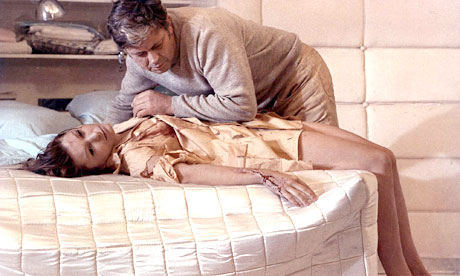
Something has been affecting the crewmen deeply since the station bombarded the surface of Solaris with radiation, and Kelvin soon finds out what that is when he finds his room occupied by his wife, Hari, a woman who killed herself ten years before. Panicking, he manages to shoot her into space, only to find another duplicate in his room minutes later.

Solaris is somehow manufacturing these duplicates, termed “guests” by one of the remaining scientists, harvested from the earthmen’s memories.  Though we get only glimpses of the “guests” of the remaining crewmen, Snaut and Sartorius, they have definitely taken their toll on the men. Snaut drinks constantly, and is always bandaging wounds on his hands; Sartorius has become a sullen cynic, using the “guests” as experimental animals.

Solaris is short on action but long on words and ideas. Sartorius mentions that most “guests” take the form of people they have wronged; Kelvin does indeed have to face the fact that Hari committed suicide after one of their many arguments, and he unwittingly supplied the means of her demise. But he also finds that in the decade since, his feelings for her have deepened, and he loses himself in her return, however false he may know it to be.

Hari is, at the same time, frightening and pathetic. Kelvin once shuts a door between them, and the panic-stricken Hari tears through the steel to rejoin him, her wounds healing within minutes. As the weeks wear on, she actually becomes more and more human, learning to sleep and to cry. And, as she becomes more truly Hari, to learn to despair, and once again, commit suicide. Only to come back to life in minutes.

Kelvin is the first to successfully bond emotionally with a Guest, so another burst of X-rays, this time modulated with Kelvin’s brainwaves, is fired at the sentient Ocean. Kelvin shortly thereafter falls into a fever, looked after by Hari; he has a feverish dream of his dead mother, who hated his former wife. When Kelvin recovers, he is told the Guests have stopped materializing since the last X-rays, and Solaris seems to be forming a land mass from its plasma. He is also told that Hari begged Sartorius use an experimental device to destroy her once and for all.

The final sequence of Solaris finds Kelvin at his Earth home, though something is wrong – it’s raining inside the house. As he embraces his father, the camera pulls back and back and back, soaring into the sky, revealing the house to be on the land mass created by Solaris from his mind.

Like I said, science-fiction is a literature of ideas and how those ideas affect and explore the human condition. Even as long as my reviews usually run, I can’t touch on everything presented in this movie, like Snaut’s drunken musings on how Mankind is forever doomed to screw up first contacts, or Kelvin’s determined blindness to evidence of the Guests on his first arrival on the station.

 Solaris is a melancholy picture, though not a totally bleak one.  There is a constant urge to return to the Earth, even in the earliest parts of the movie that are actually set on Earth. Kelvin lives with his father and aunt in the country, a serene house with a large pond and rolling hills, contrasted – none too briefly – with the nearby city, where a very busy Osaka, Japan is transformed by editing and camera trickery to a vast concatenation of tunnels, bridges and heavily occupied highways.

The station itself, one of the most expensive sets ever made for a Soviet film, is a quite marvelous blend of high-tech fallen into disrepair and slovenliness. Everything still works, but trash litters the corridors, panels hang awry.

Solaris is compared to Kubrick’s 2001 a lot, mainly because of the futurism, but especially because of the pace. Tarkovsky likes his lengthy shots and languid pacing, but those trash-strewn corridors should more than serve to distance it from 2001, which Tarkovsky dismissed as “too sterile”.  (also, I’m told that Tarkovsky’s usual penchant for loooooooooong shots was held in check for this movie). There is a lot more messy humanity on display here, too, though my first thought when we enter Kelvin’s fever dream is “Okay, we just got 2001 with this.”

Tarkovsky

Stanislaw Lem was also apparently unhappy with this version of his novel, and was more satisfied with the Soderbergh version – which also runs almost half the length of the Tarkovsky version. Which sort of implies I have no earthly reason not to see that version, now that I’ve seen the original.

Do I regret seeing this version? No, not at all. It’s an apple that has been held out of my reach for far too long, and which I have finally tasted, and found mostly to my liking. If it was a little too lengthy and a little too Russian for my tastes, well, that’s the world of film.

Emphasis on “world”. Even just stuck on this one planet, we ain’t got all the answers.

Crime and Avoiding Punishment

After spending some time with found footage movies, it was time to move to a more conventional type of movie presentation, and if we are going to ease back into a more traditional type of movie, I feel it’s best to use something with a high quirk factor, because that, my friends, is how I roll. And that means continuing to fill out my list of 60 Movies I will Absolutely Catch Up On This Year with some more Coen Brothers, in this case, No Country For Old Men.

Well, you can be pretty sure that if you’re watching something based on a novel by Cormac McCarthy, you’re in for a sure-fire laugh riot. Haha, I kid Mr. McCarthy, but in discussing this movie with pal Dave, he opined that The Road was a far more upbeat affair than No Country for Old Men.

The movie starts with Tommy Lee Jones, playing Sheriff Ed Bell, who talks about his life as a lawman in a family of lawmen, how he always loved to hear stories of the old-timers, some of whom never even wore a gun. “You can’t help but compare yourself against the oldtimers. Can’t help but wonder how they would have operated these times.” Which is your theme and explanation of the title right there.

Llewellyn Moss (Josh Brolin) is hunting in the Texas desert with no success until he stumbles upon the scene of a drug deal gone wrong: several vehicles riddled with bullet holes, corpses, the sole survivor half-dead in a truck whose bed is filled with bricks of heroin. He trails the one person to getaway from the scene, finding him dead under a tree, and clutching a satchel filled with a whole lot of money.

Moss takes off with the satchel and a couple of free guns, but doubles back later when a twinge of conscience forces him to return with water for the dying man. He’s going to regret that charitable urge for the rest of his life, because that’s when one side of the drug dealers show up to find out what happened to their stuff. Moss gets away – barely – but only by leaving his truck behind.

Moss packs his wife Carla Jean (Kelly Macdonald) off to her mother’s and begins life on the run, followed a group only referred to as The Mexicans, and someone infinitely worse: Anton Chigurh (Javier Bardem, in an Oscar-winning turn), a perfect collection of dead-nerved soicopathy who generally leaves everyone he encounters dead. His weapons of choice: an air hammer meant for use in a slaughterhouse, and a shotgun with a silencer. His trademark: making his victims call a coin toss, like a semi-sporting Two Face.

The movie is an enthralling chronicle of that brutal chess game, with Moss, who we find is a Vietnam vet, and Chigurh fairly evenly matched, their single encounter rendering both men badly wounded. Chigurh, in classic villain form, is pretty incensed when he finds out other people have been sent to look for Moss; he takes it personally, even killing the one person who has located the target and the satchel, without being told either.

If there is one thing that spoiled my watch of No Country for Old Men, it is that one sequence – because of the way it was shot, or kinda confusing dialogue, or just being an old man myself, I did not understand. Like a lot of Coen Brothers movies, there are some balls still in the air when the movie ends, and my misunderstanding led me to think that there were a whole flock of balls in the air. Luckily, I was watching it with my pal Dave, and later discussion proved he’d had the same experience (which made me feel infinitely better). Score one for waiting to watch it on DVD.

It was the same way with The Big Lebowski, really. I was tooling along on the story, ready for the big payoff, and the movie ends about 15 minutes before that payoff. And if ambiguity in an ending is the worst criticism you can level at a movie, then that is one good movie.

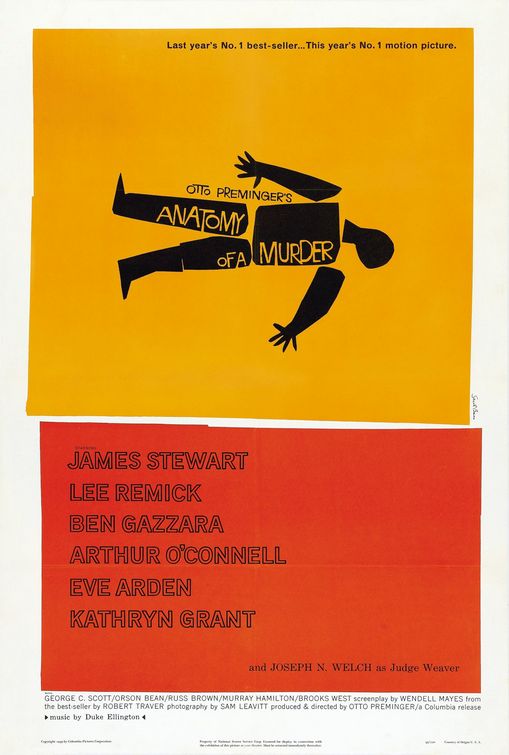
The next day called for something to balance that, which seemed to be the 1959 Otto Preminger movie Anatomy of a Murder. I knew this was held out as a classic courtroom drama, so I figured chances were good for a definite ending.

Preminger did not shy away from controversy; just four years earlier he had examined drug addiction in The Man With the Golden Arm. Anatomy of a Murder was based on a best-selling novel by Robert Travers, a pseudonym for Michigan Supreme Court Justice John D. Voelker. It’s based on a real court case, but there are some things you can do in literature that you couldn’t do in movies in 1959, like mention the word rape or even refer to panties.

Former district attorney Paul Biegler (Jimmy Stewart) is facing a foundering private practice when he takes on a high-profile case. Army lieutenant Manion (a young, intense Ben Gazzara) has shot and killed a local bar owner after the man had allegedly assaulted and raped his wife Laura (Lee Remick, who is acetylene torch hot in this movie).  Biegler will be in the courtroom up against the man voted into his former office, who brings in a better legal gun from the state Attorney General in the form of Claude Dancer (an early turn from George C. Scott, smooth and graceful as a shark).

There is the usual amount of investigation and probing before the trial, but it’s the courtroom action that forms the majority of the movie. The actions of the lawyers are as much performance and  histrionics as anything else, and it is to the movie’s credit that parts of the case as presented become so ambiguous that by the end of the picture we, the viewers, join Biegler and his team in not envying the jury the choice they have to make.

I speak of Biegler’s team, by which I mean the always welcome Arthur O’Connell as a lawyer turned town drunk who sobers up to help his old pal, and the criminally underrated Eve Arden, as Biegler’s smartass – and smart – secretary, who’s a few paychecks behind.

One especially wonderful piece of casting is the presiding judge, who is brought in from a circuit court as the local judge is recovering from a serious illness. This man is Joseph N. Welch, who served as an attorney for the Army during the Army-McCarthy hearings. You know, the guy who said, “At long last, have you left no sense of decency?” That guy. He had some TV notoriety from that, and does well in the role. (A fun anecdote from the Criterion disc tells of Welch being nervous around Gazzara, who had a reputation as an extremely serious young method actor who brooked no less than equal perfection from the people on set with him. He needn’t have worried, as Gazzara had watched the televised hearings and adored the man.)

Over 50 years after the fact, it’s hard to see what the shouting was about. We hear about rape and murder nightly (and before we even get to the news, har de har), so the more salacious moments only seem quaint at this remove. We can, instead,  just enjoy the soundtrack by Duke Ellington (and the sight of Jimmy Stewart jamming on a piano with the Duke in a smoky road house), the excellent performances by seasoned and unseasoned pros in an excellent cast, and the beautiful black-and-white photography of a handsomely appointed, real courtroom, all marble and wood.

Here’s Otto Preminger moving into Alfred Hitchcock territory with the trailer:

Found Footage

There’s a lot of pre-hype going around for a new movie from Magnet Releasing, V/H/S, and damned if I’m not starting to buy into it. A look at the red band trailer this morning kinda solidified that.

So there are, like three possible reactions to that: people like my wife, who if they accidentally watch it, swear they will never watch anything like that. People like me, who want to watch it now. And the third type, who will immediately spit on it because it’s “Shaky-cam.”

My name is Freeman Williams, and I like found footage movies.

(“Hi, Freeman!”)

A lot of you are going to start grumbling about The Blair Witch Project, but hold off on that for a while. My love for this sort of thing goes back even further, to a TV movie called Special Bulletin (1983), which is about a TV news crew reporting on a dockworker strike, who are taken hostage by a group of nuclear terrorists. Follow that up about ten years later with the 1994 Without Warning, which is a supposed series of newscasts dealing with a meteor striking near a populated area, but the meteor turns out to be something else. Both attempt to use the breaking news format to tell a story; we’re used to news reports punctuating dramatic story lines, but not as the sole means of delivery. Both movies have flaws but are pretty entertaining. Special Bulletin is available from my favorite vendor, Warner Archive, and Without Warning appears to be on YouTube in its entirety.

You could go back further to Orson Welles’ radio version of War of the Worlds, with its stitched-together radio news broadcasts. Or you could back even further, to Bram Stoker’s Dracula, presented entirely in the diary entries of various characters. But then the lines we’re trying to draw get pretty muddy, so let’s return to the present day.

The 1992 French film Man Bites Dog carries on the news crew trope, but the following year’s America’s Deadliest Home Video marks the true birth of the camcorder movie, six years before Blair Witch. I’ve seen neither of the predecessor films, but I think Blair Witch is easily considered the point at which the camcorder movie came into its own. Outlandishly successful, due more to an amazing ad campaign (that pre-release website was an absolute work of creepy genius) than its actual merit as a movie, it’s everything that’s right and wrong about the subgenre. It has a stark immediacy and some truly unnerving moments. It also has no idea what to do with itself during long periods of the running time and three actors who need to learn another word beside “fuck”.

I’ve not seen all the found footage movies since, but I do find them gaining in confidence and quality. Cloverfield, again, has its flaws, but they’re muted. Troll Hunter is one of the best. And finally, this last weekend, I saw a couple more.

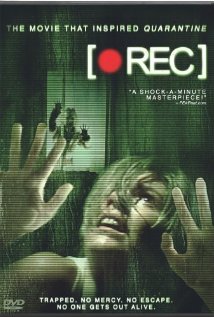
[REC] (2007) is a Spanish movie where – stop me if you’ve heard this one before – a small TV crew (a newswoman and a cameraman) are shooting an episode of While You Were Sleeping, documenting the night shift of some firemen. They go out on a minor alarm with two of the firemen, an elderly woman in some distress at a small apartment block. Then things get interesting when the woman attacks one of the police officers that arrived earlier, and everyone finds themselves sealed inside the building by a force of soldiers who threaten to shoot if people even get close to the windows. There is some sort of virus spreading quickly among whoever is bitten by the infected, and the need to find some manner of escape becomes more and more desperate as the ranks of the infected increases. They’re not quite zombies, but they’re not simply insane, either: there’s something evil afoot here.

[REC] clocks in at a brisk 78 minutes. There’s some filler, but it’s all at the beginning, as the crew shoots what would be, yes, filler for their episode. Once in the apartment, however, the story kicks into overdrive and rarely slows down. As was the case with Blair Witch, the actors had no idea what was going to happen from day to day, and that sets up several scares that not only get a hell of a reaction out of the actors, but out of the audience, too. I rate myself a pretty hard guy to scare, anymore, but [REC] definitely got me a couple of times.

The usual criticism against these movies is “Why do they keep filming?” [REC] circumvents that nicely in several ways. 1) It’s the guy’s job. Seriously, I’m a videographer in my day job. My question is always “Why did he stop filming?” 2) There is a Spanish woman yelling at him to “tape everything!” My first love was Hispanic. Do what they say. 3) There is, inevitably, a point at which the lights go out, and the only light is on the camera. Also, I am always surprised at these cameras that have a night vision function. This movie, Cloverfield, and apparently The Descent (which I am told I need to get over my claustrophobia and watch). Maybe I just use the wrong cameras.

Here’s the first trailer I ever saw for [REC], composed only of night vision footage of audiences watching the movie, followed by a more traditional trailer (there’s one available in English, but it doesn’t use any actual footage from the movie.)

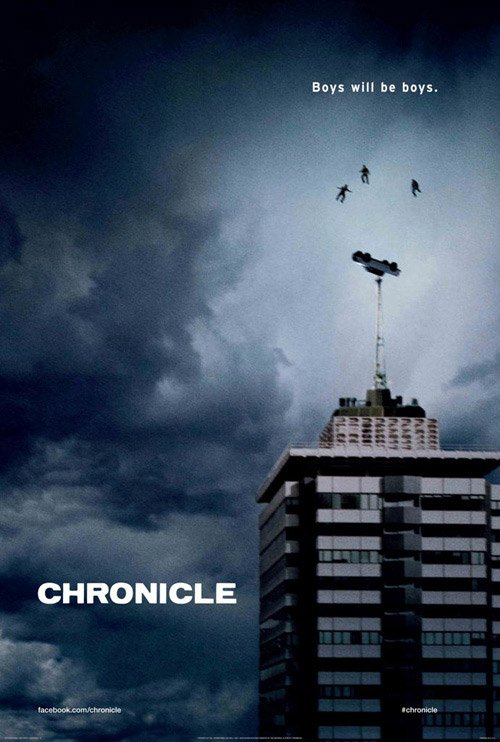
If there’s one type of movie you aren’t really expecting to get the found footage treatment, it’s the superhero genre. Nevertheless, here we are, watching a movie called Chronicle. The plot is pretty simple: three high school boys find a glowing something-or-other underground, and shortly thereafter find themselves developing telekinetic powers, including the ability to fly and some limited invulnerability. Power then proceeds to corrupt.

Director Josh Trank is pretty confident with the medium. “Why do they keep filming” is covered by the protagonist, Andrew, buying a video camera as a means of protection against his abusive, drunken father, and continues to play with his new toy. As the story progresses, the camera POV is switched to other cameras, such as a girl really into her vlogging, and security cameras. Andrew is especially adept with his new powers, multi-tasking, and eventually acting as his own camera crane. Andrew’s free-roaming camera practically becomes a character on its own as the story proceeds.

You know things are going to go badly the more we find out about Andrew’s home life; not only a father that uses him for a punching bag (along with the usual stooges at school), but a mother slowly dying of cancer. That’s going to be the tipping point of a life already spiraling out of control: a drug that will alleviate her suffering, but carries with it a $750 co-pay. When the neighborhood thugs don’t have that much, Andrew turns to outright crime, but a limited imagination squashed by a lifetime of crushed dreams leads to purely penny-ante theft and unforseen consequences, which in turn leads to the final, pretty darned apocalyptic confrontation.

The power stuff is pretty heady… if limited by the fact that it’s teenagers, who wind up doing teen-age boy things with them. That part I found pretty realistic, actually. Steve, the aspiring politician, points the way to utilizing the power for the most pragmatic uses, flight and moving cars around. Matt, Andrew’s older cousin, is slowest to master his power but also finds the deepest rewards; his feckless, slacker lifestyle becomes more responsible, he starts connecting with a girl who was once out of league, but is becoming impressed with the man he’s developing into. Matt’s altruism is also developing, but he finds out the depth of Andrew’s personal pain far, far too late.

The story applies the Foreshadowing Brush a little too heavily in a couple of places, but is pretty enjoyable, for the most part. Once more, the found footage format, the slightly stepped-on quality of the video, adds some verisimilitude to the effects. Those effects sometimes betray their digital origins, but mostly look simply amazing to the unsuspecting eye. Not a perfect movie, but a pretty damned good one.

And Josh Trank will be handling the Fantastic Four re-boot. having now seen Chronicle, I can breathe a relieved Thank God.

Then again, here I am in 2016 repairing YouTube links and thinking, “So much for high hopes.”

Oh, I’m finally watching Marble Hornets on YouTube, even if it is pretty much everything people find annoying about these things.

But yeah, I like found footage.

Bring it.

The Samurai Trilogy (1954-56)

The Criterion 50% off sale at Barnes & Noble – the gift that keeps on giving.

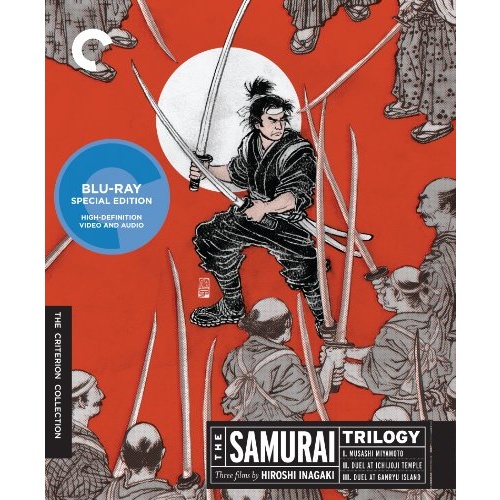
Criterion recently put out a Blu-Ray set of the well-regarded “Samurai Trilogy” by director Hiroshi Inagaki, a man with a prodigious filmography, and who pretty much defined the modern samurai movie. Taken from an incredibly popular serialized novel by Eiji Yoshikawa dubbed “The Gone With The Wind of Japan”, published several times here in the states under the simple title Musashi, (once in a five-volume paperback series, which gives you some ideas about the length and depth of the novel), it’s the tale of folk hero Miyamoto Musashi, a spectacular historical figure who was warrior, artist, and philosopher all-in-one.

To say that Yoshikawa’s version of the man’s life is incredibly romanticized is not understating the case; though there are portions of Musashi’s life that are sketchy, we can be reasonably sure he was not the unpopular orphan presented in the first movie, Miyamoto Musashi. A wild, intense youth named Takezo (Toshiro Mifune, here looking very young, indeed) who runs away from his village to make his fortune in war, dragging his best friend with him. The best friend, Matahachi (Rentaro Mikuni) the best friend’s betrothed, Otsu (Kaoru Yachigusa), and numerous others who become entangled in his life over the next two movies, are all fictional. The Buddhist priest, Takuan (Kuroemon Onoe), who looks after Otsu, has some historic basis, but didn’t enter Musashi’s life until much later.

All of this isn’t too significant to enjoying the movie, which is, to be sure, a ripping yarn. Takezo and Matahachi are on the losing side of the Battle of Sekigahara, one of the great routs in Japanese history, and wind up taking refuge with two women, Oko and Akemi (Mitsuko Mito and Mariko Okada) mother and daughter who get by looting the bodies of dead samurai (which brings uncomfortable thoughts of Onibaba to mind). Both women fall for the wild Takezo, especially when he lays the smack down on a bunch of bandits, even when armed with only a wooden sword (Mifune and bandits – go figure). Oko’s lusty advances confuse the young man so much, however, that he runs away, and it is Matahachi who winds up escorting the women to civilization, eventually marrying Oko and forsaking Otsu.

Takezo fights his way through a checkpoint to journey back to his village, and in doing so, becomes a fugitive – a contingent of troops moves into the village and a less than sympathetic samurai starts arresting villagers and forcing others to search the woods for the wild man. Intriguingly, none of these geniuses never stop to wonder just how the hell this guy is managing to take out trained soldiers with a wooden sword, but here we are. Takezo literally only wants to inform Matahachi’s mother and Otsu that his feckless friend is still alive, but after a betrayal by the mother, finds himself once again in the forest, now more a hunted savage than ever.

It’s the zen priest, Takuan and Otsu who eventually bring him in, and Takuan uses his long-standing friendship with the local lord to prevent Takezo’s execution. After a long, complicated series of escapes and captures, Takuan finally manages to trap Takezo in a room high in the lord’s castle, where he will spend the next three years, locked in a room full of books, sutras and manuals. He emerges a much more calm, worthier man. The lord proclaims he is now Miyamoto Musashi … Miyamoto for his home village, Musashi as an alternate reading of the ideogram for his name… and gives him a fresh start. Takuan advises him to make a clean break and not see Otsu, who has been living nearby all these years, but Musashi does anyway, and finds the meeting just as painful as Takuan predicted. Musashi leaves her once more to travel on a pilgrimage of training, leaving only the words “FORGIVE ME” carved into the railing of their meeting place.

Miyamoto Musashi is a consistently beautiful movie, and one wonders if Inagaki’s willingness to remake his early 40s trilogy is due at least in part to the opportunity to film in Eastman Color. The film is shot totally on location, and the countryside and forest landscapes are amazing (and needless to say, eye-popping on Blu-Ray). The next two movies will rely more on studio sets and backlots, which rachet down the eye candy a bit, but has little real impact on the storytelling.

The second movie, Duel at Ichijoji Temple, finds Musashi well on his way to becoming the finest swordsman in Japan, never losing a duel. After defeating and killing an accomplished kusari-gama weilder, another priest admonishes him for being “too strong… entirely too strong!”  This leads him into studying other disciplines, such as art, to temper his approach to life. An encounter with an unusually proficient and worldly sword polisher leads him into the world of music, where a courtesan running one of the better houses falls for him, once more to no avail. During this time, Musashi begins his famous series of duels with the Yoshioka fencing school, where the students, in order to protect their master, keep engineering ambushes to kill Musashi, usually to their sad disappointment.

During one of these donnybrooks, enter Kojiro Sasaki (Koji Tsuruta), a swordsman of no small talent himself, who knows that he and Musashi will someday duel; he recognizes that the Yoshioka students are no match for Musashi, and moreover desires that Musashi gain more stature so that this future duel will have more meaning. Sasaki is another historical figure, and Tsuruta is fascinating to watch, a combination of feline grace and equally feline amorality. There are times he comes close to eclipsing Musashi as the star of his own trilogy.

Things come to a head at the titular duel, where Yoshioka’s disciples physically restrain him from going to the Temple so they can mount one last ambush against Musashi. Knowing he is walking into an ambush, Mushashi nonetheless takes on 60-odd Yoshioka men and manages victory, eventually meeting an apologetic Yoshioka, who he then defeats… but does not kill. A definitive step in the direction of his managing his sword, and not vice-versa.

Oh yes, Akemi and Otsu drop into the story every now and then to complicate things. At the end, Otsu is nursing Musashi back to health after the multiple wounds of the ambush, leading Musashi to remark that he has never felt such peace. Yielding to the moment, he does what every other woman in the series has begged him to do, and embraces Otsu, who shocked, fearfully repels him. Shocked and dismayed himself, Musashi leaves her once more, this time deciding it is probably best to avoid women. (Among Musashi’s many notable character traits, we can also count celibacy).

Duel at Ichijoji Temple advances the story very well, showing Musashi’s development as a man, even more than as a warrior, as he comes to realize that becoming a great man involves more than simple strength. As he explores the world beyond his sword, we begin to see the man who will eventually be revered as the great Sword Saint of his country.

If the movie relies more upon studio sets, it also has to be noted that Inagaki eschews Toho-Vision, a widescreen format that was becoming extremely popular, and continues to shoot in the older 4:3 format. This may seem to be limiting as far as image size goes, but the more traditional spherical lens allows him to milk as much depth of field as possible out of the color film, and this enables him to pull off some beautiful staging, especially in that climactic duel.

The final movie, Duel at Ganryu Island finds Musashi even further advanced down his path, no longer ardently seeking out duels, but filling out his experiences, taking up wood sculpture. Meantime, Sasaki still seeks his own fame, eventually rising to fencing instructor for a lord after crippling a retainer in a duel with a wooden sword (Sasaki visits the man afterwards, apologizing that he overdid it, which is the act that secures him the position). Sasaki and Musashi set their duel, which gets delayed for a year, while Musashi and two disciples head out into the boondocks for his next phase of development: he becomes a farmer.

Of course, Akemi and Otsu are still looking for Musashi, and both run afoul of the bandits who are terrorizing the farmers, though Musashi and his two pals are terrorizing them right back (bandits again – go figure). It turns out that Akemi has connections with the bandits, and they send her into the village to tell the farmers that the bandits have been captured, so they can celebrate and be caught unawares when the bandits attack. Akemi tries to kill Otsu, accidentally triggering the signal for the bandits to attack; she then suffers a change of heart and dies protecting Otsu.

The bandits don’t fare too well in the fight, either. In the wake of the fight, a letter is delivered to Musashi, asking him to meet Sasaki at Ganryu Island, that they can finally have their duel.

Musashi prepares, returning to town, but staying with humble workers. Boatmen fall all over themselves volunteering to row him to the island. On the way, Musashi, as in the legend of his life, whittles a wooden sword out of an oar, to counter the length of Sasaki’s nodachi, the longsword. The duel is, appropriately, one of the visual highlights of the trilogy, fought on the beach, with the sun rising in the background. To no one’s surprise, Musashi wins, and looks down forlornly upon his fallen foe, telling the attending lord, “He was the finest swordsman I will ever meet,” before getting back in the boat to go home.

The final scene is of the boatsman, ecstatic and happy that he is bringing back a living Musashi, while, at the boat’s bow, Musashi weeps bitterly.

Historically, he is twenty-nine years old.

Oh, yeah, Otsu showed up one last time to distract him. By this time you’re about ready to strangle her.

Duel at Ganryu Island is a solid trilogy closer. If it seems to lag in the first half, it certainly pays off in the second, with the bandit attack and that final duel with the awe-inspiring backdrop. We lost Matahachi and his comedy relief parents in the second movie, but wind up relying on Musashi’s disciples (reluctantly accepted by the swordsman) for lightness.

Considered overall, the movies are a remarkable achievement, made at a period when a Westernizing post-WWII Japan was just beginning to be released from the Allied occupation. It was a time when it became necessary to decide exactly what part of the country’s history would be carried forward into the new age, and what part should be allowed to be forgotten. Miyamoto Musashi, embodying a unique balance of warrior, poet, artist and philosopher, was a natural for continued reverence. I would love to see Inagaki’s other version of this trilogy, made in 1940-41, to see if they have a more nationalistic flavor, to reflect an empire at war.

Mention has to be made of Toshiro Mifune, though really, what more can be said? Mifune simply owns whatever movie he is in, and the casting here – the second time Inagaki had cast Mifune as Musashi – is perfect. He takes the role and his craft very seriously – compare how young he looks and seems in Miyamoto Musashi as opposed to Duel at Ganryu Island, though the movies were released a mere two years apart. 1954 was also the year Seven Samurai was released, so Mifune had a very good year.

Weighing in at less than two hours each, I almost watched all three in one night, that’s how drawn I was into the tightly woven story. That’s a commitment I would hesitate to suggest to non-chanbara fans, but for those of us who enjoy Samurai Cinema, this was time very well spent, indeed.

Watching The Detectives

Friday was kind of an odd, time-shifted day for me. There was a special, lunch show for a private party, for which I had taken off work, and then there was no show on Saturday. That played havoc enough on my body clock, but then, during a very late lunch, I found myself reading the delightful live-tweeting of the 2012 Olympics opening ceremony by a feverish Warren Ellis. Then, after an exhausted nap, I watched the same ceremony, time-delayed by NBC, and I was one of thousands who put in at least one tweet imploring Meredith Vieira and Matt Lauer to for God’s sake SHUT THE HELL UP. Then a few hours later the ceremony was broadcast on the West Coast, and the process started all over again.

After the Very Long Ceremony had ended (along with an impressively brisk Parade of Nations, during which our NBC louts informed what was wrong with each nation as they marched), my world consisted of grand spectacle marred by clueless blathering, and time seriously out of joint. I wanted to watch a movie, but I wanted something short and, hopefully undemanding. I really should have reached for one of the low-budget horror movies that used to be my stock in trade, but my eye fell upon a recent acquisition from a Half Price Books run, a movie I had seen on it initial theatrical run in 1975 and hated, a movie I was willing to give a second chance: The Adventure of Sherlock Holmes’ Smarter Brother.

Curse my willingness to give things a second chance.

Released a year after Young Frankenstein and starring three of its major stars, we were expecting more of the same; but Smarter Brother never reaches its predecessors frantic heights, and in trying to do so, simply becomes tiresome. When your pre-credit gag involves an unconvincing physical joke followed by a poorly-dubbed Queen Victoria muttering, “Oh, shit,” you pretty much have your experience laid out before you.

Writer/director Gene Wilder is Sigerson Holmes (an arch nod to the Canon, at least), Holmes’ younger and extremely jealous brother; Marty Feldmann is Orville Sacker, Siggy’s assistant and a man with “photographic hearing”; and Madeline Khan is Jenny Hill, the MacGuffin that walks like a woman. The sublime Leo McKern is Professor Moriarty, and the usually reliable Roy Kinnear is his assistant.

The only thing worse than an unfunny comedy is an unfunny comedy with a cast this good. There is the occasional bit of business that raises a chortle from me, but they are few and far between.

I see that on the IMDb, there is a sizable number of people who love this movie. Well, good. I like everybody involved in this picture, and I’m glad that it found an audience. That audience is simply not me.

For a neck-injuring change of course, the next day I finally got to see The Dark Knight Rises, having managed to avoid all but one major spoiler. And by the time the spoiler would have paid off, I was so involved with the story that it didn’t matter, and the major payoff still caught me by surprise.

I found The Dark Knight Rises to be a very fitting trilogy ender, solid in execution. I prefer The Dark Knight, but then, that is more purely a Batman movie. Batman Begins and Dark Knight Rises are more properly Bruce Wayne movies. I enjoyed the call-backs to the earlier two movies, the unexpected guest shots, and agree with everyone that Anne Hathaway as Catwoman and Tom Hardy as Bane stole the show. Hardy, especially – respect to anyone who manages a performance that good with most of his face obscured.

Now to await the inevitable reboot and hope that it brings back the detective part of the character. The Nolan/Bale Batman was pretty much a ninja-trained reactionary, and we lost the portion of the character that studied criminology in various parts of the world along with the martial arts. Probably a minor fanboy cavil about what has been DC’s only really successful foray into the modern superhero cinema. Probably Nolan’s major achievement with this trilogy is producing a series of comic book movies that did not require much explanation to non-comics reading spouses.

Seeking to continue my Nolan buzz, Sunday night I pulled out my recently-acquired Blu-Ray of Insomnia, Nolan’s 2002 remake of Erik Skjoldbjærg’s 1997 movie of the same name (available on Criterion, no less). In an Internet discussion during the lead-up to Dark Knight Rises premiere, Insomnia was held up as Nolan’s weakest work, along with the rejoinder, “If Insomnia were my weakest work, I could die happy.”

You can, indeed, see why Nolan was drawn to the story. Al Pacino plays Will Dormer, an LA police detective who is sent to the town of Nightmute, Alaska, to help an old friend out on a murder investigation. Tagging along is Dormer’s partner, Hap Eckhart (Martin Donovan). Both men have been hustled out of LA ahead of an Internal Affairs investigation; Eckhart is going to cooperate with IA, but this endangers some of Dormer’s convictions, and, he feels, his very career. The stress of this and the fact that Nightmute is above the Arctic Circle and in its period of “white nights” – 24 hours sunlight – robs Dormer of any chance of sleep.

Dormer sets a wily trap for the murderer that fails due to some unfortunate incompetence on the part of the local police force (who, admittedly, have had to contend with nothing worse than drunks and wife beaters). This leads to a chase through a foggy beachfront which ends with one of the local cops wounded by the killer and Dormer accidentally shooting and killing Eckhart. Realizing that there is no way anyone will believe it was an accident, and finding the killer’s dropped handgun, he begins to manufacture a case that the killer was the culprit… until the killer calls Dormer in his hotel room, revealing that he witnessed Eckhart’s shooting.

Nolan is all about driven protagonists, and conveys Dormer’s increasing desperation and exhaustion very well. Pacino’s eternally haggard expression plays well into this, and I was actually concerned about the method actor’s health for a while. One thing that’s more satisfying in the consideration than in the witnessing is the matchup between Pacino and Robin Williams as the killer (oh, like that’s a spoiler. Who of the two top-billed actors doesn’t show up for a half-hour?). A pure method actor vs. an extreme extrovert.

But there’s not much in the way of pyrotechnics here. I’m always secretly delighted and not a little smug when people seem surprised that comedians are capable of doing a straight dramatic role. The good ones already understand timing and moving emotions, and the great clowns could always make you cry as well as make you laugh. personally, Williams burned me out ages ago, but I still like him in smaller, more restrained doses, like here and Gilliam’s The Fisher King.

Insomnia still has an identity crisis, though – the story’s tenor still feels Norwegian, somehow. That is, when I wasn’t thinking I was seeing an alternate universe’s version of the pilot for Twin Peaks. The fish out of water component of Dormer’s arc doesn’t really work, except when he’s being stymied by the cops of this podunk frontier town turning out to be better cops than anticipated, especially Hillary Swank’s eager Ellie Burr.

So that’s three Oscar winners in a not-bad but not-terrific remake; but as I said, mediocre Nolan is still better than most movies out in the Redbox, these days. It has made me much more interested in the original, bumping it up several tiers in the “To Be Watched” list.

I also suppose I should mention that Wally Pfister’s cinematography is done full justice on the Blu-Ray, as I was several times left gaping at the beauty of Alaska.

Here, have a completely misleading trailer: