The WordPress.com stats helper monkeys prepared a 2012 annual report for this blog.
Here’s an excerpt:
600 people reached the top of Mt. Everest in 2012. This blog got about 10,000 views in 2012. If every person who reached the top of Mt. Everest viewed this blog, it would have taken 17 years to get that many views.
The Criterion Collection website has its social element. Not a site forum that I can find, but you can set up your own account there, comment on the various Collection posts (I skip the comments, as is my habit. When I don’t, I am saddened that they usually run to the banal, like “Me wanty!” or posts about Dr. Dre’s Beats that haven’t been purged yet) and you can curate a thing called “My Criterion“. Now, while I don’t like making lists, I do love cataloging, so I had another place to post my discs besides the one on Letterboxd. You can also put together a Wish List, and the only failing there is Criterion didn’t provide a button for “Everything Not Already Owned”.
I bring this up because you also create a profile there, and one of the things displayed on your profile is, no surprise, Favorite Director. I’ve waffled a bit on that over time, but I started out with Akira Kurosawa, and after a while and some flirting with other directors, I’m right back at Akira Kurosawa.
It is, quite simply, hard to go wrong with Kurosawa. I can trace my current love of cinema, I think, to a series on PBS back in my youth, circa 1973 0r 74, that showed classic world cinema. One of the movies they showed was Seven Samurai, and my fate was sealed. The fact that they later showed Yojimbo was just to make sure I had stopped twitching. I’ve lost count of how many times I’ve seen Seven Samurai; it’s the movie I trot out at least once a year for viewing, and I find something new to admire every time.
Kurosawa is so influential, that he birthed a cottage industry, and a secondary hobby of mine. I collect Kurosawa rip-offs, remakes, or homages if the budget is big enough. Seven Samurai and Yojimbo must be the most-remade movies ever, in various genres and locales.
But the point I am making, in a typically meandering and tail-chasing way, is that if your only experience with Kurosawa is his samurai movies, then you must see Ikiru. Frankly, I could have left it at “You must see Ikiru.”
Ikiru translates as “To Live” or simply “Living”. It stars the versatile Takashi Shimura as Kanji Watanabe, an aging bureaucrat who has spent the last thirty years advancing to the head of his department in city government by doing nothing. His life is incredibly nondescript, sitting at his desk, stamping papers, and overseeing his underlings continually shuttling complaints off to other departments.
Until his stomach pains become so great he has to take his first day off in 30 years to see a doctor, only to discover that he has terminal stomach cancer. In just one more layer of an astonishingly-crafted film, Watanabe is not told of his impending death by the medical bureaucracy at the hospital, that instead falls to a loquacious hypochondriac in the waiting room, who lists off all the symptoms of terminal cancer and the lies doctors tell to terminal patients. It’s a stark reminder that at the time it was common practice to not tell terminal patients of their plight, to avoid filling their remaining days with dread.
Watanabe finds himself falling into an emotional whirlpool. He finds he cannot bring himself to tell his adult son or his daughter-in-law about his illness, as his concentration on being un-extraordinary has also subjected his personal life to the same drab non-existence of his office. He withdraws a large sum of money from his bank, intending to blow it on debauchery, only to find to his dismay that he has no idea where to start. A chance encounter with a hard-drinking writer sets them onto a long night exploring the entertainment quarter – and you had no earthly idea the night life in Tokyo was so varied and so intense. Even that, though, fails to pierce Watanabe’s melancholy, and even the Writer finds himself sobered by the man’s fate, all his efforts to render life and death poetic crushed by the simple fact of Watanabe stopping their taxi ride to vomit his ailing guts out in an alley.
Watanabe is then smitten by Toyo (Miki Odagiri) the sole woman in his department, a young girl who is leaving because she finds the work “boring” and unsatisfying. The older man isn’t in love or even in lust with her – he is drawn to the fact that she is so alive, that she makes him laugh. Shimura is, in fact, capable of making the saddest, most hang-dog expression possible, and seeing that face transform when he laughs is magical indeed.
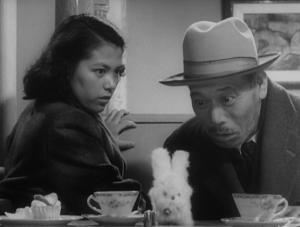
Watanabe’s son is certain that his father’s odd behavior is due to Toyo, and when the man tries to tell his son, finally, about his cancer, the son jumps the gun and completely chews his father out about hanging with a young girl. Toyo is also getting creeped out by Watanabe’s attention, and when she attempts to cut off all contact with him, he tells her of his plight and tries, one last time, to find out what it is about her life that makes it so vital, so attractive. Toyo feels it is because she is currently working in a toy factory, and she makes things. She puts one of the toy bunnies on the table. “I feel like I’m playing with every baby in Japan.” In his moment of greatest despair, Watanabe sobs he can’t make anything, not in his job… and as a party in another part of the restaurant breaks into “Happy Birthday to You”, he realizes he can, and charges out.
The narrator informs us that six months later Watanabe has died, and the rest of the movie takes place at his wake.
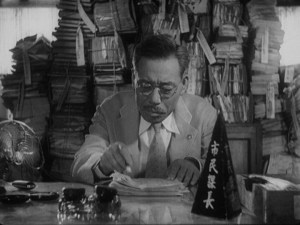
Since the movie is starting to play around with time, I’ll do the same and return to the beginning, where, in a darkly comic sequence, we are shown a group of housewives complaining about a cesspool in their neighborhood, asking to have it paved over and hopefully turned into a park for their children. They start at Watanabe’s department, then are shuffled from department to department to the deputy mayor and finally, back to Watanabe’s department. That, and the stacks of paper everywhere, reaching to the ceiling (Kurosawa’s art department apparently appropriated the studio’s paperwork for the past 40 years for these documentary vistas) artfully delineate Watanabe’s world.
As the attendees at his funeral talk, we begin to discover the particulars of the last six months of Watanabe’s life; how he used that time to successfully railroad through the creation of that park, and how he was found dead in that park the day after it opened. Through these stories, his co-workers and fellow bureaucrats – and his son and daughter-in-law – come to realize that Watanabe knew he was going to die, and utilized his final days for all they were worth. The increasingly intoxicated bureaucrats swear they will do the same, they will, like Watanabe, become firebrands of change. Of course, the next day, they all go back to their gray, do-nothing lives, leaving the one worker who attempts to follow their grandiose, drunken promises to ponder Watanabe’s park sadly as the sun sets. The change, when it comes, will not come as a sweeping wave, but as the work of individuals, like Watanabe, and like, hopefully, this one serious, concerned worker.
Ikiru is a surprising film, one that just when you think you have it scoped out, changes on you. We identify so strongly with Watanabe and his blind flailing to find something, anything to make his wasted life worthwhile, that it comes as a bit of a shock to find out he’s dead just when things finally seem to hitting a positive note. But that storytelling is incredibly canny because due to our identification with the character, we then get to attend our own funeral, and it is every bit as satisfying as we could hope. Not mawkish at all, but with heartfelt feeling.
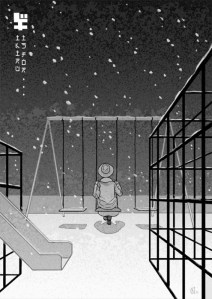
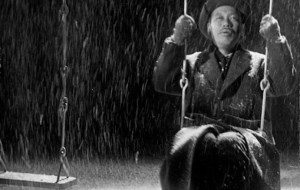
Earlier in the movie, when the Writer is showing Watanabe through the underworld, there is a scene in a piano bar where the player asks what he wants to hear, and Watanabe requests “The Gondola Song”, which dates back to 1915, a song asking women to find love before they are too old. Some drunken couples get up to dance, but slowly stop and sit down, listening to Watanabe’s sorrowful singing. In the final portion of the movie, we are privy to Watanabe’s final moments, sitting in one of the swings in the new park, joyfully crooning “The Gondola Song” in the snowy night. I have tears in my eyes just writing about that moment. Hopefully the spellcheck will catch the typos.
So yes, Ikiru is a movie to be seen. It is emotional without stooping to manipulation, heartfelt without cheap sentiment. Akira Kurosawa was a humanist, and rarely was that humanism so moving and so affecting.
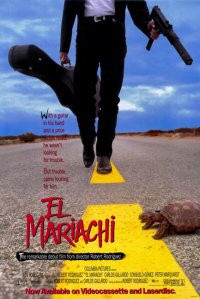
So how many years has it been that I’ve not seen El Mariachi? A lot. (mumble) What? I said twenny years. TWENTY YEARS, I SAID TWENTY YEARS, OKAY? Cripes, I remember Roger Ebert recommending it on Sneak Previews, that should tell you something about how long I’d successfully avoided it.
This is, of course, Robert Rodriguez’ first feature, made with borrowed equipment and press-ganged actors, made for an initial cost of somewhere around six to seven thousand dollars. Rodriguez got his seed money by serving as a human lab rat at a research hospital, testing a cholesterol control drug. Apparently the villainous gringo in El Mariachi, Peter Marquardt, was a fellow lab rat, just to show one of the ways Rodriguez got his cast.
Now, Mariachi did get a fair amount of post-production money poured into it when somebody smart determined it was too good to be passed off as a direct-to-video flick, but there’s a difference between polishing a turd and enhancing an already solid base. El Mariachi is an amazingly proficient piece of filmmaking. The tight pacing and snappy editing necessitated by a budget that won’t buy you a used car becomes a plus instead of the lead weight that has sunk many another first feature.
The story has a nicely classical setup: the Title Mariachi (Carlos Gallardo) travels the country looking for work in bars to perfect his craft. He hits town at the same time as Azul (Reinoi Martinez), a minor league drug lord determined to wreak vengeance on his double-crossing partner (the aforementioned Marquardt). Azul likes to dress in black and carry his many weapons around in a guitar case. Marquardt’s character is the only person who’s actually seen Azul. And so the mistaken identity shenanigans and body count begin.
Mariachi has a number of surprises with exciting chase scenes through blissfully unaware crowds, a couple of thrilling stunts, and a willingness to make fun of itself with some sped-up comedy scenes. It’s a wonderfully entertaining flick, and I liked it a lot more than I liked Desperado, Rodriguez’ better-budgeted follow-up with some, you know, actual name stars.
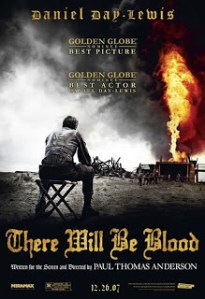
I don’t make New Year’s resolutions (I don’t need a special occasion to lie to myself), but if I did this year I would have sworn to broaden my movie-watching base, and I could have spent most of this post crowing about how I’d accomplished that. It’s exceedingly rare that I watch even one of the Best Movie nominees in any given year, and yet, here on the list, I have two contenders from a few years back. That would be The Hurt Locker, which I hope to get to in the next week or so, and There Will Be Blood.
There Will Be Blood has some strikes against it for me right out the gate because of its unfortunate parentage, by which I mean it is based, however loosely, on a novel by Upton Sinclair, Oil! Mr Sinclair and myself have not spoken since I was forced to read The Jungle back in 11th grade. But the name Paul Thomas Anderson is a balm for many old wounds, so here we go.
The movie is about the progression of Daniel Plainview (Daniel Day-Lewis) from prospector to “oil man” to tycoon though the change from oil field hustler to mansion-dwelling sociopath is achieved by the most severe compression of narrative I’ve seen since Gone With the Wind. Given the Sinclair lineage – and that his book was based on the Teapot Dome scandal – we can be pretty sure that Plainview is not going to turn out to be a very nice person. The fact that Day-Lewis is this generation’s foremost portrayer of complete assholes bears this out. Anderson and Day-Lewis are confident enough to let us see bits of decency shine through Plainview, but these, like anyone who stands in the way of his pursuit of black gold, will eventually be trampled underfoot and buried in shallow graves.
The greatest pleasure for me – beside admiring Day-Lewis’ rock-solid work – is the painstaking re-creation of oil field technology from mudhole in the ground to wooden derrick. The first fifteen minutes of the movie, devoid of dialogue – is mesmerizing. Overall, not a movie I loved, but certainly worth the watch. If nothing else, I’m glad to finally know what all this “milkshake” business the last couple of years was about.
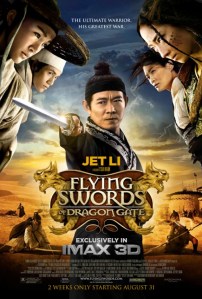
Let’s close this out by proving that I haven’t totally left my roots. I discovered to my great joy that Tsui Hark’s Flying Swords of Dragon Gate was on Netflix Instant. I came this close to seeing this in a theater. It was playing in one theater – one! – about forty minutes drive from me, in its native 3-D, for one damned week. I made plans to make a pilgrimage to see it on Memorial Day, but other events conspired against me, and I didn’t make it.
This is the third version of Dragon Gate Inn I know of, and each version just gets wilder. In its most basic form, the story concerns three factions with good reasons to kill each other instead concealing their various identities while they huddle at the title desert Inn, riding out a massive sandstorm. Most of this intrigue is jettisoned in this latest re-telling, substituting treasure hunting, vicious government agents seeking a pregnant woman (on orders from am ambitious concubine who wants no possibility of an Imperial bloodline but her own) , and Jet Li as a righteous warrior determined to kill all the corrupt government types.
CGI-enhanced wirework is the order of the day here, so get used to the idea and ride with it. I started getting unto wuxia movies back in the 80s when I realized this was best example of a comic book reality translated to film, I had ever found, and Flying Swords, with multiple daggers and swords helicoptering all over the screen to milk the possibilities of 3-D, really does look like the most berserk combination of Jademan comics/manga/Marvel I’ve seen. By the time Jet Li and the chief bad guy Chen Kun elect to continue their duel in the interior of a tornado, it all seems quite logical.
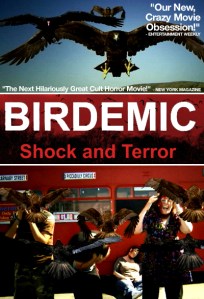
Like Hark’s other big “comeback” movie, Detective Dee and the Mystery of the Phantom Flame, the plentiful CGI is a little too obvious, and I begin to wonder if this isn’t a cultural thing. The tendency in the West is to look at something like this and think, “Man, that looks fake.” Is the Eastern tendency more toward regarding every element onscreen as a part of the picture, and judging the picture as a whole? I don’t actually have the answer to that. I mean, we know the imaginary world on the screen is just that: imaginary. Over the course of my lifetime we’ve gone from painted glass shots to traveling mattes to CGI. We’re aware that the extraordinary stuff we see on screen can’t be real. So as long as the stuff is not patently ridiculous, like the hovering birds in Birdemic, why make such a big deal out of things being too real, too sharp, too well-defined?
Maybe we got spoiled by Blade Runner and its constant rainy mist. Most of the really obvious CGI in this and Detective Dee is stuff that takes place on a clear day. Perhaps there is still some shading that could be done to dull the sharpness of the image, some atmospheric effects; but that’s not done, and you begin to wonder if it ‘s intentional, and then suddenly you’re not talking about the movie anymore. Sorry.
Like I said, rowr.
Anyway. I found Flying Swords of Dragon Gate a little long, but fun. Lots of colorful characters, plenty of fights where you can generally tell what’s going on, and a pleasant return to pre- Chang Cheh days, where women could be expected to kick just as much ass as men, if not more. (PS. Gwei Lun-Mei as the Tartar Princess – rowr!)
So I have this list of 60 movies that I was By God gonna watch this year, and I entered December not really sure I was going to pull it off. That’s generally a very busy period for me, and I was contemplating the very real possibility of carrying over any leftovers into 2013. Yes, I will be doing this again next year, the list is almost completely built. The major innovation will be starting it in January instead of later in the year.
So, anticipating this crushing personal defeat, what was my best course of action? Well, as a self-absorbed and pointlessly self-destructive child of the 60s, I felt the thing to do was to watch a movie that was not on The List. It makes sense if you’re me.
So, if you’re one of the bored people who follow me on Facebook, one evening you got to see this:
Yes, I fully admit that I am behind the social arc in many ways – that’s why I have things like The List. I’m in a perpetual state of catch-up because I don’t like to rush. Hell, I’m pretty much physically unable to rush. Anyway, there it was, on Netflix Instant, a movie that had been represented to me as the absolute nadir of movies for a couple of years.
So like I said: Inevitable.
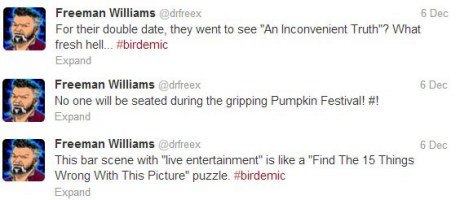
I rarely live-Tweet movies, with the exception of Crapfests, where I don’t want moments to slip by and vanish in the increasingly inebriated Lost Weekend of my brain. But there was something about Birdemic that just forces the dismayed broadcasting of your pain, like vomiting to get tainted food out of your system:
Oh, yes, I was finding out that this was, indeed, a perfect storm of bad movie-making techniques. Flat acting (in the instances it could be called acting at all), pauses in the dialogue that you could drive several delivery trucks stuck in first gear through, and that very special horror, the blossoming of ambient sound before and after a line, bespeaking no ADR or even laying down an ambient bed to make each line of dialogue sound like it might have been recorded on the same day.
Gavin R. R. Smith tells me that there is a very obvious Getty Images watermark on the news “footage”. I’m going to take his word for it, cuz damned if I’m going back to check it out.
I assumed the awkwardly choreographed CGI birds were a hint of things to come – either that or this was a story from an alien world where physics do not work the same as ours. That interpretation is, in fact, still a possibility.
The dolly comment could come from several different scenes, but this one is particular was prompted when it is announced that Generic Software Company has been bought by Oracle for ONE BEELION DOLLARS and there is a series of shots of various people being cued to look excited while the camera dollies past their table. I think these people work for Generic. I don’t know, they’ve never been introduced and I’m too busy wondering what the director is trying to say by dollying past a six foot long table over and over again.
1) There’s no band, only a singer; 2) Our heroes are the only people in the bar 3) I’m still watching this 4) …
Finally after almost an hour of relationship-building, intermittent blurbs about global warming jammed into the narrative and saying “And… scene!” while actors wait for the camera to be turned off after they run out of lines, we finally come to the birdy apocalypse.
Yeah, yeah, yeah, *in* flight. My brain was attempting to claw its way out the back of my head. If you’ve been lucky enough to avoid Birdemic – eagles can hover effortlessly by flapping their wings once a second, and they do this in formation and unison.
So our heroes fall in with another pair of campers who are, fortunately, traveling around in a van with enough guns and ammunition to take on the pesky birds. Or maybe the guns are just magic, because I never see anybody reload.
As Birdemic progresses, the M*E*S*S*A*G*E* portions get more and more preachy and obvious. They’re the opposite of subtle. Really, all global change denialists had to say over the last two years was “What, did you see that in Birdemic, or something?” to shut down all debate.
Writing dialogue for four characters is hard (six, actually, but two rescued children never get to say anything) so the picture kills off the two gun-running campers. The second one, who buys it while trying to rescue three idiots from a double-decker bus, does so by falling prey to a Birdemic attack that has never been seen before and will never be seen again in the remainder of the movie: he and his idiot rescuees are doused by either bird puke, or bile, or poop or some goddamn thing that burns them to death or makes them die of embarrassment. Anyway, our hero drives off, leaving the assault rifle behind, and I really doubt the ammo is compatible with the pistol hero is packing.
I haven’t even mentioned the hero shooting the pistol and playing the recoil a second after the animated muzzle flash and sound effect. I’m not that mean.
Otherwise the hero would know that the proper response to hundred-dollar gallons of gas is to pull a gun on the price-gouging bad actor and pay the posted amount. But, although he already has a gun in his hand, he simply hands over his credit card. Ray Milland would have bitch slapped him.
Yeah, occasionally you’ll witness one of the birds divebomb something and explode on impact. Why? Global warming, that’s why. Our hero has multiple opportunities to scavenge more guns and gasoline but passes them up, so I’m more than a little miffed with him when he runs out of gas and has to catch a fish with dead camper gear. The two kids he’s rescued start whining about wanting Happy Meals, but – you guessed it – he’s run out of bullets and can’t shoot the ungrateful little louts. The birds fly in for one last swoop, but decide that since he doesn’t have bullets anymore, he’s no fun and fly off. In an end credit sequence that lasts forever.
Best comment of the night goes to @MovieMike:
Oh, and atheists? Stop arguing. Here is your proof that there is no God:
Somehow, somewhere in there, I watched Eyes Wide Shut and didn’t write about it. Certainly an ignoble end to one of my more ambitious projects this year: watching all of Stanley Kubrick’s movies, in order. The reasons for this are many, and most do not have anything to do with the movie itself. The ones that do, are, primarily: I hadn’t heard good things about it, and I am not a fan of Tom Cruise.
Well, the first image you’re going to see in Eyes Wide Shut is a nude Nicole Kidman, which should let you know what kind of a movie you are in for. For some reason, a naked woman in the opening shot for Student Teachers signals exploitation; in the opening moments of a Stanley Kubrick movie, it presages art. It probably has something to do with the lighting.
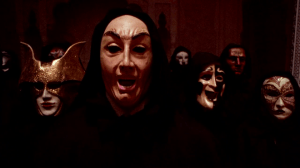
Cruise is successful Manhattan doctor Bill Harford and Kidman his wife, Alice. They’re preparing to go to a Christmas party held by one of Harford’s patients, a fabulously wealthy man played by another film director, Sydney Pollack. Bill and Alice, being young, beautiful people, are hit on by various sexual scavengers during the party. Afterwards, in a marijuana-fueled confrontation (Alice has that strain of pot that makes you aggressive, which I must admit is something I’ve never encountered), Alice is a little too frank about a fantasy she once had about a naval officer. This shakes Harford to his core, and in the next twelve hours, he is accosted by a recently dead patient’s daughter who claims to love him, nearly has an assignation with a prostitute, and finally ends up at a mansion in the middle of nowhere, a masked interloper in a bizarre Hellfire Club-type evening of debauchery, filled with naked women and others all similarly masked.
It’s this gathering that forms the center of our story, and the aftermath provides the remainder of the film. Discovered and ejected from the gathering, his life apparently saved by a woman willing to sacrifice herself in his stead, Harford attempts to piece together what exactly happened. Unable to admit to his wife what he did the night before, he also finds each of the brief, unfulfilled relationships of that evening terminated and unavailable. His paranoia becomes a feverish thing, as he becomes aware of a tough-looking individual following him. Finally, in a scene that is remarkably stolid for a Kubrick film, Sydney Pollack explains everything to him, and it’s not quite as weird or evil as we or Harford suspected.
In a fit of contrition, Harford admits everything to Alice, and the final scenes, in which the Harford take their daughter Christmas shopping, is actually a small masterpiece of acting. There is a lot of room between Bill and Alice, as they follow their child through the hectic store; their minds are obviously anywhere else than where they are, physically, at the moment. There is a note of rapprochement before the final fade, at least.
Eyes Wide Shut is taken from a novella called Traumnovelle by Arthur Schnitzler, basically, dream story. Cruise really does move through the story as if it were a dream, frequently surprised, confused, often trying to extricate himself from events unfolding around him, and when he does initiate a situation, instead of having it thrust upon him – by hurriedly putting together a disguise and catching a cab into the super-wealthy wilderness – he pays a hefty price, suddenly finding himself in the weirdest Hitchcock movie ever made.
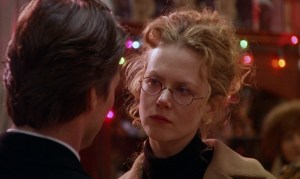
In all, it’s intriguing, if not especially fulfilling, watching Eyes Wide Shut unfold. The increasing unreality of Harford’s situation finally washed away in the overly-bright ultra-consumerism of a Christmas Macy’s. Seeing Cruise walk the night streets of a New York which we know – just because we know Kubrick – is really somewhere in England. The sudden, unheralded appearances of Alan Cumming and Fay Masterson. And the fact that I didn’t really mind Tom Cruise in this, at all (even if I find it dismaying that a well-to-do doctor drinks Budweiser, for God’s sake). Also, I like Nicole Kidman in eyeglasses, surprise, surprise.
And the fact that the very last word said in the last Kubrick movie, ever, is “Fuck”… well, dark humorist and cynic that he was, I’m sure that makes Kubrick chuckle occasionally in Movie Maker Heaven.
As I begin to write this out, it is December 5. I’ve managed to winnow The List down to 12 movies that I have 26 days to watch. Gosh, this is sort of exciting. Next year remind me to start this nonsense in January instead of March or April or whenever I began it this year.
So I bumped a few:
The biggest problem I have with watching The Last King of Scotland is reminding myself that what I am watching is not a docudrama, it was never meant to be a docudrama, it is supposed to be a thriller that just happens to feature one of the most infamous dictators of our time, Idi Amin. I’m going to blame Crapfest for this and the fact that for some reason we’ve watched Amin – The Rise and Fall twice and there are even people talking about a third go-round (to which I usually respond “Well then, we’ll have to watch Astrology Songs again, too.”).
In any case, Last King involves a fictitious young doctor (James MacAvoy) who comes to Uganda to help in a rural hospital, and who, through somewhat bizarre circumstance, becomes Amin (Forest Whitaker)’s personal physician and close adviser. Which all seems rather peachy until the man starts getting increasingly unstable and MacAvoy finds out about the massacres and people vanishing. By that time it’s too late, and he’s trapped.
Last King isn’t as tabloid-driven as The Rise and Fall, but there’s plenty of sensationalism to go around, much of it having the ring of truth. Things get very messy toward the end, though, both in terms of violence and plotting, such that it’s a relief when the end credits roll. Love or hate the subject matter, though, it is undeniably a marvelous showcase for Forest Whitaker’s considerable talent, rightfully earning him the 2007 Best Actor Oscar.
And hey, besides his love for Scotland, Amin was a big Man Called Horse fan! Who knew?
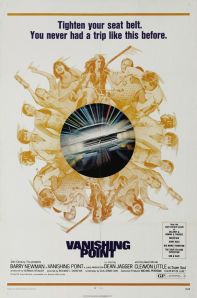
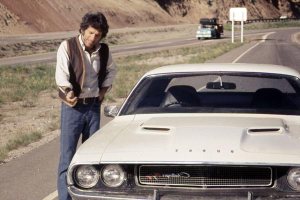
It’s small wonder that very same evening I followed up with Vanishing Point, a movie I have been assured for decades that I would love, and yet I had never seen. Well, now I have, and they were right. I could easily lavish 1000 words and more on this movie alone.
Famously, this movie stars Barry Newman as Kowalski, a man who drives cars to their destination for a delivery service. Picking up a white Dodge Challenger in Denver, he makes a bet that he can get it to San Francisco in 15 hours. Police don’t like muscle cars breaking all sorts of speed limits, so there is an effort across three states to stop him, even though the authorities admit that the only reason they’re trying to stop him is to ask him why he’s going so fast. And as the attempts to stop Kowalski escalate, he becomes a counterculture phenomenon, “The Last American Hero.”
The video box proclaims this to be “The Ultimate Car Chase Movie”, but Vanishing Point is as far removed from something like Eat My Dust as Seven Samurai is from Sgt. Kabukiman. It’s an existential mind trip, as you should guess when, at the movie’s beginning (which sets up just a few minutes from the movie’s end), Kowalski races past himself, which leads us into the beginning of the movie. Director Richard Sarafian says he wanted to construct the movie like a Möbius strip (and hoo boy, you can’t get much more of a 1971 sentiment than that).
As Kowalski travels across the desert, ripped on speed, he meets interesting characters, and we are given brief snippets of his past: a Viet Nam vet, decorated for bravery, a disgraced cop, busted for beating up his partner when he tried to rape a hippie girl. Motorcycle racer, car racer, a life full of wrecks. He forms an odd rapport with a blind radio DJ, Super Soul (Cleavon Little), who tries to pass important information to Kowalski, and pays the price for it.
If you have the blu-ray, I recommend the UK version. It has a scene, approximately five minutes long, where Kowalski picks up a hitchhiker – considering it’s Charlotte Rampling, cripes, who wouldn’t? – and tokes up with her. Considering he’s been offered marijuana several times in the course of the movie, this is pretty extraordinary. He also pulls off the road when he starts getting stoned. Rampling has an odd conversation with him, wherein she says “I’ve always waited for you, Every time, Every where. Patiently.” They kiss. Kowalski sleeps, probably for the first time in weeks, and when he wakes… she’s vanished.
It actually sets up the end very well, instead of hitting you between the eyes with it.
Other reactions: “This is a counterculture movie, where the hell is Severn Darden? Oh, wait, there he is.”
Also, the Naked Motorcycle Rider (Gilda Texter) was entirely justified artistically.
I should mention that it is now December 6, and the number of movies is down to 11. I feel like I’m racing toward some vanishing point myself.
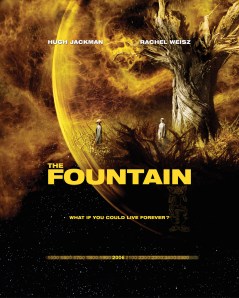
The Fountain, on the other hand, is not an existential movie. It’s very layered, and I think it wants to think itself more profound than it actually is.
Hugh Jackman plays three roles, though two are actually the same man. You see, he plays a doctor who is desperately searching for a cure for brain tumors, in particular the type his wife (Rachel Weisz) is dying from, and on the way he accidentally discovers the Fountain of Youth in the form of an old growth tree in Central America. (The third character is a Conquistador searching for that very tree in a novel his wife is writing) Jackman literally finds out his treatment is actually causing tumors in experimental animals to shrink the moment his wife goes into her final seizure and dies.
Most of this is revealed in flashback while the now ageless Jackman travels through space in one of those bubbles that must be science so far advanced as to be magic. His only companion is that same Tree of Life, ancient and dying. Jackman intends to bathe it in the dying sun at the heart of the Orion Nebula, which his wife identified as the Mayan underworld, Xibalba; through what mystic avenues we may not know, he feels this will revive the Tree.
The story switches between these three narratives, which is a device that forces you to be involved or you’re going to get lost. That involvement invests you in the story, though the fact that Jackman and Weisz are both great actors also helps. The movie is gorgeous; director Darren Aronofsky eschewed CGI for the space sequences and used, quote, “micro-photography of chemical reactions on tiny petri dishes” resulting in a totally unique visual palette, which he stitches together with golden light in the other two storylines. It is a gorgeous movie, wonderful to behold; I’m just not sure who its audience might be.
When it was over, my wife said, “That was not a chick flick.” To which my only response could be, “Well, it certainly wasn’t a guy flick either.” I don’t regret watching it, I just have to go, Hm. Art. and let it wash over me.
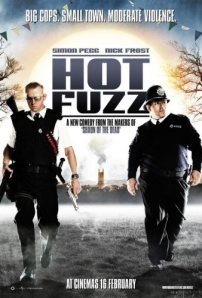
One of the reasons I came up with The List was to force me to watch some movies I’d had around forever, or at least most of a decade or so. Now one of my favorite movies of the last year or so was Scott Pilgrim vs The World, and over the years I had picked up Edgar Wright’s last two movies, Shaun of the Dead and Hot Fuzz, yet had not watched them. The List has put an end to such nonsense, eh?
So Simon Pegg is Nick Angel, a London cop who is so good at his job that he’s promoted sideways to a peaceful little village so he’ll stop making all the other cops look bad. The usual fish-out-of-water hijinks follow, except for a series of gruesome deaths that only Angel can perceive are murders. Nick Frost is along again as the larger, slightly slower-witted PC Danny, who loves movies like Point Break and Bad Boys II and is ecstatic to find himself serving with a genuine badass.
If there is a problem with Hot Fuzz, it’s that it takes a little too long to get itself moving, and even when it does, there is still a lot to get through until the third act – but by God you feel like you’ve earned that third act, which is spectacular and has one of the best twists I’ve seen. Edgar Wright is a master of the complete mood swing in the third act.
Wright seems to be making one of every genre movie he wants to, and with results like this and his other movies, I’m not about to complain.
There. Now to see if I can get the outstanding movies down to 10 before The Show eats my weekend.
Crap. You know what I watched and never wrote up? Eyes Wide Shut.
Let’s see how many of these I can spit out without going 1000 words for each.
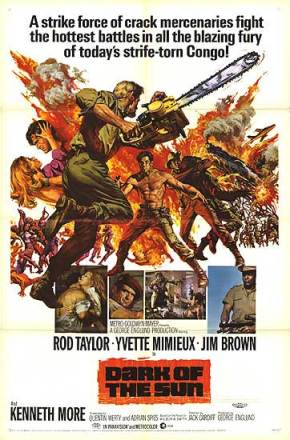
Dark of the Sun (1968) had been getting some good notices at revival screenings around this time last year; it was pointed to as a forgotten gem of manly 60s cinema. Warner Archive put it out as one of their MOD (Made On Demand) discs, and I bit, mainly because The Wild Geese is one of the movies I keep returning to every couple of years.
Rod Taylor, you see, is a mercenary working the Congo Crisis in the late 50s. Along with his partner, Jim Brown (playing an American college-educated native), he is given the task of journeying into unfriendly territory and extracting a bunch of mining employees before the Simbas arrive and slaughter them all – and, oh yeah, also bring along the 50 million or so in diamonds they have in their vault. Things are made more complicated by a wannabe Nazi German merc in charge of the native forces, Yvette Mimieux, who survived a Simba massacre and is gathered up along the way, and the fact that the head of the mining operation set his time release vault way too far in the future, meaning everyone must escape under fire by the Simbas.
That seems complicated, but believe me, the movie itself gets even more complicated. I read through the Wikipedia article on the Congo Crisis, and I’m still pretty much at sea about the backstory. I’m more than a little suspicious of the way the Simbas are portrayed, in their savagery as they overrun the mining outpost; I’m reminded of John Wayne’s The Green Berets, when the Viet Cong overrun the firebase, and are dubbed with war whoops from one of Wayne’s earlier westerns, complete with an Injun motif on the score.
Our main players are solid and professional, and this may be one of Brown’s best roles. I wonder what happened with Peter Carsten’s lines, as Paul Frees winds up overdubbing a lot of them, which gets distracting when you’re a Paul Frees fan. I guess I bought into the hype a little too wholeheartedly, as I rarely felt caught up in the story or the characters. There’s a bit too much “Oh come on” action here, as events spiral out of control, stay out of control, and then proceed to get out of control. I have no idea how Rod Taylor’s merc gets so much work, because he has the worst damned luck.
After that less-than-salutary experience, I decided it was time to swing back to the Quality Portion of The List and watch – finally – Black Orpheus.
I had owned the soundtrack to Black Orpheus for years – overheard it in a back room at a cast party, and I fell immediately in love with it (Same guy also played the score to The Egyptian, and I really hope to have enough bread to buy that Twilight Time blu-ray before it sells out). My Criterion disc tells me this is the movie that “brought the infectious bossa nova beat to the United States.” And infectious it is, there is little wonder that whenever it breaks out, everyone on the screen begins dancing with wild abandon.
It’s hard to know anything about movies and not know the central concept here: director Marcel Camus re-tells the Greek legend of Orpheus and Eurydice, against the backdrop of Rio de Janeiro’s Carnival. It all starts out normally enough, and gets more fantastic as the story progresses. Eurydice is a country girl who comes to visit her cousin in Rio because she’s convinced a man is stalking her with the purpose of killing her; she meets neighbor Orpheus, a singer local children are convinced makes the sun rise with his songs. They fall in love, of course, much to the dismay of Orpheus’ vain and faintly psychotic fiancée. Then this fellow in a Death costume starts following Eurydice through the Carnival…
It’s amusing that the movie likes to mess with your head; when Orpheus and Mira (the aforementioned fiancée) get a marriage license at the beginning of the movie, and the clerk is informed his name is Orpheus, the clerk brightly exclaims, “Then you must be Eurydice!” to the predictably pissed-off Mira. The legend is common knowledge, what must happen as Orpheus finds himself falling in love with Eurydice is inevitable.
Using the modern Bacchanal of Carnival is so logical and perfect it also seems inevitable. The scene of Death in the parade crowd, ensnaring Eurydice with paper streamers is beautiful and memorable, and Eurydice’s death – though we know it is coming – still manages to be almost entirely unexpected, coming at the end of a cat-and-mouse chase worthy of any horror movie or giallo.
I had wondered how Camus was going to handle Orpheus’ descent into the Underworld to find his deceased lover, and once again, I was surprised and amazed. Orpheus, unwilling to believe Eurydice is dead, searches for her in the aftermath of Carnival; he arrives at the chaotic police building and is told to check with Missing Persons, which is a room full of stacks of paper in a labyrinth of halls where sheets of paper blow in an eerie wind. “People are lost in paper,” advises a janitor, filling in for Charon, He takes Orpheus to a voodoo ceremony where the spirit of Eurydice possesses a woman behind Orpheus to speak to him one last time, and despite her cautions, he turns around, losing her forever. Unexpected yet completely logical, given the setting.
As I say, this is a fairy tale wrapped in the trappings of the real world, a trick Camus managed magnificently. I can see now why it was recommended to me for years, if not why I didn’t watch it for years.
It’s a pity that a little of that magic couldn’t have hung around for my next movie, Then Came Bronson.
This is another oddity from my youth: this was the pilot for a TV show on NBC, and it ran a full season. 1969-70. I vaguely recall the series, and I seem to recall really wanting to watch it, but it was always on opposite something else my parents wanted to watch. Ah, the days of single TV sets and three networks! Warner Archive made the pilot available, allowing me to re-discover that Michael Parks was Bronson. I really dig Parks’ work, so I got the disc.
Well, now.
The pilot gives us the set up, Jim Bronson is a reporter who witnesses the suicide of his best friend, a biker named Nick, played by none other than Martin Sheen. When Bronson’s boss at the paper tells him he’s about to lose his job for writing a full story about “some greaser who offed himself”, Bronson tells him to take this job and shove it, buys Nick’s bike, and sets off on the road to find himself, because that is what you did in 1969. Along the way he picks up a literal runaway bride (played by a 21 year-old Bonnie Bedelia) and on the way to New Orleans, they manage to fall in love.
There seems to be a lot of French New Wave in this movie – now, I may be wrong about that, because frankly I’m more than a bit of an idiot about labels like those, and there’s likely a better one for this movie. There’s no plot, perse, Bronson and his passenger – she spends a lot of the movie not telling Bronson her name – ride around and have… well, not adventures, but stuff kinda happens, and… hm. Bonnie eventually winds up realizing that she needs to go back West and pick up her life, and Bronson rides off into the sunset. That was apparently the thing about Bronson in the series: he always changed people through his simple decency and coolness, but he never changed himself. Makes you think, don’t it?
Anyway, the quality of the disc is wonderful. Then Came Bronson apparently had a theatrical release, as the print bears a “GP” rating. It’s also possible that Warner Archive is giving us the European release, as in our first encounter with Bedelia’s character, when she takes off her bridal gown and throws it in the surf, we are given a very good view of 21 year-old Bonnie Bedelia breasts, and we are going to get flashes of this same scene throughout the movie (in that 1969-70 rapid-cuts-to-induce-epilepsy style). Then again, I seem to recall in this period you could get away with a surprising amount in a “GP” – Parental Guidance Suggested – movie.
It’s tempting to paint this as an Easy Rider wannabe, but the two movies are pretty contemporaneous – If anything, Bronson debuted a few months before the more famous movie. Easy Rider is similarly light on plot but has the power of a lot of pretension going for it; it tries to say something, whereas Bronson… just seems to exist.
(As quoted by Mystery Science Theater 3000)
From the sublime to the ridiculous, I suppose, because the next movie – and likely the last I’ll try to cram in this entry, was Snakes on a Plane, the movie the Internet wrote.
Well, to a degree anyway. There are lots of rumors about this: it has its origins in a bunch of suits boozing it up and deciding to see who could come up with the worst movie pitch. That the working title “Snakes On A Plane” was going to be changed to something more generic like “Boiling Point” or something but A) Samuel L. Jackson said hell no, I agreed to do it because of that title, or B) The Internet as a whole said, no, it’s awesome, keep it that way. One thing is certain, however: the Jackson line “I am sick of these motherfuckin’ snakes on this motherfuckin’ plane” came from the Internet. I was also looking forward to hearing Jackson yell into a radio microphone “We got motherfuckin’ SNAKES!” but I suppose cooler heads prevailed and someone decided that “Leaving them wanting more” would be good in this case.
And that is about the last time we can accuse Snakes on a Plane of subtlety. The central concept is goofy enough: Jackson is escorting an eyewitness from Hawaii to LA to testify against a big drug boss. Since the drug boss can’t kill the guy in any traceable fashion, he instead stocks the plane with a staggering variety of venomous snakes – and, for some reason, a python – and sets up a way to release them mid-flight. To cover up the fact that snakes would normally either attack each other or just hide until the plane landed, there is a macguffin about leis that are treated with some pheromone to make them go berserk. And turn into CGI snakes because real snakes don’t take direction worth a damn.
After spending a lot of time establishing our cannon fodder in the seats, once the snakes get loose, I have to admit the movie squeezes every bit of possibility out of the situation. Snake attacks come from all angles – how the hell that one got in an airsick bag is beyond me – and things keep getting worse and worse in a somewhat believable fashion. I totally get why you wouldn’t want all the vital parts of the plane’s systems in the same place, but why the hell they’re also so inaccessible is puzzling. And dammit, the movie proves it has its heart in right place when a desperate flight attendant, encountering a snake in the galley, tosses it in a microwave and hits the SNAKE button.
I respect that sort of gumption.
So yeah, I admit I went into Snakes with expectations extremely low, but I enjoyed it beyond the level the lowered expectations should have granted. Not bad for Venom on a plane, and that python did eventually pay off.
I actually recovered from a week and a half of Extreme Bizzitude the Saturday after Thanksgiving. Wednesday night was spent brining the turkey, Thursday, of course, was cooking and eating, then eating after a nap, then eating some more. Friday was more restful, as old chum Cabot Parsons was down from Noo Yawk to visit, and we made each other remember stuff from our more youthful days that we had good cause to forget (and then I ate). That was the restful day my body had really needed. And Saturday… ah Saturday… was the rest my soul needed, as I had no Show and therefore bullied everyone into a Thanksgiving Crapfest, or, as it is known, Crapsgiving.
Our Author, ready for action.
I think I actually stuffed myself more at Crapsgiving than I had at Thanksgiving. Host Dave had cooked up some excellent beef-and-venison sausages and sautéed the hell out of a mix of mushrooms and peppers and some dirty rice – nay, filthy rice – to accompany them. As the evening wore on we would also tuck into a huge pepperoni pizza Rick had snagged from Costco – I believe the crust was also made from pepperoni, as were portions of the box. In any case, there was a hell of a lot of pepperoni. Then the usual snacks, and Paul brought supplies for root beer floats. After a year spent losing weight, I am finally back to my fightin’ weight of 500 pounds.
While various people arrived, I played a disc of terrible things from, appropriately, everythingisterrible.com. Alas, the only people to be scarred by this were myself, Dave, Rick and one of two new guys who had arrived early, Erik. Erik brought his A-game, I must say; he came with some movies of his own, about the worst of which (that I had seen, anyway) was The Angry Red Planet, and I loveThe Angry Red Planet. But I don’t think he was entirely prepared for the brain-blasting awfulness we put ourselves through on a regular basis; though Everything is Terrible should have been a fair intimation.
We started off Crapsgiving Proper with The Big Doll House, Jack Hill’s first Filipino Women In Prison flick for Corman’s new company, New World Pictures. It isn’t the absurd perfection of The Big Bird Cage, but it is still pretty entertaining in its own right. This is apparently Pam Grier’s first big movie role, where Sid Haig is giving her acting tips as the shoot progresses. Their chemistry is damned good, so much so that Hill would pair them again for The Big Bird Cage the following year.
There is really only one plot in these movies: there are women in a hellish Filipino prison, and they want to escape. What sets each apart is the bizarreness of the setpieces. Granted, there must always be at least one shower scene, one wrestling match (usually in mud, if Corman has anything to say about it), and at least one torture scene involving nudity, ideally several. Doll House also has a food fight followed up by a general fire-hosing of the inmates (which, legend says, the inmates didn’t know was coming). This particular prison is also, for some reason, run by female Nazis, though there is also a shadowy hooded military man who seems to operate things behind the scenes, leading Erik to deduce that the prison is actually being run by Cobra Commander. (“I hate you, Joe! Now get undressed!”)
Surprisingly little nudity, given the movie’s ultimate venue was the drive-in, but some little caution was apparently called for in 1971. The next year Deep Throat would put “porno chic” on the cultural map and things would loosen up considerably for a few years, providing the teen-aged me with a short Golden Age at the Drive-In. The Big Doll House’s major problems are a Shakespeare-sized cast list (with an identically Shakespearean body count), getting rid of Pam Grier way too soon, and that there is no Vic Diaz. If I had been Ferdinand Marcos, I would have required every movie made in the Philippines to cast Vic Diaz. Dammit, A Filipino movie without Vic Diaz is like a Women in Prison movie without a shower scene.
Also best line of the night comes from Dave: “Sid Haig is like the Cary Grant of Women in Prison movies.”
Best of all, Big Doll House was one of the movies from The List – I now only have 15 to go before the end of the year (oy). Thank you, gentlemen.
Alan and Paul and the other newb, Joe, sauntered in toward the end of Doll House. Paul might have gotten to see an exposed breast, or two; Alan was not so lucky. Dave called upon me to put something on while he prepared martinis to fortify ourselves against his choice. I put on my new Shazzan disc, but when Dave sneered at it, I huffily withdrew it and substituted something I had promised Paul a long time ago: the very first episode of Hee Haw.
Most of you sneered just then. But then, most people are familiar with Hee Haw from its later, syndicated years, when the bits were old and worn and the writers were desperately pawing through whatever joke books they could find in resale shops to fill up time between country stars. But the first year, all this stuff was new, and the material was smart, surreal and sharp. There was no doubting the musical ability of the visiting stars (in this case Charley Pride and Loretta Lynn, who sang a feminist song about squaws going on warpaths) and there is no gainsaying Buck Owens. No, there is not, because Buck Owens kicks ass. The very first song, on Hee Haw, on the country & western version of Laugh-In, is not a country song. It is “Johnny B. Goode” with Dogpatch-styled go-go dancers.
(You know, when I wrote this, all these things were available on YouTube. I leave this horrid placeholder up by way of protest)
This is your monthly reminder that Buck Owens always disclaimed he played country. “I play American music,” he would say, and go back to rocking out. The twin brothers in the background were the Hager Twins, there for youth appeal. Their songs were likewise good, and I always find myself infected with their “The Gambling Man” for weeks after watching this first episode. Dig the kazoo action:
So despite initial disbelief, the room wound up enjoying Hee Haw. It opened up old memory through-ways and if nothing else, it was a memory you could sing along with:
Then, finally, Dave was ready to spring his horrifying choice of the evening on us. But it was a digital copy, running off a server in a back room, so while it transferred itself to a closer hard drive (honestly, we were one hot chick with short hair shy of a 90s hacker drama), we popped in an emergency disc I had gotten from Warner Archive some time before: Hollywood Party (1934). The trailer will give you some idea of the surrealism packed into its 69 minutes:
Yes, that’s a shockingly young Jimmy Durante going mano a mano with Mickey Mouse, and that is not the weirdest thing on display in this movie. The contents are surprisingly saucy – Hollywood Party just barely slipped out before the Hayes Code started being sternly enforced. This is the sort of movie that gives you some context into older Looney Tunes gags. We never made it to Mickey Mouse, much less The Three Stooges (still shackled to Ted Healey) or Laurel and Hardy. We never had time to ponder the allure of Lupe Velez, the Mexican Spitfire, whose act consisted of combining a spoiled brat with the worst psycho girlfriend you ever had. Hollywood Party was interrupted by the completed transfer of Dave’s choice: Abby (1974).
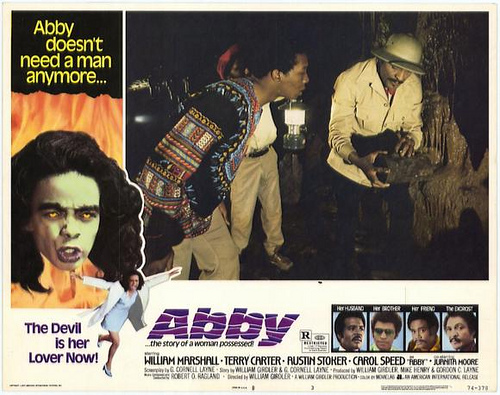
Abby is William Girdler‘s blaxploitation version of The Exorcist; it was reportedly more successful than Blacula, and one of several Exorcist knock-offs suppressed by Warner Brothers. I was a bit bemused by the other members of our gathering saying, “Abby? Abby? What’s that?” I sometimes forget what a strange little specialized bubble I occupy.
Snappy pith helmet, Bishop. You must be in Africa!
Abby is the fourth of five movies Girdler made in his native Louisville, Kentucky; he was known for making them fast and cheap, even when he moved on to Hollywood. I’m pretty sure most of Abby‘s budget went to paying William Marshall, and that is always a wise investment. Marshall plays Bishop Garnett Williams, who heads off to Nigeria to aid in pestilence and famine relief, but winds up unleashing an ancient demon who possesses his innocent daughter-in-law, the title character, played by Carol Speed. Again, there’s not much budget, so any demonic activity is limited to cursing, flailing around, popping an alka-seltzer into the mouth, renting a fog machine for one night, and scaring white women to death. And, oh yeah, screwing a bunch of men, much to the dismay of her husband, Williams’ son, himself a minister. I guess that’s a valid (and economical) path to take when your possessed character isn’t a schoolgirl.
Well, Pop comes back from Nigeria and after his son and Abby’s brother, a cop, track her down to a local nightclub, Marshall dons his holy dashiki and lays the righteous smack down on the devil. There’s a lot of not-quite subliminal flashes of Speed in some monster makeup (to echo the one in Exorcist) in the lengthy exorcism scene. They even pull out the stage illusion levitation trick, possible because they didn’t have to bother lifting a bed. Genius!
I’ve never been a big fan of The Exorcist, for much the same reason The Omen leaves me cold; I don’t have much in the way of religious roots to shake. So I’m afraid a cheap copy of The Exorcist (and Girdler, whatever his shortcomings, was refreshingly honest about that) isn’t going to do much for me. At least now I can say I’ve seen Abby.
Really, the most frightening thing about it: It has thrown the door open to a viewing of Exorcist II: The Heretic. Which, surprise, surprise, I have just gotten from the Swap A DVD Club.
You can take that earlier phrase “At least now I can say I’ve seen Abby” and use it for our next movie. Its possibility as a Crapfest entry had been danced around for some time, and finally, it seems, it was time to actually experience it.
Sweet Sassy Molassy. We’ve been through a lot at Crapfests. We’ve subjected ourselves to Dondi, Things and Strange Beings. We keep thinking we’ve developed scar tissue. But The Room punched us in places that hadn’t been touched before.
Writer/director/producer Tommy Wiseau also stars as Johnny, who is a saint, I tell you, a saint. His girlfriend, Lisa (Juliette Danielle) lives with him, and he buys her flowers, dresses, a ring, soon a car and a house. They are to be married in a month. Lisa, though, confesses to her Mom and everyone who will listen that she finds Johnny “boring”, doesn’t love him anymore, and isn’t going to marry him. Then she has an affair with Johnny’s best friend, Mark (Greg Sestero).
The Room is like a vanity novel about human relationships written by Martians; they know what relationships look like, but not what they sound like, what truly makes them tick.
Characters keep getting introduced, right up into the third act – at least I think that was the third act – mainly to tell us how awesome Johnny is and how evil Lisa has become. “She’s a sociopath!” Conveniently Introduced Psychologist tells us. Lisa also finishes every conversation with “I don’t want to talk about it!” and we were really sorry we hadn’t known to count those.
There’s a fair piece of your six million dollar budget right there.
There are four sex scenes in The Room. One is simply the first sex scene between Johnny and Lisa played again, with a different fake rock song on the soundtrack. These scenes make you wonder if you haven’t accidentally flipped to Cinemax; in fact, if not for the tragic ending, I would assume this was Wiseau’s audition tape for directing Cinemax flicks.
Wiseau is working through some issues here, and I don’t need a Conveniently Introduced Psychologist to tell me this. Johnny is just a wonderful human being, everybody agrees about this, even Mark while he’s schtupping Johnny’s girlfriend. So after everything is revealed at Johnny’s birthday party, and he makes everyone leave, Johnny tears the place apart (“I saw Orson Welles do this in Citizen Kane and it was awesome!“) and then blows his brains out, leaving Lisa and Mark to boo hoo hoo over their loss and transgression and doubtless the President to declare a day of mourning.
It’s that last scene, the oh-what-have-we-done scene, that leads me to believe that the vanity novel was written by an adolescent Martian. God, how many stories have we constructed in our little hormone-cooked brains where we died and everybody agonized over how badly they’d treated us? That’s what the last scene in The Room is, and the difference is that Wiseau managed to pull together a reported $6 million to make a movie version of it.
I also can’t help but laugh at the last part of that trailer, the “quirky black comedy” part. That’s the part that finally makes it salable, but The Room was not shot as a black comedy. It’s a teenage I’ll-show-them-all put to film, and I’m glad that Wiseau got some catharsis out of this, even if I and everyone who’s seen it has not.
My first encounter with The Room:
It’s the “Oh, Johnny, I didn’t know it was you” followed by “You’re my favorite customer” that still gets me.
Of course, I was live-tweeting the Crapfest, and about three-quarters of the way through The Room, I had to say this:
Little did I know that there is a Room bot out there, and I came home to this:
AAAAHHHHH! Stop haunting me, Tommy Wiseau! STOP HAUNTING MEEEEEEEEEE!
I’ve managed to survive that hellish week-and-a-half, though there were times I was fairly certain that it would have been possible to just lie down and die, like you hear about aboriginal elders doing. I would eventually exit those scenarios, and would lie down, but didn’t die, and that’s all to the better, I suppose. We’ve all heard the “I’m tired, but it’s a good tired” canard before, and yeah, I’ve experienced that. Not this time, though. It was a bad, cranky , irritable tired, a good-christ-will-you-people-get-it-in-fucking-gear-so-I-can-go-home tired.
It was a big week for The Show, the interactive dinner theater murder mystery thingie that supplements my part-time day job, almost adding up to a living wage. I have been doing this Show for, off and on, 15 years or so now. Yes, that is a pretty sobering realization.
Here is the thing about The Show: it is a gypsy operation with no true permanent space. There is a bit of room in the hotel’s banquet office where we keep our costumes, but by and large, everything else is packed into an aging minivan. This means I start every show by being a stagehand, carrying equipment from the van into whatever room we are occupying that evening. Then I get to be a technician, setting up the sound equipment and testing it. Then I get to be an actor for two-and-a-half to three hours. Then I return to technician land, breaking down and putting away the sound, then I get to be a stagehand again, loading equipment back into the van.
Sometimes, when you get several shows in a row, you luck out and get to stay set up in the room, with only minimal changeover activity. Last week was not one of those weeks, being the holiday season and all; in fact, the hotel’s schedule is so jammed that we wound up cooling our heels for close to an hour and a half while the room’s prior occupants finished up their presentation. This had happened once before, years ago and in another hotel. That time was bitterly amusing because the offending group was a time management seminar. This time it was a bunch of telecomm suits who didn’t seem much interested in the blather coming from the Power Point operator, and kept coming out into the hall to chat on their cellphones and be glared at by surly actors.
Setting up everything takes an unhurried hour or so. Thanks to this late group and the early scheduling of a weeknight show, we were being asked to accomplish this in 15 minutes. That didn’t happen; most of it was accomplished in 35 minutes, but then actors had to get in costume and make-up. All in all, the client group spent 45 minutes in the bar, which they didn’t mind, oh no, far from it. They were pretty well lubricated by the time they took their seats.
I hate drunks.
This is one very important reason why I never ever seriously considered a career in stand-up. Folks with a genial buzz on laugh more easily as their inhibitions loosen, but drunks have all barriers removed, they think they are funnier than you will ever be (never mind that you have been doing this professionally and successfully for 17 years), and for a drunk, volume is equal to hilarity. That particular show was a struggle to maintain control, and the aftermath, after the laborious loading back in, was the inevitable period of “What the hell am I doing with my life?”
Roger Murtaugh has become my spirit animal, “I’m getting too old for this shit” my mantra. That became very stark Sunday when the Show traveled; we were actually performing at some teenage girl’s birthday. The teenagers, I should hasten to say, were fabulous; they enjoyed themselves immensely, and the only slight problem was getting our stuff loaded out while they were dancing at the end of the evening. But we got really good at dodging each other.
The exhaustion hit in earnest that evening, and now, on Tuesday, I’m only starting to dig out from under. I obviously haven’t done bupkis on this blog, though I’m way behind in reporting on the movies I’ve watched. Then there’s the other writing project, the one I can’t tell you about, but the one that’s actually paying me money. Absolutely nothing got done on that front, but then most everyone else involved in that project was off at some conference all last week, so I’m not the only one.
In case you were wondering, the movies seen were Dark of the Sun, Black Orpheus, and Eyes Wide Shut. One day, I may get to tell you about them. I still have 18 movies left on the Lists to watch before the end of the year. If I don’t figure out how to lie down and die before then.
I keep looking at Google Calendar, and expecting the bad blocks to go away, but it isn’t happening. Monday is going to kick off the most hellaciously busy week-and-a half I have had in some time. So busy that getting up at a ridiculously early hour to cook on Thanksgiving day is going to seem like a lovely break. So I better write about this backlog, quickly, and while I can.
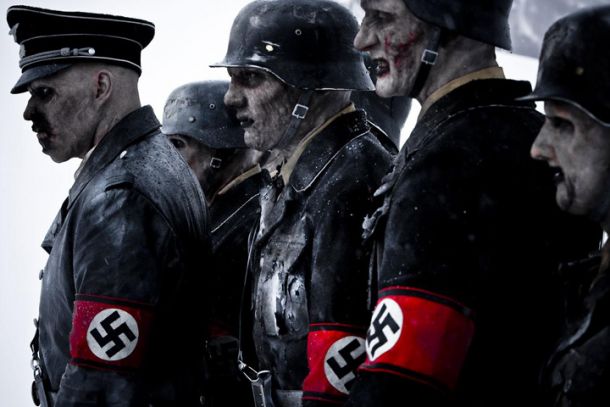
Night before Halloween night belonged to Dead Snow (2009) a Norwegian flick I knew very little about, except it obviously concerns Nazi zombies. Yes, I know, I said I was done with zombie flicks almost ten years ago – House of the Dead was the straw that broke the undead camel’s back. But, like Al Pacino, they keep pulling me back in. The reason I own this? It was 99 cents at a dying Blockbuster. What the hell.
Stop me if you’ve heard this one before, but five medical students go to a remote cabin for the weekend. Your plot twists here are that it’s in Norway, and the cabin is a ski cabin, so you’re dealing with some trees, but a whole lot of snow. Medical student #6 is the one whose family owns the cabin, but she’s a real outdoorsy type, and is cross-country skiing to the cabin. Except she’s not, as we see her die in the pre-credits sequence.
Now, the old-timer local drops in from Central Casting to tell the annoyed students about the Nazi occupation during WWII, and how the villagers turned on the greedy krauts at the tail end of the war, and the Nazis ran off to the mountains – with all the gold they’d stolen – never to be seen again. So there’s an eeeeeeevil in the vicinity. Well, haha, old-timer gets eviscerated in his tent that night – that’s what he gets for not heeding his own warnings – and Dead Owner Girl’s boyfriend goes looking for her with the only snowmobile, leaving the others to find Nazi gold in the world’s worst hiding place, have sex in outhouses, and be set upon by Stormtrooper Zombies who are after the gold.
Dead Snow, if nothing else, wears its inspirations rather nakedly. When Token Movie Nerd asks his friends, “How many movies start with people going to a cabin with no cell signal?” and Token Movie Nerd Girl answers with a number of them, notably Evil Dead and Evil Dead 2, it doesn’t get more blatant than that (yes, it does, Movie Nerd is wearing a Braindead T-shirt – Dead Alive to us Yanks) – of course Movie Nerd Me points out both movies were made before years before the current cell phone boom and that is not a plot point in any of them.
Anyway, once we reach zombie siege territory and (oh alright, SPOILER) both movie nerds get offed (end SPOILER) so we’re spared anymore annoying meta humor, things start moving at a brisk pace and rarely let up. The only real problem is the feeling that we’ve tread this ground before, it’s just that this time that ground covered in snow. The gore is enthusiastic, give them that, and well-done. It’s just that truly inspired moments – like one of the students, after raiding a tool shed, charges a Nazi with a crossed hammer and sickle – serve mainly to point out how familiar the other gags have become.
Absolutely no idea why the Nazis were killing people before that errant gold was found. Guess they just enjoy being evil fucks.
Entertaining enough, but this is a definite rent or Netflix. Although, Norway: Still beautiful.
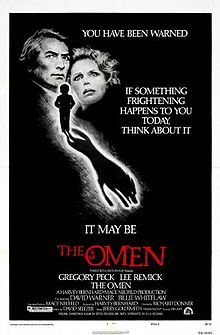
Halloween night, I know I’m going to get stuck with door duty because a) my wife always goes next door to watch Survivor, b) then she has to pick up my son who is helping his classmate guide her younger siblings around their neighborhood for trick-or-treat. I might as well watch a movie, but it’ll have to be something I’ve already seen, so I don’t mind the interruptions. Last year it was John Carpenter’s The Thing. This year? Well, I’d bought this impressively cheap blu-ray of The Omen. The original, of course. Which is odd, because I’ve never really liked The Omen.
At the end of the horror boom started by The Exorcist, Omen at least put an end to the seemingly infinite exorcism movies that were clogging the drive-ins and pointed the way to a wider variety of religion-based, or at least Catholicism-based, horror movies, to be carried on by The Sentinel and Holocaust 3000. Then 1977 came and Star Wars demonstrated that the new way to get rich was to throw spaceships at the screen.
So here is, I guess, my major problem with movies like The Exorcist or The Omen: I don’t find them particularly frightening, because I am simply not very religious. Not in the traditional Christian sense, anyway. I can appreciate the horror elements in both stories, the structure, the build-up, the FX – but that’s all they are to me. Elements. Ingredients in a recipe. I don’t experience these flicks the same way as the rest of the Western world, apparently.
Something else weighing against The Omen, thirty-five years later, is its deliberate pace. Its refusal to get to the Good Stuff, the stuff I was told about breathlessly on its first theatrical run – is actually something I respect. A movie this long was a bit of an anomaly in ’76, and usually the sign of a prestige Hollywood product… and make no mistake, this is what that was, with full-page newspaper ads and one hell of a cast, from Gregory Peck and Lee Remick to David Warner, Patrick Troughton and Leo McKern. The Omen franchise became known for its extreme death scenes, and you don’t really get the first one until 45 minutes into the movie, The second, another 45 minutes later. I never bothered with the remake (go figure!), but did it have the same structure? Were more Damien-inspired setpieces inserted for today’s ADD audiences?
I will likely never know. And I’m actually pretty okay with that.
So I admire The Omen for its craft, if not its status as a horror classic. What I do find interesting (and not at all surprising) is that David Warner’s death scene, in my memory, had become something quite more realistic, and done in a way that would be possible today with CGI, but not in 1976. (David Letterman used the beheading scene from the new Omen to punctuate a joke, and I admit it was well done. Then I have to point out that we live in an age when a bloody decapitation is used to punctuate a joke.)
That blu-ray is also packed with three commentary tracks, two of which feature Richard Donner. Those will be worthwhile.
I need to skip forward in time a week or so to keep a thematic thing going. In other words, about a week later, I saw another horror movie, and that movie was Grave Encounters. Oh yeah. Another found footage movie.
Grave Encounters‘ hook is that the footage was shot by the crew of a TV series called – um hm – Grave Encounters. A producer type, at the very beginning, tells us its production preceded all the other ghost hunting shows by a couple of years, and was showing great promise – “until they got to episode 6.”
For “Episode 6” the crew is going to be locked overnight in an abandoned mental hospital, hopefully to actually find some sort of evidence of the paranormal. Unedited footage as they scope out and set up in the hospital reveals they’ve pretty much had no luck in the previous five eps, and therefore none of them is a true believer, least of all their “psychic” – an actor who’s padding his resume.
Needless to say, as the night wears on, they find themselves rather in over their heads.
Grave Encounters has some decent scares, though too many are of the Paranormal Activity “Ooooh, that shouldn’t be moving by itself” type. When it reaches outside that economical comfort zone and get really weird, it hits paydirt. It’s tempting to go into some detail, but… no. If you’re interested, you deserve to experience them on your own.
I will say this, however: this is another movie that shows it’s inspirations, though not with a sense of humor as Dead Snow does. The influence of other abandoned asylum movies like Session 9 and the remake of House on Haunted Hill are dreadfully, wincingly obvious.
But I’m inclined to cut Grave Encounters some slack. It gets creative many times, and let’s face it: I really hate ghost hunter shows. My son is addicted to them, and frequently gets my wife sucked into them, too, but all I see is some people who found a way to monetize standing in dark rooms freaking themselves out.
Currently available on Netflix and Amazon Prime Video. You could do worse. I certainly have.



























 drfreex.com