After an impressive (low-budget) opening sequence of trains, planes and automobiles crashing because their drivers are apparently dead at the wheel, we meet Jeff Nolan (Willard Parker) driving about the English countryside, which is littered with corpses. After appropriating a shortwave radio from an empty shop, he sets up in a small inn. Two more survivors, Taggart (Dennis Price) and Peggy (Virginia Field) show up, then a couple assumed dead but just drunk, Edgar and Violet (Thorley Walters and Vanda Goodsell).
Jeff theorizes that there’s been some sort of gas attack – he’s a test pilot who was on a high-altitude flight with oxygen assist, Peggy was in a hospital in an oxygen tent, Edgar and Violet were at an office party and sleeping it off in a sealed bio lab. The question of who would have done such a thing is answered – kind of – when two robots walk through the village, seemingly unconcerned about the survivors. Until Violet, assuming they’re Air Force personnel, interrupts their stroll and we find out the robots can kill with a touch.
Publicity photo? Or community theater production of The Mousetrap?
Two more people show up, Mel and Lorna (David Spenser and Anna Palk), a young couple trying to get to Liverpool so Lorna can have her baby. Taggart bitches about the burden of adding a pregnant woman to their group, but Nolan answers “They may have just become the most important people on the planet.”
That’s your setup, and there really isn’t much more to it. There is a lot of theorizing and planning, until it’s revealed that the robots can resurrect any dead bodies they wish as shambling slave units. This induces our survivors to abandon their cozy little inn and start on their planned exodus, only to have the birth of Lorna’s baby bring everything to a halt. Nolan finally figures out that the strange transmission that’s on all frequencies is somehow guiding the robots, and he and Mel have to track down the local radio station that’s being used for transmission, and blow it up (just in the nick of time, of course).
The photo you always saw in Famous Monsters and thought, “Wow, this movie looks cool!”
The Earth Dies Screaming runs a typical b-picture 62 minutes, but still has trouble filling that time. Almost all the fantastic elements – the walking, white-eyed corpses, the robots suddenly deciding to do something about the survivors – are in the last quarter of the movie. A more even distribution of these elements would have resulted in at least a halfway decent Outer Limits episode.
A lot of that is typical of low-budget filmmaking. Talk is cheap, action costs money. There are a lot of unanswered questions in The Earth Dies Screaming – not the least of which is who is still manning the power generation plants of Britain – and some of those points actually do improve the movie, giving the viewer’s brain something to fasten on. Who are the invaders? Are the robots merely the troops, or are these aliens truly a race of robots? Who the hell is Taggart, how did he survive (“That’s not important.”), and why is he so good with a gun and picking locks? (I think he’s James Bond gone feral, but that’s just me)
Director Terence Fisher is one of my favorites in the Brit horror field; besides numerous iconic Hammer films, he’s also responsible for underappreciated indies like Island of Terror and Island of the Burning Damned. It’s largely due to his talent that this over-talkative under-active movie has any hope of keeping our interest at all; a mostly painless way to waste an hour, and not much more.
Back in the murky depths of two years ago, I finally watched the Spierig Brothers’ first feature, Undead, finding it pretty unique and satisfying among zombie apocalypse movies. It had taken me ten years to get to it (despite very good word of mouth) because I was sick of zombie movies when it came out, and didn’t watch any for ten years, not even the good ones. Once I watched Undead, I wondered, where the hell have these guys been since? only to find out they had made and released their second feature, another movie I had given a pass: Daybreakers, because it was a vampire movie. And before I was sick of zombie movies, I was sick of vampire movies.
Suddenly I was interested in watching Daybreakers.
The movie takes place ten years in the future; a plague has swept over the world, resulting in widespread vampirism, much like I Am Legend, except the vampires remain quite intelligent and the world adapts to the new monstrous normal. Life takes place at night, cities have a system of “Subwalk” tunnels so vampires can get around during the day. As the movie opens, we find that only 5% of the world population is still human, and that’s a problem when those humans are the only food source.
Ted Dalton (Ethan Hawke) is a Chief Hematologist for a global pharmaceutical company run by Sam O’Neill. Dalton, himself a very reluctant vampire, is desperately searching for a blood substitute – officially, the world will run out of blood by the end of the month. Unofficially, Dalton sympathizes with the humans, and a chance encounter puts him in league with a group of other rebellious vampires and free humans still seeking a cure, headed by Audrey (Australian star Claudia Karvan) and the enigmatic Elvis (Willem Dafoe), a vampire who has accidentally managed to cure himself.
Additional pressure is brought to bear by another unfortunate side-effect of the vampire disease; the vamps who are deprived of human blood begin to regress and mutate into savage, bat-like creatures called Subsiders, and their numbers are increasing as the blood supply dwindles. Dalton has to find a way to duplicate the extraordinary event that caused Elvis’ reversion to human, and then somehow convince the vampires to stop being immortal and rejoin the ranks of humanity.
The world-building in Daybreakers is quite extraordinary and thoughtful; Sam O’Neill says the reason he decided to do the movie was one tiny detail, of business-suited vampires lined up at a Starbucks-style kiosk to get their double shot of blood in an espresso. This sort of thing runs throughout, and is probably the major reason Daybreakers succeeds with me where another post-vampiric apocalypse movie, Stakeland, failed for me – the movie takes me somewhere else, somewhere new for two hours, instead of to a Mad Max movie with monsters. Too, the vampires there were savage beasts, and the vampires in Daybreakers are unquestionably Us, just with yellow contact lenses and longer canines. There is a layer of social commentary here that is also present in the best horror movies (Dawn of the Dead is the one that always springs to mind), and I have absolutely no problem adding Daybreakers to that short list.
Watching the making-of docs on the blu-ray presents a story that almost as good, as the Spierig Brothers take on the five-year process of scoring a budget for such an ambitious movie, and then having their 55 day shooting schedule suddenly shortened to 40 by budget cuts. That they still managed to deliver such an impressive movie in that time is a credit to their ingenuity and mad skills – they still wound up doing at least half of the post-production visual effects themselves (they did them all in Undead). They have since released their third movie, Predestination, based on Robert A. Heinlein’s “All You Zombies” and that is something I look forward to eagerly.
Ah, yes. Another of those movies I knew I was going to have to deal with some day. That list used to include Salo and The Last House on the Left, and it’s shrinking by the year.
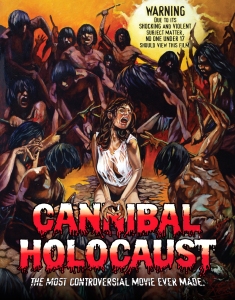
You know, back in the 80s, when I was trying to get a movie made, I called myself a gorehound and like a lot of others, read Fangoria and Deep Red, and this movie was one of the Big Dogs, the ne plus ultra of nastiness. Speaking of Deep Red magazine, its editor, the late Chas Balun was one of Holocaust‘s most ardent American supporters; to him we owe the term “Italian Gut Muncher”. The box for the Grindhouse Releasing Ultimate Platinum Super Collector’s Restored Version proclaims it to be THE ONE THAT GOES ALL THE WAY!!!
Yet… I had never seen it. My interest was minimal. I don’t much care for jungle movies, or movies that simply serve as a catalog of atrocities. I had watched some tape – maybe it was one of those short-lived video magazines – that was a compendium of scenes from various flicks, and it had all the money shots from Cannibal Ferox under its American video name, Make Them Die Slowly, and that was enough for me, for years. But in those years, I was assured that there was more substance than that going on in Holocaust, and when Grindhouse Releasing did their thing, I figured this was going to be my shot at seeing it under the best conditions possible.
I suckered frequent movie-watching partner Rick into sharing the burden with me. That was easy, because Rick has a long-standing grudge against The Gates of Hell. Rick can be a bit gullible when it comes to movie ballyhoo, and when he was told that Gates was banned in 92 countries because it was the ultimate experience in gut-wrenching terror, he was at the theater opening day, money in hand, guts ready to be wrenched. I like Gates more than Rick did, shall we say. For instance, I do not rant and rave for an hour about it when the subject comes up. So I said to Rick, “I have a movie that was actually banned in three countries I can verify. It says it goes all the way.” And he was in.
Unfortunately for me, Rick scoffed at Grindhouse’s generous offer of an “Animal Cruelty-Free Version”, saying, “We’re going all the way!” I guessed if Grindhouse put this much trouble into restoring it, I should at least watch the whole thing. Yyyyyyyyyyyeah, no. I could have easily done without that part of it.
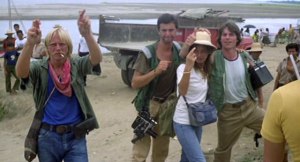
If you live on some planet where this sort of thing hasn’t reached you yet: A documentary crew of four young people (Carl Gabriel Yorke, Francesca Ciardi, Perry Pirkanen and Luca Barbereschi) set out into the Amazonia (a region we are constantly reminded is called “The Green Inferno”), seeking to make a movie about people still “living in the stone age”. After they’ve been missing for two months, Professor Monroe (Robert Kerman), an anthropologist, goes into the Green Inferno to search for them.
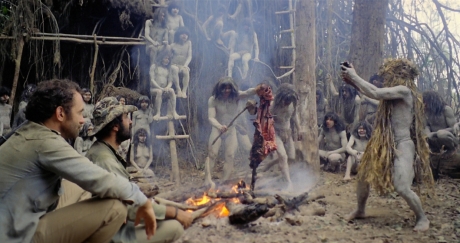
This part of the movie is pretty standard jungle adventure. The indigenous tribes are especially wary about white men, and Monroe realizes that the four missing people are the cause. He eventually tracks them to a remote tribe called The Tree People, where he finds the bones and smashed equipment of the four; slowly gaining the Tree People’s respect (with a tape recorder, and by joining in on the ritual eating of enemy guts), he is given the fifteen cans of film the group had shot.
Back in New York City (really, they never miss an opportunity to drop in a landmark), the network who backed the four’s other documentaries wants to show the returned footage. Munroe is against it. This second part of Holocaust involves the restoration of the recovered film, and Monroe interviewing people who knew the crew. The most cogent thing learned is that the leader of the group, Alan (Yorke) was “a real son of a bitch” according to even his father and his employers. Monroe is shown their previous movie, Last Road to Hell, which looks like execution footage lifted from Africa Addio. He is told that the footage is faked. That’s what Alan did – he incited or he faked. (Note: that shit wasn’t faked).
The last third of the movie is Monroe realizing these executive idiots haven’t watched all the footage, and insisting they do. And here is where the money shots start afresh. The fifth member of the party, the guide, is bitten by a snake, and the venom is so potent that that a quick amputation of the leg doesn’t help. The four decide to continue on, anyway.
(There are what we call Idiot Plots, which depend on the stupidity of the characters to advance. These guys take the cake. They take a whole bakery full of cakes.)
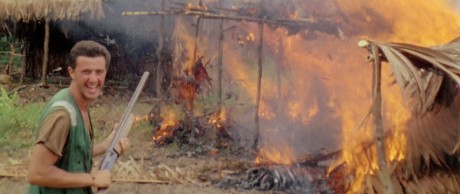
They shoot a member of the first tribe they encounter in the leg, so he’ll be slow enough for them to follow to his village. Then, awing the villagers with their boomsticks, they round them up and torch the huts. Then Alan and Faye (Ciardi) make love in front of the cowed villagers. Going further, they find an errant woman from the Tree People and gang rape her. (They are also mean idiots) . This means eventually they are going to run into a large group of Tree People – too many to shoot – and find themselves rather messily on the menu – and that on camera, to boot. Alan’s the last to go, and I guess hoping that the God of Whiteness will protect him and his film, he keeps rolling.
I’m not going to go into detail on the deaths here, except that they are very well faked – director Ruggero Deodato was actually accused of murder because he somehow managed to convince the four actors to disappear for a year to lend the story credence. There are other man-on-man horrors, but the animals are going to hit you the worst, because those deaths are real and graphic. There are two (very) small saving graces; one is that everything is on the menu in the Amazonia, and after the scenes were shot, the animals were given to the natives to eat, for which they were grateful. That’s a coatamundi, a turtle (that scene is infamously heinous), a snake, a couple of monkeys, a pig. They also list a spider, but that one looked fake, and nobody eats spiders. The other silver lining to clutch at is that the filmmakers now say they regret those scenes, and specifically asked Grindhouse Releasing to excise them. They did, via the branching capabilities of the technology – the Animal Cruelty-Free version runs a good six minutes shorter.
This isn’t even Deodato’s first cannibal movie – he and Umberto Lenzi kept trying to one-up each other on the gore-meter (“The Gore Score”, as Chas Balun would say). The thing is, in that contest, I give Deodato the clear edge. He apprenticed under Roberto Rosselini and Sergio Corbucci. As Eli Roth points out, from Rosselini he gets the power of low-key neo-realism, from Corbucci the canny use of violence to make a political point. Our documentary crew are walking examples of white privilege who push it too far, and pay the price rather nastily.
So does Cannibal Holocaust go “All The Way”? Yeah, it does. Yet somehow Deodato’s framework and execution keeps it from feeling like totally sleazy exploitation. It’s definitely exploitation, but you feel like a point is trying to be made, somewhere in there, amidst all the screaming, rape and gore.
Way back when, when I was writing about The Blair Witch Project, I was asked why I hadn’t included Cannibal Holocaust in my brief history of found footage movies. Well, it was, um… mainly because I hadn’t seen it. But this really is the first one, right down to the “based on a true story” hook. That’s a coin that has been counterfeited so many times as to make any use of it suspect, but legend (ha!) has it that there was a similar party lost to cannibal tribes, there was footage, an Italian network was going to show it, but decided not to and ordered the footage destroyed. The footage still leaked, though, and a projectionist was fined for stealing it – this is mentioned in the text at the end.
Aaaah, who knows. Now I’ve seen it. I don’t have to shuffle my feet shamefully at movie nerd meetings anymore when the subject comes up. Here’s the NSFW trailer:
Let’s get the Hong Kong horror for this year out of the way early, shall we?
The Boxer’s Omen starts with a boxing match, sure enough, an MMA style bout between a Chinese boxer and a Thai, played by Bolo Yeung. Predictably, Bolo cheats, breaking the neck of his opponent with a cheap attack. This leads his brother Chan (Philip Ko) on the road to vengeance, but first he has to be rescued from a gang of thugs (who I guess were also Thai?) by a ghostly Abbot, who then proceeds to haunt Chan until he goes to Thailand to challenge Bolo to another bout. This trip also, nearly by accident, takes Chan to the Abbot’s temple, where he finds out that he is involved in a much weirder movie than he originally thought.
Evil Wizards have the BEST decor.
The Abbot, you see, is now deceased after a battle with a black magician. This battle includes massive exploding sores, driving a magic dagger through the heart of an evil bat puppet, the skeleton of that bat puppet trying to walk out of the temple, and the black magician creating some fuzzy spider puppets so he can crawl up the ceiling of the monk’s bedroom and drop the spiders on him, so they can drive poisonous needles into his eyes, killing him.
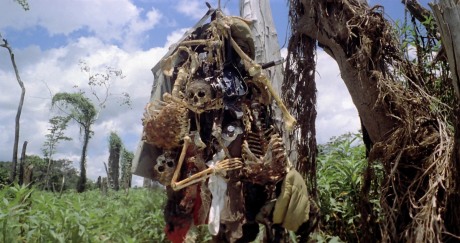
Not my favorite cookie jar.
Whew. Is that weird enough for you? How about the fact that Thai magicians keep pots of disgusting things around to eat and then spit up, creating nasty potions? And they have the most amazing decor for their warehouses full of nauseating things in jars?
If not, trust me, this movie gets weirder.
Chan and the monk were brothers in a previous life, it seems, and now their fates are linked; once the Abbot’s body decomposes, Chan will die. So Chan becomes a monk and trains up for a battle with the black magician, all in the space of three months (cuz he still needs to make it back to HK to fight Bolo).
The battle is a tough (and weird) one, full of bat puppets, animated crocodile skulls, and the black magician ultimately pulling his own head off to attack Chan, Penanggalan-style. It looks bad for Chan until the sun comes up, so burn, black magician, burn!
Ai-yaaaaah!
Well, that’s taken care of, so Chan goes back to HK and immediately breaks monk protocol by sleeping with his girlfriend. Meantime, the black magician’s disciples are doing all sorts of disgusting things, like sewing up his corpse in a crocodile carcass and chewing each other’s spit-up to resurrect him as a super-naked woman with metal nails, which also resurrects the golden needle curse just in time to rob Chan of his eyesight during his match.
Chan doubles down on his screwing up by lying about his falling off the sex wagon, robbing himself of his monkish powers and necessitating a trip to Kathmandu to find the holy ashes of his Abbot brother from yet another former life. This leads to one of the most delirious, demented magical fights ever put on screen, and it’s almost all practical effects. The final assault by the three disciples is now very high on my list of “Oh-What-The-Living-Hell?” moments in cinema.
The Boxer’s Omen was a response by Shaw Brothers to a bunch of smaller studios eating into their market share with tales of extreme horror. It’s best to leave your gag reflex at home while watching this, and don’t even think about absently enjoying a snack while watching. I’m still amused by the prospect of Thailand being the Transylvania of HK movies, but this movie’s dependence on evil wizards running everything through their salivary glands prior to use is going to be a bridge too far for some viewers. The movie’s also about ten minutes too long, but it’s a really crowded hour and forty minutes, and there’s not that much fat that could be trimmed.
But if you have a room full of people that need to be freaked out, boy, do I have a movie for you. Or parts of one, anyway.
Here, have some weirdness, including the fact that whenever the black magician appears, he always plays the audio for the last five seconds of Phantasm.
You should check out cesardg13’s movie posters on Deviant Art.
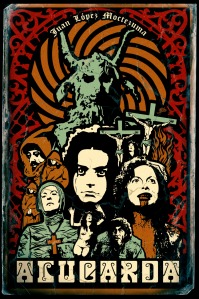
Juan López Moctezuma is an interesting side-trip in the world of genre filmmaking. A compatriot of Alejandro Jodorowsky in his Mexico City days, he was a producer on Fando y Lys as well as El Topo. Moctezuma is most widely known for three movies made in the 70s – The Mansion of Madness (73) which is loosely based on Poe’s “The Method of Dr. Tarr and Prof. Feather” and was indeed re-titled Dr. Tarr’s Torture Dungeon in the US,’cuz them Poe movies always made serious coin (though audiences expecting gothic horror were not prepared for what is actually pretty dark farce); 1975’s Mary, Mary, Bloody Mary which we’ll be visiting eventually; and this remarkably straightforward, though still weird, occult thriller.
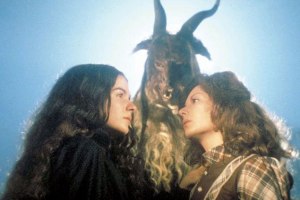
The teenaged, recently orphaned Justine (Susana Kamini) is remanded to the care of the sisters at a convent, where she meets the similarly orphaned Alucarda (Tina Romero), who you know is going to be trouble because she’s the only one who dresses in black. We also know she’s going to be trouble because immediately after her birth, her mother (also played by Romero) was claimed by something dark and scary before the opening titles.
Oh no! It’s Satan!
The friendship between the two girls deepens quickly to a nearly sexual intensity. One day while capering in the woods, they run into a sinister hunchbacked gypsy (Claudio Brook) who offers them enlightenment, even as one of the other gypsies reads Justine’s palm and blanches. Soon after, Justine falls ill and the hunchback appears in the girl’s chamber, making their clothes vanish and signing their souls over to Satan, as one does.
The girls start doing disruptive things like hailing Satan during classes, and things continue to deteriorate until Justine is hanging nude from a St. Andrew’s Cross, being stabbed to find her Witch’s Mark while being exorcised. This scene is interrupted by the local Dr. Oszek (also Claudio Brook), who has no time for such superstitious rubbish. He’s too late to save Justine’s life, but he carries the sobbing Alucarda away to his home, where his blind daughter Daniela (Lili Garza) will keep her company.
A brief pause for my favorite detail – the learned doctor keeps a book in his library entitled Satan so he can sneer at it whenever he pleases.
Oszek returns to the convent to find it in a panic – the nun tending to Justine’s body has mysteriously burned to death and Justine’s body is missing. Soon after Oszek is lead to the chapel by screams, because Father Lázaro (David Silva) is hacking off the head of the dead nun, returned to demonic life. This where the horror movie really kicks into high gear, as Oszek realizes that his book learning is useless against the forces of darkness, and what’s more, he’s put his daughter in mortal danger, because both she and Alucarda have vanished.
The first order of business is to find all these missing girls, of course, and Sister Angélica (Tina French) leads them to the ruins where Alucarda’s mom had her opening scene and the girls liked to hang out and get hallucinations. Angélica also lends another forgetful sister her crucifix, which means when she discovers the naked Justine in a coffin filled with bubbling blood, she’s pretty much doomed.
This leads to a major confrontation in the convent, where all Alucarda has to do is say the name of a devil and somebody else bursts into flames. It all looks pretty bad for anybody not named Alucarda, until the girl’s humanity kicks in when she sees Daniela, who was nice to her, injured by all her wild devil-calling and destruction. The end.
Alucarda has a reputation for being a bit of an undiscovered gem, and that holds true, by and large.There is some wild imagery left over from His Jodo days – the convent’s chapel looks like it grew organically out of the walls of a deep cave grotto, and the nuns’ habits are the farthest you can find from the traditional black-and-white – they’re dressed in odd white fabric with a red wash that is not uniform, making the sisters look like they’re dressed in bloody bandages. Quite striking, and in my experience, unique. This being the Internet, someone will let me know if I’m wrong.
It’s definitely a 70s, movie, though, which means some time spent before you get to the truly weird stuff, though quite a bit of nudity livens up the wait. Should you seek it out? Well, Guillermo del Toro is an admirer of Moctezuma and his films, so let how you feel about one director’s work be your guide as to how you’ll feel about another.
Every night through Halloween. A movie a night, A through Z. Five sites. Five doomed madmen who will, by the end of this month, never want to see a movie again. And you will be there.
Pay homage to our legacy of pain. Here is what will be unleashed upon an unsuspecting world tomorrow:
Dormez bien, my fiends. There shall be no sleep for some time.
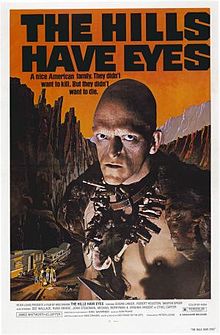
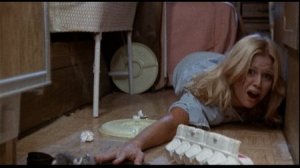
So here we are again, with another movie on the ever-shrinking List of Titles I Know I’m Going To Have To Deal With Some Day. A year ago I finally watched Wes Craven’s Last House on the Left, and now, with Arrow Video releasing an exquisite 4K restoration blu-ray of his second feature, it is high time I get over my aversion to psycho hillbilly movies and give it a watch; it is, after all, considered essential for horror fans.
The Carter family, a group of mobile white bread from Cleveland, make a detour on their vacation road trip to Los Angeles to find a depleted silver mine they’ve inherited in the Mojave Desert. It’s an isolated part of a desolate area used as an Air Force gunnery range and atomic bomb site so of course they’re going to have an accident and wind up miles from anywhere with a snapped axle. The menfolk set out in different directions to find help, not knowing there’s a family of cannibals in the rocky hills surrounding them, and they’re hungry.
In Last House, Craven was saying something about violence in Vietnam-era America, and he finds he still has to say it in the Disco Years. The Carters are a large family, and it’s difficult to figure out the exact relations of the characters at first, but then, if you’re a horror fan, you know intuitively there’s so many of them because their number is going to get winnowed down pretty quickly. The cannibals stage their raid on the Carter’s camper at roughly a half-hour into the movie, and from there the intensity rarely lets up. The elder sister’s baby is stolen away as a “tenderloin”, one of the many acts of transgression on display. In fact, The Hills Have Eyes got an initial X rating, necessitating many cuts, and I’d be willing to bet the baby subplot is what put the nail in that rating coffin, as the MPAA is reportedly as vanilla as the Carters.
As with Last House, Craven makes the point that people forced to rely upon themselves have the capability to do great violence to survive, and that violence will, indeed, have an almost irreversible impact upon their humanity. In Hills Craven plays even more with the concept of two families that are mirror images of each other. Jupiter and his feral clan work together, while the Carters are at odds with each other from the get-go. The cannibals use stolen CB radios to coordinate, while the Carters don’t really communicate, except in the form of argument and sniping.
A lot of folks feel this is Wes Craven’s masterpiece; I would argue the point, but it is a very good movie, as it turns out. Craven had resisted making another horror movie, but as he put it, “I was out of money and Peter Locke said, hey, my wife is working in Las Vegas, let’s make a movie in the desert!” He went to the library and found out about Sawney Beane, the leader of a clan of Scottish cannibals in the 16th century (his actual existence is still a source of controversy). This formed the basis of the script. Tobe Hooper had already proven that the concept would work by combining Beane and his clan with the crimes of Ed Gein for The Texas Chainsaw Massacre.
If there is any place worse to make a movie than on the ocean, it has to be the freaking desert, with 120 degree days and 40 degree nights. Craven and Locke managed to put together an amazing cast of actors trying to get into the business and willing to do what it took to do that. This is the first major film role for Dee Wallace, who plays the baby’s mother, Lynne (and once she is SPOILER FOR A 40 YEAR OLD MOVIE killed, I declared war on the cannibals myself), and it also serves as the debut of the remarkable Michael Berryman as Pluto, the poster boy for The Hills Have Eyes. Berryman describes himself as having “27 birth defects”, one of the more extreme being Hypohidrotic Ectodermal Dysplasia, which means he has no fingernails, hair or sweat glands. Craven and Locke both described him as “incredibly game”, and my god, no sweat glands and working in the desert? It’s amazing he survived. And he seems like an extraordinarily nice guy, on top of all that.
Craven and Locke’s luck with personnel didn’t stop there; they scored Robert Burns as Art Director, and he brought along a trailer full of props from Texas Chainsaw to decorate the cannibals’ cave. They hired Eric Saarinen as Director of Photography, already a veteran of several Corman movies, and he brought his own crew. Hills was shot in 16mm, a budgetary necessity, but Saarinen makes it look so close to 35 that I doubted my own assumptions (until I saw the Arriflex cameras they were using in production photos).
It’s obvious Craven learned quite a bit from making Last House and in the intervening five years; production-wise, this is a quantum leap forward in quality. It’s played practically forever in repertory, and survived a remake or two. Probably the only thing that kept it from doing truly blockbuster box office was a movie that was released a week after its debut, Smokey and the Bandit, which ate considerably into all the drive-ins and smaller movie houses that should have been Hills‘ domain. Ah well. Hills has a more timeless quality – it has endured the passage of time much better.
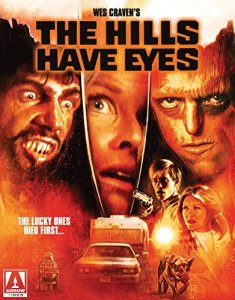
So yes, good movie, glad I finally got over myself and saw it. Arrow Video’s blu-ray is amazing and I would be just fine with them doing every blu-ray release from now on (though it would work their poor labs and restoration wizards to death). As i said earlier: this is a 4K restoration that simply blows away any previous presentation. They also carried over the making-of doc from the old Anchor Bay release (looking so good I think restoration radiation must have leaked through from the movie) and Craven and Locke’s commentary track. It’s wonderful and not a little affecting to see and hear Wes Craven again – his intelligence and wit remain sorely missed in the field of horror.
In a dramatic departure for covers, this is actually pretty close to what happens in the movie
Next month, in our annual Hubrisween marathon, I’ll be revisiting the very first movie I ever reviewed. In my usual demented brain-damaged crab fashion, I will now re-visit the second movie I ever reviewed, which is Slugs, a 1988 horror movie directed by Spanish director Juan Piquer Simón, whose biggest hit stateside was probably 1982’s Pieces (“It’s Exactly What You Think It Is”).
I didn’t care for Slugs back in ’88 or ’89, whenever it was. My entire review consisted of a list of each and every horror movie cliche which you will encounter during its runtime, up to and including, “Hey (Hero), if anything happens to me, take care of my wife.” The only one I couldn’t complain about was the alcoholic hermit saying, “Whut’s thet dawg a-barkin’ at?” and that’s only because the dog doesn’t bark, it just refuses to go into the abandoned house infested with killer slugs.
Killer. Slugs.
You two are so frickin’ doomed, I didn’t even look up your character names.
And that’s not one of the reasons I hated the movie (it is right there in the title, after all); I have watched movies about giant mollusks, murderous tires, bloodthirsty pianos and meteorological events made of man-eating fish; I am not going to balk at a movie about killer slugs, even if as a predator, they only slightly more mobile than the monster in Death Bed: The Bed That Eats. It was the rote nature of the thriller that grated on me.
So here I am, 27 years later, and Arrow Video has put Slugs out on blu-ray. A number of my friends are very excited about this. I’m talking about being as excited as me hearing a pristine 35mm print of Chimes at Midnight had been found. So here is another chance for an older, wiser version of myself to give a movie another chance.
BAD SLUG! BAD! BAD!
As you know (or could have surmised by my above rambling), this movie is about a small town being invaded by a horde of large, carnivorous black slugs (in the most famous shot, we find that the slugs have a toothy maw) traveling through the sewer system, having been spawned by some toxic waste dump in the town’s past. Their mucus is toxic, and can paralyze their victims. Also, as we find out in a particularly Cronenbergian sequence, if your alcoholic wife cuts one up in a salad and you eat it, blood flukes will proliferate in your body and make your head explode. Oops!
Pretty impressive in 1080p.
So it’s up to a heroic Health Inspector (Michael Garfield) a doesn’t-want-to-be-a-hero sanitation engineer (Philip MacHale) and a dubbed high school biology teacher (Santiago Alvarez) to combat the menace. There is a lot of time spent trying to get the local bureaucrats to do something about the bloody bodies piling up, but they can’t close the beaches on the 4th of July jeopardize a sweet business deal already in trouble because the guy negotiating it had his head explode at a ritzy restaurant. So our heroes come up with a formula that makes the slugs explode instead (I guess they were immune to salt), and dump it in the slugs’ breeding ground, which also blows up half the damn town, and serves them right.
The problems with the movie are largely structural: it never really allows itself to build any momentum to its final scene. Two men in hazmat suits blundering around a sewer system with outdated maps, trying not to get eaten should be claustrophobic and terrifying. Instead we’re told to be afraid of motionless rubber slugs and flowing water and I’m constantly checking to see how much time is left. There are times I admit I’m distracted by wondering how slugs can pull people off boats or drag dead bodies along the ground…
“We hate each other a lot, right?” “Right.”
As to the much-reviled cliches: They’re there, but I’ve mellowed about them. These are what Simón thought would make for a commercially successful movie (along with some unrepentant 1980s gore), and apparently, he was right. The special effects are quite good; the exteriors were all shot in New York, while the interiors and almost all the effects were filmed in Madrid, Simón’s home turf. This means there is an awful lot of dubbing in evidence, some of it lamentable, but really that’s part of the charm for its fans.
Those fans are going to be ecstatic about this blu-ray, too. Arrow Video are the guys who brought us a flawless Blood and Black Lace and the quality on Slugs is equally breathtaking. A 1080p presentation from the original film elements, and those elements must have been blessed by the Pope because they are amazing and show not the slightest wear.
Arrow also has their usual bonanza of supplements, but the best for my money is an audio commentary track with Shaun Hutson, who wrote the original novel. Hutson is refreshingly level-headed and entertaining about what became of this, his first book; he speaks disarmingly about his first viewing at a film festival, and the differences between the two (mainly, his book takes place in London, not small town America). The conversation, having 92 minutes to breathe, ranges over horror movies in general and Hutson’s hatred for Stephanie Meyers in specific: “You ruined vampires!”
I like Shaun Hutson.
This is an amazing time to be a genre fan with an HDTV. Are there movies I wished Arrow Video had concentrated on other than Slugs? Of course I do. But I still have to admit this is a wonderful package, beautifully presented, and I commend Arrow for taking such care with a long-neglected stepchild of the horror movie world.
Hey, remember when Satanists nearly took over the US back in the 80s? I sure do.
If you’ve ever read Charles Mackay’s seminal work on societal mania, Extraordinary Popular Delusions and the Madness of Crowds, you know mankind is prone to fads and hysteria, and sometimes you wonder what it was like to live during the events he outlines, including Crusades, witch hunts, animal magnetism crazes. Wonder no more (I find myself living through one right now, but let’s leave politics out of it for the moment), because even if you weren’t around during the 80s, you still feel the echoes of this strange, strange fixation.
FAB Press has released the Second Edition of Satanic Panic: Pop Cultural Paranoia in the 1980s, a heavily illustrated book edited by Kier-La Jannisse and Paul Corupe. It has twenty chapters by twenty-one contributors, each examining a facet of that phenomenon; we’re not talking facile remembrances, either, these are well-researched articles, frequently with lengthy bibliographies.
Don’t forget: Proctor & Gamble? Total Satanists.
Satanic Panic kicks off with an examination of the book that almost inarguably started the Panic, Michelle Remembers, which introduced the world at large to – and began the destruction of – Recovered Memory Therapy. Michelle Smith, under hypnosis, began recalling repressed “memories” of what would soon be known as Satanic Ritual Abuse when she was a child in the 1950s. I’ve never cared to track down this long-debunked book, but it is reported to have a pulp-novel ghoulishness in its descriptions of the horrors supposedly visited upon the young girl: murder, cannibalism, necrophilia, baby crucifixion. My favorite remains that at one point, a tail and horns were surgically attached to her body, which is something you’d suspect a routine medical examination could prove or disprove.
From this one case comes an extraordinary cottage industry that would tell America it was under attack by an astoundingly well-organized and powerful Satanic Underground. Numerous people began making serious coin by not only telling their disgusting and horrifying tales of debauchment while in the ranks of these nefarious ne’er-do-wells, but also training police departments about the modus operandi of these cults. Training films on the subject are still circulated on YouTube, mainly for the lulz.
Satanic Panic examines the subjects you’d expect, like backmasking in heavy metal music, that training ground for demonology – Dungeons & Dragons (and Jack Chick’s Christian comic industry going all-in on RPG’s dangers), and that hotbed of Satanic thought, He-Man and the Masters of the Universe. Horror movies, of course, like Evilspeak and 976-EVIL, which also spoke to misgivings about the new technologies ruining our lives. Let’s not even get into MTV.
Don’t do it, Elfstar!
But the search for knowledge goes to strange places, too. There’s a chapter on Playboy Press’ mass paperbacks (which I had totally forgotten about), which included a popular series by Russ Martin whose major underpinning was “The Organization”, a far-reaching network of devil worshippers which enslaved women to birth babies for sacrifice. This tasteless bit of grand guignol plotting would be reported as fact in a 1988 book, Satan’s Underground.
America doesn’t get to hog all the blame either. The book has chapters on the spread of the Panic to Quebec, Britain and Australia. A special scathing chapter is reserved for Geraldo Rivera, in this period on the cusp between “controversial” investigative journalist and national embarrassment. His two-hour TV special, Devil Worship: Exposing Satan’s Underground (hm, that title sounds familiar) earned him a cover of Newsweek entitled Trash TV.
“Yes, only a Satanist could possibly use chalk like this.”
The book maintains a rough timeline of 1980 through 1990, when the infamous McMartin Pre-School trial served to wind down the hysteria somewhat, and makes a fairly good case for Joe Dante’s underrated movie The ‘Burbs providing a catharsis through comedy, lancing the nation’s moral boil with satire.
That’s also indicative of the book’s welcome willingness to point out a bit of levity here and there, because the history of this thing is actually pretty brutal: there are a lot of lives absolutely destroyed by the most vicious – and often in hindsight ludicrous – of accusations. The Afterword by John Schooley points out a case where people convicted on a bad diagnosis and testimony from children coached by unscrupulous police and therapists were finally acquitted – after 23 years in prison, in 2015.
This is a heavy read, not only in page count, but in the weight it puts on your soul. You have to pause after every chapter, just to give yourself time to process what you’ve just uncovered. This was a period I lived through; there is enough that is familiar that it allows me to think, “Oh, yes, I remember this”, but there is so much more that makes me follow that up with, “Oh hell, I had no idea it got that bad.”
It was about a year ago that I viewed Elem Klimov’s two hour gutpunch of a movie, Come and See, based on his own experiences in World War II (and he claimed he soft-pedaled it, good lord). I was stunned in more ways than one, and even more surprised that Klimov had only made six feature-length movies (and seven shorts). Alas, more than par for the course when we talking directors under the Soviet regime, and we’ll get back to that in a bit. But I was especially intrigued that one of those six movies was a film about Rasputin.
Most of my experience with Rasputin dates back to an article I read in my grandparents’ Readers Digest back in the 60s, which was about his assassination at the hands of desperate Russian aristocrats and military officers. The reason it stuck with me was the sheer amount of damage it was reported required to put the man down: poisoned food, gunshots, stabbing, beating and finally drowning. Rasputin was Michael Myers long before Halloween was ever made. It is generally agreed that he was turned into an unstoppable demonic force after the fact to justify the murder. This bit of history-as-horror-movie was probably reinforced by Hammer’s movie Rasputin starring Christopher Lee, which I must confess I still haven’t seen, so I should probably shut up about it.
For contrast, here’s the real guy.
If you’re any sort of film fan, by now you’ve likely read the Salon article about the legal battles engendered by the 1932 Rasputin and the Empress, which led to your favorite “This is a work of fiction” legal disclaimer at the end of all movies. So I was looking forward to an actual Russian version of the story.
Agoniya takes place in 1916, which is a section of Russian history so chaotic even professional historians have a difficult time hashing out what was actually transpiring. Klimov does an effective job of boiling down the big stories at time, helpful not only to the movie’s intended audience, I’m sure, but essential for those of us on the outside. He makes canny use of actual archival movie footage, and as the movie progresses, also seems to use new footage made to match the look of older film. World War I rages, and Czar Nicholas II has taken control of the Russian military, and he is famously bad at it. Rasputin has already insinuated himself into the royal family, as a mystic holy man who is credited (by the devoted Czarina Alexandra) with alleviating the young Czar Alexei’s medical problems (Alexei, as it turns out, was a hemophiliac, and Rasputin’s insistence that he stop taking the recent miracle drug Aspirin was more or less accidentally the right choice).
Rasputin (Alexei Petrenko) is shown to be all sorts of things: intelligent, charismatic, but driven by his emotions and passions. Petrenko manages a neat trick I had previously only seen in Bruno Ganz’ truly praiseworthy portrayal of Hitler in the oft-memed Downfall: he takes a man who has become an icon of unrepentant evil and manages to humanize him without stirring undeserved sympathy. There are times, when Rasputin is stressed and angry (and such times are plentiful), that he reminds you of Dennis Hopper at his most powerful. Hopper would have played an incredible Rasputin, it occurs to me, but that is so not here or there.
We follow Rasputin’s machinations, his ups and downs, eventually coming to the assassination by Prince Felix Yusupov and his co-conspirators, but we find that the poisoned food and multiple gunshot wounds were eventually enough (the movie also shows how the clumsiness of the murder is in direct contrast to the early bravado of the group; most are ready to cut and run after they find out the poison wasn’t enough).
Rasputin’s legendary debauchery is shown, but it’s never something to wallow in, it’s just another fact laid out before us. It was that more-or-less factual approach that worked against the movie; it was finished in 1975, and then vanished without a trace for ten years, until it re-surfaced in the age of glasnost.
Rasputin is not presented as a force of pure evil, but of venal opportunism, in cahoots with a corrupt banker and an ambitious lady-in-waiting. That was likely bad enough for the leaders of the Supreme Soviet, but it was compounded by the nuanced performance of Anatoliy Romashin as Nicholas II – again, not the cruel despot that Official History required, but weak, more than willing to defer to Alexandra (Velta Line) and be swayed by Rasputin’s visions. He is a man who in way over his head, but cannot admit it, because he is the Czar, dammit. As with Rasputin’s portrayal, it doesn’t excuse the horrid bloodbaths under his rule, but it does aid immeasurably in the verisimilitude of what we are watching.
Also missing would be the beloved Bolsheviks, but this is historically accurate: they were all fighting the War, or exiled, and had been ejected from the Imperial Duma, a governing body which was a hotbed of anti-Rasputin sentiment, but only because these aristocrats and merchants were desperate to shore up the ruling family and preserve the status quo, and therefore their own power. There is increasing chaos as the day of Rasputin’s death approaches, a chaos which is nowhere evident as the dead mystic is lowered into a grave in his native village; Klimov doesn’t have to tell us this is the death knell of the Czarist government – the very stillness and grimness of the landscape lets us know an age has ended. The Age just doesn’t know it yet.
Agony is a complex story of a complex time, ultimately as confusing morally as its central character. It is a story usually presented as devilish holy faker against two pretty young lovers; here the holy man is far too human, as are the appropriately middle-aged royal couple. It’s a portrait of fucked-up people in a fucked-up time – it’s no wonder it ends in blood, even after the movie wraps up, less than year before the October Revolution. Well-made and compelling, it deserves to be much better known… much like its director.

 Hubrisween Central ♠ Letterboxd Page
 Well, great title, if nothing else.

 Director Terence Fisher is one of my favorites in the Brit horror field; besides numerous iconic Hammer films, he’s also responsible for underappreciated indies like Island of Terror and Island of the Burning Damned. It’s largely due to his talent that this over-talkative under-active movie has any hope of keeping our interest at all; a mostly painless way to waste an hour, and not much more.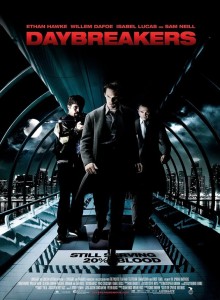



















 drfreex.com