So here I am, sedentary as a rock – in fact, I generally ask rocks “What’s the hurry?” – yet here I am, in a motel room on New Year’s Eve, several hundred miles away from home. There should now be a record scratch and a freeze frame so I can say “I guess you’re wondering how I got here.”
It’s remarkably boring. 2016’s last Ahabian spitting from the heart of Hell, as many if you know, was the placement of its last two major holidays on weekends. His classes start again on Monday the 2nd. (I, also, return to work on Monday) It’s not actually cheaper to drive him up here, but it means Mom gets to hold onto him for another 24 hours.
This is an interesting change of pace (or place). It was perhaps five years ago or so that my theater group stopped doing New Years show, so I’m accustomed to having my cheap champagne at home, kissing my wife, and walking outside to watch the illegal fireworks in my neighborhood. I am, at least with my family. The cheap champagne is in the small fridge next to this desk. I have no idea what I’ll do for illegal fireworks. I am a stranger in a strange land.
An appropriately unsettling ending to an unsettling year, I suppose. Yes, I am aware that years are not sentient, and 2016 was not deliberately seeking out and murdering people who had been an inspiration and comfort to me across my life, and fuck you for interrupting my mourning with that bit of news.
That was bad enough. Then enough of my fellow citizens decided I wasn’t disappointed in them enough, enough to give an unqualified con man and profiteer an Electoral College victory.
I am really tired of living in interesting times.
So. Besides putting on a beret and joining the American Resistance, or wondering if the next Tweet is going to cause World War III, I need to make some plans for the next year that assume just a bit of normalcy.
Hope. Is. Important.
So. I get a bit of fan mail during the annual Hubrisween event (and some new followers). Some hope for the return of The Bad Movie Report. By this I assume I should cover more marginal movies here. Maybe?
This is at odds with the other task I set myself in 2017, which is to watch all the Tarkovsky films I’ve not yet seen.
Well, it’s going to be a long year – very long, by all indications- I’m sure there’ll be room for everybody.
So enough to tapping away at this tiny, unresponsive keyboard tethered to an iPad Mini (I am so 2009). Have a safe, Happy New Year. And I sincerely pray for the Safe and Happy parts.
In an effort to save my fragile sanity, I binged on Asian movies for several weeks. I do feel a bit better now, but I’ve also been spectacularly lazy in writing about these flicks. So here we go. I’m going to try to clear out that backlog by covering six movies.
Hold my beer and watch this.
The movies I watched can be divided equally between two genres: fantasy adventures, and wuxia films. Let’s take the wuxia first:
We can even pare this down even further, as I was specializing in movies directed by Chor Yuen from scripts by Ku Long, starring Ti Lung. Those names may not mean much to you, but if they do, you know where I’m coming from. Yuen movies are a pleasant departure from a steady diet of the more popular Chang Cheh blood-and-thunder testosterone epics; the plots are never straightforward and are in fact often more than slightly fantastic, thanks to Ku Long, who also wrote a series of pulpy wuxia novels with vivid characters. Ti Lung was a powerhouse in the Shaw Brothers repertory company, excellent in action scenes and a far more versatile actor than he was often given credit for. Together, these guys made some pretty fabulous movies.
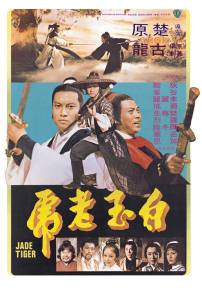
So of course let’s start with the one I didn’t like so much, Jade Tiger (1977). Lung is Chao Wu-chi, son of the head of his clan, whose wedding day is interrupted by the beheading of Dad by his own right-hand man, apparently under the direction of the rival Tang Clan, infamous for their poisoned weapons. Chao must of course ride the vengeance trail to avenge his father, and this trail is going to be full of deceptions, betrayals, double and triple crosses, and lots and lots of tragedy. If you’re looking for an overall metaphor for the plot, it’s the fact that practically every weapon used conceals hidden weapons within, down three layers.
The plot is overly-convoluted (even for a Ku Long script) and darker than jet-blackest Shakespeare, with an equal body count. Chao is going to lose every friend he has and two lady loves. When one of the final fight scenes, between Chao and a Tang who earlier saved his life, has dialogue to the effect of “Why are we fighting?” “I have no idea.” you get the range of bitterness in this conflict. This is a feuding clans wuxia taken to its extremes, and wasn’t quite the escapist fiction I was looking for, but it is a nice vehicle for Ti Lung, proving him more than an action star.
It also skimps on the other thing I love about the Yuen/Long collaborations, the offbeat characters. I wanted to see more of The Red Kid, but I did appreciate The Night Watchman, who is blind, but his glass eyes are really bombs. Still not sure how that works.
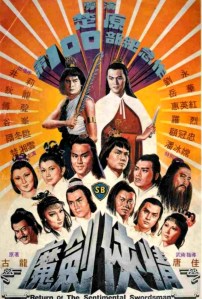
Much more to my liking was The Return of the Sentimental Swordsman (1982), which is, unsurprisingly, a sequel to 1977’s The Sentimental Swordsman. Ti Lung reprises his role as Li Chin Huan, ranked third in the World of Martial Arts, but who has retired from that world after the tragic events of the first movie (well, that and he is suffering from consumption). The dude in charge of making that ranked list urges him to come back, because, as usual, some evil bastard is trying to take over the World of Martial Arts. This time it is the head of the Money Clan, Shangguan Jinhong and his prime weapon is Ching Wu-ming, “The Left-Handed Sacred Knife” (Alexander Fu Sheng). Li must find his old friend, An Fei, who has similarly retired, but is under the power of a seductive, evil woman Lin Xianher (Kara Hui) who is slowly turning him into an alcoholic.
Lin winds up seducing just about everybody in the villain cast (for some reason this does not count for ranking in the world of martial arts), further ruining An Fei and driving him deeper into drink; he finally sobers up when he realizes Li is going to face Shangguan and Ching Wu-ming alone, and goes to stand with his friend in the final battle. The whole cast is really great here; Fu Sheng shows off why he was going to be a superstar before his untimely death in a car wreck in 1983. Lo Lieh has a memorable extended cameo as mercenary beggar Hu Gu, a charming rogue.
That ranked list of martial artists is quite important to the plot’s unfolding, as fighters test each other and try to increase their postings, resulting in plentiful fight scenes. Li, as number three, is such a badass that he goes into battle with only his fan, administering the final blow with deadly accurate throwing knives. Shangguan is, of course, number two. Have eight minutes of swordplay:
Now, just to confuse things, let’s move on to Perils of the Sentimental Swordsman. This is confusing because it is not a sequel to the two Sentimental Swordsman movies, but a sequel to Killer Clans and Clans of Intrigue. Ti Lung this time is Chu Liu-chang (as he was in those two Clans movies), aiding the marketing department by once more just carrying a fan into battle. Gone are Li Chin Huan’s throwing knives and tubercular cough – if Chu needs a weapon, he just takes it from whoever he’s fighting.
As usual, there is a convoluted fake-out plot to frame Chu for attempted murder, so he can get into the Ghostly Village, a sort of martial arts El Rey where fighters on the lam hide out. The Village is run by the mysterious Old Hawk, who is always masked and surrounded by five fighters dressed like him; one of the things Chu must discover is his identity. The other is what exactly the Old Hawk might be planning, and it is, of course, taking over the world of Martial Arts, using the combined might of the Village’s current inhabitants.
There’s the usual switcheroos and complications. Lo Lieh is in the mix, and since it’s Lo Lieh, you can be pretty sure he’s not what he first appears to be. And if nothing else, you have the line, “You’re a slut just like your sister, but her kung fu was better.” Overall, an entertaining time. Of these three movies, Return was my clear favorite, though Perils does have its charms.
The other subgenre I mentioned was fantasy adventure, and here once more I find that I need to lay out a bit of pontification.
There was an intriguing phrase/criticism of Jupiter Ascending I read months before actually watching the movie: “We’ve hit peak FX.” This may indeed be true, and I wasn’t sure why that should be considered a bad thing. We’re always going to have simple, straightforward, realistic movies – they are cheap to produce, and they fulfill a deep-seated need to see ourselves in stories unfurling before us, stories that might actually happen. But I rejoice that we are finally approaching the point where artists can actually put what is in their minds onscreen with a fair amount of accuracy, budget allowing.
So you can bitch all you want about bad CGI. It exists, to be sure, but to employ a metaphor calling back to one of my former loves, comics, I seem to be able to regard it as more like the difference between a page drawn by Don Heck and a page drawn by John Severin. One is more realistic than the other, more detailed and to my liking – but both are valid expressions. I can usually overlook obvious CGI if the story is engaging.
Now, having laid that down, let’s start with a movie that’s been on my watchlist for some time, The Sorcerer and the White Snake. First, let’s point out that there is no actual sorcerer in the movie, it’s Jet Li as Fahei, the Abbot of a nearby temple who is heavily into kicking demon ass and imprisoning them in a mirror to hopefully contemplate and reform their wicked ways. The White Snake is played by Eva Huang, a Snake Demon who rescues a herbalist, Xian Xu (Raymond Lam) from a mean-spirited prank by her sister Green Snake (Charlene Choi). White becomes obsessed with Xian, assuming human form and eventually falling in love and even marrying him, much to the disgust of Green.
At this point there are two parallel story lines, but you can be pretty sure that eventually the streams will cross. Fahei’s apprentice, Ren (Wen Zhang) has a meet cute with Green in her human form while he’s hunting for a Bat Demon at a village festival. Ren makes short work of the demon’s assistants, but the Bat itself is too powerful and bites Ren before Fahei vanquishes it. Ren starts becoming a bat demon himself, with the result that Green can no longer totally dismiss White’s love for Xian, because she’s falling for the morphing monk.
A plague later hits the village, and Xian works himself nearly to death trying to find a cure for it. Fahei knows the plague is carried by fox demons which he captures in short order, and meantime White is supplementing Xian’s medicine with her own vital essence to renew the villagers’ strength. It is this act which causes Fahei to let her go when he inevitably tracks her down, but he warns her to leave Xian and return to the world of demons – which of course she will not do. There is a confrontation during which Xian unwittingly mortally wounds her in her snake form, and must steal the legendary Spirit Root from the Abbey to cure her – but the Spirit Root powers the Mirror Prison, and all the trapped demons possess Xian.
Cured, White and Green stage an attack on the Abbey, refusing to believe Fahei and the monks are trying to exorcise and save Xian. The ensuing battle is suitably cataclysmic and fantastic, and the end satisfyingly bittersweet.
Really, the worst thing you can say about Sorcerer and the White Snake is that the movie is completely schizophrenic, alternating between tender love story and ass-kicking Jet Li movie. The good news is that both those sides of the movie are really good, and if one is not to your liking, the other will be back around in a few minutes. Director Ching Siu Tung we already knew could handle the action scenes. It’s gratifying to know he can handle a love story sensitively, too. Jet Li apparently didn’t enjoy making this movie, having first been told there was minimal fighting in it (there’s not) and then in most of the fights he was up against people with no training and had to hold back while they went all out – very tiring. As ever, though, he’s amazing and the movie is frequently beautiful.
And now let us speak of The Monkey King. I have a fascination with the Chinese epic Journey to the Westand its many filmic interpretations, ever since a chance viewing of Alakazam the Great when I was a child. Stephen Chow’s 2013 Journey to the West: Conquering the Demons was one of my favorite movies that year, and I threw a bunch of people into chairs to make them watch it. The Japanese Adventures of Super Monkey/Monkey Magic is also tons of goofy fun, and I drag it out every few months for my own entertainment.
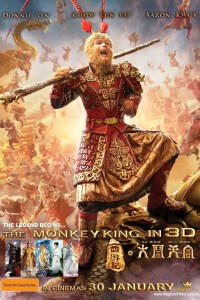
The last few years have seen a ton of Journey movies besides Chow’s, and it was way past time to watch two of them, I decided, especially since the first one, The Monkey King, has Donnie Yen in the title role – Sun Wukong, The Monkey King.
Unlike a lot of the Journey movies, which start with Wukong’s partnership with the monk Sha Seng, Monkey King is truly an origin story, showing how Wukong was born in a magic crystal left over after a war between the Demons (led by Bull Demon Aaron Kwok) and the Celestial City ruled by the Jade Emperor (Chow Yun Fat). As Wukong grows up, he is mentored by Master Puti (Hai Yitian), who finds him a powerful but undisciplined and unfocused student. Meanwhile the Bull Demon is scheming with a dissatisfied Captain of the Celestial City (Peter Ho) to once again attack the Heavenly Palace and overthrow the Jade Emperor – but he needs the power of Sun Wukong, and so begins a plan to beguile and trick the vain, silly monkey.
The Uproar In Heaven, which will eventually cause Wukong to be imprisoned in a mountain for 500 years by the Buddha to meditate and improve himself, is usually glossed over, but here it is front and center, as the Bull Demon convinces Sun Wukong the Jade Emperor killed all his monkey subjects and his best friend, a fox demon (Xia Zetong). It’s a pretty amazing sequence, actually living up to its buildup.
And oh yeah, Chow Yun Fat turns into an eff’in dragon
This is one of the movies where people are going to bitch endlessly about the CGI, and phooey on them. A lot of this is like a children’s storybook come to magical life, and I don’t expect photorealism from that. Hell, I have no idea what a dragon horse really looks like, and neither do any of the people complaining.
Donnie Yen of course absolutely rocks the action scenes, but he also puts in sterling work on the lighter side of the character. He is a playful, cheeky, often utterly infuriating but still endearing Sun Wukong. The movie is apparently pretty faithful to the opening chapters of the source material, so I’ll forgive it the slow spots.
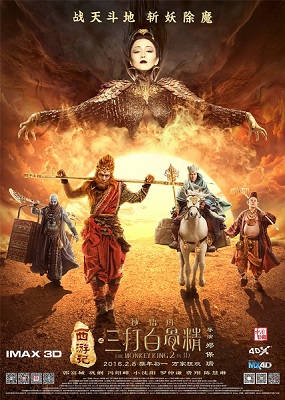
The Monkey King 2, however, is a different creature. Sun Wukong is freed by the monk Sha Seng (Him Law) and tasked to aid him on his journey. Those 500 years under the mountain have changed Sun Wukong – for one thing, Donnie Yen was booked and he is now played by Aaron Kwok (ironic considering his role in the last movie). He’s a lot surlier, too. We do miss the sillier aspects of Yen’s portrayal.
In short order, we have also added river demon Tang Seng (William Feng) and pig demon Zhu Bajie (Xiao Shen Yang). Wukong has the power of the “fiery gaze”, which allows him to see through demons’ disguises (which results in him beating the hell out of his two future comrades). That’s going to prove handy as they approach a city where they are told the White Bone Demon (Gong Li, luminous as ever) is stealing away children. It’s going to turn out to be not as simple as that, but it doesn’t change the fact that the demon wants to eat Sha Seng, which will make her immortal.
The story backs over itself annoyingly a few times, the worst offense being White Bone using her shapechanging powers to drive a wedge between Sha Seng and Wukong, using the same trick twice. The others can’t see demons as he can, and assume he’s just a murder monkey, eventually causing Sha Seng to send him away. The Monkey King is gone perhaps five seconds before White Bone carries the monk away from the comparatively ineffectual river and pig demons.
Nevertheless, Tang and Zhu will mount a brave attempt to rescue Sha Seng – eventually joined by Wukong, of course – as the FX kick into high gear. Dave and I used to think that the Giant Flying Skull Made of Hundreds of Regular-Sized Flying Skulls in Legend of Zu was the Ultimate Metal Effect, but this time we will get a Giant Skeleton Made of Hundreds of Skeletons. It would make many stoners say “Duuuuuuuuuuude” if they ever got this far.
Honestly, most of the time I spent watching this I was thinking, “This is the movie Snow White and the Huntsman wanted to be, but couldn’t manage.” It maintains a nice storybook reality, and the FX are excellent and in service to the story.
So this “short piece” is approaching 3000 words, and I want to get it online so I can concentrate on the holidays without guilt. Please have the Happy Holiday of your choice, and though I probably won’t see you until next year, have a happy new one, and above all: Have a Kung Fu Christmas.
As I said earlier, I’ve been binging on my spiritual celluloid comfort food, martial arts movies. Last time I went in-depth on one of the more… um, remarkable ones (boy howdy did I make remarks), now let’s see how many I can sort-of-briefly talk about until I once again get sick of my own voice.
This all started with Criterion’s blu-ray release of King Hu’s A Touch of Zen, which I had seen perhaps twenty years ago, when I was actually starting to take my education on Asian action films seriously. In those olden days, online information was sparse (and really, so was “online”), and you had to make do with what you could find, and all I had to go on was some passing references to Zen as an important movie. I slapped it on my Netflix queue (remember those?) and did, in fact, get pretty impressed. It was split over two sides of a flipper disc, so yeah, it’s a long movie – but it’s also deservedly considered a masterpiece.
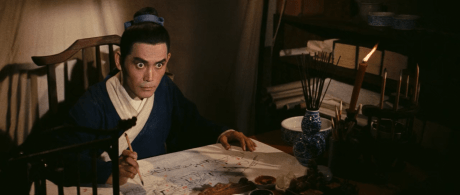
Hsu Feng is Yang, a scholar who is content eking out a living with his paintings and calligraphy in a small trading village built around an abandoned fort. A young lady, Sheng-zhai (Shih Chun) moves in to the fort, but resists the attempts of Yang’s mother to matchmake between the two. There have also been an odd assortment of people wandering through the village, inordinately interested in the young lady, and some other merchants…
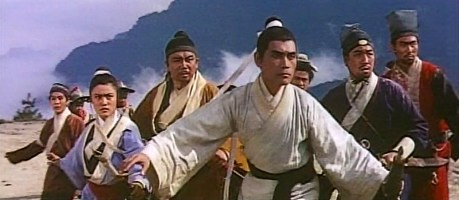
We’ll eventually find out that she’s the daughter of a lord who was disgraced, tortured and killed several years before by an evil eunuch running The Eastern Chamber (reliable villains in wuxia films). She and her general have spent the last couple of years training in martial arts at a nearby monastery, and are hoping to use them to achieve their vengeance. Yang may not be a warrior, but he has spent his life studying military strategy, and is delighted that he can help his newfound love with his knowledge. He accurately predicts what the various movements of the enemy mean, and constructs an intricate trap at the fort, building on its reputation for being haunted, allowing the outnumbered forces of good to successfully take on a small army.
King Hu’s visual storytelling game is obviously strong from the beginning; it is almost five minutes before we see a human being (he always made fruitful use of the varying landscape of Taiwan), and there are perhaps two dozen lines of dialogue in the first thirty minutes. Everything else is shown – almost pure cinema. The literal centerpiece of the movie is a fight scene in a bamboo forest (inspiration for countless battles in years to come), which must have been an absolute bear to film, but the camera moves – with stalks of bamboo in the foreground providing an exhilarating sense of dimensionality and movement – make that trouble worth it.
At three hours, timorous studio executives (of course) felt it too long and at first split it up into two movies, with that fight scene ending the first and reprised at the beginning of the second. Small wonder, as our two good guys – Sheng-zhai and her retainer, General Shi (Bai Ying) are over-matched by their two adversaries, and must pull off a desperate measure that would become rather expected in later movies but leaves Yang and the other non-combatant (and the audience) gawping in amazement.
Based on Lu Song-ping’s Strange Stories from a Chinese Studio, the movie somewhat bizarrely – to Western viewers, anyway – comes to a successful, bittersweet conclusion, only to switch protagonists and continue for another half-hour, with a new, even more powerful villain, a development that always surprises me. It’s practically another mini-movie in itself.
Two years in production, most of which was building that fort and letting the grass grow to a realistic height. Now restored and beautiful, A Touch of Zen is highly recommended. This trailer for the UK Masters of Cinema edition:
Dammit Criterion, just take my money.
Watching this reminded me that I still hadn’t seen the previous King Hu movie, Dragon Inn, though I’ve seen practically every other movie playing off it’s pedigree, like New Dragon Gate Inn and Flying Swords of Dragon Gate Inn in 3-D. I note that Letterboxd has a poster similar in style to Criterion’s Touch of Zen, which hopefully means a blu-ray from them at some point. Right now I just have to deal with this plain old primitive DVD.
This is going to sound familiar, but a decent lord is persecuted, prosecuted and executed by an evil eunuch of the Eastern Chamber, and his family is exiled to Dragon Gate, on the outskirts of civilization. Attempts are made to murder them on the way, thwarted by folks still aligned with the dead lord. The isolated Dragon Inn is run by a former retainer, and it becomes the central point for both factions as the family gets closer and closer.
Watching Dragon Inn after A Touch of Zen is instructive in many ways, especially in the casting. Shih Chun is once again the badass swordwoman, though this time dressed like a man so that, in the way of Shakespeare and wuxia films, it is automatically assumed she is a man. Hsu Feng this time is playing the kung fu hero who is so damned good he usually only carries his umbrella into battle. Ray Chiao, who played the near-invincible monk in Zen is also against that type as Shih’s brother, a decent enough fighter, but a hothead.
The fights are plentiful, varied and interesting. King’s combat aesthetic was heavily influenced by Peking Opera, so the swordplay remains pretty realistic, except for the fact that there seem to be plentiful mini-trampolines scattered about for some unrealistic jumps. Dragon Inn is just short of two hours, and it does seem a little stretched out in the final act, but it does have a more solid throughline than Zen. If you’re a wuxia fan, you’ve probably already seen it. If not, you should.
All this means that I need to go back and re-watch the movie that made King’s career take off, Come Drink With Me, which is a movie I had given up on ever seeing until Celestial started putting out remastered movies from the Shaw Brothers vault in the early part of the century. It was one of their very first DVDs, and my first overseas purchase.
Though not yet. After a conversation about the brevity and relative sedateness of Polly Kwan’s fights (not her fault) in Kung Fu Halloween, I felt the need for a more fearsome female fighter, so helloooo Angela Mao Ying in Lady Whirlwind, which was re-titled – rather risibly, to capitalize on a certain porn movie that was making waves at the time – Deep Thrust.
The first thing you’re going to notice about that trailer is that there is not enough Angela in it. When you watch the movie, you will see that is a complaint that can also be applied to the movie itself. Angela plays Miss Tien, who is looking for the guy who’s the centerpiece in the other fight scenes, Ling (Chang Yi). He opens the movie by being beaten up and left for dead, which will be a continuing motif for the next hour. Tien is looking for him because he abandoned her pregnant sister, who then committed suicide. There is some intimation that the Chief Bad Guy having his thugs leave him for dead was the cause of this abandonment, but the story moves forward rather too quickly to ever elucidate on this – Ling, who’s been practicing his kung fu, begs Tien to leave off killing him until after he has his vengeance.
Thing is, the bad guy has a new henchman who’s a 6th degree red belt in karate, and he makes short work of Ling. Tien rescues him from being buried alive, and while Ling is wandering around dazed after that, he helps a old Korean herbalist, who in gratitude teaches him the Tai Chi Palm, which will finally allow him to win a fight. Meanwhile, that karate creep everybody is afraid of? Tien finishes him off without much of a sweat.
Oh, Fatty, you are about to enter the Kingdom of Hurt.
Exactly why the hell Mao Ying isn’t the actual main character of a movie called Lady Whirlwind will be puzzling scholars into the next few centuries. She easily dominates every scene she’s in, and she’s never onscreen for any length of time before some scumbag is flying through the air and screaming ai-yaaaah. She was an actual black belt in Hapkido, and her sureness of motion and controlled energy demonstrates that. I am never going to stop believing her talents were criminally wasted in Enter the Dragon, but then I also have to admit that is likely the only one of her movies most Western moviegoers have seen.
The quality of this rip is not great, but you can at least tell that the guy in brown is a very young Sammo Hung, at this point in his career basically just a villainous punching bag for Angela, a role which he assayed often and very well:
Though it’s never going to be considered an art film like King Hu’s entries, Lady Whirlwind is very entertaining, even if you spend several fight scenes drumming your fingers, waiting for Ling to get beaten down again so Angela can take center stage once more.
I had thought that three movies would be my limit this week, but now that I’ve brought up Sammo, I have to go on to a movie from the other end of his career, the 2015 Rise of the Legend. This may mean this gets posted a day later than planned – my apologies.
Rise of the Legend is another attempt to restart the Wong Fei-hung franchise, and this is going to confuse people like myself who mainly know the character from the Once Upon a Time in China movies or Jackie Chan’s Drunken Master flicks, because this is apparently the Zack Snyder version of Master Wong. Through the opening and into the first, say, ten minutes I wasn’t sure if the character I was watching was actually Wong Fei-hung, not because he is taking on all comers in a massive alley fight, but because he’s pretty matter-of-factly killing thugs. Jet Li and Jackie didn’t hesitate to put the hurt on people who were asking for it, but we are definitely dealing with a meaner version here. Dare I say… “grittier”.
Fei-hung (Eddie Peng), we will find out in subsequent flashbacks, was orphaned when his father (Hi, Tony Leung!) roughed up a scumbag slaver who kidnapped and sold one of the orphans kind-hearted dad had been taking care of. His clinic was torched by the scumbag’s gang, and Dad died getting the kids out. The adolescent Fei-hung and his close friend Fiery (Jing Boran) sought revenge, only to find the gang was killed by another gang. They are carried away by a monk who teaches them kung fu and does his best to quell their bloodthirsty fires of vengeance.
The plan they hatch in a calmer maturity involves Fiery organizing a gang called the Orphan Gang (including some of the kids Dad Wong was caring for) while Fei-hung works his way up the hierarchy of the Black Tiger Gang, which is consolidating its hold over the docks, opium dens, and crime in general. That’s where we start in media res: Fei-hung literally fetching the head of a rival gang, ingratiating himself to the leader of the Black Tigers, who is the reason we’re doing one more movie… Sammo Hung.
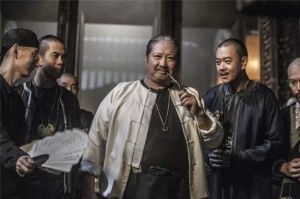
Sammo has come full circle in a long and excellent career. These days I only see him in villain roles, but he’s nobody’s punching bag anymore. Fei-hung becomes the fourth of the sub-bosses under Sammo, and then his and Fiery’s plan kicks into gear.
I’ve seen a lot of reviews trash this movie, but I have to admit it kept me interested for a little over two hours. I doubt its validity as a Wong Fei-hung story, but as a Yojimbo-esque crime drama, it’s pretty good. As we head into the third act, the story stumbles a bit – there’s one sacrifice too many for cheap emotion, one turncoat that’s a little too easy, but I did appreciate the way the overall plot was teased out.
A lot of rancor goes toward the fight scenes, which I also find unfair – Corey Yuen is the fight coordinator, and I had no complaints except for (you were waiting for the “except for”, weren’t you?) the final showdown between Sammo and Peng, which is technically pretty, but emotionally vacant, and accordingly unsatisfying.
The rest of the movie I have no complaints about – it’s quite handsomely mounted, with a soundtrack that at several point evokes Morricone, and that’s a good thing. But let’s just pretend that the main character’s name is just a coincidence, okay, and go watch Once Upon a Time in China again.
At some point in the last horrific couple of weeks writer Jessica Ritchey asked what sort of media made you feel safe, what was your head’s comfort food. That was during one of my very brief returns to the turbulent waters of social media, and I didn’t respond. Well, now I am: kung fu movies.
That is a gross generalization: what I truly love is wuxia films, tales of righteous men and women taking up the fight against evil, often in the defense of the weak and helpless. Righting wrongs. That’s a message I need to see right now.
I watched two in the days before the Election, unknowingly preparing myself, I suppose. Then came the dark days, when I couldn’t get up the gumption to watch a movie until I forcibly broke my two-week fast with another – and then I watched Doctor Strange, and found myself watching a Marvel wuxia movie, complete with training scenes. I’ve since watched at least two Chinese fantasy adventure films, maybe more by the time this finally posts.
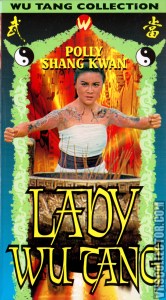
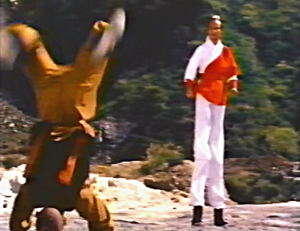
As usual, we’ll take these things on in a sort of backwards, piecemeal manner, with the movie that broke my fast, Kung Fu Halloween. This showed up several years ago in one of those “Weird Movies You’ve Never Seen” lists, which I usually read for sneering purposes, but by golly, I had to admit I hadn’t seen it, or even heard of it. The poster that accompanied the list looked pretty interesting, too. Let us gaze now upon that image, and realize, as is the way with many exploitation posters on these fair shores, that it has absolutely nothing to do with the movie, and this scene will never occur, so stop waiting for it.
As you know, we just came off the annual Hubrisween challenge, an A-Z movie review event. Because some of us are unbridled masochists (and probably sporting a certain amount of brain damage), the dust hadn’t even settled before we started working on our lists for 2017. From the depths of my memory – oh, all right, my ever-freaking-growing Letterboxd Watch List – I pulled out Kung Fu Halloween for the difficult letter K, and took the rest of the day off.
Unlike most of these re-titlings, Wu Dang is actually at least mentioned at one point.
Which is where things get interesting, if you’re interested in trivia. Like any Hong Kong flick of that era (and any other, really) that is not its original title, which would be Shi da zhang men chuang Shao Lin. Finding a copy of it would prove somewhat difficult, unless you were looking for the correct alternate title. Probably the most recent release was as Lady Wu Tang, back when Xenon was being breathtakingly barefaced in their greed to cash in on the success of kung fu-suffused hip hop group Wu Tang Clan (Kung Fu Cult Master became Lord of the Wu Tang, Taoism Drunkard changed to Drunken Wu Tang, you get the idea). Another popular title was apparently Don’t Bleed on Me. But if you go back far enough, the English title is the more generic Fight for Survival, which is how I finally found it (a tale which echoes my fractured search for Terry Jones’ The Wind in the Willows only to find out – years later – Disney had re-titled it Mr. Toad’s Wild Ride).
“But what about the movie, you long-winded buffoon?”
So the ten best, most famous fighters in the World of Martial Arts converge on the Shaolin Temple, saying they’ve heard a rumor that the famous Tammo martial arts manual has been stolen. As it is a great treasure of the temple, the Abbot is disturbed, and brings out the manual to prove it’s safe. At which point the leader of the fighters sucker punches the Abbot – mortally wounding him – and grabs the book, which is apparently like those books that contain multiple volumes on the sales tables at Barnes and Noble, because it flies into pieces and each of the fighters grab a piece and run away. Now that they each have one manual for each of the techniques in the Tammo book, they pull off Mission Impossible masks to reveal they were not the fighters they appeared to be.
Why, you’re not the fighters you appeared to be!
And that right there is the justification for the Halloween portion of the title, over in the first five minutes, and to my mind, disqualifying it for Hubrisween. I mean, the rest of the movie gets fairly weird, but we’ve left the October Country behind.
This is where we meet Shi Fu Chun (Polly Shang Kwan), a girl who steadfastly kneels before the gates of Shaolin, hoping to gain admittance for training, even though the Shaolin He-Man Woman Haters Club does not admit girls or their cooties. Two lazy acolytes fool her into carrying water for them for a year in exchange for eventual training. That works against them when the current Abbot finds out (they now have to carry water for three more years before they can train) and Shi still can’t gain admittance. This doesn’t sit well with the old hermit Shi met and has been caring for along with the water carrying (Chan Lai Wau), who it turns out was a former Abbot who left because he was fed up with Shaolin rules.
“Non-Stop Streetfighting Action!”
He’s also shocked that the Tammo book was stolen a year before and no one’s managed to get it back. Just to show everyone, he trains Shi in every one of the techniques in the Tammo book so she can retrieve it and restore Shaolin’s prestige. He estimates this will take three years (this movie is pretty serious about its time compression). One problem: learning Positive kung fu causes her to grow a moustache, which the Old Man says is natural, and can remedied by studying Negative kung fu… but he’s forgotten how. To escape Shi’s temper tantrums, he fakes his own death.
These are the jokes, folks.
So after the Old Man is installed in the hall of golden former abbots, Shi does the pick-up-the-hot-brazier-and-get-dragons-burned-into-your-arms bit and leaves the temple with the two rapscallions from earlier (because we need not one, but two Odious Comic Reliefs) to reclaim the Tammo books.
Yes, sir, that’s some vicious streetfighting right there.
Shi and her two fifth wheels make fairly short work of tracking down the various pieces of the book, and we get to see the “magic kung fu” styles we saw briefly during her training montage, some of which involve growing arms and legs to extraordinary lengths, as seen in the previous year’s Master of the Flying Guillotine and subsequent Street Fighter games. (“They look strange because they’re very evil,” Shi explains to the OCRs) The fight scenes are unusual and exciting, but feel a bit short if you’re used to a diet of Chang Cheh blood and thunder flicks, or the more modern action movies.
Aaaaaa! Creepy!
Mixed in with this is the fact that the guy who snagged the Negative kung fu manual has, of course, turned into a woman and has been smitten with the Positive kung fu gender-swapped Shi (a character that presages Swordsman 2‘s Invincible Asia by nearly 15 years). The remaining band of thieves reunite to try to take down Shi, but are undone by Negative’s unrequited love and the fact that the Poison guy can’t resist poisoning everybody. Shi eventually triumphs – with the aid of the two Odious Comic Reliefs, even – and takes the Tammo book and the captured thieves back to Shaolin.
Wait a minute… there’s still 25 minutes of movie left?
Everybody conga!
Well, those ten famous fighters show up at the Shaolin temple again – economical filmmaking right there – but this time they’re the real deal. Turns out the thieves were all various disciples of theirs, and they want them released. Not for any ethical reasons, you understand, but because having their followers imprisoned affects their prestige in the world of martial arts. So they have to fight their way through the temple – represented by three of the fighters taking on masters in Monkey, Tiger, and Crane kung fu – and eventually reaching Shi in the central courtyard. She’s more than a match for any of them – even two or three of them – so they form the Shantung Battle Line, a sort of Kung Fu Conga Line that spells mutually assured destruction for both sides. With appropriate locomotive sounds, the Line takes to the air.
Luckily, one of the two Odious Comic Reliefs knows the Old Man faked his death and he takes the hit of the Shantung Battle Line. Everyone learns a lesson, the thieves have been magically reformed by the teachings of Shaolin, the Old Man has earned his gold plating, the end.
Kung Fu Halloween/Fight for Survival isn’t the weirdest martial arts movie I’ve ever seen, except perhaps in tone. The plot is pretty standard stuff, save for the gender twist on the protagonist, and its pursuant lighter, often comedic touch. Polly Shang Kwan (real name Lengfeng Shangguan) was a versatile actress who manages the change from girl hiding behind the master (and going ee! ooh!) while he routs upstart monks to kung fu badass very well. Chan Wai Lau is a gifted physical actor who appears in what seems like thousands of kung fu flicks.
That, in fact, covers a lot of the actors in this – it’s full of familiar faces, and only the breadth of my ignorance prevents me from naming them all. Most only get one brief fight scene, if that – Polly’s the only woman who gets to show off her stances – but that original poster has the line of head shots along the bottom to prove it.
So I was a bit disappointed that I wouldn’t get to do a kung fu flick for Hubrisween – but I wasn’t disappointed in the movie itself. It was a whole lot of ridiculous fun – and isn’t that what Halloween is all about, anyway?
It’s Thanksgiving. Buddha and YouTube are merciful:
(But Man is not, as somebody took the movie down. Sorry)
This has been probably the most profound bout of jet black depression I’ve experienced since my checkered career as a college student. That new prescription for an anti-depressant was very well-timed, it seems, because this time I was actually able to get out of bed and force myself to, you know, do things. Well, some things, anyway.
I stayed off social media for a week. Then started dipping my toe in. The first day I made it five minutes before I had to turn off that particular faucet of despair. That period has gotten a little longer every day. I’m almost up to an hour now, and the flavor runs more toward anger, and then I have to turn off the faucet again.
I live and work in one of the counties that actually turned Texas blue for a few minutes, and I’ve found the best thing has been to be out among people, which is exactly the polar opposite of those dark college days. Well, perhaps not that opposite, but these days I’m a whole lot better equipped to consider that as an option. We’re all being pretty nice to each other. A succession of four people on the campus going through a door, each holding it open for the person behind them, and each thanking the person for doing so was a balm for a very bruised soul, far beyond such a seemingly simple act.
It made it feel a bit less like living in enemy territory.
No, it’s when you’re alone that things get bad, which is a hell of a thing when you’ve been cultivating a reputation as a solitary person for most of your life. I watched a movie last night for the first time in those two weeks, and maybe that will finally shake loose the article I’ve been trying to write for the same period, which has gotten no further than the first line I stare at for far too long. A first line which sounds increasingly like a suicide note, the more chronal distance I put between myself and its writing.
So obviously the first thing to do is delete that line. Delete it forever.
I haven’t entirely been ignoring the blog. I spent a significant portion of those two weeks repairing five years worth of dead YouTube links. I’ll be bold and say, you’re welcome! and even pretend that someone besides me has any interest in what I said years ago. Maybe the links will last more than a week this time. (Of course, one of the side-effects of that little exercise was getting heartily sick of the sound of my own voice, as it were)
First, welcome to the new subscribers I picked up during the last Hubrisween event. Sorry for the seeming silence – when we’re not doing Movie Challenges, we only update once a week around here. An A-Z challenge like Hubrisween takes a lot out of you, and although I didn’t end up hating movies (as I have in the past with such things), it was also spectacularly easy to just not watch any for a week or so.
Then I got two gut punches in a row. One is personal, and I won’t bore you with it. The other is that last night’s Election didn’t go the way I thought it should.
So I’m going to be personal and topical tonight. Click away if you must; I totally understand. I hope to be back to my usual light-hearted shilly-shally sooner rather than later. But that is not where I am right now.
I didn’t watch the News last night, I only checked in occasionally on Google and Twitter. The only way I could keep my heart from freezing or exploding or both was listening to the Mike Oldfield channel on Pandora and re-reading Philip Jose Farmer’s Doc Savage: His Apocalyptic Life, perhaps the ne plus ultra of escapist literature. There was a lot of deep breathing involved.
I checked into social media early this morning to confirm my worst suspicions. I did what I had to do on Facebook and Twitter for work, and then – following the advice of one very important series of Tweets, I proceeded to close the tabs for Facebook and Twitter. I had quite enough despair and rage and confusion of my own, though the little I did read at least confirmed I was not alone.
Then I followed the directions in that Tweet series I mentioned.
I had checked my blood sugars as usual that morning, but I was too dazed to write the result in my log. Whatever they were, they’re weren’t extraordinary enough to register.
I forced myself to eat breakfast so I could take my meds. Might as well, my ACA health insurance is probably going away, followed soon, no doubt, by myself.
I showered and flossed and brushed my teeth and shaved.
I put on clean clothes. I went to work.
This was important. This was to confirm to myself that Normal is still possible, still exists. Other people showed up for work and classes. Life goes on.
I took my long walk, trying to get my weight and triglycerides down.
There are a lot of people wearing black on campus today.
One of the other things the series suggested was, if you have a creative bent, do it as you are able. I’m a writer, so here I am writing. There’s some fiction I’ve let lie ignored for too long, I should get back on that horse, unhampered and untempted by those two closed-down tabs in my browser. Maybe try again to learn how to use Scrivener.
One of the other Tweet series I read before shutting it down was by an African-American, pointing out that if we felt betrayed, dismayed and that our interests and voices and well-being had been ignored and, in fact, actively torpedoed by powers apparently beyond our control – well, welcome to the club.
And that’s it, isn’t it? We’re all in that club, the Club of the Other now, and we have to redouble our efforts to look out for one another. Normal will still be possible, but it seems like it will be a debased Normal, and – barring a Twilight Zone-style plot twist – we’re going to have to struggle for it even harder.
Dan Rather used to end his newscasts with the word, “Courage,” for which he was mocked and derided. But that’s what we need now, isn’t it? Because it seems, in this horrorshow of a year, luck has largely abandoned us.
Zeder has an odd, somewhat fractured reputation. It was released during the great VHS boom under the title Revenge of the Dead, which is a pretty accurate description, I suppose – but it was being sold as another gory Italian zombie flick – and it ain’t that.
You think it might be, with the opening – an elderly woman getting mangled by a shadowy figure outside an old mansion, “The third in two years!”, and a mysterious Dr. Meyer (Cesare Barbetti) forcing an obviously disturbed teenage psychic, Gabriella (Veronica Moriconi) to seek out a body buried in the cellar while all sorts of Amityville shit is going on upstairs. While Meyer brings the authorities downstairs, another shadowy figure mangles Gabriella’s leg. The body is dug up, a moldering skeleton – with Gabriella’s slipper in its bony hands.
Going over the few effects found with the bones, Meyers finds the skeleton’s wallet, with an ID card, revealing the corpse was once Dr. Paul Zeder. Meyer is astounded. “He found a K Zone!” he exclaims.
Enough about that, let’s go to the present day of 1983. (There aren’t a bunch of visual cues – at least to these American eyes – that reveal the opening was twenty or so years in the past, but we are also going to find that Zeder is that rare creature, a movie that expects its viewer to be smart enough to keep up with it) A young writer, Stefano (Gabriele Lavia) is given an anniversary present by his wife Alessandra (Anne Canovas): a dinosaur of an electric typewriter she bought at an auction. Stefano sets to writing, but the ribbon runs out quickly, and upon trying to change it, he notices he can read what was written before, by the previous owner. Something about “K Zones”.
Sensing a story, Stefano begins to trace the previous owner, and find out exactly what a K Zone might be; he visits his old college where his former professor (John Stacy) reveals that it was the theory of a Dr. Paul Zeder, who mysteriously disappeared years before. He felt that there are certain areas of the Earth where time periodically comes unglued, as it were. opening up the possibility that the dead could be communicated with at these times, and even come back to life. Absurd, obviously! Oddly, the professor’s copy of the articles laying that out seem to have vanished…
And thus, Stefano becomes more and more obsessed with solving this mystery, and overcoming the many obstacles thrown in his path. The prior owner of the typewriter was a priest who left the order when he discovered he had terminal lung cancer. The priest’s crypt is empty… because he has been buried in the grounds of that mansion, in a coffin wired with television cameras and motion sensors by a group headed up by the now grey-haired Dr. Meyers and an adult Gabriella (Paola Tanziani). The K Zone, as it turns out, is quite real, and the dead do come back – though not quite the way you’d want.
So, as mentioned before, what we have here is not truly a zombie movie (except that the dead have a tendency to tear off throats and enough body parts for video boxes to make false claims), but a mystery more in tune with a giallo than an actual horror movie. You have an amateur sleuth, his lovely wife involved against her better judgement, and at least one remorseless killer – all that’s missing is the black leather gloves. One piece of oddness I have difficulty overcoming is why the group investigating the K Zones feel that information is worth killing to conceal. A little more information or motivation would have been nice, but perhaps that’s meant to be just one more enigma to hash over after viewing.
Pupi Avati directed somewhere around 50 movies and TV shows, but his fame in these parts rests mainly on this movie and another, The House of Laughing Windows, giving him a reputation for thoughtful horror. Zeder, as I said, is arranged as a mystery, where we know more than Stefano, but we aren’t sure of the why of things. Stefano’s gradual peeling back of the layers around the K Zone mystery keeps the viewer engaged, until the final act when the K Zone busts out The Weirdness in all its glory. A lot of low-budget horror movies do this, saving all the money for the close (appropriately so), but in the case of Zeder, it actually feels like that is earned.
It’s hard to find, but if you’re in the mood for a giallo-inflected movie with more than a bit of the supernatural in the mix, Zeder/Revenge of the Dead is worth the effort.
Yes, it’s the second Blank Tile dropped in two days. I left this one until today so I could point out that it’s “20 DaYs Later” when the Twitter intelligentsia get tired of making rape and death threats and decide this is a good hill to die on.
Dystopic horror movies can put you in a really bad mood.
Some animal rights activists break into a lab, determined to free the chimpanzees that are confined there as test subjects. The trouble being that these chimps are all infected with something called the Rage virus, which is pretty much the primary symptom, it seems. They pay the price of their misguided altruism rather quickly and messily.
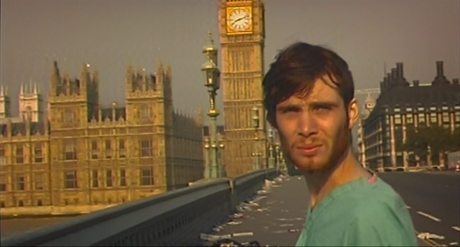
Then, as the movie helpfully informs us, 28 Days Later Jim (Cillian Murphy) awakes from a coma in a hospital. It seems Jim was a bike courier who was hit by a car, and as he wanders about a deserted London, he discovers he has slept through the Apocalypse. And then he finds out that London is not quite so deserted at night, which is when the Infected come out.
The Rage virus has spread far and wide, and Jim falls in with Selena (Naomie Harris) and Mark (Noah Huntley). Jim is the first uninfected human they’ve seen in nearly a week. Eventually our heroes will meet up with Frank (Brendan Gleeson), a bluff taxi driver, and his daughter Hannah (Megan Burns); Frank’s done his best in an abandoned tower flat, fortified it well. But there has been no rain in ten days, and they’re running out of water. Frank, however, has a hand-cranked radio, and has found a recorded, repeating message from a military base urging survivors to come to them.
Don’t get used to it, folks.
So we have a road trip during a zombie apocalypse: sometimes terrifying, sometimes lovely. The base is found, in an isolated mansion. A small garrison of troops, led by Major Henry West (Christopher Eccleston) has made full use of land mines, razorwire and generators to keep their version of civilization alive. West has a vision of rebuilding civilization from this base, and he has gone about organizing with that aim. The major problem for our heroes is that plan requires women, and they’ve just brought two of them. And these soldiers are more than willing to kill any obstructions to their Utopia.
I’d had 28 Days Later recommended to me as wondrous new twist on the zombie movie, the freshest concept in ages, a shot in the arm to the genre, blah blah blah because this was released right after I signed off on zombie movies for ten years, even the good ones. And make no mistake about it, 28 Days Later is a very good movie.
Writer Alex Garland and director Danny Boyle set out to make a different kind of zombie movie, and in some ways succeeded: an argument can be made for this as one of the very first “fast zombie” movies, for one – before this, the Re-Animator movies and Return of the Living Dead seemed like outliers. The Infected aren’t interested in eating your guts or your brains. The Rage virus seems to be just that, a lot of people wandering around looking for people to hurt, to vomit blood on them and infect them. Even when they’re set on fire they don’t slow down. Ebola was used as a basis for the virus’ spread, but Ebola isn’t terribly successful as a virus: it tends to kill its victim before they can spread the disease. Rage is much more successful in that respect. Major West keeps one of his troops who got infected chained in a courtyard to a very grim purpose: he wants to find out how long it will take the Infected outside his walls to starve to death.
For attempting to carve out a novel approach to the zombie picture, it’s surprising that 20 Day Later still pays tribute to them very openly. Though it’s not a zombie picture, Jim’s awakening in the hospital is straight out of Day of the Triffids. The movie manages to encapsulate all three of Romero’s classic Dead trilogy: the improvised strongholds from Night, the scavenging from deserted stores and not-so-deserted building next to a source of gasoline from Dawn (right down to the child zombie), and the last half of the picture is a more pastoral yet venal riff on Day, right down to its own version of Bub the zombie. Garland and Boyle are extremely open about this, and the approach is different enough to make it appreciative homage rather than naked appropriation. We’ve seen way too much of that.
The Canon XL1: lean and mean.
This is also one of the first feature films to be recorded digitally, which allowed Boyle to capture those eerie scenes of empty London far more quickly than using the standard film camera would have allowed (which probably made him very popular with the Police). That lends an intriguing look to the movie, especially where the Infected are concerned – their jittery movement caused by increasing the framerate in the camera. On film that would result in slow motion; in a digital camera, it seems to pull out frames.
So what you have here is a good-looking zombie movie with good actors and a good director, with a story that takes its characters through changes more complex than what’s on the inside suddenly coming outside. Yes, I should have gotten over myself in 2002 and watched it, but I am so much better equipped to appreciate it now, for what it is.
It may be unnecessary, but I feel I need to point out the Blank Tile Rules for Hubrisween, which was developed precisely for pesky letters like Q, Y… and X. One can substitute a movie from either of the letters bracketing the misbehaving majuscule, or a movie with a number in its title. Hence, tonight’s offering for X (and tomorrow’s for Y, but that would be telling).
Young Mary Gibson (Kim Hunter, in her film debut) leaves her private girl’s school when she is told her last remaining relative, her older sister, has vanished. She journeys to New York City, where she finds that her sister Jacqueline (Jean Brooks, eventually) sold her successful beauty company eight months before; she finds she had rented an apartment above an Italian restaurant, and when she convinces the restaurant owners to let her in that apartment, she finds only a single chair, sitting beneath a waiting hangman’s noose.
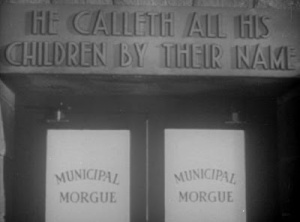
There’s more: though there’s no sign of Jacqueline ever being at the City Morgue, it does lead her to handsome lawyer Gregory Ward (Hugh Beaumont!), who is also looking for her. Ward is then visited by a psychiatrist, Dr. Judd (Tom Conway) who knows where Jacqueline is, but refuses to tell anyone.
The 7th Victim has a twisty plot, even for a Val Lewton movie, and it is certainly the most noir-inflected of his eleven movies for RKO. Mary navigates the mean streets of the Village with a growing cadre of helpers: Ward and Judd, a failed poet (Erford Gage) who fancies himself Cyrano de Bergerac, and the owners of the restaurant (Margarita Sylva and the real-life Chef Milani). It has a rich cast of characters for a unexpectedly complex story.
One of the people coming to our waifish heroine’s aid is a weasely private investigator (William Halligan), who takes up the case of the missing sister because he’s warned not to… a contrary urge that will cause his eventual death, in one of the most effective, tense sequences in the movie.
The 7th Victim is almost 75 years old, and has been written about by much smarter people than myself, so I don’t think I am giving anything away by revealing that Jacqueline – ever “the sensationalist”, according to Dr. Judd – joined a cult of “devil worshippers”, seeking excitement and happiness, and when those did not materialize, went to Judd for her depression – and the cult considers this revelation a betrayal to their secrecy, which demands her death.
But. This cult is also (rather bewilderingly) sworn to non-violence, so they have to convince her to kill herself. This non-violence thing is certainly novel, and an odd choice; rather than making the cult evil and frightening, it makes them merely selfish and self-interested to an extreme, and this fifteen years before the publication of Atlas Shrugged. This one fairly outlandish detail perversely makes our devil cult seem more realistic.
Jaqueline, we will find out, spent several weeks imprisoned at her former beauty salon, and has been in hiding since her escape. Once Mary, Ward and the Poet convince Judd to finally reveal her hiding place, Jacqueline is convinced to go to the Police. Disastrously, our band of heroes decide to let her rest for a day, which is just enough time for the Satanists to find her. Honestly, the plotting of the movie so far, in an attempt to be misleading and surprising, is a bit of a mess, but its 70 minute running time doesn’t leave much opportunity for audience cries of “Now wait just a minute…”
Jacqueline will resist the peer pressure to drink a glass of poison, leading to one of the Lewton standards: a tension-racked walk through shadowy streets, where any patch of darkness can hide doom – in this case, one of the Satanists who has been tasked with forsaking non-violence to end Jacqueline. It can’t be overstated that RKO had come close to closing its doors after the disastrous box office of Citizen Kane and The Magnificent Ambersons, but it had kept almost all the craftsmen who had worked on those pictures, to RKO’s ultimate benefit. After his successful string of low-budget features, it was felt that Lewton deserved a shot at an “A” picture, which was to be the original version of The 7th Victim (which apparently actually had 6 prior victims in its story). But to do this, he would have had to abandon director Mark Robson. Lewton was extremely loyal to his co-workers, and refused, relegating this movie back to a “B” budget – and this sequence alone, if nothing else, justifies why Lewton felt that way.
Lewton was also notoriously death-obsessed, and it shows in his movies; for so many of his characters, it is, to quote Hamlet, “a consummation devoutly to be wished.” In the closing minutes of The 7th Victim, Jacqueline meets a character we’ve seen only once, at the apartments over the restaurant – Mimi (Elizabeth Russell), a dying prostitute straight out of La Boheme. “I’m quiet and I rest and Death keeps coming closer, all the time.”
“And you don’t want to die, answers Jacqueline. “I’ve always wanted to die. Always.”
And there it is, right there, bang. Lewton’s health deteriorated steadily through the 40s – probably not aided a bit by the hellacious work hours he set for himself – and he passed away in 1951 at the age of 46. 46! He once said, perhaps jokingly, perhaps not, that the message of Isle of the Dead was “Death is good.” But that moment in this movie, that one line, is a moment that hits like a freight train… especially if you’ve ever felt that way. If you’ve felt too keenly the crushing weight of life, if you’ve listened to the lies of depression that tell you that you’d be better off, that everyone would be better off.
Don’t worry. I’m on medication now.
Mimi dresses up and goes out for one last fling before her demise. Jacqueline – quietly retires to her room, with the noose and the chair.
It is possibly one of the bleakest endings in all horror or noir, two genres not known for their uplifting qualities. And that is probably the true horror of The 7th Victim – that it touches so easily a darkened corner that lurks within us all.
As I said a lot earlier in this enterprise, I have watched a lot of horror movies over the years. A lot. I do enjoy a good horror movie. But therein lies the problem – I said a good horror movie, and because I love the genre, I am a lot tougher in my judgment of them. The last time a movie actually frightened me was Ringu, and that was back in ’99; I was writing these things for a goodly portion of a decade, and I am all too familiar with how they tick. I’ve torn them apart and put them back together again.
I’m not interested in the old cliches being rehashed, unless you can put a new slant on them. I appreciate movies that have some actual thought behind them. I’m a bad fanboy, I guess. Meh horror movies feel like a betrayal to me.
So I’m inclined to be friendly toward The Witch.
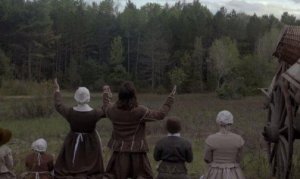
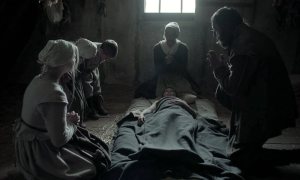
In 1630s America, a family is cast out of a settlement for being the wrong kind of Puritan. They set up house near the edge of some woods and begin to scratch out a life for themselves, which doesn’t go well at all. Their farm is failing. The father trades his wife’s silver cup to some traveling traders for traps, which aren’t catching any animals. Then the family’s infant son is stolen away by – they think – a wolf, but it’s actually a witch, who grinds the baby up (offscreen, thankfully) to make an unguent so she can fly through the night sky.
Things go downhill from there.
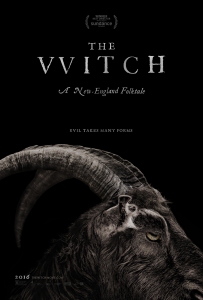
All of that is covered in about the first twenty minutes; the rest of the movie is an examination of how the isolation and increasing paranoia of the family causes it to turn on itself, as something in the woods – and it is not simply the title character – begins to prey on them. The bait for this subtle trap was already there – the teenage daughter Thomasin (Anya Taylor-Joy)’s burgeoning womanhood troubles them all – especially the eldest son Caleb (Harvey Scrimshaw), who’s hitting puberty. The father, William (Ralph Ineson) can’t bring himself to confess to the mother, Katherine (Kate Dickie) that he made off with her cherished silver cup. And the young twins Mercy and Jonas (Ellie Granger and Lucas Dawson) are six years old and monsters anyway. The fact that they keep talking to the ominous he-goat, Black Phillip – as if he can talk back – isn’t helping matters. This family was heading toward a crisis of some sort, even if an eldritch evil in those woods wasn’t actively resenting their intrusion.
The Witch, as I said, is a fairly subtle matter that won praise at festivals but not a lot at theaters, where audiences were expecting Saw or something, not a “fucking art film”. I suspect that this lack of patience was exacerbated by the thick accents of the characters; after five minutes I gave up and turned on the subtitles, much like I had to do withAttack the Block. My ear attenuated to it eventually, but the theatrical experience didn’t have that resource.
Writer-director Robert Eggers has tried to create a historically accurate picture of life in 1630s New England, up to a point (in the commentary track he’s quite forward about the times he had to fudge for the sake of the picture, and why). A movie like this has to rely on the talents of its actors, and it has to be admitted that in this case, Eggers hit a home run with each and every one. The level of emotional commitment is high, and the experience of Ineson and Dickie is evident; but special praise must be doled out to Taylor-Joy, who carries the weight of the story, and Scrimshaw, who is bewitched in one of the most harrowing scenes of the movie, which took three days out of a twenty-eight day schedule to shoot.
It is quite an achievement in many ways, this movie. Stephen King says it terrified him. I’m not willing to go quite that far, but in the realm of well-made, intelligent horror movies, it definitely stands tall. It’s not a movie to see if you’re looking for action and extreme FX, but if you’re in the mood for thoughtful horror, and willing to be open to the experience, it is impressive in both intent and execution.



























 drfreex.com