U: The Uncanny (1977)

Letterboxd Master List

Another anthology already?

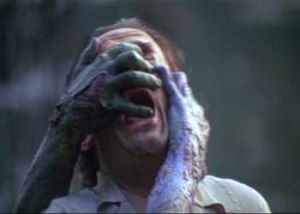
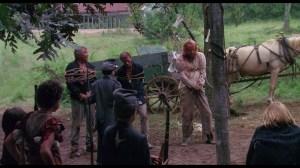
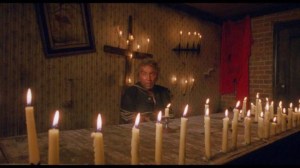
The first thing you’re going to ask is, “Is this an Amicus Film?” Which is fair, since the name Milton Subotsky is right there in the credits. But no, at this point Amicus’ grave wasn’t even cold yet, after The People That Time Forgot. Subotsky relocated to Canada, and tried to get the ol’ anthology (“portmanteau”, if you want to get fancy) mojo workin’ again with this and The Monster Club. That didn’t work out so well, alas.

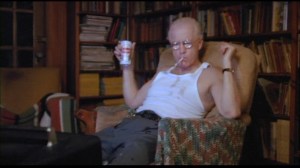
Our two big stars for the framing device are Ray Milland (yay!) and Peter Cushing (double yay!). Cushing is a very high-strung writer (his previous books were on flying saucers and ESP), who has made his way to Milland’s house with a thick binder. He’s Cushing’s publisher, you see, and he’s doubtful about the new book. Cushing responds that he has proof going back years that cats are horrible monsters that actually control the world.

Most of us who live with cats will shrug “well, duh”, but we already bought the ticket so let’s see what Peter has to say.

In 1912 London, a rich old matron (Joan Greenwood, rather wasted here but still managing to steal the show) dictates her new will, cutting out her wastrel nephew (Simon Williams) and leaving her vast estate to her multiple cats. Our snoopy maid (Susan Penhaligon) however, is also the lover of that nephew, and they hatch a plan to steal the old lady’s copy of the will. When she surprises the maid during the theft, there’s an employer murder, bringing down the wrath of all those kitties. I liked this story better when it was called Eye of the Cat and starred Michael Sarrazin, but that movie didn’t have the murderer trapped in a pantry for days, living on cat food, or the gruesome discovery that the hungry cats figured out the old lady was made of meat (Joan Greenwood, ladies and gentlemen – even dead, still upstaging everybody).
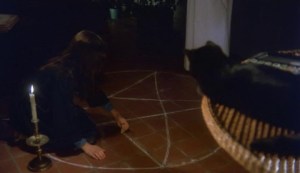
Oh, that’s never a good sign.

Then, in 1975 Quebec, the Blakes (Alexandra Stewart and Donald Pilon) take in their young niece Lucy (Katrina Holden Bronson) when her parents die in a car wreck. She brings with her dead mommy’s black cat, Wellington. Mrs. Blake doesn’t particularly like this, and she definitely hates the cat. Their daughter, Angela (Chloe Franks) is a nasty little shit who proceeds to make Lucy’s life hell. Mom finally steals Wellington away to have it euthanized, and burns Lucy’s mother’s book on black magic. Not all of them, though, and the euthanasia doesn’t take, and Angela is about to be in a lot of trouble.
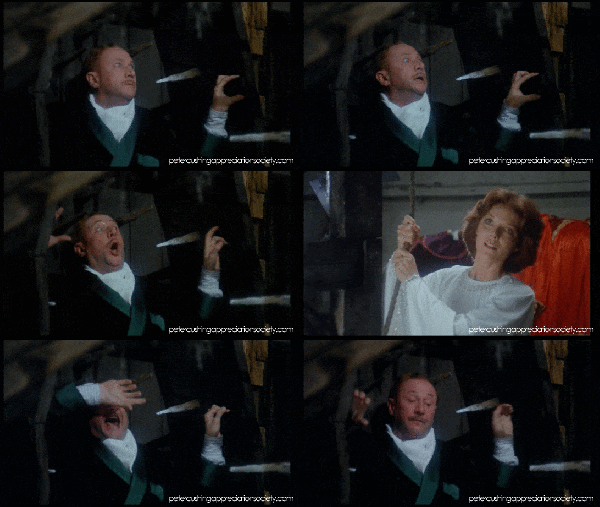
Lastly, in 1936 Hollywood, a tragedy happens on the set of Valentine De’ath (Donald Pleasance)’s latest horror movie, when somehow the Poe-inspired pendulum over his co-star – his wife Madeliene (Catherine Bégin) – turns out to be quite real. Luckily for the desperate producer (John Vernon sporting a really weird accent), Madeliene’s stand-in Edina (Samantha Eggar) is willing to step into the role. As I’m sure you’ve figured out, Edina is Valentine’s mistress, the accident was murder, and Madeliene’s cat is going to be tossed out as soon as possible. Just to make sure you know Valentine is a cad, the cat has kittens and he drowns them. Well, that doesn’t go over well at all, and not only does the wily cat evade every trap Valentine sets out for it, it starts engineering on-set accidents to avenge its mistress.

Back at the framing device, I’m sure you can figure out how things shake out. Cushing is murdered by a mob of cats on his way home, and Milland burns his book while giving his cat nice dish of milk. The end.

Most of Subotsky’s anthology movies had four or even five stories, and cutting them down to three isn’t justified by the stories, which get so padded out that your wristwatch arm will get lots of exercise as you check how much time is left. The only story that doesn’t have this problem is the third one, where everybody – especially Donald Pleasance – seems to be having a lot of fun. Sure, Bram Stoker should have gotten a writer’s credit because it rather shamelessly rips off “The Squaw”, but, we take our entertainment where we may. I pondered if my reaction to The Uncanny was due to its close proximity to the more feral and kinetic Tears of Kali, but no… this one creaks in the wrong places. Oh, it’s a fair use of 90 minutes, the actors and game and uniformly good, but some patience will definitely be called for.

T: Tears of Kali (2004)

Letterboxd Master List

Oh, hello again, Germany.

I stumbled across this movie while searching off the beaten path for Hubrisween. I fancy myself fairly well-read in the realm of horror, and searching somewhere other than the US and the UK offer strange delights. For me, there is nothing quite like coming across a movie I’ve never heard of. Even better is finding out it doesn’t suck.

We begin in a compound in what we are told is Poona, India in 1983. People on mats, all appearing to be in various stages of suffering as an older man (Pietro Martellanza) walks among them, comforting them. One in particular is Kim (Anja Gebel), quite striking because she is naked. The man asks her where she’s looking. “Inside.” “What do you see?” “Darkness.”

He walks her to a window and asks her to open her eyes. She does, only for a second. He asks her to look outside, “For there is everything. Life. Do it for me.” And he leaves her.

And she walks slowly out of the room, returns to the window, and cuts off her eyelids with a pair of scissors.

From this we go to our first story (yes, this is an anthology) “Shakti”. A writer (Celik Nuran) visits a mental hospital to interview a patient, Elizabeth (Irena-Heliana Jandis), due to be discharged in a week. Years before, Elizabeth had belonged to a cult headed by Samarfan (Joey Bazatt), where she was known as “Shakti”. Samarfan, we will find, belonged to the infamous and experimental Taylor-Eriksson Group, who we saw in that opening. What Samarfan brought from his stay in Poona was a system of meditation and primal scream therapy, first contacting what Jung called “the shadow” in each person and casting it out with the scream. One night, Samarfan was torn messily to pieces, and Shakti confessed to the crime – even though witnesses claimed she was with them all night.

It turns out that the cast-out shadows didn’t simply go away, in Elizabeth’s case becoming a tulpa composed entirely of her rage. The writer has her own agenda, and wants Elizabeth to once more summon her tulpa so a hidden video camera in her purse can capture the proof.

This is a bad idea.

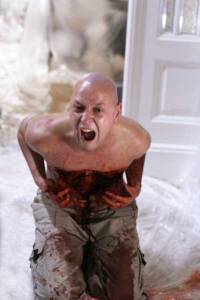
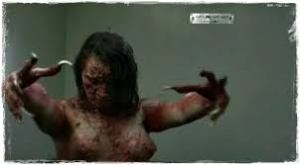
The second story, “Devi”, concerns young skinhead thug Robin (Marcel Trunsch) who has been convicted of beating a Polish tourist nearly to death while hopped up on speed. To avoid jail, he must get 15 hours of therapy, and is referred to the office of Dr. Steiner (Michael Balaun). Robin puts on what he thinks is a good contrite act, only to be countered by Steiner at every turn, until the doctor puts a Vulcan nerve pinch on him. When Robin awakes, everything in the office has been covered in plastic sheets. Dr. Steiner, you see, was in the Taylor-Eriksson Group, where he learned some interesting things about therapy. Here’s a hint: Watch out what you say in your first sentence to your therapist.

As you might guess from that plastic sheeting, this story has the goriest ending of the three.

Speaking of third stories, “Kali” introduces us to Edgar (Mathieu Carrière) a faith healer who is losing his faith. Though not spelled out, the story skillfully implies that his gift left him when he was unable to save his daughter from some disease. He’s drinking a lot more these days.

One of the people who come to him is Mira (Cora Chilcott), who is bent over with the burden of something from her past. Edgar can sense whatever it is, and it is powerful; after a tense bout of thrashing and screaming, it leaves her, and we see a shadowy form slither into the old church building Edgar has rented. Mira was in, you guessed it, the Taylor-Eriksson Group in its final days, when they were experimenting with “the Kali Process”, venturing inward, into “the cellars of the soul, where there is no separation between the living and the dead.” There are things down there that should stay there, but Mira brought one back. And now, free of her, it’s in the dark building. And it’s hungry.

Tears of Kali was originally three short films (each story starts with its own credits) and, indeed, writer-director Andreas Marschall has made quite a few short films, and I’m trying to figure out how to find more of them to watch. You can usually trust that in any given anthology film, you’ll find one great story, one lousy story, and the rest various shades of mediocre; Tears of Kali puts the lie to that by presenting three very good stories – though I will admit “Devi” is my particular favorite. All that work he did on shorts shows in a good, solid movie obviously done with not that much money but a whole lot of skill, commitment and artistry.

It’s probably not a big surprise that Marschall is also known as an artist for heavy metal album covers.

S: Slither (2006)

Letterboxd Master List

This is going to be a tough one to write. There’s a number of reasons for that. The most pragmatic is that my keyboard is screwing up (I do indeed pound the hell out of my keyboards).

Less pragmatic is that writer/director James Gunn was fired off Marvel movies for tweets he made in his youth (Too bad you weren’t running for a Supreme Court slot, huh, James). And dammit, I loved Guardians of the Galaxy. That does put some of the things in this movie in a unfavorable light.

Downright personal is the fact that I’m really tired of this subgenre. Watching Cute Little Buggers on basically a dare was a big mistake.

So.

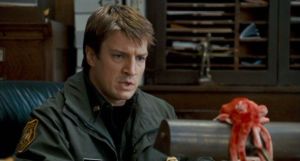
A meteor falls near a sleepy little deer season-lovin’ town. In short order we will meet local policeman Bill (Nathan Fillion), competent but easy-going, and his longtime crush Starla (Elizabeth Banks), who is unfortunately married to the possessive Grant (Michael Rooker). After Starla’s not in the mood that night, Grant heads out in a huff to get drunk and runs into Brenda (Brenda James), an old acquaintance who professes her hots for him. They head out to the woods, but Grant gets cold feet and breaks off with Brenda – just in time to find that meteor, and a trail of slime leading from it, to a sluglike creature that wastes no time in infecting Grant.

Movies like this live and die on bringing something new to the party, and in this case it’s that the slugs inhabiting Grant (and later a lot more of the cast) burrow up to the brain and are capable of acting like their host for a time. So Infected Grant has Starla thinking he’s become a nicer guy, giving him enough time to meet back up with Brenda and turn her into a human slug incubator. By this time Grant is starting to exhibit some physical changes, murderous tendencies, and it’s not long before Bill is leading an armed posse to find this creature that used to be Grant and the missing Brenda. Too late, as it turns out, as she explodes in a shower of slugs and suddenly actual uninfected humans in the town are outnumbered.

“There’s somethin’ wrong with me.”

The slugs also have a hive mind – now thoroughly entangled with Grant’s mind, so every slug-zombie in town is hunting for Starla, because Grant wants her back. Add to this mix a teenage girl, Kylie (Tanya Saulnier), who got a slug halfway down her throat and half a Vulcan mindmeld before she managed to pull it out and killed it with a curling iron, so there’s someone on the team who knows how the slugs operate. After that, you just need a halfway novel way to kill the main creature and stop the invasion, and Slither does that.

Nathan Fillion could do stuff like this in his sleep, but thankfully the man’s always awake and giving 110%. Elizabeth Banks has an odd role to play here, and I’m not sure the script did her any real favors, but by God she’s game. And anybody who watched this movie that didn’t realize that Michael Rooker is a far more versatile actor than folks had credited, they were not paying attention.

So why didn’t I like the flick? We’ve been here before, back when I watched I Married a Witch. Is it fatigue? Just in a bad mood that night? Is it because – just to bring back that Supreme Court reference – there’s a scene where Gregg Henry (playing the worst mayor ever) has a temper tantrum after most of the cast is turned into zombies because there is no Mr. Pibb and I watched this the day after Kavanaugh’s famous meltdown?
Most likely the fatigue – as I said, I’ve seen a lot of these movies. But this one is well-made, and aims to be an alien-invasion movie for fans of alien-invasion movies, with plentiful easter eggs in the background and an eye toward entertaining. You can still feel Gunn’s days with Troma hanging on here and there, the source of those troubling Tweets (which were really kinda expected when he was working for Edgelord Central), but overall, it’s a good, entertaining flick with a solid fanbase. It doesn’t require my appreciation, and that’s fine.

Except for that “oh no the monster’s not quite dead yet” post-credit scene. That can go straight to hell.

R: [REC]3 – Genesis (2012)

Letterboxd Master List

Last year we watched the really good sequel [REC] 2 (and had previously watched the original [REC] back in 2012 before these alphabetized marathons were invented. So it’s quite natural to bring in the third chapter here, and doubtless to ride this train until next year, content to not have to rack my brain or Google for a horror movie starting with R for one more year. As I pointed out yesterday: Yes, I am that lazy.

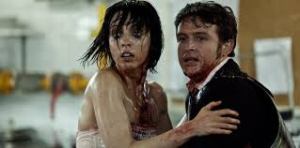
[Rec]³ begins true to its roots, though with a welcome twist: the opening apes the beginning of a cheesy wedding video, with a song and childhood pictures of the bride and groom. Thankfully we cut from that to the raw footage of the wedding, from two different video cameras – an amateur with his tiny camera and a pro with a steadicam. You’ll be meeting with most of the characters during this segment, but since this is a [Rec] movie, don’t get too attached to any of them. You’re probably safe with the Groom, Koldo (Diego Martin) and the bride, Clara (Leticia Dolera, who is kind of the platonic ideal of the beautiful bride. I mean, wow), though. For the moment.

See? I told you.

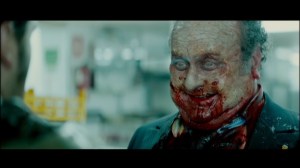
So we go through the wedding and the sumptuous reception. One of the uncles isn’t feeling well, The video camera picks up a police car and a couple of guys wearing hazmat suits. Odd. Then that sick uncle gets all bitey and things go straight to hell. Koldo and Clara are separated in the carnage, and the panicking groom demands of the photographer, “Why are you still filming?”, grabs the camera and smashes it to the floor.

There, at 22 minutes, we finally get our opening title. And with the camera smashed, [Rec]³ abandons the found footage format for the rest of the movie.

I’m of two minds about that. First – yeah, okay, it does feel like director Paco Plaza (one of the two co-directors of the preceding flicks) breathes an audible sigh of relief as he starts setting up shots without having to deal with the Rules of the Found Footage Film. The bizarreness of the subgenre is that making a good found footage flick is actually harder than making a regular film. Action and effects sequences have to be laid out and planned with long takes in mind, and if one thing goes wrong… well, movie making is an exercise in Things Going Wrong. This is why there are so many bad found footage movies – people think they’re easy to make. And the first two [Rec] movies are good found footage movies.

From that last sentence, you might think I didn’t like [Rec]³, and up to a point, you’re right. Oh, it’s a good zombie flick – plenty of gore and suspense, the mythology of the series advances somewhat – the attending priest has a theory about fallen angels and finds out the afflicted can be paralyzed by saying Bible verses to them (at least if you’re a clergyman) – but absent the sort of berserk creativity necessary to following the aforementioned Rules of the Found Footage Film, it becomes exactly that: another zombie movie. The trials of Clara and Koldo trying to get back together without dying is compelling, but toward the end of the flick viewing simply became an exercise in yelling things at the screen (these people have a lot invested in dropping weapons).

I swore off zombie movies for a decade, and after only a few years of cautiously watching them, I find myself succumbing to Zombie Fatigue once more. To anybody bitching about being tired of superhero movies, I say unto you, try being tired of zombie movies. There are lots more of those.

But it’s the care that went into [Rec]³ that makes me hold off that particular kill switch for a while (that and the fact that I have at least one more zombie flick to review this Hubrisween). Plaza makes some clever connections to the first movie, letting us know how [Rec]³ fits in with the first two: that sick uncle is a veterinarian, bitten by a dog that was thought to be dead. That’s a bit from the first movie that I had almost forgotten. In a TV in the background of one scene, we see news footage of the police and army outside the building from [Rec] 2. The Marvel fan in me appreciates that sort of callback.

Plaza and Jaume Balagueró co-directed the first two movies, then split up the duties between [Rec]³ and [Rec] 4. So I’ve also got to hold off abandoning zombies movies until I can see what Balagueró pulls off on his own. At least I have a year to build up my resistance again.


Q: The Quatermass Conclusion (1979)

Letterboxd Master List

I said I was going to ride this Quatermass train as long as I could, and seeing as how this one is called The Quatermass Conclusion, it’s looks like I may have to actually put some effort into finding an entry for Q next year.

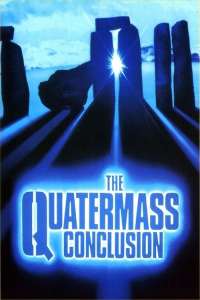
In the intervening years since Quatermass and the Pit, the British Rocket Program has shut down, and Bernard Quatermass (John Mills, this time) has retired. He journeys from his home in Scotland to London on a twofold mission: to appear as a guest on a talk show, and to look for his granddaughter, who ran away from Scotland in a fit of rebellious boredom. London, Quatermass finds, has gone right downhill; street gangs have turned the city into a combination of Mad Max and Clockwork Orange. He’s only saved from a savage beating by the arrival of radio astronomer Joe Kapp (Simon MacCorkindale) in his armored vehicle, complete with guard dog.

The TV show is celebrating the linking of American and Soviet spacecraft in a precursor to the International Space Station. Quatermass’ bitter dismissal of it is rather undercut by the station’s sudden destruction, though. Quatermass accompanies Kapp to his home/radio telescope base to find some answers, only to discover another bit of weirdness in play: lines of young people trooping across the countryside, following leaders with plumb bobs and apparently walking along Ley Lines to rings of standing stones. These are “the Planet People”, claiming they are going to be taken to another world. One such gathering is obliterated by a colossal beam of energy from the sky. Quatermass and Kapp find a girl that was on the very edge of the blast area, burned and delirious. They carry her away to treat her wounds, much over the violent protestations of the Planet People who didn’t get reduced to ash (or “transported”, as they insist).

A visit from the local commissioner (Margaret Tyzack) causes Kapp to use his radio telescopes to bounce off some satellites to receive a video call from America, because there have been more energy beams, killing thousands, and they need to get Quatermass’ opinion (I do love the fact that, no matter how much crap Quatermass has been through, if something weird comes from space, he’s the go-to guy). Quatermass and the Commissioner manage to get the girl (who looks eerily like Yolandi Visser from Die Antwoord) to a hospital; her burned tissues are turning into crystal. Well, they are until she levitates and explodes, anyway.

Quatermass theorizes that something ahead of the energy beams – some advance waves, or similar – has been feeding into the youthful members of society, causing the upset of gang warfare, and the mass migrations to the ancient sites, standing stones erected by bygone societies as a warning. As the beams continue to rain down, he recruits a group of literally senior scientists, immune from the alien influence, to attempt to forge a solution before mankind is virtually exterminated.

Writer Nigel Kneale was approaching 60 at this time, and I’m amused that his cause for youthful sullenness and rebellion is alien intervention. It is no coincidence that Kneale fan John Carpenter took a similar tack in They Live: the only possible explanation for the callousness and cruelty of the Reagan Revolution was an alien invasion, right? People wouldn’t do that normally, right? Right?

The budget on Conclusion is quite low, and the story somewhat drawn out at times – as traditional, this was a TV series first. Kneale wrote a separate script for the feature film version, but the seams are still somewhat apparent. Director Piers Haggard moves it all along quite amiably and well. The Quatermass Conclusion – simply Quatermass in its native land – is the most lo-fi of the Quatermass stories. There’s no giant monster shambling around, no conspiracies; the enemy and its motive is, as Quatermass concludes, ultimately unknowable, and the best humanity can manage is to bite them so hard they don’t come back – but at a terrible price. There’s a quite good BBC series called Invasion: Earth that owes a lot to Quatermass. That’s worth seeking out, too, if you haven’t had enough bleak science fiction pitting man against unimaginable forces.

P: Pieces (1982)

Letterboxd ♠ Master List

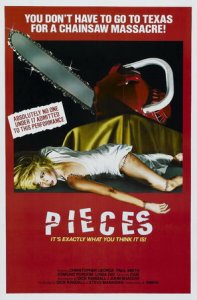
If you know me at all, you know that I hate slasher movies. Hate them with the heat of a thousand suns. Hate them with a passion I usually reserve for licorice candy and overlong meetings. I hate hate hate them. Yet here I am watching Pieces, which is the platonic ideal of everything I hate about them. Not for nothing is its tag line “It’s exactly what you think it is!”

Why am I doing this? Because it’s Hubrisween.

The opening is, I admit, pretty effective. “Thirty years ago” a boy is putting together a jigsaw puzzle of a nude woman when he’s discovered by his abusive mother. She starts screeching at him that she’s going to burn all his things, resulting in an axe to her head and the boy sawing her body apart. When the cops finally come, he hides in a closet and says the bad man did it.

If you need any early indicators as to attention to detail in Pieces – though this prologue takes place circa 1952, the mother is yelling at her homicidal child to get a “plastic bag” to burn his porn stash in, and they have a touch tone phone.

In the present of 1982, on your typical fake college campus, a girl riding a skateboard crashes through a huge mirror, and this all it takes for our now grown axe-wielding kid to start putting together his blood-stained jigsaw puzzle and assembling a woman of his own from the chainsawed-off body parts of nubile young co-eds in various stages of undress (that this is the trigger is never expressly alluded to in the movie).

Director Juan Piquer Simón delivers a movie that is almost more giallo than slasher – the preponderance of red herrings (you just know Paul Smith is not the killer, no matter how ham-handedly the movie tries to make you think he is), the utter uselessness of the cops (Christopher George and Lynda Day George), and because of that uselessness, the solution to the killings lies with an outside investigator, in this case student Kendall (Ian Sera). The only thing that keeps it from being a giallo is it lacks that genre’s devotion to artistry, to finding beauty in the worst places. What it does have is nothing that will quell accusations of misogyny in either genre – the murder scenes are drawn out, graphic, and exclusively female. Possibly the most remarkable thing about Pieces is the ending, when Simón reasons that most slasher movies have a shock ending that comes out of left field… “but what if mine came all the way from the parking lot?” It’s that outre.

“I’m not THAT worthless!”

How bad are the cops? The decision is made to keep the murders quiet to avoid a panic, which allows the killer to act with impunity, multiplying his potential number of unguarded, unaware victims. How you manage to cover up a girl getting decapitated with a chainsaw in broad daylight is quite beyond me, though. The fact that Christopher George is the detective in charge caused me to assume this movie was Italian, not Spanish, for many years.

As Joe Bob Briggs pointed out in his Last Drive-In marathon, Pieces is a picture of what Simón thinks college in America is like: non-stop sex, right down to a water bed in the training room (was this ever a thing? I mean, just look at me, I’ve never seen the inside of a training room). Well, at least it gives Lynda a chance to really go for that Oscar nom:

And, oh please, let’s not forget this (and somebody owes Goblin some money):

But, alas, one bit of glorious over-acting and a surprise cameo by Bruce Le does not move me to suddenly overcome my hatred of these things. The best I can say is that it’s undeniably trash, but at least it’s fairly well-made trash.

It was exactly what I thought it was.


O: The Offspring (1987)

Letterboxd ♠ Master List

Let’s get one thing straight, right off the bat. The Offspring is the title used for this movie’s initial U.S. theatrical and video release. Thereafter it was known by its original title, From A Whisper to A Scream, which does not begin with an O, so the hell with that.

We open with a dream sequence of a woman getting out of the bath, getting into a formal gown, and then embracing a handsome man in a tuxedo (we know it’s a dream because the guy enters in a welter of fog). The woman is shocked awake because she is strapped to a gurney, and is about to be executed by lethal injection for a series of murders.

But wait a minute. The woman is Martine Beswick. The Warden is Lawrence Tierney. And the attending reporter is Susan Tyrell.

What is going on here?

Tyrell goes to visit Martine’s uncle, Vincent Price, who lives in your typical haunted house – in fact she has to enter through a narrow hall reminiscent of Tales from the Crypt, just minus the razor blades. Price is the Librarian of Oldfield, Tennessee, a town he claims warps its inhabitants and makes them do evil things… like his niece. And to prove it to the dubious Tyrell, he tells her some stories from the history of Oldfield.

Yes, this is an anthology movie. Didn’t they tell you that at the box office?

Oh, look, it’s dream scene #2.

The first story is fairly modern. Clu Gulager is Stanley Burnside, an aging, mild-mannered clerk at a trucking company who is obsessed with Grace (Megan MacFarland), a secretary there. He finally gets up the gumption to ask her for a date, he confesses her love for her, but he’s too weird and pathetic for her, so he strangles her, as one does. He also sneaks into the funeral home for his fantasy one-night stand with her. Nine months later, something crawls out of her grave and goes looking for Stanley.

The necrophilia angle is bad enough, but the creep factor is heightened by the Tennessee Williams overlay that Stanley cares for his sister, who had rheumatic fever so he has to give her ice water baths every night. This part gets really weird until Stanley decides to murder her, too.

…aaand there’s dream scene #3.

The next story goes back to the 1950s, when Jessie (Terry Kiser) rips off the wrong local crooks and gets shot in the back while running away. He manages to get to a boat and push himself into the swamp, a poor excuse for an escape being better than none. He wakes up in the cabin of Felder Evans (Harry Caesar) a long time recluse who’s frankly glad to have some company for a change. Felder nurses Jessie back to health, but Jessie, being a scumbag, goes through his things and discovers that Felder is, in fact, over 200 years old. It must be the strange chanting he does at night, and the weird potion he drinks. Jessie means to have that potion, and is willing to kill for it. And you know, that sort of thing never ends up well.

We now go back to the 1930s, and, I kid you not, Lovecraft’s Traveling Amusements, where in the freak show Ron (Steven Arden) obligingly chews broken glass, steel nuts and razor blades for the yokels. One of these yokels is Amarrillis (Didi Lanier)(and I wonder if that name isn’t a nod to Price’s wife in The Comedy of Terrors), a young lady who has fallen hard for Ron, and vice versa. But with a name like Lovecraft’s, you know something ain’t right with that carnival, and its owner, Rosalind Cash, has a hold over each of her performers. Most of them are hiding from the law, but the hold goes… deeper. And when Ron decides to leave the carnival anyway, things are going to get… bloody.

This segment, incidentally has Angelo Rossitto in his final role as a barker.

The last story goes back to the Civil War, where four Union soldiers, led by Cameron Mitchell, wander separated from their unit. They come upon three Confederate soldiers, who they slaughter (well, C.J. Cox doesn’t slaughter, he’s the nice Union soldier), only to find out in the papers the rebels were carrying that the war is over. Pike doesn’t like his fellows’ plan to continue a-killin’ and a-rapin’, and decides to go back home. For which Mitchell shoots him in the back.

The three head over to some town called Oldfield they deem “ripe for the pickin!” only to be knocked ass over teakettle by some land mines. When they come to, they are the prisoners of the remaining inhabitants of the town after the two armies clashed there: children. And given that one of Mitchell’s men tries to threaten the leader of the kids and gets knifed in the balls for his trouble, you can bet our villains are in for a bad time.

This is the most gleefully sadistic of the four stories (though the previous three certainly haven’t held back in the violence department). Mitchell will make his escape by killing the most trusting of the children, and on his way out sees the assembled kids playing a ghastly game of Pin the Tail on the Donkey, using his men’s body parts. His escape is cut off by the not-quite-dead-yet Cox, who puts a bayonet through Mitchell’s leg just to make sure he gets caught again. So Mitchell is taken to finally meet the master of the town, The Magistrate – and that is not something you want to meet.

From that grisly origin, Price says, Oldfield grew to the pit of evil it is today corrupting its inhabitants. “How do you stay away from it?” asks Tyrell. “How do you know that I did?” asks Price. These two have a surprise or two left for each other.

Now, you notice I haven’t used a whole lot of character names in the above synopsis. The stories themselves are pretty much the expected EC Comics bad-people-getting-what-they deserve outrageousness, though, it has to be admitted, with a little extra dimension than those ever attempted. No, the truly amazing thing is THAT CAST, and how the hell did Jeff Burr, who had one previous movie to his resume (the low- budget Civil War drama Divided We Fall) get that cast?

The one clue is provided by the IMDb entry, that he simply walked up to Vincent Price and asked him. Price was impressed by his confidence and agreed – though apparently he later disowned it and claimed it was misrepresented to him. That seems a bit odd coming from the guy who was in the Dr. Phibes movies and Theater of Blood, but perhaps it’s because the gore in Offspring is not campy – it is seriously disturbing and goes for the throat.

Our character actors go for the gusto in all cases – Clu Gulager in particular decides to own his bizarre character. Susan Tyrell is sadly wasted, and it looks like she knew it. She tries a southern accent for approximately two lines, and then drops it. Price’s accent is similarly spotty, but he remembers to do it more often than not.

The Offspring is a better-than-average horror movie, elevated by its cast and a generous dose of nastiness. Burr became known largely as a director of horror movie sequels: Stepfather II, Leatherface: Texas Chainsaw Massacre III, Pumpkinhead II, Puppet Master 4 and 5. I’ve… seen none of those, actually. But Burr shows a steady hand at the horror stuff, and hopefully he got better.

Did I mention that besides the framing story, the first and second stories start with dream scenes?

Yeah, I hope he got better.

N: Night Watch (2004)

Letterboxd ♠ Master List

Well, it’s been a while since we’ve had a Russian representative on Hubrisween…

First of all, we are informed that there are people who not quite human, called “others” for their various talents, and they are basically arrayed into Light and Darkness factions. In olden times there was a tremendous battle between the two, but the armies were too evenly matched, and a truce was called. Each faction watches the other, Nightwatch is the light side watching the dark side, and Daywatch is the vice versa.

Twelve years ago, our protagonist Anton (Konstantin Khabenskiy) consults a matronly woman to get his estranged wife back from her new beau; the woman is a witch who claims a baby his wife is carrying must be aborted before she will come back to him. She can do this, but Anton must take the sin of the child’s death upon himself. That’s a violation of the truce, and she is busted by a Nightwatch team. The fact that Anton can see the team proves that he is an Other.

Twelve years later, Anton is working for Nightwatch, and it’s a job that really sucks. The mission that opens the story major requires him to get in sync with a young boy who is experiencing “The Call” – the spell of a vampire summoning him to a remote location to be exsanguinated. To do this, Anton must exploit his friendship with the vampire next door to get some pig blood to drink. This leads him to a vampire and his new bride, who is the one performing The Call – the boy is to be her first victim. Anton’s backup is late in arriving (mainly because Anton is a crap operative) and he winds up killing the male vampire in self-defense. This is going complicate his life exponentially for the rest of the movie, as the new female vampire escapes and still has a bead on the boy.

Further, while he was on the hunt, Anton saw a woman in the subway who his vision reveals was under a curse, and in his debriefing finds out it is THE curse – one that will cause a vortex of suffering and evil that will bring on, at last, the final battle between Nightwatch and Daywatch, and the end of the world.

There’s quite a bit of mythology thrown at you in Night Watch, some of it pretty standard fantasy boilerplate, some not. The not part seems pretty elastic, for instance the concept of “The Gloom”, a sort of twilight dimension only accessible by Others. First we’re told this is the safest way for Nightwatch operatives to interact with rogue Dark members, then we are told it has a time limit and requires blood sacrifice.

Night Watch is based on a novel by Sergey Lukyanenko, which itself is composed of three interlocking stories, of which the movie is only one. The sequel, Day Watch, is another, and the supposed third movie in the trilogy, Twilight Watch was the last of these. Director Timur Bekmambetov, however, split to make the 2008 Wanted, and never looked back. If, like me, you saw Wanted before Night Watch, the dazzling, rushing camerawork in many of the sequences are going to be very familiar. It’s stuff like that which made Night Watch the highest-grossing Russian movie of that year, and an international success (and made certain Russian film types grumble that it was “too American”).

The nature of the segmented source novel, though, carries with it an ironic violation of Chekov’s gun; you’re given a lot of characters with very cool potential that is never exploited. That was left, I assume, for the sequels, one of which we are never going to get.

Night Watch has a ton of interesting visuals that are worth checking out, but if you’ve never interacted with Russian cinema, be aware of some standards: a love for doomed characters, a large dose of fatalism, and a disregard for short running times. I found it interesting but not terribly engaging. As always, your mileage may vary.

M: Mary, Mary, Bloody Mary (1975)

Letterboxd Master List

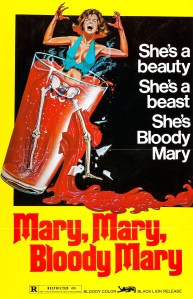
Hey, you remember what I keep saying about my unconscious tendency to access director’s careers in reverse? Starting at a recent point or movie and working my way in reverse like a dunderhead? Well, I sort of foiled my own motif, this time around. Sure, I reviewed Juan López Moctezuma’s third flick, Alucarda a couple of years ago, but I also did his first movie, Mansion of Madness (better known as Dr. Tarr’s Torture Dungeon to us gringos), back in the halcyon days of the first Mondo Macabro releases. So it was high time to watch senor Moctezuma’s sophomore effort, especially since I had been low-key obsessed with its ad art since its first-run drive-in days. I mean, just look at it. Best woman-being-turned-into-a-skeleton-making-a-horror-geek-really-want-to-see-what’s-going-on since Scream and Scream Again.

I am pleased to report I was nowhere near as disappointed in Mary, Mary, Bloody Mary as I was in Scream and Scream Again.

We first meet Mary (Christina Ferrare) while she’s having engine trouble with her van outside a creepy abandoned mansion in Mexico. As rain begins to pour down, she finds an open door and tries to find a phone, only to find herself stalked by a shadowy figure. After the standard running and screaming, we find out the figure is Ben (David Young) a drifter who is also seeking shelter from the rain. He promises to sleep upstairs while Mary stays downstairs and has a flashback.

Mary, we find out, is a successful artist who just sold one of her paintings to a guy from the American Embassy in Mexico City. This guy is also quite set on seducing Mary, with some success – at least until she pulls out a dagger disguised as an ornate hairpin and cuts his throat so she can drink his blood.

“What a waste of a perfectly good morgue attendant.”

This isn’t your typical low-budget vampire movie. Mary doesn’t do the traditional movie vampire stuff; she walks around in daylight, sleeps in a bed – at night – and has no fangs. But every so often she has to drink blood, and at those times she uses knockout drops in her necklace’s pendant to render her victim unconscious, so obviously she’s been doing this for some time. Mary is attracted to Ben, and the feeling is mutual, which is going to complicate her predatory lifestyle. There’s also the fact that the Mexican police are starting to notice the number of exsanguinated bodies, and the death of the Embassy guy has brought in the FBI. And, oh yes, there’s another vampire out there trying to track down Mary, and it’s her father… John Carradine!

If you like your vampire movies offbeat, Mary, Mary Bloody Mary is worth checking out. Some folks point to it as an inspiration for George Romero’s Martin, but I think that’s stretching a point. Mary isn’t deluded, but she has a very definite pathology, what her father refers to as “a disease”. There is one heartbreaking point where Mary’s need for a blood fix coincides with gallery owner Greta’s (Helena Rojo) pushy lesbian seduction. It’s the one time her careful searches for someone “I didn’t know or care about” has fallen through, and the first time she tearfully apologizes to one of her victims.

Yeah, yeah, it’s 1975 so there’s plenty of nudity and blood. I can see that after the surreal, Jodorowsky-influenced excesses of Mansion of Madness, it was brought to Moctezuma as a case of “Okay, can you make a normal movie?” which he does – though his penchant for creative editing and visuals is still evident. The seduction and eventual murder of Greta is shot in a lush bathroom with mirrored walls and is quite stunning. But it’s also 1975 and this is a very low budget movie, so be prepared for some slow spots, though Moctezuma tries to minimize those, and to reward you with things like unexpected car chases when you make it through them.

And now, here’s the trailer for the Code Red blu-ray, featuring a couple of my favorite bits: a newspaper with the headline NIXON CHEERED and, apropos of nothing, some dudes stabbing a dead shark to further death in shallow waters.


L: Lust for a Vampire (1971)

Letterboxd ♠ Master List

I had a friend who was one of those grey market vendors, who made his living selling VHS dupes of out-of-print movies (he’s out of the biz now, ditching the whole enterprise a couple of years before torrenting made it superfluous). For years, though, this movie was his best seller; given a VHS release once, and then vanishing from sight. So I was glad to finally watch the damn thing, and find out what the shouting was all about.

Spoiler alert: boobies.

In the opening scene, a peasant girl is kidnapped by the usual evil black carriage and taken to Castle Karnstein. Her blood is used to resurrect the dried-out corpse of what we will come to know as the infamous Carmilla (Yutte Stensgaard). The guy doing the officiating is Count Karnstein, played by Mike Raven, with a cameo of Christopher Lee’s eyes.

But never mind that, wandering nobleman and author Richard LeStrange (Michael Johnson) has arrived in the village, doing research for his next book on witchcraft, vampires and black magic. Told of the Karnstein legacy, LeStrange visits the seemingly abandoned castle, only to find himself stalked by three be-caped ladies. Ho ho, though, it’s only three girls from the nearby Miss Simpson’s Finishing School, on a field trip led by their headmaster, Giles Barton (Ralph Bates). LeStrange is introduced to Miss Simpson (Helen Christie) and the rest of the girls, just as a new student arrives – Carmilla, once again using the Mircalla alias. LeStrange is instantly smitten.

(LeStrange isn’t the only one, as we are treated to some lesbian-tinged toplessness and skinny-dipping that night at the school)

Things rapidly get complicated from there. A serving girl at the inn is found dead, two bite marks on her throat. LeStrange meets the new English instructor for Simpson’s school, tricks him into going to Vienna instead, and gets his job just to be near Mircalla. Mircalla’s skinny-dipping girlfriend Susan Pelley (Pippa Steele) vanishes (we know she’s been exsanguinated and dropped down the well). Giles Barton, knowing Mircalla’s true identity (the study of local noble families is his personal obsession), offers himself to her, hoping to become a vampire and worshipping her forever. Mircalla, though, only likes girls and turns him down. His dead body is found on the outskirts of the school the next day.

Miss Simpson has gone into full cover-up mode, refusing to call in the authorities about the missing girl, and grateful that Mircalla’s personal doctor (whom we recognize as the driver of that black coach) certifies that Barton died of a heart attack. LeStrange goes through Barton’s library, and discovers Mircalla’s secret. He, too, confesses his love to Mircalla, and begins to put that only-likes-girls thing to the test (he wins). Meantime, the school’s dance teacher (Suzanna Leigh) has notified the cops and Susan’s father (David Healy), who is American and having none of this shit.

It ends as all such gothic romances must, in a burning castle with Carmilla dead again, and LeStrange’s heart broken. The end.

After the success of The Vampire Lovers, Hammer felt they’d finally found a new vein to tap with Ireland’s other favorite author of vampire stories, Sheridan Le Fanu. The Karnsteins would crop up again in Twins of Evil and the next year’s Captain Kronos – Vampire Hunter, but never really recaptured the popularity of their Dracula series. It didn’t help that Lust for a Vampire had a troubled production.

Jimmy Sangster replaced Terrence Fisher in the director’s chair at very short notice. Also rushed into his role was Ralph Bates – Peter Cushing was to play Giles Barton, but bowed out due to the serious illness of his wife. Bates hates this role and this movie, and most people hate him for not being Peter Cushing, but really – he’s fine. There was a reason he was Hammer’s utility player at this point. What really kills the movie is the lack of Ingrid Pitt as Carmilla – she turned it down because she thought the script was lousy (she ain’t wrong). (also, there’s no Michael Ripper, so I don’t feel it can rightly be called a Hammer film) Overall, it’s pretty emblematic of Hammer’s rudderless direction in the 70s, when they found that everybody was doing the voluptuous horror bit, and the obvious thing to do was free those bosoms from their constricting bustiers and peasant blouses. A prime example, I think, of scarcity giving a movie a panache of quality it did not warrant (see also The Incubus).