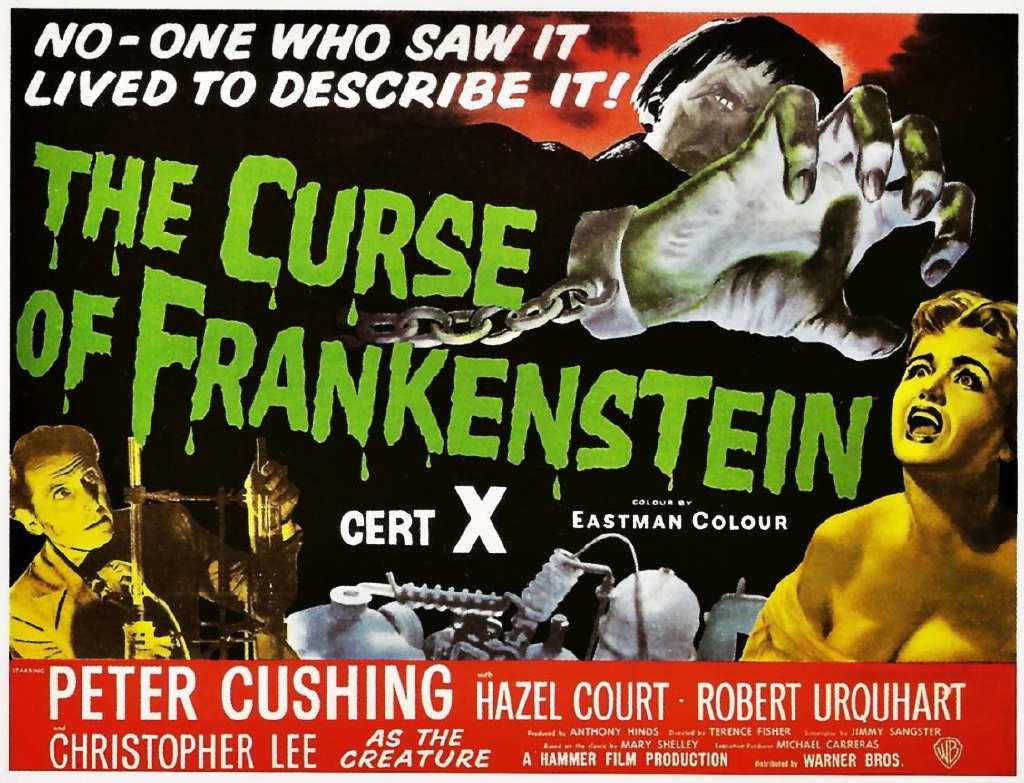
Why yes, it has taken me an inordinately long time to watch this movie – Hammer’s first gothic horror, and a film that arguably kicked off the horror boom that would blossom in the 60s. During my younger years, this was understandable, since the local TV channels seemed to have no problems showing Horror of Dracula (and especially Brides of Dracula) over and over again, but the Hammer Frankensteins seemed to rarely crop up. In Curse‘s case, never. So, when it was finally released on DVD in 2002, I snatched it up – and proceeded to ignore it for 12 years.
Don’t judge me, ye’ve not had my life.
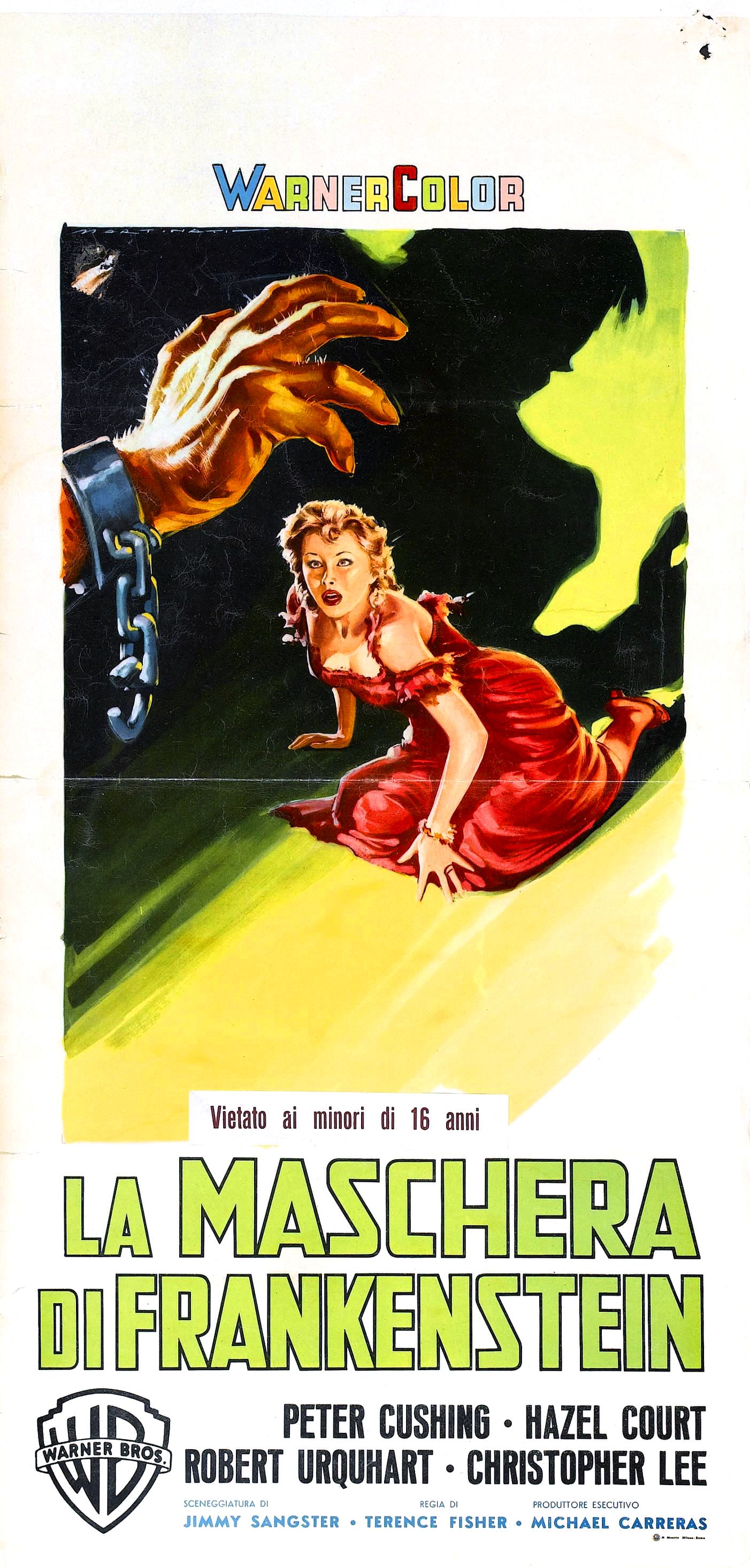
Rather famously, Universal threatened to sue this upstart British company if they dared to imitate their 1931 tentpole, and this was actually a good thing. I’ve read accounts that claim that the initial concept was to do a black-and-white movie with Karloff as the Monster – hell, Hammer even calls it “The Creature” so they couldn’t be accused of ripping that off – and the threat of litigation forced them to create something unmistakably their own.
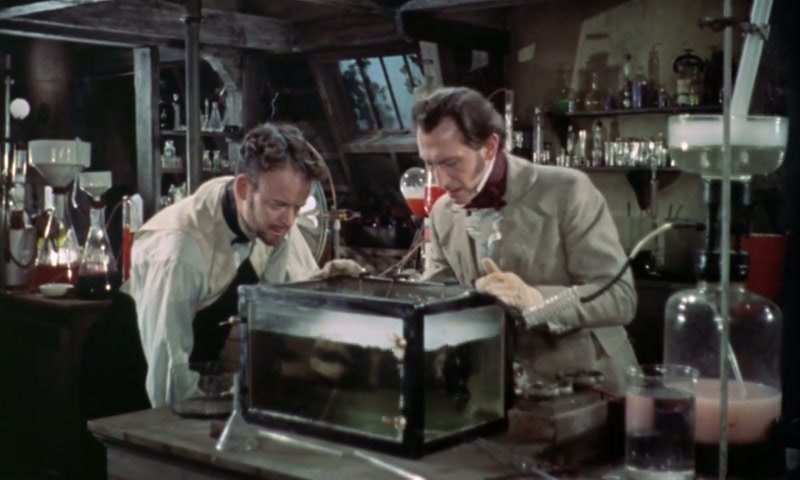
First of all, the movie is in color – a semi-big deal in 1957. It starts the Hammer look of a subdued color palette against which any bright color – especially blood red – really pops off the screen. Costume designer Molly Arbuthnot has a ball with some amazingly textured fabrics. There are no lab coats and rubber gloves in this milieu, our mad scientist does his bloody work in frock coats and cravats, white cotton gloves.
The movie begins with a desperate Baron von Frankenstein (Peter Cushing) telling a priest his tale on the eve of the Baron’s execution; the extended flashback which forms the movie proper takes its time, beginning with Victor Frankenstein as a young man, the last of his family, inheriting a vast fortune and hiring a brilliant science tutor, Paul (Robert Urquhart) who eventually becomes his collaborator in fringe science. After successfully bringing a dead puppy back to life, Paul is ready to publish, but Victor wants to go even further – to create life itself, using pieces of corpses as a framework.
Now, that is a hell of a leap, and if anyone doubts Peter Cushing’s skills as an actor (PS, if you do, you’re an idiot), the fact that Cushing actually pulls this off should provide more than adequate proof. His Frankenstein is quite the amazing portrayal, in fact – a rich nobleman used to getting his way, capable of great charm but so cocooned within his wealth and privilege that he can’t see the potential harm in anything he does, and in the pursuit of his ultimate goal, it becomes no surprise that murder becomes just another tool.
Paul, at first uneasy about his former student’s new experiments, eventually refuses to have anything to do with this horror, but Victor forges on, even when Paul deliberately tries to sabotage the process by damaging the brain of a brilliant, aged scientist Frankenstein has killed so that his creation can have the brain of a genius. Frankenstein’s first attempt to animate the Creature fails because his equipment – a riot of pre-Victorian galvanism and colored bubbling liquids – was built to be operated by two people. While he tries to convince Paul to help him, a lucky lightning strike surges through the equipment, and a surprised Victor Frankenstein is soon confronted by his own success – which instantly tries to murder him.
This is also one of the best fruits of the threatened lawsuit from Universal: the creation of a new visage for the Monster. Apparently in complete desperation, makeup artist Phil Leakey created this new version directly on Christopher Lee’s face at the last minute, using traditional supplies like cotton and spirit gum, very much in the tradition of the classic Universal monsters. Striking, horrifying and completely its own… creature.
Christopher Lee was cast as the Creature largely due to his impressive height (they almost cast another actor, Bernard Bresslaw, who was two inches taller than Lee). Now, I have the utmost respect for Christopher Lee: he has led an amazing life, recently turned what? 92? And is still kicking ass. But. I have always considered him an actor of limited range, but undeniable and truly impressive presence, That is a quality which must not be underestimated. And sadly, this role would not have given him an adequate showcase anyway: that lawsuit again, and though Lee’s Creature does have its moments of pathos, it falls to him to simply be murderous – there is no trace of Karloff’s incredible, often sensitive performance in 1931.
The story does get a bit meandering: the Creature escapes, kills a couple of people (the first one being a blind man, the polar opposite of a similar sequence in Bride of Frankenstein – take that, Universal!), and Paul shoots it through the head. This is no obstacle to Frankenstein, however, who simply resurrects it again after, once more, repairing the brain Paul had damaged. Victor uses the monster to rid himself of a troublesome maid attempting to blackmail him into marriage; it is for that murder that Frankenstein will be remanded to the guillotine at movie’s end, the monster having escaped once more, attempting to murder Victor’s bride, and finally winding up in the scientist’s convenient acid vat, erasing all evidence of the brute who actually killed the maid. Paul keeps quiet about the Creature, too, realizing death is the only way to stop the obsessed Victor.
Having mentioned Victor’s bride, I should take a moment for Hazel Court, who plays Elizabeth. Lovely and talented, Court appears in several gothic horror movies, and she is, sadly, particularly wasted here; Elizabeth exists only as a reason to keep Paul in Castle Frankenstein, hoping to protect her from the horror of Victor’s experiments. Like Lee and Cushing, she was a veteran actor at this point, and probably used to such things. Check out her filmography at the IMDb – her talent was recognized, at least.
Speaking of Cushing and Lee – this is the movie that kicked off a close friendship that would last the rest of their lives, reportedly sparked into existence when Lee complained he had no lines and Cushing responded, “You’re lucky. I’ve read the script.” They had appeared in the same movie at least twice before, but never on the same set on the same day. Both were devoted fans of Looney Tunes, and I don’t know about you, but the idea of these two men imitating Sylvester J. Cat and Tweety-Pie between takes is something that keeps me warm on cold winter nights.
The last thing that sets Curse of Frankenstein apart from its Universal forefather is an interesting reversal: both spawned many sequels, but in the Universal series, it was the Monster that remained the same, while the doctors around it changed. It was the exact opposite in the Hammer series: the monster would change, but the doctor (with one notable exception) was the constant: Peter Cushing, building on this complex, nuanced performance over the course of the next fifteen years.
So what we have here is the direct sequel to the 1968 Mad Doctor of Blood Island, so direct that it literally picks up where the original left off. Dr. Bill Foster (John Ashley, but of course) is returning home, but the monster, who stowed away in a lifeboat at the end of the first picture, can’t stand it anymore, reveals itself and starts killing people. Fuel gets spilled, and the boat blows up, with Foster and the monster the only survivors. Unconscious. Foster drifts on some debris; the monster is washed up on Blood Island and staggers into the jungle.
Fortunately, Beast of Blood loses that beyond-irritating abuse of the zoom lens every time the monster appeared in the first movie,, throbbing in and out with the monster’s heartbeat; unfortunately, it also loses the monster for most of the movie.
It’s not human and it’s got an axe! …Wait. Wrong movie. Sorry.
Foster returns to Blood Island one year later, having heard rumors that the Green Men, experimental subjects of the Mad Dr. Lorca from the last movie, are still causing problems. His investigations are hindered by Myra, a journalist from Hawaii (the incredibly white Celeste Yarnall) and helped by the fierce native woman Laida (Liza Belmonte), who isn’t afraid to use her bolo knife on the Green Men (and is, incidentally, who pulled Foster from the drink and nursed him to health a year before). Lorca’s stronghold, sealed up since the last movie’s concluding fire and explosion, still has something going on inside; Foster and crew find a tunnel leading away from the compound into the jungle.
Myra gets kidnapped by a gang of toughs and taken into said jungle and up into the mountains, where the scarred Dr. Lorca (Eddie Garcia) is still plying his nutty trade. He has the monster, Ramon, too – though the beast is still homicidal, and Lorca had to cut his head off to calm him down – literally. The body and head are still alive, machinery pumping that weird green chlorophyll blood into both, while Lorca – for some rationale which is never explained – keeps trying to transplant heads from the contaminated Green Men he keeps in a cage onto the monster’s body.
John Ashley is usually a pretty serviceable leading man in these things, but I got really irked by his continually turning down Laida – who is pretty much the ass-kicking Pam Grier of Filipinas in this – for the incredibly vanilla Myra. Hell, she’d need flavor enhancers to even qualify as vanilla.
The major problem with Beast of Blood is the monster and mad science comprise perhaps a quarter of the movie – the rest is intrigue and action as Foster tracks the bandits in Lorca’s employ back to his new stronghold, then a commando force of sailors and natives attack and there’s a lot of orange blood slopped around. It’s a problem shared with director Eddie Romero’s next movie, Twilight People, where the movie’s supposed main storyline, an Island of Dr. Moreau rip-off, is supplanted by a Most Dangerous Game rip-off.
Eddie Romero actually does make very entertaining movies, they’re just not always the movie you bought a ticket for. Beast of Blood can work as a double feature with its predecessor, Mad Doctor of Blood Island, but you also might have to pack an extra helping of patience to get through both.
I spent much of my younger days in South Texas – we’re talking almost all the 60s and a couple of years into the 70s. There was a heavy Mexican flavor to life down there, even moreso than the rest of Texas. A lot of my school chums were Hispanic, my first great love in life was a Latina named Dolores. It’s therefore odd to me that I didn’t learn Español or more about the culture through sheer osmosis. What did pass before my lily-white eyeballs on the local TV channels was pretty interesting, but was mainly limited to running Neutron movies in an afternoon slot.
Though I remembered seeing ads for the K. Gordon Murray imports like Santa Claus, I never got the chance to subject myself to any of them. They never seemed to come to the Rialto, and I suspect if any of them ever came to town, they were at the “other” movie theater, the one that seem to continually show movies starring Cantinflas. The ads were all in the great metropolis of Corpus Christi, which seemed to get all the good stuff, like all-night horror movie marathons at drive-ins. I gazed at those ads in youthful wonder, and one of the titles struck me as being probably the greatest title ever: The Robot vs the Aztec Mummy. My brain assembled out of whole cloth the most incredible monster movie ever.
That amazingly-titled movie, I would discover many years later, was actually the third movie in a trilogy, and when I finally watched it, I would discover that it was not as amazing as its title, but was still pretty delirious in its own way, and it serves as a primer for Mexican genre cinema. But we’re here to examine the first movie of the trilogy, La momia azteca, or as it is known in these parts, Attack of the Aztec Mummy.
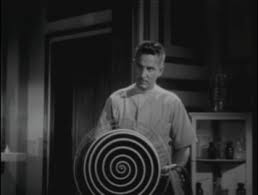
Dr. Almada (Ramón Gay) a specialist in nervous disorders (I have to assume), is addressing a congress of scientists about reliving past lives through hypnosis, which means he read The Search for Bridey Murphy in an airport at some point. Trouble is, he is presenting this with absolutely no evidence, having put no one under hypnosis, simply going on hearsay because he is a horrible scientist. On top of that, none of the other scientists at the meeting will allow him to hypnotize them because, we are told, it is too dangerous! Scientists are such wusses.
Before Fox News can hire Almada as a science consultant. his fiancee, Flor (Rosa Arenas) volunteers to undergo the regression therapy. Almada hypnotizes her, and she is attended by her father Dr. Sepulveda (Jorge Mondragon), and Almada’s cowardly assistant, Pinacate (Crox Alvarado), with all the solemnity and tools of a surgical team. I remember seeing a stage hypnotist at the Laff Stop back in the 80s. He had none of this safety equipment or medical professionals so he must have been a raving psychopath, endangering us all like that.
ANYWAY. It turns out Flor is the reincarnation of Xochitl, an Aztec maiden chosen at birth as the consort of the god Unpronounceable. Popoca (Angel di Stefani), a large warrior, loves her and begs her to run away with him before she can be sacrificed to Unpronounceable. Their lovemaking is interrupted, Popoca is given a potion that will drive him mad, and he is cursed to watch over Xochitl’s corpse and the sacrificial golden breastplate and armband she wears forever. After a big song and dance (directors love creating musical numbers for ancient civilizations. Ever notice that?), Xochitl is sacrificed, and Almada proves what a dreadful scientist he is by letting her relive the sacrifice. Good thing he has a crack surgical team with him.
Almada is smart enough to realize his needed evidence is in reach, and uses Flor’s newfound memories to locate the sealed sacrificial chamber in a nearby Aztec pyramid, where Xochitl’s skeleton remains, until now undisturbed. Almada lifts the breastplate and skedaddles, unaware that the shroud in the corner is starting to move.
Now all of this seems pretty much standard Universal (and later Hammer) mummy boilerplate, right? well, it only seems that way because I haven’t told you about The Bat yet.
The Bat is a master criminal that Exposition Radio tells us about at the movie’s opening (after the obligatory narration that tells us this is based on a true story). The Bat heads up an organization of criminals, and does things like vivisection and sewing stuff onto animals that don’t belong. The radio then informs us “Society is duly alarmed.” The Bat is always lurking about, black clothes, black cape, black fedora, black wrestling mask, looking very much like he wandered in from a 1940s serial. He frightens Pinacate several times during the nighttime visit to the pyramid, making him think he’s seen a ghost.
Almada presents the breastplate to a group of scientists, proving his theory and basically going, “Nyah nyah.” The scientists are properly impressed, but then they start going on about mummy curses and the Higher Power of God. These are terrible scientists. Almada wants to translate the markings on the breastplate, which seems to point the way to some cache of Aztec gold (which is the reason The Bat and his underlings want it). However, Almada needs the armband to complete the analysis, so it’s back to the pyramid.
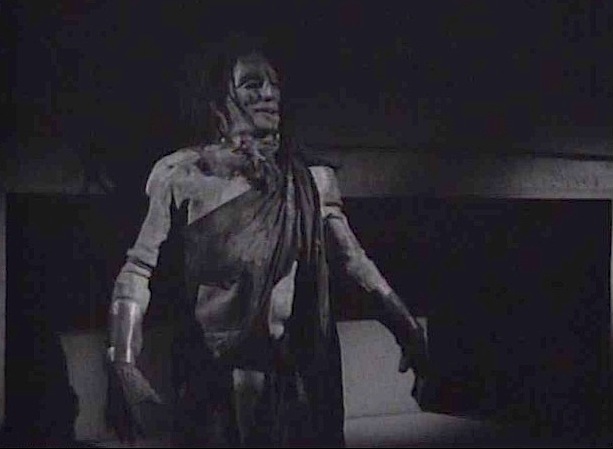
In the chamber, Dr. Sepulveda notices the shroud in the corner and asks, “Where’s the mummy?” At this point, the three men hear something shuffling in the dark…
Whatever you may think of the rest of the movie, with its costumed villains and superstitious scientists, this scene, where the Aztec Mummy sloooooowly shuffles into the light, is really good horror movie stuff.
Then the men try to hold the Mummy off with their flashlights and he starts going “Raaar!” like the Frankenstein Monster and we’re back to monster basics.
Though the men make their escape and think they’ve sealed Popoca in the chamber, the determined Mummy gets out and retrieves the breastplate, and notices Flor, the spitting image of his old flame, and takes her along, too. Everybody chases the Mummy back to Mummy Central, where Popoca is preparing to sacrifice Flor all over again, but Sepulveda holds the Mummy off with a crucifix (!) until everyone gets clear, then he tosses a stick of dynamite into a nearby fire.
The crucifix has been explained to me as a symbol representing the higher power of God and goodness in the universe, not strictly a symbol of Christ’s execution. I’ll buy that, but harder to swallow is why The Bat is simply caught by the cops on the way to the pyramid, a fairly ignominious end for a super villain.
Except! This is the first movie in a trilogy, remember! The Bat will escape! The Aztec Mummy is a lot tougher than elderly scientists and TNT! Pinacate is really a masked hero called The Angel! The Bat probably has a robot hanging around somewhere!
I told you these movies were more delirious than you suspected!
Like any good time bomb, The Aztec Mummy also managed to make me delirious in a different way several weeks after I had seen it. During the (to date) last Crapfest, Host Dave showed the El Santo movie El Vampiro y El Sexo/Sex and the Vampire, and after about thirty minutes of deja vu, I realized I was watching an unannounced remake of The Aztec Mummy, substituting Dracula for the Mummy, and adding several cups of feminine nudity into the mix.
But back to our black-and-white, non-salacious subject: I found this on YouTube, and it is a nice explanation and exploration of these movies. It’s slickly produced and has the feel of a supplement from a DVD. Anybody know the source?
Well, I did keep telling you that come October, you would be getting heartily sick of me.
Internet madman Tim Lehnerer started a Halloween movie challenge last year while deep into October. Deep enough that he called it “Hubrisween” and the name stuck. This year two other hapless movie bloggers will join him, and one of those is me.
Starting next Monday the 6th, this blog, Tim’s Checkpoint Telstar and Gavin Smith’s Terrible Claw Reviews will update daily, each day reviewing another horror movie, starting with the letter A and progressing on through Halloween and the letter Z.
Don’t say I didn’t warn you.
Just look for this banner, or one like it:
And if you were wondering what might be waiting for you on Monday, here’s a preview:
See you Monday. And every freakin’ day thereafter.
It actually happens, every now and then, that I get a Saturday off. This is a mixed blessing; no work on Saturday means no pay, but it also means that it is possible to throw together a Crapfest WITH NO HOLDS BARRED! IT’S A SATURDAY! ALL BETS ARE OFF! WHAT YOU GOT TO DO ON A SUNDAY, ANYWAY?
(Well, I had to get up at 8am to read at Hippie Church, but why should I get more sleep on a Sunday than I do any other day?)
We had a fairly full roster, with only The Other David absent, as in a mirror image of my plight, he had a show that evening. Host Dave had rearranged the furniture in the Crapfest Room, and we lolled about in spacious luxury as Hell unspooled before our very eyes.
Dave started off with a movie that, like the devil, has many names: the one plastered on the screen as a subtitle was Sex and the Vampire. If you are looking for it on the IMDb, it is better known as Santo and Dracula’s Treasure or Santo en el tesoro de Drácula. In my peculiar little world, El Santo requires no introduction; I find in this world, however, such is not the case. So there was some discussion about lucha libre and pro wrestling, and everybody missed the plot set-up, which is Standard Operating Procedure for a Crapfest. (In lieu of such discussion, I will simply direct you to the Wikipedia page for El Santo)
El Santo, besides being a famous wrestler, crimefighter, and monster-killer, is also an accomplished scientist, it turns out, and has invented a time machine. But it is INCREDIBLY DANGEROUS and has not been tested yet, so the scientists he invited to ooh and ahh at it instead go “Poo-poo!” and march out. The machine will only send a person back to a past incarnation, and for some reason it is safest to send a woman with voluptuous curves into the past, so Santo’s plucky girlfriend Luisa (Noelia Noel) puts on a high-collared silver suit and walks into a very short Time Tunnel.
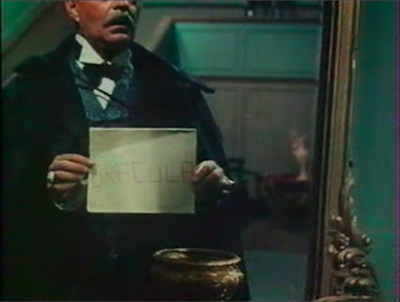
Wouldn’t you know it, she appears in a household that is being bedeviled by a foreign gent who calls himself Alucard (Aldo Monti), and yes, our local brainiac Professor Van Roth (Fernando Mendoza) has to write that name down and hold it up to a mirror. This version of Dracula, it should be pointed out, has a propensity for taking off women’s clothing, and has a harem of brides who take “clothing optional” very seriously. This convinced Paul that Dracula was the true hero of the movie.
Now, about the time we start wondering “Didn’t this movie used to have El Santo in it?” We see El Santo watching the unfolding Dracula movie on a Time TV; and he’s getting increasingly worried when Luisa’s previous incarnation is vampirized and about to be staked by Van Roth right after he put paid to Dracula. Santo brings her back in the nick of time.
Dracula, Prince of Nudies
Now how, you may wonder, did I know about Santo’s time machine, and the shadowy black figure who is watching Santo watch Time TV? Well, much to my consternation, el tesoro de Dracula is in large part an uncredited remake of Attack of the Aztec Mummy, which I had watched a couple a months ago in preparation for an October roundtable (plug plug). Santo decides that finding Dracula’s resting place, and getting his medallion, which will lead to the titular treasure, will prove to all those scoffers that his time machine works.
There follows a shot-for-shot recreation of the tomb scene in Aztec Mummy, right down to the odious comic relief spotting the villainous Man In Black and mistaking him for a ghost. The only deviation is a fight between Santo and the MiB thugs, after which they find Dracula’s coffin, the stake still in his remarkably preserved body, and they take the medallion. But! Dracula’s ring has the key to decoding the medallion’s map, and the MiB steals the ring, then has his burly henchman Atlas wrestle Santo for it (I was wondering how they were going to work a wrestling ring in, and they promote the match for two weeks). Santo, of course, wins, and the MiB hands over the ring, which you have to admit is kind of classy.
But he then has his thugs take the stake out of Dracula, figuring that the Count will track down his jewelry, and we’re back to Aztec Mummy territory again. Paul said, “Yay! Dracula’s back! Maybe we’ll have boobs again!” (speaking of titular treasure, har de har) Paul is remarkably psychic, as we did indeed, and then Drac goes ahead and revives all his clothing-challenged brides again, to boot. Santo still wins, which in Paul’s book, means that evil (and clothing) won the day.
It was time to start preparing the evening meal, and the folks doing the planning had outdone themselves: Erik had personally hand-wrapped and skewered a small army of shrimp in bacon, and Rick had an assortment of artisan sausages and pork tenderloin. Science and physics were employed to grill this meaty menagerie without making the Crapfest Room any hotter. All these efforts were highly successful, and damn Rick, but you work magic on a grill. In medieval times, you would have been burned at the stake as a sorcerer. I had a meat hangover the next day, and couldn’t look at anything but salad.
But it also fell to me to throw in some filler. We had already been through all my trailer compilations, but I had brought something else, something that could also be turned off at anytime with no loss of story: Miss Nymphet’s Zap-In, which had been offered by Vinegar Syndrome as a free download.
There is nudity in the first scene. There is nudity in every scene following. ‘Why are you being so nice to them?” Dave asked me, dismayed. “Because I know what is to come,” I replied. Zap-In is a blatantly obvious rip-off of Laugh-In. right down to go-go dancers (topless in this case) doing their thing while supposedly humorous text is displayed over their gyrating forms. Every now and then we see the cast walking in a circle as if they were playing musical chairs, until someone off camera throws the signal, they all freeze in different positions and say “ZAP!” One lady keeps falling over, which is the funniest thing in the entire movie.
False advertising, and overpriced, to boot.
You see, this is an H.G. Lewis movie, produced and directed under two of his numerous pseudonyms. And you haven’t lived until you see H.G. Lewis doing comedy. Wait, I should have said you have never experienced a slow, lingering death until you have seen H.G. Lewis doing comedy. So, in a 75 minute movie, at minute 40, I hear a haunted voice from the back of the room moaning, “I never thought I would be tired of seeing tits.” They made it to minute 50 before they begged to shut it off like George C. Scott in Hardcore. I felt like Victor Von Doom after one of his plots against the Cursed Richards had achieved fruition.
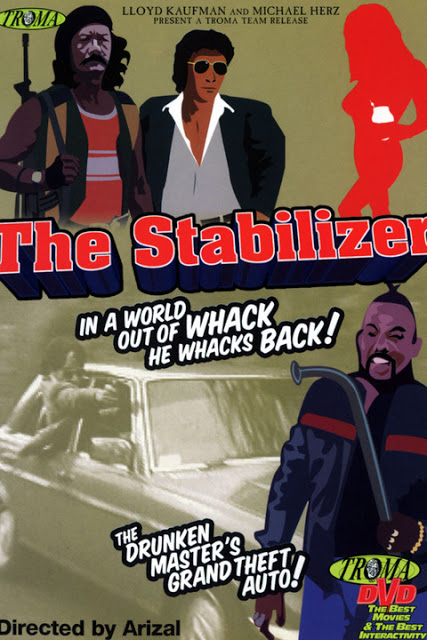
All right now, seriously, folks. It was time for a movie I had been trying to force into a Crapfest for months, if not years. The Stabilizer.
It’s the Drunken Master’s Grand Theft Auto! It says so right on the box!
The Stabilizer is an Indonesian action movie from 1986 starring Peter O’Brian, a teacher who was vacationing in Indonesia when filmmakers noticed he looked sorta kinda like Frank Stallone and offered him lots of money to extend his vacation and make a couple of movies. He wound up making five more over the next six years, ending up with Angel of Fury, with Cynthia Rothrock.
O’Brian is Peter Goldson, a CIA guy called The Stabilizer because the CIA likes to nickname guys the opposite of what they do, I guess. He comes to Jakarta to help his old friend Captain Johnny (Harry Capri) find Professor Provost (Kaharudin Sayah) who has invented a “narcotics detector”, and who has been abducted by Goldson’s old enemy, the musically-named Greg Rainmaker, whose supervillain gimmick is big boots with golf cleats.
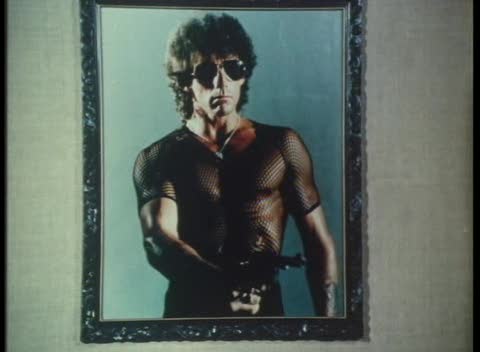
Both The Stabilizer’s girlfriend and his archenemy have this photo of him. And that’s all you really need to know about this movie.
What follows is pretty much non-stop action with sweet 80’s fashion, all leopard print spandex and triangular pockets with zippers. The only way to respond to this movie is the line from Pee-Wee’s Big Adventure: “Great movie, Pee-Wee! Action-packed!” Seriously: it is quite possible to see the seed of movies like The Raid in this, with a desire to create Raiders of the Lost Ark-style action setpieces without the real talent – or coherent story – to back it up. Whatever else it may be, The Stabilizer is not boring, and is totally committed to insane action. It presents a country where doors are never used when there is a motor vehicle to drive through a wall, and bad guys have maps on their person labeled “Location Map”, causing the heroes to say, “This could lead somewhere.”
ZAP!
When trying to come down from the mind-searing momentum of The Stabilizer (“Situation… stabilized!!!“) Dave determined that the very best way to go was with Pulgasari. Again, a short class was required.
In 1978, Kim Jong-il, then only the son of the ruling despot of North Korea, decided he wanted to make some movies and had one of his favorite directors, the South Korean Shin Sang-ok kidnapped (Shin’s actress ex-wife, Choi Eun-hee, was abducted first, possibly to lure Shin to Hong Kong) to direct his films.
Shin directed seven films for Kim Jong-il, until he and Choi managed to flee to an American Embassy while attending a film festival in Vienna – in 1986, eight years after their abduction. This story is probably better than any Shin was forced to make under orders; I may never know, because Pulgasari seems to be the only one generally available.
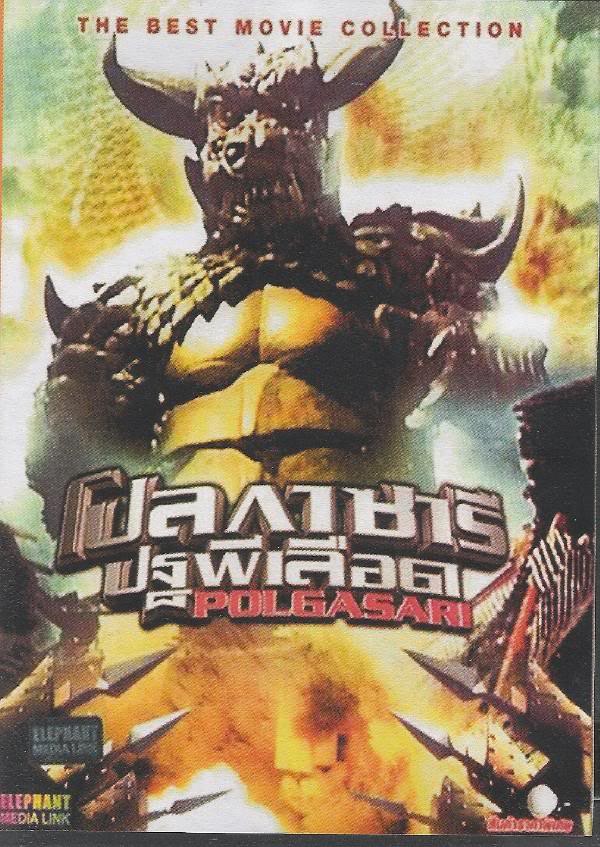
Based (of course) on a North Korean fairy tale, Pulgasari starts with the usual despotic King (but it’s okay, because he’s an imperialist despot, not a beloved despot like Kim Il-sung) crushing the peasantry and confiscating all their cookware and farming implements to make weapons. A heroic blacksmith refuses and is tortured and imprisoned. He makes a little figure out of rice and mud before he dies; his daughter pricks her finger while sewing, and a drop of blood falls on the figure, bringing it to life as the metal-eating monster Pulgasari.
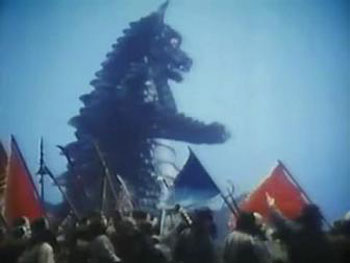
The more metal it eats, the bigger it gets, and it is soon helping the rebel army take on the evil forces of the King, despite all the kaiju size deathtraps the army prepares for it. (Kim Jong-Il was also a big Godzilla fan, so it’s really kind of interesting that his kaiju flick owes more to the Daimajin movies than the Big G). Eventually the King gets smished and the people triumph, except that Pulgasari is still hungry and starts eating all the cookware and farming implements (because Pulgy represents unchecked capitalism, you see) until the blacksmith’s daughter sacrifices herself to save the villagers.
Pulgasari has a professional sheen but stolid pace; Jong-il hired technicians from Toho, including Kenpachiro Satsuma, the stunt performer who was operating the Godzilla suit in that period, to play Pulgasari. As I said, very professional, good-looking… and more than a little tedious. As Dave said after the movie was over, “I feel like I was kidnapped by North Korea.”
Something extremely insane was necessary to raise us from the Pulgasari doldrums. There was a small vocal minority that was fomenting for The Apple, to mark the passing of Menahem Golan, but it was noted that none of these people had actually seen that movie, and they were in large part the same people Rick had conned into demonstrating for The Garbage Pail Kids Movie, so they were roundly ignored. After tossing The Apple under the bus, we, for some outlandish reason (I personally blame lots and lots of vodka), went for another movie Rick had been pushing for ages: Skatetown USA.
We must note that Skatetown has never had a legitimate video release, likely because its soundtrack has a lot of really recognizable songs from 1980, marking it as being from the same era as FM and Americathon, when movies were marketing tools for what were hoped to be hot-selling soundtrack albums. Rick’s copy was apparently one of a number of nefarious versions floating around struck from a 16mm print.
This is one of those movies that you can tell was based firmly on the Official Drug of Disco, Cocaine – and that is the only possible excuse for its existence. Roller Disco had come and gone in the time it took to make this movie, much less get it released. But let’s see what sense can be made out of what came from this cauldron of coke and something else beginning with a K sound.
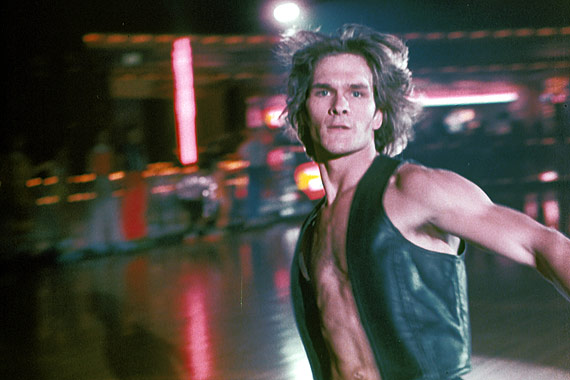
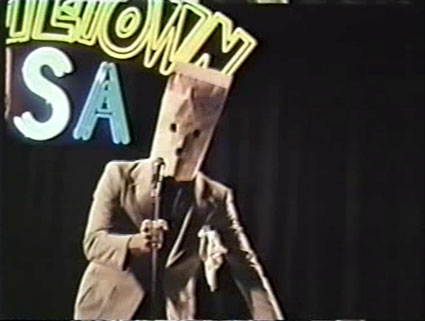
Here is everything wrong with the late 70s, in one picture.
There is this roller disco presided over by a Wizard in a white afro. It’s actually owned by Bill Barty and run by his son, Flip Wilson. Okay, I’ll wait a few minutes while you work the cramps out of your brain. Okay? Halfway through the movie, we’ll discover that Mrs. Barty is Flip Wilson as Geraldine, so that explains THAT.
NOW. There is some sort of contest held every year at the roller disco (in this wizard-run fantasy realm, roller disco has been going great guns for two years), for the best roller disco dance number, and the prize is a thousand dollars and a moped. Scott Baio is training his friend Stan (Greg Bradford) to win the contest, making them the Rocky and Mickey of this movie (Bradford actually has less range and versatility than Stallone). BUT. The fix is on, and the leader of the local gang of disco hooligans, Ace (Patrick Swayze, in his film debut) is sure to win for the second year running.
I really do not miss the days of roving bands of roller disco hooligans.
ALSO. Some illegal drugs have been spilled in a grinder so every body is getting hooked on the Most Delicious Pizza Ever (made by professional fake Avery Schrieber Vic Dunlop), including Ruth Buzzi, who is there as part of a church group to shut down this Den of Iniquity. I’m also told Joe E. Ross is in there, too, going “Ooh, ooh!” but I missed him. Also Dorothy Stratten in a halter top and hot pants. Her I saw (mainly because Rick would scream “Dorothy Stratten!” every time she appeared).
THEN. The competition happens, with Ace’s treacherous band of hooligans sabotaging all the other solo acts, led by Ace’s right hand man, Ron Pallilo as Dark Horshack. One of the contestants is a guy who, for some reason only apparent to the cocainated, is dressed like a Mexican bandito, right down to floppy mustache. He became known to us as “I Love Cocaine Man”, especially after Dark Horshack douses him with itching powder just before his number. Knowing the rest of this movie, it was probably itching cocaine.
DARK. HORSHACK.
Swayze’s entry, partnered with his belt, is actually pretty good (Swayze was a competitive skater, after all). Stan’s entry is even better (we’re told), and goes un-sabotaged when Dark Horshack is ambushed by an over-acting Bill Kirchenbauer. Admittedly, at one point, Stan does ride a skateboard while still wearing roller skates, which is sort of the Platonic ideal for skating. The fix is still on, though, and Ace wins – and it’s time for SUDDEN DEATH OVERDISCO!!!
Marcia! Nooooo!
This is a couples event, so Swayze and his main squeeze – and of course, his belt – smoke up the dance floor while Dark Horshack takes Stan’s partner out parking with a drug pizza. Stan’s partner, incidentally, is Maureen McCormick, better known as Marcia Marcia Marcia Brady on The Brady Bunch, and here, sadly enough, lapsing back into cocaine addiction, given the work environment. She is so out of it, we can’t even call her Dark Marcia, it’s more like Trash Marcia, and I just came through this movie feeling badly for her. Especially since she’s now hooked up with Dark Horshack, thanks to the drug pizza.
Ace’s squeeze defects over to Stan (replacing Marcia Marcia Marcia) and Stan wins, leading to a roller race down a pier resulting in Stan’s saving Ace’s life when a bit of sabotage goes wrong. Everybody now likes and respects everybody else, and we all go back to the roller disco for happy dancing and lots of cocaaaaaaaaaaaaaine.
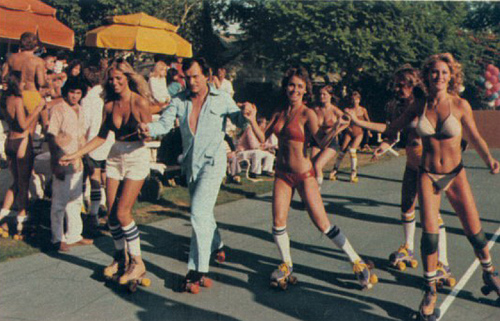
A Photo of everything ELSE wrong with the late 70s.
Scott Baio says he kept turning this movie down until they offered him a ridiculous amount of money, and he still wound up regretting it, saying “It was just a guy making a film who didn’t know how to make a film,” by which he means William A. Levey, whom we all know from (ack) Blackenstein. Case closed.
And, for all that, Skatetown USA was still accorded to be the highlight of the evening.
“The Greatest Story Ever Rolled” hahahahahaSHOOT ME
Surprisingly, this poster doesn’t lie THAT much…
The rest of the wusses headed out, leaving only Rick, myself and Dave, who then proceeded to tempt me with a movie with which I was unfamiliar. A Philippine flick featuring Vic Diaz and Sid Haig, Wonder Women. “Sold!”
Ross Hagen is Mike Harber, who is hired/blackmailed by Lloyds of London to find a missing jai alai star player, only to find that he has been kidnapped by Dr. Tsu (Nancy Kwan) for spare parts in her organ-legging operation. She offers youthful, strong body parts (and in some cases, total brain transplants) to rich old men to finance her other… stuff, I guess, including her army of mini-skirted murderesses. Harber isn’t shy about mowing them down with his sawed-off shotgun, either, when they shoot at him, which is often.
Vic Diaz, the patron saint of Philippine exploitation movies, plays Lapu Lapu, the driver of a fantastically pimped-out taxi who serves as Harber’s guide. Sid Haig, on the other hand, has a pretty uncommon role, as Dr. Tsu’s lawyer and organ broker, given to suits and shirts with enormous ruffles. Dr. Tsu has some failed experiments in cages (which I immediately dubbed “Mew-tants”), and if you think they’re going to eventually get loose and start roaming the compound, get yourself a cookie from the Crapfest jar (You can’t miss it, it looks like Vic Diaz). There is also a really good chase scene using those tricked out taxis through crowded streets – very Bondian.
Because Dave demanded (and supplied) it: a picture of Dr. Tsu’s operatory, including surgical scrubs by Glad®, all the better to continue showing off their kicky miniskirts and go-go boots:
Past that, though, there isn’t that much to remember. It seems an unnecessary remake of The Million Eyes of Su Muru, but what the hell, badass babes in miniskirts provides a good cooling down period. Oh yeah, Dr. Tsu has invented something called “Brain Sex” so you can also throw in ripping off Barbarella to the list. And the assassination at the cockfight from Man With the Golden Gun. And… oh, never mind, this piece is already too long.
So we woke up Rick (“I tried. I really tried.” “But what? It wasn’t bad enough?”) and went on our weary ways. It was a good Crapfest. You can tell a really good Crapfest by the way it eats holes in your memory, rendering you unable to be totally certain that you really saw what you think you saw. So we leave you with the two things that make the world go ’round:
ZAP!
and
(Dave worked hard on that. Feel free to praise him, or pity him.)
If you’ve been with me for any length of time, you are familiar with the phenomenon of the Crapfest. A group of us gathers every two or three months to gasp in wonder at the vast world of the Cinema of Diminished Expectations. Or, ofttimes, to simply gasp.
We had a full complement this time, saving only The Other David, who was healing his voice for an upcoming musical, and felt that shouting in dismay would be counter-productive to that. Fair enough. Break a leg, friend. This left us at myself, Rick, Paul, Alan, Mark, Erik, and your host, Dave.
While planning for this shindig, Host Dave informed us, in the tone usually reserved for doctors telling you to lose weight, that the agenda for this Crapfest had been decided long ago. (Maybe I should have said “In the tone usually reserved for the Lawgiver telling us The Prophecy”, but I’m going to need all my prophecy jokes for later) To that end, he laid out this pre-conceived roster.
I’m going to have to take some blame for the first feature. You see, once upon a time, we tried to limit the scope of a Crapfest to a single luminary in the realm of Crap Cinema. That luminary was Graydon Clark, and that was a mistake of Biblical proportions. Too much of a bad thing, as it were. But at the very beginning, there was a choice to be made, between Angel’s Brigade or Without Warning. The deciding vote came down to Paul, who reasonably enough, deduced that since Rick “Let’s watch Evilspeak again” Mantler had voted for Without Warning, it was only logical to vote for Angel’s Brigade instead. This was wronger than any deduction Dr. Watson had ever made, but I really can’t fault his logic.
So there was this time I bitched that I was still owed a viewing of Without Warning. So that was our opening salvo.
I think I’m not exactly engaging in spoilers when I tell you Without Warning is about an alien coming to Earth and hunting humans with little flying creatures he throws like frisbees, and yes, this was seven years before Predator. The major difference between the two is a) millions of dollars and b) Predator manages to fill its running time pretty well. The Alien spends the first part of the movie knocking off celebrity guests, or at least affordable C-listers of the era, starting with Cameron Mitchell and moving on to Larry Storch, playing the master of a cub scout troop. Storch was only on set half a day, and it seems to play out in real time.
Our protagonists are four teens who ignore the warnings of Professional Harbinger Jack Palance to not go to the lake, there’s trouble there. Half the teens become frisbee kibble fairly quickly, and since one of them is a young David Caruso, the Alien got a standing ovation. The other two (Tarah Nutter and Christopher S. Nelson) try to get help after discovering their pals and several other corpses in a remote shack. They find a believer in Martin Landau, playing a mandatorily shell-shocked veteran called “Sarge”, and, of course, Palance. The bar where they try to get help is notable for featuring Sue Ann Langdon, Neville Brand, and Ralph Meeker (in his last role, no less), none of whom stick around for the big alien fight, such as it is. They leave that to future Oscar winners Landau and Palance.
There is an interminable period at the end of the second act and before the third, sort of an eternal entre acte, where our two teens, on the lam from the increasingly psychotic Landau, break into somebody’s vacation home and set up shop. Nutter keeps waking up screaming and saying things like, “What if this is Sarge’s house?” which allowed us to kill the next ten minutes of filler with panicked questions like “What if snakes can carry knives?” “What if Zamfir really is master of the pan pipes?” and “What if Iron Man had Spider-Man’s powers?”
If there was one takeaway from this, it is that I wanted to make sure I didn’t buy the upcoming blu-ray from Scream Factory out of misguided nostalgia. MISSION ACCOMPLISHED!
The Alien, incidentally, is played by the 7′ 2″ Kevin Peter Hall, because of course he is. And Hall would also play the title character in Predator. Also, Mr. Hall is not finished with us yet, because we are moving on to Prophecy, for which I must also take some blame. You see, back a year ago or more, I reviewed the French movie Prey, noting that it was basically Prophecy with mutated wild boars instead of a bear. I also mentioned I had never seen Prophecy, because I’d read David O. Seltzer’s novel, and immediately thought, “well, I can miss this one.”
To which Dave was all like whaaaaaaat and you are watching this.
Dammit.
Well, we already know about the mutant bear. Robert Foxworth is a two-fisted doctor concerned with social justice issues (as we find out in an opening scene set in a ghetto with the cleanest, freshest spray-painted graffiti you have ever seen), who is sent to a northern paper mill to investigate charges of pollution. The charges turn out to be true, as the whole region is lousy with mercury, which Foxworth assures us has “mutagenic” qualities. This is going to produce some tension in his wife, Talia Shire, who is pregnant, she just hasn’t bothered to tell Foxworth yet.
Extra risibility is supplied by Richard Dysart as the front man for the paper mill, essaying a cagey mix of Pepperidge Farm spokesman and Edward G. Robinson. And Armand Assante as an Indian.
The most famous scene in the movie was quoted in the TV trailer, when the bear attacks a family campsite and a kid tries to hop away in his sleeping bag, only to be dashed against a rock in a flurry of downy feathers. This also convinced 1979 Me that avoiding this movie was a good idea. There is no way anybody thought that was going to be anything but laughable, right? Especially when you consider the movie is directed by John freaking Frankenheimer.
Frankenheimer would say in later years that the movie would have been better if he hadn’t been at the height of his alcoholism during its shooting. The truly lamentable thing is there are moments in this movie that are superb. Foxworth examining the camp site where the exploding sleeping bag took place, and finding enormous claw marks on a tree, and then realizing that the claw marks go fifteen feet up the tree.
The best sequence for me, though is a bit later. Shire finds some mutant bear cubs in a fishing net nearby. One is still alive, but barely (no pun intended). It’s in recovering this cub that Foxworth spends too long, and his helicopter ride is socked in by a storm. They make it to an Indian hunting village where Foxworth labors to keep the cub alive until Dysart and the Sheriff can come and see proof of the pollution. Trouble is, Mama Bear also shows up and wants the cub back.
This is the second great monster movie sequence, when our name actors (plus one or two more) take refuge in a tunnel under one of the tents to hide from the beast and all they can do is listen to the screams of the men still above ground as the monster kills them. Then, silence. Silence for way too long. But who’s going to look out and check?
So that day on the set, Frankenheimer only had half a bottle of Scotch, or something.
We’re building up to a big showdown with Mama Bear (even the most city-slickerish among us was yelling “Leave the bear cub! PUT IT THE HELL DOWN!” but movie characters never listen), which is… okay, I guess, but has nowhere near the tension it wants to have. It’s kind of like the end of the novel Jaws where the shark suddenly succumbs to all the damage done, but we’re led to believe it’s Foxworth stabbing it with an arrow over and over again. Also, the last shot shows us there’s another mutant bear wandering around, so fuck you, movie.
Oh, yeah, I forgot to mention that was Kevin Peter Hall in the mutant bear suit. See? Connections are everywhere.
The worst part was when I got hungry and mentioned to Rick it was time to start dinner and I was going to help Rick in the kitchen because it was like my idea, but Dave was like, no, motherfucker, you get in there and you watch this movie.
DAMMIT.
I don’t mind crap monster movies – hell, in a way, those are my life. But crap monster movies with a painfully earnest social relevance angle – those hurt me.
Speaking of hurt, I had been saving hurt up for a long time. The Garbage Pail Kids Movie, Batman and Robin, Highlander II The Goddamn Quickening. I let that all out with something that had been dredged up by the Drive-In Mob: Bob Hope’s 1976 TV special Joys.
Supposedly, someone has lured a bunch of comedians to Bob Hope’s place to murder them all. You see, it’s Joys because Jaws was really big, and… the murderer is… kinda… like a shark? But not? This is about the level of writing here; you have several roomfuls of comedians – just look at that list on the IMDb page – and none of them are allowed to do their schtick, outside of Arte Johnson obviously improvising a few and Don Rickles calling people a hockeypuck. Because that many comedians in one place? That would be hilarious. Too bad what they’re given is the most insipid jokes 1976 could dig up. Most disheartening is Groucho Marx, frail and nearing death, not even bothering to pretend he isn’t reading cue cards and still making me laugh. Though Kevin Peter Hall is not there, Larry Storch is, and we also have to deal with disco era Don Knotts and Don Adams.
And commercials from Texaco, which assured us it was working to keep our trust.
Oh, the hatred that was cast my way! Hatred which I fully deserved, but I felt much better for having given vent to my spleen. And then Dave retaliated magnificently with Playboy’s Roller Disco Pajama Party, which actually aired on ABC in 1979, even though it sounds like an SCTV sketch. I could only look across the room, give him the thumbs up, and say, “Respect.”
Yes, this is a documentary about frolicking in the Playboy Mansion. Richard Dawson is there to make you cringe, and there were lots of astoundingly beautiful women which just about every man in the room had seen naked (I profess admiration of a sort for the guys who could name each and every one of them, even when they weren’t being introduced). Roller skating, and dancing to Village People songs we had never heard.
Rick’s haunted voice came from the back of the room several times, stating, “This isn’t going to get any better, you know. You may think it is, but it ISN’T.” But I was enjoying myself. Pretty women are pretty women, and there were quite a few here.
FILTH!
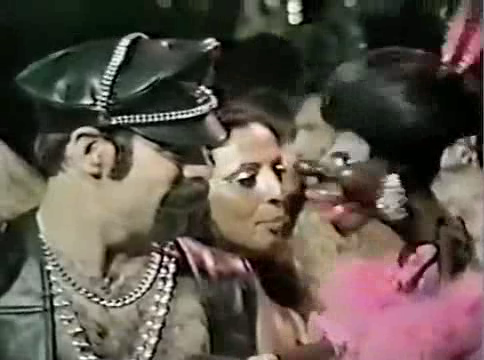
It had its educational points, too: we’d had no idea that there was a disco version of Pink Floyd’s “Have A Cigar”. Nor did we know that Waylon Flowers had a black version of his Madam puppet. (My reference source for all things gay, long-time theatre friend Rodney Walsworth, informs me the puppet was named Jiffy, and he saw Flowers perform with her at a club). The clip below has a glimpse of Jiffy, but sadly does not seem to have the bit where Flowers attempts to work his sassy black puppet magic on Jim Brown, who is visibly counting to ten several times just to keep from jamming this puppet up this little peckerwood’s ass.
No, here is this hunk of the show – the whole damn thing’s on YouTube, folks, it’s easy enough to find – that has the high point for us. About 13 seconds in, after a Mork and Mindy promo, is the 30 second throw to the local newscast coming on after Roller Disco Pajama Party, and it’s obvious the station has been getting a lot of calls about the show…
We really wanted that guy to come back.
A scene from True Detective, Season 2
You don’t have to watch the whole thing, or maybe you do, because you’ll catch a brief glimpse of Marjoe Gortner at the party (he got applause. I love my homies.), the aforementioned Jiffy, Richard Dawson referring to index cards as he interviews some Playmates, and likely the most skin you’ll see in the whole enterprise. Just enough to make our gathering feel all cheated and hollow inside.
Not me, though. I went home feeling purged, cleansed of all the negativity that had been weighing on me. Such is the power of inflicting crap on your fellow man. This feeling did not survive the light of day, but I slept like a baby that night, and I look forward to the next one, where I can start playing the nice guy again.
So. We know I take a long time to get to movies. I will go to a movie theater maybe three, four times a year; I like to engage on my own terms. Some movies I know will lose very little impact by waiting a while and watching when I want, not by making an appointment with it. There are some movies, admittedly, that I will strive to see in their natural setting (no matter how degraded that setting has become), but let’s face it: there is much more fare I know can wait. I knew The Lone Ranger was going to be such a movie before the first negative press was ever unleashed.
Yeah, I’m old. I remember watching the Clayton Moore TV series when I was a kid, somehow never realizing he was wearing tights, not jeans. There was a Lone Ranger cartoon in the good old bad old days of violent Saturday morning cartoons that was cheap but thoroughly bizarre, inflected with its prime time contemporary, The Wild Wild West (there was a later, Filmation cartoon that was typically sanitized and useless). In the pulp movie revival fueled by Star Wars and Raiders of the Lost Ark, there came Legend of the Lone Ranger, which I have never seen.
Our old pulp heroes have a built-in problem, being creatures of the pop culture of their time, and that is the not terribly-enlightened handling of sidekicks of any color but white. Mandrake the Magician would probably make a decent movie character, being so visually oriented, but the muscle-bound, leopard-skin wearing, be-fezzed Lothar would have to be re-booted several times before he could even begin to be acceptable. More on sidekickery later.
Despite this, Disney still went ahead with The Lone Ranger. Casting a white actor, Johnny Depp, as the traditional “faithful Indian companion, Tonto” is really the least of its problems. America has a particularly shameful history in its dealings with the native population, and most modern Westerns have at least a small portion of their running time devoted to this. The Lone Ranger has at least two instances of genocidal imagery, and in a better-structured movie, either of them might have mattered. But here, it simply becomes part of the white noise that slowly engulfs the story (and no matter what anyone else says, Depp is doing a superb Jay Silverheels imitation).
Through some judicious editing and – I know this is heretical, but what the hell – another run of the script through the writing mill, unhampered by focus groups, this might have been a much tighter movie at only two hours, and possibly a kickass, exciting one at 90-100 minutes. This is a problem I have with Gore Verbinski movies in general, and the major reason I never got past the first Pirates of the Caribbean movie. I don’t mind a meandering path in a movie, as long as it builds to its set pieces and provides what I came to an action movie to see: action, preferably of the cathartic kind. But chances are, if you took Verbinski or Depp out of the mix, this movie would not have gotten made.
Now, the Lone Ranger story is such an antique, we did need the origin story retold (I suppose), especially since we’re taking a few liberties with it to give our new version of the character his Hero’s Journey. This time, John Reid is a hastily-deputized Texas Ranger, who follows his brother in a posse tracking escaped outlaw Butch Cavendish, who is now a cannibal (just in case he wasn’t villainous enough before). Surviving the ambush, John is chosen by a “spirit horse” to be the “Spirit Walker”, the man who cannot be killed, at least according to Tonto. Then again, we will also later be told that Tonto was driven insane by causing the death of his tribe by leading two white men to the silver mine that will be the McGuffin for our plot.
I counted three separate instances where the movie’s plot had obviously entered its end game, but the script then undercut that and decided to keep going for an hour or so. The bizarre egregiousness of some of the story problems has no better example than Helena Bonham Carter’s character, Red Harrington (some junior executive took a three-martini lunch and the rest of the day off after coming up with that name), a whorehouse madam with an ivory prosthetic leg that conceals a shotgun. To justify her prominence in the advertising materials, the plot will then twist itself into a few more topologically improbable shapes to accommodate her part in the complex end sequence.
Armie Hammer does everything he is asked to as John Reid. Sadly, what he is told to do is often some pretty stupid stuff. There are times when the template seems to be lifted from The Green Hornet movie, where Britt Reid (yes, notice the last name, Warren Ellis fans) is the comic doofus and Kato (again, your mandatory sidekick of color) is the competent one. And more than once The Lone Ranger reminded me of another ill-starred Western reboot, Wild Wild West, especially about the time we go to Red Harrington’s whorehouse, so reminiscent of Fat Can Candy’s that I kept expecting to see Kevin Kline in drag.
There are borrowings from other movies, tributes that I can accept: the use of Monument Valley (though I don’t remember it being in Texas), and a complicated love triangle with two brothers and one’s wife straight out of The Searchers. Three locomotives are wrecked in this movie, one named The Jupiter, in deference to Buster Keaton’s train-centric The General (and Depp’s love for the comedian is indulged in several of the action set pieces). I’m okay with that.
Disney had a similar failure with John Carter, the difference being that John Carter was a much more solidly-constructed movie and deserved better (it also hedged its bets, as its indigenous noble savages were aliens). The Lone Ranger, though, is a morass of story ideas that are often in the wrong order, and the viewer simply waits, tapping its foot and checking its watch, to get to the action sequences, which are gorgeously shot, exciting, and expensive.
I do get why some people don’t like the movie, and it has a lot to do with what I’ve outlined above. What I don’t get is the hate directed toward it. I’m pretty sure there’s a “worst movie ever made” review or three thousand out there, and my response is always going to be, “You don’t watch near enough movies.” Yes, despite all my bitching, I did enjoy The Lone Ranger. Not enough to watch it again, but I had a fairly pleasant time.
I’ve said it before, I will say it again: my relationship with a movie is very simple. I ask that it entertain me, and I will allow myself to be entertained. It’s not that hard, but a lot of movies manage to fail that simple deed.
And I really feel that sometimes, what is missing from many people’s approach is that, simply, they will not allow themselves to be entertained. Like a character in an Ingmar Bergman movie desperately seeking their one version of God when evidence of God is all around them, a lot of movie-goers demand that rush, that tingle they got the first time the star destroyer rushed overhead and kept rushing, or Indy ran from the boulder. And when that rush does not come, the movie is obviously worse than the heat death of the universe. People. You’re not always going to get that. And if that’s all you’re looking for, you’re going to miss what is offered to you. Permit yourself to have some fun, for God’s sake. And I absolutely, honest-to-God do not understand the concept of “hate-watching”. What the hell. There is a doctoral thesis waiting to be written on that life-wasting nonsense.
Having said that, I am now going to undercut myself, because that’s another takeaway from Wild Wild West: undercutting and demeaning your source. At the end of WWW, as was traditional in the TV series, when they had some time to fill or a plot point cheat that needed explanation, Artie would ask West, “Mind if I ask you a question?” They did this in the movie, but Will Smith’s answer was a dismissory, “Actually, I would mind.” In The Lone Ranger, Reid finally, finally, rears up on that gorgeous white horse and belts out, “Hiyo Silver! Away!” to which Tonto says, “Never do that again!” It’s supposed to be a laugh line, but we’ve been waiting for that a long time. We have, in fact, been waiting the entire movie to hear that trademark line. And that is probably the reason why “Fuck you, movie!” is the last thing anyone remembers about The Lone Ranger.
I’m going on yelp and giving this new flu a bad review.
The last couple of weeks have been a delirious fever dream, as I pretty much lived on Dayquil and sugar-free cough drops. I punked out of work when I could, but most of the time I couldn’t. The most amazing bit, to me, was when my church asked for my voice at two Easter services and if I felt too bad I didn’t have to do it but could I please also do a rehearsal on Saturday morning, too? After the rehearsal, one musician reportedly said, “Darth Vader just opened our service.” Yeah, I sounded profoundly sepulchral. No problem hitting those low notes. I radiated gravitas. And phlegm.
So after Easter weekend – when I did the Show, and the services, and made homemade chicken soup because I was the mobile one in Plague Central – I took Monday off, and then a surprising thing happened. Exhaustion took its toll and I actually slept through Monday night, awakening only occasionally to cough up a piece of lung. I felt good enough to go into work, pound that week’s story into shape and submit it before the deadline, go home, nap, go do audio support for that evening’s Economic Development Corporation meeting (honestly, I have watched un-subtitled Mandarin movies that were more comprehensible to me), slept again, and felt almost human Wednesday. Which is good, because I had a traveling show at a refinery in Deer Park (and it’s always good before a show to receive that little lecture about what to do if there were some sort of catastrophic accident while we were there), then run home, change clothes, and do a remote broadcast that evening.
I felt good enough that I won’t even mention that the remote was for a Candidate Debate between folks running for School Board and City Council positions. No, what I’m actually not going to mention is that one of the Council candidates was sick, so we had a Candidate Debate with one participant. That was good TV.
Oh, yeah, I watched some movies while I was sick, too.
First up was Death Promise, an odd little homegrown kung fu revenge flick from 1977. This was nowhere near as bad as I was told, and I found it pretty entertaining. Okay, admittedly the boom mike should have gotten a credit. Indications are we’re going to devote a Daily Grindhouse Podcast to it, so I’ll leave my blithering to that, and leave you with this truly remarkable fight scene, including a bad guy whose ki-ya sounds like an asthmatic cat who’s smoked too many cigars:
And oh yeah, ignore them. Buy this fine movie at Amazon.com.
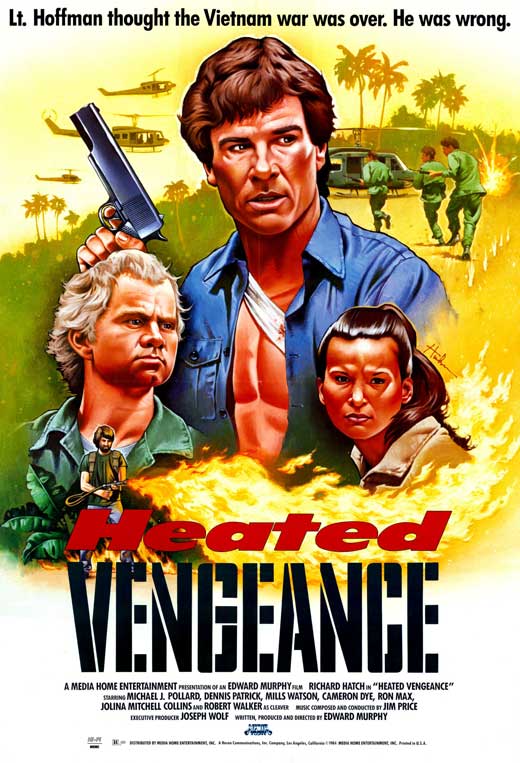
Speaking of the podcast, one of the best things it turned me onto was the delightfully insane, inept-in-all-the-right-ways movie Raw Force, aka Kung Fu Cannibals. This was the first of two movies directed by Edward D. Murphy. We were all curious about his second, and last directorial effort, Heated Vengeance, but I was apparently the only one who cared enough to do something about it.
In other words, I took a bullet for the team.
In the three years between Raw Force and Heated Vengeance, Murphy learned a few things, and got a better budget together. This is obvious from the very first scene, which depicts a Viet Cong attack on an American firebase in Laos. Richard Hatch is there as our heroic commanding officer, Joe Hoffman, who gets wounded and choppered away from his native translator lady love Michelle (Jolina Mitchell-Collins). Hoffman gets sent back to the States and his wife, and years later he returns to Thailand, newly divorced and looking for Michelle, now a doctor, and what could be his son. Too bad he runs into Larry Bingo (Ron Max), a guy in his command who was getting sent up the river for raping a native girl, but escaped during that expensive Cong attack we keep flashing back to. Bingo kidnaps Hoffman, takes him to his drug production base (set up in Hoffman’s abandoned army camp), intending to wreak some heated vengeance. Hoffman escapes, and goddammit, we’re watching The Most Dangerous Game again.
There is surprisingly little action in this action movie; there’s a lot of talk, though. Murphy still likes his villains kind of colorful, and Bingo leaves no scenery unchewed. Among his henchmen are Michael J. Pollard, being very Michael J. Pollard-y, and Robert Walker Jr., an unfortunate actor who Hollywood just never figured out what to so with. Things don’t start getting really weird until about the last twenty minutes or so when the wounded Hoffman is taken in by some Laotian natives, and Michelle and his son track him down with the help of a friendly traveling toilet salesman (a pretty welcome Dennis Patrick). By this time, Bingo is down to a flamethrower and Michael J. Pollard, and there is an explosive finale which Murphy could not have possible been able to afford, but he goes ahead and tries to do it anyway, which was the Edward D. Murphy I had been looking for all along.
“Wha? Heated? Vengeance? That’s a thing?”
It is a very good vehicle for Richard Hatch, though: he does the everyman with his back against the wall bit pretty well. But honestly, I spent a lot of time in this flick checking how many minutes it had left, and that is never a good thing.
So how do I recover from the disappointment of not finding another Raw Force? I watch Boardinghouse, because I’m an idiot.
I was pretty much unaware that Boardinghouse even existed before noted sociopath Joe Cosby forced me to watch Things for Daily Grindhouse Podcast Mark I, and evidence showed that Things was inspired by Boardinghouse, at the time the most successful made-for-video Canadian movie evar. The video was apparently even transferred to 35mm for a theatrical release.
Huh.
After an opening where we find out the titular house has a history of violent deaths (one involves an incredibly effective garbage disposal), most of which can seemingly be traced to a telekinetic sibling who’s committed to a mental hospital for life. The house eventually devolves to Jim Royce, who opens it as an all-female boardinghouse, with him as live-in landlord, figuring that this will be the ticket to a “bachelor’s paradise”. This means that he will soon be banging each and every one of his tenants, when he’s not meditating on his desk in his underpants, honing his telekinetic skills.
That’s right, there are two telekinetics in this movie, soon to be three when Jim teaches Debbie (Lyndsay Freeman) his methods. Good thing, too, because the original TK escapes from the hospital after forcing a woman to hang herself and a man’s intestines to jump outside his body.
The women in the Boardinghouse are about as well written as your typical frat house movie, which is to say they are not written at all, and they appear to have little inclination or ability to be anything more than casually catty and evil to each other. There is an Asian girl who mysteriously vanishes after her sex scene – and it’s not like when another girl vanishes and it’s part of the plot, no, she just ceases to be. There is also a black girl, but we only see her when she’s going to work (and she’s the only one who appears to do so, so I guess that should be counted as a positive character trait). Well. she does show up at the big party scene at the end just in time to get killed, but – groundbreaker! – the black character isn’t the first one to get killed! Admittedly, it’s because she hasn’t been around for most of the movie, but still…
Maybe these two ladies have expanded roles in the Director’s Cut, which is apparently a full hour longer, but I don’t care. I JUST DON’T CARE.
I will give it this: Boardinghouse tries to outdo Rock N’ Roll Nightmare in the bizarre, terminally-silly-ending-that-is-supposed-to-be-terrifying department, and it certainly gives Jon Mikl Thor a run for his money. This amazingly dark trailer should give you an idea of the visual splendor of the movie:
Folks, video equipment doesn’t do well in low light environments, unless you know what you’re doing, and even then... And oh, yes, “Horror Vision”. When you hear a sound and see a black glove, you’re supposed to close your eyes. It’s like Chamber of Horrors‘ Horror Horn and Fear Flasher, except the makers of Boardinghouse get tired of the gimmick about 45 minutes in and forget about it. Maybe it shows up in the last few minutes, but you know… care. Did not.
Folks, I watch a lot of crap like this. No dilettante I, I have seen shit that would turn you white. After a while, it gets to you, it really does. This is why I take off May and watch movies on my Wall of Shame, movies I should have watched years ago, almost all taken from Roger Ebert’s Great Movies List. At a low ebb, I kicked this off early and knocked one of those bricks off the wall: I watched Charlie Chaplin’s The Gold Rush.
I hear many of you screeching about the whiplash injuries incurred by that sudden turnaround in quality. Fine. We’ll leave that for next time.
Even for a tax week, this one has managed to excel in getting increasingly sucky.
I won’t go into the income tax woes; everybody’s got those stories, mine are worse than some, better than others. Let’s just say it’s a good thing I’m a survivalist in movie matters and have been stocking up on movies for some time, just against a buying moratorium like that which is about to be enforced. I have a fallout shelter full of, not cans of beans, but DVDs.
Typos. Mainly I’m afraid of typos.
No, other crap’s been going wrong out in the world. The saddest one is the shuttering of FearNet, which was a damned fine resource. I’m especially going to miss the reviews of Scott Weinberg, who is that rare critic that, while I may not have always agreed with him, was always enthusiastic and perceptive in his reviews, and was valuable in pointing the way to movies I might have otherwise passed over. I hope to hell he lands on his feet and gets a post somewhere else, because he deserves it.
Well, there’s not much I can do about that, except to send good thoughts his way and the way of many of my friends who have found themselves unemployed this year; I did that a few years ago and I don’t have to tell you how much it megasucked. Finding a new job when you’re over 50 is a thorny proposition, at best. I think my worst day there was being informed that I was not worthy of working at Walmart, for God’s sake.
Making matters worse is the fact that my wife came down with the current flu two weeks ago, and it is one of those that just sets up shop in your lungs and hangs on, so constant coughing in the night is a given. Neither of us has gotten much sleep, and I’m exhausted enough that the damn bug has slipped through all the vitamins and supplements and set up shop in my mucus membranes, and when you work three part-time jobs, you literally do not have time to be sick.
This Friday is Good Friday. I expect to be unconscious for most, if not all, of it.
But enough bitching. Here’s some good news:
I am now a three-time Telly Award winner under my nom de guerre, Randall Williams. Honestly, I got really cynical choosing this last entry, and went for the cute animals. It worked:
But this is the one that cemented that, my story on a specific breed rescue organization:
But the one that started it all, the one I fought to have entered that first year? Zombies. Though a few cute dogs were included:
One of the better non-work things that I do, that I do not plug near enough, is the Daily Grindhouse Podcast, which I started doing again this year along with DG regulars Joe Cosby and Jon Abrams. Do you want to know more?
Episode #16 – Street Wars– Jamaa Fanaka’s last movie is a typically intriguing mix of solid exploitation tropes and painfully earnest social issues – earnest enough to keep you guessing. I think we were all surprised at how easily this came together for a first episode.
Episode # 17 –Vigilante Force – The under-appreciated George Armitage fights the American Revolution in vigilante terms in an odd thriller starring Jan-Michael Vincent and Kris Kristofferson. Mayhem ensues.
Episode #18 – Ghosthouse – It was Joe’s turn to pick a movie, and I believe my response to this was “Umberto Lenzi? You bastard.” A surprisingly restrained – until the very end – haunted house story that we fell on like hungry zombies. This was the first movie we universally trashed, and it felt good.
Episode #19 –Thriller: They Call Her One-Eye – This one was my choice, I admit. I had been meaning to see this since Synapse put out their limited edition of the uncut director’s version with the original sub-title, A Cruel Picture. Our first divisive picture – I recommended it (with caveats), Joe didn’t like it and Jon outright hated it. A really good episode, though, as we kick around why our opinions differ so much.
Episode #20 – Raw Force – Edward R. Murphy only directed two movies, and trust me, this is the one you want to see, as it is insane from the first frame. This thing is like an exploitation smoothie with everything thrown into the blender, and then garnished with incompetence and cheap visual effects. Cannibals, boobies, bad kung fu, boobies, Cameron Mitchell, boobies, black magic, and finally, some boobies. And Fake Hitler backed up by The Village People. Code Red is supposedly working on a remastered version, and screw the IRS, I’m spending money on that. Needless to say, we have a ton of fun discussing it.
Episode #21 – Ganja and Hess – Hands down, our best episode so far. Mike White from The Projection Booth (pound for pound the best movie podcast out there) drops by to class up the joint as we mull over Bill Gunn’s moody, ethereal vampire movie.
Episode #22 – The Devil’s Express – This is how I repaid Joe and Jon for Raw Force. The Devil’s Express is another of those movies that seemingly has everything – monsters, murders, gang wars, good old bad old New York, Warhawk Tanzania, bad kung fu, Brother Theodore… we had a fun time picking this apart, but don’t be fooled. we loved this movie.
Episode #23 – The Twilight People – This was Jon’s choice, because it was a Pam Grier movie he hadn’t seen. I could have warned him that this is not truly a Pam Grier movie, but… our Guest is Dr, Gangrene, who loves the movie, which is good, because someone has to. I like Eddie Romero movies… except for this one.
Well, this has taken me a thousand words and two hours closer to that lovely, lovely Friday and my bed. (Homer Simpson drooling sound) Beeeeeeeddddddddddddd….

 Click the banner for Hubrisween Central. Or visit Hubrisween on Letterboxd
 Why yes, it has taken me an inordinately long time to watch this movie – Hammer’s first gothic horror, and a film that arguably kicked off the horror boom that would blossom in the 60s. During my younger years, this was understandable, since the local TV channels seemed to have no problems showing Horror of Dracula (and especially Brides of Dracula) over and over again, but the Hammer Frankensteins seemed to rarely crop up. In Curse‘s case, never. So, when it was finally released on DVD in 2002, I snatched it up – and proceeded to ignore it for 12 years.
 Rather famously, Universal threatened to sue this upstart British company if they dared to imitate their 1931 tentpole, and this was actually a good thing. I’ve read accounts that claim that the initial concept was to do a black-and-white movie with Karloff as the Monster – hell, Hammer even calls it “The Creature” so they couldn’t be accused of ripping that off – and the threat of litigation forced them to create something unmistakably their own.
 Now, that is a hell of a leap, and if anyone doubts Peter Cushing’s skills as an actor (PS, if you do, you’re an idiot), the fact that Cushing actually pulls this off should provide more than adequate proof. His Frankenstein is quite the amazing portrayal, in fact – a rich nobleman used to getting his way, capable of great charm but so cocooned within his wealth and privilege that he can’t see the potential harm in anything he does, and in the pursuit of his ultimate goal, it becomes no surprise that murder becomes just another tool.
 This is also one of the best fruits of the threatened lawsuit from Universal: the creation of a new visage for the Monster. Apparently in complete desperation, makeup artist Phil Leakey created this new version directly on Christopher Lee’s face at the last minute, using traditional supplies like cotton and spirit gum, very much in the tradition of the classic Universal monsters. Striking, horrifying and completely its own… creature.
 The story does get a bit meandering: the Creature escapes, kills a couple of people (the first one being a blind man, the polar opposite of a similar sequence in Bride of Frankenstein – take that, Universal!), and Paul shoots it through the head. This is no obstacle to Frankenstein, however, who simply resurrects it again after, once more, repairing the brain Paul had damaged. Victor uses the monster to rid himself of a troublesome maid attempting to blackmail him into marriage; it is for that murder that Frankenstein will be remanded to the guillotine at movie’s end, the monster having escaped once more, attempting to murder Victor’s bride, and finally winding up in the scientist’s convenient acid vat, erasing all evidence of the brute who actually killed the maid. Paul keeps quiet about the Creature, too, realizing death is the only way to stop the obsessed Victor.
 Having mentioned Victor’s bride, I should take a moment for Hazel Court, who plays Elizabeth. Lovely and talented, Court appears in several gothic horror movies, and she is, sadly, particularly wasted here; Elizabeth exists only as a reason to keep Paul in Castle Frankenstein, hoping to protect her from the horror of Victor’s experiments. Like Lee and Cushing, she was a veteran actor at this point, and probably used to such things. Check out her filmography at the IMDb – her talent was recognized, at least.
 The last thing that sets Curse of Frankenstein apart from its Universal forefather is an interesting reversal: both spawned many sequels, but in the Universal series, it was the Monster that remained the same, while the doctors around it changed. It was the exact opposite in the Hammer series: the monster would change, but the doctor (with one notable exception) was the constant: Peter Cushing, building on this complex, nuanced performance over the course of the next fifteen years.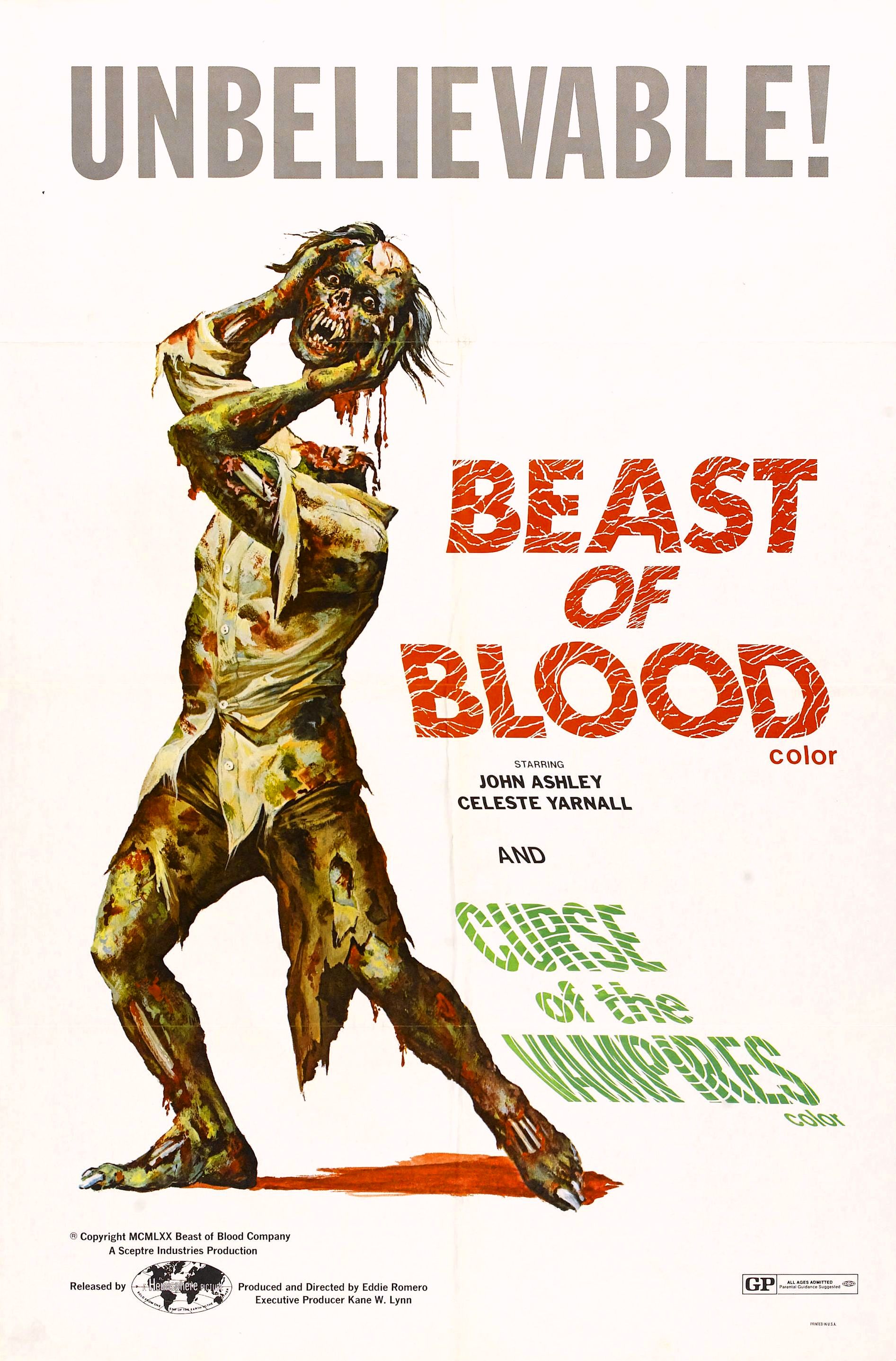




























 drfreex.com