When Superman Was A Sitcom

In the early part of the decade, I landed a dream job: I was paid some very good money to write. The odd fallout of that lucky win: I stopped any extracurricular writing. I’m trying to get back into the swing of non-deadline-oriented writing, writing for pleasure, and you – you lucky lucky taxpayer – have stumbled upon the result. Try not to hurt yourself on the sharp edges. And there will be plenty, as I attempt to get my muse back on her game.

Now back to my waxing rhapsodical (well, waxing something) about my digging back through beloved comic books.

You’d think that I’d start at the beginning, that would be easiest. That would probably mean starting with Superman, the ground zero of superhero-dom (although my current madness really started with The Fantastic Four… but enough of that). Well, I’ve got one of the Showcase Presents Superman volumes – number one to be precise – and I had it down for my recent reading rotation. I was halfway through it before I realized I had read it cover to cover when I first bought it months ago and just simply did not recall any of the stories. My failing, aged memory? No. They just weren’t very memorable.

Supes has always ranked pretty high in my super hero listings, yet he’s one I’ve never had the typical fanboy yearning to write. Even in his more modern, down-powered state, he’s still awesomely overpowered, and that can’t be easy to build a story around. (watching some of the Filmation superhero cartoons of the 60s, I was amused to see Supes pushing the Earth out of orbit again. At least they made it look kinda hard – I seem to recall in the Super Friends days, he could pretty much do it by accident. Then again, the Super Friends always did five impossible things before breakfast, anyway).

There are two things that contribute to the lightweight quality of most of these stories. The first is a stolid, hidebound editorial stance alluded to by Mark Evanier in his book Kirby: King of Comics – a very strict view of “this is how comics is done”. Apparently a commercially viable stance, but it led to practically every DC comic being written in the same voice – which starts to be truly irksome in the early Justice League stories), with only different costumes and utility belt contents to differentiate characters.

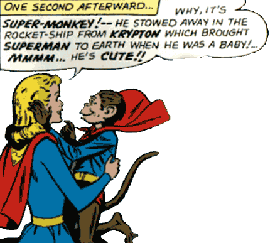
It’s also this editorial stance that apparently led to a much commented-upon propensity to feature frequent gorillas on the covers of comic books to boosts sales. Yeah, I scratch my head, too, but this has given us such evergreens as Titano the Super Ape and Gorilla Grodd. Not to mention, I suppose, Congorilla and Beppo, the Super Monkey.

Heh heh. Monkey!
Heh.
The second thing? I note that the stories in Volume One all hail from the years 1958-59. The Comics Code Authority was formed in 1955, and it has to be admitted that these stories are pretty dang unprovocative, with nothing to insult anyone. Unless you’re a woman, or a man with a lick of sense. But as we all know, these are okay to insult.

Yeah, we’re getting to the era that’s mined for sites like Superdickery or What Were They Thinking. There’s much that’s risible here – Lois Lane is so Superman-hungry that you wonder when she’s got the time to be such a highly-regarded journalist, and Superman is, to say the least, extremely gullible. He blabs his secret identity to people in disguise at least twice in the first half of the book, which would lead Batman to smack him upside the head with a Kryptonite-lined glove and bark, “Clark, you moron! You have X-ray vision!!!”
I suppose I regard these stories as more or less dispensable because they have no effect or impact on Canon, with a capital “C”. Then, Supes has been rebooted at least twice in my lifetime, so how could they? For what it’s worth, I love the happily-married Lois/Clark dynamic, and the fact that Lois is currently a strong enough character to hold her own amongst super-types. Which makes the story in Vol. One where Supes, believing himself to be marooned for life on a tropical island with Lois, reveals his identity and marries her in a native ceremony, all the more quaint. Especially since Supe then has to pull off an exceptionally lame series of explanations how Clark managed to fake super powers when a way off the island is figured out. Because, you know, girls have cooties.

Cue Batman with that kryptonite-filled sap glove again. Maybe Superman is a dick.

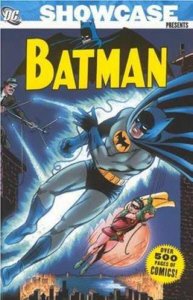
Then again, Batman has it easy. His Showcase Presents starts in 1964, into the “New Look” period that brought Batman more or less back into the “real” world (or at least as real as Gotham City ever gets), and not gallivanting off into space every issue to fight alien menaces that Flash Gordon would have refused to take seriously.
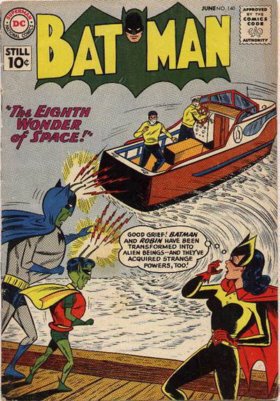
Which is too bad, really. I was looking forward to some Batman and Robin vs. the Mullet Men goofballery that filled the 25 cent 80-page Giants of my youth. Then one has to admit those, like these Superman stories, were definitely slanted toward the juvenile demographic. No way adults would ever be caught dead reading this stuff. No way at all.

This is likely the charm the stories hold for me: their very milquetoast, workmanlike quality. I admit that a few years back, when Grant Morrison was writing the JLA, I actually got very tired of the universe coming to an end every month. That was the only way to manufacture any dramatic tension, given the amount of power on that satellite – but would it have killed them to have the JLA stop a bank robbery once in a while? Those idiots in the Royal Flush Gang seem to pull one a week, at least…

So really, it’s kind of a relief to read a story where Superman is trying to teach Lois a lesson by wearing an Alfred E. Newman mask.

What? No, I’m not kidding.

I Sing the Experience Life-Wasting

Ah, youth, sweet youth. That joyful time when I regularly tackled the tough stuff. And by tackling the tough stuff, I mean reading the really thick books. You know. Ulysses. Remembrance of Things Past. Gravity’s Rainbow. Nova Express (which wasn’t thick but was no less scarring). Yes, by God, I was stretching my mind.

And truthfully, I remember very little from any of them, outside of enjoying them. Proust, especially. Maybe I stretched out the brain cells too much (though admittedly, not purely through literature. Chemicals may have been involved).

But you know what I do remember, with great clarity? The death of Jean Grey. Doctor Doom killing his right hand man rather than let him destroy the art treasures of Europe in an attempt to kill the Fantastic Four. I remember when Terra betrayed the Teen Titans.

If you look back over the card catalog of everything I’ve read in my life, this would not surprise you. By fourth grade I had chewed my way through most everything H.G. Wells and Jules Verne had to offer, but I had also read through almost the entire Tom Swift, Jr. series as well as every Doc Savage reprint paperback Bantam could toss on the market. This is pulp, you might say, this is trash.

To which I say, pfui. Big Deal.

I’m past the age of being evangelical about what I like. I’m also long past the age of being apologetic about it. And into the age where, if you ridicule me about it, I can smile easily, gently urge you to commit a physically impossible act, and then command you to get off my lawn.

I loves the funny books, you see. If you don’t, that’s fine. But you’re prolly gonna get bored here very quickly.

Funny books are what enabled me to read Verne, Wells, Heinlein and that damned nightmare-inducing Alfred Hitchcock’s Monster Museum while my classmates were still struggling to step outside Dr. Seuss. My grandmother read to me every day from comic books when I was wee – Herbie was a big favorite – and thus did I learn to read before my first day of school.

There was a brief attempt to stop me from reading comics early on, fearful that I wouldn’t read “real” books – but that turned out to be a groundless fear. Sickly child that I was, reading was one of the few pursuits I could easily perform. I loved books. Still do. Love the smell of them, the feel of them, heavy in my hand. Love the portability. No batteries required.

I find myself gadget-curious about the Kindle. But I hunger for the smell of dusty paper, and the tactile joy of physically turning that page of pressed wood and dead ink. I don’t think an e-reader will ever truly be for me.

For one thing, I don’t think comics will read especially well on them.

It’s like one of those sudden conversion stories they love in evangelical circles. You see, I once hated on those “Marvel Essential” and “Showcase Presents” phone books. They don’t have color! Where is my four-color fury? Bah!

Of course, then came the day I saw Marvel Essential X-Men Vol. 3 at Half-Price Books and figured “What the hell.” What the hell indeed. Not to diss any of the hard working colorists who labored in the trenches all those years, but the color was the least of the strengths of these stories, and I have gotten really hooked on an easy, affordable way to read through huge hunks of history.

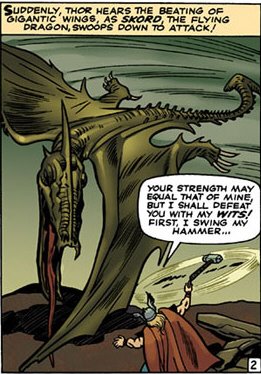
To digress – which surely you’ve come to expect from me by now – These days, the computer-driven coloring in comics is extraordinary. There is a recent re-issue of the Stan Lee/Jack Kirby Tales of Asgard in which the only change made was re-coloring, using modern methods, and the result is gorgeous to behold. I like to think Kirby would have approved whole-heartedly.

This is too long already, and I have rambled so far afield from what I originally intended to say, I hear search parties in the distance trying to find that intent. More on what I’ve been reading and why in the days ahead, I hope.

You know how I love going on and on about stuff nobody cares about.

Geekboys REPRESENT!

I await the premiere of the Watchmen movie with trepidation. First, I didn’t care for 300, and I loved Frank Miller’s original almost as much as I love the Moore/Gibbons Watchmen. Then again, I found much to like in Zack Snyder’s version of Dawn of the Dead

Then, it seems (if the innernets can be believed) Snyder fought to keep the parallel comic story of The Black Freighter in the movie – though God knows how. It has apparently been cut, and will surface in the inevitable deluxe DVD version, released six months after the initial bare-bones release. Not that I’m a bitter consumer, or anything.

Then, it is apparently common knowledge that the ending of the story has been changed. On the one hand, I can hope to be surprised by this new ending. On the other hand, how can a new ending hope to match the punch-in-the-gut impact of the original? On the mutant other, third hand, I will be glad that I will not be subjected to endless misspelled tirades on those same innernets that Watchmen totally ripped off the first season of Heroes, dude. Bad enough we’re going to be getting enough of what the webcomic The Rack so insightfully predicts.

The viral video campaign has begun, and though it’s about as tepid as the fake news segments for The Dark Knight, it still shows promise:

As usual, I reserve judgment until I see it with my own myopic peepers. But hell, I’m the guy who had nice things to say about Robocop II.

Tough Week

Well, it was a rough month plus for aging fanboys like me. Back in December we lost Forrest J. Ackerman, Bettie Page, Beverly Garland, Eartha Kitt. For the theatrically minded, there was Harold Pinter and Dale Wasserman. Probably several more that slip my mind. Sorry.

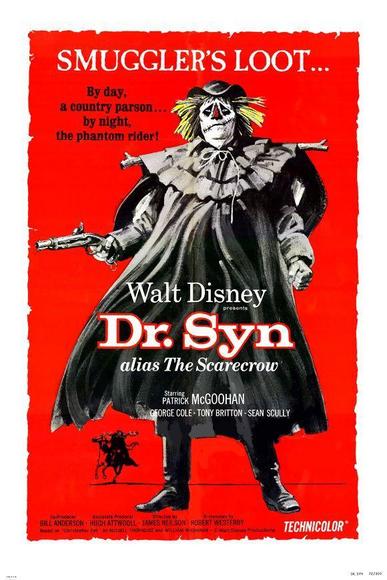
So this week, thus far: Ricardo Montalban and Patrick McGoohan. McGoohan is especially poignant for me, right now; I asked for and (barely) received for Christmas the Walt Disney Treasures edition of Dr. Syn, the Scarecrow of Romney Marsh, which, to borrow a phrase from my pal Parker, Looms Large in My Legend.

In early 1964, I was in the hospital on one of my deathbed visits – not the most serious one, the one where the docs advised my mother I would not survive, or if I did, I would be a vegetable for the rest of my days, that would wait a couple of years – but one of the most memorable things about that stay was the initial TV appearance of The Scarecrow, broken up into three consecutive weeks.

I don’t think I was in the hospital that time for three whole weeks, but I like to say that I refused to die, because I wanted to see how the story played out. That is also pure bullshit, but damn, it makes a great anecdote. I do remember asking my mother to make me a Scarecrow costume for that Halloween… which I never got.

So I felt I had a special claim to this DVD. I say I “barely” got it, because apparently Disney is quite serious – and infamous – for taking the “limited” in “Limited Edition” entirely too seriously, and the thing was out of print the week it shipped, or something. My poor wife was frazzled trying to track a copy down, and it finally came down to recruiting me for the search. I love the hunt. I find a copy misfiled as “Drama” at my local Fry’s (where I swear every time I walk in I’m going to reorganize the movie section for @#$%! free), and my Christmas is Merry one.

I had looked to reviewing it for 50 Foot DVD, when I found out about its unavailable status… but now, with the review almost completely written, it seems a bit foolish to just toss it away.

Anyway.

Ran out of unemployment compensation this week. Registered for the emergency stuff. A job I applied for in October called me in for an interview in December – a good one – and said they’d be Making their decision in January. I write and e-mail once a week to keep my name on their desk. I hate this.

Anyway.

The re-reading of Cerebus is a dicey thing in this first volume, where most of the stories are self-contained, and, in my current state of Marvel Overdose, reading pastiches of Roy Thomas/Barry Smith Conan stores with an aardvark as the main character is still a little too close to Marvel. It is very fun, though, as I progress, to see Sim finding his feet, for the art to tighten up and slowly leave the Smith influence. The story and character work still lean toward the lampoonish, but the parody is becoming better executed, as Sim starts to actually embrace the satire for what it is, not simply as a tool to deflate barbarian comics standards. I just finished the two issue arc concerning The Cockroach, Sim’s first parody of superheroes, and the writer/artist is obviously starting to have real fun.

And one last thing for a rambling post. I mentioned I recently re-read Rick Veitch’s The One, one of the first revisionist superhero books, and in the back of my collected volume is a Round Table discussion by Tom Veitch, Neil Gaiman, and Stephen Bissette about said revisionist superhero books. In it, Gaiman asks, “I wonder, in the wake of the Batman movie, how long it will be before some idiot puts on a cape and goes out to fight crime?” The collection, and the discussion are dated 1989, so Gaiman is talking about the Tim Burton/Michael Keaton Batman. It took twenty years and five more Batman movies, but they walk among you.

—————-
Now playing: Vibrasphere – Nowhere
via FoxyTunes

More Stuff Myself and Three Other People Care About

Well, I really should do something beside read, apply for jobs I’ll never get, play Chrono Trigger (thank you, Santa Wifey) and try to get interested in watching a movie for review. I know, I’ll write in that blog I started once upon a time, knowing that it was a mistake then.

Reading, of course, should never be considered a waste of time. Though what I’ve been reading would likely cause some to turn their noses up, say something disparaging, and then the pig will get up and slowly walk away. The only thing that can be legitimately called a book I’ve read during my unemployment is Jonathan Barnes’ The Somnambulist, which reads rather too much like a self-conscious attempt to make a cult classic movie. No, I’ve been re-reading that collection of graphic novels – for which read funny books collected into book form – which I’ve accumulated over the years.

This mania started when a friend mentioned he had finally read Watchmen, doubtless in preparation for the movie. It had been several years since my last reading, so I settled down in my new reading chair – well, new to me, it was cast off by neighbors to my wife’s school who had abandoned it – and got impressed all over again. Much of what Alan Moore did in that series has been ripped off so much in the intervening years (for instance, the first season of the TV series Heroes) that it has entered the realm of the cliche… but when it was coming out one issue at a time, it was electric.

After a brief detour to Watchmen‘s contemporary, Frank Miller’s The Dark Knight Returns, I went back to Moore for The League of Extraordinary Gentlemen: volume one, good, volume two, near perfection, volume three… intensely problematic. Then on to the complete run of Neal Gaimen’s The Sandman.

Then, a deep breath before diving once more into Alan Moore’s exhaustively researched From Hell. Harkened back to other limited series from the dawn of creator-owned comics, like Rick Veitch’s The One, or experiments from the Big Two like the maxi-series Camelot 3000.

In and about all these, I started digging through those Marvel Essentials I had picked up when I had disposable income. These are phone booked-sized black and white reprints of Marvel comics from back in the day, and I had resisted them for years because of the lack of color. Then I bought one at Half Price Books, found that color was the least of the charms of these stories, and set to picking them up against future boredom.

I positively devoured The Fantastic Four, which is arguably where you see the blueprint laid for what would come to be known as The Marvel Universe. A universe which is, in my not-so-humble opinion, currently in a shambled, smoking ruin… but that’s a fanboy talking, innit?

Finally, after multiple volumes of Fantastic Four, Avengers, Defenders (Steve Gerber, how he is missed), Dr. Strange, Iron Man, X-Men and Luke Cage – Power Man (Sweet sister!), I feel a bit Marvelled out. I feel more comfortable in the overbearing soap opera of the early Marvel than I do in the stories of the contemporaneous DC Showcase Presents reprints. Even though Mr. Fantastic’s barking to Sue Storm of “Don’t go all female on me now!” may grate, it’s an individual voice. The DC Heroes all seem to speak with the same voice, which becomes bothersome when they all get together in The Justice League of America. When Wonder Woman sounds the same as Batman, it’s hard to get involved on any level but the scholarly, or even archeological.

The older DC stuff – which let’s face it, was skewed to a much younger crowd than a 51-year-old fanboy, or the collegiate crowd Marvel hoped for – is also intensely formulaic. This house-mandated “this is the way comics ought to be” chased comics mainstay (perhaps even god) Jack Kirby into the arms of Marvel in the late 50s, according to Mark Evanier’s biography Kirby, King of Comics (okay, maybe I read two books), whereby hangs a history. There are far fewer Showcase books on my shelf than Essentials.

So, Marvelled out for the moment, what remains on my shelf, in terms of Grand Sweeps of History (comic)? Alas, I have already used the word problematic in this post, for what awaits me is a near-complete run of Dave Sim’s Cerebus.

Apparently, the name Dave Sim is supposed to be fronted by the adjective “controversial” whenever he is mentioned, the reason for which – it seems – won’t even be apparent until, like, Volume 9 or so. Something about gender politics. I guess I’ll find out when I get there.

You see, likely the reason I even busted out this blog post, was the serendipitous discovery of another blog as I prepared to dive into the Simiverse: Cerebus: A Diablog, in which writers Leigh Walton and Laura Hudson intend to examine the comic on an arc-by-arc if not issue-by-issue basis.

Now, this might have gotten off to a rockier start with me had I just weighed in on Laura’s initial post, which begins:

Ah, winter 1977. Sadly, neither of us Cerebloggers had yet been born, and so we cannot nostalgically recall what it was like when Cerebus first came out, only that it was a long, long time ago. I say this not to make anybody feel old, but to emphasize the scope of Sim’s accomplishment: Cerebus would subsequently go on to run for 26 years, a marathon that Sim refers to as “the longest sustained narrative in human history.”

Well, a little too damn late for the old part, as I do remember seeing that first issue in the wild. I was going through the wire rack at Roy’s Memory Shop on Westheimer, during one of my road trips to Houston from my college digs in Huntsville, looking for new issues of underground and “ground level” comics like Star Reach. I saw this first issue, and dismissed it another @#$%! funny animal comic. You see – if you are one of the uninitiated – Cerebus is an aardvark in an otherwise human-populated Conan universe.

This was the time of Howard the Duck (and have I mentioned how missed is Steve Gerber?). There were funny animal comics everywhere… hell, there was even a ground-level comic called No Ducks!… and I wasn’t in the market for another “trapped in a world he never made!” series. Many months later, my brother would show me an issue which featured Lord Julius, in whom Sim managed to flawlessly insert Groucho Marx into this world, and I got hooked.

Sim made it known that the saga of Cerebus the Aardvark would cover 300 issues. The amazing thing is, it actually does. He did it. All 300 issues. Yep, took him 26 years, just like Laura said. I also begin to wonder how many people who started out, like me, back in the late 70s actually stuck with him all through that. I know I didn’t.

Now, Cerebus, I hasten to add, is one of the things that got me through some very difficult times in the 80s, when I was just feeling my way through young adulthood and getting my nose rubbed in all manner of unpleasant realities. There were, generally speaking, maybe three continuing comic series that I looked forward to each month with anticipation, and one for a great length of time was Cerebus.

Sim started putting his work out in bound volumes which were very much the predecessors to the Essentials and Showcases – big, square phonebooks of comics goodness. The first four volumes – Cerebus, High Society, Church and State I & II – cover the years of my extreme fanboy-itude. They contain some of the keenest social satire I had seen since Walt Kelly’s Pogo, and is stuff I wholeheartedly recommend.

Ah, but it’s Volume 5 – Jaka’s Story – and beyond where things get, shall we say, interesting. Yes. Interesting it is. Sim stepped away from the political satire for a while to concentrate on story-telling, and the Earth Pig Born fell to supporting character status for a long, long stretch. About this time I decided it would be far better to invest in the collections than the comic, since I would lose the narrative thread in the time between issues. Of course, it also made it easier to just put these books on a shelf and ignore them, since – like, I suspect, a lot of readers, I longed for a return to the days of Lord Julius, Red Sophia and Elrod of Melnibone, the last member of a race of albino sorcerer kings, who talked, I say, who always talked like Foghorn Leghorn, son.

Or maybe I was simply young and callow. I shall likely find out in the weeks ahead, and it will be nice to have Hudson and Walton weighing on these matters in a much more scholarly, incisive manner than I myself can muster. Turns out I stopped buying the Cerebus phonebooks just four books shy of the complete set. Hopefully, by the time I reach that point, I will not only be able to afford those last four books, but will actually want to buy them.

God, I’m Such A Nerd

First of all, I would like to issue a very large public thank-you to webcartoonist David Willis for this particular Shortpacked! strip. I’ve not been a big fan of Marvel’s Civil War event, which has had the odd effect of making Marvel’s tragically hip, uber-cynical “Ultimate” universe seem like a happy, carefree place.

But the decision to make one of my favorite characters the bad guy, the front man for oppression – that has bugged me the most. I can even envision the story conference – “What do people hate more than Big Government?” “Big Business! Tony Stark! Of course!!!

If anything makes DC’s earth-salting of long-standing characters like Barry Allen and Hal Jordan seem like small potatoes, it’s Marvel’s dynamiting of every interpersonal relationship in their stable. I’m going to admit that the very definition of drama is to maroon your main character at the top of a tall tree and then throw rocks at him… but the results of the rock-throwing have not yielded much in the way of actual entertainment. Most of my Marvel titles have become a joyless slog of late, and really, only a really crazy-ass ultra-complicated plot to take down the Red Skull, Hydra and AIM once and for all, or Franklin Richard’s warping reality once again is going to insure my continued readership.

If you have no idea what I’m talking about, good for you. Continue living your life, blissfully unaware of the stripmining of a popular subculture. Well, unless you’re a fan of the original Star Wars trilogy, then you may understand what I’m grumbling about.

And I won’t be embedding that very popular Video of the Moment, the Dramatic Hamster. I have some standards. That, and it’s a prairie dog, dammit.

More on Hell-Rider

Juat a quick heads-up for the five or six of you who read my piece on the 1971 “Now” super hero, Hell-Rider, and wondered what the hell that was all about:

The marvelous Datajunkie today posted a PDF scan of the first issue of that time capsule. This scene is pretty heavy, dude, so don’t get bummed by what’s coming down. Or something like that.

Summer Vacation I

The Fantastic Four and I go back a long way. If you go back to the first comic book I ever owned… well, it would be Tales of the Texas Rangers, but somewhere in there, in and among a literal (and ironic) ton of Herbie would be issue #1 of Fantastic Four, likely because it had a monnnnnnnnster on the cover.

So I grew up with the FF, almost literally. They’ve been friends for a long, long time. I even bought the recent box set of the 90’s animated series, even though I hated it (and find I still do, grrrr), mainly in hopes that its success would lead to the release of the Iron Man and Silver Surfer series, for which I must sdmit there is the proverbial Fat Chance. And if you think you see where this is heading, no, I didn’t bother with the movie this last summer. The reason can be summed up in two words: Doctor. Doom.

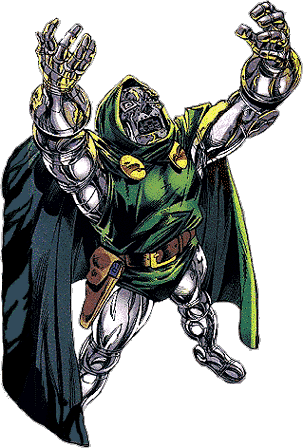
Victor von Doom is my favorite comic character of all time, bar none. grandiloquent and egotistical, he was also a bad guy who was capable of remarkable nobility. Extremely misguided nobility, to be sure, but… I can’t quite see Lex Luthor executing his right hand man, saving the life of his worst enemy and declaring the day a draw simply to save the great art treasures of Europe.

This was the magic of Doom: He would never, ever be turned to the light side of the force, but he could do astounding things. He was the guy for which the phrase “If only he could use his talents for good, instead of evil” was invented.

So for me, Doom has been an integral part of the Fantastic Four, the fifth member, as it were. No Doom, no FF for me. I was seduced into buying periodical comics for a brief time around Fantastic Four #500 to check the revamped Doom, and I hated it. So it was the changes to my beloved dictator that killed the movie for me.

Now, I can take the name change from von Doom to van Damme. That’s okay, if a little grating. Placing him so he would be in the accident that gave the FF their powers was compressing things a little too far, and then changing him so he was an electricity-wielding bad guy just got to be too much. I wanted my scarred, bitter supergenius in gray armor and green tunic, dammit.

Which is why I am astounded that I love the Ultimate Fantastic Four so much.

I’ve largely steered clear of Marvel’s Ultimate line, still smarting from that revisionist-but-not-really “Heroes Reborn” nonsense. The line’s version of Avengers, The Ultimates was highly recommended to me, however, and I found that very satisfying. As a long time Iron Man fan, I especially loved this new version of the character, with a hundred man support staff needed to maintain the armor and a Tony Stark suffering from an inoperable brain tumor. The Ultimate line seems to be benefiting from a lack of 40 years worth of recursive historical baggage, while at the same time paying homage to that history.

Ultimate FF‘s changes seem logical: the Baxter Building now houses a think tank of young geniuses under the charge of Dr. Storm, the father of Sue and Johnny. Reed Richards is now of high school age, which I think pitches the age demographic a bit too young, but what do I know. The fact that they’ve given Reed that haircut with the close-cropped sides to echo his earlier white sidewalls is amusing to me, at least.

Richards was trying to perfect a mode of teleportation using an entropic, collapsing parallel universe called “The N-Zone” (instantly recognizable as the Negative Zone), and one of his experiments goes horribly wrong, causing the cosmic accident that changes the four into their more familiar personas. The accident is caused by one of Richards’ peers, an egotistical young genius named Victor van Damme, who recodes the computers running the experiment, because to his mind, there is no way that dolt Richards could have gotten the coding right. Van Damme is also changed by the accident, and hurtled back to Europe, to boot.

This, dammit, is DOOM!Now, this is everything about the movie I hated: van Damme changed by more than his hatred, and given super powers, too. The difference here is the execution, and I place that firmly at the feet of a writer who I come to worship more and more: Warren Ellis.

Yes, I admit, it was that name that convinced me to buy the trades of Ultimate FF, and what a sound investment that proved. Not only has he done Doom right, his revisionist take on the character even provides a logical substitute for Latveria and an army of robots. The fact that the followup story arc sends the four into the N-Zone in a retrofitted space shuttle to face off with a new and frightening Annihilus is another layer of a very rich cake.

The revamping of the villains is exceptional, and it’s refreshing that Ellis hasn’t changed much about the family dynamics of the FF, except to make Richards an uber-nerd; Ellis’ dialogue is, as ever, crisp and entertaining. He’s a crackerjack science-fiction writer, and the fact that he’s actually attempting to make sense of the FF’s powers in realistic terms is proving at least as fascinating as the incorporation of Marvel standards into this new universe.

Ellis is also handling Ultimate Galactus, which I’m watching with interest; the first trade provides a new, horrifying origin for the Vision, but I felt a little shortchanged, as by and large this part of the story arc repeats the setup for my favorite story in Ellis’ much-missed Global Frequency series. But if we start kvetching about writers stealing from themselves, we’re gonna be here all day, and I have laundry to do.

So. Ultimate Fantastic Four. Enthusiastic thumbs up. Fantastic Four movie? Waiting for the DVD. And then, I’ll probably rent it.

Sappage for the Weekend

I’ve already posted that I’m a total sap, and it’s the same thing prompting that admission again: yes, the comic strip 9 Chickweed Lane. Chickweed has always been in my top 25, slowly edging up into the top 10, until it has, lately, become my favorite strip. It’s always been very smart and observant, with three exceptionally strong female characters in the lead. Concurrent with its rising in my estimation is the almost complete jettisoning of the two older members of the clan to concentrate on young Edda, just now striking out on her own, and the truncated romance with her lifelong friend, the uber nerd Amos, who has lately cleaned up real good and is also striking out into the world.

The storylines over the last few months have dealt with them separately, encountering new people and almost falling into new relationships, failing for one reason or another. The new supporting cast has, in fact, grown so quickly it’s hard to keep track. The fact that these two are both artists – Edda is a dancer in her first ballet company, Amos is a musician studying at Julliard – only makes it richer for me.

But in the last two weeks, Edda’s gay roommate and his significant other have organized a Mission Impossible-style meet cute between the two, allowing the romance – short-circuited by bad communication and confused misunderstandings – to once again blossom, allowing me to consider, for a while at least, that it truly is a nice world to inhabit. It was exactly the balm a battered, raw soul needed at the end of this week.

Now… whether the strip will continue to grow from here, or grow stagnant, as have so many relationships in serial entertainment, once they are consummated – is up to creator Brooke McEldowney. And given the high degree of expectation I feel as I search out each new installment – I trust him implicitly.

Ah, Lulls

The trouble with them, of course, is that you spend them waiting for the storms.

Superfudge has opened, and not a moment too soon, as I was feeling the creative card in my brain seriously overheating. The past few months seem to have put a serious strain on it. Then again, I can’t be sure how much of that creative exhaustion is due to the fact that none of the stuff I was working on was truly mine. The scriptwork that occupied the year to date was for a idea I had submitted to the focus groups, sure enough, but by the time its official writer was shuffled off script duties, it was no longer my vision. All I could do was attempt to link the story points in something approaching a logical manner.

One of the unexpected perks of writing so regularly again is my return to the world of reading. Though I still can’t set aside enough time to read an actual book – though several sit by my desk, waiting their turn – I’ve returned to my first love, the medium that taught me to read at the tender age of four: comic books.

I gave up the monthlies years ago, during one of my frequent fiscal crises, and now wait for the trade paperback collections to come out. My wait for some stories to conclude thusly is longer, of course, but there isn’t that agonizing wait between issues. Especially since the higher-profile comics have a way of slipping off-schedule.

Currently, I’m catching up on Warren Ellis. Friends blink at me, the unstated question being, “Catch up on Warren Ellis?” Yeah, I’ve lived in a cave for quite some time. I’m the Unabomber without the body count. Forgive me.

But what a wonderful odyssey it is, finding this wonder in huge, bookshelf-worthy chunks. It started with a recommendation for The Authority – between this and Moore’s Miracleman and Watchmen, I think the revisionist superhero story has reached its zenith. I have chewed my way through Planetary and Global Frequency, re-reading them frequently. My next course is what Ellis refers to as his “2500 page science fiction novel”, Transmetropolitan.

And while not exactly a new discovery for me, I was trolling Half-Price Books during a long lunch and discovered a couple of the small, thick Dark Horse collections of Lone Wolf and Cub. I had read the comic religiously back when First Comics was reprinting them. When First went under (taking with it my beloved Grimjack – a pause, please, for mourning), it was rumored that financial skullduggery had scotched the idea of the series ever returning to this shore. So I was pleased to see these books at my local store, but somehow never managed to pick one up.

Well, now I have to own them all. Good heavens, I had forgotten how masterful a storyteller is Kazuo Koike.

The short story is one of the toughest forms to master, and both of these men excel at it, in a medium that insures I can have a satisfying reading in a half-hour or less, the experience made more dense, rather than simplified, by the accompanying pictures.

In other, nagging, real-life concerns, I have, at least, updated the Upcoming Disc entries at Attack of the 50 Ft. DVD, and gotten the B-Masters site up to date. Still working on my review of The Incredibles, because God knows, what the Internet needs is another review of The Incredibles.