Richard Oswald’s Eerie Tales is that most venerable of horror movie formats, the anthology, made long before Amicus claimed it as their territory. The original negative is considered lost, and what we are watching today is a restoration performed by the Cinémathéque Francais, which, according to the credits, is some 100 meters shorter than the original.
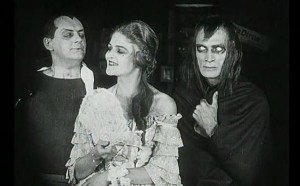
Our framing device takes place in a rare book store, run by an especially antic owner. After he shoos out his customers and closes down, life-sized portraits of the Devil (Reinhold Schünzel) a prostitute (Anita Berber) and Death (Conrad Veidt) come to life and amuse themselves by reading some of the books littering the place, and as they do, the three take the place of characters in the stories. So you see, Screams of a Winter Night totally ripped off this movie.
The first story is “The Apparition” by Anselma Heine, the tale of a woman rescued from her murderous husband, who then mystifies her rescuer by simply disappearing, with even the hotel staff testifying that the man arrived alone the previous night. (so add Kiss of the Vampire to the list of rip-offs) I am making the leap that any missing footage might be from this section, because that is more comforting than thinking that I’m too stupid to get the part when a drunken Veidt discovers the lady is missing and rushes from the room in horror.
Next up is “The Hand” by Robert Leibmann, a tale of ghostly retribution. You might feel a little more at home with the next two stories, which are Poe’s “The Black Cat” (a particularly good adaptation, too) and Robert Louis Stevenson’s “The Suicide Club”. The movie wraps up with “The Spectre” by Richard Oswald (yes, the director), where a nobleman gets the best of a literal Scaramouche character who is attempting to seduce his wife.
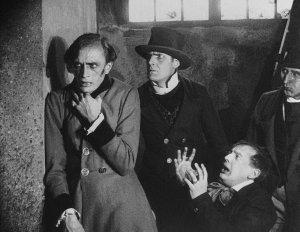
At this point in cinema history, all the tricks of visual storytelling had been worked out, so Eerie Tales is a fine example of silent filmmaking, easily accessible to the modern viewer. The actors are all up to the task of multiple characterizations, with Veidt as a standout, here a year before his star-making turn as Cesare in The Cabinet of Dr. Caligari. Reinhold Schünzel is in charge of all the scenery-chewing (at which he excels), and Anita Berber is sadly under-utilized, functioning mainly as someone to be fought over, or murdered.
Silent movies are good for you. You should watch one today.
Sometimes you just have to pay homage to the classics, even if they may not deserve it. We’re likely going to be arguing about Birth of a Nation for quite some time, for instance, and here’s another one that I’ve been curious about for some time – Nanook of the North, the first docudrama.
Robert J. Flaherty didn’t start out as a filmmaker; he was a paid explorer, who when working for the Canadian Railroads, spent several years among the indigenous people of the Hudson Bay area, in northern Quebec. This was about 1910; in 1913 he bought a motion picture camera and started filming these people in their everyday lives. In 1916, though, he dropped a lit cigarette on this film, and being nitrate stock, it went up in a fireball (it’s estimated that there was about 30,000 feet involved). He went back with more equipment, and using what he had learned in that previous venture, narrowed the focus to one family, and their struggles to survive a typical year in the hostile climate of Northern Quebec, and the result was a worldwide sensation.
But this is one of those movies where the behind-the-scenes is arguably more intriguing than what we see on the screen, and what we see on the screen is actually pretty damned good. There are many controversies surrounding Nanook, and all of them, unfortunately, bring the final product into question.
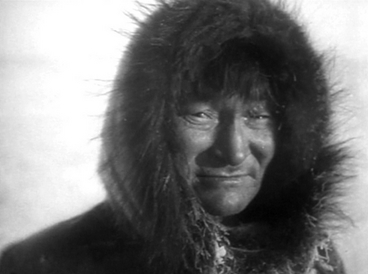
We’ll start with the obvious: the title character, the Great Hunter Nanook (which we are told means “Bear”), is actually named (I hope I get this right) Allakariallak. We are introduced to his two wives, Nyla (“The Smiling One”) and Cunayou. They were apparently not actually Allakariallak’s wives, but – and this is only an allegation, mind – that they were actually Flaherty’s lovers. The parentage of the baby constantly riding in Nyla’s furs, like a papoose, is unknown.
The movie begins with some striking imagery, as Spring begins and Nanook paddles his kayak to the white man’s trading post to barter the furs of his winter’s kills. One of his children is riding on the top of the kayak. Nanook gets out, helps the boy to land, and then the kayak starts disgorging the rest of the family, like a clown car. This was a surprise, but so logical, I was placing it in my “Things Learned” column, until finding out about the rest of the picture’s veracity. Now I’m not so sure.
“Eh, this blows. You got any Beck?”
There’s a scene at the trading post where the proprietor shows a Gramophone to the baffled Nanook. Allakariallak, it turns out, was no bumpkin, and knew perfectly well what a gramophone was; but he also apparently knew the value of comic relief. There’s also the fact that Nanook is portrayed in his constant hunting for food armed only with his trusty harpoon and a knife carved from a walrus tusk (which truly turns out to have a thousand and one uses), when the Inuit had been using guns for years.
So Flaherty convinced his plucky villagers to emulate their ancestors in their walrus hunt, and they seem to do a pretty good, if arduous job of it. The hunt itself may not be truly documentary, it may be scripted, but as Roger Ebert pointed out, nobody showed the walrus the script.
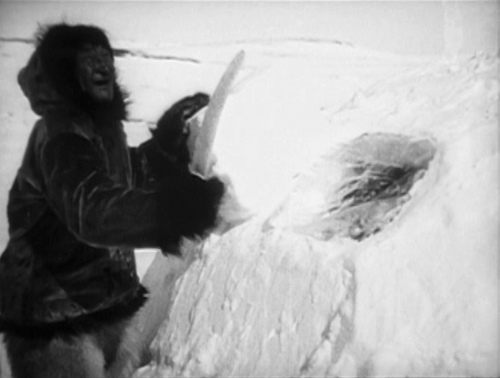
If you’re willing to grant that Allakariallak may be using old-timey methods to trap his other prey, a snow fox and a huge seal, it becomes a fairly nice re-telling and record of those ways. Then, with the onset of winter, the family builds an igloo (the film claims “within an hour”, but I ain’t so sure about that). This is one of the most famous segments of Nanook, and it is a wonder to behold: Nanook carving the blocks of snow with his trusty walrus-tusk knife, the women and children spackling the gaps with more snow. And most amazing to my eye, Nanook carving a block of ice from the frozen bay to serve as a window, and then placing a block of snow to reflect sunlight into the igloo. That is neatly done.
Then the family settles down for the night under their skins and furs. And something is chewing at the back of my brain: I’ve seen the movie cameras of that era, and they are big. Too big to easily fit through the tiny open Nanook and his clan crawled through. And they required more light than could be brought in through that ice window.
Yep, Flaherty built a half-igloo, open to the outdoors and its bounteous light.
This is a question we have to face again and again as fans of cinema: does a good story trump the needs of historic accuracy? The answer from Hollywood is always a resounding, “Yes!” and who is to say they are wrong? Perhaps Nanook serves best not as a strict documentary, but as a record of a way of life that had vanished before the invention of the motion picture. Hence, not “documentary”, but “docudrama”. Robert Flaherty made a career out of movies like these, and they are all well-regarded: Elephant Boy (with Zoltan Korda, introducing Sabu), Louisiana Story, The Land.
The final thing to consider is that the movie opens by telling us that Nanook died two years after the film was finished; he journeyed inland to find food and starved to death. It is much more likely that Allakariallak died of tuberculosis, in his home. But whatever the cause, the news of his death triggered mourning worldwide, so successful had Nanook been, so far had it traveled. That is the power of a good story, well told, and perhaps the whole question is best answered by another movie, John Ford’s The Man Who Shot Liberty Valance: “When the legend becomes fact, print the legend.”
It’s educational to visit the Classics, even in a strange environment like Hubrisween. Though I classify myself as a horror fan, this is a movie I had managed to miss seeing… well, all my life. It’s referenced in books aplenty, was a presence in the Famous Monsters magazines of my youth, hell, I had a DVD of it sitting on the shelf, part of an Alpha Video set of silent horror movies. And yet, somehow, I had never partaken of it.
It was likely because I’d already known the plot since I was a child. The plot, certainly, but there were twists in its delivery that still made the movie entertaining for me. The educational aspect I refer to here is something I had never known, until this viewing and the research that followed: this is the third movie in a trilogy, which explains the full title, Der Golem, wie in die Welt kam – “The Golem: How He Came Into The World”. Yep, it’s a prequel.
The two movies which precede it – the 1915 The Golem and the 1917 The Golem and the Dancing Girl – are both considered to be lost films. The 1915 Golem takes place in the modern day, with an antique dealer finding the clay figure (much to his eventual regret), and the 1917 version is apparently a comedy… well, we may never really know, unless the films suddenly crop up. Under these circumstances, a prequel makes some sense, and it is an intriguing production all around.
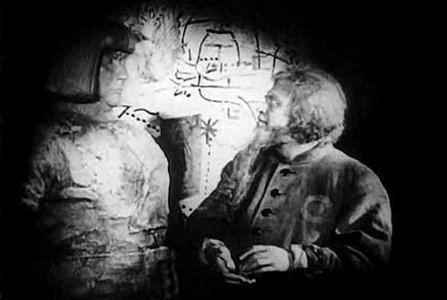
In case you didn’t read Famous Monsters as a child, here’s the plot: in 15th century Prague, Rabbi Leow (Albert Steinrück) is poring over his arcane tomes and finds the stars predict disaster. The next day, the Jewish ghetto receives word that the Emperor has decreed all Jews will be exiled from the country in a month. Leow petitions the Emperor for an audience, as he has drawn up horoscopes for the king in the past, but he has a Plan B: the stars are also right for the creation of the Golem, a clay figure of a man to be given life by a magic word, and it is Leow’s aim to construct such a creature as a guardian for his people.
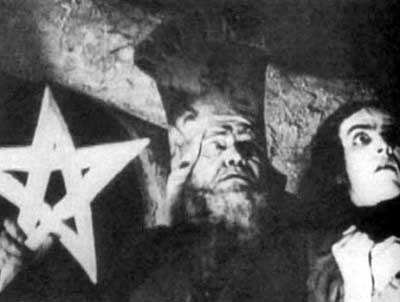
Leow performs a ritual involving magic circles and a staff that turns into a glowing star, to invoke the demon Astaroth and demand the word. This is a pretty amazing scene, and Murnau would borrow from it six years later for his production of Faust. Leow writes the provided word on a scroll, which is placed in an ornamental box that, when put on the Golem’s chest, does indeed impart life.
There is some standard stuff afterwards, of Leow and his son using the Golem as a servant; it has a tendency to be too literal in obeying orders, and is incredibly strong. Leow brings it along to his audience with the King (Otto Gebheür), which takes place during a “Festival of Roses”. Surrounded by many courtiers, the Golem begins to show some stirrings of human emotions; when the King asks Leow to perform some other miracle for their entertainment, Leow says he will show them “the history of my people, and our patriarchs,” but also warns the crowd that there must be no talking, or laughter.
So Leow magics up a 16th century movie showing the Exodus, and (I presume) Moses. The court Jester (Fritz Feld, in likely only his second role) makes a comment, the court laughs, and the castle collapses. Silly royalty should have listened to the Rabbi.
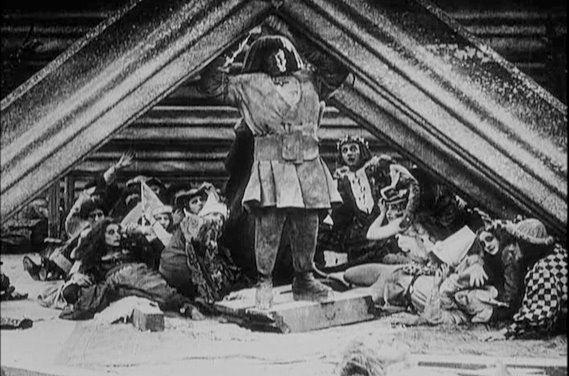
Fortunately, there is a Golem in the audience who holds up the collapsing ceiling like Big Bad John, saving the Emperor’s life, and causing him to pardon the Jews from their eviction. This would all be pretty hunky-dory, except Leow has noticed his clay servant’s peevishness and consults his book, discovering that as the stars progress, Astaroth will eventually reclaim its creation, turning the creature evil. The Golem, in fact, is reacting very badly when Leow tries to remove the box from its chest to turn it off. He finally succeeds, and decides that since the Golem has served its purpose, it’s time to destroy it.
He is interrupted from this by a summons to the synagogue to honor him and praise God for their delivery. Now, intertwined through all this drama. is the fact that the knight tasked with bringing the decree to the ghetto, Florian (Lothar Müthel), has been smitten by the very sight of Leow’s daughter, Miriam (the truly lovely Lyda Salmanova), and he has used Leow’s journey into the city to sneak into his house and spend the night with her. Once Leow heads off to the synagogue, his son discovers there’s a man in her room and, not knowing about the whole evil stars thing, reanimates the Golem to knock down the door.
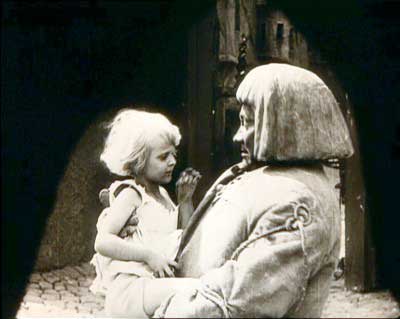
This, of course, is disastrous. It results in the death of Florian, the rabbi’s house in flames, and Miriam carried off by the Golem (although later she is mysteriously abandoned. Monsters. Go figure.) The Golem smashes down the gate of the ghetto, and finds a bunch of children playing, who mostly scatter at his approach. One does not, and offers the Golem an apple. The Golem lifts her up in his arms, and she innocently, curiously plucks the box off his chest. End of Golem.
Director and star Paul Wegener had made another early horror classic in 1913, The Student of Prague, during which he first heard of the legend of the Golem. By all indications, he felt he’d had to compromise too much on the previous two movies in the trilogy, and this was to be the definitive version. Architect Hans Poelzig designed the sets, and his recreations of the Jewish ghetto is one of the major reasons this is considered one of the great masterpieces of German Expressionist cinema.
And yes, it is almost impossible to watch this and not see the prototype for many a movie that followed, especially James Whale’s Frankenstein. Look no further than the Golem’s shambling gait and those huge, bulky welder’s boots, the creature’s clumsy attempts to deal with unfamiliar emotions. Wegener’s Golem is more of a figure literally driven by demons, though, a far remove from Karloff’s portrayal of a pathetic, betrayed lost soul.
So there’s another classic down, and it is a classic not only because of its influence on later movies; it’s also more than a little affecting to consider the politics of the story. Or as my friend Mark Konecny put it, “I just couldn’t get past the whole foreshadowing the future of Europe thing.” Not just the increasingly frequent waves of violence against Jews (as I write this late July 2014, bewilderingly on the resurgence again), but in other ways: Apartheid nations and ghettos – still with us after all these centuries.

 Richard Oswald’s Eerie Tales is that most venerable of horror movie formats, the anthology, made long before Amicus claimed it as their territory. The original negative is considered lost, and what we are watching today is a restoration performed by the Cinémathéque Francais, which, according to the credits, is some 100 meters shorter than the original.
 The first story is “The Apparition” by Anselma Heine, the tale of a woman rescued from her murderous husband, who then mystifies her rescuer by simply disappearing, with even the hotel staff testifying that the man arrived alone the previous night. (so add Kiss of the Vampire to the list of rip-offs) I am making the leap that any missing footage might be from this section, because that is more comforting than thinking that I’m too stupid to get the part when a drunken Veidt discovers the lady is missing and rushes from the room in horror.
 At this point in cinema history, all the tricks of visual storytelling had been worked out, so Eerie Tales is a fine example of silent filmmaking, easily accessible to the modern viewer. The actors are all up to the task of multiple characterizations, with Veidt as a standout, here a year before his star-making turn as Cesare in The Cabinet of Dr. Caligari. Reinhold Schünzel is in charge of all the scenery-chewing (at which he excels), and Anita Berber is sadly under-utilized, functioning mainly as someone to be fought over, or murdered.








 drfreex.com