Klaus Kinski is a deviant weirdo who is a caring doctor by day and a murdering psycho rapist at night. No, that’s the character he plays, but I can see where the confusion lies.
Jack the Ripper is a Swiss/German film directed and partially written by Jess Franco. The poster proclaims “Only NOWCan It Be Shown Like THIS!“, meaning that Kinksi can now rip off all an actress’ clothes before raping and murdering them, often at the same time.
Kinksi is Dr. Dennis Orloff (yeah, Franco wrote this part), tending to his impoverished patients by day, and then being tormented by visions of his mother, who was a prostitute that also wanted him in on the trade. After these nipple-filled nightmares, there’s nothing left for him but to go out and kill. One of his victims is Franco standard Lina Romay, who lasts the longest of his victims, even getting a production number in what looks like the worst cabaret possible on the budget.
As a Franco film, it follows the template of The Awful Dr. Orloff, except without the mad science angle. No, this Orloff is just in it for vengeance against his dead mother. The police are also notably useless as in the original flick, and Inspector Worthless’s girlfriend (Josephine Chaplin) strikes out on her own to find the killer, without telling the Inspector. Nudity will ensue.
Everybody in the movie is a better detective than the Inspector. There’s a blind man character that would give Sherlock Holmes a run for his money. Even the itinerant fisherman played by the musically-named Howard Fux is better at the game than the Inspector.
Reportedly shot in a week, Franco has no time for his usual zoom lens fetish, so the movie feels more like an actual gothic thriller, sort of a boring Hammer flick. A lot of time is spent on the police work and supposedly risible dealings with witnesses, while we wait for Kinski to whack out again. Despite his off-screen infamy, Kinski was a very good, serious actor, and he brings the appropriate level of intensity to his role. There’s some good stuff in here, especially Kinski’s cat-and-mouse game with Romay in a foggy wood, but if you’re familiar at all with the actual Ripper case, man, are you going to be pissed…
Now, a lot of people whose opinion I respect like Jess Franco. I have yet to find that movie that will win me over to his camp, however. It may actually happen someday, but in the meantime, I ain’t holdin’ my breath. The Awful Dr. Orlofis described by some as “Franco’s masterpiece”, which means in a career spanning around 200 movies, he hit his high point on his fifth movie. Contemplate that upon the Tree of Woe, and let us begin.
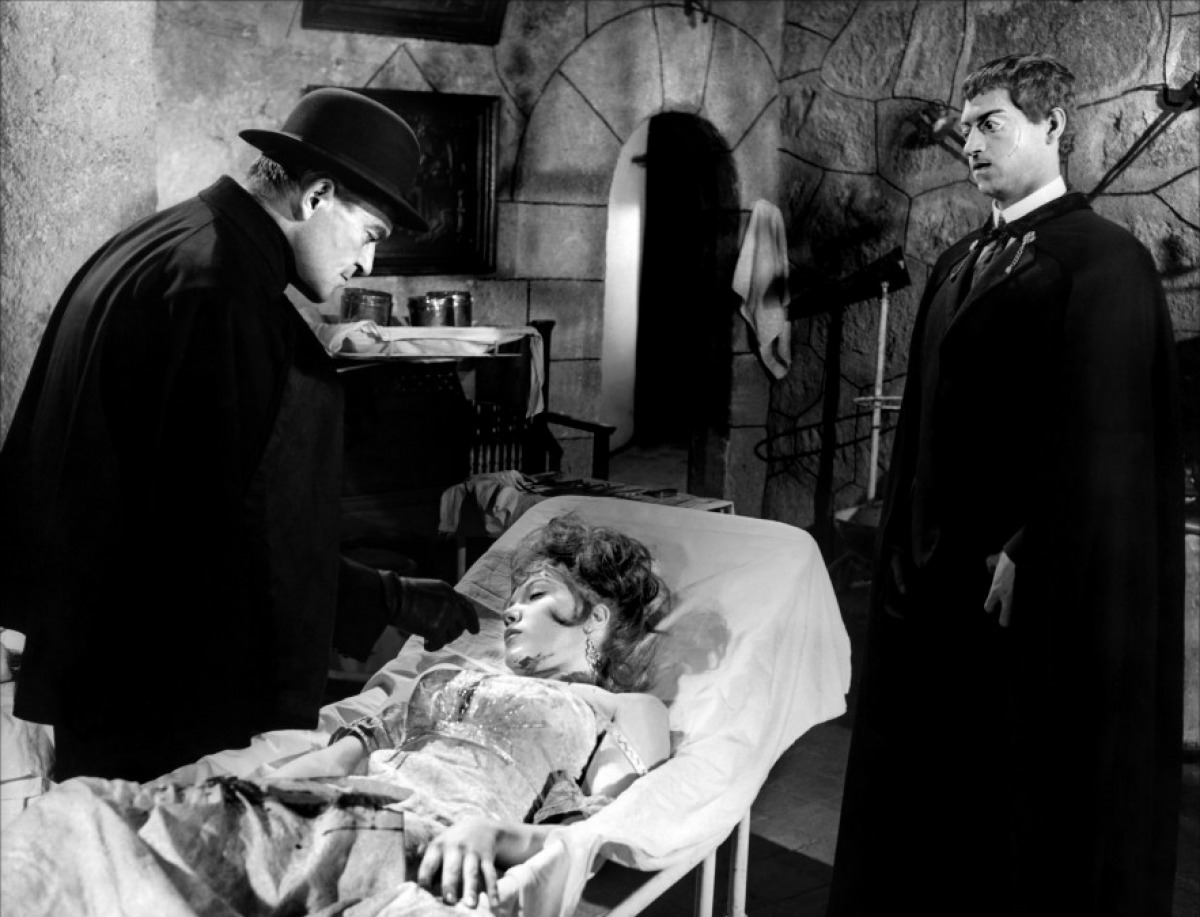
France, 1912: Four beautiful women have already disappeared, and as the movie starts, number five is killed by a disfigured, caped man, who then carries her body out, guided by the tapping of a cane. The man doing the tapping is our awful title character (Howard Vernon, here beginning a lifelong friendship and collaboration with Franco), clad in opera cape and top hat. The killer is Morpho (Ricardo Valle), whose scarred face and bulging, unblinking eyes are the classic stuff of monster movies.
We are quickly introduced to Inspector Tanner (Conrado San Martin) and his ballerina fiancee, Wanda (Diana Lorys). Tanner is put in charge of the missing woman epidemic and will prove mostly ineffective (it is, in fact only due to a comic relief drunk played by Faustino Cornejo that Tanner solves anything). Orlof is trying to restore his daughter’s face, scarred in a laboratory fire years before – after his most recent failure (an unfortunate drunken woman trapped with Morpho in an empty house, a very effective scene), he determines that his next victim must be living when he attempts the skin grafts. Then he notices that Wanda and his daughter are played by the same actress…
Okay, we can stop right now and examine the obvious, that this is the same plot as Eyes Without A Face, released only two years previous. In this instance, Franco has an excuse: he was denied a permit to film his intended fifth movie by the Spanish State Censor, and he already had a cast and crew ready to go. He wrote Orlof in a week, figuring – as is often the case – that a horror movie would be perceived as having no particular political message. This doesn’t necessarily excuse his return to this particular trough over and over again through the years, however.
Franco was a cinematic omnivore, and this really shows in this version of Les Yeux Sans Visage through the filter of a 1930s Universal monster movie (it’s a possibility that Orlof is a tribute to Bela Lugosi and his blind henchmen in The Human Monster), or one of the more contemporaneous Hammer gothic horrors. It’s certainly lacking the poetry of Franju’s film – the tormented nature of the daughter, the recipient of her father’s increasingly horrific attempts to restore her face (Lorys as the daughter is called upon to do little more than loll her head about on a uncomfortable-looking bed). There is some tribute paid to Orlof’s agony over what he’s doing, but it feels more like filler here. I’m sure the dreadful English dub is not helping out there, either.
The character of Wanda the ballerina is a new addition to the story, using herself as bait when she realizes Orloff is becoming obsessed with her. The final twenty minutes of the movie, with Wanda in the clutches of the mad scientist and her worthless boyfriend the Inspector finding every excuse possible to not read her hastily-written note, is pretty compelling, though the viewer finds himself wondering why she thinks taking such a hazardous course without notifying her policeman boyfriend in advance is going to turn out alright.
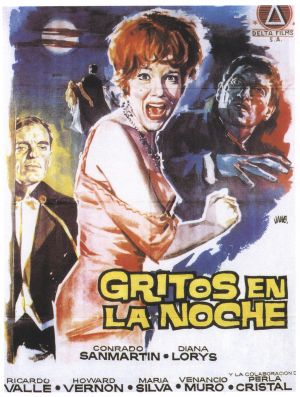
If nothing else, you have to admit that the original title, Gritos en la noche, or Screams in the Night, is a great title for a horror movie. Exactly when it became The Awful Dr. Orlof is opaque to me; I had assumed the change was made so it could occupy the lower half of a double bill with Ricardo Freda’s The Horrible Dr. Hichcock, but my Image DVD bears the french title L’horrible Docteur Orlof. I need more coffee before I can begin to untangle this, and I’m inclined to believe it’s just not worth it.
For some – like, for instance, me – it’s an okay way to kill an hour and thirty minutes. For others it’s going to be an unforgivable slog, though a couple of instances of shocking (for 1962, anyway) female nudity employing an obvious body double might wake them up.

 Klaus Kinski is a deviant weirdo who is a caring doctor by day and a murdering psycho rapist at night. No, that’s the character he plays, but I can see where the confusion lies.
 As a Franco film, it follows the template of The Awful Dr. Orloff, except without the mad science angle. No, this Orloff is just in it for vengeance against his dead mother. The police are also notably useless as in the original flick, and Inspector Worthless’s girlfriend (Josephine Chaplin) strikes out on her own to find the killer, without telling the Inspector. Nudity will ensue.
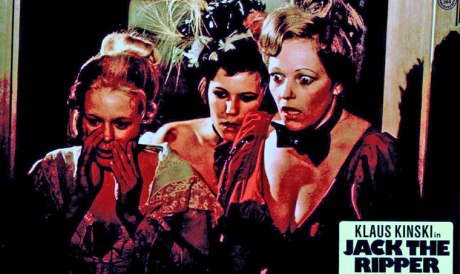 Reportedly shot in a week, Franco has no time for his usual zoom lens fetish, so the movie feels more like an actual gothic thriller, sort of a boring Hammer flick. A lot of time is spent on the police work and supposedly risible dealings with witnesses, while we wait for Kinski to whack out again. Despite his off-screen infamy, Kinski was a very good, serious actor, and he brings the appropriate level of intensity to his role. There’s some good stuff in here, especially Kinski’s cat-and-mouse game with Romay in a foggy wood, but if you’re familiar at all with the actual Ripper case, man, are you going to be pissed…




 drfreex.com