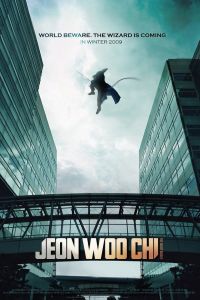
J: Jeon Woochi, The Taoist Wizard (2009)

Home ♠ Letterboxd

This Korean fantasy action comedy got a domestic release as Woochi the Demon Slayer. I didn’t need a W movie, I needed a J, so I’m stickin’ with that original title.

The movie begins with a sequence explaining that the Arch God (or so the translation says) kept the race of Goblins imprisoned for 3000 years by playing his flute. Three of the minor gods ruin this plan by accidentally opening the prison a day early, releasing the Goblins and resulting in the Arch God’s demise. The Goblins fall to fighting over possession of the powerful flute.

The minor gods continue to live among men, seeking out the Goblins (also disguised as humans) and then hiring magical warriors to capture them, because they, themselves, are obviously quite useless. In the present day, two of these Goblins escape, and the three gods panic, because their Goblin hunter of choice – Hwa-dam (Kim Yun-seok) – vanished a few hundred years ago after capturing what was thought to be the last Goblins. This leaves them no choice but to release another Taoist wizard they themselves trapped in a painting, Woo-chi (Gang Don-won).
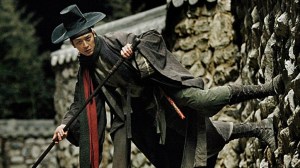
The movie is going to rebound from present day to sometime in the Joseon Dynasty in Korea. Woo-chi is known as “the scoundrel”, as he uses his magic to do things like embarrass worthless royalty. His master (Baek Yun-shik) tells him he will never be a true magician, as he “cannot empty his soul”. Indeed, Woo-chi can only work his magic with his yellow paper talismans, obligingly carried around by his servant, Chorangyi (Yoo Hae-jin), who is actually a dog hoping to someday become a full-fledged human (he also really resents being turned into a horse when Woo-chi needs one).

In the course of this extended flashback, we find out that Hwa-dam is really a Goblin (the green blood is a giveaway) and he frames Woo-chi for the murder of his mentor, as part of a plan to get the flute macguffin. Woo-chi and Chorangyi are trapped in separate paintings, but ha ha on Hwa-dam, Woo-chi had the flute in his possession, and it too is now stuck in the painting.

So 500 years later – now – Woo-chi and Chorangyi are set loose to track down the two extant goblins. Of course, Woo-chi is going to run into the reincarnation of his lady love from back in the day, and be distracted by trying to prove to her she’s just that – meantime, there’s a big rat and a big rabbit demon causing trouble, and Hwa-dam is starting to drop any pretense toward being human in his search for the flute. Just ask the restaurant he massacres.

“Cadbury Eggs my ASS!”

If there’s a flaw in Jeon Woo-chi it’s the length – two hours and fifteen minutes. Koreans seem to really like long movies. The fish out of water stuff goes on way too long and dilutes what is otherwise a pretty delightful action comedy with monsters and high production values. I do love it when a movie that ends with a battle of magic actually has the money and imagination to realize it. And I love that Bunny Goblin.

Buy Woochi the Demon Slayer on Amazon

I: I, Frankenstein (2014)

Home ♠ Letterboxd

We live in an age of reboots and remakes. Some day the madness will end, but this is not that day. Intellectual property will continue to be harvested for supposedly new audiences, and mixed with whatever the perceived new hotness with that audience might be.

So is it any wonder that we got a movie casting the Frankenstein Monster as a superhero?

After a fairly simplistic precis of the original novel, the creature (Aaron Eckhart, who seems to be living under some sort of a gypsy curse since The Dark Knight), buries his creator in the family cemetery, and is set upon by demons disguised as humans, who intend to capture him. He kills one with a holy symbol plucked from the ground, and is rescued by two gargoyles, who then turn into humans. Or disguise themselves as humans. Trying to parse this gout of madness at the very beginning is your first challenge.

The Creature – Adam – is told by the Gargoyle Queen Leonore (Miranda Otto) that there is an eternal war between the Demons and the Gargoyles. They have no idea what the Demons want with Adam, but the chief of the Gargoyles’ warriors, Gideon (Jai Courtney) wants to destroy him to make sure he never falls into Demon hands. Leonore, though, sees the possibility of a soul in Adam’s eyes, and releases him. Adam wants nothing to do with this war, and departs for remote regions. He finds he is apparently immortal, and after 200 years, the Demons have continued to seek him out. So he returns to civilization and brings the war to the Demons.

This does not sit well with the Gargoyles, who prefer their war to remain hidden from mankind. While Adam is captured yet again, a scientist, Terra (Yvonne Strahovski) attempts the ultimate experiment in her project for the head of her corporation: reviving a dead rat using some 21st century Strickfaden electric effects. By desperately pushing the equipment beyond its limits, she succeeds – which interests her boss, Naberius (Bill Nighy) very much.

Naberius, as if you didn’t already know, is the Demon Prince who put out the infernal APB on Adam 200 years previous. He has a very complicated plan which will require animated corpses – lots of them. The step up from a rat to a human being is extremely complex, Terra tells him, so he promises to get her an example to study… since one has just recently cropped back up again.

This is a cumbersome but pretty cool mythology to graft a literary character into, and another thing weighing heavily against it is that its CGI-rich imagery is all too clean – it looks and plays out like a video game cut scene, and I kept waiting for it to end so I could start playing again. It never does, and I never did. The characters do not engender any sympathy with me because, again, this all a cut scene. The story itself lurches along like one of the 30s version of the Monster. There needed to be some grain in the picture, some engagement possible. It’s all too clean. All surface.

As an action movie, it’s okay. There was supposed to be a connection with writer Kevin Grevioux’s other horror action series, Underworld, but that is vanishingly unlikely. The director is Stuart Beattie, best known as a writer on the Pirates of the Caribbean  movies, which explains a lot, as I feel exactly the same about those movies. I like the premise, I like the setup, I just find the execution distancing and lacking.

I’m probably here writing this instead of my originally intended entry for the letter I (maybe next year, The Incubus) because of a Tweet by film writer A.M. Novak – @BookishPlinko: (and be sure to check out her series on Video Nasties at the Daily Grindhouse when you’re finished here)

That is a fabulous idea, and though nowhere near as good as any of those movies, I’d throw in I, Frankenstein too, because it’s still more entertaining than the Dark Universe movie we did get, The Mummy – which we’re going to deal with in a few more letters.

Buy I, Frankenstein on Amazon

H: La Herencia Valdemar (2010)

Home ♠ Letterboxd

Seems like we were in Spanish horror land just a few letters ago, doesn’t it?

Things are getting a little intense at a real estate firm, as the Valdemar estate is coming up for auction and the agent dispatched to the remote mansion 20 days before has not returned. Desperately the freelance antiques appraiser Luisa (Silvia Abascal) is contracted to pick up where the missing man left off. She finds the house deserted, nothing catalogued, and a nearly empty attic – empty except for the mangled body of the missing man. And something shadowy stalking her.

She barely escapes, aided by the somewhat simple handyman Santiago (Santi Prego) and Domáso (Jose Luis Torrijo), who is rather pissed that Santiago let her go in the mansion. She faints, and awakens hours later in their home. Possibly a prisoner, but certainly trapped there by a storm.

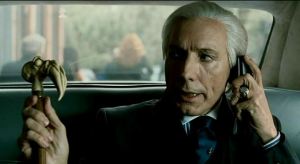
Interesting cane you have there, my friend

But never mind that, as another investigator, Nicolás (Óscar Jaenada) has been hired by Colvin, the head of that real estate firm (Eusubio Poncela) to work with the President of the Valdemar Foundation, Dr. Cervía (Ana Rusueño) to find the missing Luisa. She describes the Valdemar mansion as a classic “shunned house”, and explains why in a lengthy flashback that will be the majority of the movie.

At the fin de siècle of the 19th century, Lázaro and Leonor Valdemar (Daniele Liotti and Laia Marull), though themselves childless, run an orphanage (standard for modern Spanish horror #1). Lázaro is also a devotee of the emerging science of photography, and in his experimentation with double exposures, sets off a small cottage industry in which people come to seances, are startled by a levitating table, and in that instant are photographed; the resulting double exposures of “spirits” are much sought after, and fawning rich patrons are quite free with their donations to the orphanage. Lázaro and Leonor hope to use these proceeds to adopt a child of their own.

An opportunistic journalist, however, threatens blackmail, and when Lázaro refuses, has him arrested for fraud. Things look bleak until Lázaro is visited by an unexpected ally, none other than Aleister Crowley (Francisco Maestre), who devises a campaign to discredit the journalist and free Lázaro.

The price for this: Crowley has examined Lázaro’s spirit photos, and found, apart from the fakery, actual evidence of the supernatural lurking in the corners. He feels that not only is the mansion a spiritual nexus, but Lázaro is unconsciously a spiritual medium. These are two things that are necessary to conduct “The Dunwich Ritual” during an upcoming lunar eclipse. This will unlock secret knowledge for the participants; for Lázaro’s part, an answer to his and Leonor’s childlessness.

Despite his misgivings, Lázaro agrees, and Crowley brings in his fellows, including Bram Stoker (Lino Braxe), Lizzie Borden (Vanessa Suárez) and Belle Gunness (Laura Toledo). Crowley, though, has made a chauvinistic miscalculation, and the ritual releases what he terms “a devourer” into this world. The ritualists run away, leaving Lázaro wounded and the room aflame, and it is only the eventual sacrifice of Leonor that saves him.

The movie wraps up with the end of that story, reminding us of Nicolás, Luisa, and a couple of other folks, in an ending that confused a lot of people, apparently… I guess they ignored the brief snippets from the second part, which ends with a glimpse of something that definitely looks like Cthulhu… but that is something for the other end of the alphabet.

Now, for the good parts: this is a very handsome movie, well-shot and acted. Adding a lot of resonance and production value is Spanish horror icon Paul Naschy, in his final role as the Valdemar’s devoted manservant, Jervás. There is a lot of suitably creepy stuff, and some nicely humanistic moments, as well.

The bad part is this might as well be called Set-up: The Movie. Anyone expecting any resolution to the modern portions of the movie are going to be disappointed, those will all be left to the second part, The Forbidden Shadow, which looks to be a much rougher, more nasty, more… modern movie, perhaps. I look forward to it.

Though I am still puzzled by the fact that when Nicolás arrives, it appears he arrives by blimp… but perhaps that is another mystery which will be solved in the second part. We’ll see. (Spoiler: it won’t be.)

The Valdemar Legacy is available on Amazon Video. Bizarrely, its sequel is not.

G: The Ghost in the Invisible Bikini (1966)

Home ♠ Letterboxd

A couple of boilerplate pieces of policy around here to start off with: on challenges like this, I try to either make the movies chosen ones I have not seen before, or at least one I haven’t seen in ten years or so. The second is I toss myself at least one softball per challenge.

An unofficial policy is that I have at least one Boris Karloff movie per Hubrisween, and I found to my horror that I had not included one in this year’s lineup (although I somehow managed to schedule four, count”em, four Paul Naschy movies). So imagine my surprise and delight and downright relief when I discovered that in the years and years since I had last seen Ghost in the Invisible Bikini I had somehow conflated it with How to Stuff a Wild Bikini, and instead of Buster Keaton, I got Boris Karloff. I never thought I’d be so happy to miss out on Buster Keaton.

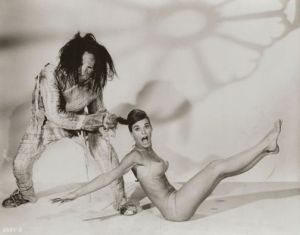
Boris is Hiram Stokely, aka “The Corpse”, so-called because our titular Ghost, Susan Hart, visits him in his crypt to tell him he has a chance to get into heaven if he can engineer a good deed within twenty-four hours. The best opportunity will be at the upcoming reading of his will, making sure that his rightful heirs get his ill-gotten million dollars, and not his evil lawyer, Reginald Ripper (Basil Rathbone). Since he can’t leave the crypt, the Ghost will act as his agent in making that happen.

So these rightful heirs – Chuck (Tommy Kirk), Lili (Deborah Walley) and Myrtle (Patsy Kelley) arrive at Hiram’s mansion. Myrtle has invited her nephew Bobby (Aron Kincaid), since he’s her only blood kin – and therefore another rightful heir – and he brings along what we are asked to believe is the whole Beach Party gang, and suddenly Ripper’s plan to simply murder what he thought were the only three heirs has gotten dreadfully complicated.

Wait, did we say complicated? Ripper has hired J. Sinister Hulk (Jesse White) to do the dirty work, and he brings in his associates, Princess Yolanda (Bobby Shaw), the incredibly Jewish Indian Chicken Feather (Benny Rubin) and Monstro the Gorilla (George Barrows). AND. Eric Von Zipper and his Rat Pack manage to get themselves in there, too.

Ripper’s plan also involves his daughter Sinestra (Quinn O’Hara) seducing and murdering Bobby, much to the disgust of Bobby’s girlfriend Vicki (Nancy Sinatra!). When the truly lovely Sinestra, a redheaded knockout, is introduced, Ripper commands her to take off her glasses. As all right-thinking Americans know, eyeglasses only serve to make women super-hot, so all this does is verify Ripper’s villainy in our eyes. Actually, it saves Bobby’s life at least twice, as Sinestra has the Velma problem, and keeps killing statues and suits of armor instead of Bobby.

Needs more eyeglasses

I don’t think Ghost in the Invisible Bikini gets near enough credit as a work of demented, if desperate, genius, as one stupid thing after another happens. For instance, the production number which is a commercial for a toy that doesn’t exist, the Swing-A-Ma-Thing™, complete with theme song by the Bobby Fuller Four:

Honestly the Swing-A-Ma-Thing™ is so ridiculous, I had to spend a half hour on Google convincing myself that Wham-O hadn’t actually put it on the market that summer. Another thing that sticks out from the far remove of 2017 is the presence of Piccola Pupa (Piccola Pupa), who sings a song to Nancy Sinatra about why she should wear a bikini. Since the way she’s presented is pretty much a case of the movie saying “Look! Look! It’s Piccola Pupa!” some research is also justified there. Ms. Pupa was a discovery of Danny Thomas, made the rounds of TV in 65-66, and this is her first – and last – film role. Also, even if, like me, you only saw Big Top Pee-wee once, you will always think of her as “Piccolopoopalo”.

Did I mention That Hiram’s mansion also houses a Chamber of Horrors, so we can have our slapstick fight scene climax there? Or that Larry Buchanan’s monster suit from Attack of the the Eye Creatures has a cameo?

The Ghost in the Invisible Bikini, as amazing as I find it, killed the Beach Party franchise. It is obviously a dead franchise walking, anyway, as its two star attractions, Frankie Avalon and Annette Funicello, had both declined to participate. Tommy Kirk had only appeared in one previously (Pajama Party) and ditto Aron Kincaid (Ski Party). The only actual regulars are Eric Von Zipper and the Ratpack, the true Rosetta Stone of the Beach Party franchise. It is also, tellingly, the only Beach Party movie with absolutely no beach in it.

Producers Samuel Arkoff and James Nicholson outright rejected the first cut of the movie, and inserted the subplot with Karloff and Hart to increase the marketability. Their later inclusion is quite obvious, even before you know about it, but I do agree that The Ghost in the Invisible Bikini is a bigger draw than the original title, Beach Party in a Haunted House. Though the more salaciously minded among us might be disappointed that “invisible bikini” means Susan Hart did her scenes against a black velvet background wearing a black bikini, rendering those parts of her invisible, too.

This is the very definition of disposable entertainment, but I would be lying if I said I didn’t have a big, stupid grin on my face the entire time I was watching. You’re allowed to have fun on Hubrisween, after all.


F: Forbidden Empire (2014)

Home ♠ Letterboxd

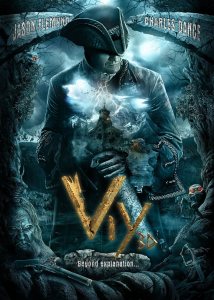
It was three years ago that I watched and reviewed the Russian movie Viy for Hubrisween. So, when I was casting about for this year’s movies and discovered a new version had been made, I was both delighted and surprised that I hadn’t heard about it. Perhaps that’s because in America it’s known as Forbidden Empire or Fobidden Kingdom, utterly generic titles that are presumably more marketable than Viy.

If you’re familiar with the Nikolai Gogol story, you’re going to be disoriented by the movie’s beginning involving an 18th century cartographer/scoundrel (Jason Flemyng) being discovered in the bed of the daughter of a nobleman (Charles Dance) before he lights off the continent to create the best map ever, traveling in a steampunk carriage dragging an enormous wheel to measure distances. He gets lost and finds himself in literally uncharted territory, and in the midst of Gogol’s short story.

Now, Gogol’s Viy is in there, and with considerably upgraded visual effects; it is revealed in stops and drabs, as Flemyng tries to unravel the mystery of what actually happened in the church, now considered off-limits, thanks to the local priest, who you just know is going to be trouble from the first time we see him. In the course of the movie it will be discovered that the details we know from Gogol’s story were fabrication, and it’s all a web of deceit and double-crossing.

Except for the stuff that was obviously supernatural and never gets explained. For instance, I’m pretty sure that Gogol is sad that he never thought of having his hero’s carriage pursued by zombie wolves. I am, however, certain that he is happy that he never came up with Flemyng’s fish-out-of-water cartographer, who reminds me of nothing so much as Steve Coogan’s Alan Partridge-inflected Phileas Fogg in that regrettable Around the World in 80 Days remake. It’s an odd appropriation to make, even though I realize that an outsider character is necessary to have the rules of this universe explained – such as chalk being more precious than gold in this cursed village, because it can be used to make a protective circle.

The production design of Forbidden Empire is gorgeous, the effects flawless, and it really is quite entertaining. Its only drawback is that if you like to mull over a movie after viewing, there are quite a few “wait a minute…” moments. But as sheer entertainment, though, it is pretty appealing.

Buy Forbidden Empire on Amazon

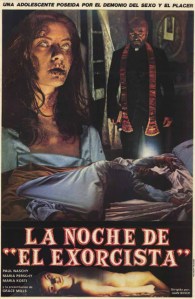
E: Exorcismo (1975)

Home ♠ Letterboxd

So… a Paul Naschy Exorcist rip-off should be pretty sweet, huh?

Yeah… about that…

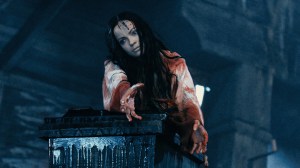
Leila (Mercedes Molina), your typical European heiress, is enjoying a typical evening of sex and drugs at a Satanic ritual with her dissolute boyfriend Richard (Roger Leveder). A near-fatal car crash later, things begin to go south for Leila’s state of mind. As things worsen, the family priest Father Adrian (Paul Naschy) is brought in to investigate, and four deaths later, he finally decides it’s time to throw down with the demon inhabiting Leila’s body.

1973’s The Exorcist still hadn’t opened in Spain, so what we have here is something like Luigi Cozzi trying to make a Star Wars rip-off without actually seeing it and coming up with Starcrash, a Barbarella rip-off. Director/screenwriter Juan Bosch probably had pictures, even the original novel to work with, and what he came up with is more giallo movie than anything, with Paul Naschy in the Tony Franciosa role. There’s a perverted chauffeur (Luis Induni) for a red herring, the usual ineffectual policeman who suspects Father Adrian, blah blah blah.

We have all the setpieces from the Friedkin movie: the freakout at the party, the levitating bed, the death by head-twisting – twice, just to one-up the original (the amateur occultist cop mentions this is a favorite murder method of Satan). But if you’re here for awesome exorcism action, be aware that it’s confined to the last five minutes of the movie, which may be a record for a title character not showing up (Spoiler: that record actually belongs to The Ice Cream Bunny) .

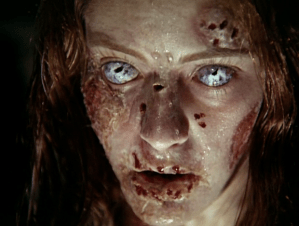
Maria Perschy is sadly wasted as the high-strung mother. I will admit that the possessed makeup on Leila is pretty good, especially the freakiest damn set of contact lenses I’ve ever seen. Too bad it’s limited to the last fifteen minutes or so. According to most of the synopses I’ve read, Leila is playing host to the spirit of her dead father, but I got no indication of that. To be honest. it may be there, I just didn’t care enough to notice. I generally hate giallo, and once I found out the movie’s true genre, I slipped into endurance mode.

Basically, if Paul Naschy had made this movie instead of just starring, there would have been 14 murders and a nude scene by the half-hour mark. And probably some zombies. Instead, what we have is an ill-informed cash-in that would have deservedly vanished were it not for the cult status of its star.

Buy Exorcismo on Amazon

D: The Dunwich Horror (2009)

Home ♠ Letterboxd

H.P. Lovecraft’s “The Dunwich Horror” is my favorite of his stories; at its heart I feel it’s the closest thing to a solid B-movie he ever wrote. Therefore, there have actually been several filmic versions. And yet each one I’ve seen so far has managed to miss the mark.

In the story, the Whateleys – an outcast New England family, one of Lovecraft’s standard cultists – has worked a ritual, the result of which is twins – Wilbur and his brother, who is never seen, imprisoned in a section of the family house. Wilbur manages to get himself killed trying to get one of the very few extant copies of the forbidden magic book, the Necronomicon, revealing that he is not entirely human. With no one left to feed his rapidly growing brother, it smashes out of the house and starts ravaging the countryside – Wilbur’s brother, you see, favored the father more. And the father was the exiled god, Yog-Sothoth.

The birth of the twins is shown at the beginning (there are tentacles involved), and the next thing we’re going to notice is that the movie is titled Witches: The Darkest Evil. And the changes won’t end there.

The one I bought at Kaybee didn’t do this.

Dr. Henry Armitage (Dean Stockwell, who played Wilbur in the 1970 version, the first instance of stunt casting) attends to the exorcism of a young lady (Natacha Itzel) who sprouts bat wings, among other things, and attacks his assistant Fay (Sarah Lieving). Armitage is even more adept at magic than his literary counterpart, shooting lightning from his fingers. The cause is a “Sumerian Ritual Pyramid” hidden under the floorboards (which I recognize as a knock-off from the Rubik’s Cube craze of the early 80s, re-painted). It’s a pretty good sequence, even with some iffy CGI, but has nothing to do with Lovecraft.

The locale has also been switched to Louisiana, we find. Armitage and Fay (Fay Morgan, incidentally. Cute) call on his old protege, Walter Rice (Griff Furst), Head of Antiquities at some university. The exorcism points to “a portal” being opened, and Armitage wants Rice to find the one page missing from all copies of the Necronomicon – page 751, which involves the rituals for opening and closing said portals. Rice departs to investigate a lead Armitage provides, accompanied by Fay – which is going to cause some problems, as the two are former lovers. Also, Rice may be steeped in the lore, but he does not believe. This will change.

The Whateleys, meantime, are also seeking out that page. Wilbur is played by Jeffrey Coombs, the other instance of stunt casting. He spends most of his time kidnapping hapless travellers to feed to the monster upstairs. All these plot threads will of course come together by the end, but getting there is, um, shall we say interesting.

Rice has a lunch meeting with a colleague, Dr. Ashley (writer-director Leigh Scott), who mentions a similar ritual that took place in Innsmouth (a brief flashback provides us with fairly effective glimpses of a Cthulhu-like figure). Armitage’s clue leads Rice and Fay to Olaius Wormius, a translator of the original Necronomicon, who is somehow still alive, and who directs the two to a house owned by a “Mr. Ward”…

Essentially, what this American/German co-production tries to do is act like a Unified Field Theory for the works of H.P. Lovecraft, and that is a double-edged sword. It’s a fun game for fans, but is going to seem needlessly complicated to the uninitiated. The wisest move the production made was casting Coombs, who gives the otherworldly Wilbur his all. The unwisest move was attempting the apocalyptic ending on a TV movie budget. Given my history, I tend to be forgiving of attempts to do Lovecraft on a budget, but even scrappy little outings like The Void are a more solid attempt.

Not terrible, but diffuse. I’m still looking forward to a movie version that has the power of the original story.


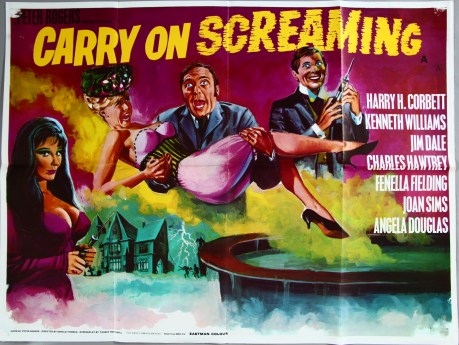
C: Carry On Screaming (1966)

Home ♠ Letterboxd

This is one of those situations where we could easily make life very difficult for ourselves by indulging our fetish for completeness. Carry On Screaming is only one of a series of movies in a franchise, and indulging that fetish would involve watching at least one or two more movies in that series, and yet I believe I can safely say nuh uh, no way.

We will instead rely upon the Wikipedia entry, which informs us that it is the most successful franchise in the history of British cinema, comprised of 31 movies, 4 Christmas specials, a TV series and three stage plays. The humor on display was “in the British comic tradition of the music hall and bawdy seaside postcards” (a fairly entertaining rabbit hole to fall down). In short, they are fairly crass, vulgar (inasmuch as the social mores of the time allowed), and cheap to produce so they made money hand over fist. And we are watching Carry On Screaming because it is the series’ parody of Hammer movies.

The fairly Byzantine plot involves the living dead-ish Doctor Watt (Kenneth Williams) who has a square-headed Frankensteinian monster named Oddbod (Tom Clegg) kidnap young women to be made into mannequins for the fashion trade. Complicating this odd scheme is the investigation of Detective Sergeant Bung (Harry H. Corbett), and the fact that pieces of Oddbod keep falling off. In this case, a finger, leading Bung and his assistant Slobotham (Peter Butterworth) to suspect something is amiss.

The medical examiner (a welcome cameo by pre-Doctor Who Jon Pertwee, who was better lknown as a comic actor at the time, and appeared in four of these) runs electricity through the dismembered finger, which, through the miracle of mad science, results in two Oddbods and one less medical examiner. Bung forces Slobotham to dress in drag in an effort to flush out the kidnapper, resulting in Bung’s harridan wife (Joan Sims) being convinced that he is having an affair.

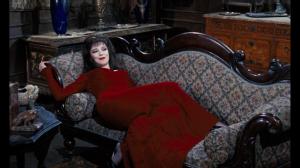
Mixed in with all this is Dr. Watt’s continuing efforts to revive an ancient mummy named Rubbatiti (these are the jokes, folks), and – the high point for me – Watt’s sister Valeria (Fenella Fielding) an ultra-vamp who seems to be Elvira’s grandmother. Supernaturally sexy, and able to distract Bung by simply being in the room. Well, golly, me too.

I had seen photos of Carry On Screaming seemingly forever – Famous Monsters seemed to run pictures of Oddbod quite a bit, and those photos would also crop up in overviews of horror movies. There was a period around 1982 when my stress release on Friday evenings involved a hit of acid and viewing SCTV, followed by a delayed broadcast of ABC’s Fridays (this was about the only circumstances that rendered Fridays actually funny). And one evening after Fridays, there it was, at about 2am on one of the local UHF stations: Carry On Screaming. So this sober re-visit actually confirmed my opinion of that bizarre night: the humor is puerile and predictable, the movie is mostly harmless, and Fenella Fielding is sexy as hell.

Buy Carry On Screaming on Amazon

B: Brides of Blood (1968)

Home ♠ Letterboxd

If I have one personal failing (well, truthfully, I have many), it’s that I seem to approach movies in a backward fashion. I start in the middle, or toward the end, of director’s filmographies, and work my way backward. Sometimes, it’s happenstance, more often it’s due to simple ignorance. That’s the case here; in an unofficial trilogy that includes Mad Doctor of Blood Island and Beast of Blood, I had had for some reason thought that Brides of Blood was the last movie. It’s not – it’s the first.

Okay, to indulge another of my personal failings – the digression – it’s not actually the first, that honor falls to 1959’s Terror is a Man, aka Blood Creature, which is a surprisingly effective Dr. Moreau rip-off starring Francis Lederer. It is the first of co-directors Gerardo deLeon and Eddie Romero’s movies to use Blood Island as a setting, which must be the most screwed-up place on the planet to live, right up there with Voodoo Island and Skull Island. But this is almost a decade before Brides of Blood, it’s in black-and-white, and it is never marketed with its colorful, far more garish descendants. Rather a pity.

But we should start talking about Brides of Blood at some point, no?

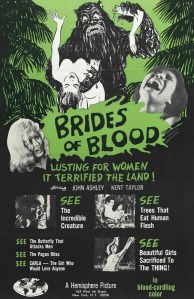
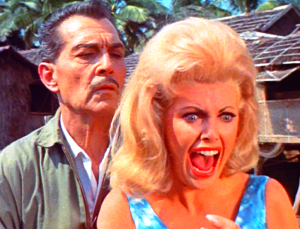
The archetypal tramp freighter is making one of its infrequent stops at Blood Island, and it’s dropping off Jim (John Ashley), a Peace Corpsman, Dr. Paul Henderson (Kent Taylor) and his oversexed wife Carla (Beverly Hills, or Beverly Powers, depending on where you are in her filmography). Jim is there to do Peace Corps stuff, and Dr. Paul is studying the possible effects of radiation from bomb tests on the local fauna. Carla is largely there to set feminism back for decades, starting with an attempted rape by one of the sailors on the boat that she starts to enjoy and then become an active participant.

The white folk arrive just in time to witness a mournful funeral procession, which gets even darker when one of the palanquins is dropped and a bunch of dismembered body parts fall out. Past this, the natives are more than happy to welcome the outsiders, and they are greeted by the village elder (Andres Centenera) and his lovely daughter Alma (Eva Darren). Carla breaks the ice by immediately suggesting a threesome between herself, Jim and Alma, but that’s not the main reason the elder and Alma are so secretive about “returning to the ways of their ancestors”.

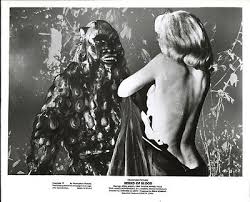
Most good horror movies weigh in at about 80-85 minutes, and Brides is a somewhat ponderous 97 minutes, so we will cut to the chase. Yes, the natives (not truly native, as they were transplanted from another island during the bomb tests) are dealing with things like man-eating plants, and more pressingly, this bizarre lumpy monster that they appease by choosing two girls by lottery every night, tying them to St. Andrews crosses, stripping them naked, and leaving them for the beast. That is some Spicy Adventure Stories pulp shit right there, and since those man-eating plants seem to change back to normal plants by day, it’s perfectly obvious to the audience that we’re dealing with an atomic werewolf, and our Larry Talbot is actually local rich toff Esteban (Mario Montenegro), whose manservant Goro (Bruno Punzalan) is facilitating his master’s deprivations. And it is going to be up to White Savior John Ashley to point out to the natives that they can gang up on the monster as they do the man-eating plants. The End.

Well, not really, as most of that extra seven minutes is devoted to Alma doing a seductive dance for Ashley, which is okay, as Eva Darren is pretty. Now, mercifully, the end.

Hemisphere Pictures was a small distribution company who had a surprise hit with the equally Philippine The Blood Drinkers in 1964 and started working seriously with Eddie Romero during the horror boom of the 60s. Brides of Blood is a pretty canny debut for that partnership – three American actors for the marquee value, to start with. John Ashley is coming off the Beach Party movies, and he liked the Phillippines so much he based the next phase of his career there. Kent Taylor had a long and solid career; if you don’t recognize his name, you’re certainly going to recognize his face. Ditto with Beverly Powers, who had enough movie and TV work under her belt that she actually manages to make Carla’s carnality work for the character, even if it is a stupid and exploitative character trait.

And this is the operative word here – “exploitative”. Sam Sherman, who was helping out in Hemisphere’s publicity department at the time, claims that Brides got out before the MPAA’s rating system went into full effect. Indeed, I seem to recall seeing Sherman’s well-worn trailer at a drive-in circa ’71 or ’72, probably for one of Hemisphere’s horror movie marathons. There was a surprising amount of skin in that trailer. There’s also some gore, and probably the worst decapitated head until the one that ended Kathy Griffin’s career.

So Brides of Blood is an entertaining enough if overly-windy piece of pulp. Unlike the later Eddie Romero movies, it stays firmly in horror movie territory, where Beast of Blood and Twilight People suddenly became action movies. Your enjoyment of it is going to depend on your tolerance for White Savior and/or Oversexed Blonde tropes.

Oh, look, here’s that trailer:

Buy Brides of Blood on Amazon


A: Altered (2006)

Home ♠ Letterboxd

I really like Eduardo Sanchez’ work. One-half of the directing team who brought us The Blair Witch Project, he’s continued to create interesting takes on standard horror genres, and his first directoral effort after the movie that launched a thousand found footage films is Altered, which starts with a tense in media res sequence and then gives very little chance to relax during its trim 88 minutes.

That sequence involves three redneck dumbasses, Duke (Brad William Henke), Cody (Paul McCarthy-Boyington) and Otis (Michael C. Williams, the only holdover from Blair Witch) hunting at night with a bewildering (and worrisome) variety of weapons. What they’re hunting is fast, smart, and vicious. They do manage to catch it in a tiger pit, and Duke insists they take it to a friend named Wyatt, because “he knows about these things.”

Wyatt (Adam Kaufman) is living in a sort of survivalist compound in the middle of the woods, surrounded by bright lights, weapons of his own, and a workshop/garage. He is not happy to see his old friends, or what they’ve brought him, and his girlfriend who recently moved in (Catherine Mangan) is even less pleased. “Why did you bring it here?” demands Wyatt. “We never thought we would actually catch one!” answers Duke.

It seems that 15 years before, these four guys (plus one more) were on a similar beer-soaked hunting trip when they were abducted by aliens. Duke, Cody and Otis were released after a couple of day of torturous experiments. The aliens kept Wyatt and Timmy – Cody’s brother – for more extreme treatment. Timmy didn’t survive, but Wyatt did – after some, um, modifications. After his release, he performed meatball surgery on himself to remove a tracking implant in his guts, and he’s been hiding ever since. And he knows that if they kill the alien that has been brought to him, the rest of his race will simply exterminate mankind. “You know what happens to an animal after it kills a person.”

Everybody has scars other than physical from the experience; Cody was blamed for his brother’s death, Otis is afraid of everything and Wyatt is definitely suffering from PTSD, with night terrors and paralyzing panic attacks. The movie doesn’t shy away from the many ways trauma can twist your life for years afterward.

The budget of Altered is certainly low, but doesn’t look it; Sanchez spends the money exactly where it needs to go. A lot of your drama and tension is going to come from interaction between the human characters, and the director has always been spot-on with his casting. The effects work is 99% practical, nasty, and won’t age like a lot of CGI from the period.

Altered takes the zombie siege formula, turns it inside out – people are trapped inside a house with something – and certainly worth a look.

Buy Altered on Amazon