N: Night Watch (2004)

Letterboxd ♠ Master List

Well, it’s been a while since we’ve had a Russian representative on Hubrisween…

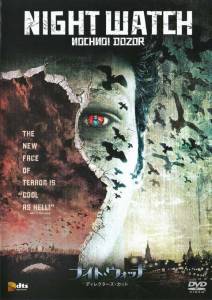
First of all, we are informed that there are people who not quite human, called “others” for their various talents, and they are basically arrayed into Light and Darkness factions. In olden times there was a tremendous battle between the two, but the armies were too evenly matched, and a truce was called. Each faction watches the other, Nightwatch is the light side watching the dark side, and Daywatch is the vice versa.

Twelve years ago, our protagonist Anton (Konstantin Khabenskiy) consults a matronly woman to get his estranged wife back from her new beau; the woman is a witch who claims a baby his wife is carrying must be aborted before she will come back to him. She can do this, but Anton must take the sin of the child’s death upon himself. That’s a violation of the truce, and she is busted by a Nightwatch team. The fact that Anton can see the team proves that he is an Other.

Twelve years later, Anton is working for Nightwatch, and it’s a job that really sucks. The mission that opens the story major requires him to get in sync with a young boy who is experiencing “The Call” – the spell of a vampire summoning him to a remote location to be exsanguinated. To do this, Anton must exploit his friendship with the vampire next door to get some pig blood to drink. This leads him to a vampire and his new bride, who is the one performing The Call – the boy is to be her first victim. Anton’s backup is late in arriving (mainly because Anton is a crap operative) and he winds up killing the male vampire in self-defense. This is going complicate his life exponentially for the rest of the movie, as the new female vampire escapes and still has a bead on the boy.

Further, while he was on the hunt, Anton saw a woman in the subway who his vision reveals was under a curse, and in his debriefing finds out it is THE curse – one that will cause a vortex of suffering and evil that will bring on, at last, the final battle between Nightwatch and Daywatch, and the end of the world.

There’s quite a bit of mythology thrown at you in Night Watch, some of it pretty standard fantasy boilerplate, some not. The not part seems pretty elastic, for instance the concept of “The Gloom”, a sort of twilight dimension only accessible by Others. First we’re told this is the safest way for Nightwatch operatives to interact with rogue Dark members, then we are told it has a time limit and requires blood sacrifice.

Night Watch is based on a novel by Sergey Lukyanenko, which itself is composed of three interlocking stories, of which the movie is only one. The sequel, Day Watch, is another, and the supposed third movie in the trilogy, Twilight Watch was the last of these. Director Timur Bekmambetov, however, split to make the 2008 Wanted, and never looked back. If, like me, you saw Wanted before Night Watch, the dazzling, rushing camerawork in many of the sequences are going to be very familiar. It’s stuff like that which made Night Watch the highest-grossing Russian movie of that year, and an international success (and made certain Russian film types grumble that it was “too American”).

The nature of the segmented source novel, though, carries with it an ironic violation of Chekov’s gun; you’re given a lot of characters with very cool potential that is never exploited. That was left, I assume, for the sequels, one of which we are never going to get.

Night Watch has a ton of interesting visuals that are worth checking out, but if you’ve never interacted with Russian cinema, be aware of some standards: a love for doomed characters, a large dose of fatalism, and a disregard for short running times. I found it interesting but not terribly engaging. As always, your mileage may vary.
M: Mary, Mary, Bloody Mary (1975)

Letterboxd Master List

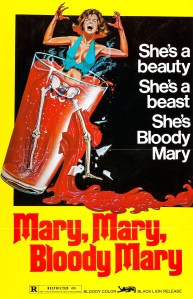
Hey, you remember what I keep saying about my unconscious tendency to access director’s careers in reverse? Starting at a recent point or movie and working my way in reverse like a dunderhead? Well, I sort of foiled my own motif, this time around. Sure, I reviewed Juan López Moctezuma’s third flick, Alucarda a couple of years ago, but I also did his first movie, Mansion of Madness (better known as Dr. Tarr’s Torture Dungeon to us gringos), back in the halcyon days of the first Mondo Macabro releases. So it was high time to watch senor Moctezuma’s sophomore effort, especially since I had been low-key obsessed with its ad art since its first-run drive-in days. I mean, just look at it. Best woman-being-turned-into-a-skeleton-making-a-horror-geek-really-want-to-see-what’s-going-on since Scream and Scream Again.

I am pleased to report I was nowhere near as disappointed in Mary, Mary, Bloody Mary as I was in Scream and Scream Again.

We first meet Mary (Christina Ferrare) while she’s having engine trouble with her van outside a creepy abandoned mansion in Mexico. As rain begins to pour down, she finds an open door and tries to find a phone, only to find herself stalked by a shadowy figure. After the standard running and screaming, we find out the figure is Ben (David Young) a drifter who is also seeking shelter from the rain. He promises to sleep upstairs while Mary stays downstairs and has a flashback.

Mary, we find out, is a successful artist who just sold one of her paintings to a guy from the American Embassy in Mexico City. This guy is also quite set on seducing Mary, with some success – at least until she pulls out a dagger disguised as an ornate hairpin and cuts his throat so she can drink his blood.

“What a waste of a perfectly good morgue attendant.”

This isn’t your typical low-budget vampire movie. Mary doesn’t do the traditional movie vampire stuff; she walks around in daylight, sleeps in a bed – at night – and has no fangs. But every so often she has to drink blood, and at those times she uses knockout drops in her necklace’s pendant to render her victim unconscious, so obviously she’s been doing this for some time. Mary is attracted to Ben, and the feeling is mutual, which is going to complicate her predatory lifestyle. There’s also the fact that the Mexican police are starting to notice the number of exsanguinated bodies, and the death of the Embassy guy has brought in the FBI. And, oh yes, there’s another vampire out there trying to track down Mary, and it’s her father… John Carradine!

If you like your vampire movies offbeat, Mary, Mary Bloody Mary is worth checking out. Some folks point to it as an inspiration for George Romero’s Martin, but I think that’s stretching a point. Mary isn’t deluded, but she has a very definite pathology, what her father refers to as “a disease”. There is one heartbreaking point where Mary’s need for a blood fix coincides with gallery owner Greta’s (Helena Rojo) pushy lesbian seduction. It’s the one time her careful searches for someone “I didn’t know or care about” has fallen through, and the first time she tearfully apologizes to one of her victims.

Yeah, yeah, it’s 1975 so there’s plenty of nudity and blood. I can see that after the surreal, Jodorowsky-influenced excesses of Mansion of Madness, it was brought to Moctezuma as a case of “Okay, can you make a normal movie?” which he does – though his penchant for creative editing and visuals is still evident. The seduction and eventual murder of Greta is shot in a lush bathroom with mirrored walls and is quite stunning. But it’s also 1975 and this is a very low budget movie, so be prepared for some slow spots, though Moctezuma tries to minimize those, and to reward you with things like unexpected car chases when you make it through them.

And now, here’s the trailer for the Code Red blu-ray, featuring a couple of my favorite bits: a newspaper with the headline NIXON CHEERED and, apropos of nothing, some dudes stabbing a dead shark to further death in shallow waters.


L: Lust for a Vampire (1971)

Letterboxd ♠ Master List

I had a friend who was one of those grey market vendors, who made his living selling VHS dupes of out-of-print movies (he’s out of the biz now, ditching the whole enterprise a couple of years before torrenting made it superfluous). For years, though, this movie was his best seller; given a VHS release once, and then vanishing from sight. So I was glad to finally watch the damn thing, and find out what the shouting was all about.

Spoiler alert: boobies.

In the opening scene, a peasant girl is kidnapped by the usual evil black carriage and taken to Castle Karnstein. Her blood is used to resurrect the dried-out corpse of what we will come to know as the infamous Carmilla (Yutte Stensgaard). The guy doing the officiating is Count Karnstein, played by Mike Raven, with a cameo of Christopher Lee’s eyes.

But never mind that, wandering nobleman and author Richard LeStrange (Michael Johnson) has arrived in the village, doing research for his next book on witchcraft, vampires and black magic. Told of the Karnstein legacy, LeStrange visits the seemingly abandoned castle, only to find himself stalked by three be-caped ladies. Ho ho, though, it’s only three girls from the nearby Miss Simpson’s Finishing School, on a field trip led by their headmaster, Giles Barton (Ralph Bates). LeStrange is introduced to Miss Simpson (Helen Christie) and the rest of the girls, just as a new student arrives – Carmilla, once again using the Mircalla alias. LeStrange is instantly smitten.

(LeStrange isn’t the only one, as we are treated to some lesbian-tinged toplessness and skinny-dipping that night at the school)

Things rapidly get complicated from there. A serving girl at the inn is found dead, two bite marks on her throat. LeStrange meets the new English instructor for Simpson’s school, tricks him into going to Vienna instead, and gets his job just to be near Mircalla. Mircalla’s skinny-dipping girlfriend Susan Pelley (Pippa Steele) vanishes (we know she’s been exsanguinated and dropped down the well). Giles Barton, knowing Mircalla’s true identity (the study of local noble families is his personal obsession), offers himself to her, hoping to become a vampire and worshipping her forever. Mircalla, though, only likes girls and turns him down. His dead body is found on the outskirts of the school the next day.

Miss Simpson has gone into full cover-up mode, refusing to call in the authorities about the missing girl, and grateful that Mircalla’s personal doctor (whom we recognize as the driver of that black coach) certifies that Barton died of a heart attack. LeStrange goes through Barton’s library, and discovers Mircalla’s secret. He, too, confesses his love to Mircalla, and begins to put that only-likes-girls thing to the test (he wins). Meantime, the school’s dance teacher (Suzanna Leigh) has notified the cops and Susan’s father (David Healy), who is American and having none of this shit.

It ends as all such gothic romances must, in a burning castle with Carmilla dead again, and LeStrange’s heart broken. The end.

After the success of The Vampire Lovers, Hammer felt they’d finally found a new vein to tap with Ireland’s other favorite author of vampire stories, Sheridan Le Fanu. The Karnsteins would crop up again in Twins of Evil and the next year’s Captain Kronos – Vampire Hunter, but never really recaptured the popularity of their Dracula series. It didn’t help that Lust for a Vampire had a troubled production.

Jimmy Sangster replaced Terrence Fisher in the director’s chair at very short notice. Also rushed into his role was Ralph Bates – Peter Cushing was to play Giles Barton, but bowed out due to the serious illness of his wife. Bates hates this role and this movie, and most people hate him for not being Peter Cushing, but really – he’s fine. There was a reason he was Hammer’s utility player at this point. What really kills the movie is the lack of Ingrid Pitt as Carmilla – she turned it down because she thought the script was lousy (she ain’t wrong). (also, there’s no Michael Ripper, so I don’t feel it can rightly be called a Hammer film) Overall, it’s pretty emblematic of Hammer’s rudderless direction in the 70s, when they found that everybody was doing the voluptuous horror bit, and the obvious thing to do was free those bosoms from their constricting bustiers and peasant blouses. A prime example, I think, of scarcity giving a movie a panache of quality it did not warrant (see also The Incubus).

K: Killing Spree (1987)

Letterboxd ♠ Master List

First of all, don’t strain yourself looking for this scene.

I was supposed to do Krampus here. That seemed like a good idea nearly a year ago when I came up with this list. Obviously, I wasn’t thinking straight. I tend to fall into fits of apoplectic rage when stores start putting up Christmas supplies in late August. I did not foresee that the same thing would happen when I tried to watch an Xmas monster movie for my favorite month of the year.

So. Killing Spree. Written and directed by Tim Ritter, who crap cineastes will recognize as the man behind Truth or Dare: A Critical Madness. This will become obvious as the movie progresses, but that’s not a bad thing.

Tom (Asbestos Felt) is a mechanic for a small struggling airline. Pay cuts have become the order of the day, so there’s a severe money crunch on, not aided by the fact that Tom refuses to let his wife Leeza (Courtney Lercara) go back to work. His state of mind is outlined when his best friend, the pilot Ben (Raymond Carbone) comes over for dinner and announces he has a girlfriend who is only 20 years old; not only is Tom extremely put out by this, but he suspects Ben is trying to make time with Leeza, and throws his old friend out in a rage. He tells Leeza afterwards that his first wife left him, and if Leeza did that, he would go insane.

Yeah, that’s kinda your plot right there.

See that red light? That means he’s NUTS!!!!

After a truly bizarre nightmare sequence concerning Ben and Leeza (and I mean quite unexpectedly bizarre, the first inclination you get that this is not going to be your typical direct to VHS gore flick), Tom finds a black notebook that details sexy dalliances with delivery men, TV repair men, the lawn guy and the like. So naturally Tom begins to do away with them in a variety of bloody, rococo fashions, some of them quite nasty. The standouts involve a chainsaw in the basement (just to make sure, a length of intestine is pulled out and plugged into a light socket to electrocute the victim), some machete blades attached to a ceiling fan, and a lawnmower, which just proved to me that Ritter read the same underground horror comic books as me while growing up.

Like I said, this is not your typical direct to video excuse for a movie – after he’s racked up an impressive body count, and feels it’s finally time to properly punish Leeza – his victims rise from the grave to exact vengeance, giving rise to a lot of extremely dark comedy. And oh yeah, Tom finds out that the entries in that notebook were rough drafts for stories Leeza was writing for her favorite magazine, Romping Romances – which she just sold for 1500 bucks so Tom wouldn’t have to get a second job.

Which doesn’t help with all the zombies banging at the door, of course.

“Hi there! They spent dang near all the money on me!”

This is Ritter’s fourth movie, made directly after Truth or Dare, which I watched earlier in the year. ToD was made when he only 19 years, and I was actually quite impressed with it. Ritter was pretty sure where he wanted to place his camera, his pacing was good, even if the logic was often very suspect.

“Very suspect logic” will cover Killing Spree, too, but then it’s basically an EC Comics story stretched to feature length, and the stretching can be verrrrry tedious early on (for instance, being told the story of why Tom’s co-worker is called “Stewmaster”. Answer: He is really good at making stew).  But there is another thing carried over from the first Truth or Dare that I liked, and that’s the fact that Ritter likes to show the disintegration of his main character’s sanity, not gloss over it in a scene or two. That speaks of a level of care in the filmmaker that goes beyond your typical gore flick. And when Tom does lose it, it has to be admitted that Asbestos Felt absolutely goes for it. Ritter obviously told him to go over the top, and then announced that the top was somewhere in the orbit of Jupiter.

That’s Raymond Carbone there, who may impress you as the dollar store version of Jerry Orbach, but he’s really good in this (and he was the detective in Truth or Dare). In fact, Ritter does very well in the actor category for this movie.

We won’t talk about that fairly lamentable severed head. There are much better FX to be had later.

The clip above and the gory trailer below (just in case you needed to see that head scene again) may not change your mind about DTV horror movies from the late 80s, but this one actually is a cut above (as it were). Some care is evident in the execution, and when I hit play, I wasn’t expecting to find a movie with so much… well, “heart” isn’t the appropriate phrase, let’s say moxie. A movie with this much moxie.


J: Jug Face (2013)

Letterboxd Master List

After the last two less-than-satisfying (to me, anyway) horror movies, it was nice to find one that hit a number of sweet spots for me: well-made, novel, compelling, and unnerving.

Jug Face starts with the neat trick of giving us the backstory during the opening credits (in my experience, only used heretofore in The Boogens, Screams of a Winter Night, and The Incredible Hulk). Presented in Grandma Moses-style rustic art, we’re given a backwoods community being ravaged by some sort of pox. One fellow makes an urn out of clay from a nearby pit; the urn bears the face of the local clergyman, who is sacrificed bloodily to a nearby pit, and everyone is cured.

Which brings us to the present day, in that same backwoods community. Teenager Ada (Lauren Ashley Carter) has sex with similarly teenage Jessaby (Daniel Manche), and not for the first time. This is going to cause problems for her later because by the cult rules of the community, she has to be a virgin when “joined” with another local youth, the doughy Bodey (Mathieu Whitman). And only Ada knows she is pregnant – she keeps stealing paint from her friend Dawai to make it look like she is till having her period.

The rather simple Dawai (Sean Bridger) is the village’s potter. Every now and then The Pit demands a sacrifice by possessing him, and while in a trance he makes the jug which bears the face of the chosen sacrifice. So Ada’s other problems recede to the background when she looks in Dawai’s simple kiln and finds out the next jug face is hers. Panicking, she steals the jug and hides it, but The Pit is not to be denied, and starts killing people randomly, while Ada, in a trance similar to Dawai’s, sees the bloody murders. She uses Dawai’s longtime love for her to cause him to make another jug face, this time with Bodey’s face – which only makes things worse for everybody.

There’s a certain understated, otherworldly realism to Jug Face‘s portrait of a community controlled, somewhat willingly, by a malign entity. Before you ask, no, we never see exactly what it is that lives in The Pit, and we don’t need to. The conviction of the cast that says things like “The Pit wants what It wants,” is often horrific enough. Ada’s parents are played by Sean Young and horror legend Larry Fessenden, and their experience and professionalism prove to be the mortar that glues the movie together.

Jug Face can be read as a more demonic, southern variation on Shirley Jackson’s “The Lottery” with a feature-length signaling to the ending, now not so much shocking as inevitable and tragic. Even at a trim 81 minutes, though, it feels a bit stretched at times, but not unworkably so. As a portrait of fear-based religion and as a horror movie, it is fairly unique and well worth checking out.

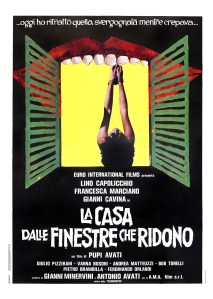
H: The House with Laughing Windows (1976)

Letterboxd ♠ Master List

So back a couple of years ago I reviewed Pupi Avati’s Zeder to close out Hubrisween and I was impressed enough to track down more of his work (so it took me two years. So what).

House opens impressively enough, with a man, strung up with arms overhead, being stabbed to death in slow-motion while we hear some crazed loon babble about the colors in his veins and paint running down his arms, all during the opening credits.

Then we meet Stefano (Lino Cappolicchio) (Avati had a thing for naming his protagonists Stefano), a professional restorationist who has been hired by the mayor (Bob Tonelli) of a small village to restore a fresco in the church. It’s a painting of the martyrdom of Saint Sebastian, done by a local artist, Buono Legnani, known as “The Painter of Agony” because of his preference for painting and drawing only subjects near death.

Stefano was hired on the recommendation of his old friend, Dr. Mazza (Giuilio Pizzarani), who was researching Legnani. Mazza is always on the cusp of telling Stefano something important about Legnani and the village, but the arrival of someone local will make him nervous and interrupt his tale, until he asks Stefano to meet him at his hotel. Of course, when Stefano arrives, it’s just in time to see Mazza thrown out a window to his death.

In proper giallo style, Stefano investigates the mystery of Legnani himself, despite creepy anonymous phone calls commanding him to leave. He finds an old wire recorder, containing the utterances we heard during the opening. Legnani was obviously more than a little off-kilter, and was aided and abetted in his off-kilterness by his two sisters, who Stefano comes to realize (as more and more of the fresco is revealed) are the models for the two women joyously murdering Saint Sebastian – and an actual murder may have taken place to act as a model for the painting. Legnani reportedly doused himself with kerosene and ran blazing into the woods, his body never found; and Stefano begins to fear that Legnani is not truly dead, and he and his sisters may still be up to no good – and they seem to have some sort of horrible control over the village at large.

The House With Laughing Windows is the most un-giallo giallo you will ever see. Most movies in this genre will keep you occupied with multiple murders, even more red herrings, sex (usually as perverse as possible), or heightened, intense visuals. House has none of these, but does have the doom-laden atmosphere and the independent investigator in way, way over his head. Leave it to Avati to not travel the well-worn road.

The movie is 110 minutes long, too long in my estimation. The final fifteen minutes, though, are suitably nightmarish and horrifying, but it can be a chore to get to them. If you’re, say, a fan of slow burn horror directors like Ty West, this is going to be right up your alley, and you should seek it out. For me, though, it’s more of a case of Okay, now I’ve seen it, and going on to my next horror movie, which will hopefully be more to my liking.

(Spoiler: it will not be.)

G: Gui si (Silk) (2006)

Letterboxd ♠ Master List

Somewhere in my questionable writings about questionable media I was about to write that the key to Japanese genre movies is that you are asked to accept one extraordinary thing, and the story moves on from that basis. I believe that was about the original Battle Royale – then I realized this was true of almost all genre fiction, and put that in the Stupid Stuff You Came Up With file, and didn’t say it. (This why I would never make it in the world of political punditry, and also why I still have a shot at getting into heaven.)

In any case, the Extraordinary Thing this time around is the Menger Sponge, an artificial substance that traps electromagnetic energy. In a sequence of newspaper clippings, it is revealed that the Sponge’s developers were hoping to use it to achieve anti-gravity, but that production of a large-scale Menger Sponge failed.

However, that is only after a sequence where a Canadian photographer (Kevin S. Smith) is given an envelope of money to take photos with Menger Sponge-treated Polaroid film in a deserted apartment in a dilapidated building. It’s not the first time he’s done this, but this time he is surprised to find an image of a ghostly child in a corner where there should be none. He dies almost instantly with a look of terror on his face.

The crippled scientist Hashimoto (Eguchi Yôsuke) has been heading the Menger Sponge development team for several years, and the Director (Tsukayama Masane) has had enough of his wasting funds, until Hashimoto reveals he has made the largest Menger Sponge ever – although it will still fit in his pocket. What the Director doesn’t know is that Hashimoto has spent the last few years ghost hunting – and he has finally found one, in that apartment. He asks the Director to pull some strings to assign the Special Forces operative Tung (Chang Chen) to his team.

Hashimoto wants Tung because he has exceptionally sharp vision and the ability to read lips – both necessary as he has trapped the ghost of a young boy in that room with Menger Sponge material. The teams has also developed Menger Sponge eye drops allowing people to actually see the ghost, but only Tung can see an eerie strand of energy – the silk of the title – that connects the ghost to other locations. Hashimoto hopes that Tung can discover the boy’s identity, how he died, and where he is buried – because, of course, Hashimoto has other goals beside developing anti-gravity.

Gui si is a well-developed mystery wrapped in a ghost story with some remarkable horror movie moments, since it is discovered that if you look a ghost in the eyes, they can then see you, and inevitably kill you – and the eye drops make that much more likely. Although the eye contact’s not really necessary if a ghost suddenly turns vengeful – and the events of the movie will ensure that a really ticked-off ghost will start tracking down the members of the team with murder on its spectral mind.

An extra layer of meaning is laid on by Tung’s backstory – his mother has been in a coma for years, apparently, but Tung refuses to turn off her life support, even if the doctors say she is suffering. Like Hashimoto, he, too, needs some questions answered about the afterlife.

It’s these layers in Gui si that surprised me, and the fact that the climactic ghost sequences launched into the operatic, and even the heartbreaking, that completely sold me. I had to make an effort to seek this movie out, and having now seen its quality, that surprises me even more.


F: Found Footage 3-D (2016)

Letterboxd ♠ Master List

Found Footage 3-D starts screwing with you right from the beginning, with a cliched opening graphic and Blair Witch sound effect:

I especially appreciate the typo.

Which is immediately followed by the director complaining about how cliched it is.

Here is your setup: Derek (Carter Roy) is producing and starring in a low-budget found footage horror movie. The aforementioned director is Andrew (Tom Saporito) and the cameraman shooting all the behind-the-scenes making-of footage we’re watching is Derek’s brother, Mark (Chris O’Brien). The Amy alluded to in the graphic is Derek’s now-ex but still co-star, Amy (Alena von Stroheim). While we’re meeting characters, let throw in the PA, Lily (Jessica Perrin) who seems to be Derek’s current squeeze (not that this will cause any drama or tension, nooooo) and the sound man, Carl (Scott Allen Perry).

As you can tell, the script for our movie-within-a-movie, as it stands, calls for Derek and Amy to go to a spooky remote cabin and have strange stuff happen to them. In a pre-production meeting with Andrew and Mark, Derek makes his pitch: since they have no real budget for hyping their production, their only hope at making a splash is to be the first at something. To which end, he reveals that this will be the first found footage movie to be shot completely in 3-D! Ta-daaaah! Skeptically, Andrew asks, “Whyyyyy are they shooting their vacation footage in 3-D?” After the briefest of pauses, Derek brightly replies, “Because he’s a 3-D enthusiast!”

This is typical of Found Footage 3-D‘s sense of humor. Not laugh-out-loud funny, but observational stuff that ultimately rings true, especially if you’ve ever been involved in shooting a low-budget movie. Then you get to say, “It’s funny because it’s true” multiple times. In fact, this is one of the best movies about shoestring film production I’ve seen an a long time.

There’s still quite a bit of friction between Derek and Amy, though the two obviously still have some feelings left for each other. Which is wearing on Mark, who has a not-so-secret thing for Amy. Andrew will be wondering increasingly why Derek even says he is the director as his producer/star overrides him more and more as the shoot progresses.

And, oh, yeah: that remote cabin with a spooky bad history? They’re shooting in an actual remote cabin with a spooky bad history. I was on Team Carl the Sound Man from the beginning, but I was willing to buy the T-shirt when he goes ballistic upon finding out that Derek has brought them all to an actual haunted house. This also leads to one of the most awesome scenes when, stopping for gas and supplies in Gonzales, they ask a couple of old coots sitting in front of the general store to be in their movie, saying old coot things. Quite funny, until the camera stops rolling and one asks where they’re headed. When they’re told which cabin they’re filming at, the two old guys get genuinely freaked out and warn them away from it. Doran Ingram and John Daws, you may have literally been two locals pressed into the job, but you did outstanding work.

Another thing I love about Found Footage 3-D is that it also serves as the Scream of found footage movies, codifying the rules of the genre – and then proceeding to use those rules for all they’re worth. For just one example, the big question of “why do they keep filming after everything goes to shit?” – there is actually a reason given that makes some sense.

Online critic Scott Weinberg is a producer, and actually shows up on set as a correspondent for the late, lamented website fear dot net (this was shot back when we could have nice things). I suspect Weinberg also served an on-set consultant – he’s about the only critic I trust on matters like contemporary horror movies. He’s there for the incredibly gruesome climax, and I don’t want to go into spoiler territory, but one of the rules is nobody gets out alive…

Which means that every time I listen to his podcast with Drew McWeeny, 80s All Over, I’m listening to a ghost. AAAAAAAAA!

Anyway. Highly recommended. I loved it.


E: Exists (2014)

Letterboxd ♠ Master List

I’ve become a fan of Eduardo Sanchez, one of the directors of the original Blair Witch Project, and whose subsequent work I’ve largely watched within the constraints of the alphabetic format of Hubrisween. E is one of the more problematic letters for horror movie titles, so I was delighted to find that Sanchez had made this Bigfoot movie.

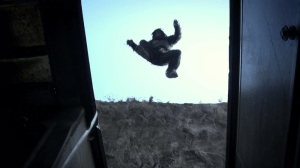
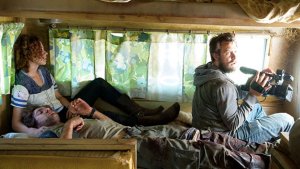
Stop me if you’ve heard this before, but five young people are headed out to a remote cabin in the Texas Big Thicket for a weekend of (supposedly) doing wacky stunts involving GoPro cameras, a mountain bike, and a ramp into a lake, all for YouTube fame. The two brothers, Matt (Samuel Davis) and Brian (Chris Osborn) lifted the key to the cabin from their uncle, who hasn’t been out to the thicket in years. Along are Dora (Dora Madison), Elizabeth (Denise Williamson) and Todd (Roger Edwards). During the late night drive to the cabin, Matt gets distracted and hits something on the road. That something leaves a lot of blood and some coarse hair on the truck’s bumper.

Though our five friends are somewhat discomfited by strange howling noises from the woods, they settle in and begin filming – particularly Brian, our dedicated video fiend for this outing, who finds really big footprints in the woods and tries to get some footage of what he believes to be a Sasquatch. That turns out to be not such an outlandish theory as something completely trashes their truck and they find themselves besieged in a not-terribly secure cabin by a very pissed-off creature. Apparently there was a reason Uncle Bob didn’t let anybody use his cabin.

Once upon a time, I reviewed Sanchez’s fellow Blair Witch director, Daniel Myrick’s The Objective, calling it “a better Blair Witch sequel than Blair Witch II.” I’m going to plagiarize myself and use that same descriptor for Exists, as it covers so very much of the same territory, right down to questionable (in fact downright idiotic) decisions made by the characters, and the eternal question of why the hell Brian keeps filming (and who manufactures his batteries). If only someone would codify the odd conventions of the found footage movie! (They did, but you’ll have to wait until tomorrow) They even go the route of a missing party member screaming in the darkness again. They find him this time, though.

Exists, I have to say, is a much better movie than Blair Witch. Sanchez is more in control, the dialogue doesn’t seem to be totally improvised (every other word is not “fuck”), the storyline is fairly logical, and best of all, they had enough budget to hire WETA Workshop to make the creature. For most of the movie, it keeps with the tradition of only fleeting glimpses of cryptids in footage, but when we finally do get a good look at it, the suit is well up to the attention.

If you hate found footage movies, Exists isn’t going to change your mind, but it’s a good, solid flick; it’s like Sanchez and co-writer Jamie Nash looked at the last segment of the original Legend of Boggy Creek and said, “Let’s do that, and crank it up to 11.”

D: The Devil Commands (1941)

Letterboxd ♠ Master List

We don’t hear much about William Milligan Sloane III these days. He wasn’t a terribly prolific writer, and most of his output was in the 1930s. He started as a playwright, and eventually published two novels combining science fiction and horror – To Walk the Night  and The Edge of Running Water – that are still being reissued to this day. I first ran across Sloane when I was helping my childhood friends pack, around 1970, I think, and his father had a copy of To Walk the Night. It had a striking cover, and a writer I had never heard of before. I decided to find a copy, but inter-library loans weren’t a thing – it probably didn’t help that I got that novel confused with Running Water. Then I found out that had been made into a movie starring Boris Karloff, which I bought on DVD back in those halcyon days when everything was coming out on DVD, and then I decided to wait until I was 60 years old to watch it. (As we know, I try to do a Boris Karloff movie every Hubrisween)

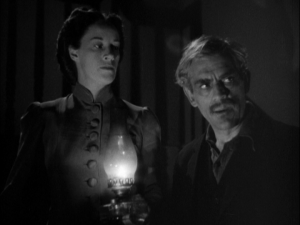
Dr. Julian Blair (Karloff) Has invited his colleagues to witness his exciting new invention, the EEG. (I kid. The electroencephalogram was first used on humans in 1923 and was only beginning to be experimented with as a medical tool in the 30s, when Sloane wrote this) The device, using a bizarre helmet and a lot of electricity (yay! a jacob’s ladder!) draws the pattern of his assistant’s brain on an enormous graph. Blair tells his impressed fellow scientists that each brain pattern is different, but as individual as fingerprints, as he demonstrates on his wife, Helen (Shirley Warde) who has one of the strongest brain waves he’s recorded.

Alas, that very evening, Helen is killed in an auto accident. Bereft after the funeral and unwilling to go back to their home, he goes to his lab and turns on his equipment, just for distraction…  and Helen’s brain wave begins to etch on the giant graph, even though she was buried that morning. No one believes Blair, not even his concerned daughter Anne (Amanda Duff), except for his manservant, Karl (Cy Schindell) who has been seeing a medium to speak to his deceased mother.

Intrigued, Blair accompanies Karl to a seance run by Mrs. Walters (Anne Revere). Blair easily sees through her fakery, but cannot explain the high voltage he felt through the table, sitting next to her. Experiments find that Mrs. Walters can absorb a high amount of electricity with no harm, and in fact while hooked up to Blair’s equipment (and bolstered by Karl as an extra resistor), Helen’s brain wave does indeed register again – but unfortunately the high voltage cooks Karl’s brain.

Walters realizes that Blair is onto a discovery that will make him very, very rich, and decides she wants in on it. They escape to a remote house near a harbor, guarded by the now brutish Karl, and years pass. The local sheriff (Kenneth MacDonald) comes calling one night because A) people are talking, and B) dead bodies have been missing lately. Mrs. Walters sends him away brusquely, but he prevails on the housekeeper, Mrs. Marcy (Dorothy Adams) to sneak into that forbidden lab and see what’s what. This she does, to find that Blair has moved up to a table with six of his ungainly apparati, he’s upgraded from jacob’s ladders to neon, and those suits contain the missing corpses. In a panic, she accidentally turns on the devices, and a glowing vortex opens in the table, drawing everything toward it. The corpses are strapped down. She isn’t.

Things are really moving to a head now. Mrs. Marcy’s husband (Walter Baldwin) doesn’t buy the evidence planted that his wife fell off a cliff into the harbor and starts putting together a lynch mob, Anne has finally tracked down her father, and… gosh, things just don’t turn out very well.

The Devil Commands is directed by Edward Dmytryk early in his career – he’d later go on to better known fare like Back to Bataan, The Caine Mutiny,  and Warlock. His direction is crisp and clean, and he wisely spends most of his camera time on Karloff and Revere. Karloff is his usual greatness at a role in which he excelled – an utter madman whose mania is absolutely understandable. Even when he is suggesting something dreadful, he seems considerate and caring, and by the final act of the picture he is visibly tortured by the terrible things he’s done. Anne Revere pulls off the neat trick of being a match for Karloff – her Mrs. Walters is one of the great Lady Macbeths of the screen, willing to cut through anything and anybody to make sure Blair will produce the breakthrough that will be her road to riches.

You know. THIS guy.

The most unusual thing is seeing Kenneth MacDonald as the sheriff, who is a calm, collected officer of the law who’s just trying to make sure everything is peaceful in his town. Like me, you’re probably more used to seeing MacDonald as the bad guy in Three Stooges shorts. Blair’s assistant and Anne’s love interest Richard Fiske is called upon to do little more than be concerned and chauffeur Anne around, and poor Anne isn’t even that interesting.

The tone of the movie is a little more elevated, a bit more thoughtful than Universal’s horror offerings. At a brief 65 minutes, it doesn’t have a chance to wear out its welcome, though it does come close. And even as a lesser known Karloff movie, it bears checking out.

Not really a trailer, but what do you want for free?