
 Richard Oswald’s Eerie Tales is that most venerable of horror movie formats, the anthology, made long before Amicus claimed it as their territory. The original negative is considered lost, and what we are watching today is a restoration performed by the Cinémathéque Francais, which, according to the credits, is some 100 meters shorter than the original.
Our framing device takes place in a rare book store, run by an especially antic owner. After he shoos out his customers and closes down, life-sized portraits of the Devil (Reinhold Schünzel) a prostitute (Anita Berber) and Death (Conrad Veidt) come to life and amuse themselves by reading some of the books littering the place, and as they do, the three take the place of characters in the stories. So you see, Screams of a Winter Night totally ripped off this movie.
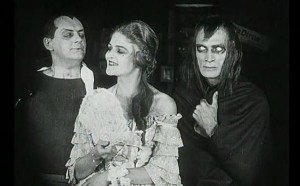 The first story is “The Apparition” by Anselma Heine, the tale of a woman rescued from her murderous husband, who then mystifies her rescuer by simply disappearing, with even the hotel staff testifying that the man arrived alone the previous night. (so add Kiss of the Vampire to the list of rip-offs) I am making the leap that any missing footage might be from this section, because that is more comforting than thinking that I’m too stupid to get the part when a drunken Veidt discovers the lady is missing and rushes from the room in horror.
Next up is “The Hand” by Robert Leibmann, a tale of ghostly retribution. You might feel a little more at home with the next two stories, which are Poe’s “The Black Cat” (a particularly good adaptation, too) and Robert Louis Stevenson’s “The Suicide Club”. The movie wraps up with “The Spectre” by Richard Oswald (yes, the director), where a nobleman gets the best of a literal Scaramouche character who is attempting to seduce his wife.
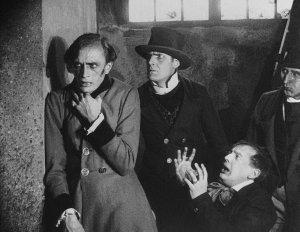 At this point in cinema history, all the tricks of visual storytelling had been worked out, so Eerie Tales is a fine example of silent filmmaking, easily accessible to the modern viewer. The actors are all up to the task of multiple characterizations, with Veidt as a standout, here a year before his star-making turn as Cesare in The Cabinet of Dr. Caligari. Reinhold Schünzel is in charge of all the scenery-chewing (at which he excels), and Anita Berber is sadly under-utilized, functioning mainly as someone to be fought over, or murdered.
Silent movies are good for you. You should watch one today.

 drfreex.com