
I’m going to pretend that we all know about who Zatoichi is and get right to the point. Right after this commercial from the Criterion Collection for the box set that’s been consuming my free time:
Zatoichi and the Chest of Gold (1964)
 It has been rightly pointed out that the Zatoichi movies only have one plot: Zatoichi comes to town, finds some people in trouble, turns the bad guys into hash (including at least one opponent smart/skilled enough to give him a challenge), and then leaves town. Where the fun comes in is the differing natures of the conflicts, and in this case (and the movie that follows it), the energized, often frenzied camerawork of young director Kazuo Ikehiro.
This time, a group of farming communities has managed to scrape together enough money to pay off the corrupt magistrate’s taxes, and, of course, the chest holding the money (with a large sign that reads “TAX PAYMENT”) is hijacked by thugs working for the magistrate. Among them is Tomisaburo Wakayama, making his second appearance in the series, this time as a cruel ronin named Jushiro, who has a fondness for the whip.
Ichi, who traveled to the main village to do penance at the grave of a man he killed almost by accident back in the first movie, gets blamed for the theft, as does a local yakuza formerly revered by the farmers, Chuji Kunisada (Shogo Shimada) (Kunisada is an actual historical character, and the subject of at least three other movies, which explains his eventual disappearance from the story). Ichi, of course, promises to get the chest of gold back.
Once more, Ichi proves himself a saint by not only working to retrieve the farmers’ gold, but by putting up with a ton of abuse – twice – from the panicking mob, when he could obviously cut down the lot of them. Another startling addition by director Ikehiro is stage blood. Ichi’s previous outings were all of the “clean cut” variety, but there’s a fair amount of the red stuff in evidence here, and it’s pretty shocking in relation to what has come before.
Zatoichi’s Flashing Sword (1964)
 The prologue has Ichi dozing in a bath house, and a bunch of yakuza considering killing him in his sleep. Ichi is bothered by buzzing flies, however, and rouses himself long enough to bisect several flies in flight – causing the yakuza to reconsider their plan. Ikehiro’s camera weaves about the room, giving us the fly’s Point Of View, presaging the imaginative camerawork of Scott Spiegel in movies like Intruder and Texas Blood Money.
In the movie proper, Ichi gets shot in the back by a rogue yakuza trying to make his name. The wounded masseur is pulled from a river by a passing lady and her retinue, and she pays to have his wounds treated. Ichi travels to her village to thank her for her kindness, and finds himself, once again, embroiled in a conflict between two yakuza gangs. The first, headed by the charitable lady’s father, is pretty benign, controlling the traffic at a river ford and looking out for the workers. The opposing boss, nowhere near as nice (and has the bad teeth to prove it) wants the river ford franchise, and is conniving with the local magistrate to take it over.
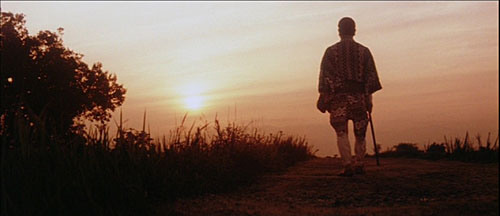 Ichi is upset, feeling that a yakuza working with a magistrate is the lowest of the low, and helps out where he can (did I mention that the good Boss’ estranged son is the guy who shot Ichi in the back? And that Ichi is going to wind up saving the young thug’s ass?). Eventually, though, Zatoichi’s reputation works against him, and the threat of the magistrate finding out the good Boss is harboring a violent fugitive forces Ichi’s ouster from the compound; of course, this leaves the good guys open to slaughter from the bad guys. Which leads to a pissed-off Zatoichi stalking the bad guy compound, cutting down candles and villains alike as fireworks illuminate his housecleaning in bright greens and reds.
It’s been pointed out that Flashing Sword feels a bit rushed, and the plot is a bit more clear-cut than is usual in a Zatoichi movie; we never once see this conniving magistrate we hear so much about, nor his compound. But the money and time is put where it needs to be, and Ichi’s avenging angel act, extinguishing lights and encouraging cowardly gangsters to come into dark rooms and find him, is one of the best in the series so far. Katsu also gets to exercise his comic muscles quite a bit in the first act, leavening the mood.
Fight, Zatoichi, Fight (1964)
 It seems like any franchise of any length is eventually going to get a baby thrown into the mix, and usually with disastrous results. This time, Ichi accepts a discounted ride in a palanquin, unaware he’s being followed by five assassins. While the assassins rush to a point where they can ambush the conveyance, Ichi and the two bearers encounter a woman carrying a baby, who has collapsed by the side of the road. Ichi insists she take over his ride, with disastrous results for her when the assassins plunge their swords into the covered palanquin.
An investigation in the village uncovers that the woman had been left for collateral for a loan taken out by her husband, a merchant down on his luck. She had worked off the debt and given birth to the merchant’s son in the meantime. Ichi determines to deliver the boy to his father, 65 miles away, though there is still the problem of the five assassins, and the pickpocket Ichi encounters on the way (and hires as a nanny). Along the way he will bust up a crooked dice game, kill yakuza while changing a diaper, and form quite a surrogate family with the baby and the pickpocket, who is so overcome by her love for the baby and Ichi’s honor that she swears to reform her ways.
 Here’s a bit of a SPOILER, so you may want to look away: Ichi becomes quite attached to the baby, and despite his reluctance, delivers the boy to the father – only to discover that he is not the hard-working merchant he had imagined, but a newly minted yakuza who used the loan to get rid of his wife for a much more advantageous marriage. Ichi vows to raise the boy himself, until convinced otherwise by a kindly but stern monk. Ichi leaves the boy with the monk, realizing that this course represents the child’s best chance at a decent life. “Teach him to read and write. Raise him to be a good man.”
Then Ichi goes to face off with the last surviving assassin, who has teamed up with the baby’s father to ambush Ichi with a torch-bearing mob. Katsu, his kimono on fire, still takes care of business.
At this point, there are a lot of things you expect from Zatoichi. He’s been pretty endearing so far, but you do not expect him to be downright cute, or, finally, to break your damn heart. Director Kenji Misumi returns to the series with this entry, and his calmer esthetic works well for this storyline; the sentiment is neither forced nor mawkish, though it certainly could have been. There is still plenty of action, but Fight, Zatoichi, Fight stands out as a novel chapter in the franchise.
Adventures of Zatoichi (1964)
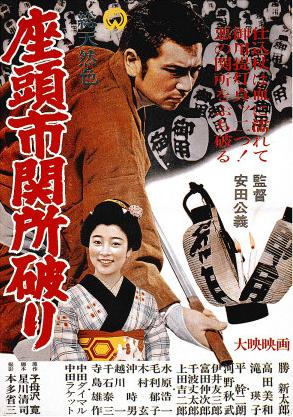 The Bond-like vignettes vanished with the last entry, and the stirring music by Akira Ifukube seems more and more spaghetti western influenced, with a thrilling flamenco guitar motif. This time Ichi is traveling to Mount Miyagi to “welcome the sunshine of the New Year”, and accepts a letter from another traveler to deliver to a maid at an inn. He reaches the village and finds it crowded with traveling vendors and entertainers, all groaning under onerous new taxes from the local Boss in league with a corrupt official (of course).
The inn is crowded and Ichi winds up sharing a room with a young lady searching for her father, a village headman who was daring enough to protest the new taxes making life unbearable for his townfolk. This is another thread in one of the most elaborately tangled plots yet, until one scene where a hurried confession ties it all together like the Dude’s ruined rug.
Add to this the local elderly drunk, who Zatoichi thinks may actually be his long-lost father, and the picture’s Big Bad, a ronin named Gouonosuke, the third son of a lowly retainer who is so desperate to prove himself that he sets his sights on Zatoichi. It’s a remarkably well-rounded performance by Mikijiro Hira, who fans of Criterion releases of chanbara flicks will recognize from Three Outlaw Samurai and Sword of the Beast. Jumbled as the plotlines may be, they come together well in one of the more emotionally complex of the Zatoichi movies.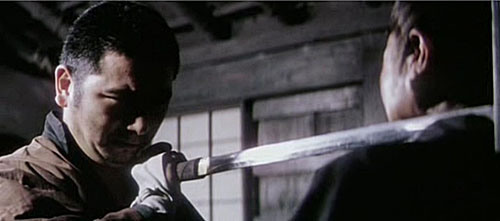
Zatoichi’s Revenge (1965)
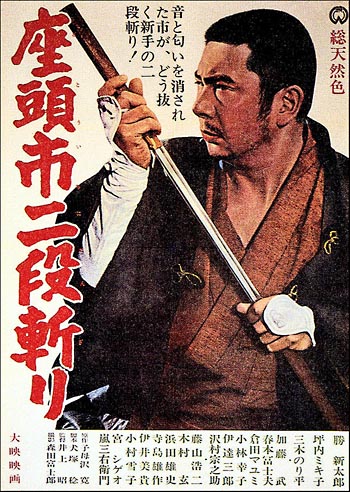 The spaghetti theme is in full bloom under the opening credits, simple black on a white background. There are two assassins on Ichi’s trail this time, as his wanderings bring him back to the village where he learned the art of massage. He also discovers his former teacher has been murdered, and the teacher’s daughter indentured to the local Boss’ brothel to pay off a loan made to the teacher just before his death. Of course, none of this sits well with Ichi.
The lion’s share of this movie deals with Ichi’s chance encounter with a dice thrower at the Boss’ gambling den, Denroku the Weasel, played by veteran comedian Norihei Miki. In his ongoing campaign to bring the Boss (and the obligatory corrupt magistrate) down, Ichi visits the dice game, and as usual is winning nicely until Denroku is brought in as a cooler. The scenes where Ichi reveals the tricks involved in cheating are always a treat; something is always going to get cut in half in some extraordinary way.
Denroku has a soft spot, an eleven year-old daughter he has been raising himself, and the Boss puts pressure on that spot, eventually driving both to betray their friendship with Ichi – which yields surprising results.
Ichi himself will betray one of his own codes, that he never strikes first, but it’s forgivable when his targets are two of the most vile villains yet, indulging in embezzlement, murder, rape and forced prostitution with an unholy glee, beating and starving the indentured, unwilling women. Some of these scenes are pretty hard to watch, but you can get through them secure in the fact that there is some shit that Zatoichi simply will not tolerate.
You also begin to get the impression that one of the reasons the Tokugawa Shogunate eventually collapsed was under-population, as Ichi seems to cut through about a hundred thugs per movie, at least. Not that I’m complaining – that’s what I’m here to see. And so, apparently, was the Japanese public, as we are only ten movies into a twenty-five movie set.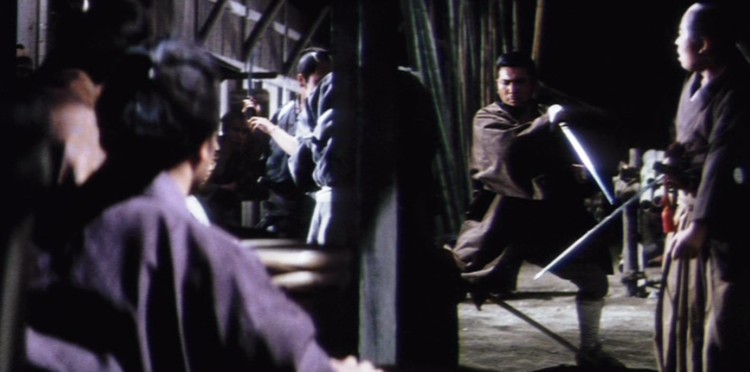




 drfreex.com