Well, it’s late Sunday and nobody has died yet (knocking on wood) so my movie from The Other List of the day was The Good, The Bad, The Weird, a Korean Spaghetti Western from director Kim Jee-Woon, perhaps most notorious around these parts for A Tale of Two Sisters and I Saw the Devil.
In 1930s Manchuria (a canny choice for a substitute wild west), there’s a plan involving a double cross for a map to an unknown treasure somewhere in the Gobi Desert. A small-time thief steals the map before the hit man hired to do the job can reach it, and both men are being pursued by a bounty hunter. There’s our three title characters, very much along the lines of The Good, The Bad, and the Ugly. Also looking for the map is a gang of Manchurian bandits and the Japanese Army, as if things weren’t already going boom enough.
It also makes me wonder what the modern action movie would do if Santa Esmerelda had never done their cover of “Don’t Let Me Be Misunderstood”.
The most expensive Korean film ever shot at the time, there is no doubting the production values on display here; from the opening train robbery to a couple of settlements that are destined to go up in explosions and gunfire, the design and execution is top-notch. Kim really gets his money’s worth from his steadicam and various cranes. The camera work is fluid and frequently dizzying, swooping along with the action like a bird of prey.
If there is anything I would criticize, it would be the movie’s length: at a little over two hours, I – remarkably – got tired of things blowing up real good (same thing happened to me with Terminator 2). There are at least two extended scenes that could be scissored without ruining the overall movie, but… that’s not up to me. It’s a bit lengthy, but still quite enjoyable.
As I ponder this, I realize this movie may be the first casualty of my push to watch films of a higher caliber (to use an unfortunate but all too appropriate turn of phrase). Sheer, zestful entertainment like The Good, The Bad, The Weird was the sort of movie I lived for, and to see it done this well should have me turning cartwheels and calling up people to insist they view it. But good as it is, it’s about as deep as a shell casing; I find I want more dimensions from the movies I watch. The Good The etc. is a very good action movie, it aspires to be nothing more than a very good action movie, and that’s admirable.
An odd thing, this watching movies because someone has died. I mean, it seems wholly justified to watch Head after the departure of Davy Jones a couple of weeks ago, but I woke up this morning to the sad news of the death of French artist Jean Giraud, better known, perhaps, under his signature as Moebius. His stories were one of the reasons I kept buying Heavy Metal after the readable Ted White years, and long long after the allure of thinking “That’s a really well-drawn breast” had worn off. His stories, besides being brilliantly drawn, were puckish, unusual, and often mind-blowing. And much as I respect his body of work, there is no way in hell I am going to watch the Heavy Metal movie in his honor. Maybe some day, I should examine why I hate that movie so much. Maybe.
The one movie I do possess which would be more in line with my current viewing template is Little Nemo: Adventures in Slumberland, for which he did design work and has a story credit. That, however, is on laserdisc. Current duties prevent me from setting up my mothballed player. He did concept art for Tron and Masters of the Universe, but again, no way in hell. There is Alien, and The Fifth Element (which is everything the Heavy Metal movie should have been, but was not), but I’ve seen both of those too recently.
The movie which would be most appropriate only exists in a parallel dimension: Alejandro Jodorowsky’s version of Dune. I’ve had a strange yen of late to watch the Lynch version again, but that is nowhere near the same thing. I guess I should dig out my copy of The Lost Incal, the impressively whacked-out comic series Moebius did with Jodorowsky – that would be a much better tribute than watching a flick only tangentially associated with his genius.
Anyway.
Yesterday (Friday the 9th, as I write this) brought the news that Peter Bergman of The Firesign Theatre had passed away. It literally stuns me that people only ten years younger than me will say “Firesign what? Who-?” Perhaps Firesign was too distinctly of its era, but I can’t really get my head around that. Funny is funny, and it’s not like the four guys who made up Firesign were overtly political or topical. Perhaps it was the fact that their best work was pretty much in the form of long radio plays, strange science-fiction constructs with pyrotechnic wordplay. Their occasional forays into video were pretty hit and miss, running the gamut from brilliant (Nick Danger and the Case of the Missing Yolks) to disappointing (Eat or Be Eaten).
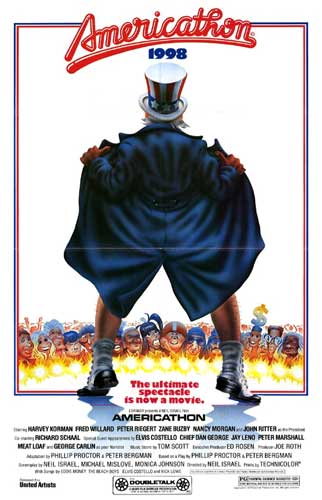
Well, Number One on The Other List was Americathon, which the box assures us is “Written by Firesign Theatre veterans Phil Proctor and Peter Bergman”. The movie credits claim that the “Adaptation” was by Proctor and Bergman from their play, with a screenplay by director Neal Israel, Michael Mislove, and Monica McGowan Johnson. Such mongrelized credits are not uncommon in Hollywood, but it does cause one to wonder just who is to blame for Americathon.
With a phrase like that, you can assume I was somewhat disappointed.
Now, the movie starts well enough, if you can get past the literal lynching of then-President Jimmy Carter. By 1998, America has run out of gas, oil, and money. It owes 400 billion dollars to multi-billionaire Sam Birdwater (Chief Dan George), who wants his money in 30 days or he’ll foreclose on the country. Our hero, media expert Eric McMurken (Peter Riegert) wakes up in his car. You see, he lives in a trailer park where all the trailers have been replaced by cars. He gets on his bike and goes to work, on a street, and finally a highway, populated only by bicycles of every make, skateboards, and joggers. Even a passing firetruck is actually mounted on a bicycle.
The freeway actually vacant of any powered vehicles is a pretty bracing sight, and sets you up to hope for great things. The president is Chet Roosevelt (John Ritter), an EST graduate who was elected purely on his last name. He and his First Old Lady are in the Western White House, a condo sub-let in San Diego. McMurkin is called in to help find a media solution to the current crisis, and that ultimate solution is a telethon to raise 400 billion in 30 days.
A villainous Presidential advisor, Vincent Vanderhoff (Fred Willard), though, is in cahoots with the United Hebrab Republic (Israel and the UAE having made peace once they realized they both liked blonde shiksas), which wants to buy America once it’s been foreclosed upon. Vanderhoff attempts to sabotage Americathon first by hiring faded matinee idol and egomaniac Monty Rushmore (Harvey Korman) to MC the show, then insisting only government-cleared acts perform, resulting in five days of ventriloquist acts. Ultimately, the money is raised, thanks to Rushmore’s getting wounded live and on the air by Hebrab terrorists attempting to kidnap McMurkin, and Birdwater himself ponying up the last $100,000 because he really liked the show.
I’d love to say Americathon was a glorious mess, but it’s really just a mess. I can see Proctor and Bergman’s sense of absurd insanity peek through every now and then – Birdwater, for instance, made his fortune by foreseeing the great Clown Shoe craze of the 80s, and then high-fashion roller-skates once the gas started giving out. China turning into a major capitalist power is accurately predicted, though it is fast food that powers its rise to prominence. Meat Loaf appears as “Oklahoma Daredevil Roy Budnitz”, whose act on Americathon is dueling “The Last Living Car” with an array of hand weapons. It’s outrageous sketch comedy like that the central concept cries out for – and sadly, never gets.
The real standout for me – at least in the realm of high weirdness – is Vietnamese Puke Rock star Houling Jackson (Vietnam, incidentally, has reinvented itself as the gambling mecca of the world). Zane Buzby plays Houling, and she is terrifying. Roosevelt, of course, falls immediately in lust with her, as she is the extreme polar opposite of his First Old Lady (the extremely lovely girl next door type, Nancy Morgan). Buzby literally chews up and spits out any scene she’s in; she went on to a fitful acting career, and a much more successful – and, I hope, satisfying – career directing sitcoms. I mean, really: I started out thinking what the hell and ended up wanting more of her.
But past that, past isolated bits, Americathon plays out like a TV comedy sketch that goes on too long (so another thing it accurately predicts is SNL movies). The subplot with the Hebrabs never quite reaches its full potential, which would have helped leaven the comedy with some dramatic tension.
For some reason, in my head, Americathon is always connected to the previous Summer’s movie, FM. You never really hear about FM anymore, either; it was up against a re-released Saturday Night Fever and Grease, and sank without a trace. But it did have a very successful soundtrack album – hell, that Steely Dan “No Static At All” song will still crop up occasionally on Classic Rock stations. Americathon tried to till that soil itself, with a theme song by the Beach Boys and a puzzling appearance by Elvis Costello. I had quit my job at the record store about the time the Americathon album came out, but I recall a pretty high-profile release.
So really, it would have been a better tribute for Bergman had I dug out my VHS of the aforementioned Nick Danger or the re-dub jobs of J-Man Forever or Hot Shorts. Those were hilarious, and a lot more indicative of the man’s talents and strengths.
The Boys circa 1971. Peter's the handsome chrome dome on the left. RIP, fella; you done good.
It has finally happened; all my local Blockbuster videos – or, as I refer to them, “The Used DVD Store” – have closed down. This shouldn’t surprise me in the least – I haven’t rented a movie in years, except through Netflix, and if you’re only interested in renting, I suppose the buck-a-night Redbox deal is pretty sweet. But as befits my encroaching age and incipient dinosaur-hood, I like to own my movies. This was a childhood dream, being able to watch a movie anytime I want, without suffering the cold equations of TV programming. One of the many, many reasons I’m not taking to streaming like everybody says I should. Between people complaining about stuttering feeds and having no control over what is available on any given evening, I just don’t feel the technology is quite there yet. Not to mention I just bought a Blu-Ray player, and my already high expectations of audio and video quality have gone through the roof.
I’m aware this puts me in the same camp as audiophiles who were dismayed that people were really going for those compressed mp3 thingies that JUST. DIDN’T. SOUND RIGHT. So be it. Nothing irks me faster than digital artifacts in a moving picture.
Well, that was a hell of a digression. Didn’t mean to go there. What I was trying to say is that I was one of the vultures picking over the carcass of Blockbuster, buying used discs while I still could. I got mainly stuff I had only sort of wanted – you know, not enough to actually go out and buy them outright, but maybe enough to put on my Amazon Wish List or maybe that dreaded Netflix Instant Queue – but here it is, it’s less than ten bucks (often less than four), I’ll take it. Copies of Grizzly Man and Cave of Forgotten Dreams. Sauna, one of the few horror movies in the last few years to actually have an effect on me; Blu-Rays of Raging Bull and Black Dynamite and Vanishing Point. Some flicks I had curiosity about: Suck, Dead Snow, Pontypool, Hobo With A Shotgun. And, finally, Shaolin.
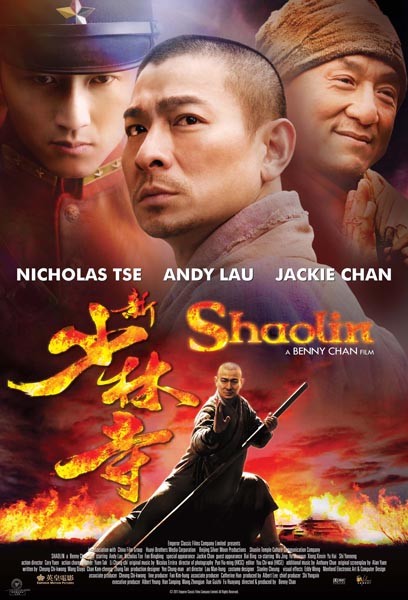
Andy Lau plays General Hou Jie, a warlord who pursues a vanquished enemy into the Shaolin Temple and kills him. (I’ll note here that this is sometime in the early 20th century. Hou appears to be using the Chinese version of the broomstick Mauser pistol, which could place it around 1920 or so). The wheel of karma and movie plots being what it is, Hou will wind up at that selfsame temple with his mortally wounded daughter, far too late to save her. Having lost everything, Hou begs to become a monk, and through the study of kung fu and Buddhist sutras, he attains a state of martial zen; he releases all the greed, fear and hate that made him such a terror in the Outside World. Alas, the subordinate who mutinied against him is still busy, and the Outside World will soon come calling on the Temple again.
That’s a sturdy plot, if somewhat unoriginal. Where Shaolin establishes its own identity is in the wholehearted conversion of Hou. He realizes that he is responsible for the behavior of his former lieutenant, Cao Man (Nicholas Tse), and wishes to not only save the people Cao will murder to cover his sale of Chinese relics to foreigners, but to also save Cao himself, to share the state of grace that total repentance has given him.
And, surprisingly, the movie has the moral courage to actually go through with it. The movie has an almost Shakespearean body count by the end, but Cao is one of the survivors, and seeing him shattered and crying in the burning ruins of a battlefield, surrounded by dead bodies, is truly moving.
Shaolin doesn’t follow the template of the last few modern martial arts movies I’ve seen, which also predisposes me toward liking it. I know I’ve mentioned it before, but here we go again: Jet Li’s Fearless, Ip Man & Ip Man 2, True Legend all end with the hero squaring off against a foreign devil – several foreign devils, in the case of True Legend, and some tigers – and the hero must beat the foreign devil for Chinese honor. I’m okay with that concept, but not a steady diet of it. (Legend of the Fist: The Return of Chen Zhen also did this, but I didn’t remotely like that movie, so it doesn’t exist) I fear the chances of getting a movie like this out of mainland China that doesn’t double somehow as propaganda are getting increasingly slim.
There are, absolutely, foreign devils in Shaolin, military types that want to sell machine guns to the local warlords in exchange for building a railroad through their territory. It’s these bastards who are buying the relics, and who, to cover up their own crimes and failures, order the shelling of the Temple during the climactic battle. Man, foreign devils ruin everything.
Jackie Chan is in there, too, playing a supposedly minor role as the Temple Cook, who studied martial arts for a few years, decided he didn’t get it, and took to the kitchen instead. Of course, the Cook slings around huge iron woks and man-sized piles of dough with no trouble, so we know he’s eventually going to get his fight scene. Chan is, as usual, affable and tremendously likable. Lau has always been a fine, charismatic actor, and though he’s not a trained martial artist, moves well enough that a skillful director can always make him look good in the action scenes, and Benny Chan’s been around long enough to know how that works. His camera swoops around the Temple, making it a character in its own right; it and the shanty town built around it by refugees give the proceedings a properly historic heft, a timeless, epic feeling that extends beyond the miserably mundane concerns of the warlords.
Shaolin is a movie that treads ground certainly treaded before, but treads it with ease and solemnity. It may all seem very familiar, but it is familiar like your favorite comfort food: warming and always welcome.
Man, a lot of noteworthy – well, noteworthy in the sub-spheres I inhabit – noteworthy people died last week. Sheldon Moldoff, an artist who did many berserk covers for comic books in the Golden through early Silver Age; Ralph McQuarrie, another artist, responsible for the look and feel of Star Wars, Battlestar Galactica, Close Encounters of the Third Kind, and E.T.; and, to bring it into the realm of this blog, Davy Jones.
Jones was, of course, the “face”, the “cute one” who fronted the Monkees. The Monkees are an odd thing to consider. I loved their shows when I was watching it on Saturday mornings, where I recall CBS put the syndicated series on several years after NBC had cancelled the primetime series. Watching them recently… well, not so much. As the boys exerted ore and more influence over the show, it became less stable, more obtuse (though I suspect I would still like the final episode, directed by Mickey. That was hilarious.).
Yes, they were the Pre-Fab Four, auditioned and cast when existing groups like The Lovin’ Spoonful weren’t available.
The more research you do, the more puzzling it becomes: no, they didn’t play the instruments on their first couple of albums, only supplied voice tracks; yes, they could play. Mike, I knew about. Peter came from the folk scene, and knew guitar and keyboards; Mickey could do guitar, but learned the drums because Davy, who could play them, was too short for the cameras to see over the drum set. In spite of the fact that it’s Mickey doing lead vocals on most of the songs.
The self-destruction of The Monkees seems almost scripted as well – or, at least predictable. Conceived as an attempt to emulate Beatlemania, the emulation became truth, and the boys began to chafe under the control of Don Kirschner, wanted to write and perform their own music, to be their own men. The same conceit that birthed them gave their critics their biggest ammo: they couldn’t play their instruments, they used session musicians, they didn’t write their own music. There’s truth in all those, but it was also true of a lot of popular groups. They were perceived as having had success handed to them, unearned, and that hurt.
So it was pretty much by accord that the TV series was cancelled after two years; The Monkees weren’t interested in doing it anymore, and NBC was tired of dealing with them. Producer/Director Bob Rafelson used the box office success of A Hard Day’s Night and Help! to get funding for a Monkees movie. The result was Head, it was a dismal failure at the box office, absolutely buried under an obscure ad campaign and oddly chosen venues… and it is one of my very favorite movies of all time.
So of course, the day Davy died, I had to watch it.
I’m not even going to try to give you a synopsis of what goes on in this movie – that’s like trying to close your fist around a glob of quicksilver. It is possible to recount exactly what happens in Head – Chad Plambeck does it pretty effectively here – but even then, it doesn’t match the full effect of the movie. There is no plot, and trying to find one will only frustrate you; but if you follow the advice of a stoned William Hurt in The Big Chill and “let art wash over you”, what you get is the truest translation of an acid trip to film ever accomplished. Neurons firing multi-colored bursts in all directions, someone keeps changing the channel and there’s Monkees on every channel. An idea slides smoothly into another idea, never mind that one has nothing to do with the other.
People like Chad and other folks smarter than me feel they have found the meaning behind the chaos, and they make damned good cases for it, too. Me, I just like to sit and enjoy the madness.
My favorite moments, of course, are the meta moments. During Davy’s tenement romance sub-movie, complete with Annette Funicello love interest (Rafelson, not knowing if he would ever make another movie, said he made about 50 of them in the course of Head) he’s a violin player who wants to be a prize fighter. Davy is getting the living hell beaten out of him by Sonny Liston (yes, really) while Mickey, in the crowd, is yelling “Stay down! Stay down!” When Mike, playing an obvious crime kingpin, calls Mickey a “dummy”, Mickey goes berserk, climbing into the ring and punching out Davy (“Stay down!”) and Sonny, and in fact, all comers, screaming “I’m not the dummy!” until he is calmed down by Peter, who appears against a wall of boxing ring smoke (or is it supposed to be a sort of heavenly haze?) and tells him, in a calm, steady matter-of-fact voice, “You’re not the dummy, Mickey. I’m the dummy. I’m always the dummy.”
In my post-young fella years, I find that Peter is the one I wind up liking the most.
Since we’re doing this in Davy’s honor, though, here he is singing “Daddy’s Song” by Harry Nilsson, dancing with Toni Basil and tripping everybody’s head out. Reminds one that Davy started out as The Artful Dodger in the Broadway Oliver!. And, oh yeah, there’s some guy named Frank Zappa in there, too.
Yeaaaaah, either Columbia didn’t know what to do with it (likely) or just decided to bury it (also likely). In any case, I had never really heard of it until it cropped up on the CBS Late Night Movie one night and I said, “Wait. The Monkees made a movie?” It seemed to have a very healthy life in bootlegs after that, until it got a legit release on VHS and then DVD, and now it’s part of a box set from The Criterion Collection.
I cannot tell you how impressive the Criterion disc of Head looks. I bought the set (America Lost & Found – The BBS Story) before I purchased a Blu-Ray player, and I can only imagine what this sucker looks like in true high-def. The upscaled DVD is almost painfully sharp, allowing me to see details I had never noticed before, like the designs painted on the psychedelic mermaid’s faces in the opening number “Porpoise Song”. In another meta bit, where at the end of a scene “Cut” is yelled and we see the whole film crew bustle about for the next setup, we see Producer/Screenwriter Jack “Lookit me, I’m so young” Nicholson. But what I had never noticed before, in that same bustle, is Dennis Hopper, wearing his Easy Rider togs, which would be Rafelson’s next Producer gig.
On top of that, in an earlier portion – a World War II movie – Peter is trying to get some ammo for his squad, but keeps getting tackled by Green Bay Packer Ray Nitschke. Peter escapes with some ammo, Nitschke throws his golden football helmet after him, and Peter gives it to Mickey, who considers his GI issue helmet “a drag”.
The next time we see that golden football helmet, it’s going be on Jack Nicholson in Easy Rider. This stuff can make your head spin. Appropriately enough.
I actually did watch other movies last week. Let’s see if I can get through them without blathering 1000 words on each:
Doom is the new Justice League animated movie from DC Universe/Warner Brothers Animation. I was all set to give this one a bye until I found out it was apparently one of Dwayne McDuffie’s last projects, so I went ahead with my pre-order. In a lot of ways, McDuffie was the heart and soul of the animated Justice League series, Static Shock and some of the more exemplary DTV offerings via DC Universe. His untimely death last year was a serious, serious blow, and when movies like Doom come along, you find out all over again just how much we lost.
Based on the Mark Waid JLA story arc, “Tower of Babel”, Doom gives us yet another version of the Legion of Doom, this time headed up by the literally immortal Vandal Savage. Batman (being Batman) has detailed contingency plans on what to do if any member of the Justice League ever turns evil; Savage gets hold of these and refines them to lethal outcomes, then unleashes each superheroes’ arch-nemesis upon them. It’s a good story, well-done, and features the familiar voice talent from the various animated series, plus Nathan Fillion as Green Lantern once again. I find that sort of continuity comforting; sometimes stunt casting the voices yields good results, sometimes they’re distracting and disastrous. I just know in my head that Batman sounds like Kevin Conroy and Superman sounds like Tim Daly.
Pretty good way to spend 80 minutes or so. Not sure I’m going to be around for any further offerings from DC Universe; I could be wrong, but I get a feeling of diminishing returns over the last year or so.
I followed up Doom with Cube, which was apparently a staple in the good old days of the Sci-Fi Channel before they started deliberately misspelling their name, and was a constant presence on the video store shelves. None of this ever meant I had seen it; there are lots of holes in my viewing history, and that is one of the things The List is about: remedying those absences. Not that Cube was on either of this year’s lists; but I listened to a typically excellent Projection Booth podcast covering it and thought, “Okay. I should nudge that further up the non-list.”
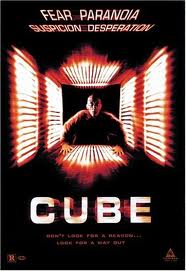
Cube is a low-budget sci-fi film with a fairly simple premise: Five people wake up in a high-tech structure of interlocking rooms. Each room is a cube, with doors on each wall, floor, and ceiling. Each door leads to another cubic room. And some of the rooms are booby-trapped.
With nothing more than the prison-type uniforms they wear, no food or water, they try to find a way out. At first they note sequences of numbers on each door; if the number is prime, the room beyond seems to have no trap. But even that dodge stops working, and they have to find the more devious, complex clues to make it through alive.
So, actually, what we have here is a movie that takes place largely in one room; sure, it changes colors to give the impression of multiple rooms, but that’s a brilliant setup for a low-budget film. What remains is a character study as the process wears away at each of our protagonists. The balance of power tips and changes; weak characters turn out be stronger than anticipated, and vice versa. That’s a tricky road to follow, but the actors, happily, are up to the task.The ending is… well, not anti-climactic, but unsatisfying. To me, anyway. This is one of those movies where you’re not really going to get any answers outside the ones the characters come up with themselves, and those aren’t going to get validated.
So that was three movies I watched last week. But now I’ve gone and brought up that gosh-darned List, and those of you keeping track at home (snort) have noticed that none of these movies is on either list. So I felt I needed to hit one of those movies or feel myself a shallow mockery of a man. Of course, I was also on a bit of a roll, and I am unable to resist gimmicks. I had just watched three movies with lots of colors: the psychedelia of Head, the four-color mayhem of Doom, and the color-coded rooms of Cube. Did I have a movie on The List that also centered upon color in this fashion? Well, no, I didn’t, but I did have a movie that had a one-word title.
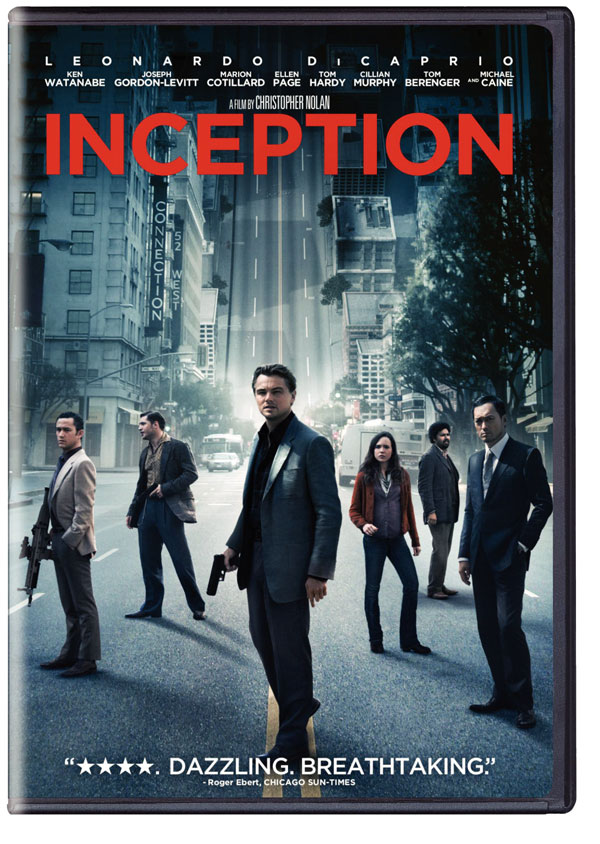
Hello, Inception.
Inception is one of those movies where really, seriously, I have no idea why it took me so long to see it. I was really excited by those trailers, back when nobody had the first damned idea what the movie was about, but those visuals. Well, it was probably a number of reasons that kept me away. Summers are notoriously tight on money for me, what with the AC bills. I still feel an adversarial relationship with most people who go to the movies these days. So anyway, when it came out on DVD, it was the very first Blu-Ray I ever bought, even before I had a player – one of those Blu-Ray/DVD combo packs – so I was probably, subconsciously, waiting until I could watch the Blu-Ray.
Hm.
Probably, most of you know the basic concept, at least, of the movie by now. An “extraction” is the high-tech corporate espionage term for stealing information from a person’s brain while they dream; an “Inception”, then, is the placing of an idea in a person’s brain while they sleep. Much more difficult, and, in the world of the movie, next to impossible. But Leonardo DiCaprio, in order to get back into the country legally (a situation teased out over the course of the movie) is willing to give it a shot.This will require taking his team three dreams deep – a dream within a dream within a dream – to accomplish it. To complicate matters, the target’s mind has been trained to resist such antics, and his resistance takes the form of unrelenting gunmen. And the reason for DiCaprio’s expatriation – his dead wife – keeps cropping up to screw things up, which eventually requires going into a fourth level of dreaming – possibly even a fifth.
This is a real mindfuck of a movie, and I totally respect that. One needs to pay attention, or one is going to get lost. To Christopher Nolan’s credit, it isn’t that hard, if you keep your wits about you. The rules and conventions of this dream invasion stuff is laid out for you, as you need it, causing Joe over at the Daily Grindhouse to call this Exposition: The Movie. Well, we need that information, and it is played out so matter-of-factly, and in easily digestible chunks, that it’s never intrusive, and never slows down the story.
Inception is pretty close to being a perfect movie. Everything is in its place, everything serves a purpose. As far as possible, Nolan keeps his special effects in-camera, heightening the sense of realism, even when that realism starts getting elastic. I’d say it was worth the wait, except the wait served no real purpose.
By way of coda, after my wife and I had finished watching it, she said, “Well, what was the point of that? Be sure to choose good dreams?” to which I could only reply, “I don’t think movies have to make a point. I’m personally willing to just let a movie take me somewhere else for two hours.” Which it did, and that brings us full circle. I let art wash over me, and I was refreshed for it.
I really need to start just writing about movies one at a time again. This is getting grueling.
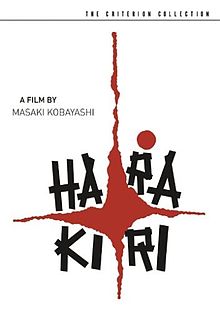
So, about a month back, I shared a couple of lists of movies I intended to watch this year. There was a list of 30 Quality Movies and a list of 30 Movies of the Type I Usually Watch (but have been putting off for one reason or another). The first list, I want to have 15 watched by the arrival of Summer. I am pleased I have finally knocked one off that list; and it was Harakiri (1962).
Harakiri was recommended to me years ago by a movie buff (and compared to this guy’s encyclopedic knowledge, I was an infant) while we were discussing Kurosawa. I was lucky enough to have seen The Seven Samurai and Yojimbo at the impressionable age of 13 or 14 during one of PBS’s World Cinema series. This was back around 1972 or so; for many years, that was it for samurai cinema for me. It wasn’t until the VHS revolution – and my move to Houston – that I was able to see Sanjuro and Rashomon. I was aware there were other Samurai movies out there, but where to start?
Well, one day I brought home a rental tape called Shogun Assassin and holy shit, to put it succinctly. So action-packed and kinetic, it literally ruined me for samurai flicks for many years. I was aware that Assassin was two movies mashed together, but I was still unable to shake the feeling that any other chanbara I saw in this time was slow and plodding.
Well, I’m older now, and am myself slow and plodding. I can now appreciate a movie with more deliberate pacing, and stories that slowly unfold themselves, which is a fair statement about Harakiri. It is also ironic that I go from that set-up to what is unarguably an anti-samurai film.
Harakiri begins with a ronin – a masterless samurai – presenting himself at the house of the Iyi clan, asking permission to use their courtyard to commit harakiri – ritual suicide – in honorable surroundings. The counselor of the house, in charge while the Lord is away, attempts to dissuade the ronin by telling him the tale of another ronin who, earlier that year, made the same request. At the start of the Tokugawa Shogunate, the houses of many provincial lords were summarily dissolved under a number of pretexts, suddenly casting thousands of samurai into unemployment. A current trend of ronin asking to commit harakiri has become a very real problem among the daimyo, who usually just give the ronin a few coins and send them on their way.
The House of Iyi, however, feels itself above such extortion, and forced the young ronin to go ahead with his threat and disembowel himself. In an extra piece of unfeeling cruelty, when the Iyi retainers found the ronin had pawned his swords and was carrying bamboo replicas, they force him to use his blunt wooden wakizashi to kill himself.
The older ronin is unimpressed by the story and emphasizes his desire to die rather than continue his life of abject poverty. The Counselor grants his wish, and once in the courtyard, the ronin asks for a specific Iyi retainer to act as his second, to strike off his head after he has cut his guts out – in fact, the same samurai who acted as the second for the younger ronin, and who ramrodded that unfortunate man’s punishment. He is found to be absent, at his own home, claiming illness. Two more seconds are requested, each of which played a major part in that earlier humiliation and death; each is also absent.
The ronin then reveals that he did indeed know that younger man, that he was, in fact, his son-in-law – and proceeds to tell the tale of their fall from grace with the dissolution of their clan, their attempts to eke out a living in the capital city. Disaster strikes in slow motion: first, his daughter contracts tuberculosis, then his infant grandson is striken with fever. There is no money for a doctor, and the son-in-law desperately tries the one course he can see open to him – the harakiri scam, which might at least garner him the few coins needed for a doctor, or at best – as is rumored to have happened – offered a place in the clan. Unfortunately, he chose the wrong clan.
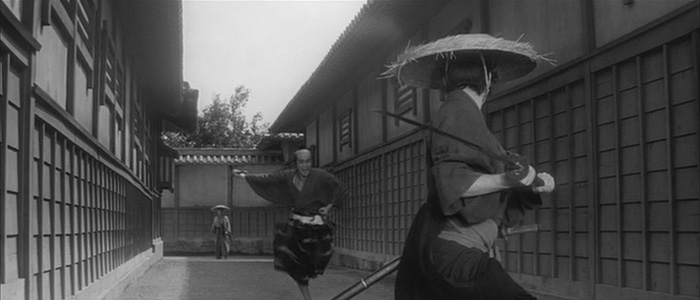
The story is teased out in flashbacks over the course of two hours; the older ronin’s revenge is spelled out, and is at once most satisfying and appropriate, as well as devious, making his point to the assembled retainers, that samurai honor – bushido – is a thin facade which diminishes life, when life is really all that counts. The storytelling is masterful and often harrowing; the suicide with a bamboo sword is equally as brutal and painful as the scene where the older ronin realizes his adopted son sold his swords to get medicine for his ailing wife – a solution that had never even occurred to the older samurai.
One can’t truly call Harakiri a chanbara – a sword-fighting film. There are two major fights, both at the end, one magnificently artistic and satisfying, the other messy and desperate. The overall feeling left the viewer is a sense of desperate futility, as the clan efficiently engineers a cover-up, rendering all the courage and suffering we’ve just seen superfluous and useless. Like all classics – and undeniably, Harakiri is one – the story is timeless, though set in the past. Thousands of people suddenly rendered unemployed by thoughtless, unfeeling Powers That Be – that doesn’t sound at all familiar, does it? And good lord, the scenes with the family realizing the baby boy is getting sicker and there is absolutely nothing they can do because they are poor – that hits way, way too close to home.
Yeah, it’s a classic. Don’t think I’ll be re-watching it on a whim anytime soon, though.
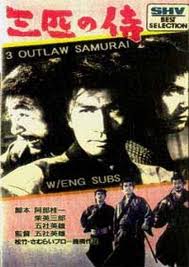
Small wonder, then, that I felt the need for somewhat lighter fare the next day, and what did I have to hand but Criterion’s new Blu-Ray of Three Outlaw Samurai (1964). I’m still in the beginning stages of my tour through chanbara, and Three Outlaw Samurai is the first movie of director Hideo Gosha, a name to be reckoned with in that field.
This movie is a sort of prequel for a popular TV series, an origin story of how the three title characters first meet. The first surprise is that the main ronin of the three, Shiba, is played by Tetsuro Tanba, who was also Omodaka, the samurai douchebag of Harakiri. Tanba had a pretty fine career stretching from the 50s to the 20-aughts, apparently acting up until his death in 2006, at the age of 84. Seeing the contrast between, at the very least, these two characters gives you some clue to his longevity.
The second surprise – okay not really a surprise, the Criterion Collection put it out, after all – is just how damned good this movie is, though good in an entirely different way than Harakiri. This is fine entertainment, with echoes of a good Western. At times I felt like I was watching another Sanjuro movie, and that is a really, really good feeling.
Three Outlaw Samurai starts – like Yojimbo – with Shiba wandering aimlessly, and happening upon an abandoned mill where three peasants have taken the local Magistrate’s daughter hostage to force the corrupt official to address the crushing taxes that are slowly starving the villagers in the area. Shiba acts disinterested in the whole matter – he only wants a place to sleep – until the Magistrate’s thugs arrive and assume he is a part of the plot, and Shiba has to administer a samurai butt-kicking to protect the roof over his head. Finding the peasant’s cause to be righteous, he wholeheartedly casts his lot with them. Meantime, the Magistrate is cleaning out his jail cells and offering amnesty and cash rewards to the criminals to go to the mill, kill everyone, and get his daughter back.
One of the jailed is Sakura, our second samurai, who switches sides once he finds out the peasant’s complaint; the third is Kikyo, a mercenary more interested in the money the Magistrate doles out than any moral issues (don’t worry, he’ll eventually come around, thanks to Shiba’s sterling example). It’s a lightning fast story of betrayals, double crosses and ultimate tragedy that ends with our three outlaw samurai, united in friendship, tossing a hairpin into the air at a crossroads to decide where they’ll go next. I can only assume that the series was like Route 66, except with samurai, which sounds like the Best Idea Ever.
So despite the fact that I have these two lists of movies I have sworn to see, the next night I was still in a martial mood, so I finally pulled out that DVD of The 300 Spartans (1962).
I love the story of the Battle of Thermopylae. I loved Frank Miller’s graphic novel, 300, even with its flaws and disregard for history. I did not like Zack Snyder’s movie version, which amplified those flaws a thousandfold by dressing them in a tenuous version of reality.
In the first fifteen minutes of The 300 Spartans, we have acknowledgement of the Battle of Marathon and the Athenian Fleet, which already makes it a thousand times better than 300. Unsurprisingly, Sir Ralph Richardson makes a great Themistocles and Richard Egan a rugged, honorable Leonidas (made even better by not being directed to shout all his lines).
Sure, the speech is elevated and florid, but I expect that from the Ancients. David Farrar brings more than a little comic book pulp to his Xerxes, but then, he’s the bad guy. I found the battle scenes and tactics realistic enough (I did a lot of tooth-gnashing at the Spartans breaking ranks to do individual slow-motion combat in 300. The Spartans were known for their close-quarter formations, not for their grandstanding) And… oh my God! ARMOR! Weren’t the Spartans supposed to lug something like 100 pounds of armor into battle? Not so much armor in evidence here, but at least they’re wearing some, which is more than I can say about 300. Frank Miller wanted to emulate the paintings on Greek urns. That’s a fine artist’s conceit, but translated into film, that just means a lot of oiled musclemen prancing about.
I will admit when I first saw the DVD cover art, my first question was “Why are these guys wearing Roman helmets?” Well, likely because they’re the leaders, and the Roman style was more open in the front, so we could see their faces. So I can’t really crow about the historical accuracy of this version either… but hey, dat’s da movies for ya.
So in effect, my weekend viewing was quite the gratifying affair; three good movies, movies I can recommend whole-heartedly, and without falling back on the cautionary phrases I usually have to employ for movies like Things or Darktown Strutters. If you want excellent drama, go for Harakiri; epic historical fiction, The 300 Spartans; entertaining action with intriguing characters, Three Outlaw Samurai.
It’s rare that I get three movies of such quality in a row. Hopefully, this is, as they say in Ancient Greece, a good omen.
This is an Election Year, and I am tempted to just keep that title for the rest of the year, which I’ll likely spend pretending to not be a member of the human race. Have you looked at the paper lately? It’s scary out there.
But this is not about politics. I will freely discuss this morning’s bowel movements before I will discuss politics, and let me be frank here, I will not discuss this morning’s bowel movement. Banging my head repeatedly into a brick wall is preferable to discussing politics, as the brick wall will let me stop, yet the end result is the same.
So now that I’m discussing politics, let me segue smoothly into what this is actually about, which is what I did on President’s Day.
Now, I realize that I am a poor excuse for an American because I did not buy new furniture on President’s Day, which is apparently the traditional method of celebration. No, in a series of mishaps and professional obligations, there had not been a Crapfest in many months. Some of us felt this absence quite keenly, and bemoaned the fact that there was a major project at Main Street Theater that was taking host Dave out of the equation through March.
Then Dave remembered President’s Day.
That was going to be a day off for him, and for Alan, who is another actor who wouldn’t be doing children’s shows on a school holiday. I work at a State college, so I was also free for that day, and the economy had finally caught up with Rick, who was unemployed, or as he put it, “Finally free to find a decent job.” Paul and Jeff had to work, as they are employed by Nazis who care nothing for our great country’s heritage and furniture shopping. The Other Dave had to bow out at the last minute, dealing with a flu epidemic in his household.
So there was just the four of us, the original four. Haha, how we laughed at the others, and indulged in the sudden glut of fabulous junk food that had brought in anticipation of a crowd twice our size. We were the Hardcore of the Apocalypse!
And, judging from the way the evening played out, we were determined to put that to the test.
As we counted coup, doled out the chips and various dips and party trays, the Warner Archive disc of The Mighty Mightor and Moby Dick played in the background. Yes, the glorious days of a caveman superhero and a literary giant reduced to fighting supervillains with two teens named Tom and Tub. You can safely assume Tub was the fat one.
Dave then started the ball rolling with… oh God… with… (just take a deep breath and say it) …Jokes My Folks Never Told Me. You will get nervous during the opening credits when you notice the number of Woolerys involved in this production – not one of which is Chuck. This could generously be called a sketch anthology movie in the vein of Kentucky Fried Movie, though lacking the wit, originality, or energy of that movie. The script for Jokes is apparently taken from one of those “adult” joke books I kept seeing in bus terminals back in the 70s. The reason your folks never told you these jokes were a) your parents likely had some wit and taste, and b) they knew how pathetically ancient the jokes were, and assumed they had long ago been buried in the cornfield.
Actions which – in the source joke, in its original form in that joke book – would be glossed over with a few words, are played out in real time to pad the running time. There are plenty of naked women to make sure you don’t demand your money back, yet not enough to dull the ennui that somehow also cuts like a knife. Here’s a couple of clips. Don’t click on them.
YouTubes of this movie come and go, so let’s see how long these last, especially that NSFW first joke. The second joke is significant, I am told, because the teen is a young Anthony Keidis from The Red Hot Chili Peppers. That is still no reason to click on these clips, which, incidentally, you should not do.
FOOL! I TOLD YOU NOT TO DO THAT! Well, now, imagine this going on for 82 minutes. I also swear that the movie was actually three hours long. In fact, Dave was surprised to discover that the second gorilla sketch was NOT the end of the movie, and that it in fact went on for another twenty minutes/years.
I took this photo of Rick at the very moment his soul left his body, after about the third “Farmer’s Daughter” sketch:
Dave claims he was introduced to this movie at the age of 12 by some hellspawned classmate whose parents had Showtime or something. Dave is also a horrible War Crimes Nazi whose word cannot be trusted in any way, manner or form.
We started doing serious damage to Dave’s vodka supply during this, and decided to cook up the pulled pork Rick had brought to fortify ourselves, and to let scar tissue develop over our raw, bleeding psyches after Jokes My Folks Never Told Me. During this, we played Sh! The Octopus which I was introduced to by Sandy Peterson at the last T-Fest. Sh! is a darned fine parody of Old Dark House movies, made during the heyday of old dark house movies, featuring some jokes the Three Stooges would later rip-off and that odd comedian who goes “Woo hoo hoo! Woo hoo!” during old Looney Tunes. It is also available from Warner Archive, a gesund on them.
It was also apparently too full of quality, as it was pulled off before finishing, even if it is only about an hour long. Too bad, as we never got to the best damned part of the movie. THIS IS A TREMENDOUS SPOILER, so don’t watch it if you ever intend to see Sh! The Octopus or if you have a head full of drugs:
And what did we take Sh! The Octopus off to watch? Things. This is bitter irony at industrial levels of bitter.
There is an alternate timeline in which I never fell in with the Daily Grindhouse guys, and in which I never saw Things. This alternate me is much happier, and does not have the pale, haunted look which I now sport. Things is a Canadian straight-to-video horror movie, from the spectacular salad days of Canadian straight-to-video horror movies. By which I mean a couple of metalhead hosers decided they liked horror movies, so they should make a horror movie. How hard can it be, eh?
Things is made on Super 8, the sound is almost totally dubbed, the music editing is done, charitably, with a hatchet and scotch tape. In order to get some name recognition for the box, they gave porn star Amber Lynn $2500 to play a news anchor and to read some cue cards which get further and further away from the camera. The only bit I can find on YouTube is a mash between one of Lynn’s more lucid news bumpers, and an appearance by star/producer Barry Gillis on actual Canadian TV to pimp the movie:
Thank your lucky stars that there’s no more of Things on YouTube. This movie is maddening. A horror movie plot is set in place, which is then studiously ignored for most of the movie. Excuses like “Dream logic” and “surrealism” are tendered in its defense – and the trouble is you can almost buy that. Why would characters be doing strange, nonsensical things in these circumstances, unless the script meant them to? Is there even really a script? Is this genius, or hackwork?
If I were to go through every bizarre … thing… in Things, we would be here all night. Here’s The Daily Grindhouse podcast that started this misery. Joe Bannerman says I sound defeated throughout. That’s a fair assessment. I can tell you it hit Crapfest like a neutron bomb. Alan’s brain seemed to shut itself down in self-defense. His wife would later ask us what we had done to him. “Destroyed his ability to ever again feel joy” was the answer.
Curse you, Canada. You fight dirty.
There really is no way to follow up Things; everything tastes like ashes. Dave put on possibly the only thing he could, which was Superstar: The Karen Carpenter Story. This is the short film that traces the professional life of Karen Carpenter and her ultimate death due to anorexia nervosa – and it’s all done with Barbie dolls. Despite that, it’s a serious look at the disorder, and quite sympathetic to Karen, although this is accomplished by making everybody else unsympathetic. The work with the dolls is pretty remarkable, especially the sets. However, filmmaker Todd Haynes didn’t get permission for the umpteen songs used on the soundtrack, lost a copyright infringement suit, and all copies of the movie were ordered destroyed (though apparently MoMA keeps a copy it cannot show). Therefore, WE WERE STRIKING A BLOW FOR LIBERTY ON PRESIDENTS DAY, YO.
Alan excused himself about midway through Superstar; he had early morning shows the next day. He was currently involved in Jackie and Me, which is about Jackie Robinson breaking the color barrier in baseball, and he was apparently playing Utility Racist #1. Too bad he left early, because we finished up the evening with something Rick had been plugging for a long time, and I finally came over to his side after hearing a Projection Booth podcast on it: Darktown Strutters. If he’d stayed, Alan could have picked up some Racist Tips.
Holy cow.
The Darktown Strutters is a small (four members) female motorcycle gang who all ride trikes and have impressively outre helmets. The leader, Syreena (Trina Parks, who played Thumper in Diamonds are Forever) is looking for her missing mother; she joins up with a street gang/doo-wop gang, finds out the corruption goes deep into the police’s reactionary Alert Squad, and is led by the local philanthropist/food magnate, who is a dead ringer for Colonel Sanders.
That short synopsis sounds like pretty typical blaxploitation fare, but what it does not tell is how bugfuck insane this movie turned out to be. This is basically a human cartoon, complete with sped-up foot chases and comedy sound effects. It is so far removed from reality that at its most racist, it somehow doesn’t seem too mean-spirited, and believe me, this movie is racist against everyone. At one point I opined that this was actually the movie Robert Townsend was in at the climax of Hollywood Shuffle, where the white director is telling him that his pimp character should thrust his butt out because “You know how those people walk.”
It is one bewildering moment after another; The Colonel has the world’s smallest cotton patch in his front yard, faithfully being picked by compliant darkies clad in Antebellum clothing, and numbers among his servants ringers for Aunt Jemima and Uncle Ben (in fact, Aunt Jemima hands out huge pancakes to be used as throwing weapons in the final fight scene). Syreena, escaping the extensive dungeons under the mansion, comes upon The Dramatics, in a cell, who proceed to sing a medley of their hit, “What You See Is What You Get”, while Syreena grooves nearby (that particular alarm system certainly stopped her escape). There are Klansmen on motorcycles. The Alert Squad has a light the size of a Volkswagen atop their car. And, of course, the fat cop who is always getting stuck in the back seat of that car (and any doorway he encounters) is named Officer Tubbins, which is surely the best name since Porkins. Or maybe he was meant to be the character from Moby Dick, all grown up.
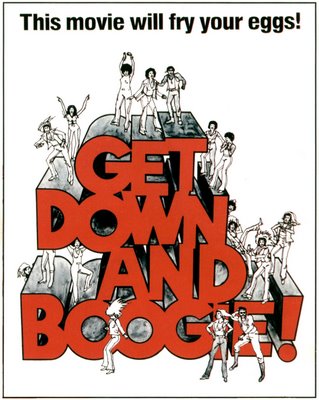
This is where Darktown Strutters – which was later re-titled Get Down and Boogie when it became apparent that no one wanted to see a movie named after a somewhat racist Ragtime standard – becomes a worthy follow-up to Things: is it a parody of blaxploitation movies? Or merely the worst blaxploitation movie ever made? (I still say that’s Blackenstein, but that’s a discussion for another day – we’re already over 2000 words here).
This movie will WHAT?
After Darktown Strutters, Dave, Rick and I just sat there for a while, silent, stunned. It had been a brutal evening, to be sure. Usually Crapfests are punctuated by at least one movie that is enjoyable and affirming in its own way – the musical version of Jack the Giant Killer, the unfettered mayhem of Shogun Assassin… this time, though, it was three movies that probably shouldn’t exist, for which there is no good reason, and we felt like we had gone ten rounds with Rocky. Dave later said he hadn’t felt that whipped since we had sat through an evening composed of three movies by or featuring Graydon Clark.
I wish to point out that was Dave’s brilliant idea, and everyone regretted it. Except for Rick, who finally got to see Joysticks again.
I felt tired, but it was a good tired. In a lot of ways, it was facing the worst life had to throw at you, and coming out the other side, shaken but alive and triumphant. There will some day be another Crapfest – and hopefully we will have some movies that have actual plots – but when those who did not attend complain about the movies, we will look at them from our battle-scarred heights and intone, “Fuck you. I’ve seen Things,” but only because it would take too long to say “Fuck you, Tinkerbell, I saw Jokes My Folks Never Told Me, Things ANDDarktown Strutters all in the same day.“
As you may have noticed, I am now the owner of the elusive “drfreex.com” domain. Surely wealth and fame are just around the corner now.
Sorry, I just convulsed myself with laughter. I’m better now.
Having taken the more than slightly egotistic plunge of buying my own name – or at least the faintly ridiculous nom de guerre I devised one sleepless night in the 90s – I find myself thinking I should be doing more with this blog. what the living hell that should be is beyond my monkey brain.
I really admire people who update their blogs daily. I tried that once and the results were pulse-poundingly banal. In fact, I think all I did was bitch about my job at the time. It may have made me feel a little better to vent, but I can’t imagine that’s the sort of thing that builds up an ardent readership. I like my current job a lot better, and I think it’s been quite some time since I’ve used the “Seething Impotent Rage” category.
I’m still filled with Seething Impotent Rage, mind you now, but it is about the usual things, as in a fuckton of stupidity being paraded through the much-derided mainstream media disguised as leadership. That ain’t gonna change soon, and I am considering moving into a cave – with a really long extension cord – until, say, next December. In a whole lot of ways, I wish the panic-crows are right and the world ends in December. The people who want to run my life (and their apparently endless hordes of willing cannon fodder) are not giving me a whole lot of hope for the future.
But thinking like that makes my head hurt.
Well, now that I’ve already punched the Seething Impotent Rage button, let me continue with this vintage glass of White Whine: what the hell is this weekend that everybody is talking about? They sound really nice. I wish I could have one.
Just to illustrate what I mean: tomorrow – Saturday – I will get up and travel to the 1940 Air Terminal Museum for their Chopper Day event. “Chopper” as in helicopters and motorcycles. I seem to have become the go-to guy for motorcycle stories here. All this really does is make me miss my motorcycle-ridin’ days. However, the weather report calls for rain, rain and more rain, so we’ll see how successful this story will be.
That evening, I have a show. I almost always have a show on Saturday. Having a shoot on Saturday morning also means I have a chance of being extra-gimpy for that night’s show. This is also the last Saturday night for Shadowlands.
Sunday, I have been given a break, and won’t be performing at the early church service. The possibility of sleeping in a bit leads into the Sunday matinée of Shadowlands – the final performance – and then we get to spend the evening striking the set. Since I shouldn’t be trusted with dangerous tools, I will likely be carrying cast-off set elements to the dumpster, loudly declaiming that I’m certainly glad I went to college so I could avoid manual labor.
But what do you know, I work at a State institution, so President’s Day is an actual holiday for me. There will perforce be a Very Special Crapfest, with other actors with a day off. True, not being salaried, I’ll be making up those hours with longer days the rest of the week, but at least that ends up with …another weekend that I get to work through. Crap.
And so, by starting off with an explanation of the type of blog post I hate, I have managed to create a blog post of the type I hate. Guess I needed more irony in my diet.
EARLY MORNING SUNDAY UPDATE: I decided to sit on this one for a bit, not sure if the Impotent Seething Rage was unseemly or not. I guess we now know the final decision on that.
whitewhine.com - because you're not depressed enough yet.
Yes, Chopper Day was rained out. But the website said “Rain or shine”, so I decided to go to the museum and see what their Plan B might be. Plan B apparently involves standing around and looking at anyone who walks in the door as if they were insane. As I Tweeted, Oh, well, maybe I can find a nice bake sale to cover, somewhere.
Still exhausted when I finished last night’s show. I think one of my oldest friends was at the show last night, but we missed each other somehow. I am nagged by the thought that I should have tried harder, should have swept through the theater at least one more time, but my exhaustion, the 40 minute drive home, and my increasingly insistent cough won that argument. I may have gotten a halfway decent night’s sleep last night. I don’t know, I wasn’t paying attention.
Fairly early Sunday, as I type this addendum. I’m likely going back to bed, having eaten my oatmeal and morning pills (protip: don’t get old). This week is going to be a chore, and I need all the rest I can get.
Okay, last week I daringly shared my list of 30 quality movies I fully intended to watch (or rewatch) in the coming year, with a rather optimistic goal of watching half of them by the Summer. I also made oblique mention of another list.
Look, I can’t go cold turkey off the stuff I usually watch. Can’t, and won’t. I fully realize that watching every single Kubrick film in one go is a dangerous enterprise. All that clinical artistic detachment would be likely to start a horrific (but meticulously controlled) psychotic episode. So there is an alternate list of more questionable *harrumph* fare that I can use as a safety valve.
Again, the ground rules are similar. All are movies I own (in some cases, for years) . I must have not seen it – no dispensations for viewings a decade or more in the past, as with the Quality List. There are some movies on this list that could have easily gone on the former list, but are marginal enough that I plopped them on this one.
1. Americathon – the first of several Warner Archive discs on this list. Rather surprised no one’s attempting a remake of this one yet, given the events of the past decade.
2. The Big Doll House – well, I saw The Big Bird Cage years ago, it’s high time I did the predecessor.
3. The Rats Are Coming! The Werewolves Are Here! – What has to be my favorite Andy Milligan title, for a movie I’ve never seen. I enjoy Milligan’s threadbare period pieces far more than I should.
4. The Cell – so I can finally get Dave off my ass about not having seen it.
5. Jackie Brown – yeah, yeah, for a Tarantino fan, I sure have dropped the ball on this one. On top of that, it’s the one everybody seems to love. The first one that easily could have gone on That Other List.
6. Cleopatra Jones and The Casino of Gold – another Warner Archive offering.
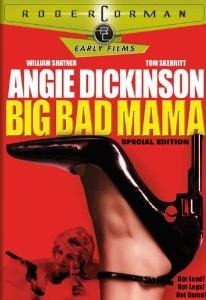
7. Big Bad Mama – Angie Dickinson and William Shatner embarrassing themselves in a Corman-produced Depression crime/exploitation flick? Sign me up. I have the disc that identifies this as one of “Roger Corman’s early films”. Should really try to get the Shout! Factory version.
8. El Mariachi – I know, I know, what rock have I been under.
9. Drive Angry – picked up the Blu-Ray at a Black Friday sale for like 4 bucks. Screw you, I like Nic Cage. Speaking of which:
10. Bad Lieutenant, Port of Call: New Orleans
11. Vigilante – a part of exploitation cinema I’ve been missing out on.
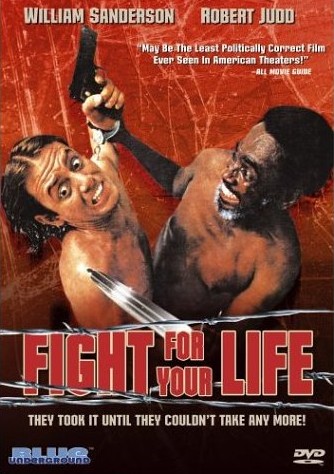
12. Fight for Your Life – same as the above. Also similar in that I only theoretically own them, as I am still waiting for them to arrive from the legendarily tardy Horror Movie Empire.
13. Eyes Without A Face – I am told this also could go on the Quality List. Having not seen it yet, I can’t really say.
14. The Fountain – I’m told this should be on the Pretentious List, but I don’t have one of those.
15. Johnny Firecloud – owned for years. An incredibly mean-spirited revenge drama, by all indications.
16. Dark of the Sun – Warner Archive again. Some revival showings in LA got good press, and I tend to like movies about mercs.
17. Major Dundee – proving there’s still some Peckinpah I’ve never seen.
18. Machete – I know, right? I been busy.
19. The Reaping – another sub-sub genre I like but rarely see done well: biblical prophecy coming true.
20. Ravenous – shut up. I been busy.
21. [REC] – ain’t bothering with the American re-make. Ain’t gonna do it.
22. Shaun of the Dead- Shut UP.
23. Hot Fuzz – see number 22, above.
24. Snakes On A Plane – can you really blame me for not seeing this yet? Was there ever any way it was going to live up to that title?
25. Sucker Punch – then there are movies that I hear terrible, horrible things about, and I still have to see them because I have to make my own decision about things. I would really like to join in on the general lynch mob, but I have to actually see the movie first. Jonah Hex, for instance, is a total waste, but I still say nice things about Star Trek V and Robocop 2.
26. Then Came Bronson – yet another Warner Archive disc. I actually remember when the series, short-lived as it was, played on TV. Don’t remember anything else about it. And I really like Michael Parks.
27. Vanishing Point – the original version, dammit. Yet another I cannot believe I have spent my life not watching.
28. The Good, The Bad, The Weird – You knew some Asian oddity had to show up, didn’t you?
29. Ronin – One of John Frankenheimer’s last films, this has also been on the “to watch someday” list for a long time.
The more astute at this point might say, “But wait – this list is only 29 movies long, and The Other List was 30! Aren’t you short-changing yourself?” Well, thank you for being astute, but no, I haven’t. This is because last weekend I watched number 30 on that list, Horror Express.
Horror Express was pretty hard to miss on TV runs in the 80s, I’m told. Apparently it was on Elvira’s show more than once, in which case I probably passed over it. I was reasonably certain it would be cut under such circumstances, and TV cuts of horror movies usually wind up being worse than useless. Also, with the advent of VCRs and then DVDs, commercial interruptions to a movie’s flow became ever more onerous to me.
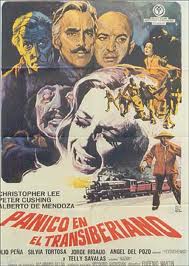
I found Horror Express to be a delightfully odd movie. The suspense was fairly nonexistent for the first act, but picked up considerably once the creature started moving through the train, and the eventual veering into science-fiction territory was very fresh, even if there was some questionable science on display. Christopher Lee was his expected powerful monolith, letting Peter Cushing have all the good lines. Telly Savalas was even more off the rails (so to speak) than usual. Still not certain about the rationale behind the resolution, but what the heck. An enjoyable 90 minutes, and the Blu-ray from Severin Films was absolutely gorgeous, showing only occasional damage around the reel changes.
Now the increasing pressures of the last few weeks and having a sick kid this week are beginning to show: a mild tickling in my throat is turning into a full-bodied cough, and I’m feeling a bit light-headed. I’ve informed my body it cannot get sick until next Tuesday, and even then there are scheduling pressures, but it doesn’t seem to be listening.
In other words, the more things change, the more they stay the same. Have a nice weekend.
We’re entering the third week of four in the production of Shadowlands at the Texas Repertory Theater. That means, so far, eight standing ovations in eight performances. I wish I could grab a bit of the credit for that, but I think it’s largely due to the performance of our C.S. Lewis, Steven Fenley. He’s wanted to play this role for years, and is by turns charming and then ripping his emotional guts out as the second act progresses. Here’s a link to a review.I got singled out for special mention. I’ll take that; after all, I’m a minor character, in only 6 scenes.
Your Long-suffering Narrator (left)
So in two weeks we’ll tear down the set. I’ll celebrate the next day – President’s Day, a State holiday for the college – with a Very Special Crapfest, then go back to spending my evenings trying to rough out that goddamn novel. At least until another, similar creative project comes along to distract me. The Wednesday following that Crapfest I’ll be reporting back to the dentist for should be my last major visit. Major because I’ll be losing the last of the worthless teeth and having a set of partial dentures slapped on, which will mean some pain and discomfort for a while, but I’m used to pain and discomfort from that particular region. Both my mother and grandmother had full dentures before they were 30 years old. Finally getting partials at the ripe old age of 55 is, I think, very much a victory.
It’s the ripe old age thing that’s particularly bothersome. I’m told that 60 is the new 40, but phooey on that. After spending two hours in the dental chair yesterday, I felt every one of those years. The dentist and assistant were concerned that I was dizzy and I had to tell them that no, I was simply stiff and my bum leg needed to loosen up, but thanks for your concern. Shadowlands has caused me a lot of pain in over-using that limb, but I think it’s gotten a little stronger through the exercise. Humor me.
It’s that, the dentures, the fact that I now take eight pills every morning and two at night. I don’t exactly have one foot in the grave, but reminders of my mortality are certainly stacking up. This is the sort of things that drives other folk to great things and lofty goals. Me, I just think about all the movies and books I haven’t gotten to, yet.
Now, I don’t generally do New Year’s Resolutions (mainly because I don’t need a special occasion to lie to myself). But this year, I swore that I would watch a better class of movie. I honestly don’t regret a lifetime watching crap and disposable cinema; I’m not going to apologize for something I love that also doesn’t hurt anybody else. But there has been an essential part of my education that has been lacking, So I’ve laid down some goals for this year, and I am going to do my very best to keep to them. Confidence is high.
First: I have to already own these movies. They’ve been sitting there mocking me long enough, as I pass them over to watch Scott Pilgrim for the 14th time. I made one exception here, but we’ll get to that. After I’ve gotten through what I already own, we can start considering acquisition once more, which would mean movies like The Rules of the Game and Solaris.
Preference is given to movies I have not yet seen, though The List has several that I simply haven’t seen in 20 or more years. My head is in a different place now.
There are 30 movies on this list. I intend to have half of them seen by Summer. I’m a bachelor this Spring Break, and I intend to use this opportunity to its fullest.
So, here’s my list. There are probably going to be a few “You haven’t seen _______? How is that possible?“s.
1. Fear and Desire – you are going to see Stanley Kubrick’s entire filmography on this list; my determination to see it all, in order, is what started this project. This is his first movie, which he disowned, and reportedly tried to destroy. Luckily Eastman House kept a copy of it.
2. The Godfather – haven’t seen it in close to 25 years.
3. Killer’s Kiss – Kubrick’s sophomore movie, luckily included as an extra in Criterion’s The Killing,
4. Ikiru – this is the only one I don’t already own. How the hell this is the case is, frankly, beyond me.
5. The Killing – seems to be acknowledged as the first “real” Kubrick film. Nope, never seen it.
6. Chushingura – The Loyal 47 Ronin
7. Paths of Glory
8. Hara-Kiri
9. Spartacus – Literally haven’t seen it in almost 50 years, and then it was on TV.
10. Inception – I know, I know. Sue me.
11. Lolita
12. The Hurt Locker – see number 10, above.
13. Dr. Strangelove – Probably the most recent of the ones I’ve previously viewed, only about 10 years ago.
14. No Country for Old Men – see number 12, above
15. 2001: A Space Odyssey – I seem to recall a more recent viewing, but I can only only definitely recall one 20 years ago, on laserdisc.
16. True Grit – the Coen Brothers version. See number 14, above.
17. A Clockwork Orange – ugly and brutal, I think it’s been more than 20 years.
18. While the City Sleeps – Fritz Lang noir classic. Never seen it.
19. Barry Lyndon – Never seen it.
20. Godfather II- Again, it’s been 25 years. I also have Godfather III, which I’ve never seen, but have been informed it is so terribly sad-making (and not in a good way) I think I’ll be able put that one off a while longer.
21. The Shining – never actually watched it all the way through. Keep encountering it on TV, but I like to see a) the whole thing; b) from the beginning.
22. The Last King of Scotland
23. Full Metal Jacket – saw it in the theaters in ’87
24. Heavenly Creatures – Please see number 16, above.
25. Eyes Wide Shut – not necessarily looking forward to this one, but a deal’s a deal.
26. Bonnie & Clyde – as a bona fide child of the 60s, how the hell have I avoided seeing this?
27. Black Orpheus
28. Drive – time to find out what all the shouting’s about.
29. Beauty & the Beast – the Cocteau version, dammit.
30. There Will Be Blood – see number 24, above. Looking forward to finally seeing what all this “milkshake” business is about.
In case you were wondering if I had completely lost my mind, there is another list of 30 Questionable movies I intend to see in the coming year. Maybe we’ll do that later. Right now I have work to do, and we’re over a thousand words.
I wish I could say I’d forgotten how tiring this work during the day, rehearse at night thing is, but honestly, my memories of life during my days as God’s Gift to Theatre (and self-delusion) are primarily of exhaustion and the crankiness borne of same. And desperation. And fulfillment, And drugs. And really good sex. Ah, good times, good times.
…
What? I’m sorry, what was I saying? Oh, yes. At this point we’re a little less than a week from opening Shadowlands, a play which is my – perhaps temporary, perhaps not – return to the Legitimate Stage. An old friend from the aforementioned Full Metal Theatre days called me up last November and asked me to come out of retirement – again – for the show (he did this almost five years ago with one of my dream roles, Van Helsing in Dracula). I had been chafing badly at the murder mystery dinner theater I normally do on Saturdays, where I am something of a big fish in a small pond. I’m doing shows I have been doing for damn near twenty years. It’s not truly acting anymore, more an exercise in timing, and worst of all, by my reckoning, for an often drunken audience who regards you as a sort of low-rent 3-D TV, something that can be talked over or to, as one does in one’s very own living room.
Nothing is worse than drunks when you are, yourself, not drunk.
So. This is not a stellar role, a main character. I guess it could be referred to as a featured role, as unlike the other actors who are not in the four main roles, I only play the one character. (Fine by me, I’ve certainly done my time in the utility player capacity). But I do also have to move set pieces.
Ah, there’s the rub.
Shadowlands began life as a BBC teleplay, which was then adapted to a stage play (and eventually the Anthony Hopkins/Debra Winger movie); the stage version retains the sweep of the teleplay, moving from pub to Oxford to Lewis’ study to Greece to hospital room and all points in-between. Usually this is done with lights and scrims and the like, but this theater has no fly space to bring curtains and the like in and out. Instead what we have are five screens – well, they are referred to as screens, but what they are is full-size replicas of the monolith from 2001 on casters., with different visual elements on either side. When the scale model was shown at first rehearsal, it was emphasized that it was important that this not “become a show about screen-moving”.
It quickly became a show about screen-moving.
No small amount of frustration there, but the last few rehearsals have been more about winnowing down the amount of screen-moving (especially once it finally sank in that it was impossible to have a scene occur while the screens were put in place – the damned things are the opposite of silent), and last night – a week before we open – we finally got back down to the business of working on the bits between the screen moves. You know, acting.
It was the most satisfying rehearsal I’d had since the beginning or the process, since the screens starting rolling in from the depths of the shop.
So back again tonight, still trying to figure out how to best come on and be the comic relief after the death scene, which is hard to ignore and always leaves me in tears (“That’s alright, I’m an actor… I can use this!”) . I guess I’m succeeding, because the dead woman sat in the house the other night and I heard her laugh.
You see, this is why I love the theatre… I get to truthfully say things like “The dead woman sat in the house the other night and I heard her laugh.”

 If there is anything I would criticize, it would be the movie’s length: at a little over two hours, I – remarkably – got tired of things blowing up real good (same thing happened to me with Terminator 2). There are at least two extended scenes that could be scissored without ruining the overall movie, but… that’s not up to me. It’s a bit lengthy, but still quite enjoyable.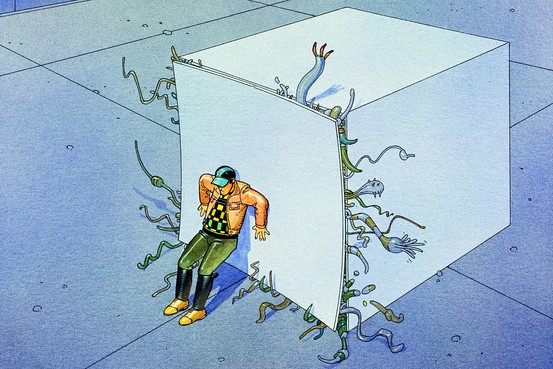






















 drfreex.com