Horrors, Netflix Style

Gadfreys, but I’ve been a lazy fellow lately. Just laid about, watching horror stuff. That’s not really an option this week, as I have to complete two stories, shoot a third, and do two acting gigs, so let me be pretty quick with this:

I used Netflix a lot during this binge. It appealed to my laziness as I didn’t even have to cross the room to put in a disc. First up, there was Nightmares in Red, White & Blue, subtitle “The Evolution of the American Horror Film”. Back in the day, i was going to write a book about how horror movies, and the political context of the times in which they were made. I don’t have to do that, because Joseph Maddrey did, and it is the basis of this documentary.

Nightmares is pretty well done; the experts providing insight include folks like George Romero, Larry Cohen, Joe Dante and John Carpenter, and Lance Henriksen providing some nice narration with the proper gravitas. The points made are very salient and well thought-out; it really is a very good treatment of the subject. Clips are plentiful. If there is a flaw, it’s that the period from the turn of the 21st century up to the doc’s year of release, 2009, seems rushed. Maybe the makers didn’t want to dwell on the era of torture porn, and I don’t blame them. This is a documentary I can recommend without hesitation, but you don’t have to trust me, have the first three minutes:

Followed that up with Celluloid Bloodbath, which is subtitled “More Prevues From Hell”. Yes, this is the follow-up to the well-regarded Mad Ron’s Prevues From Hell, which I will admit I never saw. Now, I will also admit that pretty much anything is going to suffer after a class act like Nightmares in Red, White, and Blue, but Bloodbath proves an exceptionally rough ride. The trailers themselves are great, and represent quite a few movies that haven’t been beaten to death in other comps, including rarities like The Baby, Psycho From Texas, Edgar Allen Poe’s Legend of Horror and a trailer for They Came From Within that makes you wonder how that movie ever got released in America (oh, that’s right – it was the 70’s. Never mind). The most high-profile picture represented here is The Exorcist.

The real problem with Bloodbath is the weakness of the host segments – we’re introduced to three of them, including a largely inanimate puppet, and then every sub-segment seems to have its own host – some of which seem to be taping their bits at convention tables. Some of the hosts handle their intros very well, a lot don’t, and the audio quality is all over the map. If you’re a real trailer goon like myself, you’ll tough it through those (and appreciate the good hosts all the more) for those lovely little mini-movies. Sadly the sheer number of the host segments makes Bloodbath ten minutes too long, outstaying its welcome.

I am keenly aware that there is a list of movies I have to work my way through by years end, so I roused myself from my indolence to put a disc in the machine, and that disc was Shaun of the Dead. No, I hadn’t seen it yet. Kids, this is what happens when you let an online game rule your evenings for seven years.

Anyways, as should be obvious by the name, Shaun is a zombie comedy taking place during a zombie apocalypse in England.  Simon Pegg is Shaun, Nick Frost is his childhood pal Edward, and Shaun just lost his girl over an Edward-shaped albatross. Then the zombies come.

There a great deal, in the beginning, of making Shaun squirm in his uselessness, and I don’t care for cringe comedy. But there is also an incredible amount of smarts in the staging (I especially appreciate the cast-off radio newscast at the beginning, about a deep space probe returning, a la Night of the Living Dead… which makes director Edgar Wright’s contention that the later line “We’re coming to get you, Barbara!” was unintentional ring a bit false…) as the preoccupied Shaun manages for quite some screen time to not notice that everyone around him has turned into zombies.

After the rescue of mom, former (and forever) girlfriend and a couple of hangers-on, our heroes retreat to a local pub to wait out the apocalypse. Once we’re in zombie siege territory, though, the movie takes a surprisingly grim turn, causing me to mumble, “This has suddenly turned into Dawn of the Dead.” Well, the lightness does return for our end, It’s not as intense or bloody as, say, Dead Alive – but then, what is? It’s a well-made movie for people who like some yoks but still want to see someone eviscerated at some point.

And that walk-on by Martin Freeman was quite a shock.

The inclusion of that damned mall music from Dawn of the Dead slays me every time.

Now, back to Netflix.

People have been praising Ti West’s movies, and the only thing of his I had actually seen was a segment of V/H/S I didn’t really care for. But, you know, some writers can’t really handle the short story form, but they really shine at novels. There are two Ti West movies on Netflix Instant, The House of the Devil and The Innkeepers. I felt like a ghost story, so I queued up the latter.

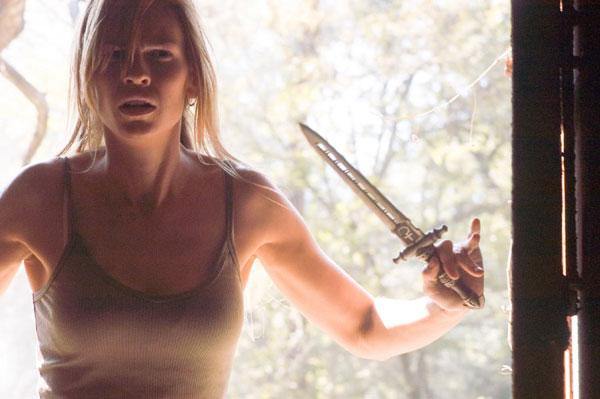
West’s reputation is as a purveyor of slow-burn horror stories, and for a good part of The Innkeepers you’re going to have trouble distinguishing it from a slacker comedy. Two twenty-somethings, Claire (Sara Paxton) and Luke (Pat Healy) are the only two staff members at the Yankee Pedlar Inn’s final weekend before it is slated to be torn down. Luke and Claire are trying to prove the Inn is haunted before it closed, though frankly they’re not trying very hard – ha ha, those aimless twenty-somethings, huh?

Quite a bit of the first act is spent humiliating Claire in various ways – the cringe comedy is back, folks, though of a particularly American flavor this time. Things finally start getting spooky enough to justify our continued attention, but it’s not until the third act that we really hit the good haunting stuff. The climax, in particular, is really, really good, it’s just that…

This reminds me of a Movie of the Week. One that really lucked out with its cast – Kelly McGillis is great as a former TV star turned psychic, and Lena Dunham has a nice cameo – and a writer who did the filler very well, but that’s just it – it’s filler. There is about as much true spookiness here as I would get from the typical Movie of the Week.

Nostalgic horror fans, those of us who’d sit through a lot of celluloid to finally get to the scare, will find a lot to like here. I can’t imagine anyone weaned on the modern horror movie, with adrenalin-driven editing and splashy FX, to have much patience with it. Overall, I liked it, but won’t be revisiting it anytime soon.

I should also warn you: this trailer has easily three-quarters of the scares in it. Just sayin’.

Okay, last one.

Prey I stumbled onto quite by accident; the Netflix blurb made it sound quite intriguing. And what do you know: the French are back again!

The opening is especially well-done: a rustic fellow is awakened by a dog barking. He gets dressed and rushes out, searching a cornfield for his father. He finds him, injured, apparently attacked by a deer. Venturing out of the field, the man then finds four dead deer, tangled in an electric fence separating the cornfield from the woods; whatever the deer were running away from, they were more frightened of it than the electric fence.
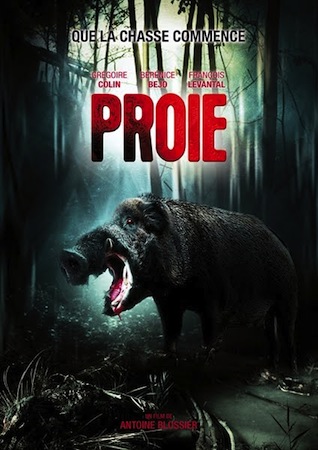
This is a better look than you ever get in the movie.

This isn’t your typical farm, though it started that way. One of the sons started a factory producing fertilizers and pesticides, and has bought all the surrounding land for the factory and his family; he’s the younger brother of the rustic man in the last paragraph. There’s a complicated bit of intrigue where the factory owner convinces – forcing, by dint of family connections – make his daughter, an accomplished chemist, stay at the facotry for another year, despite the fact she is pregnant. The two sons, their father, and the son-in-law go into the woods to hunt down whatever it was that’s killing deer. The son-in-law hopes to make the factory owner see the light, but that ain’t gonna happen.

In the interests of making this short: what we have here is a French version of John Frankenheimer’s 1979 movie Prophecy, which was based on a novel by David Seltzer, who also wrote the source novel for The Omen. The factory has been dumping its new formula in the estate’s lake, which has caused a massive fish kill and given birth to a pack of mutant boars – not bears, boars, totally different. And our four fellows are about the only things left in the woods to eat.

Prophecy marketed itself as “The Monster Movie”, and this is precisely what we have here. Our hunters don’t suss out exactly what is happening until well after dark, so the entire flick is like one long Jurassic Park in the tall grass scene, all unseen monsters charging around and squealing. The attack scenes are very well staged and quite tense; this is likely the movie Prophecy might have wished it had been. (Due diligence: I read the novel before the movie came out, found it turgid crap, and never bothered with the movie. I am told I made the right choice).

So. Prey. Good monster movie, worth it if that’s all you want. Be aware that, unlike Prophecy, they do not give you a good look at the monsters, and some folks don’t like that. Probably because they don’t remember that giant mutant bear puppet.
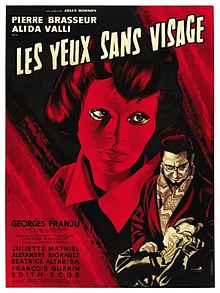
The Return of the French: Eyes Without A Face (1960)

In the halcyon days of my doing this regularly – writing about genre movies, specifically – when I was a contributing member of the B-Masters Cabal, there was once going to be a roundtable of movies that we hadn’t gotten around to seeing, you know, stuff that should be essential to our critical works, something like a science-fiction fan having never seen Star Wars, except not that outrageous. In my case, it would have been Georges Franju’s Eyes Without A Face, a fairly seminal horror movie.

Made in 1960, it has a plot that has been lifted several times since: a brilliant doctor doing research in tissue transplants has a terrible secret, hiding away his daughter, horribly disfigured in an auto accident which was apparently his fault. He and his assistant keep kidnapping young women and surgically removing their faces for transplant onto his daughter. Though, as mentioned, this is a plot that keeps being recycled throughout the 60s and into the 90s (witness Jess Franco’s remake Faceless), You get the indelible feeling during Eyes Without A Face that you’re definitely watching the original.

A brilliant, worldess beginning following the doctor’s assistant, Louise (Alida Valli) as she nervously dumps a young girl’s body in a river, is followed by a shrewdly low-key presentation of our basic story. Dr. Genessier (Pierre Brasseur) identifying the body as his missing daughter, then driving to his villa near his hospital, where we meet his unfortunate daughter, Christiane (Edith Scob).

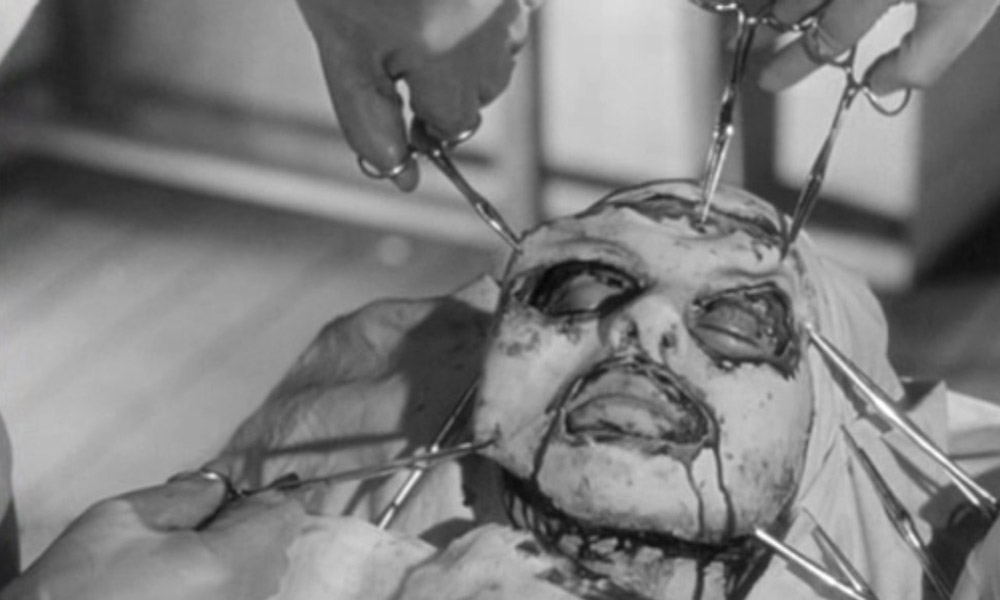
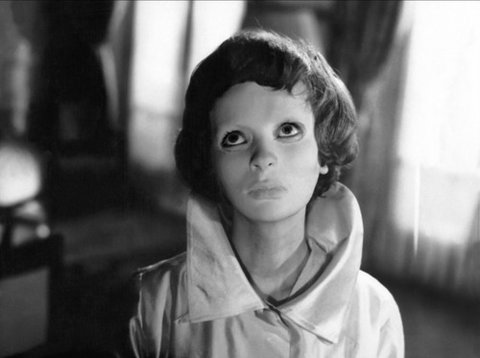
It is in the person of Edith Scob that the movie achieves true transcendence. We see her true face only fleetingly, when one of Genessier’s transplants seem to have worked, but only temporarily. The rest of the time we only see the back of her head, or an amazing, expressionless mask (cast from Scob’s face) which gives her an eerie serenity – at least until you see her eyes. Scob’s figure, dressed in a Givenchy gown, gliding from room to room in her father’s mansion is one of the more haunting images in cinema, that has staying power long after viewing. I am constantly reminded of Mia Farrow, personally, but that’s my 60s upbringing, I think. So striking is Christiane’s appearance that John Carpenter points to it as a direct inspiration for Michael Myers’ mask in Halloween.

The genius of the storytelling is in its unfolding. We have no explanation for Louise’s introductory corpse-dumping, but we are pretty darn certain something untoward is afoot (the bizarre carnivale noir music by Maurice Jarre is another good hint. It reminds me of “Ernie’s Holiday Camp” from Tommy, though what to make of that I am not sure). The story’s setup is teased out over the next fifteen minutes or so with the slow unhurried deliberation of fate itself. For this we can largely thank the writing team of Pierre Boileau and Thomas Narcejac,  who had Diabolique and Vertigo to their recent credit.

The role of Louise, the assistant in all this is shady, vague. We know Genessier performed some sort of operation that “saved her face”, and she wears multiple strands of pearls as a choker to hide a scar across her throat. It’s a tantalizing plot thread that is never played out (frankly, I was expecting to find out she was Christiane’s mother, who supposedly died four years before, but that’s how my twisted brain works). She’s necessary to Genessier’s procedures, of course, worming her way into the young girls’ trust before convincing them to step into the villa, where they are unceremoniously chloroformed and strapped to the operating table.

It’s inevitable that we’re going to get at least one surgery scene in a movie about face transplants, and, even employing the comparatively primitive effects of 1960, it’s still squirm-inducing. Apparently at its premiere in the Edinburgh Film Festival, it caused people to faint; subsequently released in the US under the title The Horror Chamber of Dr. Faustus, the scene is abbreviated with an optical zoom, but passed muster with the European censors pretty easily.

There’s another cut in that US version, and it has nothing to do with gore; it’s a scene in Genessier’s hospital, where the doctor is examining a young boy with a severe neurological affliction. He is nothing but gentle and caring in his interactions with the boy and his obviously distraught mother. That’s probably one of the deepest veins of horror tapped in Eyes; Genessier and Louise are decent people, whose love for Christiane drives them to do despicable, terrible things. Apparently the American distributor didn’t want to confuse the audience with such concepts.

Franju et Scob.

Genessier and Louise aren’t working from some meticulously planned villain plot, either, they’re obviously improvising as they go along. The first victim, who dies on the operating table is (as we’ve seen) disposed of by Louise in the opening; the second victim (who supplies the temporarily successful graft) survives, and her two kidnappers are at something of a loss as to what to do with her. She solves that by attempting to escape and either accidentally killing herself or deliberately committing suicide, we’ll never know. But their increasing desperation is becoming obvious, just as Christiane’s depression and desire to be allowed to simply die become more and more vocal.

This how Franju, when his producer (who was determined to prove French cinema could handle the realm of horror just as well as fantasy) advised him to avoid blood to prevent riling up the French censors, animal torture to avoid upsetting the British, and mad doctors to avoid pissing off the Germans… made a movie featuring all three. Franju insisted the movie was not about horror, it was about anguish… not only the anguish of the victims, but the anguish of decent people driven to extremes, and the anguish of the innocent person in whose name atrocities are committed. Eyes Without A Face, so simple on the surface, proves itself increasingly complex the more it is considered, and that is truly the mark of a masterpiece.

Let’s Go The Other Way

So after three movies of considerable quality, I felt the need to balance out my cinematic diet. And if nothing else, my collection has quite the surplus of films on the other end of that curve.
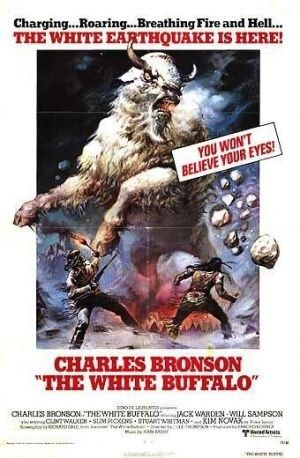
First up: The White Buffalo (1977), which is probably the oddest Jaws rip-off ever made. Charles Bronson plays an older, wiser Wild Bill Hickok who returns to an Old West that really doesn’t want him, or would prefer him dead. Hickok is  suffering from recurrent dreams of a gigantic white buffalo charging toward him, and he is chasing rumors of just such a beast into the Black Hills of Dakota during a gold rush. He is also suffering from syphilis, requiring him to wear smoked glasses in bright daylight. Many he confides in think the disease is eating into his brains.
There are historians who are going to take umbrage at that supposition; it is generally agreed that Hickok was suffering at the very least from glaucoma and possibly trachoma, common at the time; but it’s typical of the revisionist Western that the syphilis rumor is presented as fact, and is of a piece with the rest of the movie. A trip to the combination bar/brothel of a boom town is one of the most raucously filthy. smoky, noisy and chaotic scenes in a Western ever. I’m in no position to judge its truthfulness, but it does stick with you.

The upshot of the movie is that the White Buffalo is real, and is rampaging through the Black Hills as Winter approaches. One Indian village is destroyed by the beast, and a little girl killed: the daughter of the tribe’s War Chief, Crazy Horse. Until he can slay the buffalo and wrap his daughter’s corpse in its pelt, her soul will be tormented; additionally, his real name is taken from him until he can achieve this, and he will be known as “Worm”. Will Sampson plays the role with great gravitas and stoicism; he’s one of the best things about the movie.

It is, of course, inevitable that the two will team up to hunt the White Buffalo, and getting to that point makes for a pretty entertaining flick, as Hickok and Crazy Horse save each other’s asses and come to respect each other, mainly because neither one has any idea who the other actually is. Jack Warden tags along as Charlie Zane “The White Warrior of Sand Creek”… which, if they’re referring to the Sand Creek Massacre is not a compliment, but Zane is pretty much the spokesman for the Indian-hating white majority in the last half of the movie.

The major problem with The White Buffalo is that it’s two-thirds of a decent movie. It’s a very entertaining revisionist western whenever the title character isn’t around – there are some scenes where it looks good, but overall, the Buffalo isn’t one of Carlo Rambaldi’s finest creations. The first half of the movie has a bunch of fun cameos – Slim Pickens as a foul-mouthed stagecoach driver, John Carradine as (of course) the town undertaker, Ed Lauter as Tom Custer (George’s kid brother), Clint Walker as murderous trapper Whistling Jack Kileen, Stuart Whitman as a frontier pimp, and Kim Novak, making one of her last screen appearances as Poker Jenny, a reformed whore from Hickok’s younger days.

The final showdown doesn’t carry with it the same emotional grip and lift of Jaws. Director J. Lee Thompson, a long way from Guns of Navarone and Cape Fear, just can’t seem to make it click. But up to that point it’s diverting enough, and I don’t mind sharing its company every now and then.

I can’t really say the same about The Reaping, which is one of those movies I kept meaning to see but never did, so much so that it wound up on one of the lists of movies I will see this year. I had a pretty religious upbringing. It didn’t stick, but I know my way around a Bible, and instances of God taking physical action in this world is one of the things that has continued to intrigue me.

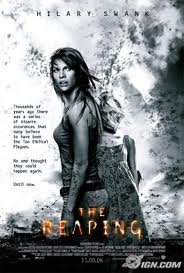
So you have Hilary Swank playing a woman who was once an ordained minister, but after a tragedy during her missionary work – blamed for the local famine, her family was murdered/sacrificed to the local heathen gods – she has turned her back on religion, and now, in fact, is a professional debunker of modern miracles. It doesn’t take a scriptwriting genius to realize that her character has yes, lost her faith, but is searching, however unconsciously, for something to rekindle it – only to find scientific explanations for everything.

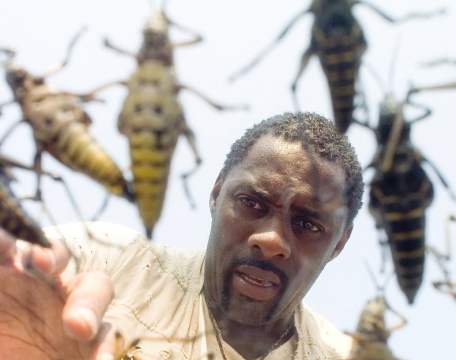
She – and her associate, played by Idris Elba (which gave me great hope) are called to a small Louisiana town where, apparently, the Old Testament Plagues of Pharoah are being played out. The river has turned to blood, there is a rain of frogs upon their arrival, cattle sicken and die – and blame is falling on a young girl from an outcast family on the edge of town. Swank, having lost her daughter to murder, is immediately conflicted.

The Reaping pulls out lots of gross stuff – instant maggots, lice (instead of gnats) boils, eventually a literal plague of  locusts, while the viewer drums his fingers and waits for Swank to regain her faith or something. Eventually she pieces everything together and sorry, I’m not going to tell you what’s going on. It’s not really worth the trip, but why should I be the only one to suffer?

The movie wants to become The Omen in its final act, then actually manages to pull off a fairly decent twist… which is negated mere minutes later by one of the lamest final twists since Big Trouble in Little China. I sincerely hope it was included at the insistence of some clueless little studio weasel who sniveled that there had to be a final twist, every horror movie has a final twist. Mainly because I don’t need more reasons to hate director Stephen Hopkins, who also dropped Nightmare on Elm Street 5: The Dream Child and the Lost in Space movie on us. He also did Predator 2, which I don’t hate, and The Ghost and the Darkness, which I really liked.

So screw you, nameless and probably fictional studio weasel. I hate you for that final twist. Hopkins, I glare at you for wasting a great cast like Hilary Swank, Idris Elba, David Morrissey and Stephen Rea, whose portion of the story makes no goddamn sense whatsoever given that decent twist I mentioned earlier…which brings us to writers Corey and Chad Hayes, who are also responsible for the 2005 House of Wax movie, and that dreadful version of Whiteout that mangled a good story by Greg Rucka.

And then I just sort of lose the will to live and go to bed. I don’t mind watching crap, unless it’s listless, boring crap. I’m going to give some props to the production for sticking it out in Louisiana when Katrina interrupted their shoot, because they knew that the local economy could really use the cash infusion brought in by a film production. I just wish the end result had been more worthy of that suffering.

So now I find myself in a bit of a quandary; in the aforementioned lists, I still have 27 movies left to go before December 31st. That’s not impossible, except that my life is a patchwork of part-time jobs and nailing down time to watch movies is more of a challenge than it ought to be. Still in the realm of the doable. But. It’s October. Everybody else is having fun watching nothing but horror movies. On The Lists, there are five, possibly six movies that could be classified as horror if I stretch the definition a bit.

So I suppose if I watch those, it still brings me down to 21 movies, and that should give me some leeway to watch some horror movies that aren’t on The Lists, right? Right.

Phew. Thanks for your help, I really appreciate it.

Accidental French Culture

It entertains me to find the pattern in things; they’re all around us, once you start finding them. I’m sure there’s some sort of perceptual Event Horizon that one can eventually cross with this sort of thing, where mere observation turns to insanity, but I haven’t quite crossed that threshold. I think.

One of these occurred to me just recently, when looking back over the previous few days, I realized I had just, without planning, taken in a weekend of French cinema. There are worse fates.

This gets kicked off last Thursday night, when I found myself waiting to watch a network TV show. This does not happen often. It was the premiere of CBS’ Elementary, and I have to give anything involving Sherlock Holmes a chance. (Okay, shortly: I liked Lucy Liu’s Watson, because I like it when the Watson character is actively involved in the story. I’m giving it another shot, even if I’m willing to toss the series under a bus for Jonny Lee Miller’s Sherlock talking during a live performance, because fuck people who do that)

I’ve never been able to get involved in Person of Interest, even though I really like Michael Emerson. A quick run around the dial revealed nothing of, um, interest (is it any wonder I don’t have cable?). The answer was upstairs, a Criterion Blu-Ray I had picked up a couple of weeks before at a used disc store, which contained Chris Marker’s La Jetee, which clocks in at a mere 27 minutes.

After a nuclear war, people are reduced to living in a series of tunnels under the city, Desperate scientists begin experimentation on prisoners of war, seeking to unlock a method of time travel which will allow them to acquire aid from either the past or the future. Our protagonist is perhaps the 40th or 50th person to be so experimented upon. He is given a high chance of success because he has an image indelibly burned into his mind: when he was a child, he was standing on an observation deck at an airport – the pier, or jetee of the title – where he saw a beautiful woman’s face seconds before a man in the crowd was shot and killed.

Using a method wisely left unexplained, the man begins to journey back to meet the woman for fleeting moments, visits which last longer and longer, until he is free to move about in the past. She accepts the oddness of his plight, referring to him as “her ghost”. At that point, he is sent into the future, to find if mankind has survived, and if they offer any information to help the struggling survivors of his present to reach their future safe point.

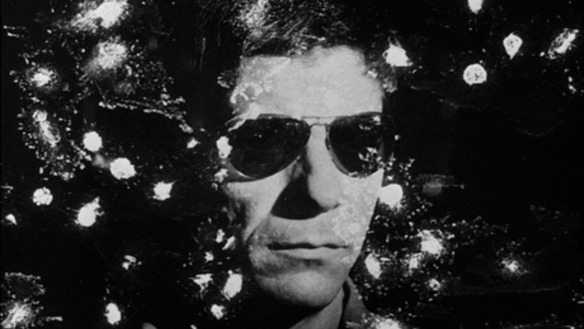
La Jetee is rightfully regarded as a masterpiece. Announcing itself as a “photo-roman“, it is composed almost entirely of black-and-white photos, appropriate for a story whose success depends upon the attachment of the protagonist to a single image. Once the viewer accepts this, the clarity and immediacy of photographs becomes the film’s strength. An associate of mine, looking at some photos I had taken with black-and-white film (which should tell you how long ago this was) remarked that there was something about black-and-white that made the images seem more significant. Whether or not this was because we were used to the regular monochrome of newspaper photography, I do not know – but the colorless worlds of La Jetee suit the doom-laden proceedings very well, and the single instance of a moving image provides a moment so laden with genuine significance and longing that it is perfect.

Yeah, I’m going to be the three millionth person to say La Jetee is brilliant.

You are lucky – you have already made the journey to the future, and La Jetee is available in its entirety on YouTube… in French. There is an English dub or two with iffy picture quality (yes, I have become quite the Blu-Ray snob), so you’ll have to make do with this excerpt:

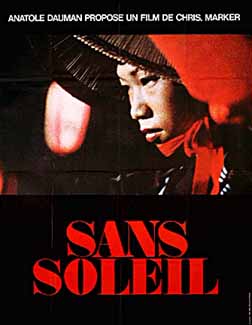
The next evening it was only logical to follow up with the second movie on the Criterion disc,  Sans Soleil, “Sunless” for those of you that flunked French. It’s named after a piece of music by Modest Mussorgsky, which is about the only clue you can hope for from me. Sans Soleil is the exact opposite of La Jetee: everything is movement and color. The female narrator reads letters from a globetrotting filmmaker, who goes unnamed until the final credits reveal him to be Sandor Krasna… who doesn’t exist.

Krasna’s letters obsess over memory and time, and a bunch of other things over a lot of footage of Japan in the late 70s-early 80s, occasionally zipping over to Africa and Iceland. It’s a dizzying kaleidoscope of cultural events, ephemera in odd places, snippets of Rintaro’s Galaxy Express 999, guerilla soldiers. The film opens with three girls on a country road in Iceland – the Narrator says that he will present only this footage bracketed by black frames, so the enduring image will be “happiness”. Only at the end of the movie does he reveal that the next day, a volcano will literally bury the girl’s village in ash.

Our fictitious filmmaker asks and ponders a lot of questions, philosophical eternals that have no real answers. Chris Marker is hard to pin down as an artist, a writer, what? The best suggestion has been to say he is an essayist working in film, and this is the greatest strength of Sans Soleil and its one downfall. It is fascinating in the way good documentaries are, engaging in the manner of late-night drunken philosophical discussions. What is maddening is that it demands multiple viewings to unpack what Marker is saying, if indeed it is possible to truly unpack it at all. Multiple viewings that would have been more possible with La Jetee‘s abbreviated running time, but not Sans Soleil‘s 103 minutes.

Yes, yes, movies should ideally exist in individual vacuums, without other movies brought in for comparison, but Sans Soleil downright invites this by spending some time visiting the shooting locations of Hitchcock’s Vertigo and mentioning the symbolic cross-section of the Sequoia was used in “one other film” – that film being La Jetee. Gah, like I said, this is a movie with ideas wrapped in images wrapped in reportage with a chewy philosophical nougat at its core.

And really, saying that you immediately need to watch a movie again to ponder its contents has to be one of the most specious complaints ever put to electronic paper.

Marker was quite the remarkable artist; I now find that he made a movie about Akira Kurosawa during the making of Ran, and I have moved that picture, AK, to the top of my list of Things To Track Down. His influence is unmistakable; the DNA of Sans Soleil is evident in movies like Koyaanisqatsi and Powaqqatsi, and given his noodling about with computerized solarization of footage in Sans Soleil, I can see his influence on Naqoyqatsi, which is a movie that almost rendered my teeth to flat nubbins, so much did I grind them during my viewing. So thank you, Chris, except for that part.

The last part of my unconscious French triple feature was Saturday morning, when I found myself all alone in the house with a soft rain outside. I finally plugged in my copy of Jean Cocteau’s Beauty and the Beast, and was a bit nonplussed to find myself underwhelmed.

I should quickly establish that this is all on me: I liked it alright, but I wanted to love it. Frankly, this is what happens when you are told for forty years that a movie is an enthralling, magical experience, until after those forty years you finally put out an effort to buy it and watch it, ’cause the only version offered to you most of your life was dire made-for-TV versions or had musical numbers.

I actually do not doubt the quality of the movie. It is well-made, and those scenes within the Beast’s palace are full of marvelous imagery, judicious use of slow motion, and the sort of dream logic that could fall flat in less-capable hands. The Beast’s makeup is superb, and Jean Marais’ eyes beautifully emotive. The one technical problem I have is the overly-bombastic score.

Well, no, I also find the denouement troublesome, as the Beast’s cure left me a severe case of what-the-hell’s, what with Avenant’s death – which I don’t really think was deserved – and Belle’s lack of concern for the death of a fellow she had confessed a fondness for… But by then, I was really ready for it to be over, and not a little cranky.

Again, I can see the movie’s quality, and I can certainly see the influence it has exerted over a half-century and more of fantasy cinema… but whether it was my mood, or alignment of the stars, or if I had been promised the be-all of romantic fantasy movies and what I found was a 1947 black-and-white movie… well, we’ll never know. But I will say all three of these movies are worth watching, and while your mileage may vary, grumpy old me could see their quality and value.

I mean, look at this stuff, it’s beautiful. What is my problem?

The Daimajin Trilogy

There was a period in my youthful life when my family moved to Del Rio, Texas, so my father could be closer to his major construction job and still have a family. Moving around at that age is tough, but there was one good thing about it: TV from San Antonio, and the local CBS affiliate, who had a regular horror movie every Friday night in a slot called Project: Terror. I got a fair amount of early tutelage on that show, and I really, really miss the days when TV station regularly had such niche programming on late night weekends.

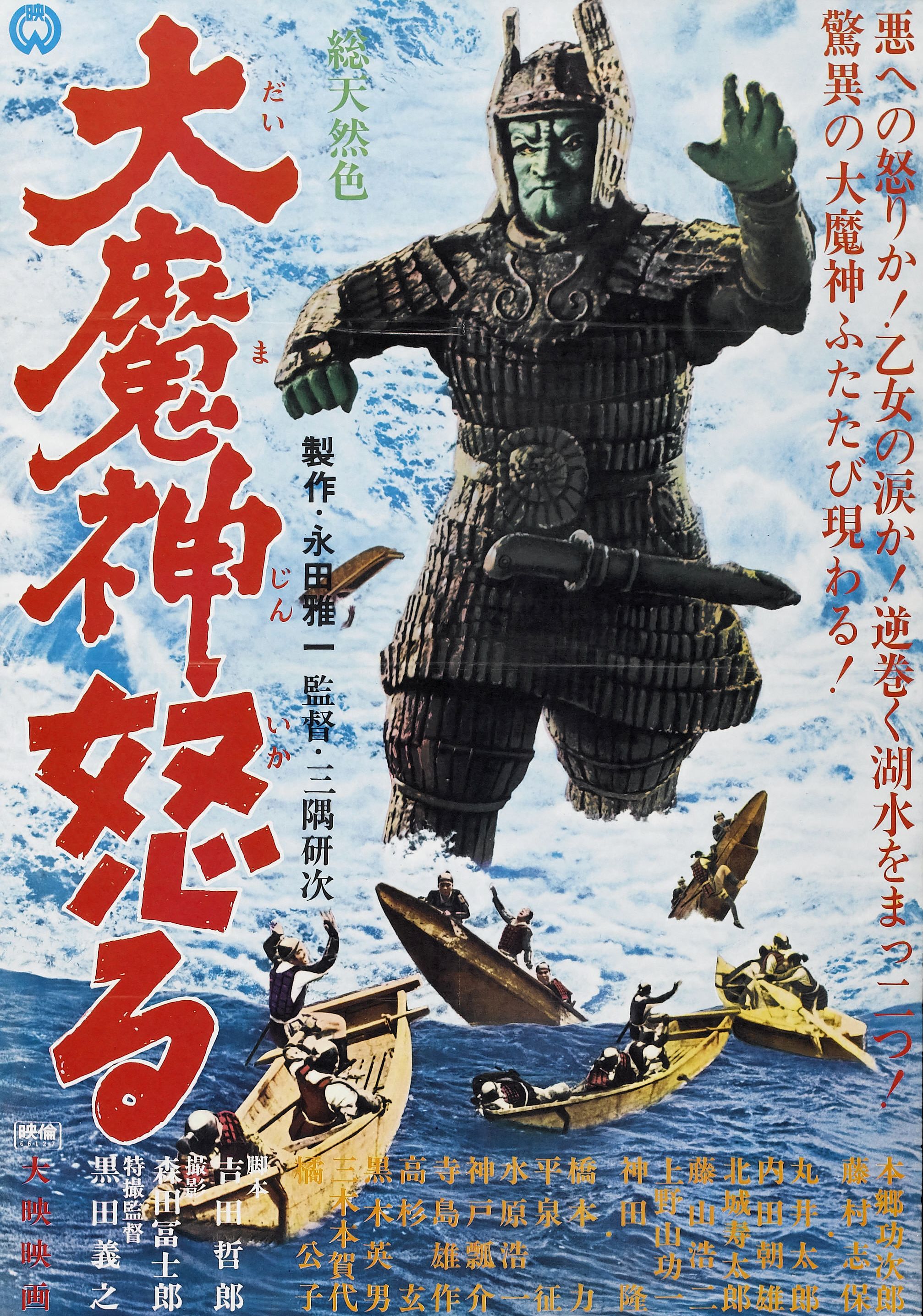
I offer that bit of biographical data by way of introducing today’s subject, which is an unusual series of daikaiju (giant monster) movies from 1966, known as The Daimajin Trilogy. The first movie, Daimajin was unfolded before my fourth grade eyes under the title, Majin, Monster of Terror, under the (likely true) assumption that no American would watch something called Daimajin. At least not in 1968.

Let me try to briefly explain what makes the Daimajin movies so unusual: they take place not in the modern day, but possibly during the Sengoku historical period between the late 15th and early 16th century, judging from the backdrop of clashing feudal lords and presence of matchlock rifles. It’s the marriage of jidaigeki  period drama and giant monster movies that make them so alluring – that and the monster in question is a rampaging, wrathful god.

This was also one of the things that 10 year-old me did not care for in the first movie – you had to sit through 90 minutes of samurai movie (in Project: Terror‘s two hour slot) to get to 15 minutes of stone god rampage. I’m (quite) a bit older now, and can appreciate things for what they are. If I do things like forgive the Rambo movies for 70 minutes of bad guys proving why they need to be Rambo-ized before I get 20 minutes of Rambo making bad-guy soup out of them, then I can’t very well criticize the Daimajin movies for doing the same thing.

Starting off with Daimajin (you can add the “Monster of Terror” part if you like), a series of earthquakes causes villagers to hold an impromptu festival/dance/ritual to appease the “Majin of the Mountain”. Under the cover of this festival, an evil Chamberlain stages a coup of the nice local lord. The Lord’s son and daughter escape, eventually settling in near the statue of Majin, an area superstitiously forbidden.

Ten years pass for the New Evil Lord to be evil and generally grind the faces of the poor. The son, now 18, tries to go back to the castle, gets captured, and is scheduled for execution. Having had enough of this Majin nonsense, Lord Evil sends some men to break up the stone statue. They get as far as hammering a big spike into its forehead before they stop, because blood is pouring from the statue’s forehead. The fearful men try to escape, but the earth literally opens up and swallows them.

The former lord’s daughter, who had been captured by the doomed demolition crew, sees this as proof of the Majin’s role as an active god, and offers her life to it if Majin will only save her brother. The stone statue comes to life, and there begins one of the better giant monster sequences of the period.

Waaaaay back in the days when we used a medium called “videotape” to enjoy our movies, ADV Films put out a widescreen VHS of this movie, and good gravy, what a difference that made (I am, incidentally, basing this on the recent Mill Creek Blu-Ray of the Trilogy, which is astounding in quality)! I think Daimajin is one of the first Daiei Studio movies made in the Vista Vision format, and that widescreen is used beautifully throughout. The forced perspective and occasional back projection are flawless, and often breathtaking; this is really some stunning stuff. I could babble all day about it,  but basically:  it has to be seen.

The second movie, Return of Daimajin (there was a weird mix-up in the names of the movies at some point, so I’m using the title Mill Creek employed), follows the usual sequel route by doing everything bigger: the Evil Lord takes over not one, but two peaceful castles, there are two male heirs in play, and Majin – this time on an island in the middle of a lake – is blown up with black powder. Once again, when the chips are down, and the daughter of one of the deceased Lords is about to be burnt at the stake, she offers her life to Majin, who literally parts the lake like the Red Sea to tromp out and proceed to smish all the bad guys.

The third, Daimajin Strikes Back (which I’ve always known as Wrath of Daimajin, but now my head hurts), shakes up the formula. Majin, apparently tired of being rousted by idiot Evil Lords, has taken to the top of a mountain. An Evil General is kidnapping men from surrounding villages and using them as slave labor to build his fortress and munitions factory near a sulfur lake. This time, our heroes are four boys from a village who trek over Majin’s mountain in an effort to save their fathers and brothers. Also, Majin has an “avatar”, a hawk that flies around and observes everything.

Saddling four child actors with the hero role could have been disastrous, but the result isn’t totally terrible (thankfully). They have some fairly good kid’s adventure stuff going on, escaping from three Evil Samurai over and over again. Our lead kid is a fairly decent actor, which is good, because lacking a Lord’s Daughter character, he’s the one who offers to sacrifice himself to Majin if the god will just save all the others.

Majin has his most extended rampage in this outing, and it is one of the most visually arresting, taking place during a snow storm. The General has cannons at his disposal, which turn out to be predictably useless. And we find out that the sword that Majin has been carrying throughout the trilogy is practical and has a steel blade.

As a whole, the Daimajin trilogy is a nice change of pace for giant monster fans. Though the daikaiju formula here is even more heavily-weighted toward the Big Finish than is usual in most of the giant monster movies, the change in venue is intriguing enough to offset that. The special effects are consistently better than other Daiei monster offerings (sorry, I was never a Gamera fan), and, perhaps harkening back to my upbringing as a Southern Baptist, I can really get into the concept of a god who actually does something… like grinding bad guys to a pulp. Reactionary of me, I know, but I do have my fantasies.

And Maybe Learn A Little Something

I can tell that the School Year has truly begun, because my wife and child have started bringing home all the latest plagues. Outside of dousing them with boiling water and bleach when they come home, there’s not much I can do except avoid them as much as possible, and hope my wife doesn’t cough on me too much at night.

I know what I like to watch when I’m sick: kung fu movies are my comfort food. But I’m not there yet, so I’m assuaging the tickle in my throat and my occasional dizziness with documentaries.

Documentaries aren’t my usual cup of tea, you know. Oh, I can watch pretty Blu-Rays of wilderness all day long, but I seem rarely interested in pushing the button on real life adventures. In my current state of health limbo I don’t want to get riled up by life injustices or embarrassed by eccentrics being brought up short by the real world.

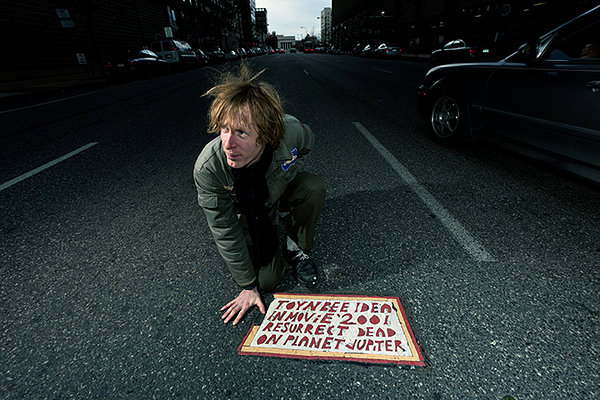
So, Stop Number One on my Netflix Instant queue: Resurrect Dead: The Mystery of the Toynbee Tiles. The basis for this is one of those pieces of true-life high weirdness I enjoy: there are a series of tiles embedded into roadways in the American Northeast that read: “Toynbee Idea/in movie 2001/resurrect dead/on Planet Jupiter” or variations thereof. There are often side panels that dangle tantalizing clues. These things have also cropped up in South America.

The primary character of Jon Foy’s movie is Justin Duerr, an artist who first noticed the tiles in the early 90s while working as a foot courier. In those early days of the Internet, he eventually finds a small community of people trying to figure out just what the hell is going on, and finally winds up with his own little Mystery Inc. of three guys who are equally obsessed with what the tiles mean, and who’s been making and placing them.

This tale of amateur sleuthery is engaging, and it all seems to point in the direction of one individual, a virtual hermit in a Philadelphia neighborhood. All attempts to contact him are ignored, and eventually Duerr, convinced that he has shared a transit bus with the perpetrator, still decides to let the man walk away unbothered. “Let him go his way in peace, and let me go in mine,” says Duerr, who closes this chapter of his life and goes on to the next. The other two, we are told, are still investigating the phenomenon, especially the many copycats who have surfaced in recent years.

Resurrect Dead remains interesting and focused for most of its runtime; an occasional digression keeps it from being too Lone Gunmen in tenor, and seeing the guys’ detective work actually bear fruit is satisfying.

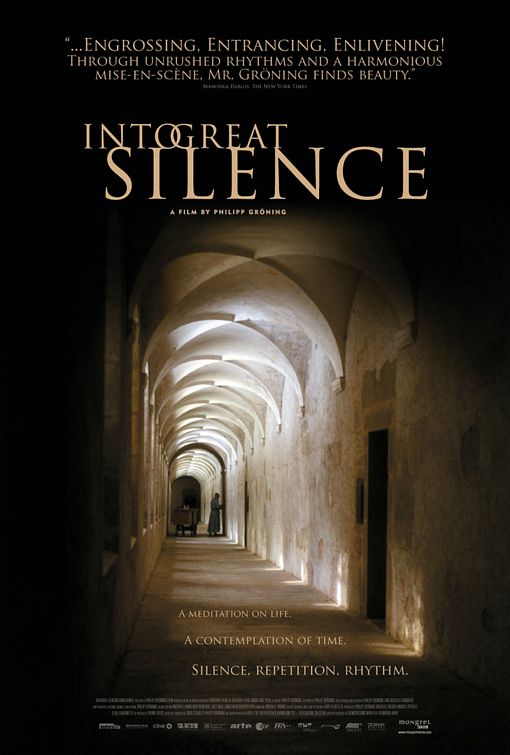
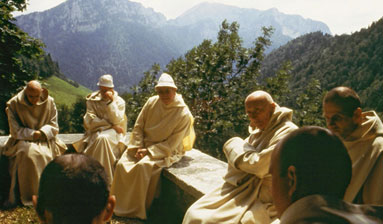
Next up was a recommendation by my friend Rick: Into Great Silence, which is about the monks of the Grande Chartreuse, a monastery deep in the French Alps. These monks have sworn a Vow of Silence, theoretically using their voices only in prayer or song; this proves to be pretty flexible, as they are also apparently allowed to converse during their weekly recreational hikes. Being monks, they talk about monk stuff – you know, religion, ritual.

One of the conceits of Into Great Silence is that there is no narration, no commentary, no incidental music. Your experience is going to be just as silent as that of the monks. It is worth noting that this has the effect of making prayer and ecumenical chants that much more moving.

It also means that there are many times the viewer is left wondering just what the heck is going on at several points; simple tasks take on an aura of mystery. Never introduced to any of the monks, we are left to our own devices to sort out who they are, and what their duties in the monastery may be. My personal favorite is the bearded monk, shoulder stooped in old age, out in the winter, shoveling snow off his vegetable plots… and, while limping away from his work, still able to direct a friendly smile at the camera. Truthfully, it is the day-to-day life, the background work that keeps the monastery running, that I find fascinating. Especially the monk going over the monastery’s accounts, using a laptop.

In the final titles of the movie, director Philip Groning tells that he first approached the Grande Chartreuse in 1984, and the response was basically, “Not right now, give us a chance to get ready”. Sixteen years later, he got a second letter, “Okay, we’re ready.” That sort of deliberate pace carries over into the movie; be aware that once you hit play you are in for a two hour and forty minute stint with the monks.

The running time has a purpose, I think. The other continuing motif is a series of intertitles with excerpts from prayers. I didn’t keep count, but there seems to be six or seven, and they repeat themselves throughout the running time. The length of the movie and the repetition serve to bring home the extent of the commitment of the monks; we’re going home to TVs and the Internet after almost three hours, but this is how the monks will spend a lifetime.

Even after spending six months with the monks, Groning apparently still has the ability to experience boredom, as several times he chooses to switch to a lower resolution, and process a shot in a grainier fashion. I’m going to shrug at that. It’s not really necessary – but then, it could be argued that two hours and forty minutes isn’t truly necessary either. Although that slow build-up makes seeing normally silent monks shouting “Whee!” as they sled down a snowy slope all the sweeter.

Fury & Vengeance with Ric & Nic

So, my busy week got a little less busy when one of the city meetings was cancelled. I made some snap decisions about movie watching.

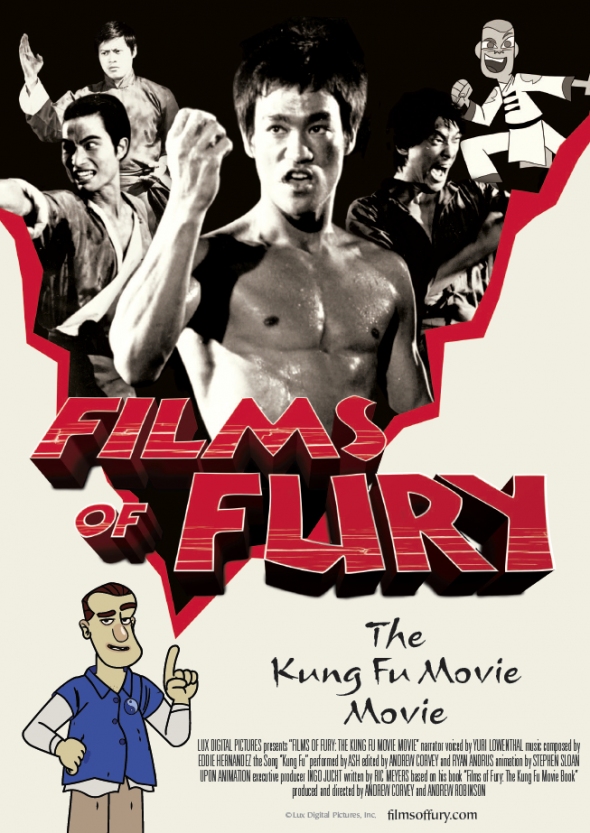
First I checked out Films of Fury on Netflix Instant. It’s based on Ric Meyer’s book of the same name, which is about martial arts movies. I will give the movie props for pointing out that Buster Keaton and Gene Kelly were superb athletes, doing their utmost for their craft; not really sure if what they did could truly be called kung fu, but hey, it was a fair point. The movie also manages to work in the fight scene in From Russia With Love before getting to the meat of the matter, the Chinese martial arts movie.

The only real problem with documentaries like this crops up if you’re already a fan of the material. Fists of Fury does a really good job of hitting the high points and avoiding the low in its accelerated history, highlighting the major players, directors and plot points (I would have liked to have had a dollar for every time the world “revenge” is used). I spent most of the running time thinking “Damn, but I want to see that movie again!” The Flash animation interstitials are amusing but disposable.

If, however, you’re curious about the genre and haven’t had that much experience, it will provide you with an excellent list of where to start.

I picked the next movie almost at random. Ghost Rider: Spirit of Vengeance. My kid is a big Ghost Rider fan, so its purchase was necessary. Especially when I found the Blu-Ray for cheap.

The great thing about second movies in these superhero franchises is that the origin story can be dealt with in three sentences and we can get on with the rest of the movie. (Hell, The Incredible Hulk did it under the opening credits, which was a smooth economic move). Staring 50 in the face, Nic Cage may be getting a bit old to pull off Johnny Blaze, but he can still break off major pieces of the scenery with his teeth and chew them up like few other actors will even attempt, and directors Mark Nevaldine and Brian Taylor – also responsible for the frenetic Crank movies – probably had script pages that were blank except for the words NIC GOES NUTS HERE.

The plot’s not going to dazzle you with originality: the same Devil whom Blaze made his original deal with has sired a son, and the kid is necessary for a ritual that will cement Old Scratch’s power on Earth. A radical sect offers Blaze a counter-deal: if he can find the boy and bring him safely to their Sanctuary, they will undo his satanic pact and separate him from the Rider.

Nevaldine and Taylor have a dizzying visual style they perfected in those Crank movies and is put to dazzling use here; their best addition to the Rider mythos is that any mechanical device the Rider controls is imbued with Hellfire, so we not only get to see the stock flaming motorcycle, but at one point, a flaming strip miner. The cast they put together is pretty fine, too; we find ourselves rooting for Idris Elba very early in the movie, then we get surprised by Anthony Head and Christopher Lambert.

Not stellar entertainment, but satisfying. Worth the rental for fans of frantic action, over-the-top performances, and pyrotechnics.

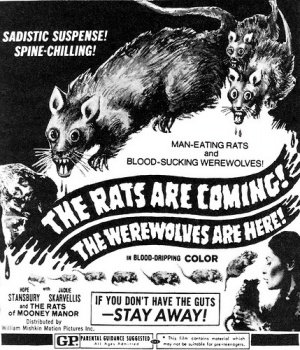
The Rats Are Coming! The Werewolves Are Here! (1972)

My greatest weakness as a writer, I have found, is that I’m just not very good at titles. I take cold comfort in the fact that I’m not the only one. How many movies are there titled Boiling PointManiacIsland of (fill in the blank)? So I get really excited – far too excited, really – when I know I absolutely must see a movie based on the title alone. Such a title – and I’ve been meaning to watch it for years – is The Rats Are Coming! The Werewolves Are Here!

There is no way I can not watch a movie titled that. It has, admittedly, taken me forty years to do so. I remember back in the dawn of the VHS boom, I saw a copy of it for rent, but I grabbed something else entirely. Maybe The Fantastic Animation Festival. Never regretted that. And now I know why.

Because, of course, the entertainment value of the movie is in inverse proportion to that incredible name.

That title is credited to producer William Mishkin, while the movie is the work of Andy Milligan. Milligan had a strange, troubled life; he entered the world of low-budget movies through his involvement in the off-off Broadway theatrical scene. His first movie was Vapors, a 30 minute gay movie set in a bathhouse. This got Mishkin’s attention, and Milligan was soon making low-budget sexploitation movies for Mishkin’s 42nd street theater connections. He knew where to find actors who’d work cheap and, thanks to his theater experience, knew how to build sets and make costumes.

So, really, I kind of sigh when I consider Milligan; His movies cannot be considered good, but it’s easy to see the aspirations at work. Given more than a few thousand bucks to work with and some support personnel, he might have been pretty good. But even his best work – something like The Body Beneath, say – still bears all the telling shortfalls of a creator wearing too many hats with too few tools at his disposal. Single mike recordings of dialogue, limited lighting, needle-drop music cues that cut off suddenly at scene changes…

But dammit, you see him trying. You see the actors trying. Milligan actually has some pretty good actors working for him… but they are betrayed by their material – almost always, written by Milligan. It is almost always stuff that would be ripe but tolerable on a stage, but on a movie screen, too often the kiss of ennui.

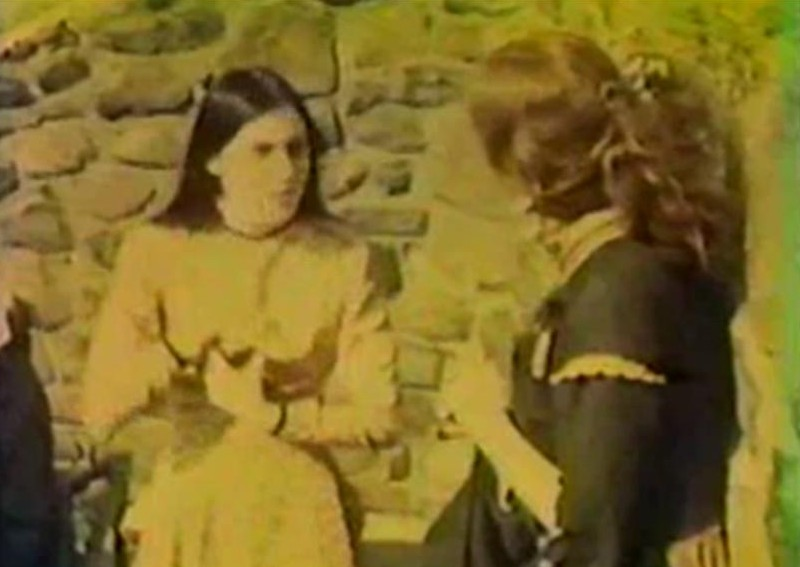
The Rats Are Comingconcerns itself with the Mooney family, in what we are eventually told is 1899 England. The period is a bit slippery here – Milligan’s costumes are serviceable for the period (if not entirely accurate – I’m particularly

Quick now – 1899? or 1972?

skeptical of one of Monica’s hats), but two of his younger actresses are quite obviously wearing 1972 hairstyles and make-up. Not that I mind. 1972 was a good year for me.

The Mooneys are a dreadfully dysfunctional family, something with which Milligan, sadly, had a lot of experience. The aged father of the clan is given to “attacks” whenever his temper is roused, and must be given increasingly frequent injections. The eldest daughter, Phoebe, is running family matters as best she can, aided by eldest brother, Mortimer. Next oldest daughter is Monica, psychotically jealous (or just plain psychotic), and another brother, Malcolm, is best described as “animal-like”. The youngest daughter, Diana, returns to the Mooney estate with a new husband in tow, much to the disdain of Pa. He sent Diana off to medical school so she could help him with his “experiments”. Dian’s husband, Gerald, starts noticing odd things, like dismembered chickens showing up in the halls and Monica jumping out of wardrobes with a knife.

Oh screw it, they’re werewolves, okay? The Mooneys are a bunch of freaking werewolves! It’s right there in the title, for God’s sake. Pa isn’t trying to cure the lycanthropy, though, he’s working on life extension – he, himself is 199 years old! Then everything goes to hell in the last ten minutes due to really bad timing, and the estate becomes werewolf central.

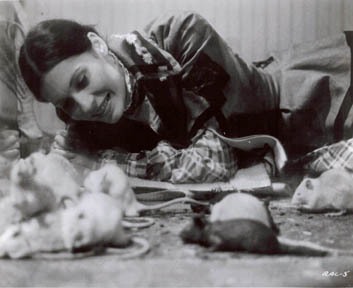
Now, this was the basis for Milligan’s original movie, which was called The Curse of the Full Moon, and ran only 72 minutes. “Not long enough!” yelled Mishkin, and to pad the movie out, they have a subplot where Monica goes into town to buy a new pet from Mr. McHarbor (that’s actually a pretty clever name), who sells her some rats that ate off his left arm and half his face one night when he had too much to drink. Why is there this subplot? Willard was making money at the time. And Mishkin came up with that delicious title.

The title still gets it wrong anyway, because the rats last maybe five minutes at the Mooney household, until Monica is bitten by a rubber rat (what part of “flesh-eating” didn’t you get?) and she returns them to McHarbor, demands her money back, and then sets him on fire. At least I think that’s what happens. The scene is badly lit, and Milligan’s handheld camera tends to go into Swirl-A-Vision during murder scenes. But The Rats Have Come And Gone! The Werewolves Will Be Here Eventually! just doesn’t have the same panache.

And this is what happens when you rely on “ends” for your film stock.

It turns out Monica has a friend, another girl-woman named Rebecca, who is basically a Cockney Monica. Introduced at roughly the one hour mark, the only reason Rebecca exists, besides to give the tooth-grindingly annoying Monica more screen time, is to mention that she’s seen things at the estate that ensure that Monica will hack her up bloodily.

Except. I have the Video Kart DVD of this, paired with Bloodthirsty Butchers, and the scene is scissored into incomprehension, apparently for TV. Good grief, this sort of thing drives me mad. I’ve run into this twice – while writing reviews for Shriek of the Mutilated and I Drink Your Blood – where the available tapes/discs were TV edits. Those movies – and Milligan’s horror movies – are infamous for their gore. This renders judging them on any sort of reasonable basis moot. How am I supposed to judge such an incomplete product? It’s like trying to review a G-rated version of Deep Throat. Uncut versions of the two linked movies above have surfaced on DVD, but I somehow doubt an uncut version of The Rats Are Coming is ever going to appear.

Then again, I should probably count my blessings – according to Wikipedia, the DVD currently resting on my desk does not exist.

At one point in the movie, Diana goes into town to buy a pistol. This leads to a very long scene with a comical old gunsmith who sells her a suspiciously modern-looking automatic pistol and is sweet-talked into melting down a silver crucifix for bullets. Even as you wonder why the hell this scene is taking so long (outside of padding the running time) you find yourself liking the gunsmith, he’s one of the better actors. Then you later find out the gunsmith was Andy Milligan.

Milligan the writer has a problem with circular scripts; in Rats it’s characters that keep almost saying something significant, then saying, “I’ll tell you when the time is right.” But I’ve got to say the one thread running through the movie, and whereby we finally find out what the hell is going on with the Mooneys is very well handled, if somewhat drawn out over a lot of territory; but then, I’ve never run across a truly gothic piece of fiction that I didn’t feel the same about.

At any rate, there’s a reason, I re-discover, that I measure the time between Milligan movies in years, rather than months. I find them interesting to hash out afterwards, but the actual watching… ho, boy, that can be a chore. But why take my word for it? You can download it from The Internet Archive! Not that I necessarily feel you should.

(And dear God, I love that the comments all think this is a British movie, not something shot down the street from the Staten Island Ferry! Good on you, Andy!)

And hey, here’s a trailer that gives away what is supposed to be the final Twilight Zone twist! Now you don’t have to see it!

V/H/S (2012)

As we’ve seen recently, I’m fascinated by the found footage format.  I was burbling about a horror anthology called V/H/S which was going to be nothing but found footage as interpreted by six directors (more really, there’s at least four operating under the pseudonym Radio Silence). Well, it finally became available on a number of Video On Demand venues, so I didn’t have to wait for its October theatrical debut… and I don’t like watching found footage movies in a cinema, anyway. It’s just not right.

Horror anthologies always have a framing device, and this one is fitting: a gang of hooligans who videotapes their illegal activities (like vandalism, burglaries and grabbing women to expose their breasts) get hired to pull a job that seems up their alley: breaking into a remote house and stealing a particular videocassette. Once there, they find the house’s sole occupant dead, and a lot of tapes. While the others search the house, various members of the gang check out tapes one by one…and these contain our stories.

The first story, “Amateur Night”, starts the proceedings off fairly strongly, and has one of the better devices for combating the “Why do they keep filming?” skepticism: a pair of “video glasses” with a built-in camera and microphone. Two frat boy-types pop these glasses on their nerdier friend, rent a hotel room, then start cruising the local bars. There is one woman who seems attracted to our walking camera, an odd, seemingly feral girl who only seems to know one phrase, “I like you.” Back at the hotel room, when the only other pick-up passes out, the other two men start concentrating on the Spooky Girl, with predictably (yet still somewhat surprisingly) gory results.

I should mention that Spooky Girl is effectively played by Hannah Fierman, an actress whose face I swear is 1/3 eyes. Very striking, very good performance. I’m going to say all the performances in “Amatuer Night” are pretty good, to the point of making me extremely uncomfortable. This segment seems to take a little long to get to its payoff, which is the only real criticism I can make.

You’re going to wind up in the same fix with “Second Honeymoon”, written and directed by Ti West. West has been getting some very good press with this movies House of the Devil and The Innkeepers, but I was dreadfully let down by this sequence. Very long setup, very sudden and unsatisfying payoff.

The third sequence, “Tuesday the 17th” starts yet again with a group of young people heading out into the country while some guy annoys everyone with his video camera – that’s pretty endemic to the format – but at least it’s dispensed with pretty quickly. The girl taking everyone out to her folks’ “cabin by the lake” has an agenda of her own, involving some murders at that location several years before.  The main interesting point to this story seems cribbed, however unwittingly, from the Marble Hornets web series, with a killer that screws up video signals, which at the very least leads to some interesting visuals.

No spoilers here, nope, nuh uh.

Story #4, “The Sick Thing That Happened To Emily When She Was Younger” breaks with established form magnificently by presenting the story as series of Skype calls, instead of camcorder footage. It also has some of the most effective scares and the best twist of the movie.

The last story, “10/31/98” is about yet another group of young men who are headed out to a Halloween party on the titular date. One of the guys has built a handycam into the head of his bear costume, so there you go. Nobody is really sure where this party is located, and there’s some driving around to fill time. Once they think they’ve finally found it… well, needless to say, it’s the wrong house. It is a very wrong house, and this story has some of the best frights in the whole flick.

The build on V/H/S is very good, starting out solidly, if a bit slowly, then upping the ante through the last three tales. Sadly, I think the Ti West story could have been easily excised and produced a tighter, shorter movie. The framing story does stand on its own pretty well, with a few shocks of its own. The acting is never less than professional (though the character work in “Tuesday the 17th” is pretty cliché, which I think was the point), and even very, very good in places.

So I’m going to say, yeah, very worth the rental. If you don’t like found footage, this isn’t going to change your mind. But in a pretty tepid year for horror stories, it’s nice to find one that goes for the gusto without resorting to the simple meanness of torture, or by remaking another, more successful movie from 20 years before.

Keeping that in mind: definitely worth the rental, especially if you’re a horror fan suffering through a drought of decent material.

How to Waste A Labor Day Weekend

Ah, Labor Day. You are a welcome surcease, a chance to sleep in a bit, to attend an impromptu lunch honoring a returning comrade, a chance to catch up on this blog. You are also a cancellation of The Show, which I may find tedious, but is a vital part of my patchwork economy in these troubled times. I could moan about that, or I could drown my sorrows in crap cinema, which I did. Rick was the only one of the Four Horsemen brave enough (or, alternately, in town enough – curse you, Final Weekend of Summer!) to attend. I was determined to make a dent on The List of movies I had required myself to see this year, which left us a whoooooooole bunch of leeway in our viewing, as I still had 33 movies to go, 24 on the B-Movie List, 9 on the Quality List. How’d we do? Well, the list is now down to 30, thanks to our valiant efforts. First, though, I put on a DVD-R I had gotten from Something Weird Video. To be precise, I got it for Adventures in Balloonland, but I am saving that in retribution for Strange Beings, which was inflicted on me at the last official Crapfest. No, I went for something Rick had once expressed interest in, even though he will deny it: the unaired pilot for a children’s TV show, Polly Pockets.

The King and Queen of Gloom. There goes the budget.

As the box copy points out, Polly Pockets has nothing to do with the toy line of pocket-size dolls; Polly Pockets is an effervescent brunette with a skirt composed of nothing but pockets, and theoretically anything can be pulled from them. Her accomplice is a Royal Dano-type named Dandy Andy, who is notable for failing at everything in a komedic fashion. At one point, Polly pulls something – an onion? – out of a pocket, reminding her of her trip to the Castle of Gloom, at which point the entire thing turns into a community theater production of Marat/Sade complete with songs. We were especially appreciative of the King and Queen of Gloom, whose crowns were so-very-obviously made of construction paper. The King’s was decorated with Magic Marker, but the Queen’s had some fancy glue-and-glitter detailing. Rick pointed out that the box copy also promised “A Visit to Santa”, and we figured what the hell, we’re here, and proceeded to suffer through the worst damned Christmas themed thing we had endured since The Magic Christmas Tree. Two kids write and ask Santa if they can visit him at the North Pole, and Santa – I’ve seen worse Santa beards, but not many – thinks, “Well, it’s Christmas Eve, my busiest night of the year… but what the hell,” and sends an elf to pick them up and bring them to his split-level ranch living room so they can tour some shopping center Christmas displays. Just when it starts to get really stultifying, apparently Something Weird thought, “Christ, this is boring,” and slapped in a puppet show.

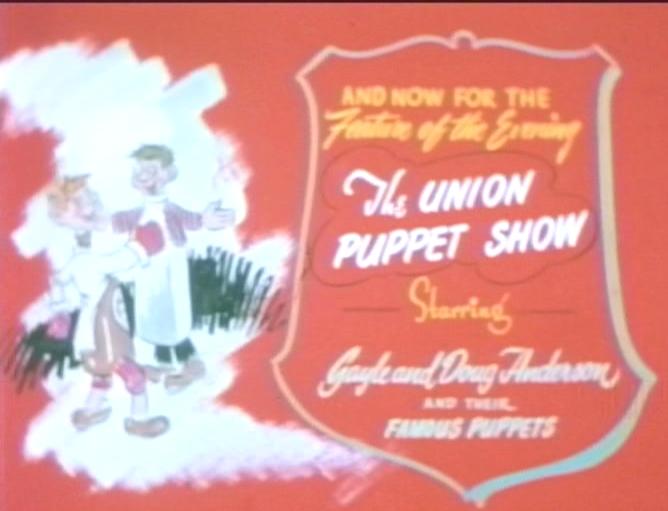
But this is not just any puppet show. No, this is Labor Day weekend, after all, so this is a Union puppet show. I am duty-bound to inform you that I Cannot Make Shit Like This Up. That title card just sort of passed us by, but then we find ourselves confronted by the happy worker puppet, telling us the sammich his wife made was so good, it practically had a beer on top. He is then bedeviled by some sort of boxer with a glass bottle for a body, who claims he is “the champion”, only to be set straight by the Worker, who informs him that the AFL-CIO is the true champion. The scene then changes to a kitchen, where another glass-bottle homunculus tells us how safe he is because he’s sterilized, which gets reallllllllly creepy when the Mom puppet shows up to be told how she needs more sterile men like himself in her life (for instance, she had been buying milk in those horrible opaque paper cartons and last evening, when she discovered it was actually empty, her husband almost left her!) . The camera keeps cutting to an audience of children who must actually be at a Howdy Doody taping or something, because they are not banging at the doors begging to be released. Then it ends, threatening us with “50 TV stations”. I don’t know what that was about, and I sure as hell ain’t going back to find out. Until I spring this on the next Crapfest, anyway, because the workers control the means of production.

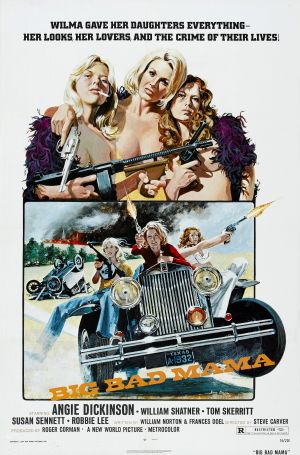
Well, enough of our civic duties, it was movie time, We started off with Big Bad Mama, something I had been trying to work into a Crapfest for ages. Pity I never did get it in, because the first bare breast shot is about two minutes into the movie, and the boys of Crapfest dearly love their gratuitous nudity.

Roger Corman had a nice little cottage industry remixing Bonnie and Clyde throughout the early 70s. This time the gang is all-female, Mama (Angie Dickinson) and her two nubile daughters (Susan Sennett and Robbie Lee), trying to make it in 1932 East Texas. If you actually live in East Texas, this will amuse you, as mountainous Southern California is not really a good match. Anyway, the girls wind up helping hapless bank robber Fred Diller (Tom Skerritt) whose heist is going terribly wrong, and thus begin their lives as felons. Mom sleeps with Diller while the girls fume over the unfairness of it all, until Mom runs into William Baxter, a smooth con man who takes Diller’s place in bed, while the two girls share the discarded Diller.

The plot structure owes a lot to Corman’s own Bloody Mama, with stress in the gang finally leading up to a kidnapping that goes wrong. Throughout, you can sense the presence of Corman, doubtless wearing a green visor and holding an open accounting ledger, nudging director Steve Carver and saying, “Excuse me, but we haven’t had a bare boob in almost four minutes.”

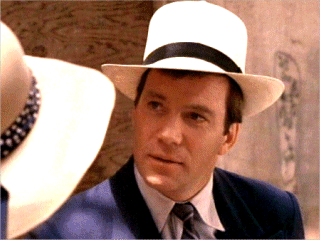
Yes, once again we find ourselves ogling Angie Dickinson’s unclad charms, and viewers of a certain age can get a bit of a pleasurable thrill by realizing that this hit the drive-ins just as Police Woman was gearing up on TV. Now a word about Shatner: I have always liked Shatner, even – perhaps especially – when he goes way over the top. There’s not a lot of it here, but I will say this: he doesn’t cheat in his nude scenes. America being what it is, the little Shatner isn’t going to hove into view, but it comes close. By God, if Angie was going to be in the altogether, so was he.

In a less salacious light: there is one scene where, in the foreground, Dickinson and Skerritt are having a yelling, screaming argument. In the background is Shatner, who, with no lines, no blocking, still manages to steal the scene. I have to respect that.

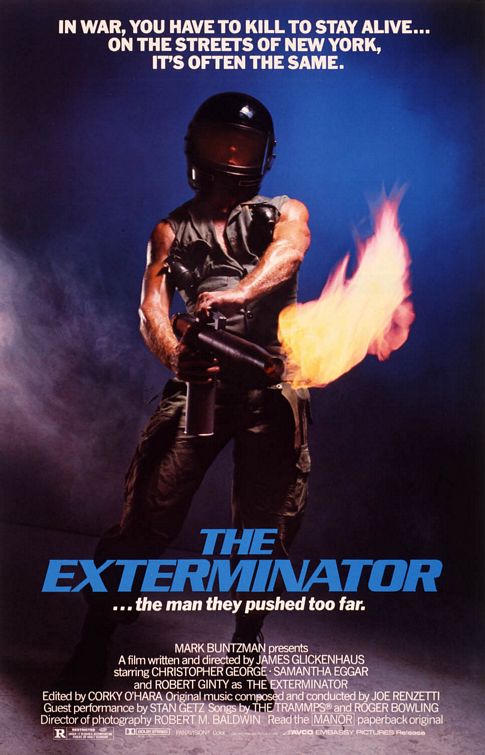
Then came the Blu-Ray (!) of The Exterminator, starring Robert “Paper Chase” Ginty, embarking on his 80s career as an action hero. Exterminator  spends a lot of money in its pre-credit sequence, showing Steve James saving Ginty’s life in Vietnam. Then we go to New York, where Steve James again saves Ginty’s ass from a gang called the Ghetto Ghouls. You might think be thinking “Hey, I hope this movie is about Steve James,” but stop thinking like that, because the Ghouls mug James the next day, breaking his neck and paralyzing him for life. Ginty starts thinking positively, tracks down the people responsible, and lets them get eaten by rats.

Hey, good movie, you might say, but no, we are only 20 minutes in. Ginty then goes about stealing money from the local head of the Beef Mafia (the cops refer to them as “meat mobsters”) to take care of James’ family. The meat mobster doesn’t tell Ginty about the trained attack dog at his house, so once Ginty dispatches the dog with an electric carving knife, he feeds the mafioso through an industrial grinding machine.

We still got tons of movie left, so Ginty just sort of starts wandering around, looking for lowlifes who need exterminating. He finds them in great plenitude in 1980 New York. There is also, needless to say, a cop on his trail: no less than Christopher George, who, like Ginty, is going to be going back and forth between USA and Italian sound stages a lot in those years. George’s story is teased out over most of the movie – very slowly teased out because we spend a lot of time on his romance with a doctor played by Samantha Eggar, which slows the plot down to a crawl.

The most interesting bit is when Ginty pulls out what we referred to as his “Vietnam Box”, a case holding a ton of weapons, including grenades, that he supposedly stole from the Army. Later, when he has a solid lead on The Exterminator, George reaches into his locker and pulls out his own Vietnam Box, with a .45 auto and a tactical shotgun.

We also get some political intrigue, which feels rather half-cooked and shoe-horned in. There’s CIA agent demanding information from George because “The Exterminator… is making the incumbent look bad.” Man! Politics! Can’t even get away from it in a crap movie!

I have to say, The Exterminator  does deliver on what it promises. If you want a gritty Death Wish type rip-off, you could do a lot worse (I know I have). And that Synapse Blu-Ray is gorgeous.

Next up: a movie my pal Dave has been pestering me to see forever: The Cell.

In The Cell, there is an experimental procedure that allows a child therapist (Jennifer Lopez) to journey into the mindscape of a catatonic boy. The procedure is suddenly, urgently pressed into use to send Lopez into the mind of a comatose serial killer (Vincent D’Onofrio), to attempt to find his latest victim before she is killed in an automated death trap.

This is Tarsem Singh’s first movie, and his penchant for manipulated images serves the trips into mental spaces quite well. Rick tells me this is a pre-nose job Lopez, and I’ll trust him on that. If there were any misgivings about Lopez as an actress, The Cell should have put them away; she does very well. D’Onofrio is, as usual, fantastic, though I think there are a few times that Singh either let him, or directed him to, go too far. Vince Vaughn is the federal agent tracking down D’Onofrio, and it was shocking to see how thin the 2000 Vaughn was.

If I have one problem with the script, it’s that when Vaughn figures out how to find the death box (after he himself has a traumatic trip into D’Onofrio’s mind), the clue that he’s sussed out is so obvious, it could only have been missed by sloppy detective work. Given the number of men working on the scene, it’s pretty unlikely.

If I have two problems with the movie, it’s that it bears some resemblance to a script I wrote back in college. My tragic mistake? I didn’t think to put a serial killer in the plot. What was I thinking?

A good enough movie. I don’t think I would have been more impressed with the visuals in 2000, though. There is just some level that it doesn’t engage me like I feel it should. I don’t delight in the process of discovery, so it fails as mystery (I’ve already bitched about that final clue). It’s not intense enough to qualify as horror, but it does come close a couple of times. It is even too busy trying to tell a touching story as Lopez struggles to save the little boy version of D’Onofrio trapped in his head to qualify as a thriller or a science fiction story. It’s an odd creature, not fish, not fowl, and I can’t find its own terms to meet it on.

But enough of that flighty stuff. We ended the evening with Women in Cages, classy fare if there ever was.

I think this may be at the start of Corman’s Filipino Women In Prison cycle; it’s directed by Gerardo de Leon, an old pro in the Philippine film market – you can thank him, at the very least,  for two of the Blood Island movies and Terror Is A Man, a surprisingly effective Island of Dr. Moreau rip-off. So Women in Cages is a well-made, efficient WIP movie, with the usual demeaning work in the sugar cane fields, showers, and catfights.

One of the very few things that sets it apart from its kin is the casting of Pam Grier as a bad guy, the Chief Matron, Alabama, a lesbian who picks her lovers from the convict pool and has a torture chamber stocked with bizarre instruments called “The Playpen”.  Alabama – who’s from Harlem, go figure – has issues, to be sure, not the least of which is the immediate assumption that the three Americans under her charge are “racist bitches”.

Alabama gets taken hostage when our heroines, such as they are, escape, and finds herself on the receiving end for a change, then in deep trouble as the savage hunters – whose job it is to bring escapees back dead or alive, usually dead – assume she is also an escapee.

There is hell of backstory here – our main prisoner is only guilty of trusting the wrong man, who is trying to have her killed in prison, and after a while you lose track of who’s double-crossing who, and then we’re back where the movie started, on a floating whorehouse where the same topless dancer has apparently been dancing for the past three months without a break. Some guy who I didn’t know was a cop for most of the movie rescues our heroine, leaving her junkie cellmate (who was the one trying to kill her) to her floating whorehouse duties in a pretty disquieting ending. Serves her right, I guess.

Women in Cages isn’t quite up to the follow-ups, Big Doll House and The Big Bird Cage, both directed by Jack Hill, which had a lot of subversive humor buried in them. Also missing is Vic Diaz. I demand Vic Diaz in all my Filipino movies, because whenever he’s around, I’m sure to be delighted with the results. Diaz retired in 2001, but he’s apparently still alive. If that is indeed so, I hope he’s well, and continues to have a long, happy life.

Vic Diaz! Praise his usefulness! (ululate)

This may be the only place on the Web where you can start out talking about the quantity and quality of boob shots in movies and wind up with a love letter to Vic Diaz. (Actually, I can think of several other places where that could be the case, but never mind that) That is the world of crap cinema in a nutshell, my friends: you often start in one place, then the journey takes you to another, surprising place. The trick is often finding a way to enjoy that journey.