The ABCs of March, Part Two

Yep, I’m still hard at work, doing the Letterboxd March Movie Madness challenge. That’s a movie a day, A for March 1st, B for March 2nd, und zo weiter. I’m even working a day ahead of time, because I know I have an unavoidable 12 hour work day on the 24th, and that ain’t gonna leave me in no movie-watchin’ condition.

Our latest chunk:

Emperor of the North (1973)

Emperor of the North spanish1933 was a pretty dismal year for America; the Great Depression is in full effect, homeless families are everywhere, and the nation is struggling to get back on its feet. But we’re not here for any Grapes of Wrath-type stuff, we are focusing on just one small part of the culture at that time: the hobo nation and its bellicose relationship with Big Railroad.

A career hobo who goes by the moniker A Number One (Lee Marvin) is King of the Road, Emperor of the North Pole, and a number of other sobriquets amongst his peripatetic brethren, but there is one thing he hasn’t yet accomplished: riding on the train of an infamously murderous conductor called The Shack (Ernest Borgnine), who has never allowed a hobo to survive a stolen ride on his train. In fact, our introduction to the man involves him bopping an oblivious tramp on the head with a large hammer and then laughing while the screaming man is cut in half under the wheels of the train. Complicating matters is a youthful braggart calling himself Cigarette (Keith Carradine), who spends his time either learning from A Number One or double-crossing him.

Emperor of the North is a pretty unique picture, providing some interesting insights into the clannish hobo culture and the dynamics of a freight train crew. The battle of wits between The Shack and A Number One provide the best parts of the movie, with the wily hobo generally a step ahead, but hampered by the extra, at first unwanted, baggage of Cigarette. A final betrayal by the callow youth causes the death of one crewman and the serious injury of another, and by this time we’re ready to let The Shack have his way with the treacherous whelp; but instead we get what we came for, a knockdown, drag-out fight between Lee Marvin and Ernest Borgnine, using every weapon to hand that can be found on a moving freight train: chains, planks of wood, a fire axe.

1171129587Carradine actually manages to deliver a level of complexity into a thankless role; we see him actively choosing to make the bad decisions. Marvin is his usual cool bastard, but Borgnine… man, Borgnine is channeling every bad guy he ever played in his career, and The Shack is his ultimate, a man so consumed by anger he seems constantly on the verge of a stroke.

The film and entertainment world lost a lot of good people in 2012, but none of them punched me square in the heart like the passing of Ernest Borgnine. It affected me way more than I thought was possible, for a man who I had never met. I grew up with Quentin McHale, first when McHale’s Navy was first being broadcast, then in syndication, but it was during those first broadcasts that my Mom watched the movie Marty on TV one night. I watched it because it had McHale in it… but the sweet-natured butcher is only slightly similar to the fast-talking PT boat captain. Marty, of course, was Borgnine’s Oscar-winning performance, at even at that young age, I was aware I was watching something special.

1171129518Here was an actor who couldn’t be called handsome, or thin, but was operating at the top of his field. It wasn’t until later I became acquainted with his work as a heavy in other movies – From Here to Eternity, Bad Day at Black Rock – his characters are all over the map, from the gruff gladiator teacher in Demetrius and the Gladiators to the genial, mentally-challenged Cabbie in Escape from New YorkRED is a fairly tepid thriller elevated by its amazing cast, and it was genuinely satisfying and edifying to see Borgnine crop up in that. I miss him terribly.

Ahem. Anyway, see Emperor of the North. It’s very good.

Flareup (1969)

flareup-movie-poster-1969-1020254226Raquel Welch plays Michele, a Las Vegas go-go dancer in a time when it was possible to make a good living out of it as a respectable career choice, ie., never, except in FantasyLand. One of her dancer pals just got a divorce from an unstable type (Luke Askew, of course), who proceeds to gun her down in front of a ton of witnesses, but decides the only other ones worth killing are Michele and the other dancer. He later manages to run over the other dancer and the cop protecting her, and Michele heads off to Los Angeles to hide in plain sight by dancing at a club there. She falls in love with a nice guy (James Stacey), so now Askew has to kill him, too.

There are some things to like in Flareup. Raquel is always easy on the eyes, and the relationship building between her and Stacey may be slow and deliberate, but it’s fairly believable. It’s that word “believable” where the rest of the movie gets into trouble. We’re asked to believe that Michele is a feisty loner, an independent woman. All this is fine until the filmmakers decide that this means SHE IS A COMPLETE AND UTTER MORON. She repeatedly turns down and even escapes from police protection. She uses the fact that Askew killed both her friend and her police escort as an excuse, ignoring that if another armed policeman had been on the scene, everybody might still be alive.

rwelchflareup0106woThe movie’s other major flaw is allowing Askew to constantly catch up with Raquel, and almost pulling the trigger on her, only to be foiled by the sudden appearance of a cop. Flareup  is a total tease in this department, employing that device no fewer than three times, maybe more. The movie doesn’t inspire careful note-taking, or much of anything, really.

Outside the appearance of a few topless dancers (no, pervs, Raquel does not work topless) and the demise of Askew at the end, this could easily be mistaken for an overly-long Movie of the Week. Though if you want to see a movie where Raquel Welch is saved by a pistol-packing Action Gordon Jump, this is your chance.

Go Tell The Spartans (1978)
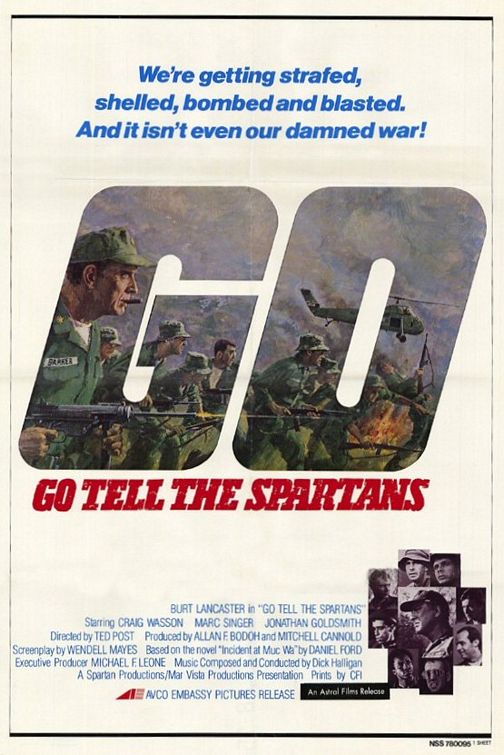
go_tell_the_spartansThis was supposed to be Good Night and Good Luck, which is even on The List, but I couldn’t find my copy of that. As I’m trying to only watch movies during this I’ve never seen, I turned to some movies I bought at the 12 for $50 sale at the WB Shop. It’s an older disc, with a 4:3 image of what wasn’t all that widescreen, but grumble grumble.

There was a sudden flap of Vietnam movies in the late 70s , and I had seen all of them, except this one, the first to hit the theaters (as an aside, I’m talking about real Vietnam movies, not Rambo or any number of Italian thrillers starring Chris Mitchum. Although I saw them, too).  It was released in 1978, barely three years after America had pulled out, and in an attempt to deal with that still-pulsing wound in the national psyche, it’s set in 1964, when we were still sending in “military advisors” without that being a euphemism.

Burt Lancaster is Major Barker, a career man since World War II who constantly finds himself dismayed and puzzled by the conflict around him. A group of new recruits comes in, and the understaffed Barker has no choice but to put them in charge of establishing a garrison in an abandoned village that the French gave up on ten years before. We get the standard types from central casting: the gung-ho second looey, big on regulations but short on experience; the veteran of the Korean Conflict, who knows what works in war but is burnt-out; the druggie, the draftee who volunteered for the duty, blah blah blah. Of course, once the garrison is established, the Cong take an interest in it, and our green recruits re going to get a swift education or die.

Hong and Wasson in Go Tell the SpartansGo Tell The Spartans has all the distinct tropes of what will constitute the Vietnam movie: the nighttime attacks, the attempts to understand and reach out to the native population, the betrayals that result from such attempts, the inability of the Western war machine to deal with a conflict that was so markedly different from any recent war. It manages to trot out all these and make a pretty decent war movie besides. Lancaster is terrific, and special kudos to first-timer Marc Singer as Barker’s executive officer and Craig Wasson as the mysterious draftee who “sure has a way with the dinks”. Also along are Evan Kim as the number one interpreter and chief torturer, “Cowboy” (man, Evan Kim should have had a much bigger career than he wound up with) and the always welcome James Hong, as a South Vietnamese soldier who bonds with Wasson despite the fact that the only English he knows is “A okay!”

Not a great or essential Vietnam movie, but a good one.

The Holy Mountain (1973)

theholymouWow. What a weird movie.

It’s tempting to leave the review at that (I certainly did on Letterboxd) – any attempt to fully describe The Holy Mountain is going to get bogged down in itself. Stripped to the minimum, it is a tale of a thief (Horacio Salinas) who is taken in by an alchemist (writer/director Alejandro Jodorowsky himself) for his plot to assemble the most powerful people in the land, run them through an accelerated enlightenment program, and using these newly-minted masters to assault the table of the nine immortals who sit atop the Holy Mountain, and take their place as gods.
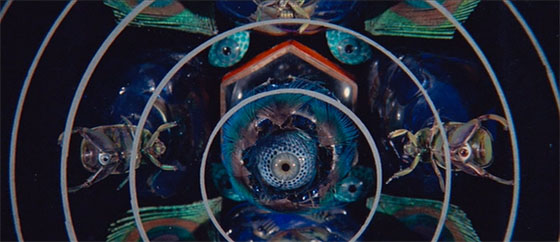
holymountain2To say the journey is psychedelic and surreal is understating matters. The first half hour is nearly speechless, one bizarre image after another. As a vendor at a long-ago convention told me, “If you like seeing toads dressed in Aztec costumes get blown up, this is the movie for you.” Once we start getting introduced to the Alchemist’s chosen, “the most powerful people on the planet”, we shift into the increasingly absurd and humor so black it absorbs any light in its presence. These are awful people creating everything that is wrong in the world, and one is concerned that these are not the types of people you want to ascend to godhood – until you consider it later (especially if you’re an old hippie like myself) and you realize the Alchemist knows exactly what he is doing – these are the people that need to be taken out of the World, for the World’s own good. (Also, as the Alchemist proves earlier, the purest gold is made from shit)

If there is an actual flaw in the movie (for me, anyway – this flick is an incredibly subjective experience) it’s the voyage to the Holy Mountain and the rituals/exercises the party has to go through for enlightenment. But I’ll also concede that it all seems old hat to me because in my sophomore year – about this time – my unbearably cool young English teacher, Mrs. Watson, recommended Carlos Castaneda to me. And in the bright remove of those early 70s, it is amazing to me that those books were in my school library. Still, one can’t tell a tale of shamanism without showing some shamanism, so here we are.

screenApparently The Holy Mountain  was going to be the most expensive Mexican movie ever made, but wound up costing less than its projected $1.5 million budget. As with Jodorowsky’s other works, the imagery is rich and lush, and I’m surprised he brought it in for less than that. It is colorful, spellbinding, and absolutely berserk. You’re either going to watch it, or not. Personally, I advise watching it. Unlike some, I’m going to advise watching it sober, or at least as far away from any actual psychotropics as you can get. I won’t be responsible for anyone ignoring that particular piece of advice.

The ABC’s of March, Part One

I’m pretty busy, of late. Besides my day job and weekly show, writing work has been coming in a pretty steady clip and it’s rare enough that I don’t like to turn it down. So, of course, I had to grab another challenge when it cropped up. At least this one is specifically for me.

6152c48c-6549-48e5-8dc8-1f1229185cdeI’m a member of the movie social media site Letterboxd – I even paid them some money for a few perks and to keep their servers running. The most valuable features, to me, were a movie-watching Diary function and a Watchlist of movies I want to see someday. (I honestly had no idea the IMDb had such a function). To top that off, the Watchlist can filter the movies down to the ones available on Netflix Instant – very handy.

So while perusing the site, I saw something called “March Movie Madness” mentioned on one of the many lists that proliferate through the site, went to the original listing, and found this: “For each of the first 26 days of the month of March, we’ll all watch a movie that begins with each successive letter of the alphabet. In other words, on March 1st, the title of the movie you watch must begin with an “A,” on the 2nd a “B,” on the 3rd a “C,” and so on and so forth.”

Well, that’s the sort of combination of discipline and anarchy that appeals to me, so I said, “Sure, why not?” (Luckily, March 1 was not quite over when I saw this). The major problem this produces for me – besides the time management thing – is that it leaves little time to write about the flicks, and I actually kind of prefer the roominess that one movie per post allows – but needs must, when the devil drives, as they say. Some of you are probably relieved by that news.

Attack the Block (2011)

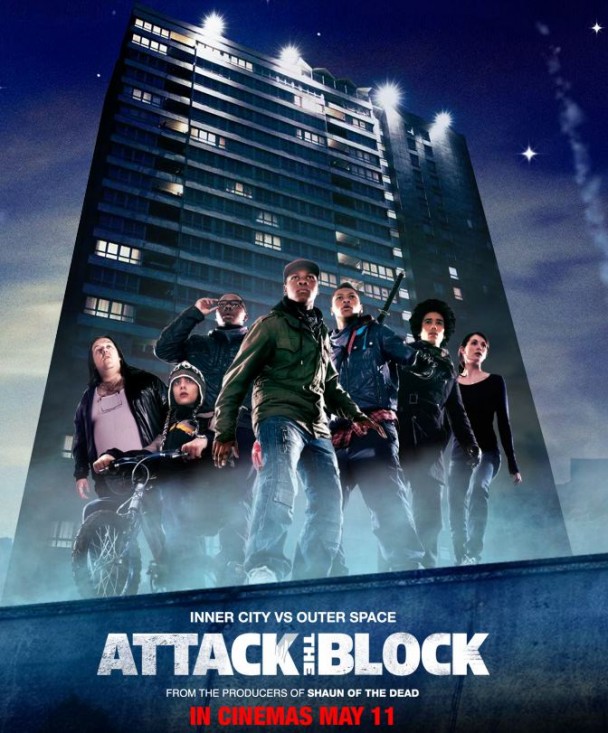
attack-the-blockAttack the Block was getting a lot of recommendations last year. It’s a pretty novel approach to the alien invasion movie, firstly in that it isn’t really an invasion and secondly in that it mostly takes place in a rundown Council tenement in London. And our heroes are a gang of thugs.

Creatures start raining down on London inside meteors, and the first one runs afoul of our heroes, interrupting  their first mugging and getting kicked to death in response. When more bigger, uglier and meaner examples of the creature start landing and pursuing our thugs, it turns into an intriguing mixture of Night of the Living Dead and Die Hard, as the thugs must team up with their mugging victim (they never would have picked her had they known she lived on The Block), and also having to deal with a pissed-off minor league drug lord who’s pretty sure they’re responsible for the cops running all over the place.

Writer/Director Joe Cornish manages the difficult task of extracting sympathy for the youth gang after that rough beginning, and the plot’s progression is logical, exciting and doesn’t skimp on the humor, either. Nick Frost has nice little role as the drug lord’s pot proprietor, controlling The Weed Room, which turns out to be the most heavily armored, secure place in the Block.

attack-the-block-hallway1The creatures are impressive, too, nightmarish combinations of ape, dog and black light poster. Filmed in costume on the set, their appearance is sweetened with CGI, rendering their fur a light-absorbing black, and multiplying the nifty feature of glowing teeth. The mixture of practical and computer effects provides the proper combination of savagery and other-worldliness.

One word of advice to American viewers: Turn on the subtitles, at least until you grow used to the cadence and slang. I also love that the Chav equivalent of “Respect” is “Ratings”.

Black Narcissus (1947)

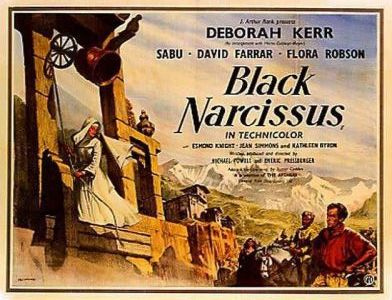
BlackNarcissusLobby3Well, that’s certainly a tire-screeching change if ever there was one. There was a time when Michael Powell and Emeric Pressburger represented the best of what British cinema could achieve, and this is a high-ranking exhibit of why.

A group of Anglican nuns is invited by the local mucky-muck to take over an abandoned brothel (in a more genteel time, this is referred to as “a palace for the General’s women”) high in the Himalayas. Apparently a group of monks tried the same thing the previous year, and only lasted five months.

Once there, the sisters set up a school and an infirmary. The local British Agent, Mr. Dean, is petty cynical about the nun’s mission, and immediately clashes with the Sister Superior, Clodagh (Deborah Kerr). The altitude, the constant wind, the vast, empty vista and the exotic local culture all begin to wear on the sisters; they find their faith eroding, and memories of their lives before the cloth intruding more and more into their daily affairs. We experience this mainly from the point of view of Clodagh, but there is one sister – Ruth (Kathleen Byron), who was none too stable to begin with, who becomes obsessed with Dean and determines to leave the Order to be with him – much to Dean’s dismay and abrupt disgust. His dismissal is the final act that will send Ruth into madness, and her jealousy of Clodagh will reach a tragic end.

BlackNarcissus4Possibly the most amazing thing about Black Narcissus is that the mountainside convent was achieved totally in the studio, with glass shots and matte paintings. Powell felt absolute control was necessary to the success of the film, and to be sure, things that are normally disastrous in such travelog-type movies, such as mismatches between footage shot in the field and in the studio, are not to be found here. The movie won an Oscar for art design – well deserved – and Jack Cardiff was similarly rewarded for his cinematography and astounding use of light, inspired to some degree by the paintings of Masters like Vermeer.

The acting can swing to the deep end of melodramatic, but then, this is 1947. Flora Robson as Sister Philippa, the gardener, gives the most subtle, yet touching performance, as the sister so shaken by the memories awakened by the locale, that instead of vegetables, she plants a garden full of flowers. The cagiest part of all this is once we see Clodagh and Dean take an instant dislike to each other at the beginning, we know these two are going to get together; it’s Hollywood law. But though they do get closer, and start to respect each other more and more, it never happens, it can’t happen. The audience finds itself in the same state of unfulfilled longing as the characters.

Come for the pretty pictures, stay for the intriguing spiritual crises.

Cronos (1993)

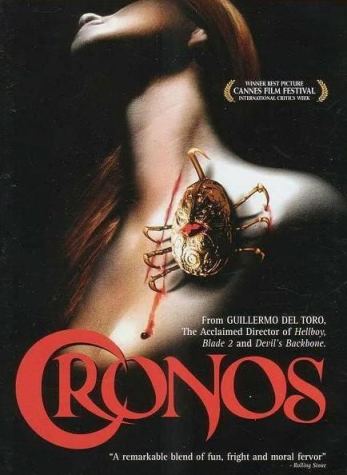
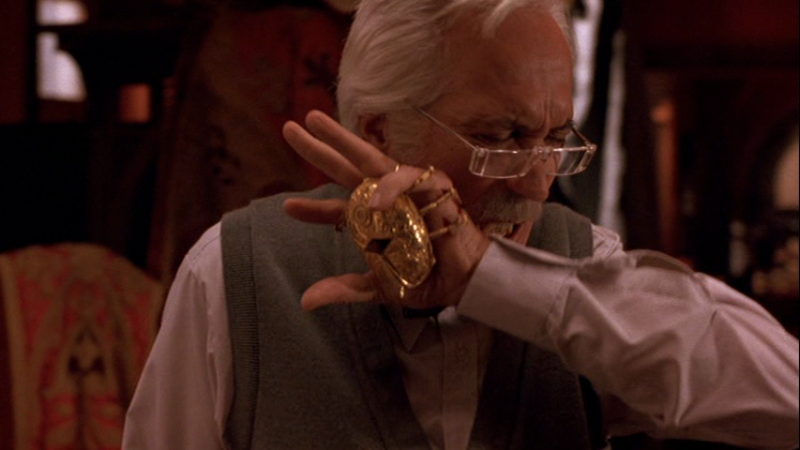
cronosGuillermo del Toro’s marvelously assured debut feature provides a unique take on the vampire legend. A 16th century alchemist creates a clockwork scarab he calls The Cronos Device; it houses an insect of unknown specie, and winding up the device and allowing its various appendages to bite into your flesh does indeed imbue you with immortality, but at a horrific price. The fact that our alchemist dies in an accident in the early 20th century proves that it works. A dead body hanging in his mansion dripping blood into a dish also proves the horrific price.

The possessions of our nameless alchemist are auctioned off, the Cronos Device concealed in the base of an archangel statue. That statue comes into the possession of an aging antique dealer (Frederico Luppi), unaware of its cargo, or that a rich, cancer-ridden man (Claudio Brook), owner of the alchemist’s notebook, has been looking for the statue for some time. A none-too-subtle  thug examining the statuary in his shop causes the dealer to discover the Cronos Device, accidentally using it, finding himself feeling much more youthful than he has in ages, although he has this peculiar thirst for blood… And he also falls afoul of the rich man’s harried nephew Angel (Rod Perlman), who isn’t afraid of breaking the law, and people, to get what his uncle wants.
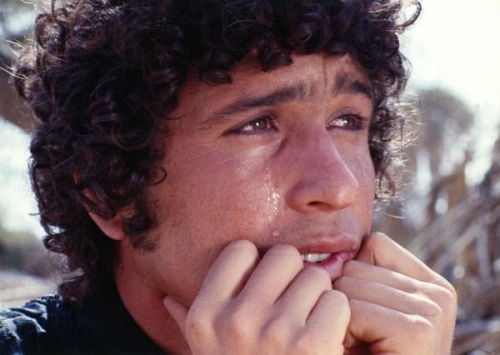
cronos2Cronos starts with a horrific vision and then is satisfied to simply ramp up the tension and the weirdness, finally re-entering the realm of out-and-out horror in the half hour. It’s marvelous to see some of the del Toro motifs in their larval form, as it were: A fascination with clockwork gears grinding like the wheels of justice;  insectile lifeforms; and the startling ability of children to deal with situations that adults cannot or will not. It’s an intriguing film that takes an interesting path to tell its tale, and it’s very nice to see the first outing of what would become one of film’s foremost voices in the realm of lyrical horror.

Diabolique (1955)

les diaboliquesHenri-Georges Clouzot’s Les Diaboliques is hailed as a suspense masterpiece; the only problem with approaching it in 2013 is that everything which was daring and new at the time has since been appropriated time after time by other movies and other directors.  On the Criterion Blu-Ray, Kim Newman makes the point that most of William Castle’s career was spent doing remakes of Diabolique.

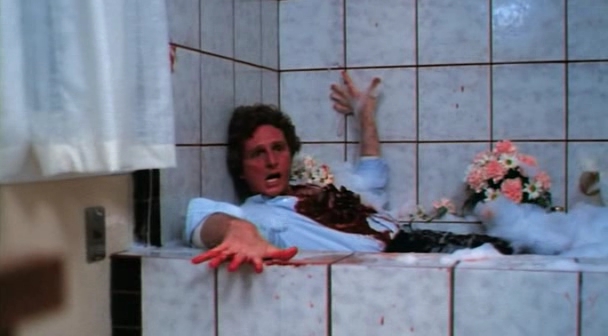
The wife and mistress (Vera Clouzot and Simone Signoret, respectively) of an abusive asshole (Paul Meurisse) join forces and plot to murder him. He’s the principal of a boy’s boarding school where they both teach. Over the course of a three-day weekend, they drug him, drown him in a bathtub, then deposit the body in the school’s neglected swimming pool, all the while providing themselves with a solid alibi. After several days, the corpse has not cooperated by surfacing, and the mistress manufactures an excuse to drain the pool. When there is no corpse found in the pool’s murky depths, things begin to get weird.

The suit in which the man was drowned returns from a dry cleaners, freshly pressed. A boy claims the Principal has told him to clean up the yard for punishment. The face of the missing man seems to be eerily present at a window behind a school group picture. Either someone knows about the murder and is scheming to blackmail the women, or the unthinkable has happened, and the man has returned from the dead.

500fullAs I said, it’s really hard to put yourself back in 1955 when all the twists were new; it’s like trying to figure out why people were fainting during the 1931 Dracula. The remove is too far; that once-shocking coin has been spent over and over again, and in our presence to boot. The climax, once so terrifying, still packs a punch because it’s so very well done, and to give Clouzot credit, there had been so many twists and bizarre mind games played with the viewer up to that point, I was still uncertain what I was witnessing was actually the truth. I still feel it runs a bit long at nearly two hours, but there’s not much in the way of fat to be trimmed.

Good movie, but perhaps I let myself be led astray by its reputation. I really loved The Wages of Fear, and that also elevated my expectations. I’d still recommend it, but be aware you’re likely going to find it awfully familiar going.

Okay, that’s it for now. I still have a movie to watch today, after all.

Belated Valentine Crap

I knew one week was going to be hellish, but I had no idea it would effortlessly balloon into two and a half weeks. My endurance was severely tried and probably exceeded, as I’m still feeling the aftereffects. I’ve become acquainted with the cane again because my supposed “good” leg is tired of taking up the slack and is actively mutinying. A walker or forearm crutches is starting to look tempting.

overworkedThere was one thing that was helping me through all these tribulations, and that was the prospect of a Crapfest in the coming weekend, when I told myself I could relax, and, as we said in the day, “Blow off some steam”. Blow off, indeed, I was so successful in achieving a state of what we in the trade call “blitzed” that I’m probably lucky I can write about it at all.

I feel much better for that.

First we should note that I was beaten to the fest by Erik, the New Guy. I cannot fault his enthusiasm – he had been fomenting for a Crapfest since January. After cursing his youthful vigor I oohed and aahed at Dave’s reincarnation of the Fest Room, dubbed Den 2.0. Den 2.0 was an order of magnitude better than the old configuration, roomier and allowing the projector a slightly longer throw. Magnificent work. Dave had even called our tallest member, Paul, to get his height, so that he could mount the projector two inches above that. SCIENCE!!!!

Trafficjam

“Loooook! Is that Dennis Roddddddman?”

People slowly drifted in while exploitation trailers played. Two people did not make it. Wald fell afoul of some traffic spawned by the Houston Livestock Show and Rodeo, gave up, and went home. Having dealt with the traffic in the Galleria area the weekend of the NBA All-Star Game (where tweets alluded various basketball players were shopping, and therefore the entire county descended on the area, and, in fact, the mall and surrounded streets were eventually shut down), and having wished I could have just given up and gone home, I couldn’t blame him. Dave asked me to text him where the sausages he was supposed to be bringing wound up. Wald replied he had been lobbing them at other drivers.

We tried to watch everything that featured exposed breasts before Alan arrived from his acting gig, and we almost succeeded, but then a trailer featured a breast or two (there was an astounding amount of stuff “based on the Marquis deSade” in the 70s). So it was down to the new version of the faithful: myself, Dave, Rick, Paul, Alan and Erik.

I apparently had the opener. I had been scheduled to present Sonny Chiba’s The Bodyguard (Paul had wanted to see it since witnessing the “Viva! Chiba!” trailer), but Dave had discovered a disc in my bag I had literally gotten just the week before, at the WB Shop’s $5 sale: Gymkata.

gymkataSome of you moaned when I said Gymkata. Well, screw you.

Gymkata was Robert Clouse’s 1985 attempt to re-capture Enter the Dragon lightning in a bottle (there were many more, and most are reasonably entertaining). This one stars Olympic Gold Medal Gymnast Kurt Thomas, as Olympic Gold Medal Gymnast Jonathan Cabot.  Cabot is recruited by the CIA to follow in his father’s footsteps. Pop Cabot went to Parmistan to participate in THE GAME, a sort of organized Most Dangerous Game where participants run through the country and numerous obstacles while pursued by Richard Norton. If they live, they get whatever they want. And what Pop Cabot wanted – or rather, what the CIA wanted – is to place a Star Wars Satellite Station (remember that? Thanks, Reagan!) in the country. Naturally, other countries want that, too. Their own satellite stations, I mean. Not a satellite station for the US.

gymkata1Yeah, you heard me drop the Richard Norton name. If you’ve watched any HK action flick from the 80s through the 90s, you recognized that name, and you realized he’s the villain. Especially since you saw him put an arrow in Pop Cabot while he was crossing a rope over a ravine. Norton’s the King’s right-hand man, wants to take over the country, marry the princess who Cabot the Younger is in love with, you know, the usual.

The Princess is one of the trainers who helps Cabot get into even better shape, and to, as the poster promises, “Combine the Skill of Gymnastics with the Kill of Karate!” And then we get to Pretendistan, and oh boy, does our story really get underway.

This is one of the beautiful things about Crapfest. Some people had said they had seen Gymkata before, but they hadn’t been paying attention, I guess because they were blindsided by Parmistan. Intensely traditional. Guns are outlawed in Parmistan. Now as to the costumes: wardrobe just called up every costume house and said, “What do you have that’s vaguely middle eastern? Yeah, give us all of it. Got some Asian stuff, too? Sure, send it over. Leftover barbarian crap? Throw that in the truck, too.” Parmistan is like no country that every existed, because it’s like all countries that ever existed. Especially in Movieland.

gymkata (1)Paul had thought that there would just be some fighting in a gym or something, but oh no, that’s not good enough for Gymkata. Fight in an alley? That waterpipe would make a swell high bar! Surrounded by homicidal lunatics in an abandoned city where Fakeistan tosses all its insane people (a hell of an obstacle)? Lucky that suspicious structure for tying up your goat in the town square resembles a pommel horse! I’m really sorry they never found a way to work in some parallel bars, but we do get some vaults and backflips in fight scenes. With, of course, the audience shouting, “GYMKATA!!!”

That was an unexpectedly strong opening for Crapfest. During a break, Dave started a copy of The Fantastic Animation Festival playing; I had seen this in the theater back in ’77, and it melted my mind then. I still remembered French Windows, which kickstarted my tardy love for Pink Floyd, but I had forgotten how trippy the rest of the stuff was – though I did get confused where new music had seemingly been laid in for Cosmic Cartoon. The new music was good, but I remembered the Paul Winter Consort and Holst’s “The Planets” being used…

Maybe I had gotten my mind blown back then. But I distinctly finally hearing Paul winters’ “Icarus” album in the 80s and thinking, “Oh yeah! Naked dancer in the surf!” Well, at least Pink Floyd didn’t change… However, that is likely the reason French Windows isn’t on YouTube. So here, have the Cosmic Cartoon:

Dave plays his choice close to the edit, as it were. He picked out the middle position (“the rocking chair” in CB terms), and makes his final decision based on how much the opener hurt him. Since the Gymkata experience was positive, he decided to be what he calls “merciful”, and plugged in Mausoleum.

mausoleum_poster_01I’m okay with this. I’ve never seen Mausoleum. And if you want to peek into the heart of the Crapfest experience, you need look no further than the fact that when Marjoe Gortner’s credit rolled across the screen, he got a standing ovation.

This is also the period of the evening when I started getting seriously sloshed, so be aware that from here on I am using Vodka Filter #3, and adjust accordingly.

1983’s Mausoleum kicks off former Playboy Bunny Bobbie Bresee’s too-brief career as a Scream Queen. In the opener, the young version of Bobbie freaks out at her mother’s funeral, and runs into the title character, where she is possessed by the same demon who apparently possessed her mother. After she grows up into Bobbie Bresee and marries Marjoe Gortner, the demon starts cropping up again, killing people for whatever reason is convenient and making Bobbie’s eyes turn green.

susan 1This all seems rather similar to the last Crapfest’s Abby, but with a somewhat better budget and no William Marshall – and nudity! And the welcome addition of LaWanda Page as Elsie the maid, the only person with any sense in the movie, as she notices things are getting all demony and immediately skedaddles. (Exit line: “No more grievin’, I’m leavin’!”)

The horrific highpoint and Fangoria photo opp is when the nude Bresee is embracing Marjoe after a tough day of whatever job it is that doesn’t insist you wear a necktie, goes full demon, and her breasts transform into demon heads that chew their way through Marjoe’s ribcage and eat his heart.

mausoleum1983dvdvhsbycrI got told about this scene back when it was in theaters and thought it was a nice callback to medieval woodcuts that showed demons with faces on their pecs; finally seeing it was so astonishing we actually rewound the movie and watched it again. It’s all falling action after that, as the psychiatrist who’s been seeing Bobbie since she was a kid finally snaps to the demon thing, gets a wrought iron crown-of-thorns from the Mausoleum that will trap said demon back in said Mausoleum, and then, although the movie has ended, it goes on for ten more minutes as Bobbie and the Psych go to the Mausoleum to load the demon back in its sepulcher. We were hoping for LaWanda to come back with a machine gun or something, but those hopes were unfulfilled.

I mention that Bresee’s career was sadly short-lived because my main takeaway from this was that she was actually very, very good – hell, she went to Mercedes McCambridge for pointers on her demon voice – and she really deserved a lot more work than she got, though she apparently had a decent run on Santa Barbara, I hope so. Especially if the rumors about the producer setting up bleachers so people could watch her sex scene being filmed are true. That’s the sort of thing that requires a karmic balancing.

Dinner break! As we cooked and cut the pizza, I supplied a copy of The Ed Sullivan Show featuring the Rolling Stones. “Why must you always sully our Crapfest with quality?” came the moan. You’d think this is a lesson they would have learned by now: Quality makes the knife cut deeper. Then, there is my rejoinder, “You have no idea what you’re in for.” This was the complete show, with all the other acts, and commercials. And leading off tonight’s really big show: clog dancing.

rolling-stones-ed-sullivanI first found out about these discs at the Rupert Pupkin Speaks blog, where cinema omnivore @bobfreelander asks bloggers to submit their older movie discoveries over the last year. Within two days I had the Stones disc and a similar one featuring the four appearances of The Beatles. These are endlessly fascinating to me; I remember back in the day – and I would have been about 7 when the first Beatles episode hit – that Ed was what we looked forward to, it was what capped off the weekend. It was the best, the show everyone vied to get an appearance. There’s a reason there’s a song about it in Bye Bye Birdie.

This was actually one of the more normal Sullivans I now have. Petula Clark does two songs, there are long monologues by the very young Flip Wilson and Alan King, an early, trippy Muppets sketch (Jim Henson shakes hands with Ed) and it ends up with the censored version of Let’s Spend the Night Together”, “Let’s Spend Some Time Together”, with Mick rolling his eyes every time the changed words come up.

I don’t know if I’ll ever spring any of the others on future Crapfests, though there is something astounding in each episode. I now realize just how annoying Topo Gigio was, and that Senor Wences wasn’t all that great. But there is one episode where the warmup act for The Beatles is none other than Cab Calloway, and I’m surprised the studio didn’t collapse into a Cool Singularity.

Here, have an ad:

Now, for the third and final movie of the evening. My copy of Exorcist II: The Heretic was a favorite, but we were also burned out on demonic possession. I wanted to see one if the movies Erik had brought: School of the Holy Beast, a Japanese nunsploitation movie. I’d had no idea there was such a thing, until Erik mentioned it, and I said something like “Holy crap, there are Japanese nunsploitation movies?” So there you go. I had to see it.

school beastNow, as a non-believer brought up as a Protestant, I admit I am a hard sell for these things. And once you’ve seen Bruno Mattei’s Guardian of Hell/The Other Hell or Juan Lopez Monteczuma’s Alucarda, or Ken Russell’s The Devils, it’s hard to believe there’s anything in the subgenre you haven’t already experienced. Then, with the Japanese, you know you’re getting the tale from a unique angle. The movie is apparently based on a popular manga, surprise, surprise…

So Maya, an attractive young woman, becomes a nun at the very convent her mother’s death took place. We’re eventually going to find out that her mother was pregnant with Maya when the Abbess tortured her, probably trying to induce an abortion. Her mother hung herself and birthed Maya at the same time, and a sympathetic nun spirited the baby to the outside world, where she was adopted and grew up to be Maya.

There, I saved you a bunch of time. School of the Holy Beast can be very confusing to your typical gaijin (translation: us) when faced with a bunch of asian women of approximately the same age all dressed in the same uniform, which obscures everything the clueless occidental could use to differentiate characters: hair style, figure. We were pretty sure who Maya was, however, because she was the Worst Nun Ever, constantly winding up in the Persecution Room (yes, that’s what it’s called) where half-naked nuns are ordered to whip each other for punishment.

The probable lynchpin scene here – yeah, the one all you pervs are waiting for – is when the naked Maya is tied with briar vines and made to suffer “The 13th Punishment” which is being whipped by bouquets of roses in slow motion. It’s artistic, at least. I guess. I’m still trying to sober up at this point.

School of the Holy Beast-3Maya finds out the particulars of her mother’s death, but who was the father? The Holy Beast of the title, the priest who oversees the convent and drops by ever so often; a man who survived Nagasaki and mentions Auschwitz. He ‘s slept with the Abbess, too, and already raped Maya. He also brought in his new consort, a sort of Witchfinder General, to find the witch who’s been causing all these troubles in the rank.

Yeah, I forgot to mention that while tossing the nun’s rooms for contraband, the Vice Abbess – appropriately enough – finds some pornography in Maya’s belongings and confiscates them. Supposedly to burn, but she really sticks them in a desk and brings them out when she’s alone to… you know. Maya then obligingly sneaks out and smuggles two men in, disguised as nuns, to rape the Vice Abbess. This is played for laughs, just in case you weren’t offended enough.

switchblade nunThings get downright Shakespearean at the end, with Maya swinging on a rope to knock the murderous Witchfinder out a window and onto the spikes of a wrought iron fence(“The skill of gymnastics! The kill of karate!”); the Abbess falling into an acid pit that, for some reason, she has under her office; and the Holy Beast himself going nuts, declaring  Maya God, and then deciding to kill God.

That was a pretty nutty time.

We kept losing Alan through the second half of School and Dave was threatening to go to sleep, too. So we grumbled and pulled together our traps, swearing not to wait so long ’till the next time. Den 2.0 is awesome, and we never came near to testing its full potential. So until our next Crapfest, stay safe, stay sober, and avoid mausoleums, convents, and countries where everybody is dressed like a grade school production of The Arabian Nights. Dormez bien.

The Man With The Iron Fists (2012)

man_with_the_iron_fistsIt’s not going to surprise anyone when I say I love kung fu movies. That’s a label that covers a wide variety of movies, and while I can’t claim to love them all, I do find almost all of them interesting on some level. One thing that puzzles me – and mainly in a rhetorical sense – is why there has not yet been a Great American Kung Fu movie. Now, kung fu tropes have been a part of American cinema for years; I’m talking here about The Matrix movies or Kill Bill. But there the kung fu is in service to another story – it is not a primary motivator, they do not take place in jianghu, The World of Martial Arts. Their characters are proficient in the martial arts, but those arts do not permeate the very fabric of the world the way they do in Asian movies.

And now, perhaps, The Man With The Iron Fists has answered that question.

Man With the Iron Fists, in case you’re not familiar, is a movie directed by, co-written by, and starring RZA, a man likely best known as a musician, rapper and hip hop producer. His credentials there are exceedingly strong, and there is no doubt that he is also a fanatic about kung fu movies. The monster group he co-founded in the early 90s was The Wu-Tang Clan, and their first album was named The 36 Chambers, for pete’s sake. I can’t judge the music, I’m not the target audience for hip hop, but there’s no doubt RZA knows what he’s talking about, kung fu movie-wise.

That said, Iron Fists didn’t do so well at the box office; reviews have run the gamut from lukewarm to outright hate. The most even-handed one I ran across is Paul Freitag-Fey’s at the Daily Grindhouse site – and even that one is all too aware of the movie’s flaws. But, as always, I have to see these things myself and make up my own mind, and so, after a hellaciously busy two weeks, on the verge of exhaustion, I put the disc into my player and willed everyone to be wrong about it.

My will was weak.

Take THAT, viewer!

Take THAT, viewer!

Now, the first remarkable thing about Iron Fists is that RZA actually set out to make a wuxia film. It is set in China in the mid-to-late 19th century, and is pretty much concerned with the jianghu as centered in the largely corrupt and extremely violent Jungle Village. Iron Fists shares a Macguffin with my favorite Shaw Brothers flick. The Kid With the Golden Arm: a cart full of government gold, headed for (mumble mumble). In Kid, it’s for the relief of flood victims. In Iron Fists… I’m just not sure.

Because here is the most severe blow against Iron Fists: the first cut reportedly came in at four hours. The same report says that RZA wanted to release it as two movies (which may have worked, we’ll never know), but it was instead cut down to 95 minutes – 107 if, like me, you watched the unrated extended version on disc. That means the first half to two-thirds of the movie is driven by narration, which is always a sign of trouble.

The-Man-with-the-Iron-Fists_07The first thirty minutes are incredibly frenetic and confusing. There’s a huge fight under the opening credits that I’m still not sure has any bearing on the story itself. A patriarch of the Lion Clan, Gold Lion (Chen Kuan Tai, himself an old school kung fu movie star of no small import) is assassinated, which does have a bearing, and the gold is being sent down the road for whatever purpose… it’s either for Jungle Village, or it’s just passing through Jungle Village… in either case, I’m not interested enough to go back and check.

The treacherous lieutenant of the Lion Clan, Silver Lion (Byron Mann) wants the gold, and is aided by a mysterious cloaked figure who will later be named as Poison Dagger (Daniel Wu, eventually). Gold Lion’s son, Zen Yi (Rick Yune) calls off his marriage to look into his father’s death. Zen, I should mention, is supposedly, anachronistically called The X-Blade, but seemingly only in the trailer. He has a “suit of knives”, which pops out porcupine-like quills as needed, though God only knows where they retract to when he’s finished. Not that this is the most outrageous weapon I’ve ever been asked to accept in a kung fu movie.

Meanwhile, at the Pink Blossom bordello (the finest in the region) Madam Blossom (Lucy Liu) welcomes an unusual traveler – a British expatriate with the unlikely sobriquet of Jack Knife (Russell Crowe), who wields a combination pistol dagger that whirls like a drill. Jack books a room with three prostitutes and settles in for his vacation.

the-man-with-the-iron-fists09 (1)Got that? Good. Now realize that none of these characters is the star of the movie, the main character. The title character.  That would be the perfectly-named Blacksmith, played by RZA, who is not only a blacksmith, but is also black! Get it? He manufactures the bizarre weapons for all the local clans, like the Lions, the Wolves, and the Rats (we are not allowed Tigers or Bears for the obvious joke).

No wonder Blossom – and nobody else, really – bats an eye when a lone Brit arrives in town. He has no novelty value.

The tale of how Blacksmith came to be in China is a fairly interesting story that will just have to wait until the third act, we still have a lot of narration to get through.

Zen Yi arrives and is promptly waylaid by the villainous Brass Body (David Bautista) who can, yes, turn his body to brass. Zen Yi barely escapes, rescued by Blacksmith and hidden by his girlfriend, Lady Silk (Jamie Chung), one of Blossom’s finest.

The gold arrives, escorted by the Gemini Killers (Grace Huang and Andrew Lin), a matched pair whose fighting styles play off each other and whose weapons, when locked together, form a yin-yang. The worst casualty of the truncated running time is character development, and it is apparent the Gemini Killers were meant to have a much more significant chunk of time. As it is, they arrive, have a quick meal, are set upon by the Lion Clan, and then polished off by Poison Dagger in typical cowardly fashion. In just a little more time than it takes to tell about it.

man-with-the-iron-fists-img05Also when Poison Dagger finally takes off that cloak, we are obviously supposed to recognize him. We don’t. Or maybe it’s a kung fu joke, because Poison Dagger has the same flowing white hair as Pai Mei, villain of many a Shaw Brothers flick. Wait, I just saw a press photo of him in court garb – so he’s in one of the Imperial Court scenes back in Narration Land. No wonder I didn’t recognize him.

We recently crossed over a 1000 words, so let me try to be brief(er), The bad guys try to make Blacksmith tell where Zen Yi is, and when he refuses, they cut off his arms. He’s rescued by Jack Knife, who turns out to be an undercover agent for the Emperor. Blacksmith has, yes, iron fists made for himself  while we are regaled by the Origin of Blacksmith. A) he’s a freed slave B) his mom was Pam Grier C) blamed for a white man’s death, he jumped onto a ship D) which was wrecked off the China shore E) where Blacksmith was found by a bunch of monks out for a stroll.

liuNot bad. It explains what a black man is doing here, how he learned Chinese. Then, we learn, after being taught by none other than Gordon Liu, he is also a kung fu master of some skill (he just strayed significantly from The Path – to say the least! – which is why karma was such a bitch). Skillful enough to make the iron fists work as if they were actual hands. And skillful enough that, later, he will punch Brass Body so hard he apparently opens a singularity and makes the metal guy explode.

The last third of Iron Fists isn’t that bad; it’s just that the hectic patchwork of the first two acts has used up all the viewer’s patience, and without the necessary time spent developing the characters, there is no empathy for any of them, no sense of tragic loss or ultimate triumph. At least the damned narration vanishes.

We expect a lot from seasoned pros like Lucy Liu and Russell Crowe, and we get it. The movie provides some nice roles for Asian actors, but only Byron Mann and Daniel Wu get to make any impression, with Mann truly outstanding as Silver Lion. Sadly, the weak link is RZA, who possesses a low-key charisma and some personality, but not the presence or intensity necessary for an action star.

Man-with-the-iron-Fists-RZA-on-Set-with-Cinematographer-Chi-Ying-ChanHe fares a lot better as a director. Iron Fists is well-made and pretty assured when it isn’t trying to patch holes created by slashing the story to ribbons. I can’t fault RZA’s ambition, but I would have loved to see what he might have done with a script without such an epic scope, with a story that could have fit comfortably in 95 minutes. Judging from the final 30 minutes of Iron Fists, it could have been sweet.

The end credits set up the sequel, but that’s likely never going to happen. I do,  however, look forward to whatever RZA does next. This had to have been a tremendous learning experience, and I want to see where that education leads.

Damn it, I wanted to love this movie.

Twitch twitch

My week, artist's interpretation.

My week, artist’s interpretation.

I’m alive. Not very nimble or demonstrative, but I’m here. On my second day of “rest”, if your definition of rest includes mundane chores like going to the grocery store and having your car’s oil changed. I was thankful for the timing of President’s Day, as it gave me an actual weekend to recover.

The best part of last week was going to the monthly meeting of the local School Board, when the two people who normally run the cameras while I ride levels on the sound board were both absent, and i found myself running the robot cameras for the first time. Many freshman mistakes were made that night, but as my supervisor at the District said, “If anybody complains, I’ll tell them to come run the cameras next time.”

I look forward to going back to my usual work station next month.

You remember how I keep saying the 60s didn’t really die until the early 70s? Well, the week from hell won’t die until tomorrow night, when we have yet another private show.  Toughest part of this one should be maneuvering through rush hour traffic to get to the hotel. Then I get to be an asshole for two acts, then die.

The flip side of the President’s Day coin, too, is that being unsalaried, I have to move my regular Monday hours across the rest of the week. The ring I’m holding out for myself is a Crapfest this Saturday. I’m looking forward to that.

Sunday involved a lot of movie-watching. Both parts of the animated Dark Knight Returns, which was superb, although I was sadly underwhelmed by Michael Emerson’s Joker (Peter Weller is an excellent Batman, though). Skyfall, which was good, and The Man With the Iron Fists, which wasn’t, but I intend to talk about that later this week. Also watched the 1973 The Outfit, because Daily Grindhouse wants to start the podcast up again. It was a pretty good, stripped-down version of the Donald E. Westlake novel, and it really made me wish Robert Duvall had done more badass roles.

Now I need to do some writing for pay, so please excuse me. I just didn’t want to interject another lengthy pause on the blog.


I’ll Be Back

29266688if I live.

This weekend… Ha! Weekends! What the hell are they? This weekend was just the prelude. Friday morning I was pressed into news anchor duty at our weekly newscast; the usual anchor was down with a kidney stone and a stomach virus. We’re shorthanded as it is, so I got to put on makeup, a tie, and be presentable.  The results were acceptable, if not stellar.

Then, Friday night, a traveling show, a very special kind of hell, this time involving mys on and my wife, who was subbing for an absent actor. It was an evening full of hurry up and wait, and then oh my god get set up, get set up now, followed by more hurry up and wait, then doing the show, then hurrying up and waiting to tear down our stuff and pack it away. The room was apparently chosen for it’s extreme distance from the freight elevator.

Next night: regular show. Then, Sunday morning, can you please read at the 8:30 service, it will be super easy! Except for the getting up after only a few hours of sleep!

All this prelude. Prelude, to a week where the occasional fart is going to have to be carefully scheduled. Regular work, Monday through Friday, except for Wednesday, when I come in later to tape a lecture. Monday Night, School Board meeting. Tuesday, Thursday, Friday and Saturday nights? Shows, all of them. Well, at least I get Wednesday night off.

“Listen, could you do the evening service on Ash Wednesday? It will be super-easy….”

Writer’s meeting Thursday afternoon. Can’t miss this one, I missed last week’s due to being in the middle of a State Park shooting a story. I said I’d have another script finished by tomorrow, then found out I don’t have the desired script template.

Like I said, if I live, I’ll be back.

The Seventh Seal (1957)

7th sealIn my quest to fill the many holes I had in my film education, I don’t think I’d yet approached anything so iconic as Ingmar Bergman’s The Seventh Seal. The movie is so well-known that The Simpsons makes jokes about it at leisure, the chess game with death is imitated and riffed upon (at some length in one of my favorite movies, Bill & Ted’s Bogus Journey), the back of the Criterion blu-ray extols it as “…one of the benchmark imports of America’s 1950s art house heyday, pushing cinema’s boundaries and ushering in a new era of moviegoing.”

Phew.

I think, like a lot of people, I was expecting a grim vista, an allegory of Man’s search for meaning and God in the midst of the Black Death. Well, there is a fair amount of that. What I was not expecting, given the movie’s reputation, was the sweep of emotions, the comedy, the rapid switching of audience allegiances with the characters.

In other words, I was expecting good, but I wasn’t expecting something that would swing in on my Top Ten and start bashing other movies out of the way, like Aragorn and Gimli on the bridge to Helm’s Deep.

(Was that last reference nerdy enough? I worry sometimes.)

Sure, Bergman starts us right off with the chess game with Death. Knight Antonius Block (Max von Sydow) is sleeping on a rocky beach, along with his squire, Jöns (Gunnar Björnstrad). Up crops Death (“I’ve been at your side for a while.” “I know.”) and Block, since his chess board is curiously already out and set up, proposes the chess game.  What I didn’t know, in my filmic ignorance, is that the chess game is ongoing throughout the movie; Block has a reprieve so long as he manages to hold checkmate at bay, or wins.

The-Seventh-SealBlock has just returned from a decade spent in the Crusades, a decade during which his faith has taken a severe beating, and his life’s course has become a quest to qualify if God actually exists, or not. He has been through such horrors that he requires physical proof, even resorting to asking a condemned witch how he, too, could see the Devil, because he has some questions for Old Scratch. These are, of course, questions that will not be answered – even Death is not forthcoming on the subject. The fact that he has returned to his home country to find an ever-spreading plague isn’t helping his demeanor any.

That I had expected. What I was not expecting was to become so involved with the character of the Squire. Jöns has similarly lost whatever faith he had, saying “Our crusade was such madness only a real idealist could have thought it up.” His is not the way of questioning; he has come to believe that all that remains after death is emptiness, and moves through life with more of an air of acceptance, of proactivity, as it were. If there are any examples of what would one consider knightly duties, saving a young woman from a rapist, or putting a scoundrel down, it’s Jöns that does it. It is beneath Block. Jöns has his bad moments – he’s far from perfect or even heroic – but he remains my favorite.

1Then we begin spending some time with a traveling troupe of actors: a family of three, Jof (Nils Poppe), the juggler who sees visions like the Virgin Mary walking the toddler Jesus; Mia his wife (Bibi Andersson) and Mikael, his one year-old son; and Jonas Skat (Erik Strandmark), who is more than a bit of a rogue.

Now, I was getting into the travels of Block and Jöns, and found myself a little impatient with the juggler sequences. Was this going to pay off? I should have know better. Of course it was going to pay off.

Block, Jöns, and the girl he rescued (Gunnel Lindblom) wind up at the same village where the jugglers are doing a show – which will be interrupted by the Flagellants, a group of people going about the countryside, singing hymns, carrying lifesized crucifixes, and haranguing everyone that they’re going to die because God thinks they suck and generally killing any hope for the actors passing the tip hat. Also, Jonas runs off with the local blacksmith’s wife, which is going to propel the plot for a while.

There will be a point where Block and Jöns join the jugglers – Jonas is still MIA with the wife – and they share a simple meal of wild strawberries and fresh milk, while Jof plays his lute. It’s a quiet, peaceful setting, and Block speaks of how the memory of that afternoon will sustain him. It’s a beautiful moment, made all the more poignant as one realizes that if Block was truly looking for the existence of God, it was never more obvious in that moment of peace on a sunny hillside.

There is a scene of almost Shakespearean comedy in the local tavern, where the blacksmith Plog (Åke Fridell) is sobbing into his ale over his lost wife. He and Jöns have a back-and-forth scene about all the things that are wrong with women, and why he is better off without her, and each one just makes the blacksmith sob harder. Later, when Block, Jöns and Plog are escorting the jugglers through a scary wood, and they find Jonas and the wife walking about, there is another marvelous scene where Plog and the actor trade insults, with only a little help to the slower blacksmith by Jöns.

flagellantsLater, camped in the woods, Jof, with his talent for visions, is the only one that can see who Block is playing chess with, and quietly gathers his family and sneaks out of the camp. Block sees this, and remembering that Death has said some things about the trip through the woods with typical Death-style foreshadowing, knocks over some of the chess pieces to distract Death while the actors escape. It is one of the most knightly things we have seen him do, but it will cost him. Shortly after, Death wins the match.

I hope I haven’t said too much, as I leave you here, still ten minutes before the end of the movie. As with all movies that I like, or love, I want you to experience it for yourself. And probably the greatest recommendation I can make is that, while writing this, I have been urgently seized with the need to watch it again. Fabulous filmmaking, all the more remarkable considering Bergman was using equipment left over from World War II, and filming in a very small studio – apparently it is possible to see apartment lights in the background of one nighttime shot – and still produced a movie, that while epic in subject matter, still manages to feel small, intimate, and wholly believable.

At the very least, I haven’t spilled any plot points the trailer didn’t:

(You might want to hit the YouTube logo and watch it on their site – I couldn’t find one where the burned-in subtitles didn’t turn to mud)

Arabian Nights (1974)

Mille_Et_Une_Nuits_(1974)So we come at last to the third and final movie in Pier Paolo Pasolini’s Trilogy of Life: Arabian Nights. For this outing, Pasolini has gone farther afield in medieval literature, if Arabian Nights can even truly be considered medieval. First instances of the collection date back to the 8th century, with more stories from various cultures being added over the years.  (I was more than a little surprised that two of the most famous of the tales – Aladdin and the Forty Thieves – didn’t enter the collection until the first French translation in 1704!)

True to the other movies in the Trilogy, Pasolini also jettisons the formal framing device of the traditional Arabian Nights, so say farewell to Scheherazade and familiarize yourself with our first tale, which will take its place: the arrival of a slave girl  Zumurrud (Ines Pellegrini) at the market – unusually, she is allowed to choose her new master, and isn’t shy about insulting prospective buyers. She chooses a young man, Nur Ed-din (Franco Merli) as her new master, and hands him a bag of a thousand dinars to purchase her, and procure a home.

zumurrudThis is, as one might imagine, a pretty sweet deal, especially since Zumurrud takes special pains to make sure Nur is no longer a virgin, and then starts using her talents at embroidery to keep the money coming in. Alas, Nur is a bit of an idiot, and proceeds to allow Zumurrud to be kidnapped – twice – and will spend the rest of the movie looking for her. Zumurrud escapes her second captor (one of the forty thieves, no less), and crosses the desert dressed as a man. She comes to a rich kingdom, where, luck would have it, the king has just died and it is the city’s custom to proclaim the next man to come in from the desert as the new king. Again, a totally sweet deal.

The first stories are read from a book by Zumurrud while the two are still in the idyllic stage of their relationship and rather serve to set up Pasolini’s view of this world: in the first, a noted sage and his wife make a deal about who will fall in love first between a boy and a girl they’ve arranged to have drugged so each will awaken in the same tent, but at different times; but they discover they’ve both forgotten about hormones and declare it a draw when both immediately hump the other. In the second, a rich poet picks up three willing young men for an evening of sex and poetry. arabian embraceIf anything, Arabian Nights is even less inhibited than the first two movies, but no less playful or joyous in its couplings. It’s also the most open about same-sex relations between males. Pasolini possibly thought that a society with such strong segregation between the sexes would result in more openness about homosexuality, and as film scholar Tim Rayns points out in his excellent essay on the Criterion Blu-ray, a general exodus by gay Beat writers like Burroughs to the Arab world in the 40s and 50s bears that out.

(One particularly lovely bit that springs from this segregation regards Zumurrud’s wedding night, when the supposedly male king is forcibly married to a vizier’s daughter. Taking a chance, Zumurrud reveals her true nature to the daughter, and the girl responds in peals of laughter, delighted that a woman has put one over on the men running the city.)

At one point in Nur’s miserable wanderings, he is hired by a girl to act as porter for her day’s purchases at the market. She winds up buying quite a bit (Nur’s goggle-eyed response at the list she rattles off to a merchant is another splendid comic moment, ending with his staggering under a huge bag of goods), and Nur dines with her and her sisters (and bathes with them afterwards,as Nur has the devil’s luck with women). After the meal, the girl who hired him reads from a book, and so begins our next major round of stories. ninetto

This is the most adventurous part yet, as the story begins with a king’s son, Prince Tagi (Francesco Governale) finding a man weeping at an oasis over a painted cloth. This man tells the story of falling in love with another woman on his wedding day, and breaking the heart of his poor cousin, who nevertheless  helps him to meet and finally bed this woman, while she herself dies of a broken heart. The man telling the story is Ninetto Davoli, who we recall is the man who broke Pasolini’s heart back during the filming of The Canterbury Tales, and it is likely no accident that the director cast him as a thoughtless and selfish young man. Reading intention into the fact that the woman he’s bedding eventually castrates him… well, that might be going a bit far.

Tagi, however, is overjoyed, because the assignations took place in Princess Dunya’s garden, and the cloth is her work, and he is in love with her! So the two head to the city and he manages to finagle his way into Dunya’s garden, only to be told that the Princess is a man-hater of the first water, due to a dream she once had. Tagi decides to create a beautiful mosaic in the garden, which will show her an error in her dream. He hires two beggars to help him with the mosaic, who turn out to be traveling holy men, who each tell the tale of how they came to be so, as both were princes who ran afoul of mystic, even demonic forces (once again, Franco Citti providing the demonic role). Well, Tagi’s mosaic works, and as he consummates his love with the formerly man-hating Dunya, we come back to the dinner with the sisters. Stories nestled within stories! Impressive!

And because I know you’re wondering, Elisabetta Genovese, whom I was crooning over in Canterbury Tales, is the girl who hired Nur Ed-din. And yes, she did smile, so my evening was complete. Yes, she also got naked, but that is none of your business. Arabian-Nights-1080-12Nur Ed-din does eventually find the city, and Zumurrud cannot resist making him think that the King wants to bugger him (and as the soldiers carry the surprised boy to the King, men at the market are heard to say the Arabian Night version of “Yeah, I’d jump that”), but true love wins out, though I’d really love to see how much more complex that particular relationship was going to become. As it is, quantum mechanics would have been needed to map it out.

As I said, this is the most uninhibited of the three movies; perhaps by moving events to the middle east, Pasolini finally felt he was out from under the Church’s thumb, and finally free from Catholic guilt, could cut loose. There is quite a bit of sex on display here, but rarely is it explicit with a capital X – again, it is Pasolini yearning for a time before sex became another commodity, when it was a simple, loving act. If you want commercialization, you seek out the many rip-offs that followed the Trilogy of Life’s success, imitators that caused Pasolini to denounce his own work, to disavow them, and to settle back down to a trademark rage against politics and the world he found himself living in, with Salo: The 120 Days of Sodom.

As Rayns also points out, the Trilogy of Life is the rather unusual act of Pasolini being positive, after so many political movies, poems and treatises that were angry fist-shakes at the powers that be, the status quo. And it’s true: these movies contain much about the foibles and often hateful nature of human beings, but they’re more about the better things: trust, love, and, certainly in the case of Arabian Nights, sex. In it, the two are inseparable. arabiannightsblu00005I haven’t even mentioned the amazing locales Pasolini found, vistas that he could pan over without much in the way of obvious modernity. It’s a handsome picture, and I wish Pasolini had not been so brutalized by a carnivorous culture that fed upon the very thing he despised, commercialism. I wish this phase of his career had lasted longer. What could he have said with more time? As it is, we must be satisfied with what we have. Now I’m fascinated, and will be seeking out his earlier works. And I think now that I have context, I can finally see Salo and meet it on its own terms.

Here, have a trailer mostly obscured by vintage VHS noise, which is okay, because it gets pretty NSFW, anyway. And ponder that this most commercial of creatures, the movie trailer, casts Pasolini in a light he likely would have despised.

Reign of Assassins (2010)

reign-of-assassins-reviewI admit it: as a writer, I have a problem coming up with punchy titles. I’m the moron I always make fun of, the guy handing in a script with some all-purpose title like “Boiling Point”. So when a trend in using meta-style titles begins, I notice.

It’s hard to put a finger on where exactly it starts – 2007’s Shoot-Em-Up is a contender (and a favorite stupid movie of mine). 2011’s Wu Xia was the one that really made an impression on me, even though I think the movie hardly qualifies as true wuxia (never mind that, for Western audiences it was re-titled the even more generic Dragon). Dario Argento made a movie called Giallo, for pete’s sake.

(You can throw down all the Scary Movie and Superhero Movie titles you want. Yeah, they’re generic titles, and all share one thing: I despise them.)

Which brings us to tonight’s movie, entitled Jianghu (or pick your favorite romanization), titled after “the world of martial arts” you so often hear characters in Shaw Brothers movies ruling. The movie has a little better bearing on its title than Wuxia, and at least its Western title isn’t too generic – Reign of Assassins. (I’m still wondering where the hell Curse of the Black Scorpion came from when they re-titled The Feast, but that’s a grumble for another time)

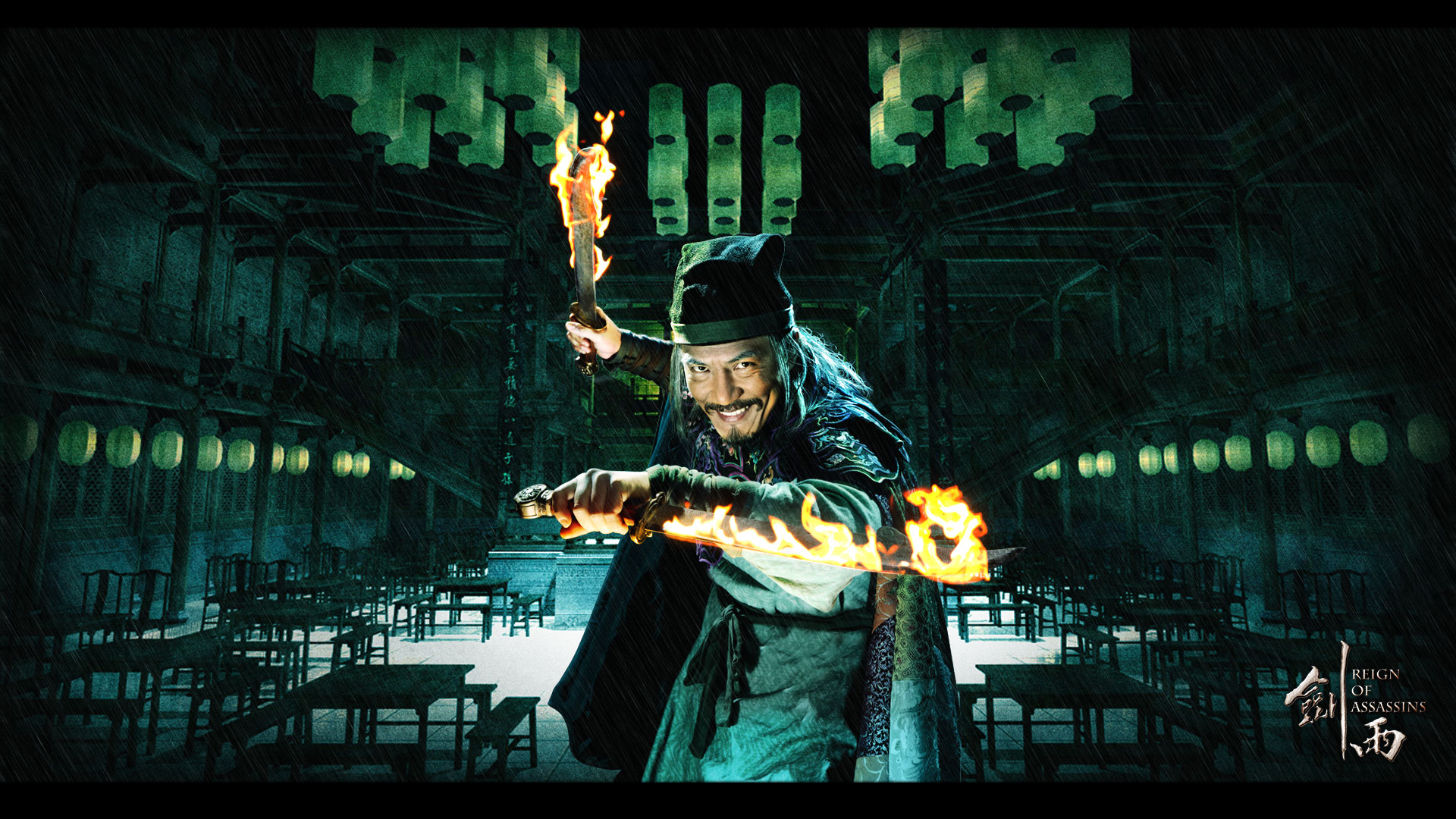
wheelkingWhat we have with Reign is a sort of reverse Kill Bill. The movie starts with the Dark Stone clan of assassins slaughtering an entire royal family to get one mystical artifact – half the mummy of a revered monk. Studying the entire mummy will allow you to rule the world of martial blah blah blah, but one of the assassins – a woman with the unlikely name Drizzle (Kelly Lin) – takes off with the mummy half and spends the next three months in hiding with a wandering martial artist named Wisdom, who, through an act of self-sacrifice, puts her on the road to a new life as a normal, law-abiding person.

After some Ming Dynasty plastic surgery (it involves carnivorous insects and golden thread), Drizzle is transformed into Zing Jing (Michelle Yeoh) who loses herself in the capital city, setting up shop selling purses and the like in the streetside market. Thanks partially to her meddling landlady, Zing meets up with Ah-sheng (Jung Woo-sung, whom you might recognize from The Good, The Bad, The Weird), a new arrival in the city working as a courier-for-hire.

This portion of the movie takes it’s time, setting up their relationship and eventual marriage very well, with only occasional cutaways to the Dark Stone bad guys, still looking for that half a mummy, and recruiting Drizzle’s replacement. Eventually the two groups are going to intersect (as you knew they would), when yet another group of villains attempt to rob a bank where the mummy is rumored to be stored (and Ah-sheng is cashing a check).When the bandits start killing potential witnesses, Zing can hold back no longer, and unleashes Michelle Yeoh whoopass on them.

roa11That amounts to a tremor in the Force, and the Dark Stone’s head, The Wheel King (Wang Xueqi) recognizes Drizzle’s style even though she didn’t use her usual weapon, the flexible Water-Shedding Sword. The chief assassins of the Dark Stone descend on the city, and the fight is on.

There are some things that set Reign apart from the usual wuxia movie, besides the willingness to spend time developing Zing and Ah-sheng’s relationship (which pays off in the second half of the movie), the main one being  the characterization of the Dark Stone assassins. Writer/Director Su Chao-bin has given each of them a backstory, and their own set of goals and desires. They’re a bit more dimensional than your usual bad guys.

martial-arts-reign-assassins-video-art-521510If there is one complaint I have to make, it’s that some decent fight scenes – once more, to my joy, mostly practical wirework and very little discernible CGI, if any – is obscured by some frantic editing, possibly owed to the credited co-director, John Woo. Or possibly not. It’s not shot-through-a-telephoto-lens-what-the-hell-did-I-just-see bad, like too many Hollywood action scenes, but it does come close a couple of times. Luckily, the editing calms down in the second half, when those fight scenes start to really matter.

That out of the way: good performers, handsome camerawork, and a couple of plot twists I honestly didn’t expect puts Reign of Assassins on my plus list.  A bit of patience with the first half – and really, guys, the relationship stuff is well-done – pays some nice dividends in the second half. Not a game changer, but not a time-waster, either.

This trailer’s a bit small, but it’s one of the few I found that wasn’t interested in revealing any plot twists:

The Most Dangerous Game (1932)

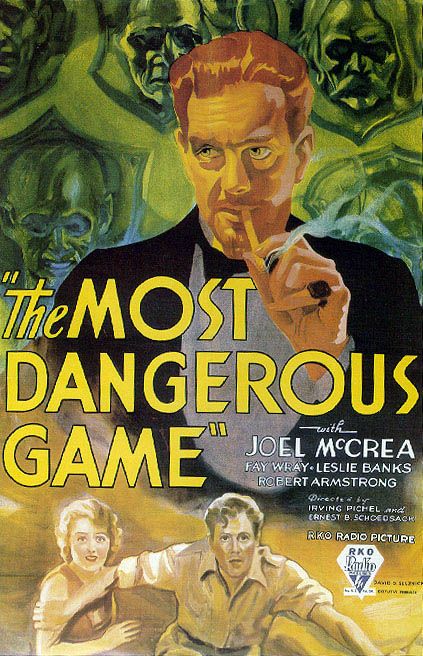
Most_Dangerous_Game_posterThe Most Dangerous Game was a movie that kept cropping up as a mention in Famous Monsters of Filmland, not only for its horrific elements, but mainly due to its close kinship with King Kong. It was shot simultaneously with the giant ape epic, and shares sets, stars, sound effects, and to a degree (and to keep the ‘s’ motif going) a score.

Based on Richard Connell’s justly famous short story of the same name, Game is pretty much glorious pulp personified. In the story, big game hunter Sanger Rainsford falls off a yacht at night, but manages to swim to a nearby island, which turns out to be occupied by the suave Russian General Zaroff, who recognizes Rainsford immediately. An avid hunter himself, Zaroff has hunted every animal on Earth, until he felt there was nothing to challenge him anymore – until he hits upon the idea of hunting “the most dangerous game” – humans – on his deserted jungle island. When Rainsford refuses to join Zaroff in his hunt, he instead becomes the hunted – and Zaroff proclaims that he has, at last, found a worthy prey.

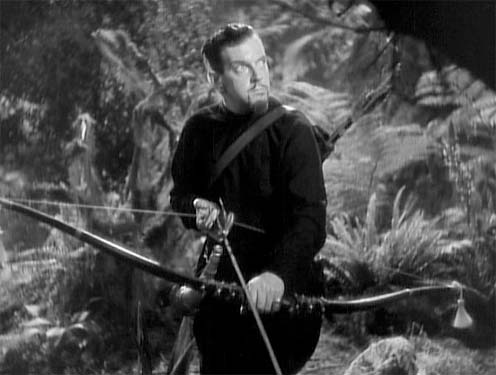
The-Most-Dangerous-Game-2Connell’s story is lean and mean, and the movie version – even at an abbreviated 63 minutes – seems almost bloated in comparison. Joel McCrea, at the very beginning of his days as a leading man, plays the rechristened Bob Rainsford. Instead of his accidental fall overboard, the movie gives an overt demonstration of Zaroff’s villainy only referred to in the story: Light buoys marking a clear channel that instead lead to ship-killing reefs, providing Zaroff with castaways for his hunt. Bob is the only one to make it through the sharks to shore.

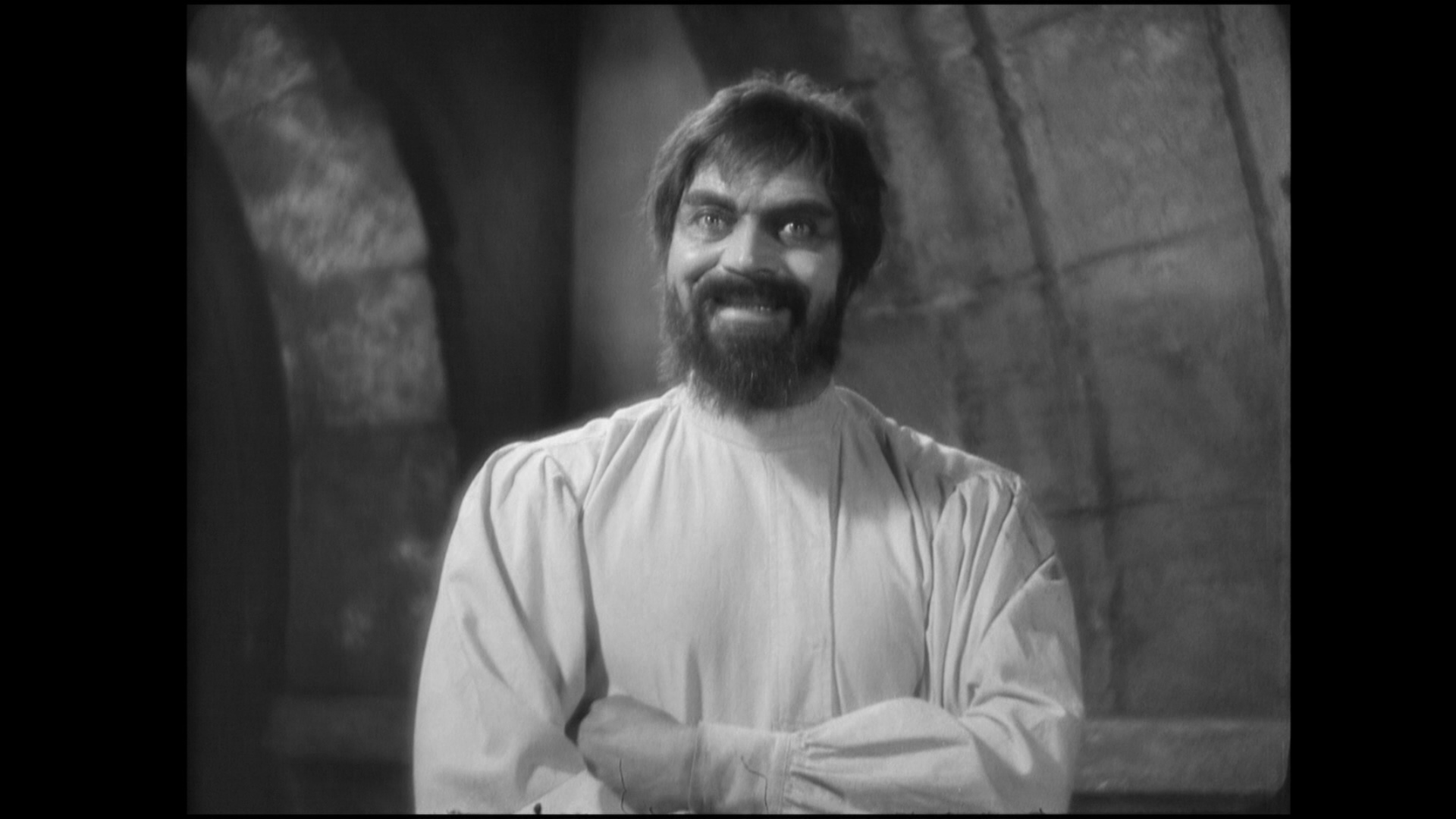
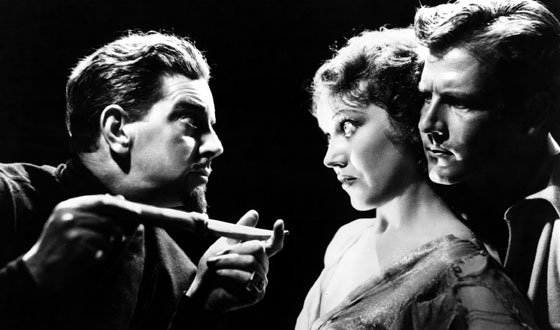
Bob discovers Zaroff’s castle, and it’s there we find the other characters: Zaroff himself (now promoted to a Count), played by Leslie Banks in his screen debut; two other castaways, Fay Wray as Eve (providing the female character every producer has insisted upon, in every story, forever) and Eve’s drunken brother Martin played by Robert Armstrong – both appearing during off days on King Kong, probably when effects shots were being arranged. And Zaroff’s chief henchman, an enormous Cossack named Ivan, whom I kept staring at, knowing I recognized him, but not quite placing him. Finally checked IMDb and holy crap, it’s Noble Johnson, also in King Kong and a whole slew of other movies – in whiteface.

large_most_dangerous_game_blu-ray_04It’s during this sort of cocktail party – although it’s Martin doing all the drinking – that all the backstory is taken care of. Another of the subtleties of Connell’s story made overt here is Zaroff telling of the time he was injured by a charging cape buffalo, a head wound that nearly killed him – a very visible scar on his forehead that Zaroff rubs when stressed. Shortly after the injury is when Zaroff formulates his sick plan, and the movie plainly picks that injury as the cause. Leslie Banks had himself received a head injury in World War I that paralyzed one side of his face. It’s not something that you notice,  I’m sure that Banks worked for years to overcome and minimize it, but he and director Ernest B. Schoedsack make good use of it in fairly ingenious and subtle ways.

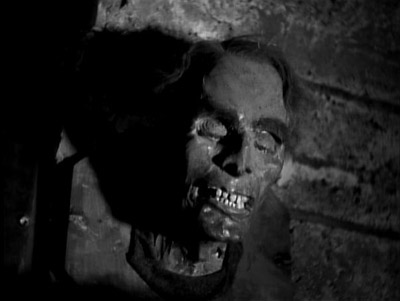
The presence of a woman in the story is not so tacked-on as one would first suspect. Eve proves herself to be a pretty savvy lady; all throughout the fake cocktail party she finds ways to warn Bob that things are not on the up-and-up. And since Zaroff is being very cagey about revealing his new, exciting sport, it’s enough for Bob and Eve to go prowling in the middle of the night and sneak into Zaroff’s trophy room, which is forbidden, unless you’re about to go hunting with him.  That’s where the horrorshow comes in, as they find a human head stuffed and mounted on the wall, and another pickling in an enormous jar. This is, of course, when Zaroff returns from hunting Martin.

mostdangerousThe Most Dangerous Game loses almost ten minutes of its running time here, apparently. Zaroff was to show off many of his more elaborate trophies, and relate how they died, which was a bit too much for the audiences of  ’32. What is left is Zaroff assuring  Bob and Eve that Martin was quite unintoxicated when the hunt began, as “Spending a couple of hours in this room has a most sobering effect.”  Rainsford, naturally, wants nothing to do with this, and thus winds up the next quarry. Eve demands to go with him, and Bob, figuring she’ll likely be as safe with him as with this bunch of villains, agrees to take her along.

Once at this point, the movie hits the ground running, much like our two heroes, and rarely pauses. The hunt is a pretty carefully considered, exciting sequence, and it’s here that you’re going to see a lot of familiar scenery, particularly that huge fallen log bridging a ravine. RKO was in dire financial straits in ’32, and Game‘s budget was slashed. Schoedsack and Cooper’s solution was to recycle and redress the jungle sets of King Kong. It got the movie made, and the monkey movie would pull RKO’s fat from the fire. So many major movie studios owed their continued existence to to genre movies, it’s amazing they still didn’t get any respect until the late ’70s.

Eve’s demand to go with Bob and, in fact, her tagging along with him is an oh-come-on moment (especially since we’re not sure how she got out of her room), but an earlier exchange in the cocktail party, where the drunken Martin promises Zaroff a good time when they get home, wine women, and then some hunting, oh boy, provides a chilling undercurrent for the rest of the movie. Zaroff proclaims – and Bob agrees – that Martin has it backwards. First, the hunt, then, in the ecstasy of triumph, it is time for love. Given that Fay Wray – and she has rarely looked lovelier – is clad in the most diaphanous gowns Pre-Code would allow, there is a nasty sexual subtext to Zaroff’s stalking the pair. He’s made it pretty plain what will happen to her if he wins.

most_dangerous_game560One of the major reasons Most Dangerous Game still feels exciting and almost modern is the Max Steiner score. A fully scored movie was pretty rare in those days – look at the previous year’s Dracula and you find a movie with music only at the beginning and the end. The rules of talkies were being created even as the movies were shot, and it was felt that music with no obvious onscreen source would only confuse the audience. I try to imagine Game without Steiner’s accompaniment and it is a much less exciting movie. Legend has it the original score for Kong was pulled and Steiner asked to create another quickly, so it’s possible to hear some of the DNA of the Kong score in the hunt music.

Anyway, The Most Dangerous Game is great pulp. With its beautiful and righteous Western protagonists, gang of sketchy Eastern types, and wonderful production values, it would make an excellent, if xenophobic, double feature with The Mask of Fu Manchu.

No trailer, but here’s a colorized clip, featuring Noble: