The Case for Outlawing August

Sorry, folks. No movie pontificating this week, either. I just came off two weeks of wall-to-wall work, and entered this week with free evenings – well, Sunday through Thursday, anyway. Work reared its head Wednesday night, Monday and Tuesday was spent dealing with financial aid for my son’s imminent college career, then waiting for the results of a meeting involving my wife’s school… my imagined week of movie-watching went up up in smoke. I did get one movie in on Sunday, but you won’t hear about it until October.

I won’t watch a movie when I know it’s going to be interrupted. I prefer not to approach things in a piecemeal fashion. It’s just the way I am. I’ve been told I should just let the movie run in the background while I’m doing something else, and I am aghast. That’s not watching a movie. Movies aren’t wallpaper. Not to me, anyway.

This week on "Supposedly Uplifting Quotations That Are Actually Distressing As Hell"

This week on “Supposedly Uplifting Quotations That Are Actually Grim As Hell”

Looking at my calendar for the approaching month ain’t doing me any favors, either. There are end-of-fiscal-year budget meetings that must be televised, and I’m also taking up the slack for some departments that have run out of budget as September approaches. Lacking some credentials, I job in at a lower rate than others. Moving my son into college will, for some reason, take five days. I’m going to try to pretend that is a vacation, which would be nice, I haven’t had one in years.

All this extra work is necessary, of course, because July and August are not satisfied with merely trying to kill you in Texas, they also have to ruin you financially. I challenge any climate denier to live in Houston in the Summer on a part-timer’s salary. They will have as much success as those people who periodically try to eat healthy on food stamps. Unless they’re iguanas and would thrive in an unairconditioned apartment, then the bet’s off.

The “Dog Days” of Summer supposedly go from July 3- August 11, as Sirius, the Dog Star, rises at the same time as the Sun. August is traditionally the Silly Season in the newspaper trade, when off-the-wall stories proliferate. Add to this one of the most bizarre Presidential campaigns in… well, ever. It’s out of either a well-written Stephen King novel or a poorly written comic book. Yet there is a surprisingly wide variety of Kool-Aid out there and an unbelievable number of people willingly drinking it. There are 10-15 things on my social media feeds that make me prematurely tired every morning, and trust me – I don’t need help to be tired.

I realize there’s no way to get rid of an entire month, but I really wish there was a way for us to just all go somewhere else and let the damn month just do its thing, and we can all come back in September, when things are a little cooler, sweep up the debris, and get back to trying to live our lives as anguish-free as possible. August is a horrible, ugly imposition on us all (My apologies to anyone who was born during this month, like my mother and my brother).

There’s a lot more I want to complain about, but who cares, really? Thanks for reading even this far. Next week begins the meeting schedule anew – I’ll have exactly one evening free next week – but who knows? Maybe I’ll be able to return to a bit of what is, for me, normal. I doubt it, but strange things happen in August. Hope to see you here with better, less bitter, results.

Return to Digitalland

I’ve seen some articles where the writer signs off from the Internet for a month or so, and it usually winds up that their lives are improved, as they interact more with the Real World, family friends, people in the street, and find that The Old Ways Were Best, and everyone should log off and take a walk. It’s like Walden for the New Millennium.

I just spent a month and a half without the Internet, and I am here to say this is bullshit.

no-internet-accessI used to have broadband through my local cable company; we parted ways somewhat acrimoniously years ago, and I went to DSL – after all, I was already paying for a phone line, this made sense. That worked out fine for a while, until the landline cut out. The DSL was still functioning, but our phones were dead. The technician who came out informed me it was our phone. I told him that seemed unlikely since I had tried three separate phones with the same result. I insisted he plug his own handset into the outlet, and got the same results I had with three increasingly expensive phones. Then he said he could rewire the connecting but wouldn’t, since he’d just have to do it all over again when I replaced the siding on my house. I could not get him to tell him how he knew I would suddenly get enough money to replace the siding in the near future.

His gift of prophecy was wrong, anyway. Yet I continued on. I attempted to go back to the cable company, but that ended in tears again, as I was getting no signal to their modem and yet they thought I should pay for this. Come to think of it, that was remarkably similar to my experience with the phone company.

LIES ALL LIES

LIES ALL LIES

The sad part is, maintaining the status quo was less work so I did that, rationalizing that I was at least getting stable service from my DSL. Then that service was sold to another company, and everything went to hell. Most of my revenue stream dried up, and I couldn’t afford the non-service I was getting anymore.

So. Back to the Cable Company. I got my self-installation kit. A nice young man came out and put some sort of filter on the existing cable outside. I hooked up the Wireless Gateway™ and watched nothing happen. Then I got stiffed on an appointment three days later (I do not yell at Customer Service Reps because I like to be different. I did, however, tell him what I thought of the technician blaming me for the missed appointment). Then, a week and two days after the Self-Installation Failure, a technician showed up and fixed the problem in about an hour. Therefore, I feel all better about the company.

Also, I never had to wait more than five minutes to talk to a CSR, which is nothing short of miraculous, in my estimation.

My son, however, has better hair than this.

My son, however, has better hair than this.

In this time, I only had access to the Internet at work and on my smartphone. My teenage son probably thought he was imprisoned in a Siberian gulag. My Facebook-addicted wife thought the same. I don’t want to talk about the data overage charges on the cell phones.

Let me bore you further, as to why the Internet is more of a necessary utility to me than a luxury that can be cut out in lean times: as I said, projects I had worked on in the past had reached their conclusion, which also included the paychecks I was earning. I’m glad the economy and the job situation is good for the country currently, but I have to say the market for 59 year-old men with my particular skill set hasn’t widened appreciably. I’m still looking, and every now and then something will come across my LinkedIn desktop that ever-so-slightly sounds like me. I apply and send along my resume.

Just as the Internet drought had begun, I got an e-mail telling me I had gotten the job, and would be embarking on a two-week trial period to see if I fit in; the e-mail listed the job duties again, and what the prospective salary would be. This was all good; finally, a chance to use all these skills and knowledge, and the work seemed pretty exciting, too. The money was good enough to get me out of my current financial hole. I wrote back thanking them, but saying due to the timing, I was about to work the Independence Day weekend at my current job, and would be out-of-pocket for those three days.

I received an e-mail back that my first duty would be to book airline and hotel reservations for a casting director coming to Houston the week after, and a cashier’s check was being cut for me to cover that cost and my own expenses.

Pretty sure this is what the SOB looked like.

Pretty sure this is what the SOB looked like.

My heart sank as I read that e-mail. That was the oldest scam in the books. I had not even done a phone interview at that point, much less talked to anyone face-to-face at a supposedly local company, and they were still sending me a large check via FedEx?

This, I guess, was the Long Dark Tea Time of My Soul. I had spent several days thinking that everything was going to be all right, that things were looking up, hey, maybe there is something to this prayer business, you know? That all went away as I stared at that letter on my phone’s screen. Nothing was going to get better. And someone was actively trying to make it even worse.

My wife was spending the night at a friend’s house, who was recovering from surgery, so I had no shoulder to cry on. I had a Very Bad Half-Hour. I did send her a series of texts about how this had turned out. They probably read like a suicide note.

After the Half-Hour I allowed myself for the pity party, I started getting angry. Not only because I had been promised a better tomorrow, but because they thought I was stupid enough to fall for such a transparent ruse. I took stock – what did they know about me? What had I told them? Name, address, phone number, e-mail address – all things that can be found out fairly easily. No social security numbers or bank info, which would have been the next thing they hoped I was stupid enough to supply (I was supposed to text them a photo of the deposit slip, which I would have painted out the numbers on even if this had been legit).

No, wait, this is probably what he looked like.

No, wait, this is probably what he looked like. Or at least dressed like.

I did as much research as I could on my phone, but it was like I was blind in one eye and on crutches; things I was attempting to do were rendered extremely cumbersome. That Saturday I was going over to Rick’s to watch movies, and I brought a laptop and mooched off his wi-fi. Tracked down who had actually registered the Gmail account that was corresponding with me. Who had registered that “Under Construction” web site for what was supposed to be a long-established company. I reported my situation to LinkedIn. Never heard a thing from them.

I survived the Independence Day weekend (again). Then the FedEx package arrived, and I called the FBI.

The FBI Lady made sure I hadn’t compromised myself, then gave me a list of things to do. There is an online form for reporting stuff like this, which I did at my earliest access to Internet. I called the bank whose name was on the cashier’s check, and the lady there verified that it was a forgery, and told me they had been dealing with this particular operation for three months. No, they didn’t need the check for their files, but thank you.

I filled out the FBI form, probably supplying way too much information (I actually hit the character limit in a couple of fields). If I hadn’t been suspicious before, the fact that the return address on the FedEx envelope was from a healthcare company should have tipped me off. I fired off an e-mail to their corporate office that their account had been hacked.

No! No! This is what he looked like!

No! No! This is what he looked like!

Not everybody is a suspicious bastard like me. Not everybody read with interest about online scams in the early parts of this Digital Age. Too many people have probably fallen for this, or something like it. Did my efforts make this any more difficult for them? Probably not, but it didn’t help them.

Facing that crap without access to online tools made me feel truly alone. So I put my animosity with the cable company aside and said, this time I will make it work. Well, my part of that is pretty small, it was mainly thanks to a tech named Paul that made it work. I’m just getting used to the idea that when I see a movie clip being ballyhooed online I no longer have to say, “Yeah, I’ll have to check that out tomorrow at work.”

My time without the ‘Net wasn’t all bad – I read many books (Hey, it turns out that John Scalzi guy is actually pretty good!), but I also played a lot of solitaire. I created a busywork project that I may now never finish… because it was busywork, but at least it didn’t require net access.

My enforced absence from the Information Highway proved to me one thing, and that is I rely heavily on it for research, Whether it’s the proper spelling of concomitant or what exactly was the deal with the Dick Tracy villain “Oodles”, I grew used to having that at my fingertips (yes, I own a dictionary. Yes, shut up). The crisis with the fake job and constantly having to figure out work-arounds for the websites I manage delineated my need for access in very stark detail.

happyThis Election season may yet cause me to forsake Facebook or edit it to hell and back, but that’s another issue entirely (I am told that living in an echo chamber would be a bad thing). Not being able to be flabbergasted by my fellow humans’ idiocy on it – that’s a problem. I use Facebook and Twitter for business purposes, not simply for excuses to be pissed off.

So yes, modern-day Thoreaus, more power to you and your neo-Luddite ways. Enjoy your non-digital lives. Of course, you’ll never know that I’m wishing you well, because I’m embracing my 64-bit existence.

Now if you’ll excuse me, a buttload of movie trailers just dropped. Holy guacamole, they now play without buffering or stuttering.

It’s like witchcraft.

Medium Cool (1969)

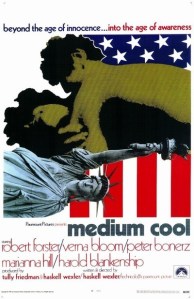
medium cool posterSo I see a lot of people had the brilliant idea to watch Medium Cool this Summer. Something about the looming Republican Convention, I’m sure. There are also a lot of people saying 2016 is 1968 all over again. It isn’t, though there are parallels.

There is unrest. There is seemingly unending domestic violence. There is change in the air, some hope (myself included). All these are playing into that hot-take cauldron proclaiming a carbon copy of 1968. No wonder so many are investigating this intriguing snapshot of that time.

First of all, Haskell Wexler is a name to respect among cameramen and cinematographers. Go look at that IMDb entry, and find out why so many were sad when he passed away just after Christmas last year. Now consider that in 1968, he felt ready to direct a feature film, and that film was nearly The Concrete Wilderness, the story of a transplanted Appalachian boy raising pigeons in the slums of Chicago. The remnants of that story are still evident in Medium Cool, but what we really get is a story about Haskell Wexler.

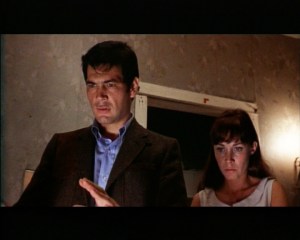
mc1Robert Forster is John Cassellis, a cameraman for the news department of a local station. We meet him as he’s filming a dead woman at the site of a recent car wreck, along with his sound man, Gus (Peter Bonerz). As they pack up their gear, John says to Gus, “Better call an ambulance.” Despite that questionable intro, we soon find that John has something of a conscience, along with some misgivings about his trade. He tries to follow the story of a black cabbie turning in a lost bag containing ten thousand dollars, against the wishes of his news director. And the day he finds out – to his dismay – that his footage has been routinely turned over to the police and the FBI so they can scope out radical elements, he’s also fired.

watching-tvJohn has also, by sheer accident and misunderstanding, met Harold (Harold Blankenship), the aforementioned boy, and his mother Eileen (Verna Bloom). A romance begins to blossom – there’s something in Eileen that John doesn’t see in his current flame, the nurse Ruth (Marianna Hill). Eventually, John gets another gig jobbing in as a cameraman during the 1968 Democratic Party Convention; he doesn’t realize that Harold, seeing his mother getting intimate with John, has run away and is basically bumming around Grant Park until it’s safe to go home. Eileen, still wearing her yellow party dress from the night before, is similarly roaming the streets trying to find him – as the protests around the Convention begin to move toward the riots that would dominate the media that Summer.

Medium-Cool-Chicago-RiotThis is probably the most famous aspect of Medium Cool, that Wexler and his cameramen (only one or two, past Wexler himself), are actually in the streets filming, and Verna Bloom is right there, wandering around in character, occasionally in harm’s way, as cops in riot gear and National Guardsmen in barbed-wire festooned jeeps get into position. There’s also footage of Forster in the Convention, as in the background we hear things starting to go to shit on the floor. This is a remarkable piece of filmmaking, with everybody on their game. It gets especially tense as you realize that is most definitely Verna Bloom in there, evidencing brass balls the size of Gibraltar, getting those shots. Wexler apparently tried to get her to go home as the situation intensified, and she refused.

One of the most referenced shots involves Wexler, as a National Guardsman – tired of being on camera, perhaps – lobs a tear gas grenade at his feet. As the gas drifts up, you see the camera shakily moving back, and you hear someone say, “Watch out Haskell – it’s real!” Wexler says the line was added in post production, but that it was pretty much what was going through his mind as the first sting of the gas hit him (The shot is in the Criterion Three Reasons clip, below).

Medium Cool1On the other hand, in a shot that was meant to provoke a reaction, Bloom cuts through a line of Guardsman and addresses their commander – in character, telling him she’s looking for her son. The commander waves her through, and even points the way toward someone who might be able to help her.

I referred to the movie as “a snapshot”, because the Convention footage doesn’t have the only message Wexler wants to convey; after the car wreck opening we have a sequence at a party where people are hotly discussing the role of news media, and the increasing danger and resentment they face. Later, in a post-coital talk, Ruth asks a question about Mondo Cane that I also asked when I first saw it at 10 years of age (which sort of explains a lot about me, I guess). John’s attempt to follow up on the cabbie story leads to a discussion of the black experience, circa 1968. John and Gus go on other stories before John’s fall, including the riot training of the same National Guardsmen we’ll see in Chicago, and Resurrection Town near the Lincoln Reflecting Pool, soon after the death of Martin Luther King, Jr.

Resurrection TownThere’s more, more more. A slow pan around a hotel kitchen as we hear Robert Kennedy’s last speech, and if you lived through that time, you know exactly what is coming, and you feel your pulse rate quicken. Mass media critiquing over a TV special containing footage of King’s greatest speeches, about media being complicit in a week-long catharsis so regular business can resume. There is more that was excised, some of which is excerpted in a documentary about the making of Medium Cool called (appropriately) Look Out Haskell, It’s Real involving the politicization of Eileen with a real-life speech by the Rev. Jessie Jackson (Jackson still crops up in the Resurrection Town footage).

GasJonathan Haze was a line producer (yes, that Jonathan Haze, Little Shop of Horrors and a bunch of others), and had connections with the local activists, so Haskell knew where to set up the next day for protest footage. (If you look quick, you can catch footage of Wexler and Haze being treated for tear gas exposure during the riot footage) Even then, there’s a counter-balancing sequence in which John takes Eileen to a go-go, where even in her yellow dress she is quite the fish out of water. There’s a band playing what the subtitles assure us is “Psychedelic rock”, though what is actually playing – out of sync, which makes the strobing and quick-cutting even more discombobluating – is The Mothers of Inventions’ “Go to San Francisco”, which has Zappa singing “Every town must have a place where phony hippies meet/Psychedelic dungeons popping up on every street”.

In a few minutes, though, we’ll be separating the phonies from the real revolutionaries. The real ones will the ones that are bleeding. And they are a diverse lot, not the cartoon hippies Zappa is satirizing.

Medium Cool is a startling blend of the real and unreal, until the viewer reaches a point where one is not quite sure which is which – until the third act, when the reality becomes undeniable – and then that controversial final scene, echoing the beginning, where we are challenged once more to define for ourselves what is real and what is not. And that is a thread that runs through the movie, even though Wexler claimed he had never read Marshall McLuhan – the necessity of the viewer, while taking in the imagery of a “cool medium” like TV, to rise above the simple, non-interactive nature of that medium, to inquire, to judge, to determine what about it is real, if anything.

It may not be 1968 all over, but that central message is more important than ever.

 Buy Medium Cool on Amazon


The Swinging Cheerleaders (1974)

the-swinging-cheerleaders-movie-poster-1974-1020206557There is sort of sad nostalgia about my relationship with the drive-in theaters of the 70s, especially when it was married to my recent acquisition of a driver’s license. This was the beginning of personal freedom, my friends and I piling into the family station wagon and heading out to the Skyway Twin on the weeknight where an entire carload could get in for one low price. This is where I saw Texas Chainsaw and Torso on a double bill, but it was also where we were sure to see those other magical R-rated movies with titles like Student Teachers and Night Call Nurses. I should say especially sure, because these were important to my budding, frustrated and often confused sexuality.

I was reasonably confident I had seen The Swinging Cheerleaders at some point during this, when my life was full of possibilities and my own innate superiority.

Did you know these sonsabitches were still being made? I did not!

Did you know these sonsabitches were still being made? I did not!

When I found out that Arrow Video was prepping a 2K restoration and blu-ray, I knew I would have to try and re-capture that brief window of time – although this time I would be doing it without hollow sound blaring from a metal speaker hanging on the driver’s side window, without the humidity of a hot Texas night, and without the smell of a burning coil of Pic® Mosquito Repellent. All of these are highly overrated.

It turned out I actually hadn’t seen The Swinging Cheerleaders. I probably would have remembered it better if I had, because director Jack Hill delivers an actual movie.

the-swinging-cheerleaders

Mesa University is having a great football year, thanks to star quarterback Buck (Ron Hajak). The cheerleader squad, though, is down one girl, and who should show up to try-outs but Kate (Jo Johnston), who wants into the squad to research her term paper on “Female exploitation in contemporary society”, which her boyfriend The Campus Radical Ron (Ian Sander) also wants to run in his underground newspaper. Kate is going to find out that Buck is, under his swaggering front, actually a nice guy, and Ron, under his progressive front, is a sniveling weasel. That’s not much to hang a movie on, so the Coach (Jack Denton), Dean Putnam (George Wallace) and math instructor Professor Thorpe (Jason Sommers) are rigging the games to make a fortune in gambling, which makes a much better exposé for Kate, since she’s also found out even cheerleaders can be worthwhile people.

swinging1Well, except for Mary Ann (Colleen Camp), the leader of the squad who hates Kate, because Buck is her boyfriend. Oh, and also she’s the daughter of Dean Putnam. And we haven’t yet mentioned Lisa (Roseanne Katon), our token black cheerleader, who is dating the very-married Prof. Thorpe. And then there’s Andrea (Cheryl Rainbeaux Smith), who is dating running back Ross (Ric Carrott), but can’t bring herself to lose her virginity to him. She’s advised by Kate and Lisa to do it with a stranger, and she winds up settling on Ron, who invites some friends over for a gang bang, which leads to Ross beating the crap out of him, and Ron’s subsequent reprisal against cheerleaders in general and Kate in specific.

The Other Cheapest Special Effect: 70s wallpaper.

The Other Cheapest Special Effect: 70s wallpaper.

Now, you are thinking, this is an exceptional amount of plot for a T&A drive-in flick and you are absolutely correct. In the third act, the trio of faculty gamblers decide Mesa have to lose the big game to State to really clean up, and the uncooperative Buck has to be kidnapped – at this point all those subplots go away in favor of low-budget slapstick action. There is a certain amount of grousing online about this movie, and that is at its core: there’s some nudity from our three main cheerleaders (sorry, Colleen Camp fans, villains don’t get nude scenes), and a whole lot of interpersonal relationships. Like I said, Hill delivered an actual movie, not an excuse for my teenaged self to ogle nekkid women. My middle-aged self is reasonably okay with this.

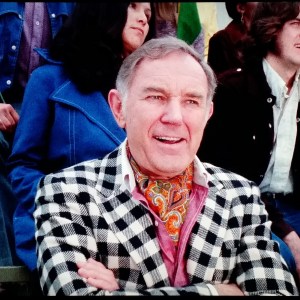
That cravat deserves its own credit.

That cravat deserves its own credit.

What I tend to be more interested in this Internet age (where it is ridiculously easy to see nekkid women) is the nuts and bolts of filmmaking, and watching The Swinging Cheerleaders allows you see a man who was a master at artful efficiency at work. Arrow Video has Jack Hill on the commentary track, and it is a beautiful thing to hear him talk about directing. He points out which scenes were achieved by simply dressing up a corner of the soundstage (it’s quite a few, including one where they didn’t even bother to throw up some flats), why pacing is so important to a movie, his history with the crew and actors. The Swinging Cheerleaders was shot in twelve days, which is extraordinary – even AIP generally went to eighteen. The sharpness of the new transfer allows you to note that the teams’ practice uniforms are turned inside-out to obscure a real team’s logo, and follow background props as they magically move from location to location. That was a really popular brand of hot plate in 1974, it seems.

Where'd you go, Jo?

Where’d you go, Jo?

Our heroes and heroines are all young and personable – it’s surprising to note that this is Jo Johnston’s sole credit. Colleen Camp is still acting (last seen in Aquarius), Roseanne Katon went on to become a Playmate of the Month and was acting up through the 80s. Rainbeaux Smith, so winning and vulnerable as Andrea, we lost to heroin and hepatitis. The bad guys – all adults, and outsiders to the intended audience, are cartoonish at best, but in the Nixon years, that is what we urgently desired: bad guys that could easily be defeated by good clean Americans.

Arrow Video Cover

I mean, look at that. That is GORGEOUS.

There’s also a new interview with Jack Hill in the extras, 83 years old and sharp as a tack. I sincerely hope he’s writing his memoirs. The Swinging Cheerleaders was made after his back-to-back successes with Coffy and Foxy Brown; this was his shot at avoiding being typecast as The Blaxploitation Director. He hasn’t made a movie since 1983’s Sorceress – from which he removed his name. And that is a shame. Hill could have made it as a director of “A” movies easily, though I suspect he didn’t want to give up the creative freedom small-budgeted fare allowed him. The Swinging Cheerleaders isn’t his best movie, but it’s a solid one. The blu-ray is deserved, if only to hear a legend talk about his craft.

The most amazing thing for me about that Arrow Disc (past the Hill commentary)? As ever, the cover art is reversible, so you can have the movie poster on front, which is my usual preference. This time, though, that cover art by Graham Humphreys is so good, I’m leaving it as is.

Buy The Swinging Cheerleaders on Amazon

American vs Italian Weirdness

There’s nothing wrong with watching good movies. But every now and then, you just need something weird, am I right?

It’s great, though, when that something also turns out to be good.

AafinalposterLet’s start with The American Astronaut, since I’ve been pestered about that one. I used my standard method of hapless examination of Cory McAbee‘s oeuvre, ie., backwards, by watching Stingray Sam first. Episodic, experimental, and entertaining – you should get on that. His first feature-length film, though, is what we’re here to talk about, and those three adjectives still apply, and a lot more.

The Astronaut of the title is Sam Curtis (McAbee), an independent trader whose latest job is delivering a cat to a saloon for asteroid miners on Ceres. In return he is given a “Real Live Girl”, which looks like a beat-up suitcase with a small door in the end. If you open the door, a flickering light is seen, and jazzy music plays. “What am I supposed to do with this?” he asks. Then he asks to use the restroom, but is cautioned: “Be careful. It’s a real toilet.”

Now, be prepared to leave even that minimal amount of normalcy behind.

Sam is going to meet with his old friend, the fruit-smuggling Blueberry Pirate (Joshua Taylor) and hatch a scheme whereby he will trade the Real Live Girl to the head of the Jupiter Mining Colony for the morale-boosting Boy Who Actually Saw A Woman’s Breast (Greg Russell Cook) – whom Sam had delivered years earlier. He will then take the Boy to the women of Venus, whose sole male finally died after years of service. In exchange for the Boy, he will get the corpse, whose family on Earth is offering a large reward for his return.

But first, a dance contest.

spacemen_fullThe major problem? Sam is being pursued by his nemesis Professor Hess, a birthday-obsessed serial killer who will disintegrate anyone Sam comes in contact with – he only kills people he has no problem with, and is pursuing Sam so he can forgive him and therefore kill him. While hiding from Hess, Sam and the Boy take cover in a barn built in space by silver miners, and pick up another passenger, a guy raised in space in a hydraulic suit so his body wouldn’t atrophy like the miners’. Then on to Venus and its population of women dressed in antebellum dresses, where a plan begins to form in our hero’s head.

So. The American Astronaut is a lo-fi science fiction space western that feels like it was made by David Lynch, and he also decided to make it a musical. A rock musical. That ought to tell you right there if you want to watch it. And even if you don’t, you should. It may seem an odd and haphazard movie, but the design and execution tell a different story. The fact that the most affecting song is given to Hess after a massacre tells of a much deeper story being told.

AmericanAstronautLet me come back to the production design in a bit. I’ll just close out this section by saying that I always find Cory McAbee so handsome and so winning onscreen, that I’m always surprised that we haven’t seen more of him in more mainstream flicks; then again, I’m glad he is where he is, doing what he is. He’s a national treasure, he is, unique and intriguing.

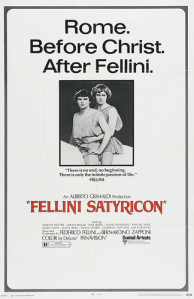
Because the other end to this weirdness is Fellini Satyricon. Now this is a notoriously loose adaptation of Petronius’ novel of the same name, of which only fragments survive anyway. What we have today is pieces of books 15, 16, and 17, so this is like trying to make a movie out of issues 276, 277 and 278 of The  Fantastic Four when you only have a few panels and an ad for G-I-ANT MONSTERS! out of each.

SATYRICONPOSTERSo what we have is a series of episodes in the life of young scholar Encolpius (Martin Potter) who is vying with his friend Ascyltus (Hiram Keller) for the love of a young boy, Giton (Max Born).  (IMDb Trivia states that Fellini chose foreigners for these roles because “there are no Italian homosexuals”, which must have come as a shock to Pier Paolo Pasolini and his posse). This will involve a trip to the theater (Ascyltus sold the boy to a prominent actor), a walk through a brothel once the boy is reclaimed, and then Giton decides to leave with Ascyltus anyway, the tramp, prompting a falling-out between the two old friends and an earthquake.

Encolpius will tag along to a lavish banquet (the movie’s longest scene, not coincidentally the largest surviving fragment), then get scooped up by the slave trader Lichas (Alain Cuny), who will be so smitten by Encolpius that he marries him, but then the Emperor is assassinated and things change and Encolpius fights the Minotaur and holy crap.

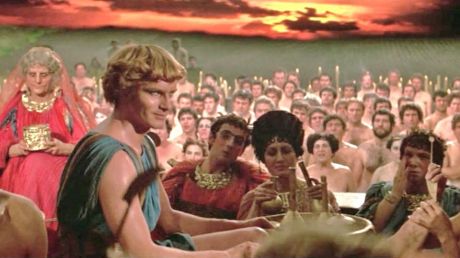
Satyricon banquetThis really might be the ultimate Fellini movie, as you spend over two hours thinking, “Yep, that’s Fellini.” Lush, often overwhelming imagery, combined with the most remarkable faces you will ever find committed to film. This is a non-stop examination of decadence and debauchery in the era of Nero and it is never less than hypnotic and mesmerizing. You can, in fact, trace the roots of Pasolini’s masterpieces in the Trilogy of Life directly here (witness the dramatization of a Greek fable as the banquet dies down).

009-fellini-satyricon-theredlistNot a little of this engagement of the viewer is due to the fact that it is so strange. Though we try to frame ancient cultures in our own experience, that approach does not take into consideration that two thousand years ago, these people were shaped by entirely different societal norms and technologies than us; the distant past would probably seem unspeakably weird to us, and Fellini plays this concept for all it’s worth. He even went to pains to make the dubbing a little off, to keep us even more off-kilter (I was reading subtitles, so that never registered on me).

The American AstronautNow contrast this to the production design of American Astronaut (I told you we’d get back here), where the future may actually be too familiar. This is not only necessary for making low-budget science-fiction space western rock musicals, it also makes sense: taking bits of home out with you into space. Of course the saloon on a mining asteroid would look like a cheap dive bar in a strip center. Of course Sam’s spaceship looks like an efficiency apartment, with a single bed, a bookshelf, wallpaper, and crap that needs to be quickly battened down for landings. Neil DeGrasse Tyson may have called during my viewing to inform me that there weren’t really barns in space, but let’s also realize that space travel is going to be a lengthy process, that it would be nice to have someone to talk to during it, and you would more than likely make up songs to sing while you wait to finally get there.

These movies are at two opposite ends of the weirdness dial, different in approach and each offering up their own menus of delights and amazements.When you get right down to it, movies like this are why I started watching movies in general: they are directories of the possible, made possible by genius, talent and a little bit of madness.

Buy The American Astronaut on Amazon (OOP- brace your wallet!)

Buy Fellini Satyricon on Amazon

Chaplin’s War Trilogy

Chaplin’s War Trilogy
An Evolving Lens in Three Dark Comedies, 1918-1947
by Wes D. Gehring
McFarland
800-253-2187

 “A Pablo Picasso painting might seem an unusual catalyst for a book on Charlie Chaplin.”

Chaplin’s-War-Trilogy-An-Evolving-Lens-in-Three-Dark-Comedies-1918-1947And so begins Wes Gehring’s Chaplin’s War Trilogy (which does, indeed, feature a black-and-white reproduction of Picasso’s Guernica in the frontispiece). Gehring makes the point that the painting of a horrific wartime attack puts him in mind of another piece of art generated from the same crucible of pain and horror, Chaplin’s The Great Dictator. And as I’d had my own, less learned, encounters with the movies featured here, I looked forward to a more complete examination.

Complete is a good descriptor, too. Gehring knows that to examine such iconic films, it needs to be in the context of their time, and the case of one of cinema’s first auteurs, also in the context of his life. Thus, Chaplin’s War Trilogy first serves as a fairly complete overview of Chaplin’s life and career, not just the parts directly involved in the three films that form the core of this book. The roots of art go deep, and Gehring attempts, with fair success, to find from whence these movies, with their increasingly complicated ethical outlooks, came.

Beginning with Chaplin’s truly Dickensian childhood in London, Gehring traces the origins of Chaplin’s Victorian outlook, his music hall career and success, which led to Mack Sennett plucking him from an American tour for the movies. That childhood gave birth in time to Chaplin’s signature character, The Tramp, the perpetual underdog in perpetual battle against oppressive authority figures, sometimes winning, just as often losing. There is an essential darkness in that setup, and slapstick comedy always has a dark, violent subtext; that often matters little in most silent shorts, as the actors are generally indestructible cartoon characters (look at Sennett’s Keystone Kops hurtling like meteors through a chaotic universe, none the worse for wear). With Chaplin’s Tramp, though, we have a perceptive artist actively engaging audience sympathies and emotions.

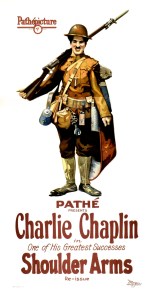
Shoulder_Arms_posterAfter tracing Chaplin’s artistic influences, Gehring begins to drill down into his subject with Chaplin’s incredibly successful Liberty Bonds Tour of 1918, traveling America pounding the drum with fellow matinee idols Douglas Fairbanks and Mary Pickford, for war bonds. It’s during this period that the first movie, Shoulder Arms plays, and Chaplin’s darker tendencies begin to get full play. How could they not? It’s The Little Tramp goes to war, for pete’s sake!

Shoulder Arms was the only one of the featured movies I had not yet seen, and I set to correcting that. It’s only 45 minutes long, and time well spent; Chaplin’s genius manages to find humor even in the terrible conditions of a WWI Behind enemy lines in disguisetrench. As Gehring points out repeatedly – and it is, indeed, a point well worth repeating – Chaplin works hard to not fall into the rabid anti-German sentiments of the time. One of the other major box office winners was a propaganda film called The Kaiser – Beast of Berlin. Chaplin treats the enemy soldiers with a fair bit of sympathy – except, of course, for the officers, who are all cads, drunkards and bounders.

Gehring then takes Chaplin through the time he could do no wrong, even into City Lights and Modern Times, essentially silent movies made long after The Jazz Singer had supposedly put paid to them. He pulls together contemporary reviews, all still lauding Chaplin, even for his stubborn refusal to commit to sound. But Gehring also points out that the authority figures in Modern Times are the Police, often in full Depression union-busting mode, which will return to haunt Chaplin, along with his several failed marriages and resulting scandals.

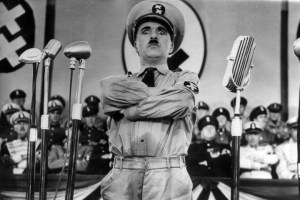
the-great-dictator-1940-6The Great Dictator is the cornerstone of this trilogy, and its darkness is not too problematic, as it is tempered by the lighter side of Chaplin’s dual roles, a Jewish barber who is, for all intents and purposes, the classic Tramp character, although with a profession and a shop to go with it. The Great Dictator‘s controversy stems from the very idea of using Hitler for laughs – though with the typically long gestation period of Chaplin’s later works (four years between Modern Times and Dictator), it is important to remember the true horrors of the Third Reich had not yet occurred. Gehring also documents the forces working against even making the movie, mainly fears that Hitler would close the German market to Hollywood movies. That would happen in any case as America entered the war, and Franklin Roosevelt rather famously cheered on the production.

All the analysis and reviews of the time made me drag out my Criterion blu-ray again to watch favorite parts. No matter how you may feel about the movie itself, Chaplin is brilliant as Adenoid Hynkel, his hours of studying newsreel footage of Hitler resulting in one of the great comic performances – and satiric put-downs – in film history.

Sadly, no. America could not.

Sadly, no. America could not.

Gehring chronicles Chaplin’s marital problems throughout, and though those might have played into the eventual making of Monsieur Verdoux – easily his blackest comedy (certainly one of the blackest comedies ever), Gehring shows that other forces were in play. Based on the real-life serial murderer Henri Landru, it serves ultimately as a condemnation of the military-industrial complex; Verdoux, at his sentencing to the guillotine, pronounces that basically he was doing exactly what nations did in war – killing to survive – but “numbers sanctify”. The same actor who was a cheerleader for the war effort in 1918, who pleaded for peace at the end of Dictator, now savagely condemns the machinery of war; the Tramp is nowhere in sight, and lacking that safety net (or release valve), the movie confuses American audiences and is savagely drubbed by most of the American critics.

Life will get progressively worse for Chaplin, as the post-WWII Red Scare begins to percolate through America, and Chaplin – who had never become an American citizen – was constantly under fire for his liberal pronouncements and his friendship with subversive artist-types. There was a continual threat of his being called before the House Unamerican Activities Committee, and when he went to London in 1952 for the opening of Limelight, his re-entry visa was revoked.

Gehring is kind in his outlining of Chaplin’s post-exile career; his last two movies, A King in New York (which contains a not-terribly caustic attack against HUAC) and Countess from Hong Kong were made in unfamiliar circumstances and do not reach the heights of Chaplin’s earlier works, but lesser Chaplin is still equal to the best of many. In Gehring’s analysis, it is more likely the sex scandals than any actual political involvements that led to the revoking of Chaplin’s visa (and given America’s ingrained neurosis about anything having to do with sex, this has the ring of truth).

One of the more heartfelt "We're sorry!"s in recorded history.

One of the more heartfelt “We’re sorry!”s in recorded history.

In the arc of the artist’s life, this fall from grace thirty years after he was the major draw for the Liberty Bonds Drive (and for a country he had only recently adopted, no less) is bewildering and not a little crazy-making. Verdoux is the father of many justly-lauded Ealing comedies like Kind Hearts and Coronets and The Ladykillers. American cinema would soon enough embrace dark comedy and even begin to consider what they had lost to paranoia and jingoism, resulting in Chaplin receiving the only Honorary Oscar given out in 1972, and a 12 minute standing ovation.  And since some politicians lately have been bloviating about resurrecting the HUAC, it is very important to consider the damage that was done last time, to no lasting benefit.

Wes Gehring is reportedly finishing up another book, logically enough about the dark comedies of the 1970s, the direct descendents of The Great Dictator and Monsieur Verdoux. After the care and detail lavished on that dark cinema’s great progenitors, I am impatiently looking forward to reading it, too.

Buy Shoulder Arms on Amazon
Buy The Great Dictator on Amazon
Buy Monsieur Verdoux on Amazon

Oh, alright, times are hard, money is tight, so this is the best-looking Shoulder Arms I could find online. You’re welcome:

Getting Bookish

Well, this past month has been rather trying, hasn’t it?

In the Top 3 for the Google Image Search "This Year Sucks".

In the Top 3 for the Google Image Search “This Year Sucks”.

Oh, all right, this entire year thus far isn’t going to win any Good Citizenship Awards, but that’s speaking on a national, nay, global level. I’m actually just talking about the only level that I can speak on with any authority whatsoever, and that is the personal level.

My son turned 18 this year. He graduated high school as the Valedictorian. He is attending a good college in August on an academic scholarship. All these are awesome achievements for a kid the regular school establishment wanted held back for a year and more because of his dyslexia. I am justifiably proud of him. I also had to track down music and make a synchronized slide show for him and his graduating class. Of eight.

Oh yeah, he’s the reason my wife created a private school for children with learning disabilities. That’s eight kids who would have dropped through the cracks. Eight kids who might not have graduated high school at all. Several of them, like my son, are going to some pretty high-powered colleges. On academic scholarships.

This is because my wife is awesome.

Any achievement I want to claim for myself looks pretty paltry after that, but it’s all I got. I did pull some remarkable stuff – for me, anyway – while I wasn’t scanning photos and cursing the vagaries of projection systems. The Great Villain Blogathon, which necessitated watching and writing up six movies. The Blood Bath Box Set, which required watching four even though all four were basically the same movie.

In the Top 3 Google Image Search for "Me and Everybody I Know".

In the Top 3 Google Image Search for “Me and Everybody I Know”.

Now here we are in Summer, and I find myself in the financial doldrums as I cast about for another writing contract or another part-time job or gee maybe a full-time job whattaya think are the chances I’m only 59 years old. Some things have to give. One of those was the overpriced-yet-still-somehow-unreliable-anyway home broadband.

My son thinks it’s the end of the world. Too much of his beloved gaming requires the Internet. This is cold turkey before you head off to college, my boy, I tell him. It will hurt less when you head off to Academic Land. He doesn’t believe me. Neither do I, really.

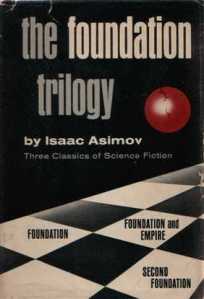
The book cover that glared at me from the Science Fiction Book Club flyers forever.

The book cover that glared at me from the Science Fiction Book Club flyers forever.

Watching ten movies (and that’s not counting the five at the last Crapfest) in a rush has taken the blush off the rose of movie-watching. So I’ve been using the time which was normally spent being distracted by social media to re-visit my older passion, reading. I’ve read something like nine books in the past week. This is, really, something I should have been doing all along but there wasn’t time. I was too busy being distracted. How could I call myself a science fiction fan when I’d never read isaac Asimov’s Foundation Trilogy? I’ll probably finish that this evening. I’m enjoying it but I’m surprised that an acknowledged classic breaks so many rules; almost all the action takes place offstage, in defiance of everything I’ve ever been told. It is a tale composed of conversations, literally a story of ideas.

This brings us to the odd announcement that next week will probably be a book review. Oh, don’t look at me like that, it’s a book about movies, and it’s been quite interesting. But it’s also so dense I’ve only managed a chapter a night.

Hey, Alex Proyas! Whatever happened to this movie?

Hey, Alex Proyas! Whatever happened to this movie?

It turns out that over the years I’ve squirreled away a ton of e-books on my hard drive, and it’s pretty satisfying to finally give those the once-over. The aforementioned Foundation Trilogy. Finally read Harry Harrison’s Deathworld. I’d read Robert Heinlein’s The Unpleasant Profession of Jonathan Hoag in my youth, and didn’t remember the first thing about it (I now realize there was a reason for that). I’ve read several of Basil Copper’s Sherlock Holmes pastiches about Solar Pons (a name which, while unlikely, has the appropriate number of syllables), who is even more of a condescending dick than Holmes, and I find the mysteries are rather transparent when they aren’t outright copies of other writers. Yet I cannot stop reading the things. They are the damned Pringles of detective fiction.

Back when Remo looked like Daniel Craig.

Back when Remo looked like Daniel Craig.

And most surprisingly, I have a number of The Destroyer novels, or as you might better know them, the basis for Remo Williams: The Adventure Begins. About the time I ran out of Doc Savage novels in my teen years, these came along, like The Executioner but with kung fu and ridiculous 70s casual sex and even more ridiculous 70s casual racism. These were always very fast reads, and I re-read the first three in the same number of non-consecutive nights. The most amazing thing to me is that it took the writing team of Richard Sapir and Warren Murphy three outings to realize how essential the character of Chiun, the aged Korean master assassin, was to the success of the series. How when he was promoted from a background character to a full partner, the odd master/pupil father/son dynamic elevated it from stupid action porn to something actually interesting. Still stupid, admittedly, but interesting. The Destroyer went on to have a downright silly number of entries. Don’t ask me how many, I don’t have access to Google right now.

I’m telling myself that this is actually essential stuff to be doing. That my own writing had become rather unsatisfactory to me of late. That I had done too much writing by committee for the contract work, and I need to start writing for myself again, and to do that, I needed to get back in touch with what worked for me, way back then, when I was writing every night instead of being questionably clever on Twitter.

God knows I have the time now.

Crapfest: Into the Mancave

Whenever I attempt to do something even remotely handy around my house, I really feel like if I succeed, the Vatican should recognize it as a miracle. I am the least handy of primates; there is a reason I earn my living by pressing buttons.

This is the blueprint Dave was working from

This is the blueprint Dave was working from

So how amazing is it to me that Host Dave took it upon himself to create the ever-popular mancave in his garage, moving our questionable movie-watching activities out of his living room (and not incidentally, a house away from his long-suffering wife, Ann?). I’m lucky I can keep my toilet running. He air-conditions and re-purposes a damn recreation room.

There are still tweaks to be made, yes (probably until doomsday, knowing Dave), but it was fully functional for our Memorial Day weekend get-together (though our host was upset that the Disco Ball wasn’t working – yes- the disco ball.). He wasn’t content with lording that over us either, he was determined to make three pizzas from scratch, dough and all. While that process was ongoing, he had some youtube playlist of music videos going (in the mancave and the living room), and the major thing learned was Rick absolutely cannot stand Adam and the Ants, and especially not “Antmusic”. So here it is for him again:

From this you can assume I owned a lot of Adam Ant albums. Okay, two. But that was on one of them.

After seeming hours of pizza prep (I didn’t actually mind – I enjoy watching other people cook so I can steal any useful techniques for my own use), we were finally eating and settling down to watch some horrible, horrible stuff.

"CURSE THESE CHEAP CHINESE CARDBOARD GLASSES!"

“CURSE THESE CHEAP CHINESE CARDBOARD GLASSES!”

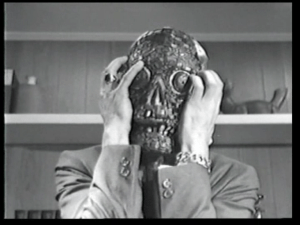
We started out with the 3-D sequences of The Mask, which were available in red-blue anaglyph as an extra on the recent Kino-Lorber blu-ray. I had ordered 3-D glasses from Amazon (shipped from far-away, exotic China) for pennies and distributed them. For those who missed me rhapsodizing about it before – The Mask is an ancient Aztec ritual mask that, when you put it on, produces bad acid trips, and eventually homicidal episodes. The gimmick was when the soundtrack started entoning “Put the mask on – NOW!!!!” the audience was supposed to put on their 3-D glasses and be wowed by the bad acid trip. Kino-Lorber is to be complimented for allowing our group to enjoy these bizarre segments without having to sit through the rest of the fairly static thriller.

The experience also pointed up the reason why 3-D was a flash in the pan in the 50s: red-blue (or in the 50s, red-green) anaglyph demands a lot of light when projected. Exhibitors weren’t inclined to shorten the life of their projector bulbs by cranking them up, resulting in dark images and headaches. We didn’t even have that option on Dave’s projector, but the results were still good enough to provoke good-natured screams and ducking of heads. It had to be admitted that was a first for Crapfest.

Conjoined-Poster-Small2This was followed by another first: local filmmaker Joe Grisaffi had offered one of his movies for viewing. I imagine the conversation involved Dave saying, “You do know this is called Crapfest, right?” and “You’re aware of how we treat these movies, right?” And yet, here we are, watching a movie called Conjoined.

This is the tale of the traditionally reclusive schlub Stanley (Tom Long), who has met the love of his life, Alina (Michelle Ellen Jones) on the Internet and plans to marry her. Stanley has only two other friends: Jerry (Jake Byrd), a co-worker at a slaughterhouse, and Courtney (Deidre Stephens), a cam girl whom Stanley pays just to have a conversation. On the eve of their wedding, Alina reveals a big secret: she has a sister, who will have to live with her and Stanley. As the title would suggest, the sister, Alisa (Keefer Barlow) is conjoined. Also, because this is Crapfest, the twins look nothing alike and we surmised that they were joined at the dress. (also, welcome to low-budget filmmaking)

Now the mood in the room was pretty tentative during the opening scenes. Would this be mere cringe comedy (not my favorite flavor to be sure)? I had sneaked a peek at the basic plot, but we were unsure what tone the movie was trying to set. Alisa starts fomenting for a boyfriend of her own, and when Jerry walks out on a suddenly abusive dinner, Stanley turns to the video dating service where he met Alisa, and the first date seems to be going pretty well – until the guy says something wrong, and Alisa smashes his head into the floor a couple hundred times until there’s blood and brains everywhere.

Yep. Those are twins, alright. Yessir.

Yep. Those are twins, alright. Yessir.

The mood in the mancave shifted appreciatively. This wasn’t splatstick on the level of Raimi or Jackson – not yet anyway – but it was something we could tune in to. Turns out this isn’t Alisa’s first kill, either, nor will it be the last, and as the body count rises, Stanley desperately turns to Jerry for help, with a plan to separate the two women in a plastic-sheet shrouded attic, using household appliances instead of surgical instruments. If this weren’t low-budget black comedy, both women would have bled to death, but as it is, several gallons of stage blood don’t mean much. The operation is a success, at least until Jerry, supposed to ditch Alisa’s body, makes a poor decision (bad in intent and taste) and suddenly there’s a homicidal twin more on the loose than ever.

The closest comparison I can make is to another semi-obscure regional flick, Blood Car, that I saw at another festival of questionable films. Extreme subject matter taken only semi-seriously enough to be engaging, and backed up by better acting than you’re used to seeing in such low-budget affairs. It’s not going to be for everybody, but good grief what is?!?! And never forget – This! IS! CRAPFEEEEEEEST! 

INTO THE PIT, MOVIE WITH A BUDGET!

INTO THE PIT, MOVIE WITH A BUDGET!

(Didn’t even mention how Joe came to the Fest about 20 minutes after we started the flick and was a tad uncomfortable, thinking we would have watched it by that time. He failed to reckon on pizza prep time. I think we were fairly kind. Fairly.)

19-DeathStalkerPoster

Note this scene does not occur anywhere in the vicinity of this movie.

Now, although I said I wasn’t going to do this anymore, I had presented a list of possible movies. To be plain, I’ve spent so long trying to catch up on the world of quality cinema, I kind of felt like I’d lost the thread of what constitutes a good crap cinema viewing experience. To be even more plain, I found out quickly why I had sworn I was going to stop being so democratic because that is how we wound up watching Deathstalker.

Deathstalker (Rick Hill) is a blonde pile of muscle indiscernible from other blonde pile of muscles like Ator, Blernbag, or Botox the Barbarian (he only needs a white horse and a forest of fake trees and Nazis would be stealing his footage for propaganda). He does not engage in any Death stalking throughout the movie, but he does engage in a lot of attempted rape. We were of the opinion that Deathstalker was a family name, like Baker or Cooper.

Has it been five minutes since the last attempted rape already?

Has it already been five minutes since the last attempted rape?

His quest (of course he has to have a friggin’ quest to link together all the instances of attempted rape) involves gathering a sword, a chalice and an amulet for Ultimate Magical Power. The villain Munkar (Bernard Erhard) already has the chalice and the amulet. The sword Deathstalker gets from a Muppet claiming to be a wizard (who then falls into a river and becomes an Odious Comic Relief person). Along the way he picks up the warrior Chachi (oh who bloody cares) and poor doomed Lana Clarkson as a female warrior who is on a quest to find the top of her costume.

You see Munkar is having a tournament of warriors that is completely unripped-off from Enter the Dragon. Barbi Benton is also there as a captured Princess because Lana Clarkson has a sword, so somebody has to be around for rape to be attempted upon. We are assured that Munkar is evil because he keeps feeding childrens’ eyeballs to Muppets and his facial tattoo keeps switching sides (we were rooting for a subplot involving twins, but no, it was just bad continuity).

(Also I need to stop calling bad special effects Muppets because the worst Muppet in the stable has more personality than any character in this flick.)

ds-2You may have noticed a certain reliance on attempted rape in this review; that is also a fair assessment of the plot of Deathstalker. While the photography is okay, the movie itself is ugly in imagery and tone. This was the flick that convinced me it was okay to not check out every sword-and-sorcery movie that came out after Conan the Barbarian. Being the forgiving sort,  I’d bought the disc cheap years later. Maybe I was in a bad mood the day I saw it? Turns out I wasn’t.

The lady in question. Not a scene from this movie, however.

The lady in question. Not a scene from this movie, however.

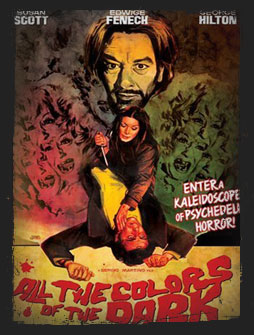
Next up, we were held hostage to Dave’s newfound love for Edwige Fenech, an almost transcendentally lovely lady who made a lot of Eurotrash epics in the 1970s. She’s known mostly for sex comedies and a handful of gialli. Pretty, a good actress, and not that particularly shy, shall we say – an ideal subject for Crapfest.

Dave, though, doesn’t like to watch movies over again, and so put on one he hadn’t seen – All the Colors of the Dark. Edwige is a young lady suffering from nightmares (“Put the Mask on—-NOW!!!!), stemming from a miscarriage she had after an automobile accident. Her sister and her shrink think she needs psychotherapy, her boyfriend (no, they’re not married) is a jerk and thinks she doesn’t. So is it any wonder Edwige joins a cult of devil worshippers (in between showers, of course)?

All-the-Colors-of-the-Dark-1972All the Colors of the Dark goes into some pretty decent mindfuck territory, as Edwige is forced to sacrifice the friend who recruited her into the cult (it turns out that, like Amway, the only way you can leave a devil cult is get your own replacement), there’s a guy with weird contact lens following her with a knife, her jerk boyfriend is doing unhelpful things like bringing home books about witchcraft. Edwige’s grip on reality is getting really slippery, and she stopped taking showers at the halfway mark, meaning there was a lot of boredom and loud conversations in the room.

(If there is one failing of the mancave, it’s that these conversations used to take place in the kitchen, where they were more easily ignored. Note to self: next time ask Dave which remote controls the sound)

"But I don't WANT to put The Mask on NOW!!!!"

“But I don’t WANT to put The Mask on NOW!!!!”

Anyway, like Scooby-Doo, there is eventually a logical explanation for everything, except that it’s not that logical and it’s certainly not reasonable. (I had to track down a copy later to confirm that. The conversation-unfettered-by-boobies had gotten particularly loud, and possibly resentful) It does however, give Luciano Pigozzi, the Italian Peter Lorre, a chance to drop by and pick up a paycheck.

Too talky, and I’m not just talking about the audience. Dave promises us much better results next time, with the more provocatively-titled Strip Nude for Your Killer, also known as Why the Hell Weren’t We Watching A Movie With A Title Like That?

Erik then attempted to elevate the evening with Death Bed: The Bed That Eats. 

Death_Bed-_The_Bed_That_Eats_FilmPosterFirst, realize you are looking at the saddest beast in the D&D Monster Manual: a monster bed that sits in a room and hopes that someone lies down in it. Then realize you are watching one king-hell bizarre horror movie and sit back and enjoy.

There is a Narrator (Dave Marsh) who may or may not be Aubrey Beardsley, trapped behind a portrait he drew of the monstrous bed – the Bed tried to eat him, but “my disease” prevented his complete digestion and somehow bound him to the Bed. He offers at least two origin stories for the Bed, but the one that sticks has something to do with a demon-infested tree whose wood was used to build the Bed. Most of our menu will be provided by a young runaway, her friends, and her brother who’s pursuing them (William Russ, who went on to a pretty decent career). There are a couple of instances of oddball but effective horror – when an injured victim crawls tortuously toward the one door in the Death Bed room (which takes at least as long as the interminable fist fight in They Live), only to be drawn back by a tentacle-like bedsheet just as she crosses the threshold; and when the Brother tries to cut the Bed apart with a knife, only to have his hands reduced to skeletons by the hungry mattress meanie.

deathbedhuhAccording to the IMDb, Death Bed was filmed in 1972, an answer print struck in 1977, and then… nothing. Apparently bootlegs were circulating, and when writer/director George Barry found out he had – without trying – actually worked up a fair amount of word of mouth, finally released it in 2003. I think I would have really liked it even if it hadn’t been preceded by several hours of pretty stultifying material. When I get through my current fiscal crisis, I am picking up that blu-ray… this is a flick that deserves more than one look.

We had cleared out the wusses for the night, but as this was a rare Saturday night off for me, I slipped in one last movie at midnight for the hardcore. That other standard of the Crapfest, Kung Fu Treachery – this time, with Iron Monkey.

iron-monkey-movie-poster-1993-1020471362Now, quick and fast came the cries from Twitter (when doesn’t it?) that Iron Monkey is not a crap film – that it is, in fact, a pretty good one. This is true. My response then, is two-fold: 1) This was our reward for sitting through some lame-ass shit that night, and 2) There are some lines I will not cross, and showing bad kung fu flicks is one of those lines.

Iron Monkey is sort of a Chinese Robin Hood, stealing gold from the local corrupt governor and distributing it to the downtrodden poor, using his superior kung fu. The governor is getting pretty hot about it, too, arresting people who own monkeys, look like monkeys, or seem to possess more than the standard fighting prowess. Enter Donnie Yen as Wong Kei-Ying, in town to pick up herbs for his medical practice, with his young son, Wong Fei-Hung. Astute viewers will note this boy will grow into the character played by Jet Li in the Once Upon A Time In China movies and Jackie Chan in the Drunken Master flicks (and Kwan Tak-Hing in about a hundred movies, but that’s a digression for another time). (Also Wong Fei-Hung is being played by Tsang Sze-Man, a girl, but we need to get back to the plot)

ironmonkeyKei-Ying, in defending himself from some local hoodlums, is immediately suspect, but once the Iron Monkey himself shows up to disrupt the kangaroo court, Kei-Ying is blackmailed into capturing the outlaw, with Fei-Hung held as ransom. Iron Monkey is, naturally, the sympathetic Dr. Yang (Yu Rongguang). Then the new governor finally shows up, and who should it be but the Shaolin Traitor (Yen Shi-Kwan) and his two hard-hitting disciples, and then things start to get really kinetic.

Iron Monkey sadly has a little too much of the typical Donnie Yen undercranking the camera so he looks faster than he already is, but that’s in the service of some truly splendid Yuen Woo Ping choreography (he also directed). Quentin Tarantino promoted the movie in its first American release (doing us all a big favor), which also resulted in some very good English dubbing. I circumvented this by using my import all-region DVD, which had poorly translated English subtitles. It still has my favorite line to attempt to work into everyday conversation:

monks

Now all I need is the right situation. This may, I admit, take some time.

We awoke Rick (who later complained of sleeping through the best movie of the night) and headed wearily home. We will meet again, mancave. We will meet again.


Blood Bath and Its Strange Clan

If you’ve been with me for any length of time, you know that I like to champion physical media. You may say that’s due to my not being able to afford robust broadband from any of the Great Satans currently controlling Big Cable, but the truth is it’s because we are living in an amazing age for boutique labels.

This week, I’m going to exclaim all over Arrow Films, who’ve been in operation in the UK since 1991, and recently branched out to America. There was a bit of a bobble in the distribution of their superb blu-ray of Mario Bava’s Blood and Black Lace, resulting in the dusting off of my Amazon UK account and importing it myself. That is an extra mile I did not mind walking… except that after watching that gorgeous, candy-coated transfer, I immediately wanted more with a capital M.

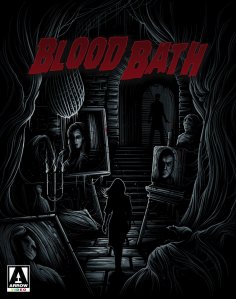
BB boxA year later, I have finally gotten my more and it is as remarkable and complete as it is improbable: A box set of four films that quite literally share the same cinematic DNA, marketed under the best-known of its many identities: Blood Bath. Tim Lucas, one of the best genre film historians and critics around today, bears the likely blame for this: in the earliest issues of his essential magazine, Video Watchdog, there was a three-part article tracing the history of these odd, stitched-together movies. Lucas points to these articles as the probable genesis of his magazine, since no other publication would have considered devoting that many pages to such obscurities. Speaking personally, I read those articles and thought, I’m not alone in obsessing over junk food movies.

I’ll try to keep this brief, as the set covers a lot of ground. Roger Corman, wheeling and dealing internationally after the box office failure of The Intruder (and not incidentally trying to get out from under the thumb of AIP), makes a stop in Yugoslavia and agrees to help fund a crime movie, filmed in English, and provide two stars for the American market. That movie, directed by Rados Novakovic, is Operation Titian. Don’t bother looking for it on the IMDb under that name, you’ll give yourself a headache. It’s there under Operacija Ticijan.

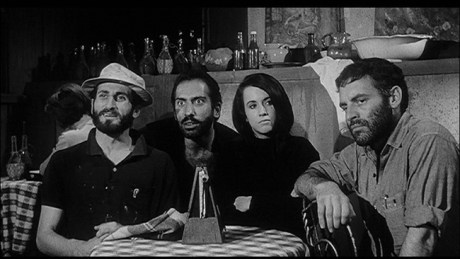
Thank you, LetterboxdOperation Titian feels a lot like the krimi movies so popular in Germany at the time, but suffers from not having a script based on a Edgar Wallace novel. The macguffin is a Renaissance painting by Titian, supposedly lost during WWII. A certain Dr. Zaroni (Patrick Magee) arrives, meeting with a shadowy someone who passes him a key to the villa in which the painting is now hidden. Zaroni kills the old man living there and steals the painting, only to discover that it is a copy. That shadowy someone is the old man’s nephew (William Campbell), who has his own plotline about his old fiancee who is marrying a reporter. Said fiancee is also the sister of the policeman who is tracking down Zaroni.

Dementia13

“Where are you headed after this, Patrick?” “Yugoslavia. You?” “What a coincidence!”

There are several more complications and twists, in true krimi fashion. The local actors, performing in English, are quite good; the photography tends toward the pedestrian, but at times produces some exceptional nighttime sequences that benefit not only from the old world architecture of Dubrovnik, but also an obvious reverence for Orson Welles’ Touch of Evil and Carol Reed’s The Third Man. Corman, for his end of the deal, provided two actors who had been working in Ireland with some young turk named Francis Coppola on a horror movie called Dementia 13. Magee does his usual excellent job of playing alternately charming and quietly menacing, often in the same line. Campbell always does best when he is allowed to be a bit hammy, and he does eventually get that chance.

The pertinent point here, though, is that, after having read Lucas’ articles and knowing what eventually became of Operation Titian, I was pretty confident that I would never actually get to see it. And now I have.

How sad is it that I can recognize an Alpha Video box by sight alone?

How sad is it that I can recognize an Alpha Video box by sight alone?

Corman had some problems with Novakovic’s finished movie, and had it reworked for the American TV market into Portrait in Terror, the second movie in the box set. Portrait rearranges the sequence of events in Titian, and excises some pretty blatant travelogue footage (think Reptilicus without that time-wasting tour of Denmark). Titian introduced its characters in a lengthy scene at an airport, and it still didn’t do a very good job of it. Portrait almost starts in media res in comparison, and the viewer clicks with the cast much more quickly.

There are some puzzling additions, however. The murder of an extorting dancer, handled obliquely in Titian is now replaced by a bizarre stabbing scene in which only the slightest of efforts was made to match the actors – the costumes are close, but that’s about it (nice work is done finding similar architecture in Venice, California, though). The stabbing is followed by the murderer laboriously carrying the body down long stretches of stairs – in broad daylight – while the camera shows blood dripping on the steps. As the killer is supposedly wearing Magee’s white linen suit – which remains spotless – this becomes egregious rather quickly. He then loads the body into a rowboat and dumps the body in the middle of a crowded bay. It is still daylight.

In Titian, that scene ends with the dancer gasping as the white-suited figure approaches; a few seconds only. In Portrait, it’s closer to five minutes. In Titian, her corpse is discovered during a sports fishing competition; we find she was impaled with a fishing spear. In Portrait, it is much the same, except the scuba diving takes much longer, and as we all know, if a movie is moving slowly, there’s nothing like a scuba diving scene to bring it to a dead stop.

What is unusual is that Portrait runs 15 minutes shorter than Titian, but it’s not an improvement. Operation Titian has a very deliberate pace, it is true, but it has a definite rhythm. That rhythm is chopped up to jarring effect in Portrait in Terror and those strange ill-considered inserts scrub the proceedings of any tension that might have been built up.

Then you get to the next evolution of Operation Titian, and things start to get really weird, as we get into the movie whose name the box set bears: Blood Bath.

SPOILER: This is all you're going to see of Magee in BLOOD BATH.

SPOILER: This is all you’re going to see of Magee in BLOOD BATH.

Roger Corman, who should have been named Patron Saint of Film Recycling some time ago, tells Jack Hill that it’s his turn to make a movie; he doesn’t so much care what kind of movie, so long as he uses 30 minutes of Operation Titian footage (this is the same MO that resulted in Peter Bogdanovich’s Targets). William Campbell balks, but is eventually brought back on to flesh out his character in Titian: this time his BloodBathArt1Antonio Sordi is a painter obsessed with his equally artistic ancestor, who was burned at the stake (along with his disturbing paintings) based on the testimony of his mistress. Sordi is also quite insane, believes he is being haunted by the ghost of that mistress, and keeps killing women at her behest, using their corpses as the models for his successful series of paintings called Dead Red Nudes, and then dipping them in a huge wax vat.

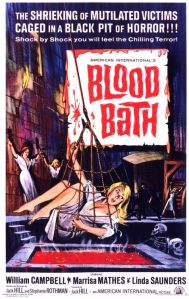
Please note that there is no blood bathing in the movie, except on the poster.

Now this is a fairly solid concept for a thriller; consult The Psychotronic Encyclopedia of Film and you’ll find half a dozen movies with a similar plot. Jack Hill does some interesting stuff, not the least of which is a surreal nightmare scene where the ghostly mistress torments Sordi. Hill also archly revives the satiric beatnik art milieu of Corman’s Bucket of Blood, with Sid Haig and Jonathan Haze drunkenly searching for the next “art thing” with skills that would make a third grader sneer.

Oh no! Beatniks!

Oh no! Beatniks!

Corman returns from shooting in Europe (Yugoslavia, again!) and once more has problems with the movie, but while Corman was wrapping his movie and Blood Bath was in limbo, Jack Hill has moved on to Spider Baby. Another Corman protege, Stephanie Rothman, gets the nod to “improve” the movie yet again. She does this by inserting a storyline that Sordi is actually a shape-shifting vampire – shape-shifting probably because Campbell rightly wanted more money to come back yet again, so hell, just turn him into another actor entirely. Rothman also manages to get another actor from Hill’s version, Karl Schanzer, as the guru of the art beatniks, Max. Schanzer is saddled by one of the worst fake moustaches in film history, but he also becomes one of the most improbable heroes in that same history.

Oh no! A vampire who looks nothing like William Campbell!

Oh no! A vampire who looks nothing like William Campbell!

Blood Bath is a surreal experience, to say the least; my main source of confusion is exactly where the hell this movie is taking place. I was quite comfortable assuming it was in California, given the Venice locations, and then Campbell starts talking about living in a clock tower active since the 11th century, so I guess we’re still in Dubrovnik? Really, the worst thing that can be said about Blood Bath is that it plays out as exactly what it is: three movies stitched together, and at least one feels like a deliberate intrusion on the others. Still, at a slim b-picture 62 minutes, it has little time to wear out its welcome.

62 minutes? That works for a double feature (it played on a double bill with Curtis Harrington’s Queen of Blood), but won’t do for TV syndication, where most movies are slotted in a two hour block. So, like the villain in a video game, Operation Titian mutates into its final form, Track of the Vampire.

Oh no! Another vampire who looks nothing like William Campbell!

Oh no! Another vampire who looks nothing like William Campbell!

The name of the game here is padding, so yet another actor becomes the black-clad vampire to chase yet another woman through California scenery to the tune of nearly ten minutes. There is, apropos of next-to-nothing, a lengthy dance scene on a beach, but most remarkable of all is the return of that extorting dancer from Titian and Portrait, and Patrick Magee – absent except for a freeze frame in Blood Bath. Campbell and Magee have been re-dubbed in these scenes to manufacture an entirely new subplot about cheating wives and avenging husbands. All this manages to bring Track up to the requisite 82 minutes, but it does the overall movie no favors whatsoever.

"If we use this fancy lens effect, no one will notice that it's padding!"

“If we use this fancy lens effect, no one will notice that it’s padding!”

Track of the Vampire is, sadly, the version I was most familiar with all these years, from several viewings on local horror movie slots – and the story never got any more comprehensible with repetition, let me tell you. That’s also where Lucas first picked up the thread, as he explains in the real jewel of the collection, a video essay titled “The Trouble with Titian – Revisited”, With all respect to Xan Cassavetes, it could have also been titled “Operation Titian: A Less-Than-Magnificent Obsession”.

If you’ve never watched a movie with a Tim Lucas commentary track, you’re in for a treat, and probably going to develop a bit of an obsession for them yourself. Track down any number of Mario Bava blu-rays (like the aforementioned Blood and Black Lace) with his work on them – Lucas literally wrote the book on Bava movies – and you will be amazed by the amount of information he can pack into less than 90 minutes. “The Trouble with Titian” represents such a magnificent visual expansion of that three-part article, along with new information he has gleaned over the years – it makes you wish every article he has written could be realized in such a form. Side-by-side comparisons of the different versions, freeze frames – a lot of time and care went into this supplement, and it shows.

blood_bath

Yay, garish blood-dripping version!

That disc also holds video interviews with Jack Hill and Sid Haig, and a gallery of around 30 pictures. A pack-in booklet has compact but fairly complete bios on Campbell, Magee and Haig, and there is a poster of the box cover art and the much more lurid theatrical poster for Blood Bath. It’s a nice bonus that labels like Arrow care enough to make reversible covers for the disc box itself, allowing me to indulge my more vulgar urges and swap that cover around for the garish, blood-dripping version.

As I said before, I never thought I would see Operation Titian in this lifetime, much less in the company of its strange, Frankensteinian descendants, and I certainly never thought I’d see them in such immaculate condition in 2K restorations! There is no reason for this box set to exist, and yet it does, and for that we should all be grateful. It traces, in great detail, the events in a very small but vibrant corner of the independent film industry, the creative arc of what were thought to be a series of disposable movies. But are any movies truly disposable?

Tim Lucas and I were not the only people struck by the strangeness of Track of the Vampire; chance cinematic encounters like this are just as likely to engender curiosity and passion as stumbling onto a viewing of an acclaimed art filmArrow Films once again has my respect for approaching movies that have long been the subject of fuzzy public domain discs, and treating them with the same reverence and respect as their much more hoity-toity, supposedly more “respectable” contemporaries.

Buy Blood Bath on Amazon


The Cinematic Life & Times of Professor James Moriarty

“He is the Napoleon of crime, Watson. He is the organizer of half that is evil and of nearly all that is undetected in this great city. He is a genius, a philosopher, an abstract thinker. He has a brain of the first order. He sits motionless, like a spider in the center of its web, but that web has a thousand radiations, and he knows well every quiver of each of them. He does little himself. He only plans. But his agents are numerous and splendidly organized. Is there a crime to be done, a paper to be abstracted, we will say, a house to be rifled, a man to be removed — the word is passed to the Professor, the matter is organized and carried out. The agent may be caught. In that case money is found for his bail or his defence. But the central power which uses the agent is never caught — never so much as suspected.”

Thus does Sherlock Holmes, the Great Detective, a man rarely given to fanciful language, describe his opposite, his arch-nemesis, his worthiest adversary: Professor James Moriarty. Outwardly an accomplished mathematician, author of the respected abstract The Dynamics of an Asteroid; in reality, a feared mastermind using his peerless intellect to create and control a criminal organization that controls London and stretches across all England.

Sidney Paget's illustration of Professor Moriarty

Sidney Paget’s illustration of Professor Moriarty

Moriarty as a concept first appears in the novel The Valley of Fear. Inspector MacAdams of Scotland Yard tut-tuts Holmes’ seeming obsession with the man, until Holmes points out that a professor earning barely £700 a year has a painting worth £4000 in his study, and moreover has no fewer than twelve bank accounts. Moriarty himself does not put in an appearance, though the machinations of his organization are present at the beginning and end of the novel.

Moriarty presents himself in the story for which he was truly created – “The Final Problem” – in which Holmes has proceeded with his investigation of the organization promised at the end of The Valley of Fear (while Watson is occupied with his marriage to Mary Morstan and a return to private medical practice). In fact, Holmes has uncovered enough information and evidence that Scotland Yard, in three days time, stands poised to arrest the Professor and his entire gang in one fell swoop, prompting a visit from Moriarty himself to 221-B Baker Street, a last warning to a respected adversary. Holmes proposes to Watson – whose wife is gone for the week – to come with him to the Continent, there to lose themselves until Moriarty is run to ground.

ChofkohUUAEJ_q_The raid is a success save for two things – Moriarty and his second in command, Col. Sebastian Moran, escaped. And thus does Moriarty confront his bete noire at the Reichenbach Falls in Switzerland, where the two men apparently struggle and fall to their death. Moriarty thus fulfills the destiny for which he was created, to put an end to the Great Detective, whose creator, Arthur Conan Doyle, had long chafed under the burden of his most successful character. As Doyle said, writing to his mother, “He takes my mind from better things.”

Possibly the best known of the Holmes novels, The Hound of the Baskervilles, is in fact a flashback, a memory of a case recalled by Watson, and written by Doyle only because of the public outcry against Holmes’ death. Ten years after “The Final Problem” came “The Adventure of the Empty House”, in which Doyle gives up and claims Holmes faked his death at the Falls and has been working to bring down Sebastian Moran.

Jeremy Brett and Eric Porter

Jeremy Brett and Eric Porter

But if the Great Detective can be brought back to life, so, too, must the Great Adversary. Professor Moriarty has had an impressive afterlife, reappearing again and again, no matter how many times he meets his doom. An entire book could be written about his many appearances in diverse media (if one has not been written already), but for the sake of time and my sanity, I will be concentrating on movies alone, which is a bit of a pity. It is in the realm of television that we not only have the most faithful rendition of the character ever – by Eric Porter, in the justly-lauded Grenada series featuring Jeremy Brett; it is also in the contemporary reworkings of Sherlock and Elementary that the Great Adversary has undergone the most remarkable changes, equal parts intriguing and annoying.

Moreover, as this blog is my hobby and time is limited, I had to similarly limit the number of movies for this article; I will try to get into the whys and wherefores as we go along.

"Really now, Professor - don't be a dick."

“Really now, Professor – don’t be a dick.”

It was recently announced that the previously lost silent movie version of William Gillette’s Sherlock Holmes had been found, and is currently being restored. For that reason, it won’t be considered here. Another reason is that it’s a film version of Gillette’s famous play, which did much to further popularize the character, solidifying the deerstalker cap and calabash pipe as iconic – but it’s an odd version of Holmes at best. Watson is a bland cipher, and Holmes even gets married at the end! As we will see, though, Moriarty (of necessity) becomes more pro-active in his schemes- after all, an antagonist who merely sits in the center of a web is not very interesting. This, too, can be credited to Gillette.

Bypassing another filmed version of this play starring John Barrymore, and several other attempts to put Holmes on the silver screen, we’ll start in a much more familiar place, with a pair of faces that came to be unshakably identified as Holmes and Watson – Basil Rathbone and Nigel Bruce.

The Adventures of Sherlock Holmes (1939)

Such a terrible poster. Who are these people?

Such a terrible poster. Who are these people?

For years I had thought this was the first of the 20th Century Fox Rathbone/Bruce Sherlock movies, but no, that would be the redoubtable (and more marketable) Hound of the Baskervilles, which was so successful this sequel was rushed out.

At this point, rather than allow it to become the elephant in the room, I should address the problem of Nigel Bruce.

If there is anything most Holmes fans can agree on, it is a near-unanimous hatred of this version of Watson as doddering, bumbling old man. There are two reasons to temper this hatred; one, as mentioned before, previous versions of the character had been as interesting as wallpaper. Then again, studio heads likely felt there needed to be some way to inject a bit of lightness into a series about grisly murders, and Bruce, a seasoned music hall performer, could do this sort of thing in his sleep. Watch the aforementioned Hound, in which – by Doyle’s intention, I am sure – Holmes vanishes for half the story, during which Watson is shown to be quite capable on his own – then Holmes shows up, and his IQ drops fifty points. Poor Watson. He has no idea he is rooming with a psychic vampire.

I’ve made my peace with Nigel Bruce’s portrayal. That doesn’t necessarily mean I enjoy watching it. It is simply the price one pays to watch Basil Rathbone, who truly is one of the great Holmes.

We now return you to your regularly scheduled The Adventures of Sherlock Holmes.
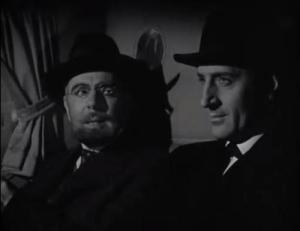
adventuresofsh_moriartyholmesThough supposedly based on William Gillette’s play, there is very little of it evident. The movie opens with Professor Moriarty (reliable screen villain George Zucco) on trial for murder, or rather being declared Not Guilty for lack of evidence, though everyone, jury and judges included, don’t like it very much. Enter Sherlock Holmes with new evidence, only seconds too late.

As it is raining, Moriarty genteely offers Holmes a ride home in his cab. Holmes accepts, so we can have one of the best parts of these Holmes/Moriarty match-ups: a brief conversation, civil but heavily laden with menace.

HOLMES: You’ve a magnificent brain, Moriarty. I admire it. I admire it so much I’d like to present it pickled in alcohol to the London Medical Society.

MORIARTY: (cheerfully) That would make an interesting exhibit.

Then after a bit more back and forth –

MORIARTY: I’m going to break you Holmes. I’m going to bring off right under your nose the most incredible crime of the century, and you’ll never suspect it until it’s too late. That will be the end of you, Mr. Sherlock Holmes. And when I’ve beaten and ruined you, then I can retire in peace. I’d like to retire; crime no longer amuses me. I’d like to devote my remaining years to abstract science.

Moriarty, after terrorizing his manservant for letting an orchid die while he was in prison, sets in motion an appropriately byzantine plot. First, writing with his left hand, he sends the Constable of the Tower of London (Henry Stephenson) a letter threatening to steal the Star of India emerald, to be delivered in a few days in tribute to Her Majesty. Then, with Holmes suitably warned, comes another mystery that the Professor knows will be more likely to snare the Detective’s interest than an improbable heist of a jewel too large to fence: the Brandons, a young brother and sister (Peter Willes and Ida Lupino, no less!) have received a bewildering message. It is a drawing of a man with a sea bird tied around his neck, and a date: that very day. The kicker is their father was killed ten years ago, after receiving just such a note.
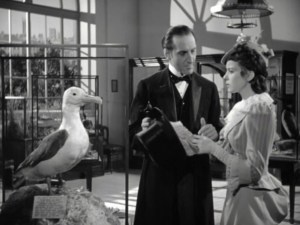
0912-advholmes3The brother is, in fact, murdered in the London fog by some devilish means that strangles him and crushes his head simultaneously. Of course, the next day, Miss Brandon receives another drawing, with another date, one which coincides with the night the emerald is to be delivered to the Tower. No problem, says Holmes, Watson will on hand to guard the emerald (the Constable receives this information with as much confidence as the audience).

While Holmes unravels this puzzle, Moriarty effects a disguise by the simple expedient of shaving his beard, then appears as one of three London policemen sent to augment the Tower’s guards. In a brilliant piece of misdirection, the fake policemen run off with the emerald, but drop it. Satisfied the emerald is safe, the room is locked once more – with Moriarty, hidden within, now able to purloin the Crown Jewels at his leisure.

Of course, after saving Miss Brandon’s life – at the last minute, equally of course – Holmes figures out what Moriarty is up to, and after a running gunfight up the Tower and a fist fight atop it, Moriarty – for the first time, and certainly not for the last – falls to his doom.
vlcsnap-2016-05-12-21h24m21s070Adventures doesn’t draw literally from any of Doyles’ stories, though the puzzle dangled in front of Holmes, having something to do with mining interests and ancient wrongs in Argentina years before, feels a lot like Doyle’s novels. A Study in Scarlet, The Sign of Four and The Valley of Fear all leave London about three-quarters of the way through, journeying to America or Injah for a complete re-telling of the mystery’s backstory. The problem is, Adventures never bothers with that bit of exposition; Holmes catches the killer, and that’s enough of that. Zucco, though, provides a nicely brainy Moriarty, with a nasty wit and a sense of drama to rival Holmes’. The double-blind scheme to discredit Holmes and steal the Crown Jewels is suitably twisted and ingenious, worthy indeed of the name Moriarty.

Sherlock Holmes and the Secret Weapon (1942)

secret weapon.kpgThere is a gap of three years between Adventures and the next Rathbone/Bruce team-up, Sherlock Holmes and the Voice of Terror. The most likely reason is Doyle’s heirs seeking more money for the rights to the characters, and the bean counters at Fox doing the math and figuring out that the cost of producing such period pieces was bad enough. In any case, Universal finally picked up the rights (at a much lower price, one would assume), and brought the characters into the present day, allowing them to make a series of 12 more movies on basically B-movie budgets. Bringing them into the 40s also meant that Holmes could use his powers against those damned Nazis.

"Brilliant Disguise, Holmes!"

“Brilliant Disguise, Holmes!”

The Secret Weapon in fact opens with Holmes sneaking Dr. Tolbel (William Post, Jr.) out of Switzerland, under the noses of two Gestapo agents ready to kidnap him. This is thanks to Holmes’ Brilliant Disguise™ and double agent-ing. Also smuggled out: Tobel’s advanced and highly accurate bomb sight, which is what the Nazis really want. Once ensconced in England, Tolbel insists on doing things his own way, which involves breaking the sight into four parts and giving each one to a different scientist, and then poo-pooing the idea of guards so that he can be kidnapped by Nazi agents under the guidance of… you guessed it, Professor Moriarty (Lionel Atwill)!
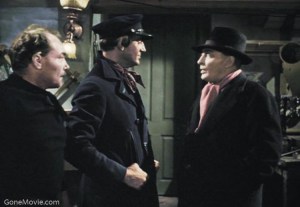
"Brilliant Disguise, Holmes." "I didn't expect it to fool you, Professor." "Thank you."

“Brilliant Disguise, Holmes.” “I didn’t expect it to fool you, Professor.” “Thank you.”

Tolbel has left behind a message in a code consisting of stick figures (the only element left over from the credited source, “The Dancing Men”), but Moriarty has gotten his hands on that, too, leaving Holmes to use some pre-CSI scientific jiggery-pokery to create a duplicate message using the pad underneath the original (most people would have used powdered graphite or somesuch, but don’t stop the man when he’s on a roll). Holmes will essay two more Brilliant Disguises™, each time being captured by and condemned to death by Moriarty. The last time he manages to badger Moriarty into a particularly slow and fiendish method of execution, so Watson and Lestrade will have time to track him down. This method – bleeding him to death slowly on an operating table – gives Holmesians a nice Easter Egg, as Moriarty smiles and says “The needle to the last, eh, Holmes?”

shandsecretweapon3Secret Weapon is one of the best of the Universal Holmes movies, if only because, in the name of the war effort, Watson and Lestrade may continually be a step behind Holmes, but they’re not total bunglers; Watson recognizes the supposed doodles in Tolbel’s message to be a coded message, and Lestrade engineers the final raid in such a way to make sure the captive Holmes isn’t killed outright – and, in fact, shoots the gun right out of Moriarty’s hand before he can administer the coup de grace.

AtwillLionel Atwill was originally cast as Moriarty in Adventures, but for reasons unknown was replaced by George Zucco. After Zucco’s version, more than willing to get his hands dirty and personally involved, Atwill’s Moriarty is more in keeping with the Professor of the stories: guiding his minions but rarely placing his own person in peril. That he is willing to abandon his crime empire and native land to basically become a war profiteer diminishes the grandeur of the Great Adversary somewhat, but is necessary for the time – and it’s not the last occasion we’ll see the character in that light, either.

Most of the authorities – like Lestrade – consider Moriarty dead (as would anyone who had seen Adventures). At the end, seeking to escape, he falls victim to his own boobytrap, a trapdoor leading to a deadfall. Or so we are told – all the proof we have is a sound effect, not even a quick fade-out on a plummeting dummy. For some reason, I’m not convinced.

The Woman in Green (1945)
The_Woman_in_Green_-_1945_-_PosterThe War is over, and Holmes has to satisfy himself with more mundane crimes, though currently London is in the grip of a series of grotesque murders: four young women, all found with their forefingers cleanly severed, as if by a trained surgeon. As the death toll rises, Holmes perceives the seeming randomness of the murders, linked only by the severed fingers, to be part of some larger, sinister scheme.

It is, of course: a complex plot to blackmail rich men by having them hypnotized by the seductress of the title, Lydia Marlowe (Hillary Brooke). They awaken in a seedy rented room, with no idea where the night has gone, and finding, to their horror, a severed finger in their pocket. They then receive a visit from a man who has one of their personal items – a cigarette case, in the one instance seen – which he claims was dropped while the man was bending over a corpse with a knife. Who could have come up with such a diabolical scheme but the most ruthless intellect to walk the earth, Holmes surmises – Professor Moriarty!

tumblr_inline_mojclbKF6x1qz4rgpPshaw, pshaws Watson, everyone knows that Moriarty was hanged in Montevideo a year ago! (Which is a surprise to anyone who assumed he actually did fall through that trapdoor). Still, when Watson is called away on an emergency case, Moriarty (Henry Daniell, this time) walks through the door of 221-B Baker Street, because no writer can resist the delicious possibilities of a dialogue scene between the two.

HOLMES: And now, Professor Moriarty, what can I do for you?

MORIARTY: Everything that I have to say to you has already crossed your mind.

HOLMES: And my answer has no doubt crossed yours.

MORIARTY: That’s final?

HOLMES: What do you think?

Then, after a bit of cut and thrust, in which it is made clear that Watson will be killed if Moriarty doesn’t leave the room alive and free, Holmes escorts Moriarty to the door.

MORIARTY: We’ve had many encounters in the past. You hope to place me on the gallows. I tell you I will never stand upon the gallows. But, if you are instrumental in any way in bringing about my destruction, you will not be alive to enjoy your satisfaction.

HOLMES: Then we shall walk together through the gates of Eternity hand in hand.

MORIARTY: What a charming picture that would make.

HOLMES: Yes, wouldn’t it. I really think it might be worth it.

walkHolmes will eventually trace the hypnosis to Lydia, but only after a detour to a sort of Hypnotist’s Club where Watson acts quite the Grand Buffoon and gets hypnotized himself, all so the audience will know what is going on when Lydia eventually puts Holmes under. Moriarty uses this opportunity to make Holmes write a suicide note, then has him walk along Lydia’s balcony railing, telling him it is a broad garden path. But ha ha! Holmes is only playing for time – again – while Watson and Scotland Yard take their sweet time arriving – again. There is the usual bit of persiflage regarding Holmes switching out the drug that would make him more susceptible to hypnosis for another that “renders the subject quite insensible to pain” so he could pass the needle test to see if he was truly under (yeah, right). Then Moriarty attempts to escape, and falls to his death. (Again: yeah, right).

Though far removed from any of the actual Doyle stories, Woman in Green does filch an element here and there. The bogus call to Dr. Watson so Moriarty can have a private chat with Holmes is right out of “The Final Problem”, and the subsequent attempt on the Detective’s life by a hypnotized sniper recalls “The Empty House”. I suppose that really, those couldn’t be called stealing, more like… shuffling pages about in a large anthology?
wig514Henry Daniell is one of the great underappreciated screen villains. My immediate association for him was as the Goebbels substitute, Garbitsch, in Charlie Chaplin’s The Great Dictator. Daniell’s Moriarty feels younger than Zucco or Atwill’s portrayal (though he’s roughly the same age here as Zucco and only six years younger than Atwill), and he brings a certain reptilian malevolence to the role. His dialogue scenes are not as droll as those of his two predecessors; there is a harder edge here, and his Moriarty does in fact feel like a man on the run who is accustomed to much, much better circumstances.

 Universal would manage to chug out another three movies in the series, but Moriarty would disappear from the silver screen until the late 70s. We’ll be ignoring the deconstructionist take of 1976’s The Seven Per-Cent Solution, and likewise the previous year’s The Adventure of Sherlock Holmes’ Smarter Brother, mainly because I don’t care for that movie. I and my friends were bitterly disappointed when we saw it on its first release, and I gave it another chance a couple of years ago. I couldn’t make it past the twenty minute mark, remarkable because I enjoy and respect everybody involved in it. I do have fond memories of Leo McKern’s completely insane Moriarty, though.

No, if I am going to have the Great Adversary in a comedic milieu, I prefer a different version.

Without A Clue (1988)

clue posterWithout A Clue is the perfect antidote for Watson fans chafing under the weight of too many Nigel Bruce movies – it posits that the actual genius behind the deductions was actually John Watson, M.D.! In order to protect a possible appointment to a prestigious hospital, Watson (Ben Kingsley) created the character of Holmes, and hired a down-on-his-luck alcoholic actor Reginald Kincaid (Michael Caine) to play that role. This allowed Watson to continue his investigating career, but when Kincaid starts improvising too much and generally tries to take advantage, Watson runs out of patience and fires him – only to discover that the Strand Magazine is not interested in the adventures of “John Watson – The Crime Doctor”. Moreover, his attempts at investigation are hindered by everyone expecting Holmes to be doing the detecting, and dismissing Watson out of hand. The two men must patch up their differences – “Just this once!” – to investigate a serious case beginning with the substitution of counterfeit five-pound plates at the Royal Exchequer.

without a clueIn the course of the investigation, when Holmes and Watson exchange hotel rooms at the Shakespeare Arms  (Kincaid is given the King Lear room, which brings up bad memories for the actor), Holmes falls into a deathtrap meant for Watson, which leads to another near-breakup of the duo, when Watson reveals the mastermind behind the plot must be… MORIARTY!

HOLMES: You didn’t tell me that bloody homicidal maniac was involved in this!

WATSON: Because I knew you’d behave this way!

HOLMES: It wasn’t YOU he tried to kill!

WATSON: Think man, think… Who was SUPPOSED to be in that room?

HOLMES: That’s right! You were!

WATSON: Moriarty knows… I am the only match for his evil genius.

HOLMES: You sure he’s not trying to kill me?

WATSON: Of course not. He knows you’re an idiot.

HOLMES: Oh, thank God!
Without-A-Clue-michael-caine-5337607-550-370However, when it seems that Moriarty has finally succeeded in killing Watson, Kincaid does rise to the occasion and manages to deduce that the Professor is hiding out in the Orpheum Theater (the site of his last, disastrous play). It then becomes incumbent on Kincaid and Mrs. Hudson to foil Moriarty’s plan to destroy the English economy. In fact, it is Kincaid’s stage training at the last, his fencing skills versus Moriarty’s sword cane, that cuts off the villain’s escape and saves the day. Moriarty apparently perishes in an explosion at the end, but as the faux Holmes reminds us, “Don’t assume. Never assume.”

freemanWithout A Clue is a solid romp, offering a story accessible to an audience even only slightly aware of the Holmes mythos. You have two Oscar winners essaying the leads (and quite obviously having the time of their lives) with good support from Jeffrey Jones (as Lestrade) and Lysette Anthony (as the Damsel in Distress). Moriarty is played by Paul Freeman, who is one of the Great Screen Villains of the modern age. The pity is, his screen time is sadly limited, robbing him of any real chance to make his Great Adversary unique – but he is a damn fine villain, and seems to be having just as much fun as the rest of the cast.

Lack of screen time isn’t going to be a problem for our next stop:

Sherlock Holmes: A Game of Shadows (2011)
sherlock_character_banner5In this Sherlock-glutted age, it is hard to comprehend that Without A Clue  was the last Holmes movie for twenty-one years, until Guy Ritchie’s 2009 Sherlock Holmes. There were ripples of grumbling about a revisionist take on the character, but that really isn’t the case. Robert Downey Jr. (in another role like Iron Man‘s Tony Stark, allowing him to use his own experiences with addiction to bring depth to the character) is twitchier and more petulant  than most Holmes, while Jude Law’s Watson is very obviously a retired military man, with all the skills and capabilities that implies. All these qualities are in the stories. If one really wishes to bitch about something, it would be the strange decision to turn Irene Adler (Rachel MacAdams) – the only person to win in a battle of wits against Holmes, who would refer to her only as “The Woman” – into Catwoman.

The first movie created a very strong villain in Lord Blackwood (Mark Strong, appropriately), a seeming warlock using some fringe science to create destructive magic. His final plot – to release a proto-nerve gas in Parliament – draws the attention of another shadowy figure, who kills a police guard to get the gas compound – Adler’s true employer, and I’m pretty sure we don’t need to tell you who that is. But he won’t show his face until A Game of Shadows.
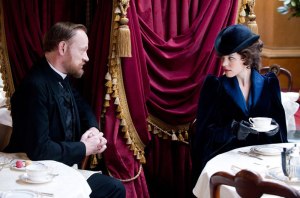
12658When he does show up – barely ten minutes into the movie, too – he will turn out to be Jared Harris (yes, Richard Harris’ son). In a neat little bit, he meets Irene Adler – having lost her last delivery to the Professor thanks to on-again off-again boyfriend Holmes – in her favorite restaurant, crowded at tea time. But everyone in the restaurant works for Moriarty, and at a signal, gets up and leaves, until she is alone with Moriarty.

MORIARTY:I don’t blame you. I blame myself. It’s been apparent to me for some time that you would succumb to your feelings for him. It isn’t the first occasion that Mr. Holmes inconvenienced me in recent months. The question is: What to do about it? That is my problem to solve now. I no longer require your services.

At which point, her poison tea takes effect. Farewell to “The Woman”.
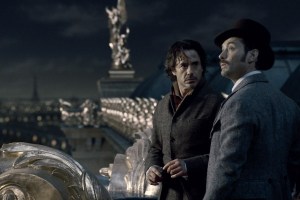
sherlock-holmes-a-game-of-shadowsA large portion of the first movie involved Holmes selfishly trying to undo Watson’s upcoming marriage to Mary Morstan (Kelly Reilly). This time, Watson refuses to postpone the ceremony to help Holmes finally unravel Moriarty’s master plan. Then Holmes has to force a detour in their honeymoon because Moriarty makes it plain that he intends to have the couple killed.

So once again Holmes and Watson head to the continent while Mary is left in the care of Sherlock’s brother Mycroft (Stephen Fry). They must seek out a gypsy, Sim (Noomi Rapace) who has the key to the mystery. Now, I expect a certain amount of complexity in a Holmes movie plot, but A Game of Shadows is simply unwieldy.  As it turns out, Moriarty is using anarchist cells to bomb various events, ratcheting up tensions in Europe, because he – through financial means and assassination – has been buying up munitions factories and other concerns so that in the coming war he will “own the bullets and the bandages.” (He’s also apparently caused the submachine gun to be developed a couple of decades early) That’s pretty much the overarching plot in The Assassination Bureau, Ltd. and as a mystery it’s fairly… elementary.

jude-law-as-dr-john-watson-in-sherlock-holmesBut everything in this Holmes canon is perforce bigger, and travel all over the continent in the name of spectacle draws the movie out to over two hours, winding up at a peace conference in a luxury resort overlooking the Reichenbach Falls. A wounded Holmes faces off against Moriarty in a last game of blitz chess while Watson and Sim try to identify the assassin in the gathering who will start World War I.  This is the third scene the two men have together, and the first to really demonstrate the usual heady crackle of a Holmes/Moriarty scene. As Holmes delineates the steps he’s taken to disassemble Moriarty’s empire, they continue playing the chess match in their heads, barking out moves between lines. Holmes wins this match, but also knows that Moriarty will first murder him, and then the Watsons in “a most creative way.” As Watson barges onto the balcony to relay the successful thwarting of the assassination, Holmes grabs the Great Adversary in a two-handed wrestling grapple and hurls them both over the railing, into the Falls.

At least Watson gets to witness it, this time.

Sherlock-Holmes-A-Game-of-Shadows-Jared-Harris-10Jared Harris has the most screen time of any Moriarty to this point, and he gifts us with a believable, human adversary, with none of the studied grandiosity of Paul Freeman or Lionel Atwill, but all of the malice. This Moriarty is an opportunist and a sociopath. Very realistic – yet, sadly, somehow the less for that.

That won’t be much of a problem in our last movie:

They Might Be Giants (1971)

There are worse movie posters. But not many.

There are worse movie posters. But not many.

In my opinion, an unjustly neglected movie. That could be because I saw it at exactly the right time in my life. Or it could be because it is generally only available in a bowdlerized version. We’ll get to that later. In any case, this is the film project that editor-turned-director Anthony Harvey and screenwriter James Goldman created after the marvelous The Lion in Winter. It is based on an unsuccessful play script, and there are times it is so early 70s it hurts.

Justin Playfair (George C. Scott) is a respected jurist whose wife dies; he becomes so bereft with grief that he retreats into madness, believing himself to be Sherlock Holmes. His brother (Lester Rawlins), desperate to pay off gambling debts, seeks to have Playfair committed so he will become executor of his considerable estate; to this end he tries to pressure a psychiatrist (Joanne Woodward) into the diagnosis, only to find that the lady takes her profession quite seriously and her observation will take time. Oh, and the psychiatrist’s name is Dr. Mildred Watson. Holmes, of course, resists her presence until her name is revealed.

HOLMES: Good Lord, I know I’m the underdog, but… are you sure that is your name?

4131274At which point he begins dragging Watson all over 70s New York, because he is, of course, seeking out Moriarty, who he feels is the source of all the evil in the world. In search of his precious clues – which he always finds, often in the most unlikely places – he and Watson intersect several lives, often changing them. This Holmes has the knack of finding the outcasts, the misfits, and making their lives just a little better. Jack Gilford plays Peabody, a law librarian who has known Holmes since his Playfair days, and is the movie’s secret weapon, stealing your heart away while you’re not looking. He, for instance, dreams of being the Scarlet Pimpernel, in a beautiful speech.

DliIXWatson, of course, resists these adventures, and the very existence of Moriarty:

WATSON: You’re just like Don Quixote. You think that everything is always something else.

HOLMES: Well, he had a point. ‘Course he carried it a bit too far. He thought that every windmill was a giant. That’s insane. But, thinking that they might be, well… All the best minds used to think the world was flat. But what if it isn’t? It might be round. And bread mold might be medicine. If we never looked at things and thought of what might be, why we’d all still be out there in the tall grass with the apes.

Yes, this is where the musical duo got their name.

THEY MIGHT BE GIANTS, Joanne Woodward, George C. Scott, 1971The thing is, Holmes and Watson are both damaged human beings, who find in each other something they are looking for, without even knowing it. They begin to fall in love, and Watson even comes round to Holmes way of thinking, or embraces his madness, whichever way you wish to interpret it. So much so that late one fateful night, as Holmes feels the showdown with Moriarty is finally at hand, he gathers a small army of misfits, all of whom seem to feel some distant call to arms. And facing his troops, he addresses them:

HOLMES: I think… if God is dead he laughed himself to death. Because, you see, we live in Eden. Genesis has got it all wrong. We never left the Garden. Look about you. This is paradise. It’s hard to find, I’ll grant you, but it is here. Under our feet, beneath the surface, all around us, is everything we want. The earth is shining under the soot. We are all fools. Moriarty has made fools of all of us. But together, you and I, tonight… we’ll bring him down.

The problem is, nobody follows him and Watson into the sewer that takes them to the site of the final showdown: a supermarket. “I don’t blame them,” says Holmes. But Moriarty is not in the meat locker, as presumed; as they go back over Holmes’ clues, Watson deduces another location, and Holmes declares her now a detective – and they set out to the new rendezvous.

This is where things can go south on you.

tumblr_mwwnp5uUsV1ruqt0eo1_500In the version I first saw, Holmes and Watson exit the meat locker, and the head of Watson’s sanitarium, under pressure from Playfair’s brother, is there with a full complement of orderlies, butterfly nets and rubber hoses. This is when the army of misfits intervenes, giving Holmes and Watson their chance to escape (and also rescue their friends when the attending police try to arrest them). It is a wonderful scene, a victory for the forces of the disenfranchised, which in this movie are the forces of good. And this scene is cut out of Universal’s original VHS and current offering from their Made on Demand Universal Vault label. Its omission doesn’t necessarily kill the movie, but it certainly cuts out its heart and leaves it to bleed to death. The only version on home video which has this scene was an Anchor Bay DVD from back in the dawn of the medium. Thank God I scarfed it up back in the day, because it now fetches over $200 on Amazon. The butchered version is apparently the official one, as far as Universal is concerned – and honestly, I blame that for the movie’s failure at the box office. That and the fact that Universal’s PR arm had absolutely no idea how to market it (the trailer scrupulously avoids any mention of Holmes at all).

Because in their version, we go directly to the last scene, outside a riding school, where Holmes and Watson await Moriarty. Watson will have a brief moment of doubt about his existence… and then she hears the hoofbeats.

HOMES: There! Riding like a king!

WATSON: He’s everything you said he was…

HOLMES: He makes you proud, doesn’t he?

WATSON: Yes!

The hoofbeats grow closer. They hold hands

HOLMES: Let it be said… they found us very close together. In the light.

As the hoofbeats grow closer, and the music builds to a crescendo, they are consumed by bright light. After a quick fade to black, the words appear on screen: The human heart can see what is hidden to the eyes, and the heart knows things that the mind cannot begin to understand.
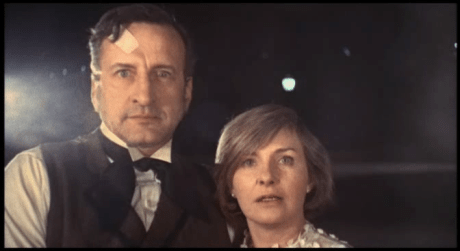
vlcsnap-2010-02-08-14h27m38s103That ending enraged me for years. Then I got older, and realized it was the only possible ending to a magical, fairy tale of a movie. Examining Holmes’ speech, and looking over the events of the movie, there is a Moriarty. That he could make us forget that we live in paradise, he could only be the one thing that drove Playfair into his madness and his crusade: Moriarty is, quite simply, Death. Riding a horse from man to man, the being that stole from him his beloved wife – but that was in another life.

FinalProblemStamp1993Thus do we come to the end of our rumination on Professor James Moriarty – from grandiose villain to unfeeling warmonger, to – finally – a literal apotheosis, an elevation to the rank of Cosmic Force. Moriarty the mathematician would scoff at the very idea, but Moriarty the villain – the concept, the Great Adversary – would no doubt be secretly pleased.

The Adventures of Sherlock Holmes on Amazon

Sherlock Holmes and the Secret Weapon on Amazon

The Woman in Green on Amazon

Without A Clue on Amazon

Sherlock Holmes: A Game of Shadows on Amazon

They Might Be Giants (damaged version) on Amazon
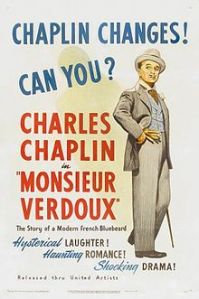
This ridiculously long post is a part of The 2016 Great Villain Blogathon, hosted by Speakeasy, Silver Screenings, and Shadows and Satin