Such an odd, strange, lovely movie. This feature by Jaromil Jireš was the last gasp of the Czech New Wave, an absurdist movement which also gave us animator Jan Švankmajer and Miloš Forman. I say “last gasp” because the Soviet government put the kibosh on arty-time films around the time of its release.
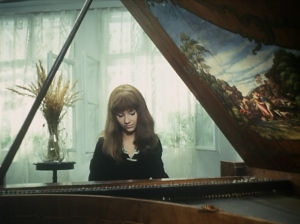
Valerie (Jaroslava Schallerová) is a 13 year-old girl living with her grandmother (Helena Anýzová). Their village is, that week, playing host to both a company of actors and a group of missionaries, one of whom is Grandmother’s old flame, a predatory priest. That set-up is only the background for a hallucinatory, episodic fairy tale with vampires, were-weasels, witch hunts, and magical earrings.
Valerie has just experienced menarche (an initial image of red currant juice dripping on a snow white daisy is typical of the lush metaphors that run rampant), and much of what she encounters in the trim 77 minutes can be interpreted as a child’s view of adult desire – mysterious, bizarre, and not a little frightening. The arrival of Grandmother’s old boyfriend – the priest who attempts to molest Valerie – causes her to turn to yet another old boyfriend, the Polecat, who turns her into a youthful red-haired vampire. The priest will also try to silence Valerie on the matter of his attempted molestation by denouncing her as a witch and burning her at the stake, something our plucky heroine survives with aplomb and nose-thumbing.
Any attempt to take this literally is going to make your eyes cross and frustrate you. Just rest secure in the knowledge that as the threads of the fairy tale begin to come together at the end, the images that were so threatening and ominous before become more welcoming and even attractive as Valerie becomes more comfortable and understanding of her incipient womanhood. It is an unusual movie; the Soviet countries produced quite a few wonderful and gorgeous fairy tale movies in the 60s and 70s, simply because glorifying local folklore was seen as beneficial to nationalism, and such movies were less likely to encounter much in the way of censorship. Valerie, however, is trying to do something more than recount old stories.
The Criterion blu-ray has an alternate soundtrack, a “folk psych” score by a gathering of musicians calling themselves “The Valerie Project”. It’s score only, no dialogue – but I was reading subtitles anyway, and I thought “Sure, why not.” It’s an interesting addendum, but the most surprising thing is it allowed me to make an unusual connection: while I was watching Valerie and Her Week of Wonders with this newer music, I kept flashing back to the short films of Maya Deren I had encountered early on, back in high school, especially Meshes of the Afternoon. I still have my laserdisc of her shorts. The amazing, layered imagery, the dreamy, rather creepy, but undeniably lovely ambiance – that’s all here in Valerie. It made me feel that if she had made a feature in color, it might have looked and felt like this.
And if you know what I’m talking about, you know if you want to see this movie, or not.
And here we are at the second of our double dips this Hubrisween season: thanks to a lack of movies beginning with the letter U, Checkpoint Telstar and myself are taking on the J-horror flick Uzumaki. If you got here first, don’t forget to hop over to his version, which is likely way more complete than mine will ever be.
Uzumaki stakes its claim to horror movie-ness with its initial image: a slow spiraling-up camera climb, its center a broken body with its brains splattered across a spiral floor pattern, surrounded by a spiral staircase, with various people staring down at the corpse.
As a translation of uzumaki means spiral, you can be pretty sure that these won’t be the last spirals you’ll see.
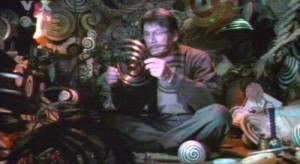
Our protagonist will be Kirie (Eriko Hatsune), a schoolgirl who is soon going to be dealing with a mass of problems in her small town. Her childhood friend Suichi (Fhi Fan) is studying hard to get into a good Tokyo university, but his father (Ren Osughi) is experiencing a sort of downward spiral (ha!). Kirie discovers him videotaping a snail, oblivious to the world; Suichi tells her he has quit his job and is currently stealing anything with a spiral on on it, and sits his room for hours, staring at these artifacts.
Kirie’s father (Tarô Suwa) is a potter of some small reknown, and has been commissioned by the nutter to make a plate with spiral patterns for him. Suichi eventually throws out his spiral collection in hopes of shocking him back reality; it only results in his father’s bizarre suicide in a washing machine, transforming himself into a spiral.
This would be enough to ruin a young girl’s life, but there’s more weirdness going on; the apparent suicide at the movie’s beginning, one of Kirie’s attention-obsessed classmates’ hair suddenly growing out in spirals, a boy who is seemingly transforming into a human snail. The cremation of Suichi’s father results in a massive spiral cloud of ash with one curly tendril dipping into a local pond (the pond where Kirie’s father gets the clay for his pottery, of course). Suichi’s mother descends into madness, so fearful of spirals that she slices off her fingertips with scissors because her fingerprints are too reminiscent of her husband’s geometric insanity – which is spreading throughout the town.
Uzumaki is based on a highly successful horror manga series by writer/artist Ito Junji (who humorously makes an appearance on a wanted poster at the local police station). Spirals are usually used for humorous effect in Japanese comics, and Ito wanted to attempt to subvert that, making the symbols something to be dreaded instead of laughed at. The film, by Akihiro Higuchi under the nom de guerre Higuchinsky, was made before the series even ended, so this story has two differnet endings, depending on the medium. That’s probably a nice surprise for fans of the manga who come to the movie after reading it, but rest assured, neither version has a particularly happy ending.
Despite having several horrific visuals, Uzumaki tends to be satisfied with simply being weird instead of actually frightening. There is an unsettling greenish tint to almost every scene, and there are at least two sequences that build impressive amounts of tension, but are never capitalized upon. Odd sections of the frame give themselves to digital spiralling effects, some obvious, some not – instead of building a sense of dread, it becomes more like looking for the hidden images of Mickey Mouse at Disneyworld while you’re waiting in line.
Higuchinsky’s actors are incredibly game, even in the most absurd moments, and add considerably to what impact the movie can claim. Folks coming to Uzumaki expecting the terror of something like Ringu are going to be disappointed, but if you are looking for something out of the ordinary, with a strangely Lovecraftian approach, Uzumaki can certainly fit that bill.
A few people were amused when i admitted on Twitter that I had seen Trog when it was first released in 1970, on a double bill with Taste the Blood of Dracula. It is very probable that being stuck in a theater full of sugar-buzzed children who scream at everything was the ideal viewing circumstance for Trog.
Three amateur spelunkers find an unexpected cave hidden away in an English pasture, and that’s not the first extraordinary thing you are going to be asked to accept (ah, I miss those salad days of college, when my friends and I would loll about in fields, carrying all sorts of equipment, just hoping to happen upon a cave no one else had ever found). What they find in the cave, on the other side of a frigid underground stream, is Trog (Joe Cornelius), your typical missing link.
Audience: “EEEEEEEEEEEE!”
One dead and one injured spelunker later, the last spelunker standing (David Griffin) remembers that his old professor, Dr. Brockton (Joan Crawford) has a research clinic nearby, and gets his friend there. We’re never quite sure what research goes on there since Brockton is an anthropologist, but never mind, we have a monster to capture. Once safely in a cage at the Clinic, Brockton and her daughter (Kim Braden) set to trying to civilize the troglodyte, even going so far as to perform surgery to allow him to attempt speech.
Of course, all this is going to be opposed by someone, and that someone, as is nearly traditional, is Michael Gough, England’s foremost portrayer of unrepentant dicks. He plays Sam Murdock, who is afraid the presence of Trog will jeopardize his planned housing project. One night, he releases Trog and trashes Brockton’s lab, knowing that if the man-ape is on the loose, the authorities will likely kill it. Murdock will also be the first of Trog’s victims, so ha ha dickweed.
“EEEEEEEEEEEEEEEEE!!!”
There follows the usual rampage through the nearby village, with Trog lashing out with deadly effect to anyone who startles or attacks him (the butcher cutting Trog with his cleaver and getting hung on a meathook in return, four years before Texas Chainsaw, was a particular favorite of my kiddie crowd). Also, did you know if an ape man turns a Brit truck on its side – sorry, a lorry – it blows up? Good to know!
As one of the training aids Brockton used on Trog was a wind-up doll with blonde hair, Trog of course kidnaps a young girl with blonde hair at a playground, and takes her back to his cave. Brockton defies the police and military men outside to go into the cave and convince Trog to hand over the girl, hoping that this will prove that Trog can actually be reasoned with – no such luck, as there is a full assault and Trog winds up on the wrong end of machine gun fire and a handy stalagmite. The end.
Trog is a twist on your typical Frankenstein story, as Brockton tries to civilize the creature instead of abandoning it; in that respect, it gets interesting in its attempts to affect us emotionally, but never quite succeeding. Joe Cornelius does a very good job with the body language as Trog, and that ape head was reportedly left over from 2001. Its quality is quite manifest, as the movie never attempts to hide Trog from us, even at the beginning. Getting that head was either a stroke of luck or (more likely) the whole reason this movie was ever made.
It’s not the only thing Trog lifts from another movie; at one point after Trog’s operation, he is shown slides of dinosaur skeletons, triggering a flashback that, even at the tender age of 13, I knew was the work of Willis O’Brien and Ray Harryhausen, from The Animal World. Perhaps the movie needed a few minute’s padding to reach a contractual length, perhaps it was the cagey Herman Cohen infusing a bit more production value at a minimal cost.
“I remember… I remember another movie entirely…”
This is famously Joan Crawford’s last movie, and done largely as a favor to her old friend, producer Herman Cohen (she had done the same thing three years previous in another movie, the circus-set giallo called Berserk!). Crawford handles the pseudo-scientific claptrap like the pro she is, and even manages to brings some subtlety to the role. Michael Gough is terrific as usual, but the part of Murdock is written so cartoonishly that any attempt he might make to render the character in more than one dimension is useless.
So this re-watch of Trog some mumble mumble years later (oh, all right – forty-six!) was more entertaining than I expected. Not a great movie by any standard, but Herman Cohen was in the entertainment business, and he always delivered (on a budget). Director Freddie Francis was equally solid, and as a fantastic cinematographer in his own right, we can at least be sure the movie always looks as good as possible.
Trog is not a classic, but then, it doesn’t try to be, either. It’s a good way to spend 90 minutes, and if you can do it with a roomful of children willing to scream their heads off at the slightest jump, so much the better.
There were a few times, looking over this year’s Hubrisween list, that I panicked, because I didn’t see a Boris Karloff movie. Then I had to calm myself down because for some reason I was forgetting this is a Boris Karloff movie.
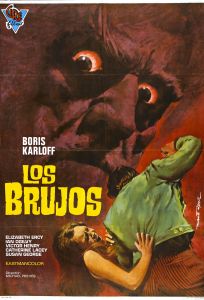
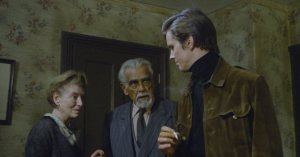
Karloff is Professor Marcus Monserrat, a medical hypnotist eking out a living in swinging ’67 London. There was a scandal in his past that ruined his reputation, and it was probably to linked the apparatus he is building in his spare room, with the help of his wife Estelle (Catherine Lacey). To test it, they need a human subject: Estelle proposes a drunk, but Monserrat avers it must a sober individual, with no connections to them: that is the only way to make certain the results of the experiment are pure. Thus he convinces Mike Roscoe (Ian Ogilvy), a handsome, bored young man, to return to his apartment for “something he’s never experienced.”
That “something” is an ill-explained psychedelic lightshow and annoying electronic tape loops, which puts Mike in a trance and somehow places Monserrat and Estelle in connection with his brain. Mike leaves under a post-hypnotic suggestion that he forget he was ever there, and the two elderly people find that they can, indeed, influence everything that Mike does, and moreover, experience whatever physical sensations he feels.
This is Monserrat’s life work: he feels that using this process, a foundation could be set up to send Mike Roscoes around the world, seeing and experiencing things the elderly and other shut-ins could not. Estelle, however, after years of deprivation and poverty, begins to give play to a darker side of her desires. She has Mike steal a fur from a store late one night, and she and Monserrat revel in the adrenalin rush of a police officer nearly discovering him. They also have cuts on their hands identical to a wound Mike received in the shop.
It goes on; Estelle sends Mike ripping around on a motorcycle, terrifying his girlfriend Nicole (Elizabeth Ercy), and beats up his best friend Alan (Victor Henry). To his horror, Monserrat finds Estelle’s will is much stronger than his, and he cannot stop her. When he tries physically, she knocks him over the head and ties him to the china cabinet, so she can continue to experience the dark side of life with no consequences.
This being a horror movie, there’s only one place it can go: Estelle uses Mike to commit murder twice in one night, and though the befuddled Mike remembers nothing, Nicole and Alan saw him with one of the victims, and know that he was friends with another (a very young Susan George, as it turns out), and the cops are not far behind Alan and Nicole. There is a low budget (but still pretty effective) car chase, and Monserrat gathers his will to overcome the drunken Estelle’s and cause Mike to crash his car, resulting in a fiery death for him …and the Monserrats, miles away.
Realize that this is a slow-burn psychological horror movie shot on a very low budget, so take a couple of shots of patience before pressing play. This was director Michael Reeves’ second feature, after the previous year’s The She-Beast, and his next – and last – would be Witchfinder General/The Conquerer Worm. He made uncommon horror movies about the darkness in men’s souls – he and Val Lewton would have gotten on together well – and who knows what he might have done, if not for an unfortunate combination of alcohol and barbituates while in pre-production for The Oblong Box.
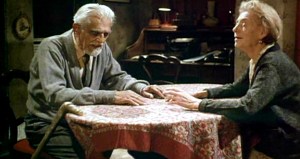
How can such a sweet old lady be so utterly frightening?
Reeves has a strong trio of actors doing the heavy lifting for him – there is Karloff, of course, entering the home stretch of his career and life. The next year he would make Targets and Curse of the Crimson Altar and a slew of lamentable foreign movies before he left us all in February of 1969. Catherine Lacey had a career stretching all the way back to The Lady Vanishes and beyond, and you have to hand it to someone who can actually out-chill Karloff on the silver screen. In fact, Estelle’s thoroughly believable descent into the abyss is probably the reason I kept forgetting this was theoretically a Karloff movie. Ian Olgilvy seemed to be Reeves’ good luck charm, appearing in all his movies, and is still active to this day.
The Sorcerers has a nice, if limited, snapshot of London youth culture in ’67, and a fairly unusual approach to its plot. But it does remain steadfastly a creature of its time, and its charms may be lost on the modern viewer, used to horror movies that evince thrill rides more than anything else.
I’ve been watching and reading about horror movies for a long, long time. So it’s really gratifying when I come across something I didn’t realize even existed, and what is more, is entertaining for all the wrong reasons. Of course, the flip side of that is information about such a thing is dreadfully hard to come by – almost as if the people involved wanted to pretend it never happened.
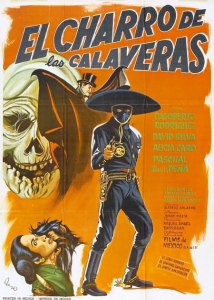
Such a thing is El Charro de las Calveras, or The Rider of the Skulls, as we gringos say. The Rider of the Skulls is an archetypal masked horseman, riding around with nothing better to do than fight monsters. He gets his name from his origin story: his parents were killed by bandits, and then one night a skull flew through the window. No, no, I’m kidding, he tracked the bandits down and wears a skull decal for each one he brought to justice. This “justice” is never defined, but since they’re skulls, I’m assuming due process was not involved.
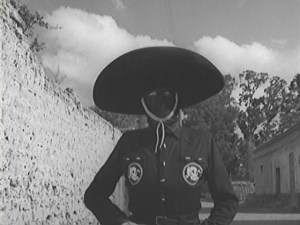
This is Rider of the Skulls Mk.2, incidentally.
But wait, you’re saying, what is this about fighting monsters? Yes, that is apparently his mission statement. The Rider of the Skulls seems to be three episodes of a failed TV series stitched together without much art (“without much art” is a description which will hold for the entire movie). It is comprised of three stories, or episodes, and during its course we will find that The Rider of the Skulls is the worst possible choice for fighting monsters.
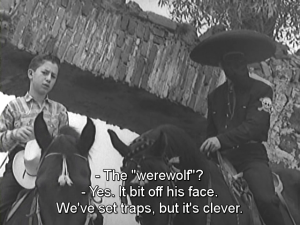
In the first episode, The Rider of the Skulls takes on a werewolf with some pretty lamentable makeup. The Rider stays with a local family while he investigates by walking around while the werewolf is off killing somebody somewhere else. We know that the werewolf is the head of the family, which everybody should have realized since Pop never changes clothes between wolfing out and returning to normal. Luckily, there’s an old witch hanging around who resurrects a corpse to explain to the Rider who the werewolf is, and by that time the Mom has gotten killed because our hero is an idiot. Hell, the werewolf is killed by falling off a cliff! By the time the episode is over, the Rider is saddled with the orphan he caused, Perico (Gabriel Angrasanchez), and the worst Odious Comic Relief sidekick since Cheaplaffs Johnson, the dead family’s manservant, Cleofas (Pascual Garcia Pena).
The ever-subtle Cleofas.
The Rider removes his mask so the two will know his true identity, revealing handsome actor Dagoberto Rodriguez, who had a good career through the 70s. This is likely because I firmly suspect that Dagoberto cut and ran after this pilot episode.
This first part will more than serve to let you know what you’re in for: Exterior sets you’re going to see over and over again, shabby monsters (though the werewolf transformation actually shows some imagination: Pop turns into a skeleton and then into a werewolf. There is no real effort made to put the skeleton in the same spot or position as the two end points, until the very last time, when somebody seems to have gone oh yeaaah), and a resounding determination to not even attempt day-for-night. Not even the usual dodge of taking the lens down a couple of f-stops. Everything takes place in the noonday sun, with only dialogue to let us know it is supposed to be night. This gets really hilarious when they encounter their next monster, a vampire. “It will soon be dawn! I must return to my coffin!” Yeah, follow your lengthy shadow to it.
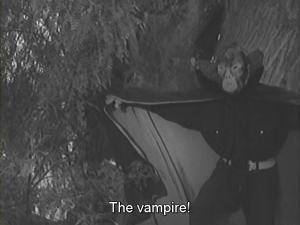
The vampire is a rubber bat (I’m pretty sure I owned this particular model in 1965) who turns into a guy in a sad bat mask. If that wasn’t enough for you, it’s pretty obvious that The Rider of the Skulls is a new guy with a more concealing mask, and Dagoberto wasn’t the only actor who wised up, because Perico is “off at school”, so the Rider and Cleofas have picked up another orphan, Juanito (Alfonso Ortiz), because honestly, somebody has to be competent in this group. It won’t be Cleofas, who spends a full minute shrieking and running from a flapping rubber bat on a string.
The Vampire is fixated on a pretty girl whose father he just killed, and, just to prove that the Rider is the worst hero ever, turns her into a vampire while he’s out walking around. (The Witch from the first episode also apparently declined to return, so he’s especially clueless now) The vampire takes her to an all-too-familiar graveyard, where he informs her “You have to die,” and puts her in a coffin beside his. The next “night”, she rises, and turns into a rubber bat to lure the Rider to his well-deserved doom. We finally have the obligatory fist-fight with the monster (the Rider loses. Again.) while Cleofas has a chance to run screaming from a woman in a nightgown. The rider does eventually spear the Vampire in the back because we’re running out of time, and fortunately the whole “You have to die” thing goes away if crap vampires in crap masks are killed.
Where can the Rider possibly take us now? What supernatural menace could he face and be worthless against? How about a headless horseman? Sure, why not!
This headless horseman rig is actually pretty good (I’d even rate it more effective than the one in The Night Stalker TV series), except that when the horse dramatically wheels about, the cape blows up, and for a second you can see the guy’s real head. Oh, well. Can’t have everything, especially in The Rider of the Skulls.
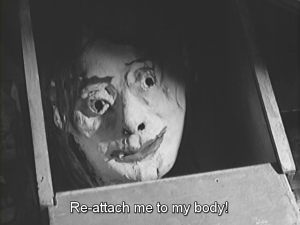
So the horseman was a bandit who was executed for his crimes, but a scientist desecrated his grave, cutting off his head to study his criminal brain. The box containing the head has wound up in the possession of the doctor’s daughter, where it does anti-social things like yell “Re-attach me to my body!” and crop back up after it’s been buried. The Headless part of the bandit, of course, is roaming the countryside at night, killing people until its head shows up. The daughter takes the head to the village where the execution took place, and the Horseman reclaims his head, which does not put him to rest, like you thought it would.
Where the hell have you guys been?
This portion has the best efforts put into the effects (yeah, for this movie, they should be called “special efforts”), like that headless rig and the Horseman’s two accomplices, executed along with him, who keep creeping around in black monk robes and skull masks. They are the most effective thing in the whole movie. The Horseman’s actual head squanders all that good will, though.
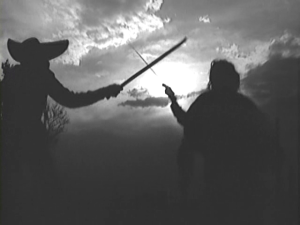
The Rider, of course, screws up and gets captured, and at this point even God has had enough and intercedes. Yep, just like Indiana Jones, God has to strike down the two accomplices with lightning and have a shouting match with the Horseman while Juanito unties the Rider. The Rider can then have a clumsy swordfight with the Horseman with the single best-shot scene in the movie.
Oh, NOW you get effective.
This whole lamentable exercise is the work of writer-director Alfredo Salazar, who was responsible for writing all the Aztec Mummy movies, and a score of others, including some El Santo flicks. Salazar had his heart in the right Halloween place, but it has to be admitted that his execution of this idea was a horrorshow all on its own. I’ve seen him described as “The Ed Wood of Mexico”, and I have to say… that comparison is not undeserved.
Why, yes, I will be riding this Quatermass gravy train as long as I keep doing these A-Z challenges.
Last year we re-watched The Quatermass Xperiment, a superb thriller that was the prototype for a particular sub-genre of monster movies. And this year I find myself re-watching its sequel, once more adapted from a Nigel Kneale TV serial, and finding it both more and less than its progenitor.
Quatermass (Brian Donlevy), the American head of the British Rocket Group, has problems, and oddly, they aren’t because his last launch brought a monster back from outer space. His current model rocket has a nuclear engine, and it is so faulty that it can’t be safely launched, putting his whole Moon Base project in peril. Adding to this bad day is the near-accident that opens the movie, as a woman trying to get her injured and seemingly delirious boyfriend to a hospital, nearly runs him off the road. This boyfriend was burned by an apparent meteorite that broke open in his hands.
Speaking of meteorites, the radar at the Group’s rocket base has been picking up strange swarms of small objects, except they’re moving too slowly to actually be meteorites – and they’re all falling at the same remote village where the man was injured. Quatermass takes a road trip there, ignoring various KEEP OUT signs, only to find a ruined village and… his Moon Base.
Much skullduggery and digging up details follows, as Quatermass eventually determines this facility – supposedly a top secret project developing “artificial food” – actually is a Moon Base of sorts – the pressure domes housing not astronauts, but the creatures traveling in the fake meteorites, which cannot exist in Earth’s atmosphere unless they invade and infect human beings. It’s a quiet invasion that’s been going on for several years, compromising even the higher reaches of government, and it’s up to Quatermass – and our old pal from the first movie, Inspector Lomax of Scotland Yard (John Longden, this time) to put a stop to it.
So the breadth of the story this time does not have the same lean, mean quality of Xperiment, and that is perfectly all right – that is what a sequel is supposed to be, and so rarely is – an expansion on the first movie, with new challenges for its heroes. The back-and-forth nature of the plot’s unfolding works against, it, though, and it’s going to take Quatermass three trips into the danger zone to find out what is going on. That’s likely more due to the compression of the original serial, which ran to six half-hour episodes, than any actual fault with the filmmakers.
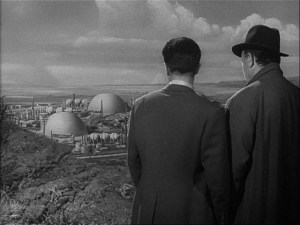
Nigel Kneale and director Val Guest share screenwriting credit here; Kneale had renegotiated his contract to have more power, but he couldn’t override Donlevy’s return as the title character. Kneale hated Donlevy’s brusque, barking version of Quatermass, and claimed his alcoholism ruined everything (Guest vigorously denied this). Guest trimmed down Kneale’s philosophizing and tried, once more, to produce a movie as close to cinema verite as possible, rendering the fantastic real. There is at least one cast member carried over from the TV version: the Shell refinery at Stanford-le-Hope, Essex, doubling for the ersatz moon base, a tremendous amount of production value, right there, providing the sort of sets that the fledgling Hammer Films would not have been able to afford.
Oh, yes, it’s a Hammer Film. The Quatermass Xperiment was such a financial success for them, they had optioned Quatermass II (note the fancier Roman numeral) before the first page of script had passed through a typewriter. Hammer had, in fact, tried to make another Quatermass movie in the meantime, only to be stymied by Kneale’s refusal to license his character; the result was 1956’s X the Unknown, which is actually a pretty effective horror movie, even if it is faux Quatermass. Their anxiety over continuing this fruitful line of production would be forgotten later in 1957 when they released another little movie, Curse of Frankenstein.
Quatermass 2 is generally regarded as the least of the Quatermass movies, but look what it’s up against! Xperiment and Quatermass and the Pit are both superior horror/science-fiction, and dismissing the middle child here is doing it a disservice. It is a darned good tale, and if you want to dig a little deeper, you can even say it is an allegory for corruption in high places, or government being suborned by corporations. It shouldn’t be passed over, because it is, at the end of the day, good entertainment, even if it does feel langorous in pace and yet, somehow at the same time, somewhat rushed.
Of course we yanks wouldn’t go to some movie with a sissy name like Quatermass! We need a more manly title!
I had seriously meant to watch Andrzej Zulawski’s Possession for this position in the Hubrisween. It’s a movie I’ve been meaning to get to for years. But it has a reputation for being challenging, and between personal setbacks and an ongoing horrorshow of an Election Cycle, I really did not feel the desire to voluntarily challenge myself on another level. Looking over my list of movies, one popped up that was another movie I had meant to see for years, and one which was unlikely to poke any bruised places on my psyche: Hammer’s The Plague of the Zombies.
Then I found out that fellow Hubrisweener Chad Plambeck at Microbrewed Reviews (formerly 3-B Theater, for all my fellow old-timers) had already staked it out weeks before. Well, go over and read his, if for some reason you got here first. (As I type this out, I say a silent prayer that I remember to come back here and link to it) Double-dipping is a time-honored tradition in Alphabet Challenges, and I’m a bit surprised we actually made it three-quarters of the way without doing it.
Circa 1860 or so, posh London medical professor Sir James Forbes (Andre Morell) is convinced by his daughter Sylvia (Diane Clare) and a troubling letter from his former star pupil Peter (Brook Williams) to spend his holiday in the Cornish village where his student has taken up practice. Peter has a problem: a slow-motion epidemic of “marsh fever” has killed a person a month since his arrival, and the superstitious villagers won’t allow him to perform an autopsy.
As there was a funeral for the latest victim during his arrival, Sir James convinces Peter to join him in a bit of resurrectionism in the dead of night (it is amusing to speculate that Sir James had some experience with this in his younger days). They find the freshly-buried coffin empty.
The Plague of the Zombies is constructed like a mystery, as Sir James puzzles out exactly what is happening, and why the graveyard is full of empty coffins. As an audience, we have an idea of how but not the why. The local Squire Hamilton had a lucrative tin mine that had to be shut down over safety concerns, and when the young Squire (John Carson) returned from lengthy time spent in the Carribean (particularly “Hy-eight-tee”, we are told), he brought with him the power of voodoo. He – and the band of rich young ne’er-do-wells which are a staple in Hammer films – are killing people with curses and then reviving them as zombies to work in the mine.
This is a good Evil Plan (I’m sure many capitalists are wishing there was such a thing as Zombie Labor), even though parts of it are quite suspect, such as why Hamilton decides to do away with Peter’s wife Alice (Jacquelin Pierce), and then Sylvia (except, you know, for the whole Being Evil thing). The scene involving Alice’s resurrection, though, is one of the movie’s most chilling sequences, brilliantly evoking one of the best parts in Bram Stoker’s novel Dracula – the confrontation with the undead Lucy in a graveyard. That’s a brilliant piece of writing perfectly transferred here.
Plague of the Zombies was shot back-to-back with The Reptile, another Hammer movie which is unjustly relegated to the second tier in most fans’ estimation. Both, like 1964’s The Gorgon, are attempts to diversify the studio’s output from what had become its stock-in-trade, vampires and mad scientists. Like a comedian attempting to perform a serious, dramatic role: people do not like having to face the unfamiliar in their entertainment. I realize that’s an absurd critique given how I came to be watching Plague instead of Possession, but here I am, Exhibit A.
Also working against it is its lack of star power: there is no Lee or Cushing here, but the cast is outstanding and solid. Morell has an impressive resume, but his major previous work for Hammer was as Dr. Watson in the 1959 Hound of the Baskervilles, and that detective work aids him greatly in this role. Diane Clare is going to be instantly recognizable from The Haunting, and that most essential Hammer actor, Michael Ripper, is on hand as a constable who is as helpful as he can be under trying circumstances.
The zombies here are genuinely chilling, the story engaging, production values high. This is not second-tier Hammer, at all. It is first-rate entertainment (if entirely suspect in its colonialism and misrepresentation of another culture’s religion) and should be treated as such.
One of the best things about roundtable challenges like this is they can force me to finally, finally watch movies that have been in my possession for years. In this case, since the days of VHS. Luckily, I still have a player that works, because domestic distribution of this movie in this digital age has been rather, shall we say, spotty. And monster movies starting with O are not terribly common.
Orochi is the Western name; most Japanese and fans of their movies know this as Yamato Takeru, which is the main character’s name, and is a long-standing legend in the Island Nation. Wikipedia has an easy-to-read breakdown of the legend… but that’s not going to do you a whole lot of good with this movie.
Twins are born to first century Emperor Keiko, and the Emperor’s advisor says that the youngest of a set of twins is always bad news, so he throws the baby off a mountain. The baby is rescued by the White Bird of the goddess Amaterasu, and deposited at a nearby temple, where the baby grows up to be our hero, Yamato Takeru.
That poison pill advisor is actually a minion of the exiled god Tsukoyomi, and he knows that Yamato was born to be a Warrior of the Gods, to do battle with Tsukoyomi when he returns from his exile. All this is your standard Chosen One movie plot, but what is uncommon is the White Bird is obviously a robot and Tsukoyomi was exiled (and is returning in) a UFO made of ice.
“Lightning bolt, lightning bolt, lightning bolt!”
After various misfortunes engineered by the evil advisor, Yamato is sent by his father on a seemingly impossible task to kill a tyrannical warlord; to give us all our standard fantasy tropes, he will be accompanied by his two older mentors, basically a Paladin and a Wizard, and he will pick up his eventual lady love, Oto, a half-elf who is really good with the Magic Missile spell. You may think I am kidding about the standard tropes, but Yamato has to recover “Three Lights” and claim the magic sword of the storm god Susanno’O, which flares into light often enough to remind us it’s a lightsaber. Yamato and Oto fight the returned god and are the verge of victory when Tsukoyomi cheats and turns into the title creature.
GOD GUNDAM!!!
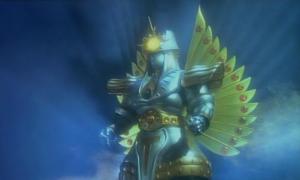
Divebombing the enormous hydra on the White Bird of Amaterasu doesn’t work, so Oto pixilates and joins with Yamato, and they turn into a Giant Divine Warrior Robot, a God Gundam if you will, complete with Flaming Sword Action Feature.
I have to admit, I was not expecting that.
You might be saying to yourself, “How is this a Halloween movie?” Pfui. The answer is monsters, my friend, and Orochi has two of them besides the titular dragon. The first, the warlord’s pet beastie, is a not terribly inspiring suit that keeps morphing weapons out of its hands. The second is a be-tentacled sea serpent that the evil advisor sics on our two heroes, and it is magnificent. Orochi himself is no less spectacular. Man does not live by vampires and slashers alone, my friend. Let yourself have some fun.
That is just a damn fine monster.
And that’s what Orochi is – it’s a fun fantasy adventure with only the slightest of connections to its source material. The blending of science-fiction elements with the fantasy gives it a unique enough feel to distinguish it from it’s brethren. If there’s one false note in the whole affair, it’s the effects done in an early stage of computer morphing madness. It’s like Wes Craven’s New Nightmare, every now and then something crops up that just makes you wince.
Okay, okay, you’re cool too, Orochi.
Orochi was supposed to be the first film of a trilogy, but poor box office put paid to that idea. Whether it was the science fiction elements, the complete bending of a well-known legend into something cosmic, or perhaps the simple fact that there is no possible way to top the God Gundam – I have no idea.
So here we are, on the fourth and final entry of Spanish director Amando de Ossorio’s Blind Dead series. Over the course of the series, the Templars have been:
Revenants who emerge from their grave either because of the Village Idiot’s human sacrifice, or because it’s the 500th anniversary of their execution by peasants who had enough
Revenants who got dug up with their treasure and took over a galleon to lure ships into “another dimension” for blood sacrifice to continue their immortal but sucky existence.
In Night of the Seagulls, the Templars are lording over a remote fishing village where every seven years, the villagers must turn over one of their children (preferably pretty girls, apparently) on seven consecutive nights, or the Templars will kill everybody. This happened once before, we are told, though why there’s still a village there is never addressed.
We don’t even get to find that out until the mid-point of the picture; Most of our time is spent with the new doctor who has been assigned to the village (Victor Petit) and his wife (Maria Kosti), who are told by the departing doctor:
Don’t go out at night
Don’t get involved in anything
Transfer out as soon as possible
They of course ignore all of these good pieces of advice, especially when the orphan girl they’ve hired as a maid (Sandra Mozarowsky) is chosen as one night’s sacrifice. The doctor frees her in the nick of time, which means there is a Templar get-together at his house.
As I said, the backstory (which changes with each successive Blind Dead movie) isn’t revealed until the midpoint, and the appearances by the Templars to that point feel rather rote and uninspired. Some footage is obviously recycled from the first movie, and though there is one instance of the most famous of the Templar’s traits – that they are blind and have to hunt by sound – that remains a factor that also received dwindling attention as the series progressed (I also have a question about the efficacy of hearing-based predators in a locale with constant rolling surf and seagulls, but let’s get on with it).
Once we get into zombie siege territory the movie takes off. The doctor’s ramshackle residence is pretty indefensible (again, the opportunity for the sound of hammering boards over windows being what attracts the zombies is wasted), and those flimsy boards are no match for ghouls wielding broadswords. The Templars slowly make their way in, and it is a pretty effective sequence, even if there are a couple of side-trips into the realm of nonsense. The fact that the heroes discover the Templars are very flammable and do not exploit that knowledge is, amazingly, not the stupidest thing that is done.
“This is surprisingly effective! Let’s never do it again!”
On the even-numbered films in his trademark series, de Ossorio also destroys the Templars at the end (Oooh, spoilers for a 40 year-old movie). The method used here is so obvious that you wonder why the villagers didn’t freaking do it years ago.
“Just wait until Stuart Gordon comes along!”
Night of the Seagulls does have its good points – the zombie siege, the fact that the Templars are apparently worshipping Dagon – but it is dragged down by tedium. de Ossorio is a firm believer in the magic of threes, which usually bears some tasty cinematic fruit – but going through the sacrifice ritual three times, without the Templars being portrayed with the same awful decaying majesty of the previous films, and no build in suspense, brings the series to a close in a less than satisfying manner.
Damn near every clip on YouTube is too freaking dark, so be warned:
In the annals of exploitation film rarely has there ever been such an obvious, and hence delightful, cheat. It is now widely known that, despite the cartoon in the corner of the poster, there is actually no man with two heads in this movie. It is instead an adaptation of Robert Louis Stevenson’s The Strange Case of Dr. Jekyll and Mr. Hyde directed by Andy Milligan, and producer William Mishkin (perhaps the great villain in Milligan’s career) re-titled it to piggyback on a movie that had an actual advertising budget, AIP’s The Thing With Two Heads.
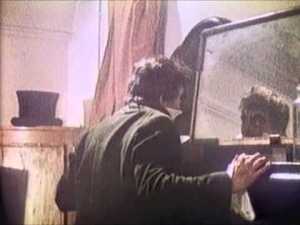
The movie is going to establish its dubious bona fides right off the top when it misspells the author’s name as Stephenson. You know the story by now; Dr. Jekyll is a kind, decent man who is seeking to isolate the source of evil in man and purge it from the world. He has managed to develop a formula that makes the evil section of the brain glow green, but he has run out of animals to experiment upon, so he injects himself with the essence of evil, not realizing his assistant bungled the formula for the antidote.
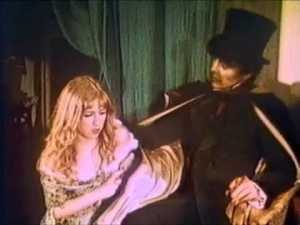
These are Milligan’s major changes in the story: Jekyll’s version of Ygor, the addition of Jekyll’s medical students to abuse as the formula starts kicking in at inopportune times, and the fact that Mr. Hyde has been rechristened Danny Blood (probably for what Milligan thought would be a very commercial title, Dr. Jekyll and Mr. Blood, not reckoning on the unvarnished hucksterism that would devise The Man With Two Heads). The rest of the story is too simple and well-told to change significantly.
This is one of three movies Milligan actually shot in England in ’71 (The Body Beneath and Bloodthirsty Butchers being the other two), and he had some unusually good luck with actors in these. Denis DeMarne is actually pretty damned good as Jekyll/Blood, Julia Stratton as the doomed prostitute April and Jacqueline Lawrence as Carla Jekyll are much better than they need to be, and Berwick Kaler as Ygor Jack is also a standout (He was in all three of the Brit Milligans, for obvious reasons). DeMarne and Kaler survived this and went on healthy careers.
“My makeup – I didn’t go too heavy, did I?”
And therein lies a confusing thing for me: I can usually only make it through one Milligan movie a year – I need the detox time. But God help me if I didn’t find myself sort of liking this plucky off-model Jekyll and Hyde. There is actually a growing sense of competence in Milligan’s filmmaking. This is not a great movie in any sense of that word, But getting through it was not the endurance contest I usually feel with Milligan. The scenes between Blood and April are grueling, for the right reasons for once: the lines seem lifted from a particularly intense dominance & submission scene, and I would actually bet money that they were.
It’s still a Milligan movie, though. Lengthy, talky scenes that would be fine on a stage are done in one take, camera and actors apparently nailed to the floor. No boom mike, so dialogue in many scenes has all the reverb bouncing off the walls and ceiling (I can hear Mishkin saying “ADR? What’s that? Some new drug?”). When he does a close shot on a dialogue scene, you can hear the whirr of the camera motor bouncing off the actor’s faces. Milligan also likes to repeat himself a lot; too much padding is derived from one character telling another what happened in another scene.
“Argh! Those two caterpillars – they’re back on my forehead!”
It is a fun game to play when looking at Milligan’s period costumes: “Tablecloth or Upholstery?” Carla Jekyll appears to be wearing Carol Burnett’s dress from her Gone With the Wind sketch, and April appears at one point in a bizarrely medieval gown that must have been left over from Torture Dungeon. Whenever we have one of Milligan’s trademark gore scenes, you can count on the scene ending by having the camera spin around in a circle.
Still. This is a damned period piece shot on a budget of $20,000. Milligan’s theatrical background allowed him to cut corners on things like costuming (he reportedly made a lot of the costumes himself). It’s those same hidebound theatrical sensibilities that often sabotage him, though.
The scariest thing about this is now I’m actually looking forward to watching another Milligan movie. What the hell.
I watched the CodeRed blu-ray which was quite good; though I can’t find a trailer on YouTube, here is a crap quality clip of DeMarne, some unfortunate eyebrow makeup, and, for some reason, a fog machine:

 Hubrisween Central ♠ Letterboxd Page
 Such an odd, strange, lovely movie. This feature by Jaromil Jireš was the last gasp of the Czech New Wave, an absurdist movement which also gave us animator Jan Švankmajer and Miloš Forman. I say “last gasp” because the Soviet government put the kibosh on arty-time films around the time of its release.
 Valerie has just experienced menarche (an initial image of red currant juice dripping on a snow white daisy is typical of the lush metaphors that run rampant), and much of what she encounters in the trim 77 minutes can be interpreted as a child’s view of adult desire – mysterious, bizarre, and not a little frightening. The arrival of Grandmother’s old boyfriend – the priest who attempts to molest Valerie – causes her to turn to yet another old boyfriend, the Polecat, who turns her into a youthful red-haired vampire. The priest will also try to silence Valerie on the matter of his attempted molestation by denouncing her as a witch and burning her at the stake, something our plucky heroine survives with aplomb and nose-thumbing.
 Any attempt to take this literally is going to make your eyes cross and frustrate you. Just rest secure in the knowledge that as the threads of the fairy tale begin to come together at the end, the images that were so threatening and ominous before become more welcoming and even attractive as Valerie becomes more comfortable and understanding of her incipient womanhood. It is an unusual movie; the Soviet countries produced quite a few wonderful and gorgeous fairy tale movies in the 60s and 70s, simply because glorifying local folklore was seen as beneficial to nationalism, and such movies were less likely to encounter much in the way of censorship. Valerie, however, is trying to do something more than recount old stories.
 The Criterion blu-ray has an alternate soundtrack, a “folk psych” score by a gathering of musicians calling themselves “The Valerie Project”. It’s score only, no dialogue – but I was reading subtitles anyway, and I thought “Sure, why not.” It’s an interesting addendum, but the most surprising thing is it allowed me to make an unusual connection: while I was watching Valerie and Her Week of Wonders with this newer music, I kept flashing back to the short films of Maya Deren I had encountered early on, back in high school, especially Meshes of the Afternoon. I still have my laserdisc of her shorts. The amazing, layered imagery, the dreamy, rather creepy, but undeniably lovely ambiance – that’s all here in Valerie. It made me feel that if she had made a feature in color, it might have looked and felt like this.


















 drfreex.com