K: Killing Spree (1987)

Letterboxd ♠ Master List

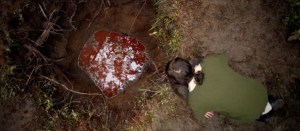
First of all, don’t strain yourself looking for this scene.

I was supposed to do Krampus here. That seemed like a good idea nearly a year ago when I came up with this list. Obviously, I wasn’t thinking straight. I tend to fall into fits of apoplectic rage when stores start putting up Christmas supplies in late August. I did not foresee that the same thing would happen when I tried to watch an Xmas monster movie for my favorite month of the year.

So. Killing Spree. Written and directed by Tim Ritter, who crap cineastes will recognize as the man behind Truth or Dare: A Critical Madness. This will become obvious as the movie progresses, but that’s not a bad thing.

Tom (Asbestos Felt) is a mechanic for a small struggling airline. Pay cuts have become the order of the day, so there’s a severe money crunch on, not aided by the fact that Tom refuses to let his wife Leeza (Courtney Lercara) go back to work. His state of mind is outlined when his best friend, the pilot Ben (Raymond Carbone) comes over for dinner and announces he has a girlfriend who is only 20 years old; not only is Tom extremely put out by this, but he suspects Ben is trying to make time with Leeza, and throws his old friend out in a rage. He tells Leeza afterwards that his first wife left him, and if Leeza did that, he would go insane.

Yeah, that’s kinda your plot right there.

See that red light? That means he’s NUTS!!!!

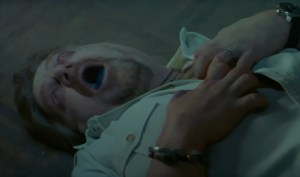
After a truly bizarre nightmare sequence concerning Ben and Leeza (and I mean quite unexpectedly bizarre, the first inclination you get that this is not going to be your typical direct to VHS gore flick), Tom finds a black notebook that details sexy dalliances with delivery men, TV repair men, the lawn guy and the like. So naturally Tom begins to do away with them in a variety of bloody, rococo fashions, some of them quite nasty. The standouts involve a chainsaw in the basement (just to make sure, a length of intestine is pulled out and plugged into a light socket to electrocute the victim), some machete blades attached to a ceiling fan, and a lawnmower, which just proved to me that Ritter read the same underground horror comic books as me while growing up.

Like I said, this is not your typical direct to video excuse for a movie – after he’s racked up an impressive body count, and feels it’s finally time to properly punish Leeza – his victims rise from the grave to exact vengeance, giving rise to a lot of extremely dark comedy. And oh yeah, Tom finds out that the entries in that notebook were rough drafts for stories Leeza was writing for her favorite magazine, Romping Romances – which she just sold for 1500 bucks so Tom wouldn’t have to get a second job.

Which doesn’t help with all the zombies banging at the door, of course.

“Hi there! They spent dang near all the money on me!”

This is Ritter’s fourth movie, made directly after Truth or Dare, which I watched earlier in the year. ToD was made when he only 19 years, and I was actually quite impressed with it. Ritter was pretty sure where he wanted to place his camera, his pacing was good, even if the logic was often very suspect.

“Very suspect logic” will cover Killing Spree, too, but then it’s basically an EC Comics story stretched to feature length, and the stretching can be verrrrry tedious early on (for instance, being told the story of why Tom’s co-worker is called “Stewmaster”. Answer: He is really good at making stew).  But there is another thing carried over from the first Truth or Dare that I liked, and that’s the fact that Ritter likes to show the disintegration of his main character’s sanity, not gloss over it in a scene or two. That speaks of a level of care in the filmmaker that goes beyond your typical gore flick. And when Tom does lose it, it has to be admitted that Asbestos Felt absolutely goes for it. Ritter obviously told him to go over the top, and then announced that the top was somewhere in the orbit of Jupiter.

That’s Raymond Carbone there, who may impress you as the dollar store version of Jerry Orbach, but he’s really good in this (and he was the detective in Truth or Dare). In fact, Ritter does very well in the actor category for this movie.

We won’t talk about that fairly lamentable severed head. There are much better FX to be had later.

The clip above and the gory trailer below (just in case you needed to see that head scene again) may not change your mind about DTV horror movies from the late 80s, but this one actually is a cut above (as it were). Some care is evident in the execution, and when I hit play, I wasn’t expecting to find a movie with so much… well, “heart” isn’t the appropriate phrase, let’s say moxie. A movie with this much moxie.


J: Jug Face (2013)

Letterboxd Master List

After the last two less-than-satisfying (to me, anyway) horror movies, it was nice to find one that hit a number of sweet spots for me: well-made, novel, compelling, and unnerving.

Jug Face starts with the neat trick of giving us the backstory during the opening credits (in my experience, only used heretofore in The Boogens, Screams of a Winter Night, and The Incredible Hulk). Presented in Grandma Moses-style rustic art, we’re given a backwoods community being ravaged by some sort of pox. One fellow makes an urn out of clay from a nearby pit; the urn bears the face of the local clergyman, who is sacrificed bloodily to a nearby pit, and everyone is cured.

Which brings us to the present day, in that same backwoods community. Teenager Ada (Lauren Ashley Carter) has sex with similarly teenage Jessaby (Daniel Manche), and not for the first time. This is going to cause problems for her later because by the cult rules of the community, she has to be a virgin when “joined” with another local youth, the doughy Bodey (Mathieu Whitman). And only Ada knows she is pregnant – she keeps stealing paint from her friend Dawai to make it look like she is till having her period.

The rather simple Dawai (Sean Bridger) is the village’s potter. Every now and then The Pit demands a sacrifice by possessing him, and while in a trance he makes the jug which bears the face of the chosen sacrifice. So Ada’s other problems recede to the background when she looks in Dawai’s simple kiln and finds out the next jug face is hers. Panicking, she steals the jug and hides it, but The Pit is not to be denied, and starts killing people randomly, while Ada, in a trance similar to Dawai’s, sees the bloody murders. She uses Dawai’s longtime love for her to cause him to make another jug face, this time with Bodey’s face – which only makes things worse for everybody.

There’s a certain understated, otherworldly realism to Jug Face‘s portrait of a community controlled, somewhat willingly, by a malign entity. Before you ask, no, we never see exactly what it is that lives in The Pit, and we don’t need to. The conviction of the cast that says things like “The Pit wants what It wants,” is often horrific enough. Ada’s parents are played by Sean Young and horror legend Larry Fessenden, and their experience and professionalism prove to be the mortar that glues the movie together.

Jug Face can be read as a more demonic, southern variation on Shirley Jackson’s “The Lottery” with a feature-length signaling to the ending, now not so much shocking as inevitable and tragic. Even at a trim 81 minutes, though, it feels a bit stretched at times, but not unworkably so. As a portrait of fear-based religion and as a horror movie, it is fairly unique and well worth checking out.

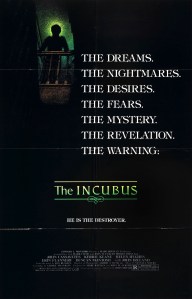
I: The Incubus (1982)

Letterboxd ♠ Master List

You know, this was supposed to be my “I” entry last year, but I decided to watch I, Frankenstein instead, mainly so I could get it posted before everybody forgot that I, Frankenstein even existed.

By the time I finished finally watching The Incubus, I really wished I had just watched I, Frankenstein all over again.

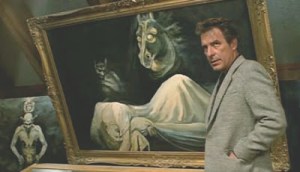
John Cassavetes is Sam Cordell, a surgeon who has recently moved to Galen Village, a small New England town, with his teenage daughter Jenny (Erin Nobel). Seems he’s the only doctor, as he’s going to wind up being medical examiner and resident Quincy. Something is violently raping women and murdering men; the first victim, Mandy (Mitch Martin) will be the only survivor, and then only because Cordell performs an emergency hysterectomy to remove her ruptured uterus.

“We can’t close the town! It’s the 4th of July!”

The rapes and murders continue, as the local police, as represented by John Ireland, are useless. After Mandy, our rapist starts leaving a prodigious amount of semen behind – analysis can’t identify it except to say it is faster and more aggressive than normal sperm, and red. The County Investigator (Harry Drivas) feels the large quantity of sperm points to a gang of perps, though Cordell isn’t so sure. After all, his daughter’s boyfriend, Tim (Duncan MacIntosh) is having headaches and bad dreams that coincide with the incidents…

Oh, yeah, a similar series of rape/murders happened in the town thirty years ago, which is something you might think is pertinent to any investigation, but noooo, it has to be brought up by local crusading journalist Laura Kinkaid (Kerrie Keane), who, incidentally looks just like Cordell’s last girlfriend, who he may have killed accidentally and oh say also Tim’s creepy aunt Agatha (Helen Hughes) is from a long line of witch hunters and

This movie will give you a headache. It’s based on a novel by Ray Russell, which should be a pretty fair indicator of quality, but that is a hope that will be dashed (yeah, it’s tempting to say that hope will be insert terrible thing that happens in the movie but it doesn’t deserve that much effort). What it does feel like is one of those gaudily-covered horror novels chronicled in Paperbacks From Hell (for all I know, it is) that glutted the market after The Exorcist and The Omen made bank, except those authors, even at their hackiest, had a firmer hand on story and character. This script does nobody any favors (least of all the audience), and John Cassavetes seems genuinely pissed to be forced to say these lines.

The decision was also made to not show the title character until the closing scene of the movie, which is a classic approach (that’s a pretty good monster, though) – but that means we spend a lot of time concentrating of the agony of the victims during the rape. A lot of time. Too much time. Dario Argento would call it excessive.

I also expected a bit more from director John Hough, who had delivered a decent horror flick with The Legend of Hell House, but he can’t get a grip on a slippery, nigh incomprehensible story that loses brain cells the longer it goes on. I have tried to figure out the timeline that is set out in the closing quarter of the movie, and though I like puzzles, I am not adverse to throwing the damn things across the room when they’re missing pieces or just too shabbily constructed to fit together correctly.

In conclusion, the 1966 Esperanto movie Incubus, starring William Shatner, is much scarier and makes more sense.

Next, please.

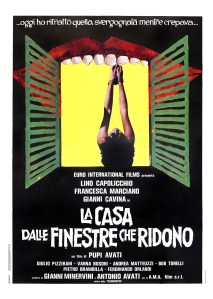
H: The House with Laughing Windows (1976)

Letterboxd ♠ Master List

So back a couple of years ago I reviewed Pupi Avati’s Zeder to close out Hubrisween and I was impressed enough to track down more of his work (so it took me two years. So what).

House opens impressively enough, with a man, strung up with arms overhead, being stabbed to death in slow-motion while we hear some crazed loon babble about the colors in his veins and paint running down his arms, all during the opening credits.

Then we meet Stefano (Lino Cappolicchio) (Avati had a thing for naming his protagonists Stefano), a professional restorationist who has been hired by the mayor (Bob Tonelli) of a small village to restore a fresco in the church. It’s a painting of the martyrdom of Saint Sebastian, done by a local artist, Buono Legnani, known as “The Painter of Agony” because of his preference for painting and drawing only subjects near death.

Stefano was hired on the recommendation of his old friend, Dr. Mazza (Giuilio Pizzarani), who was researching Legnani. Mazza is always on the cusp of telling Stefano something important about Legnani and the village, but the arrival of someone local will make him nervous and interrupt his tale, until he asks Stefano to meet him at his hotel. Of course, when Stefano arrives, it’s just in time to see Mazza thrown out a window to his death.

In proper giallo style, Stefano investigates the mystery of Legnani himself, despite creepy anonymous phone calls commanding him to leave. He finds an old wire recorder, containing the utterances we heard during the opening. Legnani was obviously more than a little off-kilter, and was aided and abetted in his off-kilterness by his two sisters, who Stefano comes to realize (as more and more of the fresco is revealed) are the models for the two women joyously murdering Saint Sebastian – and an actual murder may have taken place to act as a model for the painting. Legnani reportedly doused himself with kerosene and ran blazing into the woods, his body never found; and Stefano begins to fear that Legnani is not truly dead, and he and his sisters may still be up to no good – and they seem to have some sort of horrible control over the village at large.

The House With Laughing Windows is the most un-giallo giallo you will ever see. Most movies in this genre will keep you occupied with multiple murders, even more red herrings, sex (usually as perverse as possible), or heightened, intense visuals. House has none of these, but does have the doom-laden atmosphere and the independent investigator in way, way over his head. Leave it to Avati to not travel the well-worn road.

The movie is 110 minutes long, too long in my estimation. The final fifteen minutes, though, are suitably nightmarish and horrifying, but it can be a chore to get to them. If you’re, say, a fan of slow burn horror directors like Ty West, this is going to be right up your alley, and you should seek it out. For me, though, it’s more of a case of Okay, now I’ve seen it, and going on to my next horror movie, which will hopefully be more to my liking.

(Spoiler: it will not be.)

G: Gui si (Silk) (2006)

Letterboxd ♠ Master List

Somewhere in my questionable writings about questionable media I was about to write that the key to Japanese genre movies is that you are asked to accept one extraordinary thing, and the story moves on from that basis. I believe that was about the original Battle Royale – then I realized this was true of almost all genre fiction, and put that in the Stupid Stuff You Came Up With file, and didn’t say it. (This why I would never make it in the world of political punditry, and also why I still have a shot at getting into heaven.)

In any case, the Extraordinary Thing this time around is the Menger Sponge, an artificial substance that traps electromagnetic energy. In a sequence of newspaper clippings, it is revealed that the Sponge’s developers were hoping to use it to achieve anti-gravity, but that production of a large-scale Menger Sponge failed.

However, that is only after a sequence where a Canadian photographer (Kevin S. Smith) is given an envelope of money to take photos with Menger Sponge-treated Polaroid film in a deserted apartment in a dilapidated building. It’s not the first time he’s done this, but this time he is surprised to find an image of a ghostly child in a corner where there should be none. He dies almost instantly with a look of terror on his face.

The crippled scientist Hashimoto (Eguchi Yôsuke) has been heading the Menger Sponge development team for several years, and the Director (Tsukayama Masane) has had enough of his wasting funds, until Hashimoto reveals he has made the largest Menger Sponge ever – although it will still fit in his pocket. What the Director doesn’t know is that Hashimoto has spent the last few years ghost hunting – and he has finally found one, in that apartment. He asks the Director to pull some strings to assign the Special Forces operative Tung (Chang Chen) to his team.

Hashimoto wants Tung because he has exceptionally sharp vision and the ability to read lips – both necessary as he has trapped the ghost of a young boy in that room with Menger Sponge material. The teams has also developed Menger Sponge eye drops allowing people to actually see the ghost, but only Tung can see an eerie strand of energy – the silk of the title – that connects the ghost to other locations. Hashimoto hopes that Tung can discover the boy’s identity, how he died, and where he is buried – because, of course, Hashimoto has other goals beside developing anti-gravity.

Gui si is a well-developed mystery wrapped in a ghost story with some remarkable horror movie moments, since it is discovered that if you look a ghost in the eyes, they can then see you, and inevitably kill you – and the eye drops make that much more likely. Although the eye contact’s not really necessary if a ghost suddenly turns vengeful – and the events of the movie will ensure that a really ticked-off ghost will start tracking down the members of the team with murder on its spectral mind.

An extra layer of meaning is laid on by Tung’s backstory – his mother has been in a coma for years, apparently, but Tung refuses to turn off her life support, even if the doctors say she is suffering. Like Hashimoto, he, too, needs some questions answered about the afterlife.

It’s these layers in Gui si that surprised me, and the fact that the climactic ghost sequences launched into the operatic, and even the heartbreaking, that completely sold me. I had to make an effort to seek this movie out, and having now seen its quality, that surprises me even more.


F: Found Footage 3-D (2016)

Letterboxd ♠ Master List

Found Footage 3-D starts screwing with you right from the beginning, with a cliched opening graphic and Blair Witch sound effect:

I especially appreciate the typo.

Which is immediately followed by the director complaining about how cliched it is.

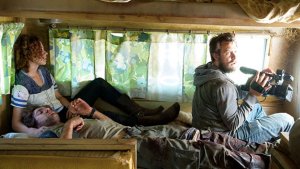
Here is your setup: Derek (Carter Roy) is producing and starring in a low-budget found footage horror movie. The aforementioned director is Andrew (Tom Saporito) and the cameraman shooting all the behind-the-scenes making-of footage we’re watching is Derek’s brother, Mark (Chris O’Brien). The Amy alluded to in the graphic is Derek’s now-ex but still co-star, Amy (Alena von Stroheim). While we’re meeting characters, let throw in the PA, Lily (Jessica Perrin) who seems to be Derek’s current squeeze (not that this will cause any drama or tension, nooooo) and the sound man, Carl (Scott Allen Perry).

As you can tell, the script for our movie-within-a-movie, as it stands, calls for Derek and Amy to go to a spooky remote cabin and have strange stuff happen to them. In a pre-production meeting with Andrew and Mark, Derek makes his pitch: since they have no real budget for hyping their production, their only hope at making a splash is to be the first at something. To which end, he reveals that this will be the first found footage movie to be shot completely in 3-D! Ta-daaaah! Skeptically, Andrew asks, “Whyyyyy are they shooting their vacation footage in 3-D?” After the briefest of pauses, Derek brightly replies, “Because he’s a 3-D enthusiast!”

This is typical of Found Footage 3-D‘s sense of humor. Not laugh-out-loud funny, but observational stuff that ultimately rings true, especially if you’ve ever been involved in shooting a low-budget movie. Then you get to say, “It’s funny because it’s true” multiple times. In fact, this is one of the best movies about shoestring film production I’ve seen an a long time.

There’s still quite a bit of friction between Derek and Amy, though the two obviously still have some feelings left for each other. Which is wearing on Mark, who has a not-so-secret thing for Amy. Andrew will be wondering increasingly why Derek even says he is the director as his producer/star overrides him more and more as the shoot progresses.

And, oh, yeah: that remote cabin with a spooky bad history? They’re shooting in an actual remote cabin with a spooky bad history. I was on Team Carl the Sound Man from the beginning, but I was willing to buy the T-shirt when he goes ballistic upon finding out that Derek has brought them all to an actual haunted house. This also leads to one of the most awesome scenes when, stopping for gas and supplies in Gonzales, they ask a couple of old coots sitting in front of the general store to be in their movie, saying old coot things. Quite funny, until the camera stops rolling and one asks where they’re headed. When they’re told which cabin they’re filming at, the two old guys get genuinely freaked out and warn them away from it. Doran Ingram and John Daws, you may have literally been two locals pressed into the job, but you did outstanding work.

Another thing I love about Found Footage 3-D is that it also serves as the Scream of found footage movies, codifying the rules of the genre – and then proceeding to use those rules for all they’re worth. For just one example, the big question of “why do they keep filming after everything goes to shit?” – there is actually a reason given that makes some sense.

Online critic Scott Weinberg is a producer, and actually shows up on set as a correspondent for the late, lamented website fear dot net (this was shot back when we could have nice things). I suspect Weinberg also served an on-set consultant – he’s about the only critic I trust on matters like contemporary horror movies. He’s there for the incredibly gruesome climax, and I don’t want to go into spoiler territory, but one of the rules is nobody gets out alive…

Which means that every time I listen to his podcast with Drew McWeeny, 80s All Over, I’m listening to a ghost. AAAAAAAAA!

Anyway. Highly recommended. I loved it.


E: Exists (2014)

Letterboxd ♠ Master List

I’ve become a fan of Eduardo Sanchez, one of the directors of the original Blair Witch Project, and whose subsequent work I’ve largely watched within the constraints of the alphabetic format of Hubrisween. E is one of the more problematic letters for horror movie titles, so I was delighted to find that Sanchez had made this Bigfoot movie.

Stop me if you’ve heard this before, but five young people are headed out to a remote cabin in the Texas Big Thicket for a weekend of (supposedly) doing wacky stunts involving GoPro cameras, a mountain bike, and a ramp into a lake, all for YouTube fame. The two brothers, Matt (Samuel Davis) and Brian (Chris Osborn) lifted the key to the cabin from their uncle, who hasn’t been out to the thicket in years. Along are Dora (Dora Madison), Elizabeth (Denise Williamson) and Todd (Roger Edwards). During the late night drive to the cabin, Matt gets distracted and hits something on the road. That something leaves a lot of blood and some coarse hair on the truck’s bumper.

Though our five friends are somewhat discomfited by strange howling noises from the woods, they settle in and begin filming – particularly Brian, our dedicated video fiend for this outing, who finds really big footprints in the woods and tries to get some footage of what he believes to be a Sasquatch. That turns out to be not such an outlandish theory as something completely trashes their truck and they find themselves besieged in a not-terribly secure cabin by a very pissed-off creature. Apparently there was a reason Uncle Bob didn’t let anybody use his cabin.

Once upon a time, I reviewed Sanchez’s fellow Blair Witch director, Daniel Myrick’s The Objective, calling it “a better Blair Witch sequel than Blair Witch II.” I’m going to plagiarize myself and use that same descriptor for Exists, as it covers so very much of the same territory, right down to questionable (in fact downright idiotic) decisions made by the characters, and the eternal question of why the hell Brian keeps filming (and who manufactures his batteries). If only someone would codify the odd conventions of the found footage movie! (They did, but you’ll have to wait until tomorrow) They even go the route of a missing party member screaming in the darkness again. They find him this time, though.

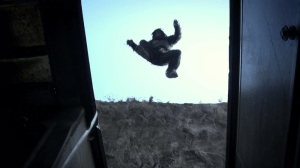
Exists, I have to say, is a much better movie than Blair Witch. Sanchez is more in control, the dialogue doesn’t seem to be totally improvised (every other word is not “fuck”), the storyline is fairly logical, and best of all, they had enough budget to hire WETA Workshop to make the creature. For most of the movie, it keeps with the tradition of only fleeting glimpses of cryptids in footage, but when we finally do get a good look at it, the suit is well up to the attention.

If you hate found footage movies, Exists isn’t going to change your mind, but it’s a good, solid flick; it’s like Sanchez and co-writer Jamie Nash looked at the last segment of the original Legend of Boggy Creek and said, “Let’s do that, and crank it up to 11.”

D: The Devil Commands (1941)

Letterboxd ♠ Master List

We don’t hear much about William Milligan Sloane III these days. He wasn’t a terribly prolific writer, and most of his output was in the 1930s. He started as a playwright, and eventually published two novels combining science fiction and horror – To Walk the Night  and The Edge of Running Water – that are still being reissued to this day. I first ran across Sloane when I was helping my childhood friends pack, around 1970, I think, and his father had a copy of To Walk the Night. It had a striking cover, and a writer I had never heard of before. I decided to find a copy, but inter-library loans weren’t a thing – it probably didn’t help that I got that novel confused with Running Water. Then I found out that had been made into a movie starring Boris Karloff, which I bought on DVD back in those halcyon days when everything was coming out on DVD, and then I decided to wait until I was 60 years old to watch it. (As we know, I try to do a Boris Karloff movie every Hubrisween)

Dr. Julian Blair (Karloff) Has invited his colleagues to witness his exciting new invention, the EEG. (I kid. The electroencephalogram was first used on humans in 1923 and was only beginning to be experimented with as a medical tool in the 30s, when Sloane wrote this) The device, using a bizarre helmet and a lot of electricity (yay! a jacob’s ladder!) draws the pattern of his assistant’s brain on an enormous graph. Blair tells his impressed fellow scientists that each brain pattern is different, but as individual as fingerprints, as he demonstrates on his wife, Helen (Shirley Warde) who has one of the strongest brain waves he’s recorded.

Alas, that very evening, Helen is killed in an auto accident. Bereft after the funeral and unwilling to go back to their home, he goes to his lab and turns on his equipment, just for distraction…  and Helen’s brain wave begins to etch on the giant graph, even though she was buried that morning. No one believes Blair, not even his concerned daughter Anne (Amanda Duff), except for his manservant, Karl (Cy Schindell) who has been seeing a medium to speak to his deceased mother.

Intrigued, Blair accompanies Karl to a seance run by Mrs. Walters (Anne Revere). Blair easily sees through her fakery, but cannot explain the high voltage he felt through the table, sitting next to her. Experiments find that Mrs. Walters can absorb a high amount of electricity with no harm, and in fact while hooked up to Blair’s equipment (and bolstered by Karl as an extra resistor), Helen’s brain wave does indeed register again – but unfortunately the high voltage cooks Karl’s brain.

Walters realizes that Blair is onto a discovery that will make him very, very rich, and decides she wants in on it. They escape to a remote house near a harbor, guarded by the now brutish Karl, and years pass. The local sheriff (Kenneth MacDonald) comes calling one night because A) people are talking, and B) dead bodies have been missing lately. Mrs. Walters sends him away brusquely, but he prevails on the housekeeper, Mrs. Marcy (Dorothy Adams) to sneak into that forbidden lab and see what’s what. This she does, to find that Blair has moved up to a table with six of his ungainly apparati, he’s upgraded from jacob’s ladders to neon, and those suits contain the missing corpses. In a panic, she accidentally turns on the devices, and a glowing vortex opens in the table, drawing everything toward it. The corpses are strapped down. She isn’t.

Things are really moving to a head now. Mrs. Marcy’s husband (Walter Baldwin) doesn’t buy the evidence planted that his wife fell off a cliff into the harbor and starts putting together a lynch mob, Anne has finally tracked down her father, and… gosh, things just don’t turn out very well.

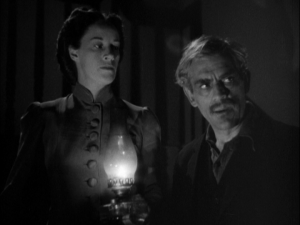
The Devil Commands is directed by Edward Dmytryk early in his career – he’d later go on to better known fare like Back to Bataan, The Caine Mutiny,  and Warlock. His direction is crisp and clean, and he wisely spends most of his camera time on Karloff and Revere. Karloff is his usual greatness at a role in which he excelled – an utter madman whose mania is absolutely understandable. Even when he is suggesting something dreadful, he seems considerate and caring, and by the final act of the picture he is visibly tortured by the terrible things he’s done. Anne Revere pulls off the neat trick of being a match for Karloff – her Mrs. Walters is one of the great Lady Macbeths of the screen, willing to cut through anything and anybody to make sure Blair will produce the breakthrough that will be her road to riches.

You know. THIS guy.

The most unusual thing is seeing Kenneth MacDonald as the sheriff, who is a calm, collected officer of the law who’s just trying to make sure everything is peaceful in his town. Like me, you’re probably more used to seeing MacDonald as the bad guy in Three Stooges shorts. Blair’s assistant and Anne’s love interest Richard Fiske is called upon to do little more than be concerned and chauffeur Anne around, and poor Anne isn’t even that interesting.

The tone of the movie is a little more elevated, a bit more thoughtful than Universal’s horror offerings. At a brief 65 minutes, it doesn’t have a chance to wear out its welcome, though it does come close. And even as a lesser known Karloff movie, it bears checking out.

Not really a trailer, but what do you want for free?


C: The Color Out of Space (2010)

Letterboxd ♠ Master List

“The Colour Out of Space” was my introduction to H.P. Lovecraft, via a thick gray book with the inventive title A Science Fiction Anthology. I was 12 or 13 – reading far beyond my age range – and though I was at first put off by its length, I persevered, and was absolutely terrified. Movie adaptations of Lovecraft are a pretty hard sell for me, with a lot of misses and a few hits (most of those being the obvious ones directed by Stuart Gordon), so The Color Out of Space came as a pleasant surprise.

It’s Arkham, 1975, and Jonathan Davis (Ingo Heise) is looking for his missing father. The investigating officer (conveniently named Ward – Alexander Sebastian Curd Schuster) finds that the man suddenly went to Germany, where he served during the post WWII settlement. Davis hastily flies to the forest region where his father was stationed, to find that the valley is about to be flooded by a new dam, and only the elderly still live in the nearby village. None of them recognize his father – until he literally runs into Armin Pierske (Michael Kausch), who recognizes the photo of his dad in his 1945 uniform.

Armin met the elder Davis when he returned from the Russian front to find the Army appropriating his farmhouse for refugees. He warns the Americans away from the neighboring valley because “It looks like it’s still happening,” which causes the squad to take him along to check it out . Armin is not surprised that his old acquaintance returned to the valley. “Once you see the colour, it is hard to forget.”

The bulk of the movie is Armin’s re-telling of what happened in that valley in the days just before WWII. A meteorite crashes into the Gärtner farm, and the stone’s properties confuse scientists; it radiates constant heat and continually shrinks, despite not producing any gases or ash. All tests are inconclusive, and they continually return for new samples, until they discover an oddly-colored sphere at the center of the bizarre rock, which shatters and disappears once tapped. And so the troubles begin.

Crops on the Gärtner farm begin to grow like crazy, producing huge fruit that is still blighted. Frau Gärtner begins to act oddly, eventually locked up in a room in the attic. One of the boys returns from the well screaming about lights. Trees seem to move on their own, with no apparent wind. The only person who still speaks to the increasingly beleaguered family is Armin, their immediate neighbor – and when he doesn’t hear from them for two weeks, he fearfully walks up to that darkened house.

This is a remarkably faithful adaptation of Lovecraft’s novella. Pre-War rural Germany is a good analog for Lovecraft’s backwoods locale, and the decision to make the movie in black-and-white is effective. I think you can deduce what the only thing in color in the movie is going to be, and it’s perhaps unfortunate that Lovecraft’s protagonists always have to see the indescribable indefinable unknowable, and filmmakers have to show that, and they will never be able to afford what that looks like in our heads.

The only other false note for me is a last-minute attempt to put a twist in the story for those of us familiar with it, which led me to have too many questions, but past that: Good adaptation. Recommended.

B: Below (2002)

Letterboxd ♠ Master List

During WWII, the submarine Tiger Shark is ordered to turn around and pick up three survivors from a torpedoed hospital ship: a nurse (Olivia Williams), a merchant marine (Dexter Fletcher) and a German POW (Jonathan Hartman). Things already aren’t too right on the Tiger Shark. Their commanding officer recently died in an accident, and there are several versions of what happened floating around; the senior officers are covering something up, and the junior officer Odell (Matt Davis) is trying to figure out what actually happened. Worse yet, they are spotted by a Nazi warship while picking up the survivors, and it is not about to give up the chase, using depth charges, grappling hooks, and good old German perseverance.

Or, actually, what is even worse: the vengeful ghost of the ex-captain seems to be bent on making sure that the Tiger Shark will not make it to port.

David Twohy made his mark writing and directing genre-blending movies like the Pitch Black/Riddick movies, and Below is no exception. The central mystery and connected ghost story are absolutely essential, but it can also simply stand on its wartime submarine story; equal care and weight is assigned to both. And watching these entwined stories unfurl is half the fun, if not more, which is why this review is briefer than usual – I don’t want to tromp on your enjoyment. It’s worth noting that Twohy’s co-writer on the script is Darren Aronofsky, who was set to direct but decided to do Requiem for a Dream instead.

You are asked from the very start to keep track of a large ensemble cast, but – being a horror movie – you’re pretty sure you won’t have to be doing that for long. Bruce Greenwood, always a solid actor, gives a truly exceptional performance as the guilt-ridden Captain Brice, and it was surprising to see Zach Galifianakis in an early role as the appropriately-named Weird Wally, who gets points for mentioning the urban legend about riveters getting sealed into the hulls of submarines, which was the basis for the One Step Beyond episode I kept having flashbacks to during my viewing.

Good movie that under-performed at the box office. Give it a shot, it deserves it.