Z: The Zodiac Killer (1971)

Home ♠ Letterboxd

After four weeks of dwelling on the fantastic, I suppose it’s only fitting to wind down with something bordering on the all-too-real. I’m lying, of course, there is no really good reason to return to the hellscape of real life, but we’re at the letter Z, there’s no way I’m watching Zaat again (maybe next year), so here we are.

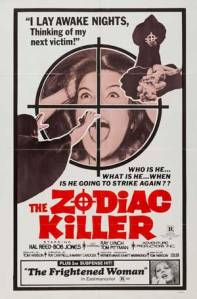
You don’t have to be a David Fincher fan to know about the Zodiac murders of the late 60s, but that’s probably a better excuse than being a true crime freak (or, like me, a constituent of Ted Cruz). I’m going to have to cop to the sick fascination angle (well, that and trying to vote him out of office). The Zodiac murders and the Manson family were impossible to avoid on the news at the time, and they were that decade’s proof that the world was going to hell in a handbasket. Robert Graysmith’s book in 1986 allowed me to get a fuller picture of the case, and would also come in pretty handy when watching not only Fincher’s 2007 flick, but also Tom Hanson’s more contemporaneous 1971 movie.
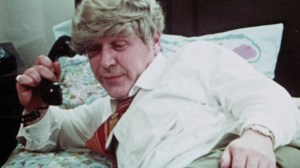
Grover and his toupee. “Don’t touch the hair!”

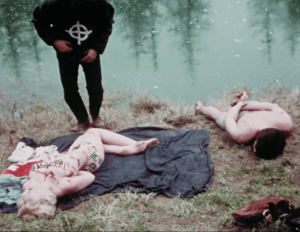
We’ve got some zero-budget recreations of the first two Zodiac killings intercut with the lives of two suspects: Jerry (Hal Reed) a put-upon postal worker, and Grover (Bob Jones) a divorced truck driver who likes to put on a toupee and cruise the local bars in the guise of a successful businessman. Grover’s got a temper on him, and is under a lot of stress, so you can be sure he isn’t the Zodiac. In fact the movie gets rid of him via suicide by cop at about the 40 minute mark and yep, Jerry – who raises bunnies in his basement – he’s the Zodiac.
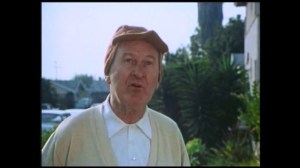
SPOILER: NOT THE ZODIAC

(I was frankly disappointed it wasn’t 50s kid show host Doodles Weaver)

The point at which this is discovered is one of the better scenes, beginning with a tight shot of his mouth during a whispered phone call to the police to let them know they got the wrong guy, gradually pulling back as he gets more agitated, hangs up and launches into an amazing unhinged speech that’s pretty much taken from Zodiac’s letters to the press. After this the movie becomes a series of vignettes of Jerry being a likable, helpful guy alternating with more of the Zodiac murders. Eventually they run out of confirmed Zodiac kills and start improvising. We find out Jerry’s father is in a mental hospital and is quite violent, make of that what you will.

Jerry and his friends.

The final scene is Jerry walking down the street, as his voiceover reminds you he still hasn’t been caught, and there are lots more like him. Maybe you pass them when you walk down the street. Maybe they’re sitting behind you at this theater. See you around. Mwoo-ha-ha.

Tom Hanson’s lack of a budget is apparent in almost every frame, but that doesn’t stop him from getting the occasional fantastic shot. The matter-of-factness of the simple approach this lack of money requires actually causes some of the murders to be quite disturbing, and a whole lot can be accomplished with enthusiasm and a knife with a collapsible blade. It plays like a low budget regional horror movie because that’s exactly what it is. After a certain point it starts to feel like a dry run for Henry: Portrait of a Serial Killer.
Yet the most intriguing part of the movie isn’t even on the screen: The movie’s premiere had a contest sponsored by Kawasaki. A motorcycle would be awarded to the best answer to “I believe the Zodiac kills because…”Hanson had handwriting experts poring over the entry cards, looking for a match to Zodiac’s letters. I have no idea if Hanson even cleared this with the cops, who were getting hammered by the public at the time. There’s a reason Dirty Harry was a monster hit; Scorpio was a thinly-veiled substitute for Zodiac, and Harry Callahan was everybody else.

Whether or not you want to check out The Zodiac Killer is going to depend on your tolerance for/interest in extremely low-budget filmmaking and attendant acting shortcomings, a historical context that is gobsmacking, or needing to see something that is basically Toxic Masculinity: The Movie. Cuz holy jeezum, those guys – all of them – are real jerks.

Buy The Zodiac Killer on Amazon

X: X-Cross (2007)

Home ♠ Letterboxd

Last Hubrisween I ran out of Xtro movies and had to resort to the Blank Scrabble Tile rule and substitute a movie with a number for X (The 7th Victim, if you’re too lazy to search). Then, while casting my nets wider for this year’s movies, I came upon this entry from Japan. How fortuitous!

Shiyori (Nao Matsushita) and Aiko (Ami Suzuki) are headed to a remote hot springs spa to get away from it all. Shiyori is trying to get over a bad breakup with her first love, Asimiya (Hiroyuki Ikeuchi). The two girls couldn’t be more dissimilar, typified by their cell phones: Shiyori’s is plain and unadorned, Aiko’s is blinged out to the max and probably weighs five pounds from the excess decoration.

I use this distinction as we will find cell phones are central to the story.

Ashikari village is at the top of a mountain; the cabins for the patrons are quite nice, but the villagers all seem to be various forms of twisted and vaguely sinister. Some friction grows between the two girls – the free-wheeling Aiko with her many lovers versus Shiyori’s mourning for her sole, unfaithful boyfriend. The two separate, and as you might suppose, this is where the trouble truly begins (particularly since Aiko calls someone on that sparkly phone to report that everything is “going as scheduled”).

Shiyori finds a phone in the closet of their cabin and answers a call from the brother of the phone’s previous owner, whose fate we saw in the film’s opening. The brother (Nozomu Iwao) fills us in on the necessary backstory. Ashikari has a dark history, a logging village that in olden times went to the hideous extreme of chopping off their wives’ left leg to keep them from running away while they were at work; this mania soon extended to any traveling women unlucky enough to wander into the area. Ashikari is now home to a full-blown cult that lures in women with the hot springs, cuts off their leg, then worships their mummified remains as goddesses. They also cut the tendons in their own left legs, which makes running after the escaping Shiyori a bit ungainly.

So this sounds rather like an Asian version of The Shadow Over Innsmouth, and it might have turned out that way, but there are various twists with the modern technology of cell phones that add layers of paranoia and doubt to what might have been a simple chase movie. Also, Aoki is having problems of her own: the jilted girlfriend of one of her former lovers, Reika (Ayuko Iwane), dressed like a goth Lolita from hell, has tracked her there and is determined to murder her with scissors, which adds an entirely different kind of weirdness and tension to the story.

The director is Kenta Fukusaku, and that last name should be familiar to you: his father was Kinji Fukusaku, a towering presence in Japanese cinema, from The Yakuza Papers movies to The Green Slime to Tora! Tora! Tora! to Battle Royale. Kenta wrote the screenplay to that one, and took over the directoral reins on the sequel when his father passed away (the sequel is, shall we say, not loved). His career since has been rather speckled; X-Cross was preceded by a Sukeban Deka movie and followed by a string of movies that hover around the 6.5 stars rating on IMDb, when they have a rating at all. He hasn’t had his breakout hit on these shores yet, and that’s a pity, because I really enjoyed X-Cross.

Though it doesn’t reach true Christopher Nolan levels, Fukusaku does mess with the timeline to show us what is happening in the parallel stories of our two stars, literally rewinding the footage to show us where we are, event-wise, even providing a couple of laughs along the way. The best part for me is when odd details in one girl’s sequence are explained in the other girl’s flashback, so I guess I should have invoked Tarantino rather than Nolan.

Generally I liked X-Cross not because it transcends its genre – it doesn’t – but because just when I think I have it figured it makes me say things like, “Holy shit, where did that crazy Reika get a five-foot pair of scissors?”

Buy X-Cross on Amazon


W: Wither (2012)

Home ♠ Letterboxd

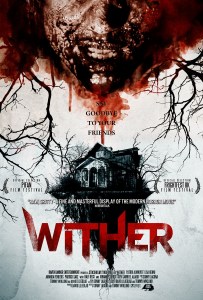
Wither was mentioned to me when it first came out as “a Swedish Evil Dead” to which my response was yeah, okay, cool as it was entered in the Infinite Watchlist until I had need/time/desire to track it down and watch it.  And I have to say that I wasn’t expecting that description to be quite so literal.

High hopes at the beginning, as we find a hunter searching through a rainstorm for someone named Lisa. He finds her – apparently his daughter – but someone is chewing on her. He shoots that someone in the head, and they get back up anyway.

Credits.

We are now going to go into setup mode for the next twenty minutes, as we meet our seven young cannon fodder characters as they prepare for a weekend at a remote cabin: four women, three men (Lisa Henni, Amanda Renberg, Jessica Blomkvist, Anna Henriksson, Patrik Almkvist, Patrick Saxe, and Max Walmo). The father of our male lead, Aldi (Almkvist), who owns some property in those woods, found this cabin, seemingly abandoned, for his son’s outing.

Seven characters might seem a lot for a horror movie, but then, since it’s a horror movie, we can be pretty sure that most of them won’t be around for the end credits. Especially since they seem to keep making the requisite dubious choices that make such movies possible. The first being Marie (Blomkvist), boosted into the locked cabin (to supposedly surprise Aldi at the front door) deciding to, instead, investigate the mysterious cellar she finds dug under the cabin.

This is Dubious Choice Prime that makes the rest of the movie possible, you see.

Instead of finding a recording raising ancient Sumerian demons, there is some kind of legendary race that lives underground, and gazing into their eyes allows them to swallow your soul, you see, and it’s not ten minutes later that Marie goes all white-eyed and bitey. The hunter from the opening (Ralf Beck) drops by to give us the backstory, and to advise that they burn Marie (like he did his wife and daughter, who had also found that basement). And oh, yeah, anybody who gets bitten or has possessed blood slopped on them will get infected, too. So right away we are able to go, okay, you and you, and that list will get expanded thanks to further dubious choices.

The FX are practical, gory and frequent. Marie’s goopy transformation doesn’t even wait for the half-hour mark, and after that the movie is pretty much non-stop – the only problem is that what is happening is so damned familiar. It manages to etch out a bit of identity by having the cat-and-mouse between the possessed and still-human take place in a two-story house, but otherwise, this really is Evil Dead without the very real weirdness Raimi and party brought to the proceedings.

Writer/directors Sonny Laguna and Tommy Wiklund (who also double as camera, sound, and FX men) know their genre chops well, and Wither is a well-made movie on all those fronts. The actors all get a chance to be scary (and speaking as an actor, we love that shit). If I had never seen Evil Dead, I would have really gotten into this movie – but I have, and therefore all I can say is, good job everybody! But I do really wish you’d brought just a little something else to distinguish yourselves from your inspiration.

Buy Wither on Amazon

U: The Unknown (2000)

Home ♠ Letterboxd

So while casting about for movies off my usual beaten path this year, I came across the Swedish flick Det Okānda, or as it is known in English-speaking countries, The Unknown. Somehow I’d never heard of it, despite it being nominated for Grand Prize at Sitges and the Brussels International Festival of Fantasy, and actually winning at Luxembourg’s Film Festival.

There may be some reasons for that. Let’s look at the film itself, first.

Five young biologists (Jacob Ericksson, Marcus Palm, Ann-Sofie Rase, Ingar Sigvardsdotter, and Tomas Tivemark) are sent by their University, at the behest of the Environmental Protection Agency, to survey the site of a huge forest fire. In three weeks, they will catalog the damage and any remaining wildlife. Being who we are and what time of year it is, we will presume that things will not go as planned.

What is assumed to be a burned animal is found on the first day – problem is, none of our gang can figure out what animal it might be. After drinking entirely too much that evening, they decide to to dissect it, and still get no answers – though two people, in the flash of a camera, see something black dart further back into the carcass. They finally put the thing into a cooler and go to sleep.

In the morning, Ingar finds her menstrual flow has gotten frighteningly bad. We’re talking emergency room bad. She manages to shrug it off, but that mysterious animal carcass is now missing. “A fox or a wolverine got it.” The site where they found the carcass is anomalously hot, even for the site of a forest fire. Ingar’s condition worsens during the  day. She begins to get hysterical – “Something’s inside me!” and she may be right. She vanishes into the woods. Some trees have fallen across the only road out. The car stops working. Everything goes to hell and paranoia is the order of the day as Jacob suspects there is some sort of horrid infection in play, and it may already be too late for Tomas, Ingar’s boyfriend. Maybe for them all.

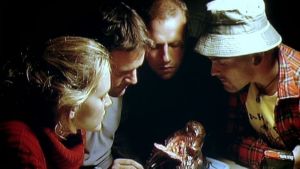
Inspecting the second most expensive thing in the movie.

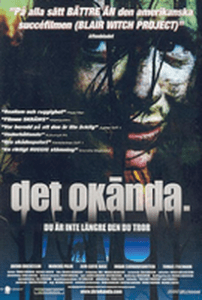
The first thing that is going to be assumed is that The Unknown was inspired by The Blair Witch Project, released the year before. I don’t think that’s actually the case, but the feel is definitely similar – similar enough that it’s even name-checked on the poster above. Though not a found footage film, the entire movie is shot handheld. The characters all use the actors’ first names. Some, but certainly not all, of the dialog feels improvised. And the budget is super low – apparently around $200,000 in US dollars.

That handheld camerawork helps cover that up immeasurably, like the fact that they could only afford the one bizarre carcass (of which we never get a truly good look). There is one particularly unsettling scene where Marcus stumbles upon some hideous Lovecraftian creature and all we can see are a couple of visceral tendrils twitching in the brush while the actors react.

I find the paranoid bickering as the movie progresses as tiresome as I did in Blair Witch, but as the saying goes, talk is cheap – action costs money. The Unknown is probably about 15 minutes too long, but it is a very good piece of extremely low-budget filmmaking, a good example of what some ingenuity and a lot of talent can pull off without access to megabucks.
It’s also another reason why I won’t go camping.


T: Taste the Blood of Dracula (1970)

Home ♠ Letterboxd

Okay, back to my comfort zone for tonight, with a Hammer film. Now, you could argue that I was just there a couple of letters ago, with Quatermass and the Pit, but I would have to answer that was not really a Hammer flick because Michael Ripper wasn’t in it.

There’s also a little bit of resonance here because a year ago, I reviewed Trog for the letter T. It was the first time I’d seen it since 1970, when I saw it on a double bill with a theater full of sugar-blitzed fellow teeny-boppers who would scream at the slightest onscreen provocation. The second movie on that double bill? Taste the Blood of Dracula. Also unseen by me in the intervening (choke) 47 years. I remembered some of it, but not all.

For one thing, I forgot Roy Kinnear is in it – then again, in 1970, I had not the foggiest idea who he was. I don’t think I even saw Help! until ’72 or so. Anyway, Kinnear is a traveling salesman named Weller, who has the unfortunate luck of showing a snowglobe he got in Karlsburg to some superstitious fellow travelers in a coach. He gets bounced out of the coach and wanders lost in the woods until he happens on the end of Dracula Has Risen from the Grave, Christopher Lee impaled on the cross. He watches the dead Count resolve to dust – even his blood – and thriftily picks it up for later.

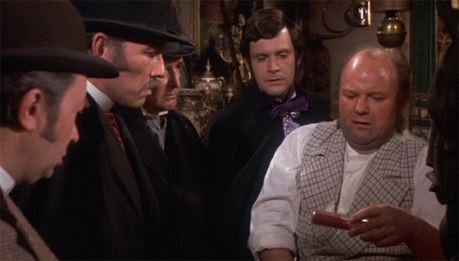
After the credits we are introduced to disagreeable toff William Hargood (Geoffrey Keen) who we know we’re going to like because he calls his daughter a harlot before leaving to spend his Sunday evening as he does every month, doing charity work. His coach picks up his compatriots, Paxton (Peter Sallis) and Secker (John Carson), Since this is a Hammer film, we already know that all toffs are actually perverts and hypocrites, and sure enough, that soup kitchen is a front for a lavish bordello.

The three men have formed a circle dedicated to experiencing the extremes of pleasures, and evenings of snake-charming doxies and champagne laced with laudanum are losing their allure. The possibility of finding something beyond that is provided by the dissolute Lord Courtley (Ralph Bates in a stunning purple ruffled shirt), disowned by his family for practicing black magic in the family chapel.

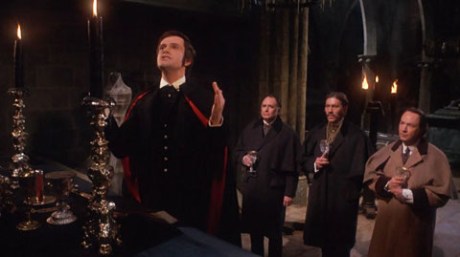
Courtley convinces the men to buy Dracula’s effects – cape, clasp, ring and powdered blood – from Weller to perform a rite in the disgraced chapel to “extend their experiences…  to infinity.” A few drops of Courtley’s blood results in goblets filled with bubbling plasma. Only Courtley has the cojones to actually drink it, and the results are apparently far more painful than he expected. The three toffs, panicking, beat him to death and flee. A few hours later, though, Christopher Lee reincarnates in Bates’ body, and he’s really pissed off that the toffs killed his servant.

Also, someone is shining a light in his eyes.

Lee’s dislike of the character is pretty legendary by this time, and it’s telling that Dracula doesn’t even show up until halfway through the movie, and then is only a fleeting presence through much of it (Warner wouldn’t distribute it in America without Lee’s marquee value). The Count gets his vengeance on the three killers through their children – Hargood’s put-upon daughter Alice (Linda Hayden), Paxton’s daughter Lucy (Isla Blair), and Secker’s son Jeremy (Martin Jarvis). They do most of the dirty work until the final showdown with Paxton’s son, Paul (Anthony Higgins), who is – economical story! – Alice’s true love (and whom the hateful Hargood despised).

Couching this entry in the Hammer Dracula franchise as a revenge drama does add a bit of distinguishing flavor, even if the whole enterprise feels like the back-up story in a comic book. The actual mechanics of vampirism get a bit confused (One bites turns Lucy into a vampire, but a second, really serious bite from the Count kills her permanently). Still no Peter Cushing, but the world-traveling Secker is presented as having some knowledge of the darker corners of existence, with a handy library to match.

Lee as ever is the most magnetic presence in the room, and is actually allowed to be charming for brief flashes. Director Peter Sasdy was always more in tune with the more perverse elements of the Hammer oeuvre, and is certainly the right choice for this venture – I’m quite surprised at how much skin is on display in the bordello scenes. It’s likely I saw a trimmed version in 1970 to play with the GP-rated Trog. I also have to say that after three ass-kicking and unusual methods to off the Count in Lee’s three previous outings, the method employed in Taste seems rather mundane (and cash-strapped).

“Cor Blimey! A corpus!”

Oh, and Michael Ripper? He’s the clueless cop investigating the murders. But you expected that, didn’t you?

Buy Taste the Blood of Dracula on Amazon


S: The Screen at Kamchanod (2007)

Home ♠ Letterboxd

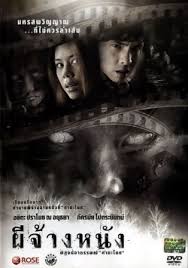
Throwing out a wider net for this Hubrisween, reaching out past my usual comfort zones of American and British horror, I found some lovely gems and, predictably, some mediocrity. At least I have to say in the case of the latter they were at least trying, and with The Screen at Kamchanod, succeeding enough that I wish the filmmakers had the resources to reach just a little further.

Then again, we have to realize my opinion can be regarded as more than a little suspect. I’m a fat white nerd in Texas sitting in judgement of a movie made in Thailand.

But let’s talk about that movie for a while.

First, as is mandatory, we are assured that this is based on a true story. Twenty years before, in the forest of Kamchanod, an outdoor cinema company was hired to screen a movie. At first, there was no one at the screening but the projectionists. Then, a group of figures suddenly appeared, staring at the screen. The movie ended, and these figures vanished into thin air, leaving behind a couple of very frightened projectionists.

(Outdoor movies are a going thing in Thailand; also the Kamchanod forest is on a small island cut off by waterways, and is the scene of many famous Thai ghost stories)

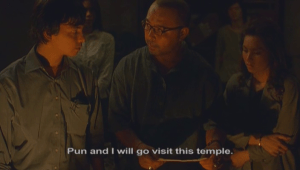
The young Dr. Yut (Achita Pramoj Na Ayudhya) is fascinated by this story, and along with the journalists Ji (Ongart Cheamcharoenpornkul) and Pun (Pimonwan Honnthongkum) is avidly researching it with an eye toward recreating the event, proving or disproving it. Dragged along

Don’t do it, Ji.

for the ride are Yut’s girlfriend Aon (Pakkaramai Potranan) and dissolute street kid Roj (Namo Tongkumnerd). Roj is the errand boy for the document restoration specialist Yut employs, and the doctor keeps him around mainly because the kid knows how to pick locks, which is handy when you’re doing Scooby-Doo ghost investigations (Shaggy does look like he’s picked a lock or two in his time).

Of the two original projectionists, one is a basket case in a hospital ward, an amulet to ward off ghosts bandaged in his eternally clutched fist. He can answer no questions, but gets violent if you try to remove the amulet. The investigation leads to an abandoned cinema where both men worked, which is also where the other projectionist died – reportedly killed by ghosts when he tried to burn the film that was shown at Kamchanod. Yut actually finds the film (which mysteriously resisted burning) and has the brilliant idea that they should watch it immediately.

This is a bad idea. But you knew that, right?

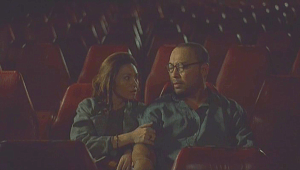
This is one of the most effective scenes in Screen, as our five investigators sit in an empty auditorium, watching the film as things begin to make themselves known in the darkness around them. Watching this in a theater was probably an unnerving experience. William Castle would have had a field day with it.

Everybody wakes up the next day with no real memory of how they left the theater, and things literally start to go to hell from there. Ghostly figures begin appearing to each, and they just get freakier as they approach the anniversary of the screening. Aon makes the observation that they are seeing fewer and fewer real people and more and more ghosts, and indeed, every time we see them travelling, the roads are absolutely empty.

The onslaught of the paranormal brings out the darkness in each of their characters, and this is just one of the ways Screen screws with the viewer: our sympathies are built on foundations of sand, and we eventually discover terrible things about them. Clues that puzzled at the very beginning bear awful fruit, and Yut’s obsession with recreating the screening, at the same site on the same day with the same film, will prove to be destructive indeed.

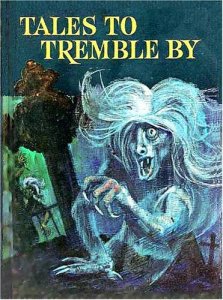
Specifically, this book.

The Screen at Kamchanod tells its story creatively, and its main drawback is that if you have seen any Asian movie about hauntings, you’ve seen most of the shocks unveiled here in one way or another. That doesn’t make them any less unsettling in presentation, and there are times the movie is visually stunning; this is the point at which my cultural shortcomings come into play. How much of this was fresh to the Thai audience, and how much played like the proverbial spring-loaded cat in American horror movies? The effect to me is that the movie plays like a supernatural mystery at both ends while the middle is interrupted by an anthology of spooky stories like the ones I devoured as a kid. And that’s okay. I loved those books.

Here’s a trailer with poor subtitles:

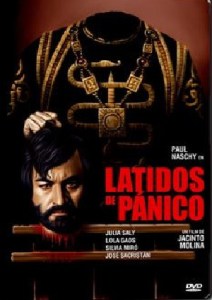
P: Panic Beats (1983)

Home ♠ Letterboxd

No, no, no, I just TOLD you it wasn’t THAT Alaric de Marnac!

Well, here it is. The third of four Paul Naschy movies I managed to schedule this year. The last two, in case you’re joining us late, were Exorcismo and The Valdemar Legacy/La Herencia Valdemar. It was my intent to spread my nets wider for movies this year, and this was the unintended result, aided by the fact that I hadn’t watched many of his movies, I’m sure.

Anyway, let’s just get this out of the way: SPOILER ALERTS FOR A 35 YEAR-OLD MOVIE. I’ll try not to give everything away, but then, up to a point, Panic Beats is pretty predictable. (Also, if you’re a Mondo Macabro fan, their disc-opening promo has already shown you most of the money shots)

We start with that Paul Naschy standard, an opening scene with murder and a naked woman. She’s running bloody through some woods, pursued by a mounted man in a full suit of armor. This is the infamous Alaric de Marnac, last seen in Horror Rises From the Tomb, tracking down and killing his unfaithful wife. Okay, so it’s not really that Alaric de Marnac, but it’s still Paul Naschy.

Yep, that’s Paris, all right.

After credits, cut to present day Paris, where Paul Marnac (still Naschy) is told he has to take his rich wife Genevieve (Julia Saly) away from the hectic life of a Paris socialite, or her heart condition will kill her. Marnac will take her to his remote ancestral home to recuperate, along the way running into bandits (so we’re still having Horror Rises From the Tomb flashbacks), the fright of which nearly kills Genevieve on the spot.

At the house she meets Mabile (Lola Gaos), the housekeeper who has been there forever, and her young thug niece Julie (Frances Ondivela), whom Mabile is trying to reform. Mabile is the receptacle of all the folklore associated with the Marnac family, especially the guy who opened the movie and whose sardonic portrait graces the wall: Good old Alaric, who in this version was not beheaded, but did turn to Satanism and got burned down with his castle. This house was built on its ashes. Supposedly Alaric comes back every hundred years or so to clean house again. This tale gives Julie nightmares because we really needed something interesting to happen at this point.

Slight digression: I’m still not sure if it was wise or not for the movie to name-check Rebecca.

Genevieve slowly regains her strength over the next month. Julie rather sadistically tells her the story of Alaric, and then things go downhill again. Nightmares, snakes and figures in armor appearing mysteriously in the night. Dinner plates covered with blood and eyeballs. Stuff like that.

Now, it’s going to be obvious to anyone that it’s all a plot to literally scare Genevieve to death. The only question is who, and since there are only two possible suspects, the mystery is not all that engaging. Remember the fright shows with a similar intent in The Tingler? Those were studied models of speed and efficiency compared to the ones in Panic Beats. It is tempting to brand it Milk That Scene: The Movie. I did a lot of time-remaining checking.

Then Genevieve’s heart finally cashes in, the mystery, such as it is, is solved… and there’s still a half hour of movie?!?

At this point Panic Beats  actually managed to engage my interests, as plots and counter-plots emerge, more people have to be killed, and a mysterious figure from Julie’s past emerges, though we’re not allowed to see his face. It does get complicated to a point where we’re not really sure what is real and what is not, and that is generally a type of movie I enjoy.

I was once told that you had to endure the first hour and fifteen minutes of Evilspeak, the Clint Howard shower scenes and puppy killing, just to get to the cool ending. I guess the same criteria holds for Panic Beats, except that first hour wasn’t all that terrible. The best part is Lola Gaos as the housekeeper, really. She can really turn on the scary when she needs to.

Hm. I see Amazon has one DVD available for seventy bucks. Here… Happy Hubrisween!


N: Nightwish (1989)

Home ♠ Letterboxd

If a lifetime of watching horror movies teaches you anything, it’s that if a movie opens with a sequence that seems like a fully-contained and realized horror movie in itself, it is either going to be a) a dream, or b) somebody else making a movie with an impossibly complex series of continuing shots. Yes, I am still bitter about Frankenstein 1970.

In the case of Nightwish, it is the former, as a debutante leaves some sort of prom night party and finds first a single shoe, then a bloody sock, then a severed hand, then some ghoul eating a corpse. A chase scene ensues, ending with her being cornered outside a locked trailer and screaming.

Let’s get our exploitation out of the way right off the… top…

But, as mentioned, this is all the dream of Donna (Elizabeth Kaitan), who wakes up inside an isolation tank. This is all part of the graduate program under the slightly sinister Professor No Name (Jack Starrett), who is conducting experiments in “guided dreaming”, with the intent of his students experiencing their death in a dream to toughen them up for what they have to face. The trouble is, every one of them has awakened before that moment.

But never mind that, let’s have some credits and then get on with our movie, as the students drive toward their first field exercise. We have Donna, Kim (Alisha Das), Jack (Clayton Rohner) and Kim’s rather disagreeable boyfriend Dean (Brian Thompson). They’re headed through the desert to a mining magnate’s abandoned home, perched atop an equally abandoned mine in an area known for earthquakes, mutants, and UFOs. Already at the house with the Professor is Bill (Artur Cybulski), the last of our graduate troupe.

The house is also known to be haunted, and Satanists were frequent visitors. After an attempt at a high-tech seance à la The Legend of Hell House involving an ectoplasmic tentacle, things generally go to hell, as we find out the Professor is a genuinely mad scientist with a brutish and sadistic assistant (Robert Tessier, of course) intent on raising a demon from hell. On the other hand, all the weirdness seems to be alien invaders needing human bodies to host their larva. On the other other hand, all these may be hallucinations created by the tentacle-wielding “Entity” to increase paranoia and dissension among the students. On the other³ hand…

Oh, hell, SPOILER ALERT FOR A 30 YEAR OLD MOVIE. This is, as you figured out three minutes after the opening credits, Kim’s guided dream, and she actually manages to make it to her own death. In the isolation tank lab, everybody congratulates her on her fine work, but Kim isn’t sure she’s actually awakened. In a nicely Bava-esque closer, it seems that she hasn’t, and may not.

As a movie that tries very hard to be a nightmare put to film, Nightwish should be a lot more interesting. It tries to hit every horror setup you might be able to think of, from Texas Chainsaw Massacre torture dungeons to ghosts to Alien body horror, and yet somehow makes so much of that tedious. There are a lot of other mixmaster movies that don’t even achieve this level of competence – Spookies comes to mind – but more than once I had to hit the fast forward because okay, okay, I get it, move on. It’s to the movie’s credit that I didn’t do it more than twice.

The actors are a game lot, but the script does them no favors. Brian Thompson’s career was just starting to take off, and he manages to take the one note he’s given and turn it into at least an interesting rock riff. Robert Tessier could do the Menacing Hulk role in his sleep. All the others have varied careers, and it’s worth noting that none of them are one-movie johnnies, which is the case in most of these forgotten flicks. KNB (Robert Kurtzman, Greg Nicotero and Howard Berger, for all you non-Fango readers) handle the special effects, but don’t really get to strut their stuff until the last half-hour.

Information about the making of Nightwish is very scarce. We know that it was shot in 1988 but not released until 1990 – both Starrett and Tessier had passed away by then – and then it was direct to video. These were the dark days of VHS, which means every copy out there – I’ve yet to see any mention of a letterboxed version – is open matte to 4:3, so the boom mike should have been given an onscreen credit. That’s not the fault of the director or the boom operator – that’s the fault of people allergic to black bars at the top and bottom of the screen. They are the real monsters.

Writer/director Bruce R. Cook worked his way up the ladder from camera & electrical to the director’s chair on two flicks – this one and The Census Taker. Nightwish can’t be described as a gem in the rough, it’s more like a semi-precious stone. Worth a look, if you like semi-precious stones.

It’s okay. I wear turquoise.

Hey… it’s available in October!

M: The Mummy (2017)

Home ♠ Letterboxd

Please note I insist on using the poster without Cruise.

Good grief, where to begin?

I guess the beginning will suffice. The beginning’s okay.

In the early 12th century, Templars bury one of their own, with a mysterious jewel, in a hidden tomb. The tomb is discovered in modern times, and a odd panel of hieroglyphics tells the tale of an ancient Egyptian princess, Ahmanet (Sofia Boutella), destined to inherit her kingdom – until her father has a son late in life. Ahmanet strikes a deal with the god Set, murders her father and half-brother, and is preparing to complete the rite which will incarnate Set into a living man – but the rite is interrupted and Ahmanet is mummified alive and interred in yet another hidden crypt.

All this is fine, if rather reminiscent of the opening of the 1999 Mummy. Nice to see a female version of the monster. I like Sofia Boutella.

Get out of my genre, Tom.

Back to present day, however, in Iraq, where ISIL is tearing down an ancient temple. Two Army scouts are watching from a nearby hill, One pulls down his scarf, revealing he is Tom Cruise, and everything goes to shit. Because at that point, it becomes a Tom Cruise movie.

I don’t hate Tom Cruise, as many people seem to – I just don’t watch his movies, mostly. I will admit enjoying the last two Mission Impossible movies, and Eyes Wide Shut, but he’s just not a factor that draws me to a movie. The story will continue to illustrate to me why this is so. Cruise is Nick Morton, who stole a map with some coordinates from a one-night stand with Jenny (Annabelle Wallis). He figures there’s buried treasure, and he and his partner, Chris (Jake Johnson) will be rich.

This is a bad plan, and Chris winds up calling in an airstrike just to save both their asses. The strike uncovers a hidden tomb, and re-enter Jenny, who holds an unreasonable amount of clout with the military. She gets a limited amount of time to examine the tomb, and against her better judgement is assigned Nick and Chris to assist.

Jenny represents a global organization called Prodigium. Prodigium means a number of things, among them portents, or wonders, or monsters. In this case, it seems to mean Bad Ideas ‘R’ Us as what they find is Ahmanet’s hidden prison tomb. Jenny correctly interprets all the signs and machinery as meaning DO NOT DISTURB, GO AWAY, THIS MEANS YOU, DON’T DO IT and she is still determined to bring this piece of erased history to light.

The cargo plane carrying our supposed heroes and the sarcophagus run into problems, mainly Chris getting possessed and killed and a flock of kamikaze crows causing the plane to crash (this movie can’t even get me involved enough to do the murder of crows joke). Nick manages to get Jenny into a parachute and out, but in the crash the sarcophagus is lost, and everybody is killed, including Nick. Yay!

Here’s an exciting scene from the movie we SHOULD have gotten.

Except that Nick wakes up later in the morgue. Ahmanet is loose, sucking out souls to regain her power. Nick is under some sort of curse and cannot die, or so he is told by his dead buddy Chris, who keeps following him around and trying to guide him to Ahmanet, who wants that jewel found in the Templar tomb to complete her magic dagger, and Nick’s deathless body to incarnate Set into, so she can rule the world in darkness, which is what your modern-day movie mummies do. None of that profaning-the temple or reincarnated love claptrap. That’s your grandmother’s Mummy movie.

This is still an okay setup for a movie. The major problem with the execution is that at this point the movie becomes entirely about Nick Morton, with the title character essentially becoming what seems to be an afterthought that annoyed the filmmakers. Ahmanet is captured in the second act and spends a remarkable amount of time restrained in a chamber while Prodigium embalms her with mercury (which seems to be the equivalent of silver in the Dark Universe), so that Dr. Jekyll can dissect her.

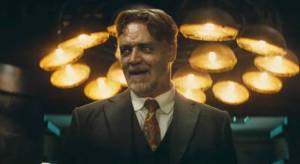
Oh, yes, the head of Prodigium is none other than Dr. Henry Jekyll (Russell Crowe). His plan to dissect Ahmanet is in keeping with the organization’s credo of “The Worst Plan Possible”, as is his practice of injecting himself with the necessary drugs to prevent him from turning into Mr. Hyde (with, of course, an extreeeeeeeeme six-chambered hypo) at the very last second.

But I don’t really mind that – Russell Crowe is one of the very few bright spots in this movie. He’s the only one who seems to know what kind of movie he’s making – one that is destined to be labeled a Superfund site – and has decided “Fuck it!” and goes for it.

Reportedly Cruise used his influence during shooting and editing to emphasize his character, but whatever actually happened, the result is disastrous. Annabelle Wallis’s main function is to convince us that Nick Morton is actually a good person, and Cruise doesn’t cooperate. His usual wisecracking manchild persona just doesn’t fit here, and concentrating on that to the detriment of the intended story basically mummifies it alive. For a movie called The Mummy, there is damned little Mummy and a whole lot of some sort of Wandering Jew character that has no prior instance in the pop mythology supposedly being employed. How the hell do you hire Sofia Boutella and then not use her?

Did you know that the dictionary has a new illustration for “Hubris”?

This is rather famously Universal’s “No! Really! This time for sure!” launch of their Dark Universe titles, something that had been attempted before with 2010’s The Wolfman and 2014’s Dracula Untold, both of which apparently no longer exist, as far as Universal is concerned. The sad part is, they could have probably capitalized on the 1999 Mummy and even its sequels, which were at least entertaining, not an endurance contest like this one. As it is, it merely makes us miss that movie, and constantly ripping off An American Werewolf in London with the undead Chris doesn’t help matters, either.

As I did with I, Frankenstein, I’m going to quote a tweet from film writer A. M. Novak, who makes this very excellent point:

It has been proven over and over again that the rich heritage of Universal’s 1930s mastery of the horror genre is in very wrong hands. Supposedly The Bride is Frankenstein was next, though at the very beginning of October, Universal announced they were pulling the plug on it. Horror fans breathed a sigh of relief, since judging from The Mummy, that one would have wound up being about The Incredible Shrinking Man.

Buy The Mummy on Amazon. See if I care.


L: The Living Head (1963)

Home ♠ Letterboxd

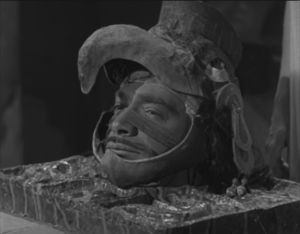
There was a golden age of living severed heads in horror movies for about six years, from 1957’s The Man Without a Body, then 1958’s The Thing that Couldn’t Die (remade as Horror Rises from the Tomb in ’73) up through Germany’s The Head and the amazingly sleazy The Brain That Wouldn’t Die. I’m sure there are more (it’s the internet, I’ll get told), but we’re here to talk about what may have been the last one for awhile, 1963’s La Cabeza Viviente. The Living Head, for all you gringos.

We start with those fun-loving Aztecs, as their high priest Xiu (Guillermo Kramer) sacrifices a guy for causing the death of their mightiest warrior, Acatl (Mauricio Garcés). In fact, all that’s left of Acatl is his head, in his ceremonial headdress. Xiu hands off the Ring of Death to the High Priestess (Ana Luisa Pellufo), and informs her that she and he will be hanging around Acatl’s tomb for eternity. Then he curses anybody who profanes the tomb, and gets sealed in.

This bling is getting out of hand

That Ring of Death is freaking huge, by the way, and crested with the fakest eyeball you have ever seen. It has to be that large for the blinking light bulb inside the eye.

So in the modern day, three scientists (Salvador Lozano, Antonio Raxel, and Mexican horror icon Germán Robles) discover the tomb and make with the profanin’. Acatl’s head and Xiu’s body, in their sarcophagi, are remarkably well-preserved; the high priestess, however, didn’t get a box and is merely standing against a wall. She disintegrates, leaving behind only the Ring of Death, which Muller (Robles) decides to give to his daughter Marta (also Peluffo, conveniently enough), as one does with priceless historical artifacts.

Oh, that’s your answer for everything.

Muller is also keeping all the damned artifacts in his house instead of the museum, including Xiu’s corpse, still clutching his obsidian dagger in a death grip. Marta’s boyfriend Roberto (Garcés again, I wonder if that’s going to be significant) notices some incredibly obvious footprints leading from Xiu’s sarcophagus, and is immediately pish-tushed by Muller.

It’s not too long before Xiu is wandering around and cutting out hearts to leave on Acatl’s altar, guided by the current possessor of the pulsing Ring of Death (Marta) until she refuses to kill her own father. Unfortunately, Roberto has found the Ring (thown out the window by a fearful Marta) and is possessed, but he too will not kill the people Xiu wants. It all looks pretty grim until Acatl points out that Marta and Roberto are played by the same actors as himself and the high priestess, which apparently shocks Xiu so much that Inspector Toledo (Abel Salazar, another horror icon) is able to shoot him to death. The end.

That all sounds pretty silly, but it has to be admitted that The Living Head  proceeds with a no-nonsense pace and rarely has a dull moment. It’s a typical Mummy death-to-the-tomb-raiders story, but the addition of those ancient Aztec blood rites gives it a visceral lift, and as I said, the pace is good – it really is a perfect example of how to do such stories, even if Muller keeping all this stuff in his home stretches the ol’ willing suspension far enough to use it to slice cheese. If nothing else, it’s fun to see Nostradamus the Vampire and The Brainiac being on the menaced side of the plot for a change. This is one of the better examples of Mexican horror cinema; not world-changing, but at least as competently made as its low-budget American brethren, and certainly as entertaining.

¡Prepárese para tener su sangre congelada por esta vista previa con marca de agua!