U: Uzumaki (2000)

Hubrisween 4Hubrisween Central  ♠  Letterboxd Page

uzumakiposterAnd here we are at the second of our double dips this Hubrisween season: thanks to a lack of movies beginning with the letter U, Checkpoint Telstar and myself are taking on the J-horror flick Uzumaki. If you got here first, don’t forget to hop over to his version, which is likely way more complete than mine will ever be.

Uzumaki stakes its claim to horror movie-ness with its initial image: a slow spiraling-up camera climb, its center a broken body with its brains splattered across a spiral floor pattern, surrounded by a spiral staircase, with various people staring down at the corpse.

As a translation of uzumaki means spiral, you can be pretty sure that these won’t be the last spirals you’ll see.

dark and greenOur protagonist will be Kirie (Eriko Hatsune), a schoolgirl who is soon going to be dealing with a mass of problems in her small town. Her childhood friend Suichi (Fhi Fan) is studying hard to get into a good Tokyo university, but his father (Ren Osughi) is experiencing a sort of downward spiral (ha!). Kirie discovers him videotaping a snail, oblivious to the world; Suichi tells her he has quit his job and is currently stealing anything with a spiral on on it, and sits his room for hours, staring at these artifacts.
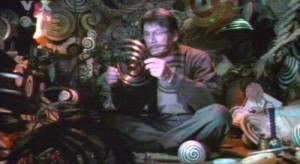
uzumaki_1Kirie’s father (Tarô Suwa) is a potter of some small reknown, and has been commissioned by the nutter to make a plate with spiral patterns for him. Suichi eventually throws out his spiral collection in hopes of shocking him back reality; it only results in his father’s bizarre suicide in a washing machine, transforming himself into a spiral.

uzumaki-frontThis would be enough to ruin a young girl’s life, but there’s more weirdness going on; the apparent suicide at the movie’s beginning, one of Kirie’s attention-obsessed classmates’ hair suddenly growing out in spirals, a boy who is seemingly transforming into a human snail. The cremation of Suichi’s father results in a massive spiral cloud of ash with one curly tendril dipping into a local pond (the pond where Kirie’s father gets the clay for his pottery, of course). Suichi’s mother descends into madness, so fearful of spirals that she slices off her fingertips with scissors because her fingerprints are too reminiscent of her husband’s geometric insanity – which is spreading throughout the town.

uzumaki-spiraleUzumaki is based on a highly successful horror manga series by writer/artist Ito Junji (who humorously makes an appearance on a wanted poster at the local police station). Spirals are usually used for humorous effect in Japanese comics, and Ito wanted to attempt to subvert that, making the symbols something to be dreaded instead of laughed at. The film, by Akihiro Higuchi under the nom de guerre Higuchinsky, was made before the series even ended, so this story has two differnet endings, depending on the medium. That’s probably a nice surprise for fans of the manga who come to the movie after reading it, but rest assured, neither version has a particularly happy ending.

uzumaki_5Despite having several horrific visuals, Uzumaki tends to be satisfied with simply being weird instead of actually frightening. There is an unsettling greenish tint to almost every scene, and there are at least two sequences that build impressive amounts of tension, but are never capitalized upon. Odd sections of the frame give themselves to digital spiralling effects, some obvious, some not – instead of building a sense of dread, it becomes more like looking for the hidden images of Mickey Mouse at Disneyworld while you’re waiting in line.

Higuchinsky’s actors are incredibly game, even in the most absurd moments, and add considerably to what impact the movie can claim. Folks coming to Uzumaki expecting the terror of something like Ringu are going to be disappointed, but if you are looking for something out of the ordinary, with a strangely Lovecraftian approach, Uzumaki can certainly fit that bill.

Buy Uzumaki on Amazon

Q: Quatermass 2 (1957)

Hubrisween 4Hubrisween Central  ♠  Letterboxd Page

quatermass_ii_quatermass_2-646929776-largeWhy, yes, I will be riding this Quatermass gravy train as long as I keep doing these A-Z challenges.

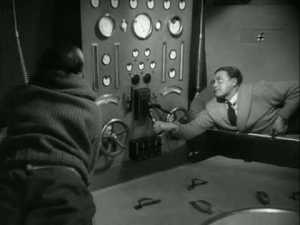
Last year we re-watched The Quatermass Xperiment, a superb thriller that was the prototype for a particular sub-genre of monster movies. And this year I find myself re-watching its sequel, once more adapted from a Nigel Kneale TV serial, and finding it both more and less than its progenitor.

Quatermass (Brian Donlevy), the American head of the British Rocket Group, has problems, and oddly, they aren’t because his last launch brought a monster back from outer space. His current model rocket has a nuclear engine, and it is so faulty that it can’t be safely launched, putting his whole Moon Base project in peril. Adding to this bad day is the near-accident that opens the movie, as a woman trying to get her injured and seemingly delirious boyfriend to a hospital, nearly runs him off the road. This boyfriend was burned by an apparent meteorite that broke open in his hands.

quatermass-ii-5Speaking of meteorites, the radar at the Group’s rocket base has been picking up strange swarms of small objects, except they’re moving too slowly to actually be meteorites – and they’re all falling at the same remote village where the man was injured. Quatermass takes a road trip there, ignoring various KEEP OUT signs, only to find a ruined village and… his Moon Base.

Much skullduggery and digging up details follows, as Quatermass eventually determines this facility – supposedly a top secret project developing “artificial food” – actually is a Moon Base of sorts – the pressure domes housing not astronauts, but the creatures traveling in the fake meteorites, which cannot exist in Earth’s atmosphere unless they invade and infect human beings. It’s a quiet invasion that’s been going on for several years, compromising even the higher reaches of government, and it’s up to Quatermass – and our old pal from the first movie, Inspector Lomax of Scotland Yard (John Longden, this time) to put a stop to it.

quatermassii1So the breadth of the story this time does not have the same lean, mean quality of Xperiment, and that is perfectly all right – that is what a sequel is supposed to be, and so rarely is – an expansion on the first movie, with new challenges for its heroes. The back-and-forth nature of the plot’s unfolding works against, it, though, and it’s going to take Quatermass three trips into the danger zone to find out what is going on. That’s likely more due to the compression of the original serial, which ran to six half-hour episodes, than any actual fault with the filmmakers.

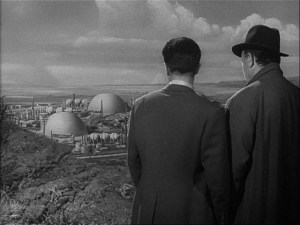
Nigel Kneale and director Val Guest share screenwriting credit here; Kneale had renegotiated his contract to have more power, but he couldn’t override Donlevy’s return as the title character. Kneale hated Donlevy’s brusque, barking version of Quatermass, and claimed his alcoholism ruined everything (Guest vigorously denied this). Guest trimmed down Kneale’s philosophizing and tried, once more, to produce a movie as close to cinema verite as possible, rendering the fantastic real. There is at least one cast member carried over from the TV version: the Shell refinery at Stanford-le-Hope, Essex, doubling for the ersatz moon base, a tremendous amount of production value, right there, providing the sort of sets that the fledgling Hammer Films would not have been able to afford.

quatermass-2-23Oh, yes, it’s a Hammer Film. The Quatermass Xperiment was such a financial success for them, they had optioned Quatermass II (note the fancier Roman numeral) before the first page of script had passed through a typewriter. Hammer had, in fact, tried to make another Quatermass movie in the meantime, only to be stymied by Kneale’s refusal to license his character; the result was 1956’s X the Unknown, which is actually a pretty effective horror movie, even if it is faux Quatermass. Their anxiety over continuing this fruitful line of production would be forgotten later in 1957 when they released another little movie, Curse of Frankenstein.

Quatermass 2 is generally regarded as the least of the Quatermass movies, but look what it’s up against! Xperiment and Quatermass and the Pit are both superior horror/science-fiction, and dismissing the middle child here is doing it a disservice. It is a darned good tale, and if you want to dig a little deeper, you can even say it is an allegory for corruption in high places, or government being suborned by corporations. It shouldn’t be passed over, because it is, at the end of the day, good entertainment, even if it does feel langorous in pace and yet, somehow at the same time, somewhat rushed.

Of course we yanks wouldn’t go to some movie with a sissy name like Quatermass! We need a more manly title!

You can try to buy Quatermass 2 on Amazon – good luck!

L: Lemora – A Child’s Tale of the Supernatural (1973)

Hubrisween 4Hubrisween Central  ♠  Letterboxd Page 

lemora-posterSo it’s 1972, and two recent graduates from UCLA, Richard Blackburn and Robert Fern, decide to make a feature film. Count Yorga, Vampire had been a hit recently, so they decide a vampire movie makes sense commercially – and then they proceed to make a fairly uncommercial movie.

It’s the Depression, and gangster Alvin Lee (William Whitton), on the run after gunning down his unfaithful wife and her lover, is drawn by mysterious gazing eyes to a house in the middle of nowhere, where he finds his shotgun is useless against the caped figure welcoming him. Then some guys in capes – and hats! – subdue him.

Meanwhile, his daughter Lila Lee (Cheryl “Rainbeaux” Smith in her first billed feature role) is trying to live down her unfortunate parentage at a small church, where she’s been a ward for three years. She has a large role in the services as “The Singin’ Angel”, and as the story progresses, we’ll see there’s not a small amount of sexual tension between herself and the Reverend (played by director Blackburn). Incidentally, Lila is only supposed to be 13 years old, here, though Smith is obviously not. Lila receives a letter from “Fellow Christian” Lemora that her father is on his deathbed, and is calling for her. So Lila does the Christian thing and goes to him, so she can forgive him.

lemoraShe leaves late at night and has to catch a bus seemingly in downtown Gomorrah. It’s a strange, dilapidated bus, the only one that goes to her destination, and it only runs at night. The exceptionally creepy driver (Hy Pyke) says he doesn’t make the run very often. The people there are strange, and too many of them have what is called “the Astaroth look”. Strange man beasts roam the woods, and eventually waylay the bus; Lila is only rescued by the intervention of those mysterious men in capes and hats.

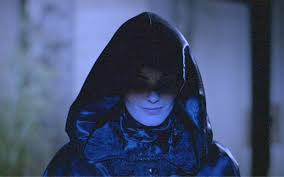
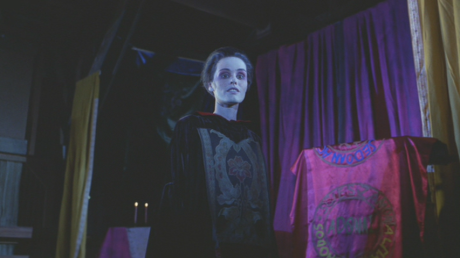
lemora9After a night of captivity in a small cottage, Lila escapes and runs into – finally – Lemora (Lesley Gilb), a striking, pale figure in black Victorian dress. Folks, We knew from that opening sequence that she was a vampire, so there’s not much of a spoiler there. She’s found something in Lila’s innocence that she must possess (and turn her into a vampire). After a lot of bizarre escapades playing with Lila’s unsophisticated, unworldly nature, she finally sees Lemora putting the bite on one of  the children that are constantly hanging around being creepy. Lila finally listens to what we have been shouting at the screen the whole time, and tries to run away, leading to a very lengthy – but good – chase sequence.

lemora_10Here’s what’s going on: Lemora’s bite apparently reveals a person’s true nature, or something like that. Some become the vampires roaming about in capes and hats, others become the man-beasts lurking in the woods. The vampires have been trying to exterminate the man-beasts, but as the story reaches its climax, the man-beasts are getting organized and retaliating, resulting in a final, internecine battle at what was supposed to be Lila’s initiation ceremony. Apparently the footage of this was not satisfactory, so Blackburn and Fern start playing with the timeline and finally end on a note of abstract ambiguity.

The initial reaction to Lemora was, um, not good, and the disappointed Blackburn and Fern sold it off and got on with their lives. A drastically-edited and far too dark print circulated on late night TV for ages, which is where I first (sort-of) saw it. There are reports it was better received in France, where they actually got the literary references.

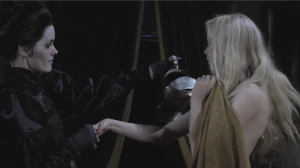
lemora-bathes-lila-2I don’t know if you got it from my terse description, but the last third of the movie (at least) is obviously Lovecraft’s “The Shadow Over Innsmouth” (that one honks it horn and flashes its brights when “the Astaroth look” crops up), except for the female protagonist and nightgown. This gets strengthened when Lemora tells Lila of the initiation ceremony, which is to be held in a church. “Baptist?” asks the girl. “Much more ancient than that,” answers the amused Lemora. Also name-checked is Machen’s “The White People” and a large dash of LeFanu, though the filmmakers eschew the more overt lesbianism of, say The Vampire Lovers for a more… well, its hard to say innocent vibe, but certainly not as salacious.

Like another unjustly ignored horror movie of the time, Messiah of Evil (which had its own production problems impacting the ending), Lemora often feels like a European movie (Blackburn says that he wished he had made it in Spanish, which makes sense on an artistic level, but then we’d be talking about this movie as a blueprint for Dagon). There is very strong art direction by Sterling Franck and exceptional costume work from Rosanna Norton. There are some odd filmmaking bobbles that can be laid to it being Blackburn’s first directorial gig (there is an over-reliance on freeze-frames, especially when they start improvising with the storyline in the final scenes), but this is overall a handsome movie, especially for its budget (and it’s a period piece, and it’s shot on 35mm!). I also really admire the spots where Blackburn thriftily realized he could save money on sync sound and found ways to have long dialogue scenes with only Smith’s silent reactions.

Something like this is going to live or die on its actors, and Blackburn hit the jackpot. Cheryl Smith’s quiet, vulnerable naturalism actually helps sell all the outrageous stuff happening around her, and Lesley Gilb is quite striking and imposing as Lemora: never a wasted motion, often a impenetrable island of stillness in a scene. I swear she goes minutes without blinking. She really does deserve to be included in the ranks of great cinematic vampires.

vlcsnap-2016-10-02-01h13m15s377Even if it does fall apart narratively in its final minutes, Lemora: A Child’s Tale of the Supernatural is that wonder, an actual undiscovered gem from the early 70s. Well, not undiscovered, Synapse’s Don May knew about it and put out a nice restored DVD for its 30th anniversary. But I only knew of it from Michael Weldon’s first Psychotronic Encyclopedia of Film so I could catch that dark, maimed version at 3:30 in the morning on channel 39. That pretty much counts as “undiscovered” these days.


Buy Lemora on Amazon. But hurry!

K: Kwaidan (1964)

Hubrisween 4Hubrisween Central  ♠  Letterboxd Page

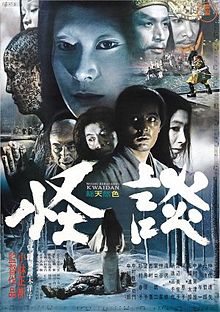
220px-KwaidanposterjapaneseKwaidan is an archaic version of the Japanese word Kaidan which, in its simplest translation, can be understood to mean “ghost stories”, but its meaning is actually more subtly complex than that: and that is a fair metaphor for director Masaki Kobayashi’s film of the same name. The title also derives from Lafcadio Hearne’s 1904 book of folklore, Kwaidan: Stories and Studies of Strange Things, though the four stories translated to cinema are actually from two of his collections.

Each story is presented with no connecting arc, with perhaps the only concession to their prose origins the occasional bit of voice narration (the deeper translation of kaidan alludes to the stories’ origins as oral tradition, anyway).

kwaidan 11In The Black Hair, an impoverished samurai leaves his faithful, patient wife to marry a noblewoman and rise to a profitable post; that marriage is an unhappy one, and the samurai torments himself with memories of the woman he treated so badly. Years later, he returns to his old house, to find it in poor repair, except for the rooms where his wife works her loom. She is radiantly happy to welcome him back into her life. This would be a happy ending, except the samurai wakes up the next morning to discover he has been sleeping next to the rotting corpse of his wife, who died of a broken heart years before.

kwaidan-08c-webThis is followed by The Woman of the Snow, which begins with two woodcutters caught in a blizzard. They seek what shelter they can in the shed of a boatman, but that night a ghost enters the shed, and her breath causes the older woodcutter to immediately freeze to death in his sleep. She spares the younger man, on the promise that he never tell anyone what he has seen, ever. A year later, the surviving woodcutter meets a young woman travelling on the road, alone, and they fall in love. Yes, Tales from the Darkside: The Movie fans, you should be recognizing this tale, though the ending here is much more bittersweet, though no less tragic.

kwaidan-hoichiAfter an Intermission, the movie resumes with probably its most famous sequence, Hoichi the Earless, which is the tale of a young blind biwa player living in a temple. His performance of the song cycle telling of a sea battle that was the death of an entire clan is so good, he is called upon by the spirits of that clan to perform it repeatedly at a nearby graveyard. Being blind, Hoichi thinks he is performing in a grand castle; these nocturnal performances are slowly killing him, and to save his life, the monks paint prayer sutras all over his body to protect him. They neglect, however, to paint them on his ears for some reason, and, well, the title itself is a massive spoiler.

kwaidanThe final story, In a Cup of Tea, was excised for American audiences, to bring the movie under three hours, I suppose. It’s a fragment, an unfinished story in Hearn’s collection, regarding a samurai who keeps seeing a man’s face in a cup of tea, and when he drinks it, finds himself bedevilled by the ghostly man and his equally ghostly retainers. Kobayashi supplies an ending, which is an appropriate button for the movie.

What none of these synopses will prepare you for is the unearthly, fabulous beauty of Kwaidan. This movie was made for blu-ray, as it is an unending buffet of visual delights. The skies of Woman of the Snow seems pulled from a painter’s easels, full of eyes watching the plight of the villagers beneath. Hoichi begins with the song of the sea battle, a massive painting of the event intercut with the actual battle, like figures from the painting come to life. It is a movie unto itself, and it is breathtakingly gorgeous.

Kwaidan-1964Coming off the success of Harakiri, Kobayashi made the most expensive movie in Japanese history, supplanting The Seven Samurai. 350 million Yen is the figure given; the sound stages are massive, and the control this gives Kobayashi over the picture is not wasted. Roger Ebert called it “one of the most beautiful films I have ever seen,” and there is no way I could possibly improve over that simple statement.

eye in the skyAmazing, beautiful, surprisingly humanistic. Revisiting this movie years after my first viewing was one of the smartest things I have done this year.

Buy Kwaidan on Amazon

I: I Married a Witch (1942)

Hubrisween 4Hubrisween Central  ♠  Letterboxd Page

I_Married_a_Witch_posterYou know, this is sort of the perfect Halloween movie, if you’re not into hardcore scary stuff. Its touch is light, its outlook humorous, it’s well-made and imaginative; it is the very definition of a frothy confection.

So why does it leave me so cold?

There’s a good old-fashioned Puritan witch-burning at the beginning (though yes, I know, the Puritans never burned a witch, they hanged them), interrupted for an intermission so a hawker can sell bags of popcorn with an anti-witch charm in each bag. That’s funny stuff right there. Nathaniel Wooley (Frederic March) reveals that the condemned witch Jennifer (Veronica Lake, eventually) has cursed him and his descendants to rotten marriages for eternity. Thereafter, we have a montage of Wooley’s descendants and the various forms of marital hell, including one who enlists in the Civil War to avoid his vase-throwing wife (“Running off to war – like a coward!”). This is also funny stuff.

I’m still not laughing. This mystifies me.

tumblr_mv0bgajJP71sodq76o1_1280The oak tree planted over the ashes of Jennifer and her sorcerer father Daniel (Cecil Kellaway – again, eventually) is struck by lightning, releasing their spirits to commit mischief once again, though only as two plumes of smoke, for the moment. Daniel absently criticizes Jennifer’s curse, stating, “Marrying the wrong woman is painful – but more painful is falling in love with the right woman he cannot have.” Jennifer then proceeds to incarnate herself again and make sure the current Wooley (March again) falls in love with her. That shouldn’t be too hard, given the implication in the opening scenes that Lake is naked under that mink coat she keeps losing, and Wooley’s current fiancee is harridan-in-training Estelle (Susan Hayward, magnificent as usual). Wooley is a leading gubernatorial candidate, and has lots and lots to lose.

imarriedawitch252852529The plot complicates from there, with spells flying everywhere, Jennifer accidentally drinking the love potion meant for Wooley, and her sudden love for the object of her curse drawing her into conflict with her father, who is still rather peeved about that whole execution thing.

I think my mood was all wrong the night I watched this. It’s well-made, it’s fun. I just couldn’t get into it.

Maybe, like doomed individuals in more serious movies, I know too much. Frederic March and Veronica Lake hated each other, though it never really shows onscreen. Some place the blame for this squarely in March’s court, but Lake arrived on set with her own set of baggage – Joel McCrea was up for the lead, but turned it down because he didn’t want to work with her again after Sullivan’s Travels.

Come on, this is as Halloween as it gets.

Come on, this is as Halloween as it gets.

Maybe the movie is as cursed as it hero – producer Preston Sturges (whose touch is still evident, I feel) quit because of “creative differences” with director Rene Clair. Co-star Robert Benchley, who plays Wooley’s best friend Dudley (who also seems to be in charge of finishing his distracted friend’s drinks) would be dead in three years of cirrhosis of the liver. Lake’s marquee value wouldn’t last much longer than that.

But no, I don’t think it’s any of that. I think the circumstances of life – both my own and the growing garbage fire that is the world at large as I write this in mid-July – I think that is why I couldn’t slip into the comforting, charming world of I Married a Witch. May your experience with it be better.

Buy I Married a Witch on Amazon

D: Daybreakers (2009)

Hubrisween 4Hubrisween Central  ♠  Letterboxd Page

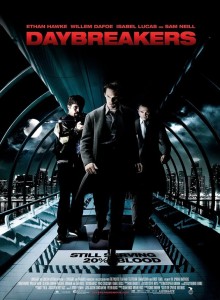
daybreakersBack in the murky depths of two years ago, I finally watched the Spierig Brothers’ first feature, Undead, finding it pretty unique and satisfying among zombie apocalypse movies. It had taken me ten years to get to it (despite very good word of mouth) because I was sick of zombie movies when it came out, and didn’t watch any for ten years, not even the good ones. Once I watched Undead, I wondered, where the hell have these guys been since? only to find out they had made and released their second feature, another movie I had given a pass: Daybreakers, because it was a vampire movie. And before I was sick of zombie movies, I was sick of vampire movies.

Suddenly I was interested in watching Daybreakers.

The movie takes place ten years in the future; a plague has swept over the world, resulting in widespread vampirism, much like I Am Legend, except the vampires remain quite intelligent and the world adapts to the new monstrous normal. Life takes place at night, cities have a system of “Subwalk” tunnels so vampires can get around during the day. As the movie opens, we find that only 5% of the world population is still human, and that’s a problem when those humans are the only food source.

ethan vampTed Dalton (Ethan Hawke) is a Chief Hematologist for a global pharmaceutical company run by Sam O’Neill. Dalton, himself a very reluctant vampire, is desperately searching for a blood substitute – officially, the world will run out of blood by the end of the month. Unofficially, Dalton sympathizes with the humans, and a chance encounter puts him in league with a group of other rebellious vampires and free humans still seeking a cure, headed by Audrey (Australian star Claudia Karvan) and the enigmatic Elvis (Willem Dafoe), a vampire who has accidentally managed to cure himself.

daybreakers subsiderAdditional pressure is brought to bear by another unfortunate side-effect of the vampire disease; the vamps who are deprived of human blood begin to regress and mutate into savage, bat-like creatures called Subsiders, and their numbers are increasing as the blood supply dwindles. Dalton has to find a way to duplicate the extraordinary event that caused Elvis’ reversion to human, and then somehow convince the vampires to stop being immortal and rejoin the ranks of humanity.

Daybreakers-farmThe world-building in Daybreakers is quite extraordinary and thoughtful; Sam O’Neill says the reason he decided to do the movie was one tiny detail, of business-suited vampires lined up at a Starbucks-style kiosk to get their double shot of blood in an espresso. This sort of thing runs throughout, and is probably the major reason Daybreakers succeeds with me where another post-vampiric apocalypse movie, Stakeland, failed for me – the movie takes me somewhere else, somewhere new for two hours, instead of to a Mad Max movie with monsters. Too, the vampires there were savage beasts, and the vampires in Daybreakers are unquestionably Us, just with yellow contact lenses and longer canines. There is a layer of social commentary here that is also present in the best horror movies (Dawn of the Dead is the one that always springs to mind), and I have absolutely no problem adding Daybreakers to that short list.

daybreakerstrioWatching the making-of docs on the blu-ray presents a story that almost as good, as the Spierig Brothers take on the five-year process of scoring a budget for such an ambitious movie, and then having their 55 day shooting schedule suddenly shortened to 40 by budget cuts. That they still managed to deliver such an impressive movie in that time is a credit to their ingenuity and mad skills – they still wound up doing at least half of the post-production visual effects themselves (they did them all in Undead). They have since released their third movie, Predestination, based on Robert A. Heinlein’s “All You Zombies” and that is something I look forward to eagerly.

Buy Daybreakers on Amazon
Buy Undead on Amazon

The Hills Have Eyes (1977)

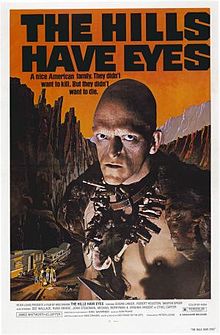
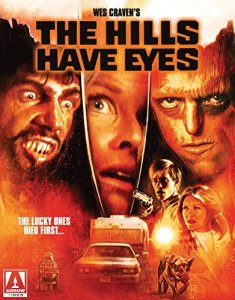
220px-hillshaveeyesposterSo here we are again, with another movie on the ever-shrinking List of Titles I Know I’m Going To Have To Deal With Some Day. A year ago I finally watched Wes Craven’s Last House on the Left, and now, with Arrow Video releasing an exquisite 4K restoration blu-ray of his second feature, it is high time I get over my aversion to psycho hillbilly movies and give it a watch; it is, after all, considered essential for horror fans.

The Carter family, a group of mobile white bread from Cleveland, make a detour on their vacation road trip to Los Angeles to find a depleted silver mine they’ve inherited in the Mojave Desert. It’s an isolated part of a desolate area used as an Air Force gunnery range and atomic bomb site so of course they’re going to have an accident and wind up miles from anywhere with a snapped axle. The menfolk set out in different directions to find help, not knowing there’s a family of cannibals in the rocky hills surrounding them, and they’re hungry.

the-hills-have-eyes-michael-berryman-1977In Last House, Craven was saying something about violence in Vietnam-era America, and he finds he still has to say it in the Disco Years. The Carters are a large family, and it’s difficult to figure out the exact relations of the characters at first, but then, if you’re a horror fan, you know intuitively there’s so many of them because their number is going to get winnowed down pretty quickly. The cannibals stage their raid on the Carter’s camper at roughly a half-hour into the movie, and from there the intensity rarely lets up. The elder sister’s baby is stolen away as a “tenderloin”, one of the many acts of transgression on display. In fact, The Hills Have Eyes got an initial X rating, necessitating many cuts, and I’d be willing to bet the baby subplot is what put the nail in that rating coffin, as the MPAA is reportedly as vanilla as the Carters.

hillseyes2As with Last House, Craven makes the point that people forced to rely upon themselves have the capability to do great violence to survive, and that violence will, indeed, have an almost irreversible impact upon their humanity. In Hills Craven plays even more with the concept of two families that are mirror images of each other. Jupiter and his feral clan work together, while the Carters are at odds with each other from the get-go. The cannibals use stolen CB radios to coordinate, while the Carters don’t really communicate, except in the form of argument and sniping.

A lot of folks feel this is Wes Craven’s masterpiece; I would argue the point, but it is a very good movie, as it turns out. Craven had resisted making another horror movie, but as he put it, “I was out of money and Peter Locke said, hey, my wife is working in Las Vegas, let’s make a movie in the desert!” He went to the library and found out about Sawney Beane, the leader of a clan of Scottish cannibals in the 16th century (his actual existence is still a source of controversy). This formed the basis of the script. Tobe Hooper had already proven that the concept would work by combining Beane and his clan with the crimes of Ed Gein for The Texas Chainsaw Massacre.

the-hills-have-eyes-movieIf there is any place worse to make a movie than on the ocean, it has to be the freaking desert, with 120 degree days and 40 degree nights. Craven and Locke managed to put together an amazing cast of actors trying to get into the business and willing to do what it took to do that. This is the first major film role for Dee Wallace, who plays the baby’s mother, Lynne (and once she is SPOILER FOR A 40 YEAR OLD MOVIE killed, I declared war on the cannibals myself), and it also serves as the debut of the remarkable Michael Berryman as Pluto, the poster boy for The Hills Have Eyes. Berryman describes himself as having “27 birth defects”, one of the more extreme being Hypohidrotic Ectodermal Dysplasia, which means he has no fingernails, hair or sweat glands. Craven and Locke both described him as “incredibly game”, and my god, no sweat glands and working in the desert? It’s amazing he survived. And he seems like an extraordinarily nice guy, on top of all that.

00244fc1_mediumCraven and Locke’s luck with personnel didn’t stop there; they scored Robert Burns as Art Director, and he brought along a trailer full of props from Texas Chainsaw to decorate the cannibals’ cave. They hired Eric Saarinen as Director of Photography, already a veteran of several Corman movies, and he brought his own crew. Hills was shot in 16mm, a budgetary necessity, but Saarinen makes it look so close to 35 that I doubted my own assumptions (until I saw the Arriflex cameras they were using in production photos).

It’s obvious Craven learned quite a bit from making Last House and in the intervening five years; production-wise, this is a quantum leap forward in quality. It’s played practically forever in repertory, and survived a remake or two. Probably the only thing that kept it from doing truly blockbuster box office was a movie that was released a week after its debut, Smokey and the Bandit, which ate considerably into all the drive-ins and smaller movie houses that should have been Hills‘ domain. Ah well. Hills has a more timeless quality – it has endured the passage of time much better.

boxSo yes, good movie, glad I finally got over myself and saw it. Arrow Video’s blu-ray is amazing and I would be just fine with them doing every blu-ray release from now on (though it would work their poor labs and restoration wizards to death). As i said earlier: this is a 4K restoration that simply blows away any previous presentation. They also carried over the making-of doc from the old Anchor Bay release (looking so good I think restoration radiation must have leaked through from the movie) and Craven and Locke’s commentary track. It’s wonderful and not a little affecting to see and hear Wes Craven again – his intelligence and wit remain sorely missed in the field of horror.

Buy The Hills Have Eyes on Amazon


Agoniya (Agony) (1975)

2jyvk9joIt was about a year ago that I viewed Elem Klimov’s two hour gutpunch of a movie, Come and See, based on his own experiences in World War II (and he claimed he soft-pedaled it, good lord). I was stunned in more ways than one, and even more surprised that Klimov had only made six feature-length movies (and seven shorts). Alas, more than par for the course when we talking directors under the Soviet regime, and we’ll get back to that in a bit. But I was especially intrigued that one of those six movies was a film about Rasputin.

Most of my experience with Rasputin dates back to an article I read in my grandparents’ Readers Digest back in the 60s, which was about his assassination at the hands of desperate Russian aristocrats and military officers. The reason it stuck with me was the sheer amount of damage it was reported required to put the man down: poisoned food, gunshots, stabbing, beating and finally drowning. Rasputin was Michael Myers long before Halloween was ever made. It is generally agreed that he was turned into an unstoppable demonic force after the fact to justify the murder. This bit of history-as-horror-movie was probably reinforced by Hammer’s movie Rasputin starring Christopher Lee, which I must confess I still haven’t seen, so I should probably shut up about it.

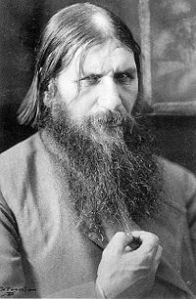
For contrast, here's the real guy.

For contrast, here’s the real guy.

If you’re any sort of film fan, by now you’ve likely read the Salon article about the legal battles engendered by the 1932 Rasputin and the Empress, which led to your favorite “This is a work of fiction” legal disclaimer at the end of all movies. So I was looking forward to an actual Russian version of the story.

Agoniya takes place in 1916, which is a section of Russian history so chaotic even professional historians have a difficult time hashing out what was actually transpiring. Klimov does an effective job of boiling down the big stories at time, helpful not only to the movie’s intended audience, I’m sure, but essential for those of us on the outside. He makes canny use of actual archival movie footage, and as the movie progresses, also seems to use new footage made to match the look of older film. World War I rages, and Czar Nicholas II has taken control of the Russian military, and he is famously bad at it. Rasputin has already insinuated himself into the royal family, as a mystic holy man who is credited (by the devoted Czarina Alexandra) with alleviating the young Czar Alexei’s medical problems (Alexei, as it turns out, was a hemophiliac, and Rasputin’s insistence that he stop taking the recent miracle drug Aspirin was more or less accidentally the right choice).

agonyRasputin (Alexei Petrenko) is shown to be all sorts of things: intelligent, charismatic, but driven by his emotions and passions. Petrenko manages a neat trick I had previously only seen in Bruno Ganz’ truly praiseworthy portrayal of Hitler in the oft-memed Downfall: he takes a man who has become an icon of unrepentant evil and manages to humanize him without stirring undeserved sympathy. There are times, when Rasputin is stressed and angry (and such times are plentiful), that he reminds you of Dennis Hopper at his most powerful. Hopper would have played an incredible Rasputin, it occurs to me, but that is so not here or there.

157932445_17ae6aWe follow Rasputin’s machinations,  his ups and downs, eventually coming to the assassination by Prince Felix Yusupov and his co-conspirators, but we find that the poisoned food and multiple gunshot wounds were eventually enough (the movie also shows how the clumsiness of the murder is in direct contrast to the early bravado of the group; most are ready to cut and run after they find out the poison wasn’t enough).

Rasputin’s legendary debauchery is shown, but it’s never something to wallow in, it’s just another fact laid out before us. It was that more-or-less factual approach that worked against the movie; it was finished in 1975, and then vanished without a trace for ten years, until it re-surfaced in the age of glasnost.

6-1Rasputin is not presented as a force of pure evil, but of venal opportunism, in cahoots with a corrupt banker and an ambitious lady-in-waiting. That was likely bad enough for the leaders of the Supreme Soviet, but it was compounded by the nuanced performance of Anatoliy Romashin as Nicholas II – again, not the cruel despot that Official History required, but weak, more than willing to defer to Alexandra (Velta Line) and be swayed by Rasputin’s visions. He is a man who in way over his head, but cannot admit it, because he is the Czar, dammit. As with Rasputin’s portrayal, it doesn’t excuse the horrid bloodbaths under his rule, but it does aid immeasurably in the verisimilitude of what we are watching.

Also missing would be the beloved Bolsheviks, but this is historically accurate: they were all fighting the War, or exiled, and had been ejected from the Imperial Duma, a governing body which was a hotbed of anti-Rasputin sentiment, but only because these aristocrats and merchants were desperate to shore up the ruling family and preserve the status quo, and therefore their own power. There is increasing chaos as the day of Rasputin’s death approaches, a chaos which is nowhere evident as the dead mystic is lowered into a grave in his native village; Klimov doesn’t have to tell us this is the death knell of the Czarist government – the very stillness and grimness of the landscape lets us know an age has ended. The Age just doesn’t know it yet.

vlcsnap-2016-09-11-01h11m00s578Agony is a complex story of a complex time, ultimately as confusing morally as its central character. It is a story usually presented as devilish holy faker against two pretty young lovers; here the holy man is far too human, as are the appropriately middle-aged royal couple. It’s a portrait of fucked-up people in a fucked-up time – it’s no wonder it ends in blood, even after the movie wraps up, less than year before the October Revolution. Well-made and compelling, it deserves to be much better known… much like its director.

Buy Agony on Amazon

Woman in the Moon (1929)

Fritz Lang wasn’t interested in making short movies.

Woman in the Moon was his follow-up to the tremendously successful (and comparatively low-budget) Spies. It finds Lang back to his UFA studio-bankrupting ways; it’s considered one of the first truly serious science-fiction movies I guess Metropolis wasn’t?), and that don’t come cheap.

Industrialist engineer Wolf Helius (Willy Fritsch, the star of Spies) visits his old friend Professor Manfeldt (Klaus Pohl) an astronomer who was disgraced thirty years earlier when he announced that there was gold on the Moon to a roomful of serious men with eccentric facial hair. Helius feels he is right, and is, in fact, about to embark on a voyage to the Moon to prove that point. Manfeldt excitedly insists that he must come with, but also warns his young friend that shadowy figures have been trying to acquire his research papers.

600_444828611Helius is also in a funk because his best friend Windegger (Gustav von Wangenheim) was faster on the draw to proposing marriage to the forewoman of the factory, Friede (Gerda Maurus, also from Spies – Lang was no fool). That personal problem recedes into the background when Helius is waylaid by an attractive woman (she had Louise Brooks hair, and was obviously trouble, but he ignored my shouted warnings), who steals Manfeldt’s papers; he returns to his apartment to find his safe cracked, and all his blueprints, files, even the scale model of the rocket he is building, have been purloined.

Turner (Fritz Rasp) is a representative of the Five Richest People in the World, and they want to control the gold on the Moon. Unless Helius allows Turner to accompany him, Turner’s minions will destroy the nearly-complete rocket. Helius eventually gives in, after reconciling somewhat with Windegger and Friede, who will join him, Turner and Manfeldt for the trip.

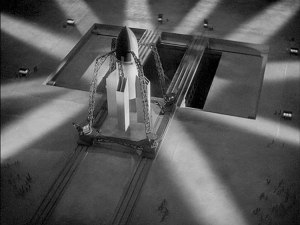
1929_frau_im_019It isn’t until almost halfway through the movie that we finally get our rocket launch, but it’s time pretty well spent. Based on the work of  Hermann Oberth, who literally wrote the book on rocket travel while he was working as a high school teacher, much of the launch sequence is prescient, and familiar to anybody who’s followed NASA through the years: the rocket drawn by tractors from its enormous hangar, the countdown (invented for this movie as a dramatic device, but oh so practical!), a multi-stage propulsion system. Lang had cut his teeth on miniature work with Metropolis, and that pays dividends here – those are astounding shots.

Lang also deals with the concept of zero-gravity – presented as a very short period of time on the trip – pragmatically, with straps hanging from the ceiling and leather loops on the floor for feet. It’s all very well-thought out and satisfying.

Then we actually land, and you can forget about all that science nonsense.

"What idiot designed this? Was it you?"

“What idiot designed this? Was it you?”

I can forgive the rocket cockpit, which has instrumentation that was not designed for ease of use during the crush of G’s Helius knows will happen during the first minutes of launch – that’s for dramatic effect. “That’s for dramatic effect” will cover the remainder of the movie.

Earlier, while the Five Rich People are going over Helius’ stolen files, they watch a film made by an earlier rocket that circled the Moon with robot cameras (good work again, Herr Oberth), and mention that on the Far Side of the Moon, there appears to be atmosphere, and possibly swarms of insects. There is definitely atmosphere, our astronauts find.

I moan and groan, and then remember being thrilled by tales of the Blue Area of the Moon, which is where The Watcher lives, you know. So I can’t kvell too much about that.

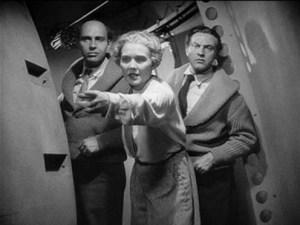
screen shot 2013-10-04 at 2.37.32 pmOh, the fact that Manfeldt then pulls out a divining rod to find water, that I’m going to moan about plenty. Instead he finds gold, and falls into a ravine when he tries to hide it from Turner. Turner goes off the rails and tries to hijack the ship, though to what freaking purpose because he has no idea how it works. This results in the shortest gunfight in history, and Turner’s errant bullet hits the oxygen tanks, resulting in there only being enough oxygen for the return trip if somebody stays behind – even if two of the crew are now dead.

This leads to a drawing-the-short-straw scene worthy of a movie almost three hours long, as the cowardly, brittle Windegger overacts mightily and thereby convinces Friede she picked the wrong guy. Then again, Helius is being a dick about the whole thing because he knows and we know that he is going to be the one to stay behind in any case, after drugging Windegger and Friede and letting Gustav launch the ship.

Woman-1Oh, did I not mention Gustav? He’s a science-fiction reading kid who stowed away on the ship (apparently one of the SF stories he read was not “The Cold Equations” by Tom Godwin, where an astronaut’s girlfriend stows away and she has to be jettisoned because there isn’t enough fuel for her added weight). Gustav also does all the heavy lifting getting the supplies and a tent out of the ship for a base camp to accommodate whoever stays behind. In this case Helius and Friede, awwwwww.

There was a ton of supplies in that ship, too, against all rationale. Good thing, too, because the flight only took 36 hours – that’s half the time Apollo 11 took to get to the Moon – but they’re going to have to build a new ship to rescue our lunar lovebirds.

Willy Fritsch said in a recent interview that everybody knew there was no air on the Moon, and the sole nod to lighter gravity is everybody wearing platform shoes that were supposed to be lead, but were actually cork, but as I say: dramatic license. The Moon set is pretty impressive otherwise, with over forty truckloads of sand brought in from the Baltic.

5024topFrauIf Lang could have kept up the dedication to actual science, this movie might have supplanted Metropolis in my rankings of his movies, but the third act becomes wearisome with melodrama and nonsensical plot machinations. Really, the stuff preceding that is so technically competent that the Nazis took it out of circulation in the 30s through the 40s because the rocket was too similar to the V-2 missile… made by men building upon the refinements to rocketry designed by Oberth… and paid for by the advertising budget of Woman in the Moon.

Let’s watch that launch (the ship is being lowered into water because “it is too light to stand by itself.”):

Buy Woman in the Moon on Amazon


The Wind in the Willows (1996)

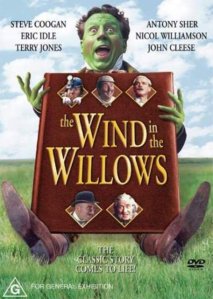
PosterYears ago my friend and fellow actor Jeff Lane, while we talking about the pitfalls of children’s theatre, told me about a movie he had seen almost by accident, a movie of which I had never heard: a live-action version of Kenneth Grahame’s The Wind in the Willows directed by Monty Python alumnus Terry Jones, full of sly details for the older members of the audience. That was my modus operandi in the days when I was directing, and I put that in my To Be Tracked Down folder. It took me damned near 20 years to do it, and the reasons why are almost as obscure as the movie’s existence has become.

I’m going to assume a bit of familiarity with Grahame’s novel to move things along. If you’re not, well… reading is good for you.

MSDWIIN EC007The first notice that you’re watching an adaptation geared toward the kids of the 90s is immediate as Mole (Steve Coogan) – who in the book leaves his underground home because he is bored with spring cleaning – is instead rousted from his burrow when a bunch of heavy machinery (operated by literal weasels) destroys the meadow where it is located. Mole goes to his friend Ratty (Eric Idle), and they travel via boat to Toad Hall, because the meadow was owned by the extremely wealthy and extremely feckless Toad (Terry Jones). This is time-saving compression – in the book, Mole has to meet Rat, then Toad.

The_Wind_in_the_WillowsToad is famously obsessed with the latest fads, monomaniacally embracing one for a few days, then discarding it for the next. The most famous of these – leading to Toad’s downfall – is the motorcar, a hot property in the novel’s 1906 setting. Toad’s constant crashes leads to several unnerving encounters with the weasels of the Wild Wood, and an intervention by an old friend of the Toad family, the stern Badger (Nicol Williamson), who places Toad under house arrest and cancels his order for six new motorcars. But the wily Toad will escape, steal a motorcar, crash it immediately, and go to prison for that crime. This is what the Weasels were waiting for, and they take over Toad Hall.

This brief synopsis covers what happens in most of the adaptations of Willows, ending with Toad’s escape from prison and he and his friends re-taking Toad Hall. What I haven’t gone into yet is Jones’ additions, playing off that initial change to the opening scene: the Weasels bought the meadow to build an enormous Dog Food Factory, and they intend to blow up Toad Hall just because they’re weasels. And say what you will about Kenneth Grahame and his novel, I somehow feel that the weasels preparing to drop Toad, Mole, Ratty and Badger into an enormous meat grinder wasn’t even in the preliminary notes for the first draft.

WeaselsI don’t know what this says about Jones, or his view of what would appeal to the kids in the 90s; I will say that I (though as far from a kid in the 90s as you can get) found it tremendously entertaining. This strain of enthusiastic cartoon murder that runs throughout the third act, though, is likely what got the movie a PG rating from the MPAA. There are already tons of much more faithful adaptations in the world; it’s refreshing to find one that is quite its own creature.

The details that so impressed Jeff are about as subtle as one would expect from Jones’ oeuvre, which is to say that they are only subtle insomuch as nobody on screen stops and points at them exclaiming “Cor! Lookit that!” Whenever the ever-present rabbits are used as background characters, they are almost always making out. Similarly for weasels, they are almost always robbing rabbits in the background.

Overall, The Wind in the Willows feels like it’s a production by a well-funded children’s theatre. There is not much done to make the actors look like the animals they portray; Idle has whiskers and a tail, Jones is painted green. Most of the look is instead created by wigs and perfectly lovely costumes, especially Toad’s overly large Edwardian suits and the uniform frockcoats and wigs worn by the Weasels.

Toad, Mole, RatSteve Coogan is properly endearing and pathetic as Mole (even if he does have to follow a truncated Hero’s Journey), and Eric Idle channels a steady British Decency as the boat and picnic-loving Rat. Jones has a tightrope to walk as Toad, making the supercilious ego-maniac with ADHD somehow likeable, and manage it he does. Nicol Williamson is not allowed to have much fun as Badger, but then, that’s the character, innit? (Yes, that was my role in my actor days) Anthony Sher is another standout as the gleefully malevolent Chief Weasel, Stephen Fry has fun as the Judge, and John Cleese jobs in as Toad’s defense attorney, who is so overwhelmed by his client’s guilt that he does a far better job at convicting him than the prosecutor.

Is it Monty Python’s Wind in the Willows? Oh no no no, heavens no. Though I am quite surprised that it wasn’t marketed as such. Ah yes, marketing – you remember I mentioned Jeff’s seeing it almost by accident, and my subsequent inability to find it? There was some sort of shooting war going on between distributors, though I’ve only got hearsay as to causes and whys and wherefores, not much in the way of hard evidence. The Wind in the Willows wasn’t the cause but it was definitely a casualty, as Columbia wound up with the theatrical distribution rights, but Disney the home video rights. Theatrical distribution is vital to home video, and in what I can only interpret as spite, Columbia buried the movie.

Jones and the distribution arm of Columbia

Jones and the distribution arm of Columbia

Jeff’s viewing was one of the cursory screenings in America. There is an infamous tale of Jones in New York City, shooting a documentary, learning that the movie was playing in Times Square. One cab ride later, he found it playing “in a seedy little porno house”.

Disney nonetheless put it out on video in 2004. Ah, there’s the end of your journey, then, you may think. But no, I was still trying to find a copy to watch. My problem was I was looking for The Wind in the Willows. Disney, in order to have yet another movie based on one of their theme park rides, like The Haunted Mansion, had re-titled it Mr. Toad’s Wild Ride (some junior marketing executive got lots of three-martini lunches out of that one). I remained unaware of this fact until, I believe, it was mentioned in Mark Cousins’ The Story of Film around 2012 or so. And then I could search for and buy the ancient, non-anamorphic DVD – which is now out of print. You can still buy it crammed onto a single DVD with three other Disney ride movies, and that’s it.

Which is a shame. This marked the end of Jones’ feature direction for almost ten years, and I generally enjoy his work (yes, I’m one of six people who will admit liking Erik the Viking). It kept me entertained for its length, and that can often be dicey for an adult watching children’s fare. The one false note struck is an ancient complaint for me: I regularly curse whoever it was who decided in antiquity that children’s entetainment must always be a musical. I despised these saccharine interruptions as a child, and I regard them no more kindly as an adult. The songs in Willows seem tacked on, with only the Weasel number having any of the wit or creativity of the surrounding material. But they do provide a good-looking sampler which will cue you in to whether or not this is a movie you’ll find worth seeking out (which you should, it’s pretty delightful, and deserving of better treatment):

Buy The Wind in the Willows Mr. Toad’s Wild Ride and three other movies on Amazon