Ha! My hard-won strategy for gaming the system strikes again!
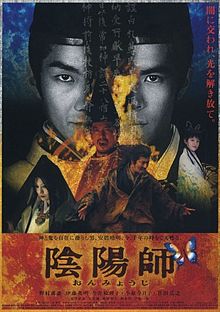
In 10th century Kyoto, a demon is killing various members of the gentry, in each case carrying off a different body part, and sorcerer supreme Abe no Seiman (Mansai Nomura) and his companion, Lord Hiromasa (Hideaki Itô) are called in to investigate. Don’t worry, the perpetually cute butterfly girl Mitsumushi (Eriko Imai) is back, too.
Another magician has cropped up amongst the peasantry, healing disease and injuries, Genkaku (Kiichi Nakai). Several of the lords, trying to bring Seiman down a notch, bring Genkaku in on the case, but he demurs respectfully to Seiman, who feels the murders are not the work of “a true demon”. Hiromasa, as usual, falls in love with the wrong woman, this time the tomboyish daughter of another lord, Himiko (Kyoko Fukada). This lady also possesses surprising healing powers. Hmmmm, I wonder if there’s a connection…
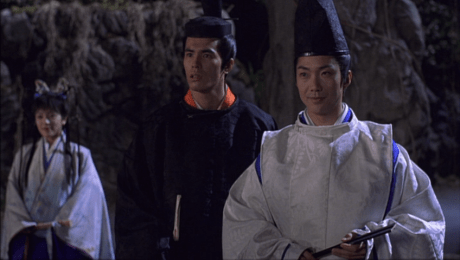
Our heroes at 221B Baker S… er, Abe no Seiman’s sanctum.
Onmyoji 2 has a more complex plot than its predecessor, and sadly suffers somewhat for it. It takes a little too long for the usual plot to destroy Kyoto to solidify; it involves a war crime fifteen years earlier, which has of course been glossed over by the government as a glorious victory over evil. Though the culmination of the villain’s plot feels a little too similar to that in Omyoji, it gains its own identity when Seiman underestimates his opponent, and has to journey to the afterlife, where, accompanied by the loyal Hiromasa and his flute, the magician must dance in drag as “the trickster goddess” to gain the attention of the goddess Ameratsu.
It saddens me that this appears to the last movie in the Onmyoji series, which featured a largely subtle, non-bombastic approach to magic, nonetheless engaging and exciting. The Seiman/Hiromasa version of the Holmes/Watson synergy is compelling, and certainly could have supported more adventures. But sometimes we just need to be happy with what we got.
Yes, it took me fully four years to figure out how to game this system. This is, of course, the sequel to La Herencia Valdemar, which we visited at the other end of the alphabet; this is simply the English title. Frankly, I prefer the Spanish version: La Sombra Prohibida, but this is the easiest V I’ve ever scored.
Some spoilers follow. You’ve been warned.
There were a ton of storylines left over when chapter one closed. Chapter two finds us firmly in the present day, except for a flashback to the 1890s which finds the tortured Lázaro Valdemar (Daniele Liotti), after the sacrifice of his wife, falling deeper and deeper into books of forbidden lore, much to the dismay of the faithful Jervás (Paul Nachy in his final role). In fact, Jervás begs none other than H.P. Lovecraft (Luis Zahera) to try to convince Lázaro to give up his ultimate acquisition: the Necronomicon. “You don’t own the Necronomicon,” he tells Lázaro, “the Necronomicon owns you.” To no avail.
In the present day, Nicolás (Óscar Jaenada) and Dr. Cervia (Ana Resueño) continue their search for the missing antiques expert, Luisa (Silvia Abascal), who has escaped from the slow-witted Santiago (Santi Prego) and the sociopathic Dámaso (José Luis Torrijo), which results in the capture of Eduardo (Rodolfo Sancho) and Ana (Norma Ruiz), also searching for Luisa, a bit ahead of schedule, we will find.
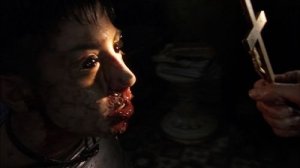
All four wind up in a room in the deserted Valdemar mansion, wallpapered with polaroids of bloody people screaming and begging. Santiago releases them and leads them through a cavern underneath the mansion, where they are unfortunate enough to encounter the thing that was released in the first movie. Fleeing it, they run right into the arms of the cultists being led by Colvin (Eusubio Poncela), the head of the real estate agency employing all four – and a surprisingly young Lázaro. It is an elaborate scheme to gather enough sacrificial souls for a rite which will undo the botched Dunwich Ritual from the first movie. However, Colvin makes a mistake equally as catastrophic as Crowley’s in that instance, with the results that the cult is suddenly confronted by a very pissed-off Cthulhu.
That synopsis doesn’t convey half the texture and turns the story presents. Santiago has a horrifying yet heart-wrenching monologue about the nastiness at the Valdemar mansion to Luisa while having one of his seizures (and the handful of horse tranquilizers he downs to kill the pain). Luisa runs into an honest-to-God gypsy fortune-teller in a wagon in the woods. Like the earlier appearance of Bram Stoker, this version of H.P. Lovecraft has a lot more going on than the guy we think we knew. What I’m saying is, the two movies considered together form a pretty good Lovecraft pastiche, while still managing to be extremely Spanish in character. As I’ve said before, I’m a sucker for Lovecraft on a budget, and the budget on this one is actually pretty decent, something in the range of 6.5 million Euros. The acting, music, effects and cinematography are all of a very high order. It’s a little too ambitious to completely fulfill all its promises, and bends back on itself a little too often – even then, it’s still admirable in many ways.
I would recommend this to all Lovecraft fans. But.
This sequel/second chapter is hard to find. Amazon lists a PAL DVD for $120 – you can find it on eBay for less – but the most astounding thing is Amazon Video has part one but not part two. Unsuspecting viewers will find themselves hanging, like I did at the end of Sword of Doom. That’s just bad policy, there. It is, however, currently on YouTube for three bucks. Maybe Shudder has access to it – I don’t know, I’m not in a position to afford streaming services at the moment.
But somebody really should remedy that situation. All those situations.
Hello again to Spain, the MVP in this year’s Hubrisween challenge! ¡Ustedes molan!
I reviewed [REC] back in 2012] , and I have no idea why I took five years to get around to its sequel, because I loved it. It did everything right for a found footage movie, and at barely 80 minutes, it didn’t have time to get bogged down. Small wonder that directors Jaume Balagueró and Paco Plaza went back to that well, and amazing that they did it so well.
We’re still on the same night as the first movie, and a four man Special Forces squad (Óscar Zafra, Ariel Casa and Alejandro Casaseca) is gearing up to go inside the sealed apartment building. They are joined by Dr. Owen (Jonathan Mellor) from the Ministry of Health, who has a very special mission: he has to get to the top floor to obtain a blood sample he somehow knows is there, a blood sample that will enable the formulation of an antidote to the mysterious plague that is turning people into violent zombies. It’s up to the squad to get him there and out.
And we all know it is just not going to be that simple.
Balagueró and Plaza open up the scenes nicely; all the troops have networked helmet cameras feeding into the main camera held by one of the troops, Rosso (Pablo Rosso, who was the cameraman in the first movie, for all you Easter Egg fans). There was a suspicion in the first installment that the plague was supernatural in origin, which is borne out this time, especially when Owen seals a zombie in a room with a crucifix and reveals a priest’s collar under his jacket. Patient Zero, we are told, was a girl the Vatican verified as possessed, and a secret lab was established in the building to find a scientific basis and cure for demonic possession. A journal in the penthouse mentioning mosquitoes points the way to what went wrong with that plan. It’s her blood Owen needs to find.
All of this is pretty straightforward and suitably intense, with the result that the story has pretty much run its course 40 minutes in. Perhaps there was some criticism over the brevity of the first movie, because the squad’s camera is damaged at that point, and we pick back up with three bored teenagers (Andrea Ros, Alex Battalori, and Pau Poch), briefly seen by the squad in the building when all hell started breaking loose. They had been videotaping a failed prank on the roof across the street before being evacuated by the cops earlier in the evening. They follow a desperate tenant from the building and a fireman (looking for his friends from the first movie) who go through the sewers into the building by a basement access. Their camera takes up the story until they finally intersect with the squad – trouble is, their battery is dying, and it’s remarkable how tense that flashing red icon makes me. Then again, I’m a videographer in my day job.
At this point a surprising survivor from the first movie pops up, and their TV camera takes a licking and keeps on ticking, which is fortunate, because if you thought things had gone to hell before, well, you likely aren’t ready for the third act, with a trip back to the top floor and the return of the night vision camera.
The intrusion of the three teens is really annoying at first, but necessary, since the story’s intensity at this point has winnowed down the cast of characters and some more fodder was needed. I don’t see much way to speed that portion of the movie up, but there’s no denying that going back into setup mode puts the brakes on the movie’s momentum.
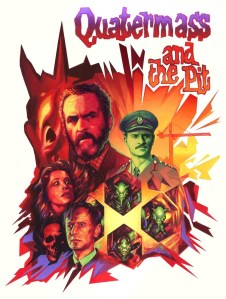
Like a lot of Americans, I was introduced to this movie as Five Million Years to Earth, because Warner Brothers/Seven Arts didn’t want to face a bunch of palookas moaning wut the hail is a quartermess? Probably wise, but said palookas were likely still not ready for one of the best science-fiction horror movies of all time.
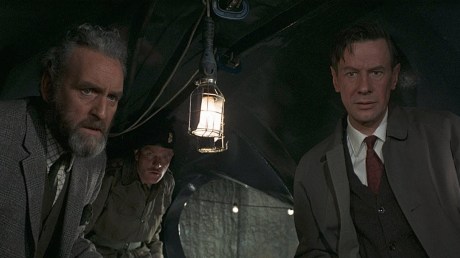
A bunch of workers on a London subway extension uncover some skulls buried in the clay, and as is the law, all work must stop as anthropologist Dr. Roney (James Donald) and his assistant Barbara (Barbara Shelley) begin excavating the remarkable find – Roney estimates the age of the skulls at five million years, possibly the oldest ancestor of man yet. Then a sort of metallic wall is unearthed, and there is a very real possibility that they’ve found an unexploded bomb from the Blitz.
Meanwhile, our old pal Professor Quatermass (Andrew Keir, this time) is receiving the bad news that his British Rocket Group is being co-opted by the military, in the person of Colonel Breen (Julian Glover). On their way back to Rocket Group, the Colonel is called upon to advise about this thing in the clay (which is a very clever way to get Quatermass involved, I must say).
As the soldiers uncover more of the object, it becomes plain that it is something novel; the magnetic stethoscopes of the bomb specialist will not stick, so it isn’t steel. Blowtorches have no effect. And in one recess, a completely intact skull is found, which means the object has been down there as long as the skulls – five million years.
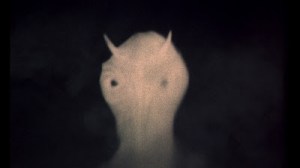
Under Barbara’s insistence, Quatermass begins to piece together the odd history of that part of London, named Hob’s End – Hob, of course, being another name for the devil. It is infamous for sightings of strange, goblin-like creatures and visitations of Old Scratch. When the entire object is uncovered, it is obvious that it is not, as Colonel Breen insists, some sort of Nazi Propaganda weapon, but a spacecraft. Especially when a sealed chamber of the craft opens to reveal four dead insectoid creatures, preserved in some sort of unnatural ice, and now decaying rapidly.
The upshot is the creatures are probably Martians, and faced with the death of their planet five million years before, began experimenting on the apes of Earth to create a lifeform that would carry on their way of life. Fortunately, we evolved past the hivemind state the Martians wanted, but buried racial memories translated the insects into horned demons. A further problem is that spacecraft is actually alive, and is waking up and reinforcing the hivemind – which insists that any living being not a part of the hivemind must be destroyed.
Nigel Kneale wrote some of the most thoughtful science fiction/horror stories for the BBC back in the day, and I think most acknowledge Quatermass and the Pit as his masterpiece. It’s hard to explain what a thunderbolt this movie was, with its effortless blending of the two genres, because so much of it has been co-opted in the following years. The most blatant – and loving – example is John Carpenter’s Prince of Darkness, which he wrote under the nom de plume Martin Quatermass. To that you can add the magnificent mess that is Tobe Hooper’s Lifeforce (whose source novel was far more Lovecraftian)
Kneale was the most satisfied with this film of his work (and rightfully so), and Andrew Keir – since this was my first Quatermass movie, Andrew Keir was Quatermass, as far as I was concerned. Imagine my surprise when I finally caught up with the first two movies, The Quatermass Xperiment and Quatermass 2 (or, thanks to the palookas, The Creeping Unknown and Enemy from Space) and got Brian Donlevy. Donlevy was cast to sell the movies in America, and Kneale hated him. A brusque and domineering version of the character, I cannot imagine Donlevy in this movie. When the Minister tells Quatermass that the object is now exclusively under the command of Colonel Breen, Donlevy would have thrown his badge at him and resigned from the force.
I used to have the original BBC serial on a double VHS set from Sinister Cinema, with Andre Morell playing Quatermass. I really like Morell, but for some reason he turned down the film version. And as I said earlier, I love Keir in the role.
If you’ve not yet seen Quatermass and the Pit (or Five Million Years to Earth, you palooka), you owe it to yourself to remedy that. Highest possible recommendation.
Every halfway-reasonably priced disc for Quatermass and the Pit is only playable on Region 2/B players. But if you have three and half hours, here’s that original TV serial:
One of the best things about casting the nets wider for this year’s Hubrisween offerings is finding that occasional gem you had no idea existed and being dazzled and deeply satisfied by it. And such a gem is Onmyoji.
An onmyoji is a practitioner of onmyodo, “a traditional Japanese esoteric cosmology, a mixture of natural science and occultism” according to Wikipedia. The article goes on to point out that in the Heian period (roughly 794-1185), the onmyoji had real political clout.
The movie begins in a fairly enigmatic fashion, with a ritual sealing of Shogun’s Mound, a tomb to trap the wrathful spirit of the wrongly persecuted Prince Sawara; he had cursed the former capitol city, so the new capitol – which will come to be known as Kyoto – is built over the tomb.
150 years later, the city has grown, and is quite prosperous under its current Mikado. The leader of the Court Onmyoji, Doson (Hiroyuki Sanada) is craftily playing the powerful Minister of the Left against the Minister of the Right to cause chaos in the palace, to what end, we shall just have to let the plot develop and see.
We are introduced to our actual title character, Abe no Seimei (Mansai Nomura), an extremely powerful magician. One of the more venal lords demands he prove his power by killing a butterfly without touching it; when a leaf blown by Seimei slices the butterfly in half, the lord flees in terror. Also witnessing this is Hiromasa (Hideaki Itô), a minor lord who is further discomfited when the master of his house sends him to Seimei to beg him to investigate supernatural goings-on.
Hiromasa protested when the lord demanded Seimei kill the butterfly, and he is honestly delighted to find that the death was an illusion, and in fact the pretty girl who greeted him at Seimei’s gate is the butterfly in human form (Eriko Imai). These two things cause the normally cool Seimei to warm toward Hiromasa, and they are going to become close companions in the course of the story.
The Japan of this period, we are told, is a time when demons walk the land, and it is the onmyoji who protect mankind from them and their curses. Doson’s power games in the palace are going to require Seimei’s intervention more than once, until the wizard’s master plan is revealed: unleashing the spirit of Prince Sawara, and binding it to himself for ultimate power.
“Oh my! You ARE sick!”
I’m going to enjoy any movie involving magic that’s done well, and Onmyoji is certainly that; Abe no Seimei is a freaking 10th century Doctor Strange, and the revelations of his power are continually surprising and delightful. Hiromasa is a fine Dr. Watson character, providing someone to whom Seimei can explain things (and thereby explain them to us), and a humanizing counterbalance to Seimei’s otherworldly aloofness. In a reversal of one aspect of the Holmes/Watson dichotomy, Hiromasa is the musician of the two, and his masterful ability on the flute is pertinent to the story, as is his continually doomed love life (more on those in the sequel, which we’ll get to eventually).
The intriguing characters don’t stop with our heroes. There is the enigmatic Lady Aone (Kyôko Koizumi), apparently immortal. And Dosun’s familiar, possibly the most metal crow ever committed to film.
“O soundless, invisible God of woe – may you reap all you have sown.”
Onmyoji is based on a series of novels by Baku Yumemakura, popular enough to be adapted to both manga and television. And after finding all this out, this gaijin was surprised to discover that Abe no Seimei is an actual, historical person. Was he truly a combination of Doctor Who and Harry Potter? We will never know, but it’s nice to think that he was.
As I said, I found this movie tremendously entertaining. I am alternately thrilled that there is a sequel and saddened that there is only one sequel. We will get to that one later. Like in ten letters later.
Seems like we were in Spanish horror land just a few letters ago, doesn’t it?
Things are getting a little intense at a real estate firm, as the Valdemar estate is coming up for auction and the agent dispatched to the remote mansion 20 days before has not returned. Desperately the freelance antiques appraiser Luisa (Silvia Abascal) is contracted to pick up where the missing man left off. She finds the house deserted, nothing catalogued, and a nearly empty attic – empty except for the mangled body of the missing man. And something shadowy stalking her.
She barely escapes, aided by the somewhat simple handyman Santiago (Santi Prego) and Domáso (Jose Luis Torrijo), who is rather pissed that Santiago let her go in the mansion. She faints, and awakens hours later in their home. Possibly a prisoner, but certainly trapped there by a storm.
Interesting cane you have there, my friend
But never mind that, as another investigator, Nicolás (Óscar Jaenada) has been hired by Colvin, the head of that real estate firm (Eusubio Poncela) to work with the President of the Valdemar Foundation, Dr. Cervía (Ana Rusueño) to find the missing Luisa. She describes the Valdemar mansion as a classic “shunned house”, and explains why in a lengthy flashback that will be the majority of the movie.
At the fin de siècle of the 19th century, Lázaro and Leonor Valdemar (Daniele Liotti and Laia Marull), though themselves childless, run an orphanage (standard for modern Spanish horror #1). Lázaro is also a devotee of the emerging science of photography, and in his experimentation with double exposures, sets off a small cottage industry in which people come to seances, are startled by a levitating table, and in that instant are photographed; the resulting double exposures of “spirits” are much sought after, and fawning rich patrons are quite free with their donations to the orphanage. Lázaro and Leonor hope to use these proceeds to adopt a child of their own.
An opportunistic journalist, however, threatens blackmail, and when Lázaro refuses, has him arrested for fraud. Things look bleak until Lázaro is visited by an unexpected ally, none other than Aleister Crowley (Francisco Maestre), who devises a campaign to discredit the journalist and free Lázaro.
The price for this: Crowley has examined Lázaro’s spirit photos, and found, apart from the fakery, actual evidence of the supernatural lurking in the corners. He feels that not only is the mansion a spiritual nexus, but Lázaro is unconsciously a spiritual medium. These are two things that are necessary to conduct “The Dunwich Ritual” during an upcoming lunar eclipse. This will unlock secret knowledge for the participants; for Lázaro’s part, an answer to his and Leonor’s childlessness.
Despite his misgivings, Lázaro agrees, and Crowley brings in his fellows, including Bram Stoker (Lino Braxe), Lizzie Borden (Vanessa Suárez) and Belle Gunness (Laura Toledo). Crowley, though, has made a chauvinistic miscalculation, and the ritual releases what he terms “a devourer” into this world. The ritualists run away, leaving Lázaro wounded and the room aflame, and it is only the eventual sacrifice of Leonor that saves him.
The movie wraps up with the end of that story, reminding us of Nicolás, Luisa, and a couple of other folks, in an ending that confused a lot of people, apparently… I guess they ignored the brief snippets from the second part, which ends with a glimpse of something that definitely looks like Cthulhu… but that is something for the other end of the alphabet.
Now, for the good parts: this is a very handsome movie, well-shot and acted. Adding a lot of resonance and production value is Spanish horror icon Paul Naschy, in his final role as the Valdemar’s devoted manservant, Jervás. There is a lot of suitably creepy stuff, and some nicely humanistic moments, as well.
The bad part is this might as well be called Set-up: The Movie. Anyone expecting any resolution to the modern portions of the movie are going to be disappointed, those will all be left to the second part, The Forbidden Shadow, which looks to be a much rougher, more nasty, more… modern movie, perhaps. I look forward to it.
Though I am still puzzled by the fact that when Nicolás arrives, it appears he arrives by blimp… but perhaps that is another mystery which will be solved in the second part. We’ll see. (Spoiler: it won’t be.)
The Valdemar Legacy is available on Amazon Video. Bizarrely, its sequel is not.
It was three years ago that I watched and reviewed the Russian movie Viyfor Hubrisween. So, when I was casting about for this year’s movies and discovered a new version had been made, I was both delighted and surprised that I hadn’t heard about it. Perhaps that’s because in America it’s known as Forbidden Empire or Fobidden Kingdom, utterly generic titles that are presumably more marketable than Viy.
If you’re familiar with the Nikolai Gogol story, you’re going to be disoriented by the movie’s beginning involving an 18th century cartographer/scoundrel (Jason Flemyng) being discovered in the bed of the daughter of a nobleman (Charles Dance) before he lights off the continent to create the best map ever, traveling in a steampunk carriage dragging an enormous wheel to measure distances. He gets lost and finds himself in literally uncharted territory, and in the midst of Gogol’s short story.
Now, Gogol’s Viy is in there, and with considerably upgraded visual effects; it is revealed in stops and drabs, as Flemyng tries to unravel the mystery of what actually happened in the church, now considered off-limits, thanks to the local priest, who you just know is going to be trouble from the first time we see him. In the course of the movie it will be discovered that the details we know from Gogol’s story were fabrication, and it’s all a web of deceit and double-crossing.
Except for the stuff that was obviously supernatural and never gets explained. For instance, I’m pretty sure that Gogol is sad that he never thought of having his hero’s carriage pursued by zombie wolves. I am, however, certain that he is happy that he never came up with Flemyng’s fish-out-of-water cartographer, who reminds me of nothing so much as Steve Coogan’s Alan Partridge-inflected Phileas Fogg in that regrettable Around the World in 80 Days remake. It’s an odd appropriation to make, even though I realize that an outsider character is necessary to have the rules of this universe explained – such as chalk being more precious than gold in this cursed village, because it can be used to make a protective circle.
The production design of Forbidden Empire is gorgeous, the effects flawless, and it really is quite entertaining. Its only drawback is that if you like to mull over a movie after viewing, there are quite a few “wait a minute…” moments. But as sheer entertainment, though, it is pretty appealing.
I really like Eduardo Sanchez’ work. One-half of the directing team who brought us The Blair Witch Project, he’s continued to create interesting takes on standard horror genres, and his first directoral effort after the movie that launched a thousand found footage films is Altered, which starts with a tense in media res sequence and then gives very little chance to relax during its trim 88 minutes.
That sequence involves three redneck dumbasses, Duke (Brad William Henke), Cody (Paul McCarthy-Boyington) and Otis (Michael C. Williams, the only holdover from Blair Witch) hunting at night with a bewildering (and worrisome) variety of weapons. What they’re hunting is fast, smart, and vicious. They do manage to catch it in a tiger pit, and Duke insists they take it to a friend named Wyatt, because “he knows about these things.”
Wyatt (Adam Kaufman) is living in a sort of survivalist compound in the middle of the woods, surrounded by bright lights, weapons of his own, and a workshop/garage. He is not happy to see his old friends, or what they’ve brought him, and his girlfriend who recently moved in (Catherine Mangan) is even less pleased. “Why did you bring it here?” demands Wyatt. “We never thought we would actually catch one!” answers Duke.
It seems that 15 years before, these four guys (plus one more) were on a similar beer-soaked hunting trip when they were abducted by aliens. Duke, Cody and Otis were released after a couple of day of torturous experiments. The aliens kept Wyatt and Timmy – Cody’s brother – for more extreme treatment. Timmy didn’t survive, but Wyatt did – after some, um, modifications. After his release, he performed meatball surgery on himself to remove a tracking implant in his guts, and he’s been hiding ever since. And he knows that if they kill the alien that has been brought to him, the rest of his race will simply exterminate mankind. “You know what happens to an animal after it kills a person.”
Everybody has scars other than physical from the experience; Cody was blamed for his brother’s death, Otis is afraid of everything and Wyatt is definitely suffering from PTSD, with night terrors and paralyzing panic attacks. The movie doesn’t shy away from the many ways trauma can twist your life for years afterward.
The budget of Altered is certainly low, but doesn’t look it; Sanchez spends the money exactly where it needs to go. A lot of your drama and tension is going to come from interaction between the human characters, and the director has always been spot-on with his casting. The effects work is 99% practical, nasty, and won’t age like a lot of CGI from the period.
Altered takes the zombie siege formula, turns it inside out – people are trapped inside a house with something – and certainly worth a look.
Sometimes life drops some wondrous things in your lap, sometimes just things that make you wonder. Such is the case with a couple of pieces of Asian animation that did not originate from Japan, but rather China and Taiwan.
We’ll start with the good news – our first movie, Wan Laiming’s 1963 Da nao tian gong, titled in these parts as The Monkey King, or in this case Uproar in Heaven, isavailable for streaming on Amazon Video, and if you’re an Amazon Prime member, it’s free. For a Monkey King fan like myself, this is sheer catnip.
Uproar in Heaven is split into two parts of slightly under an hour each, and if you’ve seen Donnie Yen’s Monkey King, you’re already familiar with the story, though this telling approaches it from a different direction, and I’m thinking it’s somewhat closer to the classic tale. It should probably be titled The Monkey King Is Here To Kick Some Ass, because that is exactly what happens.
The plucky Sun Wukong is definitely the hero, and the Jade Emperor, worried about his power, offers two different minor jobs in heaven to the Monkey (supposedly to more easily keep tabs on him), with disastrous results. Upset by the Royal horses being confined in stables, he sets them free. Charged with guarding the Heavenly Peach Preserves, he eats the peaches and steals the annual feast for his monkey minions (he also eats all the Jade Emperor’s Golden Elixir Pills, as one does). This Jade Emperor is nowhere near as amused by all these antics as Chow Yun Fat’s filmic version. Each time the Jade Emperor sends warriors to take Sun Wukong down a notch, with less than favorable results for the warriors.
Here’s where Uproar in Heaven is truly magnificent: first, the animation is wonderful, often looking like nothing so much as a painted scroll come to life. Second of all, the fight scenes are plentiful and seem to be harvested from Peking Opera productions, complete with their distinctive music. These fight scenes are all fantastic and well-choreographed.
It’s also causing me to do more research into these classic Chinese characters. Above we see Sun Wukong in his fight with Nezha, another popular character we last saw in League of Gods. He got his own popular cartoon movie in 1979, Nezha Conquers the Dragon King, which is another thing to look for, grumble grumble. In the second part, Wukong takes on Erlang Shen, the chief of the martial gods of heaven, who is more of a match for the Monkey King. Their fight segues into another setpiece from Journey of the West, Erlang and Wukong each turning into a variety of animals as they pursue each other. As I said, they are evenly matched, and it is only through the interference of another god that Wukong is captured. More disaster for heaven, though, as Wukong proves to be pretty indestructible and all attempts to execute him literally backfire.
Uproar in Heaven ends with the destruction of the Heavenly Palace and Sun Wukong triumphant. No reproach and imprisonment from the Buddha yet. A happy ending, if you’re a Monkey King fan. And who isn’t?
What’s that? You don’t have Amazon Prime? You poor thing. Here:
And then, on the other end of the scale, we have 1976’s Chinese Gods, directed by Chang Chih-hui.
Back in the halcyon days of VHS, I would spend lots of time wading through the tapes at the late, lamented Audio-Video Plus, which had a staggering inventory, and this was one I always passed up for later, which never came. The VHS box used the very same shot from the movie as the DVD box to the right; I do not, however, recall it claiming to be “An Authentic Recreation of a True Story”. (Anyone who has seen this is so going to take issue with that statement)
So, piqued by my exuberant experience with Uproar in Heaven, I actively sought it out. High time, I figured.
Well.
I guess the first disclaimer to make is that the actual title is TheStory of Chinese Gods, and it’s not Chinese, it’s Taiwanese. I would also surmise that my bewilderment at what was unspooled before me was partially due to my inebriation, but I am assured by others that this is not the case. My confused tweets of WHAT THE HELL AM I WATCHING led to some commiseration across the Network of Tubes. Chinese Gods is literally one damned thing after another, with the viewer left to his own devices as to connections and characters. Also adding to my disorientation is that the English dub is by the same voice talent that did the Shaw Brothers kung fu flicks, and I am not used to having those voices come out of cartoons.
Are you ready for MULTI-BRUCE?
So, having sobered up the next day, I did some research. Info is very scarce on this, but one thing was useful: this is a cartoon version of Investiture of the Gods, the same classic novel that is the basis for League of Gods. Everything that seemed familiar to my besotted brain suddenly made sense, such as the appearance of Nehza again (wearing a distracting apron – and nothing else – and voiced by a woman because he has long hair) and the eventual appearance of a caricature of the late Bruce Lee as Erlang Shen, stunt casting that actually makes some sense, even if nothing else does.
In a second watch with that knowledge, the story made much more sense. This puts me in mind of things from my youth like an animated Three Musketeers than ran on Thanksgiving afternoon on CBS after all the parades. Limited TV animation, all the sword fights were silhouettes of men waving around swords, and if you didn’t already have some familiarity with the story, you would have been lost. This is the Chinese Gods experience in a nutshell. Investiture of the Gods is now considered as much of a literary touchstone as the better-known Journey to the West, and its intended audience had some foreknowledge we Western heathens did not.
Die, cartoon spider!
The animation style is… eclectic, to say the least. A lot of the character designs owe much to anime, but the more outlandish fantasy creatures look like fugitives from a lighthearted children’s cartoon, even if they do die bloody deaths. The fight choreography is certainly not as good as Uproar in Heaven’s, but they still obviously took more care with them. And I hope you liked the metamorphic animal pursuit from that movie, as it shows up in Chinese Gods, as well.
And here is the kicker. Chinese Gods is alsoavailable on Amazon Video, free on Prime under the title Bruce Lee and Chinese Gods. My DVD is probably sourced from that same VHS from Audio-Video Plus, damage and all. Every other domestic version I’ve seen is the same. But Amazon’s version is widescreen, as is that video clip above (and below). I cannot tell you how much easier the story is to follow when released from the constraint of fucking pan-and-scan. Also, even though it runs ten minutes shorter than my DVD version, it has scenes that are cut from the VHS version. There is even, mystifyingly, some expository text over the opening credits explaining some of the characters – if you read German. It’s a damned enigma.
So yet another reason to hate the 4:3 Satan that ruined our entertainment for so many years. I don’t think seeing this enhanced version would have caused me to start suddenly recommending Chinese Gods, but it would have made that first watch so much easier.
Then again, I freely admit that I am so jaded that when a movie actually manages to bewilder as that first viewing did, I find it refreshing and enjoyable.
Let’s close out with more Cartoon Bruce (widescreen of course) and some Street Fighter music.
If there is one thing that Facebook’s “Memories” function does – besides reminding you of dead friends and beloved pets – is allow you to discern patterns in your life. For me, that’s an unneeded reminder that this time of year is crazy for me.
Despite the fact that I didn’t go into education like a lot of people thought I would – I always say that it’s because I’m not allowed to shoot a student on the first day to show the others I mean business – my life is nonetheless tied into the academic life cycle. Some people marry into The Church. I married into The School. Besides prepping the technical aspects of the graduation ceremony for my wife’s school, I’m also running audio support for seemingly endless School Board meetings for my Day Job (ironically in the evenings).
This hasn’t left a whole lot of time for watching movies. And what time there was got stolen away by that devil TV. Holy cow, who knew, right? I’ve spent years not visiting the Glass Teat, and here I am sucking down The Expanse and American Gods.Twin Peaks’ first episodes sit on the DVR, and I have no earthly idea when I am going to get the hours together to watch them. I’ve seen David Lynch’s last three movies, and I am not expecting the funhouse mirror of daytime TV that was the first go-round. I am expecting something stranger and darker, and downright weirder. That’s not something I’m going to try to take in a half hour here, a few minutes there. As Dale Cooper once said, you must always pay attention.
But dammit, I managed to watch The Lego Batman Movie, and by God in just the first ten minutes it kicks the living hell out of Batman v Superman and Suicide Squad. The Lego Movie was a surprise for me back in 2014, and that flick’s meta humor is bat-kicked up to 11 in Lego Batman. I don’t think you have to be a fanboy who’s experienced every single iteration of the character to enjoy the movie, but that certainly enhances it.
Lego Batman does unfortunately preserve a shortcoming of its predecessor in that it feels the need to inject some seriousness in its second half, though that doesn’t annoy me near as much this time – the tone shift isn’t near as drastic. I am also prone to be more forgiving to a movie that not only gives me an Egghead cameo, but also finally allows Billy Dee Williams to play Two-Face, as God and Tim Burton intended.
Yes, you’re right – I am being deliberately coy about the plot. That is because there is so much joy to be found in discovery in this flick, and I want you to have that joy for yourself.
Also, my time is very limited this week, as mentioned earlier. I look forward to some breathing room next week. Then, holy crap, I will likely be braving the scourge of my fellow man (oooh how I despise them) to go to an actual theater to see Wonder Woman (as you may have noticed in the verbiage above, I’ve felt burned by DC movies thus far, but hopes springs eternal and dammit, it’s Diana!), and I am feeling the uncomfortable urge to spring for the 3-D version of Valerian. What have I become?


 Ha! My hard-won strategy for gaming the system strikes again!
 It saddens me that this appears to the last movie in the Onmyoji series, which featured a largely subtle, non-bombastic approach to magic, nonetheless engaging and exciting. The Seiman/Hiromasa version of the Holmes/Watson synergy is compelling, and certainly could have supported more adventures. But sometimes we just need to be happy with what we got.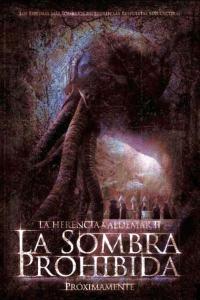



























 drfreex.com