The Stanley Kubrick Project: Paths of Glory

My attempt to go through Stanley Kubrick’s filmography continues… well not apace, certainly, but it continues. I was able to watch his fourth film, Paths of Glory, Sunday evening, after a fair amount of postponement and anticipation, and ooooh big surprise: I liked it.
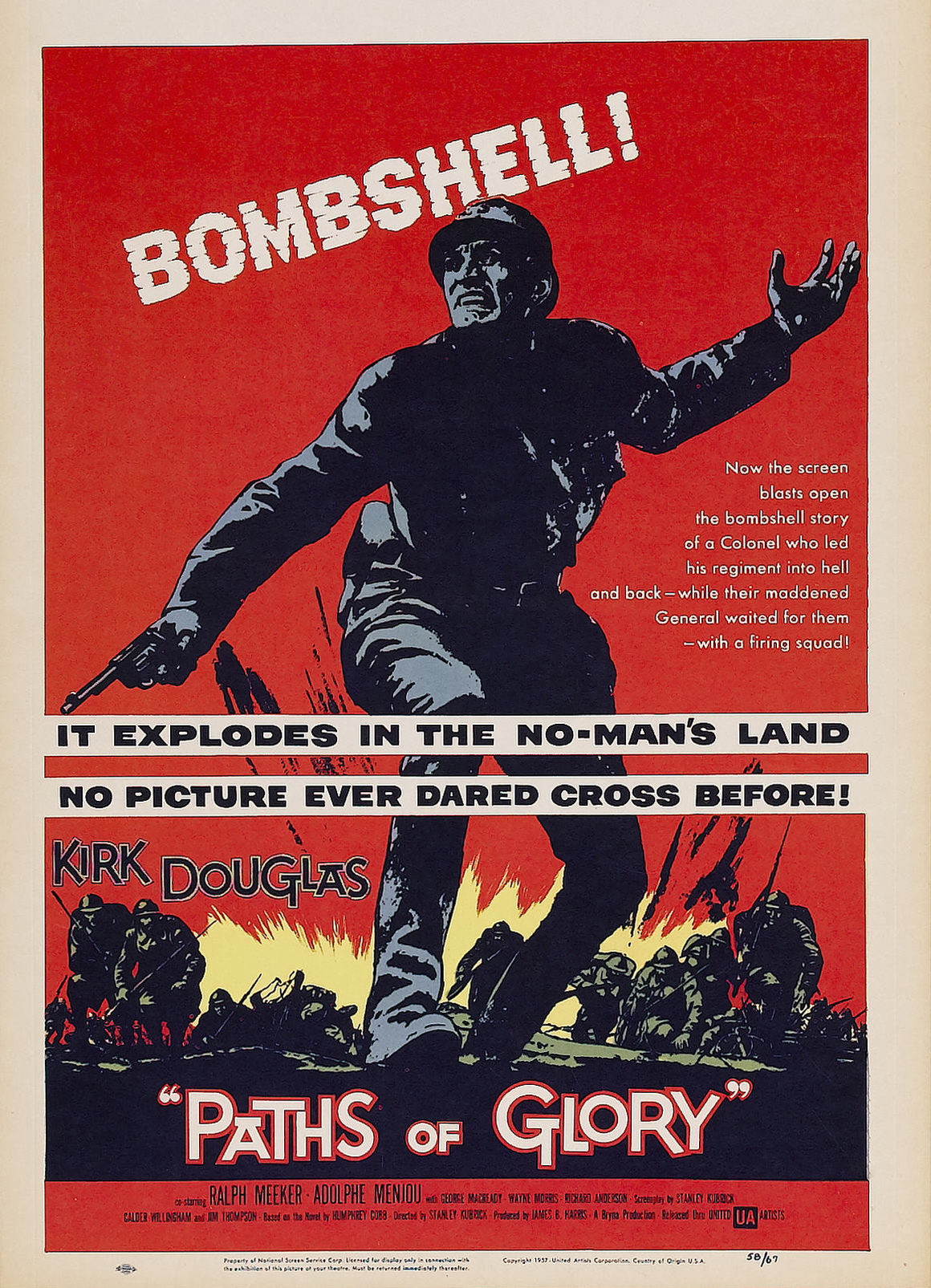
After the critical, if not box office, success of The Killing, Kubrick and producer Jack Harris decided they wanted to do a war movie; Kubrick apparently read the novel by Humphrey Cobb when he was a teenager, and the two men began work. Once again Jim Thompson worked on the screenplay, a chore eventually taken over by another novelist, Calder Willingham (who would later turn in screenplays for The Graduate and Little Big Man). This was while they were under contract to MGM. After a major shake-up in the studio (in which Dory Schary and our boys got the boot), the project seemed to be in limbo, except another star with a reputation for being a maverick was interested in the script: Kirk Douglas. Douglas’ own production company, Bryna (named after his mother) helped ramrod the project through United Artists.

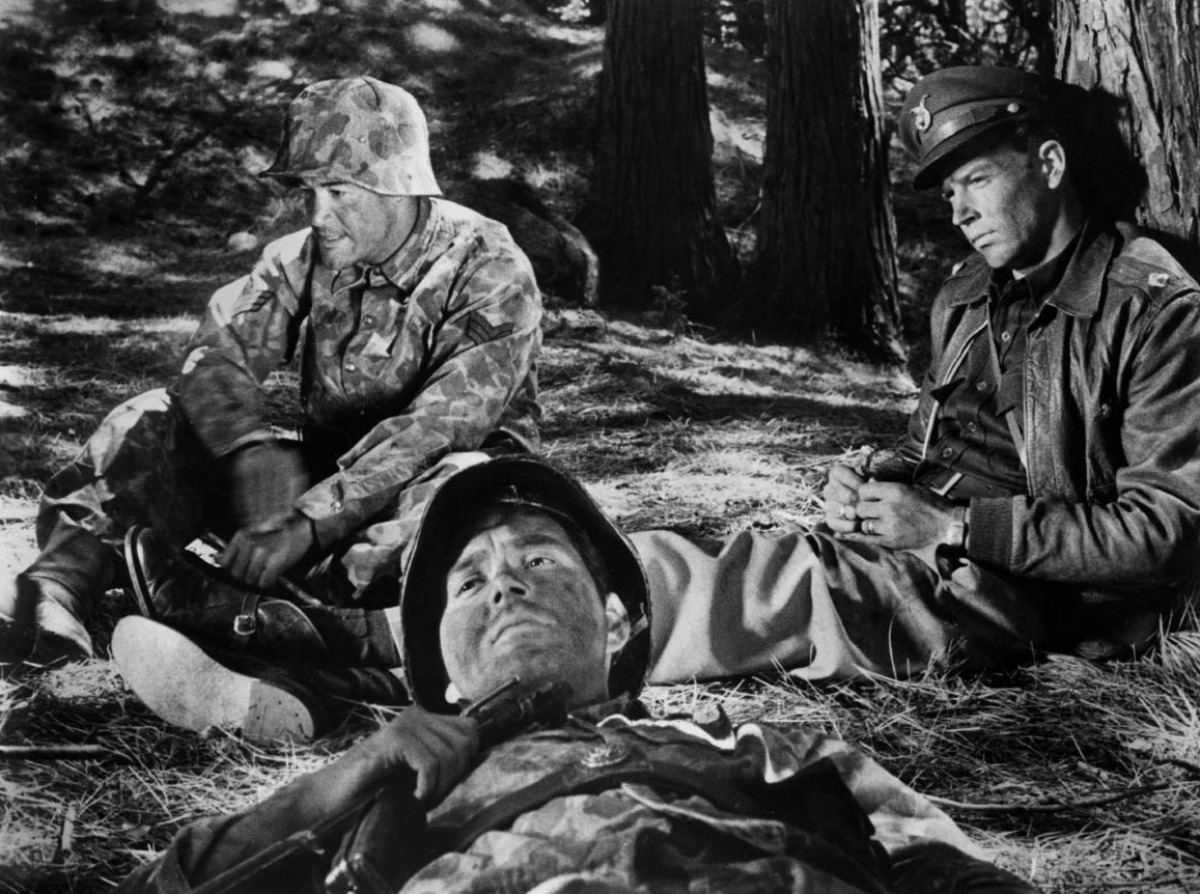
Douglas plays Colonel Dax, a WWI French officer commanded to do the impossible: take his regiment across No Man’s Land and capture The Anthill, a fortified German position that has repelled all comers for months. When the attack inevitably fails, three men from the regiment are picked, supposedly at random, to be tried and executed for cowardice. Dax insists on defending the men himself, only to find himself up against a wall of confustication; the outcome of the trial is never in doubt, and three men are executed by firing squad.

There is no denying that Paths of Glory is an anti-war movie, but there is also little denying it is a pro-soldier movie. The villains in this piece are not the Germans – we never see a German soldier – but the commanding officers, themselves lodged in a magnificent mansion far away from the dismal trenches populated by men they seem to hardly regard as human beings, more as chess pieces. Even then, that road isn’t an easy one to navigate. General Mireau (George MacReady), who will become our major heavy, starts out well enough. When his superior Broulard (Adolphe Menjou) asks him to take The Anthill, Mireau at first demurs, citing the impossibility of the goal, that the toll on his men would be too high. But then Broulard mentions that there may be a promotion for the man who takes The Anthill.

Mireau’s concern for his men evaporates at that point, even ordering his artillery to shell his own trenches when company B fails to leave its protection for the second wave of the assault. The artillery officer refuses, and Mireau immediately orders him to place himself under arrest. Afterwards, still stung at his loss of face and seeking to deflect blame, Mireau wants a hundred of the men executed for cowardice. Broulard manages to talk him down to the three men, later opining that the execution will be “good for morale”.

The unfeeling mechanics of the trial are made even more stark by the assault on the Anthill, lead by Dax himself. Noisy, messy and grueling, it’s well made and shot and seems to go on far longer than it actually does – and in another of those pieces of genius staging, when Dax and his company pauses after this long, tortuous push, for the first time in the sequence, the camera flicks toward their objective, the Anthill… and it still seems impossibly far away. After numerous casualties, they have still only reached the edge of the French wire.

If the court-martial scenes are an exercise in frustrating futility, the mood switches to grim naturalism in the stockade where the condemned men await the sunrise and their death. Ralph Meeker, a couple of years after Kiss Me Deadly, gets to show his range as Paris, a corporal chosen for the trial because he witnessed a drunken superior accidentally kill one of his own men during a night patrol; Timothy Carey brings his usual off-kilter performance to Ferol, picked because he is a “social undesirable”; and as Arnaud, a man chosen by lot for the trial, even though he has two decorations for bravery under fire, is another familiar face I was racking my brain to recognize – it’s Joe Turkel, a quarter-century removed from Blade Runner and The Shining.

The film falls back to seemingly impersonal and mechanical for the firing squad scene, which is another masterpiece of staging and pacing, monstrous in the dissonance between what can only be called the pomp and circumstance of the event versus its actual callousness, most typified by the treatment of Arnaud, who sustained a serious skull fracture when he assaulted a priest in their cell. Unconscious and not expected to live in any case, his stretcher is tied to the stake in the killing field, and the sergeant pinches his cheeks to try to awaken him – General Mireau wants him conscious for his execution.

Mireau will find himself under investigation for ordering the shelling of his own troops, and Boulard will offer Dax Mireau’s post. Upon finding that Boulard thinks Dax has done all this in order to be promoted to Mireau’s position, we get the patented Kirk Douglas tantrum, somewhere between a shout and a sob, as the colonel finally tells the general what he thinks of the whole affair and the general in specific. Boulard realizes that Dax is an idealist and tells the colonel he pities him “like one pities the village idiot.”

According to James Harris on the Criterion Blu-Ray, there was, at one point, a happy ending, doubtless because  it was felt that maybe it would be best for the box office. When it was switched back to the original ending, with the soldiers unsaved from the firing squad, he concealed it from the suits by sending them an entire script, rather than just the changed pages (when the suits saw the completed movie, they apparently didn’t mind). The ending we do get is all the more moving for its bittersweet qualities, even more so because it is an addition by Willingham that Kubrick at first hated, then accepted as he realized how to stage it. The remaining members of the regiment are crowded into a bar, noisy, boisterous. The MC of the club hauls a… prisoner? We’re never quite sure of her status, except she is young, pretty and German, “A pearl cast adrift on the tides of war.” She is, in fact, the only German we see in the picture. Urged on by the host, she sings a song, and the jeers and catcalls of the regiment slowly die down as they listen to her, singing in German. Quietly, the men, sit, rapt. One by one, they begin to hum along with the tune, since they don’t know the words. A few brush tears from their eyes. I do the same.

Outside the club, Dax stands, listening. His sergeant arrives with the news that regiment had been ordered back to the front, at once, an order no doubt prompted by his earlier tantrum. Dax tells the sergeant to let the men have a few more minutes, then walks grimly to his office.

It is quite a remarkable picture, and once again a resounding critical success, if not a financial one. It was banned from several European countries for quite some time, which verified United Artist’s worries about putting up the money for it. But many people point to this as their favorite Kubrick movie, or their favorite anti-war movie. It’s not quite flawless, but it is damned good, and the fact that it still resonates over a half-century later certainly confirms its status as a Great Film.

It also meant that when Kirk Douglas was having problems with Anthony Mann on the set of Spartacus, he would fire the director and ask for Kubrick to replace him. We’ll see how good an idea that was when I somehow manage to carve three hours out of my schedule to watch it next.

Time Off From the Movies (With Movies)

I guess that was a pretty good Spring Break -y’know, outside of the unpaid vacation premise – in that it was pretty low impact. I watched a movie a day, wrote about them. That’s about as close to Nirvana as I’m likely to currently get. Well, all good things, etc, as my family returned from their vacation, I lost my sovereign status over the TV, and found myself trying to care for a wife that had, as usual, pushed herself too far for too long. Shooting video in a thunderstorm system that had spawned three tornadoes the night before. Getting soaked to the skin and wondering if my current sniffling is due to something more pernicious than my usual rampant allergies.

You know, Life’s Rich Pageant.

I’ve managed to get two movies in so far this week, mainly because the Super Soaker day was so long, I was in danger of logging too many hours in my work week, and had to take Thursday off. Though I’m fairly itching to get on with the Stanley Kubrick Project – next up is Paths of Glory – it turned out to be neither of the movies.

First up was Vigilante, the 1983 William Lustig flick, watched for an upcoming Daily Grindhouse podcast. (And knowing that, I placed it on The Other List. I am gaming my own system) It would be pretty easy to dismiss this movie as a Death Wish rip-off, but since Death Wish was made in ’74, that doesn’t wash – you don’t do rip-offs ten years after the fact (you wait twenty, apparently, and call it a remake – but that’s a rant for another time). It’s been pointed out that Vigilante is more like an homage to the Italian revenge flicks that proliferated after the success of Death Wish, making it, at best, an homage to an homage. Or something.

The tragically under-used Robert Forster is a New York mechanic whose working buddies (including Fred Williamson) have gotten tired of the situation on the streets and have formed a sort of vigilante hit squad. For the most part, they seem to satisfy themselves with beating the living crap out of rapists and drug dealers, but it’s obvious they are soon going to be taking it to the next level. Forster isn’t having any of that, even after his wife is stabbed multiple times and his son shotgunned to death by a street gang – he still believes in the courts. Of course, that faith is quashed when a corrupt judge gives the leader of the gang a suspended sentence, and Forster himself winds up going to the pen for a month for contempt of court when he tries to assault said judge. Once out, Forster tells Williamson he is totally down with this vigilante stuff.

Vigilante is way too episodic for its own good; once Forster goes to prison, the movie splits into two movies, one about Forster, the other about Williamson. The two movies intersect when the new Vigilante Squad plus One busts into an apartment so Forster can personally plug the gang leader. After that, Forster splits from the Squad, which leaves Williamson’s movie unfinished. Forster’s movie does come to a literally explosive end, but I am still left wondering about some plot threads left over from Williamson’s flick.

There’s no denying that the movie is well cast and well made; some of the photography, in fact, is damn well gorgeous – it’s not every day you see an exploitation flick shot in Panavision. I’m always down with watching Forster, and this is one of the best things I’ve seen Williamson do; he still gets to be quite the badass, but he’s a conflicted badass. You can see he doesn’t really like what he’s doing, but he finds it necessary, and soldiers on.

Can’t really recommend it, unless you’re a Forster, Hammer, or Italian Revenge fan. In that case, go for it.

I watched Vigilante  on Netflix Streaming, and as a side project to that, remembered that there were various websites that laid out when movies were expiring on that service. Found to my shock (or something like it) that two Luis Bunuel movies were going offline on April 1, and as they were a part of my goal to get better educated about film, they got pushed waaaaay up the queue.  First up: The Discreet Charm of the Bourgeoisie.

This was my first full-length Bunuel; I had seen Un Chien Andelou years before, his short in collaboration with Salvador Dali, but none of his long-form stuff, so I wasn’t quite sure of what I was getting into. Bunuel is best known as a surrealist, but Charm is, I think, more appropriately absurdist rather than surrealist. I am down with the absurd, as the kids say, I get it, and, as such, I really enjoyed it.

A marvelous cast is led by Fernando Ray, who plays an Ambassador from the fictional Latin American country of Miranda, who is smuggling cocaine in his diplomatic pouch. He and his two French friends (and their spouses and one sister) will keep trying to sit down to a meal, but never quite get to it due to a series of increasingly bizarre and chaotic events.

And that is about the most concise and sensate synopsis I can manage. Going into too much detail would take longer than watching the movie and serve no real purpose; I’m kind of a lunkhead when it comes to these things, and have to have any symbolism that prances by explained to me. I’ll try to just point out some of my favorite bits:

In the scene where Ray starts pulling bags of coke out of his pouch, one of his compatriots points out there’s a pretty girl on the sidewalk in front of his office, selling mechanical cat and dog toys. Ray’s response is to take a sniper rifle out of a nearby cabinet and shoot one of the dogs. (He explains that she is a terrorist from Miranda spying on him, but still…)

The ladies are at a stylish restaurant (complete with string quartet)  for what appears to be brunch. They order tea and switch places because the young sister cannot stand the sight of cellists. After being told that the restaurant is out of tea, they order coffee, and a young army lieutenant joins them. He tells them the tale of how he poisoned his stepfather while young. The ladies accept this without batting an eyelash, all smiles. Then they are told the restaurant is out of coffee.

Later, in a similar scene, their dinner party is interrupted by a squad of soldiers who will be using the estate for war games. Of course, they are invited to join in for dinner, but just as they are starting their meal, a messenger arrives and advises the colonel that the opposing army has started the war early. Before they leave however, they all sit to hear the messenger relate a dream he had the night before. Afterwards, everyone is captivated. One soldier says, “Now tell the train dream!” “Oh, yes, yes!” cry the ladies, but the Colonel demurs, “No, no, we must get to the war.”

Dreams play an increasingly important part in the proceedings, as the more outrageous and violent incidents are terminated by a character awakening from a dream. In fact, one states that he was having a dream about another character having a dream – that’s the complexity with which Bunuel layers his imagery. It’s not as confrontational or frantic as the cascading imagery in Head, but it is so much more, well, bourgeois. As one can tell from the sarcastic title, these are terrible people being terrible because it is their right to be terrible, even to the point where being terrible is blase. So much of this movie is striking and haunting, I feel I must recommend it highly, even knowing that it is not for all markets.

I’m going to have to find time this week for the other Bunuel movie in danger of expiring, That Obscure Object of Desire. And possibly carve out some time to break into Paths of Glory. These are good problems to have.

The Stanley Kubrick Project: The Killing (1956)

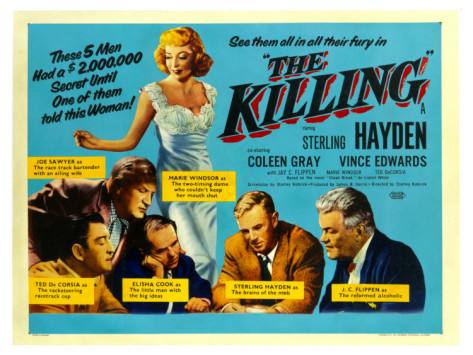
One of the very positive things to come out of Killer’s Kiss is Kubrick’s meeting with Jack B. Harris, a young TV producer looking to break into movie production. The result of that partnership was what both men felt would be their calling card in Hollywood, The Killing.

Please note – this scene does not appear in the movie. Sorry to disappoint.

Based on a paperback Harris found one evening, it’s a story about a well-planned robbery at a horse track, and how it still goes wrong. Having a bit of a budget to work with – admittedly, a small one, but much more than he ever had to work with before – Kubrick starts assembling a dream crew. A crime writer he’s always admired, Jim Thompson, works on the screenplay. Once Sterling Hayden signs on, Kubrick calls on his encyclopedic knowledge of film and pulls together a gang of interesting, reliable character actors – Elisha Cook, Jr., Marie Windsor, Timothy Carey. He gets a real Hollywood cinematographer, Lucien Ballard, though that was largely a result of film union rules. Predictably, the two did not get along very well.

The result: a quantum leap forward.

Sterling Hayden is Johnny Clay, a small-time hood just out of the pen. He’s spent the time planning out a way to rob a horse racing track and get away with two million dollars. He puts together a group of “not exactly criminals” but guys in the right positions to make his plan work, and moreover, reasons to make it work: a ticket clerk with a greedy wife, a bartender caring for a sickly spouse, a cop who owes a loan shark big time. There are also two actual criminals, who will handle the distractions necessary for the plan. Clay pays them a flat fee, knowing they’re professionals and will carry out their part without many questions and aren’t likely to give the cops the time of day.

Clay’s plan is complex, but not so complicated there’s room for things to go wrong. Part of the draw of the movie is that time becomes more fractured as we get closer to the heist, going back in the day over and over again to see the disparate parts come together. Of course, there’s one big kink in the plan, and of course, it’s a dame. This is noir we’re talkin’, after all. The ticket clerk (Elisha Cook Jr. at his Elisa Cook-iest) makes the mistake of mouthing off about upcoming big money to his feckless wife (Marie Windsor), who in turn tells her boyfriend, small-time hood wannabe Vince Edwards.

I still think of Vince Edwards as Ben Casey. Seeing him in roles like this always disorients me.

Crime fiction lives and dies on its character work; the very best employs unique takes on this end of human potential and the shapes it takes. I’m a very bad completist, I didn’t seek out a copy of Lionel White’s novel to find out how much of the final product is him and how much is Thompson; the extras on the Criterion disc indicate that the framework is mainly White, but things like the relationship between Cook and Windsor gained greater prominence under Thompson. The guy who Clay hires to start a one-man riot in the racetrack bar, a nigh-incomprehensible Kola Kwariani, is practically a movie in himself, a thoughtful bruiser Clay tracks down at his job in an “Academy of Chess and Checkers”.

I do think, however, the weirdness of the sniper character Timothy Carey brought with him.

The ability to actually build sets gives Kubrick the freedom to move the camera in ways he never could before, when he was trapped in actual apartments or forests where he couldn’t lay track, even if he could have afforded it.  A long dolly shot  the length of an apartment, through several rooms, the camera apparently passing through walls, is so damned good it gets used twice, once in daytime, once at night. There is one pretty obvious rear projection shot, but it’s 1956, and those were the norm.

It was the non-linear quality of the heist that the suits did not much care for and that animosity was likely the reason it didn’t open well, without much of an ad campaign or chance to build word of mouth. It wouldn’t be the last time that the powers that be not only didn’t get Kubrick, but were openly dismissive. Critically, the film was a success, though, and got Kubrick and Harris the calling card they needed.  The next stop would be Paths of Glory, and a legend would begin to unfold.

So, yeah, short version: I dug it.

Wu Xia (2011)

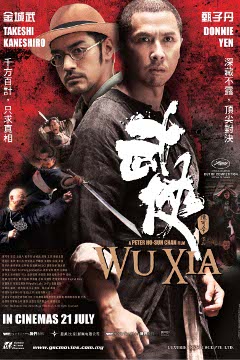
I suppose when you spend a fair amount of time pondering a film’s title rather than addressing any shortcomings, that’s a good sign. That’s where I am with Peter Chan’s 2011 Wu Xia.

In early 20th century provincial China, Liu Jinxe (Donnie Yen) has a simple, but good life: a papermaker in a small village, he has a wife and two sons. The quality of his paper has brought a bit of prosperity in the village. But when two traveling criminals decide to rob the general store, and set to brutalizing the aged owners, Liu desperately steps in, and after a hectic donnybrook, both criminals are dead, seemingly more by accident than anything else.

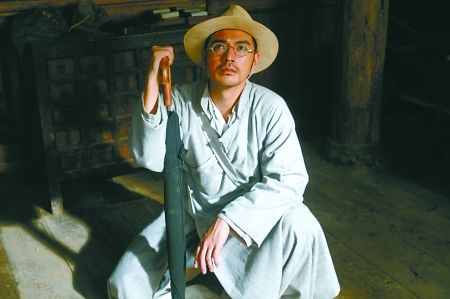
But there are things that do not sit right with assistant inspector Xu Baiju (Takeshi Kaneshiro).  From an examination of the corpses and the scene of the fight, he begins to suspect that the seemingly peaceful and thoroughly average Liu is not only a martial artist of no small skill, but also a criminal on the run from past crimes. Determined to see justice done, Xu finally bribes a judge for the warrant to arrest Liu, unwittingly alerting the very man from whom Liu is actually hiding – the head of the notorious 72 Demons (Jimmy Wang Yu).

I know what you’re going to say. You’re going to say, “Wait a minute. Isn’t that the plot to A History of Violence?” Well, yeah, sorta. The insertion of Kaneshiro’s character adds a different air of uncertainty to the proceedings. The scenes of Xu reconstructing the fight from the smallest of clues is a fascinating bit of special effects wizardry, as the detective walks through slow motion footage of the fight, observing the carnage. Xu Baiju is an expert in physiology and acupuncture, using the needles to stave off the effects of a poison he was given in a case gone wrong many years before. Also, since that case, he has been haunted by his own doppelganger, who urges him on to satisfy justice. It’s that bit of instability that casts doubt on Xu’s actions.

Kaneshiro plays this sort of brainy character with arcane knowledge well; he was superb as the master strategist Zhuge Liang in John Woo’s Red Cliff. He and Yen play well off each other, and it has to be said that Donnie Yen’s gentle everyman portrayal adds another level of uncertainty to the investigation. Tang Wei, last seen in Lust, Caution, is alternately lovely and heartbreaking as Liu’s wife, Ayu, who hasn’t delved too deeply into Liu’s past, fearing that he will vanish from her life, as did her first husband. Seeing her character deal with each new twist in her life is particularly moving.

The movie’s plot is classic slow burn material; the gloves do not truly come off until nearly an hour and fifteen minutes in, when two representatives of the 72 Demons (one of which is the welcome return of another kung fu favorite, Kara Hui) attack the village and Liu must drop his pretense of normalcy and intervene before more people die. It’s a truly electric moment, given that build-up, and the ensuing battle does not disappoint; sadly, I feel the movie never truly reaches that height again, not even in the final fight with Wang Yu, which contains a nicely ironic riff on his earlier career, but also ends with a device so close to an almost-literal deus ex machina that it’s hard not to feel cheated… cool as it admittedly was.

That should not defer you from seeing this – it’s an exceptionally good movie. The cinematography is beautiful, the countryside rendered in lush color, the period design in the village excellent, and the direction, superb. Peter Chan has worked his way up from comedy through horror (Three Extremes II) and into this sort of thoughtful foray into violence – he also directed The Warlords, another excellent movie that I likely would have waxed eloquent over if I hadn’t just seen Red Cliff.

As to my head scratching over the title; wuxia, as you might know, is actually the name of a genre in Chinese culture, the sort of story with righteous martial artists doing righteous things. That’s not, strictly speaking, what this movie’s about. I think the title came more as a result of the success of the previous year’s Jianghu (in the West, Reign of Assassins), which is the term for that “world of martial arts” we keep hearing about, the alternate universe where wuxia stories take place. The agreed-upon international title of Wu Xia is Swordsmen, although, again, not so descriptive of what happens. Dragon is the title given as the “IMDb Display Name”, whatever that means. That title either makes me think of the Bruce Lee bio pic or, God help us, a Clive Cussler novel.

So Wu Xia it remains, Wu Xia I shall call it. A Donnie Yen movie which, like Legend of the Fist, does not give us much in the way of Donnie Yen doing what we love seeing Donnie Yen do, but unlike that Andrew Lau snoozefest, uses that lack of action to good effect.

The List: Crime Time

Yeah, I swore I’d start taking these movies one at a time, but that didn’t work out so well, did it. The reason why can boiled down to two words: The Godfather.

I didn’t see The Godfather when it was first released, back in ’72. Couldn’t have, even if I’d wanted: it was rated R, and my folks had no desire to see it. It wouldn’t be until I was out on my own, in the 80s, when I was demonstrating to my then-roomate, the late Red Mitchell, what he had been missing in the way of cinema by being a football hero through high school. I brought him into the ways of The Maltese Falcon and The Quiet Man, among others… and then he was shocked that I had never seen The Godfather. One trip to the video rental store later, and we rectified that.

Look, I don’t have to tell you this, but oh my God is that movie ever good.

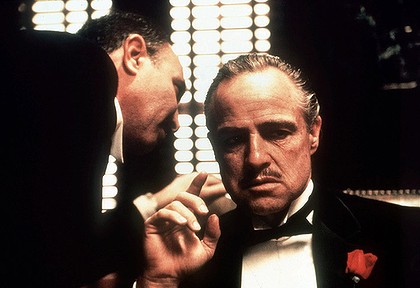
Like apparently any movie based on a best-selling novel, Godfather had a troubled production (not the least of which was the real-life Mafia trying to shut the movie down), but when it was released, it was a bona fide sensation, a cultural phenomenon. Watching it again after nearly 25 years on Blu-Ray, the “Coppola Restoration”, I see that it is still no wonder. Coppola and Brando both have a very uneven track record; but both men are firing on all cylinders in this, and the rest of the cast is similarly at the peak of their powers. It is one of those three-hour movies that doesn’t feel that long, at all.

Again, I’m not telling you anything you don’t already know; moreover, I can’t tell you anything you don’t already know. When you get right down to it, I’m a guy who likes to watch movies and then write about them a little. Didn’t go to film school, didn’t read any books on critical analysis. There’s nothing new I can bring to this party, except personal observation. And my personal observation is: I wasn’t as blown away as I was the first time I saw it. That is to be expected. My reverence for it, though, did not slip an inch. This is an American classic that deserves to be called an American Classic.

Which would have made for a brief, if honest, post.

Now, on the other end of the spectrum we have the second movie in my Stanley Kubrick Project, Killer’s Kiss.

Um, the gal on the right? I’m afraid I missed that part…

To call the plot of Killer’s Kiss slight is no mean jab, it’s the honest truth; it doesn’t even fill the 67 minute running time – there’s filler in the form of a complete boxing match and a ballet number while Gloria (Irene Kane) tells the tale of her sister and father to the sympathetic Davey (Jamie Smith). The rest of the movie is about Davey, a washed-up boxer, trying to help his neighbor Gloria, a taxi dancer, to get out from under the thumb of her boss, small-time hood Vincent Rapallo (Frank Silvera, the MVP of Kubrick’s first movie, Fear and Desire).

There are, of course, complications. This is noir, after all. Rapallo’s goons, sent to rough up Davey, pick the wrong guy and accidentally kill him, leaving the boxer under suspicion for the murder. They then kidnap Gloria because she can finger them, and Davey tries – not too successfully – to rescue her.

If it’s not too beefy in the plot department, where Killer’s Kiss excels is in the photography. Kubrick had done a number of photo spreads of Chicago for Look magazine, and his vistas of New York in the mid-50s – unglamorous, decaying – distills what noir is frequently about, as he sets his camera far back and low so the city becomes monolithic, perched above and ready to devour the characters. Kubrick’s photojournalist eye captures images without commentary, the seediness of the reality telling far more than any commentary layered upon them possibly could. There’s a reason that the Turner Classic Movies All Night bumper has three shots from the movie: The guy in the ticket booth, the dolly across the Dance Hall, and the blonde taking off her dress – that’s Gloria.

Kubrick’s still trying to work out his storytelling chops (he would, in the future, eschew original screenplays and go strictly for literary adaptations), but in the visual department, he’s already firing on all cylinders. Gone are the coverage errors that required clumsy editing solutions in Fear and Desire. Davey’s pursuit across the rooftop of a massive storehouse is done in long shots, emphasizing his aloneness as Rapallo and his thug close in; this leads to the final fight scene in a mannequin storeroom that trades in the empty space of the roof for an enclosed space that is, at the same time, crowded and yet just as empty. It’s a surreal, exciting climax, that along with the amazing cityscapes, gives the viewer a very nice preview of the director’s capabilities.

So the first two Kubrick movies: definitely tyro efforts, but there is a very clear improvement in his use of the medium; both worthwhile, for entirely different reasons.

The Stanley Kubrick Project: Fear and Desire (1953)

In one of my fits of monthly hubris, I decided that I would watch all of Stanley Kubrick’s movie in chronological order. I do stuff like that all the time, and sometimes I even finish it. Yeah, like that time I decided to read Dave Sim’s Cerebus, all 300 issues of it. I may try to finish that one day, if my bile levels ever descend from the toxic levels those last couple of volumes created. Then, I’m a very happily married man, so as far as Sim is likely concerned, I am irrevocably corrupted.

Cripes, I go off on tangents so quickly, I really should have the ADD demographic sewn up by now. Now, as to where I was going originally: why Kubrick? The only answer I have, I am afraid, is why not? On a purely practical level, I have a box set of his movies that stretches from Spartacus to Eyes Wide Shut, which only left me three movies to chase down, since I already had a copy of Paths of Glory. Over the years, I’ve seen some, but not all, of his movies, and generally enjoyed them. And, in the form of The List, it’s my goal this year to watch more movies which, in the mainstream, are considered “good”, not merely the ones with the best gunfights.

Kubrick’s first movie is called Fear and Desire, and it is an arty, ultra-low-budget war movie. We are not told which war or where; in fact, the opening narration tells us “These soldiers that you see keep our language and our time, but have no other country but the mind.” Got that?

Four soldiers – a looey, a sergeant and two privates – are stuck behind enemy lines after a plane crash, which economically happened before the movie started. They plan to float down a river to friendly territory, but events keep complicating matters. A local girl stumbles upon them, and they have to take her hostage. A nearby farm house is found to be acting as a garrison, with an enemy general on station, and Sarge starts getting obsessed with the idea of killing the general on the way out.

Now that, at face value, could easily be a Roger Corman war picture; a plot that keeps things moving, a pretty girl shoehorned into the proceedings. Kubrick and screenwright Howard Sackler had a different idea, though. In this “any war”, we are privy to the inner monologues of our soldiers, first as they hike through the enemy forest, and we hear them all at once, four men’s thoughts rising to a fearful cacophony. Sgt. “Mac” has several of them, as he floats on the raft toward a suicide mission for which he himself has chosen, argued, even begged. When the unstable Private Sidney (an amazingly young Paul Mazursky) is left to guard the girl, his private monologue becomes public, ludicrous and pathetic.

Probably the cap on the artsy part comes when Lt. Corby (Kenneth Sharp) and Private Fletcher (Stephen Coit) sneak up on the house to kill the general and his aide while Mac draws the sentries to the river to shoot him up; The General and the Aide are played by… Kenneth Sharp and Stephen Coit. The two men are stalking and murdering themselves.

Aaah, I’m being a horse’s ass, but I’m not alone. Kubrick himself eventually disowned the flick, and it’s rumored he tried to have all prints destroyed, but I haven’t found any real evidence of that. There is evidence he seriously downplayed any showing of it in later retrospectives. He was being too tough on himself, but then, there’s no surprise in that from a notorious perfectionist. You do catch glimpses of genius working its way out at various points, but you also see Kubrick the editor cursing Kubrick the cinematographer, as he has to employ rapid, out-of-place close-ups to cover holes in the coverage.

It’s certainly no worse than a lot of zero-budget first films I’ve seen, and better than many. Of the many questions I have to ask, the most significant one is: Every article about Fear and Desire lists the movie’s length at 72 minutes. My copy – the Eastman House print – ran a few seconds over an hour. So the question here is: Huh?

The List: The Good, The Bad, The Weird (2008)

Well, it’s late Sunday and nobody has died yet (knocking on wood) so my movie from The Other List of the day was The Good, The Bad, The Weird, a Korean Spaghetti Western from director Kim Jee-Woon, perhaps most notorious around these parts for A Tale of Two Sisters and I Saw the Devil.

In 1930s Manchuria (a canny choice for a substitute wild west), there’s a plan involving a double cross for a map to an unknown treasure somewhere in the Gobi Desert. A small-time thief steals the map before the hit man hired to do the job can reach it, and both men are being pursued by a bounty hunter. There’s our three title characters, very much along the lines of The Good, The Bad, and the Ugly. Also looking for the map is a gang of Manchurian bandits and the Japanese Army, as if things weren’t already going boom enough.

It also makes me wonder what the modern action movie would do if Santa Esmerelda had never done their cover of “Don’t Let Me Be Misunderstood”.

The most expensive Korean film ever shot at the time, there is no doubting the production values on display here; from the opening train robbery to a couple of settlements that are destined to go up in explosions and gunfire, the design and execution is top-notch. Kim really gets his money’s worth from his steadicam and various cranes. The camera work is fluid and frequently dizzying, swooping along with the action like a bird of prey.

If there is anything I would criticize, it would be the movie’s length: at a little over two hours, I – remarkably – got tired of things blowing up real good (same thing happened to me with Terminator 2). There are at least two extended scenes that could be scissored without ruining the overall movie, but… that’s not up to me. It’s a bit lengthy, but still quite enjoyable.

As I ponder this, I realize this movie may be the first casualty of my push to watch films of a higher caliber (to use an unfortunate but all too appropriate turn of phrase). Sheer, zestful entertainment like The Good, The Bad, The Weird was the sort of movie I lived for, and to see it done this well should have me turning cartwheels and calling up people to insist they view it. But good as it is, it’s about as deep as a shell casing; I find I want more dimensions from the movies I watch. The Good The etc. is a very good action movie, it aspires to be nothing more than a very good action movie, and that’s admirable.

I’m just greedy.

Shaolin (2011)

It has finally happened; all my local Blockbuster videos – or, as I refer to them, “The Used DVD Store” – have closed down. This shouldn’t surprise me in the least – I haven’t rented a movie in years, except through Netflix, and if you’re only interested in renting, I suppose the buck-a-night Redbox deal is pretty sweet. But as befits my encroaching age and incipient dinosaur-hood, I like to own my movies. This was a childhood dream, being able to watch a movie anytime I want, without suffering the cold equations of TV programming. One of the many, many reasons I’m not taking to streaming like everybody says I should. Between people complaining about stuttering feeds and having no control over what is available on any given evening, I just don’t feel the technology is quite there yet. Not to mention I just bought a Blu-Ray player, and my already high expectations of audio and video quality have gone through the roof.

I’m aware this puts me in the same camp as audiophiles who were dismayed that people were really going for those compressed mp3 thingies that JUST. DIDN’T. SOUND RIGHT. So be it. Nothing irks me faster than digital artifacts in a moving picture.

Well, that was a hell of a digression. Didn’t mean to go there. What I was trying to say is that I was one of the vultures picking over the carcass of Blockbuster, buying used discs while I still could. I got mainly stuff I had only sort of wanted – you know, not enough to actually go out and buy them outright, but maybe enough to put on my Amazon Wish List or maybe that dreaded Netflix Instant Queue – but here it is, it’s less than ten bucks (often less than four), I’ll take it. Copies of Grizzly Man and Cave of Forgotten DreamsSauna, one of the few horror movies in the last few years to actually have an effect on me; Blu-Rays of Raging Bull and Black Dynamite and Vanishing Point. Some flicks I had curiosity about: Suck, Dead Snow, Pontypool, Hobo With A Shotgun. And, finally, Shaolin.

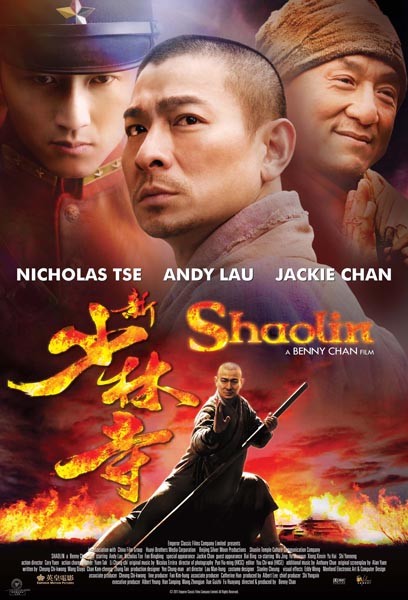
Andy Lau plays General Hou Jie, a warlord who pursues a vanquished enemy into the Shaolin Temple and kills him. (I’ll note here that this is sometime in the early 20th century. Hou appears to be using the Chinese version of the broomstick Mauser pistol, which could place it around 1920 or so). The wheel of karma and movie plots being what it is, Hou will wind up at that selfsame temple with his mortally wounded daughter, far too late to save her. Having lost everything, Hou begs to become a monk, and through the study of kung fu and Buddhist sutras, he attains a state of martial zen; he releases all the greed, fear and hate that made him such a terror in the Outside World. Alas, the subordinate who mutinied against him is still busy, and the Outside World will soon come calling on the Temple again.

That’s a sturdy plot, if somewhat unoriginal. Where Shaolin establishes its own identity is in the wholehearted conversion of Hou. He realizes that he is responsible for the behavior of his former lieutenant, Cao Man (Nicholas Tse), and wishes to not only save the people Cao will murder to cover his sale of Chinese relics to foreigners, but to also save Cao himself, to share the state of grace that total repentance has given him.

And, surprisingly, the movie has the moral courage to actually go through with it. The movie has an almost Shakespearean body count by the end, but Cao is one of the survivors, and seeing him shattered and crying in the burning ruins of a battlefield, surrounded by dead bodies, is truly moving.

Shaolin doesn’t follow the template of the last few modern martial arts movies I’ve seen, which also predisposes me toward liking it. I know I’ve mentioned it before, but here we go again: Jet Li’s Fearless, Ip Man & Ip Man 2, True Legend all end with the hero squaring off against a foreign devil – several foreign devils, in the case of True Legend, and some tigers – and the hero must beat the foreign devil for Chinese honor. I’m okay with that concept, but not a steady diet of it. (Legend of the Fist: The Return of Chen  Zhen also did this, but I didn’t remotely like that movie, so it doesn’t exist) I fear the chances of getting a movie like this out of mainland China that doesn’t double somehow as propaganda are getting increasingly slim.

There are, absolutely, foreign devils in Shaolin, military types that want to sell machine guns to the local warlords in exchange for building a railroad through their territory. It’s these bastards who are buying the relics, and who, to cover up their own crimes and failures, order the shelling of the Temple during the climactic battle. Man, foreign devils ruin everything.

Jackie Chan is in there, too, playing a supposedly minor role as the Temple Cook, who studied martial arts for a few years, decided he didn’t get it, and took to the kitchen instead. Of course, the Cook slings around huge iron woks and man-sized piles of dough with no trouble, so we know he’s eventually going to get his fight scene. Chan is, as usual, affable and tremendously likable. Lau has always been a fine, charismatic actor, and though he’s not a trained martial artist, moves well enough that a skillful director can always make him look good in the action scenes, and Benny Chan’s been around long enough to know how that works. His camera swoops around the Temple, making it a character in its own right; it and the shanty town built around it by refugees give the proceedings a properly historic heft, a timeless, epic feeling that extends beyond the miserably mundane concerns of the warlords.

Shaolin is a movie that treads ground certainly treaded before, but treads it with ease and solemnity. It may all seem very familiar, but it is familiar like your favorite comfort food: warming and always welcome.

The List: One Word or Less

Man, a lot of noteworthy – well, noteworthy in the sub-spheres I inhabit – noteworthy people died last week. Sheldon Moldoff, an artist who did many berserk covers for comic books in the Golden through early Silver Age; Ralph McQuarrie, another artist, responsible for the look and feel of Star Wars, Battlestar Galactica, Close Encounters of the Third Kind, and E.T.; and, to bring it into the realm of this blog, Davy Jones.

Jones was, of course, the “face”, the “cute one” who fronted the Monkees. The Monkees are an odd thing to consider. I loved their shows when I was watching it on Saturday mornings, where I recall CBS put the syndicated series on several years after NBC had cancelled the primetime series. Watching them recently… well, not so much. As the boys exerted ore and more influence over the show, it became less stable, more obtuse (though I suspect I would still like the final episode, directed by Mickey. That was hilarious.).

Yes, they were the Pre-Fab Four, auditioned and cast when existing groups like The Lovin’ Spoonful weren’t available.

The more research you do, the more puzzling it becomes: no, they didn’t play the instruments on their first couple of albums, only supplied voice tracks; yes, they could play. Mike, I knew about. Peter came from the folk scene, and knew guitar and keyboards; Mickey could do guitar, but learned the drums because Davy, who could play them, was too short for the cameras to see over the drum set. In spite of the fact that it’s Mickey doing lead vocals on most of the songs.

The self-destruction of The Monkees seems almost scripted as well – or, at least predictable. Conceived as an attempt to emulate Beatlemania, the emulation became truth, and the boys began to chafe under the control of Don Kirschner, wanted to write and perform their own music, to be their own men. The same conceit that birthed them gave their critics their biggest ammo: they couldn’t play their instruments, they used session musicians, they didn’t write their own music. There’s truth in all those, but it was also true of a lot of popular groups. They were perceived as having had success handed to them, unearned, and that hurt.

So it was pretty much by accord that the TV series was cancelled after two years; The Monkees weren’t interested in doing it anymore, and NBC was tired of dealing with them. Producer/Director Bob Rafelson used the box office success of A Hard Day’s Night and Help! to get funding for a Monkees movie. The result was Head, it was a dismal failure at the box office, absolutely buried under an obscure ad campaign and oddly chosen venues… and it is one of my very favorite movies of all time.

So of course, the day Davy died, I had to watch it.

I’m not even going to try to give you a synopsis of what goes on in this movie – that’s like trying to close your fist around a glob of quicksilver. It is possible to recount exactly what happens in HeadChad Plambeck does it pretty effectively here – but even then, it doesn’t match the full effect of the movie. There is no plot, and trying to find one will only frustrate you; but if you follow the advice of a stoned William Hurt in The Big Chill and “let art wash over you”, what you get is the truest translation of an acid trip to film ever accomplished. Neurons firing multi-colored bursts in all directions, someone keeps changing the channel and there’s Monkees on every channel. An idea slides smoothly into another idea, never mind that one has nothing to do with the other.

People like Chad and other folks smarter than me feel they have found the meaning behind the chaos, and they make damned good cases for it, too. Me, I just like to sit and enjoy the madness.

My favorite moments, of course, are the meta moments. During Davy’s tenement romance sub-movie, complete with Annette Funicello love interest (Rafelson, not knowing if he would ever make another movie, said he made about 50 of them in the course of Head) he’s a violin player who wants to be a prize fighter. Davy is getting the living hell beaten out of him by Sonny Liston (yes, really) while Mickey, in the crowd, is yelling “Stay down! Stay down!” When Mike, playing an obvious crime kingpin, calls Mickey a “dummy”, Mickey goes berserk, climbing into the ring and punching out Davy (“Stay down!”) and Sonny, and in fact, all comers, screaming “I’m not the dummy!” until he is calmed down by Peter, who appears against a wall of boxing ring smoke (or is it supposed to be a sort of heavenly haze?) and tells him, in a calm, steady matter-of-fact voice, “You’re not the dummy, Mickey. I’m the dummy. I’m always the dummy.”

In my post-young fella years, I find that Peter is the one I wind up liking the most.

Since we’re doing this in Davy’s honor, though, here he is singing “Daddy’s Song” by Harry Nilsson, dancing with Toni Basil and tripping everybody’s head out. Reminds one that Davy started out as The Artful Dodger in the Broadway Oliver!. And, oh yeah, there’s some guy named Frank Zappa in there, too.

Yeaaaaah, either Columbia didn’t know what to do with it (likely) or just decided to bury it (also likely). In any case, I had never really heard of it until it cropped up on the CBS Late Night Movie one night and I said, “Wait. The Monkees made a movie?” It seemed to have a very healthy life in bootlegs after that, until it got a legit release on VHS and then DVD, and now it’s part of a box set from The Criterion Collection.

I cannot tell you how impressive the Criterion disc of Head looks. I bought the set (America Lost & Found – The BBS Story) before I purchased a Blu-Ray player, and I can only imagine what this sucker looks like in true high-def. The upscaled DVD is almost painfully sharp, allowing me to see details I had never noticed before, like the designs painted on the psychedelic mermaid’s faces in the opening number “Porpoise Song”. In another meta bit, where at the end of a scene “Cut” is yelled and we see the whole film crew bustle about for the next setup, we see Producer/Screenwriter Jack “Lookit me, I’m so young” Nicholson. But what I had never noticed before, in that same bustle, is Dennis Hopper, wearing his Easy Rider togs, which would be Rafelson’s next Producer gig.

On top of that, in an earlier portion – a World War II movie – Peter is trying to get some ammo for his squad, but keeps getting tackled by Green Bay Packer Ray Nitschke. Peter escapes with some ammo, Nitschke throws his golden football helmet after him, and Peter gives it to Mickey, who considers his GI issue helmet “a drag”.

The next time we see that golden football helmet, it’s going be on Jack Nicholson in Easy Rider. This stuff can make your head spin. Appropriately enough.

I actually did watch other movies last week. Let’s see if I can get through them without blathering 1000 words on each:

Doom is the new Justice League animated movie from DC Universe/Warner Brothers Animation. I was all set to give this one a bye until I found out it was apparently one of Dwayne McDuffie’s last projects, so I went ahead with my pre-order. In a lot of ways, McDuffie was the heart and soul of the animated Justice League series, Static Shock and some of the more exemplary DTV offerings via DC Universe. His untimely death last year was a serious, serious blow, and when movies like Doom come along, you find out all over again just how much we lost.

Based on the Mark Waid JLA story arc, “Tower of Babel”, Doom gives us yet another version of the Legion of Doom, this time headed up by the literally immortal Vandal Savage. Batman (being Batman) has detailed contingency plans on what to do if any member of the Justice League ever turns evil; Savage gets hold of these and refines them to lethal outcomes, then unleashes each superheroes’ arch-nemesis  upon them. It’s a good story, well-done, and features the familiar voice talent from the various animated series, plus Nathan Fillion as Green Lantern once again. I find that sort of continuity comforting; sometimes stunt casting the voices yields good results, sometimes they’re distracting and disastrous. I just know in my head that Batman sounds like Kevin Conroy and Superman sounds like Tim Daly.

Pretty good way to spend 80 minutes or so. Not sure I’m going to be around for any further offerings from DC Universe; I could be wrong, but I get a feeling of diminishing returns over the last year or so.

I followed up Doom with Cube, which was apparently a staple in the good old days of the Sci-Fi Channel before they started deliberately misspelling their name, and was a constant presence on the video store shelves. None of this ever meant I had seen it; there are lots of holes in my viewing history, and that is one of the things The List is about: remedying those absences. Not that Cube was on either of this year’s lists; but I listened to a typically excellent Projection Booth podcast covering it and thought, “Okay. I should nudge that further up the non-list.”

Cube is a low-budget sci-fi film with a fairly simple premise: Five people wake up in a high-tech structure of interlocking rooms. Each room is a cube, with doors on each wall, floor, and ceiling. Each door leads to another cubic room. And some of the rooms are booby-trapped.

With nothing more than the prison-type uniforms they wear, no food or water, they try to find a way out. At first they note sequences of numbers on each door; if the number is prime, the room beyond seems to have no trap. But even that dodge stops working, and they have to find the more devious, complex clues to make it through alive.

So, actually, what we have here is a movie that takes place largely in one room; sure, it changes colors to give the impression of multiple rooms, but that’s a brilliant setup for a low-budget film. What remains is a character study as the process wears away at each of our protagonists. The balance of power tips and changes; weak characters turn out be stronger than anticipated, and vice versa. That’s a tricky road to follow, but the actors, happily, are up to the task.The ending is… well, not anti-climactic, but unsatisfying. To me, anyway. This is one of those movies where you’re not really going to get any answers outside the ones the characters come up with themselves, and those aren’t going to get validated.

So that was three movies I watched last week. But now I’ve gone and brought up that gosh-darned List, and those of you keeping track at home (snort) have noticed that none of these movies is on either list. So I felt I needed to hit one of those movies  or feel myself a shallow mockery of a man. Of course, I was also on a bit of a roll, and I am unable to resist gimmicks. I had just watched three movies with lots of colors: the psychedelia of Head, the four-color mayhem of Doom, and the color-coded rooms of Cube. Did I have a movie on The List that also centered upon color in this fashion? Well, no, I didn’t, but I did have a movie that had a one-word title.

Hello, Inception.

Inception is one of those movies where really, seriously, I have no idea why it took me so long to see it. I was really excited by those trailers, back when nobody had the first damned idea what the movie was about, but those visuals. Well, it was probably a number of reasons that kept me away. Summers are notoriously tight on money for me, what with the AC bills. I still feel an adversarial relationship with most people who go to the movies these days. So anyway, when it came out on DVD, it was the very first Blu-Ray I ever bought, even before I had a player – one of those Blu-Ray/DVD combo packs – so I was probably, subconsciously, waiting until I could watch the Blu-Ray.

Hm.

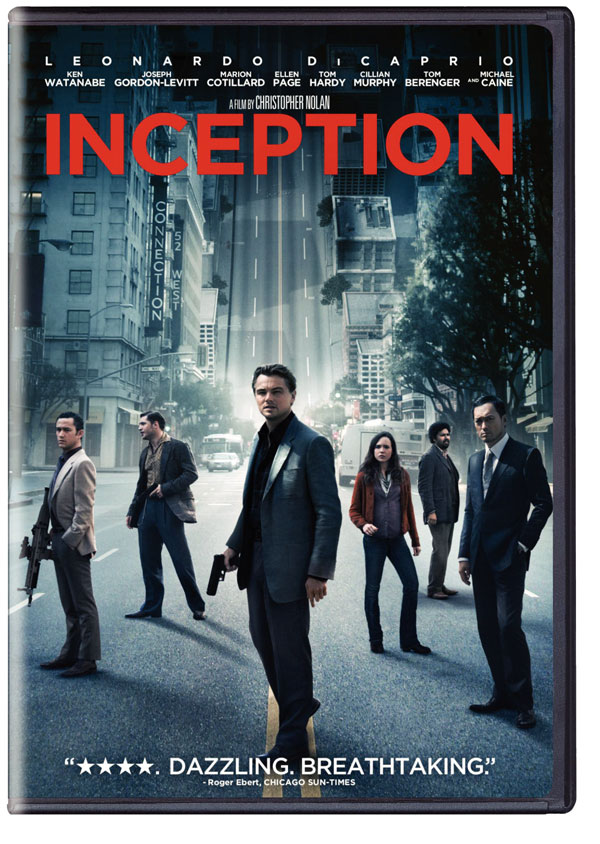
Probably, most of you know the basic concept, at least, of the movie by now. An “extraction” is the high-tech corporate espionage term for stealing information from a person’s brain while they dream; an “Inception”, then, is the placing of an idea in a person’s brain while they sleep. Much more difficult, and, in the world of the movie, next to impossible. But Leonardo DiCaprio, in order to get back into the country legally (a situation teased out over the course of the movie) is willing to give it a shot.This will require taking his team three dreams deep – a dream within a dream within a dream – to accomplish it. To complicate matters, the target’s mind has been trained to resist such antics, and his resistance takes the form of unrelenting gunmen. And the reason for DiCaprio’s expatriation – his dead wife – keeps cropping up to screw things up, which eventually requires going into a fourth level of dreaming – possibly even a fifth.

This is a real mindfuck of a movie, and I totally respect that. One needs to pay attention, or one is going to get lost. To Christopher Nolan’s credit, it isn’t that hard, if you keep your wits about you. The rules and conventions of this dream invasion stuff is laid out for you, as you need it, causing Joe over at the Daily Grindhouse to call this Exposition: The Movie. Well, we need that information, and it is played out so matter-of-factly, and in easily digestible chunks, that it’s never intrusive, and never slows down the story.

Inception is pretty close to being a perfect movie. Everything is in its place, everything serves a purpose. As far as possible, Nolan keeps his special effects in-camera, heightening the sense of realism, even when that realism starts getting  elastic. I’d say it was worth the wait, except the wait served no real purpose.

By way of coda, after my wife and I had finished watching it, she said, “Well, what was the point of that? Be sure to choose good dreams?” to which I could only reply, “I don’t think movies have to make a point. I’m personally willing to just let a movie take me somewhere else for two hours.” Which it did, and that brings us full circle. I let art wash over me, and I was refreshed for it.

I really need to start just writing about movies one at a time again. This is getting grueling.

The List: Samurai and Spartans

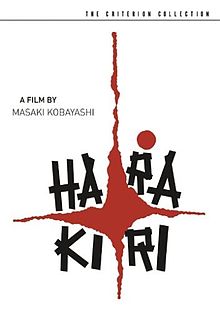
So, about a month back, I shared a couple of lists of movies I intended to watch this year. There was a list of 30 Quality Movies and a list of 30 Movies of the Type I Usually Watch (but have been putting off for one reason or another). The first list, I want to have 15 watched by the arrival of Summer. I am pleased I have finally knocked one off that list; and it was Harakiri (1962).

Harakiri was recommended to me years ago by a movie buff (and compared to this guy’s encyclopedic knowledge, I was an infant) while we were discussing Kurosawa. I was lucky enough to have seen The Seven Samurai and Yojimbo at the impressionable age of 13 or 14 during one of PBS’s World Cinema series. This was back around 1972 or so; for many years, that was it for samurai cinema for me. It wasn’t until the VHS revolution – and my move to Houston – that I was able to see Sanjuro and Rashomon. I was aware there were other Samurai movies out there, but where to start?

Well, one day I brought home a rental tape called Shogun Assassin and holy shit, to put it succinctly. So action-packed and kinetic, it literally ruined me for samurai flicks for many years. I was aware that Assassin was two movies mashed together, but I was still unable to shake the feeling that any other chanbara I saw in this time was slow and plodding.

Well, I’m older now, and am myself slow and plodding. I can now appreciate a movie with more deliberate pacing, and stories that slowly unfold themselves, which is a fair statement about Harakiri. It is also ironic that I go from that set-up to what is unarguably an anti-samurai film.

Harakiri begins with a ronin – a masterless samurai – presenting himself at the house of the Iyi clan, asking permission to use their courtyard to commit harakiri – ritual suicide – in honorable surroundings. The counselor of the house, in charge while the Lord is away, attempts to dissuade the ronin by telling him the tale of another ronin who, earlier that year, made the same request. At the start of the Tokugawa Shogunate, the houses of many provincial lords were summarily dissolved under a number of pretexts, suddenly casting thousands of samurai into unemployment. A current trend of ronin asking to commit harakiri has become a very real problem among the daimyo, who usually just give the ronin a few coins and send them on their way.

The House of Iyi, however, feels itself above such extortion, and forced the young ronin to go ahead with his threat and disembowel himself. In an extra piece of unfeeling cruelty, when the Iyi retainers found the ronin had pawned his swords and was carrying bamboo replicas, they force him to use his blunt wooden wakizashi to kill himself.

The older ronin is unimpressed by the story and emphasizes his desire to die rather than continue his life of abject poverty. The Counselor grants his wish, and once in the courtyard, the ronin asks for a specific Iyi retainer to act as his second, to strike off his head after he has cut his guts out – in fact, the same samurai who acted as the second for the younger ronin, and who ramrodded that unfortunate man’s punishment. He is found to be absent, at his own home, claiming illness. Two more seconds are requested, each of which played a major part in that earlier humiliation and death; each is also absent.

The ronin then reveals that he did indeed know that younger man, that he was, in fact, his son-in-law – and proceeds to tell the tale of their fall from grace with the dissolution of their clan, their attempts to eke out a living in the capital city. Disaster strikes in slow motion: first, his daughter contracts tuberculosis, then his infant grandson is striken with fever. There is no money for a doctor, and the son-in-law desperately tries the one course he can see open to him – the harakiri scam, which might at least garner him the few coins needed for a doctor, or at best – as is rumored to have happened – offered a place in the clan. Unfortunately, he chose the wrong clan.

The story is teased out in flashbacks over the course of two hours; the older ronin’s revenge is spelled out, and is at once most satisfying and appropriate, as well as devious, making his point to the assembled retainers, that samurai honor – bushido – is a thin facade which diminishes life, when life is really all that counts. The storytelling is masterful and often harrowing; the suicide with a bamboo sword is equally as brutal and painful as the scene where the older ronin realizes his adopted son sold his swords to get medicine for his ailing wife – a solution that had never even occurred to the older samurai.

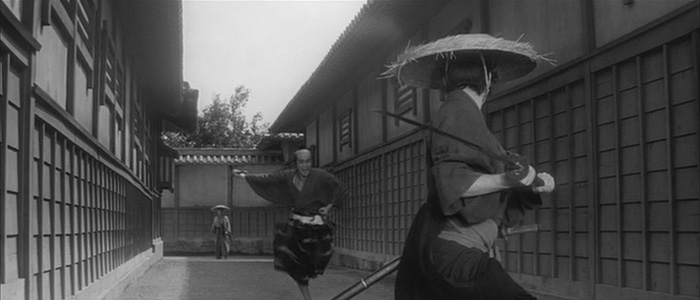
One can’t truly call Harakirichanbara – a sword-fighting film. There are two major fights, both at the end, one magnificently artistic and satisfying, the other messy and desperate. The overall feeling left the viewer is a sense of desperate futility, as the clan efficiently engineers a cover-up, rendering all the courage and suffering we’ve just seen superfluous and useless. Like all classics – and undeniably, Harakiri is one – the story is timeless, though set in the past. Thousands of people suddenly rendered unemployed by thoughtless, unfeeling Powers That Be – that doesn’t sound at all familiar, does it? And good lord, the scenes with the family realizing the baby boy is getting sicker and there is absolutely nothing they can do because they are poor – that hits way, way too close to home.

Yeah, it’s a classic. Don’t think I’ll be re-watching it on a whim anytime soon, though.

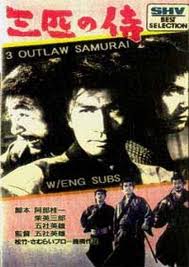
Small wonder, then, that I felt the need for somewhat lighter fare the next day, and what did I have to hand but Criterion’s new Blu-Ray of Three Outlaw Samurai (1964). I’m still in the beginning stages of my tour through chanbara, and Three Outlaw Samurai is the first movie of director Hideo Gosha, a name to be reckoned with in that field.

This movie is a sort of prequel for a popular TV series, an origin story of how the three title characters first meet. The first surprise is that the main ronin of the three, Shiba, is played by Tetsuro Tanba, who was also Omodaka, the samurai douchebag of Harakiri. Tanba had a pretty fine career stretching from the 50s to the 20-aughts, apparently acting up until his death in 2006, at the age of 84. Seeing the contrast between, at the very least, these two characters gives you some clue to his longevity.

The second surprise – okay not really a surprise, the Criterion Collection put it out, after all – is just how damned good this movie is, though good in an entirely different way than Harakiri. This is fine entertainment, with echoes of a good Western. At times I felt like I was watching another Sanjuro movie, and that is a really, really good feeling.

Three Outlaw Samurai starts – like Yojimbo – with Shiba wandering aimlessly, and happening upon an abandoned mill where three peasants have taken the local Magistrate’s daughter hostage to force the corrupt official to address the crushing taxes that are slowly starving the villagers in the area. Shiba acts disinterested in the whole matter – he only wants a place to sleep – until the Magistrate’s thugs arrive and assume he is a part of the plot, and Shiba has to administer a samurai butt-kicking to protect the roof over his head. Finding the peasant’s cause to be righteous, he wholeheartedly casts his lot with them. Meantime, the Magistrate is cleaning out his jail cells and offering amnesty and cash rewards to the criminals to go to the mill, kill everyone, and get his daughter back.

One of the jailed is Sakura, our second samurai, who switches sides once he finds out the peasant’s complaint; the third is Kikyo, a mercenary more interested in the money the Magistrate doles out than any moral issues (don’t worry, he’ll eventually come around, thanks to Shiba’s sterling example). It’s a lightning fast story of betrayals, double crosses and ultimate tragedy that ends with our three outlaw samurai, united in friendship, tossing a hairpin into the air at a crossroads to decide where they’ll go next. I can only assume that the series was like Route 66, except with samurai, which sounds like the Best Idea Ever.

So despite the fact that I have these two lists of movies I have sworn to see, the next night I was still in a martial mood, so I finally pulled out that DVD of The 300 Spartans (1962).

I love the story of the Battle of Thermopylae. I loved Frank Miller’s graphic novel, 300, even with its flaws and disregard for history. I did not like Zack Snyder’s movie version, which amplified those flaws a thousandfold by dressing them in a tenuous version of reality.

In the first fifteen minutes of The 300 Spartans, we have acknowledgement of the Battle of Marathon and the Athenian Fleet, which already makes it a thousand times better than 300. Unsurprisingly, Sir Ralph Richardson makes a great Themistocles and Richard Egan a rugged, honorable Leonidas (made even better by not being directed to shout all his lines).

Sure, the speech is elevated and florid, but I expect that from the Ancients. David Farrar brings more than a little comic book pulp to his Xerxes, but then, he’s the bad guy. I found the battle scenes and tactics realistic enough (I did a lot of tooth-gnashing at the Spartans breaking ranks to do individual slow-motion combat in 300. The Spartans were known for their close-quarter formations, not for their grandstanding) And… oh my God! ARMOR! Weren’t the Spartans supposed to lug something like 100 pounds of armor into battle? Not so much armor in evidence here, but at least they’re wearing some, which is more than I can say about 300. Frank Miller wanted to emulate the paintings on Greek urns. That’s a fine artist’s conceit, but translated into film, that just means a lot of oiled musclemen prancing about.

I will admit when I first saw the DVD cover art, my first question was “Why are these guys wearing Roman helmets?” Well, likely because they’re the leaders, and the Roman style was more open in the front, so we could see their faces. So I can’t really crow about the historical accuracy of this version either… but hey, dat’s da movies for ya.

So in effect, my weekend viewing was quite the gratifying affair; three good movies, movies I can recommend whole-heartedly, and without falling back on the cautionary phrases I usually have to employ for movies like Things or Darktown Strutters.  If you want excellent drama, go for Harakiri; epic historical fiction, The 300 Spartans; entertaining action with intriguing characters, Three Outlaw Samurai.

It’s rare that I get three movies of such quality in a row.  Hopefully, this is, as they say in Ancient Greece, a good omen.