A Month of Roger Ebert’s Great Movies, part two

As a tribute to the late Roger Ebert, some members of the Letterboxd community are spending May visiting films in his Great Movies series. Since this dovetails with my personal project of filling shameful voids in my film education, I decided to commit myself, once more, to a regimented schedule for which I don’t really have time, but hey, you know. Movies.

Rio Bravo (1959)

Poster - Rio Bravo_01Earlier this year, in the course of another challenge, I said that The Searchers is likely the Ultimate Western. That’s the sort of generalization that gives you pause, once you’ve made it, over and over again, as you think of other movies that might fit that position just as well. Its scope is not as broad, but that’s also a strength for Rio Bravo, the Other Ultimate Western.

This was director Howard Hawks’ first movie after a four-year hiatus following the critical and box office failure of Land of the Pharaohs. He had some things to prove to a lot of people, not least of all himself, and the result is a movie that is so darned good he took some its best parts and re-used them again seven years later in El Dorado.

Sheriff John T. Chance (John Wayne) locks up Joe Burdette (an astonishingly young – and thin – Claude Akins), the younger brother of the local ruthless cattle baron, for murder. This prompts big brother to seal up the town and start importing gunslingers to free Joe before the federal Marshall arrives in six days. Chance recruits his former deputy, Dude (Dean Martin) an alcoholic struggling to regain his sobriety and self-respect, and eventually Colorado (Ricky Nelson), a preternaturally calm and competent young gun. He’s already got cantankerous cripple Stumpy (Walter Brennan, sans teeth) overseeing the jail with a shotgun and an unending stream of invective.
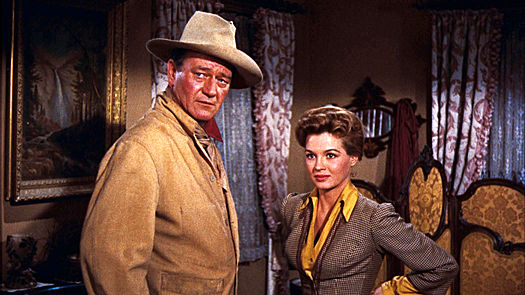
rio_bravoInto this siege situation Hawks also drops Feathers (Angie Dickinson), a peripatetic gambler who chooses to settle in Rio Bravo when she takes a shine to the Sheriff. Dickinson here is lucky to get the role of a typical Hawks woman, preferring the company of men to her own sex, easily the equal of any of them. Wayne the actor seems honestly uncomfortable with the idea of a love affair with a woman who is almost literally half his age, and that somehow makes The Duke adorable. But this movie also marks an important turning point in his career – Wayne is obviously no longer a young man, and here begins the line of movies dealing with that fact, through the 60s and eventually into True Grit and Rooster Cogburn.

Martin and Nelson seem like stunt casting, and that may be true in Nelson’s case, at the height of his popularity in the TV series The Adventures of Ozzie and Harriet, but Martin definitely worked hard for the role. It benefited his acting chops considerably when Hawks wouldn’t let him get away with his usual nightclub drunk schtick – Martin sinks his teeth into the uglier, pathetic parts of drying out, and when he finally gets his mojo back, it is a triumphant, memorable moment.

It’s easy to fantasize that you can pick and choose between the casts of this and El Dorado and swap out Robert Mitchum for Dean Martin, James Caan for Ricky Nelson… but truthfully, both movies are just fine the way they are.

The Big Sleep (1946)

el_sueno_eterno_1946_2It’s really ideal when you can follow a Hawks movie with a Hawks movie.

Humphrey by-God Bogart plays Philip Marlowe, prototypical private eye. He’s hired by the aging and slowly dying General Sternwood (Charles Waldron in his final role) to clear up the matter of some gambling debts and possible blackmail against one or both of his wild daughters (the elder of whom is Lauren Bacall). Of course, since this is from a Raymond Chandler novel, nothing is as simple as it first seems.

Rather famously, The Big Sleep was held over from its original release date to A) clear out Warner Brothers’ inventory of war movies when World War II ended earlier than Warner had scheduled; and B) to punch up Lauren Bacall’s character, reshooting several scenes and adding others a year after the original shooting had wrapped.  1944’s To Have and Have Not was a tremendous hit thanks in large part to the Hawksian chemistry between Bacall and Bogart (and obvious sexual heat, needless to say).

But you don’t monkey with the structure of a complex plot like Chandler’s without paying a price, and The Big Sleep‘s gets pretty muddled to accommodate the new dynamics. I was thankful I’d gone out of my way to see the more linear 1978 version with Robert Mitchum a couple of years back, it helped anchor me through the turmoil.

Still, it’s a good ride. Past the banter betwixt its two stars, you could spot this as a Hawks movie by the incidental characters: Marlowe keeps running into charming, attractive women doing their jobs – in one case, a normally male job like a cabbie – doing them well, and with enough smarts and sass to impress Marlowe. probably past their time in the story (were it not for Bacall, if you catch my drift). Lucky goddamn Marlowe.

Beat the Devil (1953)
large_tmtx7hDqcZGYyQ8H76I7ZKOumgmI didn’t have another Hawks movie on tap, so instead I went for more Bogart.

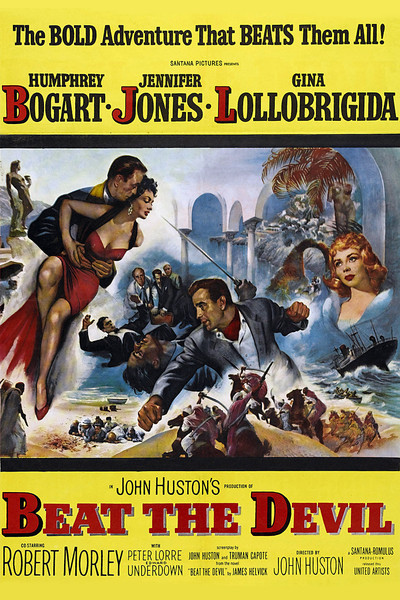
Beat the Devil is an odd bird, and most people don’t seem to know what to make of it. You have a collection of four rogues headed by Robert Morley and Peter Lorre, and they’ve thrown in with Bogart to purchase some land in Africa that they suspect is rich in Uranium. This setup is complicated by the fact that they are marooned in Italy while their steamer is repaired or the captain sobers up – “More than a day, less than a fortnight.” Also complicating matters is a British couple, the Chelms: the stuffy husband and the brilliant but talkative wife (Jennifer Jones), who has an overactive imagination that leads the rogues down all sorts of false assumptive trails.

That isn’t complicated enough? Bogart and Jones fall in love, and oh, didn’t I mention Bogart is married to Gina Lollobrigida? Gina is an ardent Anglophile who falls for Mr. Chelm.

It gets even more complicated than that, but this is another movie that depends on the joy of discovery, so let me just leave it at that. This is a stellar spoof of adventure movies with foreign no-goodniks in pursuit of atomic gold, and honestly, the only thing missing is Sydney Greenstreet, who had retired in 1949, suffering from diabetes and Bright’s Disease (which had plagued him through most of his movie career). Robert Morley rises suitably to the occasion, however.

Matters weren’t helped by the movie posters proclaiming “The Bold Adventure That Beats them All!” “Adventure At Its Boldest! Bogart At His Best!” Nobody went into Beat The Devil expecting an hour and a half of banter so dry you could make a martini with it (Truman Capote is a credited writer). Everybody plays it deadly serious, making it even more hilarious. Bogart is smart enough to just lean back and let chaos reign around him. And did I mention the director was John Huston? Yeah, this nestles between Moulin Rouge and Moby Dick.

Beat the Devil is definitely an odd creature. Enjoyable, as long as you know what sort of movie you’re going to get. Have a nice three-minute clip from early on…

Stagecoach (1939)
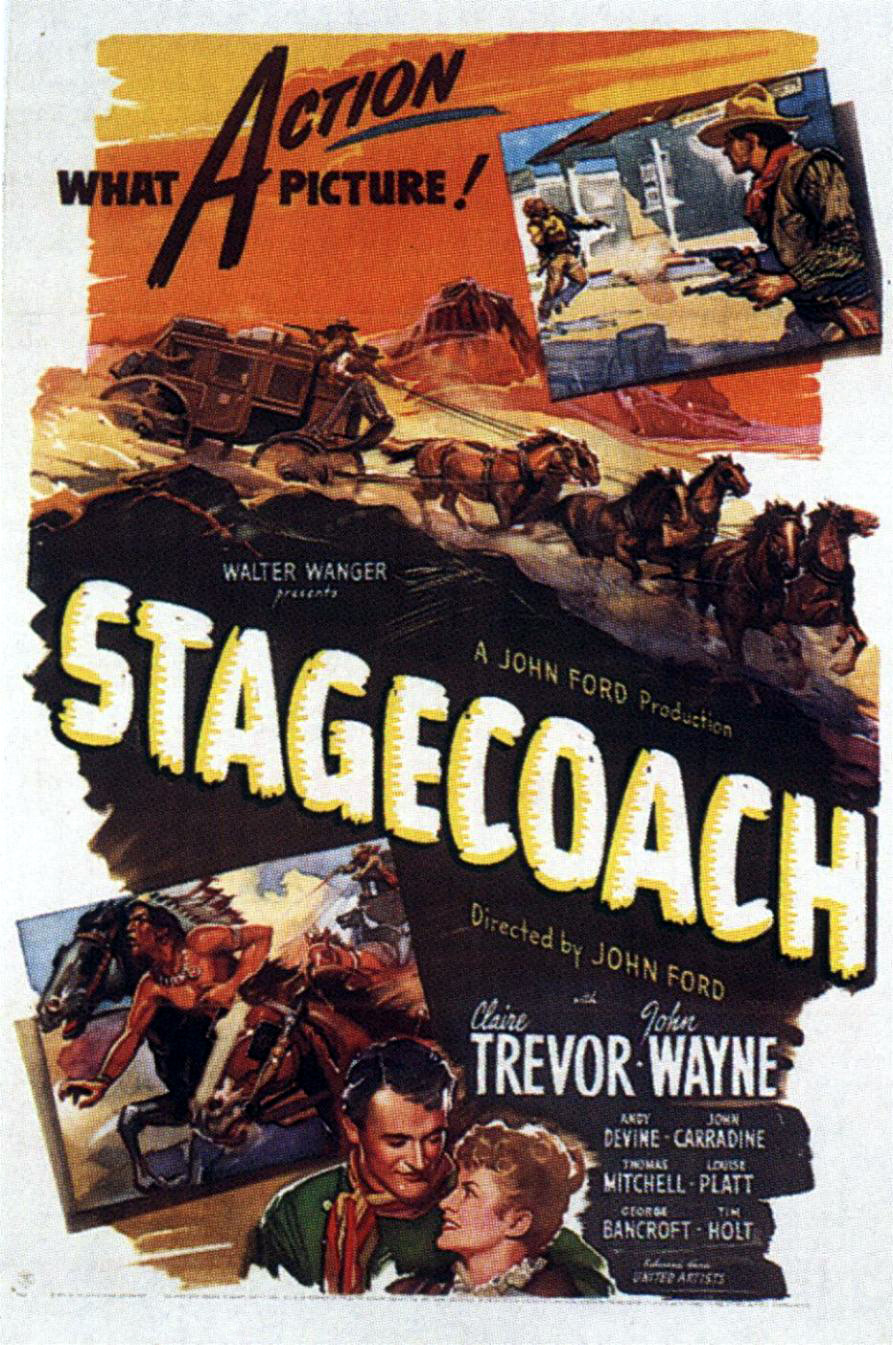
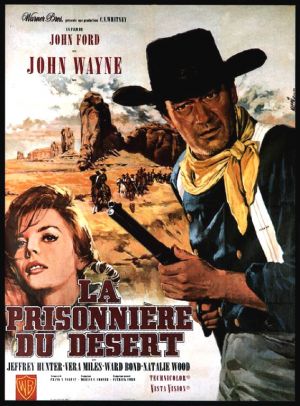
Poster - Stagecoach (1939)_03Out of Hawks and Bogey, I might as well bookend this with more John Wayne, right?

Stagecoach marks a number of notable firsts. It’s John Ford’s first movie shot in Monument Valley, and the first of a long line of collaborations with John Wayne. Wayne had, by this time, made a slew of B-Westerns. That worked against him in the casting process, but when Gary Cooper wanted too much money, Ford finally got Wayne.

Stagecoach takes a basic dramatic premise and plays it for all its worth: Throw a bunch of disparate characters in an enclosed space, put that space in danger, and let events play out. The title coach is making a regularly scheduled run, complicated by the presence of Geronimo on the warpath. The cast includes an alcoholic doctor (Thomas Mitchell) being  exiled from the town, and ditto a “fallen woman”, Dallas (Claire Trevor), whose crimes are never elaborated upon, since it’s still 1939. There is also a woman trying desperately to meet up with her Cavalry officer husband, a roguish gambler who takes her under protective wing (John Carradine, superb as ever), a banker running away with a mining company’s payroll (it’s also still the Great Depression, so boo hiss at the Banker), and a whiskey salesman whose sample case is going to be decimated by the doctor. And then they pick up the Ringo Kid (Wayne) on the way. He’s escaped prison to avenge the murder of his family by the Plummer Brothers, and unfortunately for him, the Sheriff is riding shotgun on the coach.

That’s quite a cast, and I didn’t even mention Andy Devine as the stagecoach driver. At this far remove, it is interesting to note that of this solid, often powerhouse group, Claire Trevor was at the time the box office draw.

stagemovieThe group dynamics shift throughout the journey, especially when the promised cavalry escorts keep getting called away to chase Geronimo. The scalawag Banker and the Officer’s Wife (and therefore The Gambler) want to keep pushing on, despite the danger – though the group is forced to shelter in place when the sickly wife is found to be pregnant and the doctor has to go into hyper-sober-up to get her through a difficult delivery, aided by the prostitute. During all this, the guileless and somewhat naive Ringo Kid falls for Dallas, thinking her just another lady; when they eventually arrive at their destination he’ll find out different, and it won’t matter.

That brief paragraph doesn’t begin to even outline the complexities of character and plot breezed through by Stagecoach in a mere 96 minutes. Viewing an extra on the Criterion DVD, a video essay by Ted Gallagher about Ford’s visual style, you find out how Ford threw exposition and character development simply by where he chose to point the camera in any given scene, and you realize that you are dealing with a director working several degrees above most of us. Tremendously humbling.

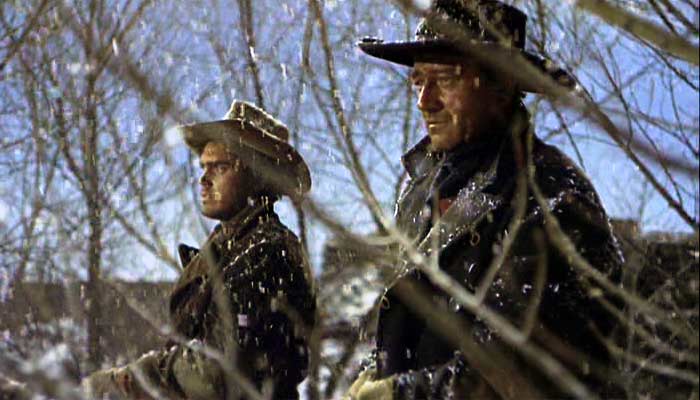
There are many, many reasons to watch Stagecoach, but I’m going to instead leave you with another first: the hat John Wayne wears as the Ringo Kid, he would wear in many another Western; its final appearance is as the beat-to-shit hat Chance wears in Rio Bravo, after the which the Duke finally retired it and kept it under glass in his house.

I love it when we can circle back like that.
A Month of Roger Ebert’s Great Movies, part one

As a tribute to the late Roger Ebert, some members of the Letterboxd community are spending May visiting films in his Great Movies series. Since this dovetails with my personal project of filling shameful voids in my film education, I decided to commit myself, once more, to a regimented schedule for which I don’t really have time, but hey, you know. Movies.

With the certain knowledge that I have to work the occasional evening, I started early, trying to get a buffer going.

Faust (1926)

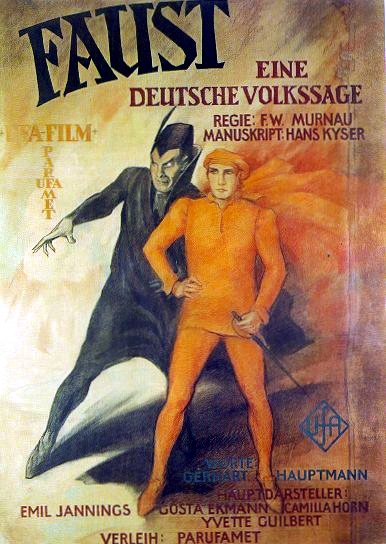
Faust-PosterLike any good horror nerd, I was familiar with F.W. Murnau’s Nosferatu – A Symphony of Horror, but remained sadly ignorant of his other works. After the phenomenal success of The Last Laugh, Murnau was given carte blanche for his next project, and the result was Faust, at the time the most expensive movie ever produced in Germany… until Metropolis, which we’ll get to later.

Based on various tales in German folklore, but most especially on Goethe’s play, Faust employs a setup well-known to readers of the Book of Job: Satan makes a bet with an archangel that he can corrupt Faust, a decent and devout man of learning. The Devil, of course, is a big cheater and sets loose the Black Death in Faust’s village. When he cannot cure the disease, Faust in desperation tries a ritual in one of his ancient books, summoning the Devil in the form of Mephisto.

3242077879-1Mephisto is an excellent marketer, offering Faust first a free trial day of unlimited power, then finagling to have the day end when the aged Faust, newly imbued with youth, is about to bed The Most Beautiful Woman in the World. Needless to say, Hell has a new customer. Eventually Faust returns to his home town, and falls in love with the shy maiden Gretchen. Of course, Mephisto put his powers to use, and being a demon, manages to frame Faust for murder and totally destroy Gretchen’s life. The demon has forgotten about the power of love, however, which prevails no matter how much misfortune he piles upon it.

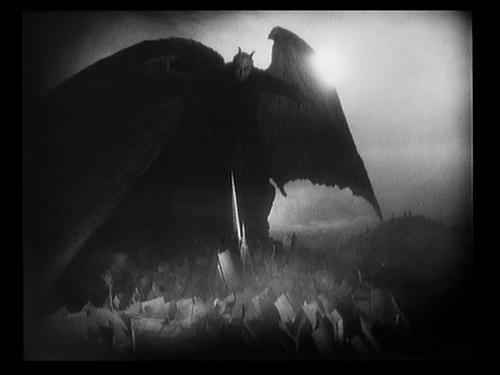
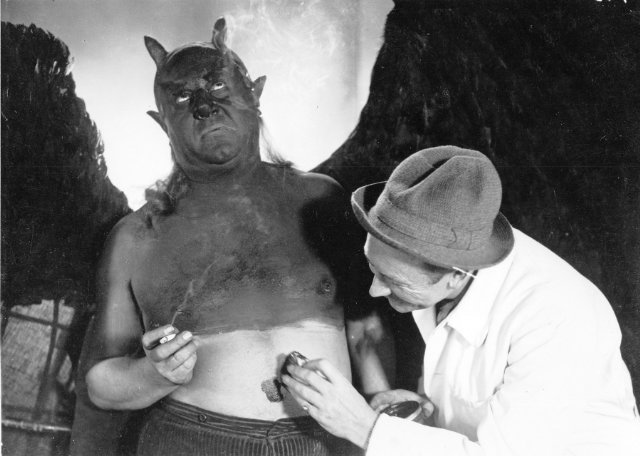
The imagery in the first act of Faust is stunning, puppets representing War, Pestilence and Famine on demon horses riding in the sky, Satan nestling  Faust’s village in enormous bat wings.  Moreover, the acting is surprisingly subtle for a silent movie. I had initially thought young and old Faust were played by two different actors, but no, that is Gösta Ekman in both roles. Emil Jannings already had a stellar career in movies when he starred in The Last Laugh, and as Satan and Mephisto, he is not only terrific, he is also obviously having the time of his life. Though Murnau wanted Lillian Gish for the role of Gretchen, he eventually cast a stand-in named Camilla Horn, launching a career that would last into the 90s.

Jannings & Murnau

Jannings & Murnau

This is, in short, a marvelous movie, leaving Nosferatu in the dust. We’ll leave this for a moment, but we’ll find it a bit of a touchstone.

Here, have the first four minutes:

Man With A Movie Camera (1929)

man_with_movie_camera_poster_3Nothing less than the great-grandfather of Koyaanisqatsi. Soviet director Dziga Vertov and his brother attempt to break down the linearity of boring old story-centered cinema with this document of  “a day in the life of a city”. Shot over three years in (actually) three cities – Moscow, Odessa and Kiev – the movie uses a dizzying variety of techniques, dutch angles, double exposures, time-lapse, even some stop-motion animation, and some very innovative editing to sweep the viewer away and shake him up, with no stories or context to distract from the images. All in 63 minutes.

I watched the Kino International version on Netflix Instant, which employs a soundtrack composed by Michael Nyman in 2002. The original score was apparently as experimental as the movie itself, featuring voices, orchestra instruments, and an electric buzzer or two, rather reminding me of some John Cage pieces. Nyman’s score is dynamic and forceful, feeling a little Glassian at moments, cementing Man With A Movie Camera‘s relationship to the Godfrey Reggio’s later Qatsi movies.

Here, I found an excerpt with the Nyman score:

Triumph of the Will (1935)

triumph-of-the-will-movie-poster-1934-1020198741Back to the Germans. This is the fairly infamous documentary of the 1934 Congress of the Nazi Party held in Nuremburg. It is rightfully held up as one of the first and one of the best propaganda films ever made. It is also one of the best documentaries.

Given total support by the Party, director Leni Riefenstahl controlled a crew of almost 200 people, 40 of which were cameramen. Trenches were dug, tracks were laid, special cranes were constructed, all so Leni could get the shots she needed. Some speeches were re-shot later, but overall, it is a testament to her abilities that there are huge, amazing crowd scenes – the congress was attended by 700,000 people – and yet, in only one instance, could I see one of those many cameras.

Triumph is only six minutes shy of two hours, and it can, fact, eventually get boring – damn, but fascists love their parades – but the final rally is amazing. The best part, for me, is seeing the uncut footage of Hitler’s closing speech. We’ve seen this footage excerpted so many times in various programs, that it’s quite refreshing to see it intact, and to witness those little moments when Hitler steps back from the podium to let the crowd roar, and you see Hitler – not the icon, not the image, but the man – you see Hitler, eyes toward his speech, silently contemplating, listening to the crowd, and thinking to himself, “Yes, that was quite good, wasn’t it?”

Reifenstahl’s techniques are still being used almost a century later; this movie is certainly worth a look, for many reasons. Like Man With A Movie Camera, its major value, outside their many innovations, is as a time capsule, a slice of a particular time and place, preserved for all time.

Reifenstahl also actively lobbied for the role of Gretchen in Faust. Who knows what might have happened had she gotten it?

Here’s that final speech, with some overblown music added:

Metropolis (1927)

metropolis-poster…and back to the silents. You’re allowed a bit of cheating in the Ebert Challenge (no more than 10 re-watches), but I’m not even sure this qualifies – it has been years since I’ve seen Metropolis, but this was certainly the first time I’d seen  the restored version.

In a sentence I am really growing weary of typing, Fritz Lang’s Metropolis was a dismal flop on first release, and it’s running time was scissored down over and over again. Restoration had variable success until the beginning of the 21st century, when a chance mention led to the discovery of a 16mm print of the original in Argentina. It had apparently been bought by a South American company for distribution at its first viewing, and somewhere in the 20th century it had been transferred to 16mm when the nitrate 35mm print became too unstable. But it had 25 minutes of the missing 30 in somewhat salvageable condition.

Kino’s edition looks astoundingly good; the insertion of the recovered footage perforce must stick out like an over-exposed, streaky sore thumb, but even that is helpful in gauging what exactly has been returned, allowing the viewer to piece together the reasoning behind the edits. An entire subplot involving “The Thin Man”, a spy sent after young Federson by his father, as the young man becomes increasingly infatuated with the under-city of the Workers, and their Messiah, Maria.

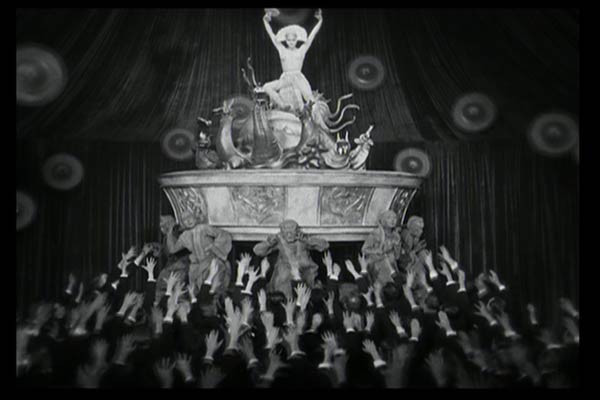
metropolis05Still missing is the scene in mad scientist Rotwang’s house, where the elder Federson struggles with his old rival and frees Maria from his clutches; this is now explained in an intertitle card. I seem to recall in my first viewing only seeing Maria running from the house, with no explanation of how she escaped.

My major realization in seeing this, so hard upon the heels of Faust, is how much more I appreciated Murnau over Lang, and I had long treasured Lang. But Murnau’s work is full of subtlety and human moments. Lang is far more interested in melodrama and grand, sweeping motions. As my friend Mark Konecny pointed out, for better or worse, Lang was the future of cinema, and kept making movies until 1960. Most of them were pretty darned good. Murnau worked more slowly, and only made three sound movies before his untimely death in a traffic accident in 1931.

So once again I get to end one of these with a “what if-?” or an “if only-” and hustle myself back to my viewing chair. It’s high time I watched some American fare.

The ABCs of March, Part Six

Finally finishing out Letterboxd.com’s March Movie Madness challenge. It got to be a little wearing there, toward the end.

The Villain (1979)

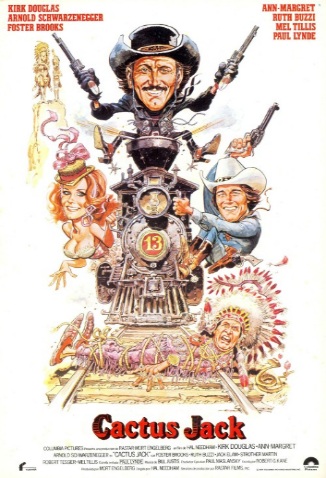
villainDear sweet mercy, is there anything worse than an unfunny comedy? This is stuntman extraordinaire Hal Needham’s third movie, after Smoky and the Bandit and Hooper. It is a Western parody, and if you are expecting Blazing Saddles, you are probably in the same shoes as everyone who paid to see this in theaters, sucked in by an ad campaign and a trailer with far better pacing and editing than the movie itself. Cactus Jack Slade, a down-on-his-luck professional bad guy (Kirk Douglas, of all people) is hired by crooked banker Avery Simpson (Jack Elam) to waylay the somewhat less-than-virginal Charming Jones (Ann-Margaret) on the way back to her pa’s silver mine and steal the money she’s transporting so Simpson can foreclose on the mine. Trouble is, she is being protected by a clueless lunkhead literally named Handsome Stranger (Arnold freaking Schwarzenegger). The other problem is that Cactus Jack is an idiot. cactus jackNo, the real problem is that the decision was made to make this a live action Roadrunner movie, with Kirk Douglas in the Wile E. Coyote role. They even do the painting-a-tunnel-on-the-side-of-the-mountain bit, for God’s sake. The problem is, neither Hal Needham nor his editor are Chuck Jones, and all the bits fall flat, flat flat. Kirk Douglas has good comic timing, and is game as hell, but the Marx Brothers, Monty Python and full frontal nudity could not have saved this movie. I haven’t even gotten into Paul Lynde and Robert Tessier as Indians. Nor will I.

White Vengeance (2011)

white-vengeance-poster-previewThis is the second Chinese historical epic I’ve seen in the last couple of years that had the original title The Feast, that has been changed to something more commercial for Western audiences. the first, an Asian “Hamlet”, was re-titled Legend of the Black Scorpion, which is a bit odd for a movie bereft of scorpions of any color. The re-titling of this one makes more sense, at least. White Vengeance tells the tale of Liu Bang (Leon Lai) and Xiang Yu (Feng Shaofeng), two warlords seeking to overthrow the crumbling Qin dynasty and become Emperor themselves; seeking to drive a wedge between the two men, King Huai proclaims that whoever takes over a certain town will become its Lord, a stepping stone to the Imperial Throne. It works, and Liu Bang manages the feat without shedding a single drop of blood; thus begins an internecine war between the two men, fought with armies, yes, but mostly through the machinations of each man’s counselor. Anthony-Wong-in-White-Vengeance-2011-Movie-ImageThe battle of wits seems to come to a head at the Feast of Hong Gate, where Xiang Yu’s elderly, blind mentor Fan Zeng (Anthony Wong) and Liu Bang’s right hand man Zhang Liang (Zhang Hanyu) play five games of chess simultaneously. Well, not chess, but Go, a Chinese version that has subtleties of its own. Though it seems to end with Xiang triumphant, the chess moves continue for months, even beyond Fan’s eventual death. That’s the White Vengeance of the title: the white pieces on the Go board, vying for advantage even when there are no hands to move them. White Vengeance does have massive armies charging at each other, and those scenes are well done; but I do admit I love movies that value strategizing and the movement behind the lines. There’s also a love story almost buried within the cut and thrust of the main storyline, and it seems superfluous – though it does add a bit of sweet and forlorn spice to the otherwise Machiavellian mix.

X-Men: First Class (2011)

X-Men: First ClassWhy did it take me so long to see this movie? Well, I guess I knew that some day I would need a movie starting with X that I hadn’t seen before. This is the oddest Franchise reboot in a while; most reboots update the characters, not backdate them. This one places the X-Men at the Cuban Missile Crisis, which wasn’t the fault of the Soviets, but that nasty old Kevin Bacon, here playing Sebastian Shaw, a character that didn’t actually crop up until the late 70s. First Class  gets pretty cavalier about which characters it wants to play with, and schizophrenically taking pains to explain why Mystique is so young-looking in the 21st century X-Men movies, while blithely ignoring any other number of continuity problems. X-Men-First-Class-MAgnetoIn all, this is a pretty necessary move if you want to maintain the backstory of Magneto as a survivor of the Nazi Holocaust. The graying of their mainstay characters is the problem Marvel and DC have been having for years with characters like Nick Fury – most notably not with the Howling Commandos in the Captain America movie. Sgt. Rock was still kicking around the civilian world in the 70s – that’s realistic enough – but DC would like us to forget that Bruce Wayne ran into Rock back during WWII, behind enemy lines. And I guess since they recently slash-and-burned their entire heritage, they can now legitimately say that never happened. Bitter, me? Nah. I have the trade paperbacks. Anyway, fun movie. Not going to be in my top ten, but a good superhero movie.

yellowbrickroad (2010)

yellowbrickroad-movie-posterI wonder if I would have ever settled down to watch this were it not for March Movie Madness? Possibly not. I found it on Netflix while looking for a movie beginning with Y, and here we are. The setup is this: in 1940, the entire population of Friar, New Hampshire, headed down a mountain trail. Some were found frozen to death. Some had been savagely slaughtered. But most were simply never seen again. One of the few survivors could only keep asking, “Can’t you hear it?” A husband and wife team, hoping to write a book on the subject, have spent years trying to get the official documents so they can retrace the town’s journey. Finally succeeding, they embark with a psychiatrist, a wilderness expert, a husband-and-wife cartography team, an intern, and a girl from present-day Friar, who has to show them where the path begins: a stone marker with the words “yellowbrickroad”. Well, before you can say Blair Witch Project (though this isn’t a found footage movie, I should add), our party is subjected to whirling compasses, a GPS that says they’re in every country in the world except where they are, and music constantly playing in the distance. When even shooting the stars with a sextant proves useless, all they can do is follow the music, while their sanity slowly unravels, and it’s not too long before the first murder happens. yellowbrickroad1The padding’s at a minimum (though still unfortunately there), and you have to admit we know these people before they meet their various ends. The slow burn material makes me think of Ty West. But that doesn’t necessarily mean that we like or identify with them, which may be the movie’s greatest weakness. The other weakness is the ending. A lot of people hate the ending, but I’m not necessarily one of them. It turns out this is a problem I have with a lot of modern horror fiction; there’s a superb amount of dread built up, and there isn’t a satisfactory conclusion, so you go obscure, you go strange, and leave it at that. Though the ending of yellowbrickroad is disappointing as to the reveal of the end of the trail, the imagery it ends with is horrific enough that I was satisfied. Your mileage may vary.
Zodiac (2007)

Zodiac (2007)Been meaning to watch this forever. I was stymied when the used DVD I bought was a full-screen edition (“What is this? Medieval times?“), which I finally replaced, and I needed the Z flick anyway, and I had already watched Z. Zodiac is about the Zodiac Killer, a serial murderer whose identity and exact body count is still a cause for conjecture (though the movie, and the book it’s based on, settles on a fairly good suspect). The actual murders take up a rather small portion of the runtime; most of it is given over to the investigation by police inspectors (Mark Ruffalo and Anthony Edwards) and newspapermen (Robert Downey Jr. and Jake Gyllenhaal). Oh, and I nearly forgot Brian Cox as Melvin Belli. Hope you like procedurals, because there’s a lot of it in the 157 minutes. kinopoisk.ruThat’s a damned fine cast, though, and David Fincher and his crew do a spectacular job of re-creating 60s through late 70s San Francisco. The character count does start getting unwieldy as more and more police departments are brought into the investigation, but that really does help the viewer understand the complicated nature of police work, and how frustrated the detectives working the case become, not to mention a public on the verge of hysteria. No wonder Dirty Harry became a hit using the thinly-disguised Scorpio as the villain. I was wondering how they were going to fill out that running time when there is no climactic chase or cathartic capture; the movie instead zeros in on how the pursuit of Zodiac comes close to destroying the lives of these men. There was, at least a cathartic moment for me toward the end, when a rack of paperbacks at a airport revealed that yes, the book that was being written during the movie was the one I read in 1986. Also, if you’re a Donovan fan, be aware that this movie will spoil “Hurdy Gurdy Man” for you forever.

Conclusion

Well, that was fun, but as I mentioned earlier, getting to be a grind toward the end. In the week before the Challenge ended, The Hobbit and Zero Dark Thirty both hit the stores. I would have loved to watch The Hobbit again, but no, I had the end of the alphabet to contend with. Still, I stuck it out, but now I have a bit of a problem getting excited about watching a movie again – this was too much of a good thing. I need to get over this because there’s a Crapfest tomorrow, and maybe that’s just what I need – too much of a bad thing.

The ABCS of March, Part Five

There was a big push to get ahead on the letterboxd.com March Movie Madness event, because a) it was Spring Break, and b) weeks off always engender a Hell of Work To Catch Up On. This time is certainly no exception, as the Week of Hell is actually growing into a Fortnight of Hell. I have a 12 hour day coming up this Sunday which may kill me. Please tell my mother and my wife that I love them.

I’ve managed to claw a bit of free time out of the schedule, let’s see how far I can get:

Queen of Blood (1966)

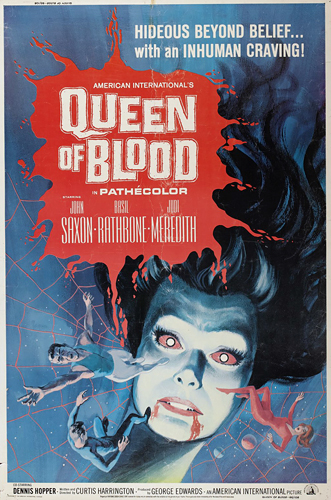
queenofbloodOne of the stranger cottage industries Roger Corman spawned in the early 60s involved buying the rights to Soviet science-fiction movies – which were pretty high-minded and had some great effects by pre-2001: A Space Odyssey standards – and then harvesting the effects sequences to plug into American-shot movies, since no red-blooded Amurrican would be caught dead watchin’ no Commie movie, anyways. Like a Comanche using every last bit of the buffalo, Corman and his crew got significant bang for the buck out of this strange vivisection – Planet of Storms is the basis for at least three movies, almost all with “Prehistoric Women” in the title, and The Heavens Call yielded Battle Beyond the Sun and this odd little Curtis Harrington movie.

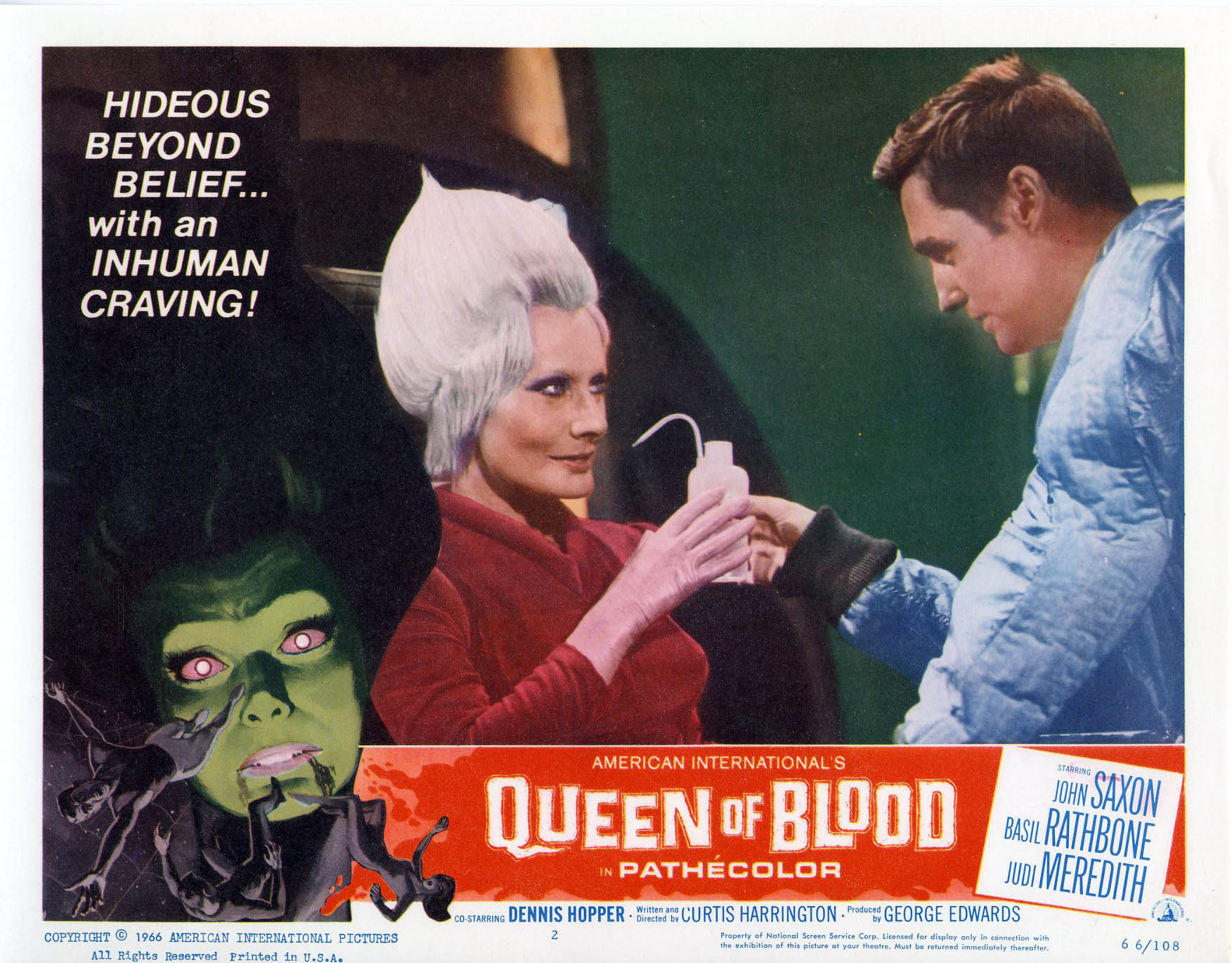
In the far-flung year of 1990, Earth’s Space Institute receives a message from another planet, informing them that the alien race is sending an ambassador. Several weeks later, it is discovered that the visitor’s spaceship has crashed on Mars, and a hasty rescue mission is organized. Only one survivor is found (by accident), and gosh darn it, on the way back to Earth it’s discovered that she’s a vampire.

A color-corrected Florence Marly in this lobby card.

A color-corrected Florence Marly in this lobby card.

Queen of Blood is an entertaining enough sci-fi programmer. It rarely drags enough to relinquish your attention elsewhere, and even has some nice drama when it’s determined that one member of a two-man rescue ship will have to stay behind on the Martian moon Phobos to allow the surviving alien to take his place on the lifeboat that will connect with the ship already on Mars. The mechanics of the plot are well-considered, even if some of the science is not.

Harrington had worked with Dennis Hopper in 1961’s Night Tide, and brings him along for the ride – it’s actually kind of refreshing to see him in a cardboard sci-fi context. John Saxon is predictably solid, and the other breath of fresh air is Judi Meredith, who has a swell little genre resume along with numerous TV roles – she’s in Jack the Giant Killer, Dark Intruder and The Night Walker. Basil Rathbone is on hand as the urbane head of the Space Institute, probably because John Carradine was shooting six other movies that day.

As mentioned in my grumbling about Prometheus, I’m more sad about the tremendously advanced Moonbase we’re utilizing in 1990 than amused. The most fun to be had is watching the film grain and lighting change from the Soviet material to the American.

The Red Shoes (1948)

redshoesThe quintessential backstage drama, which just happens to be about ballet. I’ll be frank and say that ballet, along with opera, are the two art forms I care very little about. I don’t hate them the way I loathe, say, most musicals, but I’d much rather spend my time watching something else. But they are still art forms, so I’m happy that both have more than enough fans that they don’t have to depend on me for their survival.

So I approached Red Shoes with a bit of misgiving, but I needn’t have worried. Art is art, performance is performance, and the act of creation is endlessly fascinating. The first section of the movie can get a little wearing, with two of our protagonists starting out at the bottom, and haha, those temperamental artists! But once events start to move, and we become invested in the rise of dancer Victoria Page (Moira Shearer) and composer Julian Craster (Marius Goring) under the direction of ballet impresario Lermontov (Anton Walbrook). This will lead to a triangle that has little to do with love, and everything to do with their arts. It’s a very different kind of passion at work here, and its tragic ending is almost inevitable.

At one point, during rehearsals for the new ballet The Red Shoes, Lermontov says to his set designer, “The audience will applaud in the middle!” He’s likely speaking for director Michael Powell and Emeric Pressburger, as the debut of the ballet, midway through the movie, is played out before us as a fantasia, heavily based on the paintings of scenic artist Alfred Roberts. It’s not meant to be a literal recreation of the ballet, which would require an impossible set on the world’s largest stage; it is more a representation of what is going on in the dancer’s and the audience’s minds, when, as Lermontov constantly proclaims, “The music is everything!”

red-shoesThe melodramatic plot and acting aside – all perfectly keeping with post-WWII standards, and none of it odious – The Red Shoes is an undeniable masterpiece. Which of course means that the Rank Organization thought it was pure rubbish and didn’t even bother to release it in its native England for several years.

And, just in passing, I guess I should mention I was largely on Lermontov’s side on the triangle. Both men are complete assholes at the movie’s end, but Julian’s insistence that Victoria give up her opening night in order to attend his is beyond the fucking pale, even for an artist.

The trailer gives you only an inkling of Jack Cardiff’s magnificent camera work, though the color, even faded, gives you some idea of the Technicolor glory of the restored print:

The Searchers (1956)

searchersThursday night was a good night; it started with The Red Shoes and ended with The Searchers.

The Searchers may very well be the Perfect Western. It so solidly bridges the gap between the silent starched West of Tom Mix with the gritty, grimy hell of Unforgiven. It still has love for the vast sunny beauty of Monument Valley (filling in for Texas) and the pioneering spirit of the people who live there, but it comes from a much darker place than any previous John Ford/John Wayne collaboration.

Wayne is Ethan Edwards, a man who returns to his brother’s homestead after a three-year absence (some of it due to the Civil War), just in time for the family to be slaughtered by Indians and the two young girls taken hostage. A posse of Ethan, some volunteer Texas Rangers, and Martin Pawley (Jeffrey Hunter in his premiere) take off in pursuit. The posse is eventually winnowed down to Ethan and Martin, which is going to provide most of the conflict for the movie; Martin was rescued by Ethan from a similar Indian raid when Martin was a child. But Martin is also one-eighth Cherokee, and there is one thing Ethan cannot abide, it’s a half-breed. Ethan’s discovery of the older girl, raped and killed, cements his decision to find the younger girl, Debbie, no matter the cost.

searchers1As the search drags on for five years, Martin continues to accompany Ethan; the younger man’s role, he has come to realize, is to stop Ethan from killing Debbie once he finds her. By now the girl has been accepted into the tribe, and is in fact one of the wives of the war chief Scar, and as far as Ethan is concerned, that means she is no longer white, and better off dead.

We can all conjure up images of Wayne as the good ol’ righteous western dude – that’s most of his output in the 60s. But in his best roles, there’s an edge to the character, and in The Searchers he gets to be a complete and utter dick. Anyone who thinks Wayne wasn’t a good actor should watch The Searchers; there is one close-up – after Ethan and Martin have checked over the white captives of a tribe massacred by cavalry, only to find neither is Debbie and both are far worse for wear – a close-up of Wayne that combines such strong emotions, loathing, pity, simmering hatred… that it’s shocking.

actingBut the movie is far from being a grim slog-fest. There are lighter moments aplenty, and good support from the Ford repertory company, like the always-welcome Ward Bond, and I was completely unprepared for KEN CURTIS – FRONTIER MACK.

Both movies – The Red Shoes and The Searchers – are highly recommended, especially on Blu-Ray. The Criterion Collection of Red Shoes is beautifully restored, and the VistaVision transfer of The Searchers – an awesomely affordable disc, these days – will knock your eyes out. And the trailer has a ton of fine Duke moments:

The Third Man (1949)

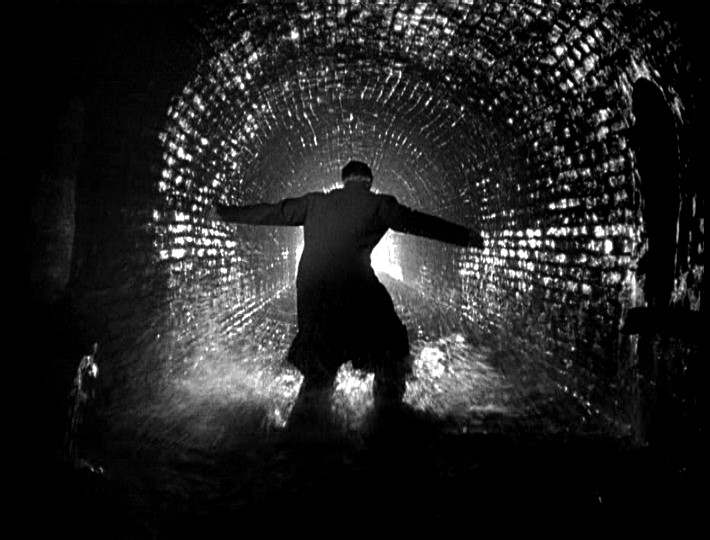
third_manEventually I was going to find a classic I just didn’t care for.

I think it was about a year back when a former colleague messaged me, saying he has just watched The Third Man, and could not figure out for the life of him what it was that made the movie so revered. What did he miss? Did I have any insights? As I had not seen it at the time, I couldn’t supply any. Well, now I’ve seen it. Still can’t supply any.

This is a well-made movie, make no mistake. It’s obvious writer Graham Greene and director Carol Reed are both in love with Vienna. And it’s the Post-World War II occupation by four separate world powers and the burgeoning black market that make the story possible; it’s interesting to see the International Police Force at work, a cop from each occupying  country making each call. The story just never grabbed me, and I’m at a loss to explain why. Perhaps I was poisoned by that year-ago question.

The Third Man is the tale of Western novelist Holly Martins (Joseph Cotten), who arrives in Vienna at the behest of childhood chum Harry Lime (Orson Welles, eventually) promising work. Martins, however, arrives just in time for Lime’s funeral, as he was killed in an odd pedestrian accident across from the building where he lived. Odd because Martins finds conflicting stories about the accident, including a, yes, Third Man at the scene that the police know nothing about. Martins, of course, sets about investigating.

org third man13711If there is one thing that bewilders me about The Third Man, it is the enduring popularity of Harry Lime. One of the things that Martins finds out, to his dismay, (okay, spoiler alert, even though there a statute of limitations on spoilers for movies that are 64 freakin’ years old) is that Lime was not only a black marketeer, but dealt in adulterated penicillin, resulting in the death and disability of many people, including children. Yet Harry Lime had his own radio show for many years (tales of Lime’s past, given the ultimate outcome of the movie), and by the time there was a Harry Lime TV show (starring Michael Rennie, if I recall correctly) Lime had been completely rehabilitated as a globe-trotting art collector.

I don’t get it. I shrug. I will say that my non-genuflection at The Third Man‘s altar should not be taken as a condemnation; as I said, it is a well-made movie that should be checked out, and if nothing else, has the best denouement of any number of noirs. You can make your own decision.

The Unknown (1946)

iloveamystery2Is he really going to do five movies this time? Yes, and five the next, if I survive tomorrow. Then this whole thing will be over, and we can get back to our normal anarchy.

The Unknown is one of three movies based on the I Love A Mystery radio series. To be disarmingly cute about it, I love I Love A Mystery, especially in its later incarnation as a 15-minutes-a-day serial. I think – no time for research this time, mes enfants, sorry – that this hearkens to the older, half-hour incarnation of the show, when our detective agency was only two people, Jack Packard (Jim Bannon) and the laconic Texan, Doc Long (Barton Yarborough), both men repeating their roles from radio.

i-love-a-mysteryThe Unknown is an old dark house, reading-the-will story, populated with strange characters and tangled sub-plots, so much so that Jack and Doc are practically guest stars in their own movie. There is an accidental death years previous that has completely twisted the family tree, a dead patriarch walled up in a fireplace rather than the family crypt, a will that keeps vanishing, and the ghostly crying of a baby in the night. Also the requisite secret passageways and cloaked killer, whose identity is perfectly obvious at the halfway mark, if not sooner. At a trim 70 minutes, though, it doesn’t have time to get truly tiresome, and does have at least one plot twist that surprised me.

It’s also so obscure there’s no trailer for it online. Instead, have the trailer for Larry Blamire’s parody of Old Dark House Reading of the Will thrillers, Dark and Stormy Night:

There. Bring on that 12 hour day.

The ABCs of March, Part Four

Blah blah blah Letterboxd.com blah March Movie Madness blah blah Movie starting with “A” on March 1, “B” on March 2, blah.

Miami Connection (1987)

miami_connection_ledeA minor cultural artifact that would be languishing in the used VHS bin at Half-Price Books were it not for Drafthouse Films, who managed to turn it into a sort of cause celebré last year. If you like your heroes to be a rock band made up of five orphans who have sworn friendship forever, and who use the proceeds from their club gigs to pay for college, this is the movie for you. If you’d like these five friends to be “black belts in Tae Kwan Do”, this is especially the movie for you. If you want your five black belt rock stars to fight a bunch of motorcycle-riding, drug-dealing ninja (in Orlando, Florida), then you already own the Blu-Ray.

I put “black belts in Tae Kwan Do” in quotes because it becomes pretty obvious that only three of the members of Dragon Sound have any moves (in fact, the diminutive Gino Vanelli-looking lead guitarist is pretty much the girl of the group), and one of those is star/producer/co-director Y.K. Kim, for whom English is a distant second language.

fyc_5The dialogue is largely improvised, which means I give the movie’s sound man a big thumbs up, because there would be no way to convincingly loop any of the scenes, because everybody talks at once (and not in a good Howard Hawks way). The fight scenes aren’t dreadful, and some are pretty good, though watching the bad guys dutifully line up to attack our heroes one-by-one on a largely empty street is kind of painful.

An interview with Y.K Kim on the DVD reveals that Miami Connection was turned down by every distributor as, quote, “Crap”, unquote, until one guy agreed, but only if they completely re-did the ending, since in the original the bad guy got away and a Dragon Sound member died. With a new bloody showdown and a formerly fatal sword wound downgraded to “Walk it off, wuss” status, Miami Connection went out into the world, to wait 25 years for anyone to appreciate it.

Maybe it’s due to having seen Intercessor only a few days before, but I didn’t find Miami Connection all that bad. Not all that good, either, but a likely candidate for a Crapfest.

The Night of the Hunter (1955)

night_of_the_hunter_posterAnd for every story where a distributor said that something was “crap” and was right, there seem to be five stories about the same thing, but the movie in question was a masterpiece that the bean-counter could not appreciate. Such is the case with actor Charles Laughton’s sole directorial effort, The Night of the Hunter.

Based on the novel of the same name by Davis Grubb, Hunter is the tale of serial killer Harry Powell, a travelin’ man who professes to be a preacher, finding widows with money, marrying them, killing them, and moving on. While serving time in prison for auto theft (30 days!), he meets up with Peter Graves, due to be hanged for a bank robbery in which he killed two men. Powell manages to find out that Graves hid the ten thousand dollars, but won’t tell where; after his release, Powell goes searching for this newly-created widow, and the ten thousand.

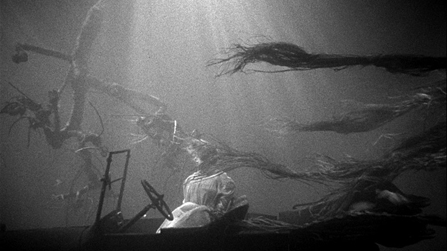
The story is largely told from the point of view of Graves’ ten year-old son, John (Billy Chapin), sworn to protect his younger sister Pearl and the location of that ten thousand dollars. With an ease born of practice, Powell sweeps their windowed mother off her feet (Shelley Winters, very convincingly projecting a brittle, damaged vulnerability) and eventually murders her, tying her body to an old model T and dumping it in the river, producing one of the movie’s indelible images: Winters’ hair drifting lazily in the current, echoing the surrounding weeds.

img-night-of-the-hunter_095346717469The kids strike out on their own down the same river, Powell in inexorable pursuit (“Don’t he never sleep?” marvels John), eventually winding up in the care of Lillian Gish (who came out of retirement specifically for this role), playing a woman who has found new meaning in her life caring for orphans the Depression has sent her way. She sees through Powell’s guile immediately, and in a nighttime confrontation, the spurious preacher finds himself no match for a good woman with a shotgun.

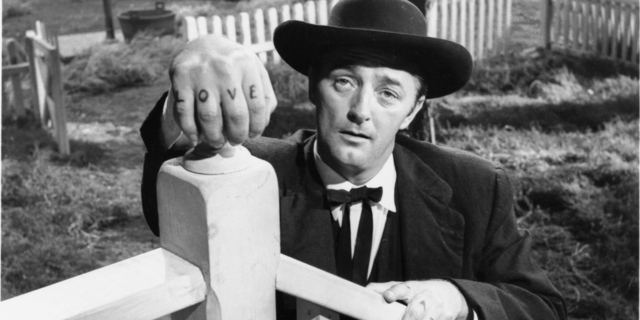
Part of the genius of Night of the Hunter is that it slips so subtly into the boy’s point of view, we almost don’t realize we’ve left an adult’s mindset behind. We’re surprised that the adults of the tiny town don’t see through Mitchum’s bullshit as easily as we do, but that’s because we’re sharing John’s experience. Powell is a surprising change for sex symbol Mitchum, who must have leapt at the chance to play a character so different from his usual fare.

hunterIn a story that is going to be too familiar, an executive at the first screening called the movie “too arty” and buried it on the second half of a double bill with the now largely forgotten medical potboiler Not As A Stranger, also featuring Mitchum. The posters and advertising materials reveal just how clueless United Artists was as to what approach to take with Night of the Hunter, and it almost vanished from sight, championed only by a very few until its true status as a classic was embraced.

Laughton, never the most confident of artists, took it all very much to heart and never directed another movie. Which is a damned shame.

Orca (1977)

7“I know! Let’s remake Jaws, but rig it so that this time you root for the shark!”

BRILLIANT! Another round!”

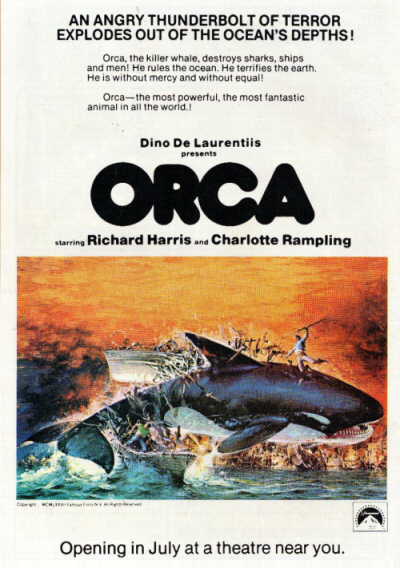
Fisherman Nolan (Richard Harris) thinks that capturing a killer whale and selling it to an aquarium or sea park will finally pay off the mortgage on his boat. What he manages to do is harpoon his target’s mate, resulting in a gruesome whale miscarriage on his deck and the unending enmity of a killer whale who, doctor Charlotte Rampling informs us, is capable of feeling grief and unending vengeance.

This is indeed the McGyver of killer whales, causing huge explosions in the seaside town and targeting vulnerable supports of buildings so he can bite off Bo Derek’s leg. Nolan is responsible for four human deaths and millions in property damage by the time we reach the final showdown, and despite attempts to generate sympathy for the character, I never stopped rooting for Orca.

At least I now have seen the movie was that was plastered all over the back of comic books until they invented Megaforce.

Prometheus (2012)

Prometheus-2012-Movie-PosterFinding identical star maps in several ancient civilizations, two scientists (Logan Marshall-Green and Noomi Rapace) have figured out that a race of beings called The Engineers created life on Earth and left this calling card as an invitation. The near-ubiquitous Weyland Corporation funds an expedition to the planet to try and make contact. Things do not go well.

First: Jiminy Christmas, what a cast. Beside Rapace, you have Charlize Theron, Idris Elba, Michael Fassbinder, and, eventually, Guy Pearce. That is a hell of a lot of quality acting talent. You have special effects that are often incredible. What you do not have is much of a compelling story. In short, you have a Ridley Scott movie.

Prometheus is at its best when it is functioning as a sense-of-wonder story, a stripped-down-to-the-basics space opera about exploration and first contacts. It veers into horror (and even Cronenbergian medical horror in the movie’s most intense segment) in ways that worked like gangbusters in Alien but seem somehow tacked on here.

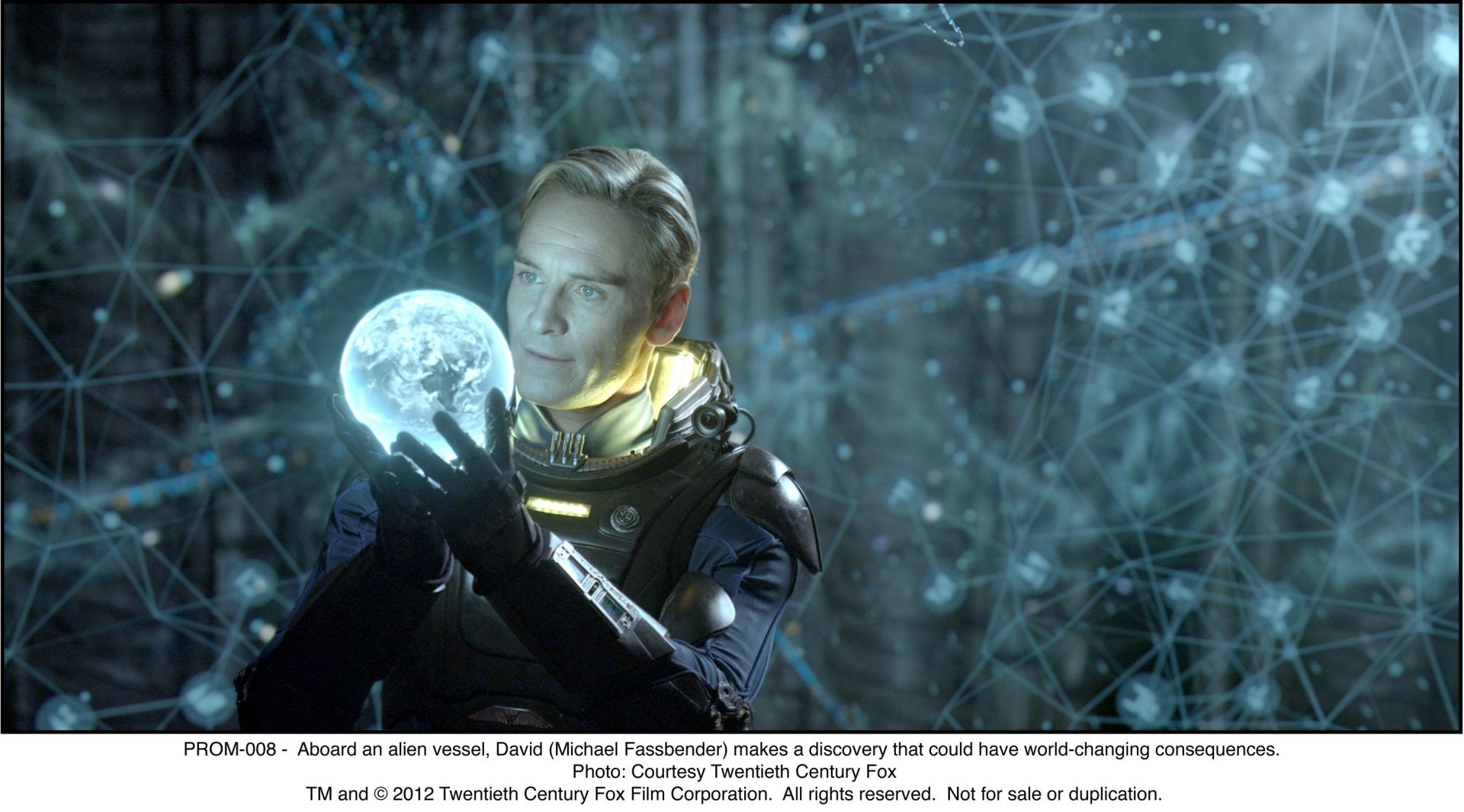
PROM-008 -  Aboard an alien vessel, David (Michael Fassbender) makes a discovery that could have world-changing consequences.Because Prometheus, you see, is a prequel to Alien. What our heroes find is a seemingly abandoned Engineer base full of bioweapons that was going to be shipped to Earth but something went wrong and the Engineers themselves were the ones that got destroyed. Exactly why the Engineers, having created life on Earth, were  suddenly so determined to eradicate it is a question left unanswered, and in fact is the entire reason for the movie’s denouement, and possibly a reason for all the bad press and rancor I had heard during the general release. My pal Roger Evans had read an interview with Scott that explained it all, and proceeded, like a kindergartener with a dead rat chasing his classmates all over the playground, to pursue me until I read it. I really don’t need to have everything explained for me. I frequently enjoy the mystery more than the solution. But now I know. And it did kind of bruise my opinion of the movie.

Really, I think  Prometheus works better outside the Alien universe. Trying to shoehorn it in is just going to cause headaches. And this is from someone who strenuously pretends the Alien vs Predator moves never happened.

prometheus_01Honestly, the biggest, most jagged pill for me to swallow in the movie is that it takes place in 2094 or so. Which means interstellar flight in 80 years. I suppose that’s possible, but I’m doubtful. When I was a kid, we sent men to the Moon regularly and you could fly from New York to Paris in a few hours. What the hell happened? Whatever it was, it makes a rapid advancement like that, even financed by a voracious corporation, very dubious to my mind.

Then again, my next movie will be Queen of Blood, which takes place in 1990, when a mere 21 years after the Moon landing, we have a fully functioning Moon Base and  plans to go to Mars. That didn’t seem too far-fetched in 1966, so I’m hoping I’m wrong and we do, indeed, wind up on that road again.

The ABCs of March, Part Three

You know the score by now. Letterboxd dot com, March Movie Madness, a movie a day, A for Day One, B for Day Two. To continue:

Intercessor: Another Rock ‘N’ Roll Nightmare (2005)

movie_254625People kept waving me off from this, which is like waving a red tablecloth at a bull (sorry, Mythbusters). This is, as the title implies, a sequel to the 1987 Rock ‘N’ Roll Nightmare, which is kind of a reluctant favorite of mine; it starts out as a rock band version of The Evil, veers into Ghoulies territory, then has a gonzo twist at the finale which is actually endearing in its desire to reach awesomeness, if lacking the resources to get there.

Which is about the best way to describe Intercessor. It’s shot on video, has a comic book plot with comic book dialogue that uses fannish comic book art to advance the story – and that last bit is quite literal. The bad guys are Zompira and Mephisto, and there is some sort of plot involving a spindly emo geek and his would-be girlfriend who, never mind, get killed off about a half hour into the story because never mind, the story we really want to tell is Mephisto trying to corrupt a little girl’s pure soul by attacking her in her dreams, and finally, in an empty factory. He is aided in this by four witches representing the four elements, and the Four Horsemen of the Apocalypse: Rather Fey Pestilence, Whiney Famine, Mardi Gras Death, and Bad Acting. Luckily the spindly geek managed to discover the power of METAL and bring back Jon Mikl Thor before being written out of the story.

pantsfish~Intercessor_skeletorSo Intercessor is Rock ‘N’ Roll Nightmare writ large, with that last ten minutes or so expanded to an entire movie. As in the end of that movie, there is absolutely no way the production has the resources to effectively tell the story they want. Somebody’s pretty damned good with Adobe After Effects, and there are occasionally some nice visuals, but the seams are really, really visible; the chaotic story, the villains who need to go to Evil Laugh School (the good guys and the four witches are fair to pretty good, though), and those fights that really want to be Highlander class stuff, but generally consist of a couple of moves and the witches getting defeated by Thor throwing his cape over them. Incidentally, I was rather surprised to find out that Pestilence and Famine can be killed by zombies. Who knew?

My suspicion is that each and every member of the cast and crew owned a van with Frazetta’s Death Dealer airbrushed on the side. Intercessor has heart, there is no doubt. What it didn’t have was the budget and actors to pull off its grandiose ambitions.

Hm. No trailer, but here’s the first 60 seconds:

John Carter (2012)

john-carter-movie-poster-7_8fe99ead…is the polar opposite. Disney’s multi-kabillion dollar film version of Edgar Rice Burroughs’ John Carter of Mars series has the moolah to make the story work, and in astounding, visually impressive ways. Good God, the fact that I never doubted the reality of the four-armed, green Tharks is a testament to the FX department (although I expected them to be more muscular, influenced by the Frank Frazetta covers to versions I read while a teen. Just to drag ol’ Frank into the discussion again).

There were changes made to make the story more palatable to modern audiences, or so the focus groups decreed. Since we no longer cotton to the concept of gentleman swashbucklers, Carter has become a Civil War vet with a dead family to mourn, stopping just short of Josey Wales in Space. Dejah Thoris , the Princess of Mars (hey, he said the name of the book!) has been updated fairly nicely, and the Therns are upgraded to all-purpose, powerful villains who are apparently not even Martian, but an older alien race who are beginning to set their sights on Earth. Past that, John Carter successfully carries on the one-damned-thing-after-another structure of the novels, all on a convincing alien world.

JOHN CARTERTaylor Kitsch won me over as Carter, and Lynn Collins is fantastic as Dejah Thoris. A friend of mine contends that Hollywood should stop screwing around and cast Collins as Wonder Woman, and he’s right. Everybody I know who’s seen John Carter enjoyed it, if not outright loved it. So why did this movie die at the box office? Why aren’t we already talking about the sequel? For some reason, Disney seemed to pretty much abandon it; the striking of the words of Mars from the title for purely superstitious reasons (“No movie with Mars in the title has ever been successful!”) is pretty emblematic of the corporate lack of trust in the product.

It’s saddening, really. John Carter is pulp entertainment on the same high satisfaction level as The Avengers, but it was just never given a chance.

(And I kind of wonder how much it cost Disney to license “Kashmir”…)

Kagemusha (1980)

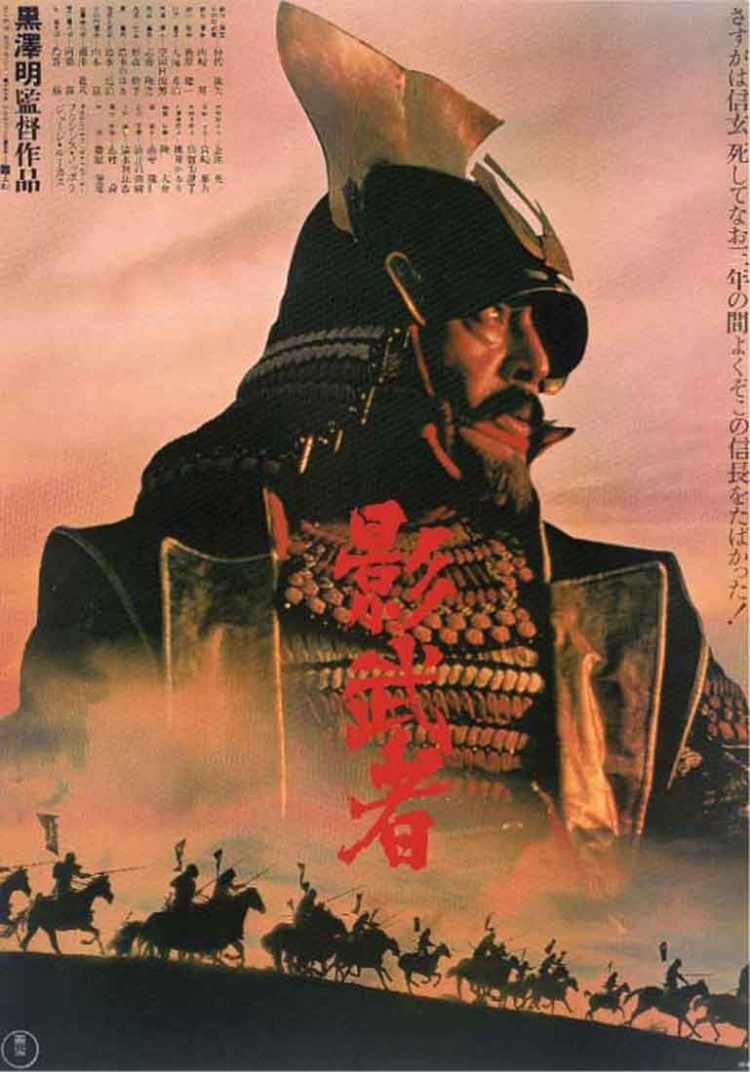
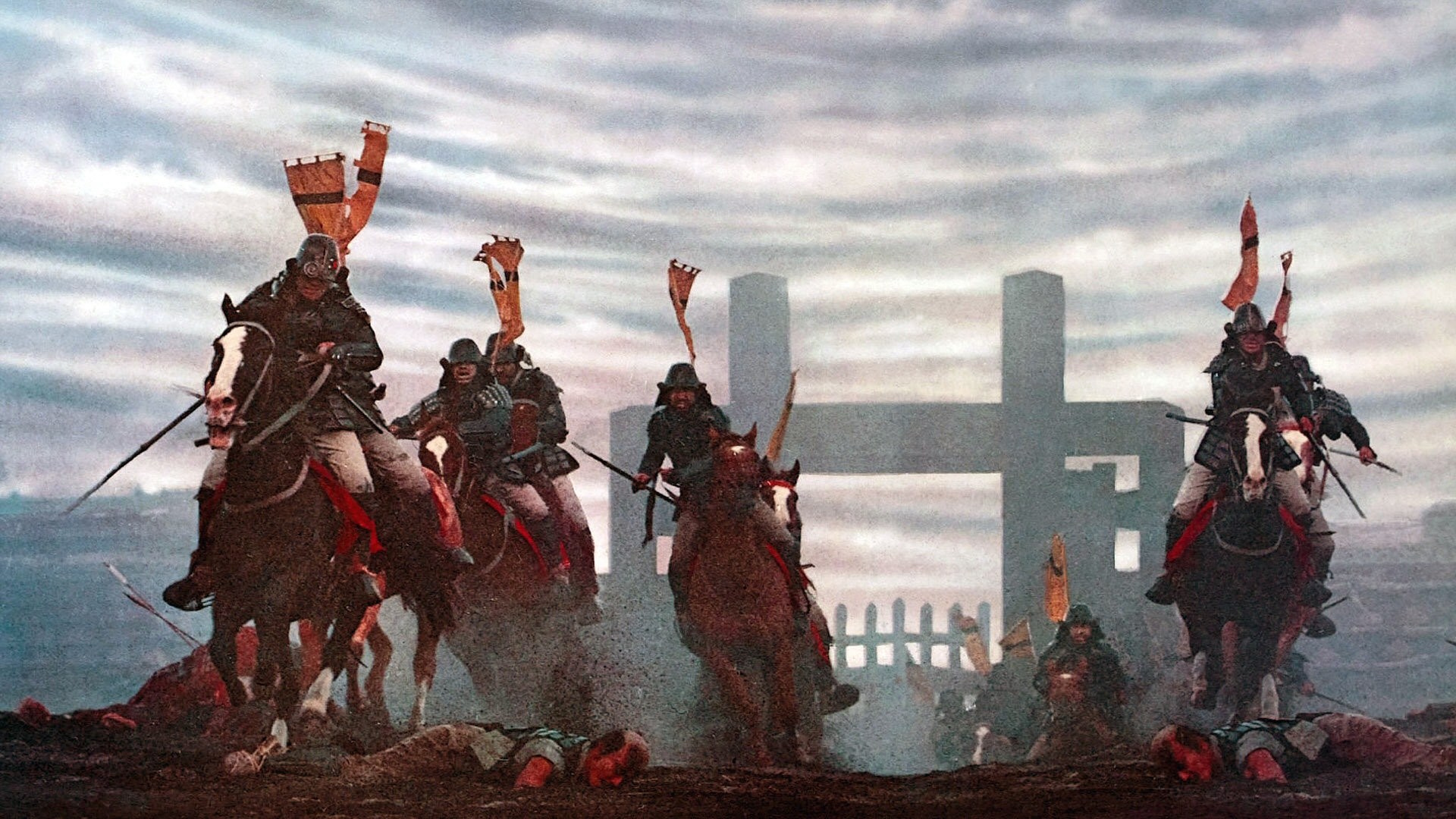
kagemusha-1980Akira Kurosawa begins the twilight portion of his director’s career. He almost didn’t get there; Red Beard put an end to his relationship with Toshiro Mifune, and left the director with a reputation for difficulty and wastefulness. The failure of Dodes’ka-den in 1970 seemed to put an end to that career. Mosfilm had the good sense to hire him to direct Dersu Uzala in ’75, and that movie receiving an Oscar for Best Foreign Film bolstered him a bit, but Toho was on the financial ropes and no one seemed especially anxious to finance Kurosawa’s next project, a return to the medieval samurai film. Enter a couple of Kurosawa fans named Francis Ford Coppola and George Lucas, who convinced Fox to put up the money in return for distribution rights.

Kurosawa spent a lot of that downtime painting, and it is those paintings that form the most beautiful storyboards ever employed. There are times that the lighting in Kagemusha is so lush,so colorful, it is impossible to deny that Kurosawa had successfully transferred his painted image to film.

041_kagemusha_theredlistKagemusha, literally, “shadow warrior” is supposedly based on a true story of the Warring Nations period preceding the Tokugawa Shogunate, when Japan was constantly in a state of  battle between various ambitious warlords, roughly the end of the 16th century. When one of the most powerful of them, Lord Shingen (Tatsuya Nakadai) is wounded fatally by a sniper’s bullet, a common thief with an uncanny resemblance to him must take his place to maintain the clan’s position of strength. The thief excels at the deception, his overconfidence eventually, albeit accidentally, revealing the ruse, and the thief watches in horror as Shingen’s ambitious, unfortunately impetuous son wastes his entire army on one ill-conceived attack.

img1akira3The story was at first fairly small, concentrating on the thief, his change of heart and demeanor  and the growing relationship between him and Shingen’s grandson, a six year-old who is delighted that his grandfather’s “long illness” has rendered him “no longer scary”. But the scope of the story spun out from there, with the various competing lords trying to figure out what exactly is going on so they can plot their next move with assurance. The deliberate unfolding of the plot and the seeming lack of focus on the title character can wear a viewer down, but that’s also part of the genius of Kurosawa; the thief so thoroughly vanishes into Shingen, we never truly know him, and as Shingen’s brother, who had so often played the role of Shingen’s brother, says, “The shadow of a man can never desert that man. I was my brother’s shadow. Now that I have lost him, it is as though I am nothing.” Indeed, once the thief can no longer wield the power of Shingen’s phantom, the entire clan becomes nothing.

Kagemusha is good – it’s really very hard to go wrong with Kurosawa – but so much of it also seems a dress rehearsal for Ran, it can be easy to put it on another shelf, with less respected works from a master.

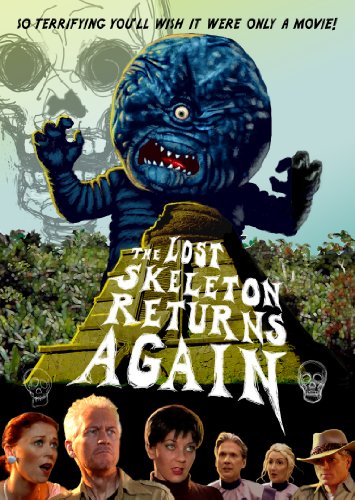
The Lost Skeleton Returns Again (2009)

LostSkeletonReturnsAgainSo we bookend this entry with shot-on-video sequels. The major difference between Intercessor and The Lost Skeleton Returns Again is, although they likely had similar budgets, Larry Blamire got what he wanted out of his.

This is the sequel to Blamire’s 2001 The Lost Skeleton of Cadavra, a canny parody of low-budget late 50’s sci-fi programmers. It was the best post-Airplane parody movie, because it didn’t lampoon a specific movie – Lost Skeleton is very much its own movie, using every bad movie trope Blamire had ever seen. The Ed Wood-style mangled speech patterns, flying saucers (and skeletons) on wires, a monster wearing workboots under its carpet-remnant costume… it was a project that came from love, and it was damned near perfect. I couldn’t wait to see what Blamire would do next.

LSaliensI’m actually still waiting. His immediate follow-up, Meet the Mobsters (2005), I literally only found  out about five minutes ago. Trail of the Screaming Forehead (2007) ran into that old bugaboo, troubles with the producer, who at one point reportedly took the film away from Blamire, recut it and shot more special effects scenes. That version has shown up on cable channels, and Blamire’s version remains available only on Region 2 PAL DVD.

The same year as Returns Again, Blamire also released Dark and Stormy Night, his “old dark house” parody, replete with wisecracking reporters, ominous, hooded killers and more secret panels than are likely safe for structural integrity. I love Dark and Stormy Night.

"Rowr" indeed.

“Rowr” indeed.

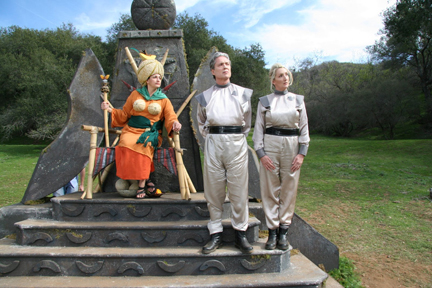
Returns Again is very much the spiritual brother of Dark and Stormy Night; Blamire still employs some twisted Wood grammar but relies a lot more on twisted wordplay and rapid-fire delivery of non-sequiturs for his humor. In this outing, the surviving cast from Lost Skeleton all converge on the Amazon, journeying to the Valley of Monsters, ruled over by the Cantaloupe People – both of them. Tagging along are the twin brother of two characters that died in the first movie (how handy!) and Blamire, bless him, found a way to bring back Animala, the best character from Lost Skeleton, the woman made of four animals combined by alien technology. Then again, he sort of had to, as she is played by Jennifer Blaire, his wife.

Like 98% of all movie sequels, Returns Again isn’t as good as its predecessor, but the fun far outweighs the blah. It’s still an eminently quotable movie, and hell, that’s a goodly portion of what movie geeks care about when they gather together. In my circle, we still pull out the “Have i the message? Have you the message?” bit from Dark and Stormy Night, amusing ourselves and puzzling others.

Isn’t that what it’s all about?

The ABCs of March, Part Two

Yep, I’m still hard at work, doing the Letterboxd March Movie Madness challenge. That’s a movie a day, A for March 1st, B for March 2nd, und zo weiter. I’m even working a day ahead of time, because I know I have an unavoidable 12 hour work day on the 24th, and that ain’t gonna leave me in no movie-watchin’ condition.

Our latest chunk:

Emperor of the North (1973)

Emperor of the North spanish1933 was a pretty dismal year for America; the Great Depression is in full effect, homeless families are everywhere, and the nation is struggling to get back on its feet. But we’re not here for any Grapes of Wrath-type stuff, we are focusing on just one small part of the culture at that time: the hobo nation and its bellicose relationship with Big Railroad.

A career hobo who goes by the moniker A Number One (Lee Marvin) is King of the Road, Emperor of the North Pole, and a number of other sobriquets amongst his peripatetic brethren, but there is one thing he hasn’t yet accomplished: riding on the train of an infamously murderous conductor called The Shack (Ernest Borgnine), who has never allowed a hobo to survive a stolen ride on his train. In fact, our introduction to the man involves him bopping an oblivious tramp on the head with a large hammer and then laughing while the screaming man is cut in half under the wheels of the train. Complicating matters is a youthful braggart calling himself Cigarette (Keith Carradine), who spends his time either learning from A Number One or double-crossing him.

Emperor of the North is a pretty unique picture, providing some interesting insights into the clannish hobo culture and the dynamics of a freight train crew. The battle of wits between The Shack and A Number One provide the best parts of the movie, with the wily hobo generally a step ahead, but hampered by the extra, at first unwanted, baggage of Cigarette. A final betrayal by the callow youth causes the death of one crewman and the serious injury of another, and by this time we’re ready to let The Shack have his way with the treacherous whelp; but instead we get what we came for, a knockdown, drag-out fight between Lee Marvin and Ernest Borgnine, using every weapon to hand that can be found on a moving freight train: chains, planks of wood, a fire axe.

1171129587Carradine actually manages to deliver a level of complexity into a thankless role; we see him actively choosing to make the bad decisions. Marvin is his usual cool bastard, but Borgnine… man, Borgnine is channeling every bad guy he ever played in his career, and The Shack is his ultimate, a man so consumed by anger he seems constantly on the verge of a stroke.

The film and entertainment world lost a lot of good people in 2012, but none of them punched me square in the heart like the passing of Ernest Borgnine. It affected me way more than I thought was possible, for a man who I had never met. I grew up with Quentin McHale, first when McHale’s Navy was first being broadcast, then in syndication, but it was during those first broadcasts that my Mom watched the movie Marty on TV one night. I watched it because it had McHale in it… but the sweet-natured butcher is only slightly similar to the fast-talking PT boat captain. Marty, of course, was Borgnine’s Oscar-winning performance, at even at that young age, I was aware I was watching something special.

1171129518Here was an actor who couldn’t be called handsome, or thin, but was operating at the top of his field. It wasn’t until later I became acquainted with his work as a heavy in other movies – From Here to Eternity, Bad Day at Black Rock – his characters are all over the map, from the gruff gladiator teacher in Demetrius and the Gladiators to the genial, mentally-challenged Cabbie in Escape from New YorkRED is a fairly tepid thriller elevated by its amazing cast, and it was genuinely satisfying and edifying to see Borgnine crop up in that. I miss him terribly.

Ahem. Anyway, see Emperor of the North. It’s very good.

Flareup (1969)

flareup-movie-poster-1969-1020254226Raquel Welch plays Michele, a Las Vegas go-go dancer in a time when it was possible to make a good living out of it as a respectable career choice, ie., never, except in FantasyLand. One of her dancer pals just got a divorce from an unstable type (Luke Askew, of course), who proceeds to gun her down in front of a ton of witnesses, but decides the only other ones worth killing are Michele and the other dancer. He later manages to run over the other dancer and the cop protecting her, and Michele heads off to Los Angeles to hide in plain sight by dancing at a club there. She falls in love with a nice guy (James Stacey), so now Askew has to kill him, too.

There are some things to like in Flareup. Raquel is always easy on the eyes, and the relationship building between her and Stacey may be slow and deliberate, but it’s fairly believable. It’s that word “believable” where the rest of the movie gets into trouble. We’re asked to believe that Michele is a feisty loner, an independent woman. All this is fine until the filmmakers decide that this means SHE IS A COMPLETE AND UTTER MORON. She repeatedly turns down and even escapes from police protection. She uses the fact that Askew killed both her friend and her police escort as an excuse, ignoring that if another armed policeman had been on the scene, everybody might still be alive.

rwelchflareup0106woThe movie’s other major flaw is allowing Askew to constantly catch up with Raquel, and almost pulling the trigger on her, only to be foiled by the sudden appearance of a cop. Flareup  is a total tease in this department, employing that device no fewer than three times, maybe more. The movie doesn’t inspire careful note-taking, or much of anything, really.

Outside the appearance of a few topless dancers (no, pervs, Raquel does not work topless) and the demise of Askew at the end, this could easily be mistaken for an overly-long Movie of the Week. Though if you want to see a movie where Raquel Welch is saved by a pistol-packing Action Gordon Jump, this is your chance.

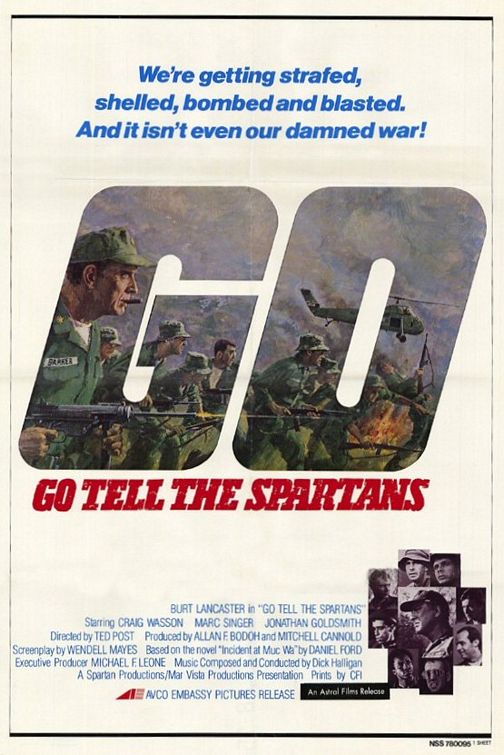
Go Tell The Spartans (1978)

go_tell_the_spartansThis was supposed to be Good Night and Good Luck, which is even on The List, but I couldn’t find my copy of that. As I’m trying to only watch movies during this I’ve never seen, I turned to some movies I bought at the 12 for $50 sale at the WB Shop. It’s an older disc, with a 4:3 image of what wasn’t all that widescreen, but grumble grumble.
There was a sudden flap of Vietnam movies in the late 70s , and I had seen all of them, except this one, the first to hit the theaters (as an aside, I’m talking about real Vietnam movies, not Rambo or any number of Italian thrillers starring Chris Mitchum. Although I saw them, too).  It was released in 1978, barely three years after America had pulled out, and in an attempt to deal with that still-pulsing wound in the national psyche, it’s set in 1964, when we were still sending in “military advisors” without that being a euphemism.

Burt Lancaster is Major Barker, a career man since World War II who constantly finds himself dismayed and puzzled by the conflict around him. A group of new recruits comes in, and the understaffed Barker has no choice but to put them in charge of establishing a garrison in an abandoned village that the French gave up on ten years before. We get the standard types from central casting: the gung-ho second looey, big on regulations but short on experience; the veteran of the Korean Conflict, who knows what works in war but is burnt-out; the druggie, the draftee who volunteered for the duty, blah blah blah. Of course, once the garrison is established, the Cong take an interest in it, and our green recruits re going to get a swift education or die.

Hong and Wasson in Go Tell the SpartansGo Tell The Spartans has all the distinct tropes of what will constitute the Vietnam movie: the nighttime attacks, the attempts to understand and reach out to the native population, the betrayals that result from such attempts, the inability of the Western war machine to deal with a conflict that was so markedly different from any recent war. It manages to trot out all these and make a pretty decent war movie besides. Lancaster is terrific, and special kudos to first-timer Marc Singer as Barker’s executive officer and Craig Wasson as the mysterious draftee who “sure has a way with the dinks”. Also along are Evan Kim as the number one interpreter and chief torturer, “Cowboy” (man, Evan Kim should have had a much bigger career than he wound up with) and the always welcome James Hong, as a South Vietnamese soldier who bonds with Wasson despite the fact that the only English he knows is “A okay!”

Not a great or essential Vietnam movie, but a good one.

The Holy Mountain (1973)

theholymouWow. What a weird movie.

It’s tempting to leave the review at that (I certainly did on Letterboxd) – any attempt to fully describe The Holy Mountain is going to get bogged down in itself. Stripped to the minimum, it is a tale of a thief (Horacio Salinas) who is taken in by an alchemist (writer/director Alejandro Jodorowsky himself) for his plot to assemble the most powerful people in the land, run them through an accelerated enlightenment program, and using these newly-minted masters to assault the table of the nine immortals who sit atop the Holy Mountain, and take their place as gods.

holymountain2To say the journey is psychedelic and surreal is understating matters. The first half hour is nearly speechless, one bizarre image after another. As a vendor at a long-ago convention told me, “If you like seeing toads dressed in Aztec costumes get blown up, this is the movie for you.” Once we start getting introduced to the Alchemist’s chosen, “the most powerful people on the planet”, we shift into the increasingly absurd and humor so black it absorbs any light in its presence. These are awful people creating everything that is wrong in the world, and one is concerned that these are not the types of people you want to ascend to godhood – until you consider it later (especially if you’re an old hippie like myself) and you realize the Alchemist knows exactly what he is doing – these are the people that need to be taken out of the World, for the World’s own good. (Also, as the Alchemist proves earlier, the purest gold is made from shit)

If there is an actual flaw in the movie (for me, anyway – this flick is an incredibly subjective experience) it’s the voyage to the Holy Mountain and the rituals/exercises the party has to go through for enlightenment. But I’ll also concede that it all seems old hat to me because in my sophomore year – about this time – my unbearably cool young English teacher, Mrs. Watson, recommended Carlos Castaneda to me. And in the bright remove of those early 70s, it is amazing to me that those books were in my school library. Still, one can’t tell a tale of shamanism without showing some shamanism, so here we are.

screenApparently The Holy Mountain  was going to be the most expensive Mexican movie ever made, but wound up costing less than its projected $1.5 million budget. As with Jodorowsky’s other works, the imagery is rich and lush, and I’m surprised he brought it in for less than that. It is colorful, spellbinding, and absolutely berserk. You’re either going to watch it, or not. Personally, I advise watching it. Unlike some, I’m going to advise watching it sober, or at least as far away from any actual psychotropics as you can get. I won’t be responsible for anyone ignoring that particular piece of advice.

The ABC’s of March, Part One

I’m pretty busy, of late. Besides my day job and weekly show, writing work has been coming in a pretty steady clip and it’s rare enough that I don’t like to turn it down. So, of course, I had to grab another challenge when it cropped up. At least this one is specifically for me.

6152c48c-6549-48e5-8dc8-1f1229185cdeI’m a member of the movie social media site Letterboxd – I even paid them some money for a few perks and to keep their servers running. The most valuable features, to me, were a movie-watching Diary function and a Watchlist of movies I want to see someday. (I honestly had no idea the IMDb had such a function). To top that off, the Watchlist can filter the movies down to the ones available on Netflix Instant – very handy.

So while perusing the site, I saw something called “March Movie Madness” mentioned on one of the many lists that proliferate through the site, went to the original listing, and found this: “For each of the first 26 days of the month of March, we’ll all watch a movie that begins with each successive letter of the alphabet. In other words, on March 1st, the title of the movie you watch must begin with an “A,” on the 2nd a “B,” on the 3rd a “C,” and so on and so forth.”

Well, that’s the sort of combination of discipline and anarchy that appeals to me, so I said, “Sure, why not?” (Luckily, March 1 was not quite over when I saw this). The major problem this produces for me – besides the time management thing – is that it leaves little time to write about the flicks, and I actually kind of prefer the roominess that one movie per post allows – but needs must, when the devil drives, as they say. Some of you are probably relieved by that news.

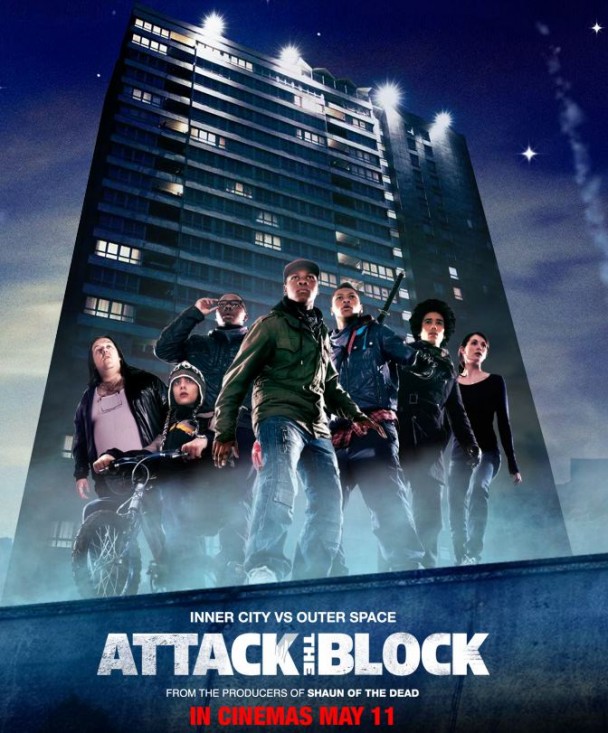
Attack the Block (2011)

attack-the-blockAttack the Block was getting a lot of recommendations last year. It’s a pretty novel approach to the alien invasion movie, firstly in that it isn’t really an invasion and secondly in that it mostly takes place in a rundown Council tenement in London. And our heroes are a gang of thugs.

Creatures start raining down on London inside meteors, and the first one runs afoul of our heroes, interrupting  their first mugging and getting kicked to death in response. When more bigger, uglier and meaner examples of the creature start landing and pursuing our thugs, it turns into an intriguing mixture of Night of the Living Dead and Die Hard, as the thugs must team up with their mugging victim (they never would have picked her had they known she lived on The Block), and also having to deal with a pissed-off minor league drug lord who’s pretty sure they’re responsible for the cops running all over the place.

Writer/Director Joe Cornish manages the difficult task of extracting sympathy for the youth gang after that rough beginning, and the plot’s progression is logical, exciting and doesn’t skimp on the humor, either. Nick Frost has nice little role as the drug lord’s pot proprietor, controlling The Weed Room, which turns out to be the most heavily armored, secure place in the Block.

attack-the-block-hallway1The creatures are impressive, too, nightmarish combinations of ape, dog and black light poster. Filmed in costume on the set, their appearance is sweetened with CGI, rendering their fur a light-absorbing black, and multiplying the nifty feature of glowing teeth. The mixture of practical and computer effects provides the proper combination of savagery and other-worldliness.

One word of advice to American viewers: Turn on the subtitles, at least until you grow used to the cadence and slang. I also love that the Chav equivalent of “Respect” is “Ratings”.

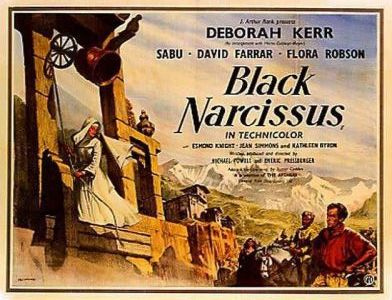
Black Narcissus (1947)

BlackNarcissusLobby3Well, that’s certainly a tire-screeching change if ever there was one. There was a time when Michael Powell and Emeric Pressburger represented the best of what British cinema could achieve, and this is a high-ranking exhibit of why.

A group of Anglican nuns is invited by the local mucky-muck to take over an abandoned brothel (in a more genteel time, this is referred to as “a palace for the General’s women”) high in the Himalayas. Apparently a group of monks tried the same thing the previous year, and only lasted five months.

Once there, the sisters set up a school and an infirmary. The local British Agent, Mr. Dean, is petty cynical about the nun’s mission, and immediately clashes with the Sister Superior, Clodagh (Deborah Kerr). The altitude, the constant wind, the vast, empty vista and the exotic local culture all begin to wear on the sisters; they find their faith eroding, and memories of their lives before the cloth intruding more and more into their daily affairs. We experience this mainly from the point of view of Clodagh, but there is one sister – Ruth (Kathleen Byron), who was none too stable to begin with, who becomes obsessed with Dean and determines to leave the Order to be with him – much to Dean’s dismay and abrupt disgust. His dismissal is the final act that will send Ruth into madness, and her jealousy of Clodagh will reach a tragic end.

BlackNarcissus4Possibly the most amazing thing about Black Narcissus is that the mountainside convent was achieved totally in the studio, with glass shots and matte paintings. Powell felt absolute control was necessary to the success of the film, and to be sure, things that are normally disastrous in such travelog-type movies, such as mismatches between footage shot in the field and in the studio, are not to be found here. The movie won an Oscar for art design – well deserved – and Jack Cardiff was similarly rewarded for his cinematography and astounding use of light, inspired to some degree by the paintings of Masters like Vermeer.

The acting can swing to the deep end of melodramatic, but then, this is 1947. Flora Robson as Sister Philippa, the gardener, gives the most subtle, yet touching performance, as the sister so shaken by the memories awakened by the locale, that instead of vegetables, she plants a garden full of flowers. The cagiest part of all this is once we see Clodagh and Dean take an instant dislike to each other at the beginning, we know these two are going to get together; it’s Hollywood law. But though they do get closer, and start to respect each other more and more, it never happens, it can’t happen. The audience finds itself in the same state of unfulfilled longing as the characters.

Come for the pretty pictures, stay for the intriguing spiritual crises.

Cronos (1993)

cronosGuillermo del Toro’s marvelously assured debut feature provides a unique take on the vampire legend. A 16th century alchemist creates a clockwork scarab he calls The Cronos Device; it houses an insect of unknown specie, and winding up the device and allowing its various appendages to bite into your flesh does indeed imbue you with immortality, but at a horrific price. The fact that our alchemist dies in an accident in the early 20th century proves that it works. A dead body hanging in his mansion dripping blood into a dish also proves the horrific price.

The possessions of our nameless alchemist are auctioned off, the Cronos Device concealed in the base of an archangel statue. That statue comes into the possession of an aging antique dealer (Frederico Luppi), unaware of its cargo, or that a rich, cancer-ridden man (Claudio Brook), owner of the alchemist’s notebook, has been looking for the statue for some time. A none-too-subtle  thug examining the statuary in his shop causes the dealer to discover the Cronos Device, accidentally using it, finding himself feeling much more youthful than he has in ages, although he has this peculiar thirst for blood… And he also falls afoul of the rich man’s harried nephew Angel (Rod Perlman), who isn’t afraid of breaking the law, and people, to get what his uncle wants.

cronos2Cronos starts with a horrific vision and then is satisfied to simply ramp up the tension and the weirdness, finally re-entering the realm of out-and-out horror in the half hour. It’s marvelous to see some of the del Toro motifs in their larval form, as it were: A fascination with clockwork gears grinding like the wheels of justice;  insectile lifeforms; and the startling ability of children to deal with situations that adults cannot or will not. It’s an intriguing film that takes an interesting path to tell its tale, and it’s very nice to see the first outing of what would become one of film’s foremost voices in the realm of lyrical horror.

Diabolique (1955)

les diaboliquesHenri-Georges Clouzot’s Les Diaboliques is hailed as a suspense masterpiece; the only problem with approaching it in 2013 is that everything which was daring and new at the time has since been appropriated time after time by other movies and other directors.  On the Criterion Blu-Ray, Kim Newman makes the point that most of William Castle’s career was spent doing remakes of Diabolique.

The wife and mistress (Vera Clouzot and Simone Signoret, respectively) of an abusive asshole (Paul Meurisse) join forces and plot to murder him. He’s the principal of a boy’s boarding school where they both teach. Over the course of a three-day weekend, they drug him, drown him in a bathtub, then deposit the body in the school’s neglected swimming pool, all the while providing themselves with a solid alibi. After several days, the corpse has not cooperated by surfacing, and the mistress manufactures an excuse to drain the pool. When there is no corpse found in the pool’s murky depths, things begin to get weird.

The suit in which the man was drowned returns from a dry cleaners, freshly pressed. A boy claims the Principal has told him to clean up the yard for punishment. The face of the missing man seems to be eerily present at a window behind a school group picture. Either someone knows about the murder and is scheming to blackmail the women, or the unthinkable has happened, and the man has returned from the dead.

500fullAs I said, it’s really hard to put yourself back in 1955 when all the twists were new; it’s like trying to figure out why people were fainting during the 1931 Dracula. The remove is too far; that once-shocking coin has been spent over and over again, and in our presence to boot. The climax, once so terrifying, still packs a punch because it’s so very well done, and to give Clouzot credit, there had been so many twists and bizarre mind games played with the viewer up to that point, I was still uncertain what I was witnessing was actually the truth. I still feel it runs a bit long at nearly two hours, but there’s not much in the way of fat to be trimmed.

Good movie, but perhaps I let myself be led astray by its reputation. I really loved The Wages of Fear, and that also elevated my expectations. I’d still recommend it, but be aware you’re likely going to find it awfully familiar going.

Okay, that’s it for now. I still have a movie to watch today, after all.

The Seventh Seal (1957)

7th sealIn my quest to fill the many holes I had in my film education, I don’t think I’d yet approached anything so iconic as Ingmar Bergman’s The Seventh Seal. The movie is so well-known that The Simpsons makes jokes about it at leisure, the chess game with death is imitated and riffed upon (at some length in one of my favorite movies, Bill & Ted’s Bogus Journey), the back of the Criterion blu-ray extols it as “…one of the benchmark imports of America’s 1950s art house heyday, pushing cinema’s boundaries and ushering in a new era of moviegoing.”

Phew.

I think, like a lot of people, I was expecting a grim vista, an allegory of Man’s search for meaning and God in the midst of the Black Death. Well, there is a fair amount of that. What I was not expecting, given the movie’s reputation, was the sweep of emotions, the comedy, the rapid switching of audience allegiances with the characters.

In other words, I was expecting good, but I wasn’t expecting something that would swing in on my Top Ten and start bashing other movies out of the way, like Aragorn and Gimli on the bridge to Helm’s Deep.

(Was that last reference nerdy enough? I worry sometimes.)

Sure, Bergman starts us right off with the chess game with Death. Knight Antonius Block (Max von Sydow) is sleeping on a rocky beach, along with his squire, Jöns (Gunnar Björnstrad). Up crops Death (“I’ve been at your side for a while.” “I know.”) and Block, since his chess board is curiously already out and set up, proposes the chess game.  What I didn’t know, in my filmic ignorance, is that the chess game is ongoing throughout the movie; Block has a reprieve so long as he manages to hold checkmate at bay, or wins.

The-Seventh-SealBlock has just returned from a decade spent in the Crusades, a decade during which his faith has taken a severe beating, and his life’s course has become a quest to qualify if God actually exists, or not. He has been through such horrors that he requires physical proof, even resorting to asking a condemned witch how he, too, could see the Devil, because he has some questions for Old Scratch. These are, of course, questions that will not be answered – even Death is not forthcoming on the subject. The fact that he has returned to his home country to find an ever-spreading plague isn’t helping his demeanor any.

That I had expected. What I was not expecting was to become so involved with the character of the Squire. Jöns has similarly lost whatever faith he had, saying “Our crusade was such madness only a real idealist could have thought it up.” His is not the way of questioning; he has come to believe that all that remains after death is emptiness, and moves through life with more of an air of acceptance, of proactivity, as it were. If there are any examples of what would one consider knightly duties, saving a young woman from a rapist, or putting a scoundrel down, it’s Jöns that does it. It is beneath Block. Jöns has his bad moments – he’s far from perfect or even heroic – but he remains my favorite.

1Then we begin spending some time with a traveling troupe of actors: a family of three, Jof (Nils Poppe), the juggler who sees visions like the Virgin Mary walking the toddler Jesus; Mia his wife (Bibi Andersson) and Mikael, his one year-old son; and Jonas Skat (Erik Strandmark), who is more than a bit of a rogue.

Now, I was getting into the travels of Block and Jöns, and found myself a little impatient with the juggler sequences. Was this going to pay off? I should have know better. Of course it was going to pay off.

Block, Jöns, and the girl he rescued (Gunnel Lindblom) wind up at the same village where the jugglers are doing a show – which will be interrupted by the Flagellants, a group of people going about the countryside, singing hymns, carrying lifesized crucifixes, and haranguing everyone that they’re going to die because God thinks they suck and generally killing any hope for the actors passing the tip hat. Also, Jonas runs off with the local blacksmith’s wife, which is going to propel the plot for a while.

There will be a point where Block and Jöns join the jugglers – Jonas is still MIA with the wife – and they share a simple meal of wild strawberries and fresh milk, while Jof plays his lute. It’s a quiet, peaceful setting, and Block speaks of how the memory of that afternoon will sustain him. It’s a beautiful moment, made all the more poignant as one realizes that if Block was truly looking for the existence of God, it was never more obvious in that moment of peace on a sunny hillside.

There is a scene of almost Shakespearean comedy in the local tavern, where the blacksmith Plog (Åke Fridell) is sobbing into his ale over his lost wife. He and Jöns have a back-and-forth scene about all the things that are wrong with women, and why he is better off without her, and each one just makes the blacksmith sob harder. Later, when Block, Jöns and Plog are escorting the jugglers through a scary wood, and they find Jonas and the wife walking about, there is another marvelous scene where Plog and the actor trade insults, with only a little help to the slower blacksmith by Jöns.

flagellantsLater, camped in the woods, Jof, with his talent for visions, is the only one that can see who Block is playing chess with, and quietly gathers his family and sneaks out of the camp. Block sees this, and remembering that Death has said some things about the trip through the woods with typical Death-style foreshadowing, knocks over some of the chess pieces to distract Death while the actors escape. It is one of the most knightly things we have seen him do, but it will cost him. Shortly after, Death wins the match.

I hope I haven’t said too much, as I leave you here, still ten minutes before the end of the movie. As with all movies that I like, or love, I want you to experience it for yourself. And probably the greatest recommendation I can make is that, while writing this, I have been urgently seized with the need to watch it again. Fabulous filmmaking, all the more remarkable considering Bergman was using equipment left over from World War II, and filming in a very small studio – apparently it is possible to see apartment lights in the background of one nighttime shot – and still produced a movie, that while epic in subject matter, still manages to feel small, intimate, and wholly believable.

At the very least, I haven’t spilled any plot points the trailer didn’t:

(You might want to hit the YouTube logo and watch it on their site – I couldn’t find one where the burned-in subtitles didn’t turn to mud)

Arabian Nights (1974)

Mille_Et_Une_Nuits_(1974)So we come at last to the third and final movie in Pier Paolo Pasolini’s Trilogy of Life: Arabian Nights. For this outing, Pasolini has gone farther afield in medieval literature, if Arabian Nights can even truly be considered medieval. First instances of the collection date back to the 8th century, with more stories from various cultures being added over the years.  (I was more than a little surprised that two of the most famous of the tales – Aladdin and the Forty Thieves – didn’t enter the collection until the first French translation in 1704!)

True to the other movies in the Trilogy, Pasolini also jettisons the formal framing device of the traditional Arabian Nights, so say farewell to Scheherazade and familiarize yourself with our first tale, which will take its place: the arrival of a slave girl  Zumurrud (Ines Pellegrini) at the market – unusually, she is allowed to choose her new master, and isn’t shy about insulting prospective buyers. She chooses a young man, Nur Ed-din (Franco Merli) as her new master, and hands him a bag of a thousand dinars to purchase her, and procure a home.

zumurrudThis is, as one might imagine, a pretty sweet deal, especially since Zumurrud takes special pains to make sure Nur is no longer a virgin, and then starts using her talents at embroidery to keep the money coming in. Alas, Nur is a bit of an idiot, and proceeds to allow Zumurrud to be kidnapped – twice – and will spend the rest of the movie looking for her. Zumurrud escapes her second captor (one of the forty thieves, no less), and crosses the desert dressed as a man. She comes to a rich kingdom, where, luck would have it, the king has just died and it is the city’s custom to proclaim the next man to come in from the desert as the new king. Again, a totally sweet deal.

The first stories are read from a book by Zumurrud while the two are still in the idyllic stage of their relationship and rather serve to set up Pasolini’s view of this world: in the first, a noted sage and his wife make a deal about who will fall in love first between a boy and a girl they’ve arranged to have drugged so each will awaken in the same tent, but at different times; but they discover they’ve both forgotten about hormones and declare it a draw when both immediately hump the other. In the second, a rich poet picks up three willing young men for an evening of sex and poetry. arabian embraceIf anything, Arabian Nights is even less inhibited than the first two movies, but no less playful or joyous in its couplings. It’s also the most open about same-sex relations between males. Pasolini possibly thought that a society with such strong segregation between the sexes would result in more openness about homosexuality, and as film scholar Tim Rayns points out in his excellent essay on the Criterion Blu-ray, a general exodus by gay Beat writers like Burroughs to the Arab world in the 40s and 50s bears that out.

(One particularly lovely bit that springs from this segregation regards Zumurrud’s wedding night, when the supposedly male king is forcibly married to a vizier’s daughter. Taking a chance, Zumurrud reveals her true nature to the daughter, and the girl responds in peals of laughter, delighted that a woman has put one over on the men running the city.)

At one point in Nur’s miserable wanderings, he is hired by a girl to act as porter for her day’s purchases at the market. She winds up buying quite a bit (Nur’s goggle-eyed response at the list she rattles off to a merchant is another splendid comic moment, ending with his staggering under a huge bag of goods), and Nur dines with her and her sisters (and bathes with them afterwards,as Nur has the devil’s luck with women). After the meal, the girl who hired him reads from a book, and so begins our next major round of stories. ninetto

This is the most adventurous part yet, as the story begins with a king’s son, Prince Tagi (Francesco Governale) finding a man weeping at an oasis over a painted cloth. This man tells the story of falling in love with another woman on his wedding day, and breaking the heart of his poor cousin, who nevertheless  helps him to meet and finally bed this woman, while she herself dies of a broken heart. The man telling the story is Ninetto Davoli, who we recall is the man who broke Pasolini’s heart back during the filming of The Canterbury Tales, and it is likely no accident that the director cast him as a thoughtless and selfish young man. Reading intention into the fact that the woman he’s bedding eventually castrates him… well, that might be going a bit far.

Tagi, however, is overjoyed, because the assignations took place in Princess Dunya’s garden, and the cloth is her work, and he is in love with her! So the two head to the city and he manages to finagle his way into Dunya’s garden, only to be told that the Princess is a man-hater of the first water, due to a dream she once had. Tagi decides to create a beautiful mosaic in the garden, which will show her an error in her dream. He hires two beggars to help him with the mosaic, who turn out to be traveling holy men, who each tell the tale of how they came to be so, as both were princes who ran afoul of mystic, even demonic forces (once again, Franco Citti providing the demonic role). Well, Tagi’s mosaic works, and as he consummates his love with the formerly man-hating Dunya, we come back to the dinner with the sisters. Stories nestled within stories! Impressive!

And because I know you’re wondering, Elisabetta Genovese, whom I was crooning over in Canterbury Tales, is the girl who hired Nur Ed-din. And yes, she did smile, so my evening was complete. Yes, she also got naked, but that is none of your business. Arabian-Nights-1080-12Nur Ed-din does eventually find the city, and Zumurrud cannot resist making him think that the King wants to bugger him (and as the soldiers carry the surprised boy to the King, men at the market are heard to say the Arabian Night version of “Yeah, I’d jump that”), but true love wins out, though I’d really love to see how much more complex that particular relationship was going to become. As it is, quantum mechanics would have been needed to map it out.

As I said, this is the most uninhibited of the three movies; perhaps by moving events to the middle east, Pasolini finally felt he was out from under the Church’s thumb, and finally free from Catholic guilt, could cut loose. There is quite a bit of sex on display here, but rarely is it explicit with a capital X – again, it is Pasolini yearning for a time before sex became another commodity, when it was a simple, loving act. If you want commercialization, you seek out the many rip-offs that followed the Trilogy of Life’s success, imitators that caused Pasolini to denounce his own work, to disavow them, and to settle back down to a trademark rage against politics and the world he found himself living in, with Salo: The 120 Days of Sodom.

As Rayns also points out, the Trilogy of Life is the rather unusual act of Pasolini being positive, after so many political movies, poems and treatises that were angry fist-shakes at the powers that be, the status quo. And it’s true: these movies contain much about the foibles and often hateful nature of human beings, but they’re more about the better things: trust, love, and, certainly in the case of Arabian Nights, sex. In it, the two are inseparable. arabiannightsblu00005I haven’t even mentioned the amazing locales Pasolini found, vistas that he could pan over without much in the way of obvious modernity. It’s a handsome picture, and I wish Pasolini had not been so brutalized by a carnivorous culture that fed upon the very thing he despised, commercialism. I wish this phase of his career had lasted longer. What could he have said with more time? As it is, we must be satisfied with what we have. Now I’m fascinated, and will be seeking out his earlier works. And I think now that I have context, I can finally see Salo and meet it on its own terms.

Here, have a trailer mostly obscured by vintage VHS noise, which is okay, because it gets pretty NSFW, anyway. And ponder that this most commercial of creatures, the movie trailer, casts Pasolini in a light he likely would have despised.