Y: The Yellow Sign (2001)

Click here for Roundtable Central!

Click the banner for Hubrisween Central. Or visit Hubrisween on Letterboxd


yellowsign-209x300Making movies from established classic literature is a tricky business. Making one from established classic horror literature even more so. It takes a sure, subtle author’s touch to make you look up from a book and make sure no Damned Thing has slithered into the room while you were absorbed in the story. You’d think that would be easier with a movie, all visuals and sound, but no, it’s harder. Literature has the power to make your mind, your imagination work against your own well-being. Few movies have the art to do that.

To my knowledge, this is the only serious attempt to bring one of  Robert W. Chambers’ seminal horror stories to life, and even so writer/director Aaron Vanek is sure to mention that it is “inspired by”. The Yellow Sign is the fourth story in the book, The King in Yellow, which was spoken of in reverent terms in my youth. There was a resurgence of interest in H.P. Lovecraft in the late 60s and early 70s, and I don’t think his stories have gone out of print since; therefore attention was paid to his influences, and Chambers most definitely is one.

yellowsign1 The movie first: Tess Reardon (Shawna Waldron) is the owner of a near-bankrupt art gallery. She’s having trouble sleeping, plagued by dreams of weird art, a girl sleeping in a chair covered in yellow and purple ribbons who won’t wake up, dreams always ended by a large man with empty eyes asking “Have you found the yellow sign?” Her gallery partner (Andrea Gall) says the art sounds like the work of a surrealist shown at her former gallery years before – Aubrey Scott. That show didn’t end well, she says, and Scott has been a recluse ever since.

Tess tracks Scott (Dale Snowberger) to an old, seemingly empty hotel. His apartments have become a riot of his work, compelling but dark. He agrees to a show, but only if Tess will model for his new painting. She quickly agrees.

yellowsign2While painting, Scott tells Tess a story to stop her from fidgeting. It’s about a tribe where the children seem to go mad for several years, but they are really existing in two worlds simultaneously, and when this period is over, they became the tribe’s shamen. The combination of Scott’s story and a swirling painting before her causes Tess to lapse into a trance, as the Yellow Sign appears on the canvas. In the trance she refers to Scott as “Aldones” – “You know my real name!” he gasps – and informs him the Watchman is coming for him. Panicking, Scott wakes her. She thinks she was asleep.

The tenor of her dreams change. Now the large man is driving a carriage under her window. It’s a hearse, and Scott is in the coffin, screaming to be let out.
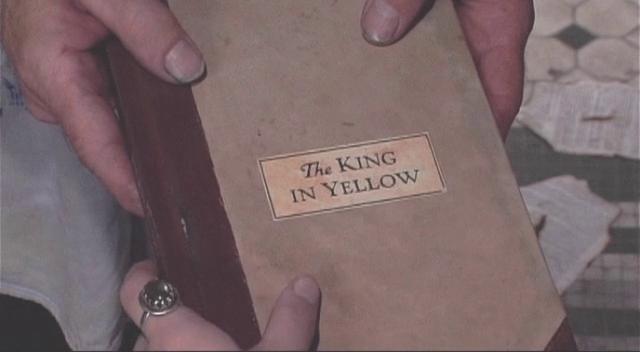
yellowsign4The next modeling session, Tess tells the painter about her childhood, and an invisible twin sister she had called Camilla. Not an imaginary friend, a real person, who was queen of a place called Ythll. Tess doesn’t realize that her childhood mirrors the story Scott had told her before. And as she leaves that day, he hands her a copy of a book: The King in Yellow, Though she tries to throw it away when she is halfway through, it comes back to her. She finishes it, and the next day, the signing of the contract with Aubrey Scott takes on a much more unearthly and deadly significance.

This sent me scurrying to my copy of The King in Yellow (the story collection, thankfully not the book in the story) to see exactly how “inspired by” was this version. Vanek’s changes are intriguing. Chambers’ story concerns a painter and his model, and the large man who lurks around the graveyard across the street from his studio, whom he describes as looking “Like a coffin worm”. His model has the dream about the coffin in the hearse, and so it goes. The movie is basically a reverse of the story, which is told from the painter’s point of view. The movie unfolds from the model’s POV, and while the ending differs greatly, well – that’s all the better for people who read the story, I suppose. It does impose a sort of order and reason on the denouement, which was pretty creepy and inexplicable in the original.

yellowsign5It’s Chambers’ refusal to explain the supernatural goings-on that so inspired Lovecraft along with that device, the evil book. The King in Yellow is a play script, a script that, if read, drives people to madness and death. Apparently the first act is quite normal; but the second act reveals several awful truths about life and the universe around us that are better left unknown.

That, of course, is next to impossible to get across in a movie. So Vanek, probably wisely, chose not to, changing The King in Yellow to the key that unlocks the mystery of what Aubrey Scott has been up to with these strange paintings (as only a slight digression, the Art Direction by Lisa Horn and paintings by Jason Voss are truly outstanding). That is concrete enough, that is do-able, it is even satisfying. Chambers did not carry on with horrific literature, his writing went to other genres over his lifetime. He’d probably be satisfied with the result.

yellowsign6At a sleek 50 minutes, The Yellow Sign doesn’t get a chance to wear out its welcome, but that also seems to have worked against it. It’s only available commercially in a somewhat hard-to-find disc called The Weird Tale Collection. That’s a pity, because it manages to get its desired effect without any of what seem to be the staples of modern horror cinema, like gore, nudity or sudden blaring loud sounds.

The Yellow Sign on Amazon

V: Viy (1967)

Click here for Roundtable Central!

Click the banner for Hubrisween Central. Or visit Hubrisween on Letterboxd


You know, if I can say nothing else about the Hubrisween Challenge, it has given me instance to track down and find some Viy1967movies I read about in the Famous Monsters of Filmland’s “Coming Distractions” articles that I had never seen, had been mentioned once, and then dropped off the radar. Shanks was one of them. Another I remember was – as was the case with FM, spelled out in capital letters: THE VIY – SPIRIT OF EVIL. That was unusual enough that it stuck with me, and likely the reason I referred to it as The Viy all these years. Nope, it’s just Viy.  I can’t find any records of it actually getting a theatrical release in the US, either. AIP’s appropriation and repurposing of several Soviet genre films had been in the early 60s, and Viy didn’t see a release outside the USSR until 1970.

In any case, Viy keeps cropping up in genre books, so it was high time to give it a look. It’s based on a short story by Nikolai Gogol, itself a mixture of several Ukranian folk tales (Mario Bava’s Black Sunday is based on the same story, but far more loosely). A group of young student priests on summer break from a seminary in Kiev find themselves lost on the way to their village. They beg an old woman for shelter for the night, but she tells them they each have to stay in a different part of the house.

PDVD_026That night, in the barn, she visits Khoma (Leonid Kuravlyov). Horrified, the young man thinks she is trying to seduce him, but instead she climbs on his back and starts riding him through the night like a horse. As the two fly up in the sky, he realizes she is a witch (duh) and begins shouting prayers, causing them to fall to earth. Once landed, he grabs a branch and begins beating the old woman. As she nears death, she turns into a beautiful young woman (Natalya Varley). Now sincerely freaked out, Khoma starts running and doesn’t stop until he gets back to Kiev.

Messengers soon arrive from a rich cossack in a remote part of the province; bearing gifts and donations to the monastery, they convey that their masters’ young daughter has been severely beaten, is near death, and has asked specifically for Khoma to come pray over her. The Rector forces the reluctant Khoma to go, though on arrival he finds that the daughter has died, and he is commanded to sit a prayer vigil in an old, ruined church with her coffin for three nights, her final request. The guilt-ridden Khoma has no choice but to comply.

night1Of course, the first night, she rises from her coffin, and Khoma hastily, fearfully draws a circle of protection in chalk around the stand holding his prayer book. While he prays, the corpse lurches around the room, hearing his voice, but unable to see him due to the circle. She presses against the circle like an unseen wall, to no avail. Finally, the cock crows and Khoma’s first night of terror is over.

The second night is no better. That night the witch rides around the church on her coffin like a goth Silver Surfer, using the casket as a battering ram against the circle. Again, the circle and scripture hold, and Khoma has survived again – but his hair has turned snow-white.

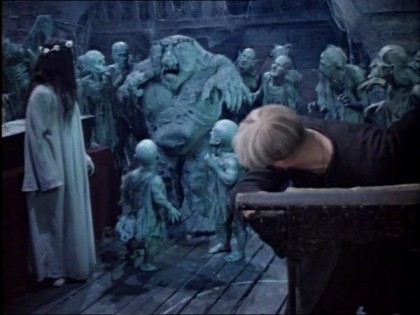
viy-1967-2-420x315Khoma tries to refuse to sit the last night, he attempts escape, all to no avail. On the last night, the witch pulls out all the stops, summoning all manner of creatures of the night and outer darkness. They still cannot see Khoma, and finally the witch calls Viy, which seems to surprise and trouble even the creatures of the night. Viy comes, massive and ugly, telling the others to lift his heavy eyelids so he can see Khoma. The young priest knows that if he avoids eye contact, he will be safe – but then he hears the cock-crow, and he turns.

Viy shouts “I CAN SEE HIM!” and the monsters pile on Khoma. But, they were so excited they missed the first cock-crow, and when the second one comes, they try to escape, but are trapped half-in, half-out of the walls of the church like bad statuary, and the beautiful daughter returns to the withered form of the old crone. Khoma is dead, having paid the price for his sins, but the church is forever now a place of horrors, and abandoned.

It’s a good story, and where a typical American viewer might find fault with it is the languid pace – the vigils do not begin until halfway through the running time, and man, are nights ever short in that part of Russia! They’re also going to be confused by the seminarians. The dismissal of the students at the beginning of the movie is treated by the surrounding villagers like the arrival of the Mongol Horde, as the students are a thieving, venal bunch. Khoma himself is not a very upright man at all, and spends most of the three days of the vigil getting progressively drunker. Can’t have a Soviet film endorsing religion, I suppose.

tumblr_lb8pmcRuzr1qz72v7o1_500The vigil scenes are the best part of the movie, and one wishes there were more; but as Samuel Fuller advised Bogdanovich when he was planning Targets, “save the money for the end of the picture”, and it has to be admitted the directors, Konstantin Ershov and Georgi Kropachyov have done just that: the last night is an absolute corker, and a whole lot of credit for that should probably go to Art Director Aleksandr Ptushko.

Ptushko was the director of some incredible and beautiful Russian fairy tale movies, Sadko, Ilya Muromets and Sampo. Or, as they are better known in America, The Magic Voyage of Sinbad, The Sword and the Dragon and The Day the Earth Froze. Yes, these have all been on MST3K, largely because of the ham-fisted attempts to de-Russianize them by AIP, but they are each wonderful movies in their own right and deserve to be sought out on their own merits. Sadly, the original versions are tough to come by, though their bowdlerized versions remain available.

Viy doesn’t have that problem, perhaps because it has remained unhampered by the perceived necessity of pretending it’s not Russian. With no English dub playing to the masses, it remains generally available in its original form, and worth a look.

Oh, alright, I know what you want, here’s the money shot:

Viy on Amazon

U: Undead (2003)

Click for Roundtable Central

Click the banner for Hubrisween Central. Or visit Hubrisween on Letterboxd


undeadUndead was getting really good word of mouth back in 2003. Unfortunately, that was also the year I began my ten-year moratorium on zombie movies, engendered by the one-two punch of Resident Evil and House of the Dead. I reluctantly re-entered the zombie movie world last year, so there are a few – and honestly, only a few – I  need to catch up on.

The surprising thing is I managed to go that decade without any spoilers.

Undead starts with some standard horror movie boilerplate set-up: a comet collides with a meteor, and fragments streak toward the Earth, targeting Australia. The meteorites actually hit a few people in the small town of Berkeley, who immediately get back up as gut-munching zombies. If I complimented Return of the Blind Dead for giving us zombies at 16 minutes, I really have to think up new superlatives for  Undead doing the same thing at seven and a half minutes – less than half that time.

2003_undead_1_640That time is used to introduce most of our cast of characters, but the first is obviously the one we’ll be rooting for, local beauty queen Rene Chaplin (Felicity Mason) who is desperately trying to get out of town on what she only thought was the worst day of her life. A zombie-infested three car pile-up on the road out puts an end to that (and almost to her) when she meets Marion (the brilliantly named Mungo McKay), owner of what used to be the town’s gun shop and a man seemingly possessed of the skills and weaponry to survive a zombie apocalypse.

253Trouble is, Marion is also the town pariah, after an incident a while back when he was attacked by zombie fish and then abducted by aliens. His main mistake was telling the townsfolk about that. And given the zombies, the unusual cloud cover, and the shafts of light from that cloud cover lifting animals up into the sky, it looks like Marion is going to have his day in the sun. Four more people escape to Marion’s house, a pilot and his extremely pregnant wife, and a local cop who has seen too many American movies and his timorous partner, on her first day of the job. We quickly settle into zombie siege territory as this band is slowly driven down to Marion’s fallout shelter. Then the pregnant waitress’ contractions start.

SO just when we think we’ve settled into a submarine movie, our cast has to get out of the house and (again) out of town… only to find that the area is surrounded by a tall metal wall festooned with spikes.

undead-005149-501x282Even for a horror comedy, this is pretty out there, and is indicative of the charm of Undead. Just when you think you have the story pegged, it outfoxes you. Though the opening scenes are reminiscent of Brain Dead (or as we Yanks like to call it, Dead Alive) with its splattery comedy and extreme gore, as the story progressed I was reminded more of Dark City, by another Aussie filmmaker, Alex Proyas. That’s high praise, and it’s deserved. If, like me, you’ve managed to avoid spoilers, I am not going to go any further. Most of this movie is about the joy of discovery.

Made by two brothers, Michael and Peter Spierig, this movie defines the term labor of love. The cast was rehearsed for two months, because the budget was so tight, there were only one or two takes per shot. The interiors are all sets, and look incredible, and a movie could probably be made about the scavenging involved. The impressive special effects were done on the brothers’ home computers, over nearly a year of post-production.

undead3The result is professional in the extreme – honestly, this is the sort of thing that really makes you want to spit on stuff clogging the midnight movie circuit, stuff like The Room and Birdemic. Passion and talent together with a bunch of friends and (doubtless) a lot of support, created something that deserves views for its quality, dammit.

The Spierig’s follow-up didn’t happen for another six years, and that was Daybreakers. I was never interested in it… until I saw Undead.

Undead on Amazon

T: Targets (1968)

HubrisweenBlackRed

Click the banner for Hubrisween Central. Or visit Hubrisween on Letterboxd


MPW-56708Every now and then the pieces just come together, and it is wonderful when that happens.

After shooting The Terror, one of Roger Corman’s more infamous patchwork movies, Boris Karloff owed Corman two more days of work. There was a young feller named Peter Bogdanovich, a writer who had come to California and started working with Corman by accident more than anything. After almost half a year toiling in that fruitful movie factory/film school, Corman felt that Bogdanovich had earned his shot, and offered him his own film. It could be any movie Bogdanovich wanted, with two conditions:

1) He had to use Boris Karloff for the remaining two days on his contract, and

2) He had to use 20 minutes of footage from The Terror.

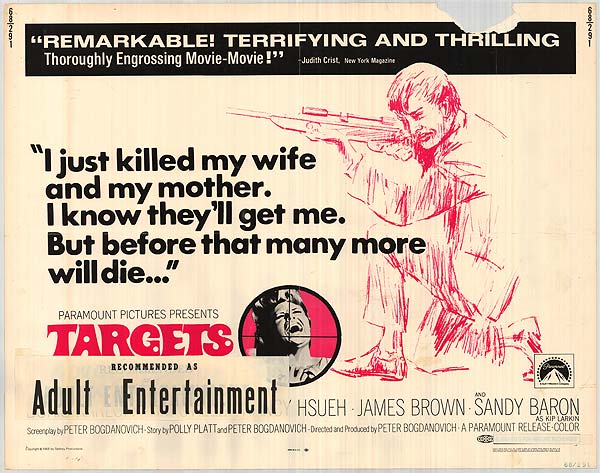
targets-1968Employing Corman math, this meant 20 minutes of new Karloff (“You can shoot 20 minutes in two days, right? I shot whole movies in two days!”) plus 20 minutes of old footage added up to enough Karloff to ballyhoo it as a new Karloff movie. All Bogdanovich had to do was figure out how.

What began as a joke in his head while desperately trying to put those puzzle pieces together – Karloff watching the end of The Terror  in a screening room, turning to Roger Corman and saying, “That was the worst movie I’ve ever seen.” – eventually became the movie we know as Targets.

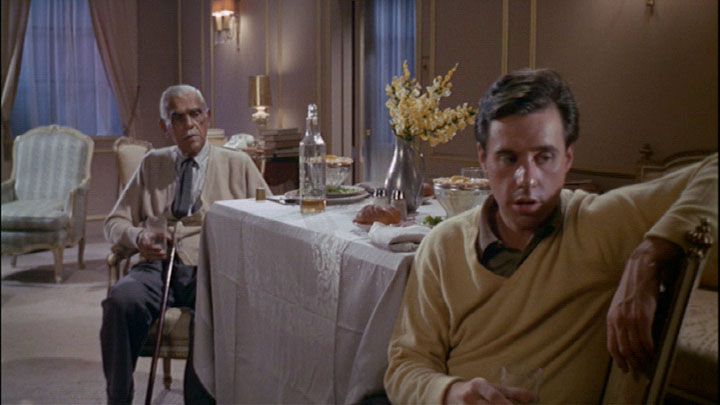
The movie does begin with the end of The Terror and the screening room. Karloff is playing Byron Orlock, star of The Terror (and so much more), who has decided this is the perfect time to retire. Entreaties from producers and the young director of The Terror (Bogdanovich himself, playing a character based on uncredited script doctor Samuel Fuller) prove useless. Orlock feels he is an anachronism, his stock in trade fallen to mere camp against headlines of shooting rampages in supermarkets.

vlcsnap-00011What Orlock does not know, as he stands on a sidewalk arguing with the director, is that he is literally in the crosshairs of a hunting rifle across the street.

The rifle is being bought at a gun store by Bobby Thompson (Tim O’Kelley), who gladly purchases the rifle, then puts it into the trunk of his Mustang, where it joins a small arsenal of rifles and pistols.

And so begins the two stories that will alternate throughout the movie, as Bobby exists in his gray suburban tract house with his parents and wife. Bobby’s dad has a lot of guns and a few hunting trophies; we see a picture of Bobby in Army fatigues on the wall. Bobby tries to talk to his wife before she leaves for work, saying he doesn’t know what’s happening to him, he’s having some funny ideas. She’s late, though, and laughs it off.

600px-Targetswoodmaster4Byron, after a sullen night interrupted by a drunken Bogdanovich that ends with both of them waking up with enormous hangovers, decides to do one last personal appearance at a drive-in theater premiering The Terror. In our other story, Bobby waits for his wife to wake up, then shoots her, his mother, and a hapless delivery boy. They will just be the start.

Based on the case of Charles Whitman, Bobby climbs to the top of an oil storage tank and snipes at the cars passing on the highway below. He seems a bit surprised that the police come so quickly, and eventually dodges into a drive-in movie to escape them – as luck would have it, the drive-in where Orlock will be appearing. He manages to climb into the screen and views the killing fields below, rows of unsuspecting cars, He waits only for night, and unwary persons to turn on their interior lights to give him his targets.

It must have been kind of intense seeing this movie at a drive-in, is what I’m saying.

targets_1In a nicely meta bit, Bogdanovich keeps begging Orlock to do his next movie, written especially for him, and that script is obviously Targets (finally the drunken Bogdanovich snatches the script and staggers toward the door, saying. “Fine! I’ll offer it to Vincent Price!”).

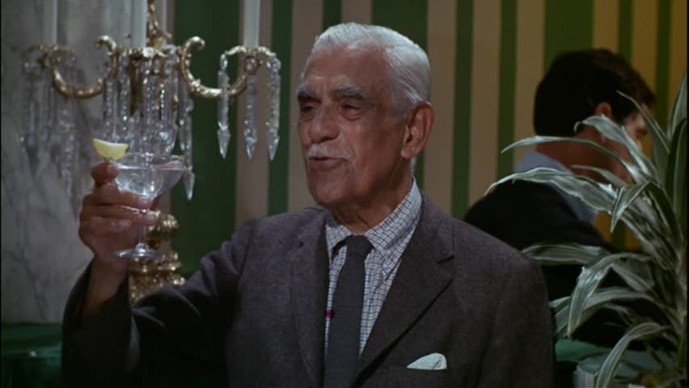
Karloff is 80 years old here, still intensely vital and utterly professional. At this point in his life, both legs were in braces, and he was usually in a wheelchair; when we see him walk, it is always with a cane. Emphysema had him down to half a lung, and on constant oxygen support. Tales of his last years had him taking off the oxygen mask, rising from his wheelchair, hitting the damned mark and saying his damned lines, and returning to the chair and his life-giving tank only after “Cut” was called, and never complaining. That is what the word “professional” has always meant to me. Karloff had none of the bitterness or disdain for his work that Orlock has; but other than that, he was pretty much playing himself in this role. Legend has it that Karloff liked the script so much, he gave the tyro director three extra days of shooting for free.

Not all actors are lucky enough to have that one movie that acts as a perfect coda to their career. John Wayne managed it with The Shootist, and Karloff did it with Targets. But Karloff being Karloff, this was not his last movie; that would fall to Curse of the Crimson Altar and a group of low-budget Mexican movies. But I can alter my perception of the world as I see fit, and so Targets, possibly the first and best of the modern horror movies to successfully deal with a uniquely modern monster, remains for me the capper of Karloff’s long and storied career.

This trailer is obviously from after the movie’s troubled first release, and the success of Bogdanovich’s The Last Picture Show, in 1971, and minimizing Karloff’s involvement is awfully telling. 1968 was a particularly violent year for America, and Paramount was, perhaps understandably, timorous about the movie’s subject matter. But I wonder what those quaking studio heads would have thought of the present day, when mass shootings have become so common they don’t even register on the nightly news anymore.

Targets on Amazon

N: Nosferatu the Vampyre (1979)

HubrisweenBlackRed

Click the banner for Hubrisween Central. Or visit Hubrisween on Letterboxd


Nosferatu_Phantom_der_NachtI have watched a lot of horror movies in my life, and I really have no idea how many times I’ve seen the story of Dracula play out. In the course of my time on this Earth, I have seen the Count go from Evil Incarnate to Tragic Romantic Hero (a metamorphosis of which I do not approve).  I suppose the ultimate capper was when I finally got to play my dream role, Van Helsing, in a theatrical version that was pretty close to the novel, meaning I actually lived the story for a few months.  Good as the story is – and there are portions of Bram Stoker’s novel that deserve their high place in the annals of horror fiction – man I am tired of this story.

So, I have managed successfully to avoid Dario Argento’s Dracula, although I admit I have never seen the Count turn into a giant praying mantis, but I’m afraid that even that novelty isn’t enough to make me sit through that series of events again. But I am more than willing to make an exception for Werner Herzog’s remake of F.W. Murnau’s Nosferatu.

7723_5The first reason is the storyline of Nosferatu is different enough to seem fresh (not fresh enough for Stoker’s widow Florence, who very nearly succeeded in making Murnau’s version a lost film). Removed from the possibility of litigious widows, Herzog returns the character’s original names, though for some reason possibly only known to himself, he flips the characters of Lucy and Mina. He also combines the characters of Van Helsing and Dr. Seward, but combining characters is par for the course in versions of Dracula.

The other reason, of course is this is Werner freakin’ Herzog. This is the director who made a movie about dragging a steamship over a mountain by dragging a steamship over a mountain. No sets for this man, if Castle Dracula must be a ruined castle atop an inaccessible mountain, he hauls his cast and crew to a ruined castle atop an inaccessible mountain. When the ghost ship Demeter drifts to port, bringing the vampire and his numerous coffins, that is a real damn ship scraping the walls of the canals of Drelft in the Netherlands. Herzog makes no bones about his intentions as the opening credits play out over footage of actual mummified corpses in Guanajuato, Mexico.

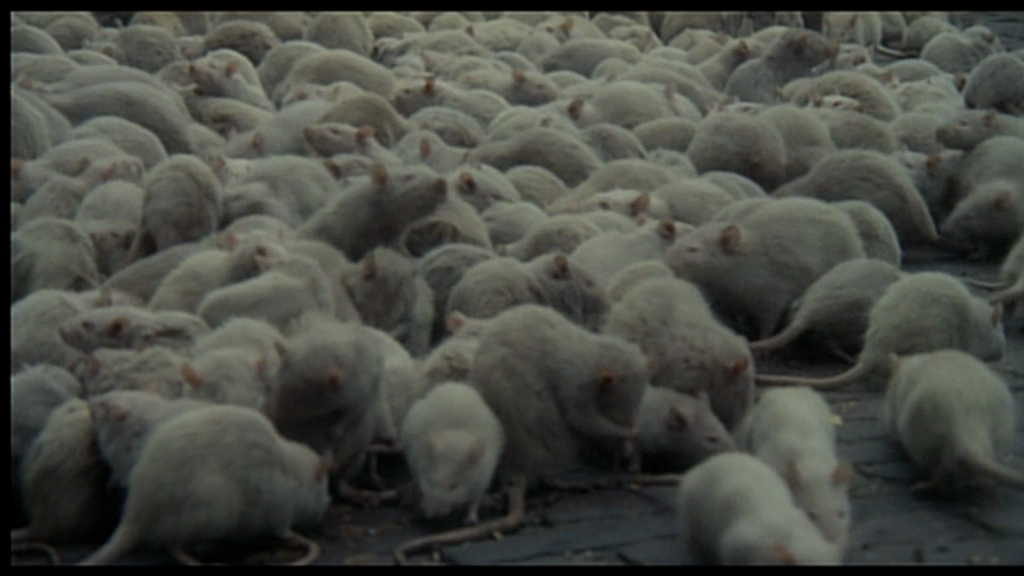
nosferatu ratsAs Herzog’s version of the story progresses, it gets farther and farther from Murnau’s, as Herzog is not going to be satisfied with Gus Van Sant-ing what he considers to be one of the most important movies in German cinema. The most telling embellishment brings to the fore the metaphor of vampire as disease; a lot of treatises and think pieces have been written about vampires representing syphilis or AIDS, and Herzog runs with it. The arrival of the ghost ship also brings an army of rats, and the Plague with a capital P descends on the town. Again, Herzog doesn’t rely on camera angles and trickery to turn a couple of hundred rats into an army, we are talking thousands of the suckers, white rats bought from a scientific research supply and dyed gray for their moment in the limelight.

nosferatu-1979-061The cast is an amazing lot, too: Bruno Ganz as Jonathan Harker, the lovely Isabelle Adjani – looking as if she has just stepped off the silent screen – as Lucy, and, of course, Klaus Kinski as Dracula. Kinski and Herzog’s fractious, often violent relationship yielded some of the most amazing cinema of the 20th century, and Kinski’s Count is so layered, he is almost impenetrable. He would never be mistaken for a romantic hero, but he is unmistakably tragic, sometimes conflicted, but above all, very, very frightening and otherworldly.

Possibly the most satisfying parts of this movie are the times Herzog, ever the intelligent filmmaker, has the reverence to simply restage shots from the original, and they remain just as powerful in this present day as they did nearly a century ago, reminding us why both films are considered masterpieces.

Nosferatu on Amazon


M: Man Bites Dog (1992)

HubrisweenBlackRed

Click the banner for Hubrisween Central. Or visit Hubrisween on Letterboxd


manbitesdogposterThere was a moment watching Man Bites Dog that I had an appropriate moment of deja vu (well, appropriate except that the filmmakers are Belgian, not French). When the small indy film crew following prolific serial killer/hit man Benoit (Benoit Poelvoorde) admit that they’re running out of money and must stop filming, and Benoit offers to take over as producer. That nibbled at me for a few minutes until I realized where I had seen it before: the Adi Shankar/Joe Lynch unofficial Venom short, Truth in Journalism. Substitute Eddie Brock for Benoit.

Reviewing news stories about Truth in Journalism reveal that Shankar was very upfront about the Man Bites Dog influence (and that very few of these reporters had ever seen Man Bites Dog). He describes it as a “super-niche” movie, which may be true, but it shouldn’t be, because it is very, very influential.

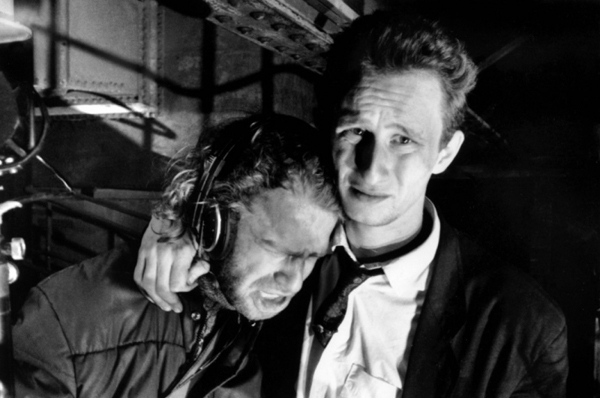
man-bites-dog-screenshot-2[1]Benoit is an efficient, ruthless killer who has disposing of bodies down to scientific ratios, and exactly which victims are likely to have money socked away, and where. “I  like to start every month with a postman,” he says, as this allows him to target pensioners. The film crew following Benoit is already complicit in his numerous crimes (you will lose track of how many murders are committed in shock-cut montages), but they also start getting more involved, as when director Remy (Remy Belvaux) drags off the body of a dead watchman – Benoit doesn’t want to touch him, because the murdered man was black and he is afraid of getting AIDS.

So, yes, besides being a thief and murderer, he’s also racist and frequently cruel to what friends he does have, but is also capable of being extremely charming and playing the comic. As the cast is using their real first names, the segments with Benoit’s mother and grandparents are all quite real – they thought the boys were making a movie about Benoit, so of course they are unaware of how “little Ben” is making his way in the world.

mbd3This is a comedy, make no mistake, though it is comedy blacker than the inside of a lump of coal at the center of the earth. Possibly the best example of this is the fact that the film crew keeps losing sound men, by which I mean they keep getting killed in the course of filming, with a tearful Remy delivering the exact same eulogy and dedication of the film to each fallen audio guy – right down to the same pregnant girlfriend. Jeez, Remy, think of a new name.

But the darkness at the heart of the movie is still constant, leading up to a night of  drunken carousing, when the crew actually participates in a particularly repulsive gang rape and double homicide, and all pretensions about being impartial observers and recorders go by the wayside.

The actual, real filmmakers had no idea the movie would be as well-received as it was; shot over the course of a year whenever they had the money, using family and friends, this was supposed to be a “calling card”, proof that they could actually make a feature. That in their desperation to find a hook for a movie to be made with nearly no money, they manage to pretty accurately predict reality TV (along with another excellent “super-niche” movie, Series 7), and provide a template for found footage movies yet to come – and eventually wind up in the Criterion Collection – is pretty amazing.

It’s also sadly predictable for this sort of thing that none of the filmmakers, save Benoit, has gone on to much of a career. Like Leonard Kastle and The Honeymoon Killers, lightning struck once, and we’ve all been waiting for it to strike again.

Man Bites Dog on Amazon

I: I Walked With A Zombie (1943)

HubrisweenBlackRed

Click the banner for Hubrisween Central. Or visit Hubrisween on Letterboxd


220px-IwalkedwithazombieWhen you combine a youth spent mainly watching disposable cinema with a later life determined to educate oneself on a hundred years of cinema, it’s really nice to find the place on that Venn Diagram those two intersect; in this case, the films of Val Lewton.
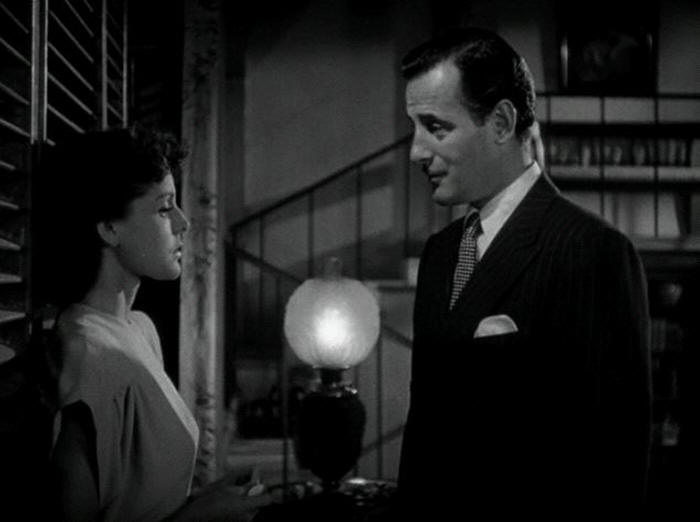
Lewton had some small success as a novelist, then worked as a publicist and assistant to David O. Selznick (it’s a piece of Hollywood apocrypha that Lewton, in the course of writing some scenes for Gone With the Wind, jokingly added a shot that would be ridiculously expensive to produce, and Selznick loved it: the now famous scene slowly revealing the seemingly infinite field of war casualties) . This eventually led to him being named head of RKO’s new horror unit. His job: produce horror movies under 75 minutes in length, developed from titles given him by the home office. None could cost over $150,000.

The first movie he delivered was Cat People, which became RKO’s major money-maker for that year. This allowed Lewton a certain amount of freedom, which resulted in eight more movies, many of which are acknowledged as classics of cinema, not just of the horror genre. This came to an end with a management change at RKO and the death of the horror movie itself after World War II. Lewton would attempt to regain his former stature, despite increasingly poor health, until his death in 1951.

The thing is, to this point I had actually seen only two of his movies. High time for a third.

i-walked-with-a-zombie5 Based on an article (or series of articles, depending on the source) by Inez Wallace in the Saturday Evening Post, Lewton considered the title probably the worst that he had been saddled with, and proceeded to largely ignore the source material, telling his writers to instead distill a story from Charlotte Brontë’s Jane Eyre.

Young nurse Betsy Connell (Frances Dee) is hired to tend to a sugar plantation owner’s wife on the isle of Saint Sebastian in the West Indies. The owner is the handsome but tragic Paul Holland (Tom Conway), whose wife, Jessica (Christine Jordan) suffered a bout of some tropical fever that has left her an active catatonic, a mute robot prone to nocturnal walks and not much else. Betsy is of course going to fall in love with Paul – his half-brother, Wesley (James Ellison), refers to him as “ideally Byronic” – and the feeling is going to be reciprocated. Betsy becomes obsessed with the idea of restoring Jessica to normal, and returning Paul his wife, even if it means her own heartbreak, though that is going to reveal to her the twisted family history that possibly led to Jessica’s condition.

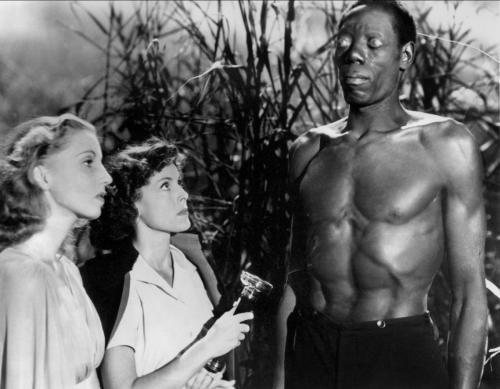
I Walked with a ZombieIt’s Betsy’s desperate resorting to the local voodoo houngan as a possible cure for Jessica that leads to the justification for the title, and the movie’s most famous sequence, when our plucky nurse and her charge, in a flowing gown worthy of the cover of a gothic romance, travel through sugar cane fields to the sound of jungle drums, passing all sorts of grim pathmarks until finally confronted by the movie’s true zombie, the striking Carrefour (Darby Jones). Director Jacques Tourneur, always a master of the use of darkness in his films, is especially masterful here.

Add to this mix of characters Paul and Wesley’s mother, a nurse who runs the island’s dispensary and a lady with a host of secrets herself (Edith Barrett, at the time only 3 years older than her “son”, Tom Conway, and Mrs. Vincent Price!) and James Bell as Dr. Maxwell, the physician who always provides a rational counter to the superstitions running rampant through the rest of the story, and you have a very busy 70 minutes, indeed.

zombiLewton’s penchant for ambiguity is in full display here; the houngan seems to have a certain amount of power over the catatonic Jessica, and Carrefour is an ominous presence, but equal points are made for rational explanations. The point has also been made that Lewton’s movies are obsessed with death, and I Walked with a Zombie is certainly a prime exhibit, with Paul’s morbid, sour observations and Wesley’s growing notion that the only true release for Jessica is death. There is a pall of doom hanging over everything and everyone, exacerbated by Paul’s explanation that Saint Sebastian was populated by slave ships, leading to a culture that cries at the birth of a baby and celebrates death as the only release from a life of sorrow.

Criticism has been leveled at the movie for the now-native population of the island, largely shown to be little more than superstitious children, but compared to a lot of its contemporaries, the portrayal of the non-white characters in the story is damn near enlightened. Hell, the fact that it addresses the horrors of slavery and the massive, lasting scars it leaves on a society, a mere four years after Gone With the Wind, is amazing.

You can probably see Lewton’s whole approach to this movie (and his others) in that somebody probably mentioned that Jessica isn’t really a zombie. So in the opening credits, we see Betsy walking along the beach with Carrefour, apropos of nothing, while her voiceover says, “Yes, I walked with a zombie.” You can almost hear Lewton in the background muttering, “There. You happy? Now shut up and let me make the movie I wanted to make.”

I Walked with a Zombie  on Amazon

H: The Haunted Strangler (1958)

HubrisweenBlackRed

Click the banner for Hubrisween Central. Or visit Hubrisween on Letterboxd


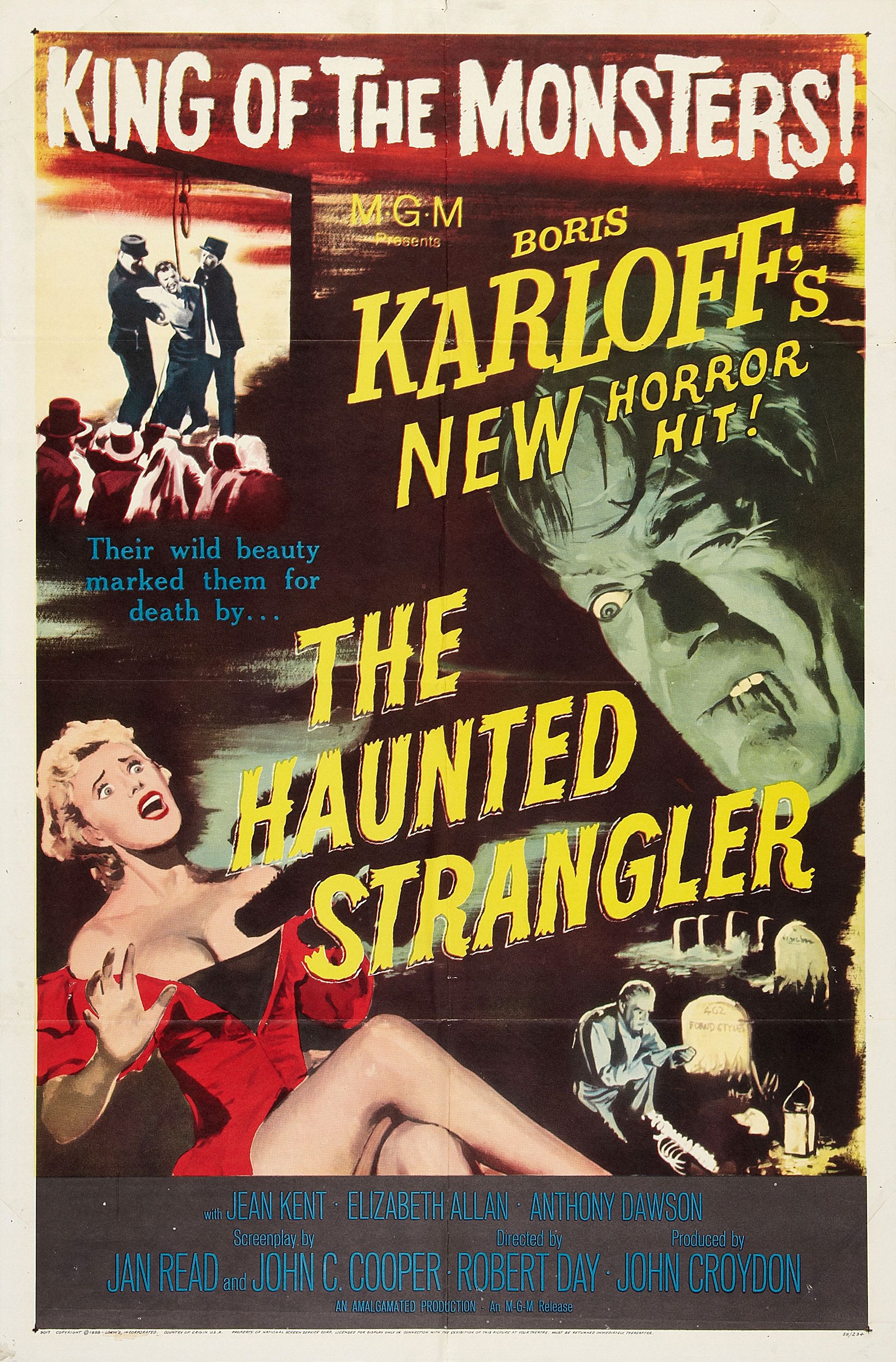
haunted-strangler

If you’ve been reading my babblings for any length of time, you know that my childhood occurred during the Great Monster Revival of the late 50s-early 60s, sparked by that upstart medium, television and its dependence on older movies. Oh, how I recall poring through every issue of TV Guide, seeking out horror movies, especially those gems I read about in Famous Monsters of Filmland, the Universal cycle of the 30s.

I watched them all, but I can’t say I really appreciated them until I was older. The thing I’m reaching for here is Frankenstein, which has become something of a touchstone for me. I didn’t really give it a serious rewatch until Universal put out a deluxe version in 1999, and a lot was suddenly made clear to me, particularly why the Monster had garnered our sympathy all these years, and that is due in no small part to director James Whale and a 44 year-old actor making the most of a long hoped-for and worked-for break: Boris Karloff.

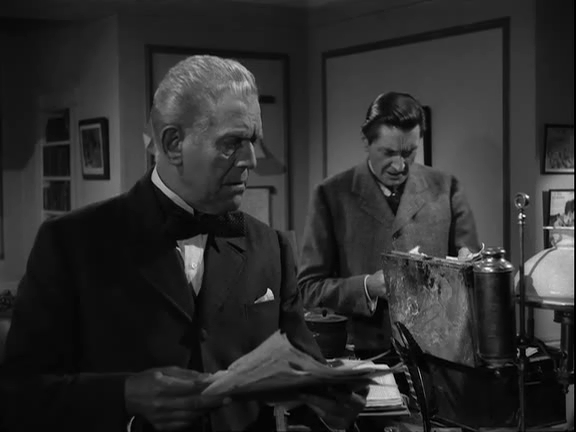
THauntedS1Karloff proved to be an actor of great sensitivity who was immediately typecast; he made his peace with that, referring to it as a trademark he was given for free. He worked steadily through the 30s and 40s, but in the opening years of the 50s, he was seen as less useful, relegated to supporting roles. He moved into television, and his first love, theater. When he did return to movies, it was in drivel like Voodoo Island and Frankenstein 1970 – so it must have seemed a very pleasant change when, in 1957, he agreed to do two movies for producer Richard Gordon which feel like welcome throwbacks to a bygone era: Corridors of Blood and The Haunted Strangler.

Karloff plays James Rankin, a successful novelist and social reformer in 1880 London. His newest project concerns one Edward Styles, a one-armed man hanged twenty years earlier as the Haymarket Strangler (before you ask the very same question I did, his victims were only “half-strangled, then slashed to death”). Rankin feels that Styles was railroaded, and his research puts him on the trail of a Dr. Tennant, who autopsied the Strangler’s victims and seemed to know far too much in his reports. Tennant disappeared soon after Styles’ execution, and Rankin discovers the missing doctor’s kit, which has its scalpel just as obviously missing.

Film_367w_HauntedStrangler_originalRankin suspects what the audience has known since the movie’s opening: the scalpel was placed in the coffin with Styles’ corpse. Since no one will believe his theories, Rankin resorts to bribery to exhume Styles in the prison cemetery in the dead of night. He finds the scalpel, but his triumph turns to horror as his body twists and contorts, and soon he is apparently possessed by the spirit of the Haymarket Strangler, once again preying on dance hall girls after an absence of twenty years.

Despite its low budget, The Haunted Strangler manages the look of a much more expensive picture. The supporting cast is full of solid British performers like Anthony Dawson and Vera Day,  but the movie rests solidly on Karloff’s shoulders, and he once more grasps the opportunity – no pun intended – with both hands. He’s nearly 70 years old during filming, suffering chronic back pain and emphysema, but nonetheless turns in an astoundingly physical performance. Oh, I know that’s not him doing the John Wilkes Booth leap off a balcony onto a stage, or hurling himself through a window, but the later scenes when an increasingly distraught and violent Rankin is committed to an asylum, wrestling with orderlies, you would swear you were watching an actor half his age.

FILM_Wilentz_DVD_MonstersThis also brings up what has become one of my favorite Karloff stories: he and director Robert Day were discussing the transformation scenes, and how they could be accomplished with what little makeup they could afford – it is a plot point that Rankin is unrecognizable while possessed. Karloff’s solution was elegant in its simplicity: he took out his lower dentures and sucked his face into the resulting void. He had done something like this earlier in his career, when he was playing Frankenstein’s Monster, in fact: to get the proper cadaverous look, he removed a dental bridge and sucked his cheek in. Simple, inexpensive, effective.

So consider The Haunted Strangler the Jekyll-and-Hyde story Karloff never got to make. There is a major plot twist three-quarters of the way in that I admit caught me flat-footed, and that happens rarely for me, so familiar am I with the tropes of the horror movie. Karloff had other memorable roles ahead of him, but not many – The Sorcerers and Targets (and arguably The Terror and The Raven), so it is very nice to see him in great form in a tidy little thriller.

Also, there was no place to put it in that last paragraph, but I find him absolutely hilarious in The Comedy of Terrors, but, again: supporting role. And now, as is usual, I find myself fighting the impulse to replace every single movie I’ve planned to watch for this project with Karloff movies.

Monsters & Madmen on Amazon

G: The Golem (1920)

HubrisweenBlackRed

Click the banner for Hubrisween Central. Or visit Hubrisween on Letterboxd


golem poster

It’s educational to visit the Classics, even in a strange environment like Hubrisween. Though I classify myself as a horror fan, this is a movie I had managed to miss seeing… well, all my life. It’s referenced in books aplenty, was a presence in the Famous Monsters magazines of my youth, hell, I had a DVD of it sitting on the shelf, part of an Alpha Video set of silent horror movies. And yet, somehow, I had never partaken of it.

It was likely because I’d already known the plot since I was a child. The plot, certainly, but there were twists in its delivery that still made the movie entertaining for me. The educational aspect I refer to here is something I had never known, until this viewing and the research that followed: this is the third movie in a trilogy, which explains the full title, Der Golem, wie in die Welt kam – “The Golem: How He Came Into The World”. Yep, it’s a prequel.

The two movies which precede it – the 1915 The Golem and the 1917 The Golem and the Dancing Girl – are both considered to be lost films. The 1915 Golem takes place in the modern day, with an antique dealer finding the clay figure (much to his eventual regret), and the 1917 version is apparently a comedy… well, we may never really know, unless the films suddenly crop up. Under these circumstances, a prequel makes some sense, and it is an intriguing production all around.

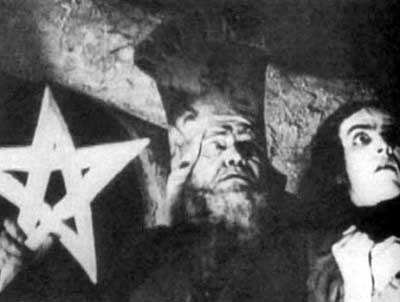
golem1In case you didn’t read Famous Monsters as a child, here’s the plot: in 15th century Prague, Rabbi Leow (Albert Steinrück) is poring over his arcane tomes and finds the stars predict disaster. The next day, the Jewish ghetto receives word that the Emperor has decreed all Jews will be exiled from the country in a month. Leow petitions the Emperor for an audience, as he has drawn up horoscopes for the king in the past, but he has a Plan B: the stars are also right for the creation of the Golem, a clay figure of a man to be given life by a magic word, and it is Leow’s aim to construct such a creature as a guardian for his people.

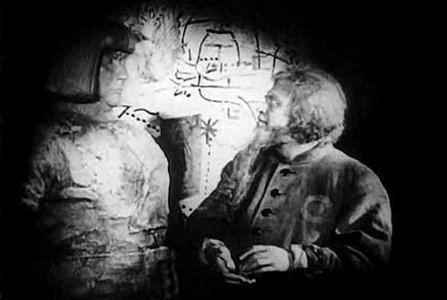
Leow performs a ritual involving magic circles and a staff that turns into a glowing star, to invoke the demon Astaroth and demand the word. This is a pretty amazing scene, and Murnau would borrow from it six years later for his production of Faust. Leow writes the provided word on a scroll, which is placed in an ornamental box that, when put on the Golem’s chest, does indeed impart life.

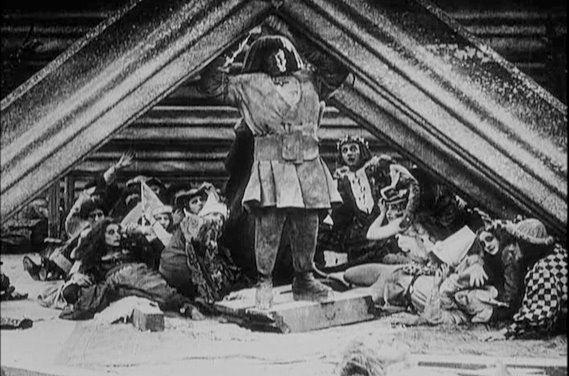
Golem-photo-1-400x302There is some standard stuff afterwards, of Leow and his son using the Golem as a servant; it has a tendency to be too literal in obeying orders, and is incredibly strong. Leow brings it along to his audience with the King (Otto Gebheür), which takes place during a “Festival of Roses”. Surrounded by many courtiers, the Golem begins to show some stirrings of human emotions; when the King asks Leow to perform some other miracle for their entertainment, Leow says he will show them “the history of my people, and our patriarchs,” but also warns the crowd that there must be no talking, or laughter.

So Leow magics up a 16th century movie showing the Exodus, and (I presume) Moses. The court Jester (Fritz Feld, in likely only his second role) makes a comment, the court laughs, and the castle collapses. Silly royalty should have listened to the Rabbi.

Golem as Strong ManFortunately, there is a Golem in the audience who holds up the collapsing ceiling like Big Bad John, saving the Emperor’s life, and causing him to pardon the Jews from their eviction. This would all be pretty hunky-dory, except Leow has noticed his clay servant’s peevishness and consults his book, discovering that as the stars progress, Astaroth will eventually reclaim its creation, turning the creature evil. The Golem, in fact, is reacting very badly when Leow tries to remove the box from its chest to turn it off. He finally succeeds, and decides that since the Golem has served its purpose, it’s time to destroy it.

He is interrupted from this by a summons to the synagogue to honor him and praise God for their delivery. Now, intertwined through all this drama. is the fact that the knight tasked with bringing the decree to the ghetto, Florian (Lothar Müthel), has been smitten by the very sight of Leow’s daughter, Miriam (the truly lovely Lyda Salmanova), and he has used Leow’s journey into the city to sneak into his house and spend the night with her. Once Leow heads off to the synagogue, his son discovers there’s a man in her room and, not knowing about the whole evil stars thing, reanimates the Golem to knock down the door.

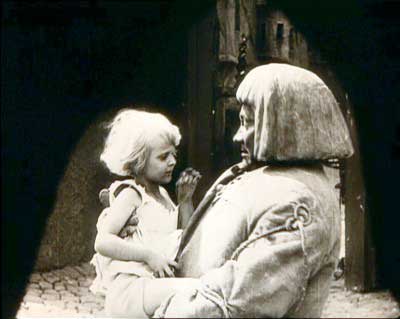
Golem-photo-6-400x319This, of course, is disastrous. It results in the death of Florian, the rabbi’s house in flames, and Miriam carried off by the Golem (although later she is mysteriously abandoned. Monsters. Go figure.) The Golem smashes down the gate of the ghetto, and finds a bunch of children playing, who mostly scatter at his approach. One does not, and offers the Golem an apple. The Golem lifts her up in his arms, and she innocently, curiously plucks the box off his chest. End of Golem.

Director and star Paul Wegener had made another early horror classic in 1913, The Student of Prague, during which he first heard of the legend of the Golem. By all indications, he felt he’d had to compromise too much on the previous two movies in the trilogy, and this was to be the definitive version. Architect Hans Poelzig designed the sets, and his recreations of the Jewish ghetto is one of the major reasons this is considered one of the great masterpieces of German Expressionist cinema.

der-golem-1920And yes, it is almost impossible to watch this and not see the prototype for many a movie that followed, especially James Whale’s Frankenstein. Look no further than the Golem’s shambling gait and those huge, bulky welder’s boots, the creature’s clumsy attempts to deal with unfamiliar emotions. Wegener’s Golem is more of a figure literally driven by demons, though, a far remove from Karloff’s portrayal of a pathetic, betrayed lost soul.

So there’s another classic down, and it is a classic not only because of its influence on later movies; it’s also more than a little affecting to consider the politics of the story. Or as my friend Mark Konecny put it, “I just couldn’t get past the whole foreshadowing the future of Europe thing.” Not just the increasingly frequent waves of violence against Jews (as I write this late July 2014, bewilderingly on the resurgence again), but in other ways: Apartheid nations and ghettos – still with us after all these centuries.

The Golem on Amazon

E: The Eye (2002)

HubrisweenBlackRed

Click the banner for Hubrisween Central. Or visit Hubrisween on Letterboxd


Jian-Gui-Eye-The

I suppose it will be about another thirty years before we get another crop of fin de siècle movies, though, unlike the turn from the 19th century to the 20th, I can’t put my finger on what era truly came to an end with that turn. Possibly the illusion of an untouchable America? The complete demolition of sanity in social discourse? I’m not that much of a big picture person, I can’t really predict what lessons will come out of that crucible. I watch horror movies, so that period for me is when the West started pilfering Asian horror movies for fun and profit.

I guess that started with 1998’s Ringu, translated in 2002 by Gore Verbinski as The Ring. Thereafter followed several domestic transfers: The Grudge, Dark Water, and tonight’s exercise, The Eye. I almost always find the original more compelling, so that’s what we have here.

The Pang Brothers, Oxide and Danny, are two astoundingly prolific filmmakers with 23 movies to their credit in only fifteen years. The Eye is their fourth movie (and, symmetrically enough, they’ve made three sequels for a total of four, though their connection seems pretty tenuous).

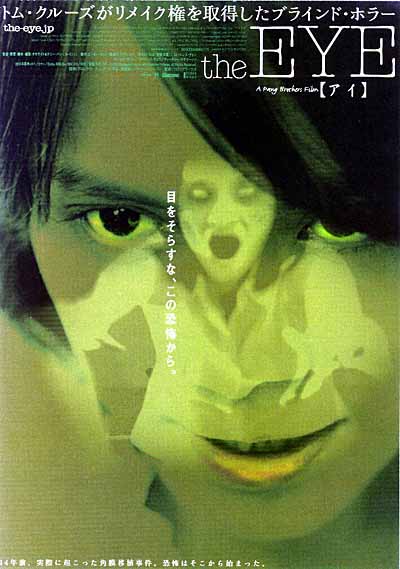
(2002) The Eye Screenshot 1Wong Kar Mun (Angelica Lee) is a young violinist who has been blind since age 2. She receives a cornea transplant, and even in the early stages of blurry vision, she starts seeing unusual things. As things get clearer, she finds that not only can she see the ghosts of people haunting the places of their death, but she also sees a faceless black figure who escorts recently deceased spirits to the beyond.

That’s a pretty typical horror movie set-up – The Sixth Sense and “I see dead people” was only three years before – but what elevates The Eye above the norm is not only Lee’s expressive and sympathetic performance, but the layers of detail the Pangs bring to the table. I like, for instance, her therapist Dr. Wah (Lawrence Chou) holding up a stapler and asking her what it is. Curious, she reaches out for it, but he tells her, “The minute you touch it, you’ll know it’s a stapler. We have to work on your visual vocabulary.” Mun can neither read nor write Chinese, only braille. Her first question to the attending nurse is “Is there a mirror in the washroom?” The Pangs did their research.

2100Our heroine isn’t just seeing ghosts, either. When she wakes from the obligatory nightmares, another room is superimposed over hers. And one of the best, most chilling moments is when she realizes that when she looks in the mirror, she isn’t seeing her own face, but the face of the woman whose eyes she now sees through. Finally, for her own peace of mind, she decides to trace this donor and find out why her spirit seems to also be restless.

Most impressive is that the Pangs give us a happy ending, then you realize there’s still almost fifteen minutes left in the movie; and what comes after is as inexorable as it is horrifying.

I wasn’t blown away, but I was impressed. There’s a lot to like here, and no, I do not feel at all impelled to check out the Americanized version.

Oh, yeah, “Based on a true story”. According to the Pangs, the true story was that a woman, blind from birth, had the operation and could see for the first time in her life. Though recovering normally, she killed herself within a week. That is the basis of The Eye, and about as far as our “based on a true story” goes.