The Killers Times Three

100
Nobody will be surprised to learn that I really love the Criterion Collection. I’ve had some people try to tell me they’re not all that, but this gets the same response as telling your great-aunt Emily June that Obama isn’t a Muslim: a few seconds of blinking uncomprehension, then renewed screeching. Yes, I am aware they put out Armageddon and The Rock. I am also aware that angel investors have to be rewarded.
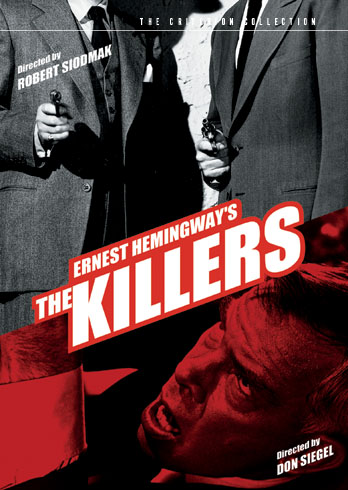
176_box_348x490_originalA few months back, when visiting my parents, I discovered that someone had offloaded a bunch of older Criterion DVDs at the local Half-Price Books. That day I could afford only one, even at half price. When we returned a few months later for Christmas, I had made sure to bring more money, and this time I managed six. And one was a really fun concept package containing three versions of Ernest Hemingway’s “The Killers”.

For those of you who did not have the privilege of being English majors, “The Killers” is considered to be a classic of American literature. Here’s a link to a PDF of the story as it originally appeared in Scribner’s Magazine in 1927. Go ahead, read it, it’s short. I’ll wait. (One of the extras on the Criterion set is Stacy Keach reading the story and doing a bang-up job. It only takes 17 minutes.)

So anyway, for the tl;dr crowd (and I pity you), it’s the story of a small town diner terrorized by the title characters, two gangster types who are in town to “kill the Swede”, who always comes in at 6:00 to eat dinner. When the Swede doesn’t show, the two killers leave – leaving the diner’s occupants alive, to their relief – and one of them – Hemingway’s guy, Nick Adams, runs to tell the Swede – and the Swede refuses to escape or call the cops, saying it would be no use.
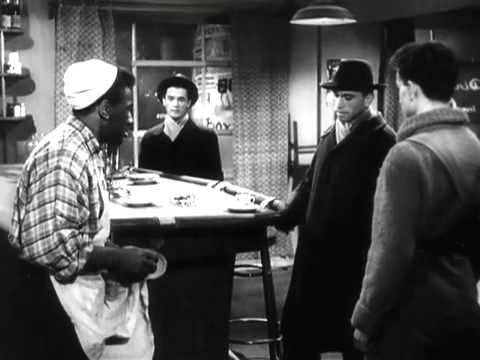
Russkies in blackface. But what you going to do?

Russkies in blackface. But what you going to do?

One of the three versions of the story in the Criterion set was made in 1956, and it’s the exam film of several students at the Soviet Gerasimov Institute of Cinematography, one of whom was Andrei Tarkovsky, later the director of movies like Solaris and Andrei Rublev. It is the most literal version of the three, basically translating the short story directly onto film. It’s also only 19 minutes long. It’s worth seeking out just for that; there are a couple of minor film school flubs, but it’s remarkably assured filmmaking, otherwise.
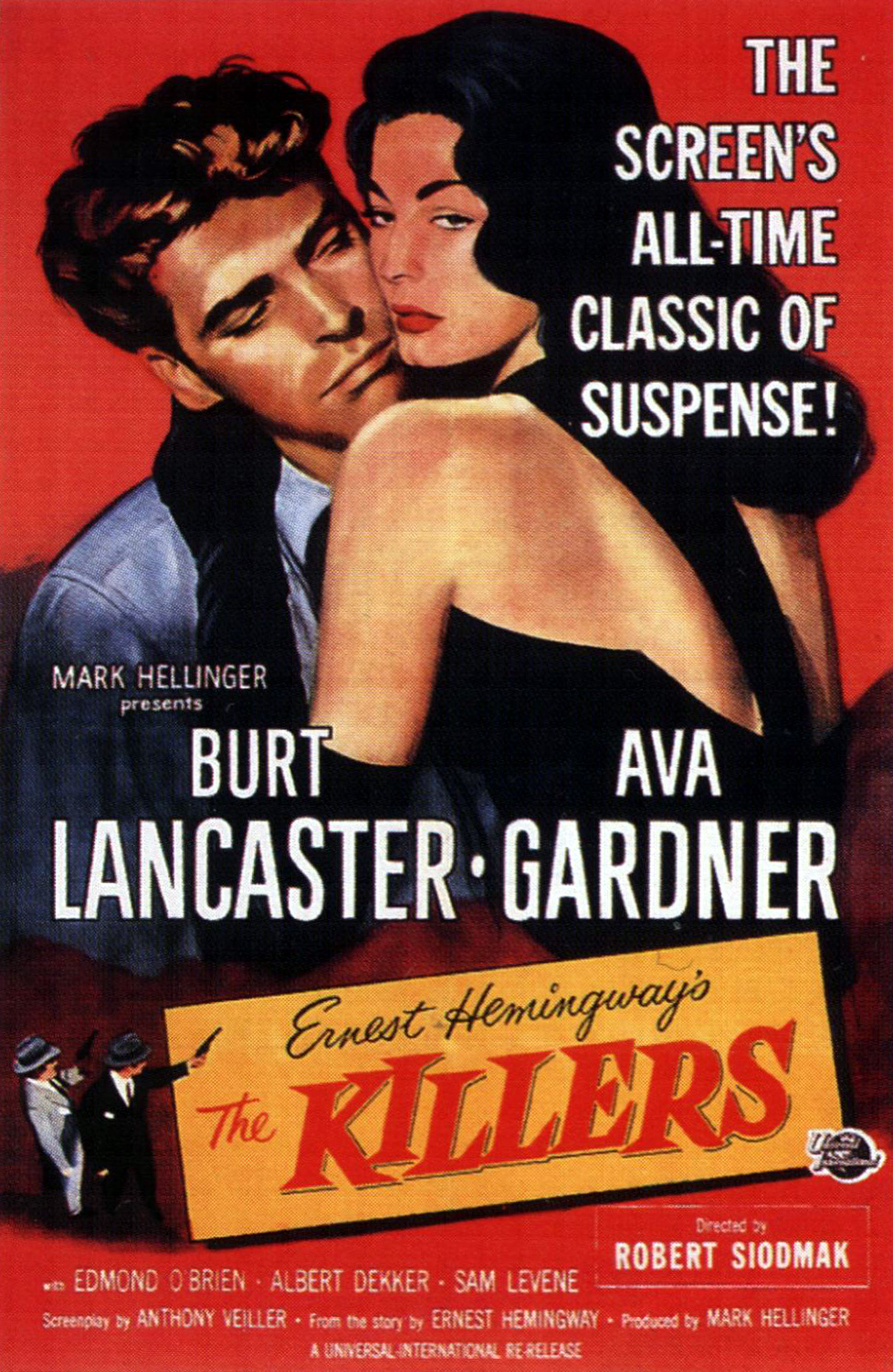
The-Killers-PosterOur first movie chronologically, however, is the 1946 version, directed by Robert Siodmak. It starts with the Hemingway story, practically verbatim, though this time when the killers leave and Nick goes to the Swede – whose name is Ole Anderson, just in case you didn’t read the story – in his boarding house room, it’s barely ahead of the killers. We find out that the Swede is also Burt Lancaster (in his film debut!). He still refuses to run, because he’s tired of running, and “I did something bad.” So the killers bust in and kill him.

Yep, we’re only 19 minutes into a 105 minute movie.

So we leave Hemingway behind and meet Joe Reardon (Edmond O’Brien, increasingly a go-to guy for film noir post-WWII), ace insurance investigator. It seems the Swede had a life insurance policy through the gas station where he worked, and Joe sets out to find why someone would want to employ overkill methods on a grease monkey.
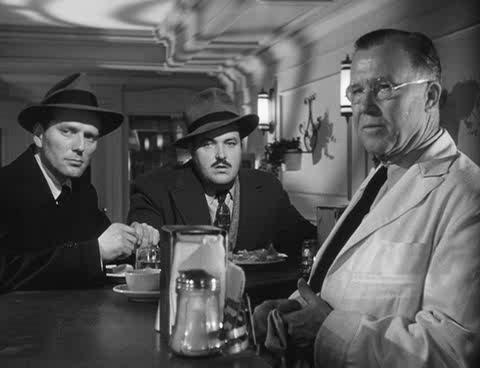
William Conrad takes NO guff.

William Conrad takes NO guff.

The rest of the movie plays out like a noir version of Citizen Kane as Reardon slowly puts together various people’s testimonies to fill out Anderson’s life: a prize-fighter with a career-ending injury, he falls in with the wrong people, falling for in the case of Kitty Collins (Ava Gardner, who plays a poison dame like you wouldn’t believe). Anderson even takes a rap for her, serving three years in the pen. When he gets out, Collins’ once and present sugar daddy, Big Jim Colfax (Albert Dekker, six years removed from Doctor Cyclops) recruits Anderson for a big job that will net them a quarter of a million dollars.

Now Reardon is really interested, as that job – stealing the payroll of that most necessary of noir establishments, a hat factory – was covered by his company. Anderson shows up after the robbery and hijacks all the dough and escapes, not being seen again until Big Jim spots him at that gas station (and after last week’s movie, Out of the Past, I now know not to work at a gas station if I’m hiding from a crime boss). There are too many things that don’t add up for Reardon, and he knows that if he’s going to solve this case, and find that money for his insurance company. he’s going to have to find Kitty Collins. I would say, “even if it kills him,” but that’s a pretty safe bet.maxresdefault

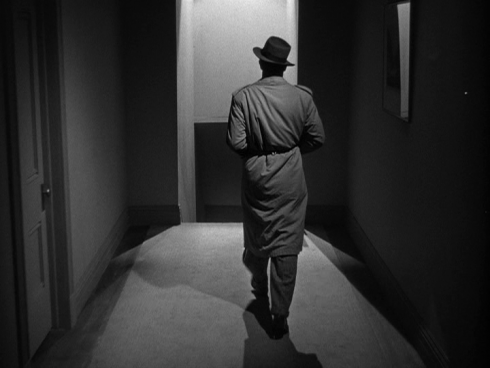
vlcsnap-2192371The 1946 Killers is pretty good noir, full of interesting characters and guys with suspenders carrying pistols and lit cigarettes. That opening sequence (remember, back when we were still doing Hemingway?) is a little masterpiece of noir camerawork and lighting, our two killers walking in and out of pools of darkness, finally splitting up and approaching opposite ends of the well-lit diner, like an Edward Hopper painting gone wrong, dark and violent.

the-killers-1964-movie-posterCompare this to the last version in the collection, made in 1964 by Don Siegel. Producer Mark Hellinger had wanted Siegel to direct the ’46 version but the studio nixed the then-fledgling director. Siegel now steadfastly refused to do a remake, and set out to make a movie as markedly different from the ’46 version as possible, and proceeded to filing off the serial numbers.

The movie, as shot, was to be titled Johnny North. North is the Anderson character, played by John Cassavetes. The killers are Lee Marvin and Clu Gulagher. They track North to a school for the blind, where he’s teaching auto mechanics to a group of blind men. Although warned the two men are coming, North simply stands there and lets them shoot him down, and that – along with the fact that somebody paid them more than twice their usual fee to kill a shop teacher – really bothers Marvin.
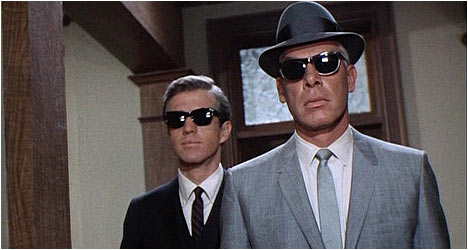
assassinsSo our two killers take the place of the insurance investigator in the earlier film, and find out North was a pretty good race driver who fell in with a sports groupie, Sheila Farr (Angie Dickinson, whose career keeps intersecting my interests). She’s also the property of a shady character named Jack Browning (Ronald Reagan, in his last movie, and playing a bad guy, which he hated).

imagesNorth has a crash that breaks his leg and screws up his vision, ending his racing career. Sheila later finds him working at a drag strip, and Jack needs a good driver for a big job. There are no more hat factories, so they are going to waylay a mail truck that has the weekend’s receipts from “all those resorts on the coast.” All goes according to Reagan’s evil plans, until Johnny slugs him and takes off with the loot.

As you can guess, now the killers have to find this Sheila dame and… well, let’s just say it doesn’t have quite the happy, tidy ending of its 1946 predecessor (although there are no loose ends). And they still wound up calling it Ernest Hemingway’s The Killers, leading to a lot of critical drubbing, as this is a homeopathic version of the Hemingway story: there’s a molecule or two of the story, floating around in there, somewhere.

28The title change likely came about because, while it was being shot, it was going to be the first two-hour made for TV movie. When it was judged too violent and too amoral for TV, it was released theatrically, and the name change was likely thought more marketable. The TV origins do work against it, I feel. It feels too brightly lit, and several of the dialogue scenes drag. It has an amazing cast though; I haven’t mentioned Claude Akins as Johnny’s old mechanic, or Norman Fell as Jack’s stooge.

John Cassavetes acted in other peoples’ movies to make money to make his own. That’s not an uncommon story in Hollywood, but the thing about Cassavetes was he always gave value for the dollar. He always gave more in his roles than was necessary.
"HERE'S one for the Gipper!"

“HERE’S one for the Gipper!”

He was damned good, is what I’m saying.

And in The Killers, he gets to slug Ronald Reagan. I’m good with that.

The Killers box set on Amazon

Le SamouraÏ (1967) & Out of the Past (1947)

100le_samouraiThe French again! Jean-Pierre Melville again! An influential film, again! Where will this all end?

Well, this is about as close to binge-watching as I get.

Once more I find myself paying for my ass-backwards journey into cinema; I’ve already seen most of the movies directly inspired by  Le Samourai, rendering it less fresh and impressive than it might have been had my movie-watching habits been more refined in the early part of my life.  Regrets like that are pretty inane, however, since my life has mostly been a journey from the rural to the increasingly urban. I was lucky to have landed in a small city with access to a PBS station when I was only 13 or 14, coinciding with a series of “Classics of World Cinema” or somesuch. That got me even more hooked on movies, but at that time – 1972 or 73 – other options were extremely limited.

I’ve always looked older than I actually am, so I managed to get into some movie screenings at the nearby college, which is where I saw King Kong for the first time (on the big screen, luckily). But again, very limited options. VCRs didn’t appear on the scene until I was in college, and then the software was still exceedingly commercial, even during the big VHS boom. It was all barbarians, boobs, blood and beasts, to paraphrase Joe Bob Briggs, and I ate it up with a spoon. I had to special order videotapes of Rashomon and Yojimbo – such fare was still rare, even after I moved to the Big City. It got better. I discovered mail order and laserdiscs, which catered to a more sophisticated clientele, shall we say.

samourai-1967-01-gSo it’s no small wonder I saw The Killer before I saw Le Samourai. It is also a matter of no small wonder that in these times, I can bloody well watch Le Samourai whenever I damned well please. There is a lot to despise about these Modern Times, but there is a lot to be thankful for, too.

So now the trick is to find something significant to say about a well-respected movie that is almost as old as I.

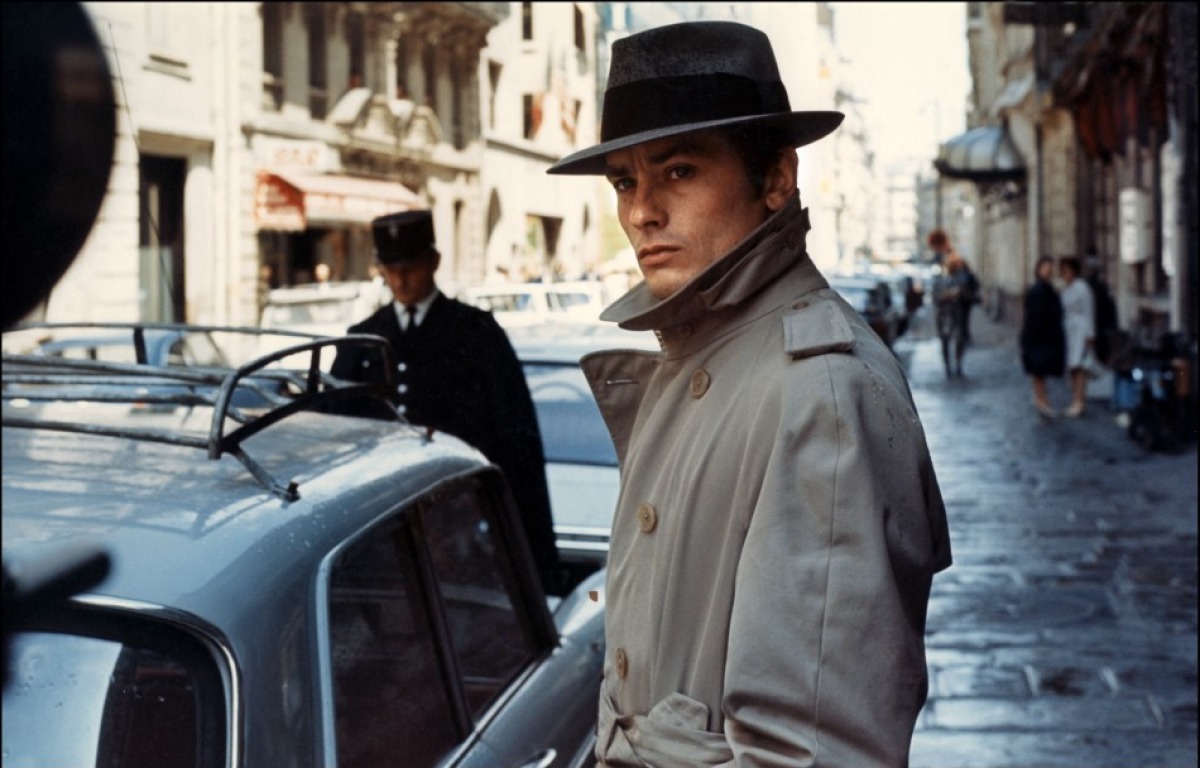
In case you’re as cinema-deficient as myself: Alain Delon is Jef Costello, a preternaturally calm hitman living a spartan existence in Paris. Jef accepts a contract on the owner of a nightclub, and successfully carries it out, after engineering a complex two-part alibi involving his former lover (Nathalie Delon), an unsuspecting customer of said lover, and a hotel room of card-playing cronies. There are several eyewitnesses who saw Jef leave the scene of the shooting, but the one who confronted him face-to-face – the club’s star attraction (Cathy Rosier) – intriguingly does not finger him in the ensuing police line-up.

le-samourai-01There are two complications: the first is Jef’s mysterious employer, who panics when Jef is picked up in a wide police dragnet, and orders Jef killed. The other is that the Commissioner in charge of the investigation (François Périer) feels Jef’s alibi is too airtight, and starts devoting more and more manpower to bring pressure to bear on the young assassin.

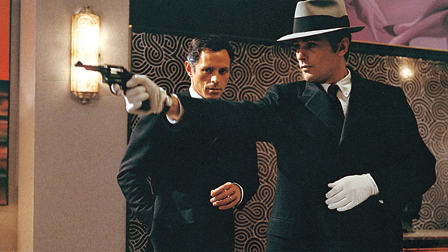
The movie’s title is not mere affectation – Jef goes about his work with a competence and inner stillness reminiscent of those earlier warriors (significantly, the title of the original novel by Joan McLeod was The Ronin, a masterless samurai). The uniform has changed: a snappy raincoat, a fedora with a carefully-corrected brim, white cotton gloves for the wet work. What Jef finds, however, is that all this is useless against the massed might of practically an entire police department, and a maddeningly inconsistent employer who sends the same man who tried to kill him to apologize and offer a new contract. Jef will try to plumb exactly what is going on, to little avail. He is an impressive warrior, but a terrible detective. Upon finding that his lover is being harassed by the police to recant his alibi, Jef makes his final decision and promises her he will sort everything out. He does this by killing the feckless employer and carrying out his last assignment with an unloaded gun, insuring the pursuing police will gun him down.

Film_306w_LeSamurai_originalLe Samouraï is perhaps the height of the French New Wave’s appropriation of and stylization of popular American film noir and gangster tropes; if one looks askance at the commissioner’s increasing use of manpower and taxpayer money to pursue a man on a mere hunch (and fortunately for him, that hunch is correct), then it is also useful to realize that this story is in no way meant to be realistic. Melville ignores current fashion, making the movie timeless. JFK had put paid to men’s habitual wearing of hats earlier in the decade, yet everyone here still wears them, just as in the American movies that inspired it.

Le Samouraï at Amazon

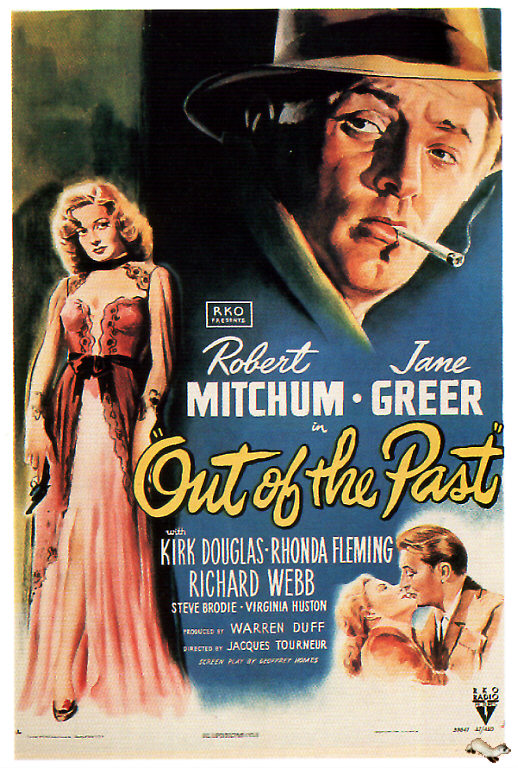
out_of_the_past_1947Even though little of it can really be called new to my jaded cinema eyes, it is useful to examine one of those inspirational movies: the Jacques Tourneur-directed 1947 classic Out of the Past.

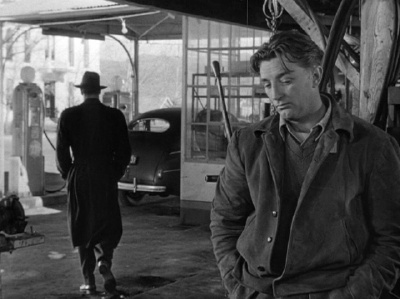
In this, another Jeff (Robert Mitchum), the owner of a gas station in a small California town, is confronted by Joe (Richard Webb), a man in a tellingly dark trenchcoat and hat, who knew Jeff back when and insists he come to a meeting with a former employer. Jeff’s calm life as a working joe and his budding romance with local girl Ann (Virginia Huston) is suddenly upended, and he confesses to Ann his past life as a detective, hired by a mobster, Whit (Kirk Douglas) to track down a woman who shot him and stole $40,000 before vanishing.

2447041_origIn an extended flashback, we find that Jeff tracked the woman, Kathie (Jane Greer) to Acapulco, where he finds out why Whit “Just wanted her back”. He falls in love with her “like a chump”, and runs away with her to California. Whit hires Jeff’s old partner to track him down, resulting in a fist fight at the lovebirds’ cabin, during which Kathie shoots his partner in cold blood and leaves him there to take the rap. Jeff buries the body, and finds a bank book that proves that Kathie’s denials of stealing the money from Whit were false.

Now that Whit has found Jeff – and, we discover, Kathie is once more under the mobster’s roof – the affable gangster wants Jeff to do one more job for him, by way of atonement. It involves stealing some paperwork that would cause Whit to serve time for tax evasion, but Jeff begins to perceive it is all a spiteful plot to frame him for murder, with his former love Kathie as an all-too-willing accomplice.

past1Tourneur was one of the top directors for filming this sort of story, and the gorgeous black-and-white photography of Nicholas Murusaca provides visual evidence of the contrast between the wide-open spaces of Jeff’s new life and the slow entrapment and claustrophobia of his return to the Big City and attempted manipulation by everyone he meets. A fine bunch of actors make good use of a script by Geoffrey Homes from his own novel Build My Gallows High, which supplies a pleasing amount of dimensionality to some pretty stock characters. It’s obvious that Kathie really does care for Jeff, but panic for her own survival causes her to make some poor, even murderous choices, making her a much more satisfying Femme Fatale than many.

Kirk Douglas Out Of the PastKirk Douglas, in only his second movie, makes Whit a charming, smiling fellow with a nicely understated violent undertow. My absolute favorite moment in the flick happens when Jeff is in his hotel room in Acapulco, packing to run away with Kathie. There is a knock at the door, and Jeff opens it, expecting his new gal – but it’s Whit and Joe the gunsel. Douglas flashes that 40,000 watt smile and says, “I hate surprises, myself. Wanna just shut the door and forget about it?”

And if there is anything to take delight in, it’s in these movies’ snappy banter, and Out of the Past has a ton of it. Le Samouraï, on the other hand, is proud of its brevity – the first ten minutes of the movie are utterly devoid of dialogue.

ootp1The other trademark of these movies is an inexorable sense of doom following the protagonist about. You keep hoping for both Jeffs to pull it off, to deliver that final Maltese Falcon coup de grace that delivers justice to the bad guys and lets him live to fight another day, at the very least, if not get the girl (who was usually trying to kill him, anyway). Le Samouraï‘s Jef we already know about, but by the end of Out of the Past, Kathie has effectively murdered every patsy, and despite Jeff’s best efforts, he realizes he is trapped, and can think of no better recourse than to call the cops while Kathie is packing for yet another escape, so that they will encounter a heavily-armed police roadblock on their way out. Both protagonists decide enough is enough, and make sure their true loves, at least, have a chance at a better life, uncomplicated by them and their bad life choices. And sometimes that is the only choice left to you.

out-of-the-past-e1403181284954My last takeaway from this Doomed-Guy-In-A-Hat-and-trenchcoat double feature concerns Alain Delon’s and Robert Mitchum’s (once he returns to his former life) uniform, the coat and the snap-brim hat: I have that raincoat, and it is never going to look as good on me as it does on those two. And though I have a fine fedora, the Legion of Douchebags have seen to it that I can never wear it again. That this saddens me more than the fate of two likeable protagonists is a personal failing, but sometimes, as the Jeffs would tell you, personal is all you got.

Out of the Past at Amazon

Belle de Jour (1967)

100belledejourThere is frequently a problem while dealing with films that are known as “Groundbreaking” and “Iconic” years after their release. This is a barrier I face once again with Belle de Jour, viewing it for the first time nearly half a century after its release: what was at first shocking and liberating is now commonplace.

Just like our last entry, Army of Shadows, Belle de Jour is based on a novel by Joseph Kessel, which was itself published in the 1920s. It seems to have changed little in the transition to screen, except for the fantasy sequences created by director Luis Buñuel. One such sequence opens the movie, with our central character, Séverine (Catherine Deneuve) enjoying a carriage ride in the country with her husband, Pierre (Jean Sorel). Pierre criticizes her for being so cold toward him, and when she tells him not to speak of that, he stops the carriage, has her tied to a tree, whipped, and ravished by his footmen.

hero_EB19990725REVIEWS08907250301ARSéverine does have an intimacy problem, possibly dating back to an incident of molestation in her girlhood. And Pierre is indeed a long-suffering saint, constantly rebuffed and spending the night alone in his half of their Rob-and-Laura-Petrie separate beds. Chance conversations with her friend Renee (Macha Meril) and her shady husband Hussen (Michel Piccoli) leads her to the establishment of Madame Anais (Geneviève Page), a somewhat upscale brothel with only two prostitutes. Séverine becomes “Belle de Jour” (a rather clever play on words, both on “day lillies” and the French expression “Belle de nuit”), who works only between the hours of two and five, coming home before her husband the surgeon.

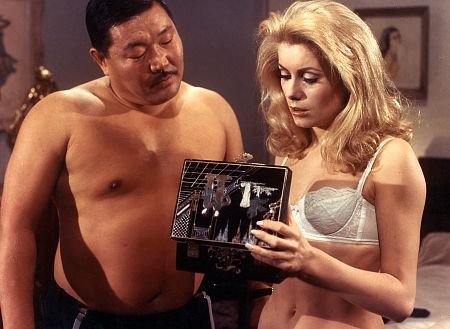
MV5BMTk1NTg3NjAwNF5BMl5BanBnXkFtZTYwOTczNTU2._V1_SX640_SY720_As Séverine waffles on whether or not she will actually commit to her new trade, Anais commands her to get into her room, and when Séverine complies meekly, says, “So. You need a firm hand.” Her first client realizes this, too, and plays to her desire for the rough stuff. So begins her sexual liberation; she even takes on an Asian client with a box whose contents mysteriously buzz, causing the other ladies in the brothel to turn him down – and in fact, in the aftermath of this encounter, we see a genuine smile on Séverine’s face for the first time in the movie. And she begins to warm to her husband, too, much to his amazement and delight.

Two serpents enter this garden of earthly delights: the first is Hussen, whom we were expecting – after all, he’s the one who gave Séverine the address – and the other is Marcel (Pierre Clémenti), a young gangster who represents a sort of bad boy avatar – leather trenchcoat and boots, sword cane, metal teeth – everything Séverine’s dark side desires. They become obsessed with each other, and Séverine quits her job at Madame Anais’ – the Madame thinks it is because of Marcel, and agrees it is a good decision, but it is truly because of Hussen’s discovery of her second life.

Belle-de-Jour-1Everything goes about as one would suspect – Marcel still manages to track Séverine to her home, demands are made, there is tragedy – but it is all so bound up in Séverine’s fantasy life, that we are not sure that the dis-assembly of her otherwise lovely bourgeois life is not another fantasy designed to punish herself, just like the opening sequence. The ending is deliberately ambiguous, and even Luis Buñuel himself has stated that he doesn’t know what the ending truly means.

Buñuel does manage to surprise me every time I approach another of his movies. He is known as one of the greatest of the surrealist filmmakers, and that is a reputation that is roundly reserved. I suppose it is pretty much bourgeois on my part that when I hear surrealism I expect Monty Python wackiness, when in reality (heh), the movement is more about giving the unconscious part of the mind equal representation with the conscious; I read a comment that the carriage bells on the soundtrack are an indicator of Séverine’s fantasies, and while the ambient sound track in the movie is quite sharp and often draws attention to itself, I’m not certain about that assertion.

I’ve also seen it held up as a feminist film, and I look at that claim sidewise as well. It can argued that it is about a woman taking charge of her sexuality, but for that interpretation to work, it has to gloss over practically every relationship in the movie. The only people that actually seem real are the pragmatic Madame Anais and her two girls (Françoise Fabian and Maria Latour), who are friendly and chatty, but have no illusions as to the absurdity and general pathos of their clientele. Humanity is messy, and these women get to see perhaps the best and worst of it.

f6a8cc81d988b2ebf9c3bebf0b8077aba8145830-700Perhaps Belle de Jour‘s reputation as a masterpiece relies on the fact that, of Buñuel’s many surrealist films, it is the most approachable; That Obscure Object of Desire demands constant interpretation, The Exterminating Angel is a puzzle, and my favorite, The Discreet Charm of the Bourgeoisie, is more like a fabulous funhouse than anything else. Belle de Jour, like its source novel, is more of a standard potboiler with some surrealist spice. In fact, I think of all the movies mentioned above, I would be most likely to recommend Belle de Jour as the entryway to the films of Luis Buñuel, for exactly those reasons.

Belle de Jour on Amazon

Army of Shadows (1969)

100
ARMY_OF_SHADOWS_1SHIt’s hard to know how to start on this, so there’s no better place than where the movie begins: the Arc de Triomphe in Paris, as a parade of Nazis file first past it, then down the Champs Elysee, right into the camera. A long, unbroken scene, devoid of reaction shots, or any context save an historical one; and this is how Army of Shadows will present its tale of the French Resistance under Nazi occupation. Unromanticized, matter-of-fact, almost documentarian.

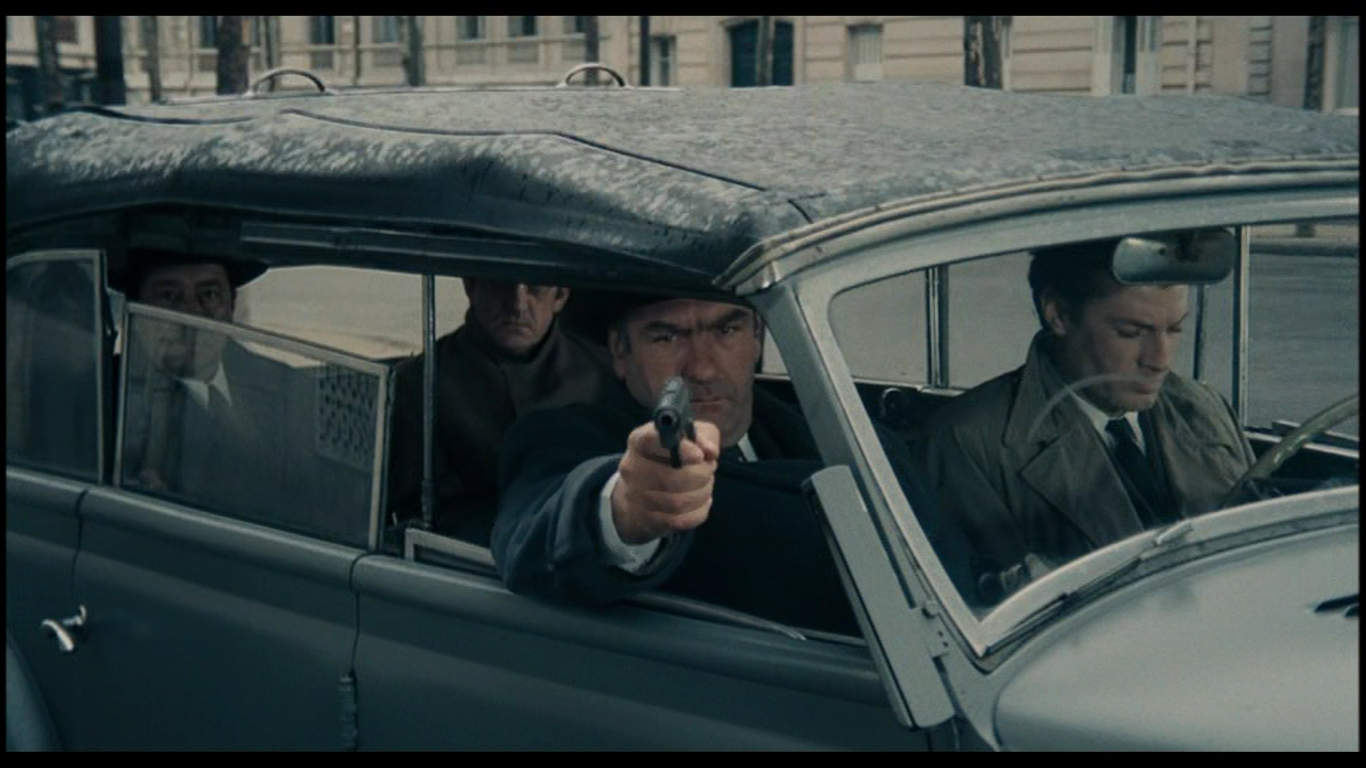
By and large, we’re going to follow Phillipe Gerbier (Lino Ventura), an electric engineer who begins the movie on his way to a Vichy concentration camp for political prisoners. Gerbier will eventually escape when he is taken to the city for interrogation by the Gestapo, in a burst of violence surprising for the quiet intellectual we’ve spent the last fifteen minutes or so with. And so it is, layers of quiet deception always a heartbeat away from disaster or violence.

army-of-shadowsIn the first segment after Gerbier’s escape, he and two of his comrades capture a young man who had sold out his cell to the Nazis, and take him to a safe house for execution. To their dismay, they find a family has moved in next door the night before and they cannot safely shoot the traitor, and so spend several minutes dispassionately discussing various forms of murder in front of their terrified victim.

Army of Shadows did not do well on its opening in France in 1969. One of the reasons is scenes like this, wherein critics felt that the heroes of the Resistance were being cast in the same light as the gangsters in other movies by director Jean-Pierre Melville, like Le Samouraï and the forthcoming Le Cercle Rouge. (There is a political angle, too, as De Gaulle was extremely unpopular at the time of the movie’s premiere, and there is a moment when the head of the Resistance is decorated by the General-in-exile, and he receives the award with a beatific smile, as if he had just been visited by God.)

Melville himself and the author of the novel on which this is based, Joseph Kessel, were both in the Resistance, and both escaped to England to join the Free France organization there, so as depressing and bleak as the events before us are, they still carry a ring of truth.

There is heroism on display in Army of Shadows, but it’s never rewarded. A chancy attempt to rescue a comrade fails, and one daring member, who arranges to get himself captured and tortured just to find the man they are trying to rescue, dies alone and in obscurity, his legendary luck failing him when he needs it most. All our characters are doomed and they know it – and death will not always come at the hand of the Nazis, but sometimes at the hands of their comrades – and they are still determined to play their hand out until the last.

Army of Shadows 8It’s not an edifying movie, but it is a very, very good one. Thanks to a critical lambasting by Cahiers du Cinema in the 60s, it never even played in America until 2006, when it started getting its due acclaim as possibly Melville’s defining movie, if not an actual masterpiece.  Definitely recommended, though not if you’re in need of cheering up.

Army of Shadows on Amazon

Nanook of the North (1922)

Nanook_of_the_northSometimes you just have to pay homage to the classics, even if they may not deserve it. We’re likely going to be arguing about Birth of a Nation for quite some time, for instance, and here’s another one that I’ve been curious about for some time – Nanook of the North, the first docudrama.

Robert J. Flaherty didn’t start out as a filmmaker; he was a paid explorer, who when working for the Canadian Railroads, spent several years among the indigenous people of the Hudson Bay area, in northern Quebec. This was about 1910; in 1913 he bought a motion picture camera and started filming these people in their everyday lives. In 1916, though, he dropped a lit cigarette on this film, and being nitrate stock, it went up in a fireball (it’s estimated that there was about 30,000 feet involved). He went back with more equipment, and using what he had learned in that previous venture, narrowed the focus to one family, and their struggles to survive a typical year in the hostile climate of Northern Quebec, and the result was a worldwide sensation.

But this is one of those movies where the behind-the-scenes is arguably more intriguing than what we see on the screen, and what we see on the screen is actually pretty damned good. There are many controversies surrounding Nanook, and all of them, unfortunately, bring the final product into question.

Robert_Flaherty_Nyla_1920We’ll start with the obvious: the title character, the Great Hunter Nanook (which we are told means “Bear”), is actually named (I hope I get this right) Allakariallak. We are introduced to his two wives, Nyla (“The Smiling One”) and Cunayou. They were apparently not actually Allakariallak’s wives, but – and this is only an allegation, mind – that they were actually Flaherty’s lovers. The parentage of the baby constantly riding in Nyla’s furs, like a papoose, is unknown.

The movie begins with some striking imagery, as Spring begins and Nanook paddles his kayak to the white man’s trading post to barter the furs of his winter’s kills. One of his children is riding on the top of the kayak. Nanook gets out, helps the boy to land, and then the kayak starts disgorging the rest of the family, like a clown car. This was a surprise, but so logical, I was placing it in my “Things Learned” column, until finding out about the rest of the picture’s veracity. Now I’m not so sure.

"Eh, this blows. You got any Beck?"

“Eh, this blows. You got any Beck?”

There’s a scene at the trading post where the proprietor shows a Gramophone to the baffled Nanook. Allakariallak, it turns out, was no bumpkin, and knew perfectly well what a gramophone was; but he also apparently knew the value of comic relief. There’s also the fact that Nanook is portrayed in his constant hunting for food armed only with his trusty harpoon and a knife carved from a walrus tusk (which truly turns out to have a thousand and one uses), when the Inuit had been using guns for years.

So Flaherty convinced his plucky villagers to emulate their ancestors in their walrus hunt, and they seem to do a pretty good, if arduous job of it. The hunt itself may not be truly documentary, it may be scripted, but as Roger Ebert pointed out, nobody showed the walrus the script.

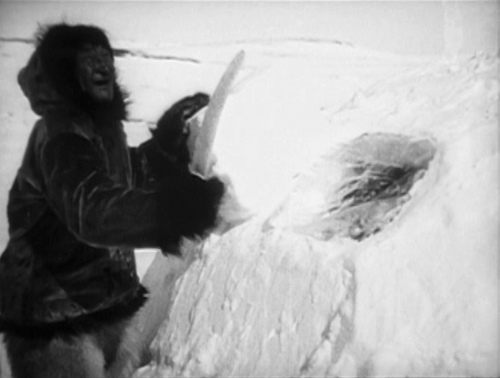
nanook windowIf you’re willing to grant that Allakariallak may be using old-timey methods to trap his other prey, a snow fox and a huge seal, it becomes a fairly nice re-telling and record of those ways. Then, with the onset of winter, the family builds an igloo (the film claims “within an hour”, but I ain’t so sure about that). This is one of the most famous segments of Nanook, and it is a wonder to behold: Nanook carving the blocks of snow with his trusty walrus-tusk knife, the women and children spackling the gaps with more snow. And most amazing to my eye, Nanook carving a block of ice from the frozen bay to serve as a window, and then placing a block of snow to reflect sunlight into the igloo. That is neatly done.

Then the family settles down for the night under their skins and furs. And something is chewing at the back of my brain: I’ve seen the movie cameras of that era, and they are big. Too big to easily fit through the tiny open Nanook and his clan crawled through. And they required more light than could be brought in through that ice window.

Yep, Flaherty built a half-igloo, open to the outdoors and its bounteous light.

flaherty_port_harrison_1920This is a question we have to face again and again as fans of cinema: does a good story trump the needs of historic accuracy? The answer from Hollywood is always a resounding, “Yes!” and who is to say they are wrong? Perhaps Nanook serves best not as a strict documentary, but as a record of a way of life that had vanished before the invention of the motion picture. Hence, not “documentary”, but “docudrama”. Robert Flaherty made a career out of movies like these, and they are all well-regarded: Elephant Boy (with Zoltan Korda, introducing Sabu), Louisiana Story, The Land.

critique-nanouk-l-esquimau-flaherty12The final thing to consider is that the movie opens by telling us that Nanook died two years after the film was finished; he journeyed inland to find food and starved to death. It is much more likely that Allakariallak died of tuberculosis, in his home. But whatever the cause, the news of his death triggered mourning worldwide, so successful had Nanook been, so far had it traveled. That is the power of a good story, well told, and perhaps the whole question is best answered by another movie, John Ford’s The Man Who Shot Liberty Valance: “When the legend becomes fact, print the legend.”

Nanook of the North on Amazon

A Bit of Tati

imagesOne of the great boons to a movie collector on a budget is the twice-yearly Criterion Sale at Barnes & Noble. We will not speak of the July version last year, because I was broke that month. Last November, however, the combination of the 50% off sale, a coupon, and a membership bought in better days resulted in me walking out of the store with the newly-released Jacques Tati box set for thirty-five bucks.

Tati was a mystery to me; I had no idea he even existed until I moved to the Big City and was exposed to the wondrous world of repertory movie houses. We had two back in those days, and it was the River Oaks Theater – still around, to this day – that had the wonderful sheets detailing the month’s double features, that I found stuck to most friends’ refrigerators. It was on one of these that I read of M. Hulot’s Holiday and Mon Oncle, and the bare paragraph describing Tati and his work. It sounded very intriguing, but I was working in a warehouse during the day and acting at night – time for a movie was rare. But that double feature kept coming back, year after year, so it must have been good.

So, when the Sale started mere days after the box set was released, I regarded it as a Sign.

And then I started rationing them out, because he made only six features in his life.

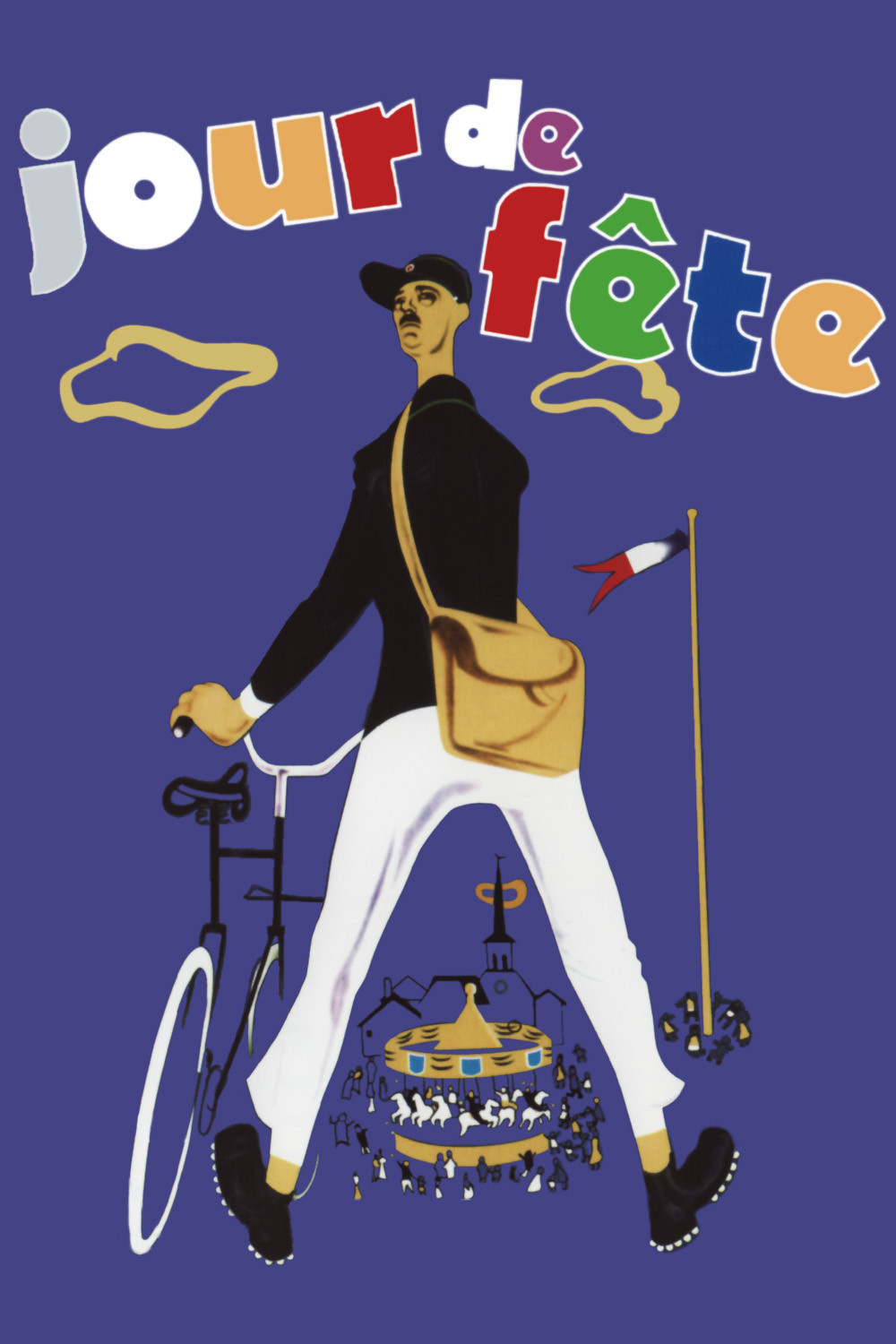
jourHis first feature,  Jour de Fête (1949), or “Day of the Celebration” (more popularly, The Big Day), was intended as a tribute to a tiny French village where Tati and several of his friends had found refuge during the Nazi occupation. The rustic village has a number of instantly identifiable types, serving as a sort of Commedia del Arte cast as the movie unfolds. A carnival comes to town, as the village celebrates… well, something. A centenary or Bastille Day, perhaps. The nature of the celebration isn’t important, it’s what it brings to town that matters.

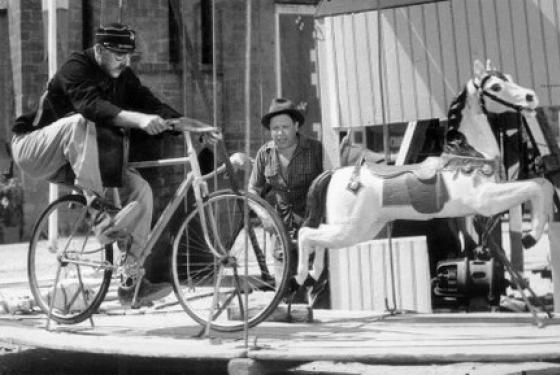
Tati is Françoise, the local mailman, the usual butt of jokes amongst the villagers, and a prime target for the two carnies running the merry-go-round, as they find him a willing participant in his own debasement. A large tent is set up, showing movies throughout the day (the soundtrack of a Western provides an ingenious backdrop for a meet cute between a carnie and a local girl, much to the disgust of the carnie’s wife), and it is in that tent that Françoise sees a film of airplane and motorcycle stunts, purporting to be the American Postal Service at work!

jour_de_4_webThis leads to a tremendous burst of energy in the last part of the movie, when Françoise (egged on by the carnies, of course) attempts to perform his postal duties as quickly as possible, in often dangerous ways, such as tethering his bicycle to a moving truck so he can use its tailgate as a desk, all the while shouting “L’Americaine!” (translated as “American-Style!”) This is apparently taken almost wholesale from his earlier short film, School for Postmen, but as an ignorant Yank, I didn’t know and didn’t care. It’s a marvelous sequence that left an enormous, happy grin on my face.

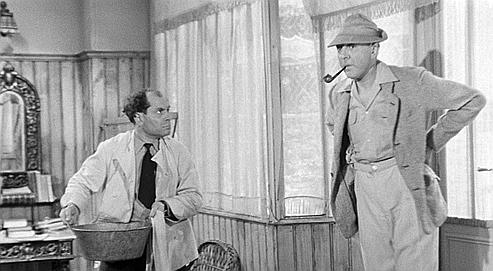
hulotTati didn’t shift into International Recognition gear until his second movie, Monsieur Hulot’s Holiday (1953), in which the title character (played by Tati himself, of course) wreaks havoc on a quiet seaside resort, usually with the very best of intentions. Like Jour de Fête, the story is episodic, but much more solid, as this time the viewer is certain as to the identity of the main character. Hulot, with his tall, angular frame (far too large for his rattletrap jalopy, whose noisy passage surpasses that of Jack Benny’s Maxwell), odd hat and ever-present pipe instantly inserts himself into the Classic Book of Clowns, probably inconveniencing someone while doing so and creating a catastrophe, all unawares.

I’m aware that Tati made his initial fame as a performing mime, and that most people use “clown” as a pejorative, but the true Clown works on a higher level than mere greasepaint and child-frightening costumes. Charlie Chaplin, Buster Keaton, Marcel Marceau, Claude Kipnis, Red Skelton, Jackie Gleason: all superior clowns, their best work rarely requiring anything so distracting as dialogue (in fact the version of Holiday I watched had been re-edited by Tati in 1978, eliminating virtually all dialogue); their comedy not only entertains but often comments and sometimes even teaches.

hulot et waiterHoliday, in fact, announced the arrival of an artist in no uncertain terms. Beautiful, idyllic scenes of peaceful seashore vistas are matched perfectly with hectic scenes of a train station swarming with harried vacationers trying to find their way to supposed peace and relaxation. It’s brilliant stuff, and Tati will continue to impress, not only with the staging of his setpieces, but the artist’s eye toward composition.

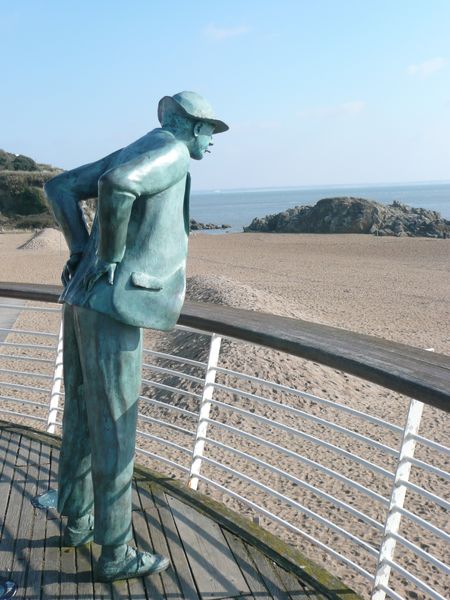
The Tati statue, at the resort where Holiday was filmed.

The Tati statue, at the resort where Holiday was filmed.

These two movies together form a delightful entrée into the man’s work, as it becomes plain how much he had advanced in only a few years. Jour de Fête is a perfectly good movie, but Monsieur Hulot’s Holiday has been rightly praised as a masterpiece. I read several reviews that puzzled me, that criticized the episodic nature of the story, and that they did not find Tati funny. These people went in expecting Chaplin or Keaton and say so, and that way – expecting an entertainer to fall conveniently into a pre-drilled hole – will always result in disappointment. Much of the humor in Holiday is so mild as to be nearly Canadian (the apparent oxymoron “gentle slapstick” is often used) but I laughed out loud many times. Ask any of my embittered friends who are stand-up comedians: it is tough to deliberately make me laugh out loud.

Anyway, these two movies begin and end similarly: a crowd comes to town, it bustles for a while, the crowd leaves town. Françoise’ frantic mail delivery is sidelined so he can help bring in the harvest. The vacationers say their goodbyes and head home, but Hulot is ignored, more readily accepted by the bored children playing in the dirt at beach’s edge. There are a couple of people who specifically seek  him out to say goodbye, having found him a delightful distraction in a pack of stolid, joyless people – but we are only too aware that Hulot was deprived of a last romantic picnic and goodbye from that attractive blonde girl who also found him entertaining, an opportunity sabotaged by his comedy rattletrap car. Such is the fate of the Clown, why we love and pity him so, and why we will always find room for him in our hearts.

Jacques Tati on Amazon

Lisztomania (1975)

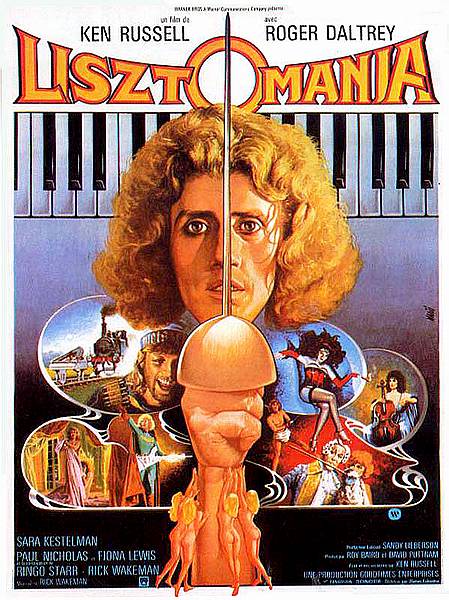
Lisztomania_1975_1One of my great regrets is that I don’t know more about classical music. I can pick out and identify the heavy hitters, but that’s most likely due to exposure via movies or Warner Brothers cartoons. Given that, I likely couldn’t, given a choice of five classical pieces, pick out which one was by Franz Liszt.

Still, here I am, watching Ken Russell’s biopic of the composer.

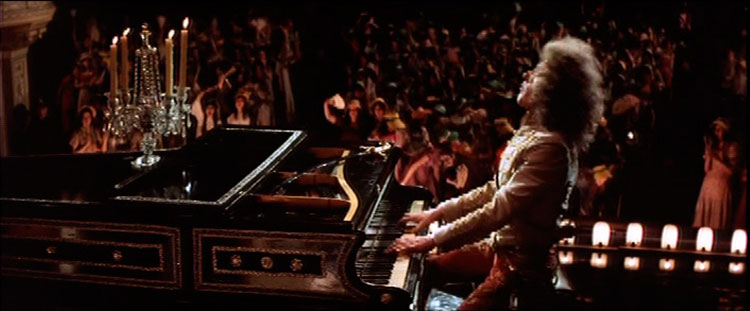
“Lisztomania” was apparently a very real thing, a term coined during Liszt’s glory days as a concert pianist; normally staid concert-goers were shocked by the screams of ecstasy and longing from Liszt’s young female admirers. (It has also been pointed out that a better translation of those contemporary writings is “Liszt Fever”, as “mania” held a much more serious meaning in the 19th century) Therefore, it seems fairly reasonable to cast Roger Daltrey, lead singer for The Who, as a very real classical music rock star.

Lisztomania-26110_2Lisztomania is concerned with the composer’s adult life, starting with his affair with the Countess Marie d’Agoult (Fiona Lewis), then into a concert where the audience is populated by screaming young girls (causing me to flash back to the final concert scenes of A Hard Day’s Night), then onward through his years of fruitful creativity under Princess Carolyn zu Sayn-Wittgenstein (Sara Kestelman), finally ending with his exorcism of the Nazi vampire Richard Wagner, using a flame-throwing piano made of steel and glass. Then Liszt returns from the afterlife in a pipe organ spaceship powered by the women he loved in life, to defeat Wagner, resurrected as a Frankenstein Monster/Adolf Hitler with an electric guitar that doubles as a machine gun.

What I’m saying is, some liberties may have been taken with Liszt’s biography.

liszt5Now, biopics almost always play fast and loose with the truth, because movies, you know? Anybody going into a biopic directed by Ken Russell expecting a documentary is, to put it politely, going to be blown out the back of the theater by the sheer force of the extravagant visuals that flow out of the screen like a water cannon. That is, if they haven’t had a heart attack at the first sight of bare boobies 30 seconds into the film. And remember: we are talking about Ken Russell right after Tommy.

The drying up of Liszt’s creative powers during his years of non-connubial bliss with Marie is presented as a silent Charlie Chaplin movie, accompanied by Liszt’s “Love Dream” (Liebestraum), with lyrics by Daltrey. That’s a conceit that shouldn’t work, but it’s brilliant. And if you hadn’t already figured out that this movie was going to have only the slightest flirtation with reality by that opening concert with its mylar curtain backdrop, this is at least a fairly gentle – for Russell – wake-up call.

lisztomaniae_thumbConsidering we’ll be soon entering into the segment where Liszt is seduced by Princess Carolyn, who will unlock his pent-up creative juices (heh) by forcing him to abandon his libertine ways and concentrate on composing. This is presented in a sequence involving Liszt growing a ten foot erection during a production number with the Princess’ chambermaids, who then feed the preposterous priapism through a guillotine manned by the Princess in her best Rocky Horror corset. This is entirely justified artistically (I am sure).

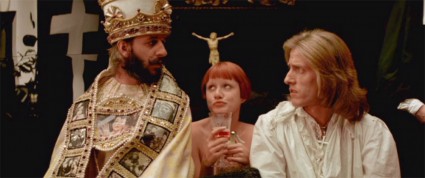
And did I mention Ringo Starr as the Pope?

And did I mention Ringo Starr as the Pope?

Russell is one of those directors I have come to appreciate late in life. In my early adult years, I knew him mainly for Altered States (for which my acidhead phase thanks him) and Crimes of Passion (for which… not so much). In subsequent years I’ve found Salome’s Last Dance, and thanks to the BFI and a region-free DVD player (and no thanks to Warner Brothers), The Devils. In my younger days, he was known as “Mr. Wretched Excess”, but I have really come to appreciate his audacity as well as his visual sense.

After nearly six decades on the planet (most of it spent watching movies), I’m more than grateful to find a filmmaker who not only makes me say “Oh what the fuck?” on a regular basis, but also makes sure that I have a smile on my face while doing it.

 Lisztomania on Amazon

Yet Another 2014 List

(This is an expanded version of an article I wrote for Daily Grindhouse)

Asking me to do a Top 10 list for the year is a dicey proposition. I’m rarely in a hurry to see movies, and it’s even more rare that anything excites me enough to expose myself to the pit of annoying human behavior which is the modern theatrical experience. But damned if I didn’t wind up seeing twelve movies in the year they were made available (spoiler: it was this year).

I also don’t care for ranking movies. All the movies on this list were of a pretty high quality, rendering placement squirellier than usual; overall, though, this list probably reflects that I am more colossal nerd than actual film buff. I look at other Top 10 lists and think, “Yeah, that does sound good. I should watch that some day.” Then again, the best movie I saw this year was made in 1943 – more on that later – so maybe there’s a bit of hope for me yet.

But let’s talk about 2014.

HONORABLE MENTION

Maleficent_42MALEFICENT – Frankly, this was going to be a hard sell to me; Sleeping Beauty is my favorite Disney animated movie, and that is due in no small part to its villainess. I like my bad guys grandiose and unrepentant, and Maleficent gives my favorite one a redemptive arc. Unsure whether to regard it as representation of how the Patriarchy subverts women of genuine power and motive, even to re-writing history, or simply as a cynical money-grab. Its very existence puzzles me , but it is well worth watching for Angelina Jolie, who is frequently magnificent as the title character. Especially when she’s being evil.

cap2CAPTAIN AMERICA: THE WINTER SOLDIER – Was highly regarded as the best Marvel yet, a seamless marriage of 80s action with the money of the current Marvel Cinematic Universe. It is certainly that, a damned near flawless action flick that actually made me like The Falcon (the Widow gets her movie first, dammit. Sorry, Mr. Mackie). But me, I like a little cosmic in my superhero stories, and Winter Soldier felt too stuck in that 80s action mode. (Don’t worry, there’s stuff coming up on this list that will allow you to call me a hypocrite) Chris Evans, though, remains the best damn Superman who never got to play Superman, a perfect portrayal of an inspiring, noble comic character.

And now for the list that is probably going to get shuffled around right up until press time:

713310. GODZILLA – I like big beasts, and I cannot lie. Yes, too much time was spent on Action Man while Bryan Cranston and Ken Watanabe were wasted, but frankly, spending too much time on boring human characters is a complaint I also lodge against most of the Japanese Godzilla movies. I want my Kaiju Big Battel, dang it. This one felt heavy and apocalyptic, just like the first Gojira, and I was a very happy monster movie fan. Also, people coming out of the woodwork to talk about how much they preferred the 1998 version allowed me to clean up my friends list somewhat.

Thor_The_Dark_World_poster_0069. THOR: THE DARK WORLD – I told you I like my superhero story leavened with the cosmic, and Dark World delivered. The production design of the Thor movies impress me with their visualization of science so far advanced it looks like magic (Thank you, Misters Clarke, Kirby and Lee). Jane Foster went to Asgard and didn’t turn into a sobbing wretch like her comics counterpart, We got much more Thor/Loki love/hate action, and I absolutely loved the final battle scene flipping through dimensions. (Bizarre battle chases like that make me very happy, one of the few reasons I find Shocker tolerable).

8. THE HOBBIT: THE BATTLE OF THE FIVE ARMIES – I see an astounding amount of hate directed toward these movies; bizarre, because I find them enjoyable and very entertaining. Still, I sadly realized, as I left the theater this time, that I hadn’t enjoyed any of these as much as I had the original Lord of the Rings movies – but it was still nice to have them to look forward to every Christmas season, and there’s a part of me that will miss that. And if you hate on Billy Connolly riding a war pig, you and I are going to have words.dain

lego7. THE LEGO MOVIE – Released in the movie wasteland of February, we all went, “Right. Another toy tie-in. Super.” But this was no Transformers or GI Joe or Teenage Mutant Ninja Turtles. this was a frenetic ode to creativity and fun with an anarchic storyline encompassing (and making light of) The Chosen One, Objects of Great Power, Prophecies, DC superheroes, pirates, and spaceships (“Spaceship!”). I wasn’t a fan of the third act twist, but what are you going to do? Sing “Everything is Awesome”, probably. Like you are right now. You’re welcome. There will be a sequel – of course – but I don’t see how they can possibly keep this up.

tilda6. SNOWPIERCER – Quite a lot of cinematic dystopias around lately, fancy that. This one is literally inescapable, as a world-circling train carries the last of humanity after an attempt to counter global warming turns the Earth into a frozen graveyard. After nearly 20 years, the Have-Nots in the rear car stage an uprising, fighting their way to the Haves in the front cars, with each car containing new hazards and new wonders. Science fiction, doing what it does best: exploring the human condition, and how we have a tendency to screw each other – and just as big a tendency to actually save each other, occasionally.
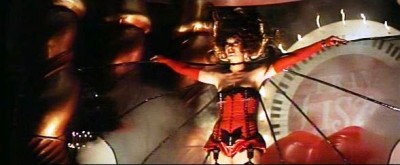
DUNE F 6_WEB_9115. JODOROWSKY’S DUNE – Yes, this is a 2013 movie, but it was released on DVD in 2014, smartass, allowing those of us who don’t live near an art house to actually see it. I remember reading about Jodorowsky’s ill-fated movie adaptation of Frank Herbert’s Dune in the pages of Heavy Metal magazine when both were going concerns. Even if the movie had gotten made, I would likely have hated it, but watching Jodorowsky talk about the project, his passion undimmed by the years, and his belief he could change the world with this movie and his fellow “spiritual warriors”… well, it’s impossible to not fall a little in love with the man.

X-Men-Days-of-Future-Past-Full-Cast-Photo4. X-MEN: DAYS OF FUTURE PAST – The return of Bryan Singer to the franchise he launched yielded such a remarkable movie, not only linking up the personnel from the original two movies with the younger versions of First Class via a time travel story that manages to wipe out the mistakes of the franchise-killing Last Stand, but also managing to be tremendously entertaining and gripping while doing it. This was the best Marvel movie last year, that Marvel didn’t make.

JOURNEYTOTHEWEST_FINISH3. JOURNEY TO THE WEST: CONQUERING THE DEMONS – I love Journey to the West, one of those million word Chinese novels that influenced everything that came after it (and many, many film versions), so I was uncertain about a prequel. Silly me, Stephen Chow came up with a beguiling, raucous, funny epic tale with fantastic, thrilling set pieces and genuine emotion. This was the movie I kept grabbing people and forcing them to watch this last year. And Holy Jesus, look at that poster. It’s a throwback to the masters of the 60s and 70s, it’s art, not a Photoshop job. For that alone, the movie deserves all the views.

The-Raid-2-Australian-poster_JPG.jpg2. THE RAID 2 – And after dissing 80s action movies in the first section, what do we find here, near the top? Possibly one of the finest action movies ever made, by one of the best action directors we have seen in an age. Gareth Huw Evans, forsaking the rapid-cut, what-the-hell-just-happened style that murdered action cinema in this country, to present a more calculated, but still frantic, visceral palette. The only thing that kept this movie from the number one slot is an overly familiar storyline (a decent cop going deep undercover to infiltrate a crime family). Otherwise, acting, camerawork, the superlative fight scenes and stunt crew are all top-notch. And any final fight scene that has a grizzled old vet like me curled up in a fetal position in his chair grunting, “Ah! Oh! Gaaaah!” is some intense shit.

Which leads us to –

guardians-of-the-galaxy-movie-image1. GUARDIANS OF THE GALAXY – Am I a huge nerd or what? Who expected a Marvel movie with no hook, no established characters hailing from an earlier movie (except for Thanos, one of the most ineffectual villains ever – so far, anyway), and in fact populated with characters it would take a Marvel geek of long years to recognize – to deliver so satisfyingly? Each of these “Guardians” are dealing with their own form of grief, and they find out in the course of the movie that they do not have to do it alone; or, in the parlance of motivational seminars, “Sometimes misfits are the right fit.” Nobody went into a movie with a tree monster from the 50s and a talking raccoon expecting to cry – but they did. There was some loose talk of Guardians being this generation’s Star Wars, and that may be true; I left the theater with the same buoyancy and sense of pure cinematic joy I felt on a certain summer day back in 1977.

Now, you may ask, what was all that about a movie from 1943? This is where things get a little strange, as I had to finally distill down what were my Top Ten Movies seen in 2014, for my Letterboxd Year in Review. Which is when I realized something: there were repeats between the two lists, of course, but their orders shuffled because of the picture in the #1 slot. This was not something that had occurred to me. So what were the Top Ten I Saw (for the first time) in 2014?

10. GUARDIANS OF THE GALAXY – That’s right, the #1 got shuffled down to the #10 spot, as I reconsidered my rankings in light of the movies in the top two slots. Ranking movies numerically is pretty stupid, anyway.

Yeah, same to you, Sky Prince or whatever your name was.

Yeah, same to you, Sky Prince or whatever your name was.

9. HIGH AND LOWKurosawa’s film version of an Ed McBain police procedural about a kidnapping gone wrong delivers on all fronts, especially when we get to the “Low” part of the equation. As in Ikiru, Kurosawa makes Japanese nightlife look like revelry on another world, so familiar and yet alien; and that sidetrip into Junkie Alley becomes a horrifying glimpse into Hell. All this, and Toshiro Mifune, too!

8. THE PHANTOM CARRIAGE – Silent movies are good for you. Director and star Victor Shölström delivers a melodramatic portrait of a hateful, worthless human being and somehow still gets us to root for his redemption. Charlie Chaplin and Ingmar Bergman were both big fans, and now I am, too.

7. JOURNEY TO THE WEST:CONQUERING THE DEMONS – For some reason, ranking this above Guardians on this list made good sense at the time. Maybe it was the multiple viewings. Anyway, here we are.

6. THE GOLD RUSH – Hey, another silent movie! It’s incredible to me that I managed to get this far in life without seeing one of Chaplin’s feature-length movies. I picked a good one to break that particular fast.

5. THE RAID 2 – Yes, even the mighty Raid 2 dropped a few slots, under the onslaught of quality that is to come. I still want to see Gareth Evans’ next movie noooowwwwwwww

Please don’t hurt me, Hammer Girl. I still love you.

4. HELLZAPOPPIN’ – The quality is coming, I assure you. I had wanted to see this for years, and Dave finally managed to dig up a copy of it (there’s some sort of rights issue with the original Broadway show script that kept it from getting a legit home video release). I was so smitten by it, by what Olsen and Johnson managed to pull off, even with a studio-mandated romantic storyline (and spending most of that opening ten minutes lampooning the studio that was screwing with them) – well, I’m sold. I went and sought out my very own bootleg copy. (Wheeler & Woolsey’s Diplomaniacs almost made the list, but Olsen and Johnson accomplished a lot more while under the Hayes Code, no less.)

3. CHILDREN OF MEN – Like I said, it takes me a while to see some movies. I’m ashamed to admit I didn’t watch Children of Men because I thought it was going to be another macho shoot-em-up, and boy howdy, I was wronger than a Nazi trying to pick out the Holy Grail. Brilliant movie. I have rarely been gladder to be wrong in my life. Ironically, I watched it the night Cuaron picked up the Oscar for Gravity, but I’m pretty sure that was just making up for not even nominating him in 2006. (The winner was Crash. Oh, yeah. Remember Crash?)

2. WILD STRAWBERRIES – Oh, the fight for first and second place was a wild and bloody one. Like I said, rankings are dumb, and both movies deserve to be #1. Here’s Victor Shölström again, this time coaxed out of retirement by Ingmar Bergman, and such a wonderful movie. Any words I’m going to babble out are not going to do it justice. Just watch it.

1. THE LIFE AND DEATH OF COLONEL BLIMP – I was expecting it to be good. I wasn’t expecting it to be superb. Again: Just. Watch it. Instead of merely showing you a clip, here’s a special guest to tell us about the restoration of the movie:

HONORABLE MENTION goes to A Hard Day’s Night, another stunning restoration on Criterion (especially with that 5.1 remix!). But I had seen it before.

And to all those other fine movies I re-watched this year: Targets, The Three Musketeers (1973), Sorcerer, The Quiet Man, Yojimbo, Sanjuro, The Holy Mountain, Samsara, The Untouchables, Vampyr, RoboCop, and Koyaanisqatsi.

Happy New Year. Go watch a movie.


Going Dark for the Holidays

Today is the last day of the Thanksgiving Holiday, the second weekend in a row I’ve had off. I have done nothing except cook. eat, sleep and play stupid puzzle games. It has been remarkably renewing. The opposite of profitable, but renewing. Which brings me to this entry.

December begins tomorrow. That is usually a busy month for me; hopefully the last two weeks are not an indicator of how busy I’ll be this year. I need to wrap up phase one of a writing project by the end of the month, and there is a personal writing project I’ve been putting off far too long.

So what I’m saying is, I’m going to stop pretending and simply announce that, likely, this space is going dark for the rest of the year. This downtime has been nice, but I need more. I haven’t watched a movie in more than a week, because – and I find this hilarious – if I watched any more, I’d have to write about them, and this entry was getting ungainly long already. That’s the epitome of putting the cart before the horse. So, before I close this tab on my browser, here’s a shorter version of that ever-growing blog post:

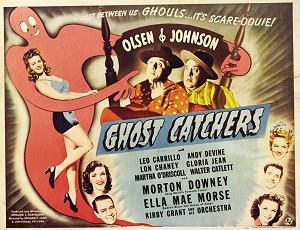
ghost-catchers-1Ghost Catchers (1944) is Olsen and Johnson’s third movie for Universal, the first being Hellzapoppin’, which I raved about last time. Fortunately, it’s up on Vimeo in its entirety, as is their second movie, Crazy House.

Studio execs had ground them way down by this time (it is probably telling that their last picture is titled See My Lawyer, and reportedly has very little Olsen and Johnson in it), to the point that once more we have two movies occupying the same space, but there isn’t even the uneasy truce between them that made Hellzapoppin’ great. Olsen and Johnson find themselves in an Abbott & Costello knockoff (typically, they make a meta joke about it), and the best sequence involves a jitterbug exorcism to cast out the one actual ghost in the whole thing. Mel Torme is supposedly in that, and so is Morton Downey Sr., providing far more entertainment value in five minutes than his son did in an entire career. Chic Johnson seems to be on nitrous, so constant is his giggling. I should have watched Hellzapoppin’ again.

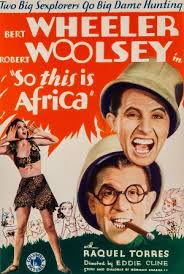
downloadI went over to Rick’s to watch more movies; now, normally, Rick and I, during these outings, watch a better quality of film. During the last sojourn at Dave’s, however, when I showed Wheeler and Woolsey’s Diplomaniacs, Rick became a hardcore convert to the cause of W&W. We had been interested in So This Is Africa, their sole movie for Columbia (during a contract dispute with RKO), and reportedly one of their most heavily censored. Alas, my suspicions were correct, as not only does this movie suffer from the lack of Joe Mankiewicz’s lunatic scripting, but the print is pretty heavily and obviously cut, so much so that Rick and I took to marking each instant with scissor motions in the hour while hissing, “Filth!”

The best bit is an out-of-left-field riff on Eugene O’Neill’s Strange Interlude, which would have been brilliant had the Marx Brothers not done it three years before in Animal Crackers.

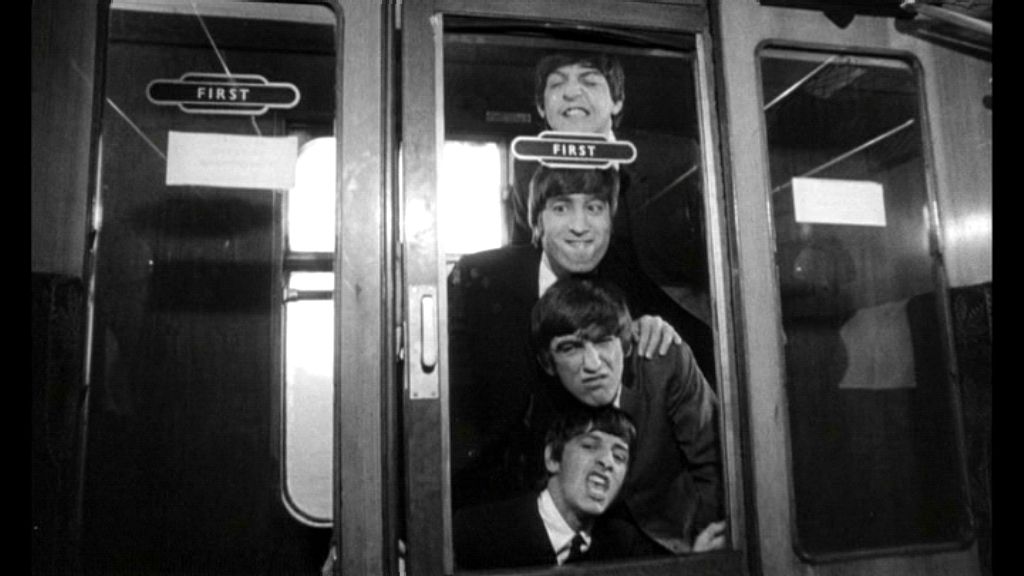
CTA1113_originalWe next watched what is the best thing I’ve seen all week, which is the recent Criterion blu-ray of A Hard Day’s Night. The image is a crisp, clean black-and-white and the sound features a lovely 5.1 remix that serves the songs well. The movie stands as a milestone for any number of reasons, but mainly as a testament to letting creative types have their head, and how important is good timing. The Beatles occupied one of those rare intersections where talent and desire were in the right place at the right time, and it was amazing that Richard Lester and writer Alun Owen could break the precedent of other rock musicals to actually allow their stars to show their differing personalities, to be themselves by playing larger versions of themselves.

I hadn’t seen this movie since 1975, when a local theater ran a midnight movie marathon of this, Help!, Yellow Submarine, and Let It Be. Some of the ladies in the college crowd were game enough to scream during the appropriate parts. But what I had forgotten was how claustrophobic this picture was, that it showed how trapped the Beatles were inside their own success. There’s always a smile or a joke, sure, but their faces do not truly light up until they’re playing their music.

Hard2For some reason I truly appreciate that in the final concert segment of the movie, you are able to see that the Beatles are sweating under the stage lights. People tend to forget how much actual work is involved in performing, and it is good to see that paid tribute.

It took me two more nights to get through all the supplements. That’s a great disc, is what I’m saying.

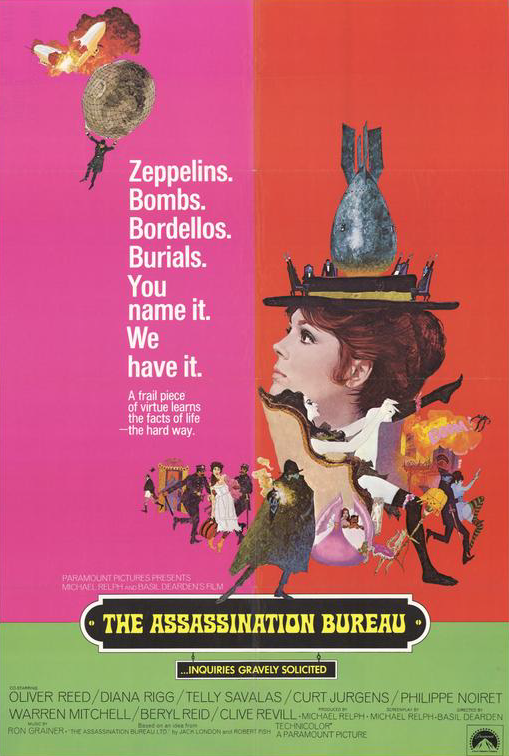
I1Ww9Rick is a recent convert to the cult of Oliver Reed; he arrived there by watching Terry Gilliam’s Baron Munchausen, followed by my insistence that he watch Richard Lester’s (there he is again) Three Musketeers, where Reed rather steals the show as Athos. So I brought my old disc of The Assassination Bureau (1969) (Warner Archive recently re-issued it).

This movie is what we used to call a “romp”. In pre-World War I England, a young suffragette journalist (played by Diana Rigg) discovers the existence of the title organization, run by the son of its founder, Ivan Dragamiloff (Oliver Reed). She contracts the Bureau to kill Dragamiloff himself, which the young idealist accepts – he feels the organization has grown too complacent and greedy, accepting hits for their monetary value, not the moral killing of deserving targets his father had insisted upon. Thus begins a cat-and-mouse chase throughout Europe, with Rigg unknowingly reporting to the Vice Chairman of the Bureau (Telly Savalas), who wants that World War, because all his money is tied up in munitions factories.

Oliver Reed & Diana RiggThis is light (despite the subject matter), frequently silly comedy-adventure, with a final fight scene aboard a zeppelin loaded down with a prototype blockbuster bomb bearing down on a castle housing a peace conference between all the crowned heads of Europe and Russia. I wanted Rick to see it because I think it proves that Reed could have been a credible James Bond… were it not for, you know, all the drinking and punching people.

For our follow-up, we’ll be watching The Devils, as soon as I figure how to play my Region 2 DVD on his system (really, Warner Brothers, what the hell).

I should close by mentioning that Rick, in retribution for my constant bad-mouthing of and cock-blocking a re-showing of Evilspeak at Crapfest, had re-named his wi-fi router so this was showing on my phone and iPad:

ClintBut this scheme, twisted genius that it is, has backfired upon him, as my phone now displays this comforting message:

No Clint

Nyeah, nyeah.

If I don’t have a chance to see you before then, have a Merry Christmas, or whatever your inclination is this time of year. Be safe, and watch good movies. It won’t kill ya.


Arabian Hellzamaniacs

So I went to Dave’s. So did Rick. We watched some movies.

Hellzapoppin’ (1941)

From the Broadway Revue, not the movie. Do you care?

From the Broadway Revue, not the movie. Do you care?

Now this is what you call your basic bucket list movie. It actually got mentioned in Famous Monsters, once upon a time, and I’ve wanted to see it ever since. The fact that it’s known as a milestone in anarchic filmmaking is also a definite plus. So when Dave managed to conjure up a copy, I was, as they say, there.

The movie opens with an incredible production number in Hell (the reason the movie ever cropped up in Famous Monsters), but the director charged with making the movie version of Olsen & Johnson’s successful New York stage show (in 1941, the longest-running show on Broadway!) wants to make an entirely different sort of movie altogether. Aided by a pre-Gunsel Elisha Cook, Jr. reading and re-working the script, Olsen & Johnson watch the dailies of this new movie, supplying voices for the characters, until one of them asks, “Doesn’t this movie have any sound?” “Sure, listen!” the other replies, and BAM, we are into that movie.

hellzapoppin1These bits leading up to our more normal picture are fast-paced and brilliant, and there was no way Olsen & Johnson could have kept that up – not without their stock-in-trade, interacting with a live audience. Still, you give out a heavy sigh when we slip into the usual screwball romantic comedy that forms the core of Hellzapoppinthe Movie. The romantic lead is staging a charity show at the mansion of his lady love, but he doesn’t want to butt in on his pal, who is at least as wealthy as the girl; he doesn’t want to look like he’s a gold digger. The boys are running tech for the show, and brought along their kid sister to help lug props: an incredibly young Martha Raye (only 25 at the time), playing a man-hungry wench who sets her sights on a fake European Count. There are mistaken identities, crosses and double-crosses, and thank God Olsen & Johnson not only tear down the fourth wall repeatedly, they dance on the rubble of the wall and then sell it for scrap.

HellzapoppinWe had some conversation about what the original stage show must have been like, because Olsen & Johnson use the medium of film for all its worth, having shouted conversations with the projectionist (Shemp Howard, no less), and doing any number of things that would be impossible on stage. One thing that could be done on stage, and is so amazing that we played it twice (and if I’m not mistaken, was excerpted in one of the That’s Entertainments): during a check of the instruments, every black servant on the estate wanders onto the stage conveniently built in the backyard, and they have an impromptu, amazing Lindy Hop number that is physically exhausting just to watch:

“Man, I wish they were in the show!” says one of the boys afterwards. You ain’t the only one, Jackson. The dancers, known as The Harlem Congaroos, are the only personnel from the Broadway show to make the leap to the movie version.

The effort to superimpose a plotline over what was apparently a vaudeville show writ large should have damaged it, but instead Olsen & Johnson grabbed the opportunity and made a movie so profoundly postmodern that every hipster should carry a copy of it in their pocket; yet, for some reason, home video currently eludes it, or vice versa. The best known of Olsen & Johnson’s movies, that’s a shame: it should stand as an example of how studio meddling can’t quite bring the creative spirit down.

Diplomaniacs (1933)

10091Yeah, it was me who wanted to glory in the Old Stuff that night, and that desire was sparked by this movie. The comedy team of Wheeler and Woolsey have, much like Olsen & Johnson, descended into obscurity, but thanks to Warner Archive, have had a bit of a renaissance. Diplomaniacs was an impulse buy – I needed one more disc for one of their “5 for $50” sales – but oboy, what a stroke of luck.

Wheeler and Woolsey have opened a barber shop on an Indian reservation, figuring there would be no competition – but there’s no custom, either. But hearing Woolsey making barbershop talk about international debts, the oil-rich tribe decides the barbers are their best bet for signing a peace treaty with the rest of the world. So our doofuses – the musically named Willy Nilly and Hercules Glub – are given a million dollars each and sent to Geneva.

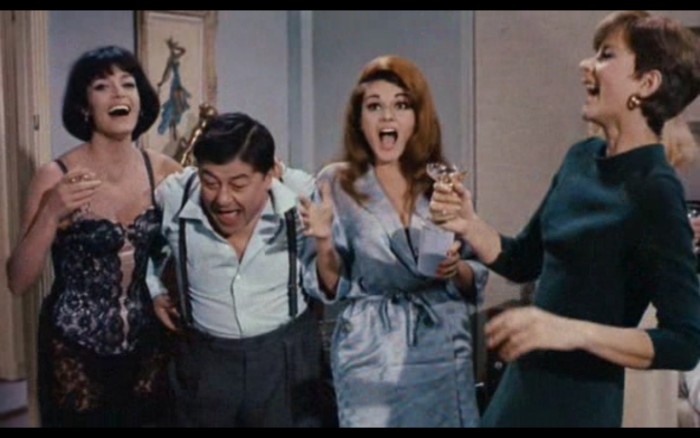
maxresdefaultThis opening bit is little more than your typical Three Stooges opening gambit, though the Stooges didn’t have production numbers with scantily-clad pre-Code Indian maidens. But once they get on the ocean liner to Geneva, the movie really takes off, and what I mean by that is writer Joseph L. Mankiewicz’ opium shipment arrived. The remainder of the movie is so fast-paced and anarchic, so downright silly, that it is hard to imagine some manner of narcotic not being involved. Hugh Herbert (who was in Hellzapoppin’ as the detective with a bewildering array of bad disguises) is the villainous Chinaman Chow Chow, who begins every line with “It is written…” He’s the henchman of Louis Calhern, whom Dave immediately recognized as Trentino in Duck Soup. Calhern is, himself. working for a war munitions manufacturing combine run by Schmerzenpuppen, Puppenschmerzen, Schmerzenschmerzen and Puppenpuppen.

As I said, it’s a very silly movie, and I loved it. Sure, the casual racism of Chow Chow can be off-putting, but then Wheeler and Woolsey double down on the racism – hell, triple, quadruple down – with a final production number at the Peace Talks. Tex Avery cartoons had a long tradition of what Dave terms “blackface dynamite”, where characters getting a faceful of TNT were instantly transformed into minstrel show performers. Here is the precursor to that, a surprisingly effective bomb labeled “BOMB – For medicinal purposes only” (I kind of hate that the image is so soft here you can’t read that):

Oh, Holy Mother of God

Oh, Holy Mother of God

Is this offensive? Well, duh. But I also think that extending the bomb’s effect to the observation gallery, and reversing Woolsey’s black glasses frames to white, points to a certain amount of piss-taking going on. It is a silly part of a very silly movie, and I look forward to seeing more of these madmen at work. Pity Mankiewicz isn’t credited as writer on any other Wheeler and Woolsey movies. Hopefully there was more opium floating around Hollywood.

Diplomaniacs on Amazon

Arabian Adventure (1979)

arabianadventureosI had brought the 1937 Sh! The Octopus, which would have provided us with a Hugh Herbert Film Festival, but this was deemed too Mantlerian so we watched Arabian Adventure, which I had never seen. It was a fairly obvious attempt to produce a Star Wars rip-off without being obvious about it, and its success pretty much depends on how you feel about Kevin Connor movies. Connor had previously directed fare like At the Earth’s Core, The Land That Time Forgot and Warlords of Atlantis. Genre adventures made with special effects that were dated, even for their time, also known to me as The Movies You Take A Nap During At B-Fest.

Arabian Adventure isn’t too bad, especially if you approach it as a children’s movie. It has all the standard Arabian Nights claptrap: an evil, wizardly Caliph (Christopher Lee!), a sniveling toadie (Milo O’Shea), a prince in disguise (Oliver Tobias) and a princess to rescue (Emma Samms). Also a plucky young orphan and his trained monkey, and an imprisoned good Vizier (Peter Cushing, who graces the movie far too little).

Can't touch this!

Can’t touch this!

The big scene here for the Star Wars crowd is a climactic dogfight on magical flying carpets, which manages to squeeze out a bit of excitement, but overall could have been much more impressive. Our big moments of groaning horror had to do with the appearance of Mickey Rooney as a clumsy, trollish blacksmith in charge of the giant fire-belching Kevin Connor puppets, and John Ratzenberger as the head of a group of thieves. Many were the Cliff Clavin imitations that punctuated our Arabian Adventure.

Like I said, entertaining enough, but curiously of a piece with how we began our evening: an episode of Space: 1999 that Rick credits with totally destroying his cherished memories of childhood. I’m in no rush to revisit either.

Arabian Adventure on Amazon