It was only a matter of time before we hit a zombie picture before actually reaching the letter Z; frankly, I’m surprised it took this long.
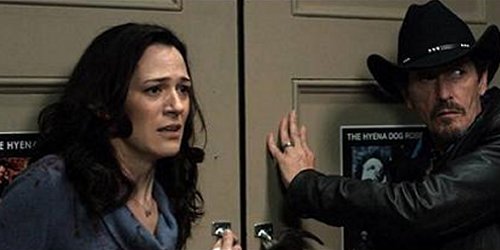
Pontypool is the name of a small town in Ontario. Grant Mazzy (the underrated Stephen McHattie) has been consigned to a small news radio station there for his sins. His reputation as a “take no prisoners” on-air personality doesn’t mesh well with Canadian Mayberry politics, and his harried producer Sydney (Lisa Houle) is trying to ease this squarest of pegs into the station’s round hole.
This snowy Valentines Day morning, however, something is up. Their traffic reporter (who Sydney admits is not in a helicopter, just a guy on a hill with some binoculars) sights a crowd of people mobbing and destroying a doctor’s practice, then moving on, destroying and killing anything in their path. There is nothing on the news wire, and the station has to rely on phoned-in eyewitness reports. The possibility that this may be a hoax is ruled out when the mob actually reaches the station.
Pontypool started life as a novel, Pontypool Changes Everything, and then a radio play, a format in which the story likely soared. The ever-growing mob aren’t really zombies, though; they are in the grip of a virus that transmits itself through spoken language. That’s not a totally new or original concept, but it is a difficult one to get across in a visual medium. The doctor whose practice was destroyed (Hrant Alianak) manages to escape to the station, and gives voice to the exposition, if not an explanation for the phenomenon.
There may be something of an explanation slyly buried in the story: a warning message in French that breaks into the station’s frequency and cell phone calls. Reports that military forces are moving in to the area. The government seems very prepared for this particular emergency. And not, as a BBC reporter opines, because of the area’s “secessionist tendencies”.
Confining the story to a single radio station gives us the requisite claustrophobia for our zombie siege, but it also means the movie is going to depend heavily on the acting chops of the small cast, and they are uniformly more than up to this task (I haven’t mentioned Georgina Reilly as the doomed assistant producer, and I should). The story begins to flag somewhat in its final act, though there is some cleverness when our survivors figure out that English seems to be the only language that’s a carrier, and have to rely on their limited knowledge of French.
However, I really appreciate that the filmmakers found a way to continue the story under the final credits crawl.
Overall, Pontypool is a pleasant surprise, a very unusual zombie picture managing to be both thoughtful and frequently harrowing, exploiting the theater of the mind in a way that movies rarely ever attempt.
This is another of those “I knew I was going to have to deal with this movie someday” posts.
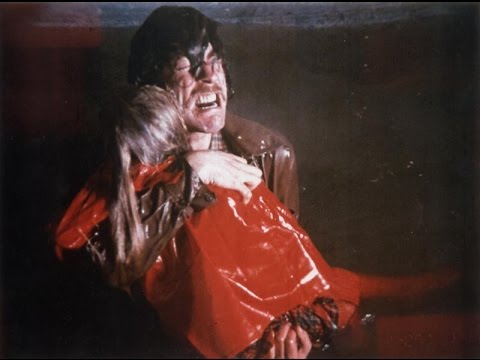
Yes, I managed to live through almost a half century without watching The Last House on the Left, despite it being pointed to as a milestone in horror movies. There are two reasons for this. The first, and I suppose major, reason is I don’t like movies like this. Yes, I love horror movies. But I prefer my fright films on the fantastic side; give me literal monsters, not human ones. So the period of my life when nothing but slasher movies were being made was a particularly tough one.
The second reason: a close childhood friend – and we had bonded over the fact that he was the only other person in my small town as obsessed by horror movies as I – had managed to see it despite its R rating, and before much furor had built up over it. He proceeded to describe the movie to me in gleeful detail, editing out every scene that did not include death, humiliation, debauchery, terror or gore.
So I felt like I had already seen it.
As I write this, it’s only been a couple of weeks since we lost director Wes Craven to brain cancer. The outpouring of grief and admiration from his fellows and fans was nice to see; after all, as Ken Lowery pointed out on Twitter, “It’s not everybody who gets to set the zeitgeist for his genre three times.” I liked and respected his movies (Nightmare on Elm Street, after all, put the fantastic into slasher films), but again – I hadn’t seen his first two (Yeah, Hills Have Eyes, also. Psycho hillbillies, Not a favorite subgenre, Texas Chainsaw notwithstanding). Immediately after Craven died, lots of people were watching his movies. Last House on the Left I had slotted into Hubrisween almost a year ago, and it was also in my 100 Films challenge.
So now I’ve seen it.
It’s Mari Collingwood’s 17th birthday, and she is going to a concert with her friend from the wrong side of the tracks, Phyllis (your designated victims are played by Sandra Peabody – under the assumed name of Sandra Cassell – and Lucy Grantham, respectively). Mari’s dad, a doctor, is worried about the concert taking place in the seedy part of town, but it’s okay, because that’s where Phyllis lives, right?
The Collingwoods live out in the country, incidentally. And we are given a preview of the generally sleazy tendencies of the upcoming movie when the grandfatherly rural mailman refers to Mari as “The prettiest piece I’ve ever seen.” And oh, yeah, there’s something wrong with the phone. That might be significant later.
The two girls hit the seedy part of town we’ve heard so much about, and try to score some grass from an equally seedy looking guy. Unfortunately, this guy is Junior (Mark Sheffler), the son of escaped convict Krug Stillo (David Hess), whom Exposition Radio had earlier informed us is so bad he hooked his son on heroin just to further control him. Junior takes them upstairs to where Krug, his moll Sadie (Jeramie Rain) and associate Weasel (Fred Lincoln) are hiding out. And before you can say “fresh meat”, the two girls find themselves the hostages of some pretty bad people.
The gang is going to take the girls in their trunk as they head over the border into Canada, but their car breaks down, and the girls are taken into the woods for what passes for fun and games among creeps. There is an effective moment when the tied and gagged Mari realizes the car broke down next to the mailbox outside her house.
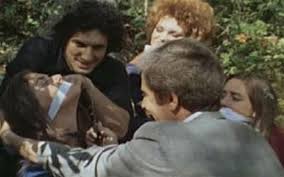
Thereafter follows the portion of the movie that got Last House declared a Video Nasty in England and incurred most of the projection booth censorship by shocked projectionists and nervous theater owners with scissors. We’ll start out with various forms of humiliation, including forced lesbian sex, but it isn’t until Phyllis tries to escape – and almost succeeds – that things turn really bad, She is stabbed, disemboweled, and generally hacked to pieces. Then, blood-soaked and in a frenzy, the killers return to where Mari has been desperately trying to convince Junior to run away with her. Mari is raped, and as she staggers away in shock, is shot in the back.
We are now little more than halfway through the movie.
Krug and company clean up, change clothes, and go to that house across the road to call for someone to fix their car. The Collingwoods feed them dinner and invite them to use the guest room and the missing Mari’s room, until the phone is fixed in the morning. Junior is in withdrawal, and while Mom is checking on him, she notices he is wearing the necklace Dad gave Mari for her birthday. She then finds their bloody clothes, and rousting Dad from bed, they head out into the woods and find Mari’s body.
And then they turn into avenging angels. Rather bloody avenging angels. With a predilection toward booby traps (which would serve the director well in Nightmare on Elm Street).
Wes Craven said he was trying to say something about violence when he made Last House. Given that the movie is still regarded as a non-stop assault, he may have made that point. There are many times where the camera is expected to cut away, and it doesn’t. Some of that is due to the fact that the only filmmaking Craven had done to this point was documentary, and he went with what he knew; scenes are done in long takes, rarely employing a tripod, so the atrocities are presented to the viewer like the evening news, unbroken by edits. It lends an immediacy to the horror that can’t be over-emphasized. The filmmakers also only knew the rough basics of how to make stage blood, and the stuff they came up with looks disturbingly like the real thing.
What my childhood friend didn’t tell me about, though, what he didn’t feel was special enough, can be broken up into two classes. The first is the comic cops, a Sheriff and Deputy (Marshall Anker and Martin Kove, oddly enough), who suddenly realize that the broken-down car they saw outside the Collingwood’s is the Krug getaway car, but they run out of gas while racing back to the scene. Mari and Phyllis’s desecration and murder is intercut with supposedly comic sequences of these two trying to hitch a ride. It’s supposed to add more tension to the girls’ plight, but generally just makes one question the filmmaker’s judgement.
The second thing omitted might have made me more interested in watching Last House, and it’s the Littler Things, things that could get lost in the bloody wash. First, the script is actually pretty clever, and often witty – really. Second, Craven is quite aware that even barbaric tribes are concerned with their own: witness Weasel’s cry of “Sadie! Are you all right?” when the escaping Phyllis smacks her on the head with a rock, abandoning his pursuit to check on her. And finally, after Mari’s rape, as the girl slowly pulls her clothes on and wanders off in shock – Krug, Sadie and Weasel looking everywhere but at her, finally at each other, realizing they have just thrown away the last shreds of humanity they might have harbored, and that is not cause for celebration.
That is what gives Last House on the Left its claim to being an important movie. The ultimate message that violence not only damages the victim, but also the aggressor, in ways beyond blood and bone. Mari’s parents get their revenge, certainly, but at similar violence to their humanity.
Most people don’t want to know about that, though. They want to see rapin’ and killin’.
It eventually came out that the source material for Last House on the Left was an Ingmar Bergman movie, fer cryin’ out loud, The Virgin Spring(Academy Award Winner, Best Foreign Language Film, 1960, no less). So once again I hie myself to The Criterion Collection.
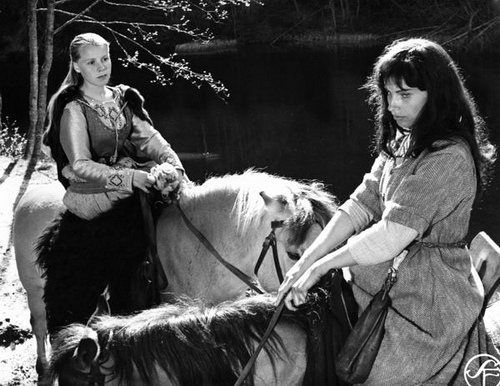
The first difference you’re going to note is the story is set in medieval times; paganism is being supplanted by Christianity. Phyllis, the girl from the wrong side of the tracks, is now Ingeri (Gunnel Lindblom), a pregnant girl adopted by the family of Töve (Max Von Sydow), a successful farmer and ardent Christian, though perhaps not as ardent as his wife, Mareta (Birgitta Valberg), who burns herself with candles on “the day of our Lord’s suffering”.
Ingeri opens the movie by praying to Odin to strike down her foster sister, Karin (Birgitta Pettersson), who is currently oversleeping on the day she is supposed to take candles to the local church for the Virgin Mary. Karin is the opposite of Ingeri in every way: blonde, chaste, spoiled. She puts on her finest garments and heads to the church, with a reluctant and bitter Ingeri in tow.
At a river crossing, Ingeri begins to be fearful of the vengeance she had called down on Karin, and stays behind, only to be freaked out again by a fellow Odin worhipper when he begins showing her the remains of his last sacrifice. So Karin is alone when she runs into three wandering sheepherders, known only as Thin, Mute, and The Boy, which is a good descriptor of them (Axel Düberg, Tor Isedal, and Ove Porath). Beguiled by Thin’s use of a mouth harp, Karin talks with them for a while, then offers to share her lunch with them. They’re not much interested in saying grace with her, though.
As the lunch goes on and Karin brags about her family and their farm, the herdsmen start getting closer and closer, and Karin begins to realize she’s in trouble, but way too late. In fact, one of the most heartbreaking parts of this segment is that she shifts into hyper-nice, trying to distract the two older herdsmen from their obvious intent, but to no avail.
Karin’s rape is, once again, the part that got scissored for years and years. It is not explicit in any way, but it is ugly and horrifying. Bergman argued that it should be ugly and horrifying, that to cover its brutish offensiveness by discreetly cutting away would not only lessen the impact, but would, in effect, let the audience off the hook emotionally. That sigh of relief would diminish the character’s suffering. Honestly, rape needs to be seen for the horrific crime it is, not a mere plot device.
Immediately afterward is the same scene as in Last House, as the two herdsmen realize the monstrousness of what they’ve done (Craven knew what was important, and what was necessary to carry over to his version). Karin wanders first toward the camera, then back, before the mute herdsman beats her to death with a club. There’s another shocked moment, then the two herdsmen strip the clothes off her body and run off, telling The Boy to watch the herd until they come back. Eventually, overcome with horror, The Boy will try to throw some dirt over her body, as snow begins to fall.
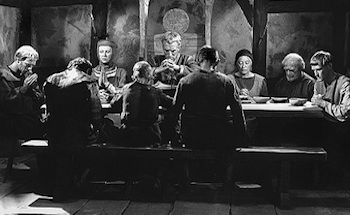
That night, Töve receives three visitors to his manor house: it’s the three herdsmen, claiming to be workers travelling south for warmer weather and work. Töve tells them to come in from the cold, and feeds them. The Boy, terrified, is the only one who recognizes the grace they say over their meal is the same said by the girl the two men murdered. Töve, ever the good Christian, tells them there will be work at his farm soon, and goes to bed.
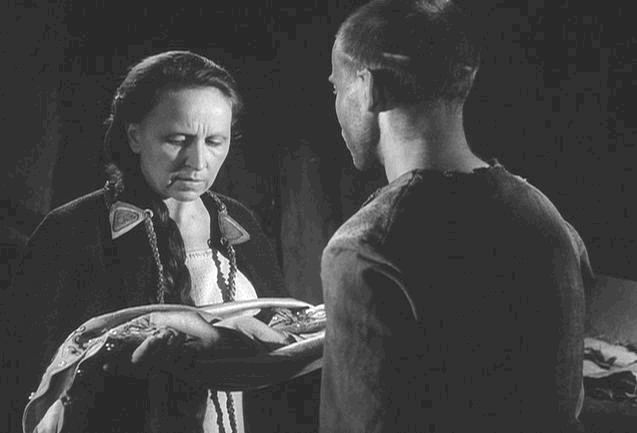
Marta checks in on her guests when she hears the boy cry out; another guest – a beggar – tells her the mute one struck the boy. As she leaves, Thin tries to sell her a silk shift he says belonged to his dead sister. Marta recognizes it as Karin’s, and the absolute stillness of Valberg’s acting in this scene is a gut punch. She takes the shift, saying she’ll have to talk to her husband about a proper reward for it, and leaves, not giving in to emotion until she has left the room. Then she locks the door behind her and wakes Töve.
Töve digs through a chest of clothing and recovers his sword. He goes out to prepare for what he must do, and finds Ingeri hiding under the stairs. The poor girl had witnessed what happened to Karin, and is convinced that her prayers to Odin were the cause. (In the original cut of Last House, when Mari’s body was found, she was still supposed to be clinging to life, long enough to finger Krug and company for the crime. You can still see her moving and breathing in that scene) She begs Töve to kill her for that transgression. He tells her to get up and help him get ready.
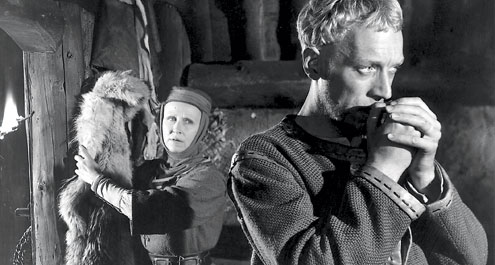
He forsakes the sword for the “butcher’s knife” and walks quietly into the main room, where the killers are still sleeping. Marta follows, locking the door silently behind her. Töve opens the men’s bags, finding more and more of Karin’s clothing. Then he wakes them up and kills them, one by one. It’s not the climax of Last House with a chainsaw and a switchblade, but it is cringe-making as the two men try to defend themselves but are no match for a wrathful father. Töve then, in an Old Testament rage, grabs The Boy, who had run to Marta in terror, and smashes him against a wall, killing him instantly.
This is pretty much where Last House ends, with mother and father covered in blood, the comedy cops finally arriving and horrified, and the living protagonists with a thousand yard stare. Bergman, however, gives us Töve’s despair at what he’s done, the search for Karin’s body, Töve’s talk with God about how He allowed this to happen, and his own determination that he must atone for his wrath and murders by building a church of rock and mortar on the spot where Karin was killed. He raises Karin’s body, and a spring begins to flow from the spot, as this is based on an ancient Swedish ballad, and that is how it ends.
In the overall sweepstakes of my favor, The Virgin Spring has the clear edge, technically and presentation-wise. But that’s a mug’s game, really; Bergman had been making movies for fourteen years, and The Virgin Spring was his 26th. It’s not totally an apple-to-oranges comparison, but it’s close. I find in considering and analyzing it, my overall opinion of Last House on the Left has actually improved. That said, I know which movie I would watch again, given a choice.
You’ve probably seen The Last House on the Left, you’re not a general movie layabout like myself. Now watch how one of the greatest filmmakers of the twentieth century handles that last scene. No subtitles necessary.
I keep trying to remember when I first heard about Jeepers Creepers. It was released on August 31, 2001, which means eleven days later nobody was talking about it. Perhaps once the initial shockwaves wore off, and people were looking for escapism – that might have been when I starting hearing about it. The general consensus was that it was good up to a point, and then we found out there was a monster involved, “and that ruined it.”
Bullshit.
I am getting all sorts of ahead of myself.
Trish and Darry (Gina Phillips and Justin Long) are two college students, brother and sister, driving home for break, and due to Trish’s misgivings about their parents’ deteriorating relationship, they are taking the scenic route, the long way home. This is a mistake.
Start with a Duel type encounter with a huge, rusted-out van with a dissonant horn that would deafen a heavy metal concert. The two later spot the van outside a deserted church, and a rather creepy-looking figure throwing what are oh-so-obviously bodies into a drainpipe. Then they get chased again, and forced off the road.
Darry wants to go back and find out if whoever got tossed into that pipe is still alive. Trish takes the much more sensible approach that they should just get to a phone and call the cops (Darry’s cell phone is dead and the cigarette lighter in Trish’s vintage Chevy is broken). Gina makes the far more compelling case, but this is a horror movie, so back they go.
The pipe goes down much further than anticipated, and Darry, of course, winds up falling down it. One of the bodies, he finds, is still alive, though not for long… and it isn’t the only body down there. In fact, there seems to be a hundred or more, nailed to the ceiling of a subterranean chamber like a ghoulish Sistine Chapel.
Darry finds a way out through the church basement, and they finally head to the next town to get help. Two cops will follow them back to the church… but they won’t make it there.
Ah, you already know this. What’s driving the van is The Creeper, a thing that is allowed, every twenty-three years, to eat for twenty-three days. It eats only parts, the parts it needs to replace, until its next meal break. The rest it arranges in its lair because it has an artistic bent. And it wants some body part from either Trish or Darry.
Once it’s established the Creeper is supernatural, it becomes a chase movie, Trish and Darry careening from one supposed place of safety to another, finally ending up at a police station where the Creeper is going to re-enact The Terminator after chowing on some prisoners to replace damaged limbs. The movie’s process is pretty sneaky and well played-out; The Creeper gets a little weirder every encounter, every attempt to kill it, even multiple attempts at running it over with that Chevy (should we add Forever Evil to the movies referenced? Naaaaaah). This is a totally new movie monster, and we – and the characters – are unsure of its mythology and any weaknesses, if indeed it has any. Clues are dispensed by Gizele (Patricia Belcher), a woman with unreliable psychic powers, and they aren’t very useful.
As we already know, I hate slasher movies, and I hate psycho hillbilly movies, and I tolerate giallo if it has a decent murder mystery embedded in it. But monster movies? Them I love. I should have rushed right out to see Jeepers Creepers when it was in theaters, the instant I found out it was a creature feature. But I was pretty broke in those days. It did alright without me.
As much as I liked it, though, I really can’t see how this would support not one, but two sequels. But then, that is something I could say about any number of horror movies.
(I know, I know, you’re waiting for me to say something about writer/director Victor Salva. What I knew before watching this was hearsay, and now I have confirmed details. Google his name, if you’re unfamiliar. I still like this movie. Separating art from its creator is never easy. It was a lot easier with Roman Polanski, whose movies I generally didn’t like. Salva’s a little tougher. Unlike Polanski, though, Salva did jail time – not very much – but he didn’t try to escape his punishment. Judging any further than that is for a higher power than myself.)
When one is doing a challenge like Hubrisween, it behooves one to occasionally program oneself a softball. So let’s all say “Hello!” to our designated softball, the 1920 Harold Lloyd short, Haunted Spooks.
By 1920, after numerous shorts for the Hal Roach studios, Lloyd was finally beginning to find his own voice. He had cast off the imitation of other, successful stars, donned a pair of glasses with no lenses, and became the character that would be known and loved for years: honest, earnest, kinetic, and extremely physical.
Haunted Spooks is pointed to as the first of Lloyd’s mature works. And true to Lloyd’s character and future works, it damn near killed him.
The plot is somewhat complex for a two-reeler. First, there is some Southern gentlemen who has passed away and left his plantation to his only daughter, on the stipulation that she live there with her husband for a year. If she fails this, the mansion goes to her evil uncle (the will doesn’t say “evil uncle”, but you know what I mean). The problem is, she’s not married.
Switch to Harold Lloyd, who is one of many young men wooing a rich young lady. In a truly funny sequence, he manages to freeze out the most ardent of his rivals, and gain the father’s consent to marry her. After getting this permission, though, he finds his lady love in the arms of another man, and so spends the next five minutes unsuccessfully trying to commit suicide. No, wait, trust me, it’s really funny!
His final attempt, trying to get run over by a car, puts him in touch with the heiress’ lawyer (it’s his car), and within minutes, the lovelorn Lloyd is wed to The Girl (Mildred Davis, who in a few years would actually be Mrs. Harold Lloyd). They pile into her rattletrap Ford, and journey to their new home.
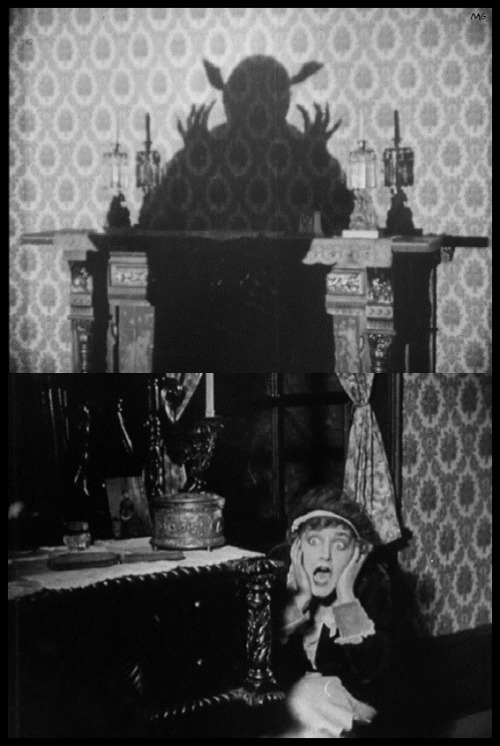
Meantime, the Evil Uncle (Wallace Howe) is inspired by a thunderstorm to tell the superstitious staff that the mansion is haunted. Yes, the domestics are all black, so just steel yourselves for the Standard Comical Negroes of the time. Lloyd and the Girl arrive just in time to nearly get trampled by the stampeding servants, leaving only the petrified Butler (Blue Washington). Thereafter follow multiple people wearing sheets for various reasons, people running from them, and the occasional coating with flour to risible effect.
The thing is, this is all hilarious, and must have been even moreso in 1920 when it was all relatively new (maybe?). The bits are well staged, frenetic, and even at this far remove, often unexpected and always humorous. And we can – and should – tut-tut at the racial stereotyping, but we must also admit that it is fairly forward-thinking when the formerly terrorized Butler is the one who discovers and completely exposes the subterfuge, giving Lloyd and The Girl their happy ending and one of the better closing lines, from The Girl: “By the way – what’s our name?”
So how did this amped-up yet scaled-down episode of Scooby-Doo nearly kill this promising young comic star? Turns out it wasn’t anything that actually happened during filming (and given later successes like Safety Last! is only logical to assume). It was, in fact, while shooting a publicity still. He was supposedly lighting a cigarette from a lit bomb fuse, and the supposed prop bomb actually exploded.
No matter where I went in my research, I could not find the whys and wherefore of how Harold Lloyd was handed something that would actually blow up. That would seem to me a very interesting story, but I suppose it is amazing enough that Lloyd, having lost the thumb and forefinger of his right hand, his face severely burned and temporarily blinded, made such an astonishing comeback. He regained his vision and is using a prosthetic glove in the second half of the short. He is, in fact, using it so well that it is only apparent by its color (it’s lighter than Lloyd’s intact left hand) or by careful freeze-framing. Lloyd’s own doctors had to see the movie twice before they could determine when he was using it.
So yes, Haunted Spooks doesn’t refer to the sheet-wearing Uncle or his accomplice, but to the terrified servants. That’s a shame. But it would also be a shame to let that discourage you from enjoying a particularly energetic gem from the silent era. I laughed more than I shook my head in sad disbelief. Here, let me make it easier for you:
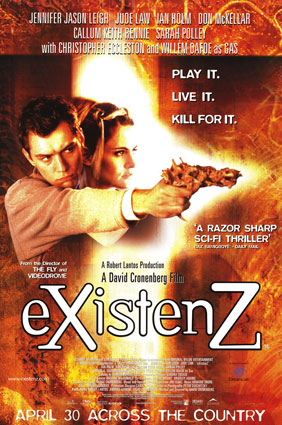
eXistenZ was David Cronenberg’s first completely original script since 1983’s Videodrome, my personal favorite of his many movies. It’s a bit disheartening that the two movies share themes, but then, Cronenberg hasn’t exactly hidden his obsessions over the years, and it only makes sense that he returns to those themes employing a different medium, a different Macguffin. In Videodrome, it was TV; in eXistenZ, it’s video games.
Jennifer Jason Leigh is Allegra Gellar, a rock star among game designers. eXistenZ is her new game, and the movie begins with a focus group gathered in what appears to be a rundown church. The people are there to play-test eXistenZ, and here is where we get the first of the Cronenbergian buzzconcepts, as each participant is assigned a “gamepod” made of “meta-flesh” which they will plug in to their “bio-ports”.
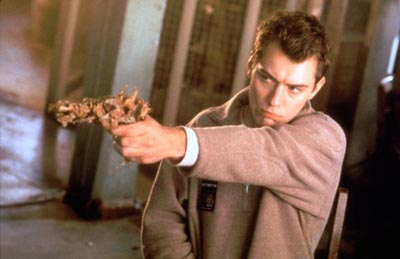
Sorry, I really am taken by that bizarre gun.
Plunging the viewer into the story in media res and filling in the details of this world is a trick Cronenberg knows well, and as 12 random volunteers plug themselves in to their borrowed gamepods and are networked to Allegra’s pod with cables that look suspiciously like umbilical cords, a latecomer arrives with an older gamepod. He takes a seat in a pew, takes out the older, larger gamepod, and from it pulls a bizarre looking gun, which he uses to shoot Allegra. A security guard shoots and kills this would-be assassin, and the wounded Allegra is entrusted to the care of a PR intern (Jude Law). They escape in the panic and go into hiding until they can figure out who wants to kill Allegra and why.
Besides the gamepods, which are flesh-colored and seem to pulse and breathe while they are being operated, the assassin’s gun is the only clue you need that this is a Cronenberg movie: to get past the metal detector at the door, the gun is made of bone and meat and fires human teeth instead of bullets. That is the Cronenbergiest thing ever.
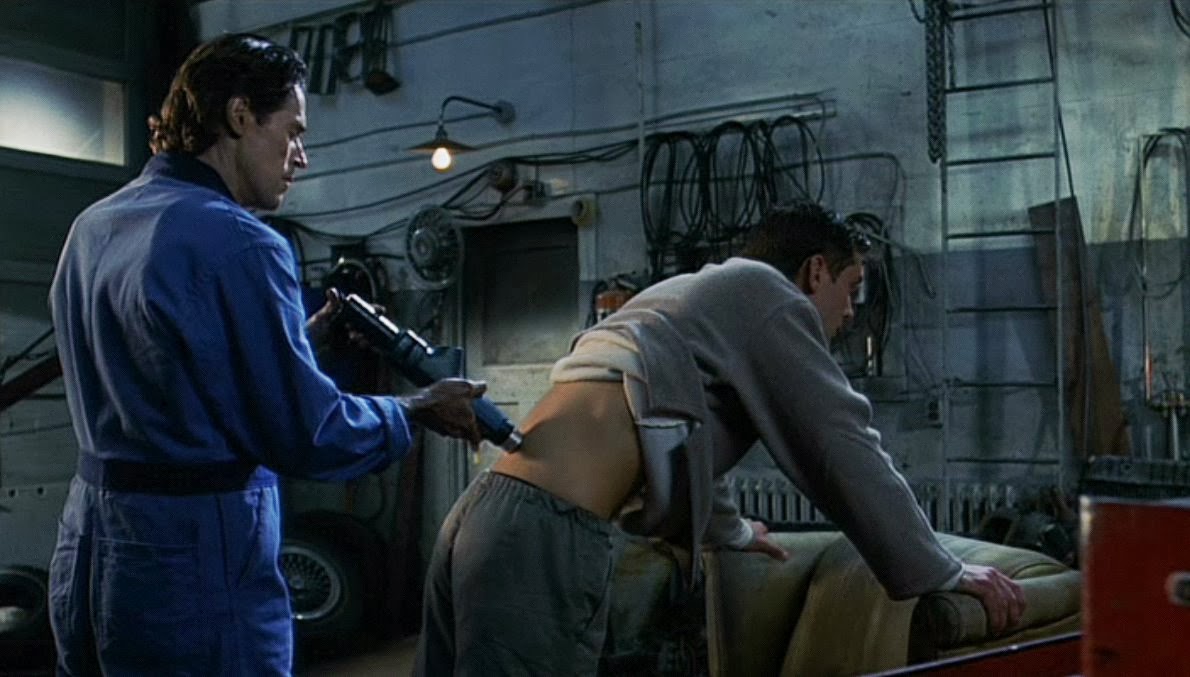
To continue coining new words, things get Cronenbergier when Allegra discovers that her new guardian, Ted Pikul, doesn’t have a bio-port, and we learn these sockets that run directly into the spinal column are installed routinely in shopping malls. “It’s like getting your ears pierced,” says Allegra.
Her gamepod was injured in the attempted assassination, and apparently has the only copy of eXistenZ, which has so far cost $38 million to develop. She has to access the game to make sure it has survived, and for that she needs a partner, and they seek out a black market bio-port supplier for Pikul. That this supplier is played by Willem Dafoe should raise red flags.
Once Allegra and Pikul do access eXistenZ is when we start traveling through Cronenberg mindfuck territory. Pikul turns out to be really good at this new virtual reality experience, though his perception of what is real and what is game begins to get very soft. Allegra is surprised at developments in her own game, which seem to be the work of the people trying to kill her, the Reality Underground.
I admit I approached this with some misgivings; near future science fiction has a tendency to get very embarrassing very fast (Johnny Mnemonic‘s cyberspace sequences were embarrassing out of the box). Cronenberg sidesteps the whole thing pretty neatly with his body horror version of the future; hell, even Jude Law’s cell phone is some sort of glowing lump. So the most jarring thing about this future is that Leigh, Law, and Christopher Eccleston are so freaking young. (not to mention that Law’s American accent is really good.)
eXistenz is probably the closest we are ever going to get to a decent film version of Philip K. Dick’s trippier stuff, like The Three Stigmata of Palmer Eldritch or Ubik (I would love to be proven wrong on that). Creepier stuff like synthetically mutated amphibians being harvested to provide the meta-flesh for gamepods put aside, it uses nestled realities with an effectiveness that wouldn’t be seen again until Christopher Nolan’s Inception, and, like its older brother, Videodrome, it leaves the viewer, like the characters, unsure of what truly is reality.
The Brits have a very layered way of moving up in the world of performing arts: you start at the bottom, and work your way up. I rather prefer that over the hope-you-get-noticed-and-rocket-to-fame model of American show business. One of the more interesting of these rising through the ranks stories is Nicholas Roeg, an intriguing cinematic voice who managed to keep his extremely singular nature in his ascent to the director’s chair.
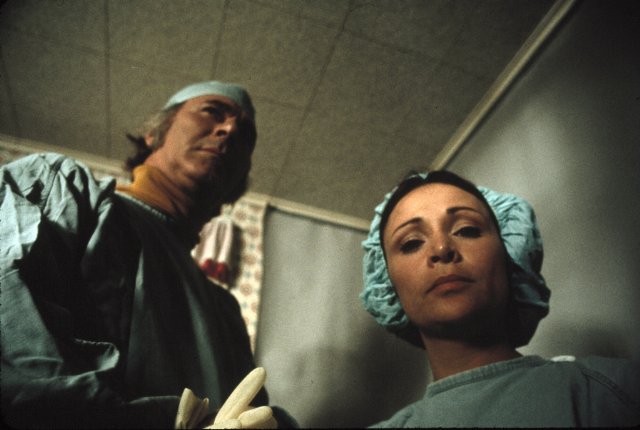
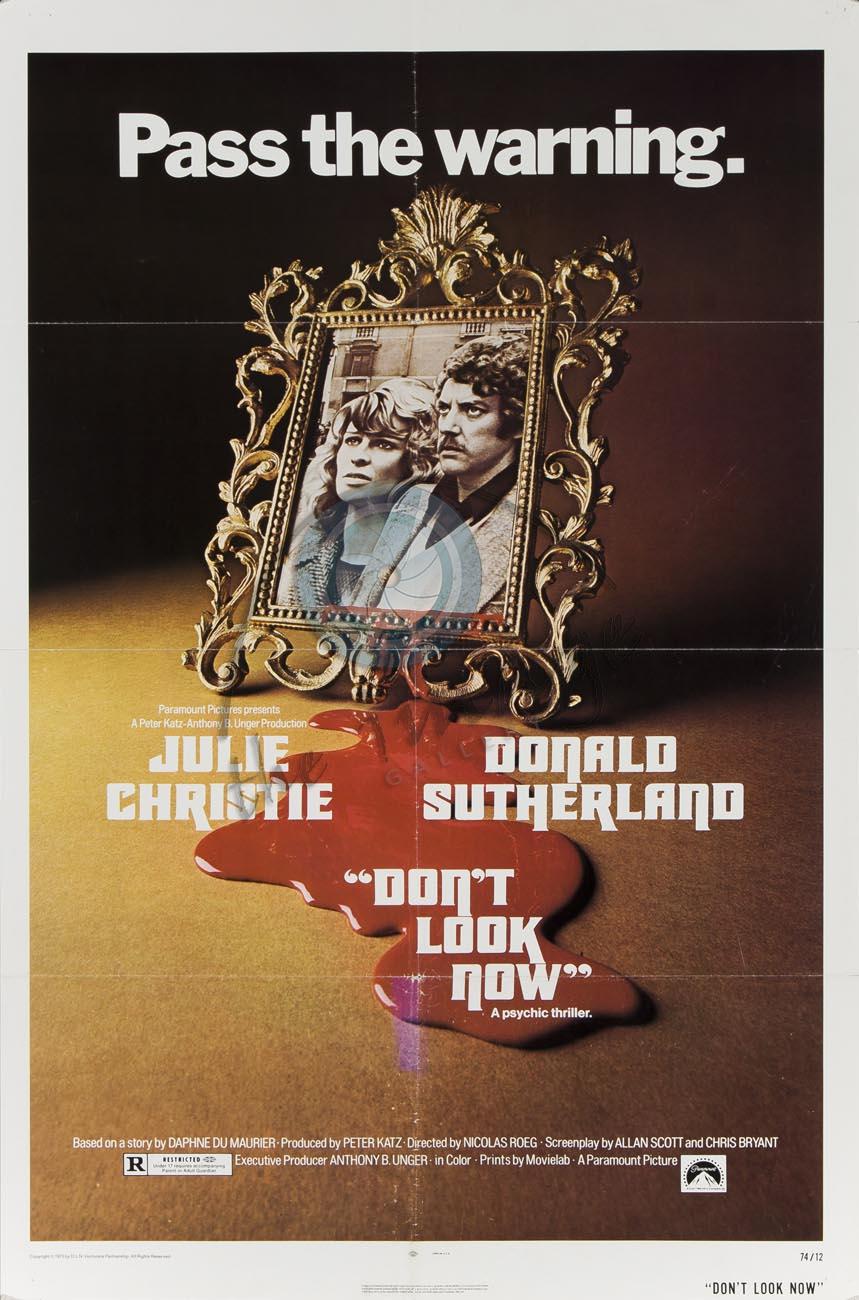
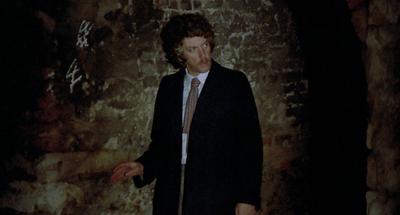
After his debut feature, Performance, and its follow-up Walkabout, Roeg directed this mind-bending movie, described by himself as “an exercise in film grammar”. Based on a Daphne du Maurier short story, it’s the tale of Laura and John Baxter (Julie Christie and Donald Sutherland), a couple in the months after the accidental drowning death of their daughter. They’re currently living in Venice, where John is supervising the restoration of a decaying church. At dinner one night, they encounter a pair of vacationing English sisters (Hilary Mason and Clella Mantania) , one of whom is blind, but psychic. The blind one tells Laura she can see her dead daughter, who is attempting to warn John he is in danger if he stays in Venice.
There is a lot to what she says: there has been a series of unsolved murders, and John keeps seeing a tiny figure darting about in the shadows of the winding streets, seemingly wearing his daughter’s favorite red raincoat – which she was wearing when she drowned. John himself also has the Second Sight, a notion which he vigorously denies, until he has a vision which sets in motion his doom.
Roeg is messing with the viewer from the beginning, presenting the daughter’s death in a early morning scene snipped into several converging, simultaneous storylines, separate realities that eventually merge into one harrowing whole. John’s psychic ability is foretold as he spills a drink on a slide of one of the Venetian churches he’s researching, his daughter in one of the pews; the drink causes the red dye of the slide to run (she is, of course, wearing the raincoat in the picture), bringing a dreadful premonition to him as he runs out the door to the nearby pond, too late.
This fragmented vision of reality, strings flailing about in an effort to wrap themselves into the cord of fate, runs throughout the movie. John wandering lost in the alleys of the seedier side of Venice, stopping suddenly and saying, “I know this place,” unaware that he is foreseeing his own eventual death; the final shock that we see coming from a mile off (like John, if he would only let himself see as the blind sister does) which is nonetheless so visceral, so shocking, (and it must be said, Christie and Sutherland are so good in their roles) it burns itself into your mind, even though you thought it prepared.
This movie was a bit of a cause celebre amongst my classmates at the time, probably as much for the sex scene as the horror story (oh, hush, you were in high school, too, at some point). Don’t Look Now presents a universe where everything is connected, but it is still a chaotic, uncaring place, full of danger and terror. I’m actually kind of glad I didn’t receive that message in high school; I’m a little better prepared for it now.
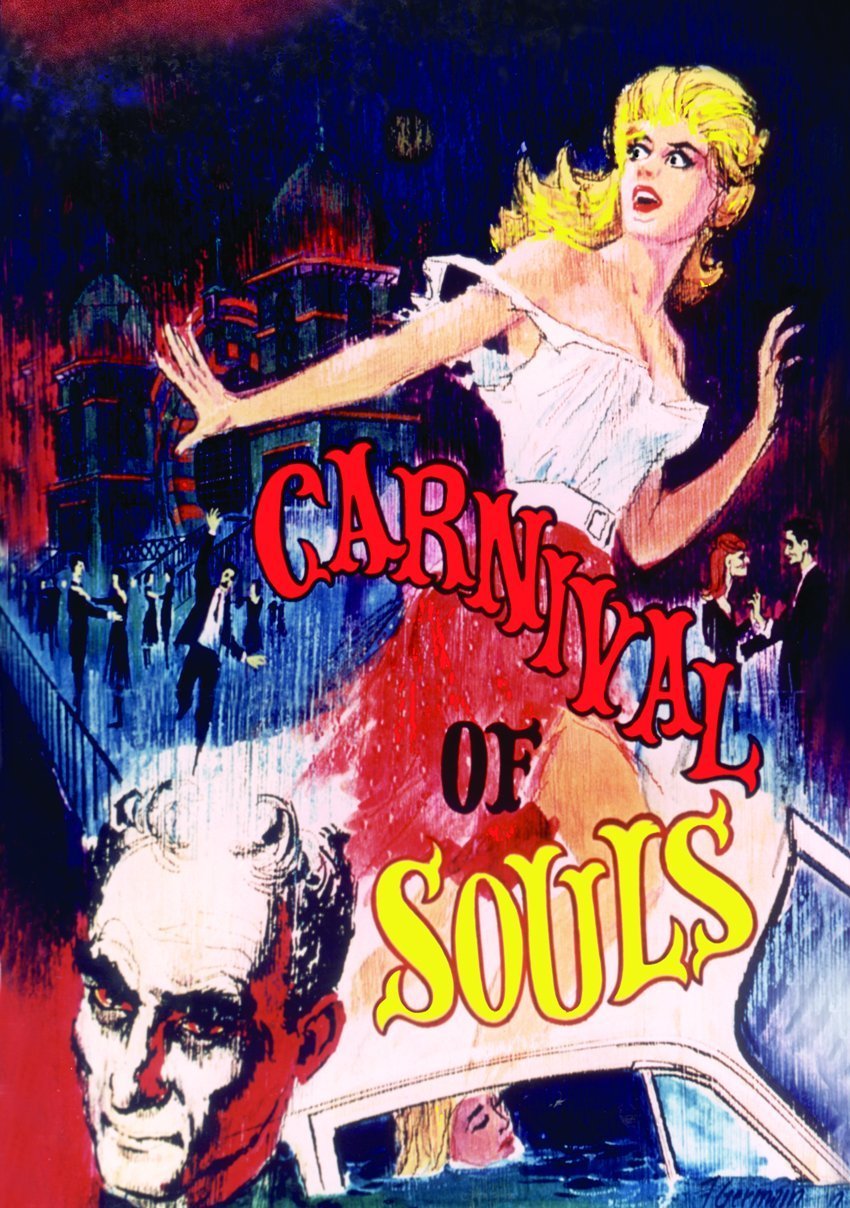
It’s strange to see Carnival of Souls so venerated now – it’s even out on the Criterion Collection. A quickly-produced low-budget movie meant as a calling card to the movie industry, now acknowledged as a classic. Well, okay, there are more than a few of those in the Collection, but it’s rare that we get to watch one during Hubrisween.
Just in case you recently switched living arrangements from underneath a rock, Carnival opens with a drag race gone wrong, as a car carrying three women plunges off an old bridge into a river and sinks immediately. While the river is being dredged for the car and the bodies, one of the women – Mary Henry (Candace Hilligoss) stumbles from the muddy river, unable to remember anything since the crash.
Mary’s a skilled organist taking a position at a church in Utah, though she denies being particularly religious. On the way to this new life, she is stricken by the sight of an abandoned pleasure palace on the shore of a lake. Her increasing obsession with the place becomes a problem, though not as much as the ghoulish, silent white-faced man who seems to be stalking her.
Since we’re dealing with a movie half a century old, I think we can stop being so precious and just say that Mary died in that car wreck, and she’s only been pretending to be alive all this time. It’s something that anyone who’s read “An Occurrence at Owl Creek Bridge” or seen an episode of Twilight Zone has already figured out by the first half hour mark, if not ten minutes in. The difference is in the delivery of that revelation, which is where Carnival manages to edge itself into the realm of actual art.
There are two times in the movie when Mary finds herself in a silent world, unable to interact with any of the people bustling around her, as if she’s ceased to exist. It’s amazing how affecting something like killing the ambient sound in a sequence can truly be. These segments, and the scenes taking place in the decaying Saltair Amusement Park (an amazing setting that was only waiting to be discovered), its downbeat denouemant, are what give the movie its power to chill.
Producer/director Herk Harvey (who also plays the ubiquitous dead-faced man) was a veteran of numerous “mental hygiene” and industrial shorts, and went into his two-week shoot with a budget of $17,000 and a five man crew. Years of quick production put him in good stead as the shoot proceeded guerilla-style in Salt Lake City (offering a man in a van twenty-five bucks to “nearly” run over Hilligoss, for instance). Much of the movie was shot in Lawrence, Kansas, where Hervey and his cohorts were well-known and respected (“You need to shoot in my church? Sure!”).
The oddest note in the movie is struck by Hilligoss’ portrayal of Mary; judging from interviews with her and Harvey, the cold, non-social aspect of the character is a choice by the director, which Hilligoss struggled with. It may be good for the story – Mary is a character that never truly lived, and now desperately wishes to, but doesn’t know how. It does, however (and as Hilligoss feared) limit viewer sympathy for the protagonist.
Faring better is Sidney Berger as the only other occupant of Mary’s boarding house, John. John is a realistic, horny working guy, equal parts good humor, sexual bluntness and desperation. Mary acquiesces to his constant efforts to get close to her simply because her fear of the Man and the call of the abandoned park are beginning to terrify her. Even the horndog, though, is unwilling to expose himself to her increasing instability. Berger went on to a sterling career as head of the drama department at the University of Houston, and had to put up with some frequent razzing about the role, but honestly, he is, in many ways, the best actor in the movie.
Carnival did not fare well on its initial release, and was, as is so often the case, screwed over by a con man masquerading as a distribution company. It was also cut by as much as eight minutes, and since I saw the original, uncut version, that might have actually been an improvement – it does drag in parts. But when it was sold to TV, frequent airings allowed its strengths to be appreciated, and a cult grew. And this is why, even knowing the Twilight Zone properties of the script, it is possible to still watch this small, well-organized picture and still be able to pick up a chill or two.
Here’s a movie that kept cropping up on late night horror movie slots, causing some consternation amongst fans expecting crepe hair werewolves or cardboard robots going berserk – a reasoned, almost stately historical drama. The station’s programmers couldn’t really be blamed – this was produced by Val Lewton, who similarly produced Cat People, Curse of the Cat People, I Walked With A Zombie, you know. It starred Boris Karloff, for pete’s sake. Similar reasoning/excuses held for Tower of London (though Camp on Blood Island was a little less forgivable).
This was the last of Lewton’s movies produced at RKO, the most expensive, and the first one to ever show a loss at the Box Office. In 1945, as Bedlam was being filmed, America was dropping atomic bombs on Japan. Small wonder that horror movies were on the wane; there’d been enough horror to go around in the real world, no need to visit it in our entertainment. Lewton would only produce three more movies in his life, and when you look at what he accomplished with remarkably small budgets, you wonder how the heck that ever happened.
It’s probably Lewton’s intellectual bent, as Bedlam is pretty much derived from an engraving by William Hogarth in his Rake’s Progress series. Quick views of other satiric Hogarth art is used for scene dissolves, and I can just imagine studio execs scratching their heads over that. The artwork was, in fact, excised for the TV version.
Bedlam is short for St. Mary of Bethlehem’s Hospital, an insane asylum in 1761 London. Our story concerns the Apothecary General of the hospital, George Sims (Karloff) and his increasing clashes with the protege of the Tory Lord Mortimer (Billy Law), the quick-witted Nell Bowen (Anna Lee). Horrified by the conditions in Bedlam – especially during Bedlam‘s most famous scene when an inmate, gilded to portray Reason in a show to honor Mortimer, suffocates (two decades before Goldfinger!) – Nell becomes a crusader for reform, eventually losing all her standing with the politically queasy Mortimer, and finally committed by Sims and a kangaroo court to become an inmate herself at the very asylum she is attempting to reform.
Nell still manages to reform Bedlam from the inside out, turning the huge common room into a much safer, healthier place. A Quaker stonemason (Richard Fraser), who had inspired her, is meanwhile working with the Whig reformist John Wilkes to get her another trial. Seeing that this new trial would be disastrous to him, Sims decides to give Nell the 18th century equivalent of a lobotomy, but the inmates rise against him, and while Nell escapes, hold a trial for their abusive warden, with surprising (but ultimately horrifying) results.
The Breen office hacked the script to pieces before it ever started filming, and it is still surprising what got through. Director Mark Robson recreates several of Hogarth’s prints in real space, often on hastily improvised sets (in fact, that enormous commons room in Bedlam is the church set from The Bells of St. Mary’s!). If Lewton could get this much period accuracy out of a tiny budget and some painted flats, it’s incredible he had to fight to get any work afterwards. Robson often said that he wouldn’t have been able to make movies like Earthquake if not for the lessons he learned under Lewton.
Karloff’s three movies with Lewton were probably the last of the classy horror movies he would make until he teamed with Richard Gordon in the late 50s. He always rankled when Bedlam was termed a horror movie, claiming it was historic drama. So it is… but nonetheless, here we are, talking about it during Hubrisween, because honestly – sometimes there is nothing so horrible as truth and history.
I’ve been binging on a lot of quality movies lately, trying to make the deadline for this 100 Movie Challenge I managed to get myself into (the number of ways I find to make watching movies feel like work is utterly astounding to me). That’s not my favored way of doing things. I like to sit back and ponder what I have just seen for a day or so. Okay, to be honest, if I don’t like what I’ve seen, I like to take a couple of days to figure out just how mean I’ll be to it. But my general covenant with movies – You entertain me, and I agree to be entertained – works and works well. I rarely have to be mean.
Didn’t totally understand. Doesn’t matter.
But sometimes I have to admit I’ve just not entertained as much as I am bumfuzzled. I’ve been going through a lot of movies with extraordinary imagery lately, and the processing on those takes longer. Some, like Alejandro Jodorowsky’s “magical autobiography” The Dance of Reality are lush but fairly accessible – I had to satisfy myself with a briefer-than-usual review on Letterboxd just to get it out of my system so I could work on the more difficult tasks, all the while aware that the clock was ticking and I’ve got to cram in ten of these movies a month to make my quota, and win the challenge. Which has no prize other than finally watching movies I’ve been telling myself I really need to watch.
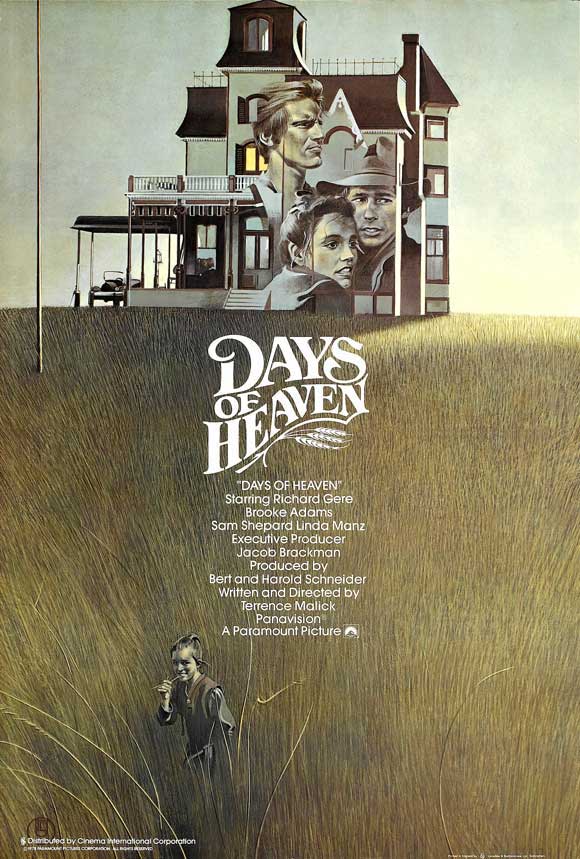
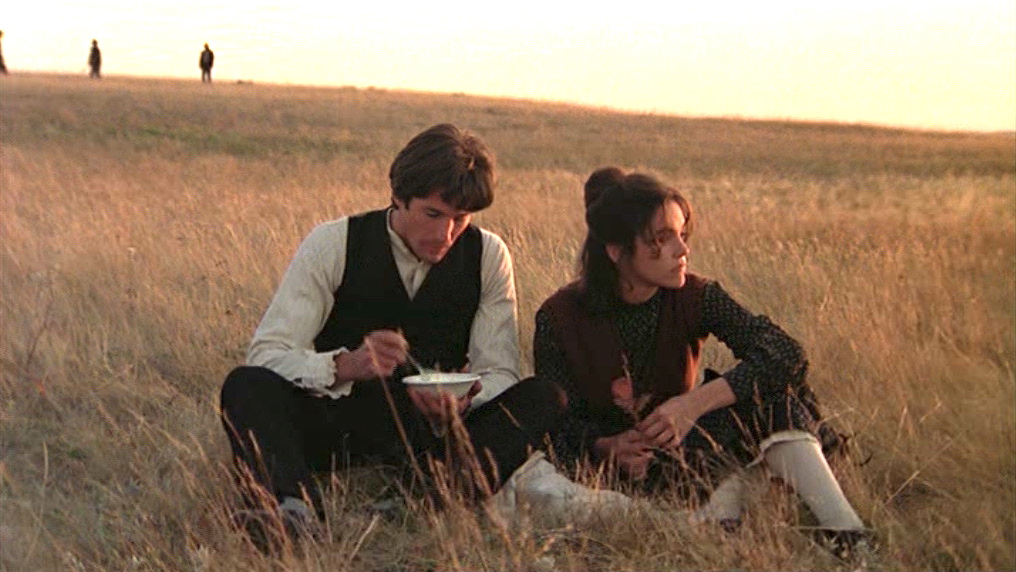
Now first up on that list is Terrence Malick’s Days of Heaven, which I grant you isn’t as jam-packed with symbolism or hidden meanings as something like 8 1/2 (which is one of the movies I’m still processing), but it is, unmistakably, all about the imagery. There is a well-deserved Academy Award for Cinematography given to Nestor Almendros (though Haskell Wexler will point out to you that he shot at least half of the movie, if you give him half a chance).
Now for a personal digression: I recall reading an article sometime in the 80s about the difficulties of being a film’s producer, and one of the passages that really stuck in my memory talked about the wonderful director the project was lucky enough to score, but who demanded that the movie only be shot during “golden time”, the hour before and after sunset and sunrise, increasing the budget by drastically limiting the shooting time available. It is only now that I realize this somewhat bitter and bemused paragraph was about Terrence Malick.
Days of Heaven is beautiful, have no doubts on that front. When a movie evokes Wyeth’s Christina’s World (and I had a print of that on my wall for years), and does it well, that’s art. Where it falls down for me is the story.
The time is 1916. Richard Gere is Bill, a hot-tempered sort who flees Chicago when, in a fit of rage, he accidentally kills a foreman in the steel mill where he’s working (the foreman is Stuart Margolin, and who among us has not desired to murder him at one time or another?). Bill hops a train with his young sister, Linda (Linda Manz), and his lover Abby (Brooke Adams). They wind up working on an enormous wheat farm in the Texas panhandle owned by Sam Shepard (The Farmer isn’t even given a name).
One problem for our peripatetic trio – besides Bill’s temper – is that they’re living under the lie that Abby is also Bill’s sister, but they don’t bother hiding their feelings for one another. The other problem is The Farmer becomes enamored of Abby (it’s Brooke Adams, who wouldn’t be enamored?). Bill overhears a conversation that indicates that The Farmer has only a year to live, and convinces Abby to marry the smitten Farmer, so their fortunes will be made. The last problem is that The Farmer is a genuinely good man, and Abby falls in love with him, too.
No, wait, the last problem is that plague of locusts. And the fire that burns the entire farm. And Bill, once again, accidentally killing the Farmer (who was, to be sure, trying to kill Bill). And then the law on their heels. And…
The cult around this movie perplexes me. It is beautiful to look at, I cannot stress that enough. These are all fine actors. That story though… that’s only one step removed from a TV miniseries from the same era, and one of those would have been better scripted, to boot (apparently Malick just let the actors improvise for a good while to “find the story”). I find I don’t have a problem with overwhelming imagery, as in 8 1/2 or Dances of Reality, as long as those images are backed up with ideas. So much of the two Malick films I have seen thus far – this and The Thin Red Line – seem to be about the beauty of nature providing a contrast for man fucking up. I get that. I got that with Easy Rider. Can we move on?
There are more Malick movies, these are just the two that were on The List. I will watch more; my resistance against these two have not been enough to turn me against Malick (though I know plenty of people who have not only walked away, but are driven to screech on social media whenever I mention him). What has been presented has been presented so well that I feel there must be something I am missing. And I am not sure which may be the true failing here – my missing whatever it is or thinking that there is something I am missing.
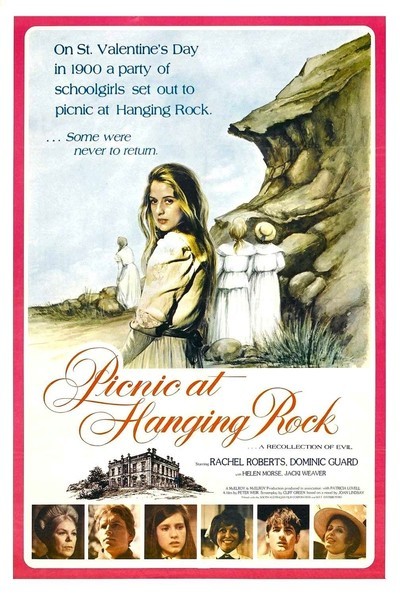
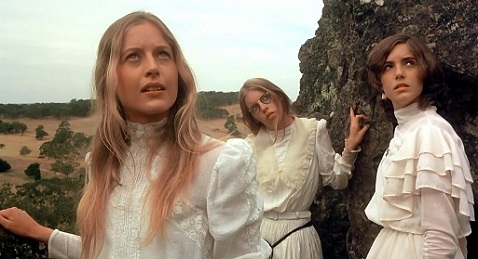
I am much more kindly disposed toward Picnic at Hanging Rock. Rather famously, it concerns the class of a girls-only boarding school in Australia who go on a picnic on Valentine’s Day, 1900 to the titular rock, a huge misshapen piece of volcanic stone jutting out of the forest. Four girls, against the prior orders of the school’s headmistress, climb the rock. Only one comes back, in a panic. One teacher goes in search of them, and she vanishes.
Picnic at Hanging Rock is mainly about the wear and tear on the people left behind by that singular event. The school and its personnel; the townspeople; the roommate of the ringleader of the missing girls, who was desperately in love with her; the son of a visiting English family who saw the girls wander off and becomes so obsessed with them that he spends the night on the Rock, hoping to find a clue as to what happened.
There is an underlying feeling of the supernatural at work, but never so overt or clear that one can say, “Aha! This is what happened!” Which has always presented a problem for the movie, especially in America, where we like our mysteries solved (That last sentence really needs a font that implies sarcasm). Even knowing that this is going to be the case, the pining in your soul for an answer, any answer, is going to be extreme. Although the story is entirely from the imagination of novelist Joan Lindsey, many have tried to research the incident, only to be stymied when they can find no corroboration. It’s rumored the production company started a rumor that it was true story, just so people might not come to the film expecting any sort of closure.
Lacking an explanation, then, Picnic at Hanging Rock, while telling a period piece in a time and a place almost none of us have experienced, still manages the magic quality of veracity; though the images are pretty and often poetic, it feels real, as we are forced to ponder similar incidents which have no explanation, no end, no matter where or when we may be. This was Peter Weir’s third crack at a feature film, and he demonstrates a remarkably sure hand at a tricky subject, ably aided by his actresses and one of the more remarkable physical locations that was just waiting to be discovered.
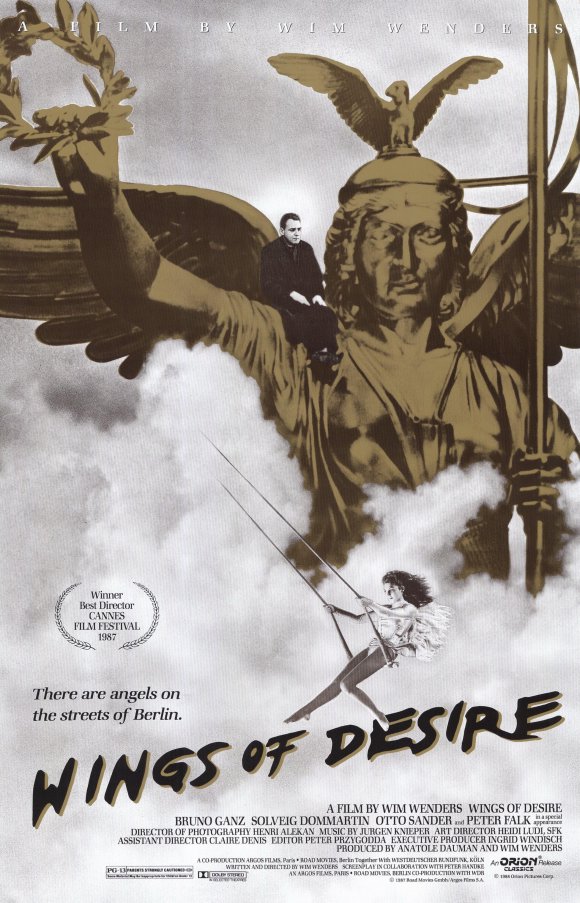
I said last week that I like to leave things on an upbeat note when possible, so I’ll finish up with another movie also packed with remarkable imagery, but one that I could understand and appreciate: Wings of Desire.
Wim Wenders, after the success of Paris, Texas had wanted to make a movie about Berlin, which was, at the time, still a city divided by the Wall. In trying to find a hook on which to rest this movie, he at one point hit upon the idea of guardian angels. And here it begins.
Bruno Ganz and Otto Sander are Damiel and Cassiel, two angels who watch and observe the people of Berlin. They can hear the thoughts of these people, but it is their lot to watch but not interfere. The most they can do is, with a touch, impart a bit of grace, a calm, a peace. It sometimes helps; sometimes it does not. The two are part of an apparent flight of angels in the city; one of the best sequences is Cassiel slowly walking through a library, luxuriating in the chorus of thoughts, nodding to his fellow angels, each at a person’s shoulder, observing. Wandering through the story is Homer (Curt Bois), an elderly writer, who may or may not be the original Homer, immortal and eternally pursuing and preserving the story of Man.
The thrust of the story concerns Damiel’s growing disenchantment with his angelic lot and a desire to become active, to, in short, become mortal. There are two things that drive this desire: a female trapeze artist (Solveig Dommartin) in a failing circus, whom Damiel first encounters complaining about the angel wings the Ringmaster wants her to wear; and an American actor (Peter Falk, playing Peter Falk), who can sense the angel’s presence, and tells him how good it can be on this side of existence.
The thematic touches are simple and glorious throughout; the angels’ world is black and white, only humans see in color. And perhaps the most striking scenery is provided by that Wall, which seemed so damned eternal in 1987. It is a frequent backdrop, covered in graffitti. When the angels walk through it to the Soviet side, the sight of those closely guarded walls so white and clean is shocking.
Hollywood, of course, sought to remake Wings of Desire after its success, and as usual sought to “improve” it. I’m not sure about the “improvement” part. City of Angels has much more of a three-act structure and solid through-line to it, but Wings of Desire, slipping in and out of Damiel’s quest, follow other threads, other people, manages to take an extraordinary, truly supernatural story, and make it feel more real that any number of movies built on carefully-studied Syd Field script models.
I really liked it, is what I’m saying. Am I missing anything Wim Wenders was trying to say? Does that matter? I liked the movie. I’m likely to tell other people to see the movie.
War is a given. Yes, let’s not beat around the bush, let’s not pontificate about the necessity of man stumbling while working toward his higher being blah blah blah. I wish you were right. I really do. But all the evidence points toward Man being a brutal, twitchy animal that needs only the slightest of motivations to get very violent, very quickly. In Wings of Desire, an apparently immortal Homer leafs through books in a library, wondering why there are no epic poems about peacetime. “What is wrong with peace that its inspiration doesn’t endure?”
We seem to be made of meat and conflict. As a writer, I am told again and again that the engine of story is conflict. Without conflict, there is no story. So, alright, we are made of meat, conflict, and stories. So I arranged my viewing in a certain way to embrace one of the biggest of those stories – World War II, for many the defining event of the last century – and it took me weeks to unpack what I had seen.
Overlord is a movie I was turned onto by the redoubtable Chad Plambeck. It was originally planned as a documentary about the Overlord Tapestry, a sort of modern-day Bayeaux Tapestry commemorating the 30th anniversary of D-Day (Overlord being the code name for the massive amphibious invasion). Director Stuart Cooper, an American expatriate, sat through three thousand hours of war footage housed at the Imperial War Museum, and he and producer James Quinn developed instead the idea of a feature film about a young Englishman called up for service in the latter part of the War.
The movie starts with a flash-forward – the first of many – of a young soldier running on a beach, his life suddenly cut short by a gunshot. This shot is mirrored by our first sight of Tom (Brian Stirner) running home to collect his luggage, so he can meet the train to report for duty. He misses his connection, and is delayed overnight while Nazi planes rain bombs down upon London. This is also the first major use of the motif Cooper will use throughout, as firemen battle the blazes and collapsing buildings in just one night of The Blitz. Tom and his story is shot in black-and-white, and the marriage of the film of two different eras is handled almost seamlessly (the skilled sound work goes a long way toward making the older footage seem more alive and current, part of the world the actors move through).
Tom will go through basic training (not without a bit of trouble), forge new friendships, and start an almost-romance with a girl which is cut short by the secretive moving about of troops, seemingly at random, in the run-up to the landing. It is to the credit of Cooper, Stirner and Julie Neesam playing The Girl (literally) that the audience feels the pain of this termination, with no time to say goodbye or even explain, as keenly as the characters.
Throughout, Tom has visions of his death on the battlefield, and it doesn’t matter where the eventual battle will be fought, he has a vision for every terrain. As Overlord approaches, he becomes convinced that he will, indeed, be one of many who will be felled on that day, and says so in a letter to his parents – which on the eve of invasion, is burned with all his personal papers, as it no longer seems to matter.
Overlord feels as gray as its cinematography, yet feels so utterly human that we never doubt the truth of what is being presented onscreen. Its major failing, perhaps, was in its timing -1975 wasn’t a good year for war. America was still smarting over the loss of Vietnam; the last completely successful war movies were probably four years in the past, movies like Patton and M*A*S*H*, neither of which could really be called typical war movies. And, at the time, if you didn’t open well in America, you simply disappeared. Which was the case with Overlord, until it was re-discovered and championed by Xan Cassavetes for her documentary Z Channel: A Magnificent Obsession, for which we may all be thankful.
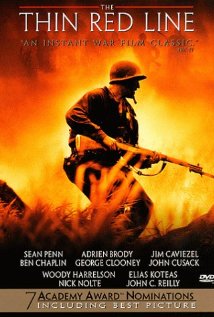
As big a story as D-Day was – big enough to support many, many movies – it was not the entirety of the war. Hell, it wasn’t even the only continent or hemisphere in which it was fought. So it was time to journey to the Pacific Theater with The Thin Red Line.
It was 20 years since Badlands and Days of Heaven, and it is really odd to consider Terrence Malick coming back with a war movie. The Thin Red Line is the second book in James Jones’ war trilogy – the first is From Here to Eternity – and since Jones served in the battles portrayed, I tend to expect some truth from him. More on that later.
The movie The Thin Red Line is first and foremost an ensemble piece, and holy moley what an ensemble. Off the top of my head: James Caviezel, Nick Nolte, Sean Penn, Adrien Brody, Elias Koteas, John C. Reilly, Ben Chaplin, John Cusack, Woody Harrelson, John Travolta, Jared Leto, John Savage, George Clooney I mean holy crap. That sounds like the cast of a late 20th century version of The Longest Day, except that it’s a Malick film.
That means there’s a lot of internal monologue laid out over the movie, by various characters, and sometimes you’re not really sure who’s talking. Like the girl’s musings in Days of Heaven, it feels like a Beat poetry fest suddenly overlaying the movie proper. In this case, most of them seem to be pulled from Jones’ text (and a few from From Here to Eternity, just to be sure), cementing Malick’s reputation as a philosopher-filmmaker, for better or worse. Many people think that’s for the worse.
What cannot be denied, though, is the quality of the Oscar-nominated cinematography by John Toll. The contrast of the beauty of the countryside with the absolute terror and bloodshed and random death of the Battle of Mount Austen is hypnotic and engrossing. One image that will stick in my mind forever: a young soldier, cowering against the earth as Japanese bullets whiz over his head, noticing a fragile leaf that closes as his fingers brush against it, fascinated even as death flies and comrades die all around him. It’s an image cribbed from Picnic at Hanging Rock, but it’s a memorable one.
This portion of The Thin Red Line does handle the truth of the situation pretty well: this was the first combat experience for many of these soldiers, and that panic and havoc are well-conveyed. The booklet in the Criterion blu-ray reprints an article by James Jones from the 1963 Saturday Evening Post, shortly after Thin Red Line‘s publication. It’s entitled “Phony War Films”, and it contains this passage:
“…the true test of a true antiwar film is whether or not it shows that modern war destroys human character. None of these films does. Instead, they show that (for our side, if not for the enemy) war develops and enlarges human character.”
There is some of this in Malick’s Thin Red Line. Ben Chaplin, in a truly excellent portrayal as Private Bell, is a soldier who finds himself doing brave things not because he’s a hero, but because this is where he is, and if he does these things, maybe things will be better tomorrow, maybe more of his buddies will be alive. This means he winds up on the front line, taking out a hardened machine gun bunker in the only firefight shown in the movie, hectic and terrifying. Bell writes to his wife often throughout the movie, his memories of them together a source of strength, After this battle, his letters tell of his struggle to not change, to come back to her the same man as when he left. His reward is a letter telling him she has fallen in love with an Air Force captain, and asking for a divorce.
The balance to this is Caviezel’s Private Witt, a former AWOL who sees a bright light in everyone, even the enemy. Sean Penn’s Sergeant Welsh, slowly being eaten alive by the war, regards him as a “magician” for that. One of them will survive the movie. I’ll bet you know which.
I find myself on the fence about Malick. I don’t hate what I’ve seen, but I’m not sure if I like it or not. That means I’ll watch more of his movies to figure that out, which puts him in the win column for now.
But for the sheer embodiment of Jones’ earlier statement about war grinding out all character in a person, we have to move back north again, for Elem Klimov’s Come and See.
I owe Mark Cousins’ The Story of Film: An Odyssey for my even knowing about Come and See. The few scenes referenced therein, a few episodes of the Hardcore History podcast, and the constant threats of “The Russian Front!” in Hogan’s Heroes was about all the prep I had for this one.
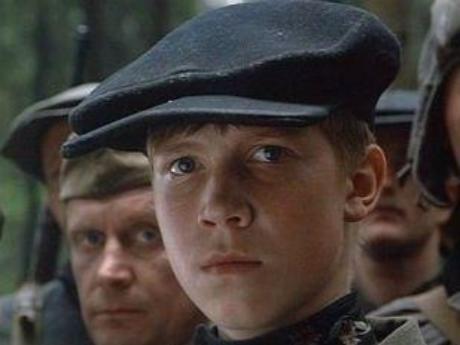
We start with Flor (Aleksey Kravchenko), a young Belorussian boy (Kravchenko was 14 at the time), digging in a WWI battlefield, much against his father’s wishes. Flor finds an old rifle, cleans it up, and joins the partisans in the surrounding woods fighting the invading Nazis. His dreams of glory are crushed when the commander leaves him behind to help establish a secondary camp. He’s not allowed to nurse his hurt feelings for long, though, as German bombs destroy the camp and troops begin filtering through the woods. He and a girl from the camp (Olga Miranova) escape to Flor’s village, only to find that the Nazis have already been there, and the bodies are stacked like cordwood behind a barn.
Flor… before.
Flor finds the remnants of his village – vice versa really, he is shell-shocked, half-deaf, and almost gets himself and the girl killed in a bog – and he eventually heads out with a small guerilla force to find food for the refugees. The war is not going to be kind to this venture, and attrition will eventually leave Flor on his own. He attempts to steal a cart, only to be taken in by his attempted victim as a new wave of Nazi troops flood over the region. Flor’s rifle and partisan uniform are hidden in a haystack and he is hastily given a peasant tunic and the quick biographies of his new family, in case the Nazis ask.
The Nazis do not ask. They round up the entire village into a central building, lock the doors, and set the building on fire. Flor escapes this fate only through a whim of the commanding officer, who needs a victim for the photo op quoted on the video box. He is left in the middle of the burning village, devastated and ravaged as the landscape itself. He reclaims his rifle and uniform, and follows the Nazi’s tracks to where they have been ambushed by the very partisans Flor had joined a seeming lifetime ago.
Flor… after.
Klimov filmed Come and See in chronological order, and we see the progression of Flor’s descent into the madness of war, how the events wear upon him. Klimov had sought to have Kravchenko hypnotized, so the filming would not cause him any lasting damage; but the boy was resistant to hypnosis. So filming proceeded, and by the time we reach the end of the movie, some of the 14 year-old’s hair had gone gray. That is not entirely acting and makeup at the end.
This truly is one of the great antiwar movies, by simply telling the truth. The slaughter of the village – which the closing credits tell us was the fate of 628 Belorussian villages and their occupants – is only one atrocity in a vast sea of them.
I’d like to end this with something calming, something soothing, but I fear I cannot. Every day someone new is beating the drum for war somewhere, and moreover, there is always war somewhere, not even for intelligible reasons beyond our apparent need for these stories, this fiction of war that is disproven over and over again, yet we seem to continually pitch headlong toward it. Perhaps our thirst for such stories really is that great, even though we have many, many sad stories to relate already.

 Click ^^ for Hubrisween Central, here for our Letterboxd page.
 It was only a matter of time before we hit a zombie picture before actually reaching the letter Z; frankly, I’m surprised it took this long.
 Pontypool started life as a novel, Pontypool Changes Everything, and then a radio play, a format in which the story likely soared. The ever-growing mob aren’t really zombies, though; they are in the grip of a virus that transmits itself through spoken language. That’s not a totally new or original concept, but it is a difficult one to get across in a visual medium. The doctor whose practice was destroyed (Hrant Alianak) manages to escape to the station, and gives voice to the exposition, if not an explanation for the phenomenon.
 Confining the story to a single radio station gives us the requisite claustrophobia for our zombie siege, but it also means the movie is going to depend heavily on the acting chops of the small cast, and they are uniformly more than up to this task (I haven’t mentioned Georgina Reilly as the doomed assistant producer, and I should). The story begins to flag somewhat in its final act, though there is some cleverness when our survivors figure out that English seems to be the only language that’s a carrier, and have to rely on their limited knowledge of French.




















 drfreex.com