Why, yes, why SHOULDN’T I start the (hopefully) last of these compressed reviews with another odd, hard-to-categorize movie? Is it not traditional, at this point?
The 90s were a strange time for David Cronenberg. His acclaimed adaptation of the play M. Butterfly was bookended by movie versions of two “unfilmable” books – William S. Burroughs’ taboo-busting Naked Lunch, and this equally sui generis piece, just as controversial, by J. G. Ballard.
James Spader plays James Ballard (yes, that’s his name in the novel, too), a film director who is a little too prone to trying to do organizational work while driving. This results in his head-on collision with another car, a dead man through his windshield, and the sight of Helen (Holly Hunter) in the other car, her breast exposed. He recovers in the same hospital as Helen, and that is where he also meets Vaughan (Elias Koteas), a lab-coated fellow walking with Helen during her therapy. Vaughan is carrying color photos of other peoples’ injuries and seems very interested in the metal sticking out of Ballard’s fractured leg.
Helen and Ballard meet again while examining their respective wrecked cars, and Ballard finds himself following Helen into Vaughan’s world of people fetishizing car wrecks, the violent intrusion of hurtling metal into the human body. Vaughan restages famous auto wrecks with stunt drivers (we first see this as James Dean’s death is recreated in front of an admiring crowd in bleachers, like a Little League game). Ballard and Helen integrate into a strange group of fetishists – a cult, really, under Vaughan’s guidance – which includes Rosanna Arquette, practically armored in a set of braces and harnesses holding – perhaps even cradling – her damaged body together. It even begins coloring Ballard’s troubled sex life with his wife, Catherine (Deborah Kara Unger).
The movie is a series of episodes which somehow does not feel episodic, but more like the story is slowly gathering speed and headed toward an inevitable collision; the sex becomes more polymorphous and perverse as the story continues. Catherine and Ballard are both shown having brief sexual flings before his accident, but neither seems as satisfying to them as the dark encounters that come afterward, starting with Catherine talking dirty to Ballard about Vaughan during sex, and progressing through the almost inevitable coupling of Ballard and Vaughan. The box copy uses the word “omnisexual” to describe the movie’s characters, and that seems more fitting than a simple “bisexual” – these folks are moving beyond gender and into flesh being penetrated by metal at high velocities. Crash is possibly the most un-erotic of erotic movies, willfully perverse – and absolutely unique and fascinating.
Also, naughty Holly Hunter is the best Holly Hunter.
This may surprise you young’uns, but some of us actually knew about Lady Snowblood before Quentin Tarantino became a thing.
A couple of years earlier in Japan, the Lone Wolf and Cub movies had done good business, so making a movie based on another kinetic manga series written by Kazuo Koike only made sense. Even for that writer, the setup is unusually dense: in the waning years of the 19th century, as Japan ramps up its drive to become a major military power, four criminals are running a scam on a farming village, taking money to supposedly excuse the local young men from the draft. A new elementary school teacher arrives with his wife and child; the villains frame him as a conscription officer, and the villagers murder him and his boy. The wife is raped and kidnapped; she eventually kills her tormentor, but is arrested while hunting down the other three. She seduces every guard in the prison until she finally gives birth to the daughter that will carry on her vengeance, naming her Snowblood.
Whew.
The first movie, simply named Lady Snowblood, gives us that origin story, her training as a swordswoman, and her hunting down of those last three villains, twenty years after the fact. She’s grown up to be Meiko Kaji, capitalizing on her success in the Stray Cat Rock movies and Female Convict Scorpion Jailhouse 41. Snowblood’s gimmick is her sword hidden in an umbrella – we first get to see it as she plies her trade as an assassin while tracking down her three targets.
The only real problem I have with the movie is director Toshiya Fujita’s over-reliance on handheld camera work, which is generally pointed out – favorably – as giving the movie a documentary feel. All it does for me is remind me that there is a movie camera in the streets of 1895 Japan. That’s a small complaint, though, as the story barrels along. And barrel it does; Fujita plays fast and loose with the timeline, which keeps things interesting, and the challenges to our heroine varied. This movie is a major inspiration for Kill Bill Vol. 1, and watching the Criterion blu-ray it is possible to go Um hm, I recognize that now at various points. That Fujita doesn’t seem to mind cribbing an idea or two himself only seems appropriate in that context.
Fujita had been previously known for making popular movies about disaffected youth, which was something of a hot ticket in Japanese cinema at the time (note their inclusion in a couple of Zatoichi movies made in the same time period). That does color the presentation of the story in ways interesting enough to differentiate them from the Lone Wolf movies.
For the next year’s Lady Snowblood 2: Love Song of Vengeance, we have the same personnel, though in the extras of the Criterion blu-ray, screenwriter Kazuo Kamimura says, somewhat proudly, he strayed from the manga. I have no idea how true that is, but I can testify that Lady Snowblood all but vanishes from her own movie for a large portion of its running time.
Snowblood is captured and condemned to hanging for her various murders, but she is sprung by the head of the Secret Police, so she can go undercover as a maid to the house of an anarchist rabble-rouser and find a secret document which would spell disaster for the current government if it were ever made public. Snowblood understandably finds the anarchist and his cause much more sympathetic than her murderous and corrupt employer. One machination leads to another, the anarchist is arrested, Snowblood spends the next hour or so recovering from a gunshot wound, only occasionally peeking in to witness the plot major involving marital betrayal, the black plague, entire ghettos burned down, and other antisocial activities before picking up her umbrella and Snowblooding a bunch of assholes.
Now, admittedly the only Koike series I’ve read in depth is the Lone Wolf and Cub series, and this is a device he does employ – a human interest story taking front and center before Itto Ogami clears the board, but at least his son Daigoro is usually more involved – having your solo heroine sit out most of the story, only cropping up time to time to look sad is not terribly dynamic.
So I fear I’m rather ambivalent toward the two movies, though obviously I find the first one much more satisfying. That one, at least, I can recommend.
I admit that I sneaked my way into the Andrei Tarkovsky camp, with Solaris, reportedly the most un-Tarkovsky of his movies. It took me a bit longer to seek out more, probably because finding more takes some effort, compared to other directors’ work (though not, happily, as hard as finding copies of the work of Klimov or Ptushko!). So when Andrei Rublev was all but thrust into my hands, it became sort of an imperative, though I will be honest and also admit that the three hours and forty minute runtime was… daunting.
That being admitted, I must follow up with my initial reaction, which was Idiot! Why did you wait so long?
First, for the non-history majors: Andrei Rublev is considered to be the greatest of the medieval icon painters in the Russian Orthodox Church in the late 14th to early 15th century.
Now that I’ve told you this, I will now tell you that the first section of this movie begins with a medieval thinker who is hurriedly attaching himself to a hot air balloon made of animal skins and the like before a mob of villagers stop him. He manages to fly for a few ecstatic minutes before he crashes to earth.
This segment is never brought up again, and has no apparent connection with the rest of the movie.
And that was when I knew I was going to like it.
The rest of the movie is going to follow Rublev (Anitoliy Solonitsyn) through several great swaths of his life… sort of. How he becomes assistant to another famous icon painter , Theophanes the Greek, with whom he will argue about theology; his commission to paint the Last Judgement in a church in Vladimir, outside Moscow, and his delaying the task for months because he does not see the point in terrifying believers, finally painting a great feast, just in time to survive the sacking of Vladimir by the villainous Tatars, in alliance with a treasonous Russian prince. His forsaking of painting and a vow of silence sworn to atone for his killing of a man during the attack, and his witnessing of the casting of a massive bell for the Crown Prince, which will rekindle his faith and show him the necessity of using his God-given talent.
You can rest assured that in the attempt to gain a worldwide audience, this movie was cut to shreds, and showings in New York resulted in reviews “comparing it unfavorably to Doctor Zhivago.” I read that with a bit of satisfaction – not because Andrei Rublev got ripped, but because that was a comparison I had made myself, while the movie was in progress. There are great swaths of story where Rublev vanishes from our sight (rather like Love Song of Vengeance, but it leads to a higher level of storytelling than that). Both movies are about a man buffeted about by history and forces beyond his control – a major difference, though, is Rublev doesn’t try to paper over that history with a love story (a love story based on betrayal, but that’s a complaint for another time) (obviously, I am no great fan of Zhivago). Rublev feels like it is truly more about Mother Russia than Zhivago could ever hope to be, its ability to withstand invasion after invasion, sea change after sea change, yet it and its people still remain.
The imagery is outstanding, the black-and-white cinematography often reminding me of Sven Nykvist’s work, and that is not a comparison I make lightly. Andrei Rublev‘s nearly four-hour runtime rumbles along like a glacier, but it truly feels like it’s earned it. Even that lengthy final section, with the forging of the bell, delivers an emotional payload that proves entirely logical in completing the story. There are a lot of overly-long movies in this world, but Andrei Rublev is not really one of them.
(Also, you need to see this movie for the Bawdy Jester – that guy is magnificent.)
What the hell is with me starting these posts off with movies that possess impenetrable narratives? Is it an unconscious drive to get “the hard one” out of the way first, so the rest of the column flows smoothly?
If I ever figure that out, I’ll let you know.
James Fox (cast against type and blowing doors out with his performance, pun unintended) plays Chas, an enforcer with a London protection racket that enjoys his work way too much. When he takes it upon himself to discipline an old rival, the door is opened for assault, murder, and suddenly Chas is on the run from his own mob. While searching for a place to lie low, he lucks onto a flat being rented in the basement of reclusive retired rock star Turner (Mick Jagger). Mind games ensue.
Performance takes its time setting up Chas’ world and how he moves in it, so the sudden immersion into the drugged-out anarchy of Turner’s world is exactly as puzzling and off-putting as it is to Chas; at first Turner refuses to give him refuge, then reverses that decision. Though Chas tries to pass himself off unsuccessfully as a musician on tour, one of Turner’s live-in lovers, Pherber (Anita Pallenberg) will tell him that Turner is keeping him around because the musician “lost his devil” and is seeking to resurrect that driving force with Chas’ presence. To that end, Chas is given psylocybin mushrooms without his knowledge (“That’s insane!” says a surprised Turner when Pherber tells him how much), and the two men’s characters begin to bleed into each other.
It is damnably hard to categorize Performance, if that’s even possible or, more to the point, desirable. It is an intriguing time capsule for London in that period, blossoming counterculture and Kray Twins gangsters. References to Jorge Luis Borges abound (in this world, even the gangsters read Borges), and, indeed, this may be one of the best adaptations of Borges’ work that wasn’t actually written by Borges himself. The blending of Chas and Turner is probably best represented by the movie suddenly becoming a music video for Jagger’s “Memo from Turner” (a definite high point) in which Turner becomes the head of the mob Chas has left. Afterwards, Chas is more rock star than enforcer – even the second of Turner’s live-ins, a French waif named Lucy (Michele Breton), who was before frightened by Chas, is now sleeping with him. Turner, on the other hand, has become uncertain and aware of encroaching doom, resulting in one of those final movie shots that has no possible explanation, but which people will nonetheless argue about for years, and have.
Performance was shot in 1968, but delayed for two years after a test screening resulted in the wife of a studio executive vomiting in disgust. History doesn’t record what it was that pushed her tender tummy into revolt, but there is a lot of transgressive stuff here, not just the sex, drugs and rock-and-roll. For instance, the homosexual tendencies of the gangsters, which starts out subtle but becomes much more obvious and matter-of-fact as the movie moves on.
Co-director Donald Cammell took the picture for re-cutting (the other co-director, Nicholas Roeg, was in Australia filming Walkabout), and what he returned with is the Performance we are familiar with today, with its opening scenes now possessed of almost avant-garde cross-cutting, and noodling about by Jack Nietzsche on one of the first Moog synthesizers.
Performance is definitely not for all markets, but it is novel and intriguing. I remember many a midnight movie showing billing it as a rock movie, and can only imagine the stunned and puzzled stoners staggering out of the theater into the dead of night.
Which brings us to yet another unique picture. Unique if only for the fact that the story is, rather famously, a flashback told by a corpse floating in a Hollywood swimming pool.
The corpse is Joe Gillis (William Holden) a down-on-his-luck screenwriter desperately trying to get up enough money that he can save his car from the finance company (in L.A., if you don’t have a car, you might as well be a corpse floating in a swimming pool). Circumstances lead him to concealing the car in the garage of what he thinks is an abandoned mansion; the mansion is, in fact inhabited by silent film queen Norma Desmond (Gloria Swanson) and her devoted manservant Max (Eric von Stroheim). Once Norma discovers Joe is a writer, she hires him to rewrite her comeback script, Salome, moving him into a garage apartment, then the mansion, and finally, into her bedroom.
Joe’s downfall and sideways-seduction into the easy life of a gigolo is countered by a chance relationship with studio reader Betty (Nancy Olsen), who spots a worthwhile section of one of Joe’s old scripts, and he begins to meet with her clandestinely, to collaborate on a project that could revive Joe’s career and move him out of Norma’s mansion. Naturally, Joe and Betty are going to fall in love, and Norma is going to find out, and that is going to lead to Joe burning all his bridges, to Betty for her own good, and to Norma for his own good – which will lead to Joe getting three slugs in the back and one of the most iconic final scenes in movie history.
Chad Plambeck told me that if you consider Sunset Boulevard a film noir, then Joe is the villain, but if you approach it as a horror movie, Norma is the villain. This is perfectly true, but I hold that what writer/director Billy Wilder has created here is an absolutely novel genre, throwing light onto a subject that would be harvested again and again in series like The Twilight Zone and the book Hollywood Babylon – a sort of tabloid scandal character study shot through with melancholy and condemnation.
The amazing thing is it exists at all, and that Paramount studios was willing – and in fact, apparently pleased – to be a character in its own movie. Cecil B. deMille himself has an extended cameo (in which it has to be admitted that he comes off pretty damned well, in a movie so critical of the starmaker machinery). Wilder pretty much invents meta-fiction here, with Norma watching her old silent movies, which we are told later were directed by Max – and the movie being shown is Queen Kelly (1929), starring Gloria Swanson and directed by Eric von Stroheim. Norma has frequent bridge parties attended by friends of the old silent days, and I am ashamed I had to look up two of them (Anna Q. Nilsson and H.B. Warner). Buster Keaton I managed to recognize on my own.
(I have to mention Jack Webb, because he’s Jack Webb, playing the most un-Jack Webb character I’ve ever seen, Joe’s assistant director pal Artie Green, effervescent, constantly smiling, and Betty’s fiance – oops! Sorry Jack!)
Roger Ebert said of Bette Davis that the smartest career move she ever made was getting older, and that also goes for William Holden. This was his most significant role in the 11 years since his breakthrough, Golden Boy, and his experience in the intervening years has tempered him (and Good Lord, can the man wear a tuxedo. Not everyone can pull off white tie and tails, and he does so with panache). His career only rose from here, and it is in recent years that I find myself really appreciating his work in the 60s and 70s, and the way he so effortlessly projected a sort of vulnerable, weary masculinity in his roles.
But there is no denying that this movie belongs to Gloria Swanson, who was only 50 at the time the movie was made, but was harshly lit to make her look older – talk about bravery in an actress! She applies exactly as much over-the-top to Norma Desmond as is required of a character who considers her life to be one long silent film. Alternately delusional, grandiose and pathetic, this is a role for the ages. and of course, Hollywood being what it is, it offered her nothing afterwards except different versions of Norma Desmond.
Sometimes the meta is a little too close to reality.
A very common thread in my postings here is “Why did it take me so long to get to this movie?” but this time the cause is easier to determine – it simply wasn’t available for some time. I had a close friend who ran one of those grey market VHS mail-order services and for literally years his big seller was Ms. 45, off a videotape he’d bought even further back. He’s since moved on to less grey pursuits, but it wasn’t until only recently that Drafthouse Films put out a legit version of it on blu-ray, a strange thing for a movie that is praised in many movie history books as a classic.
Zoe Lund (Tamerlis) plays Thana, a mute woman working in a small sweatshop in New York’s garment district. On one particularly bad day she is raped twice – once in an alley (by director Abel Ferrara) and then again in her apartment, where she gains the upper hand on the burglar and beats him to death with an iron.
Instead of going to the police or her admittedly terrifying landlady (Editta Sherman), she hacks up the body in her bathtub and stores the trash-bag wrapped pieces in her refrigerator. She carries the dead man’s gun around with her as she distributes the body parts around the city, and winds up killing a cat-calling schmoe who was trying to chase her down with one of the bags; after that, Thana’s mind begins to go seriously south as she tracks down males she feels are predacious and takes them out of the gene pool forcibly, even walking though Central Park at night to find targets. Her choices become more questionable as her mind deteriorates, leading up to a slow-motion massacre at a Halloween party where it is deemed good enough that the recipients of her bullets are simply male.
This was Ferrara’s follow-up to his proto-slasher film, The Driller-Killer (which predates Friday the 13th by a year or more). Doing a distaff version of 1972’s Death Wish is kind of a no-brainer for exploitation filmmakers, but Ferrara’s approach to the subject matter is what has helped its reputation endure for decades. The disposal of the body parts – a continuing thread throughout the movie – is handled with much dark humor and cleverness. I would normally say that the movie provides a good document of the streets of good old bad old New York, which it does – but a cursory search of YouTube will net you videos of women being catcalled and propositioned in the street, and those videos are a few months old, not years. Nothing has changed.
Ms. 45 is often mentioned in the same breath as Bo Arne Vibenius’ Thriller, A Cruel Picture, another iconic rape-revenge movie, but Thriller is a lot more interested in brutalizing the viewer as much as its protagonist, and the revenge segment of the story feels episodic and unfocused. Ms .45′s vengeance cuts a much broader and less discerning swath, edging it into the realm of horror movies, and its episodic nature feels more like a solid directorial choice. I doubt I’ll ever watch Thriller again, but Ms .45, equal parts Death Wish, Taxi Driver and still its own creature – possesses more than enough artistry to deserve another look.
The question is how, in this day and age, do you distribute a movie with a deliberately inflammatory title? The answer turns out to be very simple, in that you simply excise the inflammatory part. You know the title of this is Boss Nigger. I know the title of this is Boss Nigger. once you get into the opening credits, the movie certainly knows its title is Boss Nigger. But all things considered, I’m perfectly happy just calling it Boss.
Fred “The Hammer” Williamson and D’Urville Martin are black bounty hunter in the post-Civil War West (The Hammer is only referred to as “Boss”), and they find out one of the members of their latest group of bounties is carrying a letter from the corrupt Mayor (R.G. Armstrong!) of a nearby town, naming the bandit the new Sheriff. Boss rides into town and claims the office as his own, hoping to flush out their big bounty, the gang leader Jed Clayton (William Smith).
This was released a full year after Blazing Saddles worked a similar setup for laughs, and Boss works it from the opposite direction; most of the townsfolk are dismayed that the new Sheriff is not at all white, and Martin’s gleeful posting and enforcement of fines related to racial epithets and other forms of rudeness is played for any comic possibilities; the oppressed become the oppressors for a bit, then Boss remembers it has a story to tell. The script, written by Williamson, meanders too much for its own good, but is fairly entertaining in a weekend afternoon sort of way.
He’s also carrying Steve McQueen’s gun from “Wanted Dead or Alive” – Coolness Factor +10
Williamson’s schtick may have been somewhat limited, but he is very good at it. Martin, Armstrong and Smith are all reliable character actors. Probably the most valuable player of all, though, is veteran director Jack Arnold, who at this stage of his career was directing mainly episode TV. There’s a steady workmanship that keeps Boss moving even when the script is being improbable, and if there is a negative, it’s that Boss feels like a TV movie, with a little more swearing and more dropping of the N-word. A lot of outlets, including the IMDb, describe Boss as a comedy, but a Shakespearean body count at the end – all the bad guys, damn near all the sympathetic characters, black and white, and even Boss’ survival in question – sorta belies that.
Entertaining enough, and a welcome change to the typical blaxploitation formula; but alas, no classic.
Time has been an issue with updating here, to be sure, but I also have to admit that the concept of having to say something coherent about David Lynch’s last theatrical movie to date possesses a reverse magnetism that does not exactly draw me to the keyboard.
This much I can tell you: Laura Dern is Nikki Grace, a Hollywood actress having a bit of a lull in her career. Her comeback movie is a script based on a… I think it’s maybe Polish?… movie called Vier Seben, which was never released. It is reportedly cursed, causing the death of its stars. Nikki begins falling into the character of her role, Susan Blue, and scenes from the original movie keep inserting themselves into her life, and she even sometimes finds herself in the real-life incidents that inspired the original story and there’s some prostitutes and a woman who claims she was hypnotized into stabbing someone to death with a screwdriver and oh hell I give up.
This movie was born when Lynch called up his pal Dern and asked her if she’d like to “Come over and experiment”. Lynch was playing with the new generation of digital video cameras and kept writing short scenes to film while he messed around with the new technology and discovered the amazing amount of freedom the smaller, versatile cameras allowed. The scenes had nothing to do with each other until Lynch started sensing connecting tissue between them and suddenly we’re all sitting through three hours of what the living fuck.
Some people were turned off by the digital photography. Some didn’t like sitting through three hours of what the living fuck. I can understand all these stances, which is more than I can say for the plot – if such ever existed – for Inland Empire.
I like Lynch. I like that he’s challenging. I like that you absolutely cannot intellectualize his movies, you have to respond to them on a deeper, instinctual, intuitive level. Needless to say, given my babbling, Inland Empire is a major example of this. Ask stars Laura Dern and Justin Theroux what the movie’s about, and they are not going to be able to give you an answer. I’ve seen some remarkable analyses, and now I need to find those again, now that I’ve seen the movie because at the time it seemed like hallucinatory babbling. It may have been.
Past that, the terrifying existential TV show with the bunnies, impromptu production numbers, that damned red lampshade from Mulholland Drive… I got no idea. Watch at your own risk. I actually sort of prefer just experiencing and surviving this sort of thing to picking it apart.
Here’s the Italian trailer. I don’t think English would have helped.
As you’ve figured out by now, it takes me years to get to some movies.
Guy Pearce plays Leonard, a man who a) is vengefully tracking down the burglar who raped and killed his wife, and B) after that assault (and his own injury) is left unable to form new memories. His life is now a patchwork of tattoos and polaroid instant pictures annotated in Sharpie, as he continues the quest, each day starting fresh. His current life is complicated even more by Teddy (Joe Pantoliano), who claims to be an undercover cop helping him (though his polaroid portrait says “Don’t believe his lies”) and Natalie (Carrie-Anne Moss) who may be his lover but maybe not or maybe she’s the femme fatale in this strangest of films noir?
Director Christopher Nolan made quite the splash with this, only his second feature. His first, the rarely seen Following, was released on disc by the Criterion Collection a couple of years ago, and features an earlier version of Memento‘s fractured timeline and layered deceptions. This is one of the few times I have regretted watching a director’s films in chronological order, because Following prepared me for the twists and turns of Memento. In the final analysis, that’s no big deal, really, because Memento is still quite remarkable in its concept and execution. The setup is similar to Gene Wolfe’s Soldier in the Mist – truly the most elegant example of Wolfe’s penchant for the unreliable narrator – but admirably trimmed down to tell a complete and intriguing story, even if that story is told in reverse order.
I love Nolan when he’s left to his own devices. He rewards and in fact demands attention be paid. There is apparently a remake being planned. You can despair at this new lack of originality in Hollywood, or you can stop and realize that there were three versions of The Maltese Falcon made in ten years. The only real difference is that they stopped when they got it right – and Nolan got it right the first time.
I thought I was being all kinds of clever when I posted this Tweet:
Oh, quite quickly was I informed that this was not a good movie for that purpose, no, not at all. Perhaps I would like to try some other Billy Wilder movie, like Sabrina, perhaps?
This is just one more example of why we need a font that signifies sarcasm. Like this was my first Billy Wilder movie.
Kirk Douglas plays Chuck Tatum, a down-on-his-luck expatriate New York journalist who talks his way into a job at a small New Mexico newspaper. A year later, he’s going stir crazy, unable to find the big story that will jump-start his career and get him back into the big papes. Assigned to cover a “Rattlesnake Festival” at a nearby small town, he stumbles upon his big chance: Leo (Richard Benedict), the owner of a cheesy diner and trading post, while mucking about in a nearby ruined cliff dwelling for “genuine Indian artifacts” has been trapped in a cave-in.
By the force of his own brash personality and a cagey partnership with the local corrupt sheriff, Tatum quickly takes possession of this human interest story (the original title of the film), even to the point of interfering with the rescue process by forcing the crew to take a more laborious, time-consuming approach to the trapped man. Tatum needs the story to play out over a week or more for maximum drama and circulation.
His manipulation extends to the owner’s wife Lorraine (Jan Sterling, holding her own and occasionally surpassing Douglas), who first sees her husband’s entombment as a chance to split a no-win situation for her, then cashes in on the media frenzy that follows Tatum’s ballyhoo, charging for parking and even admitting a carnival to entertain the flood of bystanders and gawkers crowding the area. Tatum, who started out insufferable, only becomes worse as his power over the story is consolidated, but the inevitable outcome of such hubris is not long in coming. Leo contracts pneumonia and Tatum’s conscience comes roaring back, dooming him as he discovers his insistence on drilling through the cliff to rescue the man has rendered any chance of a speedier recovery impossible.
Ace in the Hole is based on the 1925 death of spelunker Floyd Collins and its ensuing media frenzy, and it may represent Wilder at his most cynical, but certainly at his most perceptive: this movie presents Truth with a capital T and it has aged damned little over the course of 65 years. A few hours after Leo’s death, the crowded field between the highway and the mesa is empty, except for windblown garbage and Leo’s mournful father – Lorraine hitched a ride out in the exodus.
Perhaps as contrition on my own part after that duplicitous first Tweet that caused so much concern on the part of so many, I bookended the experience with this Tweet:
A nighttime patrol finds a dead man in the sleepy streets of Sparta, Georgia late one night. An impromptu dragnet nets an unfamiliar black man waiting at the train station, and as it is 1967 in the Deep South, he is immediately taken into custody. However, Virgil Tibbs (Sidney Portier) is a homicide detective from Philadelphia, just trying to get home. When local Police Chief Gillespie (Rod Steiger) calls Tibbs’ superior to confirm his identity, said superior offers Tibbs’ services to the Chief, seeing as how there’s a homicide and all. Gillespie doesn’t want Tibbs’ help, and Tibbs would just like to be rid of this town and its cracker population – but the real sticking point is the dead man was a rich industrialist from Chicago who was planning to build a factory in Sparta, and his widow (Lee Grant) threatens to cancel the project unless the “Negro officer” remains on the case.
This movie was very much a cause celebre in my youth, and how the hell I managed to go so long without actually seeing it is one of those puzzles I’d probably need Virgil Tibbs’ talents to unwind. The pedigree of the film is impressive, even outside the two stars: Directed by Norman Jewison, written by Sterling Silliphant, cinematography by Haskell Wexler edited by Hal Ashby, music by Quincy Jones. It’s one of the few winners of the Best Picture Academy Award that I can totally agree with (Steiger, Silliphant and Ashby also took home statues. But not Portier. Don’t be absurd, he wasn’t even nominated).
The script never takes the easy route, and fully exploits the thorny and dangerous difficulties of the set-up. Tibbs is playing Sherlock Holmes without a Watson, against a roomful of Lestrades; Gillespie twice makes the wrong arrest based on partial information. Even then, it’s the character of Gillespie that actually makes the story work so well. Though he verges on stereotype several times (and the rest of the police force is squarely in that category), Gillespie is determined to do the right thing, and however unwillingly, becomes a strong ally. He’s almost as much an outsider in the town as Tibbs, unpopular and threatened with dismissal by a City Council that’s dismayed their Chief didn’t shoot Tibbs when he returned a rich white planter’s slap.
(That is one spoiler I’m glad I avoided all these years. Evidence points to the murder victim having been on the planters’ property the night of his death, and when the planter (James Patterson) realizes he’s being interrogated, he slaps the uppity nigra and Tibbs immediately slaps hims back, stunning not only the planter, but Gillespie and the black manservant. That scene must have hit like a thunderbolt in urban theaters in 1967, and I’m glad I had no idea it was coming because it is fucking awesome.)
Steiger is nicely complex as Gillespie. Sidney Portier, as ever, is America’s foremost portrayer of capable black men in difficult circumstances (also in the aftermath of that slap scene is the revelation that Tibbs is concentrating on the planter as a suspect to “bring that fat cat down”, and Gillespie’s quietly surprised “You’re just like the rest of us, man.” It’s a brave script on many levels). Portier would return to the character twice more, in They Call Me Mister Tibbs! and The Organization, and I’m curious enough to check those out. Warren Oates, as the officer who discovers the body, arrests Tibbs, and eventually becomes a suspect himself, continues to hone his reputation as America’s foremost portrayer of hapless motherfuckers that you somehow still can’t bring yourself to hate.
There’s no real open reconciliation between Gillespie and Tibbs, no sudden buddy-buddy, but there is a quiet, realistic respect between the two at the end that feels earned. It really is a stunning, vital piece of 60s cinema, and I have no idea how they managed to make a TV show out of it. Nor am I that interested, even though the cast is full of actors I like; the movie has made that much of an impression on me.
Well, people were asking me 15 minutes after I had seen it what I thought, so yeah, I guess I have to. The response given to these people was, “It didn’t suck,” and it doesn’t. But I like to let a movie percolate for a day or so before I trust my opinion.
It didn’t suck.
There’s a lot of static on the Interwebs complaining about the *ahem* lack of originality in certain aspects of the story. The question here, I think, is have you been paying attention over the last ten years or so? The current marketplace does not reward originality. It often actively punishes it. Therefore, carbon paper is the preferred method of moviemaking. I’m not really surprised that The Force Awakens relies on “the same, just bigger” for its action setpieces. There is a memo somewhere mandating this, I’m sure.
By concentrating on rhyming instances, though, you are missing the very strength of this new chapter: an abundance of heart, and the very, very welcome return of humor to this universe. The new characters are strong and deserving of our attention. The return of – literally – older characters helps that medicine go down just fine, thank you, and provides more than a little resonance with our own youth.
I was 20 years old when the first Star Wars came out. I stood in line for hours on its second day of release, thankfully in the air conditioning of the lower level of Houston’s Galleria. 38 years later, here I am again, standing in line. There are some parts of our dystopian future that do not suck; I had bought my ticket in advance and was only waiting for the doors to open. Fifteen minutes instead of hours.
So I am deeply aware of the magic that happened that day at the beginning of Summer 1977. I know, I know, you wanted that feeling back. You wanted to leave the theater feeling the same way your younger self did, dazzled and intoxicated by the possibilities of cinema bent to a compelling story.
To engage in more acquisition from an earlier property, you can’t go home again.
Star Wars (I still refuse to call it A New Hope) hit like a thermal detonator because there was nothing else like it in a comparatively parched movie landscape. As Jessica Ritchey brilliantly reminds us over at rogerebert.com, Fox’s big moneymaker for the season was supposed to be The Other Side of Midnight. There had been pulpy science-fiction before, but it was almost inevitably a low-budget affair. Good special effects were only to be found in the rarified field of Thoughtful Science Fiction – 2001: A Space Odyssey and Silent Running. This… this was Flash Gordon with a budget. And it was fun.
You want to know why you left The Force Awakens disappointed? It’s because practically every movie and TV show made since, science-fiction and otherwise, has been Star Wars. Be it an attempt to reach Peak Special Effects or yet another rehash of The Hero’s Journey, they’ve been trying to catch that lightning in a bottle. Of course you don’t feel it’s original. It’s been cannibalized and recycled multiple times in the last four decades.
In 1977, there was nothing like Star Wars. In 2015, everything is Star Wars.
So you feel let down. Fine, that’s your right. I was too, a bit. But let’s not go tearing down quite so vociferously what other people – especially kids, kids of color, little girls – are enjoying and building future dreams upon. We had our trilogy. Let them have theirs.
Because I’m going to bet that, if you loosen up a little bit, to allow yourself to have just a little fun, they’re not going to mind you coming along for the ride, at all.
Well here we are at the end of the year. I have three more work-related obligations to get nailed down, and then I am an indolent layabout through the rest of the year (alright, more of an indolent layabout. Fine.). Trust me, if I could, I would knock out those three things bang bang bang, but – as you know – such things are dependent on time-space coordinates and other people. So here I am, in between bursts of housekeeping and letter writing, biding my time.
So let me waste some of yours.
I watched some movies, when I wasn’t working or madly re-writing my post on The Seven Samurai. Let’s talk about those.
The Last of Sheila (1973)
There are Bucket List movies, and then there are… I guess you could call them Pail List movies? Movies you don’t have to see before you die, but you’ve heard some halfway decent things about them, and maybe you might want to look them up sometime? I honestly don’t remember this having much of a theatrical release, but I do remember it being reviewed in Creem magazine, of all places, which is probably what placed it on the… Pail List. Anyway, during one of Warner Archive’s sales, I picked it up.
James Coburn plays Clinton Green, a megalomaniacal Hollywood producer whose wife, the titular Sheila, was a victim of a hit-and-run homicide a year previous. Green invites several of his colleagues – all of whom were at the party leading up to the incident – on a week-long voyage on his yacht, during which they will play a devious scavenger-hunt game of his own devising. The yacht, incidentally, is named Sheila.
All of the participants are variously down on their luck in the star-maker machinery, and the cast is pretty amazing – Richard Benjamin, Dyan Cannon, Joan Hackett, James Mason, Raquel Welch, and Ian McShane. Green is an exceptionally clever, but sadistic asshole, and his guests must play along to curry his favor, with the hope of some payout or work at the end, even if they are unsure as to what the ultimate purpose of his game may be… but that ultimate purpose is put into question when Green himself winds up dead.
The Last of Sheila feels like an NBC Mystery Movie of the same vintage, without a continuing detective character. The dialogue is lot more sardonic and the twists and turns a bit more clever, thanks to a script by… Stephen Sondheim and Anthony Perkins?!?! The plot becomes pretty byzantine, and I think at least one ball is dropped, but the script is so agile I can’t be sure unless I watch the movie again, and therein lies a problem.
For the first time in my fairly long relationship with Warner Archive, I got a lemon of a disc. My blu-ray player choked on the layer change (which occurs just at the point that Green’s murder is discovered) and I had to use the chapter stop to get to the scene afterwards. I don’t think I missed that much, as there are several flashbacks when the surviving party members make with the detectin’, but I can’t be sure.
Also, the spoiler in the box back copy wasn’t cool, guys. It wasn’t subtle at all.
The Green Pastures (1936)
Warner Archive, though, remains one of my favorite boutique labels, because without them, I would never have the opportunity to see cultural oddities like this. The Green Pastures was based on a highly successful play by Marc Connelly (winner of the Pulitzer Prize for Drama in 1930!), which was in turn based on a short story collection called “Ol’ Man Adam and His Chillun”. The framing story takes place in a black Sunday School in the Depression South, where a parson discusses the Bible with the children – the vast majority of the movie is a recreation of the high points of the Old Testament in the children’s minds.
Despite Warner’s disclaimer at the very beginning that The Green Pastures is “a product of its time”, there are a lot of folk who would turn their back on this movie almost immediately. The very first of the biblical scenes, taking place in a heaven presented as an eternal fish fry with endless ten-cent cigars is going to provoke a lot of eye-rolling and face-palming. But then Rex Ingram shows up as “De Lawd” and the proceedings suddenly become less childlike and more reverent.
The Green Pastures takes us from the creation of Man (appropriately, Adam is also played by Ingram), through Noah and the Great Flood, Moses and the Flight from Egypt, ending up at last with the Crucifixion – and the theology gets surprisingly complex. The simplistic, childlike approach will continue throughout, as Noah (a marvelous pre-Rochester turn by Eddie Anderson) is beleaguered by dice-throwing gangsters; Moses is given the power of “a trickster” by De Lawd to confront a Pharaoh surrounded by secret societies and lodges straight out of the more cartoonish Laurel and Hardy movies. It’s the Porgy and Bess version of the Scriptures, and it is quite something to see.
But as I said, the theology gets complex. De Lawd is constantly disappointed and puzzled by his creation, especially after wiping nearly all of them out once, and they still insist on going bad; eventually De Lawd turns his back on Man and falls into depression, much to the dismay of the assembled angels. The biggest surprise (to me) is that Jesus does crop up at the very end, but not as the Son of God; instead, in God’s darkest hour of despair, he appears as a sign that Man is capable of Getting It Right, and De Lawd returns to his previous, beatific happiness.
Say what you will, this is one of the very, very few studio films with an all-black cast, and a lot of actors get to shine in something beside Stepin Fetchit comic relief roles. Rex Ingram, in particular, only got to shine a few times – here, and in the 1938 Huckleberry Finn as Jim, and The Thief of Bagdad as the sardonic genie. Apparently, the original plan was to have Al Jolson play the role in blackface, which is as wrong-headed and idiotic an idea as I can possibly imagine. This movie would have actually deserved all the opprobrium leveled against it for the wrong reasons (Paul Robeson was also offered the role, which would have been amazing, but he turned it down). Ingram is a winning blend of serenity, gravitas, and quiet power – one literally cannot conceive of the movie without his presence.
But the most telling thing in Warner Archive’s package is the trailer: nearly four minutes of Dick Powell and Marc Connelly telling us how great and important a movie it is. No blacks are ever shown except in a long shot., at a safe remove from the audience.
The Swimmer (1968)
So how best to follow that up than with the whitest movie I have ever seen?
Burt Lancaster plays Ned Merrill, a middle-aged man who decides that he will get home by swimming through a man-made river of swimming pools in a suburban enclave of wealth and privilege. Where exactly Merrill is coming from as he dives into the first pool is never revealed, another piece in the puzzle that is The Swimmer – we only know that the people are delighted to see him, and he has been away for a while.
As I said, this is a puzzle, and we are going to be given more pieces as the picture progresses. Merrill has been gone for at least a year, yes, and we find out that he was fired unceremoniously from his high-powered job at an “agency”. As he gets closer to his destination, he journeys from the land of the truly rich to the nouveau riche and finally into the land of the working schlubs (his last pool is the local municipal pool, with many rules and too much chlorine); resentment at his presence at scorn at his fallen status grows, even as his constant references to his happy marriage and loving children begin to take on the flavor of “the lady doth protest too much, methinks.” This leads to a gut-punch of a surprise – though not entirely unexpected – ending.
This is the Death of The American Dream as Twilight Zone episode, though Rod Serling would have put more of a keener edge on it, more of a stark moral. In the (as usual) exhaustive and informative extras on the Grindhouse Releasing blu-ray, we find that the production was a troubled one, and star Lancaster, who apparently felt this was one of his best roles, later said that the movie really needed a Fellini (or more likely, his pal Visconti) to actually pull it off well. This is a possibility – there is a level of grotesquerie that is lacking a sense of commitment in this story.
Director Frank Perry’s previous success was his first movie, the equally oddball love story David and Lisa. He would go on to more successful pictures like Diary of a Mad Housewife, Rancho Deluxe and Mommie Dearest, but his doom was probably ensured when producer Sam Spiegel got Burt Lancaster for the lead (after being turned down by William Holden, Paul Newman and George C. Scott). Lancaster was eager for the role, learning to swim from Olympic coach Bob Horn (reportedly, Lancaster was afraid of water before this movie), and undergoing a strenuous physical regimen that slimmed him down while still producing twenty pounds of muscle. Critics may not have liked the movie, but they all praised the star’s physique.
He also started directing the movie behind Perry’s back.
The most famous instance of this is in Joan River’s debut scene, as a woman who encounters Merrill during the aforementioned nouveau riche Binswanger’s pool party (where no one is using the pool for swimming except Merrill). The scene lasts perhaps three minutes, and took seven days to film, Rivers attempting to follow both men’s direction. Eventually, Perry was fired from the director’s chair, and Lancaster prevailed upon his friend, Sydney Pollack, to re-shoot one sequence completely, and to add several more scenes.
The actual best scene – well, my favorite, anyway – involves Merrill hitching a ride in a limo to one exceptionally rich mansion, and finding to his surprise that the chauffeur is not “Steve”, and manages to have a complete conversation with the replacement without once asking his name. Bernie Hamilton is the replacement, only the second black we will see in the movie – the first being a bartender at a party – and his terse, restrained and resigned scene with Lancaster speaks volumes about how he feels about his place in this world. That one scene calls bullshit on the rest of the movie most effectively and efficiently.
Still, the most effective condemnation of all this is in the extras – and I must admit that this may only be due to my jaundiced eye. There are many, many interviews, of course, but the ones I am concentrating on are with Joan Rivers and Janet Landgard, who plays Julie, a young girl who confesses to a childhood crush on Merrill that the man proceeds to totally misinterpret, giving us an early glimpse into his mental problems. Landgard had a continuing role(s) on The Donna Reed Show and this was her theatrical debut, an absolutely perfect avatar of a young blonde suburban girl, just entering into womanhood. She had since left Hollywood and was working at something awesome like managing scientific bases in the Antarctic (so numerous are the extras I don’t have time to scan back and verify that, but it was impressive enough to make me say, “Good on you!”). Rivers, of course, went on and became quite the enduring presence in Lala Land.
Both ladies’ interview segments are interspersed with clips from the movie. Both women have changed significantly in the intervening years, of course. The difference is that Landgard allowed herself to age, while Rivers, ever mindful of Hollywood, has had her face plasticized and botoxed to near-immobility – probably the best indictment of the lifestyle The Swimmer was trying, however unsuccessful ultimately, to condemn.
The Magic Flute (1975)
Okay, one more before I put this to bed.
This is Ingmar Bergman’s TV adaptation of Mozart’s famous opera. I am going to freely admit that opera is one of those art forms I just do not get, but if there is one thing I have developed in these last few years of cinematic horizon-broadening, it is a deep love for Bergman, and the trust this engendered. This was a dream project for him, so I surrendered myself to Bergman’s dream, and did not regret it one bit.
The Magic Flute isn’t pure opera, it’s a form of it called Songspiele, which incorporates spoken dialogue. Bergman attempted to duplicate the theatrical experience, right down to having a facsimile of the original 1791 theater built in a studio of the Swedish Film Institute. The overture is illustrated with the expectant faces of the audience.
My lack of operatic knowledge worked soundly in my favor. I went into this knowing nothing about the opera, so every plot twist, every character beat and nuance was completely new to me. Tamino, a handsome prince lost in a strange land, if tasked by the Queen of the Night to rescue her daughter, Pamina, from the evil sorcerer, Sarastro. He will be assisted by the fowler, Papageno, who wants nothing more than a girlfriend. The Queen gives Tamino the Magic Flute of the title, and Papageno a set of magic bells.
The major twist (spoilers for an 18th century opera, dude) is that Sarastro is actually Pamina’s father, and he is no sorcerer, but a respected holy man hoping to not only free Pamina from the evil influence of her mother, but also deliver all mankind from evil. Tamino, he feels, will prove to the active agent of this change, but only if he can survive the ordeals suffered by every member of Sarastro’s priesthood, and an ultimate test that he will face along with Pamina and the power of the Flute.
Bergman’s staging is magical – there are occasional glimpses of backstage activities, and the sets fluidly expand to impossible vistas as the story progresses, moving back and forth between the physical confines of an actual theater and the larger expanses of the imagination. The Magic Flute also gives me something I had not been aware I craved in the few operas I have attended: intimacy, in the form of canny close-ups and camera moves.
The Magic Flute has some notoriously difficult passages; Mozart wrote these for singers he knew and their particular strengths. The singers here – some of the best Sweden had to offer – tackle the music with relish, and as the first TV movie recorded in stereo sound, the presentation is quite luscious.
Here’s an example of the playful staging, with Papageno’s entrance and first song:
That’s a high point to leave you on, here. Hopefully, back soon with more blathering, because I’ve certainly watched more movies.
This post is a part of The Criterion Blogathon, a massive assortment of movie blogs writing about another massive assortment, namely the Criterion Collection, and our love for the films they champion. Click the image below to take you to headquarters (or the link above for the schedule), and join me in reading the work of a lot of other folks who love movies:
1. Opening Shot
Moving from one city to another is never easy for a child, and honestly, I had it better than some. I really only got uprooted three times as my father’s work in the construction trade moved us around the state. The last one really hurt, taking place in my raw adolescence and severing my first love affair in mid-sigh. Things did improve, as they often do; after a year or so we moved into a larger house, where I even got my own room and TV.
While we were at that first house, the PBS station in Houston was showing a series of great silent films, and I watched quite a few of them with my grandfather, who was living with us as he slowly died of cancer. The second TV I would eventually inherit was in his room, and he seemed to enjoy the old stuff with me. This is how I checked off classic horror movies like The Phantom of the Opera and The Hunchback of Notre Dame. Monster movie kid that I was, these were the only ones I deemed important, though I was surprised how much I enjoyed Orphans of the Storm.
The PBS follow-up in the year we moved to the larger house was Great World Cinema. I admit I intended to tune in only to watch Fritz Lang’s M, but then a funny thing happened. The movie one week was Akira Kurosawa’s The Seven Samurai, and I decided to watch it mainly because samurai were cool, they carried big swords. I vaguely knew this was the basis for The Magnificent Seven, which I had watched on TV in another town years before, but that was about all I knew.
And so I was completely unprepared to have my mind opened that night.
I had some small acquaintance with classic cinema, thanks to my mother, and also thanks to the TV format of my youth, where movies were used as filler, both late at night and in the afternoons, even the mornings on occasion (“Dialing for Dollars”, you are missed). She loved movies, and remarkable among Moms, she liked a good horror movie. So though I had watched some higher-toned fare like Meet John Doe or Here Comes Mr. Jordan, my taste honestly ran to movies with giant insects and men in rubber monster suits.
So I sat in front of that second-hand black-and-white TV for three and a half hours, watching a tale of bravery, deception, fear, love, false identities, social classism, action, camaraderie, sacrifice, joy, victory, defeat, and an overwhelming desire to do what is right.
I knew that movies could be good, but I had no real idea they could be magnificent.
I had been forced to abandon a love affair in South Texas, but that night a new love affair was born, between myself and movies, certainly, but most especially between myself and The Seven Samurai, which that night became My Favorite Movie Ever Made, and has remained so for forty-five years.
2. Shooting Script
If you look at me and ask, “What is The Seven Samurai about?” you will first have to forgive me for taking a moment to try to find your spaceship, because you are obviously an alien. The movie has been remade several times (most famously – and openly – as The Magnificent Seven,Battle Beyond the Stars and A Bug’s Life), has been the basis of an animated series, a (terrible) video game, there are constant talks of a remake… this is a story that should be in the cultural consciousness, and to a degree it is… but a synopsis will only give you an impression of the entire canvas; it will not give you an inkling of the brushstrokes involved, and Seven Samurai is a movie of details.
Nonetheless, I will try, hopefully without doing too much damage.
During the Sengoku, or Warring States period of Japanese history (roughly the entire 16th century), a poor farming village finds out it will once more be raided by a gang of horse-riding bandits after their harvest. Close to panic, they ask their village elder for advice, who recalls a similar village in his youth that was untouched by bandits: they had hired samurai for protection. When it is protested that the village could only offer food as payment, the advice is, “Find hungry samurai.”
A party of four villagers begin searching for these hungry samurai, and after some angry refusals or being fooled by charlatans, they luck onto Kambei (Takashi Shimura), an aging warrior who at first demurs, citing his age, and saying he has survived many battles, but never won a single one. Only when he realizes the sacrifice of the villagers – they are eating millet while feeding him rice – does he accept.
Kambei – and a young samurai who desperately wants to be his disciple, Katsushiro (Isao Kimura) – begin searching for the seven warriors he estimates will be necessary to protect the village. He finds Gorobei (Yoshio Inaba), a scholarly soldier who agrees because he is fascinated by Kambei’s character; the good-natured Heihachi (Minoru Chiaki), whose swordplay is only mediocre, but “will be a treasure in hard times”; Kyuzo (Seiji Miyaguchi), a deadly swordsman interested only in perfecting his technique; Shichiroji (Daisuke Katô), Kambei’s former right-hand man – both had thought the other killed in their last battle together; and finally – and reluctantly, on the part of the others – Kikuchiyo (Toshiro Mifune), a boistrous drunkard who has been haunting Kambei’s steps, and will eventually be revealed as a farmer’s son trying to pass himself off as a samurai.
After a rocky reception in the fearful village – during which Kikuchiyo proves his true worth as a sort of missing link between the samurai and villagers – the seven begin to train the villagers to use bamboo spears, in between their farming duties. The village is fortified as well as possible , and then, one day, the scouts arrive after the harvests, and matters turn serious. Kambei’s master strategy is revealed, allowing the village to pick off one and two bandits at a time, and repel nighttime incursions. Eventually, it comes down to the final battle, all the remaining villagers and samurai against all the remaining bandits – a battle in a driving rainstorm that would set the bar extremely high for action scenes in the following years. Of course, the samurai do not win the campaign unscathed – only three of them will still be standing at the end. And as Kambei states, “The farmers have won. Not us.”
Those four paragraphs do not begin to do the movie justice. It does not mention the remarkably full characterizations of the villagers. Rikichi (Yoshio Tsuchiya), the farmer driven not only by his desire to find the samurai that will defend his village, but also by a dark secret related to the bandit’s last raid that eats at him; Manzo (Kamatari Fujiwara), so possessive of his daughter Shino (Keiko Tsushima), that he forces her to cut her luxuriant hair and dress like a boy, inciting the other villagers to panic; and Yohei (Bokuzen Hidari), the long-faced, perpetually fearful old man who will become a comic foil for Kikuchiyo. Manzo’s plan to preserve Shino’s virtue will fail, of course, as Katsushiro will accidentally discover her true identity, but keep her secret even as their love blossoms; eventually they do what desperate young people do on the night before the final battle, consummating a relationship that cannot be at this point in history, between samurai and peasant.
These added details still do not give the full picture; Seven Samurai is the work of a master storyteller at the top of his form. There is not a single shot, not a single scene, not a single line that does not serve a purpose in the furthering of the complete story. People complain about its length, and after I calm myself, I ask what they would cut, and the response would always result in a lesser film. This is one of those three hour movies that doesn’t feel like a three hour movie. Toho reportedly cut 50 minutes from it for the American market, thinking the Yanks wouldn’t want to watch the whole thing. Bitterly, I reflect they were probably right, but that is a version I do not wish to see. It was, in fact, nearly impossible to see the movie in its intended form until the early 70s, so luck was definitely on my side for that first viewing.
If you haven’t seen it, you need to, just to see what my truncated summary left out. No cheating. Go the Criterion route and experience the whole thing.
True to practically every other classic film I’ve examined here, The Seven Samurai was not immediately hailed as a classic, and in fact very nearly did not happen. Kurosawa repeatedly went over budget and schedule, and production was halted many times, prompting showdowns between the director and Toho Studios (which was also dealing with another expensive monster, a little movie called Godzilla). A major part of that expense was the construction of the village, which is very much a character in the story. Toho already had a peasant village set it thought was perfectly good, but Kurosawa disagreed, preferring authenticity and control over convenience. It was the most expensive Japanese movie ever made, costing around 2 million US dollars, a record it held until 1964’s Kwaidan, which weighed in about a little less than 3 million.
Kurosawa’s main ambition had been to make a realistic samurai movie. There had been chanbara, or samurai action movies before, of course, but those were heavily influenced by kabuki theater, and the action scenes tended to be very stylized and not a little fantastic. The original thought was to make a movie about a day in the life of a samurai, ending with the main character committing ritual suicide over some trivial matter. That idea simply didn’t come together, but Kurosawa and his crew had done a tremendous amount of research, and there was one anecdote that stuck with him, of a village hiring ronin, masterless samurai, to protect them. The research also allowed him to easily create the six true samurai of the story, each based on historic personages. The one exception, of course, is Kikuchiyo, a character created in the eleventh hour when the screenwriters realized they had six highfalutin’ characters and no everyman, no comic relief to balance them out. Toshiro Mifune was originally supposed to play the Miyamoto Mushashi character, Kyuzo, but was instead (and brilliantly) recast as Kikuchiyo, to his and cinema’s great enduring luck.
Mifune’s Kikuchiyo and Shimura’s Kambei are literally the heart and soul of The Seven Samurai, but in the logline description I give everyone who asks, “The movie gives you twelve major characters and takes each of them through changes.” Going back over my synopsis, above, I keep thinking, “Oh, I didn’t mention this… and this… or this…” So many good moments. So many favorite little scenes.
I really love this movie.
3. Enter the Criterion Collection
My first encounter with The Seven Samurai was back in the early 70s, so that was the last I would get to see of my great cinematic love for a while. VCRs would be along eventually that decade, but it wasn’t until the mid-80s that I could afford one; even then, the movie was a two-cassette box set, priced beyond my exceedingly modest means. There was a wonderful two week event where the local repertory movie house, The River Oaks Theater, showed a restored print. I was there almost every night, bringing a different person with me each time; none of them regretted it. Yes, perhaps if I had taken all those movie ticket prices and combined them, I might have been able to afford that pricey VHS package, but the chance to see it on the big screen was, to quote an old commercial, priceless.
I eventually left my warehouse job and wound up at a video production company, at a decent rate of pay. Once essentials were taken care of, I took the plunge and invested in that hot new technology, a laserdisc player, the preferred home format of the discerning cinephile. Those of you who grew up on DVD have no real idea of the tremendous step forward laserdisc presented over VHS – the clarity of the picture, the crispness of the audio, the magic of the subwoofer – not to mention something called a secondary audio track. And the picture? Letterboxed! Correct aspect ratios! Chapter settings, allowing you to skip to specific scenes! Sure, a laserdisc was the size of a long-playing vinyl LP and twice as heavy, but who cared? This was the ultimate, it couldn’t possibly get any better than this!
So having bought this magical device and wired it into my system, there was the next step: software. Luckily (for me, if not for my bank account) I lived a few blocks away from a branch of the biggest video store in Houston at the time, and they had a large laserdisc selection. And what do I find there, in the foreign film section, but The Seven Samurai, from some outfit called The Criterion Collection. That sounded sufficiently elite, and I made my very first laserdisc purchase.
My mania for Seven Samurai was not all-consuming, I must admit – there were two versions, and I got the cheaper one (hey, I had just bought a laserdisc player, no small investment). The more expensive set was encoded in CAV, which meant a flawless still frame every time you hit pause, not the blue screen you got with the more standard CLV format. This also meant more discs, because while CLV could fit close to an hour on one side of a disc, CAV and its density limited you to 20 minutes or so, if memory serves.
Truthfully, the plea of poverty doesn’t hold all that much truth, either, as the very next day I went back and bought the Criterion laserdisc of Ghostbusters.
Yes, Ghostbusters.
I still have all my laserdiscs – I guess I’m still hoping for a vinyl-like resurgence in popularity, though that seems highly unlikely. DVD and Blu-ray simply does everything laserdisc did, and does it effortlessly, at a fraction of the cost. But pawing through my old collection has dredged up a ton of memories, and a number of Criterion titles I keep hoping will make the leap to their blu-ray line. Some, like The Fisher King and The Devil and Daniel Webster (DVD only, at present), did come to pass. But then I look at my Criterion lasers of Citizen Kane, King Kong, Help! (for which I hold out hope, given their lovely blu-ray of A Hard Day’s Night), Lawrence of Arabia, Confidential Report aka Mr. Arkadin, Close Encounters of the Third Kind, Dr. Strangelove, Boyz n the Hood, Akira, The Player, Bram Stoker’s Dracula, Supercop, and the three lasers I would conquer nations to have on Criterion blu-ray, John Woo’s The Killer and Hard Boiled (both released on DVD, now out of print), and Jason and the Argonauts.
But we were talking about The Seven Samurai, weren’t we? This laserdisc allowed me to once more be evangelical about my favorite movie, this time in the comfort of my own home. The audio commentary track by Michael Jeck helped me tease out stuff I hadn’t noticed before, movie connections that weren’t obvious in my multiple viewings (Then again, I still wasn’t as conversant with film, particularly international film, as I should have been). It also allowed me to begin my practice of watching the movie at least once a year.
We all know what’s coming, don’t we? Toward the end of the 90s, there was this thing called DVD that started making waves in the video world. I successfully resisted it for a while – not another format! Not something else that will be obsolete in a few years! That’s it! I quit! But, like diets, that sort of thing never lasts. I was writing for StompTokyo (over here if you like cobweb sites) at the time, and a sister review site – Attack of the 50 Foot DVD -was born, and I received a refurbished player in the mail and a Netflix account. And thus was my doom sealed again.
The Seven Samurai is spine number 2 in the Criterion DVD Collection, and was actually released before spine number 1, Grande Illusion (mainly because new film elements cropped up for Renoir’s film). It’s practically a clone of the laserdisc, right down to the Michael Jeck commentary, with the added benefit of not having to walk across the room to flip or change discs (I had bought the fancy laserdisc player that eliminated having to flip the disc, at least). I could now freeze frame whenever I wanted. I hated to admit it, but it seemed to look and sound better than my precious laser.
And I know you’ve been waiting for this. Yes, as I groused and prophesied earlier, HD CAME ALONG. I resisted this trend even longer than I did DVD, and my recalcitrance actually paid off this time (honestly, it usually does with new technology, if only from a cost standpoint). This time, it was our old friend, the Format Wars, in a shiny new battlefield. HD-DVD vs Blu-ray in a fight to the death, and by the time I broke down and bought an HDTV and a Blu-ray player, HD-DVD was only a curiosity, crammed to the side in resale shops, next to VHS and cassette tapes.
About a decade after the DVD, Criterion released a newly restored blu of The Seven Samurai. I think we know what one of my first purchases was fated to be. The blu-ray is amazing; there is some sort of digital voodoo involved, resulting in a picture that is sharper and clearer than any print I have ever seen; I doubt the movie looked this good the first time it was run through a projector. There’s an enhanced stereo track and a mono track for traditionalists. Our old friend Michael Jeck is represented, and even yet another commentary track by David Desser, Joan Mellen, Stephen Prince, Tony Rayns, and Donald Richie. Each of whom take on about 40 minutes of the running time individually, which was a relief to me, as I find audio commentaries with more than two people usually irritating and pointlessly confusing. This is going to be the preferred version across all media, until holographic crystals, or whatever new wizardry is going to be used to pick my pocket next.
The supplements, always a strong point with me, are likewise amazing. A two-hour (!) conversation between Kurosawa and fellow filmmaker Nagisa Oshima; a fifty minute making-of from the Toho Masterworks series, another featurette on samurai history and historical influences, the usual gallery of trailers and posters. And a thick little booklet – another standard feature of the Criterion Collection – with essays by Kenneth Turan, Peter Cowie, Philip Kemp, Peggy Chiao, Alain Silver, Stuart Galbraith, Arthur Penn, and Sidney Lumet. And, oh yeah, an interview with Toshiro Mifune.
There are also New and Improved English subtitles supervised by Linda Hoaglund, which represent possibly my only complaint about the package (this is how you know I’m a fanboy – I finally found something to whine about). It is foolish and a bit churlish of me to grumble about these subtitles. They are superb, and reportedly do a better job of translating Japanese idiom into English. If there is anything technically wrong with them, it’s that at one point it subverts one of my favorite moments by erring on the side of readability, truly one of the best reasons to do so.
(It’s one of those small moments that nonetheless speaks volumes about the characters. Kambei, almost immediately after his reunion with Schichiroji, tells him “We’re about to engage in a tough battle, and not for money or rank. Will you join us?” And Schichiroji answers, without a picosecond’s hesitation, “Yes.”)
It is the usual fanboy’s bete noir, misplaced nostalgia, at the base of this. I simply miss my old Janus Films print’s subtitles. In the exchange above on the blu-ray, the subtitles for Kambei’s question and Schichiroji’s reply are shown on the same screen, when the camera is focused on Kambei. In the original version, the subtitles were split up, with the subtitles for each character in his own shot, preserving the rhythm of the scene and the impact of that moment. I’ve always been a fast reader, though, and had no problem following that; someone slower would miss something. But on those magical River Oaks Theater nights, I always enjoyed the admiring laughter that exchange provoked.
The other line I mourn from the old days belongs to Kikuchiyo, in the scene leading up to the final battle, as he sticks one sword after another into the mound at the village’s center. Schichiroji asks him, “What are you up to?” and Kikychiyo now replies, “Can’t kill five with just one sword!” In the old days, Kikuchiyo, who spent the night before mourning the death of a villager he had caused, said, “Today I must kill many.” Yeah, that’s a little too stilted for Kikuchiyo, but it is the last thing we will ever get to hear him say, and it was a fine battlefield elegy.
These are so terribly minor, though. My old friend has changed a little, but is still my old friend. I forgave this old friend all those years for having the subtitles mis-timed during an important sequence, giving lines that made no sense to a character and thus imposing visual silence until the movie caught up; that bobble is forever gone, and good riddance. It’s like my grumbling about a couple of good lines from Peter Beagle’s screenplay adaptation of The Lord of the Rings not making it into Peter Jackson’s version – I should just shut up and stop talking just to hear my head rattle.
So no offense, Ms. Hoaglund, your work is splendid. I just had to say something critical about something, to keep this from being four thousand words of gushing and sweetness and light. That might damage my credibility, doncha know.
Because as you know by now (though I haven’t mentioned it in a thousand or so words), this is my favorite movie of all time. Akira Kurosawa took a reified social class that was trained for war and sacrifice in the name of a titled lord, and instead showed that class using these tools to protect and aid the weak and suffering, even if it caused their own demise, both immediately and eventually. In that respect, it is a timeless tale of a world the way it should be, and yet so rarely is. In that way, it also represents movies the way they should be – and frequently, incredibly – are.
I have in my possession one of those two-disc, four-movie sets, imaginatively entitled Karloff & Lugosi Horror Classics. The movies are actually anything but, but the set has served me well over the years; last Hubrisween, there was Zombies on Broadway. A mere 17 days ago, Frankenstein 1970. Back in the murkier depths of the archives, there was You’ll Find Out, which in retrospect, though I had problems with it, was the high point of the set thus far. Then I watched The Walking Dead with dreadfully low expectations, and to my surprise found an underappreciated gem.
You have no idea how rare that truly is.
Warner Brothers was having incredible success with their gangster movies at this point, so it’s little surprise that The Walking Dead opens just like one – crusading judge Shaw (Joe King) convicts a racketeer, despite all the anonymous threats he’s been receiving. The other racketeers meet to decide what to do; killing this judicious killjoy is the obvious course of action, but they need a fall guy, and down-on-his-luck ex-con pianist John Elman, convicted (perhaps unjustly) by Shaw years ago for manslaughter, seems ripe for that role.
The fact that Elman is played by Boris Karloff means the gangsters have just doomed themselves, of course.
Interspersed with this is the laboratory of Dr Beaumont (future Santa Claus Edmund Gwenn), who has kept a human heart beating in a jar for two weeks. His two lovebird assistants, Nancy and Jimmy (Marguerite Churchill and Warren Hull) head out on a date, which is where our two storylines will intersect.
The gangster’s plot relies on their house hit man, Trigger (Joe Sawyer) to pose as a detective who hires the desperate Elman to watch Judge Shaw’s house; Nancy and Jimmy see the hoods deposit Shaw’s dead body in Elman’s car, and get threatened with death if they don’t keep their mouths shut.
The head of the racketeers, the crooked lawyer Nolan (Ricardo Cortez) acts as Elman’s defense, insuring his conviction and date with the electric chair. Nancy’s conscience finally wins out over her fear of death, and she tells Beaumont what they saw that fatal night. Nolan manages to draw everything out just long enough that the phone call from the governor arrives too late to save Elman’s life. Beaumont insists on delaying the autopsy and claims Elman’s body,
This has gone from noirish gangster flick to horror movie with fine efficiency, and here is where The Walking Dead actually begins to distinguish itself. Beaumont will, of course, bring Elman back to life, but the process as shown is fairly unique. There is the usual folderol with electricity, but we’ve already seen (and are now shown again) a pretty accurate model of the Lindbergh Heart Pump, a device that could keep organs functioning apart from the body (Yes, that Lindbergh). Then Karloff is set on a sort of teeterboard, which rocks his body back and forth, and the commentary track by film historian Greg Mank points out this is based on the fairly contemporaneous work by Dr. Robert Cornish, who apparently revived a dog five minutes after its death. Jank goes on to relate that the dog lived for another eight hours, but seemed to suffer a sort of waking nightmare, constantly whining and barking. My research doesn’t support that, but my research was done pretty quickly, and besides – that does support what comes after in the movie.
The post-execution Elman (now with a sinister shock of white hair) shambles about in a near-catatonic state, except when he is near a piano – he remembers how to play one very well. He recognizes the District Attorney (who suspects how Elman was railroaded), but does not regard him as an enemy; on the other hand, he also recognizes Nolan and knows he is an enemy – though he does not remember why. Beaumont chalks this up to an inoperable blood clot in the brain, although, just to help the audience along, he mentions Elman sometimes acts like “the tool of some supernatural force.” (Fine scientist you are, Beaumont!)
Though he may be right about the supernatural force, as Elman begins improbably tracking down the criminals responsible for his execution, often appearing almost miraculously, when least expected. This is another distinguishing characteristic of the movie: we are primed to expect Elman to exact some sweet, painful justice on these bad guys, but in every case, all he does is slowly advance on them, asking “Why did you kill me?” and it’s their own blind, guilty panic that undoes them. The triggerman trips over a table and shoots himself. One runs in front of a speeding locomotive. One has a heart attack and for good measure, falls out a window.
In each instance, Elman seems shocked and saddened by the outcome. Karloff should have patented his ability to shift from frightening to pathetic to sympathetic in the same scene.
There are other factors that elevate The Walking Dead above the norm. Beaumont’s conquering of death actually makes headlines around the world, counter to every other mad scientist we’ve seen (and provides another reason why the bad guys can’t just kill Elman again). When Nolan manages to get himself named Elman’s legal guardian, Beaumont prepares to operate on the blood clot, which he knows will kill Elman – this time, permanently – but also might finally unlock Elman’s memory so he can tell Beaumont what he really wants to know – what happens at the moment of death? That’s a plot thread I feel could have been given more time (as it was in the much later Brainstorm), but there’s little room for it in this movie’s slim 65 minutes.
So The Walking Dead was an extremely welcome surprise, subverting damn near all my expectations (well, except for Karloff being excellent. That goes without saying). A clue might have been offered to me when I noticed the director was Michael Curtiz, whose name you might recognize from other little pictures like Casablanca and The Adventures of Robin Hood. He was no stranger to horror movies, either, as he also directed the original, excellent Dr. X. Apparently a stern taskmaster and more than a bit of a dick, his movies are often incredible, solid entertainment, and I’m now more than a little sorry that he and one of my favorite actors didn’t get together more often.
Speaking of Dr. X, it is more than a little telling that The Return of Dr. X, which we covered last week, started as a Karloff period piece but eventually devolved into a far stupider version of this movie, down to the shock of white hair and the weakened arm of the title character. Who would notice? they figured.
No trailer this time, but here’s Beaumont and the DA holding a piano recital to guilt trip the racketeers, which at least proves that somebody had read Hamlet:
It’s actually rather rare I get to do a movie so recent for Hubrisween, though that’s likely more a matter of personal taste than actual happenstance. The fact that I’m calling a two year-old movie “recent” is telling, some people are likely thinking.
Then, perhaps Under the Skin isn’t of such recent vintage after all – it’s said it took director Jonathan Glazer ten years to get it made. And then, once it was made, nobody seemed to like it. Dipping a toe into User Reviews and message boards is a whole lot like falling into a Gamer Gate discussion or something equally rancid. There are people who like this movie, but they’re not the ones who are driven to spout off about it; they’re the ones in the corner pondering and staring into space.
Scarlett Johansson is The Female (watch the extras and you’ll find out the crew named her Laura). The Female is some sort of alien being imitating a human woman. Driving about chilly Glasgow in a van, she picks up men, takes them to a deserted house for some sex, but instead they find themselves in some sideways dimension where they are consumed.
That is a B-movie concept right there, and you can be sure that Fred Olen Ray has used it at least once or twice; what is different here is the way in which the story is told. Under the Skin has maybe 100 lines of dialogue (if that many) in its hour and forty-eight minutes. This is purely visual storytelling, using some astonishingly sneaky technology. The reason the van the Female uses for stalking is so large is because it has eight cameras concealed in it and a recording studio in the back. The Female’s interactions with men is quite real, many of them not realizing they were in a movie until Glazer told them.
The Female is quite good at mimicry, it seems, but her observation of and traveling among humans begins to wear upon her, to infect her. Upon the seduction of a man afflicted with neurofibromatosis (Adam Pearson, and that ain’t makeup), she has a most un-alien crisis of conscience, frees him from the death dimension, and goes on her own voyage of self-discovery, ditching the van and wandering at random. She will find that humans are capable of great kindness. She will also find that some humans are just as capable of predation as she, perhaps even moreso.
It’s feels hard to judge Johansson’s performance here, which is why I tend to think it’s great. The bits with human interaction stand so starkly against the Alien parts – unreadable, unknowable. The hardest thing for an actor to do is to present a totally blank slate that the audience can pour itself into. She does this, then gives us a conflicted blank slate. It’s at least as tough a nut to crack as the movie that contains it.
What infects The Female is empathy, something neither she nor her handler, The Bad Man (Jeremy McWilliams) possesses. It is something that cannot be afforded in their line of work, whatever the ultimate purpose of that may be. And that will bring us to the probable reason of why so many seem to hate this movie: there is never a breath of explanation in it, anywhere, as to why they are seeking out men who can vanish without a trace (whatever the reason is, their demise is pretty horrific and apparently not very speedy). Under the Skinrequires engagement from the viewer, to the level that the viewer has to connect and devote themself to the whys and wherefores of what is happening. The only other movie I can think of to compare it to is Shane Carruth’s Upstream Color, which is similarly divisive to its audience. Under the Skin‘s narrative is much more straightforward, at least. At its heart, it is what it is like to be human, and that turns out to be complicated. As complicated as the taste of chocolate cake, it turns out.
It’s a puzzler, so I did something I rarely do; I looked at the comments. I would have had better luck asking for the opinion of the local cesspool.
“It’s so long! Nothing happens!” Dude. avoid Tarkovsky. In fact, give up on World Cinema in general.
“I’d rather be watching a wall.” A wall is what you deserve.
“It’s boring!” You’re not paying attention.
“Scarlett Johansson has a fat ass!” That is what you took away from this movie? Go fuck yourself, which is likely the only prospect you have.
It’s obvious, I guess, that I liked it far more than I originally thought as the final credits roll, that I would be driven to actual anger by Idiots on the Interwebs, Incorporated. I’m still haunted by it days later, that it pricked so many responses deep inside me. It has completely – and you will have to forgive me – gotten under my skin.
I am reminded of an old SCTV sketch (so old I believe it dates back to their days as a syndicated show) wherein Joe Flaherty’s Count Floyd introduces that evening’s “Monster Horror Chiller Theater”, The Hour of the Wolf, only to find out it is the Ingmar Bergman movie (or at least, SCTV’s version of it). He is finally reduced, after the movie has played out, to sputtering into the camera, “What? You don’t think being depressed is scary? Wait until you get older! It is! A-WOOOOOOOOOO!”
If you don’t think Seconds is a horror movie, you are too young.
Arthur Hamilton (John Randolph) is a career banker in the throes of his mid-life crisis (A phrase I’m not sure had even been invented in 1966). He is wealthy, successful, and terribly unhappy. Then his best friend – who died several years before – starts calling him in the night and directs him to a mysterious company that directs him through several different storefronts, worthy of a spy movie, until he gets the pitch. Like his supposedly deceased friend, this company will fake Hamilton’s death, then provide him with plastic surgery and a new life in a new identity, free of all the loveless relationships that have run their course and the hidebound responsibilities currently smothering his life.
Hamilton agrees (with a ruthless efficiency born of much practice, the company leaves him little choice), and after the surgery and months of grueling exercise to create a new, “younger” body, the bandages are removed to reveal that he has become Rock Hudson. Hamilton, now rechristened “Tony Wilson” initially has trouble adjusting to his new existence as a beach-dwelling artist. Eventually he forms a relationship with Nora (Salome Jens), a neighboring divorcee who finally gets him to loosen up in his new role – perhaps too well, as in the resulting cocktail party with his new neighbors, he makes some very disillusioning discoveries about his new community and his new life.
Seconds is very deliberately paced, and some are going to have a problem with that. But the truth is, that pace adds up to the inexorable march of fate as Hamilton/Wilson reaches out to his former wife, masquerading as a chance acquaintance of his former self, and tells his liaison with the company that he wants to try again, a new identity, a third life; he had abandoned a life full of “the things I was told I had to have” for another life made of a similar list. He wants a life where he makes the decisions, and that path leads to disaster.
Seconds is no less deliberately paced than the best of John Frankenheimer’s movies, but there is so much pain, disappointment and ennui in its composition that its audience quickly turned against it. The enmity of the French press at Cannes is the stuff of legend. Frankenheimer reflected that it was the only movie “that’s ever gone from failure to classic without ever having been a success.”
James Wong Howe’s acclaimed cinematography (nominated for an Oscar) is tremendous; enveloping and suitably nightmarish. And special mention must be made of Rock Hudson, whom Frankenheimer considered a light comic actor at best (He wanted Laurence Olivier for the role). Frankenheimer later recanted that position. Watching Hudson in his early scenes, his body language, his replication of John Randolph’s mannerisms, and the rollercoaster of emotions his character rumbles through, all give proof of a serious actor working his craft.
Really, you don’t have to be of a certain age to appreciate Seconds. But it does help.
We’ll get a commonly-known piece of trivia out of the way: the missing initial “E” in “Xperiment” was a clever little nod to the British film classification’s “X” rating – no one under 16 allowed. That wouldn’t have flown for us Yanks, though, who needed none of those fancy-pants classifications, we just relied on good ol’ censorship to make our movie-going safe. So over here we called it The Creeping Unknown, which is much more butch.
So a rocketship crash lands just outside a British farmhouse, and among the folks flocking to the crash site are Professor Bernard Quatermass (Brian Donlevy) and Dr. Gordon Briscoe (David King-Wood) of the British-American Rocket Group. Quatermass, ever the pushy American, sent out the rocket and its three-man crew without waiting for official sanction, much to the dismay of the man from the Home Office (the always welcome Lionel Jeffries). And now this! Jeffries sputters. Shut up, Quatermass explains.
It turns out only one crewman is in there – Victor Carroon (Richard Wordsworth). All that remains of the other two are empty pressure suits. Caroon is in shock and can say nothing.
Quatermass has Carroon taken to their base so Briscoe can try to puzzle out the man’s condition while his wife, Judith (Margia Dean) fusses about. Carroon’s body is undergoing strange changes, and he seems to rouse from his catatonic state only when Judith brings flowers into his room…
Eventually Carroon deteriorates to the point that Briscoe overrules Quatermass and has him taken to a hospital – where Judith, having had enough, hires a detective to smuggle her husband out. During this escape attempt, Carroon can’t hold out anymore and punches a decorative cactus in his room. The investigator notices that Carroon’s hand is now changing into cactus, and Carroon kills him, “absorbing his essence” -ie., sucking all the blood and water out of his body – and escaping into the night.
Quatermass, reluctantly joining forces with Inspector Lomax of the London Police (Jack Warner), now must track down the metamorphosing Carroon as he lurches about London, trying not to kill people but failing as the alien thing inside him grows and grows. A piece – or something of a seed pod – falls off, and examining it while it eats mice (offscreen, luckily), Briscoe deduces that once Carroon fully transforms, he will release spores, and then there will be millions of the creatures.
This is, of course, the first of the highly successful Quatermass movies, based on a character created for a popular BBC TV serial, which was, for 1955, “Event TV”. It was written by Nigel Kneale, a name which would become synonymous with intelligent science fiction. Many film companies were interested in turning it into a movie, but they all balked at making something that would surely be rated “X”. Except for this one upstart company, known up to that point for only making “second features” – what we call “B movies” over here. A little studio called Hammer Films.
Director Val Guest, heretofore known primarily for comedies, claims that he was the only person in England who didn’t watch “The Quatermass Experiment” when it was first broadcast – he didn’t like science fiction. He intended to put off Producer Anthony Hinds by going on vacation and only grudgingly taking the script with him. His wife, actress Yolande Donlan, teased him about it until he read the script in one afternoon on the beach and fell in love with it.
Kneale’s original serial ran three hours, I believe, and was heavily edited for the movie. What he resented even more, however, was the casting of Donlevy as Quatermass, a necessity for selling the picture to an American market. In the serial, Quatermass is a thoughtful Oxford Don type. It has to be admitted that Donlevy’s brusque, no-nonsense approach to the character propels the movie forward like a barking dog shepherding its flock. Kneale had his contract with the BBC re-negotiated so he would have more control over his intellectual property in the future (though Donlevy is still playing Quatermass in the sequel film Quatermass II – in America, Enemy From Space).
Val Guest’s equally no-nonsense direction is what gives Quatermass most of its power – he decided that such a fantastic story – this is still two years before Sputnik, remember – needed a realistic delivery, and tried, as much as possible, to shoot the movie in a documentary fashion, to great effect. And no discussion of Xperiment can be complete without at least a mention of Richard Wordsworth’s performance as the doomed, tortured Carroon. Never speaking, everything the character is experiencing – the horror, the struggle – is delivered only through facial expression and body language. Best known as a theatrical actor with occasional TV roles, this is Wordsworth’s first movie role. Certainly not his last.
The Quatermass Xperiment was a tremendous success for Hammer (although the reviews from the local press are amusingly disdainful), and in the next couple of years they would produce Quatermass II and the faux Quatermass movie X the Unknown (Kneale wouldn’t let them use his character), before finally hitting the cash cow they would ride for a decade and more, gothic horror with Dracula. (Horror of Dracula hereabouts, just to distinguish it from all those other Dracula flicks)
This is a ground zero movie, folks. This is the progenitor of its own sub-genre; from this descends First Man Into Space,Monster-A-Go-Go and others. As the first, it demands some respect, and that respect is quite honestly deserved.

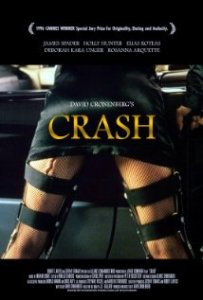 Why, yes, why SHOULDN’T I start the (hopefully) last of these compressed reviews with another odd, hard-to-categorize movie? Is it not traditional, at this point?
 Helen and Ballard meet again while examining their respective wrecked cars, and Ballard finds himself following Helen into Vaughan’s world of people fetishizing car wrecks, the violent intrusion of hurtling metal into the human body. Vaughan restages famous auto wrecks with stunt drivers (we first see this as James Dean’s death is recreated in front of an admiring crowd in bleachers, like a Little League game). Ballard and Helen integrate into a strange group of fetishists – a cult, really, under Vaughan’s guidance – which includes Rosanna Arquette, practically armored in a set of braces and harnesses holding – perhaps even cradling – her damaged body together. It even begins coloring Ballard’s troubled sex life with his wife, Catherine (Deborah Kara Unger).
 The movie is a series of episodes which somehow does not feel episodic, but more like the story is slowly gathering speed and headed toward an inevitable collision; the sex becomes more polymorphous and perverse as the story continues. Catherine and Ballard are both shown having brief sexual flings before his accident, but neither seems as satisfying to them as the dark encounters that come afterward, starting with Catherine talking dirty to Ballard about Vaughan during sex, and progressing through the almost inevitable coupling of Ballard and Vaughan. The box copy uses the word “omnisexual” to describe the movie’s characters, and that seems more fitting than a simple “bisexual” – these folks are moving beyond gender and into flesh being penetrated by metal at high velocities. Crash is possibly the most un-erotic of erotic movies, willfully perverse – and absolutely unique and fascinating.
 The first movie, simply named Lady Snowblood, gives us that origin story, her training as a swordswoman, and her hunting down of those last three villains, twenty years after the fact. She’s grown up to be Meiko Kaji, capitalizing on her success in the Stray Cat Rock movies and Female Convict Scorpion Jailhouse 41. Snowblood’s gimmick is her sword hidden in an umbrella – we first get to see it as she plies her trade as an assassin while tracking down her three targets.
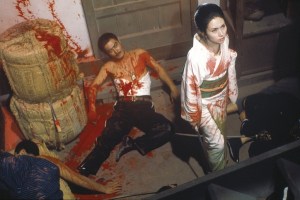 Fujita had been previously known for making popular movies about disaffected youth, which was something of a hot ticket in Japanese cinema at the time (note their inclusion in a couple of Zatoichi movies made in the same time period). That does color the presentation of the story in ways interesting enough to differentiate them from the Lone Wolf movies.
 Snowblood is captured and condemned to hanging for her various murders, but she is sprung by the head of the Secret Police, so she can go undercover as a maid to the house of an anarchist rabble-rouser and find a secret document which would spell disaster for the current government if it were ever made public. Snowblood understandably finds the anarchist and his cause much more sympathetic than her murderous and corrupt employer. One machination leads to another, the anarchist is arrested, Snowblood spends the next hour or so recovering from a gunshot wound, only occasionally peeking in to witness the plot major involving marital betrayal, the black plague, entire ghettos burned down, and other antisocial activities before picking up her umbrella and Snowblooding a bunch of assholes.
 Now, admittedly the only Koike series I’ve read in depth is the Lone Wolf and Cub series, and this is a device he does employ – a human interest story taking front and center before Itto Ogami clears the board, but at least his son Daigoro is usually more involved – having your solo heroine sit out most of the story, only cropping up time to time to look sad is not terribly dynamic.
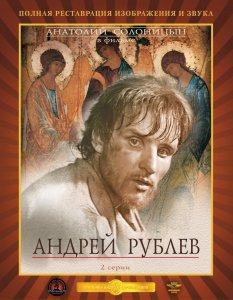 I admit that I sneaked my way into the Andrei Tarkovsky camp, with Solaris, reportedly the most un-Tarkovsky of his movies. It took me a bit longer to seek out more, probably because finding more takes some effort, compared to other directors’ work (though not, happily, as hard as finding copies of the work of Klimov or Ptushko!). So when Andrei Rublev was all but thrust into my hands, it became sort of an imperative, though I will be honest and also admit that the three hours and forty minute runtime was… daunting.
 Now that I’ve told you this, I will now tell you that the first section of this movie begins with a medieval thinker who is hurriedly attaching himself to a hot air balloon made of animal skins and the like before a mob of villagers stop him. He manages to fly for a few ecstatic minutes before he crashes to earth.
 The rest of the movie is going to follow Rublev (Anitoliy Solonitsyn) through several great swaths of his life… sort of. How he becomes assistant to another famous icon painter , Theophanes the Greek, with whom he will argue about theology; his commission to paint the Last Judgement in a church in Vladimir, outside Moscow, and his delaying the task for months because he does not see the point in terrifying believers, finally painting a great feast, just in time to survive the sacking of Vladimir by the villainous Tatars, in alliance with a treasonous Russian prince. His forsaking of painting and a vow of silence sworn to atone for his killing of a man during the attack, and his witnessing of the casting of a massive bell for the Crown Prince, which will rekindle his faith and show him the necessity of using his God-given talent.
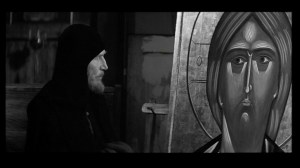 You can rest assured that in the attempt to gain a worldwide audience, this movie was cut to shreds, and showings in New York resulted in reviews “comparing it unfavorably to Doctor Zhivago.” I read that with a bit of satisfaction – not because Andrei Rublev got ripped, but because that was a comparison I had made myself, while the movie was in progress. There are great swaths of story where Rublev vanishes from our sight (rather like Love Song of Vengeance, but it leads to a higher level of storytelling than that). Both movies are about a man buffeted about by history and forces beyond his control – a major difference, though, is Rublev doesn’t try to paper over that history with a love story (a love story based on betrayal, but that’s a complaint for another time) (obviously, I am no great fan of Zhivago). Rublev feels like it is truly more about Mother Russia than Zhivago could ever hope to be, its ability to withstand invasion after invasion, sea change after sea change, yet it and its people still remain.
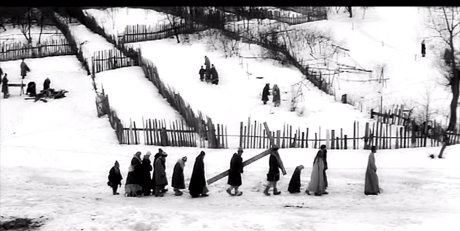 The imagery is outstanding, the black-and-white cinematography often reminding me of Sven Nykvist’s work, and that is not a comparison I make lightly. Andrei Rublev‘s nearly four-hour runtime rumbles along like a glacier, but it truly feels like it’s earned it. Even that lengthy final section, with the forging of the bell, delivers an emotional payload that proves entirely logical in completing the story. There are a lot of overly-long movies in this world, but Andrei Rublev is not really one of them.

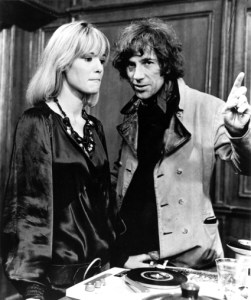

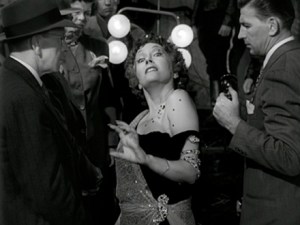


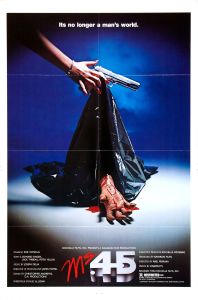


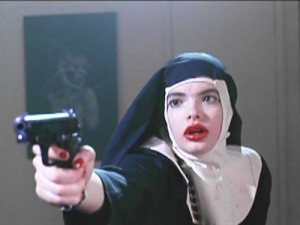



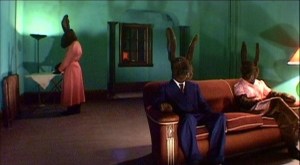

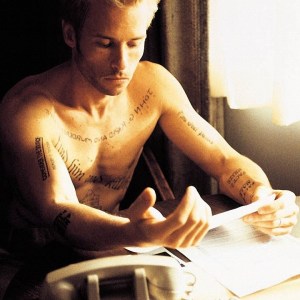
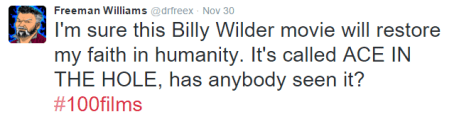


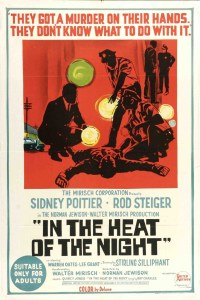
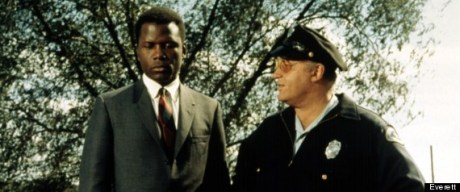

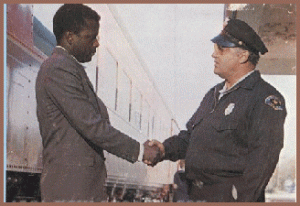


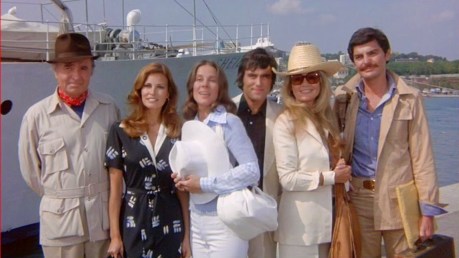

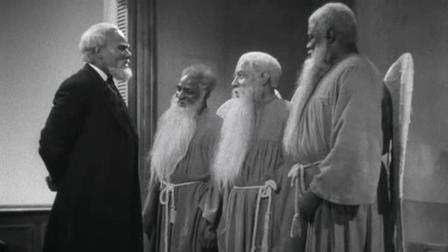
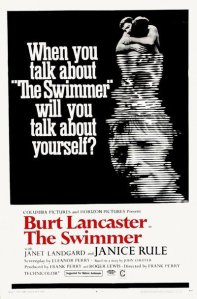

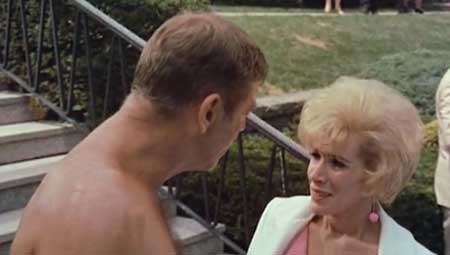

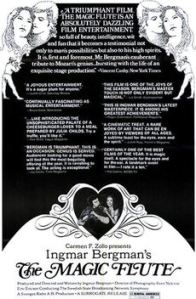
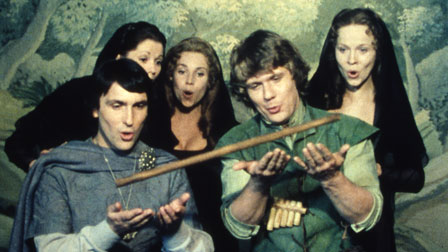

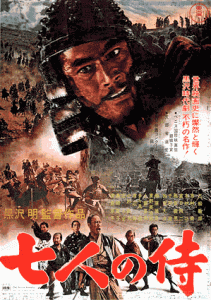


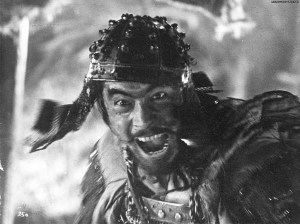


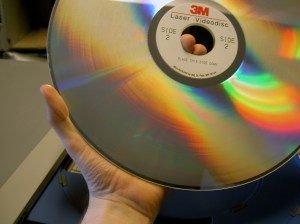


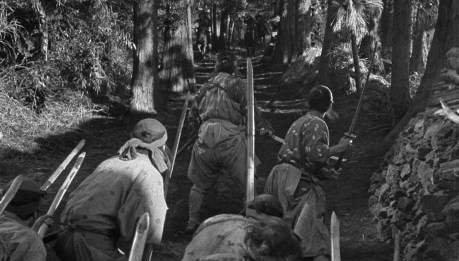
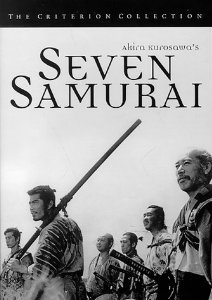

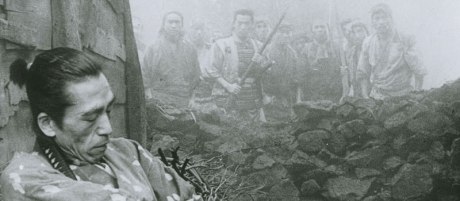
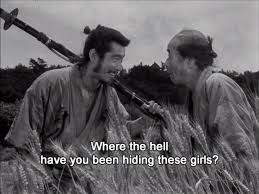





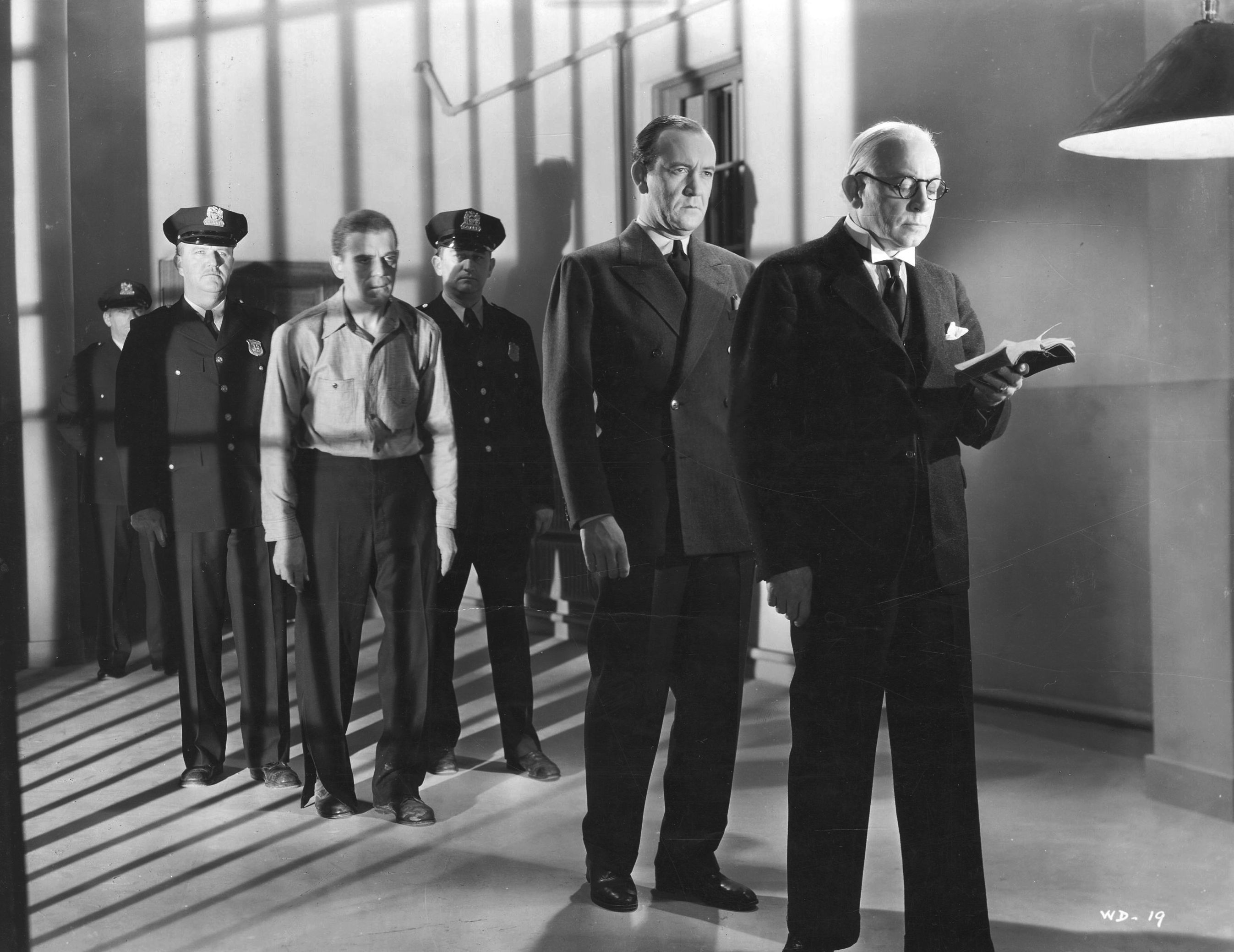


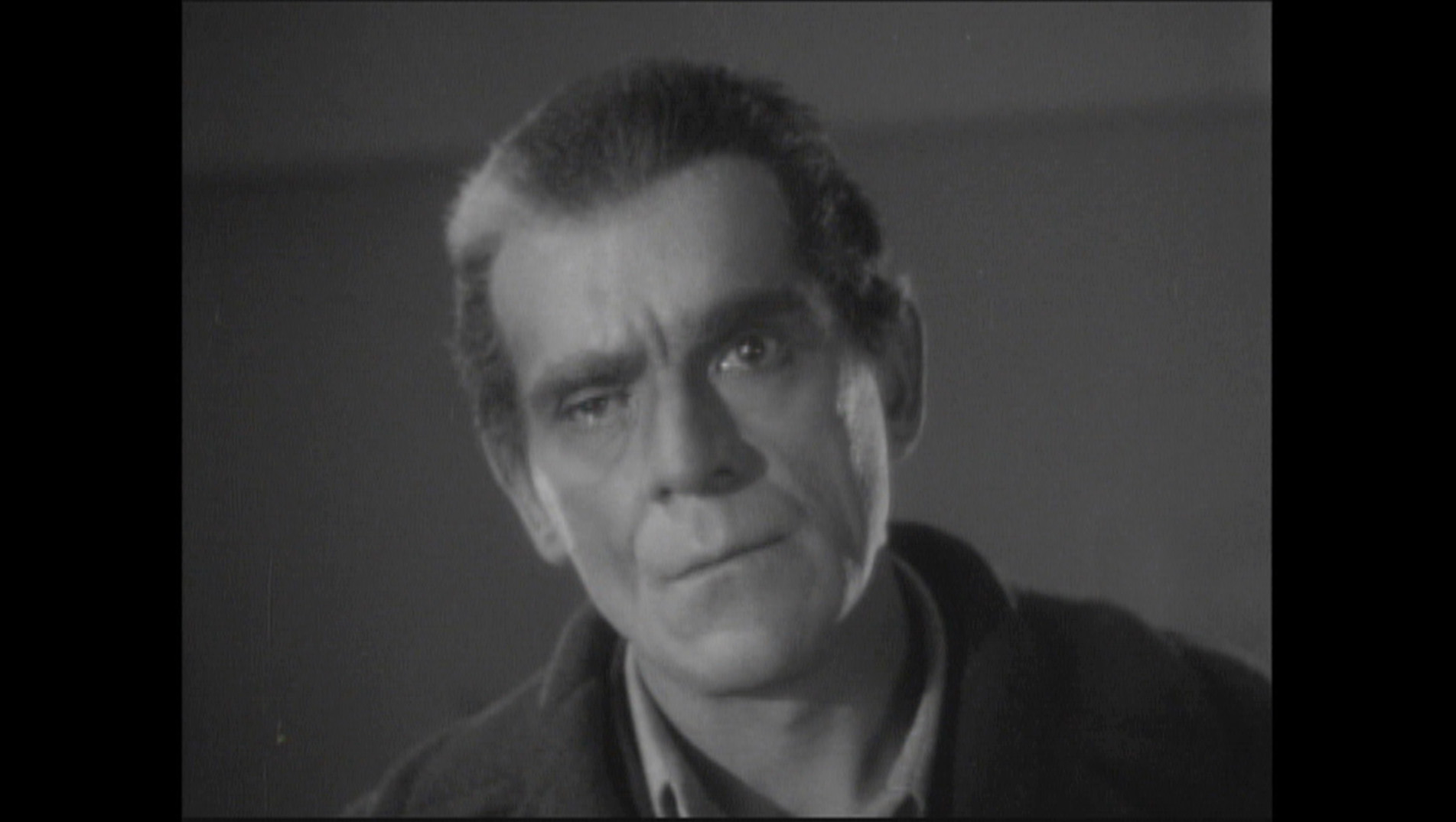








 drfreex.com