Noise and Toys

I resisted jumping to my keyboard during the ginned-up controversy surrounding the premiere of James Gunn’s Superman because a) I was extremely busy at the time and b) there was already more than enough digital ink being wasted over it. If you’ve been enjoying the Patrick the Starfish lifestyle and only just now crawled from under that rock, the kerfuffle was over the fact that Supes is, essentially, an immigrant, and the national zeitgeist revolved. we were told, around disparaging immigrants. (Well, and the fact that this Superman actually cares about people and Ma and Pa Kent hadn’t read Atlas Shrugged, but that’s a digression for another time.)

Aside from the understandable reaction of What the fuck Superman did you grow up with, anyway that caused most of the churn on the interwebs, the other major reaction should have been this is obviously manufactured outrage. To use the Internet against itself, I bring you some truth from that same fount:

The right wing profit machine must find something new to be angry about every day to keep their audience hopped up on adrenalin and willing to shell out money to help influencers fend off the latest barbarians at the gate, however they think that works. So a decent, caring Kal-El must have seemed like a godsend to them. Low-hanging fruit, as it were.

“Why would liberals do this?”

So if you got swept up in that one, I understand. They have since moved on to the next Two Minute Hate, but if this is the first time you got caught in the Outrage Machine, congratulations, Patrick! But I think you should remember this, how it felt, and store it away to compare against other such incursions. This time, at least, they were screaming about a fictional character. The usual target is LBTQ+, trans, or a just plain normal person who has an opinion counter to the dank, steaming worldview these people cling to.

They make me end sentences with prepositions, so fuck them, let’s move on.

Superman is a wonderful movie – it’s the one I wanted in 2013, and didn’t get. Tim Lucas called it overstuffed, which I will admit, is valid. But I’m the guy who orders the pizza with the cheese-stuffed crust, so I didn’t mind. It was fun, which is what a Superman movie should be. I loved the Easter Eggs. I always check out Ryan Arey’s Screen Crush videos for which ones I missed (mainly the street signs, damn my aging eyes), but just to prove that I have been poisoned by the Internet, I was convinced that I spotted one that nobody else had.

There is a mass evacuation in the third act of the movie, and at one point in the montage, we see a middle-aged lady carrying a terrarium with her pet turtle in it, and I immediately decided that this was a tribute to the Henry Boltinoff half-page Super Turtle comics that DC would tip in to fill space.

Like I said, poisoned by the Internet. And my early childhood.

And I would like a Mr. Terrific movie as soon as possible, please.

Fantastic Four: First Steps did a similar good job cleansing previous versions from my psyche; everything I was worried about got dismissed pretty quickly. They absolutely nailed Ben Grimm. Reed Richards is the most intelligent person in the room, and also the dumbest. Sue is still obviously the most powerful, and they even managed to not make Johnny a douche. And Galactus! Daaaaaaamn.

I have the weekend off, which is rare enough in my work, and when I get them I enjoy the feeling of just existing. I sit here, drinking coffee, and not feeling any pressure to do anyone’s bidding. It’s nice, and I’m imagining that retirement will feel a lot like this, though with a lot less money. Come on, 70!

Which is an awkward segue into my next rumination, which involves neither movies or comics. You are now either sighing with relief or clicking somewhere else. Either is valid.

In an unfortunate incident last week, I broke my coffee cup.

The Death of the Author, Roland Barthes, 1967

Now, again, there are likely two reactions: aw, that’s too bad and Shit! What did you do? i.e., normal people and coffee drinkers like myself.

was the only coffee drinker in my house (until my wife discovered Caramel-flavored coffee), so there were the typical coffee cups in the cabinet for company, small and polite. And then, there was mine, big enough to hold a 12 ounce cup and still have enough room at the top to carry it from room to room without danger of spillage. Virtually perfect for me, except for the color. I had bought its mate at a local store, and it was gray -my favorite color – and when I broke that one I went back, found that model had been discontinued, but found one in the back clearance rack that was brown. I am not a fan of the color (although the rental house I moved into is exclusively that color, blech). But that cup was my boon companion for years.

Found one on Amazon that was not the same design – the old one sorta looked like a potbelly stove – but it was large, and it was gray, so I ordered it. In the interim I was using our largest surviving cup, which Lisa had bought because it was decorated with Shakespearian insults, but I was walking very carefully from kitchen to office. The new cup arrived, huzzah!

I didn’t like it.

One of the new cups, with Ganesh for size. Note room for two fingers, below.

It was at this point I had to consider the matter of cup design, not just the size. I remember only doing that once, when I was looking for the tall coffee cups I had seen in the Double R Diner in Twin Peaks, good times, good times. I had already figured out that a thin handle was no good for my drinking style. It had to be broad, so I could comfortably hold it aloft in my right hand while I got distracted by social media in-between sips.  Then I had to analyze the way my fingers had become accustomed to gripping that handle: index and middle finger through the loop of the handle, ring and pinky fingers under the handle for support.

The Amazon cup’s handle went all the way down to the bottom of the cup, foiling that.

The Once and Future Cup, and I now realize Ganesh needs cleaning.

My usual approach to this sort of thing is adapt or die! but goddammit, this was my coffee we were talking about. So the Hermit had to actually leave his brown sanctuary and go out in the world to audition coffee cups. And luckily for me, the Halloween themed cups were out.

So now I have four large cups (including the unfortunate Amazon one). Absolutely none of them match, which is wonderful. Lisa claims my favorite will become the one festooned with Disney villains, which is quite likely – it’s the largest (almost too heavy when filled)(almost) – and has the legend “Absolutely Miserable” in red around the inner lip, so I can see it when drinking. It’s almost too perfect for me.

Things get busy again this week, hope to see you soon. Take care, and take care of each other. That will piss the bad guys off more than anything.

L: Last Radio Call (2022)

Sarah Serling (Sarah Froelich) is on a mission: in 2018, her husband, police officer David Serling answered a call to an abandoend hospital, and disappeared. Only his damaged body camera was recovered, and ever since, no one has been able to help her, especially the police.

Sarah’s hired a filmmaker to document her search, so there’s your found footage explanation right there. After she has nearly given up, she gets a surprise phone call from someone who is angrily leaving the force; he was in charge of tracking and archiving the department’s body camera footage. When he was ordered to delete everything, he instead made a copy of everything, and then deleted it. He gives Sarah the copies and announces he’s getting the hell out of Dodge.

What Sarah finds in the memory cards is an incident a few days before Serling’s disappearance, in which Serling was forced to shoot a man who was committing ritual murder in his backyard. There is no offical report of an officer-involved shooting, the death is reported as a standard homicide. Luckily (or not), Sarah sees an ad with the ritual murderer’s twin brother.

This whole thing, we find, involves the Red Sister, a nasty spirit who hangs out on the piece of land the hospital was built on – and it is becoming possible that her husband is actually still alive in there, held prisoner by the Red Sister.

As I’ve said before, I really like found footage movies when they work, and I do think Last Radio Call fits into that category. Sara Froelich has a good, naturalistic delivery that grabbed me at once. Alas, her co-stars aren’t quite up to her quality, but then again, Keekee Suki as the twin brother has a lot of Expository Stuff to get through that no human tongue could make sound natural.

I’m ultimately able to give Last Radio Call a better than passing grade because of the novel nature of its bad guy and dammit, I love a supernatural detective story.

G: The Great Buddha Arrival (2015)

This is a curious movie. It is based on a 1934 movie of the same name, which is presumed lost in the bombings of World War II. It featured a giant Buddha statue standing up and walking around Japan. Yoshiro Edamasa, the director, used trick photography to get the images, and produced not the first kaiju flick, but almost certainly the first tokusatsu movie.

A video editor working on a program finds out about the possibility of a walking Buddha in pre-War Japan, which the video host claims the government hushed up. He manages to find photos of the incident (actually the only surviving pictures of the original movie) and starts investigating. He finds out that the movie was made by Edamasa to retell his experiences during the incident, but more troubling, the event was preceded by a wave of suicides and then the name “Hiroshima” crops up…

And so does something else.

Yep a Giant Buddha statue has stood up and is walking across the city. Needless to say, a lot of people turn out to watch this. The Buddha stops before a tower; a great chanting is heard, and the crowds begin to walk toward the statue, as if in a trance. And then the  horror starts.

As I said, it’s a curious beast. Partially a documentary, partially cosmic horror story. At a trim 50 minutes, it has no time to wear out its welcome. If fact, the only annoying thing was having to watch it on FreeVee, which only served to remind me how much I hate commercials during movies.

Overall, the hardest part was convincing myself that yes, there was an actual lost movie involved. Not some Larry Blamire/Blair Witch jiggery-pokery.

F: Feed the Light (2014)

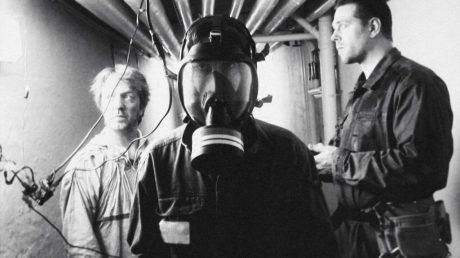
Sara (Lina Sundén) is a desperate woman who breaks into the Malmö Institute armed only with a knife and a set of lockpicks. She’s looking for her daughter, whom her recently-divorced husband has taken into the nondescript building. When the Chief (Jenny Lampa) mistakes her for a new hire, Sara finds that Malmo is much weirder than she thought; her job is to sweep up the sparkling dust that drops from the facility’s lights, because the dust “attracts vermin”. She also witnesses one of the other workers get covered with the dust, and the vermin – a swath of darkness – enters the worker’s body and he dies in an explosion of blood.

She enters into an uneasy alliance with the head janitor (Martin Jirhamn), who reveals that things can get even worse: the reason her cell phone was confiscated by the Chief is not because it would interfere with Malmö’s machines, but because the phones can be used to unlock the seemingly nonexistent door to Level Two. Sara has found her husband (Patrik Karlson), now significantly older, because he got lost in Level Two, where time can move… oddly. Level Two is where their daughter is now trapped.

And you do not want to go to Level Three. That’s where the Light lives.

Feed the Light is a fascinatingly low-fi tale of cosmic horror. The black-and-white presentation (except for the occasional burst of color, see the bloody demise above) is going to immediately make most cineastes think of David Lynch, and that’s an association that’s not far wrong, with demented behavior, existential dread and a trove of unanswered questions. It’s not as ultimately incomprehensible as Lynch, but it is as accomplished.

And it’s always good to find a movie that can turn a lack of a multi-million dollar budget into an asset, rather than a disadvantage.

E: Eerie Tales (1919)

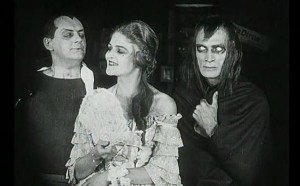
Richard Oswald’s Eerie Tales is that most venerable of horror movie formats, the anthology, made long before Amicus claimed it as their territory. The original negative is considered lost, and what we are watching today is a restoration performed by the Cinémathéque Francais, which, according to the credits, is some 100 meters shorter than the original.

Our framing device takes place in a rare book store, run by an especially antic owner. After he shoos out his customers and closes down, life-sized portraits of the Devil (Reinhold Schünzel) a prostitute (Anita Berber) and Death (Conrad Veidt) come to life and amuse themselves by reading some of the books littering the place, and as they do, the three take the place of characters in the stories. So you see, Screams of a Winter Night totally ripped off this movie.

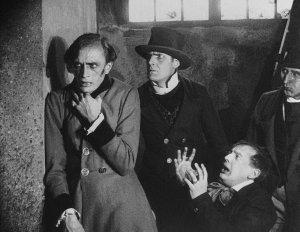
The first story is “The Apparition” by Anselma Heine, the tale of a woman rescued from her murderous husband, who then mystifies her rescuer by simply disappearing, with even the hotel staff testifying that the man arrived alone the previous night. (so add Kiss of the Vampire to the list of rip-offs) I am making the leap that any missing footage might be from this section, because that is more comforting than thinking that I’m too stupid to get the part when a drunken Veidt discovers the lady is missing and rushes from the room in horror.

Next up is “The Hand” by Robert Leibmann, a tale of ghostly retribution. You might feel a little more at home with the next two stories, which are Poe’s “The Black Cat” (a particularly good adaptation, too) and Robert Louis Stevenson’s “The Suicide Club”. The movie wraps up with “The Spectre” by Richard Oswald (yes, the director), where a nobleman gets the best of a literal Scaramouche character who is attempting to seduce his wife.

At this point in cinema history, all the tricks of visual storytelling had been worked out, so Eerie Tales is a fine example of silent filmmaking, easily accessible to the modern viewer. The actors are all up to the task of multiple characterizations, with Veidt as a standout, here a year before his star-making turn as Cesare in The Cabinet of Dr. Caligari. Reinhold Schünzel is in charge of all the scenery-chewing (at which he excels), and Anita Berber is sadly under-utilized, functioning mainly as someone to be fought over, or murdered.

Silent movies are good for you. You should watch one today.

A: All Eyes (2022)

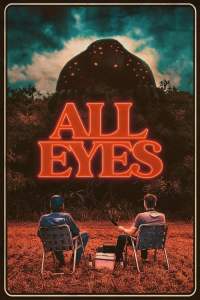
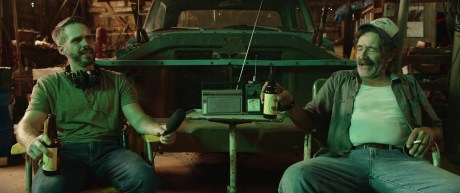
Allen (Jasper Hammer) has a top rated radio show/podcast called “UN/Sane” which seems to be mainly exploiting people with paranormal experiences, sort of a combination of Art Bell and Alex Jones. A returning video caller who in a previous episode claimed to be followed by “shadow people” now claims to have caught one. When he points his phone at a locked door, we hear the voice of a woman pleading to be let out. At his point, the caller starts brandishing a gun, and if you’ve seen The Fisher King, you know where this goes.

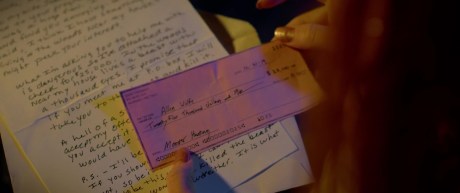
The ensuing tragedy loses Allen his show and his job, but his producer, Kim (Danielle Evon Ploeger) retrieves his box of story leads (labeled “Box of Freaks”) and visits him with it. She thinks she can get Allen back on the air, but she needs a redemption story. In the Box of Freaks is a letter that stands out: a farmer in Oklahoma claims to have a monster living in the woods behind his house, and if Allen does a show about the monster, well, there’s an unsigned check for $25,000.

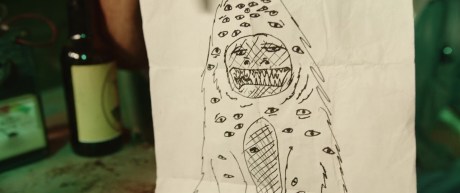
So Allen finds himself in the almost literal middle of nowhere in the company of Bob (Ben Hall), a farmer who despises him and his show, but Bob’s deceased wife loved it, so he seemed the logical choice to tell the story of Bob and his monster, which he claims has already eaten all the livestock on the farm. His one remaining goal is to kill the monster (which he calls “Eye” because it is covered in eyes), which is why Allen also finds himself on a farm in the middle of nowhere which is festooned with booby traps. “Just try to walk where I walk!”

Bob’s drawing of the monster.

If you’re familiar at all with movies, you know that Allen and Bob will eventually reach some level of accord, especially when it turns out that somebody else is hunting Eye in the woods, and they’re calling it “Number 878“.

It seems that this movie is going to be all talk and no action, until there is a hell of a tone shift in the third act, and the less you know about this, the better. But All Eyes proves itself to be a rather unique horror movie in that it demonstrates it has a heart, covered with a bunch of monster stuff, and that gives it a lot more staying power. Recommended.


The Hubrisween That Wasn’t: F

Much brouhaha and a family emergency that had me travelling during my usual writing time. Everything turned out okay, but it is not a little alarming how something like that has a ripple effect that affects everything at my age. Younger me would have powered through and claimed everything was normal, but that’s not remotely true. The new strategy is to realize that I’ll get to it eventually….and then attempt to power through it.

Still waiting for that wisdom of age to settle in.

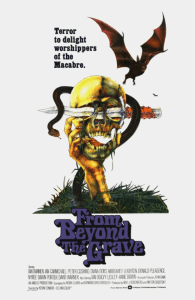
From Beyond the Grave (1974)

Why yes, this was the last of the movies I watched when pretending I was going to do Hubrisween in a timely manner and then did not power through the writing. How nice of you to remember.

I really like the Amicus anthology movies, just like I always had a soft spot for short story anthologies. What’s not to like? There is a special joy for me in a story that takes just as long as it needs to tell itself, and no more, which is where some anthology movies (and feature-length adaptations of short stories) fail. But that’s a complaint for another time.

Given how much I love these movies – I never passed up an opportunity to catch them back when local TV stations ran movies instead of informercials, or those special late-night marathons at college-town theaters where they’d schedule four of them at Midnight on Halloween or Friday the 13th. But lately I’ve begun to realize just how many of them I had not seen. They never seemed to show up on TV, despite being rated PG in release. Or crop up in those marathons. Who knows what arcane licensing restrictions were involved?

One of the missing ones was The Uncanny, which unfortunately ran into the story-stretching problem, but I also recall it cropping up on CBS’ late night movie one evening. I don’t recall ever seeing From Beyond the Grave on broadcast TV.

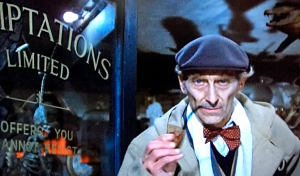
As is the way of these anthologies, the framing device is a curiosity shop called “Temptations Ltd.” presided over by none other than Peter Cushing, as a bit of a doddering, slightly scattered old man. There are four stories, each linked to a specific item from the store, and the ruination brought upon the customer by the various ways in which they cheat Cushing to get their items.

In the first tale, David Warner browbeats Cushing into selling him an antique mirror, claiming that it’s an obvious reproduction (it’s not, as Warner well knows), only to find out after an ill-advised séance there is a killer trapped within it that has the power to make Warner kill young ladies for their blood to unleash him from the shiny prison.

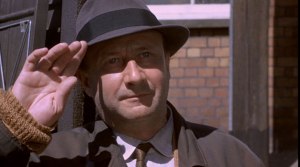
In the second, a salaryman (Ian Bannen) with an unhappy home life encounters Donald Pleasence on the street, selling shoelaces and matches as many ex-servicemen were forced to do. Bannen, finding someone who seems to honestly admire him, tries to buy a Distinguished Service Cross from Temptations, Ltd. to impress him, but is stymied by Cushing requiring a certificate to prove that he lost his own. Bannen then simply steals the medal, sealing his fate. Because if you thought that Donald Pleasence (and his daughter, Angela) might have an agenda of their own, well, you’ve seen a few of these movies as well. Kudos to everyone for the denouement not being exactly what I expected, too.

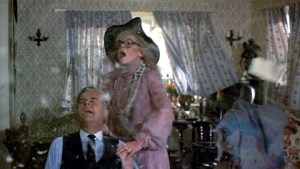
The third story is kicked off by a venal businessman (Ian Carmichael) switching price tags between two snuff boxes to get the silver one he wants for cheap. On the train ride home, he is confronted by the flamboyant Madame Orloff (Margaret Leighton), who informs him that there is an invisible elemental spirit burrowing into his left shoulder, and it’s a nasty one, too. Carmichael pish-tushes these pronouncements until various dreadful things start to happen at home, at which point he is more than happy that Orloff pressed her business card into his hand.

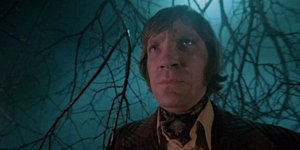
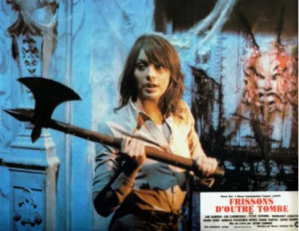
Ian Ogilvy is the customer who kicks off the last story, buying an ornate carved door that’s languished in the store for a while. That door will cover some shelving he uses for office supplies at his home, and looks quite handsome, too, until he opens it one night and find it now leads into a blue gothic nightmare of a room, which he explores in bewilderment until something starts turning the knob on the only other door in the room. He rushes out, slamming his new door behind him. After a quick shot of brandy, he opens it again, only to find his closet once more.

Later, he will explore the room again, finding a journal explaining that the room’s original owner, a sorcerer of some power, created the room to ensure his immortality – the carven door offering a portal to the room when it – and its master – needed feeding. And guess who’s on the menu?

Well, Ogilvy is the one patron who didn’t try to cheat Cushing, so he at least has a fighting chance to not become sorcerer chow. Which is good, because he’s married to Lesley-Anne Down, whom I have a personal stake in not getting hurt.

From Beyond the Grave represented a pleasant surprise for me, and I believe it’s because, unlike a lot of the Amicus anthologies I watched, the stories are not written by Robert Bloch, but the British writer R. Chetwynd-Hayes, which brings a different flavor and some freshness to the approach. All due credit to Bloch – I loved those movies, but a bit of variety is good for you. As far as I know, the only other movie using Chetwynd-Hayes’ work is The Monster Club, which is, yes, yes, another I haven’t seen.

There is always one thing you can count on with these British horror flicks: you are in an irony-free zone. The work is accorded the respect and seriousness it deserves (and all-too-frequently, I admit, even when it doesn’t). And just to do a complete about-face on that last statement, I am especially a fan of the “Elemental” story and its lighter touch carried on the able shoulders of Margaret Leighton, who is a hoot and a half, and her exorcism scene in a highly mobile set with various physical effects almost literally sings. Fantastic, delightful stuff.

The Hubrisween That Wasn’t: E

Eyes of Fire (1983)

Can this be? A movie I actually watched right now instead of back in July, when I was intending to do Hubrisween the “normal” way? (Don’t worry, we’re back to the last of the warm recollections stage next time)

Eyes of Fire was a staple on video store shelves back in the heyday of the 80s, yet I never rented it. I wasn’t very fond of American attempts at folk horror during the time, but in my more tolerant “Golden Years”, I’m going back and sometimes finding some gems. It also helps that Severin included an excellent restoration in its extraordinary “All the Haunts Be Ours” box set, making my viewing so very much easier and pleasant.

We’re in “The American Frontier” in the year 1750, where a French officer (Mike Genovese) is interrogating three English girls who were, bewilderingly, found hundreds of miles from their home. The story will told in flashbacks as the girls remember.

In a rustic little village there is a scandal when a woman, Eloise (Rebecca Stanley), tired of the months-long absences of her trapper husband, has moved in with the new preacher, Will Smythe (Dennis Lipscomb). Smythe already lives with another woman, Leah (Karlene Crockett), a sub-vocal redhead who he claims he rescued from a witch-burning episode. These small pre-Revolution villages being what they are, Smythe is soon rousted from his home and strung up in the smokehouse for blasphemy or something. He is only saved by a) Leah breaking the noose by apparent magic, and b) Smythe’s small but loyal band of followers bursting in with weapons.

Smythe’s followers lock the villagers in the smokehouse and proceed to steal provisions and the town’s ferry for a journey to “a promised land” prophesied by Smythe. Soon afterward, Eloise’s husband Marion (Guy Boyd), a true James Fenimore Cooper type, returns, carves a canoe out of a tree, and starts downstream to find his errant wife and the daughter Fanny (Sally Klein), who is narrating everything.
That ferry, meanwhile, has run afoul of Indians (and are saved, once more, by magic from Leah) and our potential group of Jonestowners have abandoned the boat and set off across land, still hoping for that promised land. About the time they are accosted by some Shawnee and and a nastier band of trappers, Marion catches up with them and helps them out of that spot, but now the whole group is stuck in the middle of Shawnee territory. Luckily, though, they are on the edge of a valley the Shawnee consider taboo, and so they head there, and find some ruined cabins that offer shelter.

Of course, there is a reason the Shawnee don’t go there, and that would be the Demon Witch who holds reign over the woods. So things get considerably worse.

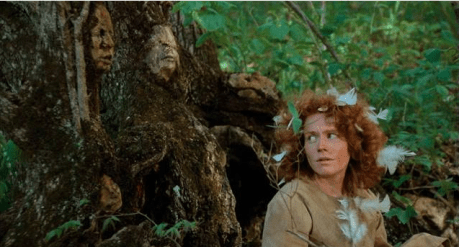
Writer/director Avery Crounse is an award-winning photographer in his own right, and the images shown in Eyes of Fire certainly prove that – there are many sequences where you just find yourself thinking, “Damn, that’s pretty.” And the story, simple as it is, is fairly solid; some will complain of its slow pace, but the fact that Crounse and his cohorts made a very good period piece on next-to-no-money is a magic trick of its own. Some of the imagery is of necessity simple, but still striking: the trees bearing the human faces of the Demon Witch’s victims, and their mud-soaked bodies when she summons them to attack the cabins. There are times when things get downright psychedelic.

Present-day viewers are also likely to point out the story’s remarkable similarity to 2015’s The Witch, but as I said, it’s a simple story. Simple as the folklore it invokes.

There is an original cut of the film, Crying Blue Sky on the set’s disc, which has a half-hour that was trimmed out for (I presume) nervous suits. Time pressures keep me from checking it out at this time, but I should watch it to see if any of my unanswered questions are answered. I mean, Leah is quite obviously a witch, and the subject is never truly broached, even though much of the story’s time is spent on her realization that she and the Demon Witch are headed for a showdown, and she must somehow prepare while still trying to protect her friends – the young girls who are telling the tale to the French officer.

Chances are that my gorehound younger 80s self might have actually appreciated this movie, but I’m glad I instead experienced it these days, when I watch these movies more to determine how well the filmmakers delivered their vision to the screen. Avery Crounse did so very well on this, his first feature, that I would like very much to track down his other two movies, The Invisible Kid and Cries of Silence aka Sister Island, which is likely the highest recommendation I could offer any movie.

Five minutes later: Great, just what I needed. More movies to watch. Grumble gripe bitch complain


The Hubrisween That Wasn’t: D

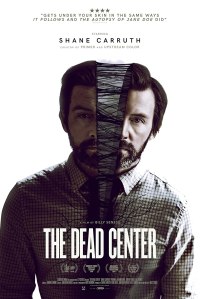
D: The Dead Center (2018)

I hate the holidays.

I admit that I don’t hate the holiday itself, but for some reason the forces of fate keep making the run up to Christmas horrible for me. This year its workplace drama and, of course, the Arctic Blast coming through these parts in a couple of days. Houston, indeed, much of Texas, is not good about such things. I fully expect to lose power again, and people will die again, and Ted Cruz is probably already in Cancun. So bah and humbug and all that.

This was the second of the movies I watched I watched and never wrote about. The Letterboxd film diary says I watched it on August 28th. It made enough of an impression that I might only have to skip through my copy for some details, but just barely, and probably only because I knew I was going to be writing about it, no, really.

The movie opens with a body being wheeled into a hospital morgue. No sooner is the gurney placed in a refrigerated room and the light turned out than there is a animalistic growl and the body in the bag starts convulsing. Later we’ll see a dazed man (Jeremy Childs) walking through hospital corridors, shivering. He finds an empty bed, covers himself with a blanket, and passes out.

Next we’ll meet Dr. Daniel Forrester (Shane Carruth, yes, that Shane Carruth, Primer and Upstream Color Shane Carruth), a psychiatrist at that very same hospital who is having some problems of his own. After this mystery catatonic man – who we will learn is named Michael Clark – is discovered in the hospital bed, Forrester bends the rules yet again to get him put in the psych ward under his care. Clark snaps out of his catatonia but remembers nothing, so Forrester begins the process of trying to regain his memories.

Our last proactive cast member is Edward Graham (Bill Feeheely), an investigator with the Medical Examiner’s office. He finds the initial stage of his investigation into Clark’s apparent suicide is a bit hindered by the fact that the body disappeared from the morgue. He continues on, heading toward the scene of death, and finding a motel room covered in blood and a bathtub filled with same. Draining it yields the kitchen knife Clark used to slash his wrists (photos will show Clark did it the right way) – and a mysterious spiral cut into the bathtub’s floor. A similar spiral-shaped weal was on the corpse’s back.

Forrester tries hypnosis on Clark, who can still remember nothing, except that he did die.

” I died, and I came back, it wasn’t the first time. I can’t kill it, it came back with me in the fire. It wanted into this world, it’s inside of me now. It comes back at night, moves around inside of me. I kept cutting cutting until I was dead.”

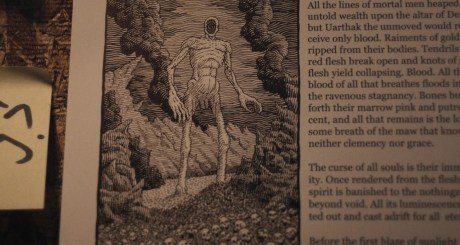
Graham has backtracked Clark’s timeline to that aforementioned fire, which almost completely consumed the house. Continuing to the home of Clark’s parents, he (and we) find out that the fire killed his wife, but somehow spared Clark and their two children. The parents took them in and Clark’s mental state declined precipitously, until he ran away in the middle of the night, leaving his children behind. Clark’s room at this house has the traditional wall of newspaper clippings about unexplained mass deaths throughout history, and an engraving from an old book, with the caption “I am the Mouth of Death, none are beyond my reach”, which is also the suicide note Clark left behind, although Clark appended “Forgive me.”

I think you all know where this is all headed, and the fun is going to be had in getting there. Clark is going to beg Forrester to kill him again, because when he tried to do it himself, “I just made it stronger.” Clark is trying to hold back the Mouth of Death, but will lose control enough times to get some people in the ward killed. Clark’s actual identity will be determined, and his father will show up at the hospital demanding his release. Graham won’t get there in time to stop it, either, and all we can do is watch the tragedy take its course.

The Dead Center is not a bad movie, by any definition of that word. It is competently made, well-shot, and very well acted. I truly love it when methodic investigation slowly uncovers what is going on in any story, and when it’s in service of a horror story, I am ecstatic. It delivers on that aspect.

You may looking at the plot synopsis and thinking, this is a whole bunch of people talking in rooms, isn’t it? Sounds abysmally low budget and yes, you would be correct. It doesn’t look low-budget though, and it looks like most of the money was spent in the final act (where, according to Sam Fuller rules, it should have been), where a panic-stricken Forrester is running through a twilit neighborhood full of houses with the front door ripped off its hinges, full of fresh corpses harvested by the Mouth of Death.

There are several of The Mouth’s kill scenes in the ward where there were more explicit versions filmed, but writer/director Billy Senese felt that went against the “grounded approach” he wanted to take to the story. Unfortunately, that is likely where Senese will lose quite a bit of his audience, who look for such visceral thrills, and will just add to the complaints of low budgetry.

But it’s not a bad movie, not at all, especially if you’re kind of into lo-fi horror.

The Hubrisween That Wasn’t: A

As mentioned in the last posting, I fully intended to do Hubrisween this year. I shouldn’t let what pitiful amount I did get done go to waste, so here goes. I’m also going to handle this in a different way than I originally intended, cuz I’m fickle that way

So.

A: AM 1200 (2008) is the directorial debut of David Prior, better known for The Empty Man and “The Autopsy” on Cabinet of Curiosities. Well, his debut as a fictional storyteller, he has some heavyweight credits on video documentaries on filmmaking. I can’t seem to find it streaming anywhere except YouTube and Vimeo – probably because it’s only 40 minutes long – and that is a shame. It deserves a wider following.

We meet our main character, Sam (Eric Lange) on the run. We find he acted on drunken advice from an associate at his financial securities firm (the always welcome Ray Wise), and made off with a bunch of money, resulting in the suicide of said associate. The increasingly paranoid Sam’s escape plan is apparently to drive as far as he can, continuing on into the night, until he falls asleep at the wheel.

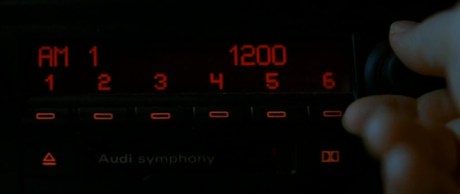
Turning on the radio to keep himself awake, he finds he’s so far into the boondocks that the only station he can pick up is on AM 1200, an evangelical station, and that just barely. On that, he hears a call that there’s a medical emergency at the station, and if anyone is listening, please help. Sam realizes that he has gotten himself totally lost, there is no cell phone coverage out here, and oh, look – there’s that radio station. He looks down the dark, wooded path to the station and utters the deathless horror movie line, “No fuckin’ way” and drives on.

Only to find the road he’s on is a dead end. driving back, his overtaxed car finally craps out. In front of that radio station. Odd, that.

Well. Nothing left to do but go up there and see if they have a phone.

And thereby hangs the tale.

I really enjoyed AM 1200 the first time I saw it, and I enjoy it more every time I see it. Prior’s direction and visuals are both extremely assured, and he is able to conjure dread out of the simplest things. I tracked it down after seeing The Empty Man, hoping to find more cosmic horror done well, and boy was I rewarded. I wish Prior the best, I hope he continues in this vein for a long, long time.

Looking back over my archives, I see that when I link to YouTube on here, the file inevitably goes away. So hurry up and watch. Like I said, it’s only 40 minutes long, and far more rewarding than hate-watching another episode of whatever you young people are hate-watching these days