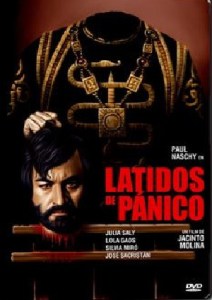
P: Panic Beats (1983)

Home ♠ Letterboxd

No, no, no, I just TOLD you it wasn’t THAT Alaric de Marnac!

Well, here it is. The third of four Paul Naschy movies I managed to schedule this year. The last two, in case you’re joining us late, were Exorcismo and The Valdemar Legacy/La Herencia Valdemar. It was my intent to spread my nets wider for movies this year, and this was the unintended result, aided by the fact that I hadn’t watched many of his movies, I’m sure.

Anyway, let’s just get this out of the way: SPOILER ALERTS FOR A 35 YEAR-OLD MOVIE. I’ll try not to give everything away, but then, up to a point, Panic Beats is pretty predictable. (Also, if you’re a Mondo Macabro fan, their disc-opening promo has already shown you most of the money shots)

We start with that Paul Naschy standard, an opening scene with murder and a naked woman. She’s running bloody through some woods, pursued by a mounted man in a full suit of armor. This is the infamous Alaric de Marnac, last seen in Horror Rises From the Tomb, tracking down and killing his unfaithful wife. Okay, so it’s not really that Alaric de Marnac, but it’s still Paul Naschy.

Yep, that’s Paris, all right.

After credits, cut to present day Paris, where Paul Marnac (still Naschy) is told he has to take his rich wife Genevieve (Julia Saly) away from the hectic life of a Paris socialite, or her heart condition will kill her. Marnac will take her to his remote ancestral home to recuperate, along the way running into bandits (so we’re still having Horror Rises From the Tomb flashbacks), the fright of which nearly kills Genevieve on the spot.

At the house she meets Mabile (Lola Gaos), the housekeeper who has been there forever, and her young thug niece Julie (Frances Ondivela), whom Mabile is trying to reform. Mabile is the receptacle of all the folklore associated with the Marnac family, especially the guy who opened the movie and whose sardonic portrait graces the wall: Good old Alaric, who in this version was not beheaded, but did turn to Satanism and got burned down with his castle. This house was built on its ashes. Supposedly Alaric comes back every hundred years or so to clean house again. This tale gives Julie nightmares because we really needed something interesting to happen at this point.

Slight digression: I’m still not sure if it was wise or not for the movie to name-check Rebecca.

Genevieve slowly regains her strength over the next month. Julie rather sadistically tells her the story of Alaric, and then things go downhill again. Nightmares, snakes and figures in armor appearing mysteriously in the night. Dinner plates covered with blood and eyeballs. Stuff like that.

Now, it’s going to be obvious to anyone that it’s all a plot to literally scare Genevieve to death. The only question is who, and since there are only two possible suspects, the mystery is not all that engaging. Remember the fright shows with a similar intent in The Tingler? Those were studied models of speed and efficiency compared to the ones in Panic Beats. It is tempting to brand it Milk That Scene: The Movie. I did a lot of time-remaining checking.

Then Genevieve’s heart finally cashes in, the mystery, such as it is, is solved… and there’s still a half hour of movie?!?

At this point Panic Beats  actually managed to engage my interests, as plots and counter-plots emerge, more people have to be killed, and a mysterious figure from Julie’s past emerges, though we’re not allowed to see his face. It does get complicated to a point where we’re not really sure what is real and what is not, and that is generally a type of movie I enjoy.

I was once told that you had to endure the first hour and fifteen minutes of Evilspeak, the Clint Howard shower scenes and puppy killing, just to get to the cool ending. I guess the same criteria holds for Panic Beats, except that first hour wasn’t all that terrible. The best part is Lola Gaos as the housekeeper, really. She can really turn on the scary when she needs to.

Hm. I see Amazon has one DVD available for seventy bucks. Here… Happy Hubrisween!
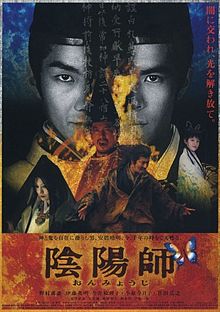
 

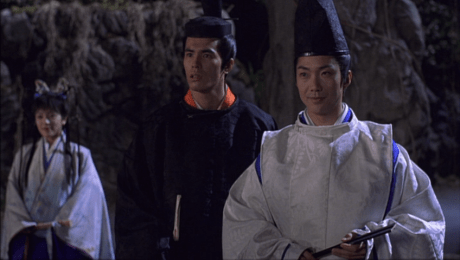
O: Onmyoji: The Yin Yang Master (2001)

Home ♠ Letterboxd

220px-onmyoji-2001-film-posterOne of the best things about casting the nets wider for this year’s Hubrisween offerings is finding that occasional gem you had no idea existed and being dazzled and deeply satisfied by it. And such a gem is Onmyoji.

An onmyoji is a practitioner of onmyodo, “a traditional Japanese esoteric cosmology, a mixture of natural science and occultism” according to Wikipedia. The article goes on to point out that in the Heian period (roughly 794-1185), the onmyoji had real political clout.

The movie begins in a fairly enigmatic fashion, with a ritual sealing of Shogun’s Mound, a tomb to trap the wrathful spirit of the wrongly persecuted Prince Sawara; he had cursed the former capitol city, so the new capitol – which will come to be known as Kyoto – is built over the tomb.

150 years later, the city has grown, and is quite prosperous under its current Mikado. The leader of the Court Onmyoji, Doson (Hiroyuki Sanada) is craftily playing the powerful Minister of the Left against the Minister of the Right to cause chaos in the palace, to what end, we shall just have to let the plot develop and see.

We are introduced to our actual title character, Abe no Seimei (Mansai Nomura), an extremely powerful magician. One of the more venal lords demands he prove his power by killing a butterfly without touching it; when a leaf blown by Seimei slices the butterfly in half, the lord flees in terror. Also witnessing this is Hiromasa (Hideaki Itô), a minor lord who is further discomfited when the master of his house sends him to Seimei to beg him to investigate supernatural goings-on.

vlcsnap-2017-01-04-13h02m47s51Hiromasa protested when the lord demanded Seimei kill the butterfly, and he is honestly delighted to find that the death was an illusion, and in fact the pretty girl who greeted him at Seimei’s gate is the butterfly in human form (Eriko Imai). These two things cause the normally cool Seimei to warm toward Hiromasa, and they are going to become close companions in the course of the story.

The Japan of this period, we are told, is a time when demons walk the land, and it is the onmyoji who protect mankind from them and their curses. Doson’s power games in the palace are going to require Seimei’s intervention more than once, until the wizard’s master plan is revealed: unleashing the spirit of Prince Sawara, and binding it to himself for ultimate power.

"Oh my! You ARE sick!"

“Oh my! You ARE sick!”

I’m going to enjoy any movie involving magic that’s done well, and Onmyoji is certainly that; Abe no Seimei is a freaking 10th century Doctor Strange, and the revelations of his power are continually surprising and delightful. Hiromasa is a fine Dr. Watson character, providing someone to whom Seimei can explain things (and thereby explain them to us), and a humanizing counterbalance to Seimei’s otherworldly aloofness. In a reversal of one aspect of the Holmes/Watson dichotomy, Hiromasa is the musician of the two, and his masterful ability on the flute is pertinent to the story, as is his continually doomed love life (more on those in the sequel, which we’ll get to eventually).

The intriguing characters don’t stop with our heroes. There is the enigmatic Lady Aone (Kyôko Koizumi), apparently immortal. And Dosun’s familiar, possibly the most metal crow ever committed to film.

001c66d0

“O soundless, invisible God of woe – may you reap all you have sown.”

Onmyoji is based on a series of novels by Baku Yumemakura, popular enough to be adapted to both manga and television. And after finding all this out, this gaijin was surprised to discover that Abe no Seimei is an actual, historical person. Was he truly a combination of Doctor Who and Harry Potter? We will never know, but it’s nice to think that he was.

As I said, I found this movie tremendously entertaining. I am alternately thrilled that there is a sequel and saddened that there is only one sequel. We will get to that one later. Like in ten letters later.

Buy Onmyoji on Amazon

N: Nightwish (1989)

Home ♠ Letterboxd

If a lifetime of watching horror movies teaches you anything, it’s that if a movie opens with a sequence that seems like a fully-contained and realized horror movie in itself, it is either going to be a) a dream, or b) somebody else making a movie with an impossibly complex series of continuing shots. Yes, I am still bitter about Frankenstein 1970.

In the case of Nightwish, it is the former, as a debutante leaves some sort of prom night party and finds first a single shoe, then a bloody sock, then a severed hand, then some ghoul eating a corpse. A chase scene ensues, ending with her being cornered outside a locked trailer and screaming.

Let’s get our exploitation out of the way right off the… top…

But, as mentioned, this is all the dream of Donna (Elizabeth Kaitan), who wakes up inside an isolation tank. This is all part of the graduate program under the slightly sinister Professor No Name (Jack Starrett), who is conducting experiments in “guided dreaming”, with the intent of his students experiencing their death in a dream to toughen them up for what they have to face. The trouble is, every one of them has awakened before that moment.

But never mind that, let’s have some credits and then get on with our movie, as the students drive toward their first field exercise. We have Donna, Kim (Alisha Das), Jack (Clayton Rohner) and Kim’s rather disagreeable boyfriend Dean (Brian Thompson). They’re headed through the desert to a mining magnate’s abandoned home, perched atop an equally abandoned mine in an area known for earthquakes, mutants, and UFOs. Already at the house with the Professor is Bill (Artur Cybulski), the last of our graduate troupe.

The house is also known to be haunted, and Satanists were frequent visitors. After an attempt at a high-tech seance à la The Legend of Hell House involving an ectoplasmic tentacle, things generally go to hell, as we find out the Professor is a genuinely mad scientist with a brutish and sadistic assistant (Robert Tessier, of course) intent on raising a demon from hell. On the other hand, all the weirdness seems to be alien invaders needing human bodies to host their larva. On the other other hand, all these may be hallucinations created by the tentacle-wielding “Entity” to increase paranoia and dissension among the students. On the other³ hand…

Oh, hell, SPOILER ALERT FOR A 30 YEAR OLD MOVIE. This is, as you figured out three minutes after the opening credits, Kim’s guided dream, and she actually manages to make it to her own death. In the isolation tank lab, everybody congratulates her on her fine work, but Kim isn’t sure she’s actually awakened. In a nicely Bava-esque closer, it seems that she hasn’t, and may not.

As a movie that tries very hard to be a nightmare put to film, Nightwish should be a lot more interesting. It tries to hit every horror setup you might be able to think of, from Texas Chainsaw Massacre torture dungeons to ghosts to Alien body horror, and yet somehow makes so much of that tedious. There are a lot of other mixmaster movies that don’t even achieve this level of competence – Spookies comes to mind – but more than once I had to hit the fast forward because okay, okay, I get it, move on. It’s to the movie’s credit that I didn’t do it more than twice.

The actors are a game lot, but the script does them no favors. Brian Thompson’s career was just starting to take off, and he manages to take the one note he’s given and turn it into at least an interesting rock riff. Robert Tessier could do the Menacing Hulk role in his sleep. All the others have varied careers, and it’s worth noting that none of them are one-movie johnnies, which is the case in most of these forgotten flicks. KNB (Robert Kurtzman, Greg Nicotero and Howard Berger, for all you non-Fango readers) handle the special effects, but don’t really get to strut their stuff until the last half-hour.

Information about the making of Nightwish is very scarce. We know that it was shot in 1988 but not released until 1990 – both Starrett and Tessier had passed away by then – and then it was direct to video. These were the dark days of VHS, which means every copy out there – I’ve yet to see any mention of a letterboxed version – is open matte to 4:3, so the boom mike should have been given an onscreen credit. That’s not the fault of the director or the boom operator – that’s the fault of people allergic to black bars at the top and bottom of the screen. They are the real monsters.

Writer/director Bruce R. Cook worked his way up the ladder from camera & electrical to the director’s chair on two flicks – this one and The Census Taker. Nightwish can’t be described as a gem in the rough, it’s more like a semi-precious stone. Worth a look, if you like semi-precious stones.

It’s okay. I wear turquoise.

Hey… it’s available in October!

M: The Mummy (2017)

Home ♠ Letterboxd

Please note I insist on using the poster without Cruise.

Good grief, where to begin?

I guess the beginning will suffice. The beginning’s okay.

In the early 12th century, Templars bury one of their own, with a mysterious jewel, in a hidden tomb. The tomb is discovered in modern times, and a odd panel of hieroglyphics tells the tale of an ancient Egyptian princess, Ahmanet (Sofia Boutella), destined to inherit her kingdom – until her father has a son late in life. Ahmanet strikes a deal with the god Set, murders her father and half-brother, and is preparing to complete the rite which will incarnate Set into a living man – but the rite is interrupted and Ahmanet is mummified alive and interred in yet another hidden crypt.

All this is fine, if rather reminiscent of the opening of the 1999 Mummy. Nice to see a female version of the monster. I like Sofia Boutella.

Get out of my genre, Tom.

Back to present day, however, in Iraq, where ISIL is tearing down an ancient temple. Two Army scouts are watching from a nearby hill, One pulls down his scarf, revealing he is Tom Cruise, and everything goes to shit. Because at that point, it becomes a Tom Cruise movie.

I don’t hate Tom Cruise, as many people seem to – I just don’t watch his movies, mostly. I will admit enjoying the last two Mission Impossible movies, and Eyes Wide Shut, but he’s just not a factor that draws me to a movie. The story will continue to illustrate to me why this is so. Cruise is Nick Morton, who stole a map with some coordinates from a one-night stand with Jenny (Annabelle Wallis). He figures there’s buried treasure, and he and his partner, Chris (Jake Johnson) will be rich.

This is a bad plan, and Chris winds up calling in an airstrike just to save both their asses. The strike uncovers a hidden tomb, and re-enter Jenny, who holds an unreasonable amount of clout with the military. She gets a limited amount of time to examine the tomb, and against her better judgement is assigned Nick and Chris to assist.

Jenny represents a global organization called Prodigium. Prodigium means a number of things, among them portents, or wonders, or monsters. In this case, it seems to mean Bad Ideas ‘R’ Us as what they find is Ahmanet’s hidden prison tomb. Jenny correctly interprets all the signs and machinery as meaning DO NOT DISTURB, GO AWAY, THIS MEANS YOU, DON’T DO IT and she is still determined to bring this piece of erased history to light.

The cargo plane carrying our supposed heroes and the sarcophagus run into problems, mainly Chris getting possessed and killed and a flock of kamikaze crows causing the plane to crash (this movie can’t even get me involved enough to do the murder of crows joke). Nick manages to get Jenny into a parachute and out, but in the crash the sarcophagus is lost, and everybody is killed, including Nick. Yay!

Here’s an exciting scene from the movie we SHOULD have gotten.

Except that Nick wakes up later in the morgue. Ahmanet is loose, sucking out souls to regain her power. Nick is under some sort of curse and cannot die, or so he is told by his dead buddy Chris, who keeps following him around and trying to guide him to Ahmanet, who wants that jewel found in the Templar tomb to complete her magic dagger, and Nick’s deathless body to incarnate Set into, so she can rule the world in darkness, which is what your modern-day movie mummies do. None of that profaning-the temple or reincarnated love claptrap. That’s your grandmother’s Mummy movie.

This is still an okay setup for a movie. The major problem with the execution is that at this point the movie becomes entirely about Nick Morton, with the title character essentially becoming what seems to be an afterthought that annoyed the filmmakers. Ahmanet is captured in the second act and spends a remarkable amount of time restrained in a chamber while Prodigium embalms her with mercury (which seems to be the equivalent of silver in the Dark Universe), so that Dr. Jekyll can dissect her.

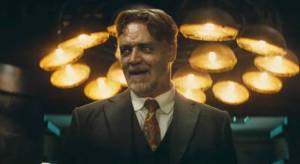
Oh, yes, the head of Prodigium is none other than Dr. Henry Jekyll (Russell Crowe). His plan to dissect Ahmanet is in keeping with the organization’s credo of “The Worst Plan Possible”, as is his practice of injecting himself with the necessary drugs to prevent him from turning into Mr. Hyde (with, of course, an extreeeeeeeeme six-chambered hypo) at the very last second.

But I don’t really mind that – Russell Crowe is one of the very few bright spots in this movie. He’s the only one who seems to know what kind of movie he’s making – one that is destined to be labeled a Superfund site – and has decided “Fuck it!” and goes for it.

Reportedly Cruise used his influence during shooting and editing to emphasize his character, but whatever actually happened, the result is disastrous. Annabelle Wallis’s main function is to convince us that Nick Morton is actually a good person, and Cruise doesn’t cooperate. His usual wisecracking manchild persona just doesn’t fit here, and concentrating on that to the detriment of the intended story basically mummifies it alive. For a movie called The Mummy, there is damned little Mummy and a whole lot of some sort of Wandering Jew character that has no prior instance in the pop mythology supposedly being employed. How the hell do you hire Sofia Boutella and then not use her?

Did you know that the dictionary has a new illustration for “Hubris”?

This is rather famously Universal’s “No! Really! This time for sure!” launch of their Dark Universe titles, something that had been attempted before with 2010’s The Wolfman and 2014’s Dracula Untold, both of which apparently no longer exist, as far as Universal is concerned. The sad part is, they could have probably capitalized on the 1999 Mummy and even its sequels, which were at least entertaining, not an endurance contest like this one. As it is, it merely makes us miss that movie, and constantly ripping off An American Werewolf in London with the undead Chris doesn’t help matters, either.

As I did with I, Frankenstein, I’m going to quote a tweet from film writer A. M. Novak, who makes this very excellent point:

It has been proven over and over again that the rich heritage of Universal’s 1930s mastery of the horror genre is in very wrong hands. Supposedly The Bride is Frankenstein was next, though at the very beginning of October, Universal announced they were pulling the plug on it. Horror fans breathed a sigh of relief, since judging from The Mummy, that one would have wound up being about The Incredible Shrinking Man.

Buy The Mummy on Amazon. See if I care.


L: The Living Head (1963)

Home ♠ Letterboxd

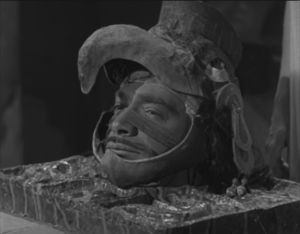
There was a golden age of living severed heads in horror movies for about six years, from 1957’s The Man Without a Body, then 1958’s The Thing that Couldn’t Die (remade as Horror Rises from the Tomb in ’73) up through Germany’s The Head and the amazingly sleazy The Brain That Wouldn’t Die. I’m sure there are more (it’s the internet, I’ll get told), but we’re here to talk about what may have been the last one for awhile, 1963’s La Cabeza Viviente. The Living Head, for all you gringos.

We start with those fun-loving Aztecs, as their high priest Xiu (Guillermo Kramer) sacrifices a guy for causing the death of their mightiest warrior, Acatl (Mauricio Garcés). In fact, all that’s left of Acatl is his head, in his ceremonial headdress. Xiu hands off the Ring of Death to the High Priestess (Ana Luisa Pellufo), and informs her that she and he will be hanging around Acatl’s tomb for eternity. Then he curses anybody who profanes the tomb, and gets sealed in.

This bling is getting out of hand

That Ring of Death is freaking huge, by the way, and crested with the fakest eyeball you have ever seen. It has to be that large for the blinking light bulb inside the eye.

So in the modern day, three scientists (Salvador Lozano, Antonio Raxel, and Mexican horror icon Germán Robles) discover the tomb and make with the profanin’. Acatl’s head and Xiu’s body, in their sarcophagi, are remarkably well-preserved; the high priestess, however, didn’t get a box and is merely standing against a wall. She disintegrates, leaving behind only the Ring of Death, which Muller (Robles) decides to give to his daughter Marta (also Peluffo, conveniently enough), as one does with priceless historical artifacts.

Oh, that’s your answer for everything.

Muller is also keeping all the damned artifacts in his house instead of the museum, including Xiu’s corpse, still clutching his obsidian dagger in a death grip. Marta’s boyfriend Roberto (Garcés again, I wonder if that’s going to be significant) notices some incredibly obvious footprints leading from Xiu’s sarcophagus, and is immediately pish-tushed by Muller.

It’s not too long before Xiu is wandering around and cutting out hearts to leave on Acatl’s altar, guided by the current possessor of the pulsing Ring of Death (Marta) until she refuses to kill her own father. Unfortunately, Roberto has found the Ring (thown out the window by a fearful Marta) and is possessed, but he too will not kill the people Xiu wants. It all looks pretty grim until Acatl points out that Marta and Roberto are played by the same actors as himself and the high priestess, which apparently shocks Xiu so much that Inspector Toledo (Abel Salazar, another horror icon) is able to shoot him to death. The end.

That all sounds pretty silly, but it has to be admitted that The Living Head  proceeds with a no-nonsense pace and rarely has a dull moment. It’s a typical Mummy death-to-the-tomb-raiders story, but the addition of those ancient Aztec blood rites gives it a visceral lift, and as I said, the pace is good – it really is a perfect example of how to do such stories, even if Muller keeping all this stuff in his home stretches the ol’ willing suspension far enough to use it to slice cheese. If nothing else, it’s fun to see Nostradamus the Vampire and The Brainiac being on the menaced side of the plot for a change. This is one of the better examples of Mexican horror cinema; not world-changing, but at least as competently made as its low-budget American brethren, and certainly as entertaining.

¡Prepárese para tener su sangre congelada por esta vista previa con marca de agua!

K: Kibakichi (2004)

Home ♠ Letterboxd

kibakichi_bakkoyokaiden_2004For those of you keeping score (and if you are, good God, don’t you have anything better to do?), this position was supposed to be filled with Kung Fu Halloween, but it failed to make good with the Halloween connection. K is one of those difficult letters, so while flailing about, I found Kibakichi, and thought, “Oh, cool! Samurai werewolf!”

Wellllllllll, not quite. The character we’re introduced to carries the swords, and as we find in the prologue, when he takes on five bandits, he’s quite good with them, and on top of that, has fangs. His outfit, including his hat, is made of animal pelts. So he may not be in that social class, but yeah, he’s pretty definitely a werewolf, eh? (This was apparently released in America as Werewolf Warrior, which is at least truthful, but screw that – I needed the K)

What the well-dressed lycanthrope is wearing this year.

What the well-dressed lycanthrope is wearing this year.

Kibakichi (Ryûji Harada) comes upon an isolated village that welcomes him, and it turns out that the inhabitants of this village are all Yokai monsters. We’ve been informed that in the early part of the century mankind had declared war on and largely eradicated the Yokai because humans are assholes. These particular Yokai are allowed to exist because of a deal made with the local Yamayi Clan, in that criminals and other malcontents are channeled into the village, where they think they’ve found safe harbor in the local gambling den/brothel but instead find themselves on the menu. This increases the Yamayi prestige and power for cleaning up society, and in return the Yokai are promised their own land on a nearby mountain to exist peacefully. Since Kibakichi apparently got his own village of lycanthropes destroyed by trusting humans, he advises against this deal.

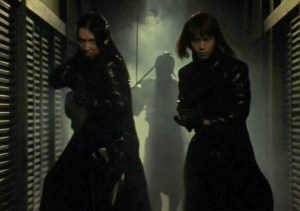
kibakichi8The village leader doesn’t agree with him, and inevitably the Yamayi have the riches to invest in something to replace the Yokai’s power in their land – a gatling gun and other firearms imported from the West. Honestly, the Yamayi were obviously villains from the get-go, because all their kimonos are made of black leather. They move through the village, shooting everything in sight, eventually triggering The Change in Kibakichi, and it turns out a werewolf is a much better fighter than your average Yokai.

Where did you go? We NEEDED you!

Where did you go? We NEEDED you!

Once the characters are all in place in Kibakichi, the movie becomes a waiting game for the ultimate confrontation we all know is coming, and it’s time that is not always used fruitfully. There is a bit of character development so the final massacre has some impact, but it seems achingly slow in developing. A bit of excitement is provided when another survivor from Werewolf town shows up – and she’s determined to kill Kibakichi for what she feels was his betrayal – but it is a brief interlude, never alluded to again. We can only assume she crops up in the inevitable sequel. At least the one human in the village – an orphan adopted as a baby years before – does not have a forced romantic interlude with our werewolf hero.

kibakichi-werewolfThe werewolf transformation is pretty well-done, but then we see far too much of Harada in his full body suit, which gets compounded when it is discovered that one of the Yokai is a turncoat, and he monsters out – and then there is a full-fledged sentai-style fight in a village with lots of balsa wood walls.

There are flaws, but it’s reasonably fun movie, especially if you don’t mind a large expanse of somewhat languid semi-weirdness between the opening and closing fight scenes.

This looks like it was cam-ed off somebody’s TV, but it should give you an idea if you want to check out the full movie. And oh yeah, massive spoiler alerts and all:

Buy Kibakichi on Amazon


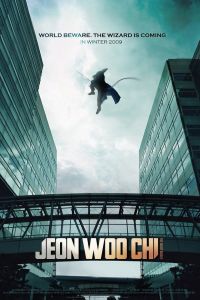
J: Jeon Woochi, The Taoist Wizard (2009)

Home ♠ Letterboxd

This Korean fantasy action comedy got a domestic release as Woochi the Demon Slayer. I didn’t need a W movie, I needed a J, so I’m stickin’ with that original title.

The movie begins with a sequence explaining that the Arch God (or so the translation says) kept the race of Goblins imprisoned for 3000 years by playing his flute. Three of the minor gods ruin this plan by accidentally opening the prison a day early, releasing the Goblins and resulting in the Arch God’s demise. The Goblins fall to fighting over possession of the powerful flute.

The minor gods continue to live among men, seeking out the Goblins (also disguised as humans) and then hiring magical warriors to capture them, because they, themselves, are obviously quite useless. In the present day, two of these Goblins escape, and the three gods panic, because their Goblin hunter of choice – Hwa-dam (Kim Yun-seok) – vanished a few hundred years ago after capturing what was thought to be the last Goblins. This leaves them no choice but to release another Taoist wizard they themselves trapped in a painting, Woo-chi (Gang Don-won).

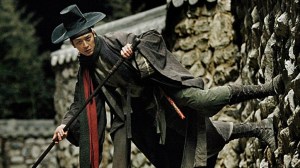
The movie is going to rebound from present day to sometime in the Joseon Dynasty in Korea. Woo-chi is known as “the scoundrel”, as he uses his magic to do things like embarrass worthless royalty. His master (Baek Yun-shik) tells him he will never be a true magician, as he “cannot empty his soul”. Indeed, Woo-chi can only work his magic with his yellow paper talismans, obligingly carried around by his servant, Chorangyi (Yoo Hae-jin), who is actually a dog hoping to someday become a full-fledged human (he also really resents being turned into a horse when Woo-chi needs one).

In the course of this extended flashback, we find out that Hwa-dam is really a Goblin (the green blood is a giveaway) and he frames Woo-chi for the murder of his mentor, as part of a plan to get the flute macguffin. Woo-chi and Chorangyi are trapped in separate paintings, but ha ha on Hwa-dam, Woo-chi had the flute in his possession, and it too is now stuck in the painting.

So 500 years later – now – Woo-chi and Chorangyi are set loose to track down the two extant goblins. Of course, Woo-chi is going to run into the reincarnation of his lady love from back in the day, and be distracted by trying to prove to her she’s just that – meantime, there’s a big rat and a big rabbit demon causing trouble, and Hwa-dam is starting to drop any pretense toward being human in his search for the flute. Just ask the restaurant he massacres.

“Cadbury Eggs my ASS!”

If there’s a flaw in Jeon Woo-chi it’s the length – two hours and fifteen minutes. Koreans seem to really like long movies. The fish out of water stuff goes on way too long and dilutes what is otherwise a pretty delightful action comedy with monsters and high production values. I do love it when a movie that ends with a battle of magic actually has the money and imagination to realize it. And I love that Bunny Goblin.

Buy Woochi the Demon Slayer on Amazon

I: I, Frankenstein (2014)

Home ♠ Letterboxd

We live in an age of reboots and remakes. Some day the madness will end, but this is not that day. Intellectual property will continue to be harvested for supposedly new audiences, and mixed with whatever the perceived new hotness with that audience might be.

So is it any wonder that we got a movie casting the Frankenstein Monster as a superhero?

After a fairly simplistic precis of the original novel, the creature (Aaron Eckhart, who seems to be living under some sort of a gypsy curse since The Dark Knight), buries his creator in the family cemetery, and is set upon by demons disguised as humans, who intend to capture him. He kills one with a holy symbol plucked from the ground, and is rescued by two gargoyles, who then turn into humans. Or disguise themselves as humans. Trying to parse this gout of madness at the very beginning is your first challenge.

The Creature – Adam – is told by the Gargoyle Queen Leonore (Miranda Otto) that there is an eternal war between the Demons and the Gargoyles. They have no idea what the Demons want with Adam, but the chief of the Gargoyles’ warriors, Gideon (Jai Courtney) wants to destroy him to make sure he never falls into Demon hands. Leonore, though, sees the possibility of a soul in Adam’s eyes, and releases him. Adam wants nothing to do with this war, and departs for remote regions. He finds he is apparently immortal, and after 200 years, the Demons have continued to seek him out. So he returns to civilization and brings the war to the Demons.

This does not sit well with the Gargoyles, who prefer their war to remain hidden from mankind. While Adam is captured yet again, a scientist, Terra (Yvonne Strahovski) attempts the ultimate experiment in her project for the head of her corporation: reviving a dead rat using some 21st century Strickfaden electric effects. By desperately pushing the equipment beyond its limits, she succeeds – which interests her boss, Naberius (Bill Nighy) very much.

Naberius, as if you didn’t already know, is the Demon Prince who put out the infernal APB on Adam 200 years previous. He has a very complicated plan which will require animated corpses – lots of them. The step up from a rat to a human being is extremely complex, Terra tells him, so he promises to get her an example to study… since one has just recently cropped back up again.

This is a cumbersome but pretty cool mythology to graft a literary character into, and another thing weighing heavily against it is that its CGI-rich imagery is all too clean – it looks and plays out like a video game cut scene, and I kept waiting for it to end so I could start playing again. It never does, and I never did. The characters do not engender any sympathy with me because, again, this all a cut scene. The story itself lurches along like one of the 30s version of the Monster. There needed to be some grain in the picture, some engagement possible. It’s all too clean. All surface.

As an action movie, it’s okay. There was supposed to be a connection with writer Kevin Grevioux’s other horror action series, Underworld, but that is vanishingly unlikely. The director is Stuart Beattie, best known as a writer on the Pirates of the Caribbean  movies, which explains a lot, as I feel exactly the same about those movies. I like the premise, I like the setup, I just find the execution distancing and lacking.

I’m probably here writing this instead of my originally intended entry for the letter I (maybe next year, The Incubus) because of a Tweet by film writer A.M. Novak – @BookishPlinko: (and be sure to check out her series on Video Nasties at the Daily Grindhouse when you’re finished here)

That is a fabulous idea, and though nowhere near as good as any of those movies, I’d throw in I, Frankenstein too, because it’s still more entertaining than the Dark Universe movie we did get, The Mummy – which we’re going to deal with in a few more letters.

Buy I, Frankenstein on Amazon

H: La Herencia Valdemar (2010)

Home ♠ Letterboxd

Seems like we were in Spanish horror land just a few letters ago, doesn’t it?

Things are getting a little intense at a real estate firm, as the Valdemar estate is coming up for auction and the agent dispatched to the remote mansion 20 days before has not returned. Desperately the freelance antiques appraiser Luisa (Silvia Abascal) is contracted to pick up where the missing man left off. She finds the house deserted, nothing catalogued, and a nearly empty attic – empty except for the mangled body of the missing man. And something shadowy stalking her.

She barely escapes, aided by the somewhat simple handyman Santiago (Santi Prego) and Domáso (Jose Luis Torrijo), who is rather pissed that Santiago let her go in the mansion. She faints, and awakens hours later in their home. Possibly a prisoner, but certainly trapped there by a storm.

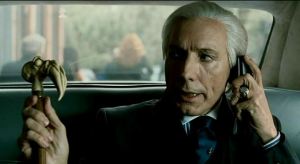
Interesting cane you have there, my friend

But never mind that, as another investigator, Nicolás (Óscar Jaenada) has been hired by Colvin, the head of that real estate firm (Eusubio Poncela) to work with the President of the Valdemar Foundation, Dr. Cervía (Ana Rusueño) to find the missing Luisa. She describes the Valdemar mansion as a classic “shunned house”, and explains why in a lengthy flashback that will be the majority of the movie.

At the fin de siècle of the 19th century, Lázaro and Leonor Valdemar (Daniele Liotti and Laia Marull), though themselves childless, run an orphanage (standard for modern Spanish horror #1). Lázaro is also a devotee of the emerging science of photography, and in his experimentation with double exposures, sets off a small cottage industry in which people come to seances, are startled by a levitating table, and in that instant are photographed; the resulting double exposures of “spirits” are much sought after, and fawning rich patrons are quite free with their donations to the orphanage. Lázaro and Leonor hope to use these proceeds to adopt a child of their own.

An opportunistic journalist, however, threatens blackmail, and when Lázaro refuses, has him arrested for fraud. Things look bleak until Lázaro is visited by an unexpected ally, none other than Aleister Crowley (Francisco Maestre), who devises a campaign to discredit the journalist and free Lázaro.

The price for this: Crowley has examined Lázaro’s spirit photos, and found, apart from the fakery, actual evidence of the supernatural lurking in the corners. He feels that not only is the mansion a spiritual nexus, but Lázaro is unconsciously a spiritual medium. These are two things that are necessary to conduct “The Dunwich Ritual” during an upcoming lunar eclipse. This will unlock secret knowledge for the participants; for Lázaro’s part, an answer to his and Leonor’s childlessness.

Despite his misgivings, Lázaro agrees, and Crowley brings in his fellows, including Bram Stoker (Lino Braxe), Lizzie Borden (Vanessa Suárez) and Belle Gunness (Laura Toledo). Crowley, though, has made a chauvinistic miscalculation, and the ritual releases what he terms “a devourer” into this world. The ritualists run away, leaving Lázaro wounded and the room aflame, and it is only the eventual sacrifice of Leonor that saves him.

The movie wraps up with the end of that story, reminding us of Nicolás, Luisa, and a couple of other folks, in an ending that confused a lot of people, apparently… I guess they ignored the brief snippets from the second part, which ends with a glimpse of something that definitely looks like Cthulhu… but that is something for the other end of the alphabet.

Now, for the good parts: this is a very handsome movie, well-shot and acted. Adding a lot of resonance and production value is Spanish horror icon Paul Naschy, in his final role as the Valdemar’s devoted manservant, Jervás. There is a lot of suitably creepy stuff, and some nicely humanistic moments, as well.

The bad part is this might as well be called Set-up: The Movie. Anyone expecting any resolution to the modern portions of the movie are going to be disappointed, those will all be left to the second part, The Forbidden Shadow, which looks to be a much rougher, more nasty, more… modern movie, perhaps. I look forward to it.

Though I am still puzzled by the fact that when Nicolás arrives, it appears he arrives by blimp… but perhaps that is another mystery which will be solved in the second part. We’ll see. (Spoiler: it won’t be.)

The Valdemar Legacy is available on Amazon Video. Bizarrely, its sequel is not.

G: The Ghost in the Invisible Bikini (1966)

Home ♠ Letterboxd

A couple of boilerplate pieces of policy around here to start off with: on challenges like this, I try to either make the movies chosen ones I have not seen before, or at least one I haven’t seen in ten years or so. The second is I toss myself at least one softball per challenge.

An unofficial policy is that I have at least one Boris Karloff movie per Hubrisween, and I found to my horror that I had not included one in this year’s lineup (although I somehow managed to schedule four, count”em, four Paul Naschy movies). So imagine my surprise and delight and downright relief when I discovered that in the years and years since I had last seen Ghost in the Invisible Bikini I had somehow conflated it with How to Stuff a Wild Bikini, and instead of Buster Keaton, I got Boris Karloff. I never thought I’d be so happy to miss out on Buster Keaton.

Boris is Hiram Stokely, aka “The Corpse”, so-called because our titular Ghost, Susan Hart, visits him in his crypt to tell him he has a chance to get into heaven if he can engineer a good deed within twenty-four hours. The best opportunity will be at the upcoming reading of his will, making sure that his rightful heirs get his ill-gotten million dollars, and not his evil lawyer, Reginald Ripper (Basil Rathbone). Since he can’t leave the crypt, the Ghost will act as his agent in making that happen.

So these rightful heirs – Chuck (Tommy Kirk), Lili (Deborah Walley) and Myrtle (Patsy Kelley) arrive at Hiram’s mansion. Myrtle has invited her nephew Bobby (Aron Kincaid), since he’s her only blood kin – and therefore another rightful heir – and he brings along what we are asked to believe is the whole Beach Party gang, and suddenly Ripper’s plan to simply murder what he thought were the only three heirs has gotten dreadfully complicated.

Wait, did we say complicated? Ripper has hired J. Sinister Hulk (Jesse White) to do the dirty work, and he brings in his associates, Princess Yolanda (Bobby Shaw), the incredibly Jewish Indian Chicken Feather (Benny Rubin) and Monstro the Gorilla (George Barrows). AND. Eric Von Zipper and his Rat Pack manage to get themselves in there, too.

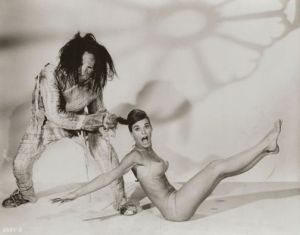
Ripper’s plan also involves his daughter Sinestra (Quinn O’Hara) seducing and murdering Bobby, much to the disgust of Bobby’s girlfriend Vicki (Nancy Sinatra!). When the truly lovely Sinestra, a redheaded knockout, is introduced, Ripper commands her to take off her glasses. As all right-thinking Americans know, eyeglasses only serve to make women super-hot, so all this does is verify Ripper’s villainy in our eyes. Actually, it saves Bobby’s life at least twice, as Sinestra has the Velma problem, and keeps killing statues and suits of armor instead of Bobby.

Needs more eyeglasses

I don’t think Ghost in the Invisible Bikini gets near enough credit as a work of demented, if desperate, genius, as one stupid thing after another happens. For instance, the production number which is a commercial for a toy that doesn’t exist, the Swing-A-Ma-Thing™, complete with theme song by the Bobby Fuller Four:

Honestly the Swing-A-Ma-Thing™ is so ridiculous, I had to spend a half hour on Google convincing myself that Wham-O hadn’t actually put it on the market that summer. Another thing that sticks out from the far remove of 2017 is the presence of Piccola Pupa (Piccola Pupa), who sings a song to Nancy Sinatra about why she should wear a bikini. Since the way she’s presented is pretty much a case of the movie saying “Look! Look! It’s Piccola Pupa!” some research is also justified there. Ms. Pupa was a discovery of Danny Thomas, made the rounds of TV in 65-66, and this is her first – and last – film role. Also, even if, like me, you only saw Big Top Pee-wee once, you will always think of her as “Piccolopoopalo”.

Did I mention That Hiram’s mansion also houses a Chamber of Horrors, so we can have our slapstick fight scene climax there? Or that Larry Buchanan’s monster suit from Attack of the the Eye Creatures has a cameo?

The Ghost in the Invisible Bikini, as amazing as I find it, killed the Beach Party franchise. It is obviously a dead franchise walking, anyway, as its two star attractions, Frankie Avalon and Annette Funicello, had both declined to participate. Tommy Kirk had only appeared in one previously (Pajama Party) and ditto Aron Kincaid (Ski Party). The only actual regulars are Eric Von Zipper and the Ratpack, the true Rosetta Stone of the Beach Party franchise. It is also, tellingly, the only Beach Party movie with absolutely no beach in it.

Producers Samuel Arkoff and James Nicholson outright rejected the first cut of the movie, and inserted the subplot with Karloff and Hart to increase the marketability. Their later inclusion is quite obvious, even before you know about it, but I do agree that The Ghost in the Invisible Bikini is a bigger draw than the original title, Beach Party in a Haunted House. Though the more salaciously minded among us might be disappointed that “invisible bikini” means Susan Hart did her scenes against a black velvet background wearing a black bikini, rendering those parts of her invisible, too.

This is the very definition of disposable entertainment, but I would be lying if I said I didn’t have a big, stupid grin on my face the entire time I was watching. You’re allowed to have fun on Hubrisween, after all.