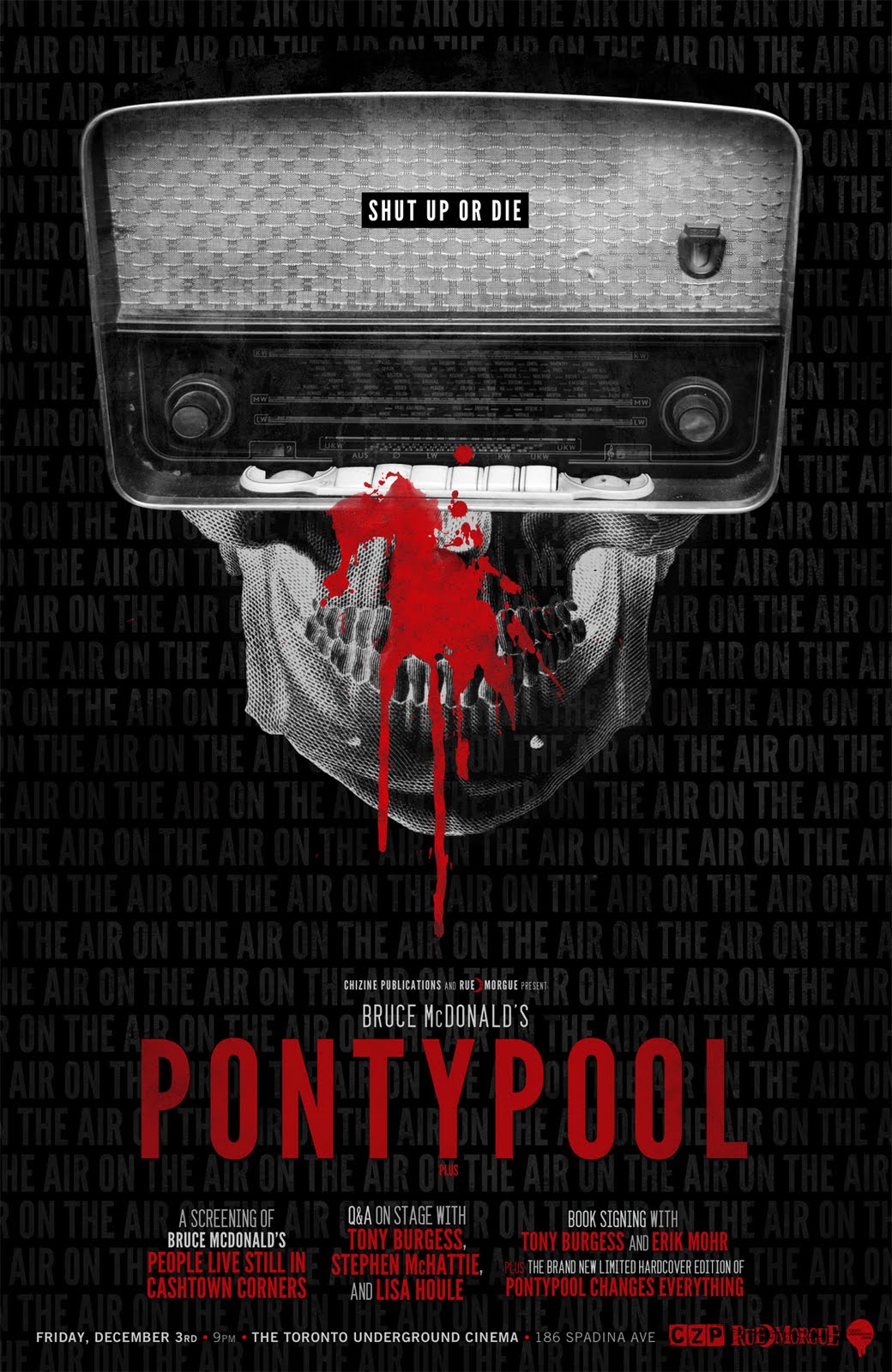
It was only a matter of time before we hit a zombie picture before actually reaching the letter Z; frankly, I’m surprised it took this long.
Pontypool is the name of a small town in Ontario. Grant Mazzy (the underrated Stephen McHattie) has been consigned to a small news radio station there for his sins. His reputation as a “take no prisoners” on-air personality doesn’t mesh well with Canadian Mayberry politics, and his harried producer Sydney (Lisa Houle) is trying to ease this squarest of pegs into the station’s round hole.
This snowy Valentines Day morning, however, something is up. Their traffic reporter (who Sydney admits is not in a helicopter, just a guy on a hill with some binoculars) sights a crowd of people mobbing and destroying a doctor’s practice, then moving on, destroying and killing anything in their path. There is nothing on the news wire, and the station has to rely on phoned-in eyewitness reports. The possibility that this may be a hoax is ruled out when the mob actually reaches the station.
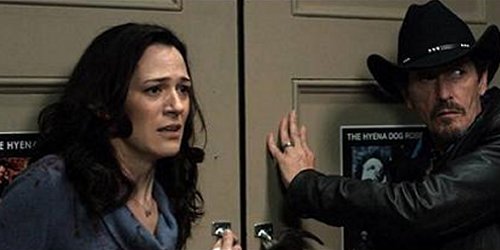
Pontypool started life as a novel, Pontypool Changes Everything, and then a radio play, a format in which the story likely soared. The ever-growing mob aren’t really zombies, though; they are in the grip of a virus that transmits itself through spoken language. That’s not a totally new or original concept, but it is a difficult one to get across in a visual medium. The doctor whose practice was destroyed (Hrant Alianak) manages to escape to the station, and gives voice to the exposition, if not an explanation for the phenomenon.
There may be something of an explanation slyly buried in the story: a warning message in French that breaks into the station’s frequency and cell phone calls. Reports that military forces are moving in to the area. The government seems very prepared for this particular emergency. And not, as a BBC reporter opines, because of the area’s “secessionist tendencies”.
Confining the story to a single radio station gives us the requisite claustrophobia for our zombie siege, but it also means the movie is going to depend heavily on the acting chops of the small cast, and they are uniformly more than up to this task (I haven’t mentioned Georgina Reilly as the doomed assistant producer, and I should). The story begins to flag somewhat in its final act, though there is some cleverness when our survivors figure out that English seems to be the only language that’s a carrier, and have to rely on their limited knowledge of French.
However, I really appreciate that the filmmakers found a way to continue the story under the final credits crawl.
Overall, Pontypool is a pleasant surprise, a very unusual zombie picture managing to be both thoughtful and frequently harrowing, exploiting the theater of the mind in a way that movies rarely ever attempt.
Oh dear God, not Jess Franco again! Why? Whyyyyyyyyy
What’s that you say? It’s not Jess Franco? It’s Pierre Chevalier? And what is more, you claim that after the first ten minutes, I am going to be begging for the return of Jess Franco? Pish tush, I say! And furthermore, folderol!
You are, incidentally, going to be right.
This is known by many names – even on its own DVD. Sure, the cover says Orloff and the Invisible Man, but the menu claims it’s Orloff Against the Invisible Man. Go to the IMDb and it’s Dr. Orloff’s Invisible Monster. In the UK, The Invisible Dead. And if you use Letterboxd, it’s the original title, The Love Life of the Invisible Man. That last one is going to turn out to be – rather horrifyingly – the movie’s raison d’etre.
We are apparently once a-goddamn-gain in some superstitious 19th century Carpathian village, and the new doctor in town can’t understand why no one wants to take him to the castle of Professor Orloff for an emergency call. At least the doctor in Kill Baby… Kill! made it almost to his destination, this poor sod gets ditched in the middle of nowhere, and in a rainstorm, to boot.
Dr. Garandet (Paco Valladares) finally makes it to Castle Orloff, where the two remaining servants also refuse to tell him what’s going on. He finally talks with Orloff’s daughter, Cecile (Brigitte Carva), who tells him she’s seen an invisible man, and also her father is always in his laboratory. Papa, of course, is Professor Orloff (Howard Vernon), who not only somehow survived our last encounter with him at the other end of the alphabet, but also managed to add an “f” to the end of his name.
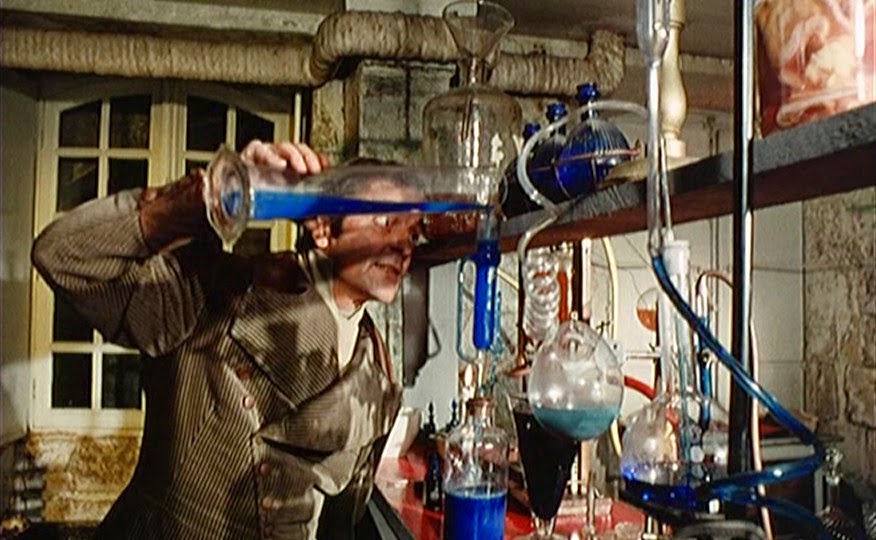
Oh, good God, why keep pretending? This has absolutely nothing to do with that Orloff except it’s still Howard Vernon, and he’s still tampering in God’s domain like a mofo. In this case, he has created an Invisible Man (exactly how is never revealed), an entirely new form of life which is “Intelligent and obedient” and will rule the world, or something mad science like that.
But never mind that, let’s while away the next twenty minutes with the tale of how, six years ago, Cecile had some sort of cataleptic fit and was interred alive, and saved only by two wicked servants robbing her grave for the jewelry. When she revived, they panicked, stabbed her, and ran off. Well, the smart one, the woman (Isabel del Rio) ran off, the man stuck around to be used for experiments. Oh, don’t worry, the woman is tracked down with dogs, which causes her blouse to unbutton.
This suspiciously modern underwear does not appear in the actual movie.
You see, to get back to the Invisible Man stuff, and the Love Life thereof, if you see a woman under the age of 30 in this movie, you can rest assured that at some point you are going to see her naked. Isabel del Rio, to convince her fellow servant to do some grave robbing, will coquettishly (ie., slowly) change into a nightshirt. Then take it off and put her clothes back on for some resurrectionist action. The one remaining female servant in the castle – who is the one who sent for Garandet – will be punished by handing her over to the Invisible Man, mainly because Orloff “wants to see what he will do with a human female.” It involves the poor girl jerking herself around, trying to convince us that she is being pulled along by something invisible, and then manhandling herself on a bed of hay. Then, when we thankfully start running short on time, the Invisible Man also wants to rape Cecile, so say goodbye to that particular nightgown, too.
(I must give Image Entertainment props for giving us, as a DVD extra, the Alternate Clothed Footage of these scenes, unlike yesterday’s feature)
SCIENCE!
In other words, a better title would have been The Rape Life of the Invisible Man. The plot is entirely superfluous, and were we not distracted by naked breasts and unshaven pudenda (I would like to thank modern pornography for making pubic hair exotic again), the entire enterprise would be so generic and unoriginal, so padded with lugubrious claptrap, that the only way to deal with it would be to take a restful nap or perhaps read a book while you coexisted in the same room with it during its mercifully brief 82 minutes.
There are points at which somebody on the crew said, “Hey, you know, that Bava guy’s been doing some pretty cool stuff” and breaks out the colored gels in the numerous catacomb scenes, but overall the scenes are way too brightly lit – there are obviously big lights on the other side of the camera, eliminating all atmosphere and period ambience. There is also a bizarre reliance on close-ups that are out-of-focus, but now perhaps I’m just being bitchy.
The invisible effects are, at least, handled pretty well… at least until Garandet tosses some flour on the Invisible Man and we discover it was a man in a monkey suit all this time. Don’t believe me? Here:
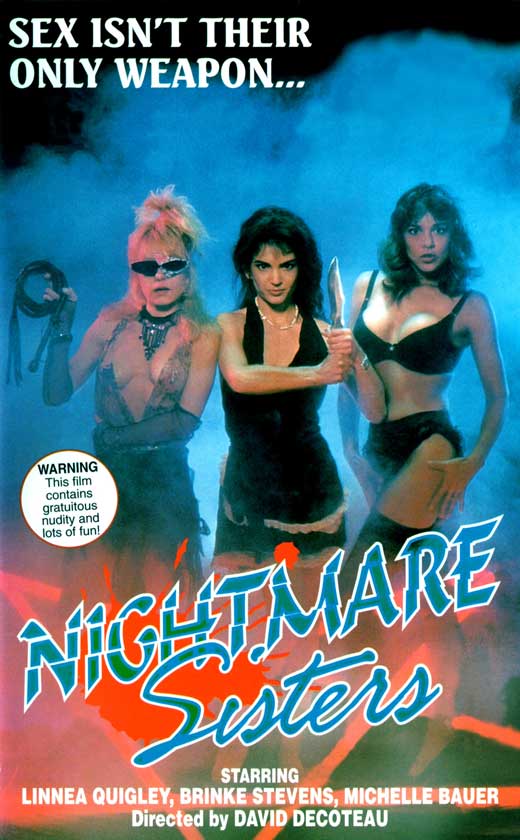
I’ve gone on record that most movies featuring more than two horror icons tend to be pretty dreadful. I have to say the inverse is true for movies featuring multiple 80’s scream queens, because, despite all my worst intentions, I wound up enjoying Nightmare Sisters.
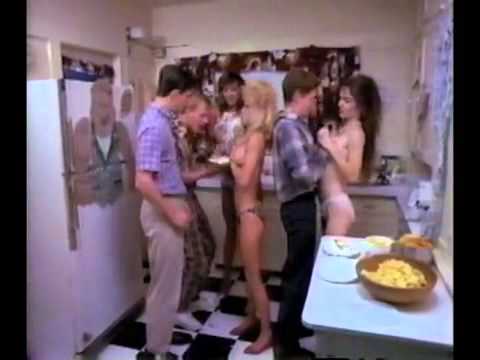
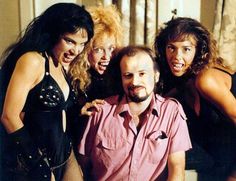
Your three Scream Queens in question are Linnea Quigley, Michelle Bauer, and Brinke Stevens, all of whom spend the first half of the movie trying to make themselves look unattractive. They’re playing what the ad copy calls “geeky sorority sisters”. Melody (Quigley) has buck teeth, Mickey (Bauer) is wearing a fat suit and has some cotton stuffed in her cheeks, and Marci (Stevens) wears glasses and needs some hair product. All are alone in their sorority house for the weekend, so the only one who knows a boy on campus (that would be Melody) calls up the guy she had a disastrous date with a month before and invites him and two friends over for a party.
This proves only slightly less disastrous than that date a month ago, involving scrapbooks, bad sing-alongs, and a game of Twister that ends in injury. Finally they decide to have a seance with the crystal ball Marci bought at a flea market earlier that day. If the kids had been watching the movie before their part, they’d know that the crystal ball belonged to a medium who had used it to track a client’s missing husband, and discovered the chap had been killed by a succubus… who then reached through the ball to rip off the medium’s head.
Well, the succubus is still hanging around the orb, and decides to possess the three girls, transforming them instantly into Scream Queens. Topless Scream Queens (they were apparently supposed to be nude, but Stevens objected). Extreme debauchery seems to be in the offing, but the one sensible freshman suspects that something may be up.
There are also three upperclassmen from the boys’ frat who are determined to ruin our “heroes” night by substituting themselves for the unfortunate freshmen. Unfortunate is in the eye of the beholder, however, as this means that each charming member of the WASP Hitler Youth club gets reduced to ashes via fanged mouths on their little Hitler youths. There’s nothing left to do but call an exorcist our heroes find in the local Yellow Pages. (“California! Go figure.”)
If you are thinking, with the plentiful and exceedingly gratuitous nudity, that this sounds like a David DeCoteau movie, congratulations! You did not fall off the B-movie turnip truck yesterday! This project was apparently shot on leftover film stock, using a script that was written in seven days. No word on the shooting schedule, but the credits do mention a “Four Days Wonder Group”, which may provide a clue. I’m thinking the ladies provided their own costumes. When they’re wearing any, I mean.
As I mentioned, I was really expecting to hate this. But dammit, it won me over. The script is cheesy, to be sure, but bizarrely good-natured, seldom mean. Except where the frat boy monster fodder are concerned, but come on, they’re asking for it. The most overt nod to self-awareness is an early line from Quigley, who says she’s doesn’t like scary movies because “One zombie movie was enough for me.” (Return of the Living Dead was in ’85, in case you were wondering) Quigley, Bauer and Stevens seem to be having fun playing theoretically unattractive versions of themselves, which really helped.
And, okay, there was a chink in my armor anyway, and that is Michelle Bauer. I’ve followed her career through a bewildering variety of aliases and a number of genres, some of which *harrumphharrumph* probably shouldn’t be spoken of here. The thing is, in addition to her obvious beauty, if called upon to do so, the lady can actually act, which has made all the difference in some pretty scuzzball movies. That’s my kryptonite, right there. Cute and talented? Go ahead and start chiseling my tombstone.
I was entertained while watching it, but there was one thing that niggled at the edge of my concentration: I knew I had seen part of this on USA Up All Night, the question became, how was this even possible? Apparently the nude scenes were replaced with lingerie shots, and a three-way bubble bath was replaced by the three lingerie-clad demons frolicking on a bed with balloons and blowing bubbles, to match (as well as, um, possible?) the existing dialogue track. Honestly, I would liked to have seen this stuff as an extra on the DVD (which I see now fetches a ridiculous price on Amazon).
I’m not sure which amazes me more: that the movie had enough of a budget to shoot alternate scenes, or that they were optimistic enough to think that such footage would even be necessary. You know this thing was destined for a quick VHS release, and not much more.
Well, there’s none of that alternate footage stuff here, so don’t go watching this at work:
If there was one thing – one thing – I have taken away from 70s horror movies, it’s that “monster rallies” almost inevitably suck. I’m not talking about actual monster rallies, but movies that gathered together the gray eminences of horror stars in the same flick. Christopher Lee, Boris Karloff, Peter Cushing, John Carradine, any combination of the above should be marvelous. What they are, usually, is quite tedious. This may be a problem with the horror genre overall in the 70s, desperately trying to re-invent itself in a new era with real-life horror vomiting forth from living room TVs every night. Watch Bogdanovich’s Targetsagain and realize in how many ways it was a prophetic piece of work, not only cinematically, but in the real world.
Well, sometimes they’re not too terrible, perhaps in spite of themselves. Madhouse falls into this category.
That is, however, some very nice makeup.
Vincent Price plays Pete Toombs, an actor who has made his fortune playing a character named Dr. Death in a very successful series of movies (which always seem to look a lot like movies made by co-producers AIP in the 60s, hmmmmm…). During a fairly fractious New Years party “five years ago”, Toombs has a falling-out with his young bride-to-be, and later finds her decapitated body. It’s possible that he killed her in some sort of fugue state, and he spends several years in a mental institution.
In present day, he is called to England by his old friend, Herbert Flay (Peter Cushing), a former actor himself and writer of the Dr. Death flicks. Flay has joined with producer Oliver Quayle (Robert Quarry) – who caused the falling-out five years ago – to produce a Dr. Death TV series. Toombs resists at first, still unquiet over his fiancee’s death, and above all, fearful of Dr. Death. “He frightens me. I’m frightened of what he can do.”
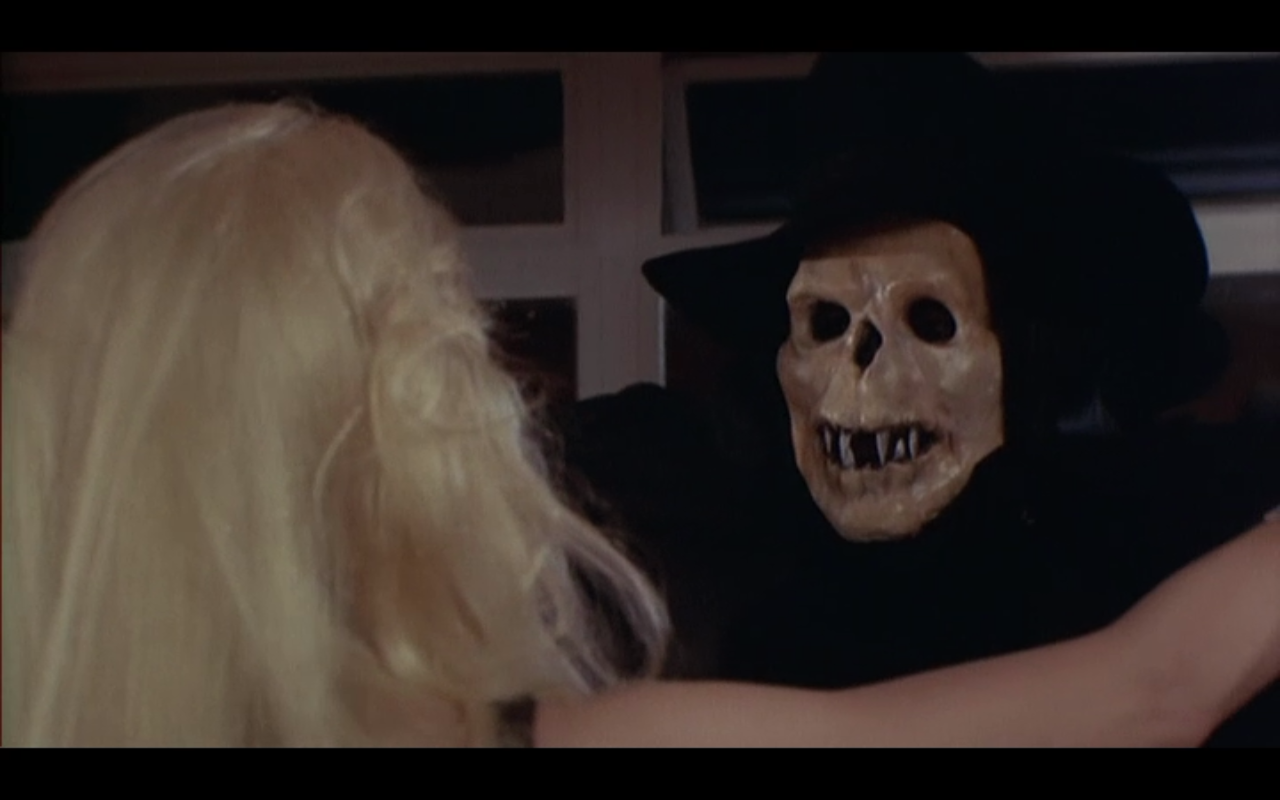
Well, needless to say, being a horror movie and all, it’s not long before the bodies start stacking up like cordwood. Toombs gets stressed out, closes his eyes, we see hands donning black gloves, and someone wearing Dr. Death’s costume kills someone else in ways reminiscent of the movies. A very real problem is that whoever the killer is wears a skull mask, so it’s obviously not Toombs committing the murders (if it was, why bother with the mask?). In fact, the culprit is pretty transparent from the get-go, though the movie tries to obscure this over the next 90 minutes or so. When the last line of a flick is, “It’s your favorite dish… sour cream and red herrings” that notice has been noisily nailed to the wall.
Yes, this is famously (and obviously) one of those movies where the script was being written even as scenes were being shot. Supposedly based on a novel by Angus Hall, Devilday, about the only things left over are the main character’s name and the fact that he was a horror star. Everything else was in an improvisational muddle right up to the end, which is just as confusing and unlikely as anything else preceding it. There is a reason this was the final collaboration between AIP and Amicus.
But another thing I learned from watching allllll these British horror movies from the 60 and 70s: even in the worst of them, the actors can be relied upon on to take the whole thing seriously. They do not camp or mince about, unless the material explicitly calls for it; even Christopher Lee, when he refused to say his lines as Dracula because he found them too gawdawful, once that camera was rolling and “Action” was called, hit his mark and made with the scary.
Every actor in Madhouse gives it his or her all, even though the script does not particularly reward them for it. Price is especially good, Cushing is sadly wasted, for the most part. Robert Quarry was obviously being groomed to replace Price as AIP’s horror guy, but increasingly it became obvious they had no idea how to facilitate that, which is too bad: he’s always solid. I was also pleased that I recognized Linda Hayden from Blood on Satan’s Claw.
The conceit of using footage from Price’s earlier movies as previous Dr. Death flicks allows us to enjoy sequences with Boris Karloff and Basil Rathbone – and to ballyhoo their names in the opening credits as “Special Participation by…”
Leave it to AIP to find a way to exploit you after your death. It’s a device lifted from that earlier mentioned, Corman-produced Targets. Too bad AIP learned the wrong lesson from Corman, or, rather, badly misinterpreted it.
This is another of those “I knew I was going to have to deal with this movie someday” posts.
Yes, I managed to live through almost a half century without watching The Last House on the Left, despite it being pointed to as a milestone in horror movies. There are two reasons for this. The first, and I suppose major, reason is I don’t like movies like this. Yes, I love horror movies. But I prefer my fright films on the fantastic side; give me literal monsters, not human ones. So the period of my life when nothing but slasher movies were being made was a particularly tough one.
The second reason: a close childhood friend – and we had bonded over the fact that he was the only other person in my small town as obsessed by horror movies as I – had managed to see it despite its R rating, and before much furor had built up over it. He proceeded to describe the movie to me in gleeful detail, editing out every scene that did not include death, humiliation, debauchery, terror or gore.
So I felt like I had already seen it.
As I write this, it’s only been a couple of weeks since we lost director Wes Craven to brain cancer. The outpouring of grief and admiration from his fellows and fans was nice to see; after all, as Ken Lowery pointed out on Twitter, “It’s not everybody who gets to set the zeitgeist for his genre three times.” I liked and respected his movies (Nightmare on Elm Street, after all, put the fantastic into slasher films), but again – I hadn’t seen his first two (Yeah, Hills Have Eyes, also. Psycho hillbillies, Not a favorite subgenre, Texas Chainsaw notwithstanding). Immediately after Craven died, lots of people were watching his movies. Last House on the Left I had slotted into Hubrisween almost a year ago, and it was also in my 100 Films challenge.
So now I’ve seen it.
It’s Mari Collingwood’s 17th birthday, and she is going to a concert with her friend from the wrong side of the tracks, Phyllis (your designated victims are played by Sandra Peabody – under the assumed name of Sandra Cassell – and Lucy Grantham, respectively). Mari’s dad, a doctor, is worried about the concert taking place in the seedy part of town, but it’s okay, because that’s where Phyllis lives, right?
The Collingwoods live out in the country, incidentally. And we are given a preview of the generally sleazy tendencies of the upcoming movie when the grandfatherly rural mailman refers to Mari as “The prettiest piece I’ve ever seen.” And oh, yeah, there’s something wrong with the phone. That might be significant later.
The two girls hit the seedy part of town we’ve heard so much about, and try to score some grass from an equally seedy looking guy. Unfortunately, this guy is Junior (Mark Sheffler), the son of escaped convict Krug Stillo (David Hess), whom Exposition Radio had earlier informed us is so bad he hooked his son on heroin just to further control him. Junior takes them upstairs to where Krug, his moll Sadie (Jeramie Rain) and associate Weasel (Fred Lincoln) are hiding out. And before you can say “fresh meat”, the two girls find themselves the hostages of some pretty bad people.
The gang is going to take the girls in their trunk as they head over the border into Canada, but their car breaks down, and the girls are taken into the woods for what passes for fun and games among creeps. There is an effective moment when the tied and gagged Mari realizes the car broke down next to the mailbox outside her house.
Thereafter follows the portion of the movie that got Last House declared a Video Nasty in England and incurred most of the projection booth censorship by shocked projectionists and nervous theater owners with scissors. We’ll start out with various forms of humiliation, including forced lesbian sex, but it isn’t until Phyllis tries to escape – and almost succeeds – that things turn really bad, She is stabbed, disemboweled, and generally hacked to pieces. Then, blood-soaked and in a frenzy, the killers return to where Mari has been desperately trying to convince Junior to run away with her. Mari is raped, and as she staggers away in shock, is shot in the back.
We are now little more than halfway through the movie.
Krug and company clean up, change clothes, and go to that house across the road to call for someone to fix their car. The Collingwoods feed them dinner and invite them to use the guest room and the missing Mari’s room, until the phone is fixed in the morning. Junior is in withdrawal, and while Mom is checking on him, she notices he is wearing the necklace Dad gave Mari for her birthday. She then finds their bloody clothes, and rousting Dad from bed, they head out into the woods and find Mari’s body.
And then they turn into avenging angels. Rather bloody avenging angels. With a predilection toward booby traps (which would serve the director well in Nightmare on Elm Street).
Wes Craven said he was trying to say something about violence when he made Last House. Given that the movie is still regarded as a non-stop assault, he may have made that point. There are many times where the camera is expected to cut away, and it doesn’t. Some of that is due to the fact that the only filmmaking Craven had done to this point was documentary, and he went with what he knew; scenes are done in long takes, rarely employing a tripod, so the atrocities are presented to the viewer like the evening news, unbroken by edits. It lends an immediacy to the horror that can’t be over-emphasized. The filmmakers also only knew the rough basics of how to make stage blood, and the stuff they came up with looks disturbingly like the real thing.
What my childhood friend didn’t tell me about, though, what he didn’t feel was special enough, can be broken up into two classes. The first is the comic cops, a Sheriff and Deputy (Marshall Anker and Martin Kove, oddly enough), who suddenly realize that the broken-down car they saw outside the Collingwood’s is the Krug getaway car, but they run out of gas while racing back to the scene. Mari and Phyllis’s desecration and murder is intercut with supposedly comic sequences of these two trying to hitch a ride. It’s supposed to add more tension to the girls’ plight, but generally just makes one question the filmmaker’s judgement.
The second thing omitted might have made me more interested in watching Last House, and it’s the Littler Things, things that could get lost in the bloody wash. First, the script is actually pretty clever, and often witty – really. Second, Craven is quite aware that even barbaric tribes are concerned with their own: witness Weasel’s cry of “Sadie! Are you all right?” when the escaping Phyllis smacks her on the head with a rock, abandoning his pursuit to check on her. And finally, after Mari’s rape, as the girl slowly pulls her clothes on and wanders off in shock – Krug, Sadie and Weasel looking everywhere but at her, finally at each other, realizing they have just thrown away the last shreds of humanity they might have harbored, and that is not cause for celebration.
That is what gives Last House on the Left its claim to being an important movie. The ultimate message that violence not only damages the victim, but also the aggressor, in ways beyond blood and bone. Mari’s parents get their revenge, certainly, but at similar violence to their humanity.
Most people don’t want to know about that, though. They want to see rapin’ and killin’.
It eventually came out that the source material for Last House on the Left was an Ingmar Bergman movie, fer cryin’ out loud, The Virgin Spring(Academy Award Winner, Best Foreign Language Film, 1960, no less). So once again I hie myself to The Criterion Collection.
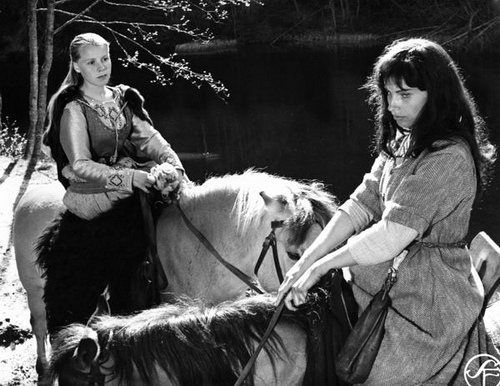
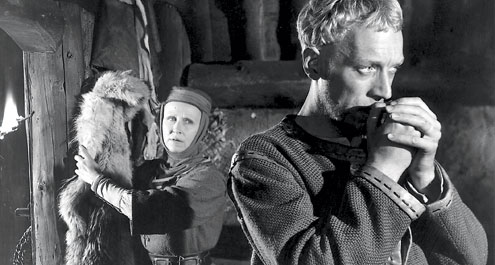
The first difference you’re going to note is the story is set in medieval times; paganism is being supplanted by Christianity. Phyllis, the girl from the wrong side of the tracks, is now Ingeri (Gunnel Lindblom), a pregnant girl adopted by the family of Töve (Max Von Sydow), a successful farmer and ardent Christian, though perhaps not as ardent as his wife, Mareta (Birgitta Valberg), who burns herself with candles on “the day of our Lord’s suffering”.
Ingeri opens the movie by praying to Odin to strike down her foster sister, Karin (Birgitta Pettersson), who is currently oversleeping on the day she is supposed to take candles to the local church for the Virgin Mary. Karin is the opposite of Ingeri in every way: blonde, chaste, spoiled. She puts on her finest garments and heads to the church, with a reluctant and bitter Ingeri in tow.
At a river crossing, Ingeri begins to be fearful of the vengeance she had called down on Karin, and stays behind, only to be freaked out again by a fellow Odin worhipper when he begins showing her the remains of his last sacrifice. So Karin is alone when she runs into three wandering sheepherders, known only as Thin, Mute, and The Boy, which is a good descriptor of them (Axel Düberg, Tor Isedal, and Ove Porath). Beguiled by Thin’s use of a mouth harp, Karin talks with them for a while, then offers to share her lunch with them. They’re not much interested in saying grace with her, though.
As the lunch goes on and Karin brags about her family and their farm, the herdsmen start getting closer and closer, and Karin begins to realize she’s in trouble, but way too late. In fact, one of the most heartbreaking parts of this segment is that she shifts into hyper-nice, trying to distract the two older herdsmen from their obvious intent, but to no avail.
Karin’s rape is, once again, the part that got scissored for years and years. It is not explicit in any way, but it is ugly and horrifying. Bergman argued that it should be ugly and horrifying, that to cover its brutish offensiveness by discreetly cutting away would not only lessen the impact, but would, in effect, let the audience off the hook emotionally. That sigh of relief would diminish the character’s suffering. Honestly, rape needs to be seen for the horrific crime it is, not a mere plot device.
Immediately afterward is the same scene as in Last House, as the two herdsmen realize the monstrousness of what they’ve done (Craven knew what was important, and what was necessary to carry over to his version). Karin wanders first toward the camera, then back, before the mute herdsman beats her to death with a club. There’s another shocked moment, then the two herdsmen strip the clothes off her body and run off, telling The Boy to watch the herd until they come back. Eventually, overcome with horror, The Boy will try to throw some dirt over her body, as snow begins to fall.
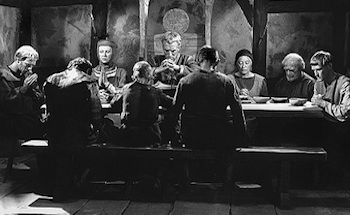
That night, Töve receives three visitors to his manor house: it’s the three herdsmen, claiming to be workers travelling south for warmer weather and work. Töve tells them to come in from the cold, and feeds them. The Boy, terrified, is the only one who recognizes the grace they say over their meal is the same said by the girl the two men murdered. Töve, ever the good Christian, tells them there will be work at his farm soon, and goes to bed.
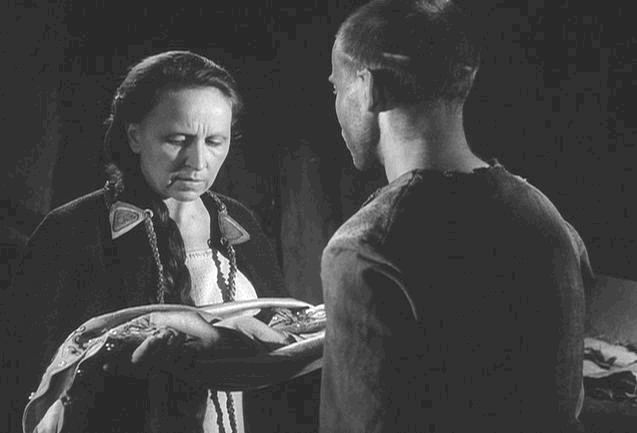
Marta checks in on her guests when she hears the boy cry out; another guest – a beggar – tells her the mute one struck the boy. As she leaves, Thin tries to sell her a silk shift he says belonged to his dead sister. Marta recognizes it as Karin’s, and the absolute stillness of Valberg’s acting in this scene is a gut punch. She takes the shift, saying she’ll have to talk to her husband about a proper reward for it, and leaves, not giving in to emotion until she has left the room. Then she locks the door behind her and wakes Töve.
Töve digs through a chest of clothing and recovers his sword. He goes out to prepare for what he must do, and finds Ingeri hiding under the stairs. The poor girl had witnessed what happened to Karin, and is convinced that her prayers to Odin were the cause. (In the original cut of Last House, when Mari’s body was found, she was still supposed to be clinging to life, long enough to finger Krug and company for the crime. You can still see her moving and breathing in that scene) She begs Töve to kill her for that transgression. He tells her to get up and help him get ready.
He forsakes the sword for the “butcher’s knife” and walks quietly into the main room, where the killers are still sleeping. Marta follows, locking the door silently behind her. Töve opens the men’s bags, finding more and more of Karin’s clothing. Then he wakes them up and kills them, one by one. It’s not the climax of Last House with a chainsaw and a switchblade, but it is cringe-making as the two men try to defend themselves but are no match for a wrathful father. Töve then, in an Old Testament rage, grabs The Boy, who had run to Marta in terror, and smashes him against a wall, killing him instantly.
This is pretty much where Last House ends, with mother and father covered in blood, the comedy cops finally arriving and horrified, and the living protagonists with a thousand yard stare. Bergman, however, gives us Töve’s despair at what he’s done, the search for Karin’s body, Töve’s talk with God about how He allowed this to happen, and his own determination that he must atone for his wrath and murders by building a church of rock and mortar on the spot where Karin was killed. He raises Karin’s body, and a spring begins to flow from the spot, as this is based on an ancient Swedish ballad, and that is how it ends.
In the overall sweepstakes of my favor, The Virgin Spring has the clear edge, technically and presentation-wise. But that’s a mug’s game, really; Bergman had been making movies for fourteen years, and The Virgin Spring was his 26th. It’s not totally an apple-to-oranges comparison, but it’s close. I find in considering and analyzing it, my overall opinion of Last House on the Left has actually improved. That said, I know which movie I would watch again, given a choice.
You’ve probably seen The Last House on the Left, you’re not a general movie layabout like myself. Now watch how one of the greatest filmmakers of the twentieth century handles that last scene. No subtitles necessary.
What a ludicrous title. I can’t say its original title, which translates out to Operation Fear was any better. Neither works very well for a 19th century ghost story. Probably the most appropriate of its many alternate titles isCurse of the Living Dead. Still. It’s bizarre how a little something like that can turn me against a movie so many people revere.
Into your typical spooky 19th century Carpathian village strides Dr. Paul Eswai (Giacomo Rossi Stuart). He strides because, as is traditional with spooky 19th century Carpathian villages, the carriage driver refuses to take him into the village gates. There’s the usual superstitious peering through windows as he passes.
Eswai is there at the request of Inspector Kruger (Piero Lulli) to act as coroner in the death of a young lady before the opening credits. She was seriously frightened, and felt compelled to impale herself on an iron fence. Kruger is ranting and raving about superstitious villagers – he even stops the hasty burial of the girl so Eswai can perform his autopsy, assisted by Monica (Erika Blanc, playing the ingenue for a change), a local girl who recently returned to the village from college. What Eswai finds is a silver coin actually inside the girl’s heart.
There is a whole lot of superstition roaming about so Eswai can tut tut at it. There’s the ghost of a little girl, and whoever sees her has a habit of dying violently (spooky 19th century Carpathian villages hold a plethora of spiky, edged decorations just waiting for someone to be cursed by a vengeful little ghost). This is all tied to the local Baroness, and the tragic death of her daughter, but whoever ventures to her house is doomed, so it’s going to take an entire movie to tease that out. There is also a sorceress (Fabienne Dali’) in the village trying to thwart the ghost, but Eswai, of course, is going to undo all her witchy poppycock and get at least one person killed doing it. Take that, science! You’re not helping!
The movie’s more than a bit of a mess, with at least one prime scare built up to but not exploited, likely due to the producers running out of money two weeks into the shoot. The best move those idiots made was hiring Mario Bava as director, though. The atmospherics are cranked up to 11, as is the color saturation. I was watching an older DVD (I think it was given to me by a friend ages ago, and a sales receipt tucked inside bears a date of August, 2001) with a grainy image and – horrors! – a 4:3 picture. TV print, probably, and it still couldn’t kill Bava’s imagery, especially the final scenes, where things get downright hallucinatory. Bava and the actors finished the movie without pay, which was darned generous of them. And if the final act feels somewhat… rushed, shall we say… there are some impressively pretty pictures. And one sequence involving a repeating room that really makes me smile.
The pity is the script had a bit of novelty going for it – novelty that got squashed by the producer’s financial problems. It is a small miracle it’s as watchable as it is.
This is how I ALMOST saw KILL BABY KILL back in ’68 or so…
I recall Video Watchdog had a typically comprehensive story on the trials of making this movie and its many, many versions, but I hadn’t seen it yet, so there was little in the article to relate to, and nothing stuck in my memory. I lost most of my VW collection in Hurricane Ike, so I can’t check on that. Well, I could, their entire run is available digitally, I just don’t have the time.
So you’re stuck with this, off-the-cuff impression: It’s a mess, it’s not too terribly original, but any Bava movie is worth watching, for the sheer artistry alone. It’s possible to hit “pause” at almost any point in this movie and say, “Uh huh. This is a Mario Bava movie.” We are talking the Platonic ideal of gothic horror setpieces here. And if you find a version that’s in its original 1.85:1 ratio, so much the better. (Amazon Prime Video has the Kino-Lorber print, which is windowboxed, but a bit soft. I have been so spoiled by the recent Bava blu-rays, it ain’t even funny).
I keep trying to remember when I first heard about Jeepers Creepers. It was released on August 31, 2001, which means eleven days later nobody was talking about it. Perhaps once the initial shockwaves wore off, and people were looking for escapism – that might have been when I starting hearing about it. The general consensus was that it was good up to a point, and then we found out there was a monster involved, “and that ruined it.”
Bullshit.
I am getting all sorts of ahead of myself.
Trish and Darry (Gina Phillips and Justin Long) are two college students, brother and sister, driving home for break, and due to Trish’s misgivings about their parents’ deteriorating relationship, they are taking the scenic route, the long way home. This is a mistake.
Start with a Duel type encounter with a huge, rusted-out van with a dissonant horn that would deafen a heavy metal concert. The two later spot the van outside a deserted church, and a rather creepy-looking figure throwing what are oh-so-obviously bodies into a drainpipe. Then they get chased again, and forced off the road.
Darry wants to go back and find out if whoever got tossed into that pipe is still alive. Trish takes the much more sensible approach that they should just get to a phone and call the cops (Darry’s cell phone is dead and the cigarette lighter in Trish’s vintage Chevy is broken). Gina makes the far more compelling case, but this is a horror movie, so back they go.
The pipe goes down much further than anticipated, and Darry, of course, winds up falling down it. One of the bodies, he finds, is still alive, though not for long… and it isn’t the only body down there. In fact, there seems to be a hundred or more, nailed to the ceiling of a subterranean chamber like a ghoulish Sistine Chapel.
Darry finds a way out through the church basement, and they finally head to the next town to get help. Two cops will follow them back to the church… but they won’t make it there.
Ah, you already know this. What’s driving the van is The Creeper, a thing that is allowed, every twenty-three years, to eat for twenty-three days. It eats only parts, the parts it needs to replace, until its next meal break. The rest it arranges in its lair because it has an artistic bent. And it wants some body part from either Trish or Darry.
Once it’s established the Creeper is supernatural, it becomes a chase movie, Trish and Darry careening from one supposed place of safety to another, finally ending up at a police station where the Creeper is going to re-enact The Terminator after chowing on some prisoners to replace damaged limbs. The movie’s process is pretty sneaky and well played-out; The Creeper gets a little weirder every encounter, every attempt to kill it, even multiple attempts at running it over with that Chevy (should we add Forever Evil to the movies referenced? Naaaaaah). This is a totally new movie monster, and we – and the characters – are unsure of its mythology and any weaknesses, if indeed it has any. Clues are dispensed by Gizele (Patricia Belcher), a woman with unreliable psychic powers, and they aren’t very useful.
As we already know, I hate slasher movies, and I hate psycho hillbilly movies, and I tolerate giallo if it has a decent murder mystery embedded in it. But monster movies? Them I love. I should have rushed right out to see Jeepers Creepers when it was in theaters, the instant I found out it was a creature feature. But I was pretty broke in those days. It did alright without me.
As much as I liked it, though, I really can’t see how this would support not one, but two sequels. But then, that is something I could say about any number of horror movies.
(I know, I know, you’re waiting for me to say something about writer/director Victor Salva. What I knew before watching this was hearsay, and now I have confirmed details. Google his name, if you’re unfamiliar. I still like this movie. Separating art from its creator is never easy. It was a lot easier with Roman Polanski, whose movies I generally didn’t like. Salva’s a little tougher. Unlike Polanski, though, Salva did jail time – not very much – but he didn’t try to escape his punishment. Judging any further than that is for a higher power than myself.)
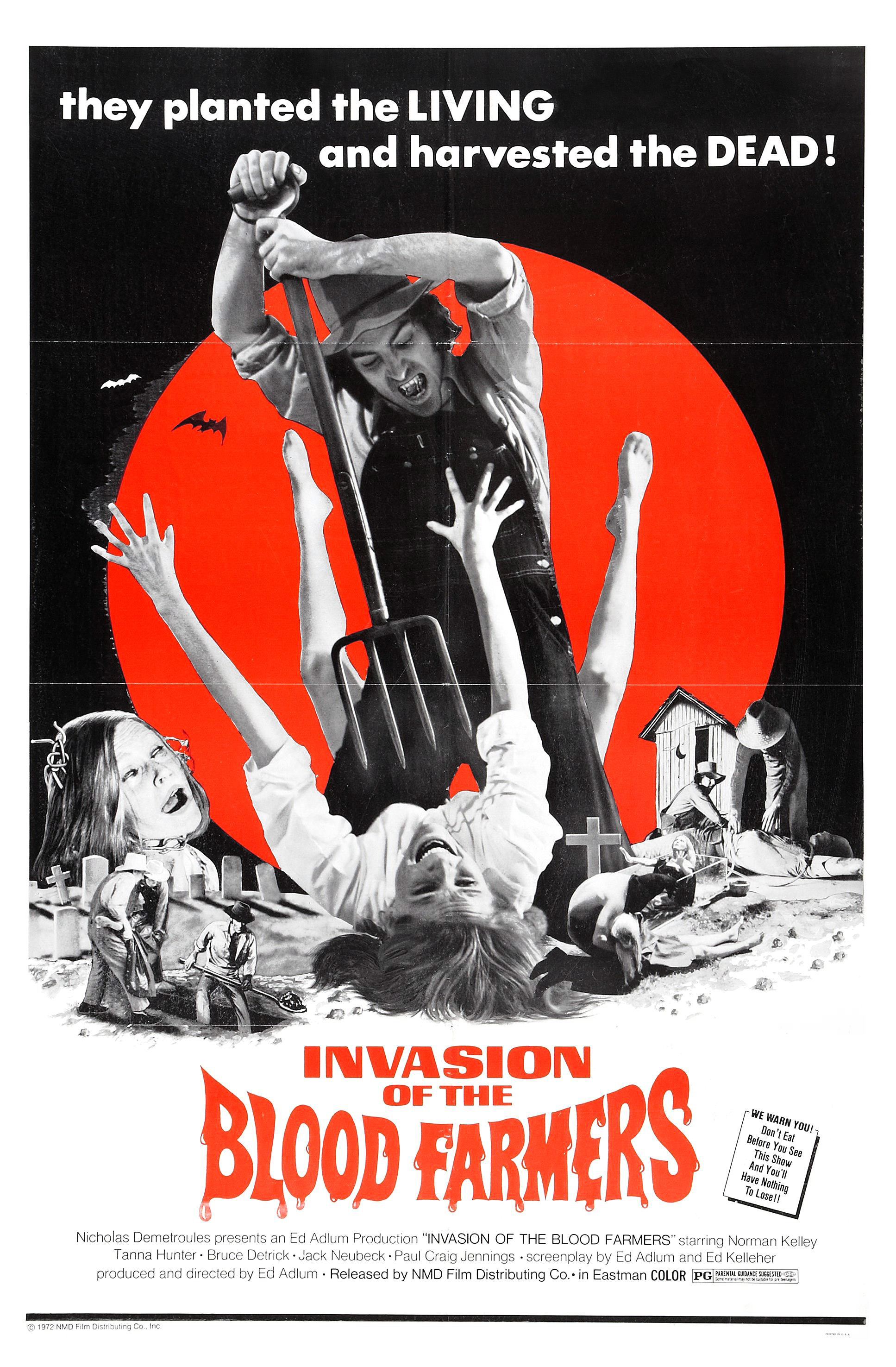
I don’t think it was until the Psychotronic Era of Film Writing came about that I even heard about Invasion of the Blood Farmers. It maybe maybe maybe had a brief mention in Famous Monsters of Filmland in a “Coming Soon”, but its existence was news to me until I got out of college. When a movie vanishes that completely, you should know something is up, but no, not us, no sirree, we know we have to see a movie with a title like that. It could be an unjustly ignored gem!
It never is. We’re idiots.
(I’m an idiot who wants to thank Code Red DVD for enabling my idiocy on a regular basis)
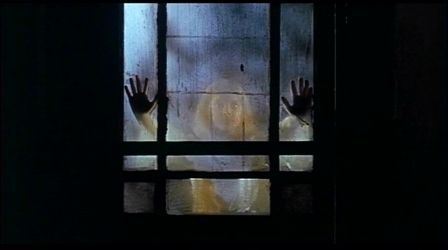
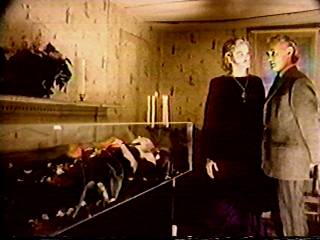
These “blood farmers” are a cult of druids calling themselves “Sangroids”. They’ve apparently done away with a family in a remote farmhouse while searching desperately for the extremely rare bloodtype that will revive their Queen (who lies in repose in a glass case) before the stars match up for the last time and the “Prince of Darkness” (they’re pretty Catholic Druids) comes for them all. They do this by injecting some sort of drug into their victims; if the unfortunate is not the Chosen Type, it will cause their blood cells to multiply exponentially, which is okay, because Sangroids drink blood on a regular basis. They just hook up the non-Chosen to a siphon and drain them, leading to much overacting.
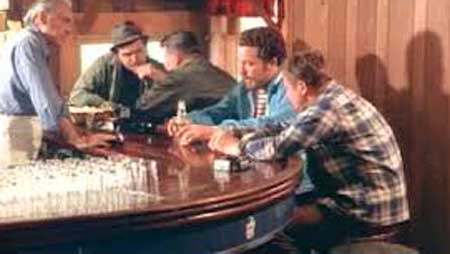
One of their victims escapes and makes it to a local bar before expiring because the rampant blood production kills him (this could have been a far messier demise, but low-budget and all that. A young Peter Jackson or Stuart Gordon would have painted the bar and everybody in it red). This gets a local pathologist and his grad student assistant involved in the Mystery of the Growing Blood, and the pathologist’s daughter (and grad student’s love interest) gets to hang around and whine and fix breakfast and be the Chosen One.
There are two cogent pieces of trivia about Invasion of the Blood Farmers on its IMDb entry:
The film was shot over three weekends, with a $24,000 budget. It never made its money back.
According to the director, most of the cast members worked for a six-pack of beer as payment.
In that first scene in the bar, you are going to discover that many of the actors overcharged the director.The better actors are where they need to be, in the guise of the three good guys. The rest run the gamut from tolerable to Sweet Jesus You Are Actually Reading Fucking Cue Cards, Aren’t You?
“Here’s this week’s paycheck, boys.”
The story needed another run through the rewrite mill, but I admit that the central premise is novel, and could have been something memorably nasty in more experienced hands. Writer/Director Ed Adlum did learn a thing or two, as his next feature, Shriek of the Mutilated, is equally novel and a little better constructed. (He also got Michael Findlay to direct, which helped)
My favorite bit from this movie is going to remain the scene where the Cue Card Reading Druid is visiting the Pathologist and goes down to the “downstairs laboratory”, which is reached by walking into a very obvious closet.
There is one more thing about the Code Red DVD – the IMDb lists the running time as 84 minutes, but the DVD only runs 76. The included trailer has a couple of scenes that are not in the movie as presented, and the worst thing I can say about Invasion of the Blood Farmers is – I didn’t mind those missing 8 minutes. At all.
(Most of these vidcaps were yoinked from the far more complete B-Notes review by Apostic. Dude, come back, you’re missed.)
When one is doing a challenge like Hubrisween, it behooves one to occasionally program oneself a softball. So let’s all say “Hello!” to our designated softball, the 1920 Harold Lloyd short, Haunted Spooks.
By 1920, after numerous shorts for the Hal Roach studios, Lloyd was finally beginning to find his own voice. He had cast off the imitation of other, successful stars, donned a pair of glasses with no lenses, and became the character that would be known and loved for years: honest, earnest, kinetic, and extremely physical.
Haunted Spooks is pointed to as the first of Lloyd’s mature works. And true to Lloyd’s character and future works, it damn near killed him.
The plot is somewhat complex for a two-reeler. First, there is some Southern gentlemen who has passed away and left his plantation to his only daughter, on the stipulation that she live there with her husband for a year. If she fails this, the mansion goes to her evil uncle (the will doesn’t say “evil uncle”, but you know what I mean). The problem is, she’s not married.
Switch to Harold Lloyd, who is one of many young men wooing a rich young lady. In a truly funny sequence, he manages to freeze out the most ardent of his rivals, and gain the father’s consent to marry her. After getting this permission, though, he finds his lady love in the arms of another man, and so spends the next five minutes unsuccessfully trying to commit suicide. No, wait, trust me, it’s really funny!
His final attempt, trying to get run over by a car, puts him in touch with the heiress’ lawyer (it’s his car), and within minutes, the lovelorn Lloyd is wed to The Girl (Mildred Davis, who in a few years would actually be Mrs. Harold Lloyd). They pile into her rattletrap Ford, and journey to their new home.
Meantime, the Evil Uncle (Wallace Howe) is inspired by a thunderstorm to tell the superstitious staff that the mansion is haunted. Yes, the domestics are all black, so just steel yourselves for the Standard Comical Negroes of the time. Lloyd and the Girl arrive just in time to nearly get trampled by the stampeding servants, leaving only the petrified Butler (Blue Washington). Thereafter follow multiple people wearing sheets for various reasons, people running from them, and the occasional coating with flour to risible effect.
The thing is, this is all hilarious, and must have been even moreso in 1920 when it was all relatively new (maybe?). The bits are well staged, frenetic, and even at this far remove, often unexpected and always humorous. And we can – and should – tut-tut at the racial stereotyping, but we must also admit that it is fairly forward-thinking when the formerly terrorized Butler is the one who discovers and completely exposes the subterfuge, giving Lloyd and The Girl their happy ending and one of the better closing lines, from The Girl: “By the way – what’s our name?”
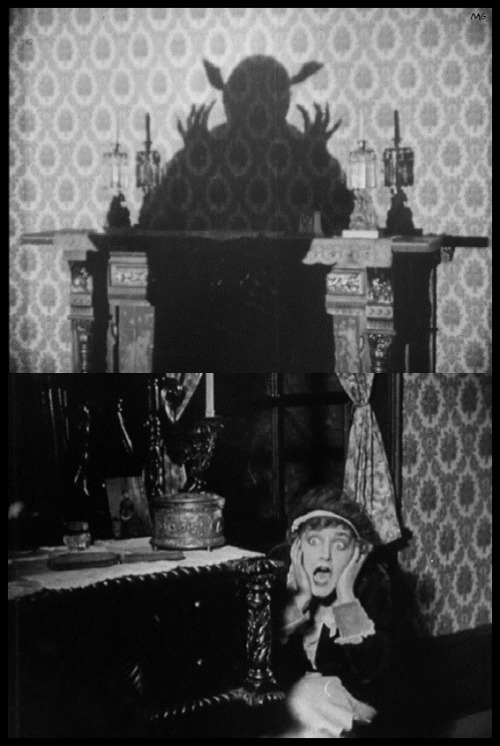
So how did this amped-up yet scaled-down episode of Scooby-Doo nearly kill this promising young comic star? Turns out it wasn’t anything that actually happened during filming (and given later successes like Safety Last! is only logical to assume). It was, in fact, while shooting a publicity still. He was supposedly lighting a cigarette from a lit bomb fuse, and the supposed prop bomb actually exploded.
No matter where I went in my research, I could not find the whys and wherefore of how Harold Lloyd was handed something that would actually blow up. That would seem to me a very interesting story, but I suppose it is amazing enough that Lloyd, having lost the thumb and forefinger of his right hand, his face severely burned and temporarily blinded, made such an astonishing comeback. He regained his vision and is using a prosthetic glove in the second half of the short. He is, in fact, using it so well that it is only apparent by its color (it’s lighter than Lloyd’s intact left hand) or by careful freeze-framing. Lloyd’s own doctors had to see the movie twice before they could determine when he was using it.
So yes, Haunted Spooks doesn’t refer to the sheet-wearing Uncle or his accomplice, but to the terrified servants. That’s a shame. But it would also be a shame to let that discourage you from enjoying a particularly energetic gem from the silent era. I laughed more than I shook my head in sad disbelief. Here, let me make it easier for you:
It appeals to my warped sense of symmetry when a review featuring a horrible Spanish galleon is scheduled to run on Columbus Day.
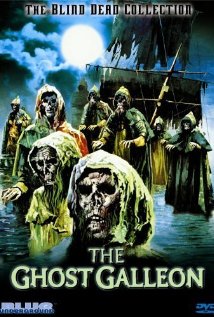
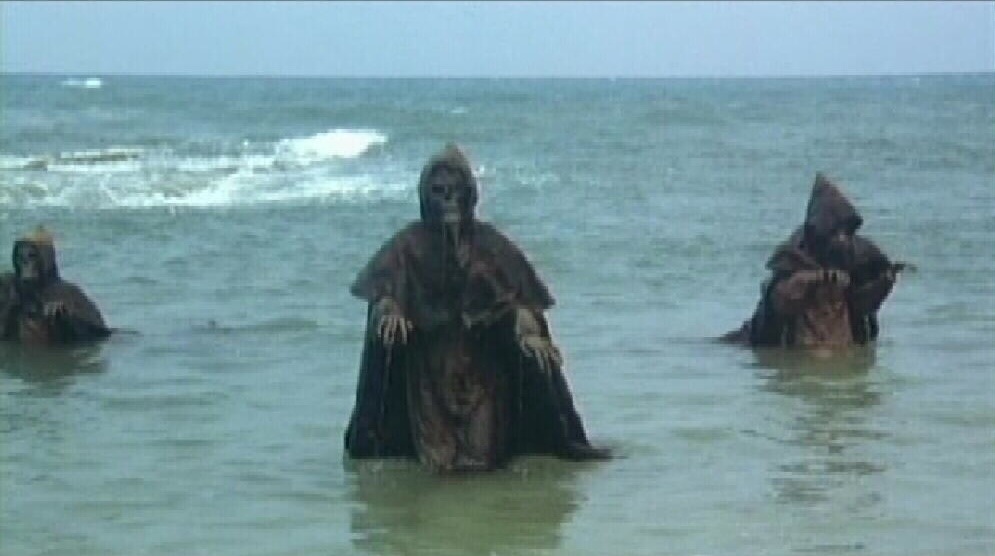
When you want to talk about Spanish horror movies, there are two series that are going to jump out of the spooky box at you: Paul Naschy’s El Hombre Lobo flicks, and Amando de Ossorio’s Blind Dead movies. I wrote about the inaugural Tombs of the Blind Deadback in the day, and the sequel, Return of the Blind Dead (duh) last year. And with this offering, we see that the Law of Diminishing Returns is sadly in action.
Worthless rich dude Howard Tucker (Jack Taylor) and model agency owner Lillian (the always welcome Maria Perschy) are working an ill-considered publicity stunt: two of Lillian’s models on Tucker’s new boat design will strand themselves in the ocean, be discovered, and Step Four: Profit! Except that the two run afoul of a weird patch of fog and the derelict 16th century galleon adrift therein. The galleon rams their boat, they go on board, and are not heard from again.
So Tucker, Lillian, Tucker’s hired muscle Sergio (Manuel de Blas) and model Noemi (Barbara Rey) head out on Taylor’s yacht to find them. Noemi is the friend of one of the missing models, and has been doing stuff like threatening to go to the cops about the whole thing, completely unaware that this is a bad way to deal with villains and/or rich people. For her efforts she has been kidnapped, raped by Sergio, and brought along for the trip. Also accompanying them is Professor Gruber (Carlos Lemos), a scientist at a meteorological service who assured them there is never fog in that part of the ocean, but there is the occasional ghost galleon.
Well, needless to say, this amazingly doomed quintet is going to find the galleon, and their launch is going to vanish, because the Professor tells us they are in another dimension. Gruber has an almost Russell Johnson-esque grasp of a number of scientific disciplines, including how to do an “exorcism” that will keep the zombie Templars at bay for 24 hours (which is a pretty crap exorcism, if you ask me).
Gruber also finds the ship’s log that explains how the Templars came to be on a ship (I was wondering): the crew apparently picked up a slew of Templar treasure, and brought the bodies, too, maybe? So the satanic templars now drift in their magical fog, drawing in victims for blood sacrifice that will allow them to maintain their immortality.
This, at least, is pretty cool. Too bad it’s at the end.
If in Return de Ossorio opened up the action to encompass an entire village, in Galleon it closes back down again drastically – he gets a lot of use out of those galleon sets, probably built for another movie entirely. We also see way too much of the most woeful miniature ship I have ever seen.
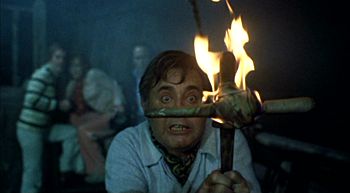
The Templars, so creepy in the last two movies, seem to be pretty perfunctory in their roamings this time, and too often the puppetry is obvious and sub-par. Perhaps they seem less ominous because in their previous movies, they were pretty relentlessly homicidal. This time, they have to drag their victims away to… well, we never find out, which could be terrifying, but first we’d have to care about the characters, wouldn’t we? I admit that all the Blind Dead movies have depended on people making stupid choices, but this time out we are talking about complete imbeciles.
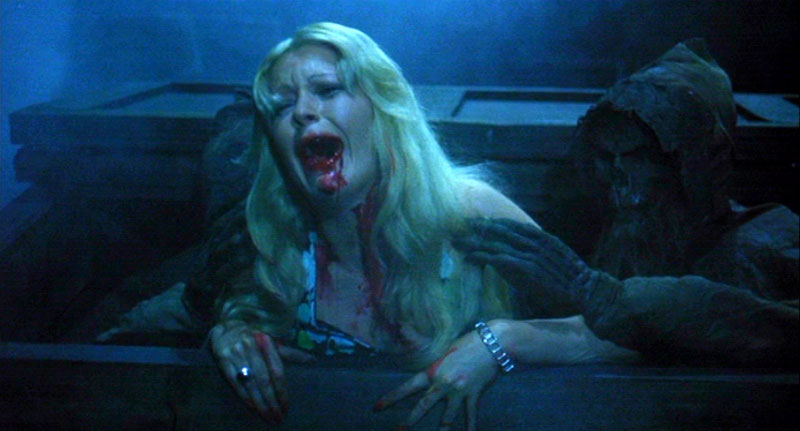
We are spared yet another revisionist origin story, but that also robs us of one of the few things that gives them their identity: no mention is ever made of their blindness, or their reliance on tracking their victims by sound. Noemi’s encounter with the zombies is the one instance of true horror in the whole enterprise, and even then that’s because it is so sadistically drawn out.
This is by far the weakest of the Blind Dead movies (that I have seen. I can only imagine Night of the Seagulls will patiently wait to ambush me next year). Its reputation hasn’t been aided by having numerous other names pasted over its beginning through the years. Most people will recognize it better under the utterly generic Horror of the Zombies, which I believe was the title when it appeared on the USA Network’s Up All Night over and over again. Not to mention the piggy-backing title Horror of the Evil Dead, or the Brentwood disc I viewed where it was called Zombie Flesh Eater. Singular. Not Eaters.
Needless to say, there is no flesh eaten.Whether or not this would have improved the movie, I just don’t know.

 Click ^^ for Hubrisween Central, here for our Letterboxd page.
 It was only a matter of time before we hit a zombie picture before actually reaching the letter Z; frankly, I’m surprised it took this long.
 Pontypool started life as a novel, Pontypool Changes Everything, and then a radio play, a format in which the story likely soared. The ever-growing mob aren’t really zombies, though; they are in the grip of a virus that transmits itself through spoken language. That’s not a totally new or original concept, but it is a difficult one to get across in a visual medium. The doctor whose practice was destroyed (Hrant Alianak) manages to escape to the station, and gives voice to the exposition, if not an explanation for the phenomenon.
 Confining the story to a single radio station gives us the requisite claustrophobia for our zombie siege, but it also means the movie is going to depend heavily on the acting chops of the small cast, and they are uniformly more than up to this task (I haven’t mentioned Georgina Reilly as the doomed assistant producer, and I should). The story begins to flag somewhat in its final act, though there is some cleverness when our survivors figure out that English seems to be the only language that’s a carrier, and have to rely on their limited knowledge of French.





















 drfreex.com